
Judge, 1888-07-07 · page 7 of 16
Judge — July 7, 1888 — page 7: what you’re looking at
What you’re looking at
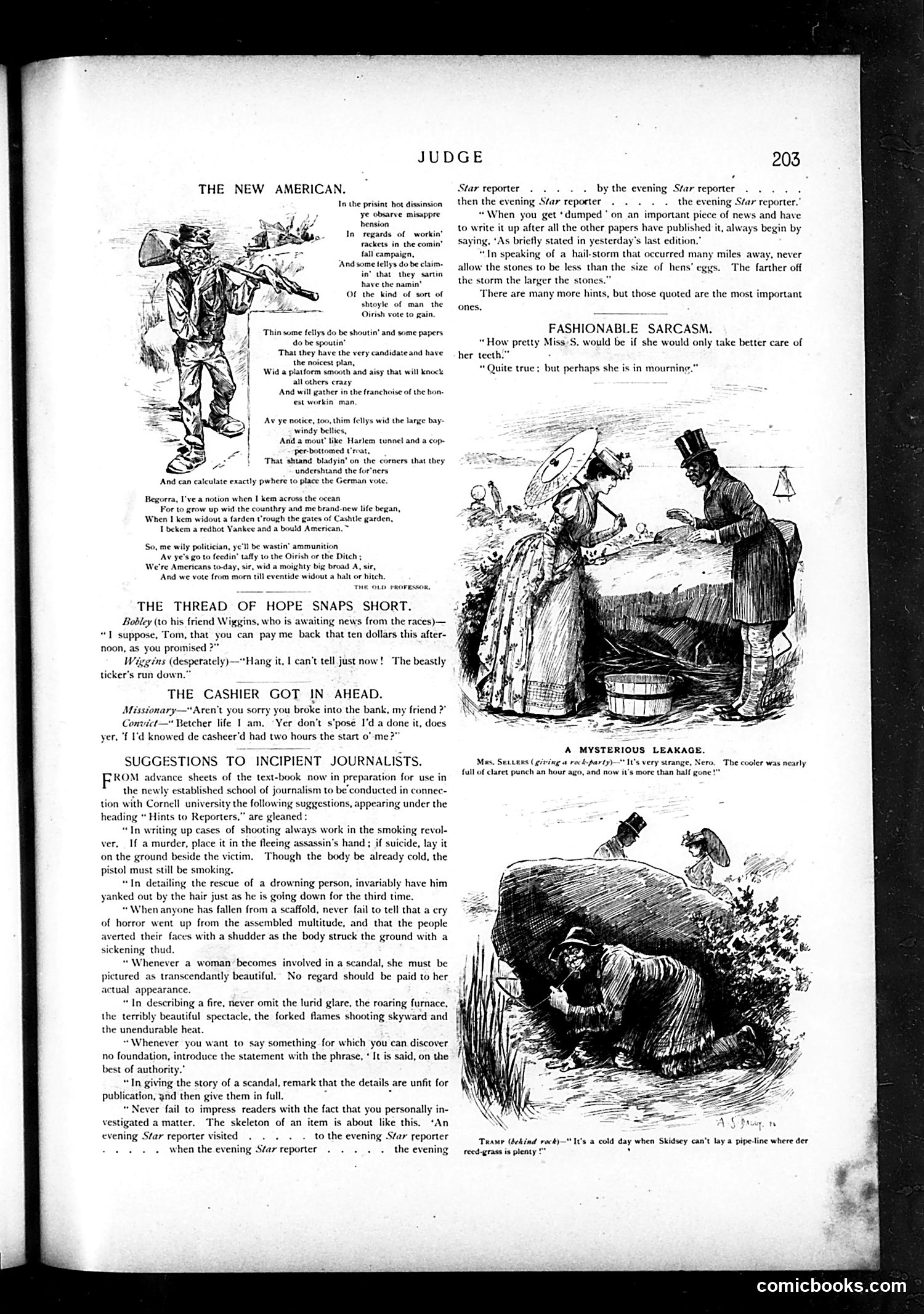
This page contains multiple satirical pieces mocking American journalism and politics circa the Gilded Age. **"The New American"** lampoons Irish-American political participation. Using exaggerated Irish dialect, it satirizes both corrupt politicians who manipulate immigrant voters and the immigrants themselves—depicting them as naive tools exploited for their voting bloc, particularly the "German vote." The underlying tension reflects nativist anxiety about non-Anglo-Saxon political power. **"Suggestions to Incipient Journalists"** ridicules sensationalist newspaper reporting practices: always including smoking pistols at crime scenes, exaggerating emotional reactions to tragedies, and idealizing women involved in scandals regardless of truth. It's satire of yellow journalism's disregard for accuracy. The shorter jokes mock gambling losses and crime, while "Fashionable Sarcasm" satirizes polite society's backhanded compliments. The cartoons and text together critique corrupt journalism, immigrant political manipulation, and Victorian hypocrisy—all targets of Judge's satirical mission during this period.
📄 Transcribed text from this page (OCR, searchable)
Machine-transcribed from the original scan — historical spelling and the odd misread are preserved.
JUDGE NEW AMERICAN. In the prisint hot dissinsion ye obsarve misappre hension In regards of workin’ rackets in the comin’ fall campaign, ‘And some tellys do be elaim- in’ that they sartin have the namin’ the kind of sort of shtoyle of man the Oirish vote to gain. Thin some fellys do be shoutin’ and some papers do be spoutin’ ‘That they have the very candidateand have the noicest plan, Wid a platform smooth and aisy that will knock all others crazy And will gather in the franchoise of the hon: fest workin. man, Av ye notice, 100, thim fellys wid the lange bay: windy bellies, And a mout’ like Harlem winnel and a cop- perbottomed Uroat, That shtand bladyin’ on the corners that they x “1 » a undershtand the for'ners And can calculate exactly pwhere to place the German vote, Begorra, I've a notion when I kem across the ocean For to grow up wid the counthry and me brand-new life began, When I kem widout a farden t'rough the gates of Cashtle garden, I bekem a redhot Vankee and a bould American. ~ So, me wily politician, ye'll be wastin’ ammunition Av ye's go to feedin’ taffy to the Oirish or the Ditch ; We're Americans to-day, sir, wid a moighty big broad A, sir, And we vote from morn till eventide widout a halt or hitch, THK OLD PROFESSOR, THE THREAD OF HOPE SNAPS SHORT. Bobley (to his friend Wiggins, who is awaiting news from the races)— “1 suppose, Tom, that you can pay me back that ten dollars this after- noon, as you promised 2” Wiggins (desperately) —“Hang it, 1 can’t tell just now! The beastly ticker’s run down.” THE CASHIER GOT IN AHEAD. Missionary—*Aren't you sorry you broke into the bank, my friend ?” Convict—" Betcher life 1 am. “Yer don't s'posé I'd a done it, does yer, ‘f I'd knowed de casheer'd had two hours the start o” me?" SUGGESTIONS TO INCIPIENT JOURNALISTS. FROM advance sheets of the text-book now in preparation for use in the newly established school of journalism to be’conducted in connec- tion with Cornell university the following suggestions, appearing under the heading “ Hints to Reporters,” are gleaned “In writing up cases of shooting always work in the smoking revol- ver. If a murder, place it in the fleeing assassin’s hand ; if suicide, lay it on the ground beside the victim. Though the body be already cold, the pistol must still be smoking, “In detailing the rescue of a drowning person, invariably have him yanked out by the hair just as he is going down for the third time. * When anyone has fallen from a scaffold, never fail to tell that a cry of horror went up from the assembled multitude, and that the people averted their faces with a shudder as the body struck the ground with a sickening thud. “Whenever a woman becomes involved in a scandal, she must be pictured as transcendantly beautiful. No regard should be paid to her actual appearance. 203 Star reporter by the evening Sar reporter a then the evening Star reporter the evening Star reporter. “When you get ‘dumped ‘on an important piece of news and have to write it up after all the other papers have published it, always begin by ‘As briefly stated in yesterday's last edition.” occurred 1 allow the stones to be less than the siz the storm the larger the stones.” ‘There are m ones. ny miles away, never of hens’ eggs. The farther off ny more hints, but those quoted are the most important FASHIONABLE SARCASM. “How pretty Miss’. would be if she would only take better care of her teeth.” “Quite true; but perhaps she is in mourning.” A MYSTERIOUS LEAKAGE. Mus, SeLunns (giving a rech-party) full of claret punch an hour ago, and now 's very strange, Nero. ‘The cooler was nearly \"s more than half gone!" “In describing a fire, never omit the lurid glare, the roaring furnace, f the terribly beautiful specta the unendurable hea “Whenever you want to say something for which you can discover no foundation, introduce the statement with the phrase, * It is said, on the best of authority.” “In giving the story of a scandal, remark that the details are unfit for publication, and then give them in full. * Never fail to impress readers with the fact that you personally in- vestigated a matter. The skeleton of an item is about like this. ‘An evening Star reporter visited : to the evening Star reporter when the evening Star reporter... . the evening le, the forked flames shooting skyward and Tramp (behind rock)" It’s a cold day when Skidsey can’t lay a pipe-line where der reed-grass is plenty!" . comicbooks.com