
A complete issue · 16 pages · 1888
Judge — June 30, 1888
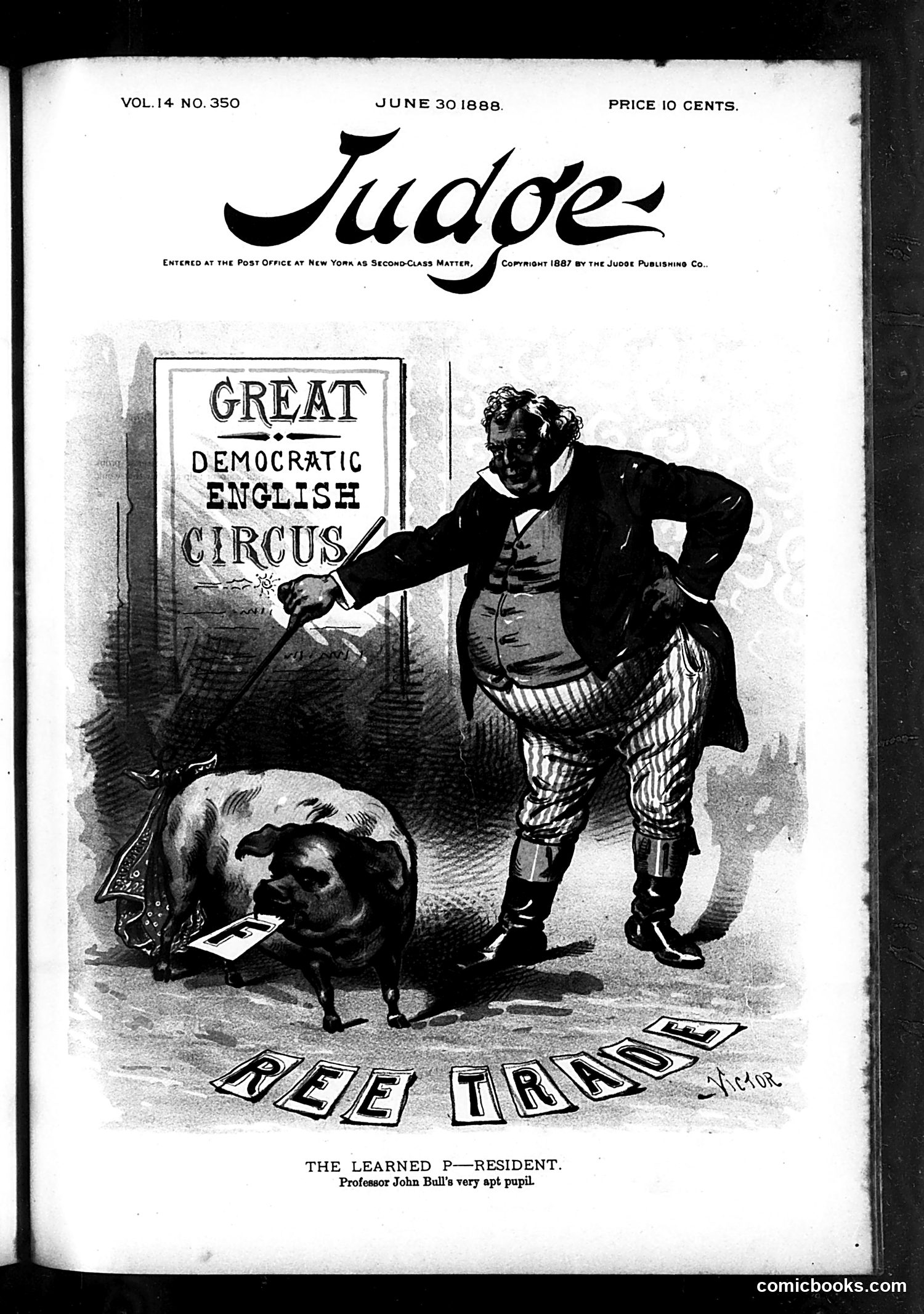
This June 30, 1888 *Judge* cartoon satirizes a U.S. President (likely Cleveland, given the date) as a trained circus animal. The sign reads "Great Democratic English Circus," and the figure operates a pig labeled "Free Trade" on strings like a puppet or performing animal. The caption, "The Learned P—resident. Professor John Bull's very apt pupil," suggests the President is controlled by British interests (John Bull represents England) and is essentially a trained performing animal, not an independent leader. The satire attacks the President's free-trade policies as subservient to British economic interests and ridicules him as intellectually compromised—a "learned" performer executing tricks rather than governing with genuine American independence. This reflects 1888 protectionist sentiment opposing free trade.
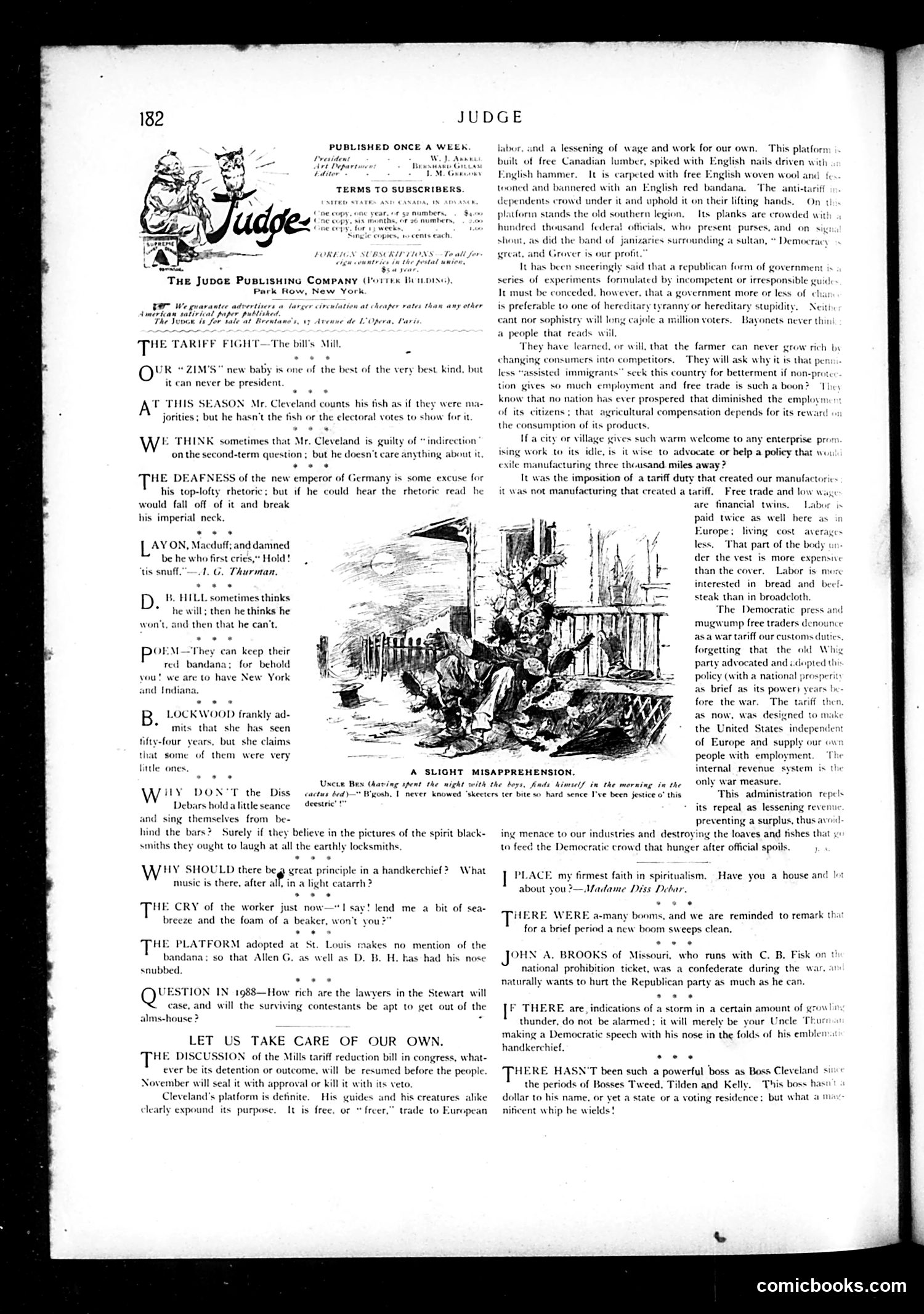
The cartoon depicts a figure (labeled as appearing to represent a political or public official) who has apparently misunderstood something crucial—suggested by the caption about "the night oasis the boys." The figure seems caught in an awkward or compromising situation, surrounded by what appear to be satirical elements of confusion or chaos. The accompanying text references political debates about tariffs, manufacturing, and labor policy—issues central to turn-of-century American politics. The broader page discusses Republican governance, trade policy, and economic competition with Europe. Without clearer identification of the specific figure or date, the precise political target remains unclear, but the cartoon satirizes political misunderstanding or incompetence regarding economic policy during this era of intense tariff debates.
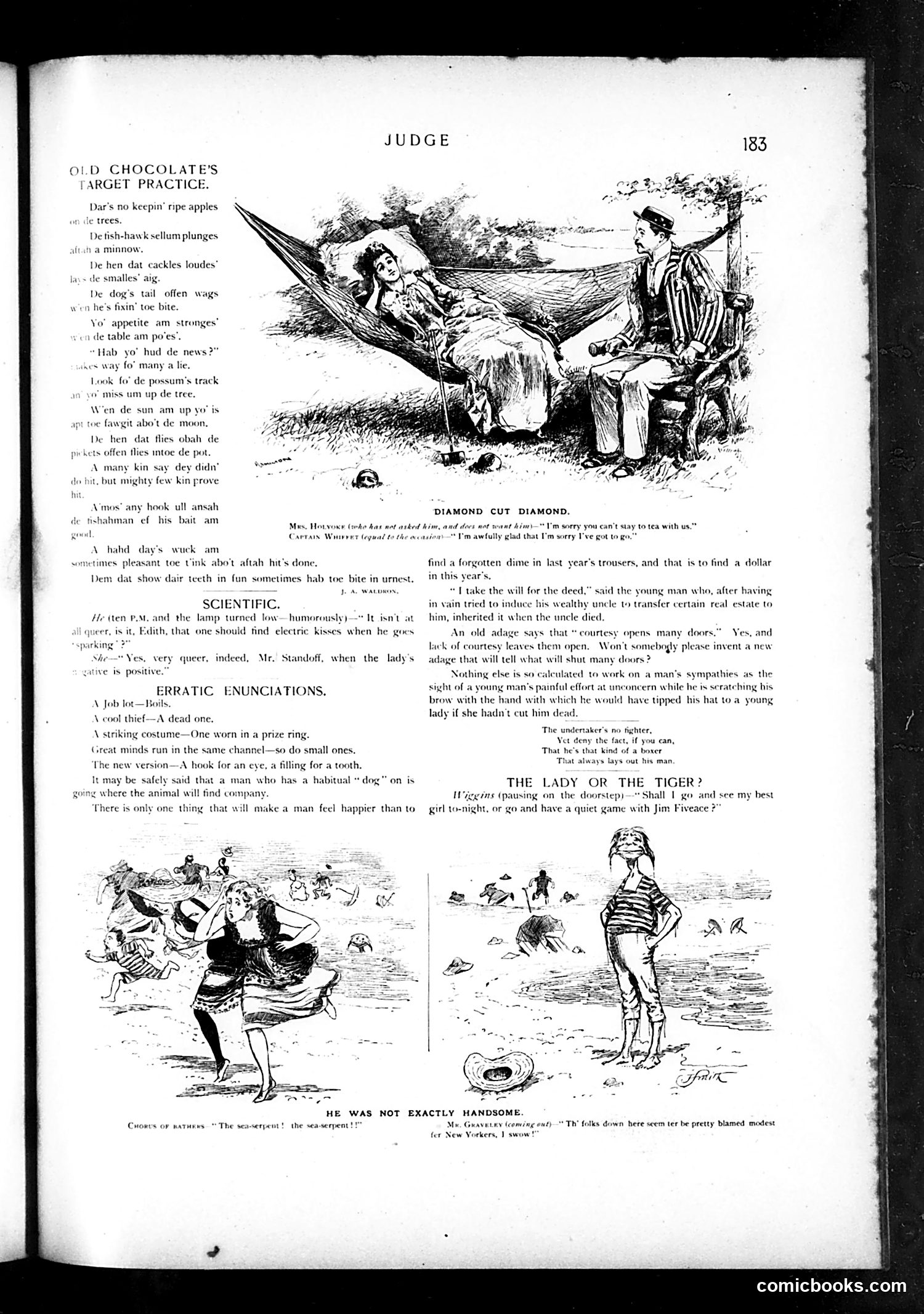
This page contains several distinct humor pieces typical of Judge magazine's satirical approach: **"Old Chocolate's Target Practice"** presents racist dialect humor featuring a Black character dispensing folk wisdom in exaggerated speech patterns—common but deeply offensive content in early 20th-century American satire. **"Diamond Cut Diamond"** satirizes social pretense: a hostess makes a perfunctory invitation she hopes will be refused; the guest gleefully accepts, exposing her insincerity. **"Scientific" and "Erratic Enunciations"** are brief wordplay jokes about kissing, unconventional definitions, and human nature. **"The Lady or the Tiger?"** plays on the famous Frank Stockton story, depicting a man choosing between courting his girlfriend or gambling with "Jim Fiveace"—likely mocking male priorities. **"He Was Not Exactly Handsome"** jokes about prudish New Yorkers reacting with shock to a sea serpent, suggesting urban sophistication masks provincial modesty. The page demonstrates Judge's mix of observational humor, social commentary, and period-specific prejudices.
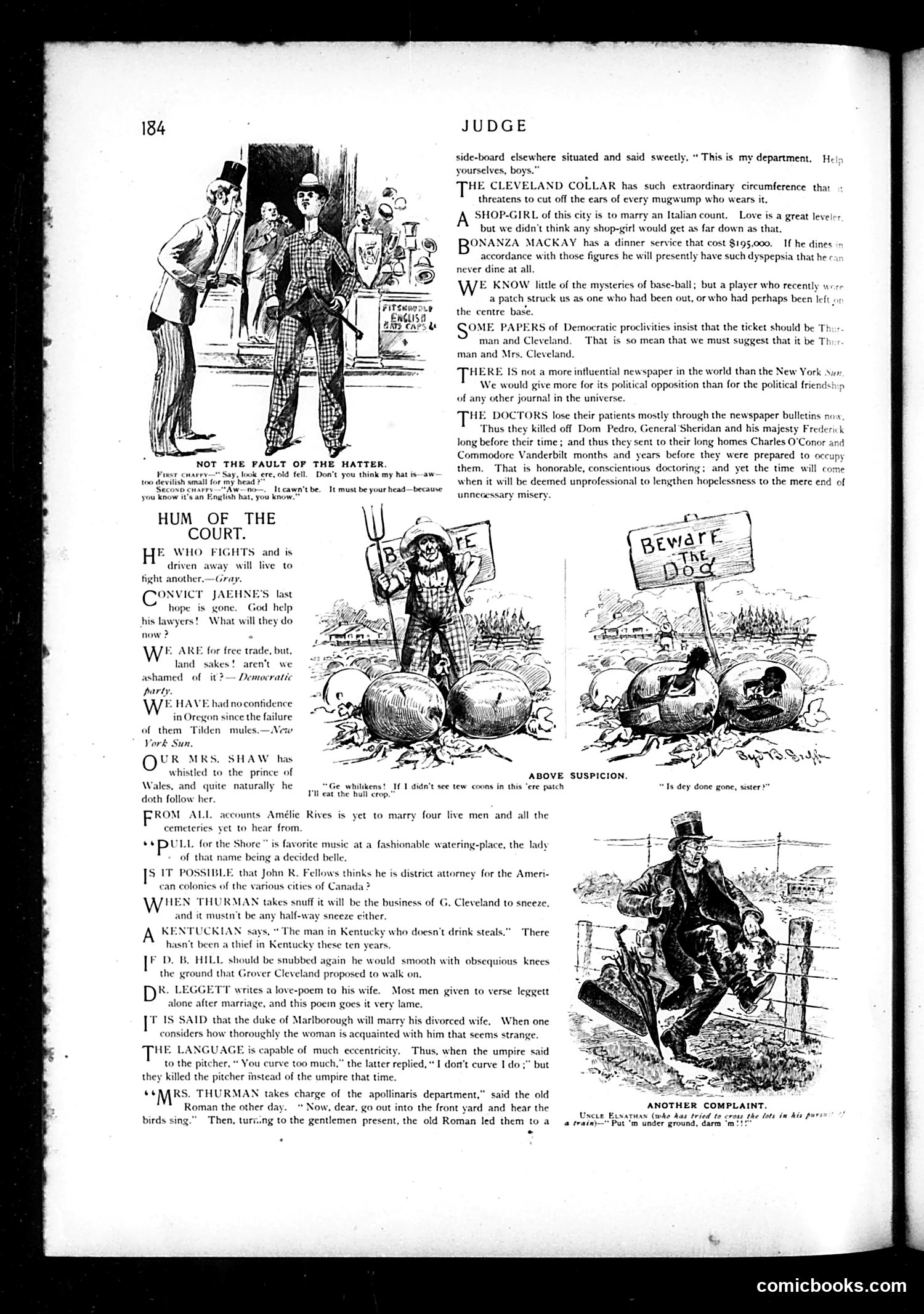
This page from **Judge** contains brief political and social jabs typical of 1880s American satirical journalism. Key targets include: **Political figures**: References to **Grover Cleveland** (appearing multiple times, suggesting he was a prominent figure—likely a presidential candidate or officeholder) and **G. Cleveland**, mocked for various perceived failings. The "Cleveland Collar" joke suggests exaggerated or ridiculous association with him. **Social commentary**: Jibes at wealth (Bonanza Mackay's expensive dinner service), class mobility (shop-girl marrying an Italian count), and professional hypocrisy (doctors hastening deaths through pessimistic newspaper reports). **Sporting humor**: A baseball reference mocking a player who wore a patch, suggesting poor play. The cartoons ("Not the Fault of the Hatter," "Above Suspicion," "Another Complaint") use visual humor about everyday absurdities—hats, gardens, complaints—typical of the magazine's approach to social satire.
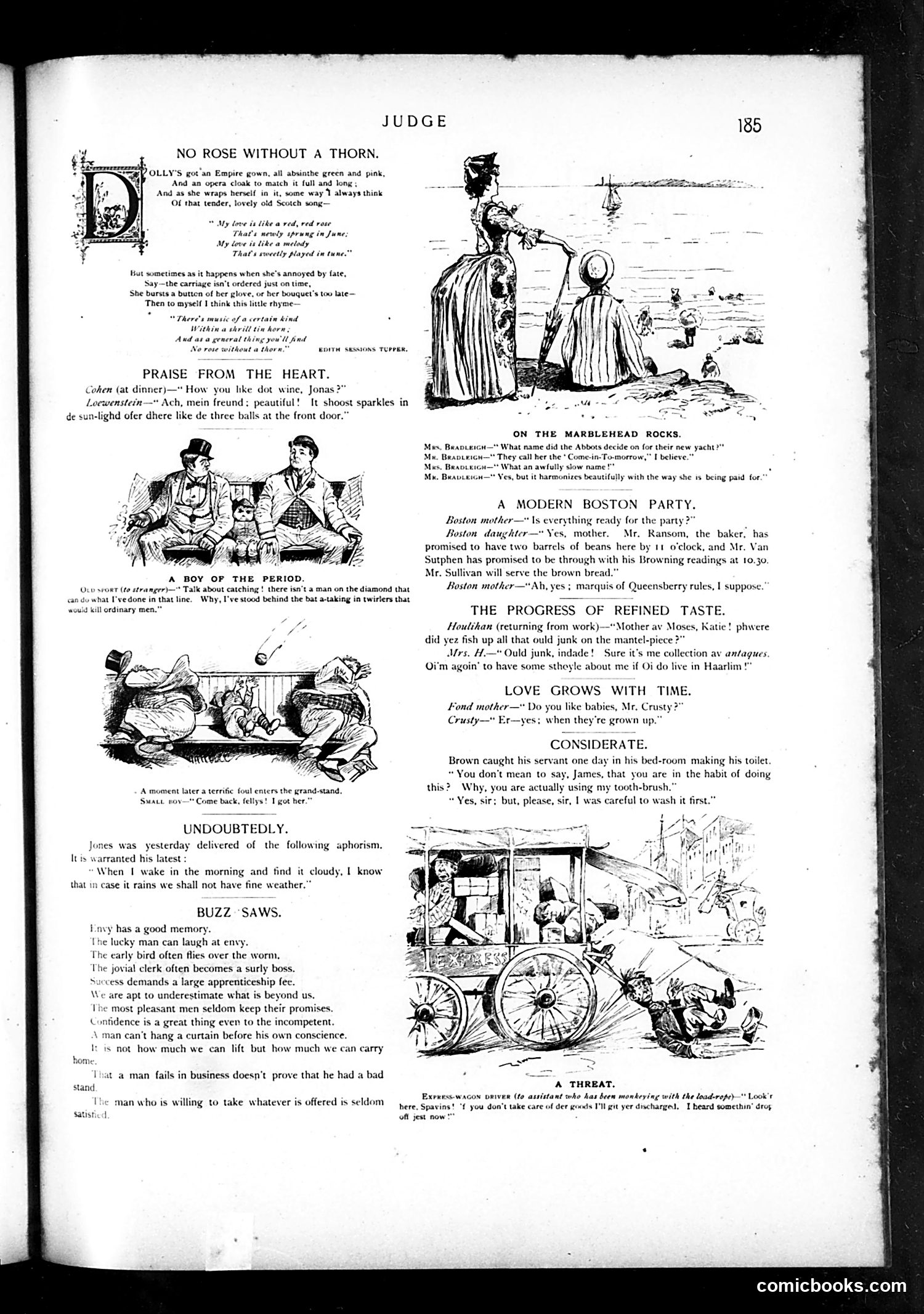
This page collects short humorous sketches mocking various social types and pretensions of the era: **"No Rose Without a Thorn"** contrasts romantic idealization (Robert Burns's "red, red rose") with reality—elegant women become shrewish when minor inconveniences occur. **"A Boy of the Period"** satirizes boastful baseball fans who exaggerate their catching prowess, then comically fail. **"A Modern Boston Party"** mocks Boston's intellectual pretensions, depicting a "refined" gathering centered on beans, Browning poetry readings, and brown bread—suggesting their culture is provincial and mundane despite airs of sophistication. **"The Progress of Refined Taste"** shows an Irish immigrant woman (Houlihan) collecting junk and calling it "antiques" to appear cultured—mockery of aspirational social climbing. **Dialect humor** throughout (Yiddish, Irish accents) was typical Judge fare, often patronizing immigrant communities. The page reflects Gilded Age anxieties about social mobility, pretense, and changing urban demographics.
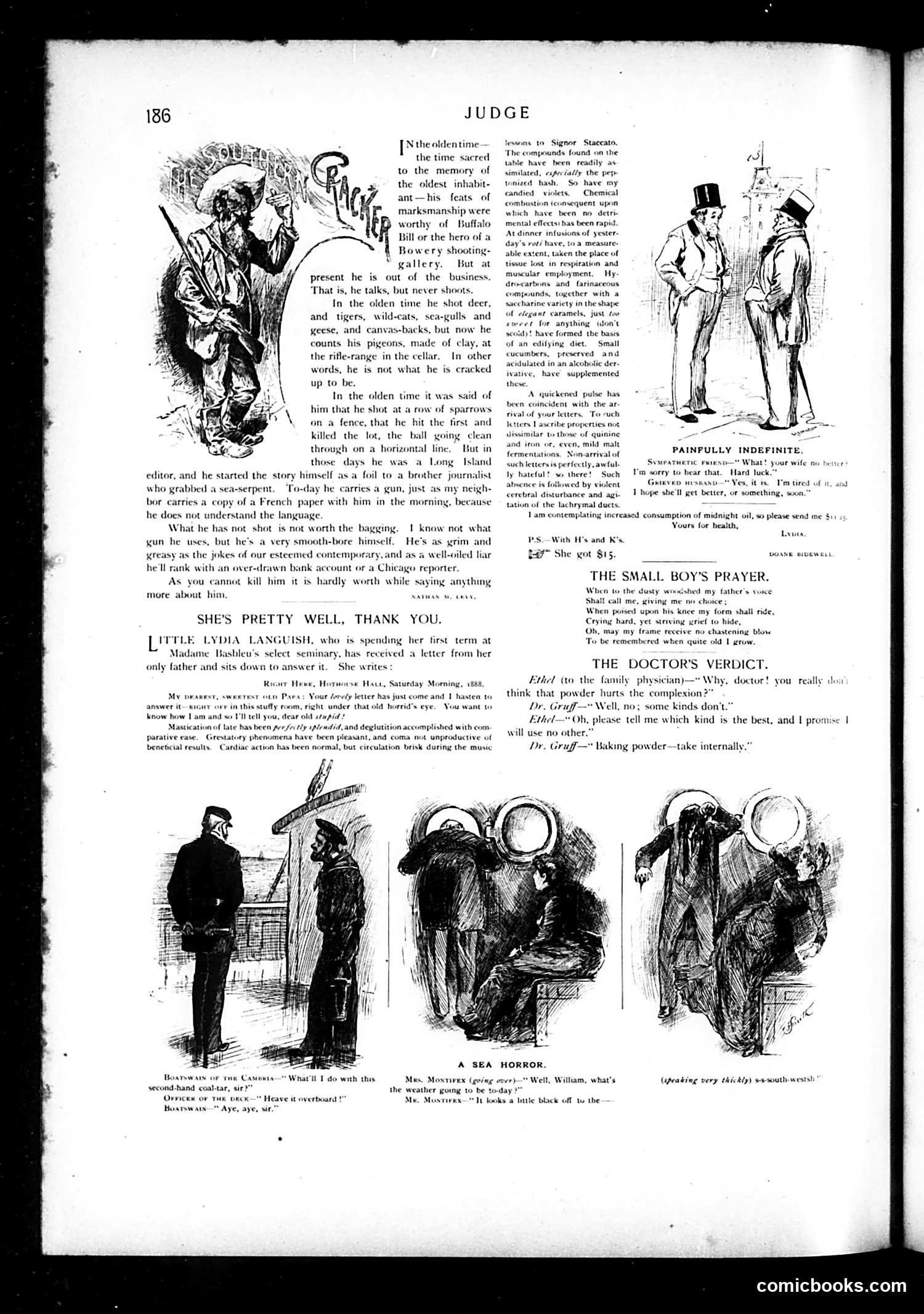
This page contains several satirical pieces typical of 1880s American humor: **"The Cracksman"** (top left): A nostalgic sketch mocking an elderly marksman. The satire suggests he's all talk—boasting of Wild West-style shooting feats from his youth, but now reduced to shooting clay pigeons in a cellar. The joke appears to be about aging men who live on past glories while accomplishing nothing presently. **"She's Pretty Well, Thank You"**: A humorous piece satirizing affected, over-educated speech. A seminary student responds to her father's letter using exaggerated medical/scientific terminology about digestion and bodily functions where simple language would suffice. The joke mocks pretentious academic jargon and pompous young women. **"A Sea Horror"** (bottom): A brief nautical comic dialogue, unclear in full context but appears to involve deck officers and mundane matters. The page represents typical Judge satire: poking fun at human pretension, vanity, and affectation through exaggeration and wordplay.
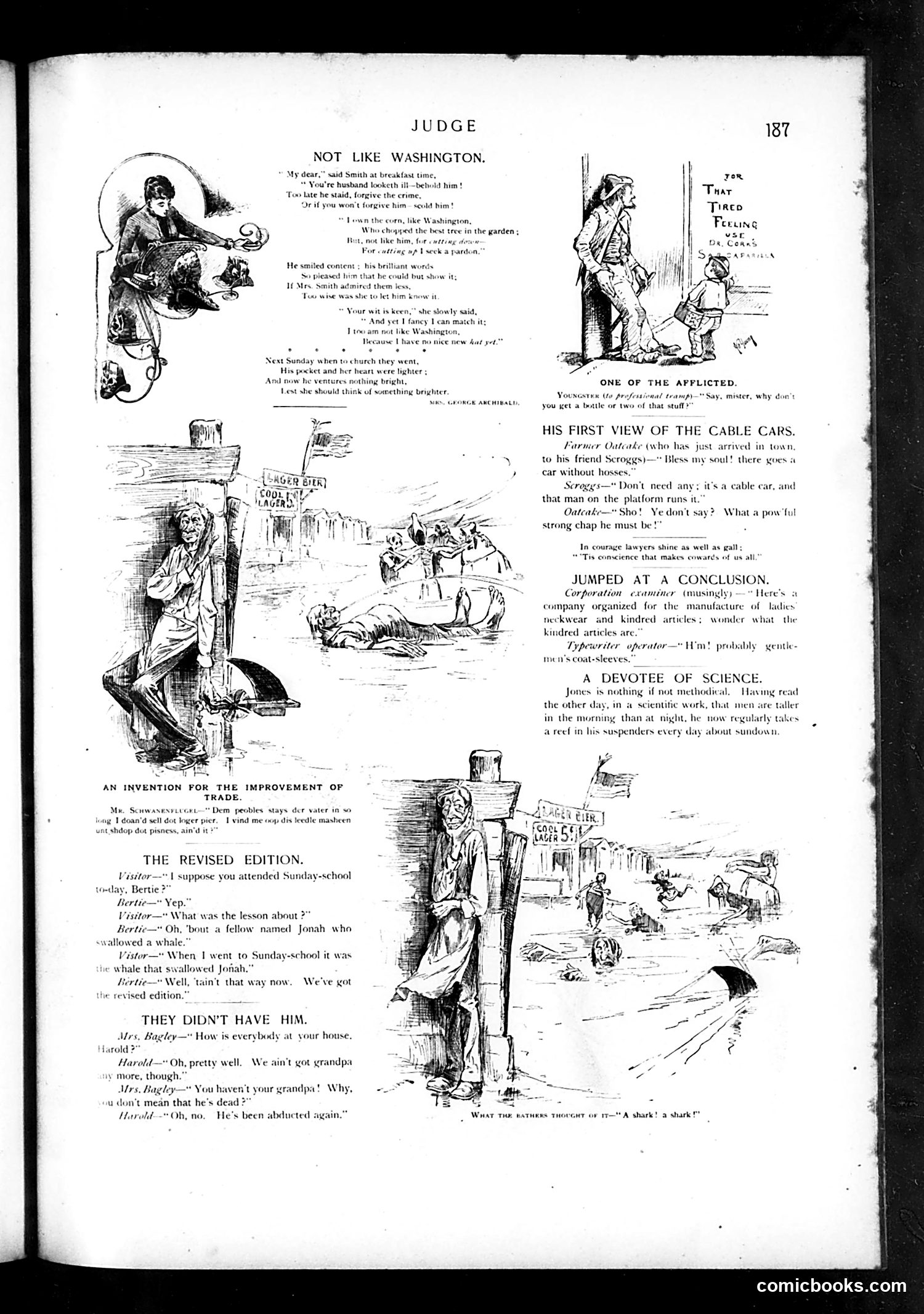
This page collects several brief humorous sketches typical of *Judge* magazine's satirical approach: **"Not Like Washington"** mocks a husband's vanity—he boasts of his wit until his wife demonstrates she can match it, then he becomes cautious to avoid further comparison. The Washington reference is unclear but likely invokes the founding father's supposed virtue. **"His First View of the Cable Cars"** satirizes rural ignorance. A farmer newly arrived in San Francisco mistakes the cable car operator for an extraordinarily strong man, not understanding the mechanical system—poking fun at agricultural visitors encountering modern urban technology. **"Jumped at a Conclusion"** jokes about corporate euphemism: examining a "neckwear and kindred articles" manufacturer, the typist quips the "kindred articles" are likely gentlemen's coat-sleeves—implying the company manufactures women's clothing for illicit purposes. **"They Didn't Have Him"** uses "abducted" humorously—the grandfather keeps getting taken away (presumably by death), though the joke remains unclear. The cartoons reflect period anxieties about urbanization, changing morality, and modernity's impact on traditional life.
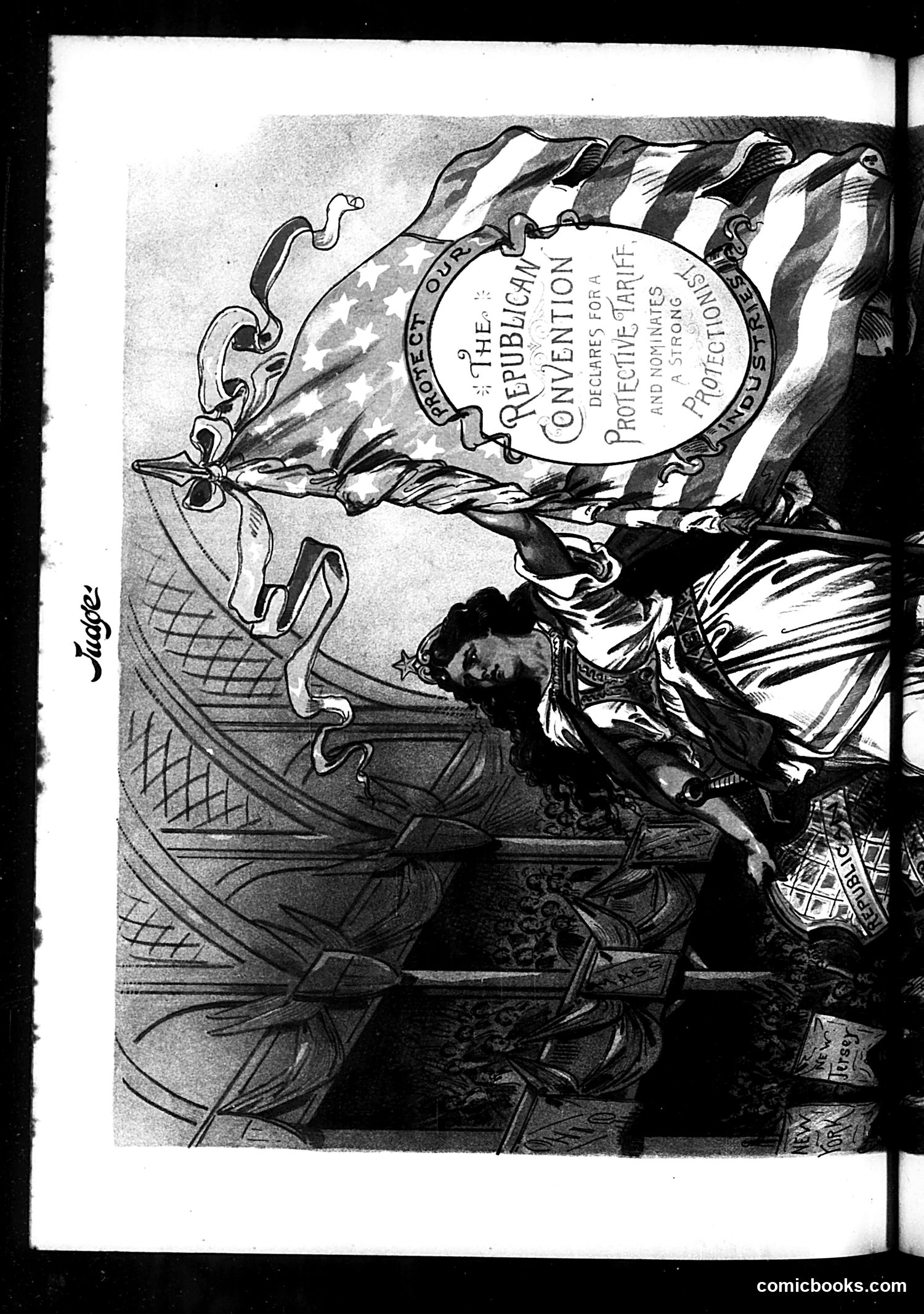
This appears to be a satirical cartoon depicting **the U.S. Constitution as a ship or vessel being protected/defended**. The central image shows what looks like a banner or sail containing text referencing "THE REPUBLICATION (CONVENTION)" and mentions of "DECREES FOR LIFE," "PROTECTION," and "PROPOSED SAFEGUARDS." A figure (likely representing a political leader or the American people) stands guard or at the helm. The striped sail/banner and ornate naval imagery suggest this is commentary on **protecting constitutional principles or governance during a period of constitutional debate or reform**. Without clearer dating or additional context, the specific historical moment—whether this references a particular convention, constitutional amendment debate, or political crisis—remains **unclear from the image alone**.
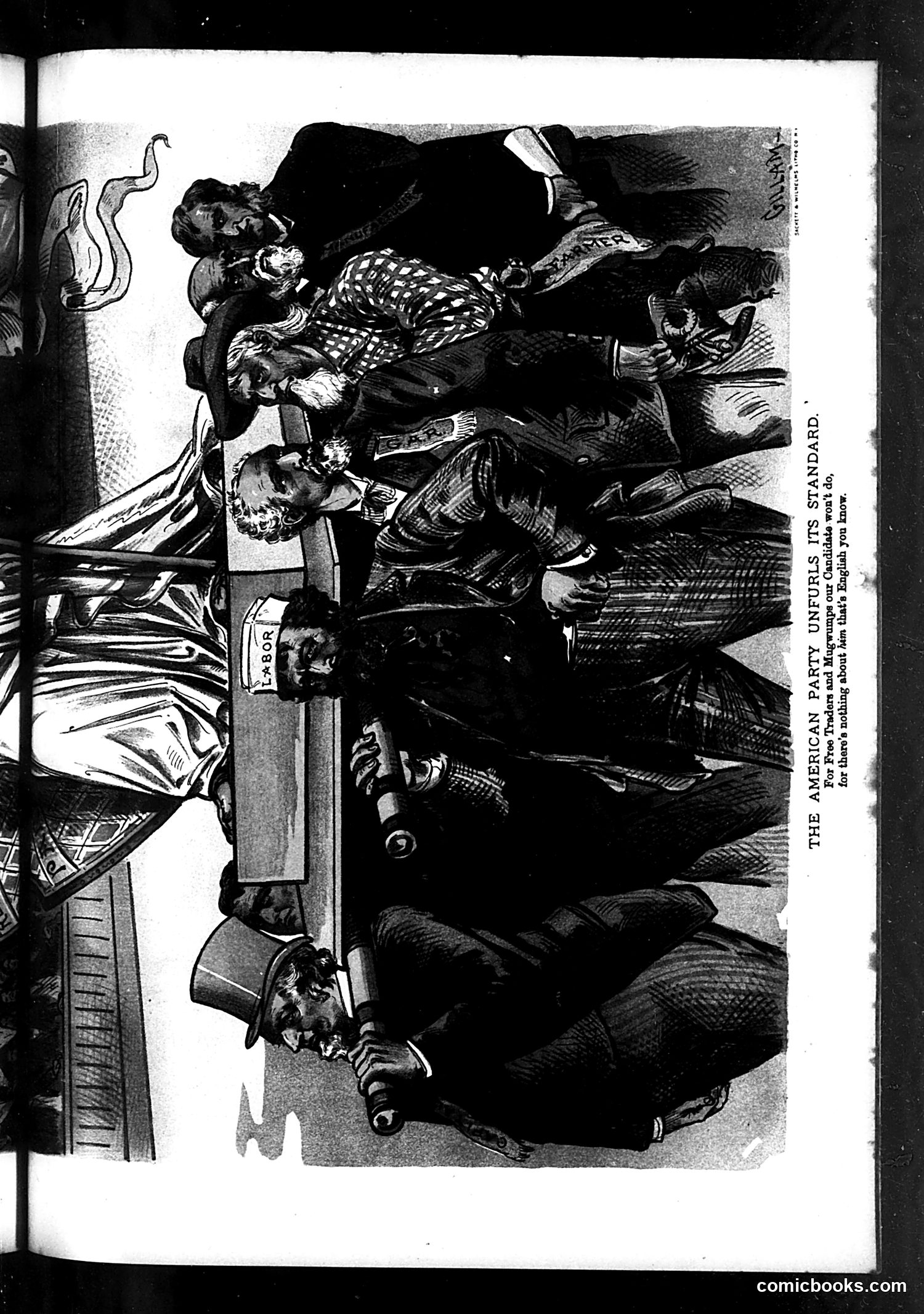
I cannot reliably read the OCR text on this page—it appears heavily corrupted or inverted. However, examining the image itself: this is a black and white engraving showing what appears to be a political or social commentary scene with multiple figures in period dress (likely late 19th century based on the style). The composition suggests a satirical take on American politics or society, given this is from *Judge* magazine. The title visible reads "THE AMERICAN PARTY UPTURNS ITS STANDARD" or similar, which likely references political faction infighting. Without legible text, I cannot identify specific figures, parties, or the precise satirical point being made. The dramatic engraving style is typical of *Judge's* political cartoons from that era.
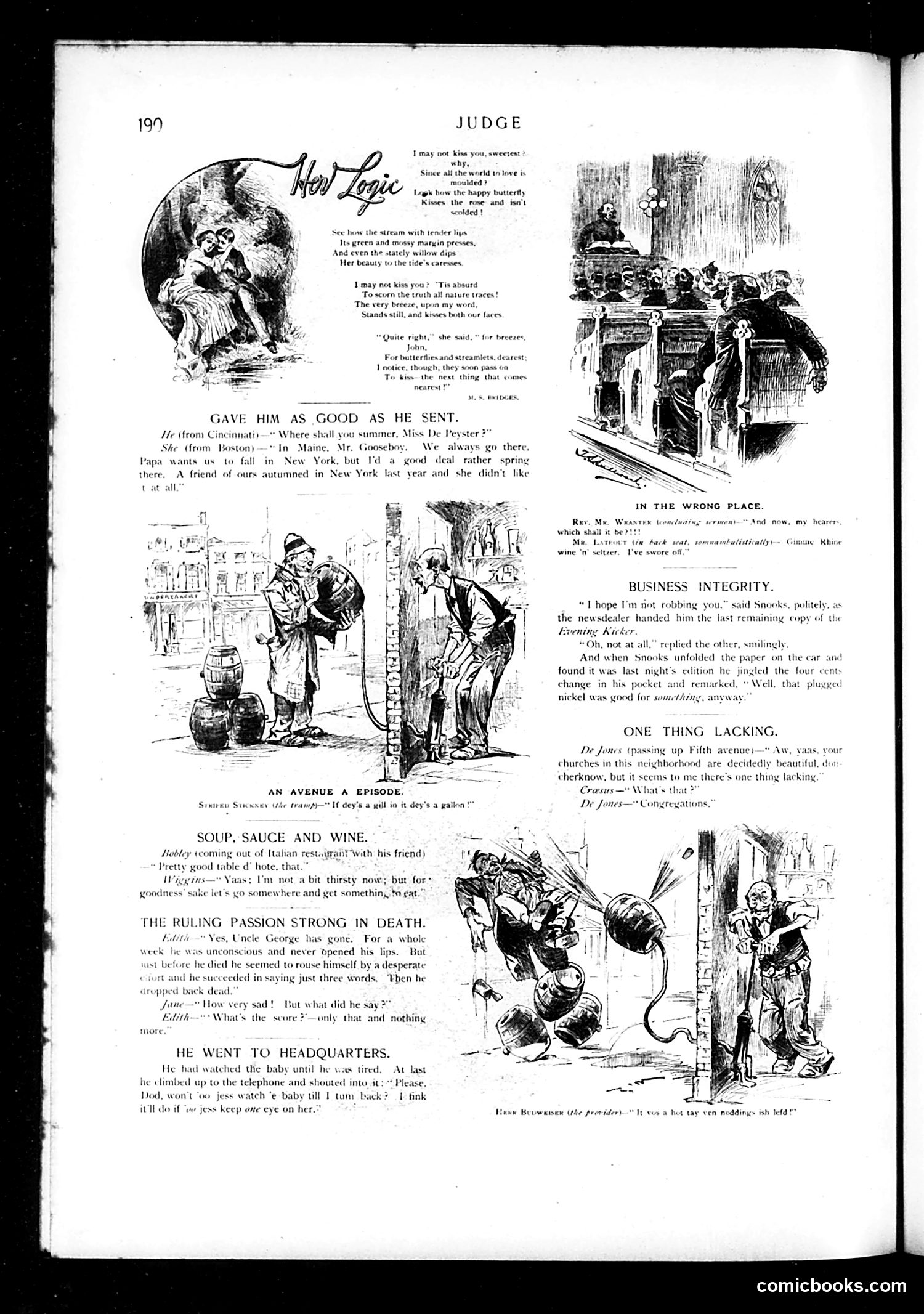
This page contains multiple brief humorous sketches typical of late-19th/early-20th century satirical journalism. **"How Logic"** mocks romantic poetry through a woman's practical rebuttal to a suitor's flowery arguments about nature kissing. The joke: she accepts his logic but turns it against him, noting breezes kiss the "nearest" thing—implying he shouldn't presume intimacy. **"Gave Him as Good as He Sent"** plays on regional speech patterns, contrasting a Cincinnati man's casual "summer" plans with a Boston woman's correction: they "spring" there instead, then she counters his suggestion about New York by noting their friend "autumned" there unsuccessfully. **"The Ruling Passion Strong in Death"** depicts an uncle who remains obsessed with sports/gambling even on his deathbed—his final words are "What's the score?" rather than anything sentimental, satirizing misplaced priorities. The other sketches target working-class characters and minor social hypocrisies (babysitters, clergy, newsdealer honesty). The cartoon style and dialect humor reflect period attitudes toward immigrant and lower-class speech as inherently comic.
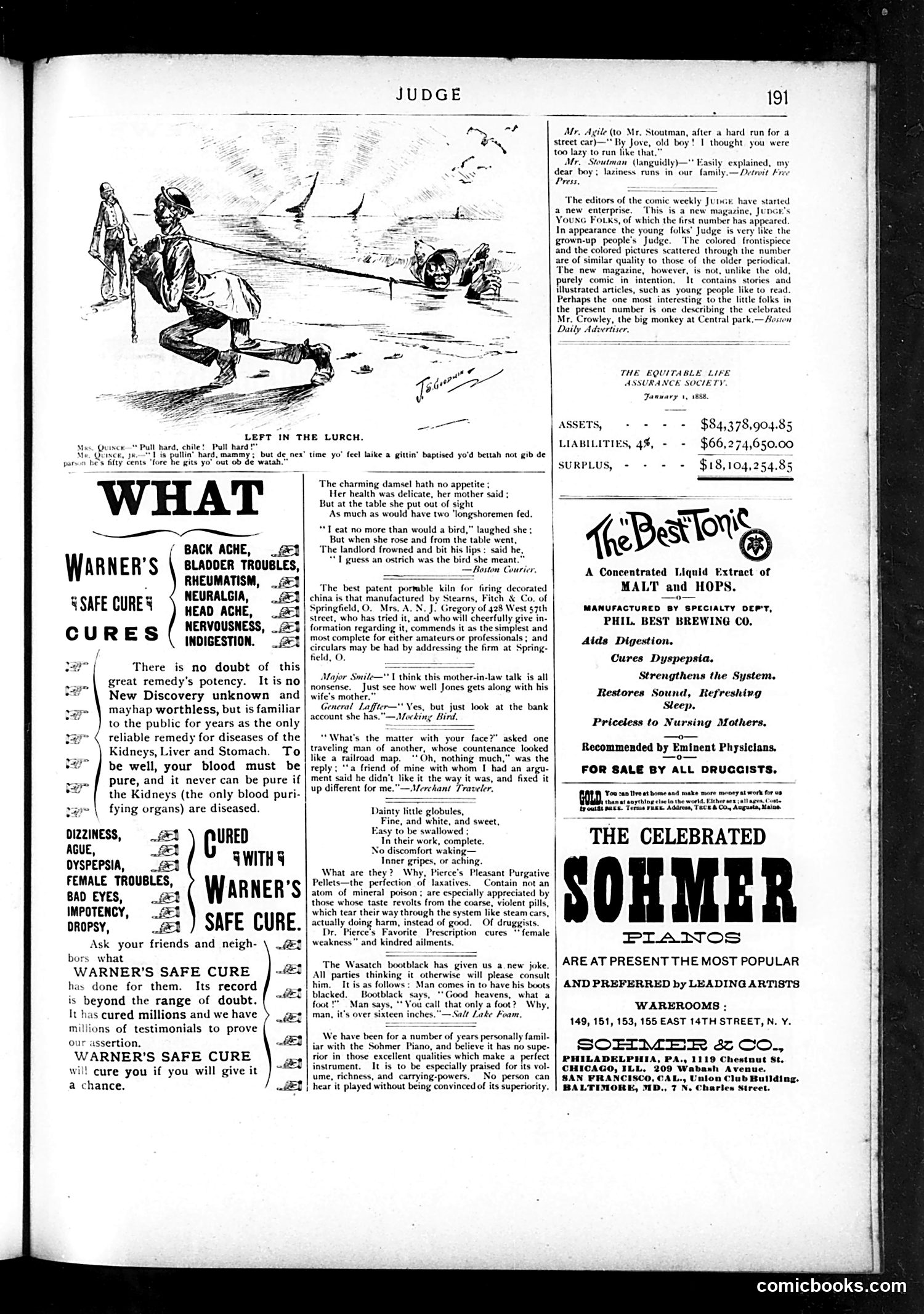
This cartoon depicts a Black woman and child in a boat, with the woman struggling to pole it while the child remains seated. The caption reveals the joke's cruel premise: the woman is laboring to free them from mud while the child, identified as "Meo Quosce," refuses to help, claiming he's "pullin' hard" but the boat won't budge—though he'll only assist if paid fifty cents. The satire employs racist dialect and stereotypes typical of late-19th-century Judge magazine. It mocks Black Americans through exaggerated speech patterns and portrays them as lazy or greedy. The "lurch" references being stuck—both literally in mud and figuratively in a dependent, powerless social position. This represents the casual racism embedded in period American humor, where Black figures served as objects of ridicule in supposedly sophisticated publications aimed at educated readers.
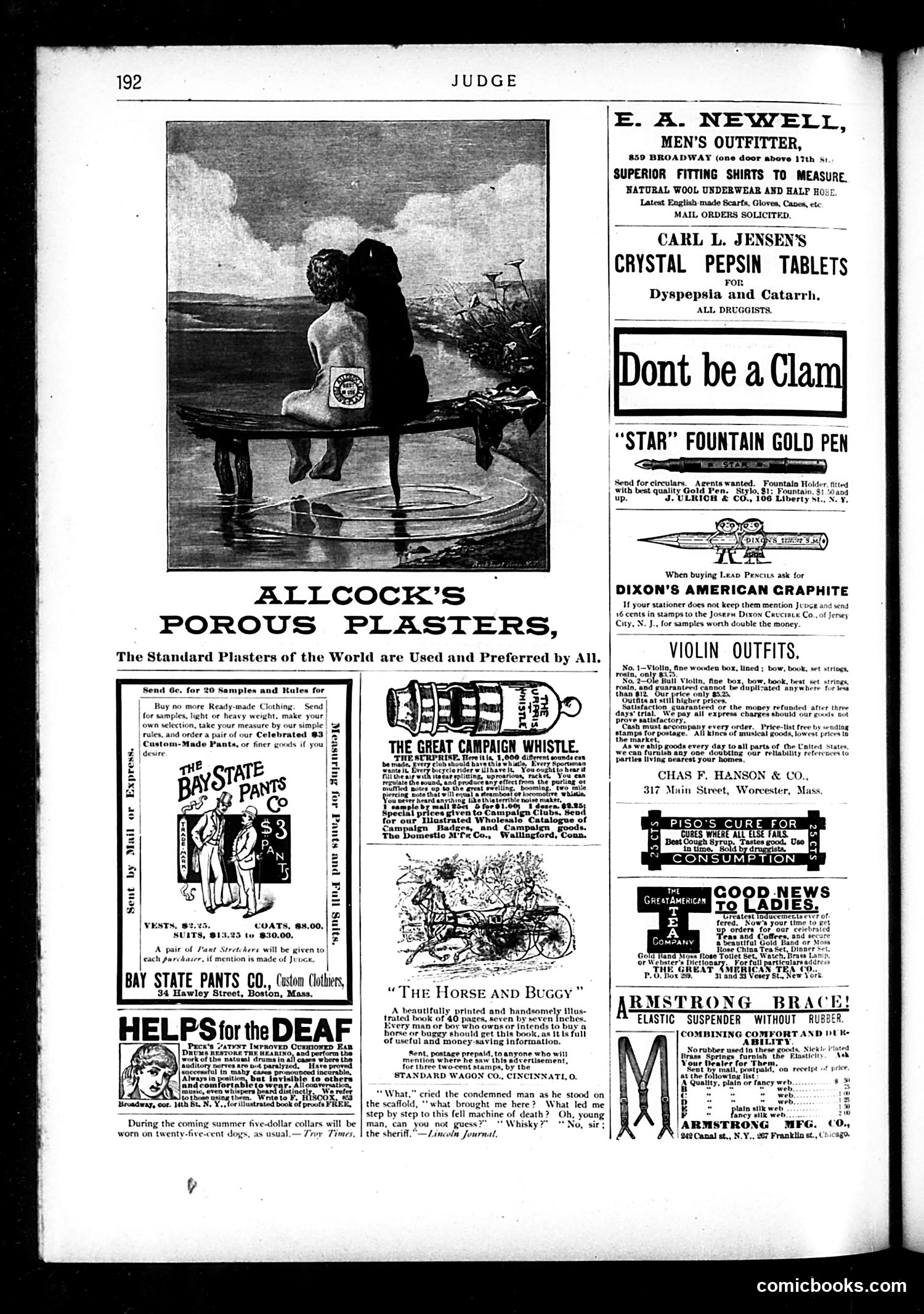
This page is dominated by period advertisements for products like porous plasters, custom pants, and medical tablets. However, it contains one notable satirical cartoon labeled "The Horse and Buggy." The cartoon depicts a condemned man on the scaffold asking what brought him to this fate. When asked to guess, he expects the answer "Whisky?" but the sheriff responds "No, sir"—the implication being the man's downfall came from purchasing an inferior horse or buggy, making a dark joke about the Standard Wagon Company's product quality (which advertises on the same page). The humor targets both reckless consumer choices and—likely—cautionary temperance messaging common to the era, subverting expectations by blaming commercial deception rather than alcohol for moral ruin. The cartoon reflects Judge's tradition of satirizing American commerce and consumer culture.
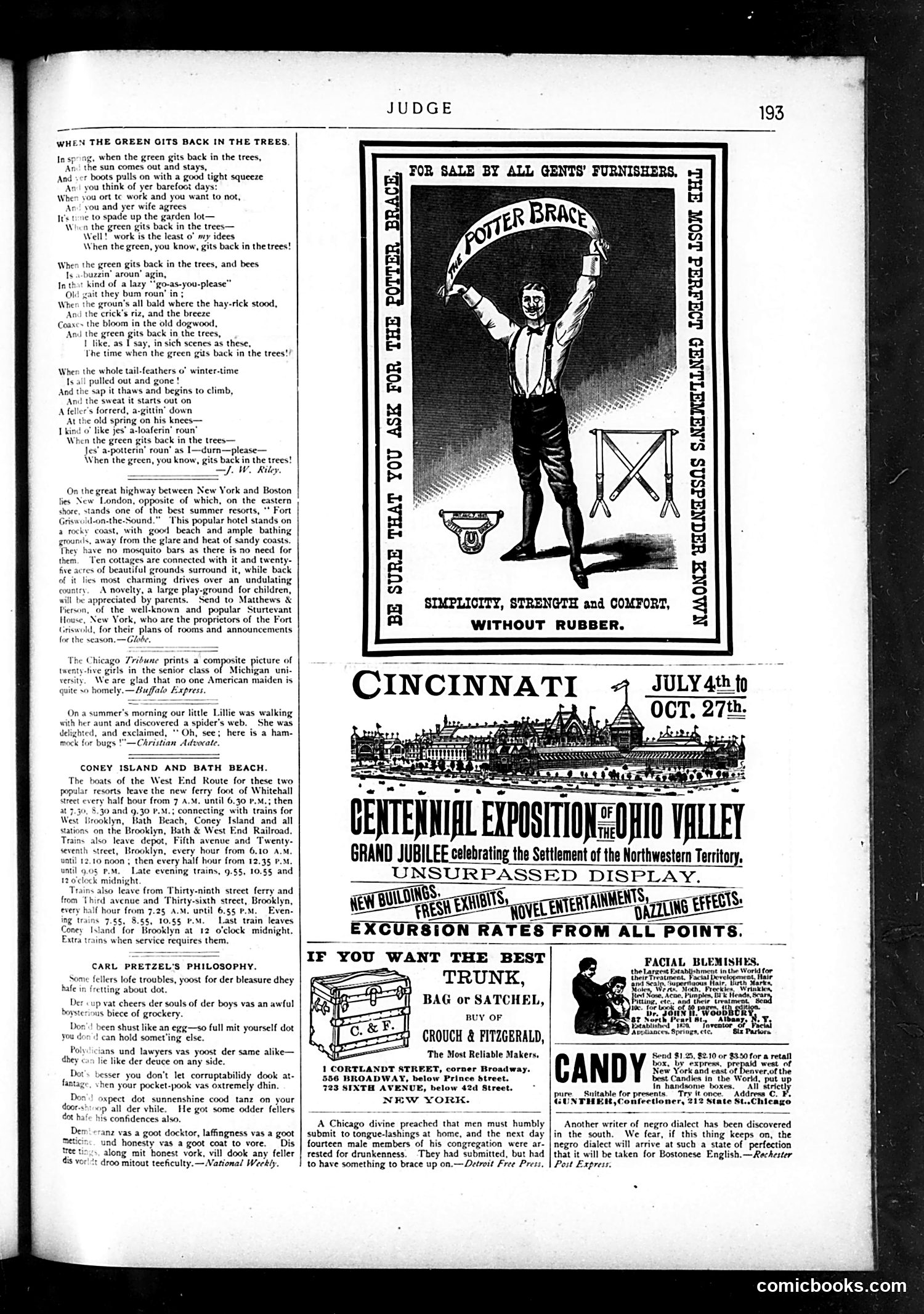
This page is primarily **advertising and miscellaneous content** rather than political satire. The main elements are: **Potter Brace Advertisement**: The large illustrated ad promotes a men's suspender/brace product, emphasizing "simplicity, strength and comfort, without rubber." The figure demonstrates the product's reliability—typical 19th-century masculine product marketing. **Literary Content**: "When the Green Gits Back in the Trees" is a nostalgic poem about spring and rural leisure, written in dialect. It reflects period sentimentality about seasonal renewal and escape from labor. **Other Ads & Notes**: The page includes resort advertisements (Fort Griswold, Coney Island), a Cincinnati Centennial Exposition notice, and "Carl Pretzel's Philosophy"—a humor column using heavy German-immigrant dialect for comic effect. This dialect humor, now considered offensive, was mainstream entertainment then. The page lacks coherent political satire; it's a typical Judge magazine mixture of advertisements, light verse, and ethnic humor.
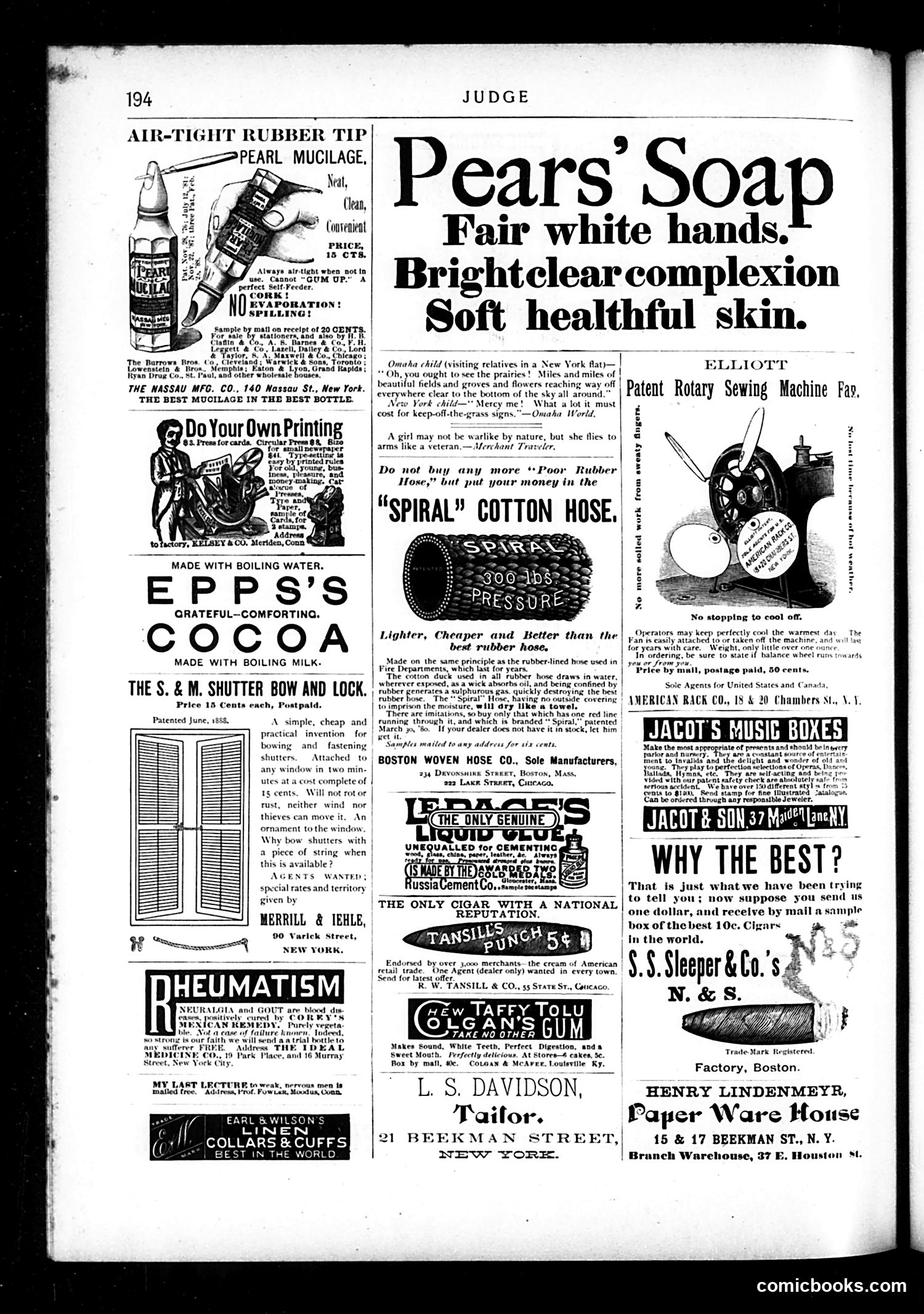
This page is primarily **advertising**, not political cartoons or satirical content. It comprises various commercial advertisements typical of a late 19th-century magazine. Notable features include a small embedded joke contrasting prairie-loving Omaha children with city children's assumptions about property maintenance costs. The bulk of the page advertises consumer products: Pears Soap (emphasizing feminine beauty standards—"fair white hands," "bright clear complexion"), various home goods, foods, cigars, and patent medicines. One notable ad shows a caricatured figure for "Rheumatism" treatment, but there's no identifiable political figure or satirical target beyond the general commercial messaging. The "Do Your Own Printing" advertisement features a generic illustration unrelated to current events. This appears to be a standard magazine revenue page, with social commentary limited to the casual humor in period-appropriate advertisements.
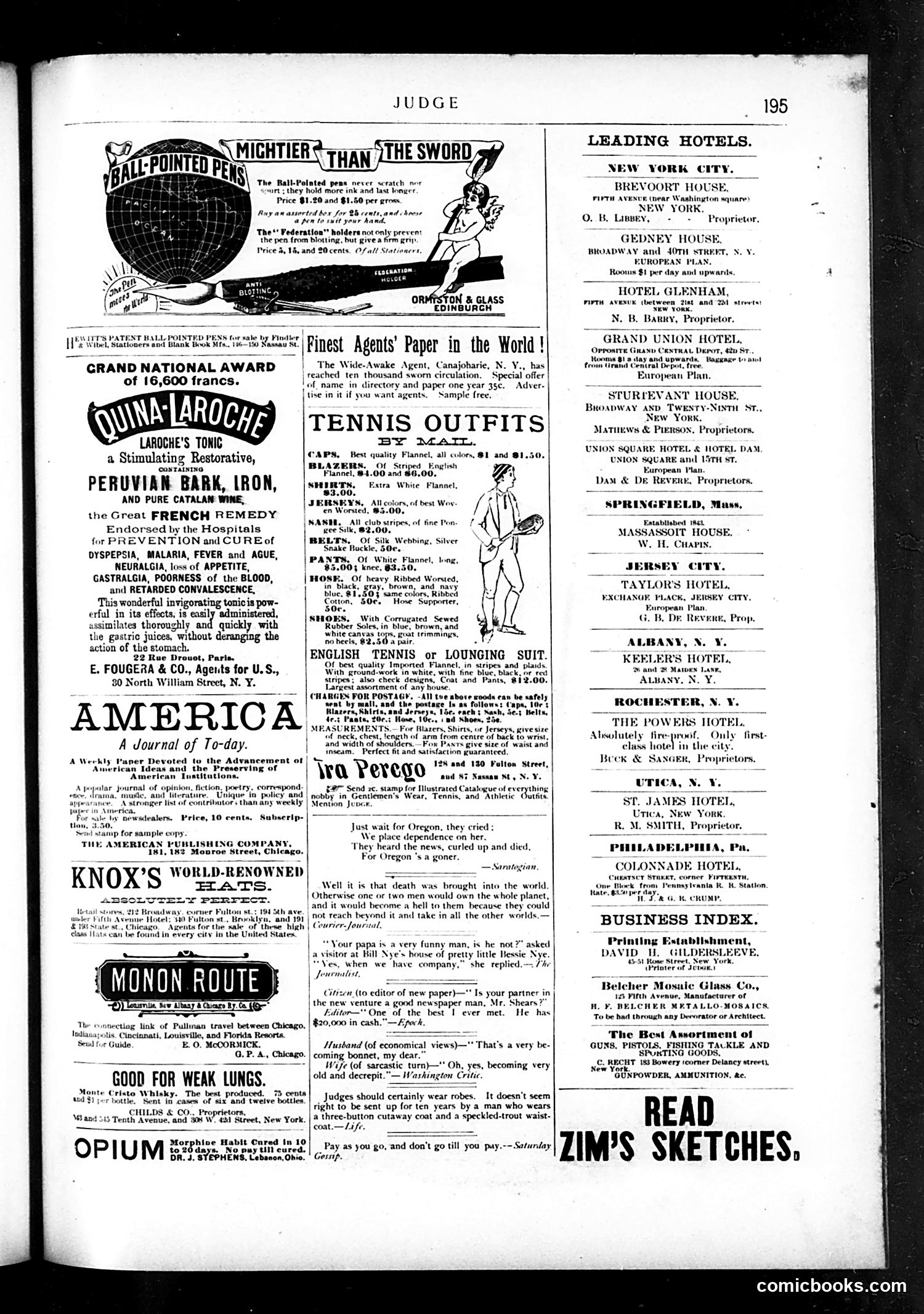
This page is primarily **advertisements and filler content** rather than political satire. The top features ads for ball-pointed pens, patent medicines (Laroche's Tonic for dyspepsia and malaria), and Knox Hats. The center section advertises tennis outfits by Marz, detailed with prices for flannel pants, blazers, and shoes. The only editorial content includes brief humorous quotes: - A poem mocking Oregon's prospects (context unclear without additional information) - A philosophical observation about death preventing monopolistic world ownership - A joke about Bill Nye's daughter, referencing the 19th-century American humorist Bill Nye The page demonstrates *Judge*'s typical mix of satirical commentary with commercial advertisements—the magazine's revenue model. No identifiable political cartoon or significant satire dominates this particular page.
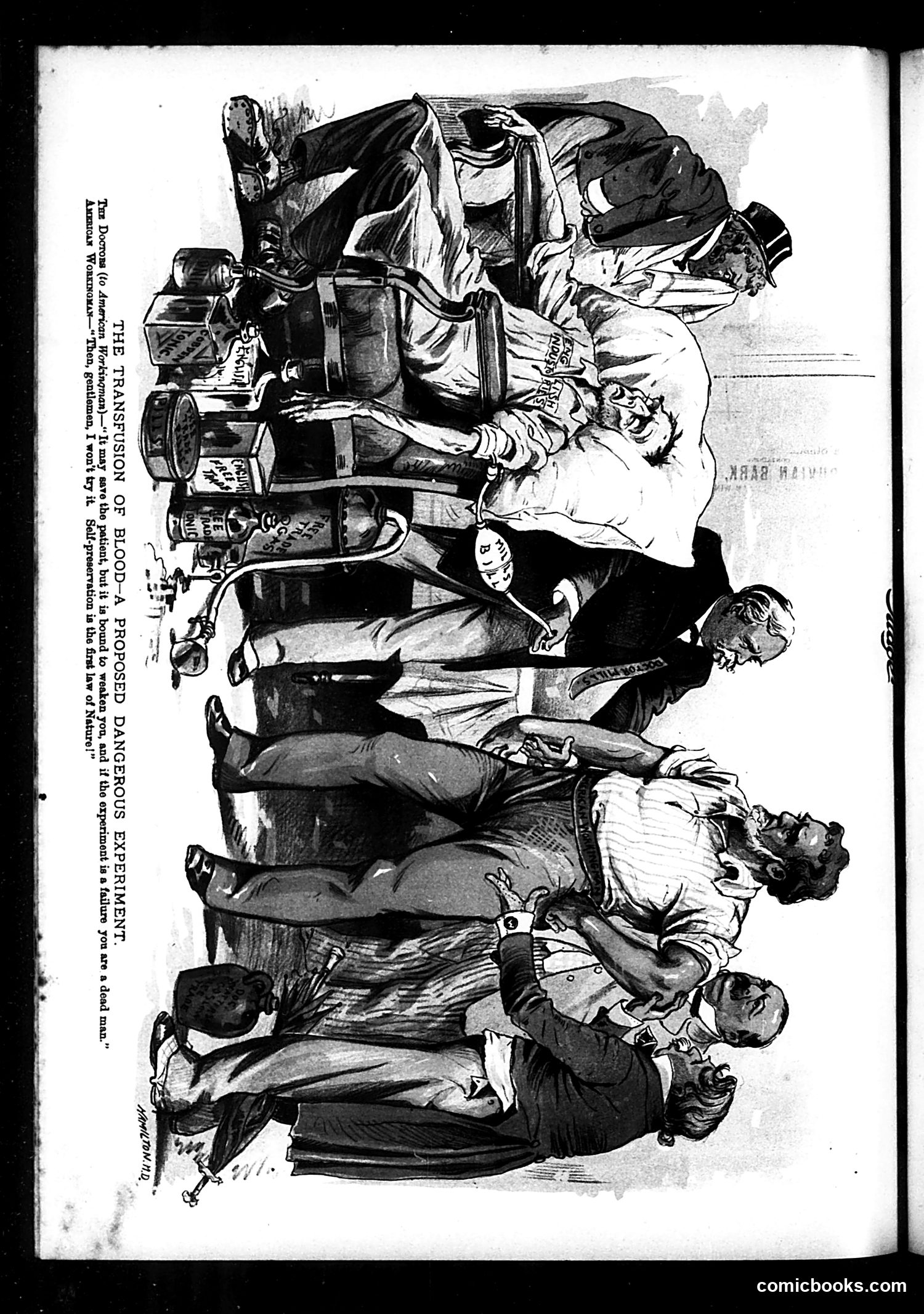
This political cartoon depicts a medical metaphor for wealth redistribution. The "American Workingman" (shown at bottom, appearing robust) is being asked by "Tax Doctors" to donate blood to save a dying patient (likely representing the wealthy or struggling industries at top). The satire critiques Progressive-era redistribution proposals: doctors warn that giving blood will weaken the workingman and might fail anyway, killing him. The workingman wisely refuses, citing self-preservation. The cartoon argues against taxing workers to support the wealthy or failing businesses, framing such policies as dangerous to the working class's own survival. This reflects *Judge* magazine's conservative stance against wealth redistribution and labor-friendly taxation during the early 20th century.