
A complete issue · 16 pages · 1888
Judge — June 23, 1888
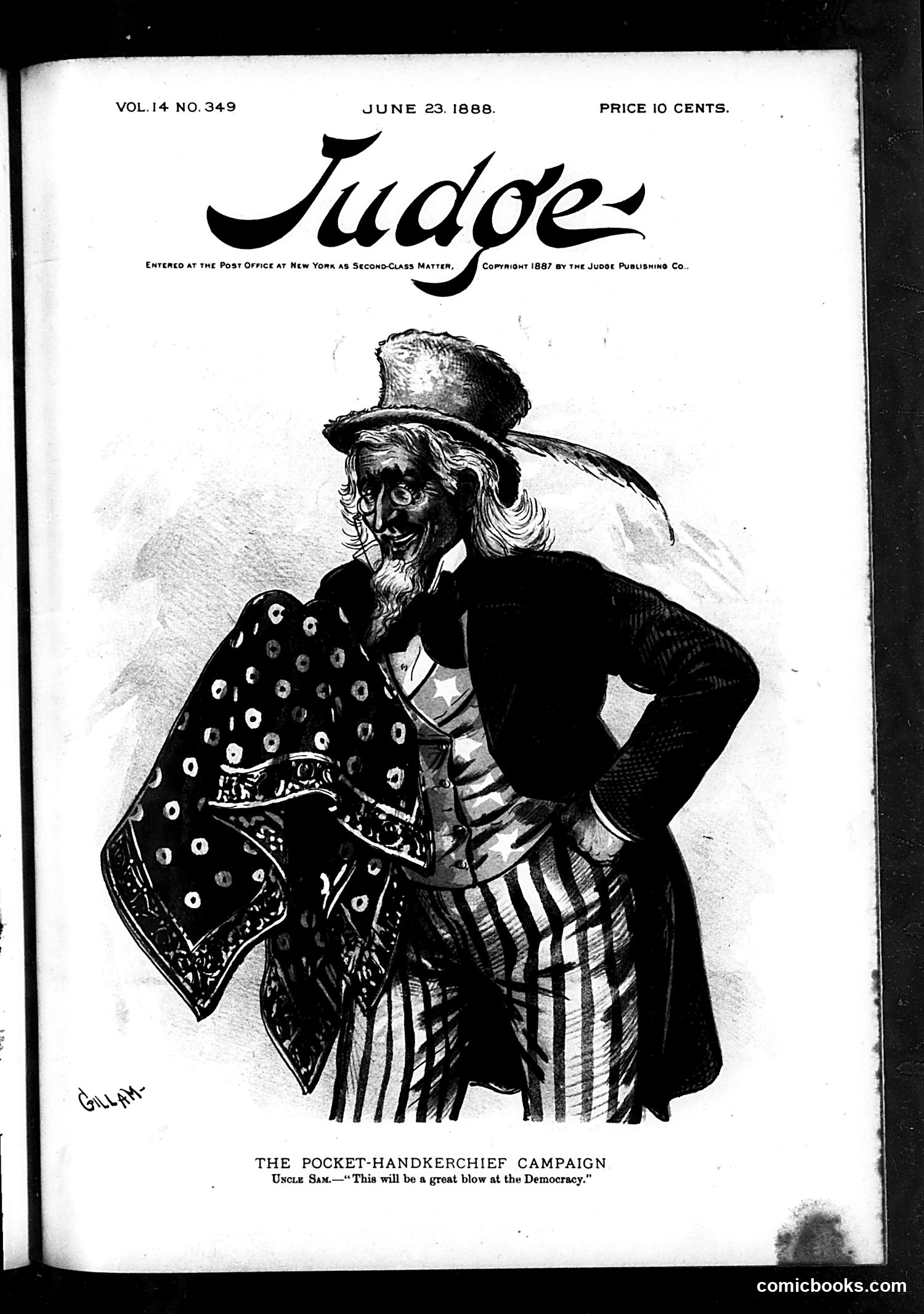
This Judge magazine cover from June 23, 1888 depicts Uncle Sam (personified America) displaying a pocket handkerchief, with the caption: "This will be a great blow at the Democracy." The cartoon satirizes the 1888 presidential campaign, likely referencing a minor or trivial Republican campaign tactic being promoted as a major attack against the Democratic party. The "pocket-handkerchief campaign" appears to be mockery of what Judge viewed as an inconsequential or absurdly small-scale political effort—suggesting Republicans were making mountains out of molehills in their opposition to Democrats. The exaggerated confidence of Uncle Sam's pose contrasts with the triviality of his "weapon," emphasizing Judge's satirical point about the weakness or ridiculousness of the Republican attack strategy.
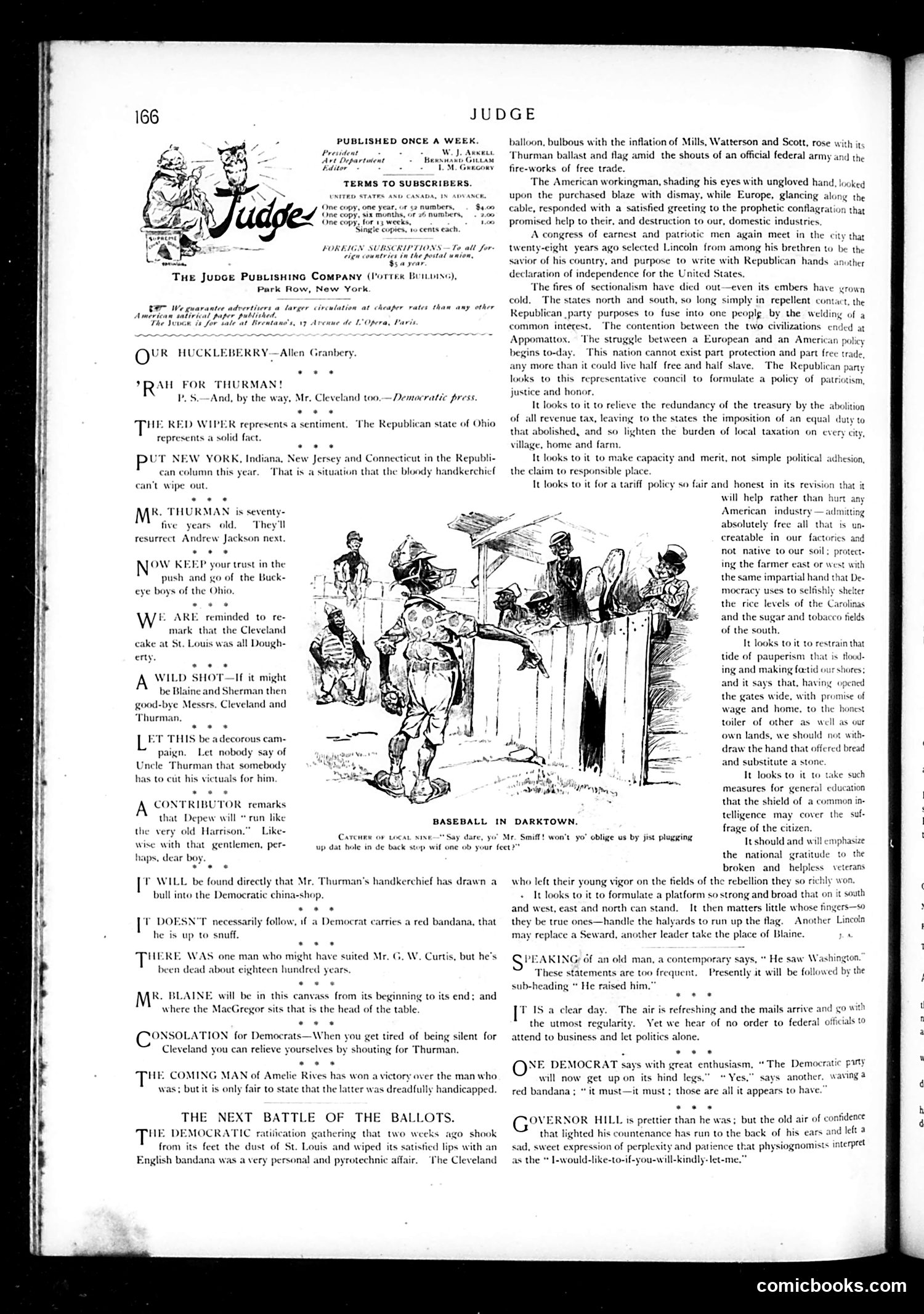
This cartoon satirizes African Americans through a racist caricature style common to 1890s-era Judge magazine. The sketch depicts Black figures playing baseball in an exaggerated, mocking manner—a visual "joke" that relies entirely on dehumanizing racial stereotypes rather than social or political commentary. The accompanying editorial section contains political commentary on contemporary issues: Republican and Democratic party disputes over tariffs, currency policy, and governance. References to Cleveland, Thurman, and other figures suggest content addressing 1880s political controversies. The cartoon itself has no substantive satirical point beyond the racism itself—it's an example of how mainstream American humor of this era casually weaponized racial caricature as entertainment, reflecting the deeply embedded prejudices of the period.
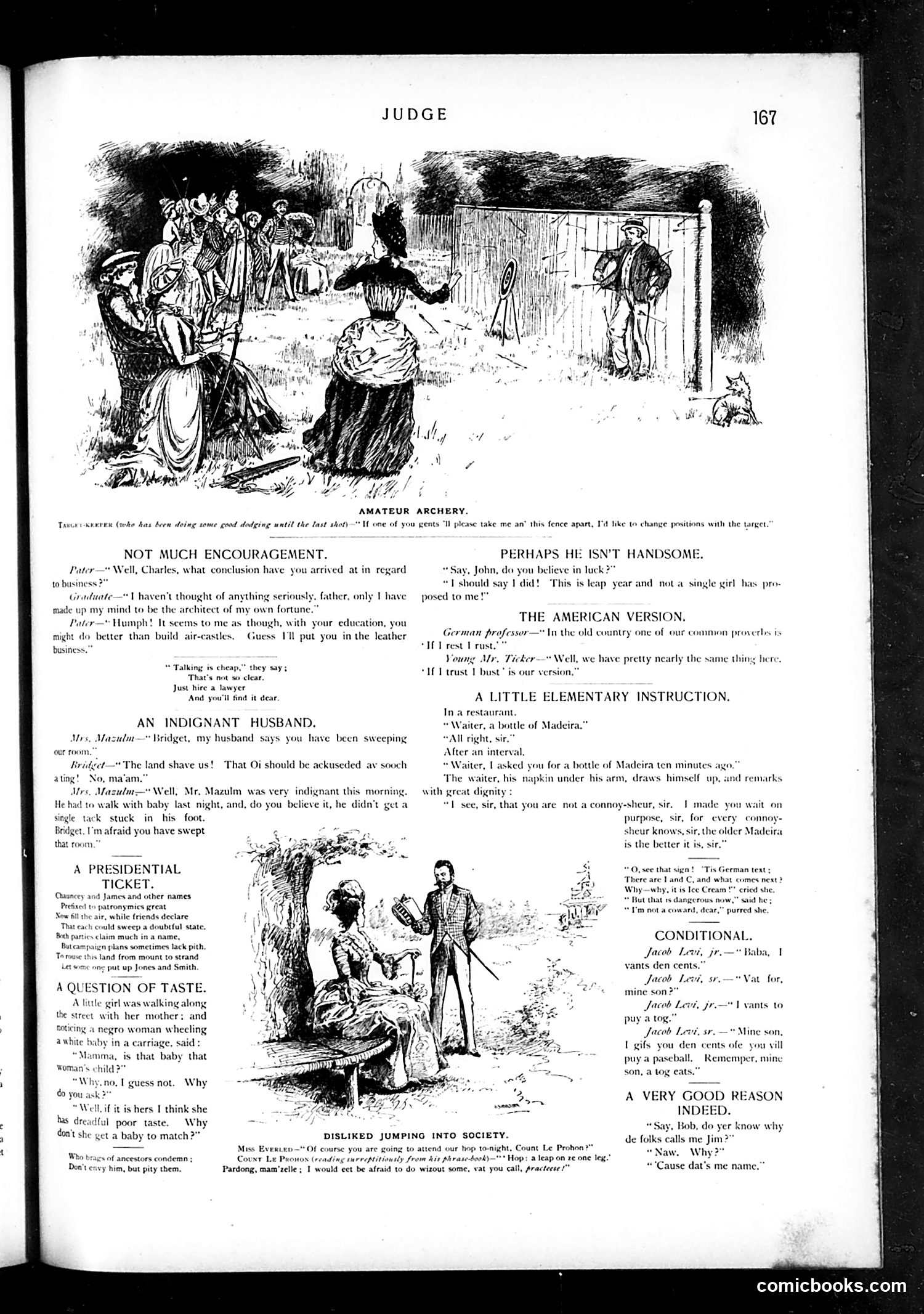
This page contains multiple short humorous sketches typical of Judge magazine's social satire: **"Amateur Archery"** mocks inexperienced archers attempting the sport—a leisure activity for the well-to-do. **"Not Much Encouragement"** satirizes a young graduate's vague business ambitions versus his father's practical skepticism about "air-castles." **"An Indignant Husband"** plays on Irish servant stereotypes (Bridget, Mrs. Masulm's accents) and domestic humor about a housemaid's thoroughness. **"A Presidential Ticket"** critiques hollow political campaigns that rely on candidates' names rather than substantive policy. **"A Question of Taste"** contains racist humor about a Black woman caring for a white child—reflecting period prejudices. **"A Little Elementary Instruction"** depicts class pretension: a waiter affecting expertise about aged Madeira wine. The remaining sketches use dialect humor (German, Jewish, Irish characters) and play on wordplay ("trust/bust," mistaken names). These reflect common Judge satirical tropes: targeting social climbers, incompetence, and ethnic stereotypes now considered offensive.
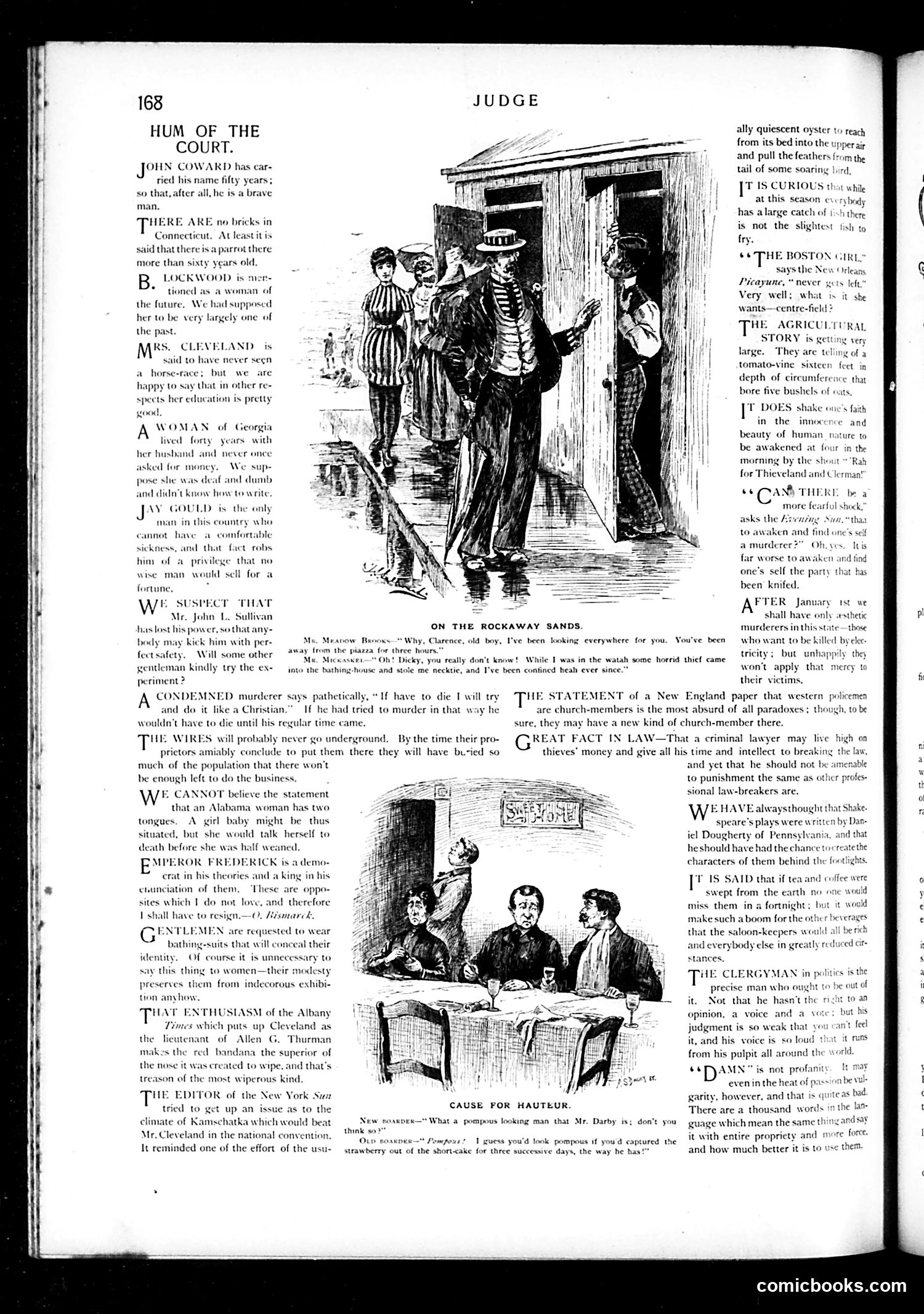
This page of *Judge* satirical commentary targets prominent figures and social issues of the Gilded Age (likely 1880s-90s based on references). **Key figures mocked:** - **John L. Sullivan**: The famous boxer is ridiculed for losing his fighting prowess - **Mrs. Cleveland**: Wife of President Grover Cleveland, satirized for her sheltered upbringing - **Jay Gould**: The railroad magnate criticized for his inability to enjoy leisure due to wealth anxiety - **Allen G. Thurman**: Referenced regarding Cleveland's 1884 vice-presidential running mate **The cartoons** ("On the Rockaway Sands" and "Cause for Hauteur") use humorous domestic situations for social commentary. **Overall satirical points**: The pieces mock the pretensions of the wealthy, criticize political figures, and use absurdist humor about contemporary manners and morality. The tone is lighthearted mockery typical of *Judge*'s irreverent approach to American public figures and society.
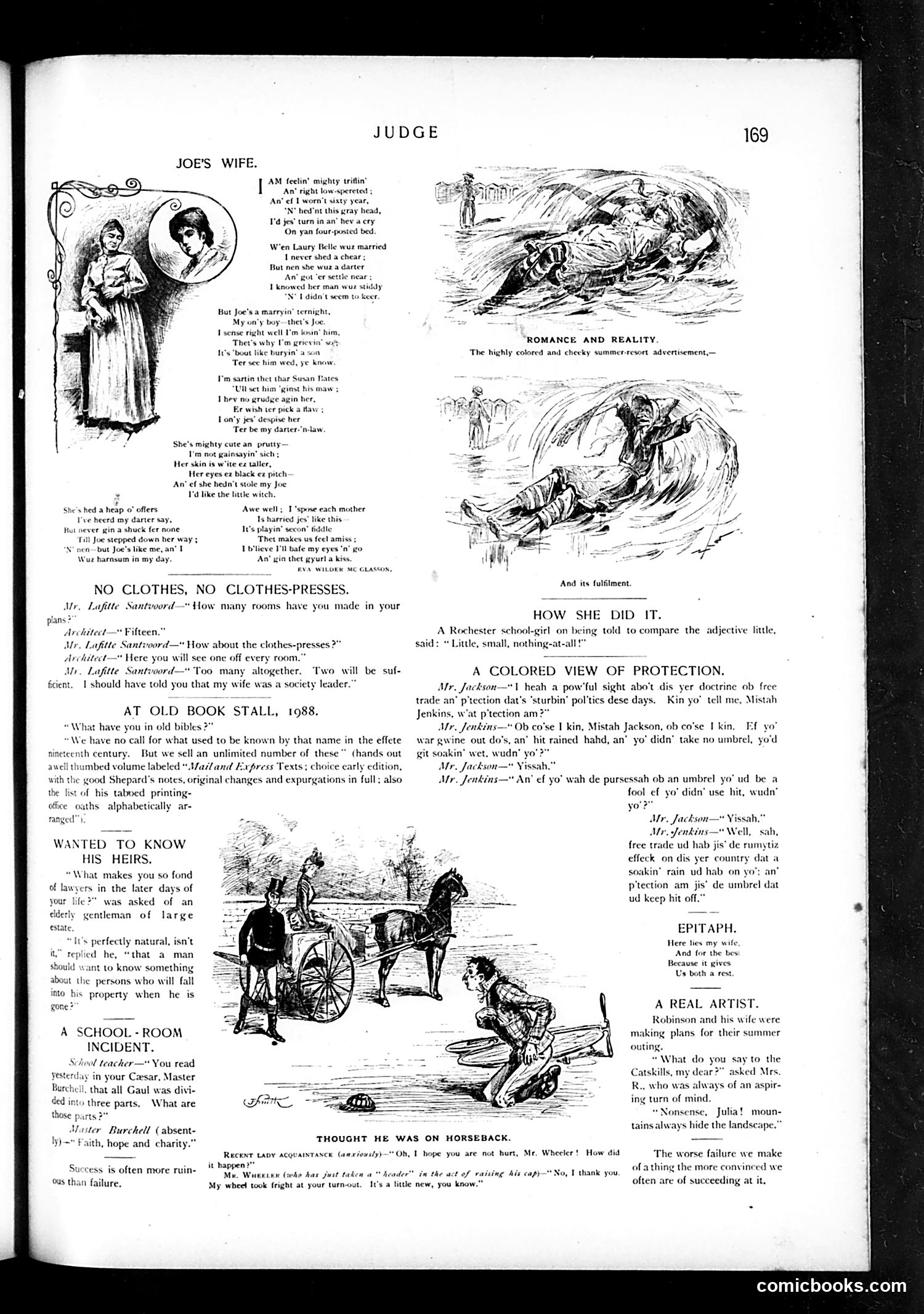
This page contains several satirical pieces typical of late-19th-century Judge magazine: **"Joe's Wife"** (left): A sentimental poem in dialect about an aging mother losing her son to marriage. The satire targets sentimentality itself—the exaggerated emotional displays of the era. **"No Clothes, No Clothes-Presses"**: Mocks wealthy "society leaders" for their excessive wardrobes, suggesting an architect's client needs no closet space because she's never home (implying constant social obligations). **"Wanted to Know His Heirs"**: Dark humor about elderly wealthy men befriending lawyers—implying mercenary motives disguised as inheritance planning. **"A Colored View of Protection"**: Uses racist dialect to satirize the tariff debate through an umbrella metaphor—free trade leaves the country "soaking wet" while protection is the "umbrella." This reflects contemporary economic policy arguments, though expressed through offensive racial caricature. The remaining items are brief humor sketches on school life, book collecting, and accidents. The page represents Judge's mix of social satire, sentiment, and period prejudices.
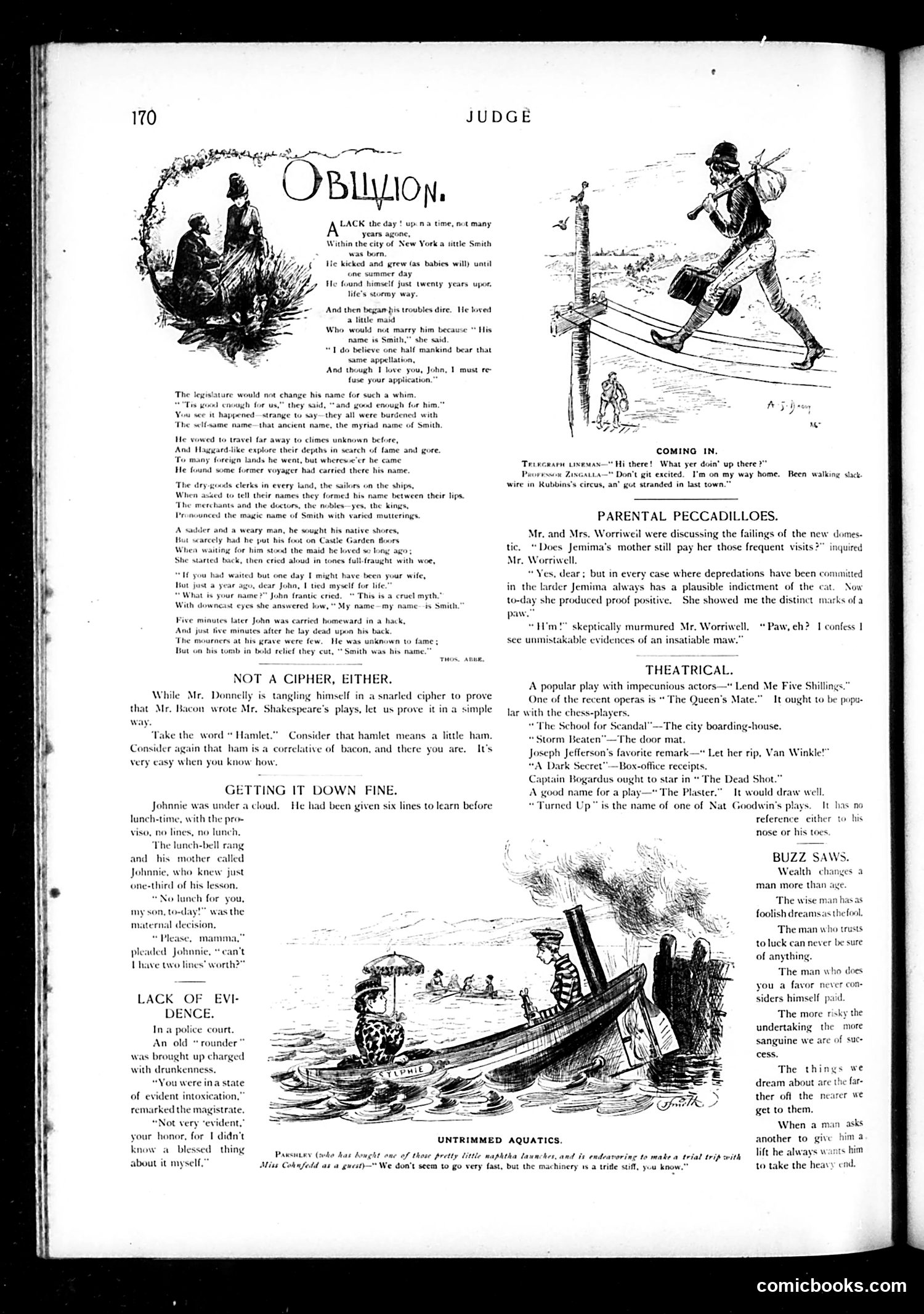
**"Oblivion"** (the main cartoon) satirizes the commonness of the surname "Smith." A young man named John Smith cannot marry his beloved because she refuses to marry someone with such an ordinary name. He travels the world seeking fame and fortune, only to return home and discover—to his despair—that the woman he loves has also become "Mrs. Smith" through marriage to someone else. The joke: his efforts to escape his generic identity were pointless. The other short pieces mock contemporary absurdities: a "cipher" theory about Bacon writing Shakespeare (solved by puns), a child's incomplete homework excuse, a drunk man's claim he wasn't "evidently" intoxicated, and a servant blaming household theft on the cat. The page reflects late-19th-century Judge humor: wordplay, puns, social pretension, and gentle mockery of everyday middle-class life and logic.
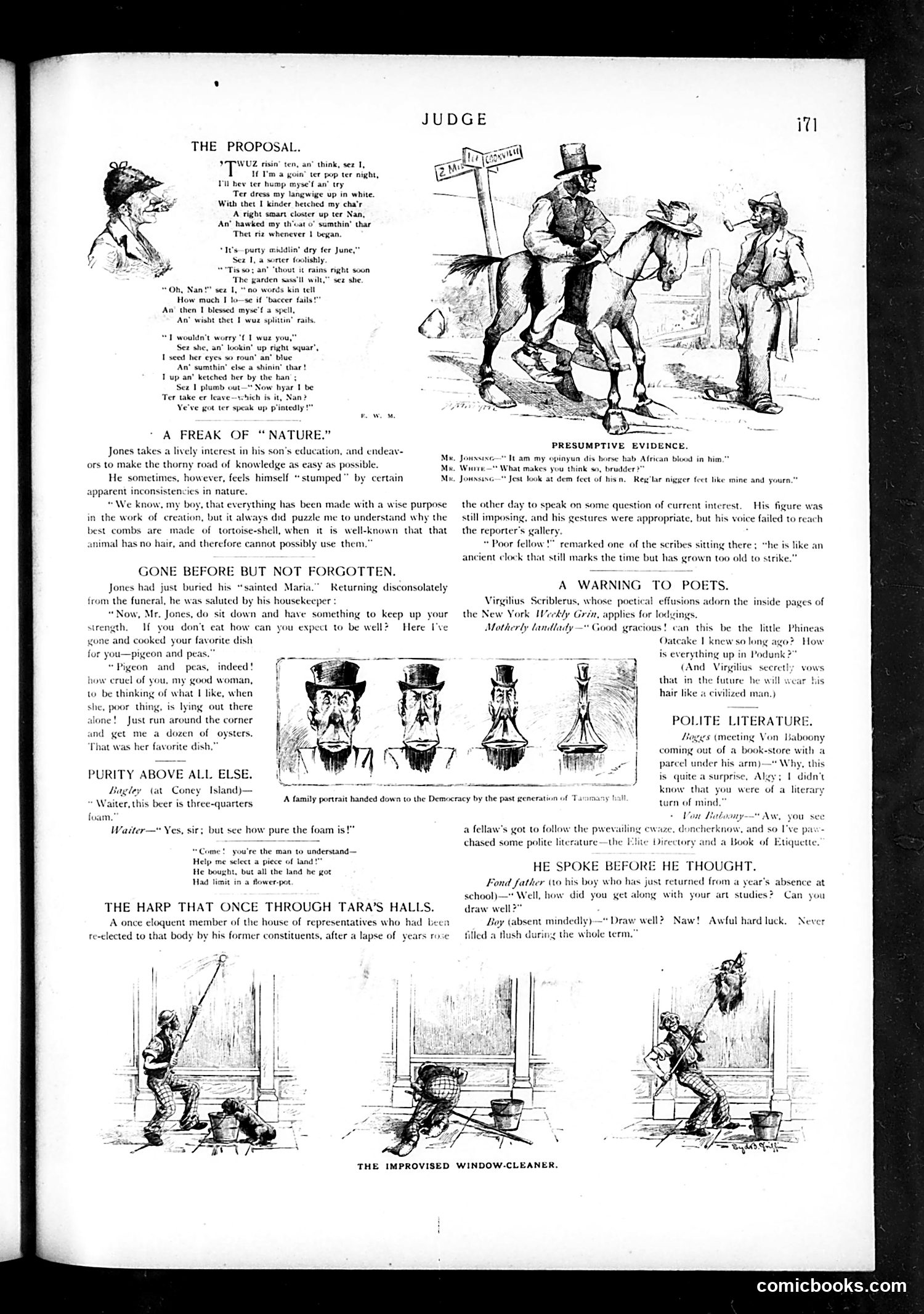
This page contains several independent humorous sketches typical of late-19th-century American satire: **"The Proposal"** depicts a rural courtship in heavy dialect, satirizing unsophisticated suitors attempting romantic gestures while discussing crops and tobacco—poking fun at working-class earnestness. **"A Freak of Nature"** mocks a father's confused logic about animal anatomy, a gentle jab at pseudo-scientific reasoning common among the uneducated. **"Gone Before But Not Forgotten"** shows a widower's hypocrisy—he grieves his wife while immediately requesting his favorite meal (oysters instead of her pigeon and peas), satirizing insincere mourning. **"The Harp That Once Through Tara's Halls"** and **"The Improvised Window-Cleaner"** are visual gags without clear political content visible in the OCR. **"A Warning to Poets"** mocks literary pretension—a bohemian poet now dresses respectably and reads etiquette books to fit society's expectations, satirizing the compromises artists make for respectability. The overall tone targets rural naiveté, class pretension, and human hypocrisy through humor.
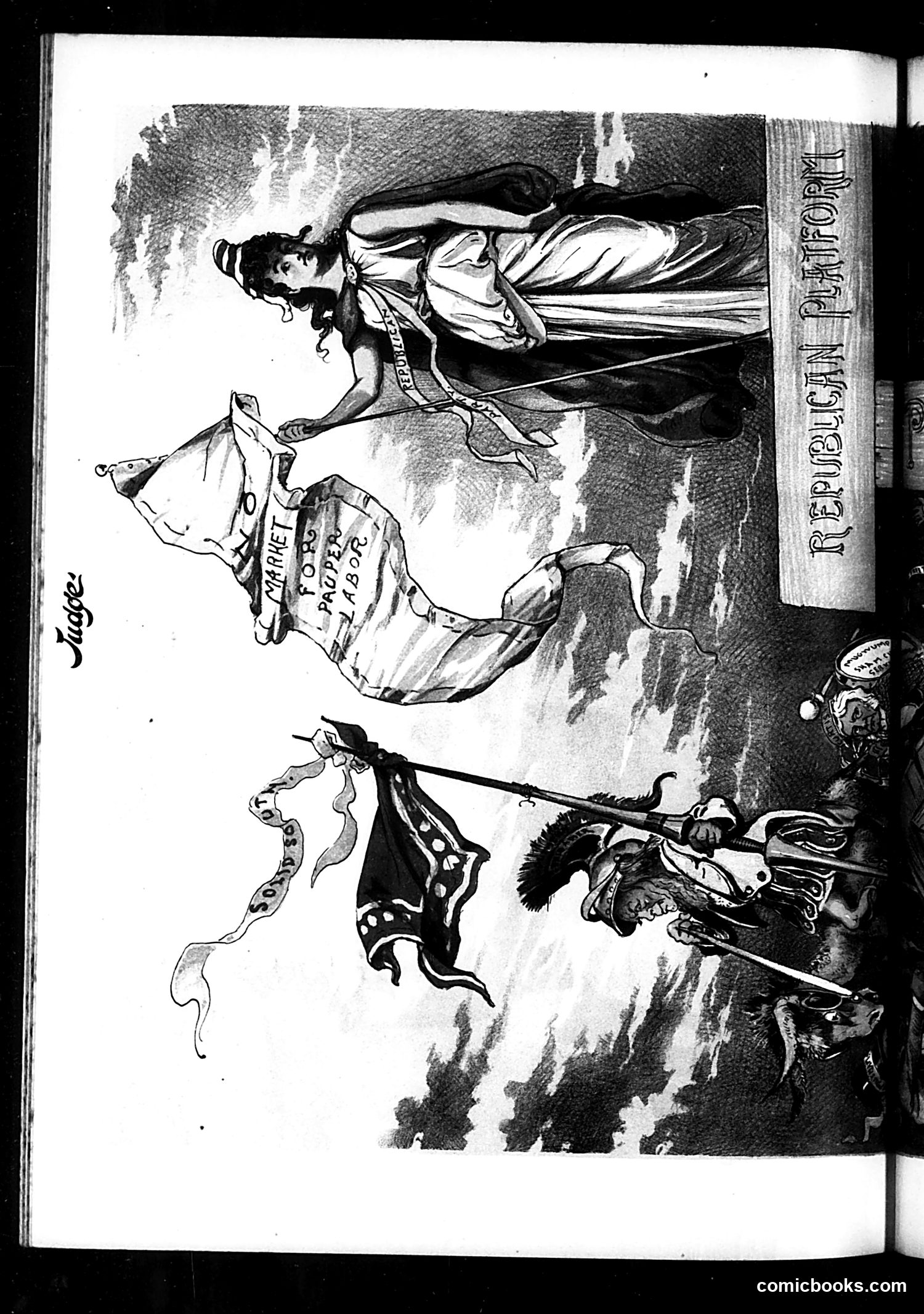
This appears to be a satirical cartoon from Judge magazine, though the OCR text is largely illegible due to image quality. The visible imagery shows a female allegorical figure (likely "Liberty" or "Justice," based on classical iconography) confronting or restraining what appears to be a military or uniformed figure. The composition suggests political satire about government overreach or military authority being checked by democratic principles. Without clearer text or artist attribution visible on this page, I cannot definitively identify the specific historical moment, political figures involved, or the precise satirical message. The cartoon's style appears consistent with early-to-mid 20th century American political commentary, but determining the exact event or context would require additional information beyond what's legible here.
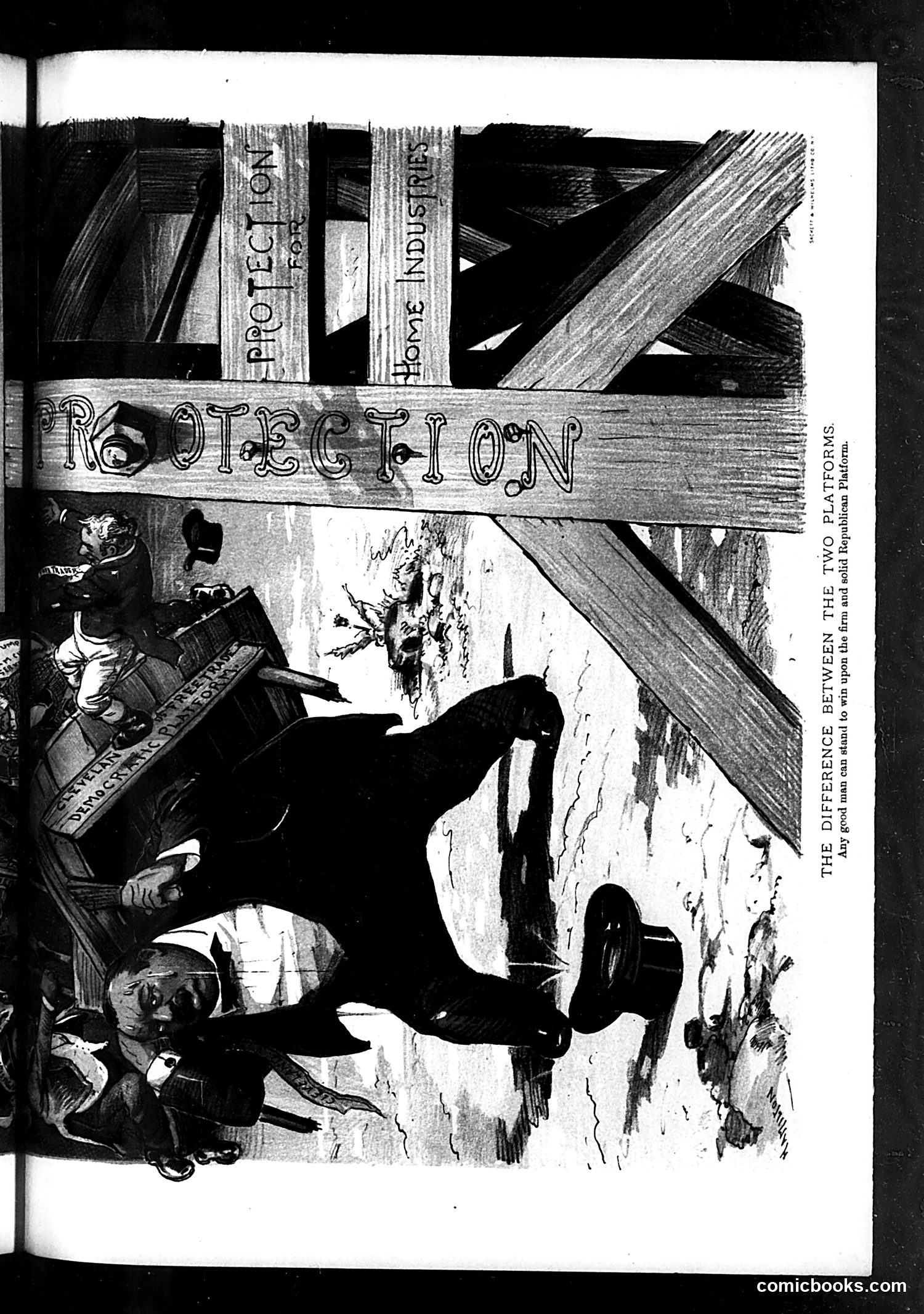
This Judge magazine cartoon satirizes American protectionist trade policies. The image shows a figure operating what appears to be industrial machinery or a printing press labeled "PROTECTION," with the text "Home Industries" visible above. The satire critiques how protectionist tariffs—marketed as protecting domestic American industries—actually operated mechanically or artificially. The machinery metaphor suggests protectionism functioned as a constructed, artificial system rather than organic economic policy. The OCR text is largely corrupted and unreadable, making it difficult to identify specific political figures or precise historical context. However, protectionism was a major American political debate spanning the 19th-early 20th centuries, with Republicans generally favoring tariffs while Democrats opposed them. Without clearer text or visible date, the specific historical moment and intended targets remain unclear.
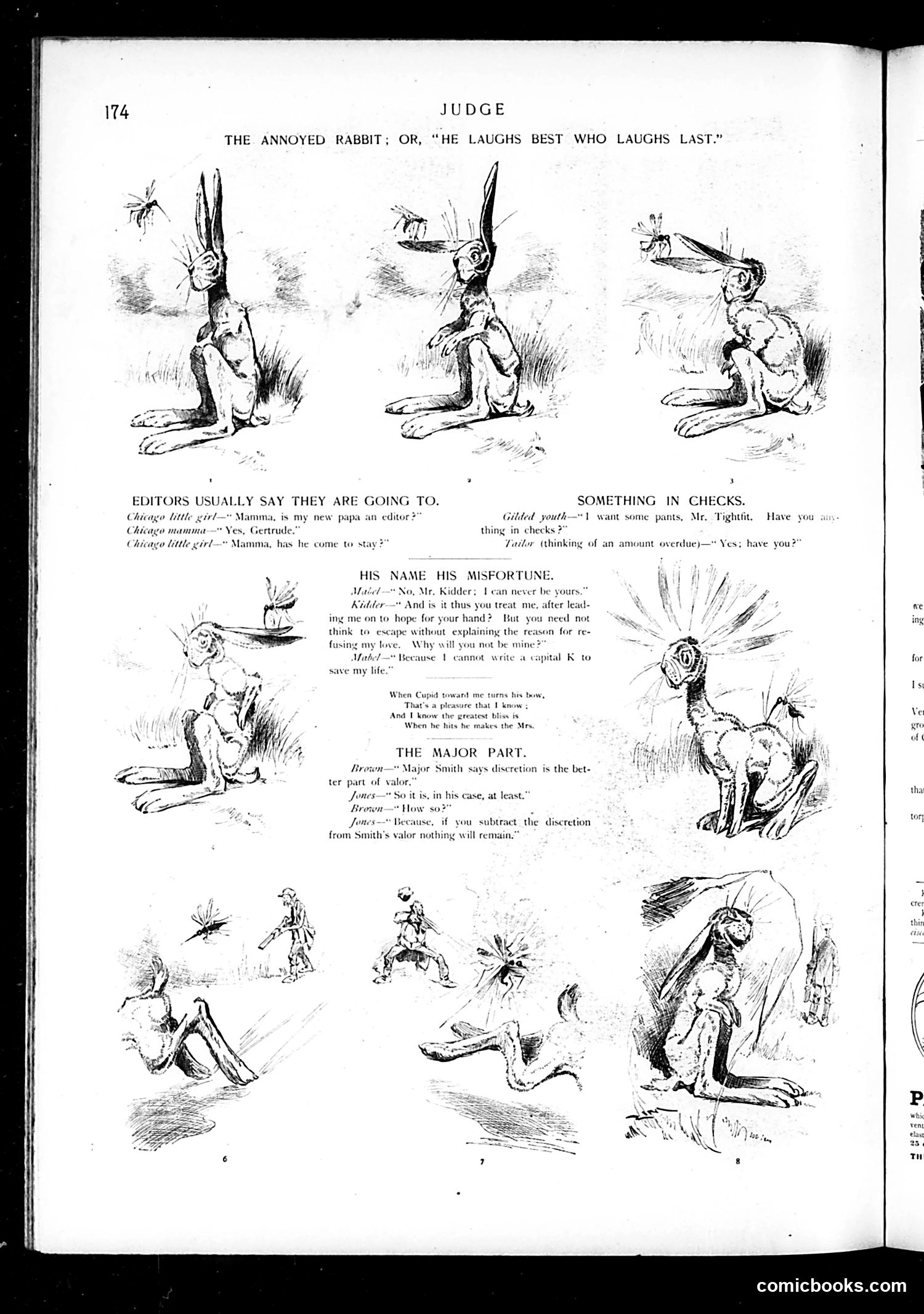
This page contains multiple short comic vignettes satirizing contemporary social types and behaviors: **"Editors Usually Say They Are Going To"** mocks editors' unreliability—a child asks if her new stepfather (an editor) will stay, implying editors are notoriously absent or transient figures. **"Something in Checks"** plays on a tailor's double meaning: a wealthy young man asks for checkered pants while the tailor, owed money, responds "yes, have you?"—a financial dig at the client's empty pockets. **"His Name His Misfortune"** depicts a rejected suitor named "Kidder" (suggesting he's a joker or fraud) being refused by Mabel, who claims she must refuse because he once tried to make her laugh. **"The Major Part"** is a wordplay joke: Jones claims Major Smith's "discretion is the better part of valor"—but if you subtract Smith's discretion from his valor, nothing remains, suggesting Smith has no actual courage, only cautious restraint. The page is typical Judge humor: brief domestic and social jokes targeting recognizable character types of the era.
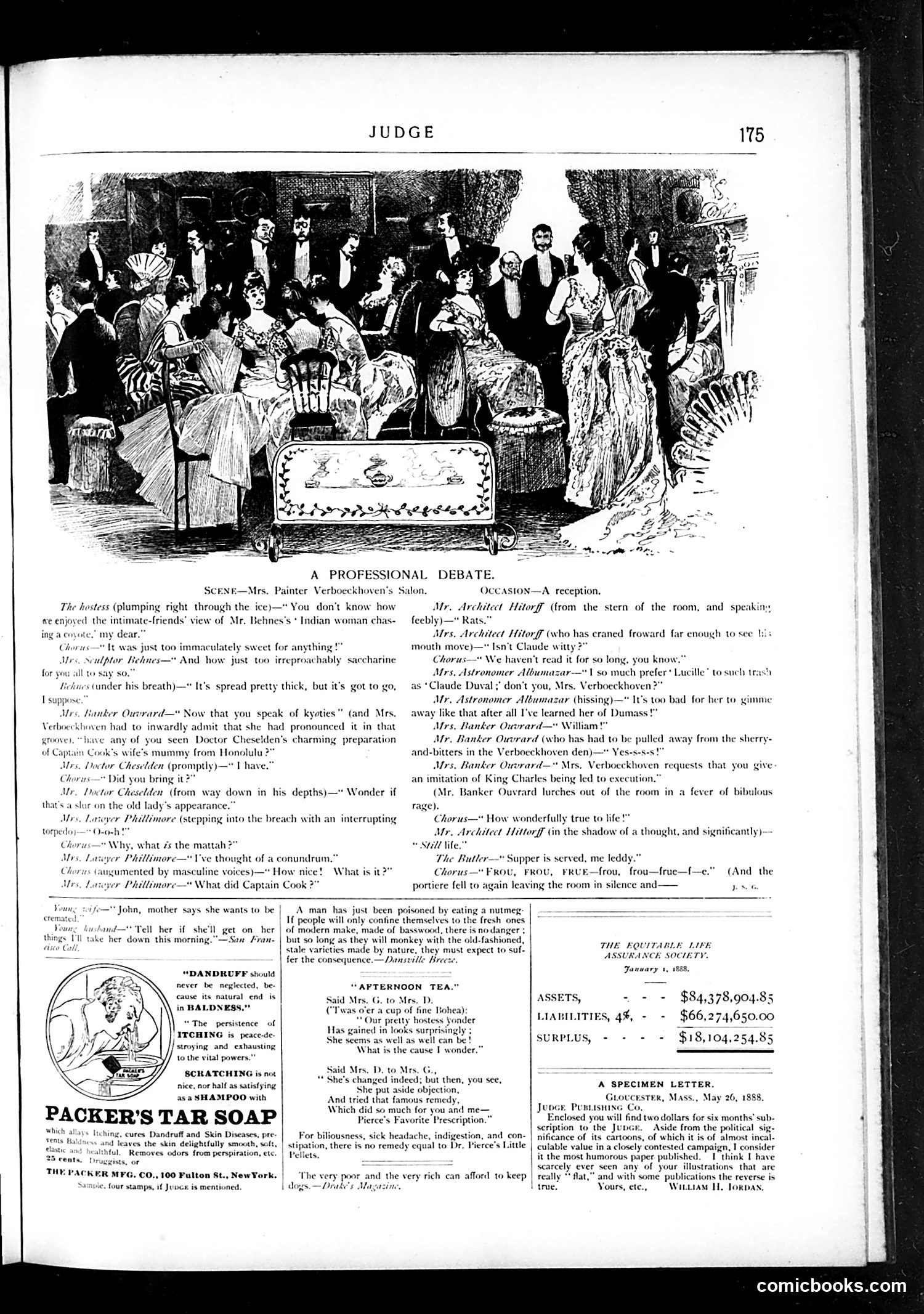
This page satirizes the pretentious social gatherings of wealthy Victorian society. The main cartoon depicts a fancy reception at "Mrs. Painter Verboeckhoven's Salon," where guests engage in forced, tedious conversation about art and literature. The satire targets: 1. **Affected intellectualism**: Characters pretentiously discuss obscure literary works ("Claude Duval") and cultural references, often revealing they haven't actually read what they're discussing. 2. **Social climbing and name-dropping**: Guests constantly reference each other's professions (Architect, Astronomer, Banker) and use affected speech patterns. 3. **Marital dynamics**: The exchanges between husbands and wives—particularly Mr. Banker Ouvrard getting drunk on sherry while his wife manages his social behavior—mock domestic power struggles. The humor derives from the gap between guests' pretensions of sophistication and their actual vapidness. The title "Professional Debate" is ironic; these are merely superficial social exchanges masquerading as intellectual discourse. The page also includes advertisements (Packer's Tar Soap, insurance company) typical of Judge's mixed editorial-commercial format.
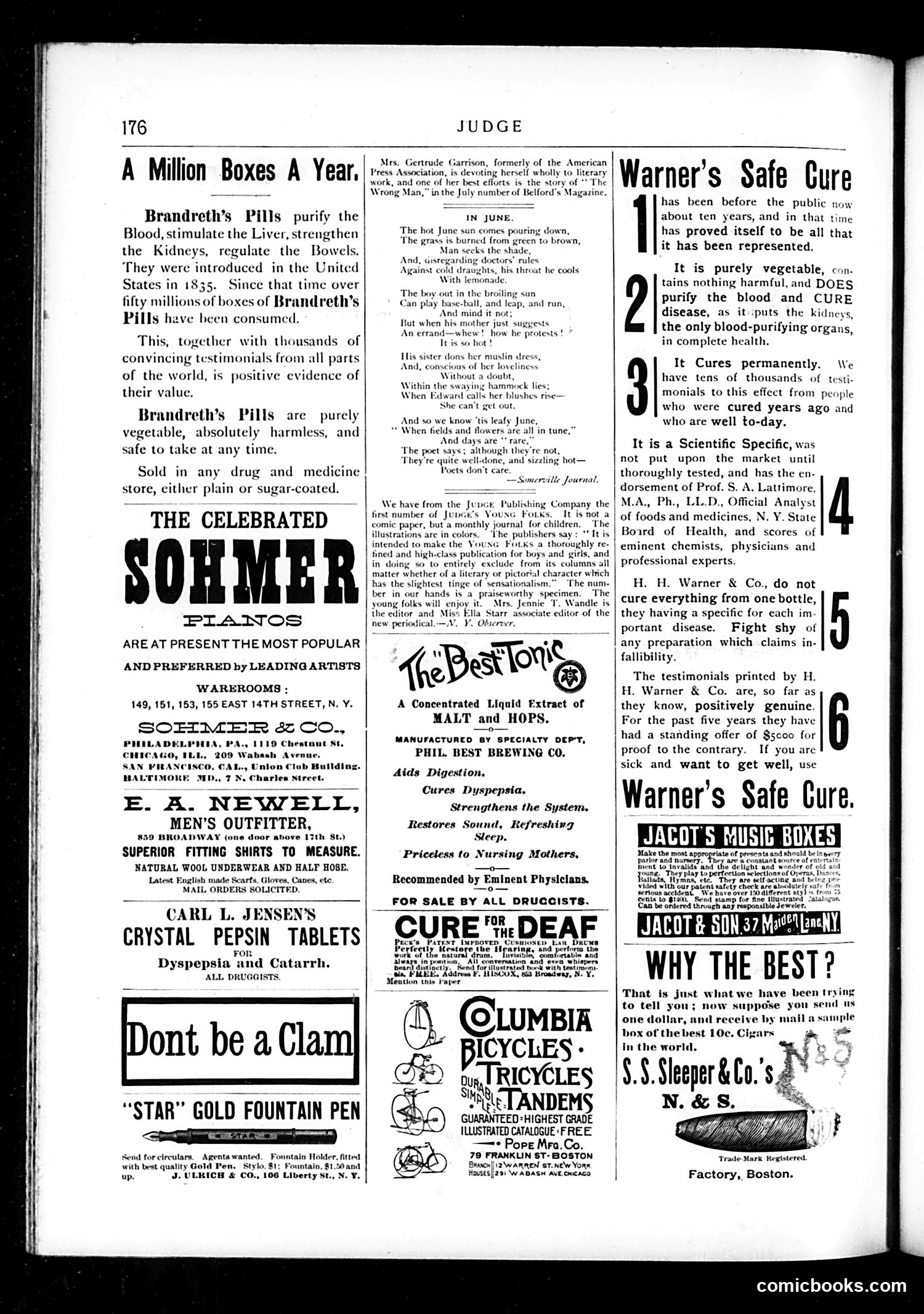
This page is primarily **advertising**, typical of Judge magazine's revenue model. Rather than cartoon satire, it contains various patent medicine and product advertisements interspersed with minor editorial content. The few non-advertisement pieces include: - A poem about June weather (mocking hot-weather discomfort) - A brief notice about a new children's magazine called *Judge's Young Folks* - An excerpt from verse by the poet Somerville Journal **The advertisements reveal period attitudes worth noting for modern readers:** The dominant products—Brandreth's Pills, Warner's Safe Cure, Crystal Pepsin Tablets, and tonics—represent the unregulated patent medicine industry. These products made broad health claims (blood purification, kidney strengthening, deafness cures) with minimal scientific evidence. The testimonials and "scientific" endorsements cited were common marketing tactics before FDA regulation. Warner's Safe Cure, featured prominently, exemplifies the dubious remedies marketed as cure-alls during this era, often containing harmful substances like mercury or alcohol.
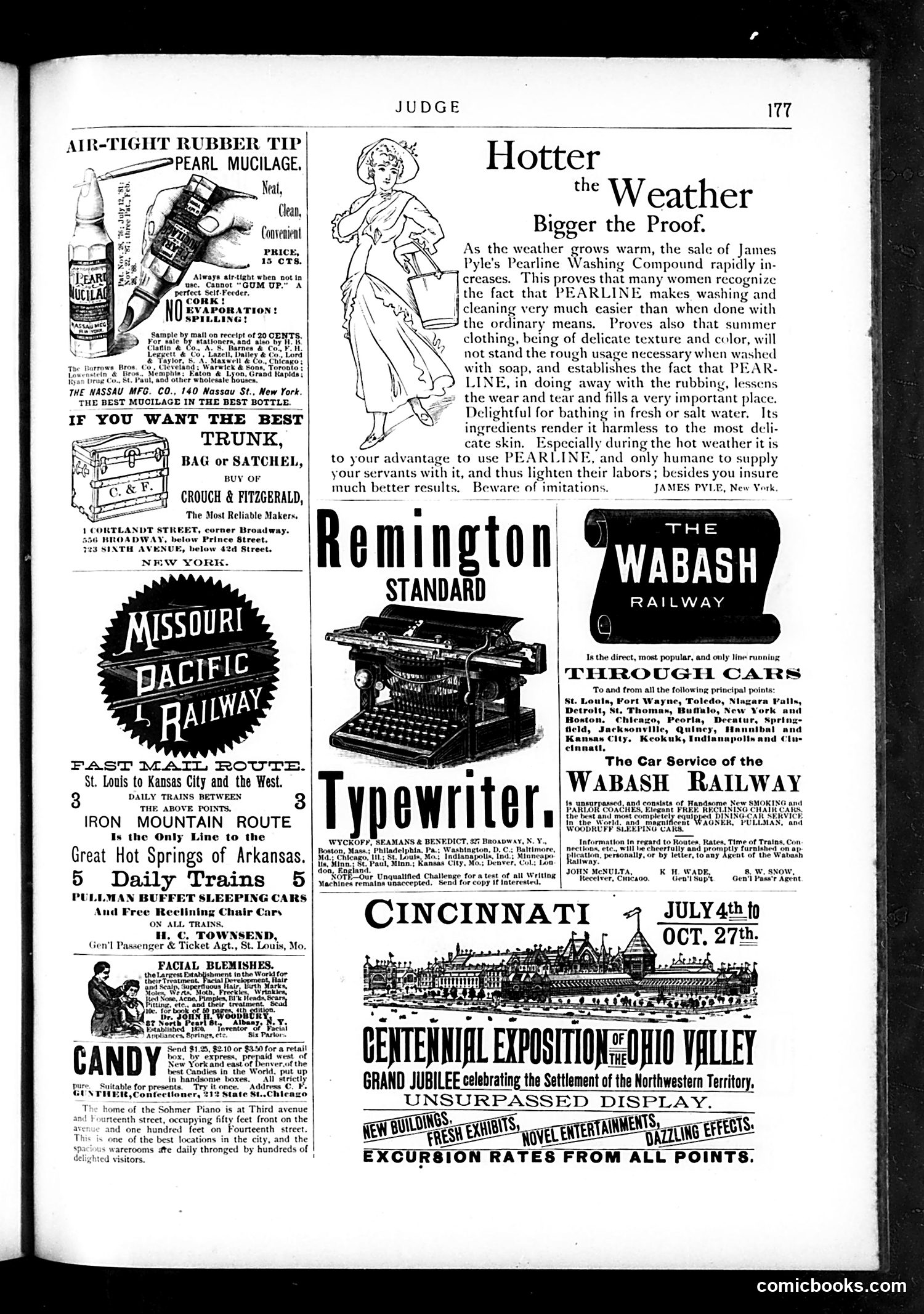
This page is primarily **advertising**, not political satire or editorial cartoon. It contains product advertisements and promotional notices typical of late 19th-century Judge magazine. The main content includes ads for: - Pearl Mucilage and rubber-tip products - Pearline washing compound (with accompanying illustration of a woman) - Trunks and luggage - Remington typewriters - Railway services (Missouri Pacific, Wabash Railway) - Candy and piano retailers - Facial blemish treatments The Pearline ad includes a claim about "servants" and hot weather, reflecting period attitudes toward domestic labor. The Cincinnati Centennial Exposition advertisement promotes an 1888 fair celebrating the Northwestern Territory's settlement. There are **no political cartoons or satirical commentary** visible on this page—it functions as a standard advertising section of the magazine, showcasing consumer products and travel/entertainment services of the era.
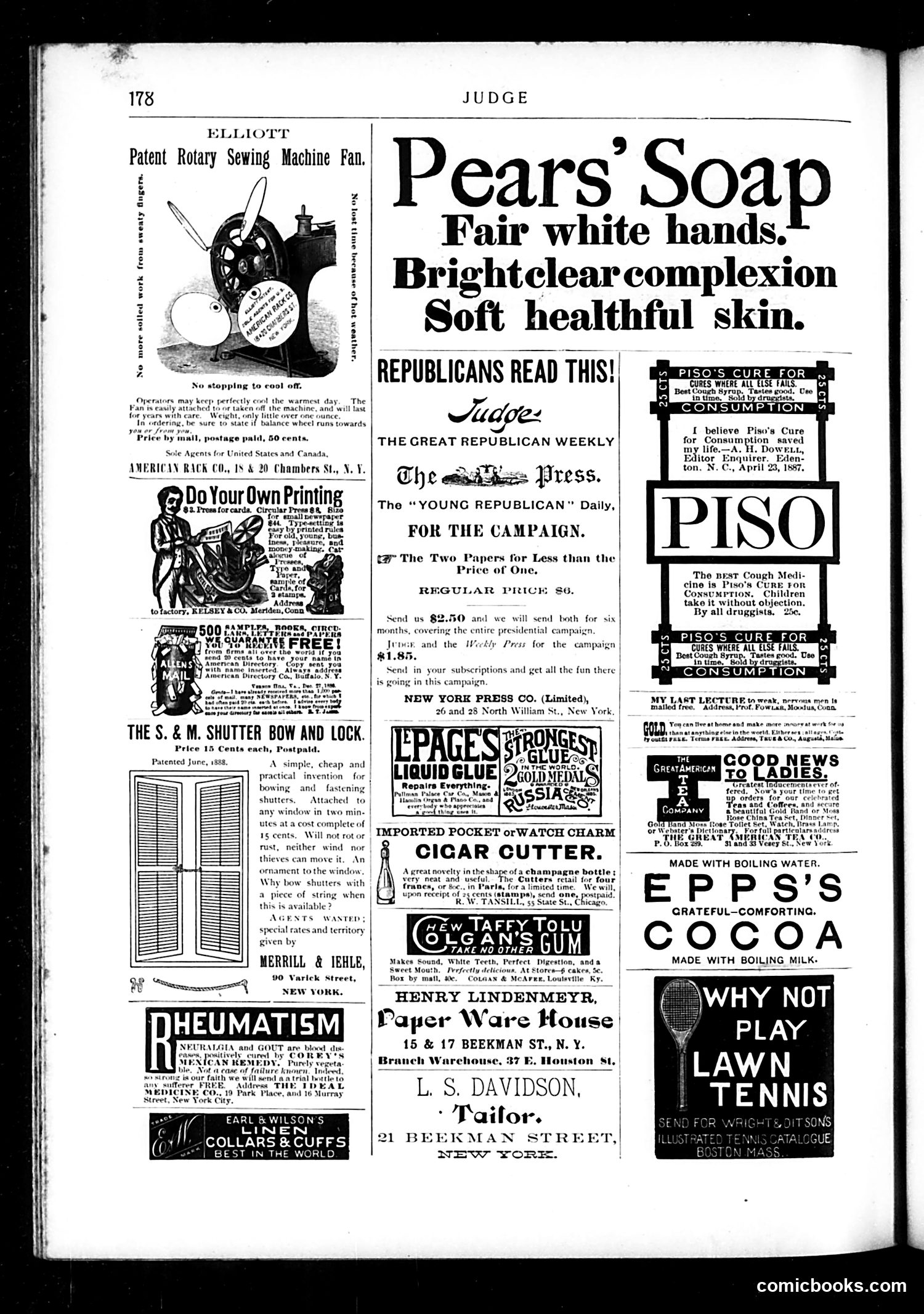
This is primarily an **advertising page** from Judge magazine (page 178), not a political cartoon. The page contains numerous commercial advertisements typical of late 19th-century publications. ## Notable Content: **Political Reference**: The only explicit political content is a Republican campaign advertisement promoting *The Press* and *Young Republican* newspapers as a bundle deal ($2.50 for both) during a presidential campaign. This reflects the partisan press system of the era, where political parties directly sponsored newspapers. **Advertisements**: The page features typical products of the period—sewing machine fans, printing services, window shutters, Pears' Soap (emphasizing "fair white hands" and "bright clear complexion," reflecting period beauty standards), patent medicines like Piso's Cure and tooth tonics, cocoa, and other goods. The page demonstrates how 19th-century magazines supported themselves financially while serving as outlets for partisan political messaging.
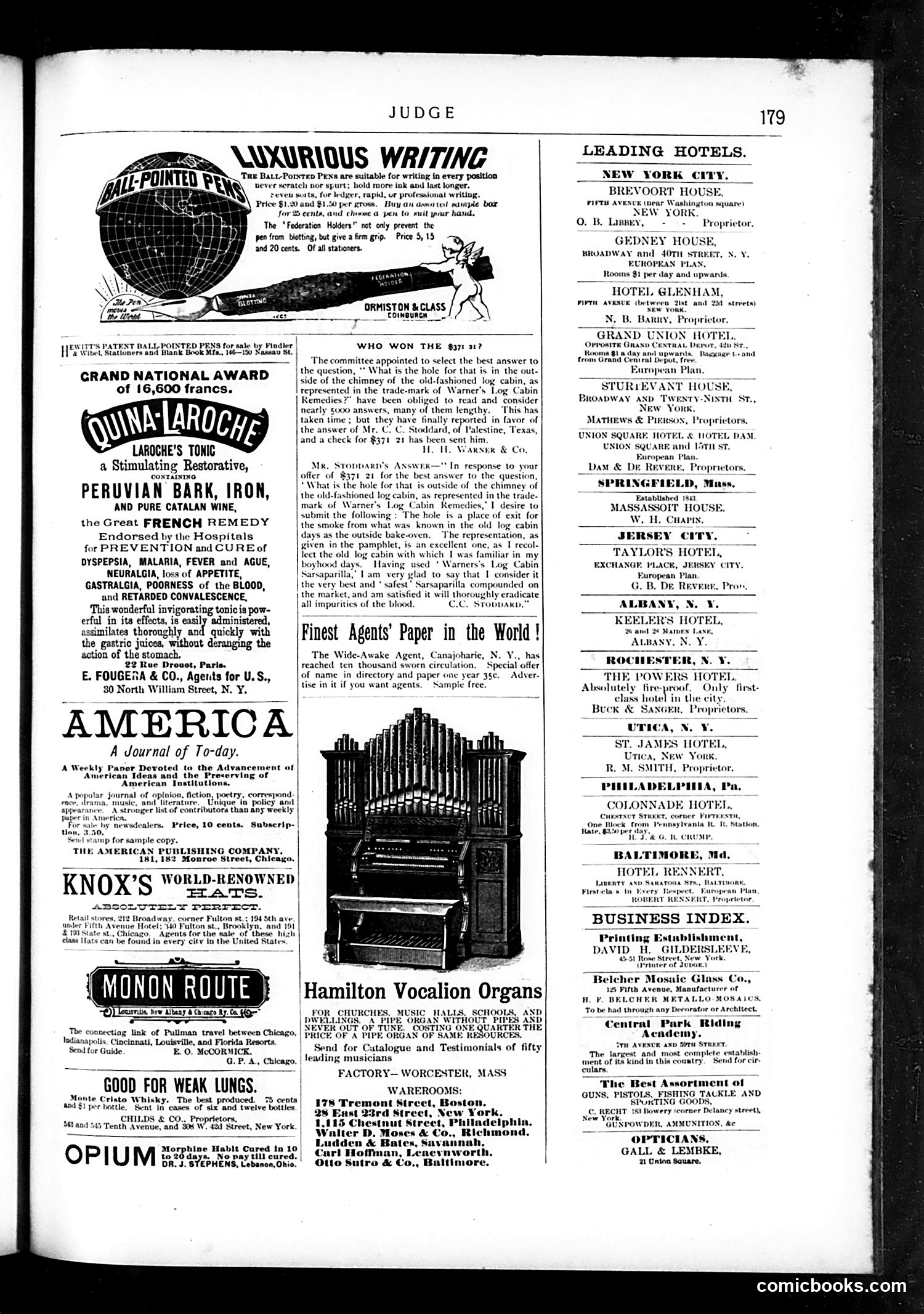
This page is primarily **advertising** with minimal editorial cartoon content. The main substantive content is "WHO WON THE $371.21?"—a contest where **Warner's Log Cabin Remedies** asked readers to explain a hole depicted in the company's trademark image of an old-fashioned log cabin. The winner, C.C. Stoddard of Palestine, Texas, correctly identified it as a smoke exit for an external bake-oven used in frontier cabins. The featured testimonial praises Warner's Sarsaparilla as the "best and safest" blood purifier. This was common advertising strategy: Judge magazine published readers' contest answers alongside product endorsements, blending entertainment with marketing. The page reflects late-19th-century commercial publishing, where satirical magazines relied heavily on patent medicine advertisements—many of dubious efficacy—to fund operations. No political cartoon or satire is evident here.
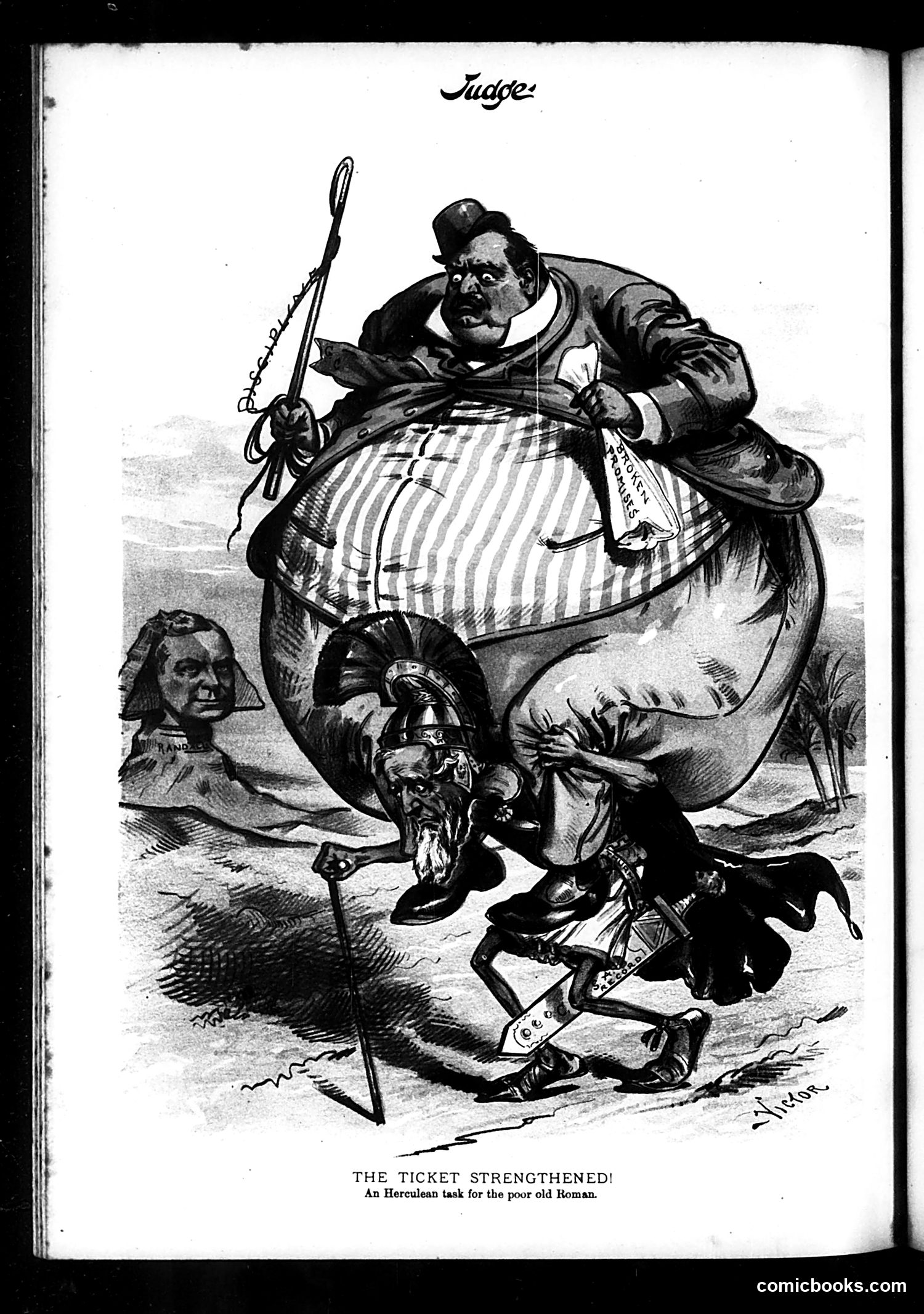
This Judge cartoon satirizes a political figure (labeled "Roman," likely referring to a contemporary politician) depicted as Hercules attempting an impossible task. The bloated, well-fed figure strains to lift or manage something labeled with text on his garment, while a smaller demon or devil-like character at his feet complicates his efforts. The title "The Ticket Strengthened! An Herculean task for the poor old Roman" suggests the cartoon mocks efforts to strengthen a political "ticket" (slate of candidates). The imagery implies this task is impossibly difficult—comparing it to Hercules's legendary labors. The satirical point appears to be that strengthening this particular political ticket or candidate is futile given the impediments shown, though the specific political context and identity of "Roman" remain unclear without additional historical documentation.