
A complete issue · 16 pages · 1888
Judge — May 26, 1888
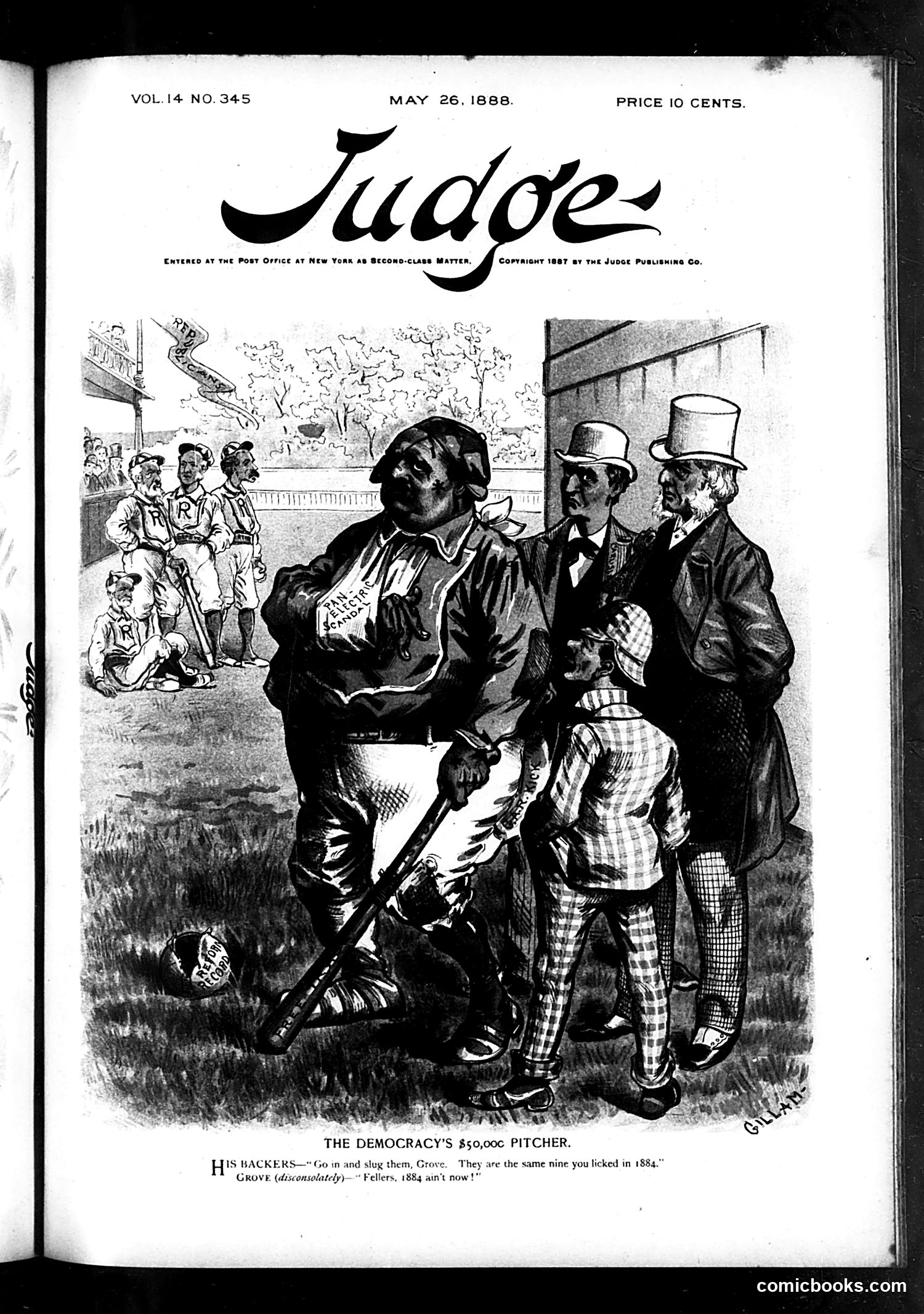
This 1888 cartoon satirizes the Democratic Party's campaign strategy. The large figure—likely a Democratic campaign operative or party leader—is depicted as a baseball pitcher about to throw, while two men in top hats (possibly Republican opponents or party officials) stand nearby. The caption's dialogue references the 1884 election: Grove (a Democratic figure) tells the pitcher to "slug them" using the same tactics from four years prior. The response "Fellers, 1884 ain't now!" suggests the Democrats' old strategies won't work in 1888. The "$50,000 pitcher" likely refers to substantial campaign spending. The baseball metaphor represents electoral competition. The cartoon mocks the Democrats for recycling failed campaign tactics rather than adapting to current political circumstances.
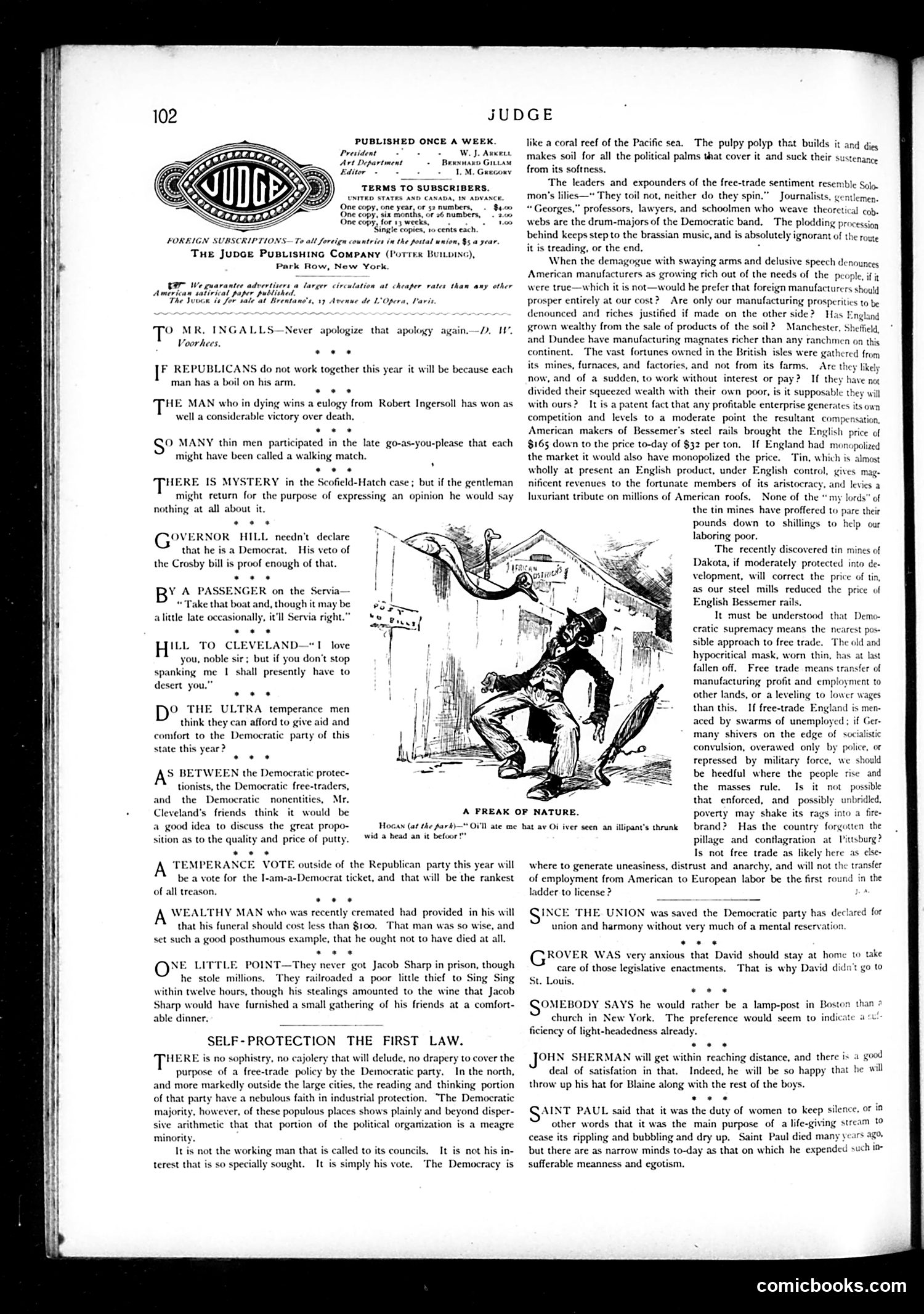
This cartoon depicts a grotesque figure labeled "Freak of Nature," apparently representing a political opponent or social threat. The surrounding text discusses Democratic party divisions, free-trade policy debates, and manufacturing competition with England. The image appears to be commentary on industrial/economic policy conflicts of the late 19th or early 20th century. The figure's exaggerated, contorted form suggests the cartoonist viewed a particular political position as unnatural or absurd—likely relating to protectionism versus free-trade arguments that divided the Democratic party. The accompanying text references factory competition, English manufacturing, and tariff disputes, suggesting the "freak" represents either free-trade extremism or protectionist policy, though the specific target remains somewhat unclear from this page alone.
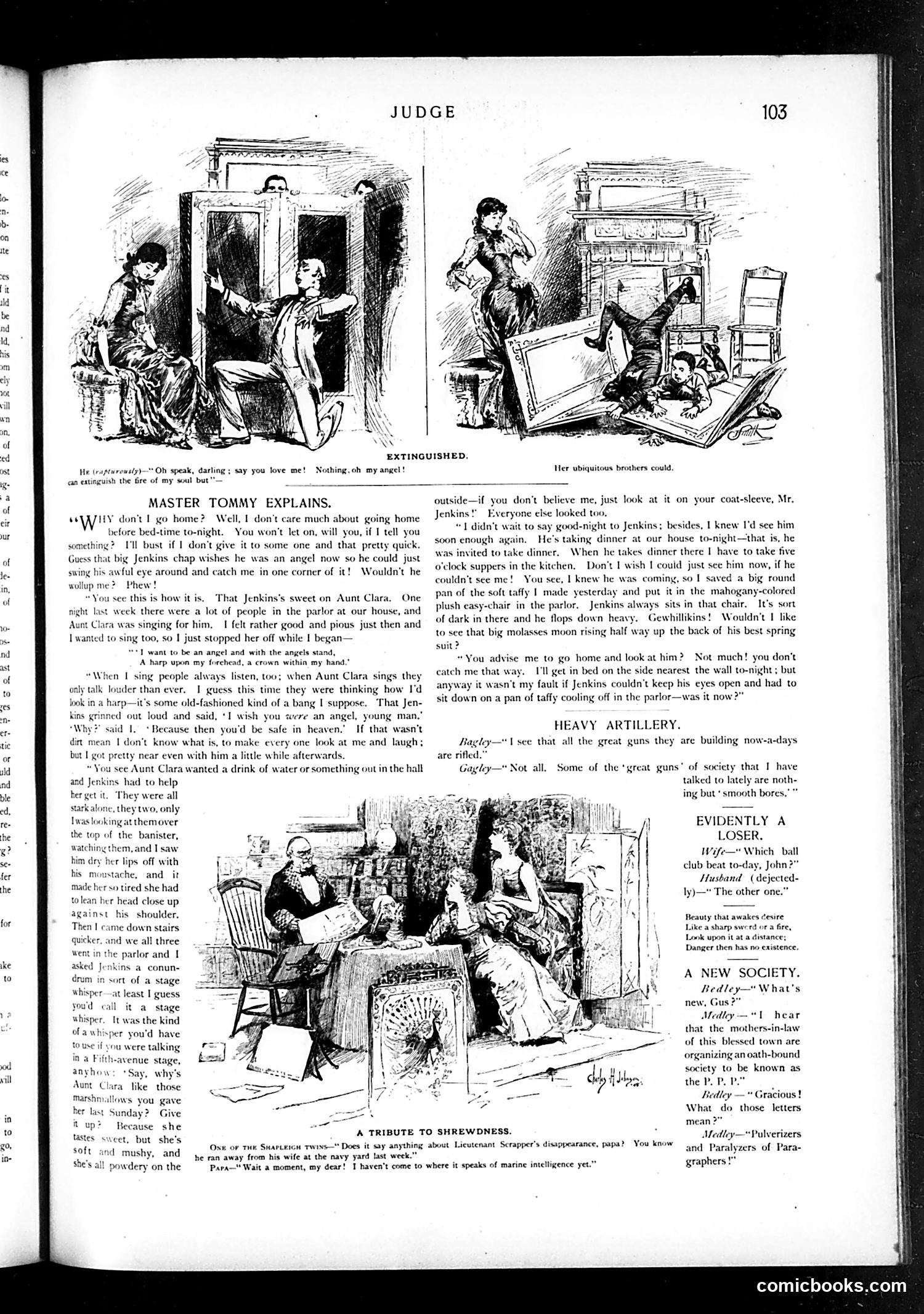
This page from *Judge* contains three satirical pieces: **"Master Tommy Explains"** is a coming-of-age humor piece where a boy describes tricking a suitor (Jenkins) into sitting on hidden taffy in the parlor. The joke relies on Victorian domestic courtesy—Jenkins cannot react openly to the prank without scandal. The boy's triumphant narrative mocks both adult propriety and Jenkins's awkward position. **"Heavy Artillery"** is a pun contrasting military "great guns" (cannons) with society's "great guns" (prominent people), describing the latter as "smooth bores"—empty-headed despite their status. **"Evidently a Loser"** presents a husband returning from his club defeated, admitting "the other one" won—a brief joke about gambling or competition. The page uses ink illustrations and conversational humor typical of *Judge*'s satirical approach to upper-middle-class American life, targeting pretension, courtship customs, and social pretense with lighthearted mockery.
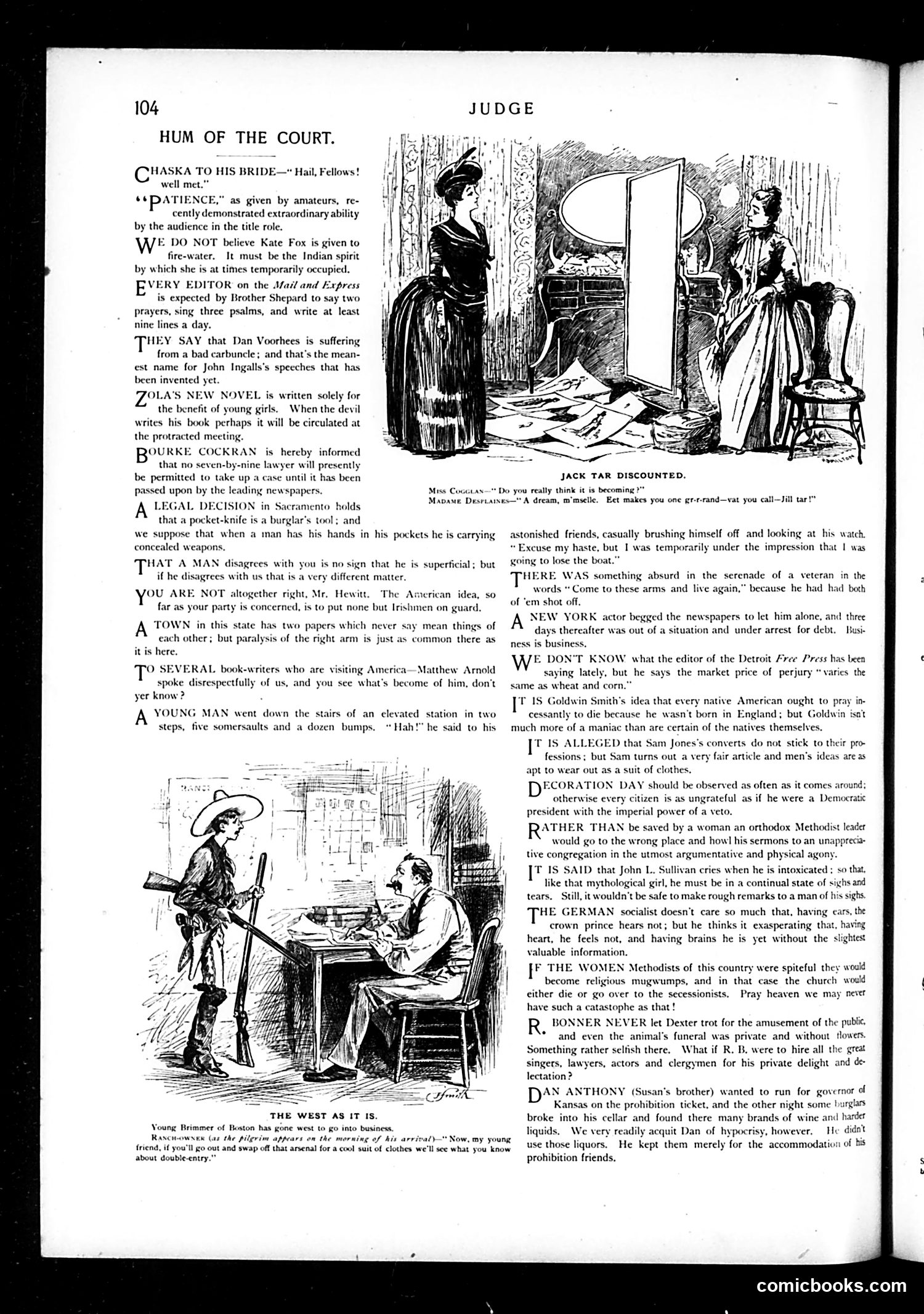
This page from *Judge* magazine contains brief satirical commentary on contemporary American figures and issues, circa late 19th century. **Key targets include:** - **Kate Fox** (spiritualist medium): Mocked for allegedly channeling "Indian spirits" while possibly intoxicated - **Dan Voorhees** (politician): His speeches compared to a "bad carbuncle" (a painful skin infection) - **Bourke Cockran** (lawyer): Criticized as insignificant - **Matthew Arnold** (British critic): Ridiculed for disparaging Americans - **Goldwin Smith** (intellectual): Called a "maniac" for his pro-British sentiments **The cartoons** include "Jack Tar Discounted" (a sailor's romantic delusion) and "The West As It Is" (a Boston businessman humorously accosted by a Westerner about his gun). The satire attacks pretension, hypocrisy, and absurdity across spiritualism, politics, and cultural criticism—*Judge*'s typical function as a middle-class humor magazine puncturing inflated reputations.
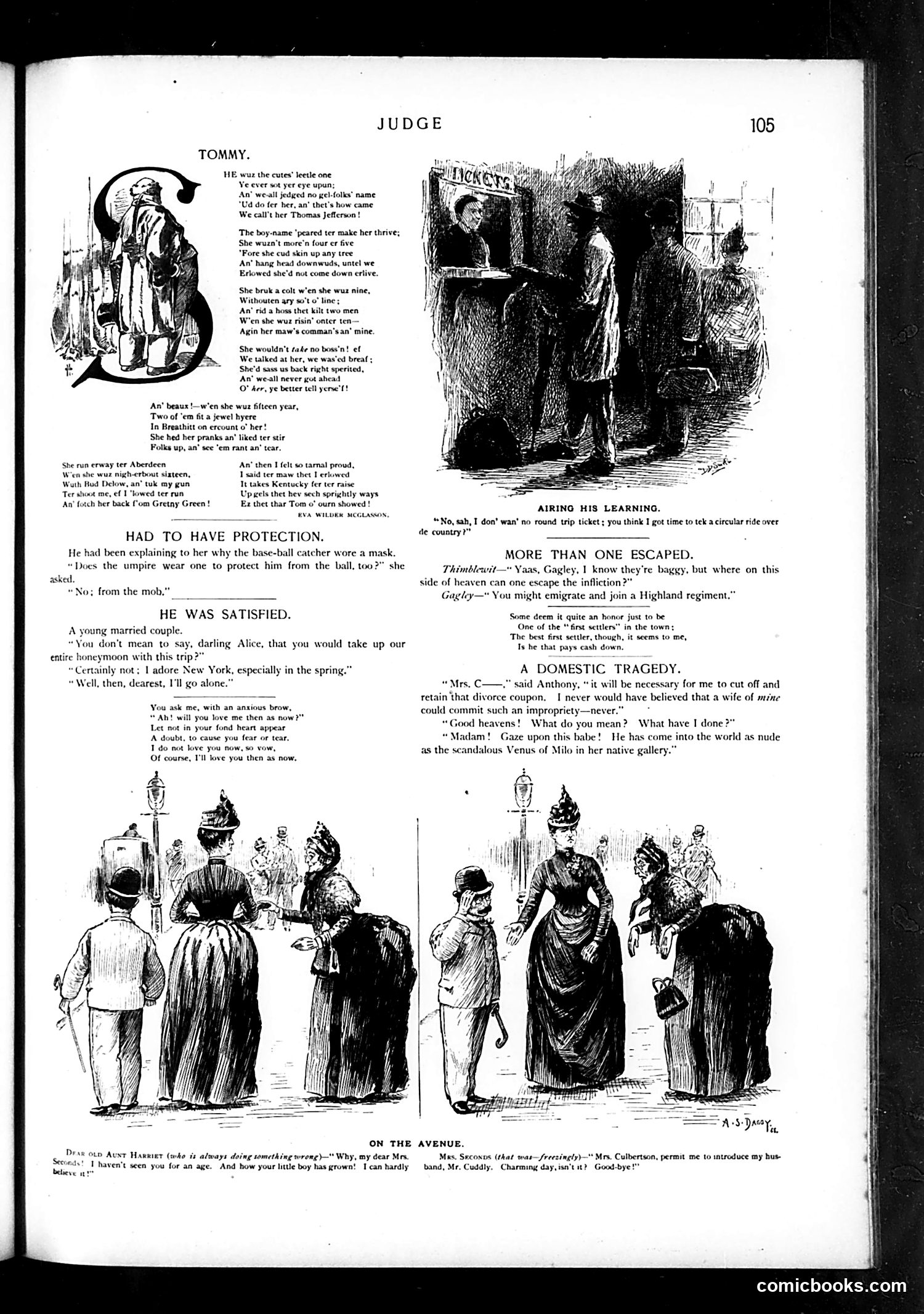
This page contains multiple satirical pieces typical of late 19th-century American humor: **"Tommy"** is a dialect poem celebrating a tomboy girl named Thomas Jefferson, raised in Kentucky. The satire mocks sentimental Victorian femininity by praising a girl who breaks colts, rides dangerous horses, and runs away—behavior considered scandalous for her era. The father's pride ("It takes Kentucky fer ter raise / Upgels thet hev sech sprightly ways") ironically inverts conventional expectations about female propriety. **"A Domestic Tragedy"** satirizes prudish Victorian attitudes about female modesty, where a husband discovers his wife has borne a child—the implication being she's seen naked, violating decorum. **"On the Avenue"** jokes about divorce and remarriage among the wealthy, with "Mrs. Seconds" (a woman remarried) coldly introducing her new husband before leaving. Other brief pieces mock baseball, honeymoon expectations, and urban pretension. The illustrations show typical Victorian street scenes and domestic scenarios that accentuate the absurdity of the social conventions being lampooned.
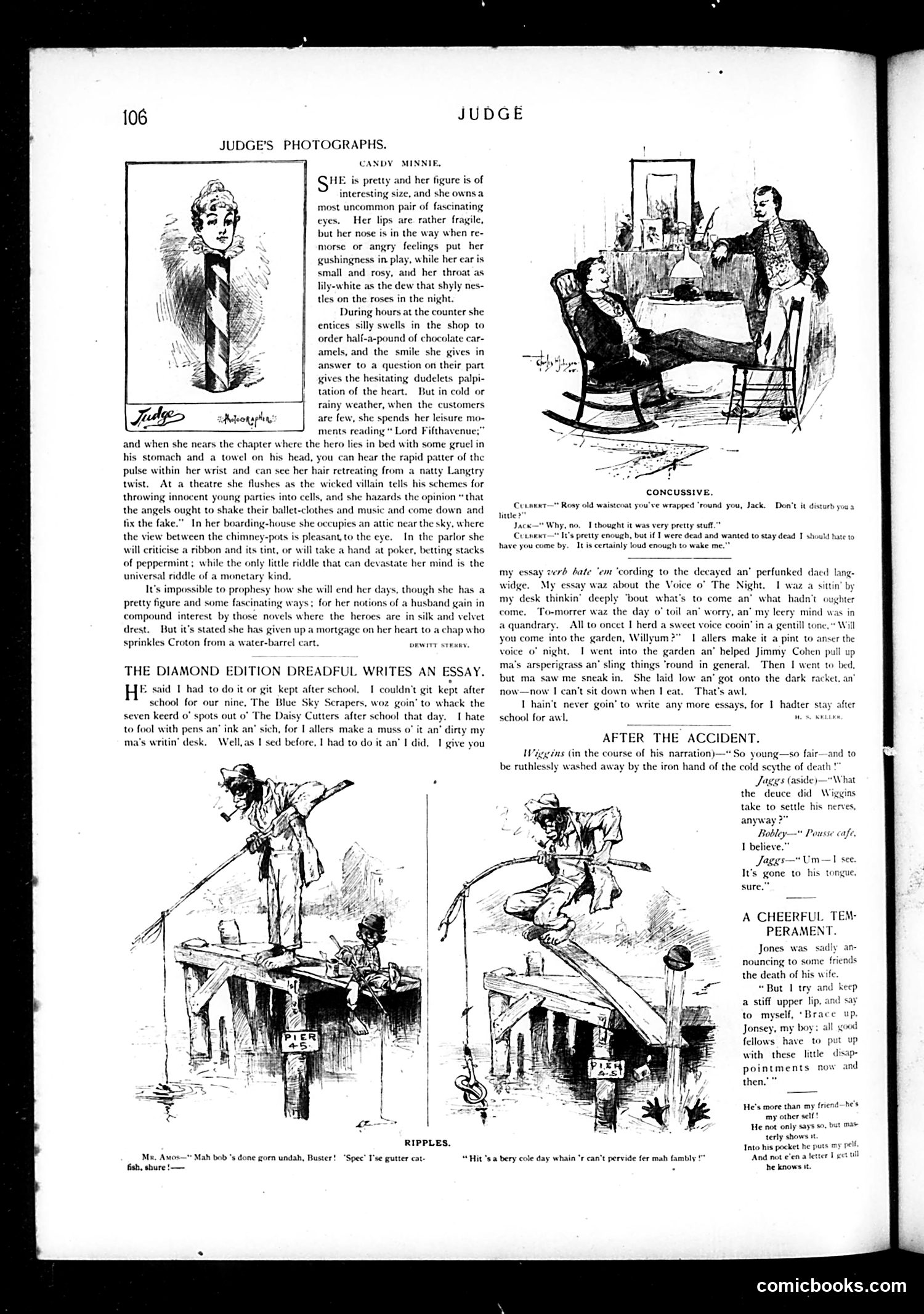
This page from *Judge* magazine contains three distinct satirical pieces: **"Candy Minnie"** profiles a shop girl who sells chocolates, portraying her as sentimentally romantic—she's moved to tears by penny dreadfuls about sickly heroes and theatrical melodrama, yet pragmatically dreams of marrying a man who works with "a water-barrel cart," suggesting modest aspirations despite her romantic imagination. **"The Diamond Edition Dreadful Writes an Essay"** satirizes poorly educated youth and cheap serialized fiction. A boy writes a school essay in deliberately misspelled, grammatically mangled dialect about hearing a "voice" calling him into a garden—where he helps steal his neighbor's asparagus. The satire mocks both the boy's illiteracy and the sensational "dreadful" literature that corrupts youth. **"Ripples"** and **"Concussive"** are brief humorous snippets about everyday absurdities—poverty, old clothing. The page collectively satirizes working-class sentimentality and the perceived cultural dangers of cheap popular literature to the uneducated masses.
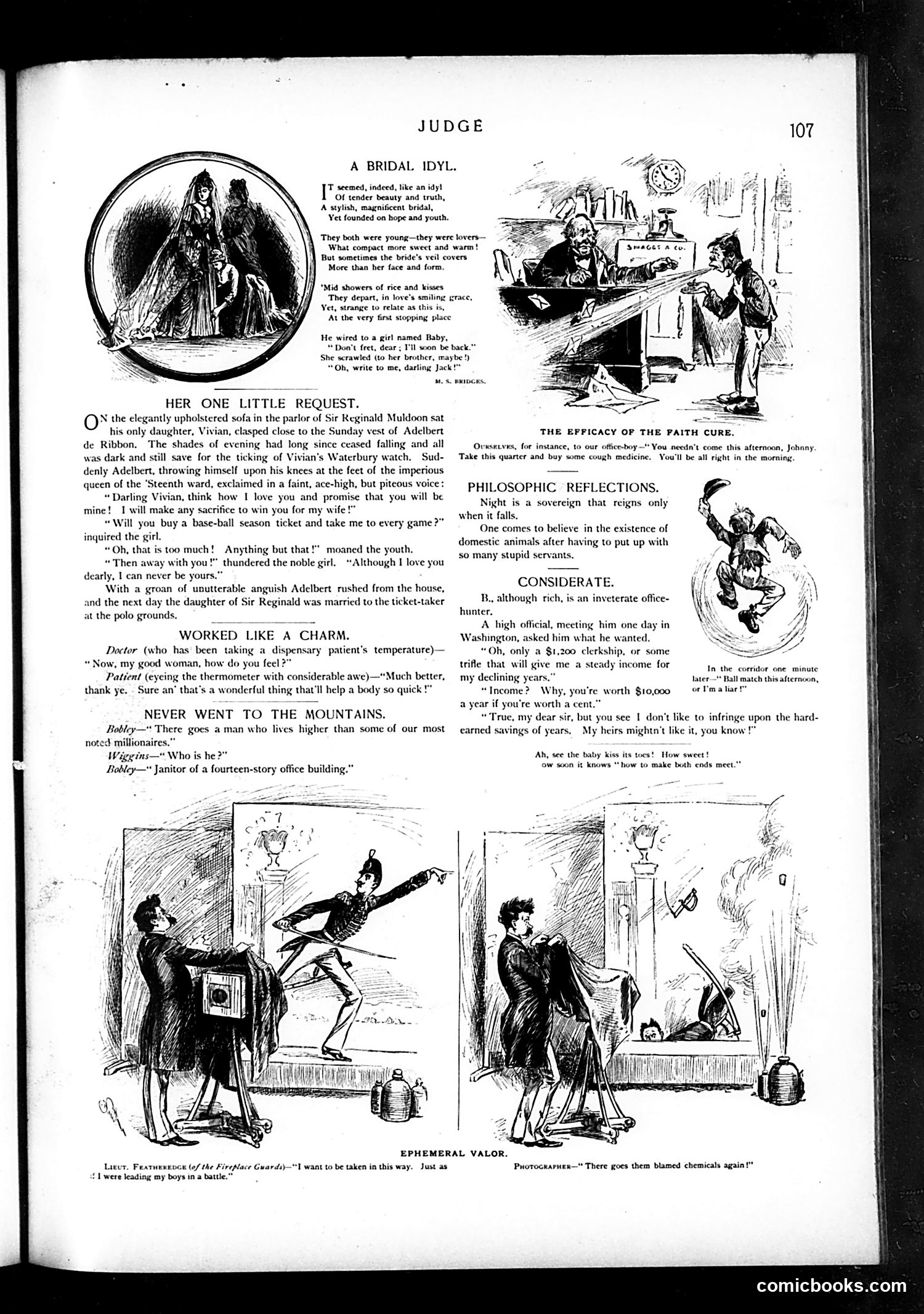
This page satirizes romantic and social pretense in Gilded Age America. The title piece mocks newlyweds whose marriage appears ideal but conceals infidelity—the groom immediately telegraphs another woman ("Baby") during his honeymoon, revealing the bride's veil covers deception, not virtue. "Her One Little Request" ridicules materialistic courtship: a wealthy suitor refuses to buy his fiancée baseball season tickets, so she marries the polo-ground ticket-taker instead—suggesting women's supposedly romantic nature is actually transactional. Other brief pieces lampoon workplace hierarchy, wealth pretense, and masculine posturing. "Never Went to the Mountains" jokes that a janitor in a tall building literally lives "higher" than millionaires—simple wordplay on status. The overall tone reflects Judge's skepticism toward Victorian sentimentality and middle-class social climbing, exposing hypocrisy beneath genteel surfaces.
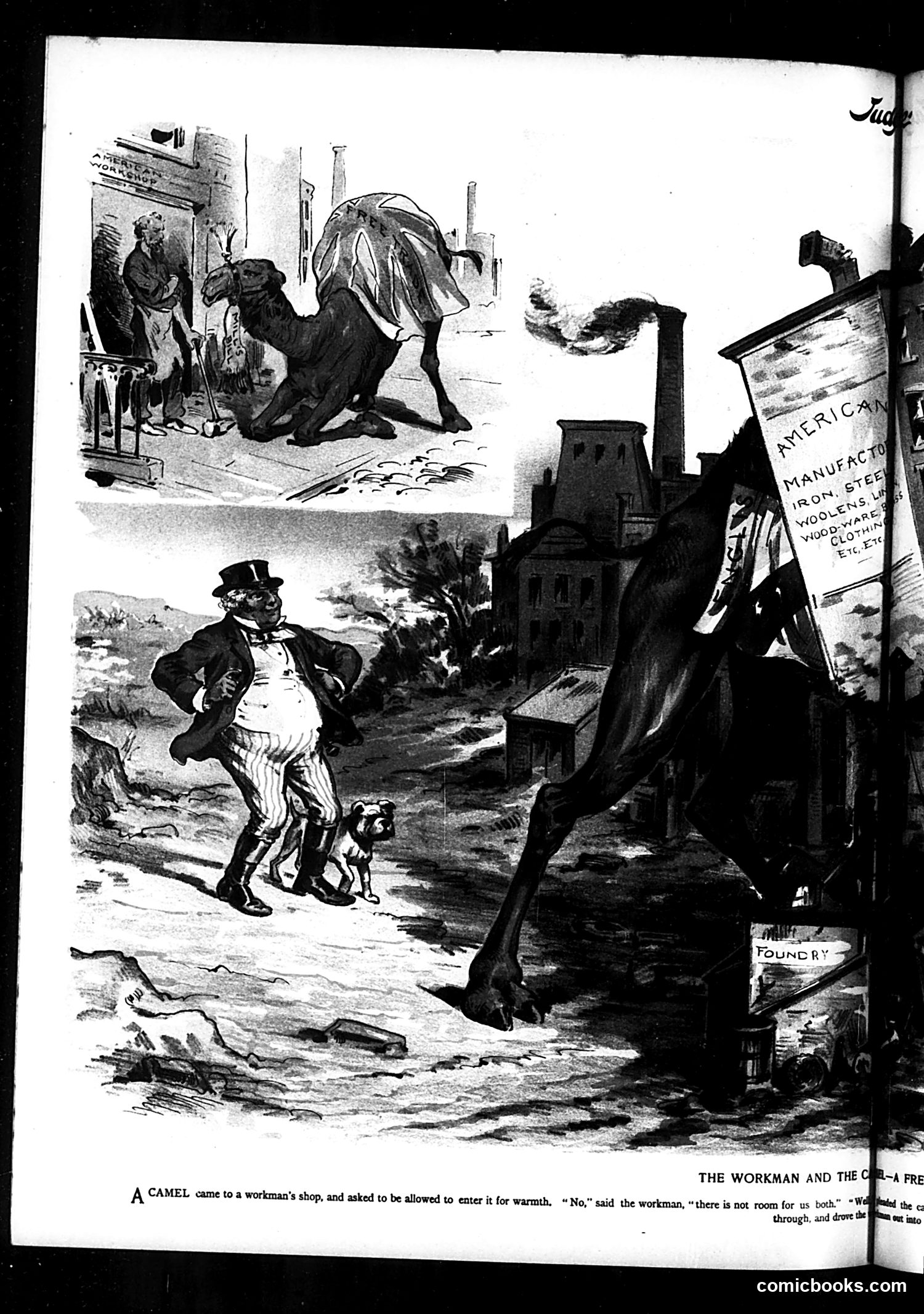
This appears to be a fable-based satirical cartoon, likely referencing the classic "Camel and the Tent" parable about incrementally surrendering space/rights. A camel seeks entry to a workman's shop for warmth; the workman refuses, saying there's no room for both. The top panel shows what appears to be a wealthy figure (possibly representing capital or monopoly interests) in a shop. The bottom depicts an industrial scene with factories, foundries, and manufacturing—suggesting labor/working-class themes. The incomplete OCR suggests the camel eventually forces its way in, driving the workman out—a metaphor for how economic forces or capitalist expansion allegedly displace workers. Judge magazine frequently used animal fables to critique labor relations and industrial power dynamics in the Gilded Age.
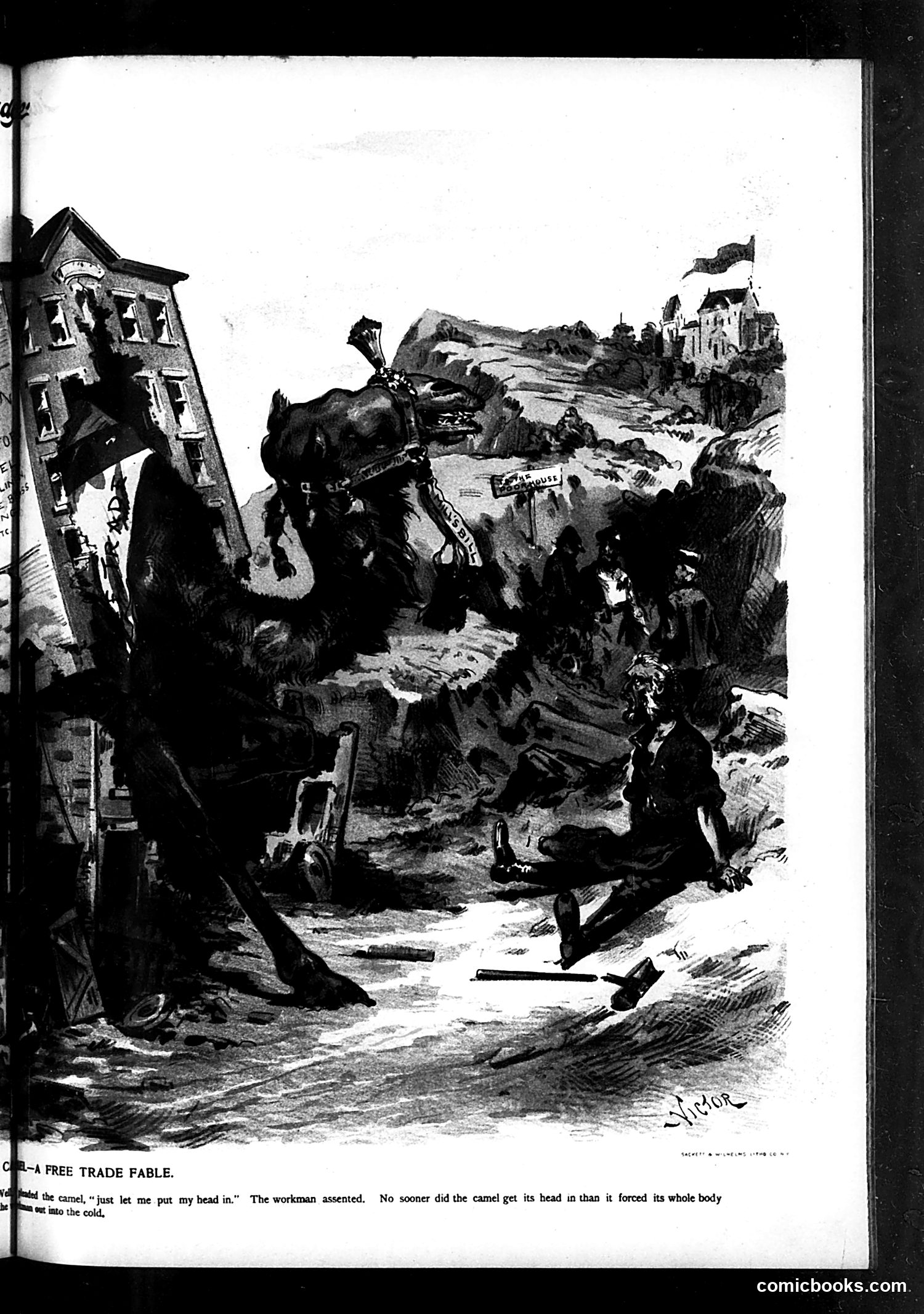
This appears to be a political cartoon satirizing free trade policy, illustrated by Victor (visible signature). The image depicts a camel forcing its way into a shelter—a visual adaptation of Aesop's fable about the camel and the tent. The cartoon uses this parable to argue against allowing foreign trade access to American markets. Just as the camel's "head in the door" leads to it taking over the entire shelter, the satire suggests that permitting initial free trade concessions will inevitably lead to complete economic takeover by foreign interests, displacing domestic workers and industries (represented by the figures being forced out). This reflects late 19th/early 20th-century protectionist arguments against free trade expansion.
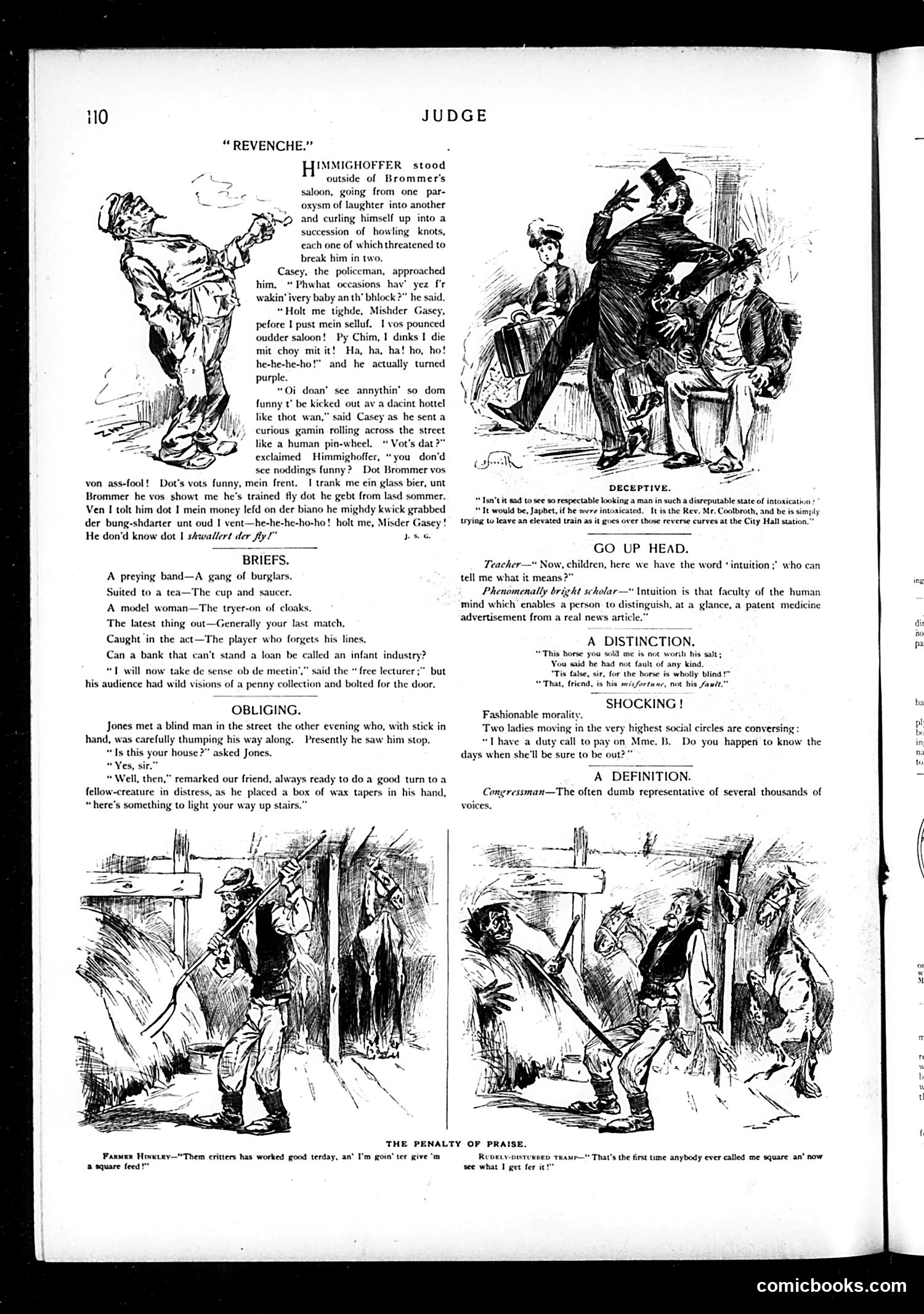
This page contains several brief satirical pieces typical of Judge's humor: **Main cartoon ("Revenge"):** An Irish immigrant named Himmighoffer recounts being kicked out of Brommer's saloon after swallowing a trained fly left on the piano. The humor relies on ethnic stereotypes—exaggerated German-Irish dialect and immigrant working-class culture—mocking both the character's drunkenness and the absurdity of the situation. **Surrounding content:** Short joke pieces satirize American society: corrupt congressmen ("dumb representative"), respectable-looking clergy disguised by drunkenness, fashionable ladies timing social calls to avoid hosts, and dishonest horse traders. **The satire targets:** Working-class immigrant behavior, urban vice (saloons), social hypocrisy among the wealthy and clergy, and general human foolishness. The ethnic caricature approach and crude dialect representation reflect late 19th-century Judge magazine's reliance on immigrant humor—often derisive by modern standards.
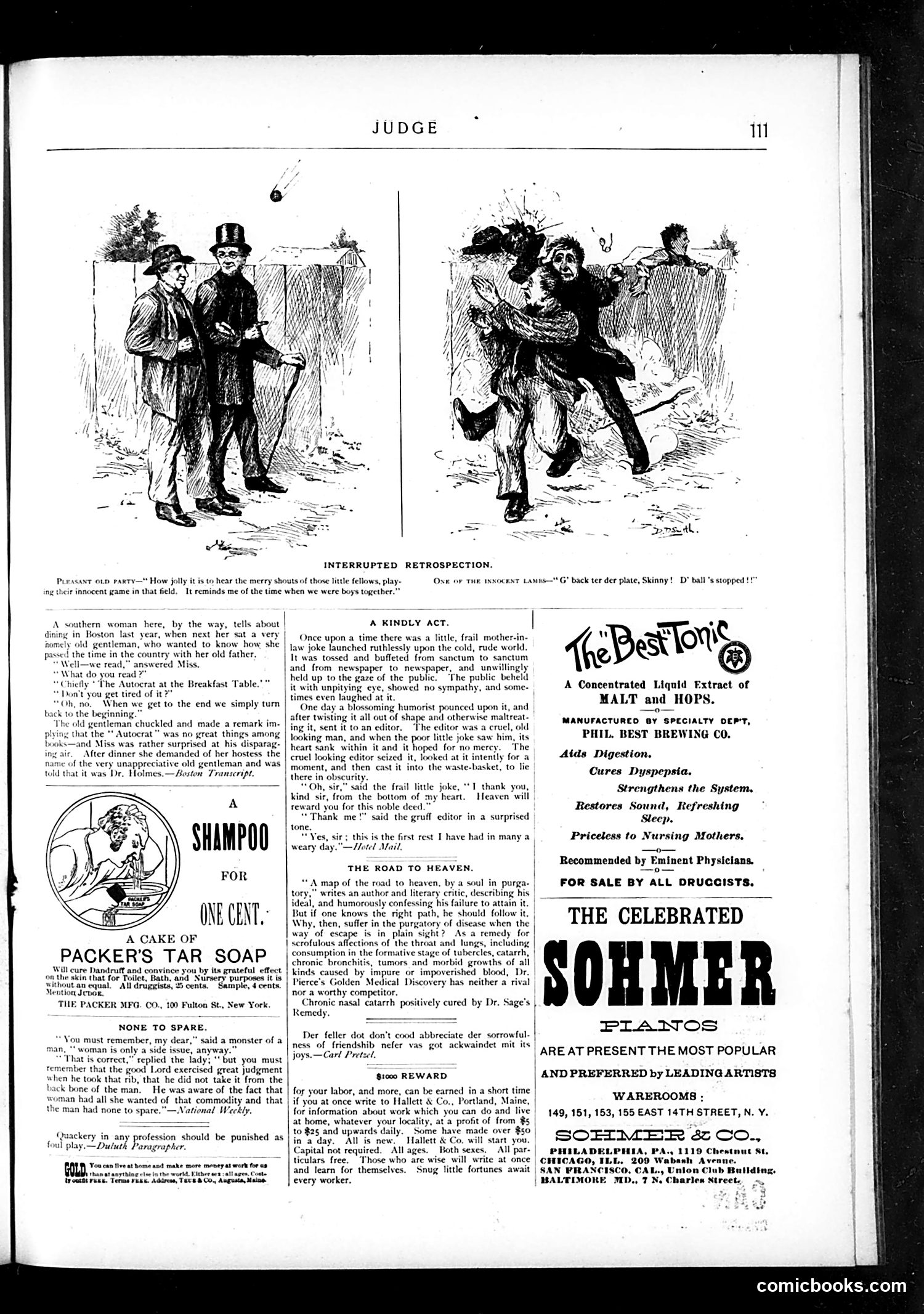
This page from *Judge* contains several satirical pieces and advertisements typical of late 19th-century American humor. **"Interrupted Retrospection"** (top): Two cartoons depicting gentlemen reminiscing about boyish pranks. The caption references "the merry shouts of those little fellows" playing innocently, contrasting with adults' cruder recollections—satirizing how nostalgia romanticizes childhood. **"A Kindly Act"**: A humorous allegory where a worn-out mother-in-law joke finally receives mercy when an editor discards it into the waste-basket. This mocks the tired, overused nature of this common joke format and editor's relief at its demise. **Various brief anecdotes** mock pretension (a woman rereading the same book repeatedly) and gender relations (a joke about women wanting men's "backbone"). The page is primarily **advertising-driven**, featuring patent medicines (Dr. Pierce's remedies), soap, and shampoo—typical of *Judge*'s revenue model. The editorial content serves mainly as filler between advertisements.
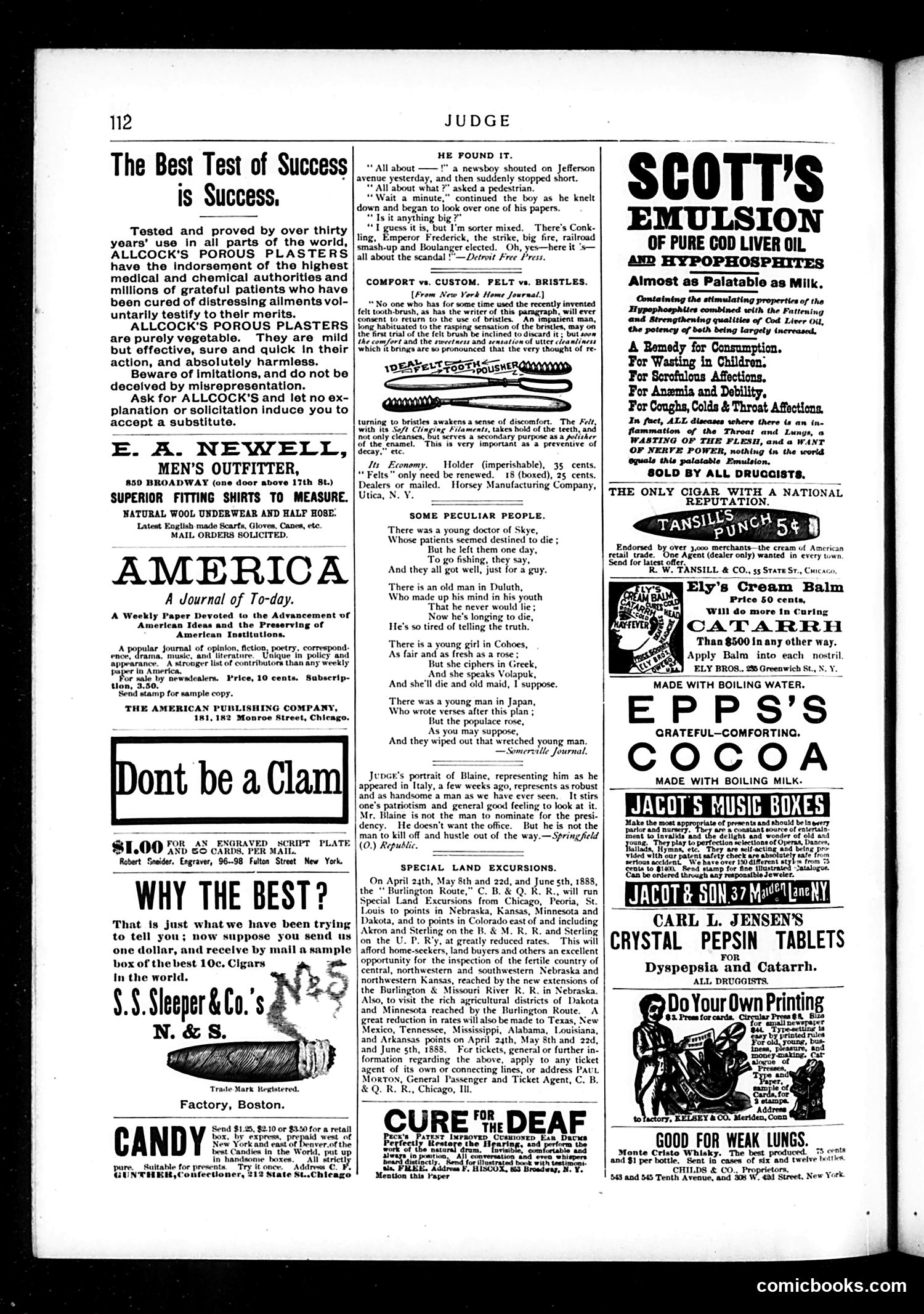
This page is primarily **advertising and filler content**, not political satire. The main elements are: **"He Found It"** (top center): A brief humorous anecdote about a newspaper boy struggling to decide which headline story is most important—mentioning Conkling, Emperor Frederick, a strike, fire, railroad accident, and Boulanger's election. The joke is that with so many major stories, the boy can't identify which is "the" story. **Remainder**: The page consists almost entirely of **product advertisements** (Allcock's Porous Plasters, men's clothing, cigars, candy, toothbrushes, cocoa, etc.) and **filler verse** like "Some Peculiar People" (lighthearted doggerel about odd individuals). There are **no identifiable political cartoons** on this page. The Boulanger reference and Conkling mention suggest late 1880s dating, but this is a standard Judge page mixing modest humor with commercial content.
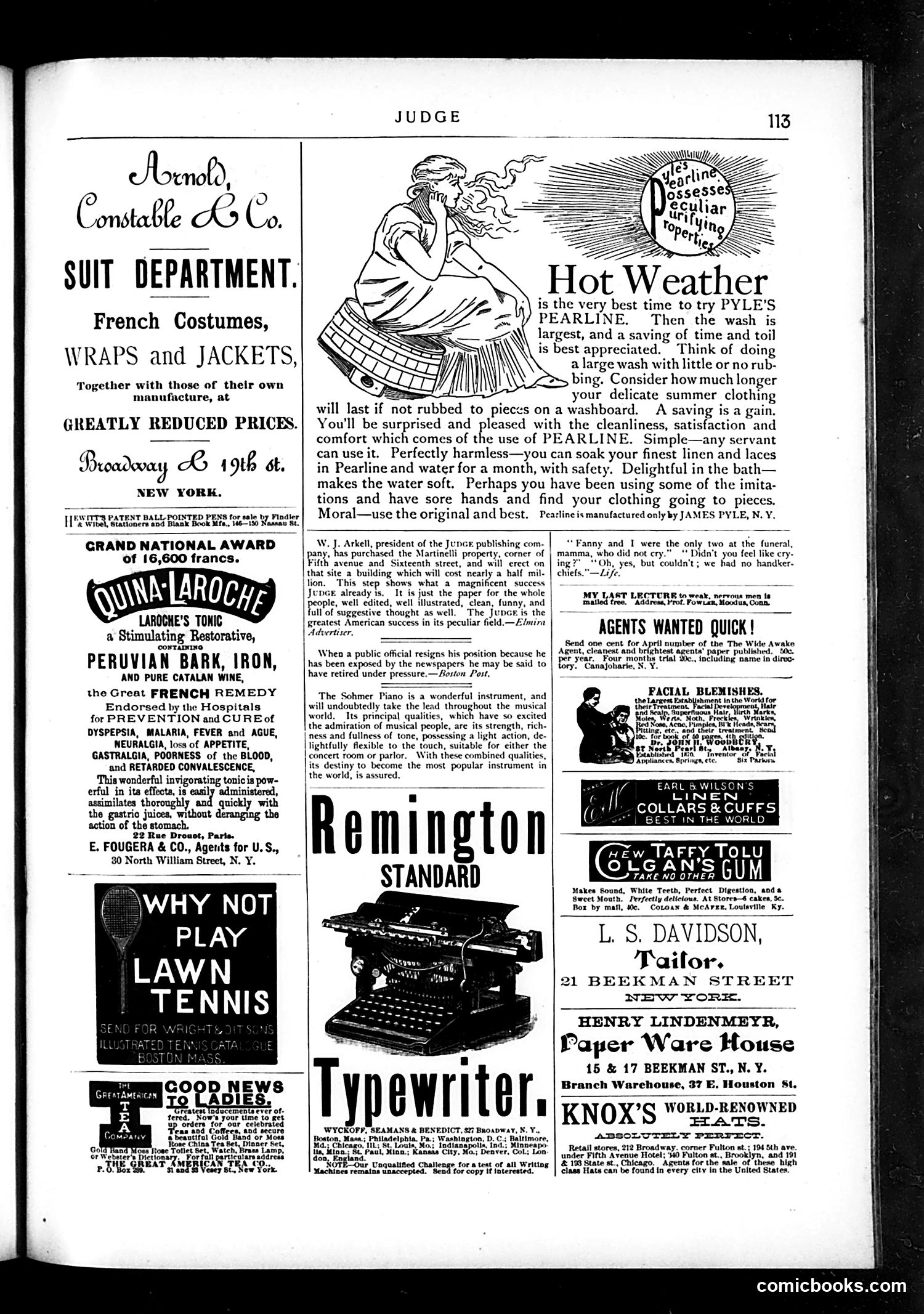
This is primarily an **advertising page** from Judge magazine, with minimal editorial content. The main featured ads are for commercial products popular in the 1880s-90s: Remington typewriters, Pyle's Pearline laundry soap, and Laroche's tonic (a patent medicine containing Peruvian bark and wine—typical for the era as a supposed cure-all). There's also an announcement that Judge's publisher has purchased valuable New York real estate, presented as evidence of the magazine's success. The only distinct joke appears at the bottom: a brief one-liner about a public official resigning after newspaper exposure, quipping he "retired under pressure"—light political satire of official embarrassment. The page itself isn't satirical; it's primarily commercial space. The cartoonish header illustration (woman doing laundry) is simply advertising artwork. Without additional context about specific political events or figures Judge was attacking that week, there's little to analyze beyond noting this represents how late-19th-century magazines monetized through dense advertising.
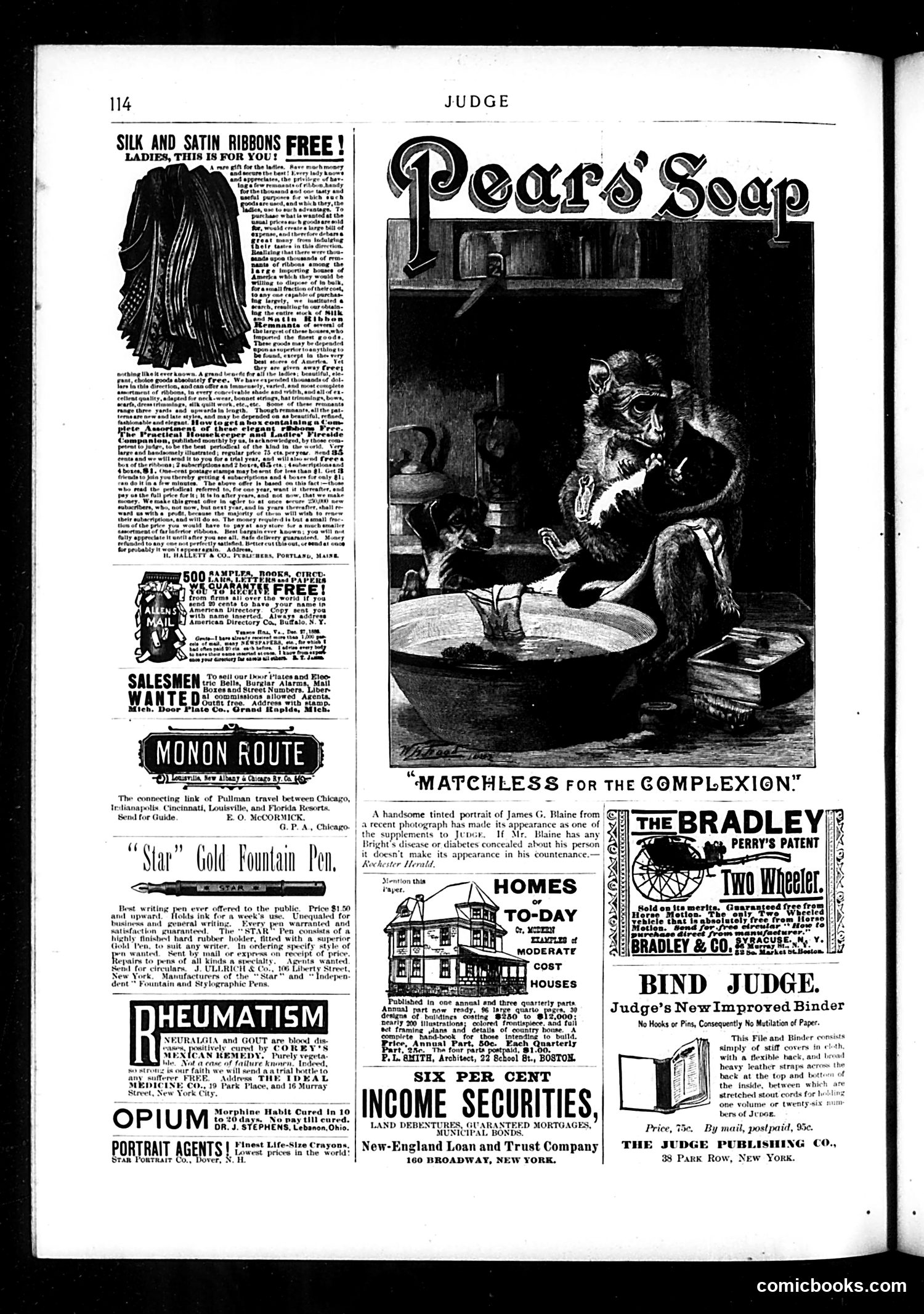
This page is primarily **advertising content** rather than political satire. The dominant image is a **Pear's Soap advertisement** titled "Matchless for the Complexion," depicting what appears to be a caricatured figure (possibly intended as comedic or ethnic caricature, typical of late 19th-century advertising) using the soap product. The accompanying text references **James G. Blaine**, a prominent Republican politician, noting that a portrait of him appeared in Judge's supplement. The Rochester Herald humorously comments that if Blaine suffered from Bright's disease (kidney disease) or diabetes, it doesn't show in his face—likely a gentle jab at his appearance or health. The page also contains numerous other advertisements (fountain pens, real estate, financial securities, portrait services) typical of Judge magazine's revenue model. **This is not primarily a satirical/political cartoon page but rather a standard advertising-heavy magazine page from the era.**
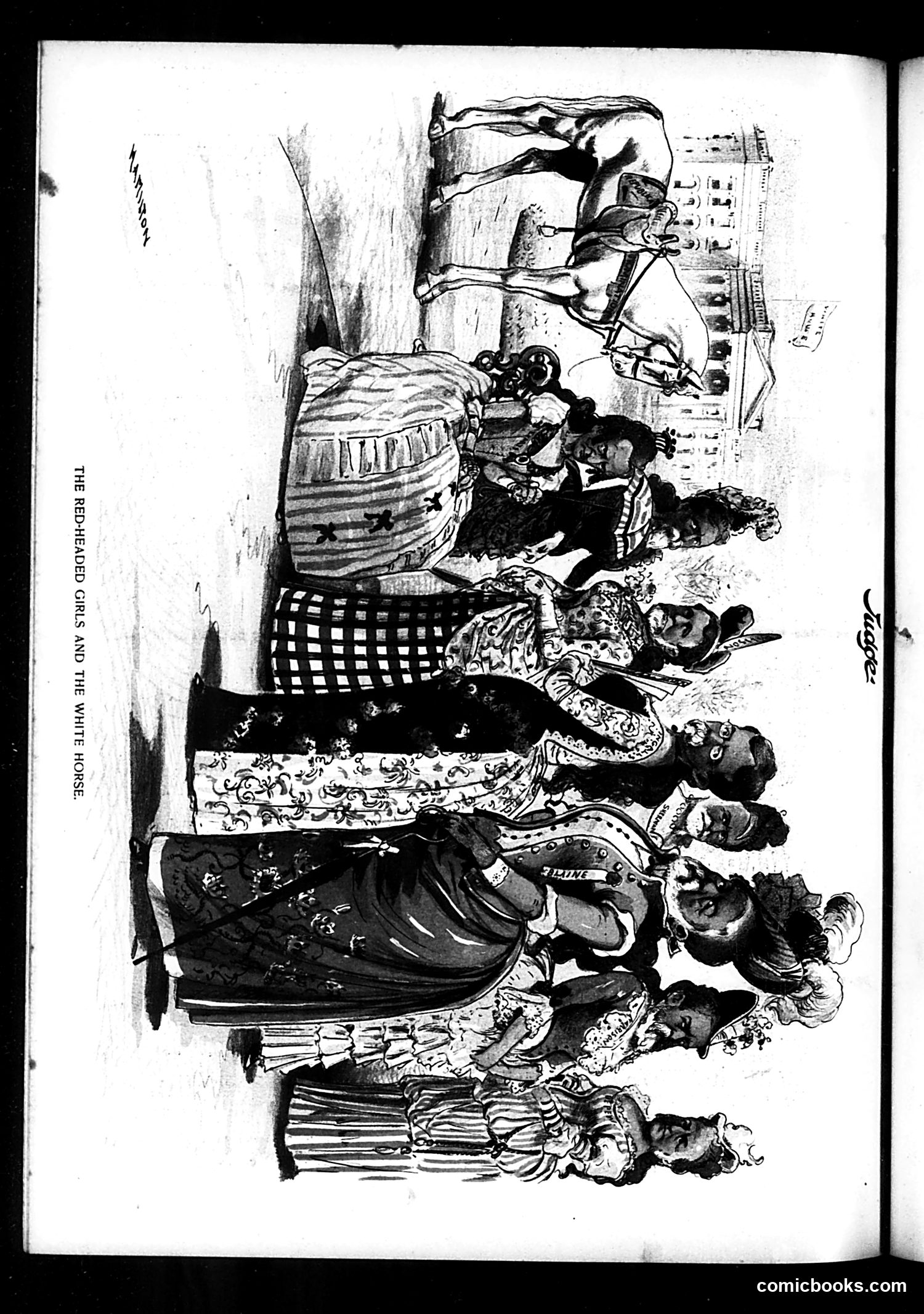
The page title reads "THE REDEEMED GIRLS AND THE WHITE HORSE," indicating this is a satirical scene. The image appears to show a Victorian-era social commentary piece depicting multiple figures in period dress arranged around a central white horse. The composition suggests satire regarding morality narratives common to the era—likely critiquing sentimental or melodramatic depictions of "fallen women" being "redeemed." The white horse may symbolize purity or salvation in the redemptive narrative being mocked. Without clearer context about *Judge* magazine's specific publication date or surrounding articles, I cannot identify particular historical figures or events referenced. The satire appears to target contemporary attitudes about female virtue and redemption storylines popular in Victorian literature and theater.