
A complete issue · 21 pages · 1888
Judge — May 5, 1888
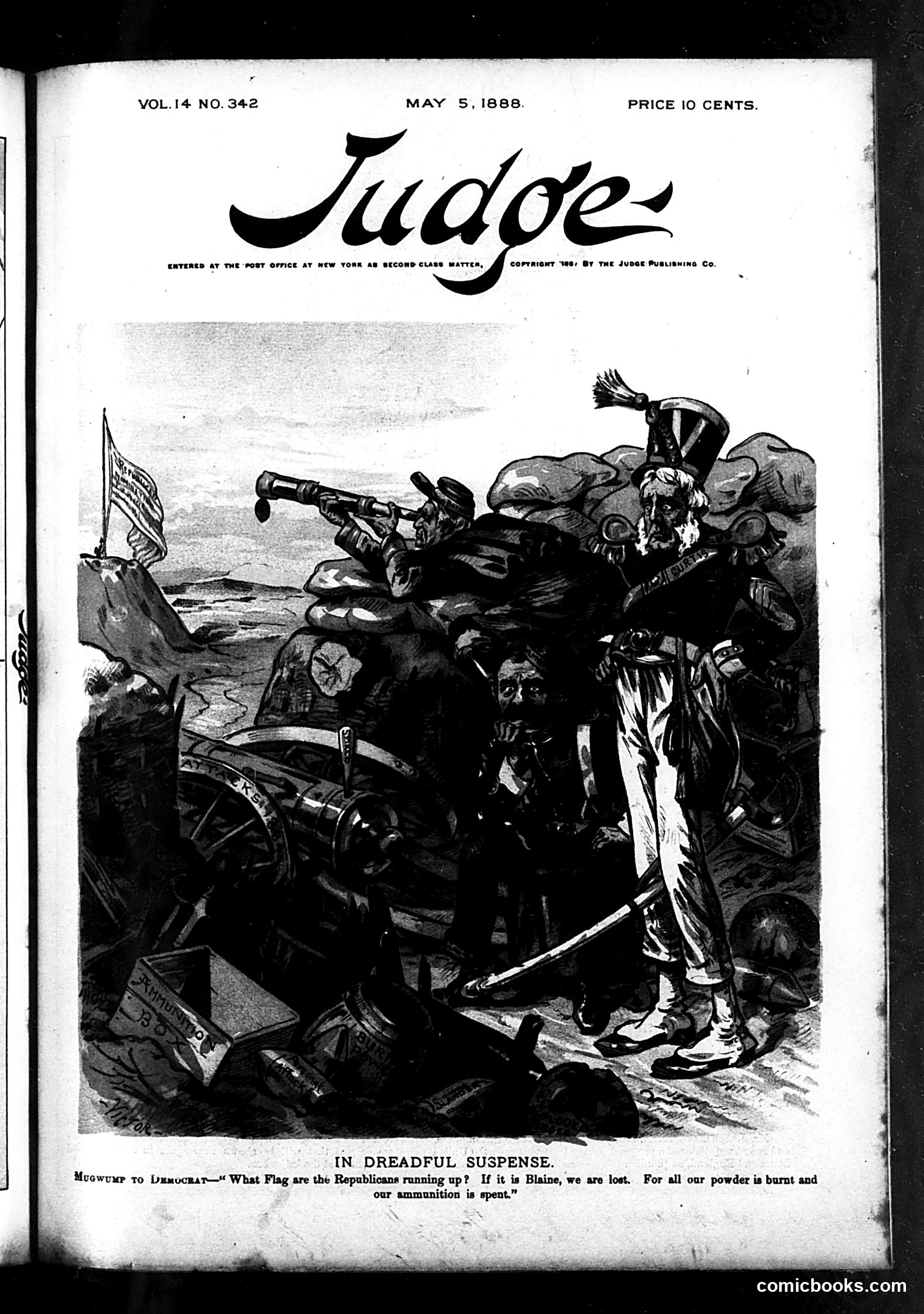
This cartoon satirizes Republican anxiety during the 1888 presidential election. The scene depicts a military fortification with American flag, where anxious figures peer through a telescope/cannon, asking "What Flag are the Republicans running up? If it is Blaine, we are lost." James G. Blaine was the likely Republican nominee. The cartoon mocks Republican internal divisions and uncertainty about their candidate choice. The military/fortification imagery suggests political warfare, while the "dreadful suspense" reflects genuine party fracturing. The Democratic response ("For all our powder is burnt and our ammunition is spent") indicates both parties faced resource exhaustion—possibly literal campaign spending or metaphorical political capital depletion heading into November's election.
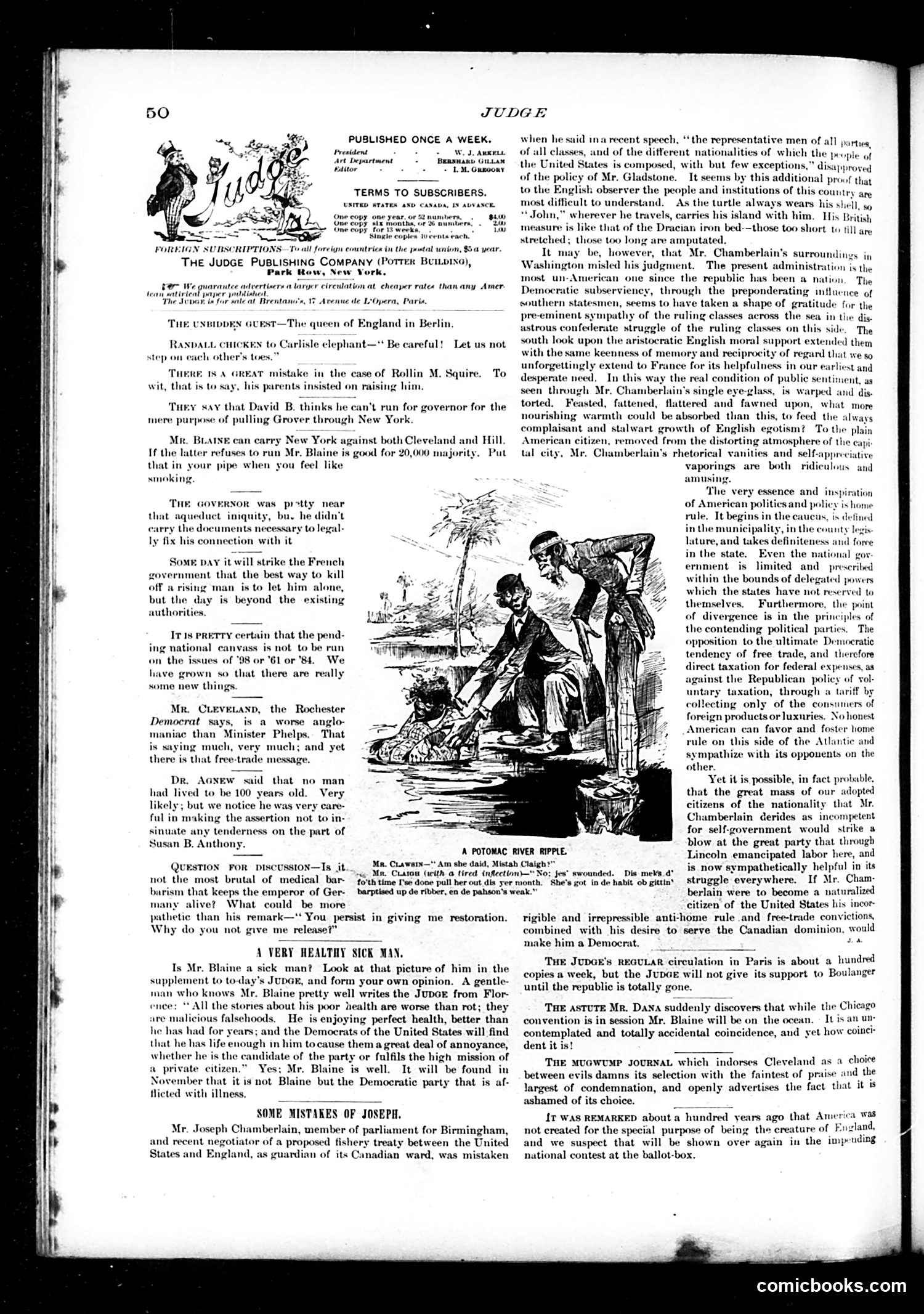
This cartoon satirizes Joseph Chamberlain, a British politician and recent negotiator of a proposed fisheries treaty between the United States and England. The text discusses his role as "guardian of its Canadian ward." The illustration shows well-dressed figures by the Potomac River, likely depicting diplomatic negotiations or social interaction related to the treaty discussions. The satire appears to mock Chamberlain's position as intermediary between American and British interests, particularly regarding Canadian affairs. The accompanying text ("Some Mistakes of Joseph") criticizes Chamberlain for various political miscalculations, suggesting the Judge magazine editors viewed his diplomatic efforts skeptically or found them bungling. The cartoon's riverside setting may reference the geographic context of American-Canadian-British relations.
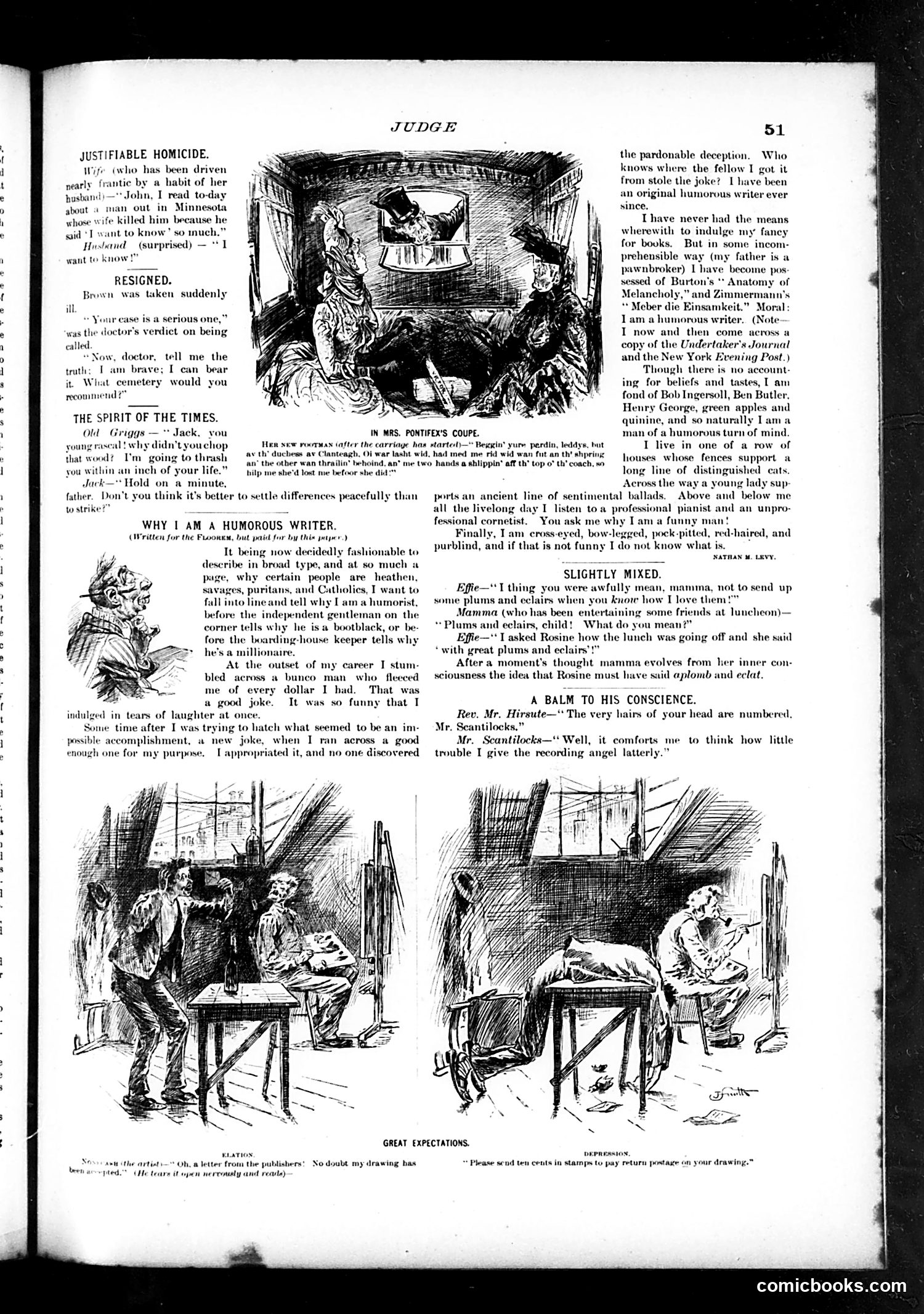
This page contains several satirical pieces mocking contemporary American life and social hypocrisy: **"Justifiable Homicide" and "Resigned"** mock marital discord—wives threatening husbands over annoying habits, husbands suggesting their deaths. **"The Spirit of the Times"** satirizes the era's new emphasis on peaceful conflict resolution (likely referencing labor disputes or social reform movements), showing a father about to beat his son, who advocates for "peaceful" settlement instead. **"Why I Am a Humorous Writer"** is self-deprecating satire about the author's own methods—admitting he steals jokes, has no education except inherited books, lives among mediocre musicians, and possesses unfortunate physical characteristics. The humor lies in confessing fraud while claiming genius. **"Slightly Mixed"** jokes about a child mishearing French words ("plums and eclairs" misheard as "aplomb and eclat"). **"A Balm to His Conscience"** puns on a bald man (Scantilocks) finding comfort that God tracks fewer of his hairs. The cartoons throughout illustrate these verbal jokes visually.
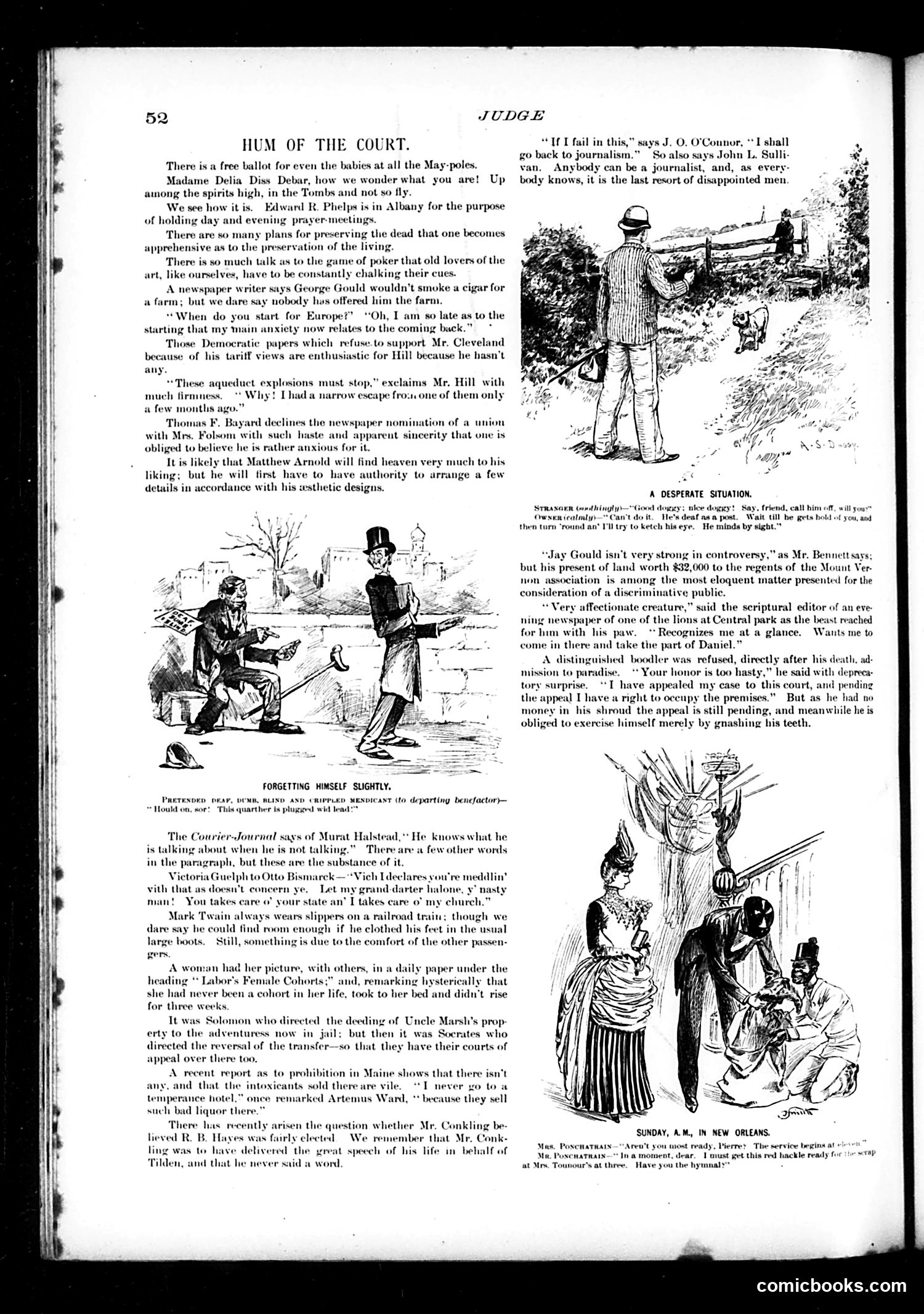
This page from Judge combines satirical commentary on contemporary politics and public figures with humorous illustrations. The "Hum of the Court" section offers brief, pointed jabs at various notable figures of the era. Key targets include: - **J. O. O'Connor and John L. Sullivan**: Both allegedly threaten to return to journalism if they fail—presented as a profession for "disappointed men." - **Jay Gould**: Criticized for weak debating skills, though his $32,000 land donation to Mount Vernon is sarcastically praised as "eloquent matter." - **Political figures (Cleveland, Hill)**: Democrats are mocked for inconsistent positions on tariffs and candidates. The illustrations depict everyday social scenarios ("A Desperate Situation," "Sunday A.M. in New Orleans") unrelated to the text—typical of Judge's format mixing political commentary with general-interest humor. The page exemplifies Gilded Age satirical journalism targeting wealthy industrialists, politicians, and social pretension.
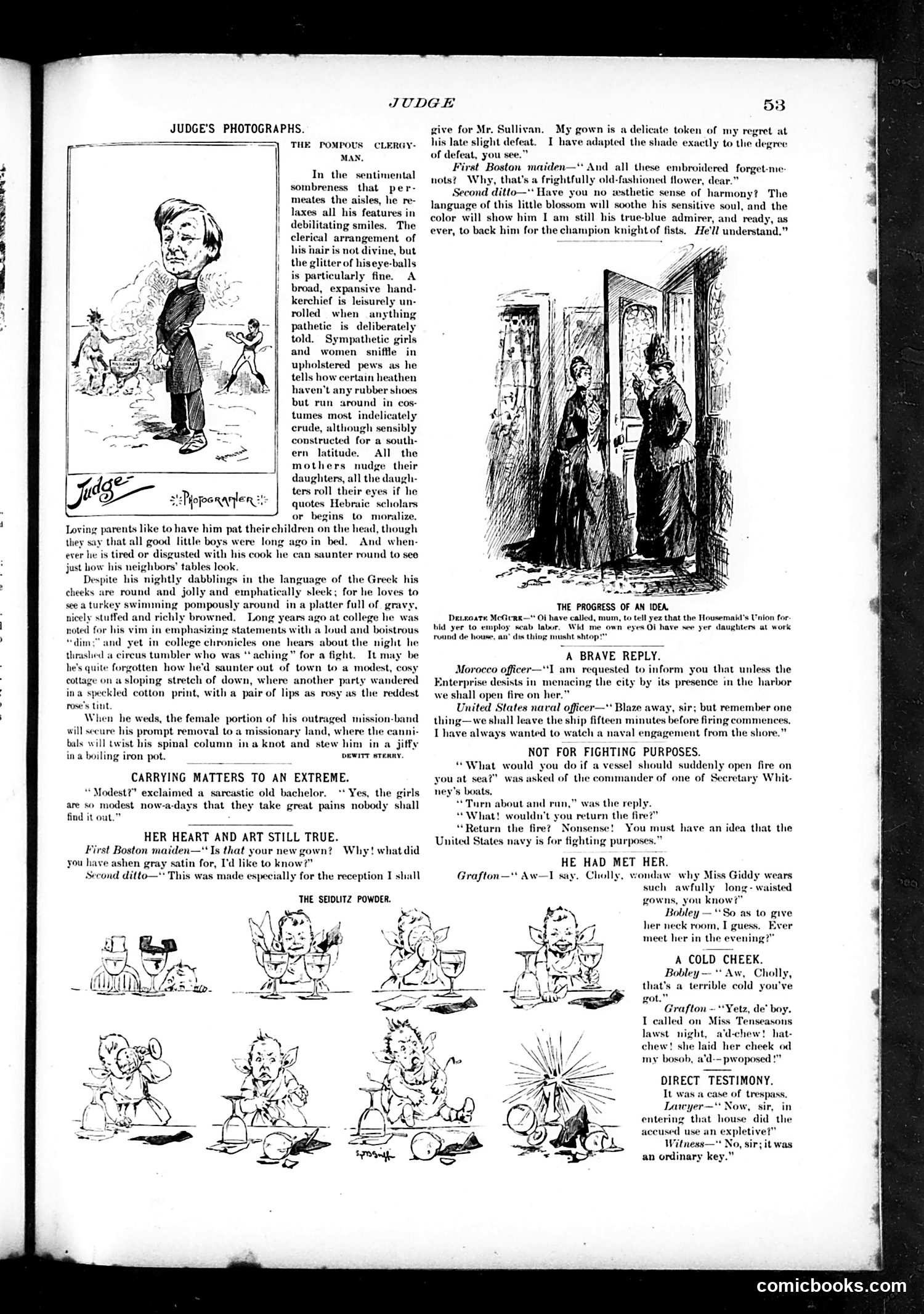
This page satirizes a pompous clergyman through detailed character sketch and several unrelated humor pieces. **"The Pompous Clergyman"** (main feature): A lengthy, illustrated critique of a sanctimonious minister—round-cheeked, well-fed, emotionally manipulative in sermons about heathen poverty, yet personally gluttonous and prone to visiting neighbors' tables. The satire mocks his theatrical piety, college-era rowdiness (fighting circus performers), and inevitable missionary-bound fate if he marries a missionary's daughter. This reflects 19th-century skepticism toward clergy hypocrisy. **Minor jokes** include a woman choosing gray satin and forget-me-nots to support boxer Sullivan after defeat; an Irish housemaid enforcing a union ban on scab labor; and a U.S. naval officer humorously admitting he'd flee before combat to watch from shore. The "Seidlitz Powder" section contains sequential comic illustrations (unclear without better resolution). Overall: Social criticism targeting clerical pretension, class relations, and American military absurdity.
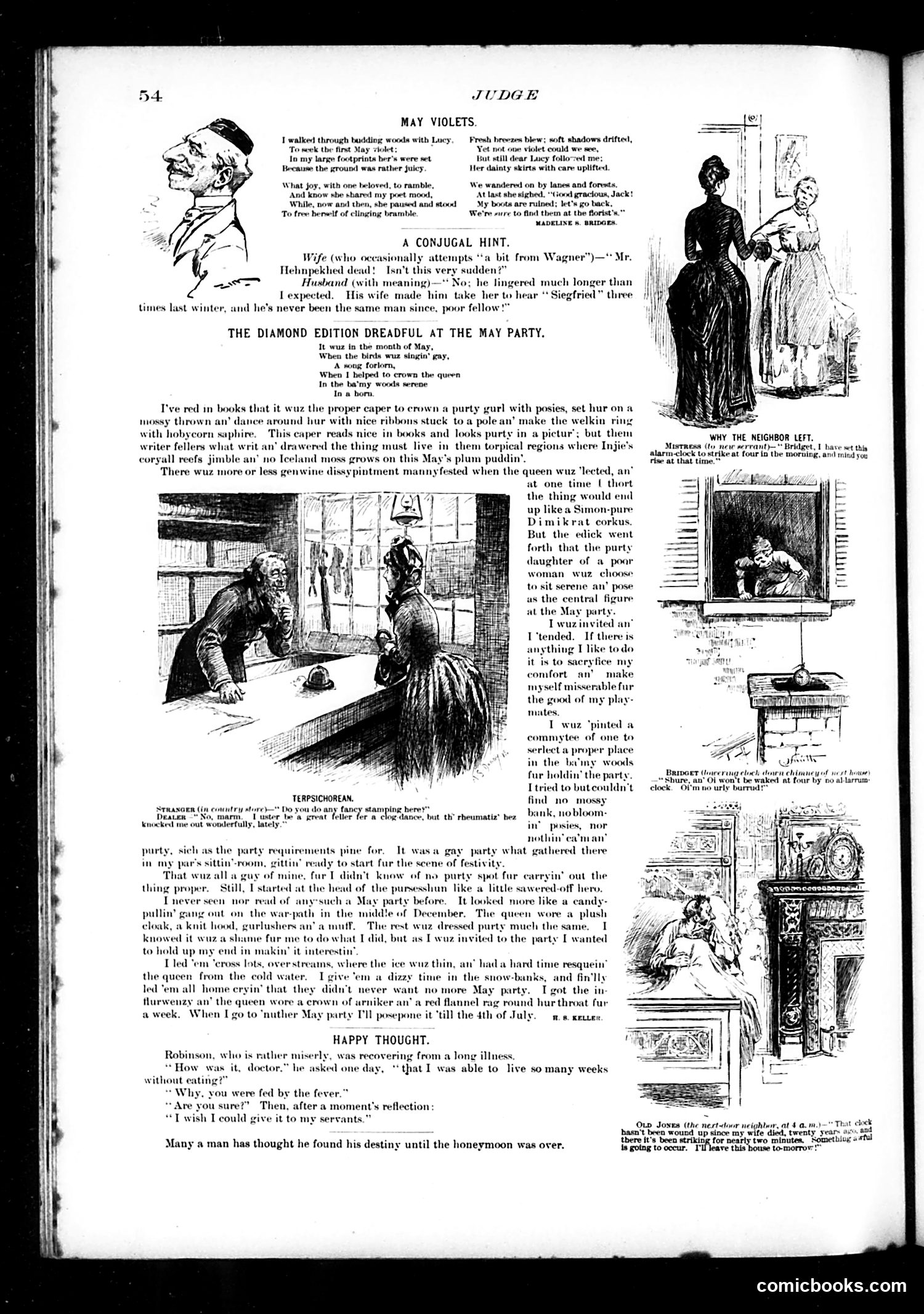
This page from *Judge* magazine contains several satirical pieces mocking everyday social situations: **"May Violets"** and **"A Conjugal Hint"** are light domestic humor. The first jokes about a romantic walk yielding no wildflowers—only florist flowers will do. The second depicts a henpecked husband traumatized by attending Wagner's opera three times, now lingering at concerts too long. **"The Diamond Edition Dreadful at the May Party"** is the main piece—a humorous tall tale in dialect about a poorly-executed May Day celebration in the woods. The narrator, appointed to find an ideal pastoral setting, discovers reality disappoints: instead of mossy banks and blooming flowers, the party attendees dress warmly and trudge through streams. The mock-heroic tone satirizes both romantic literary descriptions of nature celebrations and the gap between literary ideals and actual small-town American experience. **"Happy Thought"** is a brief joke about a miserly man grateful the fever fed him, wishing to pass it to his servants—dark humor about economic self-interest. The cartoons illustrate these pieces with period social scenes.
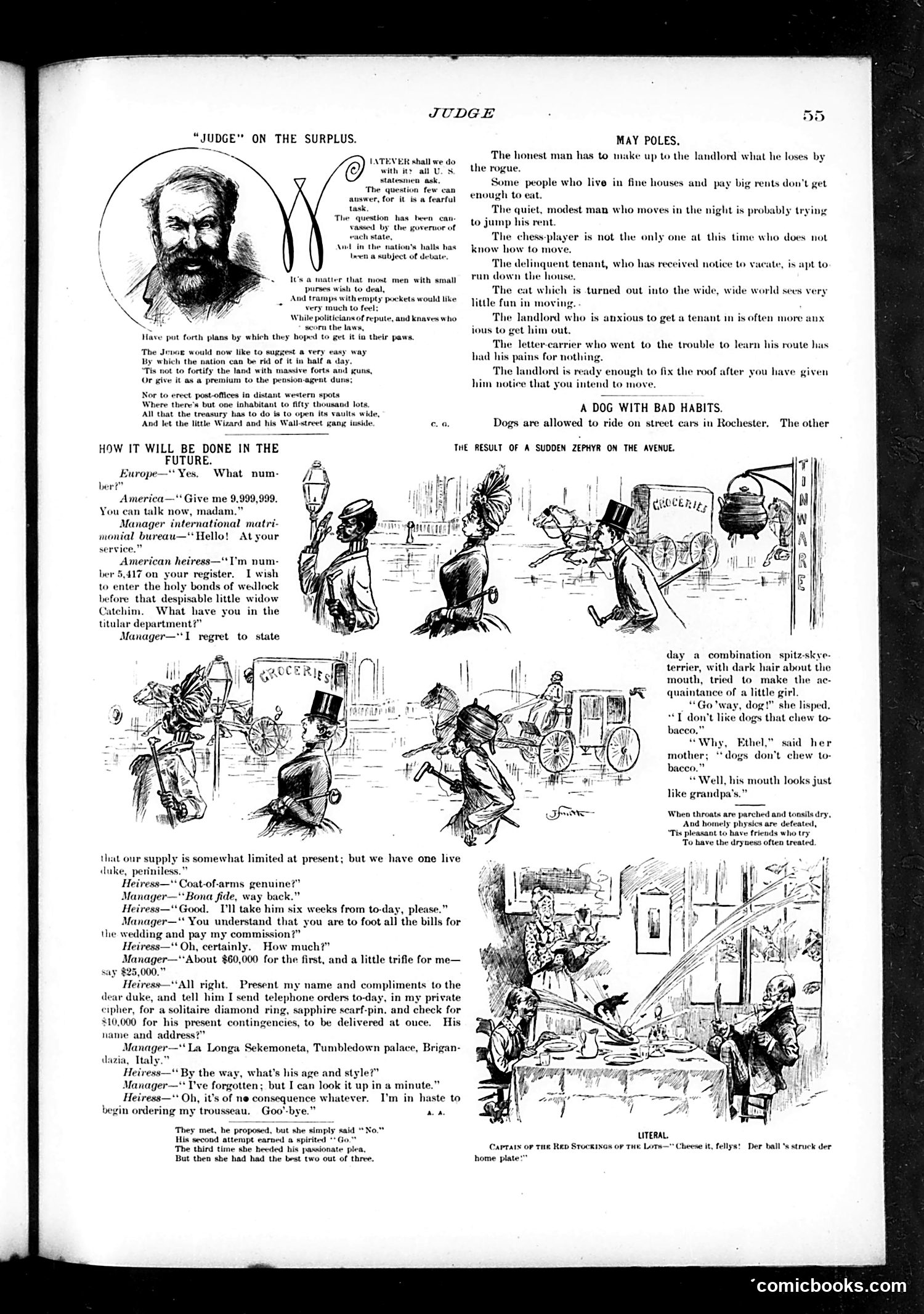
This page contains three distinct satirical pieces: **"Judge on the Surplus"** critiques the government's inability to manage a budget surplus, sarcastically suggesting letting a "little Wizard and his Wall-street gang" handle it—likely referring to President Cleveland's administration and Wall Street financiers, implying they'd squander public funds. **"How It Will Be Done in the Future"** mocks wealthy American heiresses purchasing European nobility. An heiress (numbered like merchandise) buys a fake Italian duke, paying $60,000 for the wedding plus $25,000 commission, demonstrating how industrial-era wealthy Americans were stereotyped as status-obsessed and gullible. **"A Dog with Bad Habits"** is a light joke about a dog's mouth resembling someone who chews tobacco, playing on the era's common tobacco use. The "May Poles" section offers brief social commentary on landlord-tenant relations and eviction practices of the period. The cartoons use exaggeration and caricature typical of Judge's satirical style to critique Gilded Age excess and social pretension.
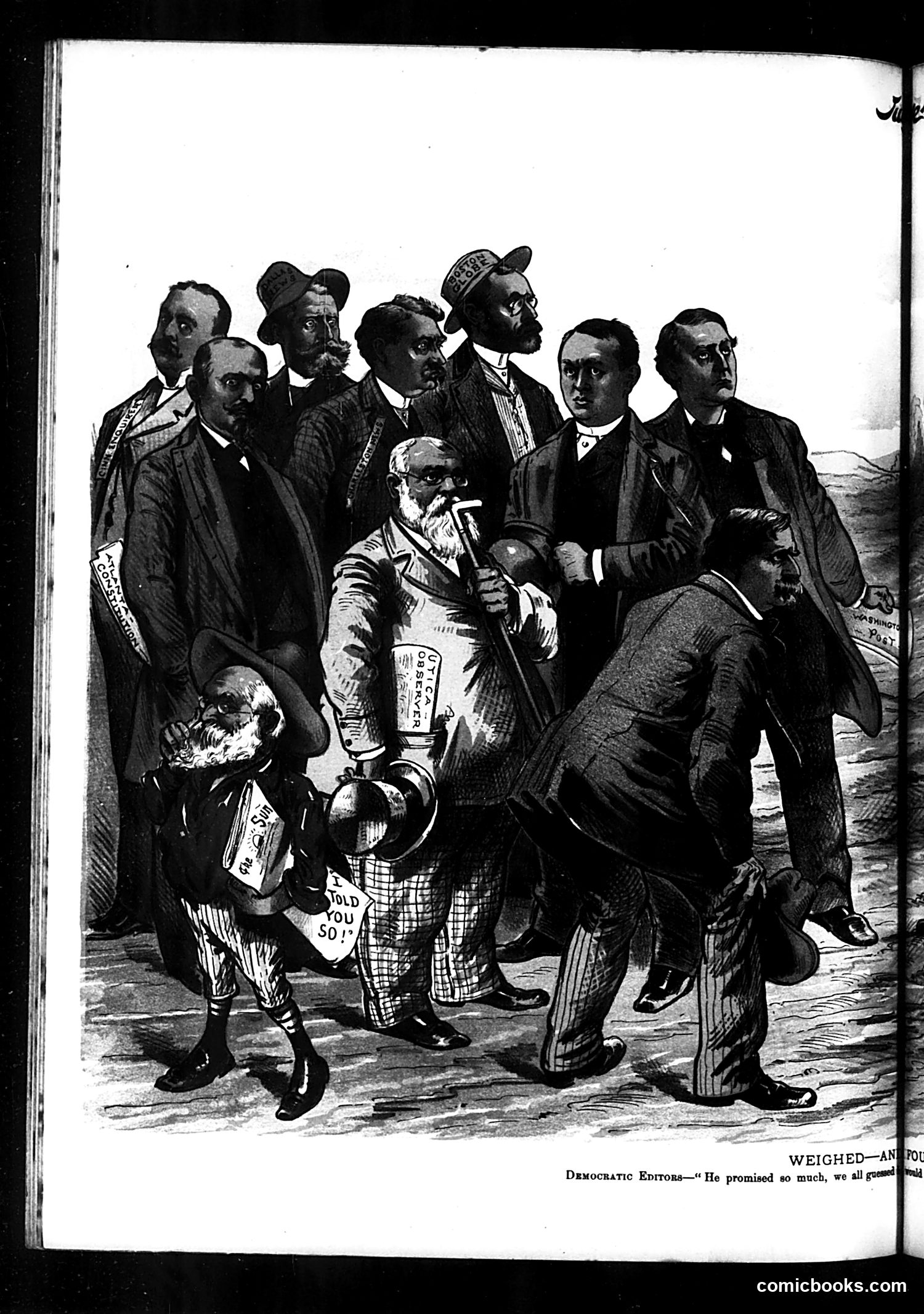
This is a satirical cartoon titled "Weighed—An Political" (text partially cut off). The caption reads: "Democratic Editors—'He promised so much, we all guessed...'" The cartoon depicts a central bearded figure being weighed or measured by a group of well-dressed men standing in a circle around him. The figure appears to be a political leader or candidate, while the surrounding men likely represent Democratic newspaper editors or party officials. The satire suggests that Democratic editors supported this politician based on his promises, but the act of "weighing" him implies they're now assessing whether he delivered on those promises—or perhaps discovering he's lighter/less substantial than expected. This reflects common 19th-century political cartooning about unfulfilled campaign pledges and editorial disappointment with elected officials.
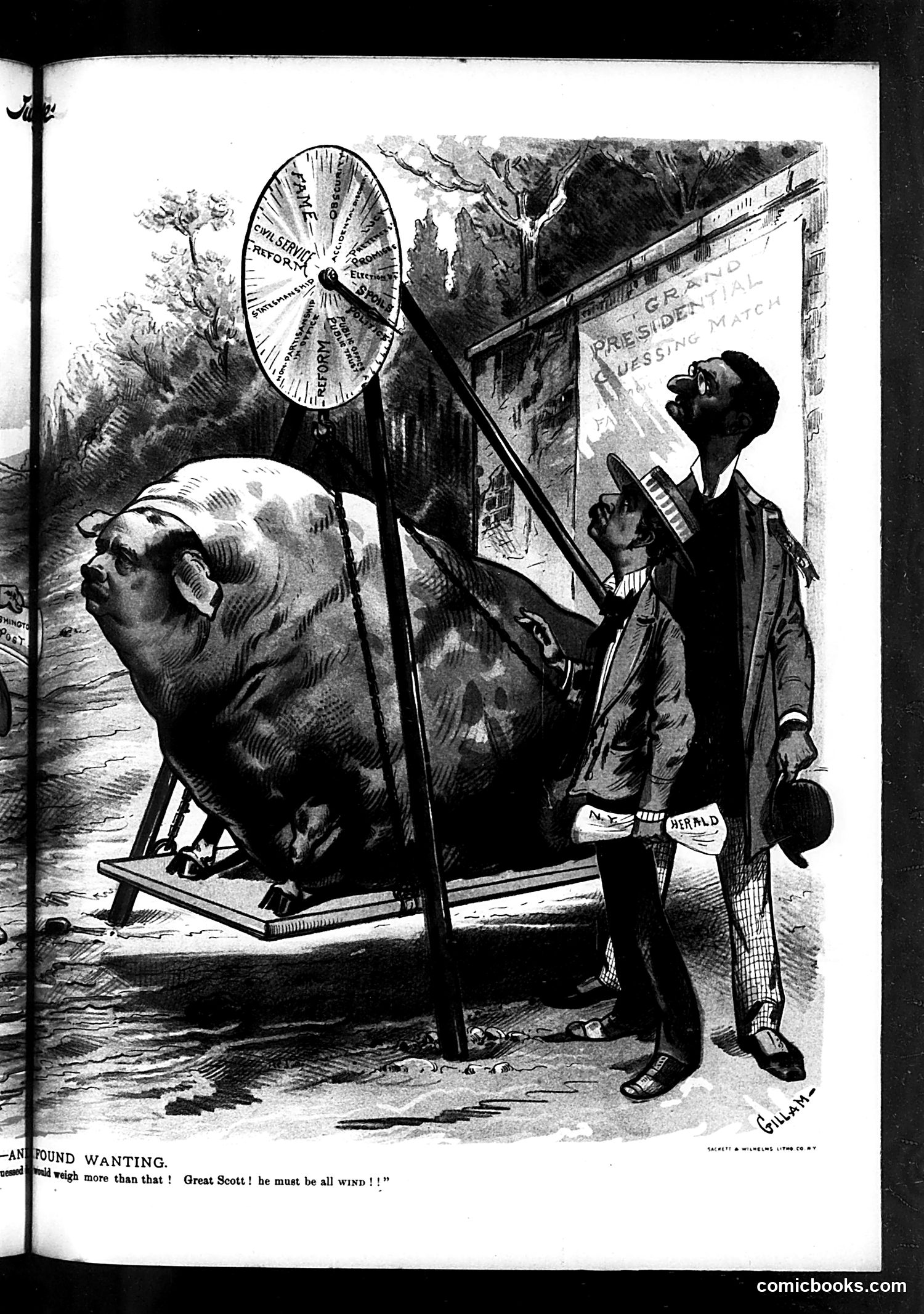
This political cartoon satirizes a figure being weighed on a scale marked with various attributes (the text on the wheel appears to reference qualities or promises). Two men observe the weighing, with one exclaiming the subject "must be all wind"—meaning he's full of hot air and lacks substance. The cartoon likely critiques a political figure or public official whose promises or claimed qualifications don't match reality. The "pound wanting" (falling short by a pound) suggests he fails to meet expected standards when actually measured against them. The scale's wheel and the formal setting suggest an official evaluation or assessment. Without clearer text on the wheel or additional context clues, the specific target remains unclear, though this appears to be commentary on political dishonesty or overblown rhetoric versus actual merit.
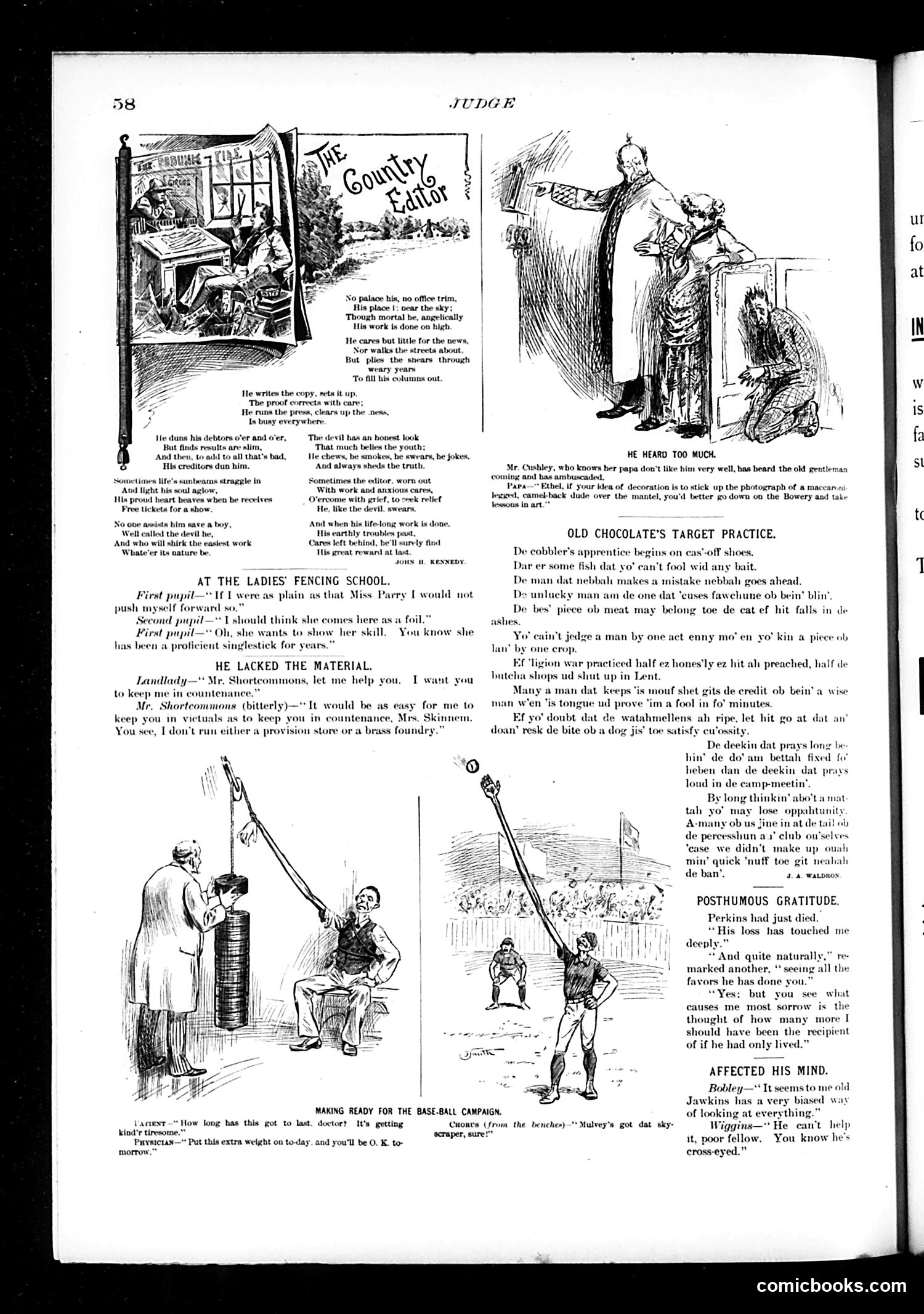
This page contains several satirical sketches and brief comic pieces typical of Judge's format: **"The Country Editor"** (top left) mocks the struggles of rural newspaper editors—working without office help or fancy equipment, constantly behind on deadlines, receiving little payment, and dealing with endless complaints. **"At the Ladies' Fencing School"** presents gender-based humor about women attempting athletic pursuits traditionally reserved for men, suggesting they lack the physical capability or proper training. **"Making Ready for the Base Ball Campaign"** (bottom) appears to reference preparation for baseball season, though specific figures are unclear. The remaining pieces—"Old Chocolates' Target Practice," "Posthumous Gratitude," and "Affected His Mind"—are brief humorous anecdotes about social situations, featuring ordinary characters in everyday scenarios rather than political figures. The page exemplifies Judge's typical blend of social satire and domestic humor from the period.
This page is primarily a **paid advertisement** for Massachusetts Mutual Life Insurance Company, not satirical content. The headline "I WILL NOT INSURE MY LIFE" is a rhetorical hook—a consumer complaint that the ad then *answers* by promoting this specific insurer. The pitch emphasizes the company's compliance with Massachusetts's "Non-forfeiture law," which protected policyholders who missed payments by guaranteeing them paid-up insurance or cash value rather than total forfeiture. This was a consumer protection feature distinguishing Massachusetts Mutual from competitors. The ad includes financial credentials (1887 assets of $9+ million) and lists company officers and branch locations to establish legitimacy. For modern readers, the key context: life insurance in the 1880s was poorly regulated; policies could be lost entirely through missed payments. This company's adherence to non-forfeiture protections was a genuine competitive advantage and genuine consumer protection.
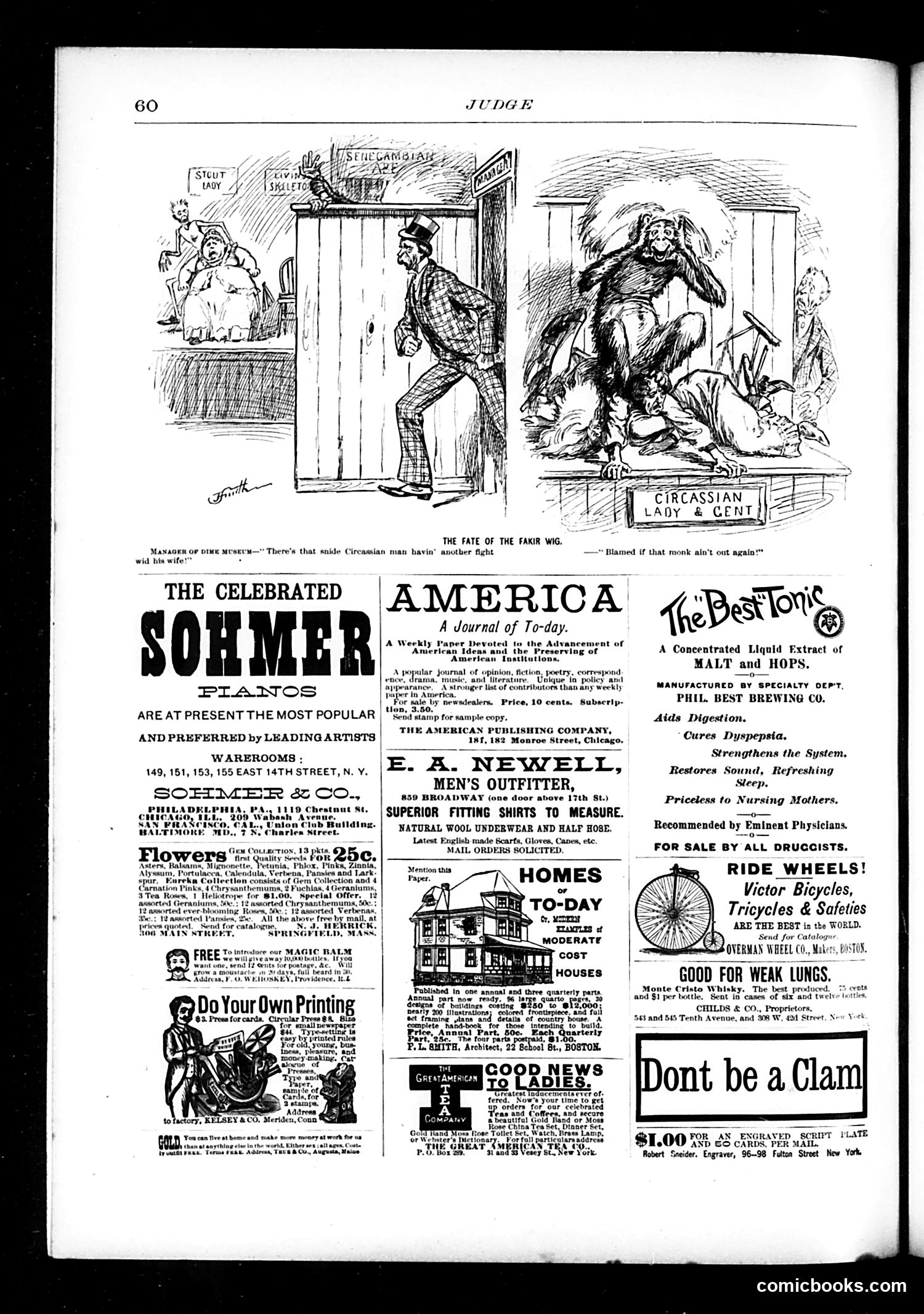
This page contains two cartoons satirizing dime museum attractions and marital discord. **Left cartoon:** A "Stout Lady" bartender at a dime museum confronts a "Circassian Man" (likely a sideshow performer billed as exotic) about fighting with his wife. The joke mocks the absurdity of dime museums—cheap entertainment venues featuring human curiosities—where even the "exotic" attractions are merely ordinary people with domestic quarrels. **Right cartoon:** "The Fate of the Fakir Wig" depicts a Circassian Lady performer (identified by the label) with an angry man, likely a monk or authority figure. The caption "Blamed if that monk ain't out again!" suggests the fakir's elaborate wig—a prop enhancing the exotic illusion—has been removed or compromised, exposing the deception behind the sideshow act. Both cartoons ridicule dime museum performers as fraudulent attractions peddling fake exoticism to gullible audiences. The satire targets both the performers' pretense and the public's gullibility.
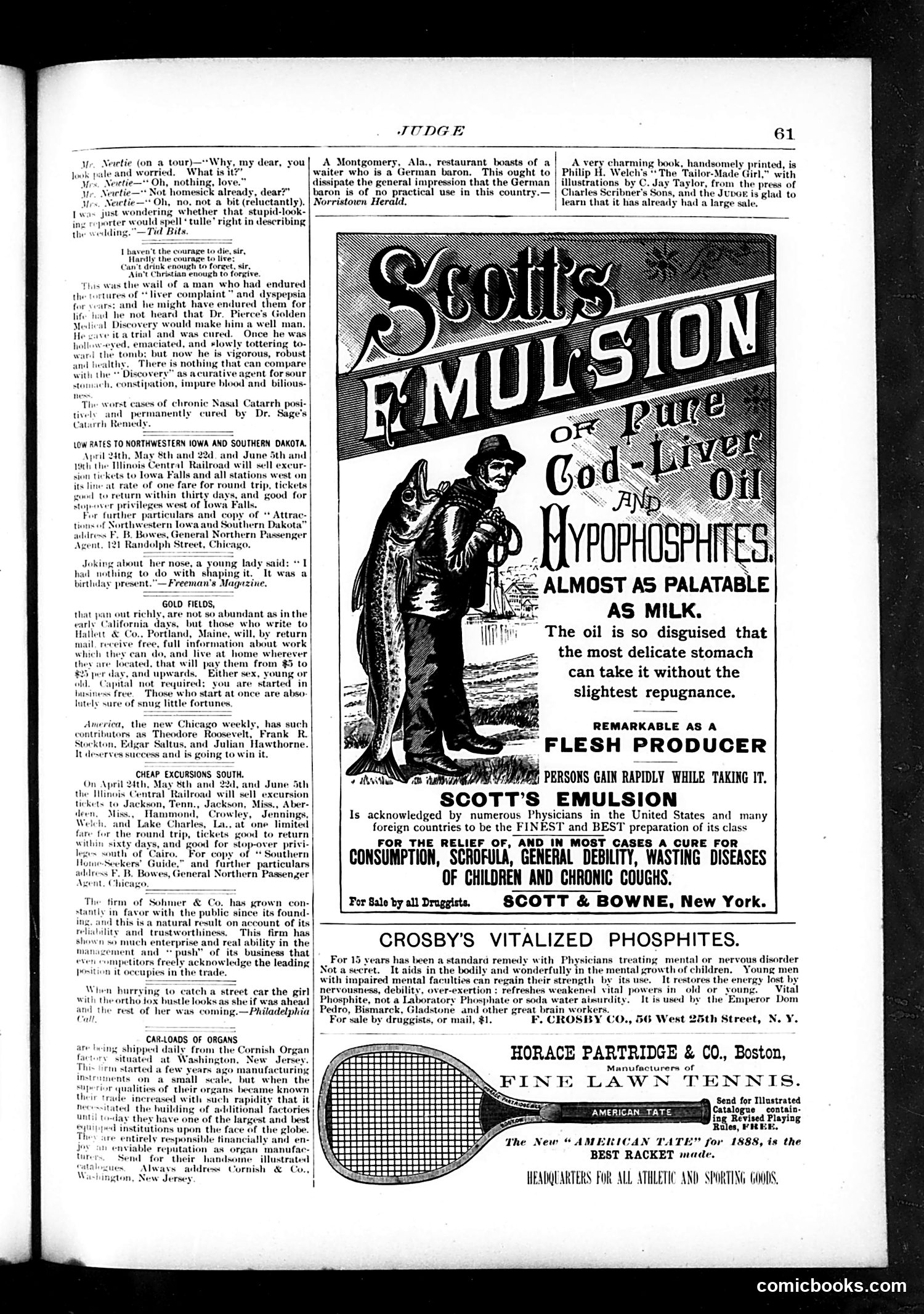
This page is primarily **advertising**, with minimal satirical content. The main visual element is a large advertisement for Scott's Emulsion, a cod-liver oil product marketed as a cure-all for consumption, scrofula, and wasting diseases in children—reflecting late-19th-century patent medicine culture. The small cartoon at the top appears to be a domestic humor piece about a couple on tour, with a wife asking her husband about his worried expression. He dismissively references a "stupid-looking" German baron working as a waiter in Montgomery, Alabama, joking that the baron is useless in America—likely satirizing the pretensions of European nobility and their lack of practical value in the American context. The remainder consists of advertisements for health products (phosphites, emulsions), sporting goods (lawn tennis rackets), and railroad excursions—typical Judge magazine filler from this era. The page reflects contemporary anxieties about health and consumption while showcasing the patent medicine industry's prominence.
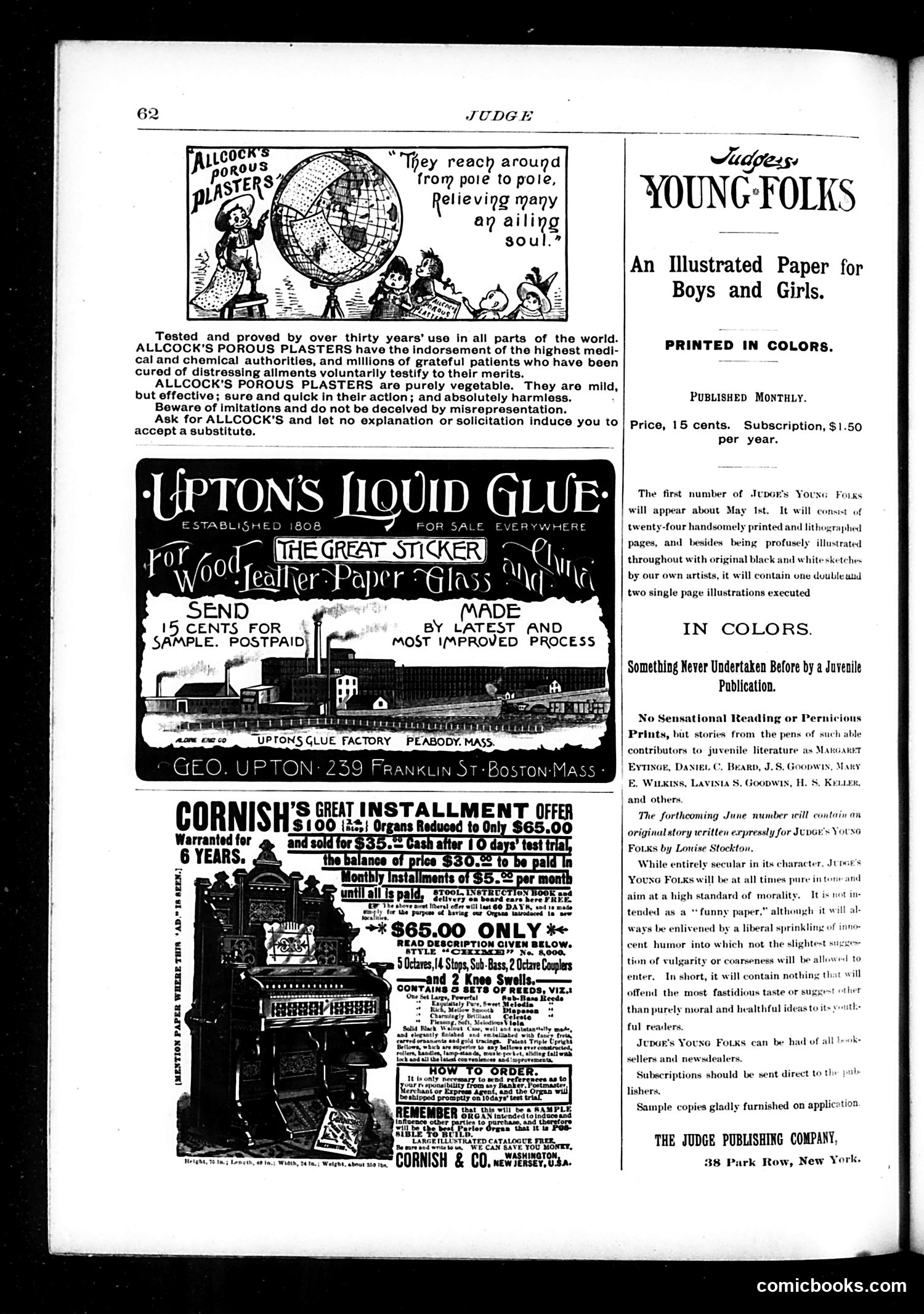
This page is primarily **advertising and promotional material** rather than political satire. It contains: 1. **Allcock's Porous Plasters advertisement** — a patent medicine claiming to cure ailments, with a globe illustration and testimonial language typical of 19th-century medical marketing. 2. **Upton's Liquid Glue advertisement** — industrial adhesive for wood, leather, paper, and glass. 3. **Cornish & Co. organ advertisement** — promoting a $65 parlor organ with installment payment options. 4. **Judge's Young Folks announcement** — promoting a new illustrated children's magazine launching in May, featuring color illustrations and stories by established authors including Margaret Eytinge and Louise Stockton. The only potential satirical element is the implicit critique embedded in the Allcock's ad's exaggerated health claims—typical of the patent medicine industry that Judge often mocked. However, this appears to be a legitimate advertisement rather than satire. The page reflects Gilded Age consumer culture and publishing expansion rather than political commentary.
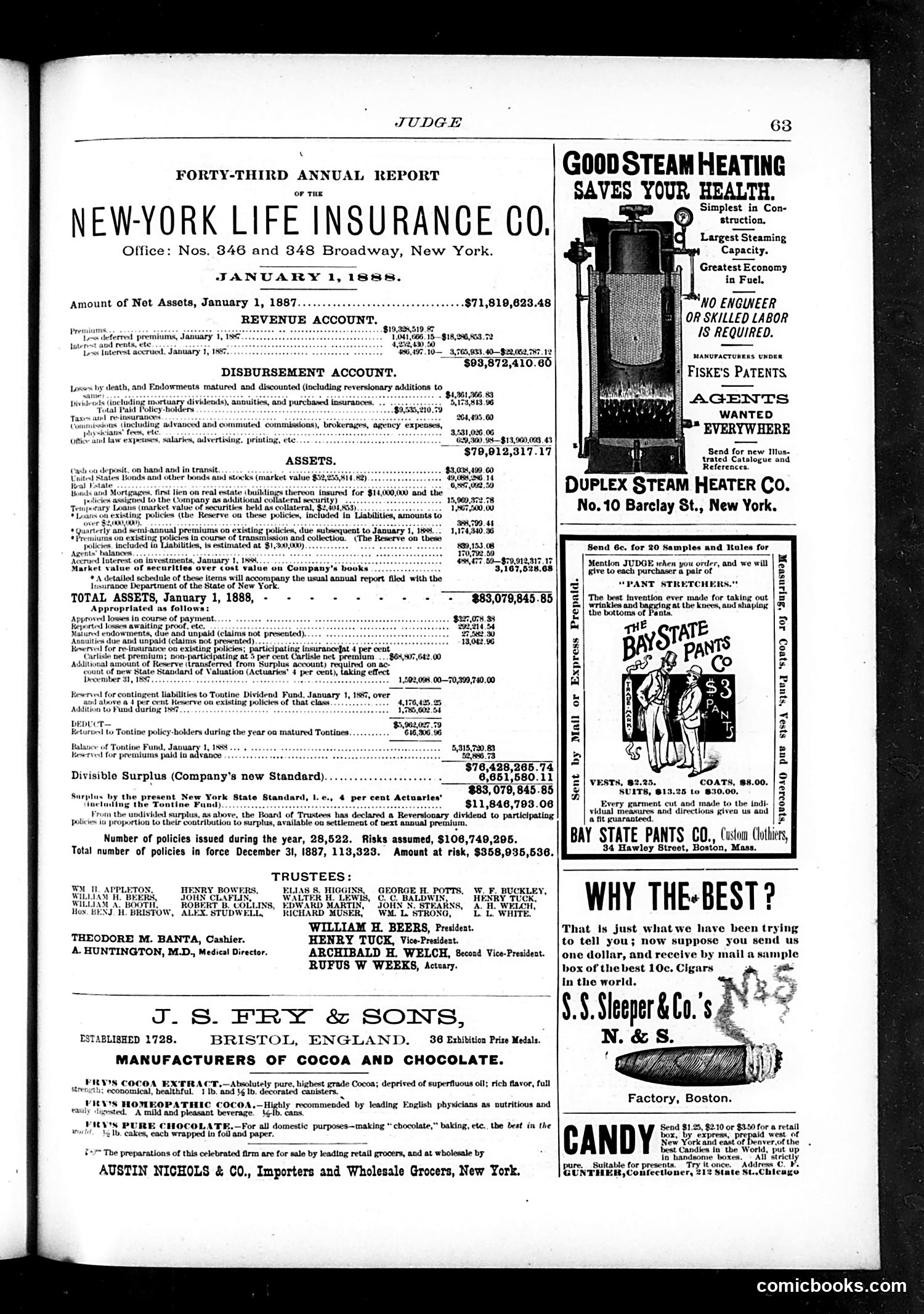
This page is primarily a **financial document and advertising**, not a satirical cartoon. It contains: **Main Content:** The forty-third annual report of the New-York Life Insurance Company (dated January 1, 1888), displaying detailed financial statements including assets (~$83 million), revenue, disbursements, and trustee names. **Surrounding Advertisements:** - Good Steam Heating systems - Duplex Steam Heater Co. - Bay State Pants Co. - J.S. Fry & Sons cocoa and chocolate products - S.S. Sleeper & Co. cigars - Various other commercial products **Historical Context:** Judge was a satirical magazine, but this particular page functions as a financial report wedged between advertisements—common for periodicals of this era. The insurance company report itself contains no satire; it's straightforward corporate documentation. The page demonstrates how 19th-century magazines mixed editorial content with substantial advertising and business documents to generate revenue. There are no identifiable political cartoons or satirical commentary visible on this page.
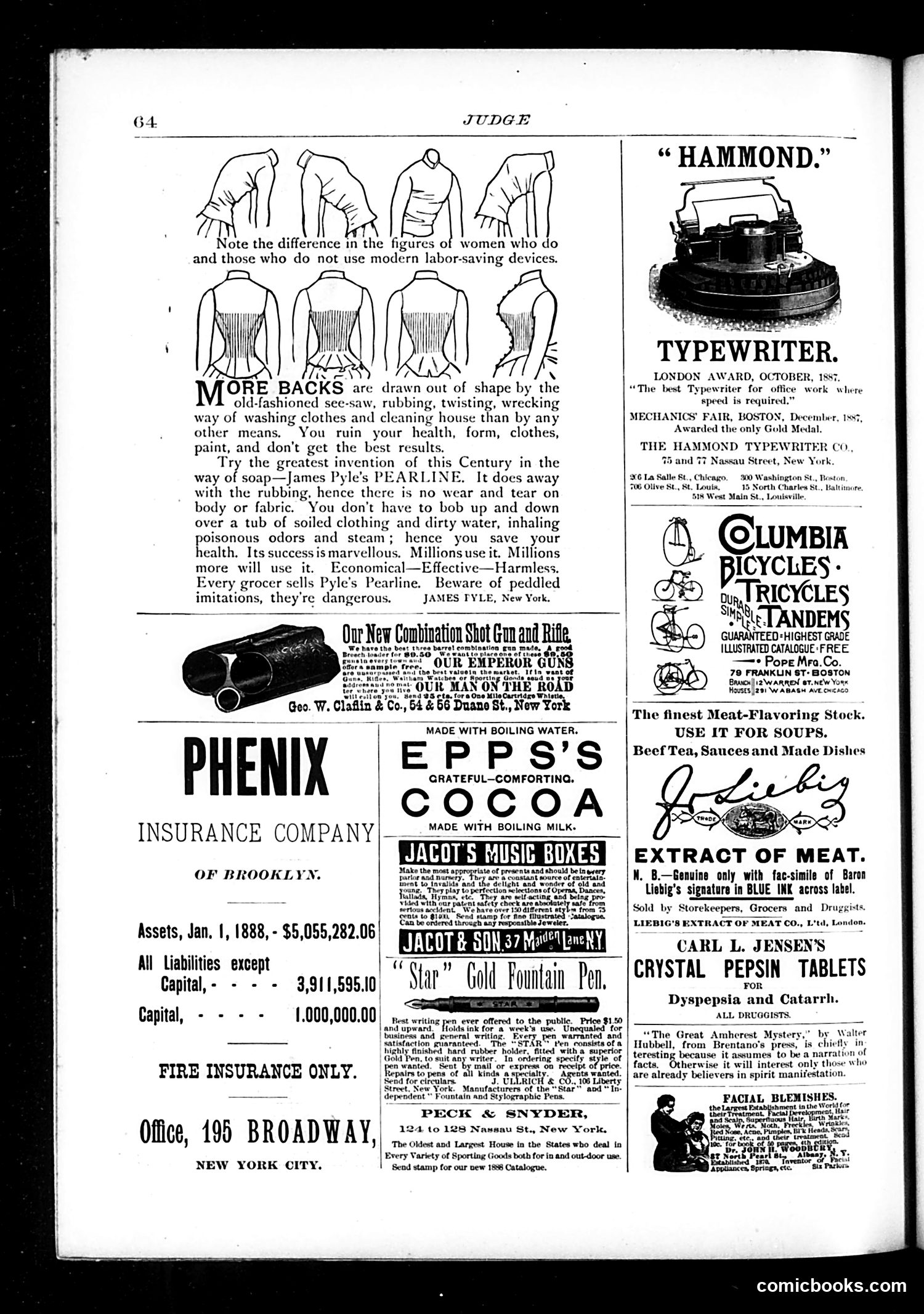
This page is primarily **advertising**, not political satire. It showcases late-1880s consumer products marketed to modernizing American households. The upper cartoon contrasts women's **posture and physical condition**: those using "modern labor-saving devices" (like Pearline soap) maintain upright, healthy figures, while old-fashioned laundry methods ("see-saw, rubbing, twisting") deform women's bodies. This reflects genuine Victorian anxieties about women's health and labor, while promoting commercial solutions. The advertisements reflect the era's technological optimism: typewriters, bicycles, fountain pens, and prepared foods (meat extracts, cocoa) marketed as time-saving conveniences. These products specifically targeted middle-class women seeking to modernize household management. The page exemplifies how *Judge* monetized its satirical platform through advertising, blending social commentary with consumer promotion. The "moral" is consistent: purchase modern goods to improve health, efficiency, and social standing.
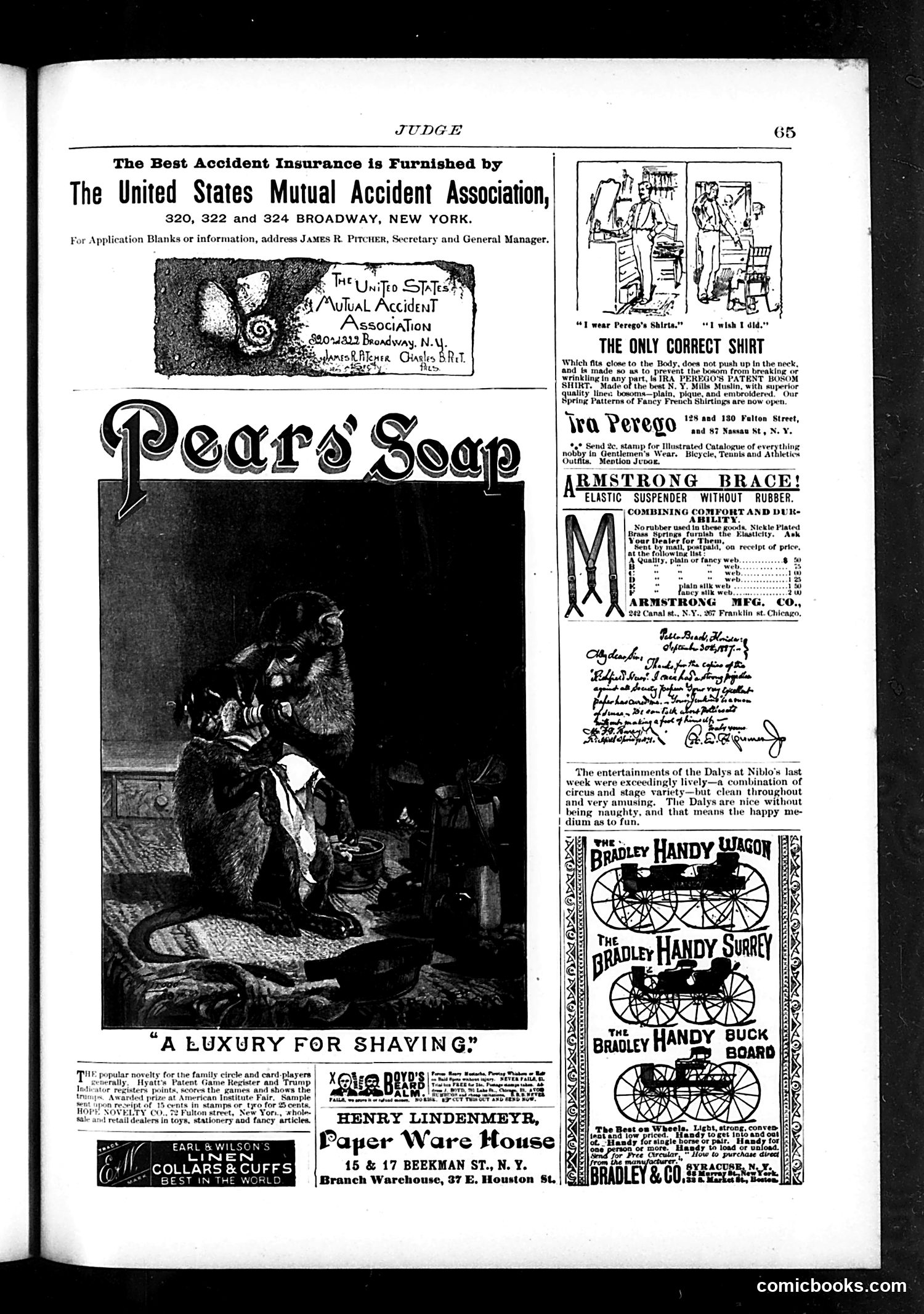
This page is primarily **advertising**, not editorial content or political satire. It contains multiple commercial advertisements from the late 19th century directed at middle and upper-class male readers. The largest ad features **Pear's Soap**, using a Victorian-era image of a woman at her toilette—marketed as "a luxury for shaving," appealing to gentlemen's grooming concerns. Other notable ads include: - **Perego's Patent Bosom Shirt**: Claims superior fit and construction for gentlemen's wear - **Armstrong Brace**: An elastic suspender without rubber - **Bradley & Co. Handy Wagons/Surrey/Buck Board**: Horse-drawn vehicles - **Henry Lindenmeyr Paper Ware House**: Commercial supplies The page header advertises **United States Mutual Accident Association** insurance. There is a brief mention of "The Dalys" performing at Niblo's theater, noting their "circus and stage variety" entertainment as "nice" family fun. This reflects Judge's dual role: satirical editorial content mixed with advertisements targeting prosperous Victorian-era consumers.
This page is predominantly advertising, typical of late-19th century magazine publishing. The most substantive content is the "Tooth Brush Reform" article, which reprints Scientific American material advocating a recent innovation: felt-based tooth brushes replacing traditional bristle brushes. The article argues felt polishers clean teeth without harsh friction or enamel damage, with replaceable worn tablets—presenting this as economical and hygienic progress. The remainder consists of commercial advertisements for various consumer goods: patent medicines (catarrh remedy, rheumatism cure), clothing retailers, tobacco/cigarettes, cocoa, theater productions, and employment opportunities. These ads reveal consumer concerns (dental health, digestive ailments) and entertainment/shopping options available to Judge's readers. No political satire or cartoon content appears on this page.
This page is primarily **advertising and business listings** rather than political cartoons or satire. The main content includes: **Advertisement Section**: Promotions for luxury writing implements (ball-pointed pens), Hamilton organs, quinine wine tonic, and other period products. **Campaign Subscription Pitch**: Judge magazine advertises discounted subscriptions ($2.00 for 26 weeks) specifically for the upcoming 1880 or 1884 presidential campaign. The text emphasizes Judge will provide "pictorial history" and "sound aggressive republican" coverage of the national conventions and election season. **Hotel & Business Directory**: The remaining space lists leading hotels across major American cities (New York, Philadelphia, Baltimore, etc.) and business establishments. **Historical Context**: This reflects Judge's identity as a Republican-leaning satirical publication using campaign season subscriptions as revenue. The page shows how 19th-century magazines bundled editorial content with commercial advertising.
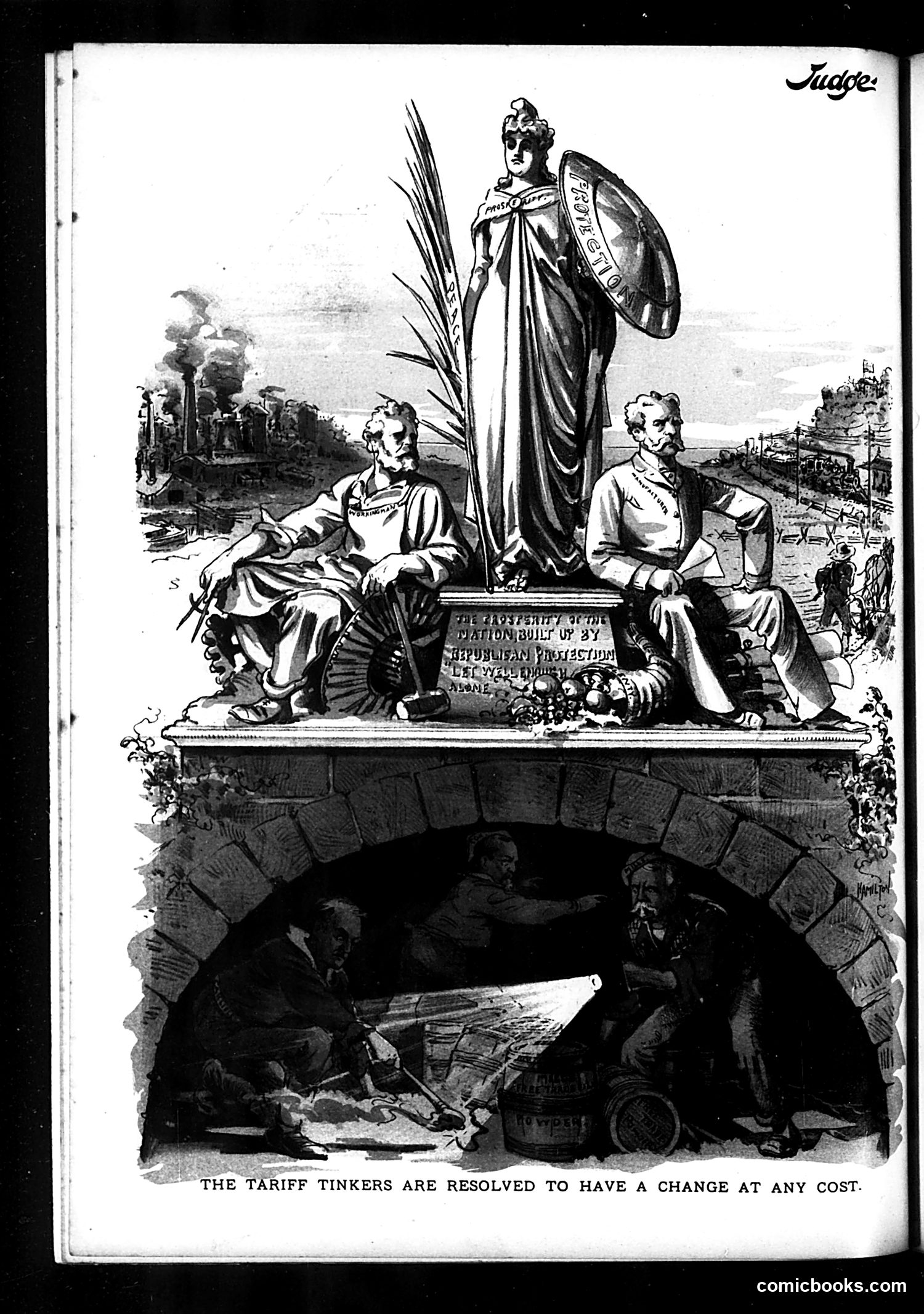
This Judge magazine cartoon satirizes Republican tariff policy-makers as "tinkers" (incompetent tinkerers). The allegorical composition shows: **Upper level:** A classical female figure (Liberty or Justice) stands between two seated male figures, overlooking industrial landscapes. This represents the nation's ideals. **Lower level:** Workers or political operatives huddle in a tunnel or underground space, examining plans, suggesting backroom dealing and hidden machinations. **The satire:** The caption "THE TARIFF TINKERS ARE RESOLVED TO HAVE A CHANGE AT ANY COST" mocks Republican politicians who repeatedly adjusted tariff policy, portrayed as reckless tinkerers willing to disrupt the economy for political gain. The contrast between noble ideals above and scheming practicality below criticizes the disconnect between stated principles and actual protectionist motives. The industrial imagery suggests concern about how tariff changes would affect American manufacturing and workers.
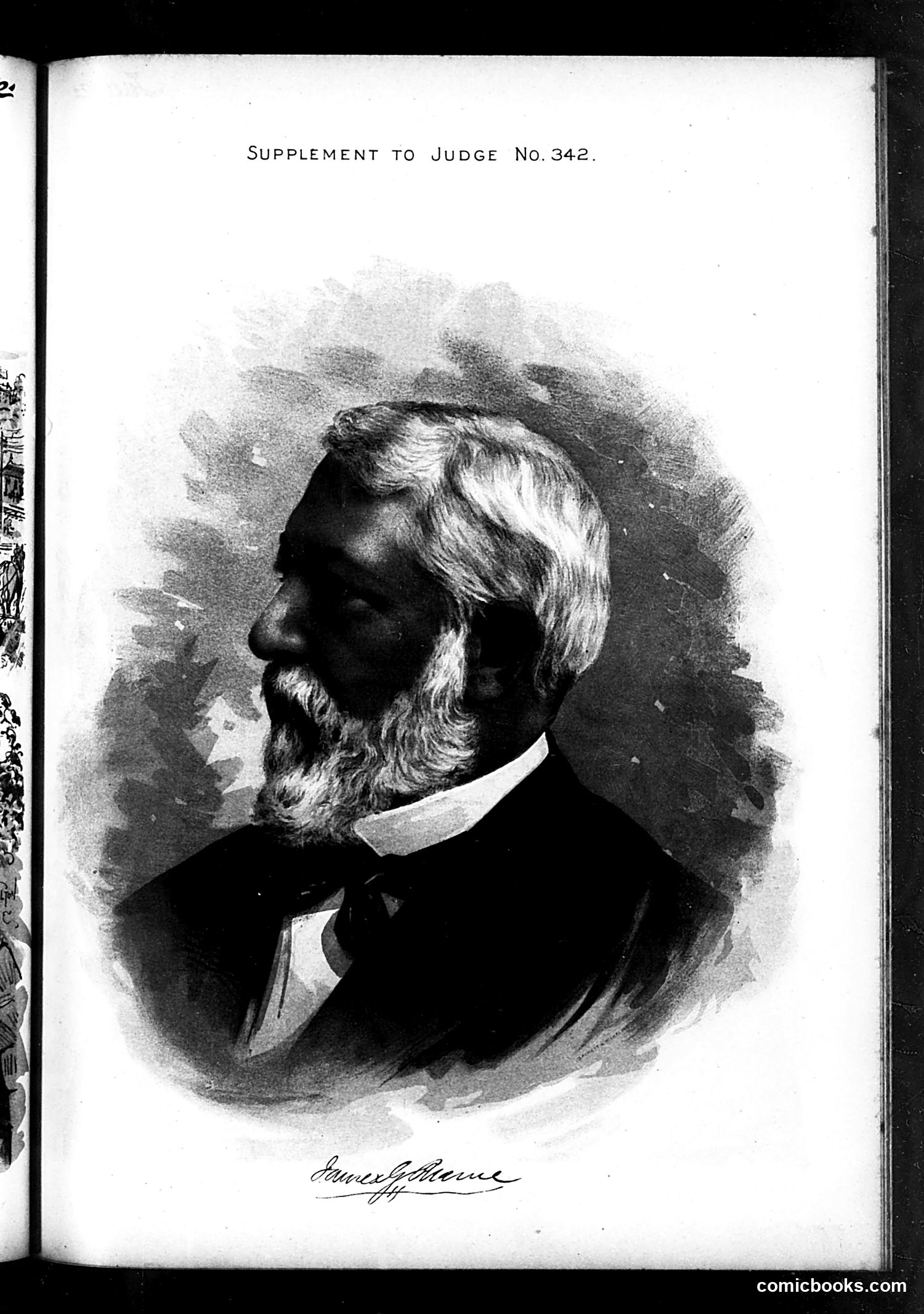
This page appears to be a supplement or illustration section from *Judge* magazine featuring a portrait engraving labeled "SUPPLEMENT TO JUDGE NO. 342." The image shows a bearded man in formal 19th-century attire (dark jacket, white collar) in profile, rendered in the classical engraving style typical of period publications. A signature appears below the portrait. However, the OCR text is corrupted and unreadable, containing only scattered letters and symbols. Without legible accompanying text, I cannot definitively identify the subject, determine what political or social commentary the portrait intended, or explain the satirical point to a modern reader. To properly analyze this as satire, I would need either: the readable caption/text identifying the subject, or the original publication date and issue context from *Judge*.