
A complete issue · 16 pages · 1888
Judge — April 28, 1888
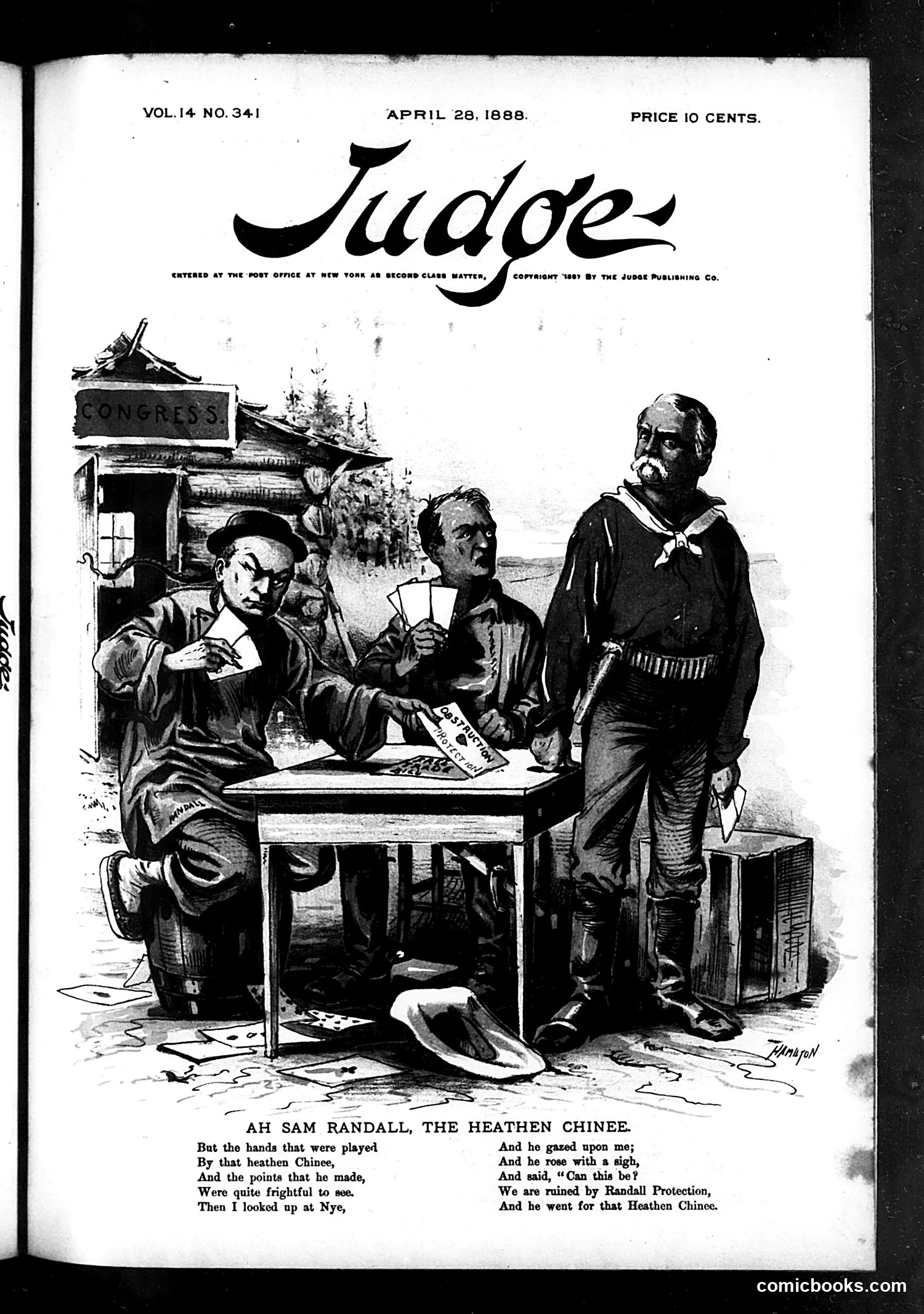
This 1888 *Judge* cartoon satirizes anti-Chinese sentiment and protectionist trade politics. The illustration depicts a Congressional building with three American figures (likely politicians or business representatives) examining documents at a table, while an elderly Chinese man stands apart. The accompanying verse references "Sam Randall" and "Randall Protection," likely alluding to Congressman Samuel J. Randall's protectionist policies. The cartoon's title invokes Bret Harte's 1870 poem "Plain Language from Truthful James," which satirized anti-Chinese prejudice using the phrase "heathen Chinee." The satire appears to critique American political hypocrisy: politicians who invoke nationalist "protection" rhetoric while engaging in trade disputes with China, framed through dehumanizing racial language of the era.
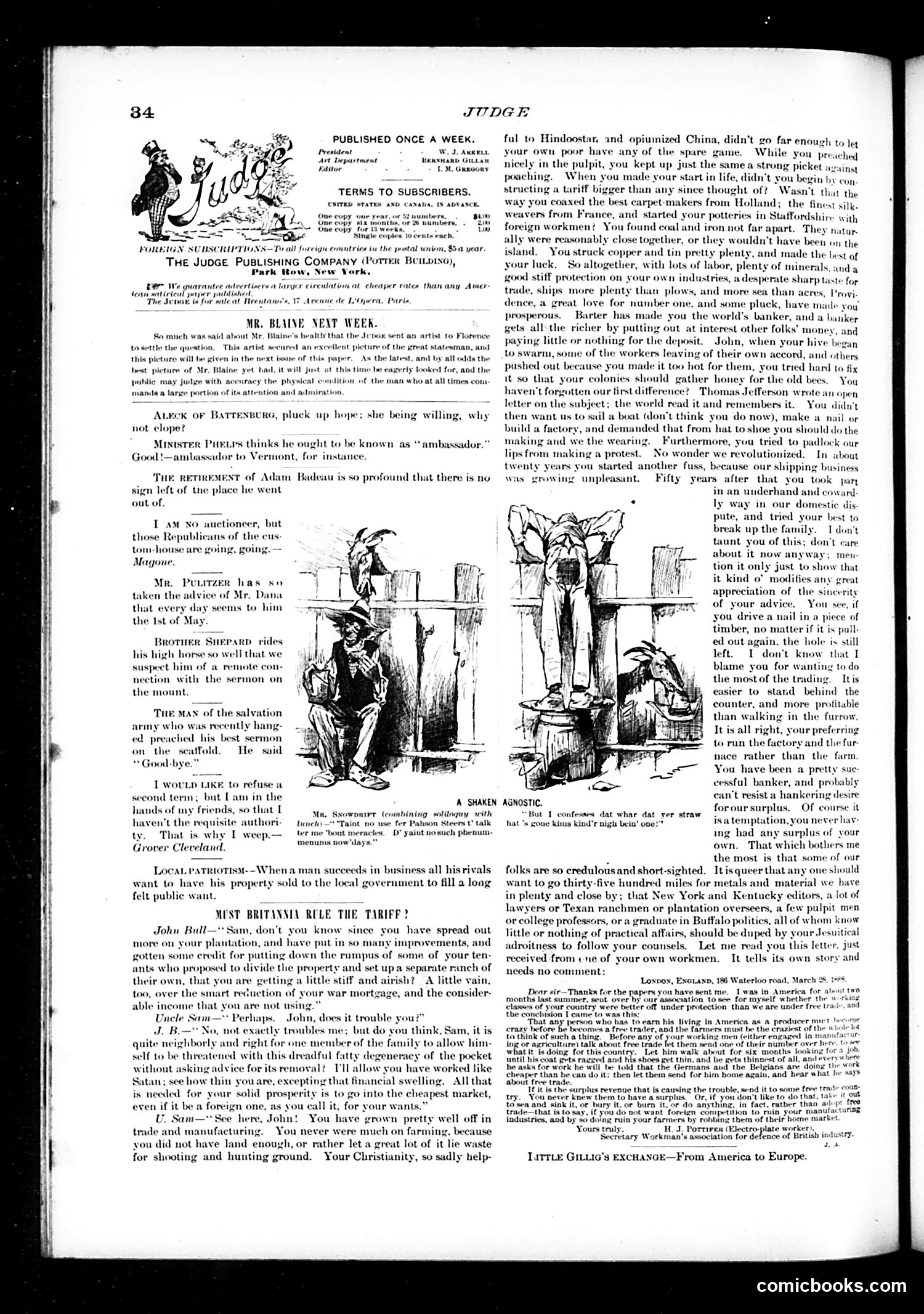
This page contains satirical commentary and letters to the editor rather than political cartoons. The main illustration, titled "A Shaken Agnostic," depicts a man appearing distressed or frightened near wooden posts or a fence. The text includes critiques of business practices and political figures. One section mocks "Ambassador" titles, suggesting Republicans are leaving office. Another letter from "Grover Cleveland" criticizes business failures and calls for Christian charity toward workers and the poor. The satire targets late 19th-century industrial capitalism—attacking wealthy businessmen who exploited workers while claiming patriotism, and criticizing politicians' hypocrisy regarding labor and poverty. The "shaken agnostic" likely represents someone whose faith in American progress has been undermined by witnessing economic injustice.
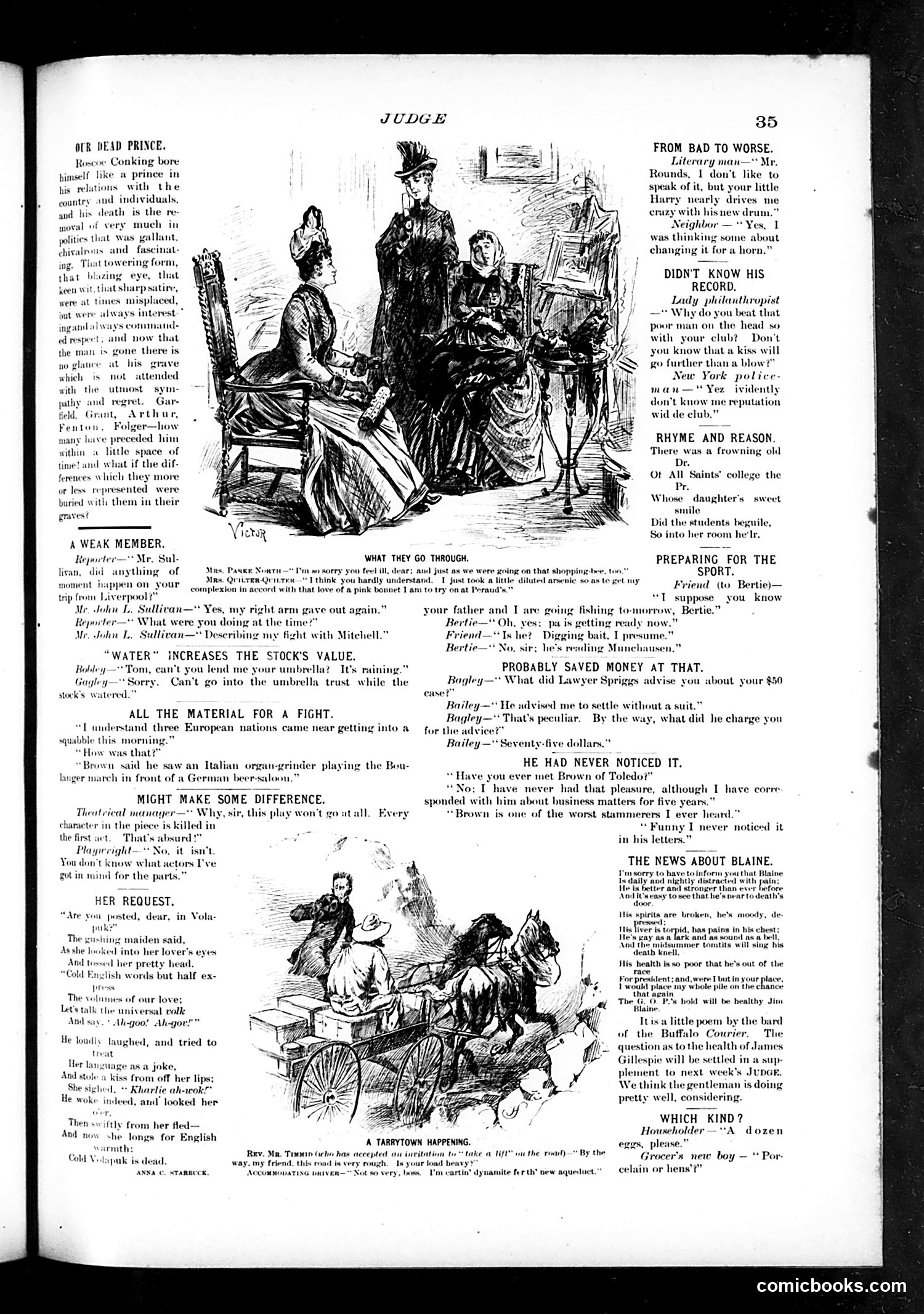
This page from Judge (a 19th-century American satirical magazine) contains multiple brief humor pieces typical of the era: **Notable content includes:** - **"Our Dead Prince"** — An obituary-style tribute to Roscoe Conkling, a prominent politician, lamenting the loss of great leaders - **John L. Sullivan reference** — A joke about the famous boxer's arm "giving out" after describing his fight with Mitchell - **"Water Increases Stock's Value"** — Satire on watered stock (fraudulent corporate practice of inflating shares) - **Theatrical/character humor** — Jokes about actors, playwrights, and managers - **"Velapük"** — A humorous poem about an artificial language, mocking its impracticality - **Various social commentary** — Including jabs at police brutality, lawyers' fees, and stammering The cartoons show Victorian-era domestic and social scenes with exaggerated expressions characteristic of Judge's satirical style. The humor targets contemporary issues: corporate fraud, public figures, and social absurdities familiar to readers of that period.
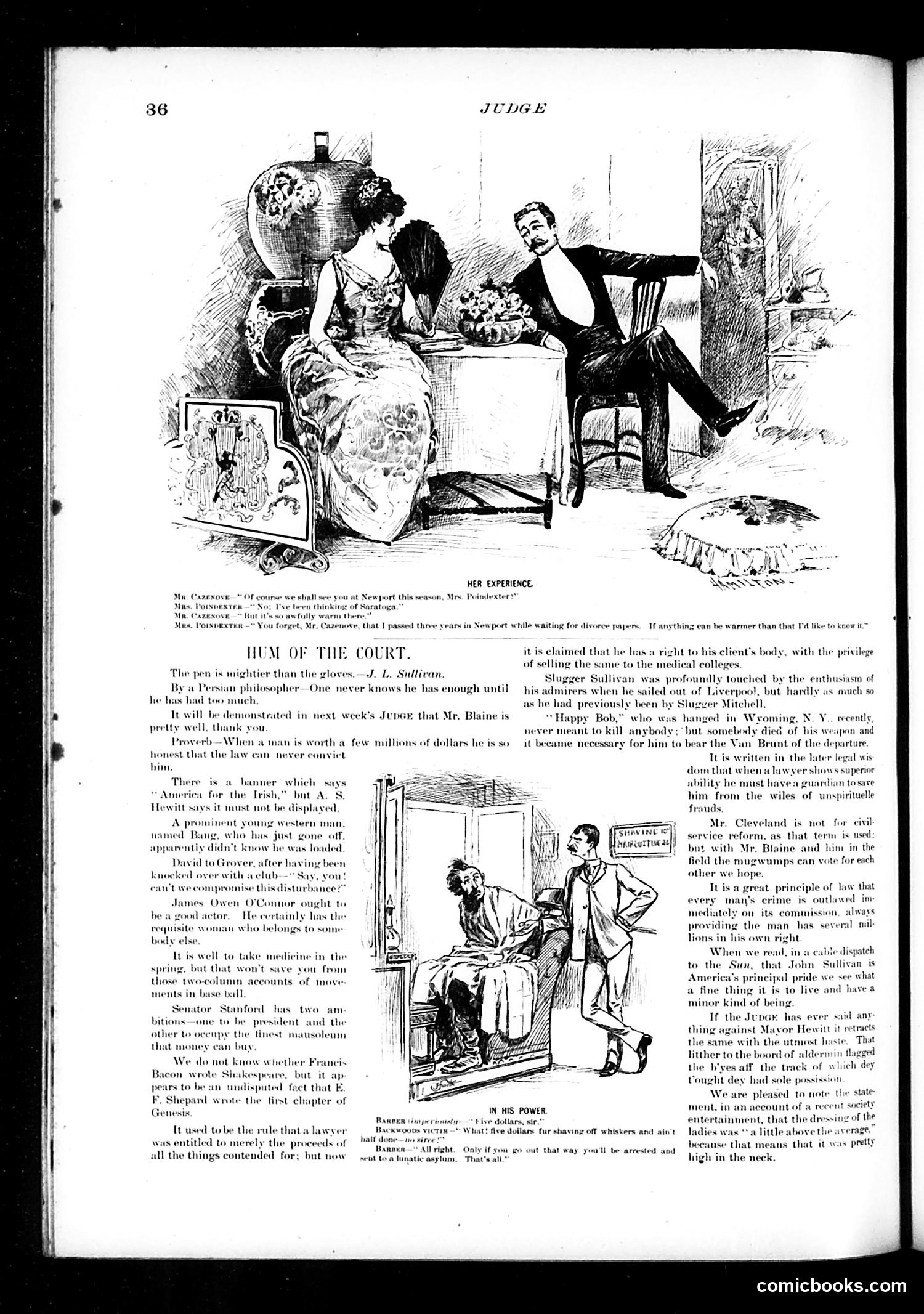
This page from the satirical magazine *Judge* contains several distinct pieces mocking prominent figures and social absurdities of the Gilded Age. **Top Cartoon ("Her Experience"):** Depicts wealthy women discussing Newport society—likely satirizing the leisure class's obsession with fashionable resorts and divorce scandals. **"Hum of the Court":** A collection of witty epigrams targeting: - **James G. Blaine** (politician): Referenced mockingly regarding his reputation - **John L. Sullivan** (boxer): The "Slugger Sullivan" references suggest satire of his celebrity and violent reputation - **Wealth and justice**: Jokes suggesting rich men escape legal consequences ("When a man is worth millions, he is so honest the law can never convict him") **"In His Power":** A dialogue joke about a barber charging excessive prices, satirizing service industry exploitation. The overall theme attacks corruption, the protection of wealthy elites, celebrity excess, and class hypocrisy—typical *Judge* fare from this era attacking Gilded Age moral failings.
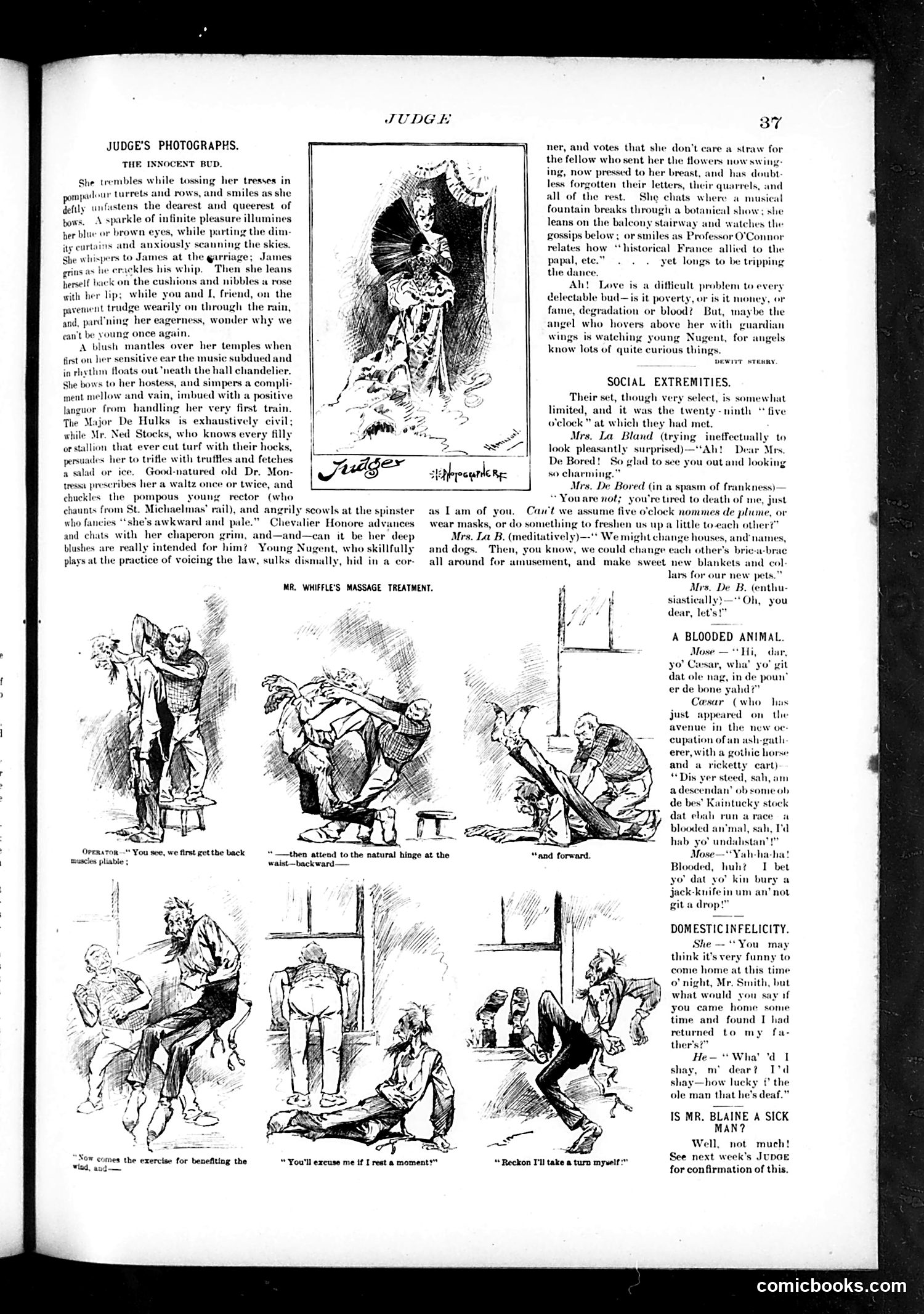
This page contains several satirical sketches typical of Gilded Age humor: **"Judge's Photographs"** (top): A lengthy narrative piece mocking romantic courtship rituals. It describes a young woman receiving flowers and attention from suitors while remaining emotionally detached—satirizing both female fickleness and male courtship desperation among the leisure class. **"Social Extremities"**: A dialogue between two wealthy, bored women (Mrs. La Bland and Mrs. De Bored) joking about assuming false identities and swapping belongings to escape monotony. The satire targets wealthy society women's ennui and shallow social lives. **"Mr. Whiffle's Massage Treatment"**: Comic illustrations of a quack massage practitioner manipulating clients' bodies in absurd ways, mocking pseudoscientific health treatments popular in the era. **"A Blooded Animal"**: A formerly enslaved man (using period dialect) tries selling an old horse to a white man, claiming aristocratic lineage. This appears to satirize both con-artistry and post-Reconstruction racial dynamics through crude stereotype. **"Domestic Infelicity"**: A brief marital dispute joke about a wife threatening to leave her husband. The page reflects typical Judge content: upper-class social satire, quack medicine mockery, and racially insensitive humor.
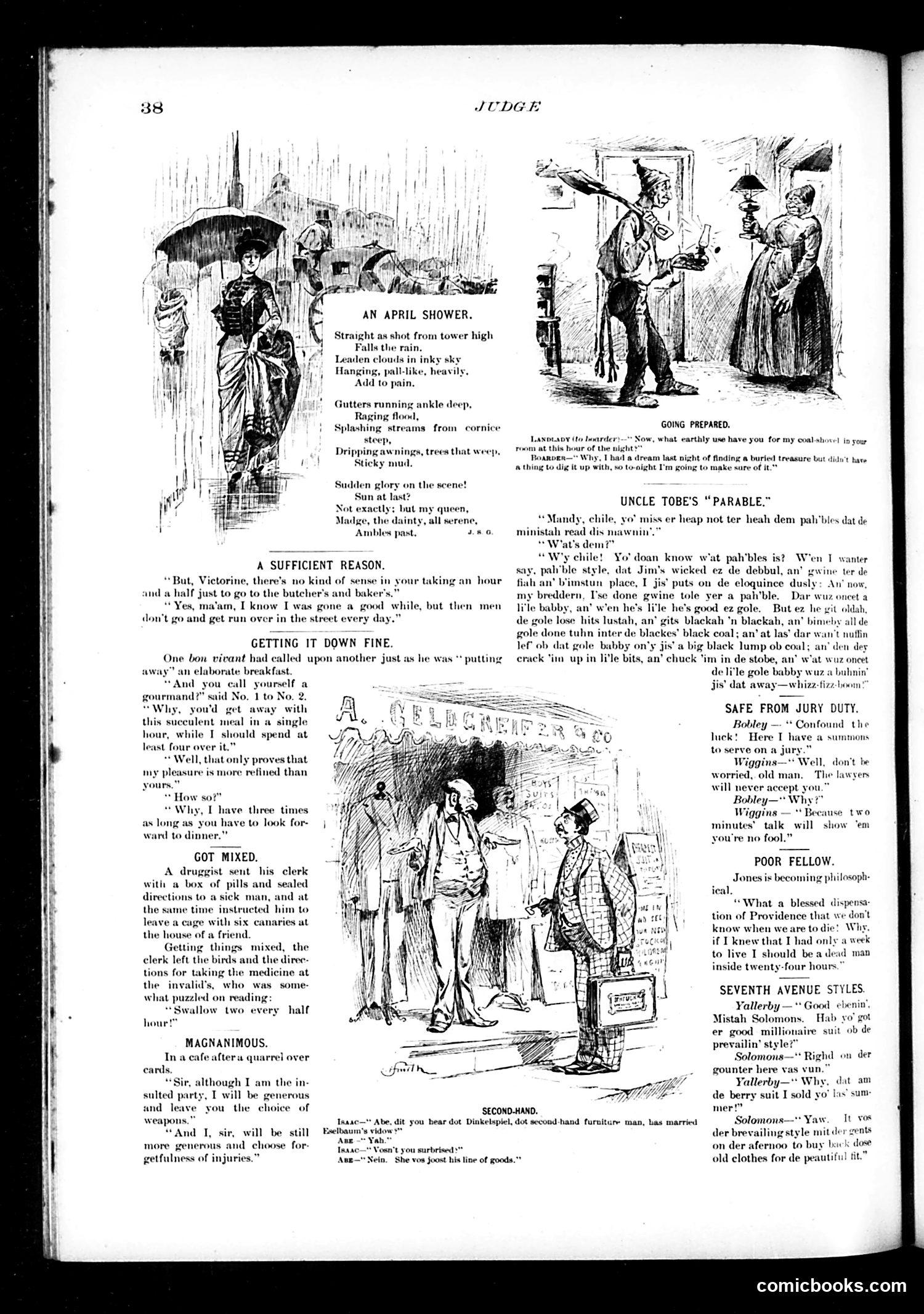
This page contains several short humorous sketches typical of late 19th-century American satirical magazines: **"A Sufficient Reason"** mocks pretentious gourmands—a man boasts he spends four hours over a meal, claiming refined taste. His friend retorts this only proves he has more time to kill before dinner, deflating the pretension. **"Got Mixed"** is a slapstick joke: a druggist's clerk delivers canaries to a sick person with medicine instructions, creating absurd chaos when the invalid tries to follow "Swallow two every half hour" for birds. **"Magnanimous"** presents a gentlemanly duel setup where both men claim generosity—one offers choice of weapons, the other chooses "forgetfulness of injuries" (forgiveness), making reconciliation the punchline. Other sketches include poetry about April showers and dialect humor featuring African American characters using exaggerated speech patterns (common but offensive by modern standards). The "Second-Hand" and "Seventh Avenue Styles" pieces play on immigrant characters' accents and Jewish stereotypes typical of the era's casual ethnic humor.
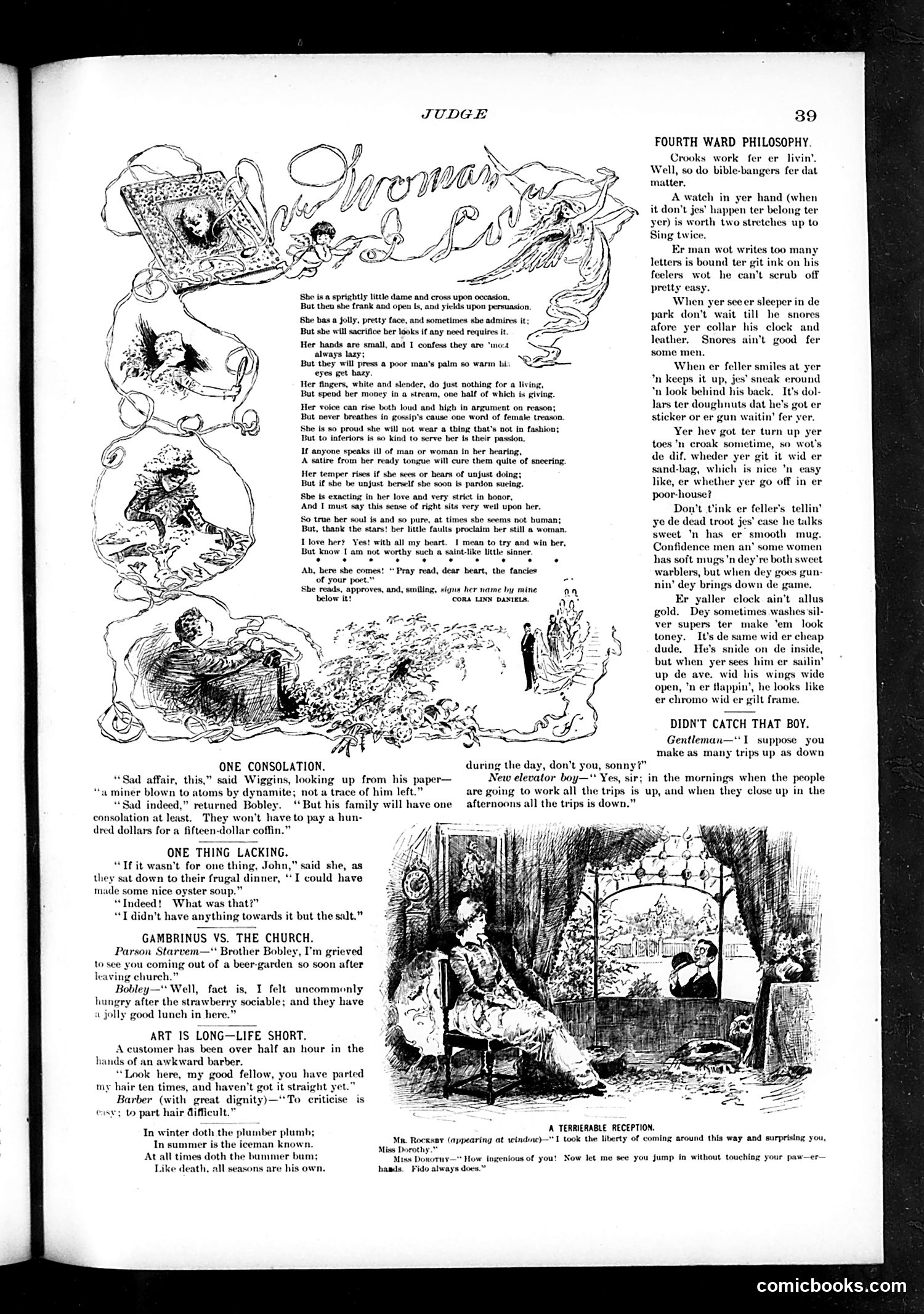
This page from Judge contains satirical humor typical of late 19th-century American commentary: **"Woman's" poem (left):** A romantic tribute to an idealized woman—intelligent, compassionate, fashionable yet charitable, principled yet flawed enough to remain human. The satire likely mocks sentimental Victorian idealization of womanhood. **"Fourth Ward Philosophy" (right column):** Working-class cynicism presented as folk wisdom—criminals and clergy both "work fer a livin'," stealing watches gets you prison time, confidence men are charming liars, cheap people try to look expensive. This satirizes lower-class urban morality and the gap between appearance and reality. **The cartoon vignettes:** Show domestic humor—an elevator boy explaining morning/afternoon trip directions, a wife unable to make oyster soup due to lack of ingredients, and what appears to be a social reception scene. The page mixes romantic sentiment with urban cynicism, reflecting Judge's satirical approach to American life across class divisions.
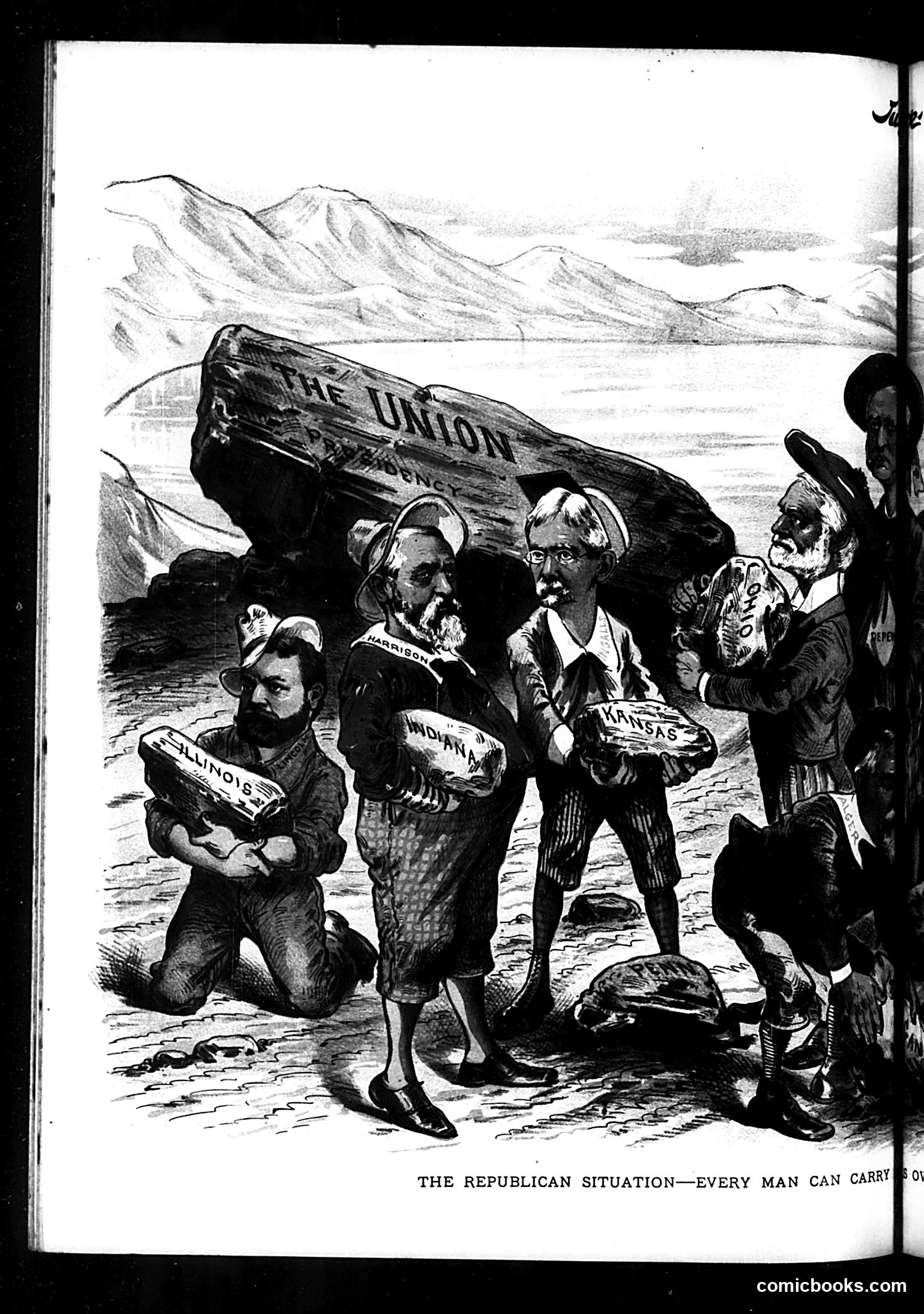
This political cartoon satirizes the Republican Party during a period of internal crisis or leadership vacuum. The figures appear to be prominent Republican politicians struggling with the burden of "The Union"—a heavy, capsizing boat labeled with state names (Illinois, Indiana, Kansas visible). The men carry boxes labeled with state names, suggesting they represent regional Republican leaders. The cartoon's message—"every man can carry on"—appears ironic, implying that despite claiming competence, these leaders are overwhelmed and disorganized, unable to effectively manage the party or nation. The mountainous background and troubled waters suggest a dire situation. This likely references a specific Republican Party crisis, though without a date visible, the exact historical context remains unclear.
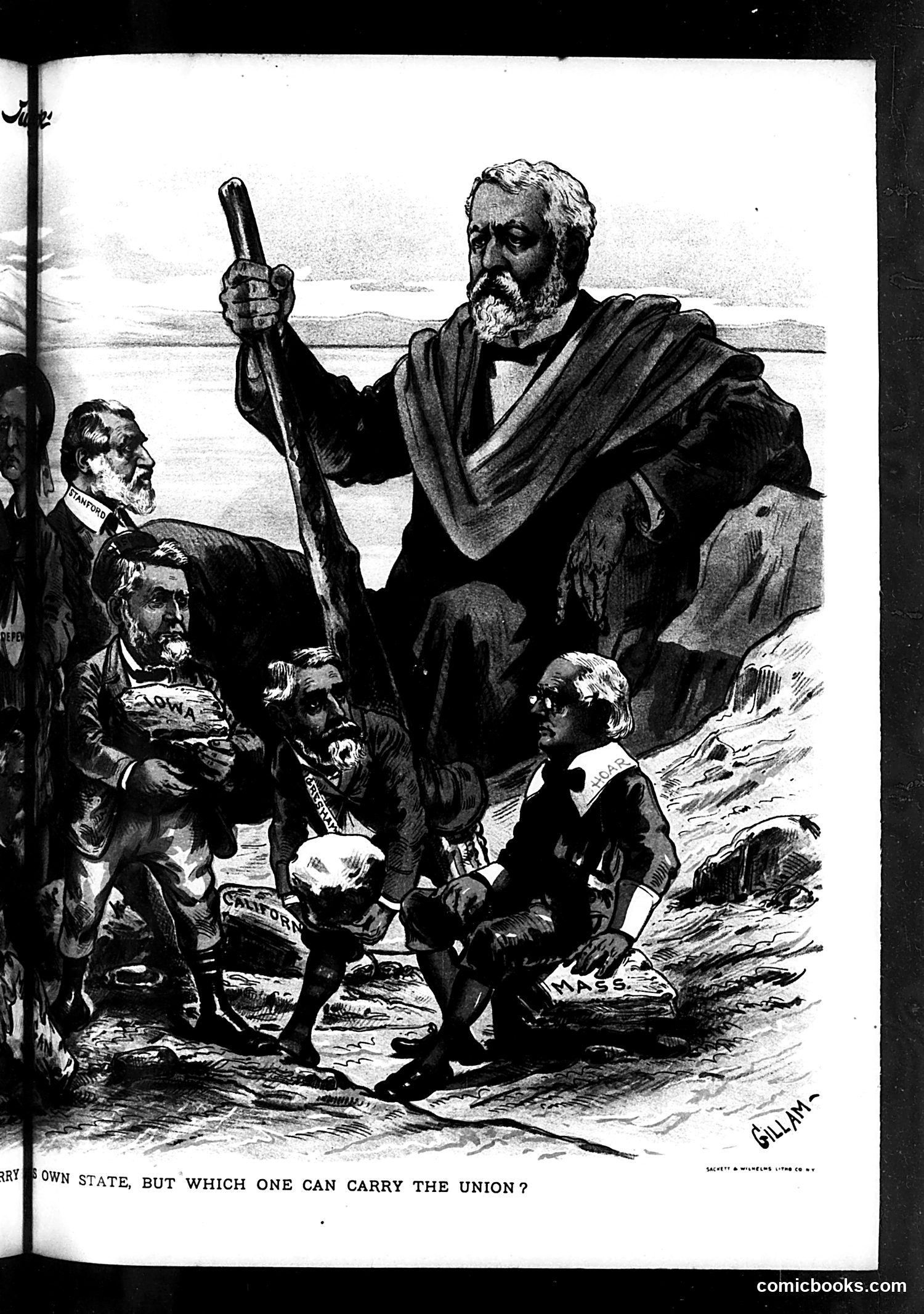
This *Judge* magazine cartoon depicts a bearded man holding a large club, standing over several smaller figures labeled with state names (visible: "IOWA," "CALIFORNIA," "MASS"). The caption reads: "OWN STATE, BUT WHICH ONE CAN CARRY THE UNION?" The satire appears to address **tensions over which state or political leader could "carry" (support/lead) the Union**—likely referencing a presidential election or political succession debate. The tall figure wielding the club seems to represent a powerful political figure or region, while the smaller figures represent individual states struggling beneath the burden of Union responsibility. The imagery suggests anxieties about political power distribution during a period of American sectional conflict, though without a visible date, the exact historical moment remains unclear. The cartoon satirizes the competitive struggle among states or politicians for national leadership.
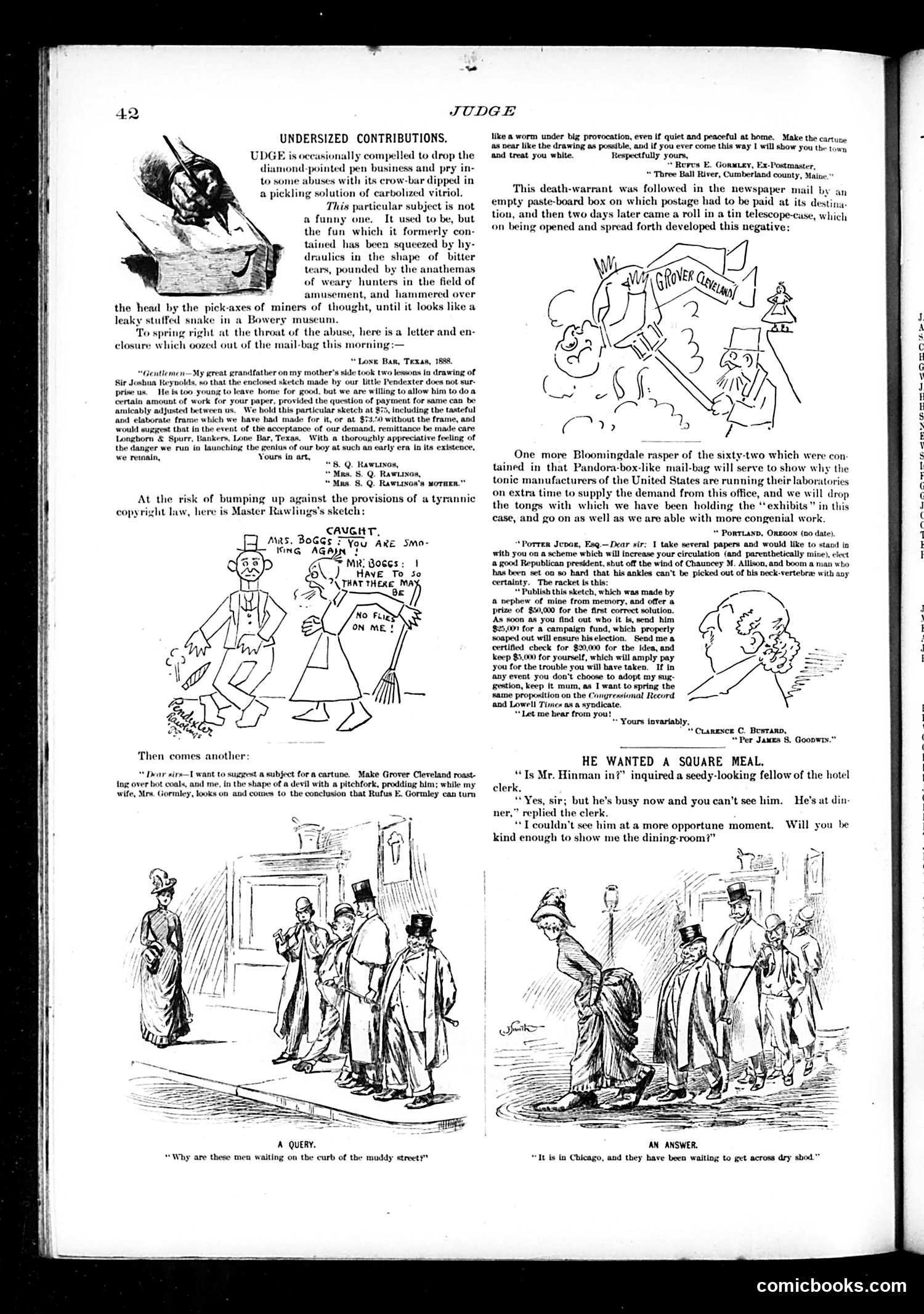
This page satirizes unsolicited, low-quality contributions to *Judge* magazine. The editorial presents three absurd submission letters mocking readers who presume to contribute artwork or story ideas while making outrageous demands. The first letter, from "S. Q. Rawlings" of Lone Bar, Texas, claims his young son's crude stick-figure drawing is worth $75 because a distant ancestor took two drawing lessons from Sir Joshua Reynolds. The accompanying childish sketch—labeled "mas. Boggs"—deliberately demonstrates complete artistic incompetence. The second solicitation requests *Judge* create a cartoon of Grover Cleveland being tortured by the letter-writer himself (as a devil), apparently to impress his wife. A third fragment mentions wanting to boost circulation through vague "Republican" scheming involving Chauncey M. Allison. The satire targets amateur contributors' delusional self-regard, nepotistic entitlement, and ludicrous payment expectations. By publishing these absurd letters alongside their terrible submissions, *Judge* ridicules the flood of unsuitable material editors constantly received.
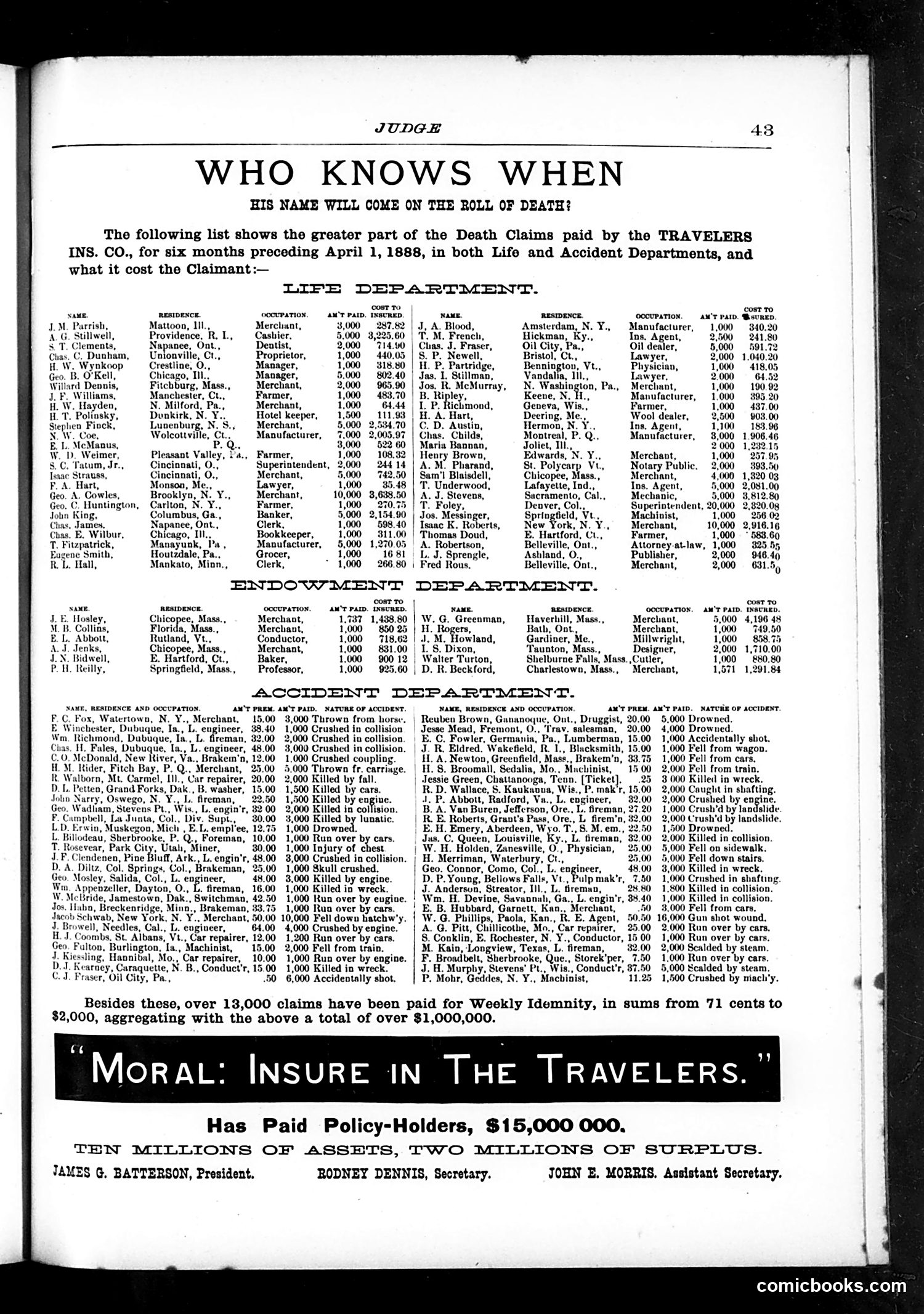
This page is an advertisement for the **Travelers Insurance Company**, presented as a stark reminder of mortality. Rather than traditional marketing, it functions as darkly satirical social commentary. The page lists hundreds of actual death claims paid by Travelers between 1888-1889, organized by department (Life, Endowment, Accident). Each entry shows the deceased's name, residence, occupation, and payout amount—creating an unsettling catalog of death across America. **The satire**: By displaying this exhaustive death roll, the ad makes a morbid pitch: "who knows when **your** name will appear here?" The final moral—"INSURE IN THE TRAVELERS"—transforms grim inevitability into a sales pitch. Death is presented not as tragedy but as actuarial certainty, making insurance seem prudent rather than morbid. The approach exploits Victorian anxiety about sudden death and financial ruin, weaponizing mortality statistics as persuasion. It's darkly clever: confront readers with proof that death comes for ordinary people (merchants, farmers, lawyers) to compel them to buy protection for their families.
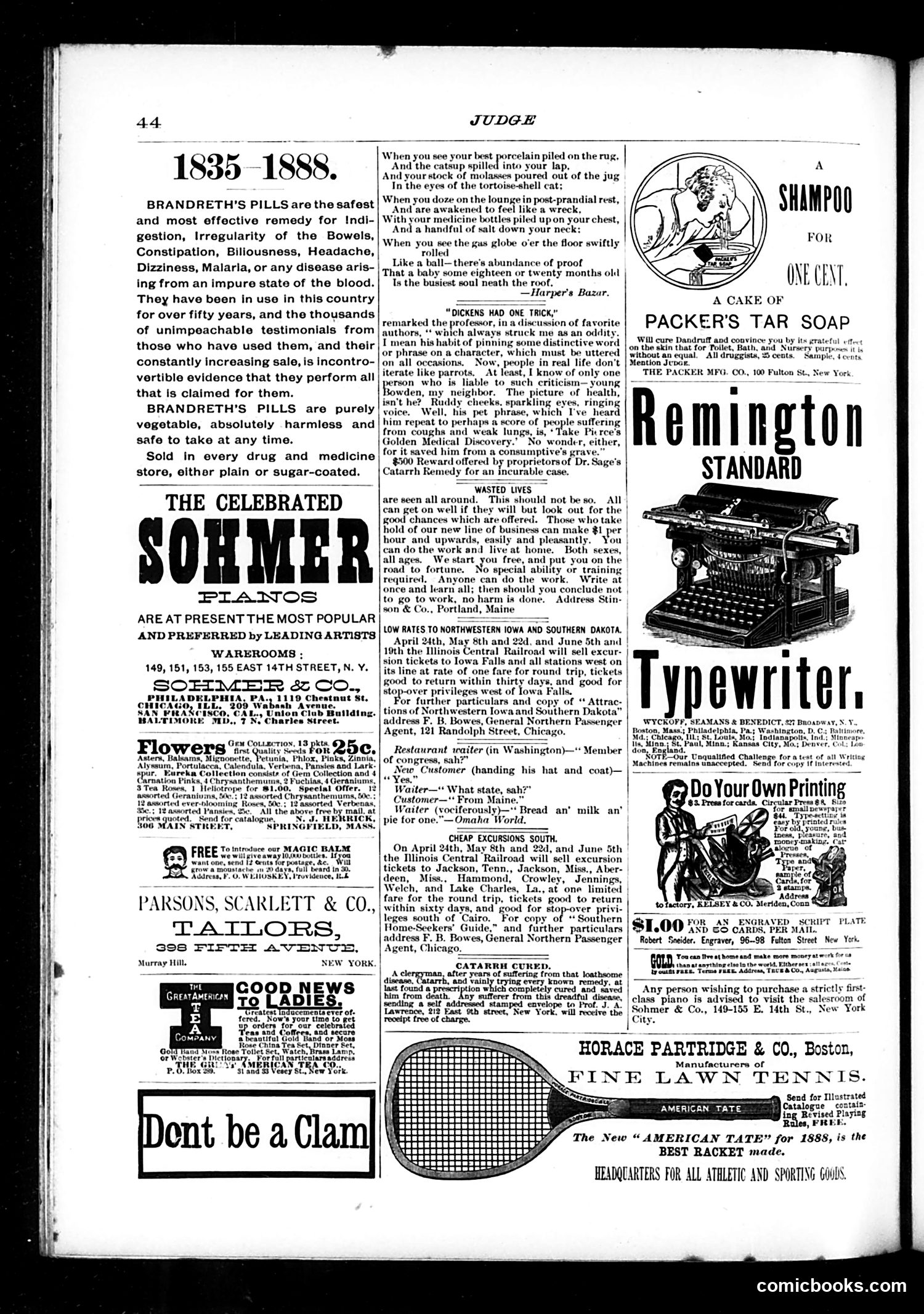
This page is primarily **advertising**, with one substantial satirical piece. The main cartoon/article is "Dickens Had One Trick," a humorous commentary on Charles Dickens's literary style—his habit of giving characters a repeated catchphrase. The joke adapts this to a modern character, young Bowden, who constantly recommends Dr. Pierce's Golden Medical Discovery for his cough, much like Dickens's invented speech patterns. The satire mocks both excessive advertising claims and people's mechanical repetition of product endorsements. The remainder consists of period advertisements: Brandreth's Pills (a long-established patent medicine), Sohmer Pianos, flower seeds, clothing tailors, tennis rackets, typewriters, and railroad excursion fares. The ads reflect 1880s consumer culture—patent medicines, sheet music, flowers by mail, and leisure travel. The "Don't be a Clam" advertisement appears fragmentary but likely promoted some product or service using populist language.
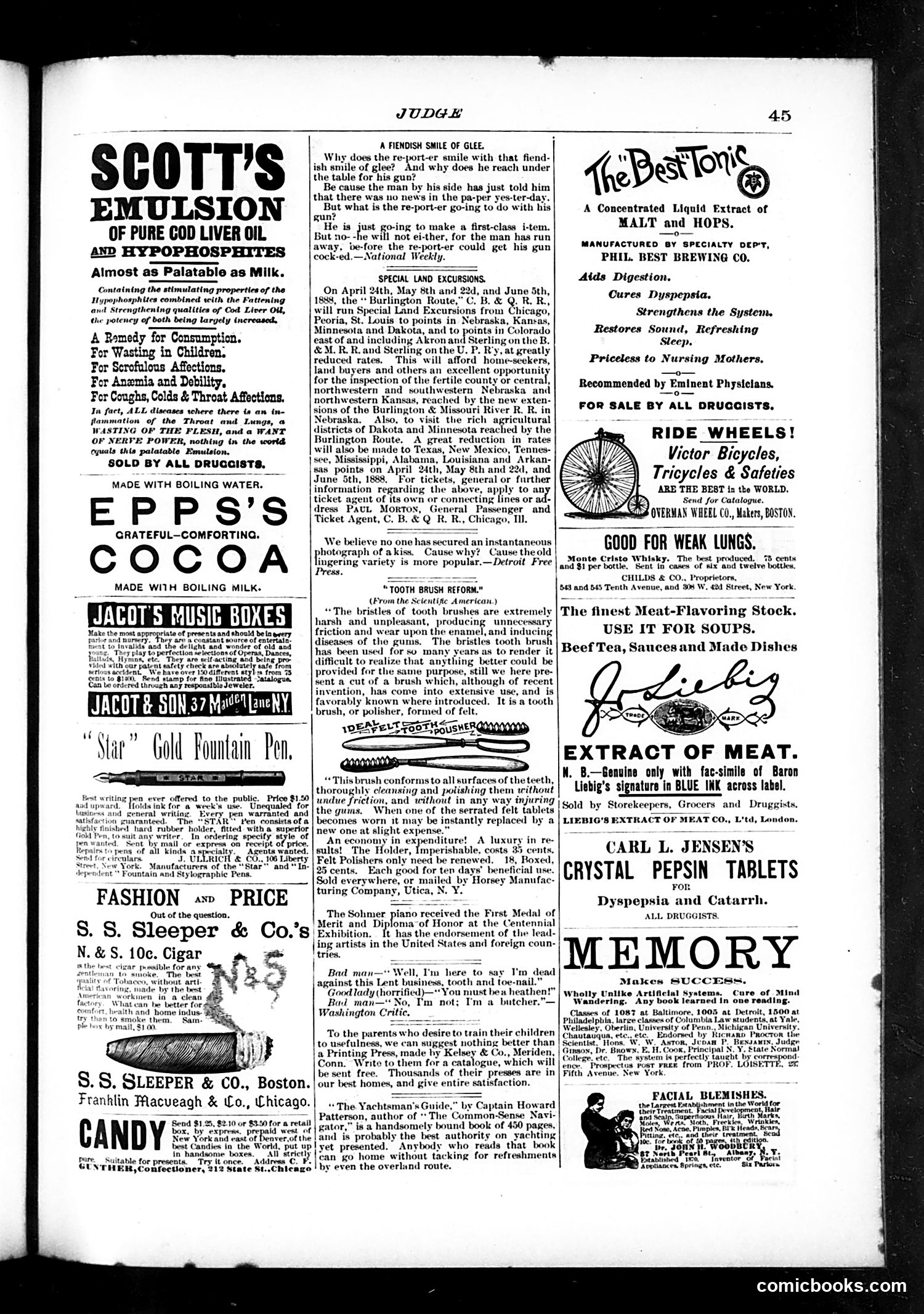
This page is primarily **advertisements and filler content**, not political cartoons. The main satirical item is a brief joke titled "A Fiendish Smile of Glee" (top left), which describes a newspaper reporter who smiles menacingly when told there's no news—implying he'll *create* newsworthy events (violent ones, with a gun) rather than report actual occurrences. The joke mocks sensationalist journalism of the era. The rest of the page consists of period product advertisements: Scott's Cod Liver Oil Emulsion (a health tonic), Epps's Cocoa, Jacob's Music Boxes, fountain pens, cigars, and candy. A brief throwaway joke about kiss photography appears mid-page. These ads and filler pieces were standard Judge magazine content between major editorial cartoons.
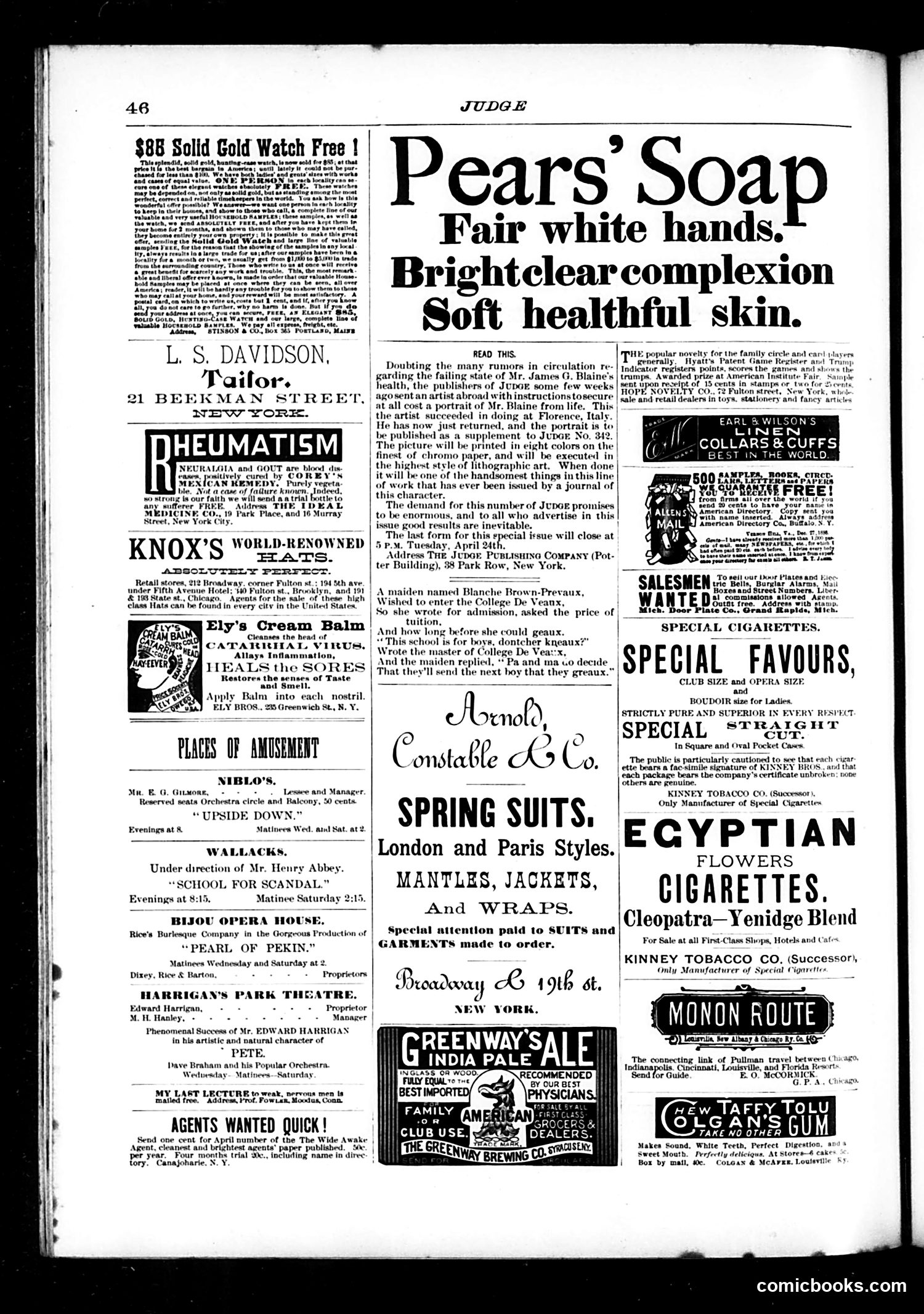
This is primarily an **advertising page** with limited satirical content. The main noteworthy element is an advertisement for *Judge* magazine itself, announcing a special forthcoming supplement featuring **James G. Blaine**. ## Key Content: The *Judge* advertisement describes sending an artist to Florence, Italy to secure a portrait of the reportedly ailing politician James G. Blaine for publication. The image would be printed in "eight colors on finest chromo paper" in "highest style of lithographic art." The publishers promote this special issue heavily to advertisers, claiming the "demand...promises to be enormous." ## Context for Modern Readers: James G. Blaine was a prominent 19th-century Republican politician. The heavy promotion of his portrait—obtained despite rumors about his health—reflects how *Judge* leveraged current events and public figures' notoriety for circulation and advertising revenue. The remainder of the page comprises standard period advertisements for watches, tailoring, patent medicines, and theater productions. There is no visible political cartoon on this page requiring interpretation.
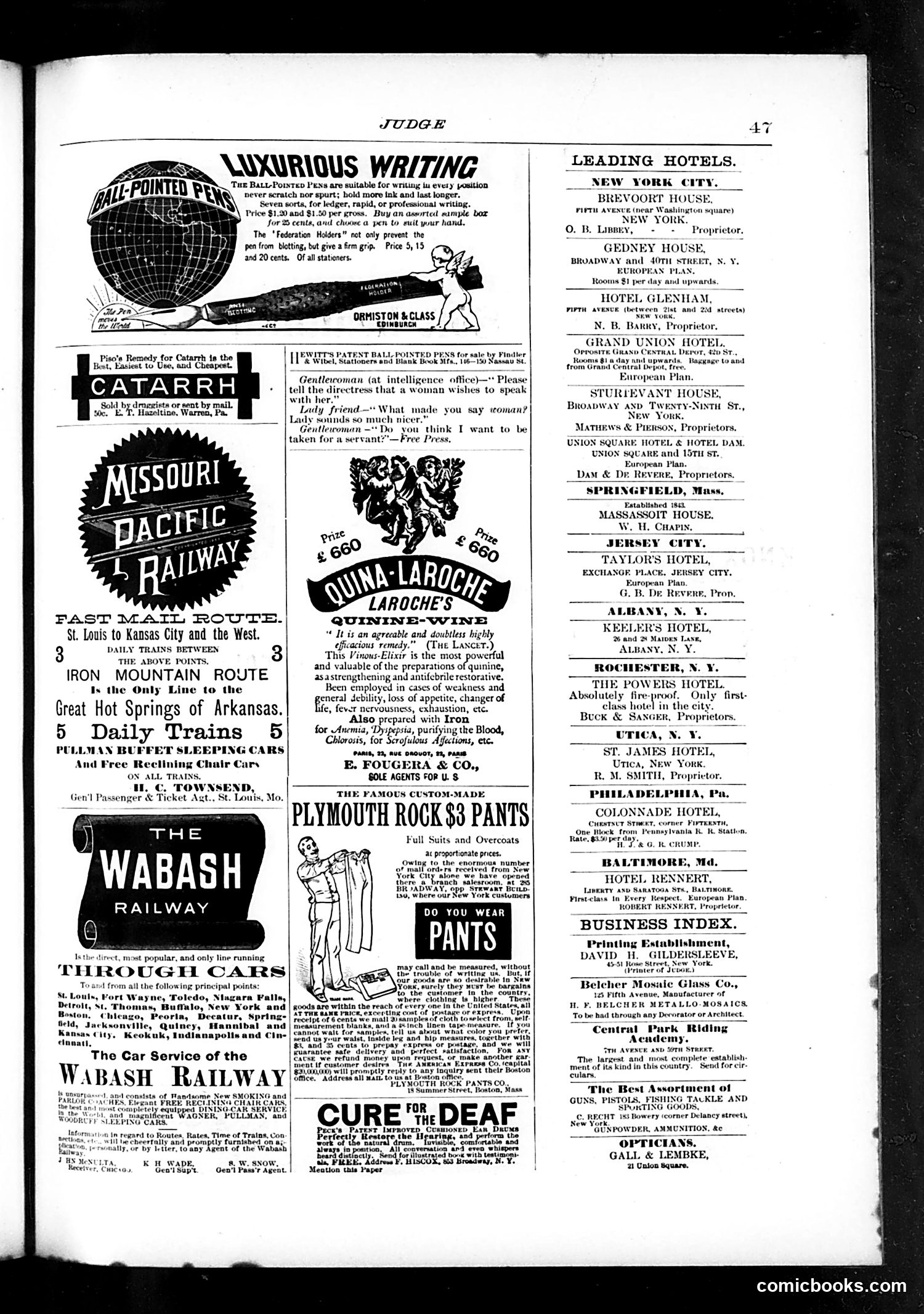
This page is primarily **advertisements and hotel listings** for late 19th-century America, with one small satirical exchange. The only actual cartoon content is a brief dialogue joke: A gentlewoman at an employment office tells a job-seeking "lady friend" that a woman wants to speak with her. When the friend asks why the gentlewoman said "woman" instead of "lady," the response is: "Do you think I want to be taken for a servant?" **The satire**: This reflects Victorian-era class anxieties. The term "lady" implied respectability and social status, while "woman" was considered a lower-class descriptor. The joke mocks this linguistic snobbery—the fear that using the "wrong" word might demote one's social standing. It's poking fun at the rigid class consciousness of the period, where even word choice signaled social position. The rest of the page features period advertisements for railways, pens, hotels, patent medicines (quinine wine), custom pants, and devices claiming to cure deafness—typical of Judge magazine's commercial content.
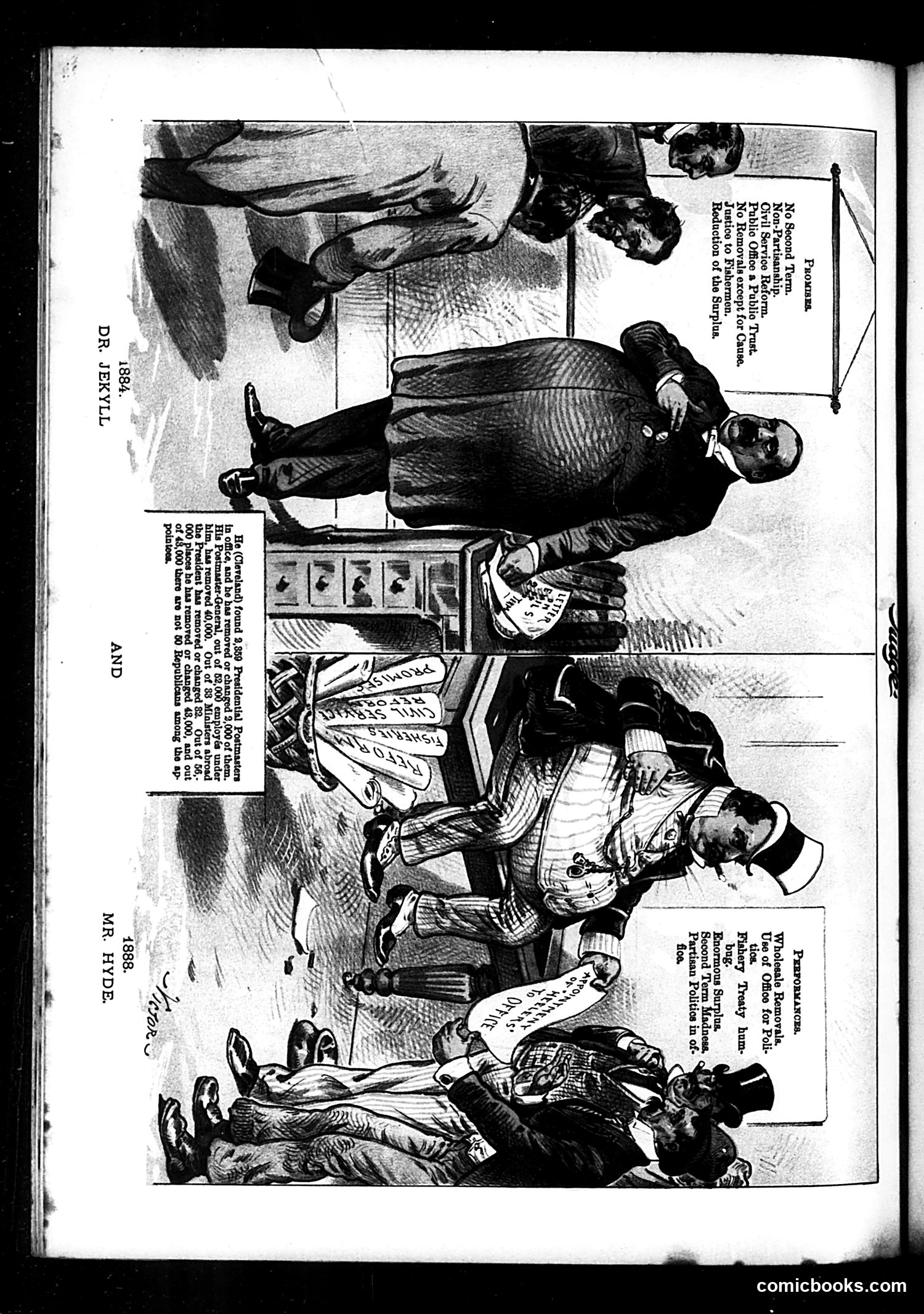
This satirical cartoon compares President Grover Cleveland to Robert Louis Stevenson's fictional character Dr. Jekyll/Mr. Hyde, critiquing his broken campaign promises. The left side lists Cleveland's 1884 campaign **promises**: civil service reform, no partisan removals, treating public office as a public trust, and rejecting a second term. The right side documents his actual **performances**: wholesale removals of officials, using office for political purposes, partisan politics, and pursuing a second term in 1888. The satirical point: Cleveland's administration contradicted its own reform platform, abandoning principles once in power. The Jekyll/Hyde metaphor suggests a complete personality reversal—the reformer became indistinguishable from the corrupt machine politician he claimed to oppose. This was a common attack against Cleveland during his 1888 re-election campaign.