
A complete issue · 16 pages · 1888
Judge — April 21, 1888
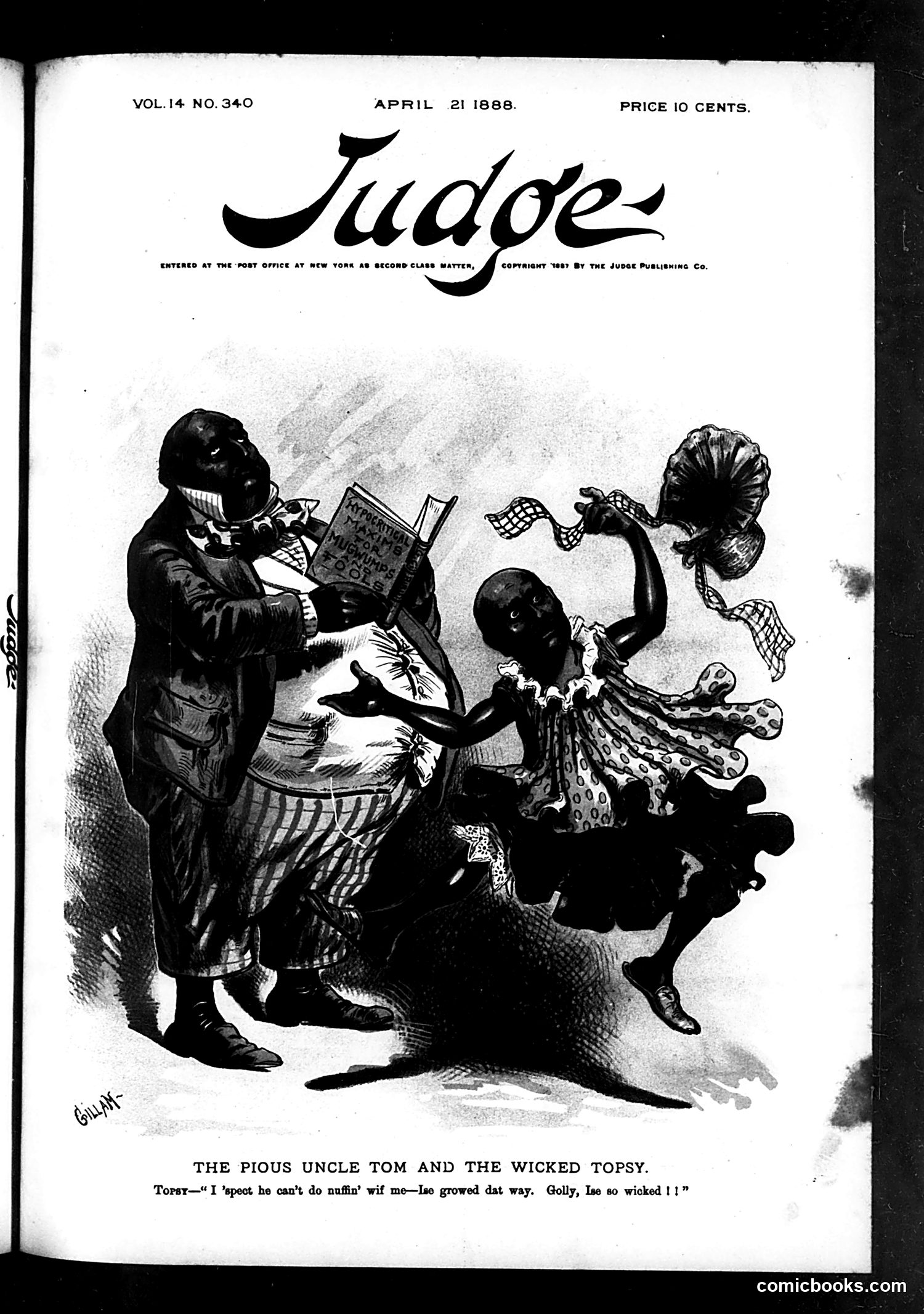
This cartoon references Harriet Beecher Stowe's *Uncle Tom's Cabin* (1852), specifically the characters Uncle Tom and Topsy. The image depicts two figures with exaggerated caricature features characteristic of 19th-century racist imagery. The caption quotes Topsy saying she "spect he can't do nuffin' wif me—Ise growed dat way. Golly, Ise so wicked!!" This references Topsy's famous line from the novel about lacking Christian instruction. The satire appears to contrast Uncle Tom's moral piety with Topsy's mischievous behavior. The exact 1888 political context is unclear, though the cartoon likely uses these literary characters to comment on contemporary social or moral issues. The artwork's style and stereotype imagery reflect period conventions Judge magazine employed for humor.
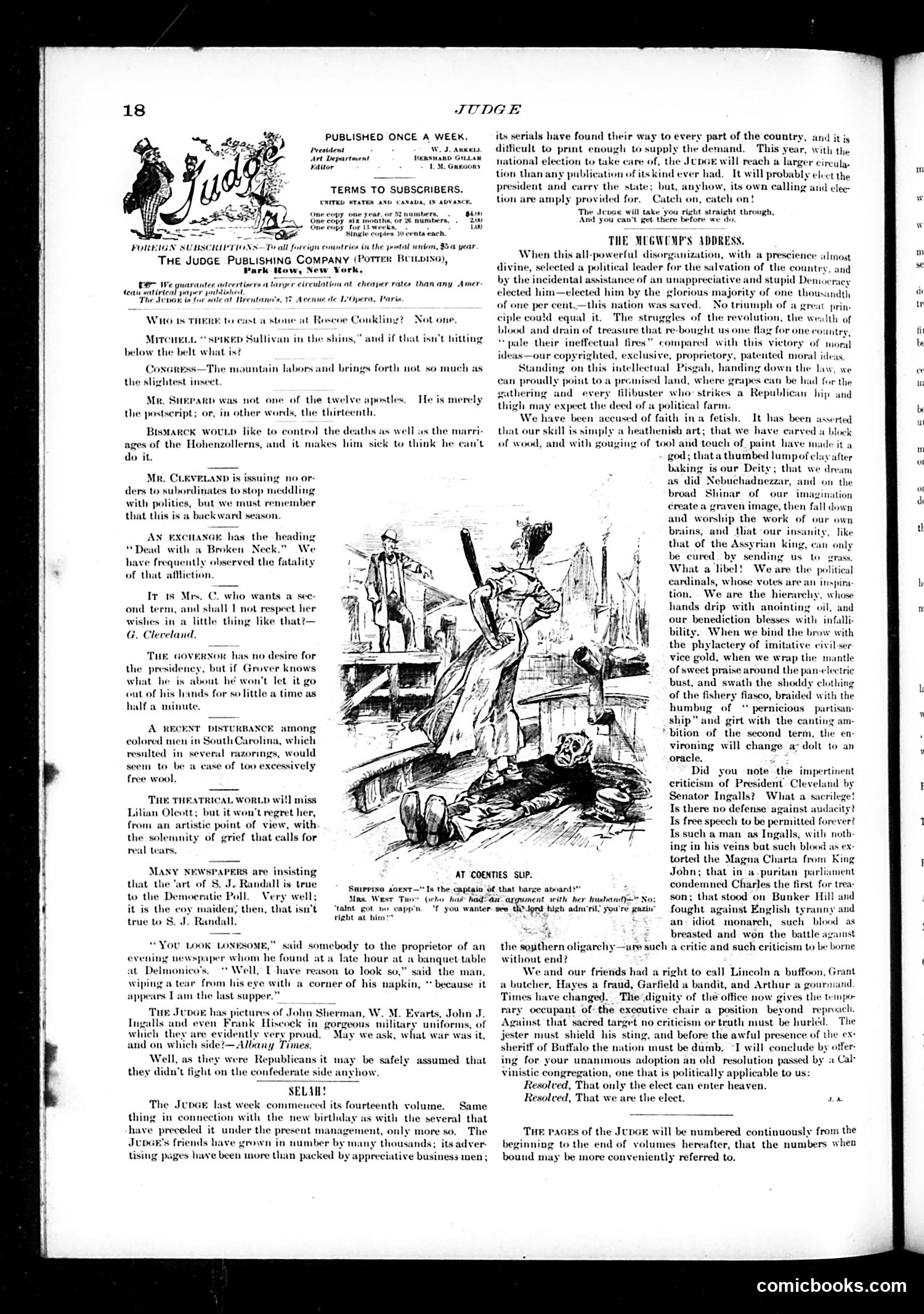
This page contains editorial commentary rather than a primary cartoon. The main illustration shows a shipwreck scene labeled "AT COXSWAIN'S SLIP," depicting chaos at a ship with figures in distress. The text addresses political figures including President Cleveland, Senator Ingalls, and references to Lincoln, Grant, and Hayes. The commentary criticizes what appears to be Republican political strategy, using maritime disaster as metaphor for political instability. Specific references include mockery of "free speech" debates and comparisons to historical figures. The editorial argues Republicans are in disarray ("At Coxswain's Slip"), though without additional context, the exact political event being satirized remains unclear—likely relating to 1880s-era Democratic/Republican political conflicts. The page emphasizes editorial voice over visual satire.
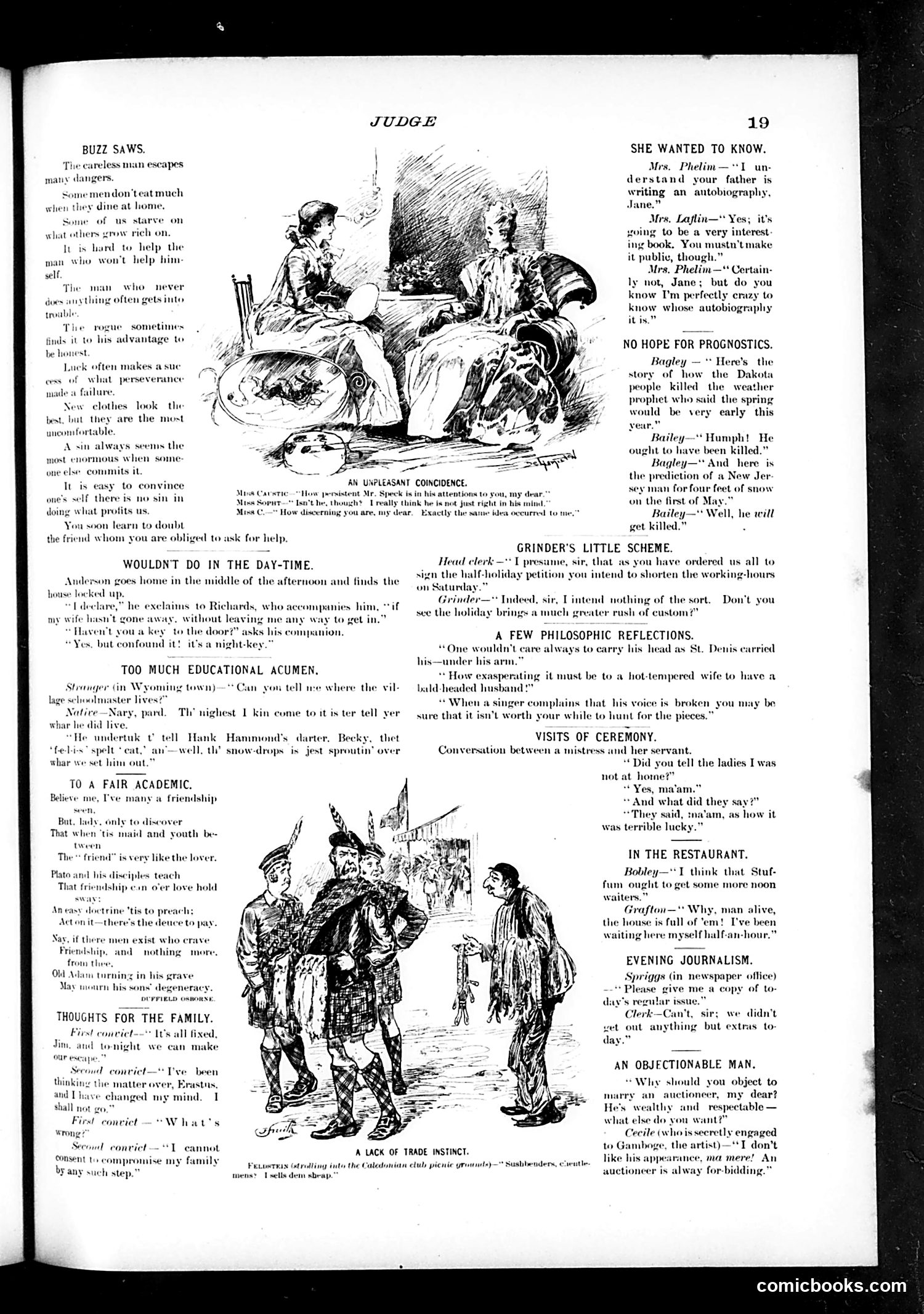
This page from *Judge* magazine presents satirical commentary on everyday social situations through brief anecdotes and jokes rather than political cartoons. The content mocks human nature and social hypocrisy. "Buzz Saws" offers cynical observations: the careless escape danger while careful people worry; rogues sometimes prosper; people judge others' sins more harshly than their own. Other sections ridicule specific scenarios: a husband using a "night-key" to enter his locked house; a father writing an autobiography nobody should read; the illogic of a weather prophet's predictions; servants deceiving visitors by claiming employers aren't home. The illustrations show Victorian-era social interactions—people in period dress engaged in conversation or ceremony. The satire targets Victorian upper-class pretense and the gap between public propriety and private behavior. This represents *Judge's* typical approach: gentle, domestic social satire rather than hard political commentary, relying on recognizable middle and upper-class situations for humor.
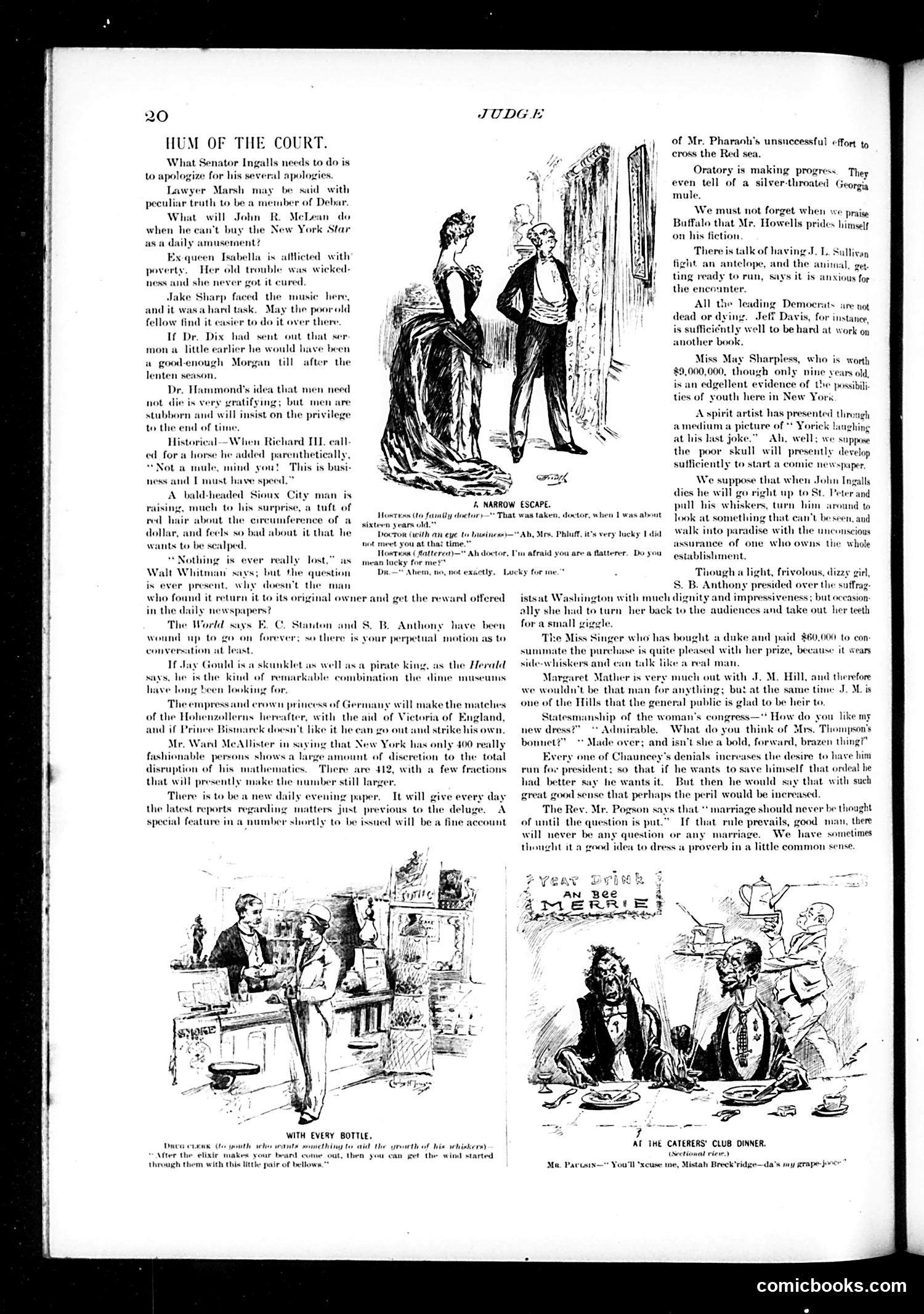
This page contains several disconnected satirical jabs at 1880s-90s public figures and social trends: **"Hum of the Court"** section mocks various celebrities: Senator Ingalls's apologies, John Roach's inability to buy respectability despite wealth, and a Sioux City man finding unexpected hair growth. **The cartoons** appear to lampoon contemporary figures—one shows a "narrow escape" dialogue about a doctor and patient, another depicts a dinner scene at "The Caterers' Club." **Social commentary** targets: Ward McAllister's claims about New York's "400" fashionable people (a real Gilded Age controversy), discussions of J.L. Sullivan fighting an antelope, and Margaret Mather's romance drama. **The overall tone** is typical Judge satire—gossipy, irreverent attacks on wealthy pretenders, celebrities, and social climbers. Without clearer OCR or date confirmation, specific identifications remain uncertain, but the page exemplifies how Judge mixed illustrated humor with society-page mockery.
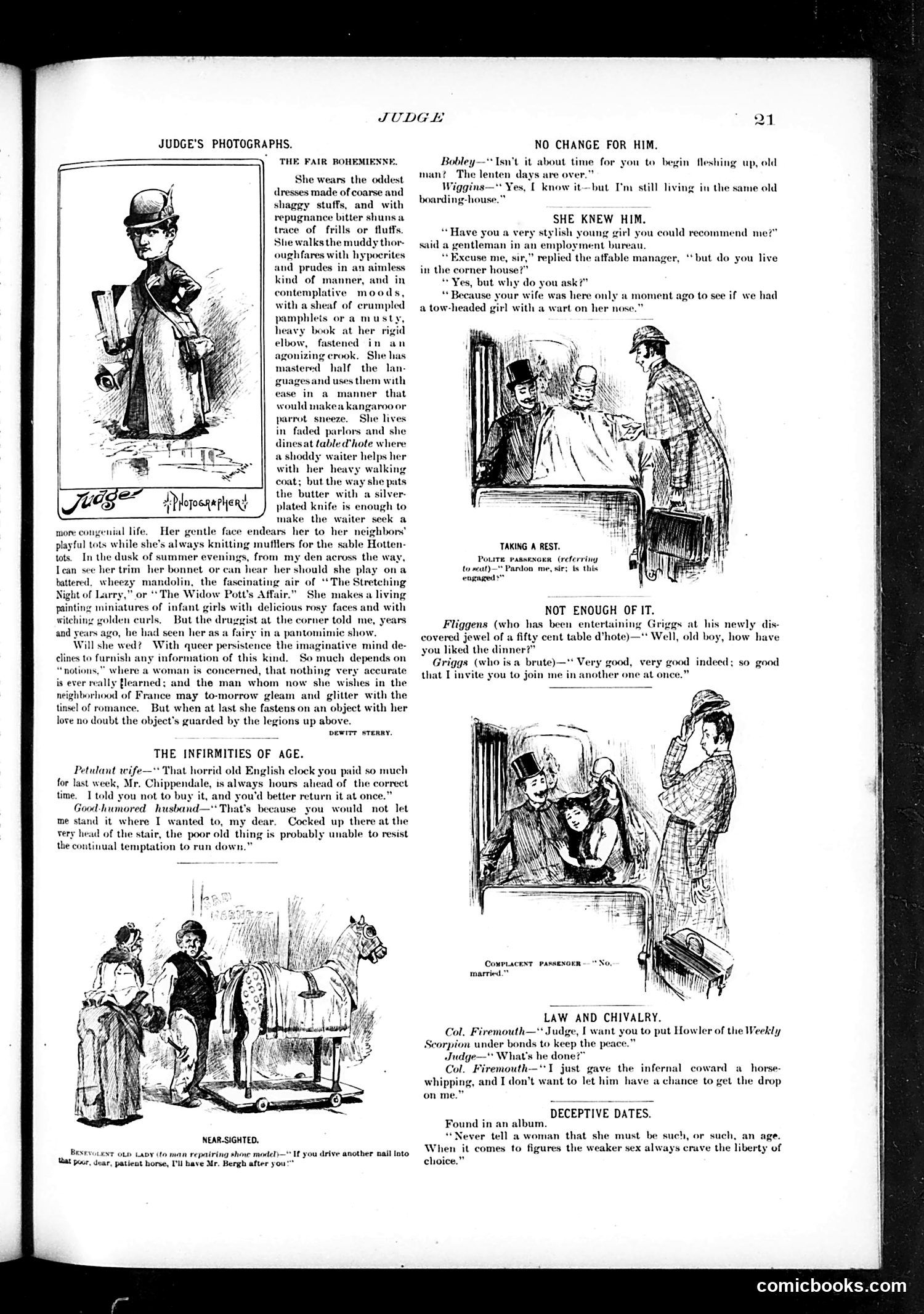
This page from Judge magazine (an American satirical weekly) contains multiple brief satirical vignettes about social types and domestic situations typical of the 1880s-90s era. **Key content:** The main feature, "The Fair Bohemie," satirizes an unconventional woman who affects artistic pretensions—wearing plain clothes, carrying weighty books, living frugally—while remaining fundamentally conventional. The satire mocks both the "bohemian" affectation and bourgeois attitudes toward unconventional women. The shorter pieces target common domestic absurdities: a husband unwilling to move a clock that runs fast because it's perched temptingly at the top of the stairs ("continual temptation to run down"); an employment bureau manager who recognizes a job-seeker's wife by her appearance; a man so cheap he only takes dates at fifty-cent restaurants. **Broader point:** Judge ridicules social pretension, marital friction, class anxiety, and the gap between people's self-image and reality—standard satirical targets of the era.
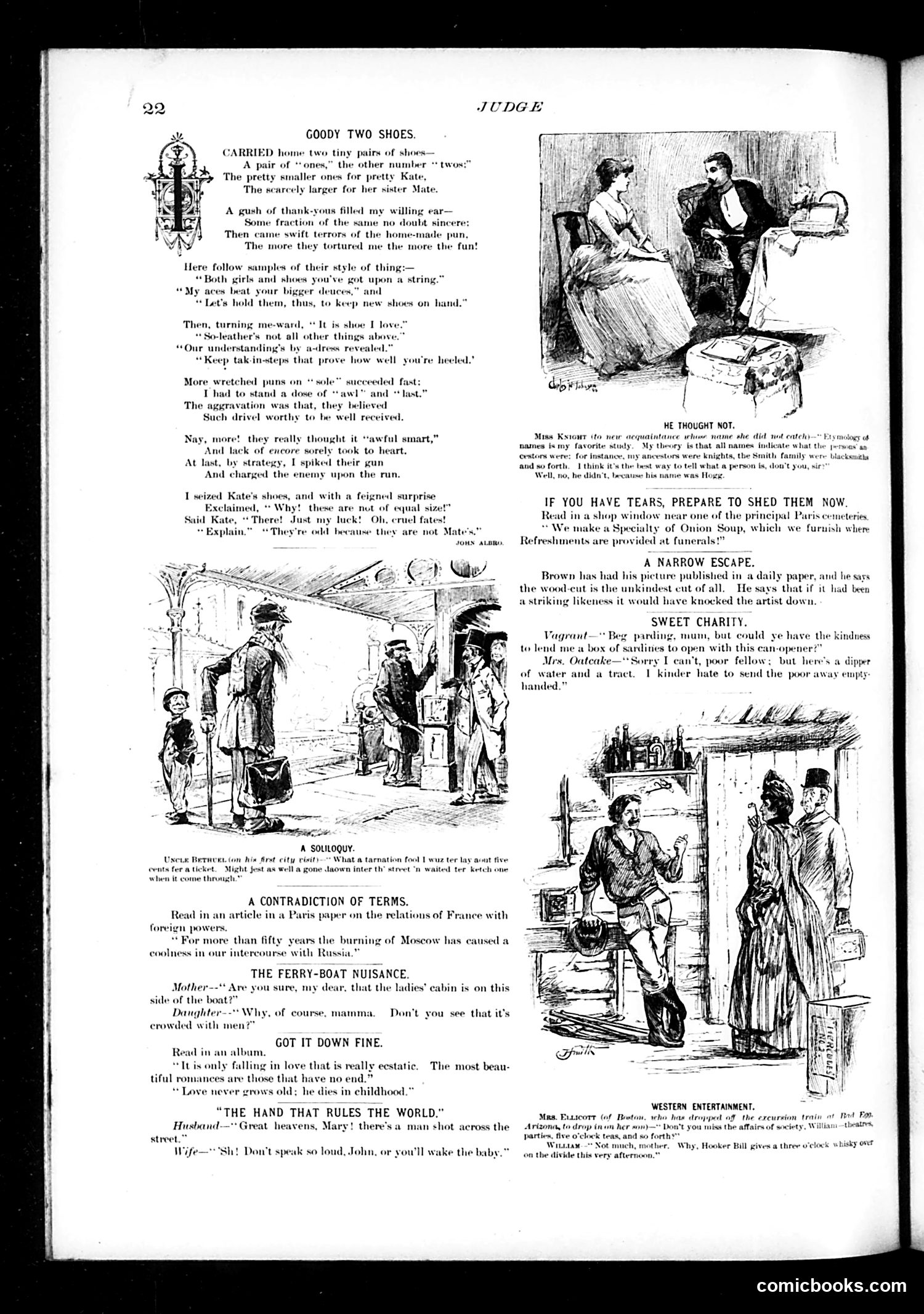
This page from *Judge* collects brief satirical vignettes mocking Victorian society and contemporary absurdities: **"Goody Two Shoes"** ridicules the excessive punning and forced wordplay that amused Victorian audiences—the joke being that the girls' terrible shoe-related puns are presented as clever entertainment. **"The Ferry-Boat Nuisance"** satirizes the impracticality of gender-segregated spaces; the "ladies' cabin" is actually crowded with men, exposing the futility of such social arrangements. **"If You Have Tears"** mocks the juxtaposition of onion soup and funeral refreshments—absurdly marketing cheap soup as appropriate funeral fare. **"Sweet Charity"** critiques misguided benevolence: a vagrant asks for sardines to open, but a well-meaning woman offers only water and a religious tract instead, implying charity was often performative rather than genuinely helpful. **"The Hand That Rules the World"** uses a dramatic domestic scene—a husband's concern about street violence ignored by a wife worried only about waking the baby—to satirize female indifference to serious matters. The cartoons collectively mock Victorian social pretense, ineffective charity, and absurd priorities.
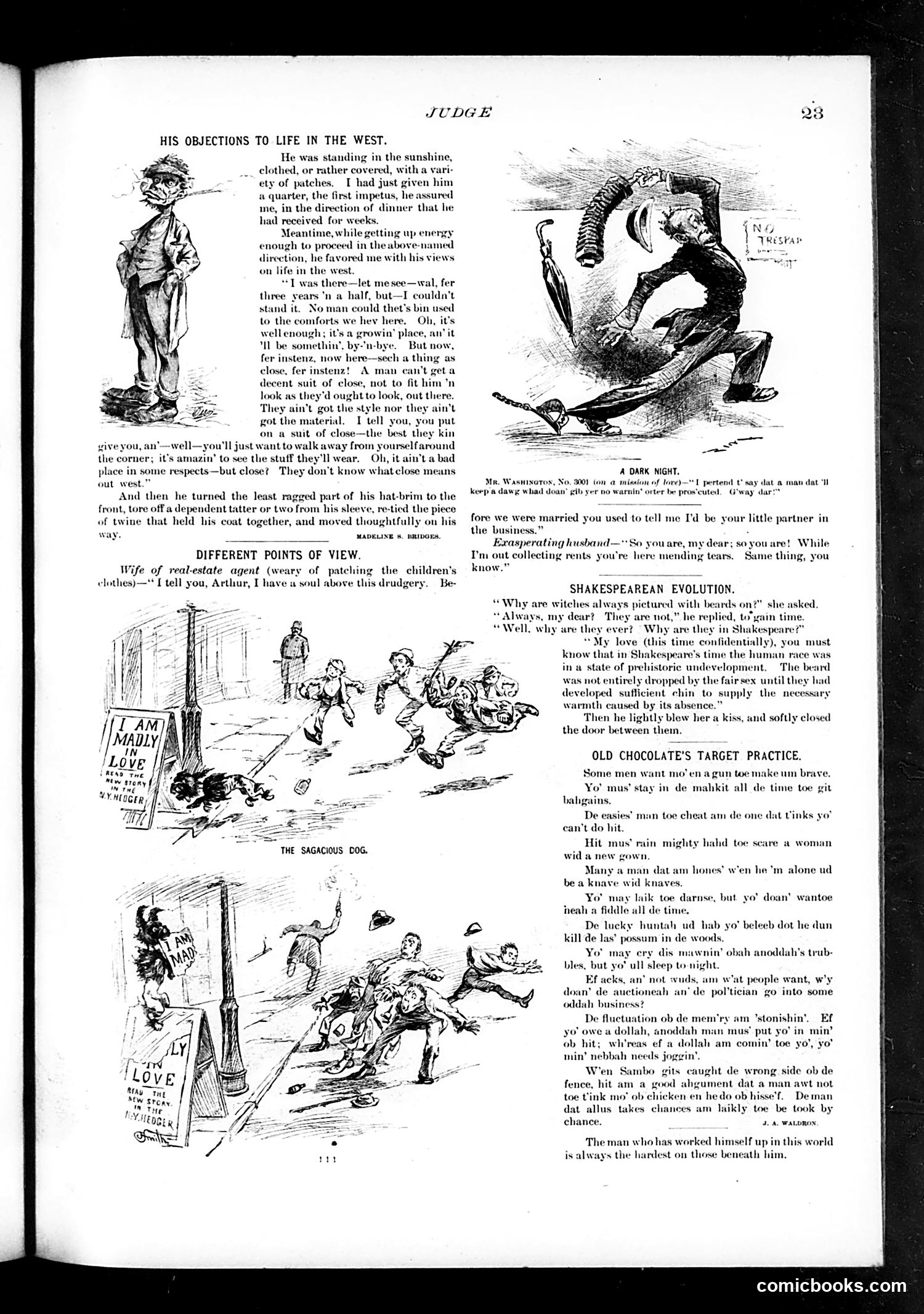
This page contains three satirical pieces reflecting late 19th/early 20th-century American social humor: **"His Objections to Life in the West"**: A poorly-dressed man complains that Western frontier life lacks the civilized comforts of the East, particularly quality clothing. The satire mocks both frontier roughness and Eastern snobbery about material refinement. **"Different Points of View"**: A wife and real-estate agent husband have conflicting priorities—she sees domestic drudgery as beneath her; he sees rent-collecting as his duty. The cartoon satirizes gender roles and marital tensions over class aspirations. **"Old Chocolate's Target Practice"**: Attributed to J.A. Waldron, this presents African American dialect wisdom sayings. While framed as folk philosophy, the heavy dialect representation reflects period conventions of minstrel-style racial caricature common in mainstream publications. **"Shakespearean Evolution"** and **"A Dark Night"**: Brief comedic vignettes on romantic and literary topics. The page exemplifies Judge's mix of class satire, domestic humor, and period racial stereotyping typical of 1890s-1900s American satirical magazines.
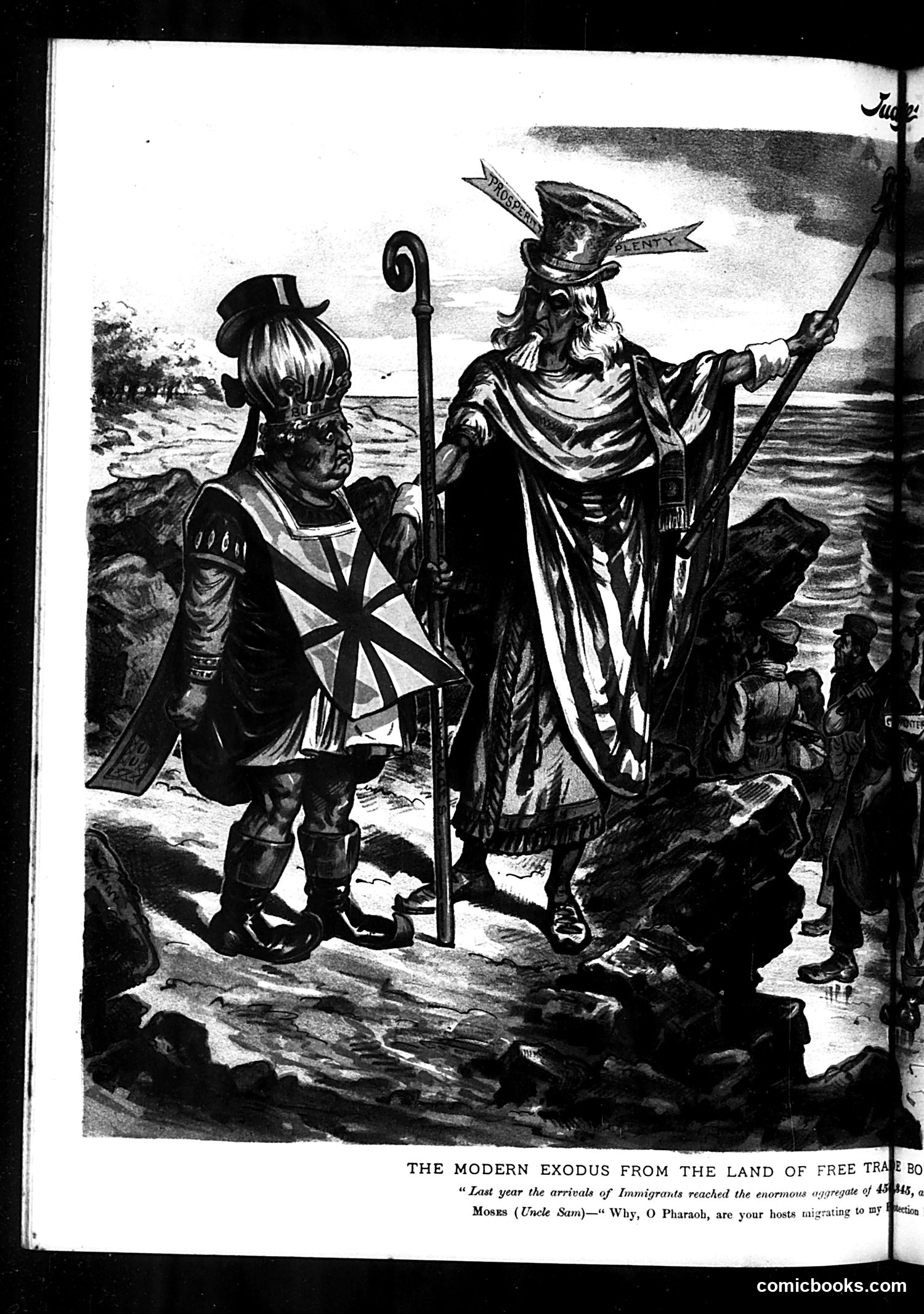
This cartoon satirizes immigration to America using a biblical parallel. The figure on the right labeled "Moses (Uncle Sam)" represents America itself, dressed as the biblical Moses. The left figure appears to be "Pharaoh," likely representing a foreign power or restrictive trade regime. The title references an "exodus" of immigrants reaching America in enormous numbers. The cartoon's ironic framing—comparing American immigration policy to Moses leading people to freedom—suggests tension over immigration levels. The reference to "free trade" indicates this critiques either protectionist policies driving emigration or anxieties about unrestricted immigration. The biblical allusion inverts the Exodus narrative: rather than escape from oppression, this depicts mass arrival that contemporaries may have viewed as problematic or overwhelming.
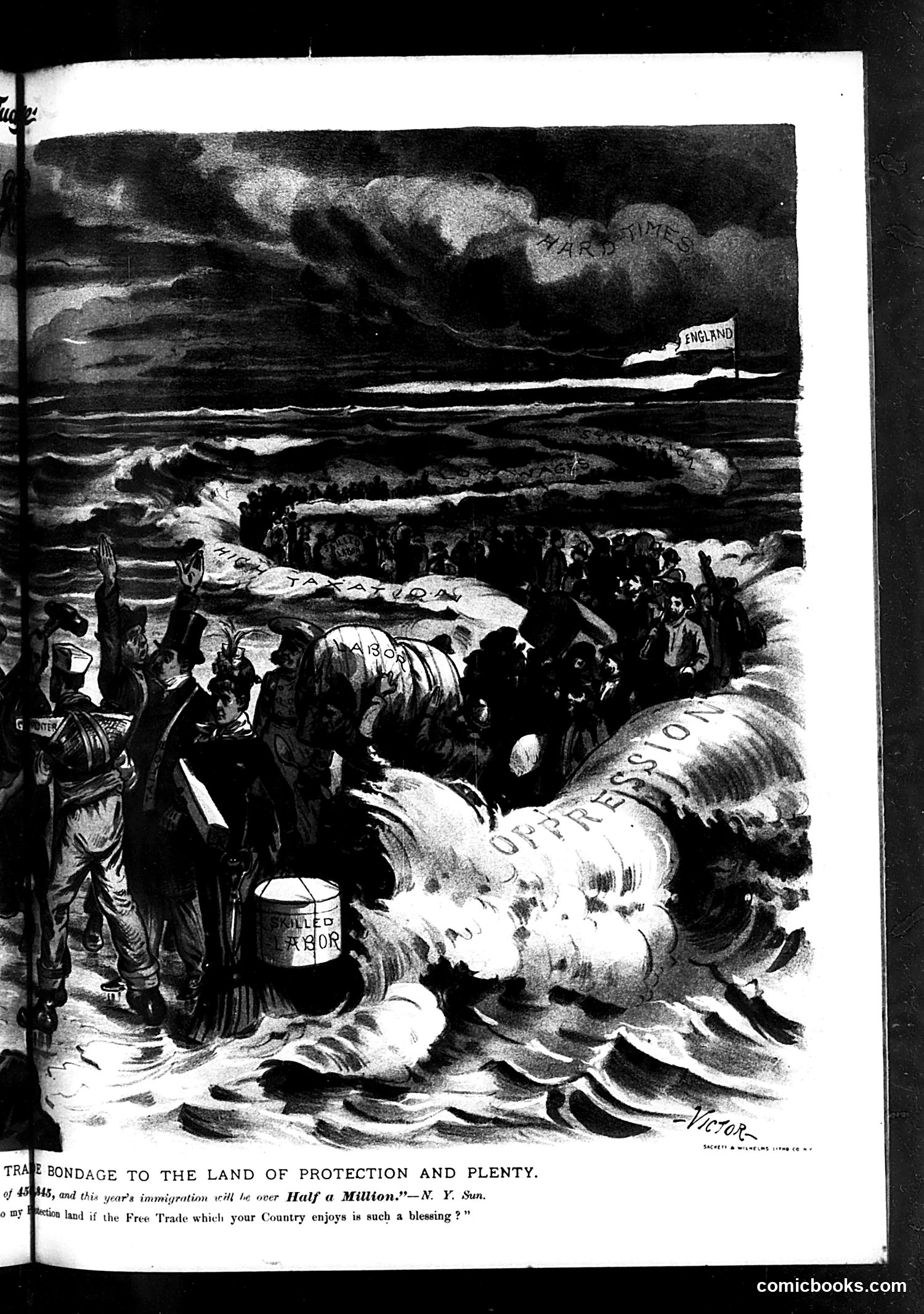
This appears to be a satirical cartoon titled "Trade Bondage to the Land of Protection and Plenty," critiquing immigration policy. The image shows a crowded, chaotic scene at what appears to be a harbor or entry point, with masses of immigrants depicted as cargo or goods labeled "PROTECTION" being unloaded. The cartoon references a New York Sun quote about half a million immigrants arriving yearly. The satire mocks the contradiction between American promises of "protection and plenty" and the actual conditions immigrants face—depicted here as overwhelming, disorganized chaos. The barrels and cargo imagery suggests immigrants are treated as commodities rather than people. The cartoon likely argues that America's free trade policies and immigration rhetoric don't match the grim reality of immigrant reception and working conditions.
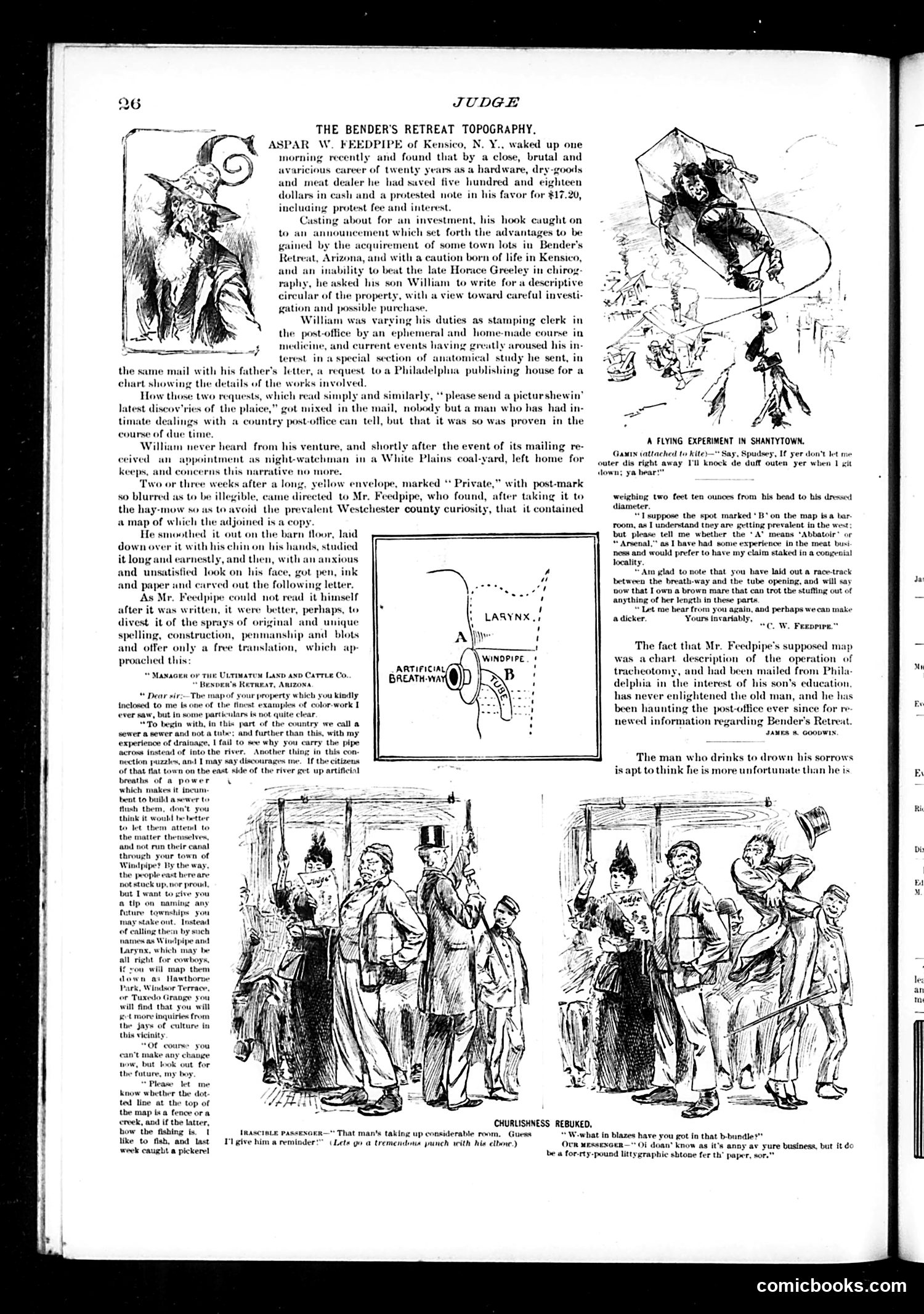
This multi-panel satirical piece mocks Western land speculation schemes popular in the 1880s-90s. A credulous businessman named Aspar Feedpipe, swindled by a local dealer, receives a land prospectus for "Bender's Retreat, Arizona." His son requests anatomical diagrams from a Philadelphia publisher, but the mail gets mixed up—he receives instead a detailed map of human respiratory and digestive systems (larynx, windpipe, breath-way, etc.). Feedpipe earnestly studies this anatomical map as if it were actual property, writing confused inquiries about drainage, fishing rights, and whether marked spots are "abbatoirs" or "arsenals." The satire targets: greedy investors, incompetent rural post offices, fake Western development schemes, and the general gullibility of the era's speculators. The side panels show unrelated street scenes depicting urban churlishness and a child's kite experiment.
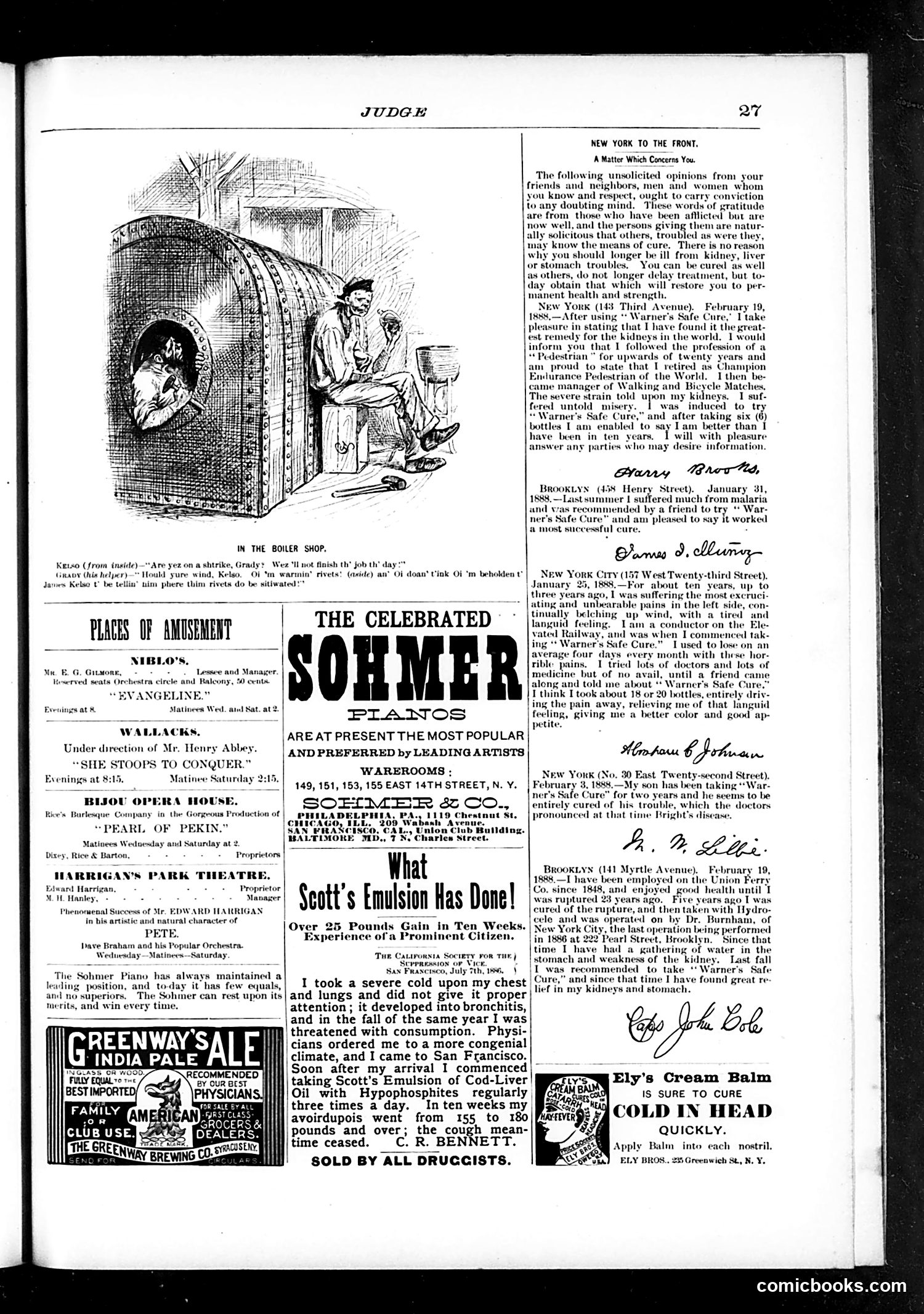
This page mixes entertainment advertisements with testimonial advertising—specifically for "Warner's Safe Cure," a patent medicine. **The Main Cartoon:** "In the Boiler Shop" depicts two working-class men (likely Irish, based on dialect) in industrial labor. The joke is an exchange about work pace and personal obligation—Ketso refuses to finish the job at his boss's pace, asserting independence ("Oi doan' think Oi'm beholden"). It's humor about labor tension and worker autonomy. **The Testimonials:** The bulk of the page consists of unsolicited endorsements for Warner's Safe Cure, a kidney and digestive remedy. These quote real people—a retired "pedestrian" (competitive walker), various Brooklyn residents—claiming the medicine cured kidney disease, malaria, rupture, and other ailments. The testimonials appear designed to overcome skepticism through "authentic" voices. **Context for Modern Readers:** Patent medicines were heavily advertised in late 19th-century publications with celebrity and common-folk endorsements. These were largely unregulated and often ineffective or harmful. Judge's inclusion of multiple testimonials reflects the era's saturated patent-medicine marketing.
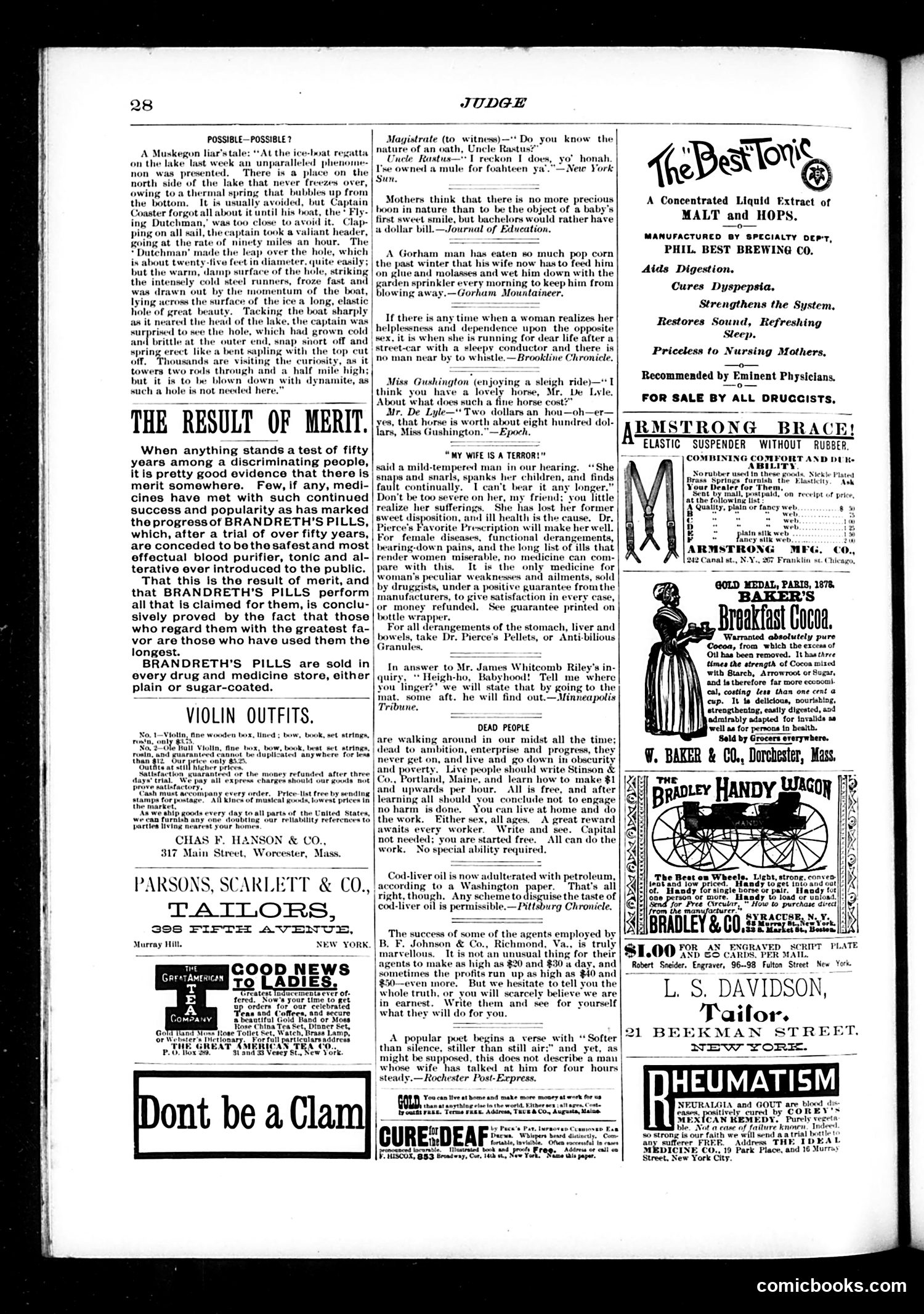
This page is primarily **advertising and filler content** rather than political satire. The main elements are: **"The Result of Merit"** — A large advertisement for Brandreth's Pills, a patent medicine claiming 50 years of success. This reflects 19th-century medical advertising's common exaggerations and unregulated claims. **Small humorous anecdotes** at top and scattered throughout — Brief jokes about Muskegon liars, pop-corn eaters, and romantic misunderstandings. These are genteel period humor with no specific political target. **"Why Wife Is a Terror"** — A domestic joke suggesting a man should be patient with his wife's "sufferings," reflecting Victorian gender attitudes. **Other ads** — Violin outfits, tea sets, tailors, and medicinal products typical of late 19th-century publications. The page contains **no identifiable political cartoons or caricatures**. It's representative of Judge's mixed content: satirical commentary elsewhere in the magazine paired with advertisements and light domestic humor filler.
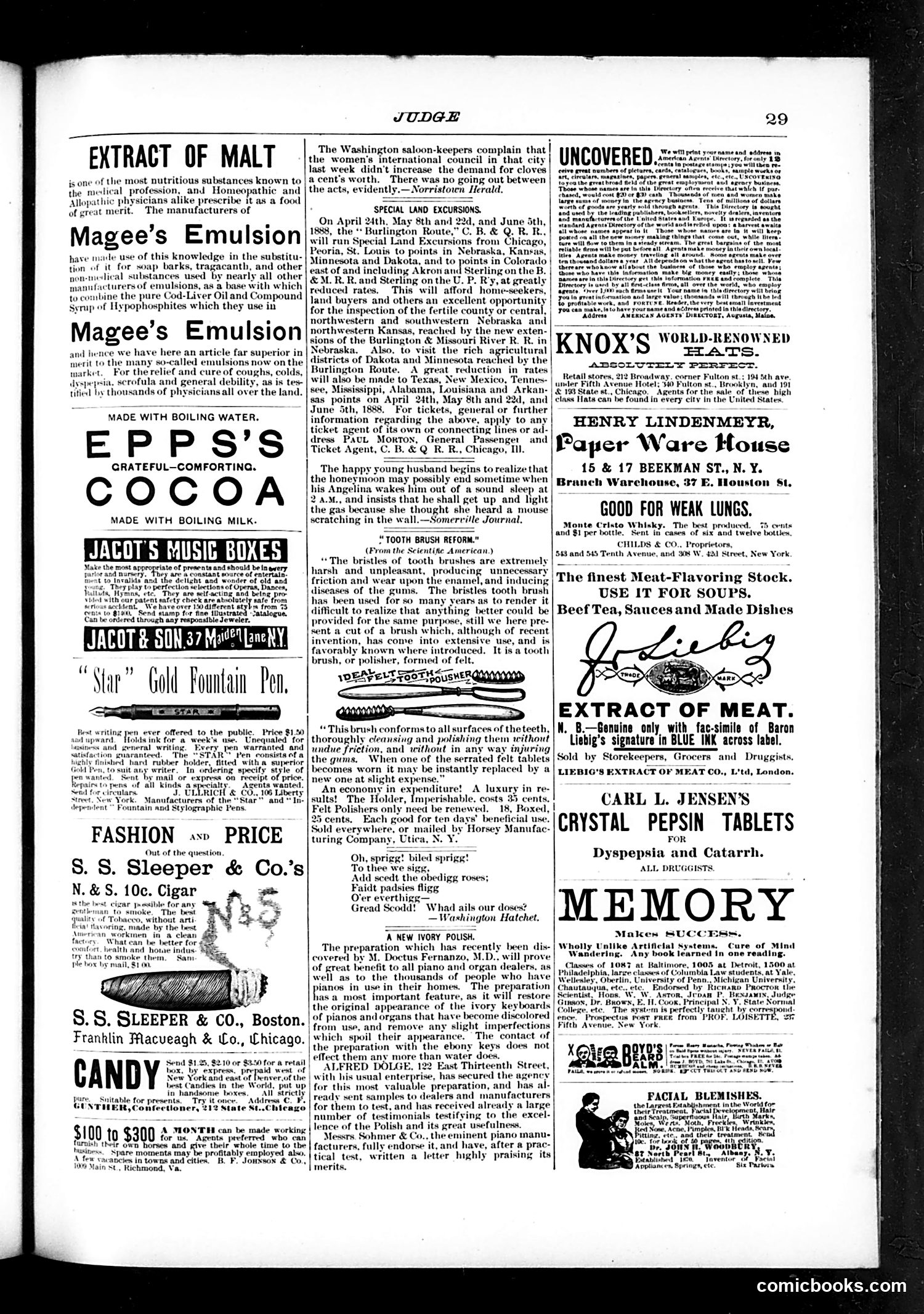
This page is primarily **advertisements and notices**, not political cartoons. The main content consists of commercial ads for products like Magee's Emulsion (a health supplement), Epps's Cocoa, Jacob's Music Boxes, and various other Victorian-era goods. The few satirical snippets are brief and lightweight: - A joke about Washington saloon-keepers complaining that a women's international council meeting didn't increase demand for cloves - A quip about a newlywed husband being woken at 2 a.m. by his wife hearing a mouse in the wall - A note about theater audiences not leaving between acts These are gentle social humor rather than pointed political satire. The page reflects **Judge's** character as a humor magazine that mixed advertising with light jokes about domestic life and contemporary observations. There are no identifiable political figures or serious satirical targets visible here—it's simply period advertising and mild comedy, typical of late-19th-century magazine content.
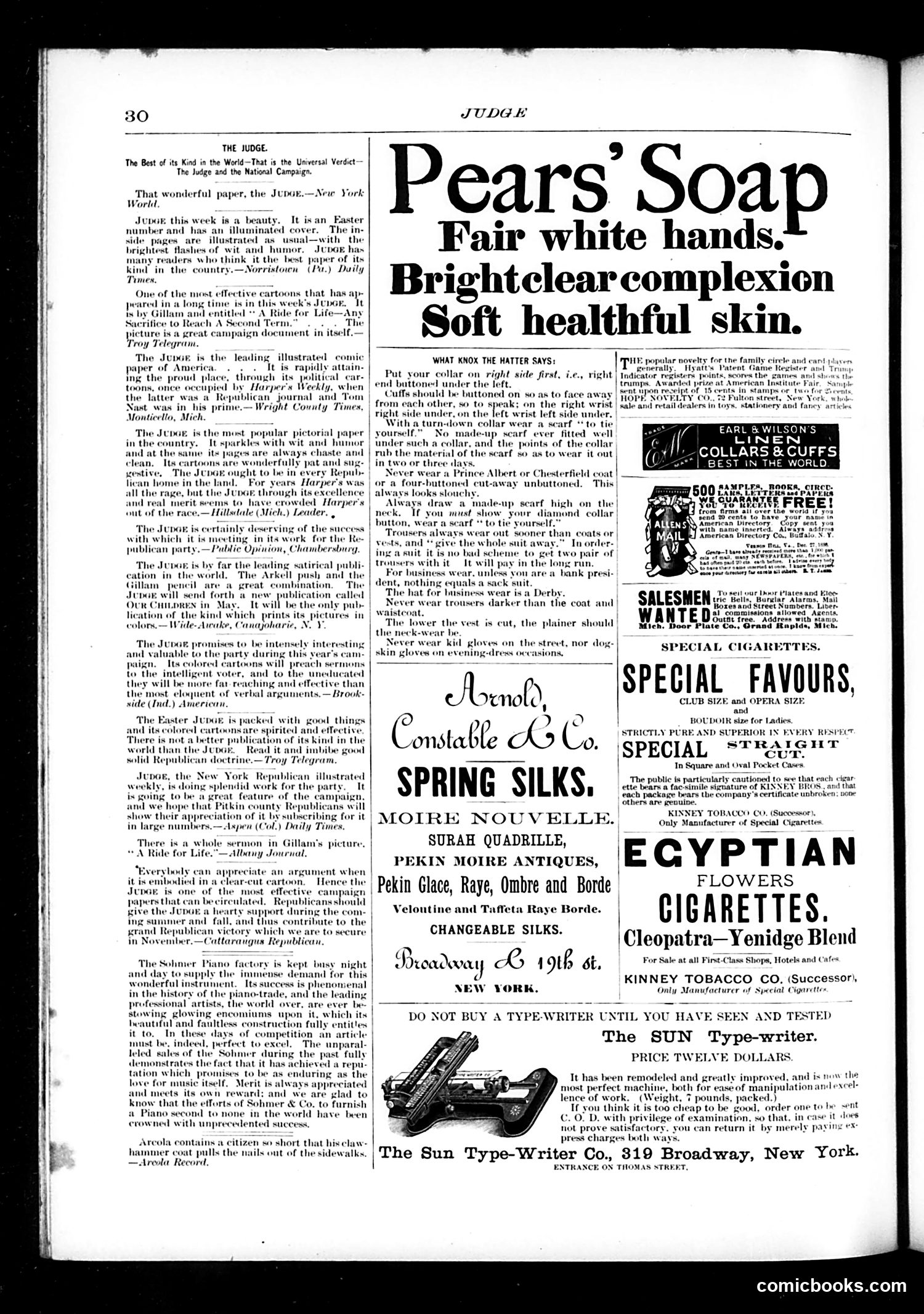
This is primarily an **advertising page** from Judge magazine, not a political cartoon page. The main content consists of commercial advertisements interspersed with quoted praise for Judge itself. The page opens with **testimonials to Judge's quality and influence**, describing it as America's leading illustrated satirical weekly. Publications like the *New York World* and various regional papers praise its "effective cartoons" and influence on the Republican Party during what appears to be an election campaign. The bulk of the page advertises **consumer goods typical of the era**: Pears' Soap (emphasizing "fair white hands"), Knox the Hatter (offering advice on proper collar and cuff wear), silk fabrics, cigarettes (Egyptian Flowers brand), and typewriters (the Sun Type-Writer). There are **no identifiable political figures or caricatures** visible in this particular page. It functions as both self-promotion for Judge and a vehicle for period advertisements reflecting early 20th-century consumer culture and gender norms.
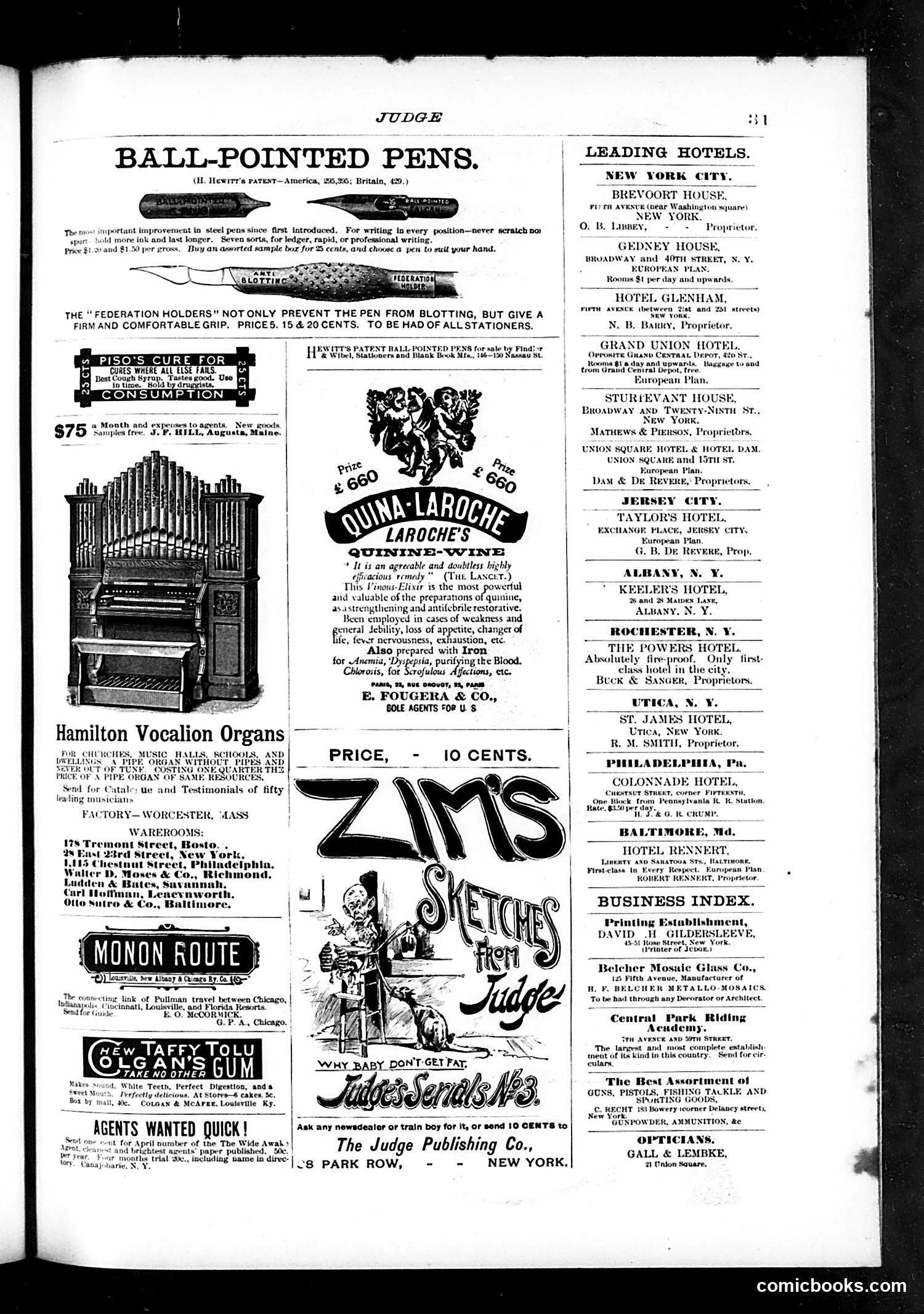
This page is **primarily advertising** with no significant political cartoons or satirical content requiring historical context. The main advertisements include: - **Ball-pointed pens** (H. Hewitt's patent) — promoting a writing innovation claiming superior performance - **Quinine wine** — a patent medicine marketed as a general health tonic for weakness, appetite loss, and various ailments - **Hamilton Vocalion Organs** — musical instruments - **Zim's Sketches from Judge** — promoting the magazine itself - **Hotel listings** across major American cities - **Various business services** (printing, guns/ammunition) The only visual humor appears to be the **Zim's Sketches** advertisement, which shows a cartoon figure, though its specific satirical point is unclear from the image quality. This represents a typical Judge magazine page structure: revenue-generating advertisements surrounding minimal editorial content, rather than pages devoted to political or social satire.
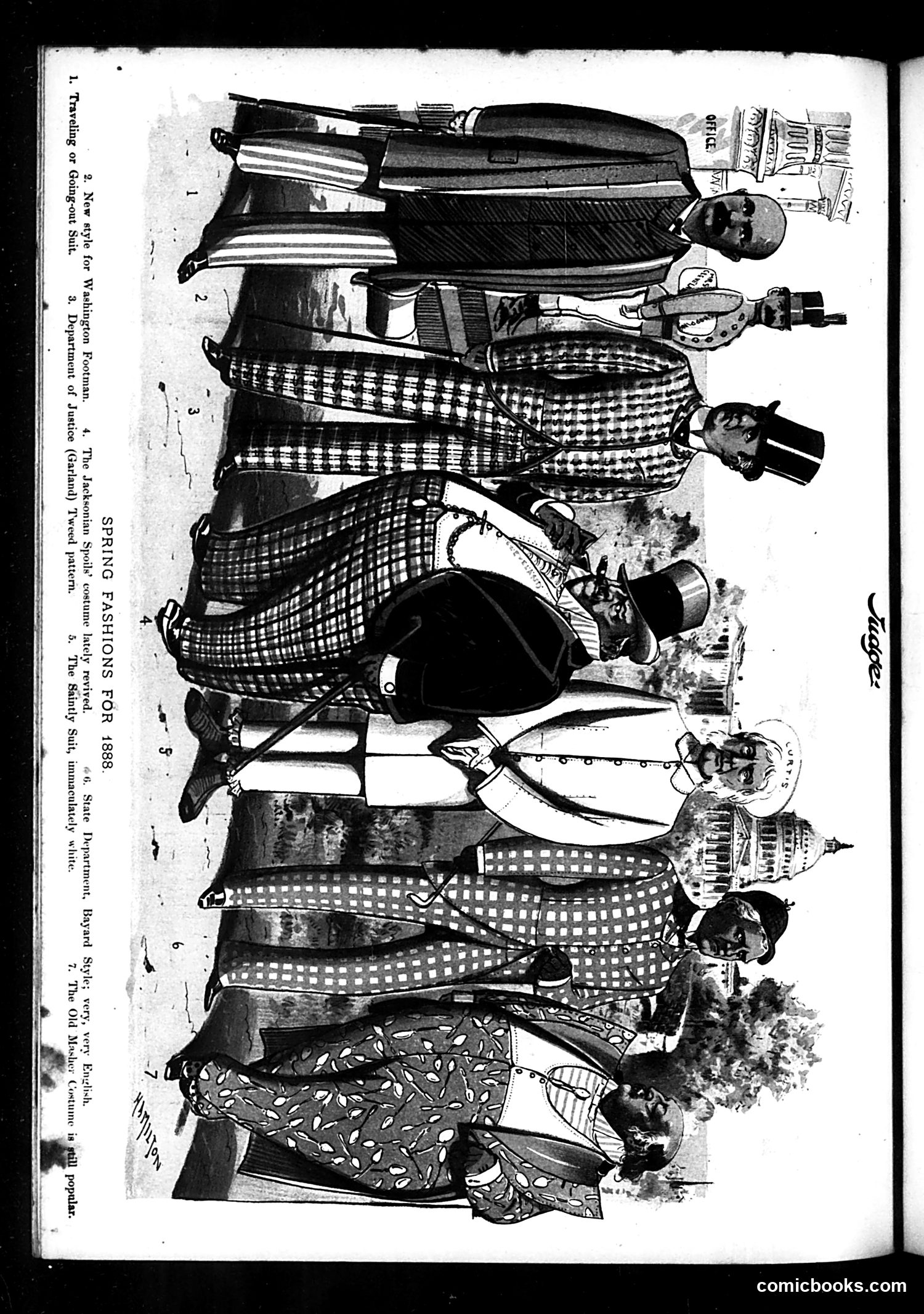
This page satirizes prominent members of President Cleveland's administration through fashion mockery. The numbered figures represent: 1. A traveling outfit (unclear reference) 2. Washington footman's new style 3. Department of Justice suit, referencing Attorney General Garland 4. An unidentified style 5. "The Saintly Suit" in white—likely mocking someone's false virtue or hypocrisy 6. State Department style attributed to Secretary Bayard 7. Another administrative figure The satire works by presenting government officials as fashion models, implying their roles are superficial or their public personas are costume-like. This was common Judge magazine practice: lampooning political figures through exaggerated visual caricature and wordplay. The "saintly suit" particularly suggests accusations of false piety or moral pretense against a specific official. The page critiques 1880s Democratic administration figures through fashion-industry parody.