
Judge, 1888-04-21 · page 3 of 16
Judge — April 21, 1888 — page 3: what you’re looking at
What you’re looking at
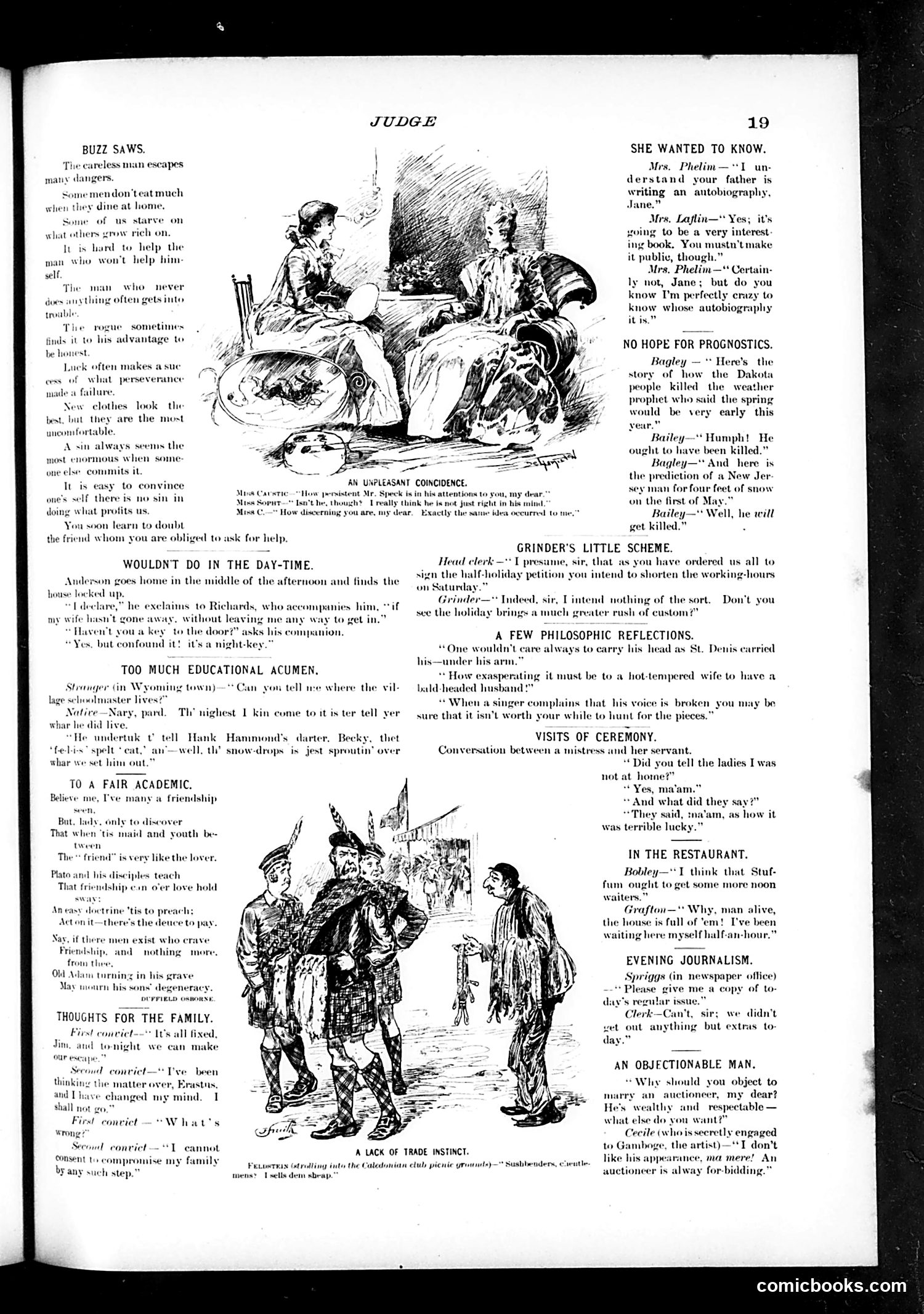
This page from *Judge* magazine presents satirical commentary on everyday social situations through brief anecdotes and jokes rather than political cartoons. The content mocks human nature and social hypocrisy. "Buzz Saws" offers cynical observations: the careless escape danger while careful people worry; rogues sometimes prosper; people judge others' sins more harshly than their own. Other sections ridicule specific scenarios: a husband using a "night-key" to enter his locked house; a father writing an autobiography nobody should read; the illogic of a weather prophet's predictions; servants deceiving visitors by claiming employers aren't home. The illustrations show Victorian-era social interactions—people in period dress engaged in conversation or ceremony. The satire targets Victorian upper-class pretense and the gap between public propriety and private behavior. This represents *Judge's* typical approach: gentle, domestic social satire rather than hard political commentary, relying on recognizable middle and upper-class situations for humor.
📄 Transcribed text from this page (OCR, searchable)
Machine-transcribed from the original scan — historical spelling and the odd misread are preserved.
BUZZ SAWS. ‘The careless man eseapes many dangers. mendon‘teatmuch us starve yrow rich on, nl ty help the man who won't help him self what others 1 who never r often gets into trouble The sometimes finds it to his advantage t rogue be honest Lueck often makes a suc what persev a failure, New clothes look — the best, but they are the most uncomfortable, mad A sin always seems the most enormous when some: one else commits it. It one’s self there is no sin in doing what profits us is easy to ce PLEASANT Ware, my dear You soon learn to doubt the friend whom you are obliged to ask for help. WOULDN'T DO IN THE DAY-TIME. Anderson goes home in the middle of the afternoon and finds the house locked up I declar my wife hasn't gon he exe Wit, * Haven't you a key “Yes. but confound it! it’s a night-key. TOO MUCH EDUCATIONAL ACUMEN, Can you tell we where the vil- Native whar he did | He undertuk ‘felis’ spelt *¢ Nary, pard. Th’ nighest L kin come to it is ter telly tell ‘an’ out.” TO A FAIR ACADEMIC. Believe me, P've many a friendship Hank well, th’ s umond'’s darter, Bee! y. thet w-drops ix jest sprouti over whar we set hin seen But, uly, only That when ‘tis am: tween friend” is very like the lover. » discover and youth be- The Plato and his disciples teach That friendship can o'er love hold sway An easy doctrine ‘tis to pr it—there’s the d exist whe nothing Nay, if there mm ve Friendship, and more, OW Adan turning in his grave May THOUGHTS FOR THE FAMILY. First convict--" Is all fixed, and tonight we can make our escape.” Jim. Second con thinki and I shall ict I've been over, Erastus, my mind. 1 <I convict “What's wrong? Seco convict “1 cannot consent ty compromise my family Feunereas (afro by any such step.” mens? [sells dem sbrap peck is in his attentions t ‘A LACK OF TRADE INSTINCT. ito the Caledonian clubs picnic yrouuils)—* Sushbendens, ceutle 19 SHE WANTED TO KNOW. Mrs. Phelim—“1 un- derstand your father is writing an autobiography, Jane.” Mrs. Laflin—" Yes; woing to be a very interest ing book, You mustn't make it public, though.” Mrs. Phelim—* Certain- ly not, Jane; but do know I'm perfectly crazy to know whose autobiography itis.” NO HOPE FOR PROGNOSTICS. Bagley — * Here's the story of how the Dakoti people killed the weather prophet who said the spring would be very early this year.” Bailey—" Humph! He ought to | been killed.” Bagley—"* And here is the prediction of a New Jer: sey man forfour feet of snow on the first of May Bailey—" We get killed, GRINDER'S LITTLE SCHEME. I presume, sir, that as you have ordered us all to jay petition you intend to shorten the worki COINCIDENCE. ou, my dear in his rnin, Exactly the same idea occurred tot , he will Head clerk “Indeed, sir, T intend nothing of the sort. jay brings a much greater rush of custom?” Don't you see the holi A FEW PHILOSOPHIC REFLECTIONS. “One wouldn't care always to carry his head as St. Denis carried his—under his arm.” * How exasperating it must be to a hot-tempered wife to have a bald-headed husband “When a singer complains that his voice is broke: sure that it isn’t worth your while to hunt for the piece: VISITS OF CEREMONY. Conversation between a mistress and her servant. “Did you tell the ladies Iwas not at home?” “Yes, ma‘am.” “And what did “They said, was terrible luc! you may be they say? Yam, as how it IN THE RESTAURANT. Bobley—“1 think that Stuf- fum ought to get some more noon waiters.” Grafton—"* Why, the house is full of * waiting y, man alive, m! ['ve been e myself half-an-hour.” EVENING JOURNALISM. Spriggs (in newspaper office) Can't, sir; we didn't yet out anything but extras to- da AN OBJECTIONABLE MAN, “Why should you object to ry an auctioneer, my deart He's wealthy and respectable — what else do you want?” Cecile (who is secretly engaged to Gambe the artist)—**T don't like his ap} ma mere! auctioncer is alway for-bidding.” comicbooks.com