
A complete issue · 16 pages · 1888
Judge — April 14, 1888
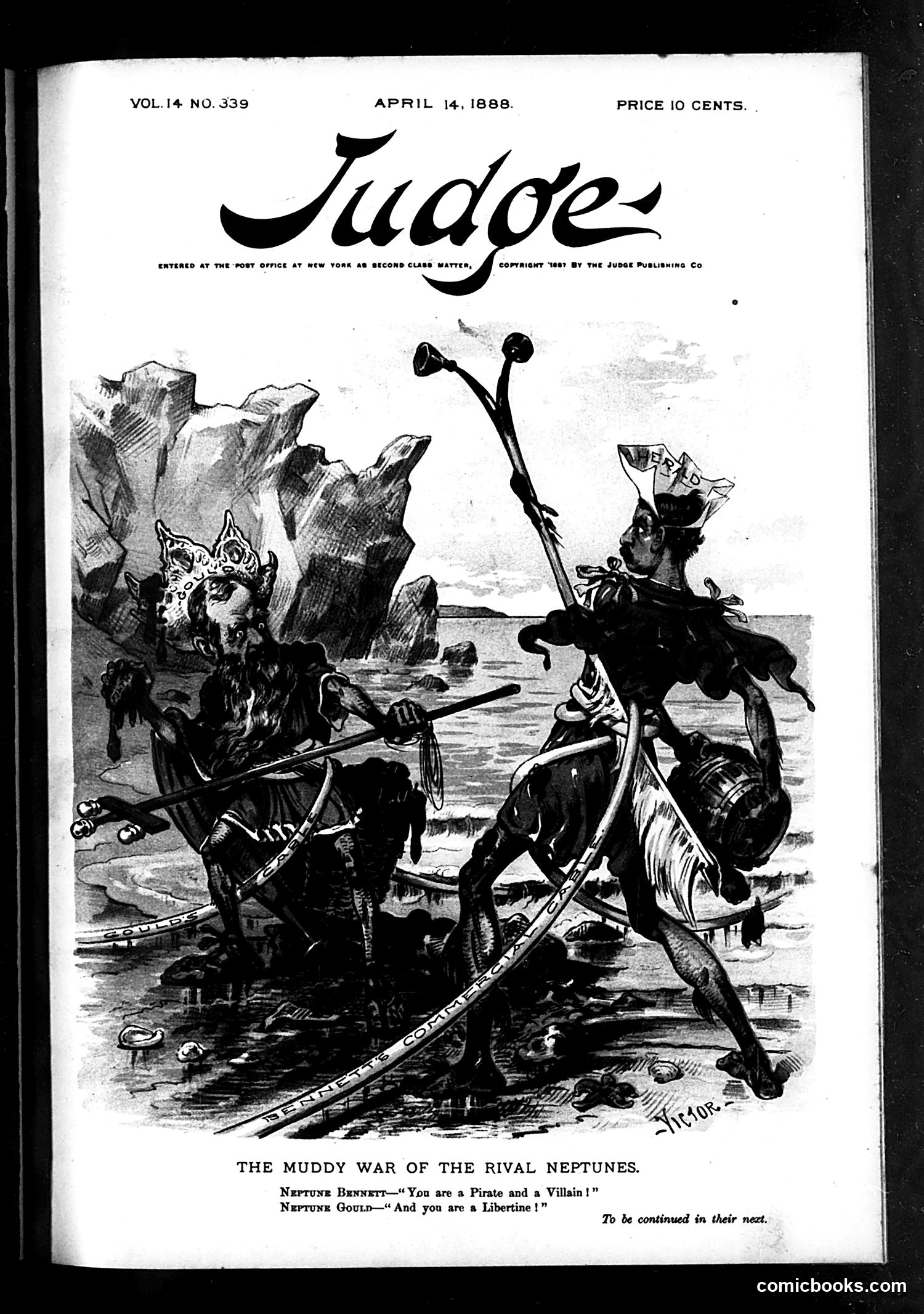
This satirical cartoon depicts two figures identified as "Neptune Bennett" and "Neptune Gould" engaged in combat in shallow, muddy water. The dialogue exchanges accusations: one calls the other "a Pirate and a Villain," while the other responds "you are a Libertine." The cartoon appears to reference a contemporary political or business rivalry between two prominent figures named Bennett and Gould. The "Neptune" designation likely alludes to their involvement in maritime or shipping matters. The muddy, undignified fighting pose mocks both parties, suggesting their dispute is petty and conducted without honor. The "to be continued" caption indicates this was an ongoing public controversy that Judge's readers would have recognized and followed.
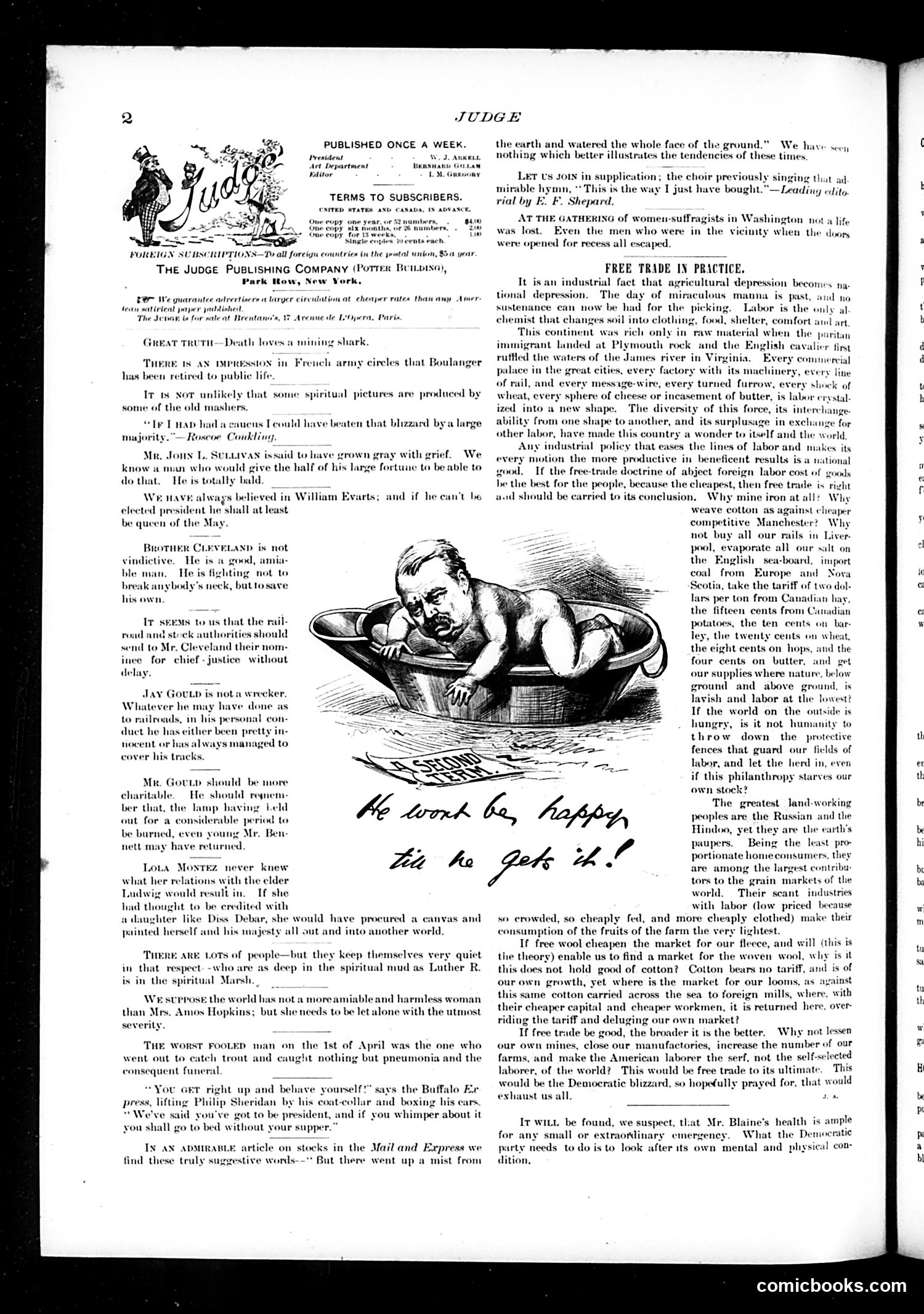
The main cartoon depicts a cherub-like figure in a barrel labeled "FREE TRADE," appearing distressed or drowning. The caption reads "he work be happy, / let he gets it!" This satirizes the debate over free trade policy in America. The cartoon suggests that free trade—promoted as beneficial—actually causes suffering rather than happiness. The figure's distress implies the policy harms rather than helps common people. The accompanying article "FREE TRADE IN PRACTICE" argues that protective tariffs benefit American workers by keeping wages and prices competitive, while free trade enriches foreign producers at laborers' expense. The cartoon visually reinforces this protectionist argument, showing "free trade" as a trap causing misery rather than prosperity—the opposite of its promised benefits.
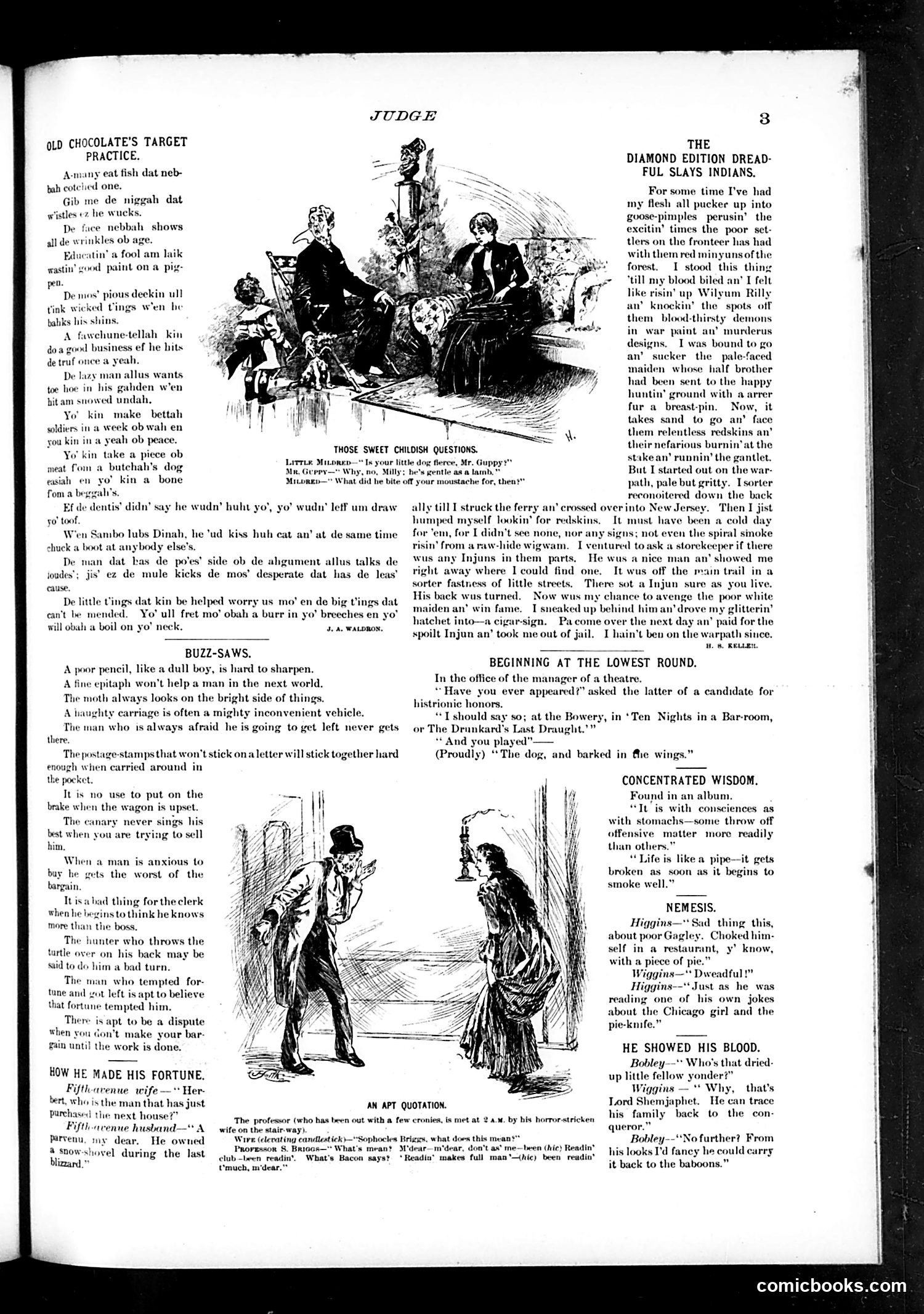
This page contains multiple satirical pieces typical of late-19th-century American humor magazines. **"Old Chocolate's Target Practice"** presents racist dialect humor featuring stereotyped Black folk wisdom—common in this era but offensive today. The aphorisms mock rather than celebrate. **"Buzz-Saws"** offers brief satirical observations on human nature and social climbing (the "Fifth-avenue" couple joke mocks nouveau-riche pretension). **"The Diamond Edition Dreadful Slays Indians"** parodies sensationalist dime-novel narratives about frontier Indian conflicts. The narrator seeks bloodthirsty "redskins" but only finds one peaceful Indigenous person in New Jersey—deflating the exaggerated adventure-story tropes. This satirizes both the genre's theatrical violence and the absurdity of "Indian scares" in settled areas. The cartoons throughout appear to illustrate these texts with period line-drawings. The page reflects Judge's mix of social satire, ethnic stereotyping, and mockery of literary conventions—attitudes that have aged poorly alongside its sharper social commentary.
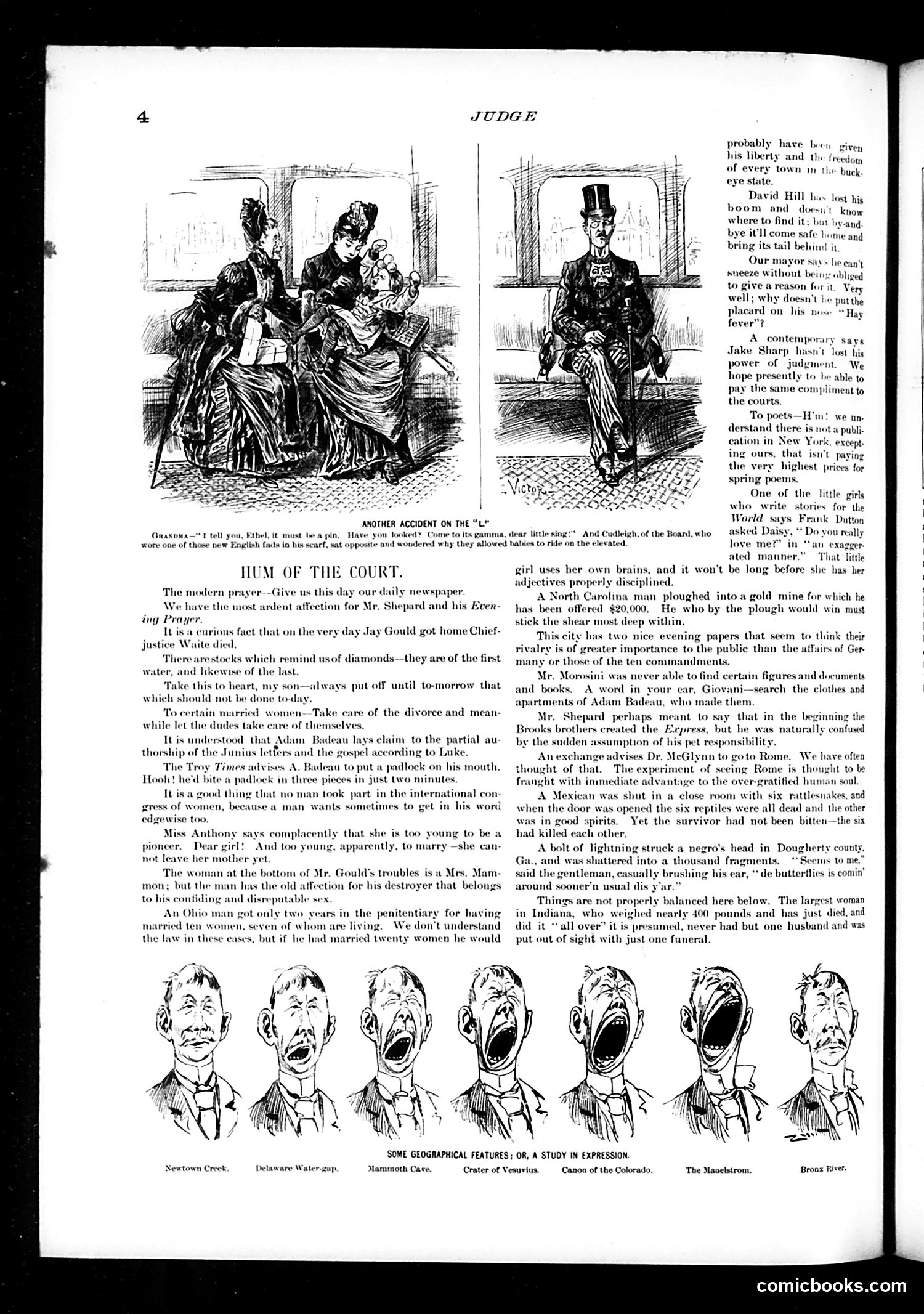
This page from *Judge* contains multiple satirical pieces targeting late 19th-century New York political and social figures. **Top cartoon** ("Another Accident on the 'L'") depicts an elevated train accident, satirizing the dangers of the new elevated railway system while mocking wealthy New Yorkers who ride it. **"Hum of the Court"** section offers brief satirical commentary on contemporary figures and issues: references to railroad magnate Jay Gould's marital troubles, Susan B. Anthony's age and unmarried status, Adam Badeau (appears to be involved in document/authorship disputes), and various New York politicians and judges. The pieces mock divorce scandals, women's rights advocates, and perceived corruption. **Bottom section** ("Some Geographical Features") presents exaggerated facial expressions labeled as geographical formations—a visual pun comparing landscape features (Newtown Creek, Delaware Water Gap, etc.) to human expressions of emotion. The satire targets political corruption, social hypocrisy, and the leisure class's scandals with characteristic *Judge* irreverence.
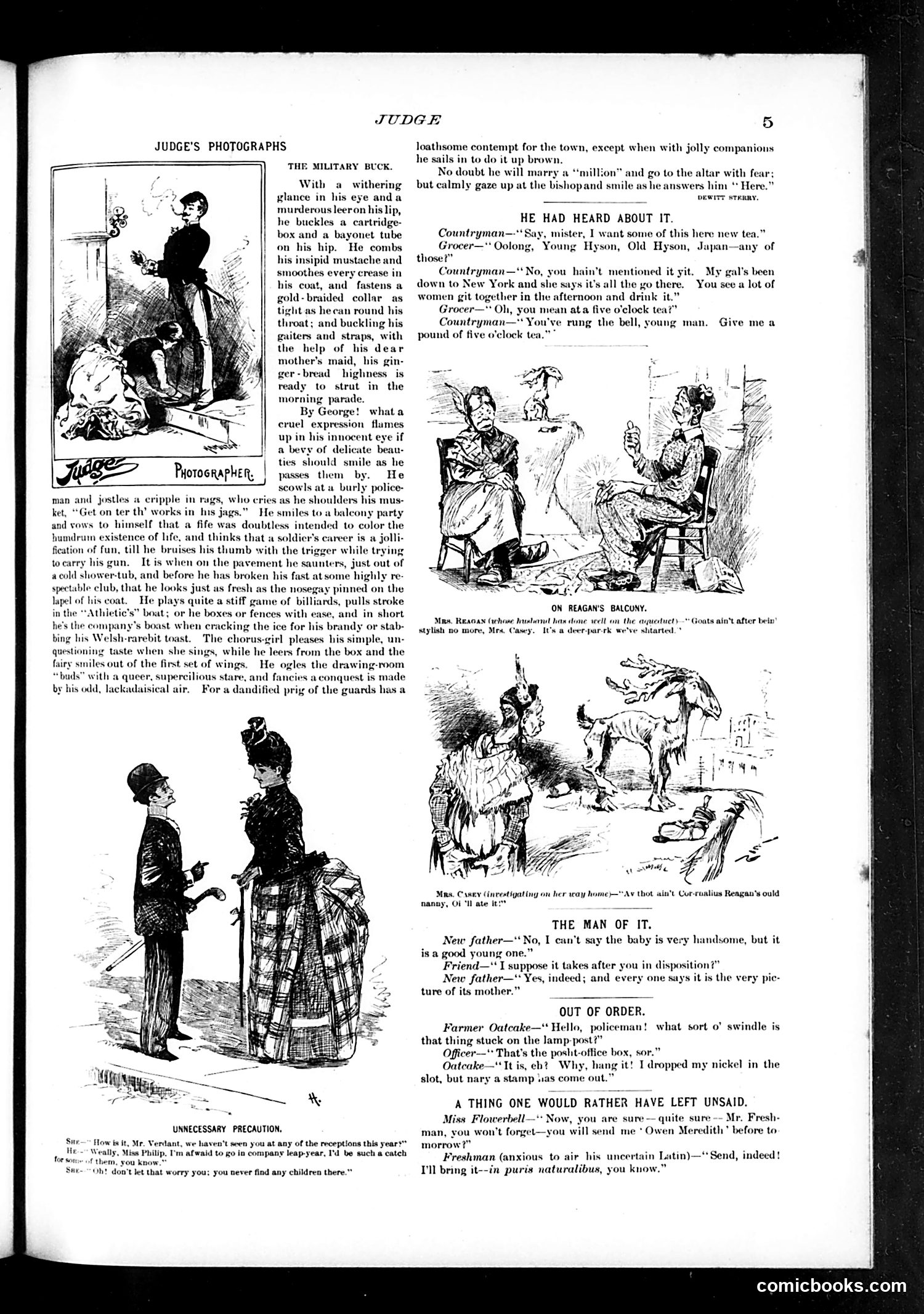
This page from *Judge* contains several satirical sketches mocking social pretensions and cultural absurdities of the era. **"The Military Buck"** ridicules vain soldiers who primp obsessively before parades, adopt cruel airs toward civilians, yet behave as dandified "prig[s]" seeking frivolous pleasures—the satire targets their hollow bravado masking shallow character. **"He Had Heard About It"** jokes about rural ignorance of urban fashions: a countryman's wife has heard of "five o'clock tea" in New York and demands it, but he doesn't know what it is. The humor derives from the gap between rural and urban sophistication. **Other sketches** include "Unnecessary Precaution" (a man avoiding leap-year social events), "The Man of It" (new father claiming his baby resembles him), and "Out of Order" (a farmer confusing a mailbox for a stamp dispenser). The page represents typical *Judge* content: genteel mockery of class pretension, rural simplicity, military vanity, and social climbing—reflecting Gilded Age anxieties about status and propriety.
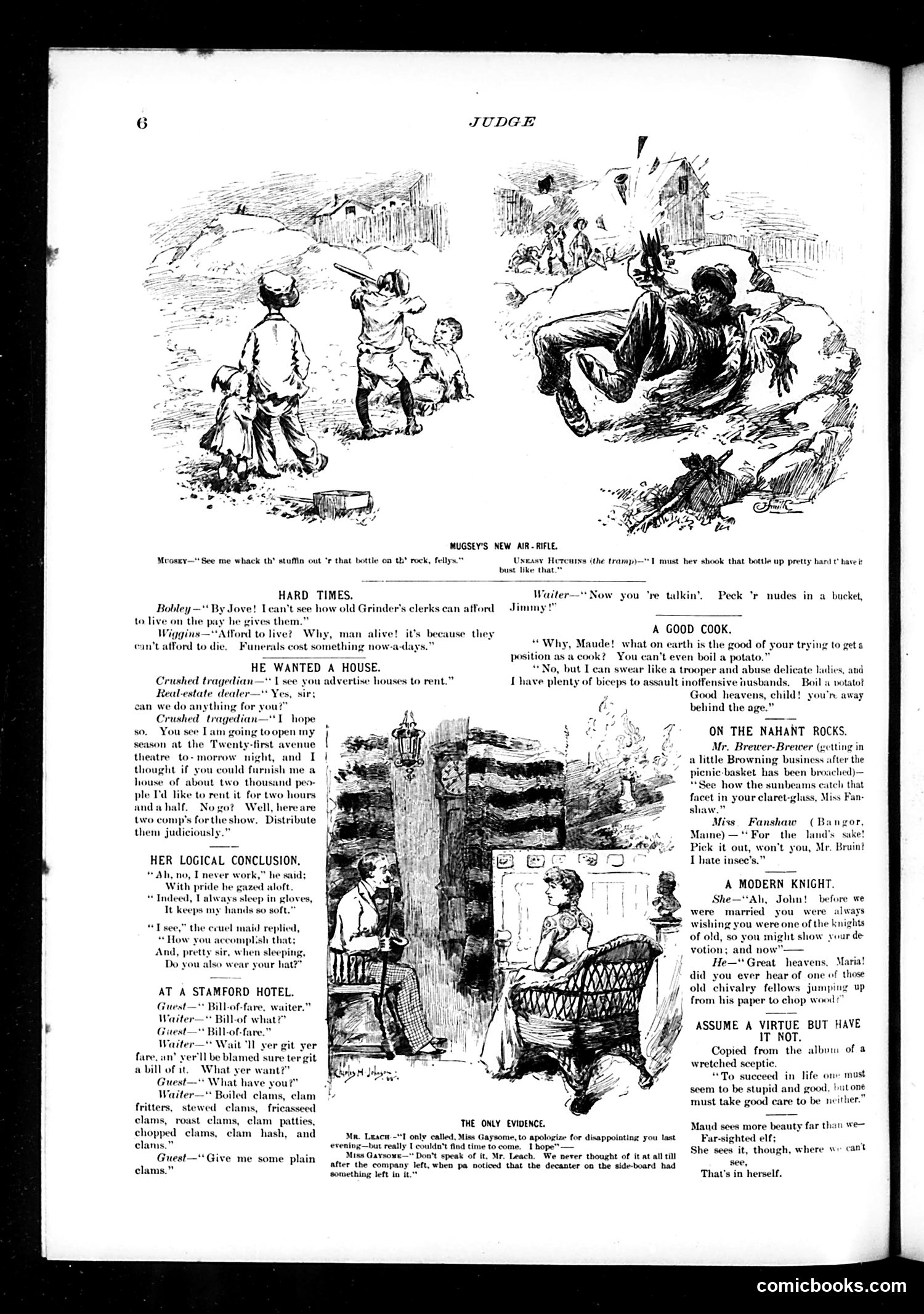
This page contains multiple satirical vignettes typical of Judge's humor, targeting late 19th-century social pretension and economic hardship: **"Hard Times"** mocks the poor's survival strategies during economic depression—clerks survive on meager wages, yet claim financial stability through denial. **"He Wanted a House"** ridicules a failed actor's absurd rental proposal, satirizing theater's economic precarity and the desperation of thespians. **"Her Logical Conclusion"** uses a maid's sarcasm to expose male vanity—a man claims never working and sleeping in gloves to keep hands soft, and she suggests he also wears his hat to bed, revealing the illogic of his pretensions. **"At a Stamford Hotel"** plays on puns: the waiter mishears "bill of fare" (menu) as "bill of" and literally describes the restaurant's clam-heavy inventory. The remaining sketches follow similar patterns: deflating pretense, exposing economic struggle, and revealing human folly through wordplay and social observation. The drawings emphasize working-class and lower-middle-class characters.
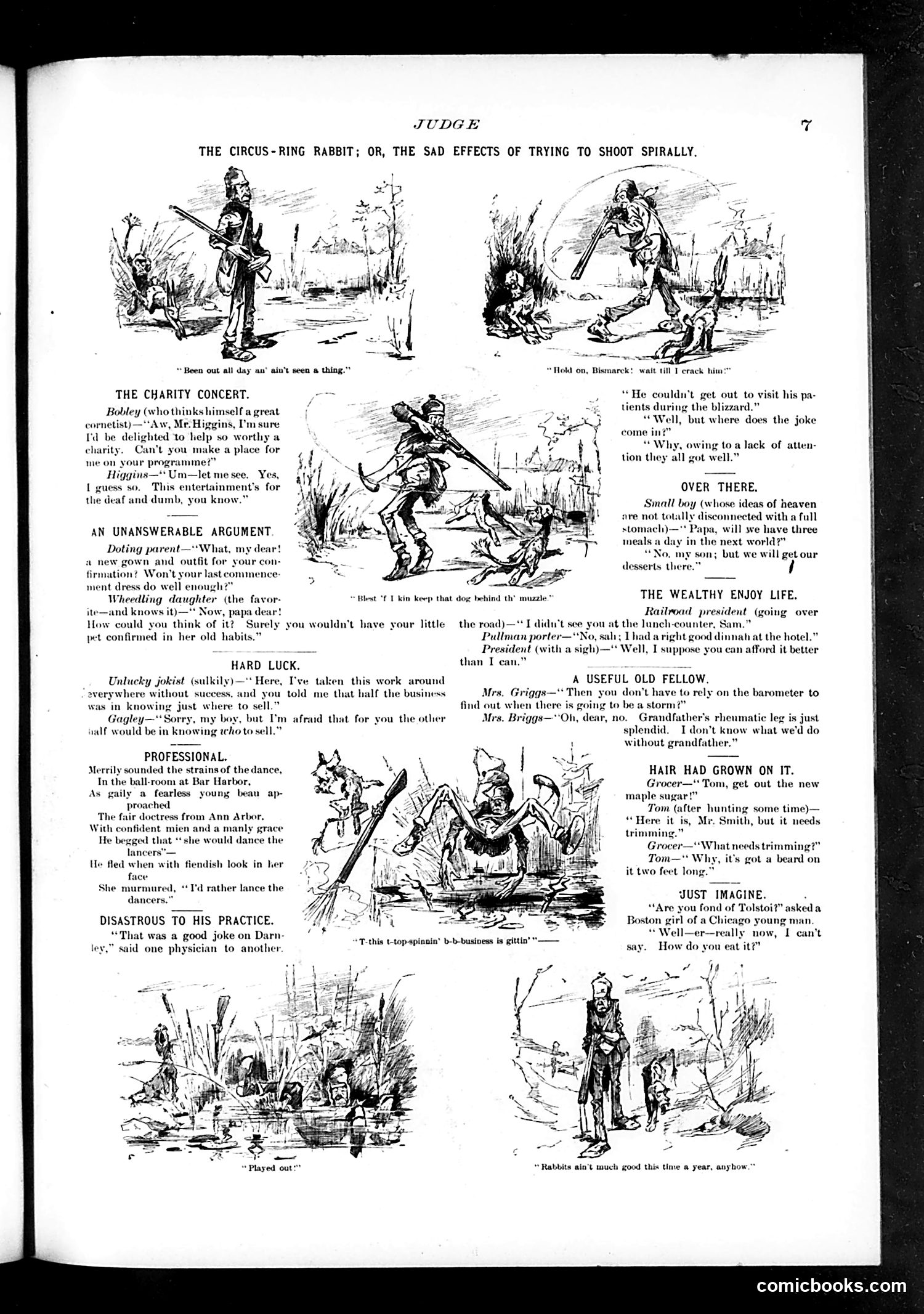
This page from *Judge* contains multiple brief satirical sketches typical of late 19th-century American humor magazines. The top cartoon, "The Circus-Ring Rabbit," depicts a hunter repeatedly missing a rabbit—the joke being the futility of attempting "spiral" shots. Other sketches mock contemporary social pretensions: a mediocre musician pressuring his way into a charity concert; a daughter manipulating her father for a new confirmation dress; a failed joke-teller; a "fearless beau" approaching a female physician only to flee when she makes a double entendre about "lancing dancers." The humor targets class anxiety, gender dynamics, and professional pomposity. A Boston socialite's ignorance of Russian author Tolstoi (confusing the name with food) satirizes pretentious cultural affectation. References to blizzards, the wealthy's leisure (railroad presidents, Pullman porters), and rural life suggest these sketches addressed a broad middle-class readership. The overall tone is gently mocking of social climbing, romantic mishaps, and metropolitan manners.
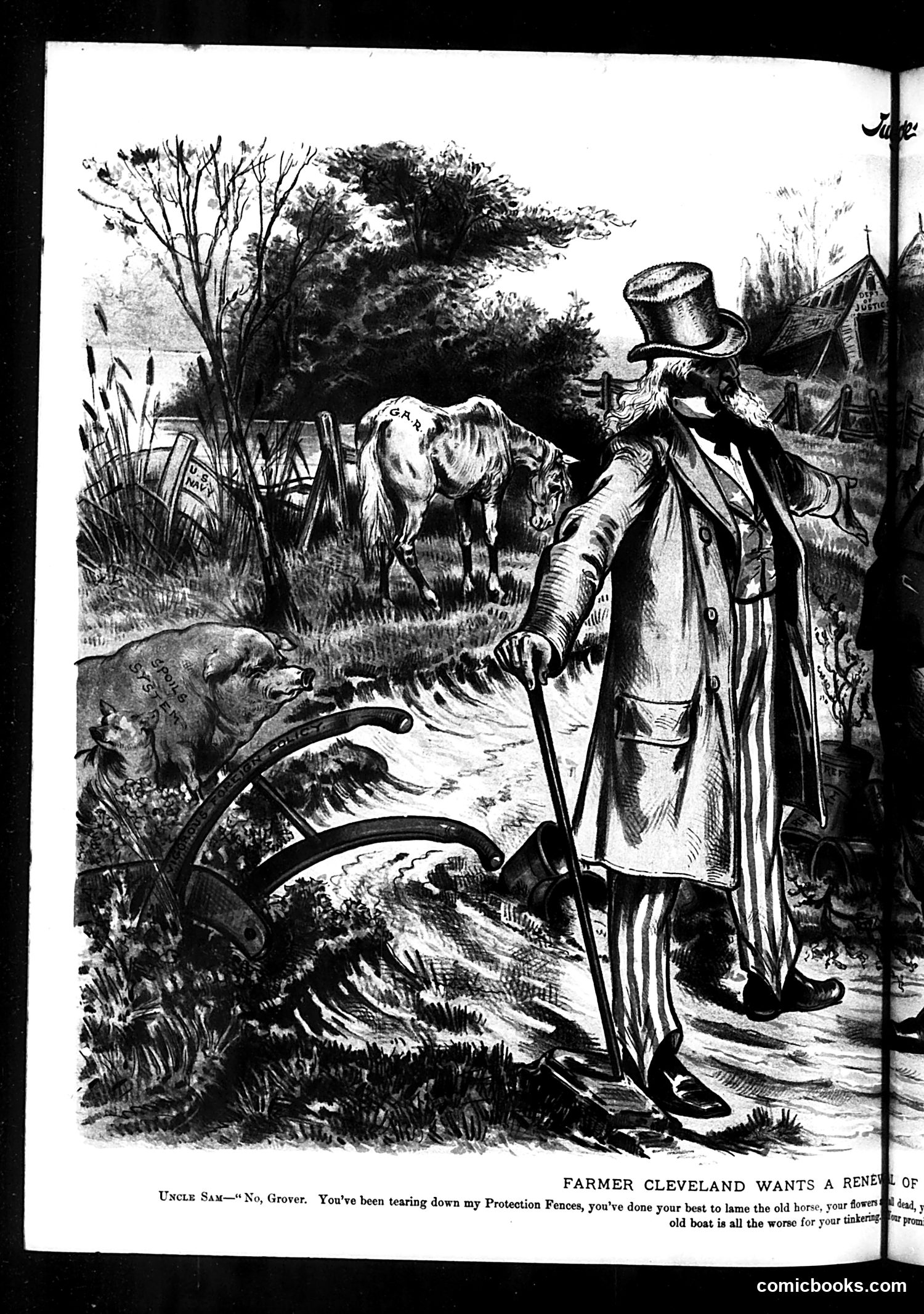
This political cartoon satirizes President Grover Cleveland's policies through the metaphor of property damage. "Uncle Sam" (representing the nation) confronts "Farmer Cleveland" (the President), accusing him of destroying "Protection Fences"—a reference to Cleveland's opposition to protective tariffs that shielded American industry. The damaged "old horse" and "boat" represent the American economy suffering from his policies. The cartoon advocates for tariff protection and criticizes Cleveland for weakening economic safeguards through his free-trade stance. The title's misspelling ("RENE\") appears incomplete, likely meaning "renewal" of protective policies. This reflects the late-19th-century political debate between protectionists and free-traders.
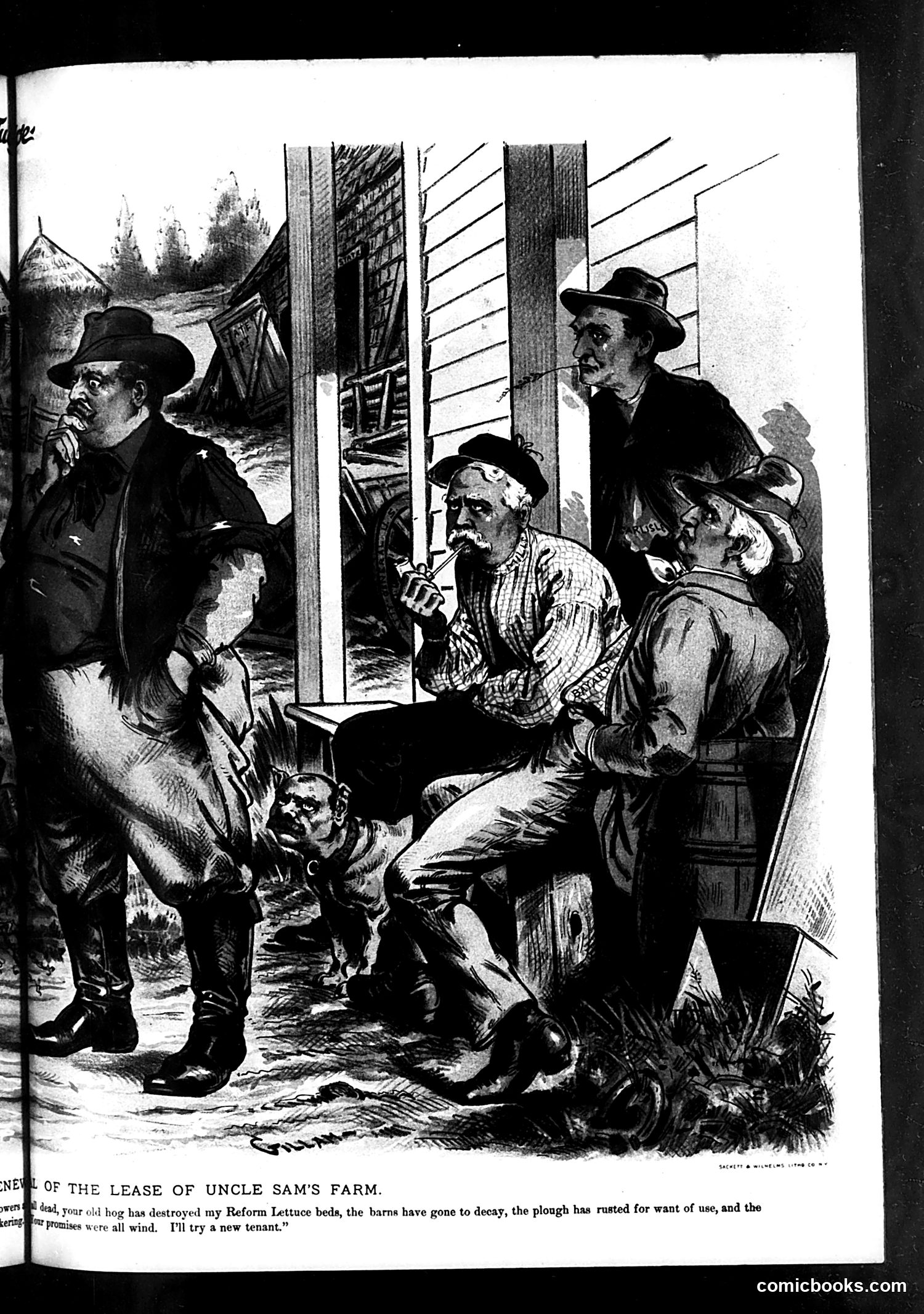
This Judge cartoon uses farming as a metaphor for American governance. "Uncle Sam's Farm" represents the United States. The well-dressed men appear to be political figures or parties discussing a failed tenant—likely referring to a departing presidential administration or political party that mismanaged the country's affairs. The complaint lists specific failures: destroyed crops ("Reform Lettuce beds"), deteriorating infrastructure (decaying barns, rusted ploughs), and broken promises ("all wind"). The phrase "I'll try a new tenant" suggests an election or transfer of political power, with the landlord (American voters/government) seeking new leadership to repair the damage. This reflects late 19th-century political criticism about governmental mismanagement and the hope that new leadership would restore prosperity and fulfill reform promises.
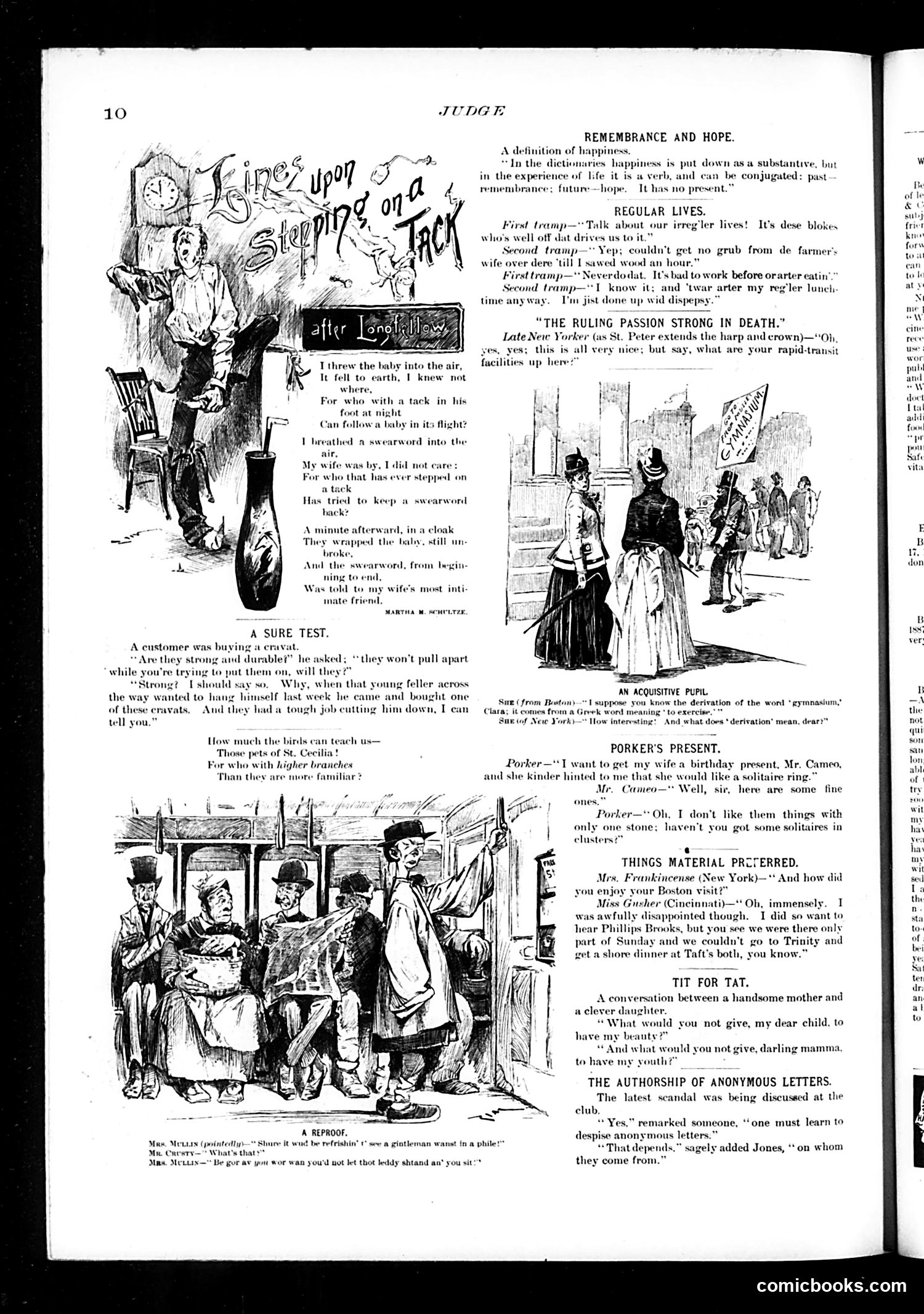
This page from the satirical magazine **Judge** contains multiple short humorous pieces typical of late 19th-century American humor: **"A Sure Test"** mocks the quality of cheap cravats (neckties), joking that one is so durable a man used it to attempt suicide without success. **"Regular Lives"** presents tramps complaining about irregular meals, satirizing vagabond existence through working-class dialect humor. **"The Ruling Passion Strong in Death"** depicts a newly deceased New Yorker arriving at heaven still obsessing over rapid-transit facilities—satirizing urban New Yorkers' preoccupation with transportation infrastructure. **"Porker's Present"** ridicules a man requesting solitaire diamond clusters rather than single stones for his wife's ring, suggesting materialistic vanity. **"Things Material Preferred"** and **"Tit for Tat"** offer brief social commentary on materialism and witty domestic exchanges. The page emphasizes period-typical satirical targets: class differences, marriage dynamics, urban obsessions, and social pretension, all rendered through sarcasm and exaggerated dialect.
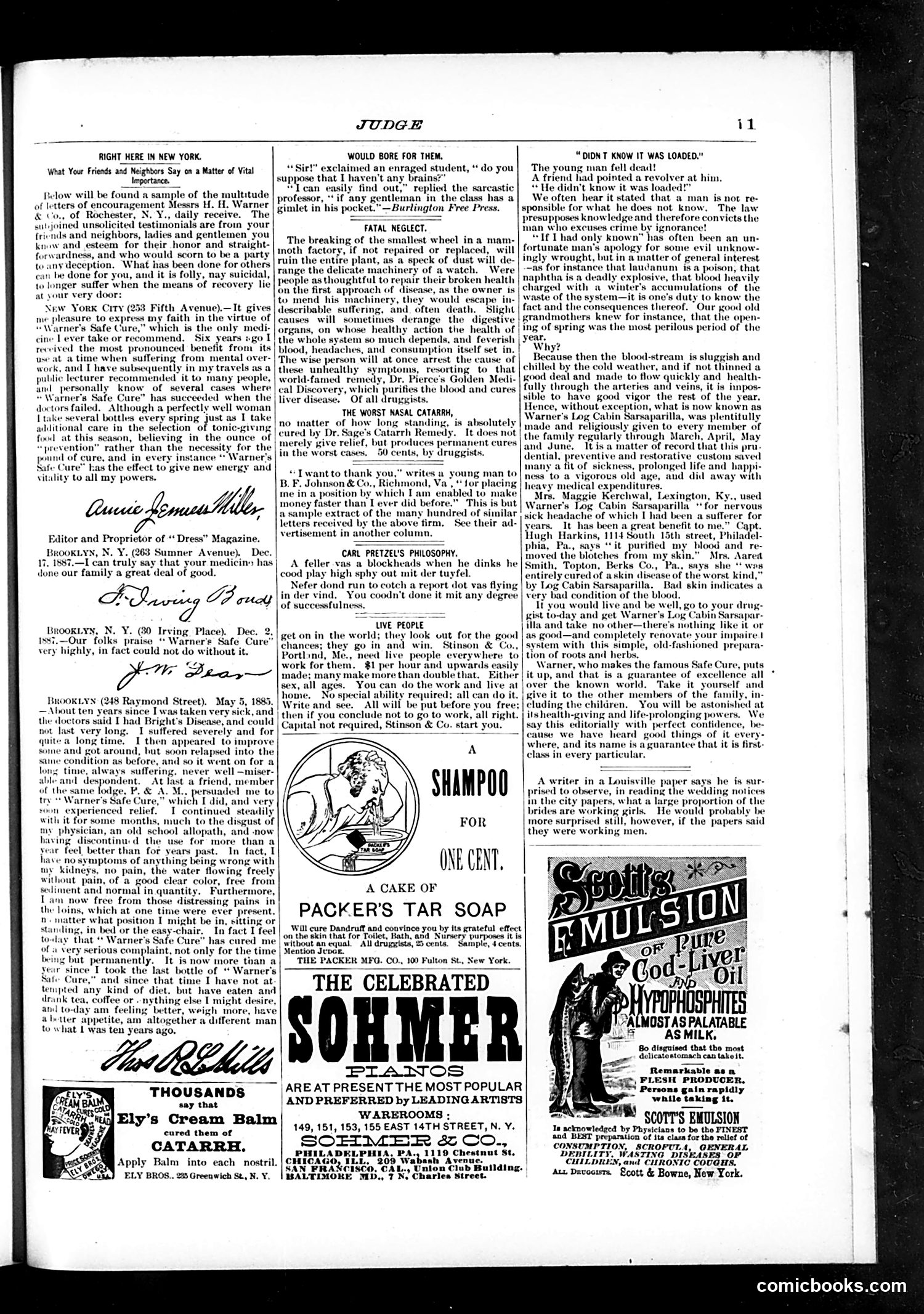
This page is primarily **advertising disguised as testimonials**. The bulk of the content consists of fake customer letters praising "Warner's Safe Cure," a patent medicine made by H. H. Warner & Co. of Rochester, New York. The testimonials claim the product cured serious ailments like Bright's Disease (kidney failure) and general debility. These letters—attributed to real New Yorkers with specific addresses—were a common 19th-century marketing tactic designed to create false credibility. **The small cartoon** (top right, captioned "WOULD BORE FOR THEM") shows a sarcastic exchange between a student and professor about brains and gimlets—a mild joke unrelated to the patent medicine promotion. The page also advertises other products: Ely's Cream Balm for catarrh, Packer's Tar Soap, and Sohmer pianos. **Context**: Patent medicines made exaggerated health claims and were largely unregulated until the FDA's establishment. Such testimonial-heavy advertising was standard practice before modern consumer protection laws.
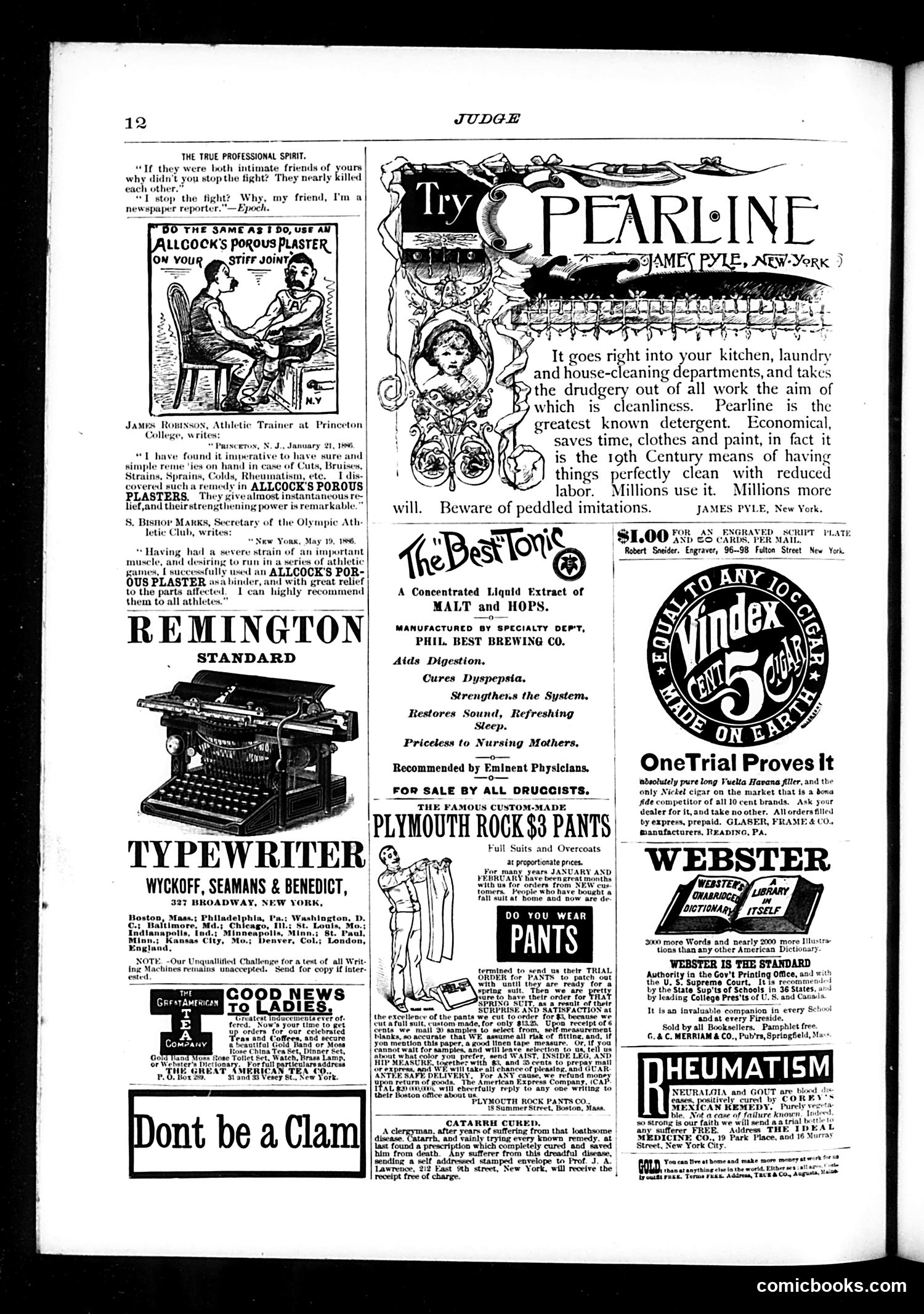
This page is primarily **advertising**, not political satire. It contains one small cartoon labeled "The True Professional Spirit" showing two men in conversation about a fight between mutual friends. The cartoon's joke appears to reference **boxing or athletic combat** — the speaker stops a fight not out of concern for safety, but because the combatants are "intimate friends." The irony suggests misplaced priorities: valuing friendship over preventing injury, which Judge presents as absurdly backwards logic. The remainder of the page consists of **product advertisements** typical of early 1900s American magazines: medical remedies (Allcock's Porous Plasters, malt extract), office equipment (Remington typewriter), household products (Pearline detergent), custom pants, cigars, and patent medicines claiming to cure catarrh and rheumatism. The ads reflect era-specific concerns and dubious medical claims now recognized as fraudulent.
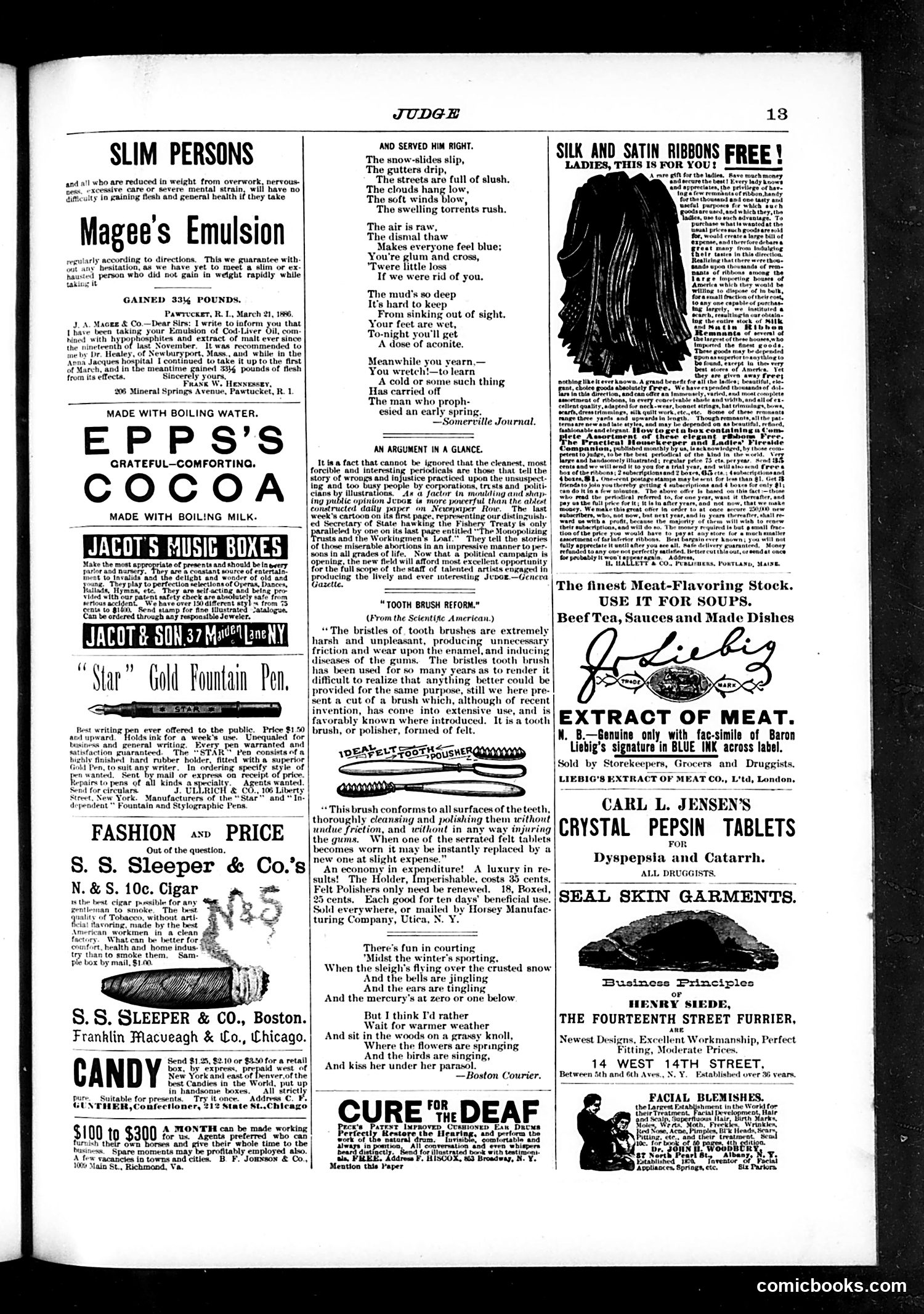
This page is primarily **advertising**, not political satire. It contains promotional materials for various patent medicines and consumer goods typical of the 1890s era. The largest advertisement features **Magee's Emulsion**, a cod-liver oil tonic marketed to underweight or overworked people, with a testimonial claiming 33½ pounds of weight gain. Below are ads for Epps's Cocoa, Jacot's Music Boxes, a Star Gold Fountain Pen, S.S. Sleeper & Co.'s cigars, and various other products. The only editorial content is a brief **humorous poem** titled "And Served Him Right," mocking someone complaining about winter weather—suggesting they deserve to catch cold and die from aconite poisoning as punishment for predicting early spring. It's mild satirical verse, not political commentary. The page reflects the magazine's mixed format of advertising and light humor rather than hard-hitting political satire.
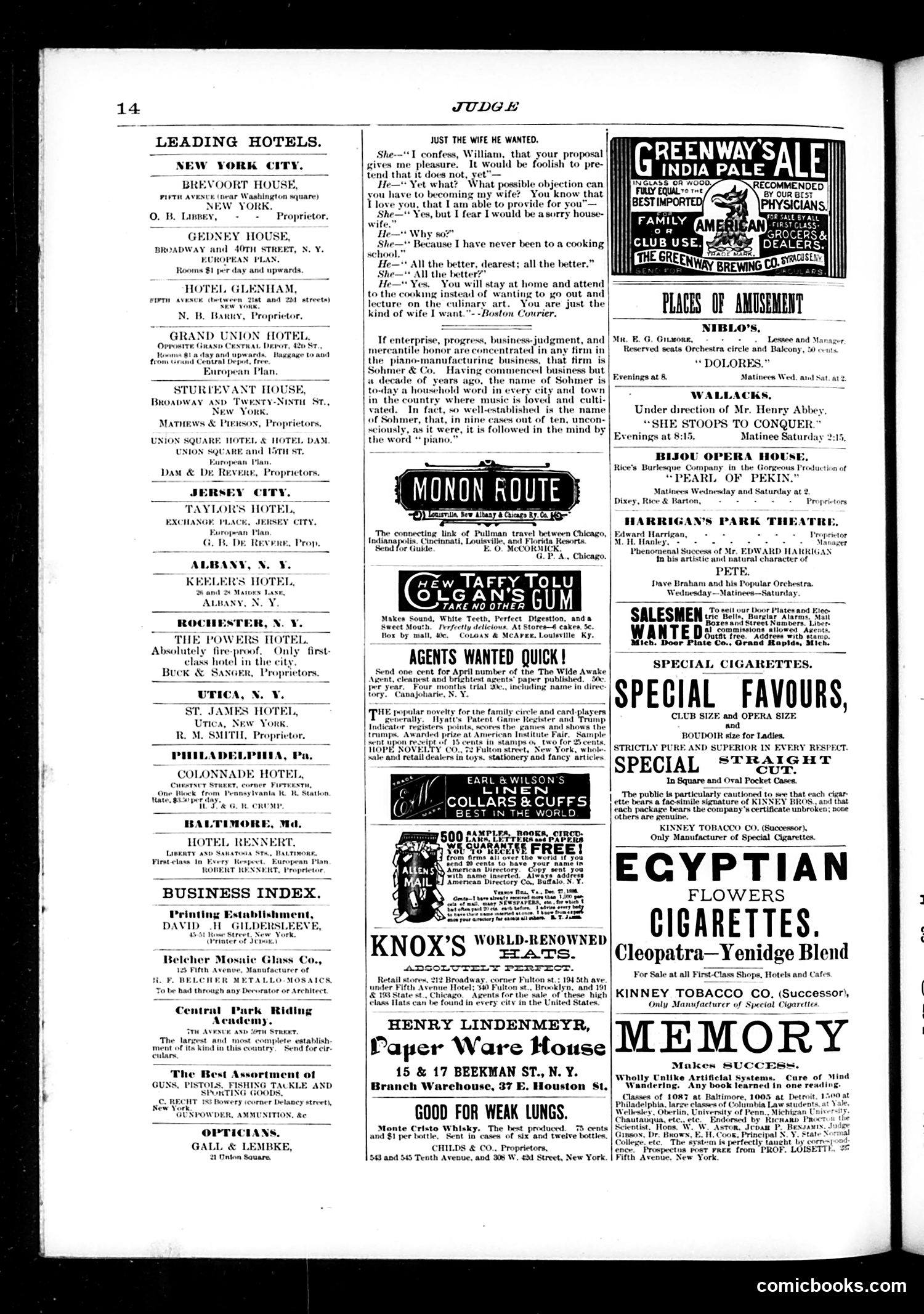
This is primarily a **commercial page**, not a satirical cartoon issue. It features: **Main Content:** A dialogue humor piece titled "Just the Wife He Wanted," where a husband proposes to a woman specifically because she *won't* pursue intellectual or social interests—she'll stay home and cook. The satire targets Victorian marriage expectations and male anxieties about "New Women" seeking education and independence. His ideal wife is domesticated and unambitious. **Advertisements:** The page is dominated by hotel listings, consumer products (cigarettes, whisky, hats, collars, gum), and theatrical venue promotions typical of 1880s-90s Judge advertising. The humor assumes readers will recognize the social debate over women's roles in the era—specifically the tension between traditional domesticity and emerging feminist demands for education and public participation. The husband's relief at finding a woman who *rejects* ambition reflects contemporary male anxieties about gender's changing boundaries.
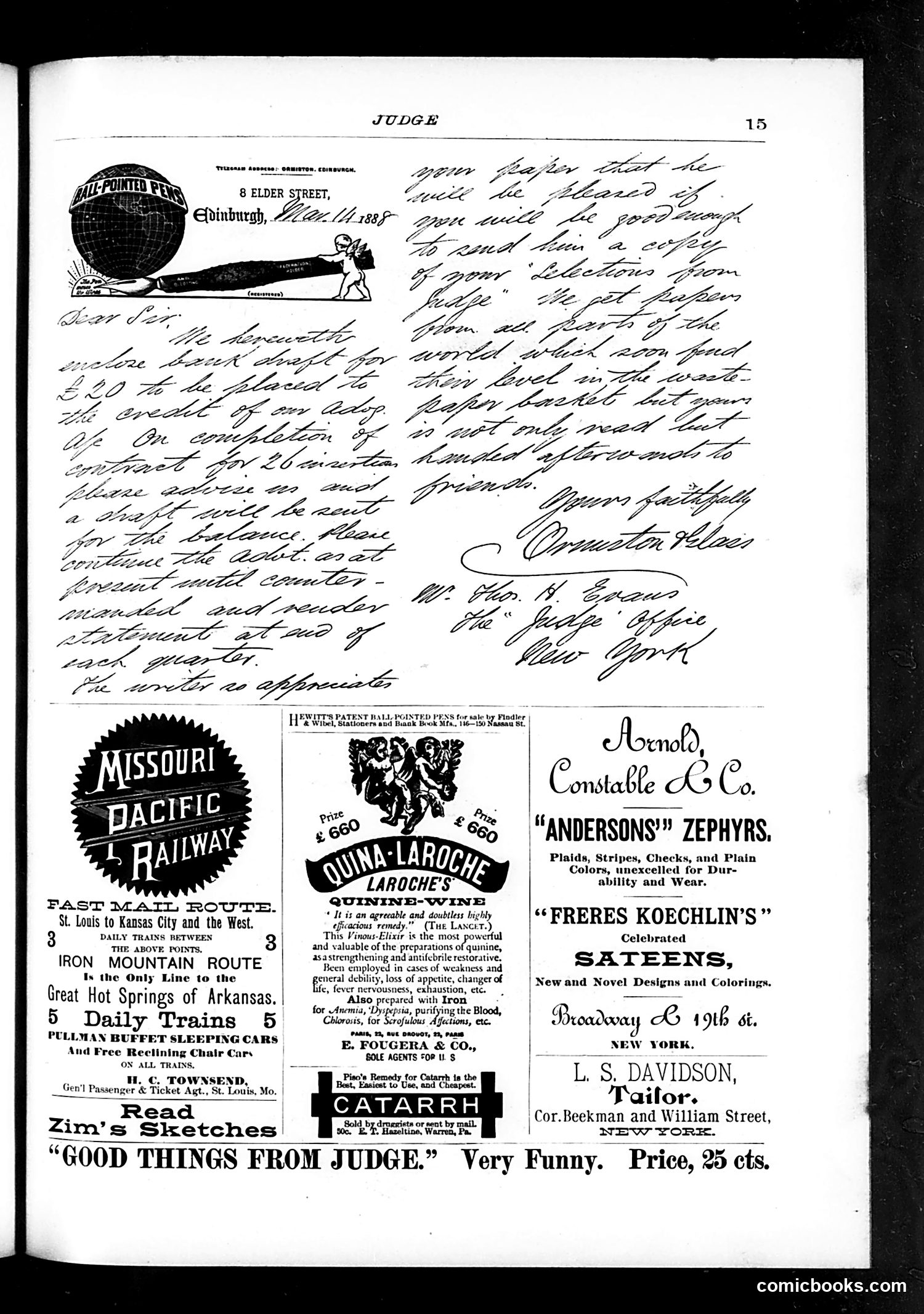
This page is primarily **advertisements and business listings** rather than editorial cartoons. The content includes: **Visual Elements:** - A globe illustration (top left) associated with what appears to be a printing/publishing business at 8 Elder Street, Edinburgh - A Missouri Pacific Railway logo - Various product advertisements (Quina-Laroche wine, Zephyrs fabric, Koechlin's sateens, a catarrh remedy) **Textual Content:** The handwritten letter at top appears to be correspondence regarding Judge magazine business or circulation matters, though the cursive is difficult to read clearly. **Notable:** The page concludes with an advertisement for "**Good Things from Judge**" — promoting Zim's Sketches as humorous content available for 25 cents, suggesting this was how the magazine marketed its satirical content to readers. This is essentially a **back-of-magazine advertising section** typical of 19th-century periodicals, not a satirical commentary page.
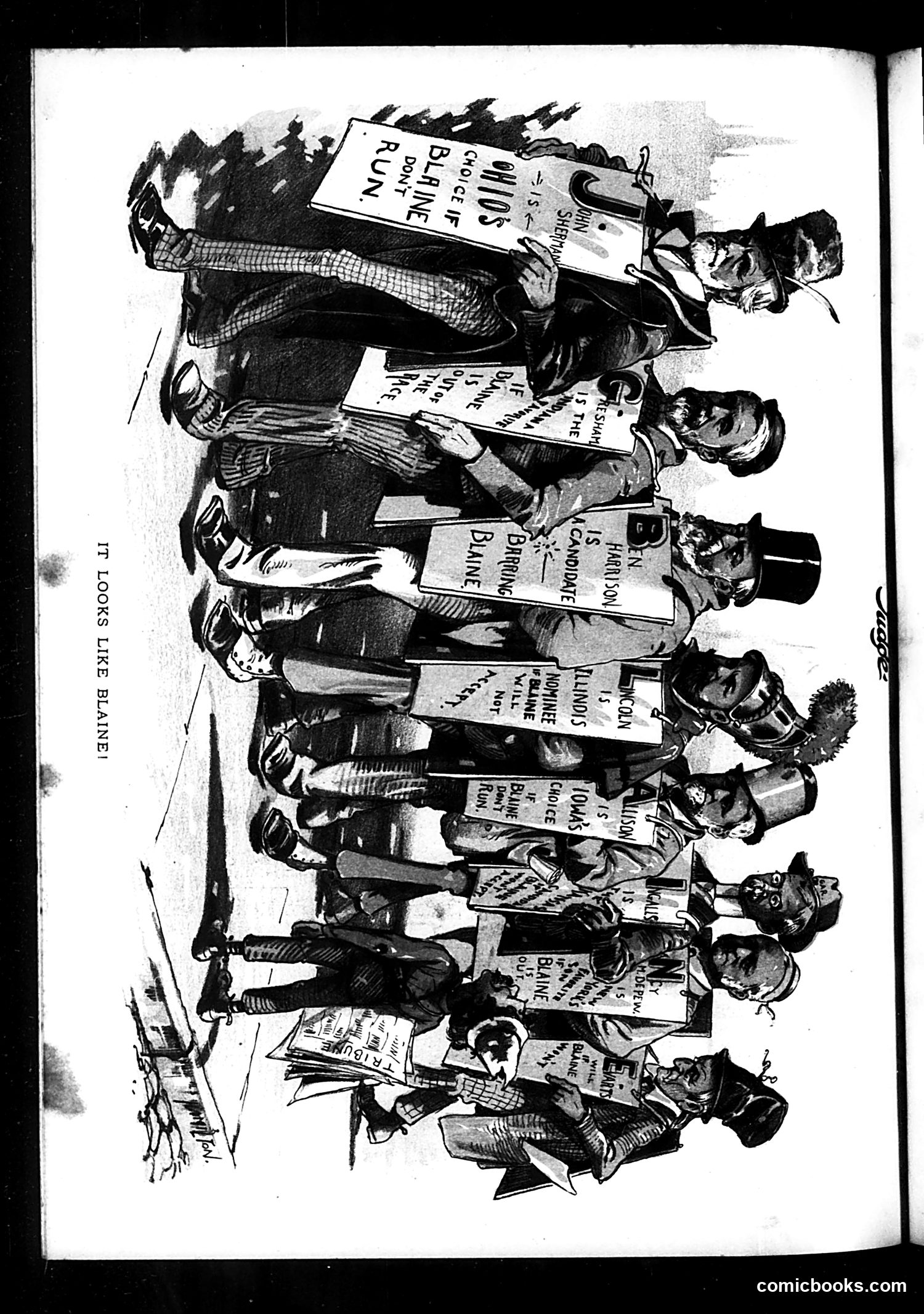
This appears to be a political cartoon from *Judge* magazine titled "It Looks Like Blaine!" The image shows a figure (likely representing a political candidate or public figure) balanced precariously on the heads of several people holding signs. The signs are difficult to read clearly in this reproduction, but appear to reference various political positions or constituencies. The cartoon satirizes political instability or the precarious nature of a candidate's (presumably James G. Blaine's) political support. The visual metaphor suggests the figure is literally balanced on supporters who could topple at any moment, implying their backing is unreliable or that the political position is dangerously unstable. Without clearer text visibility, the specific issues or groups being referenced remain unclear, but the satirical point concerns political vulnerability.