
A complete issue · 18 pages · 1888
Judge — February 18, 1888
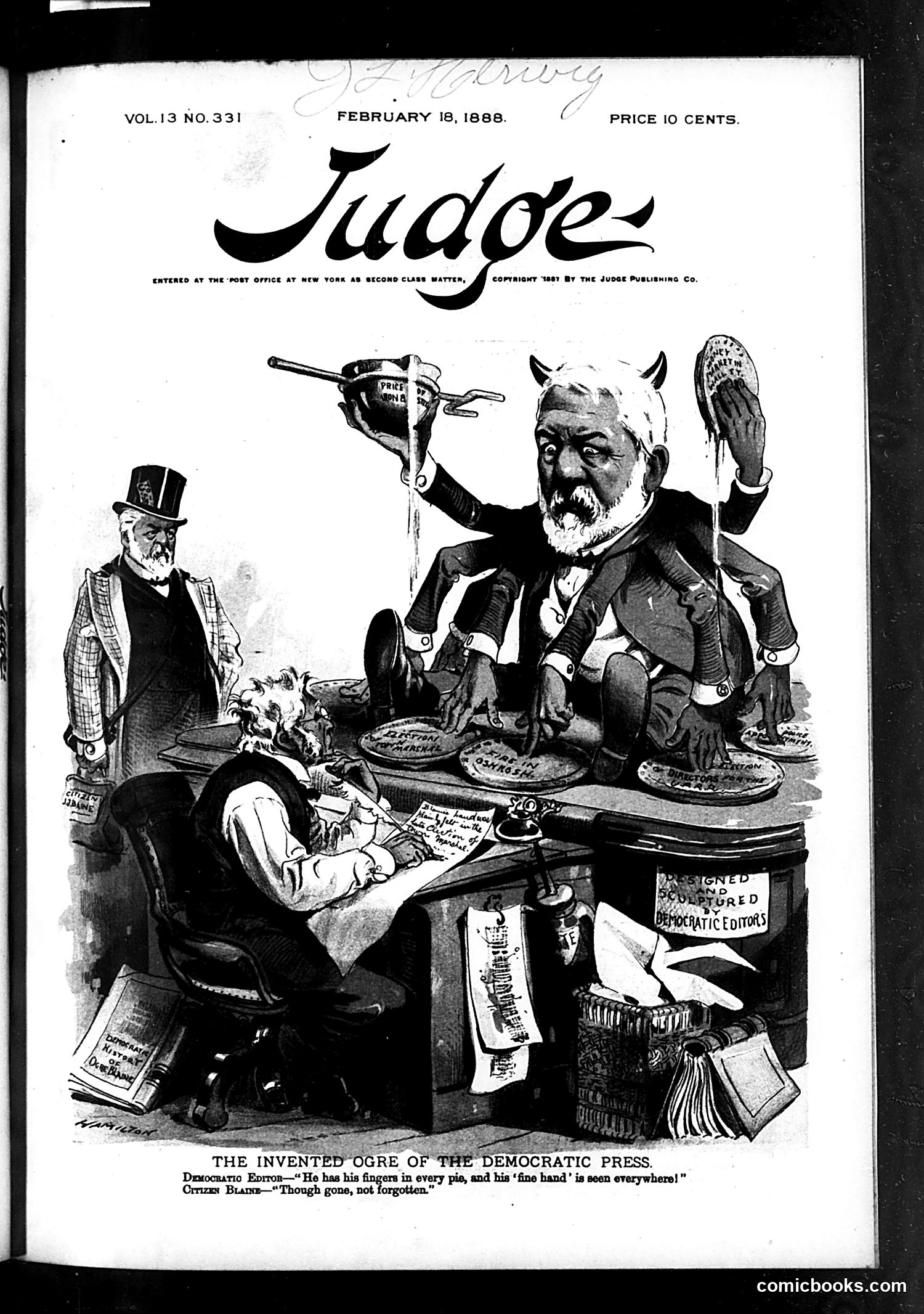
This **Judge** magazine cover from February 18, 1888 satirizes Democratic newspaper editors. The central demonic figure—portrayed with horns and wielding a printing press—represents the caricatured "Democratic Editor." The caption identifies two characters: the editor claims he has "his fingers in every pie, and his 'fine hand' is seen everywhere," while "Citizen Blade" responds "Though gone, not forgotten." The surrounding documents labeled "signed and countersigned diplomatic editions" suggest accusations that Democratic papers manipulate political narratives through selective reporting or propaganda. The cartoon attacks the perceived influence and deceptive practices of Democratic-leaning newspapers, portraying them as malevolent forces shaping public opinion. This reflects late-19th-century partisan tensions over press power and credibility.
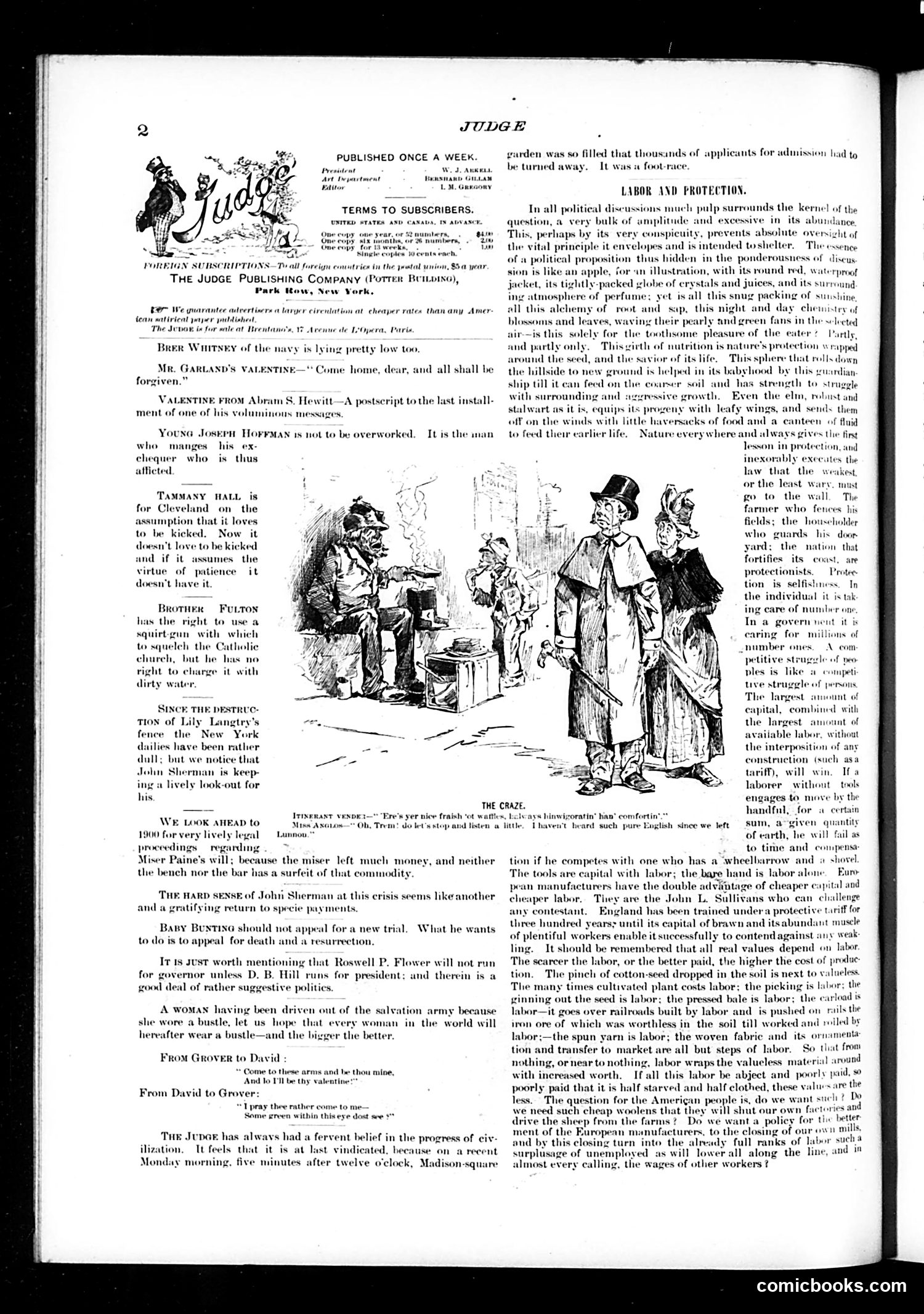
The central cartoon depicts a street scene where a well-dressed man in a top hat appears to be selling or distributing something to poor, ragged citizens. The caption reads: "Immigrant vendor: 'Ere's yer last fresh'n' waffles. I ch'us blanocratin' less confetto.'" The poorly-rendered dialect suggests immigrant speech. This satirizes economic exploitation and likely the emerging consumer culture of the era. The contrast between the well-off vendor and desperate-looking customers suggests commentary on how immigrants or working poor were being sold cheap goods or false promises. The "craze" referenced in the title probably mocks a contemporary fad or speculative bubble affecting vulnerable populations. The surrounding text discusses labor, wages, and manufacturing—suggesting broader economic anxieties of Gilded Age America.
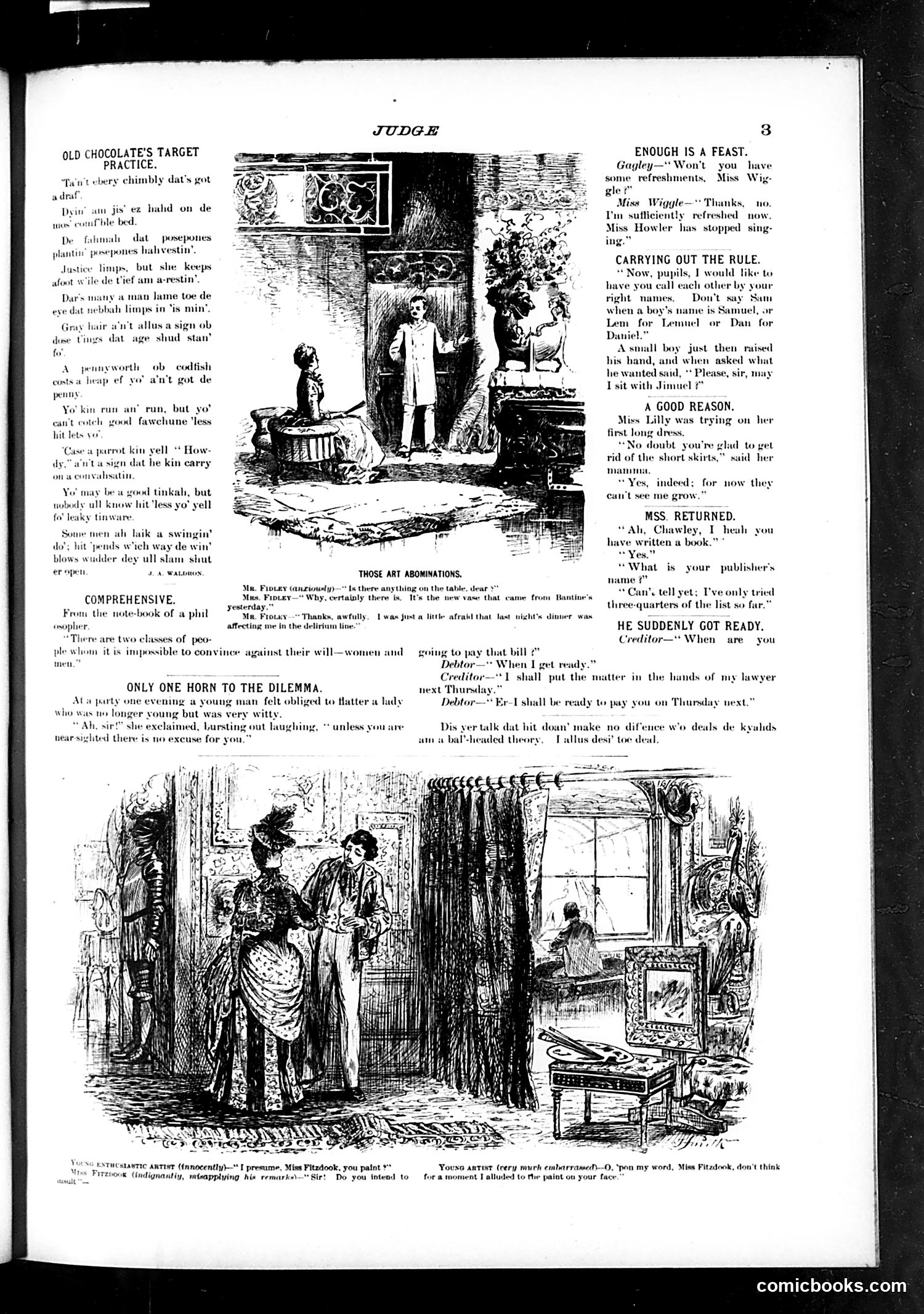
This page contains multiple short humorous pieces typical of Judge magazine's satirical style: **"Old Chocolate's Target Practice"** presents dialectal humor through an African American character's folksy observations about life's ironies—justice limping, aging, unreliable people—using colloquial language common to period humor (though reflecting era-appropriate racial caricature). **"Only One Horn to the Dilemma"** satirizes the impossible compliment: a young man flattering an older woman is forced to choose between insulting her looks or her eyesight. **"Carrying Out the Rule"** mocks strict classroom pedagogy when a teacher's insistence on using full names backfires—a student requests to sit with "Jimuel" (apparently a boy nicknamed Jim whose actual name is different). **"He Suddenly Got Ready"** plays on a debtor's sudden willingness to pay when threatened with legal action. **"Those Art Abominations"** and other brief sketches mock artists and pretension. The illustrated scenes depict these scenarios with period-appropriate Victorian settings and clothing.
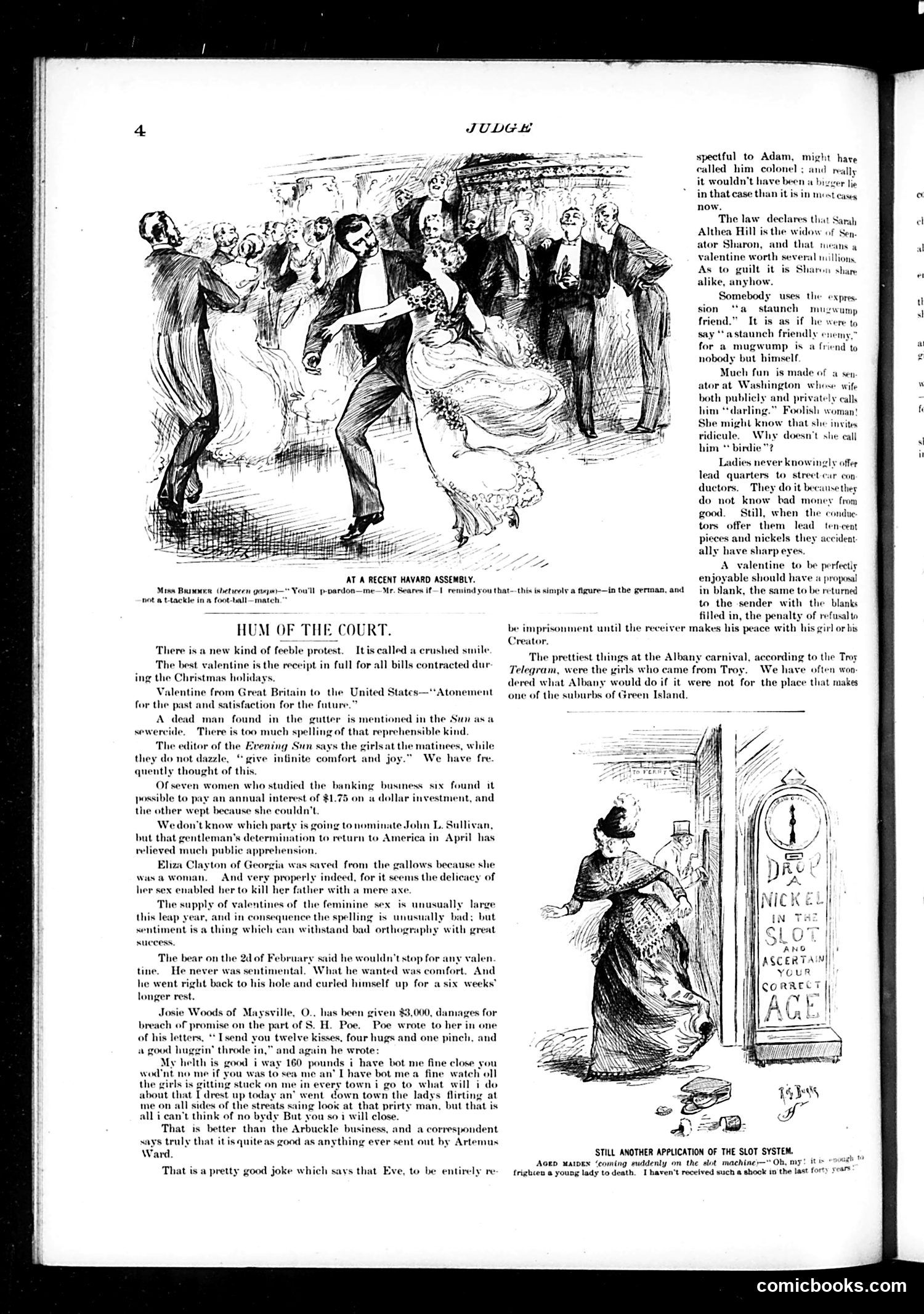
This page from Judge contains multiple satirical pieces mocking contemporary social absurdities: **"At a Recent Harvard Assembly"** mocks a woman's misunderstanding of football terminology, confusing "tackle" with romantic advances. **"Hum of the Court"** is a collection of brief satirical observations: women attempting banking and failing financially; the "crushed smile" as protest; criticism of poor spelling in valentines; and a jab at boxer John L. Sullivan's planned return to America. **The Josie Woods case** ridicules a breach-of-promise lawsuit where a man's crude letters (misspelled, pedestrian) became evidence—satirizing both the legal system and the absurdity of prosecuting romantic deception. **Miscellaneous jokes** target Valentine's Day customs, the widow Althea Hill's claim to Senator Sharon's estate, and municipal corruption involving counterfeit coins. The overall tone mocks feminine sentimentality, legal proceedings, and urban foolishness—typical Judge targets of the period.
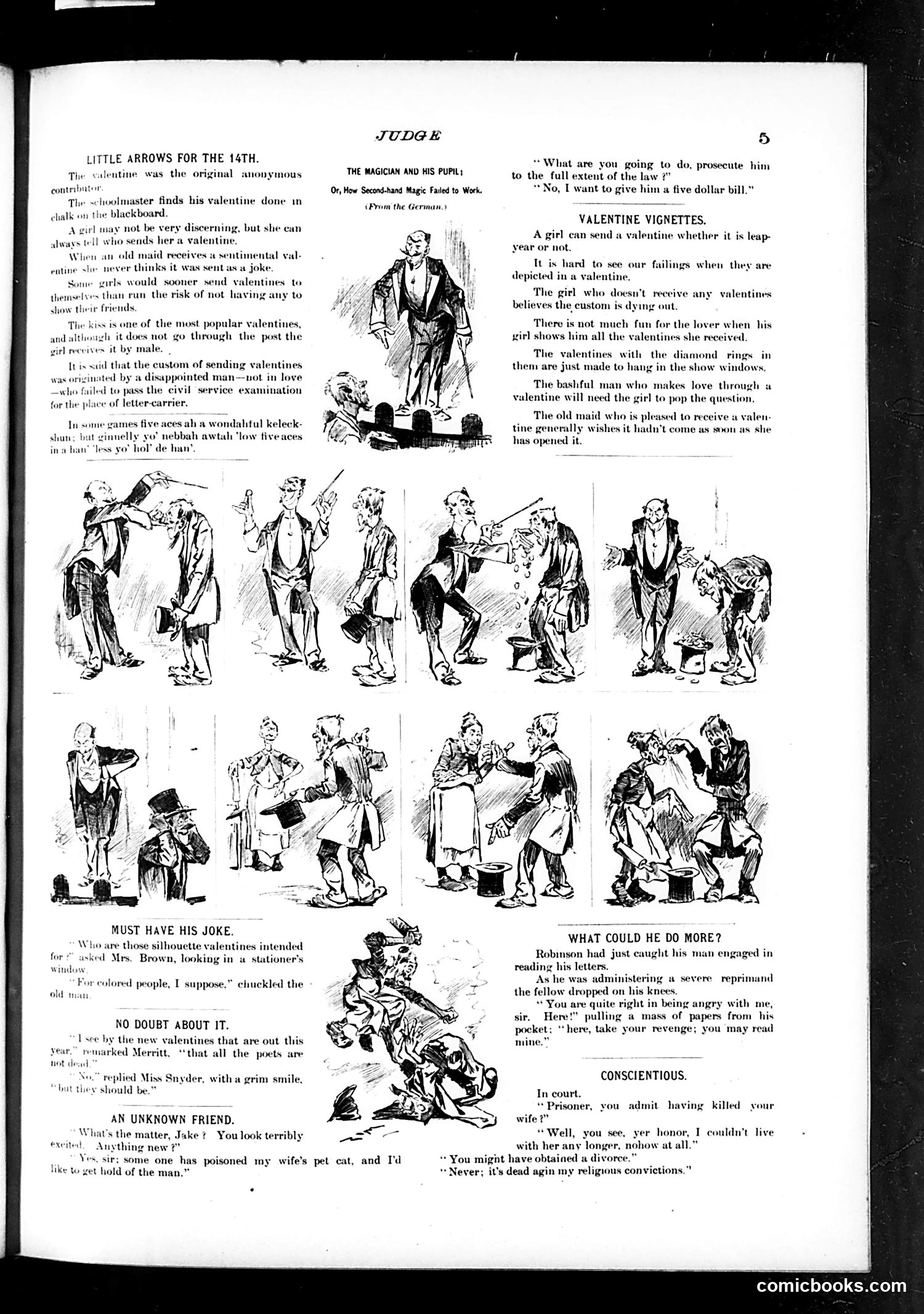
This page from Judge magazine contains Valentine's Day humor and satirical vignettes typical of late 19th/early 20th-century American comedy. **"Little Arrows for the 14th"** offers cynical observations about Valentine's Day customs: anonymous valentines, schoolhouse romance, and the social pressure around receiving them. The humor targets vanity (people sending themselves valentines) and gender dynamics. **"The Magician and His Pupil"** (German origin) depicts a man catching another reading his letters—a serious breach—yet responds with forgiveness rather than prosecution, offering money instead. The satire questions whether excessive mercy is wise. **"Valentine Vignettes"** comprises brief observations mocking romantic conventions: women's assumptions about anonymous senders, disappointment when gifts lack sincerity, and the awkwardness of bashful proposals. **The lower cartoons** ("Must Have His Joke," "What Could He Do More," "Conscientious") satirize male behavior through domestic scenarios: racial prejudice, workplace violations, and a prisoner who refused divorce on religious grounds—suggesting hypocrisy when murder seemed acceptable. The overall tone is cynical about romance, morality, and social conventions.
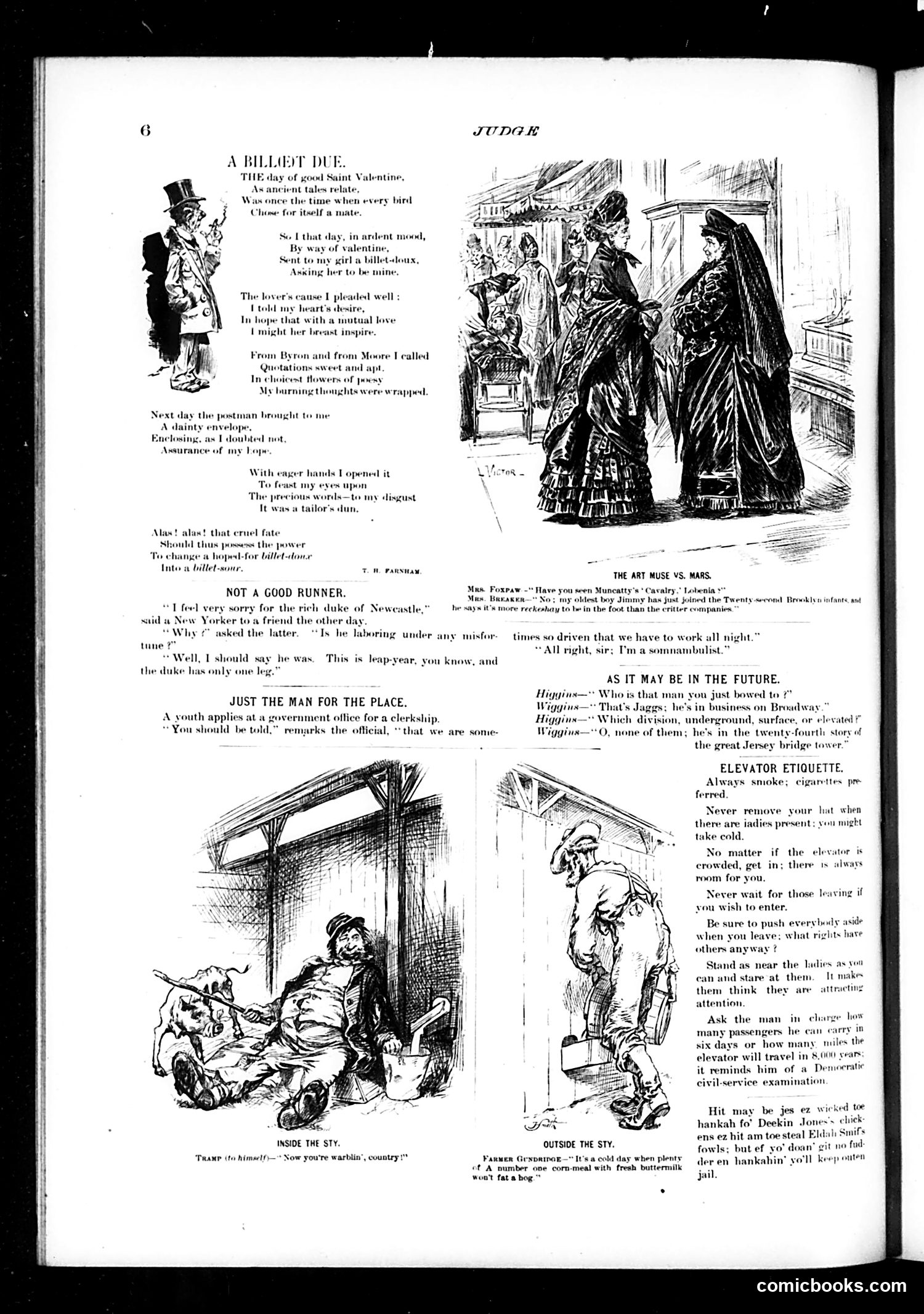
This page contains several distinct satirical pieces typical of late 19th-century American humor: **"A Billet Doux"** mocks romantic letter-writing conventions, presenting an elaborate valentine composed of literary quotations from Byron and Moore—satirizing young men's overwrought sentimentality. **"Not a Good Runner"** jokes about the Duke of Newcastle's lameness (he had "only one leg"), playing on the double meaning of "runner" as both an athlete and a person who flees difficulties. **"Just the Man for the Place"** satirizes bureaucratic hiring based on appearance rather than competence. **"Inside/Outside the Sty"** contrasts a vagrant's optimistic singing with a farmer's cruel reality—social commentary on poverty. **"Elevator Etiquette"** is satirical advice reversing actual etiquette rules (smoking in elevators, ignoring women, pushing people)—mocking both new technology anxiety and deliberate rudeness presented ironically as proper behavior. The remaining pieces blend light domestic humor with gentle social observation typical of Judge's mixed content approach.
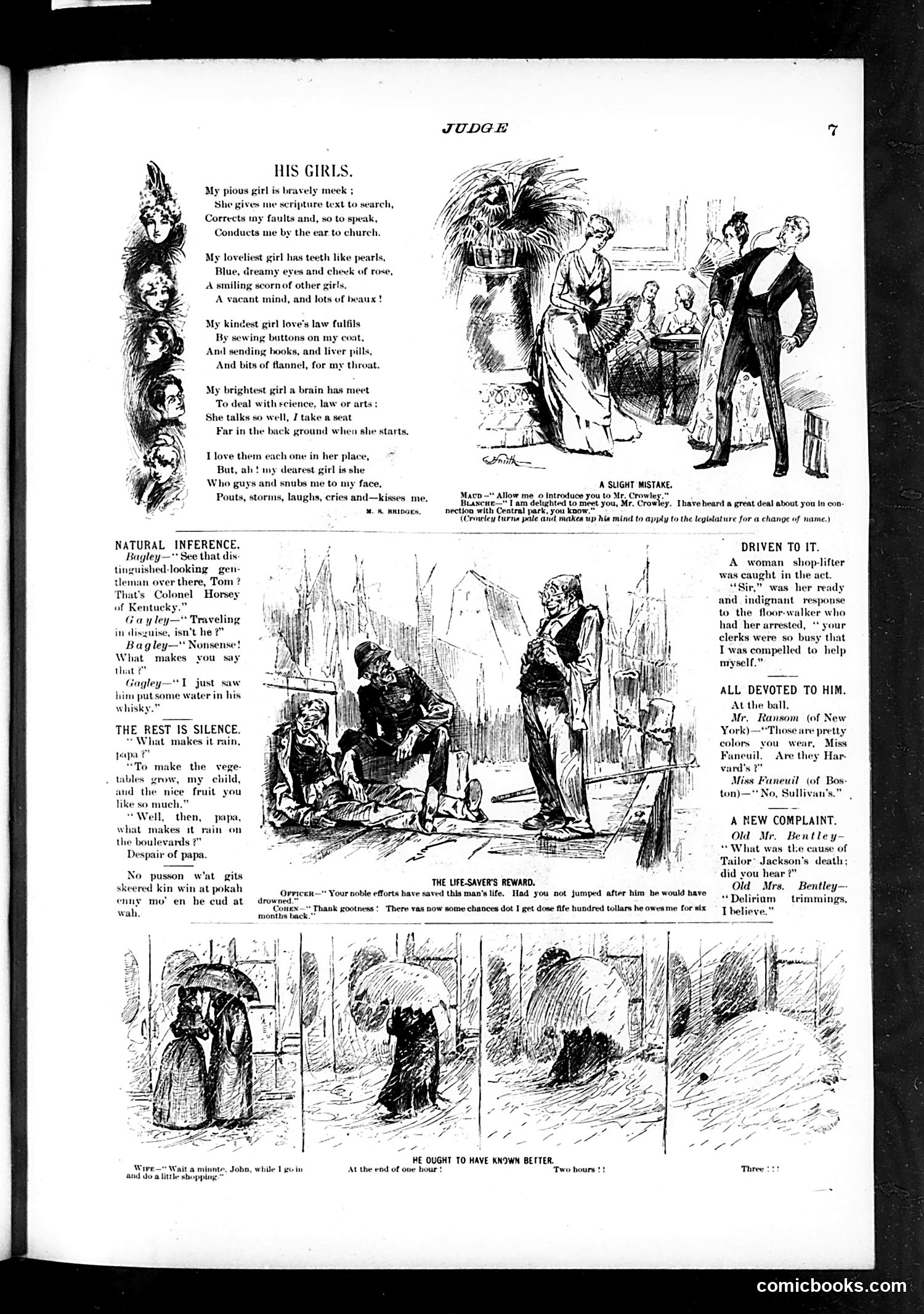
This page from **Judge** (a 19th-century American satirical magazine) contains multiple brief humorous sketches mocking Victorian social conventions and character types. **"His Girls"** satirizes different female archetypes—the pious girl, the beautiful but empty-headed girl, the domestic girl, and the intellectual girl (mocked for talking too much). The final preference for the girl who "snubs me...and kisses me" jokes about male attraction to volatile, contradictory women. **"Natural Inference"** depicts a running gag: a man assumes a distinguished gentleman must be a drunkard because he saw him add water to whisky (supposedly to dilute alcohol). **"A Slight Mistake"** shows a man mortified when introduced in connection with Central Park, apparently fearing association with some scandal there. The remaining sketches mock shop-lifters caught stealing, immigrants with broken English, and social pretension. The humor relies on period-specific assumptions about class, gender roles, and national stereotypes that modern readers would find dated or offensive.
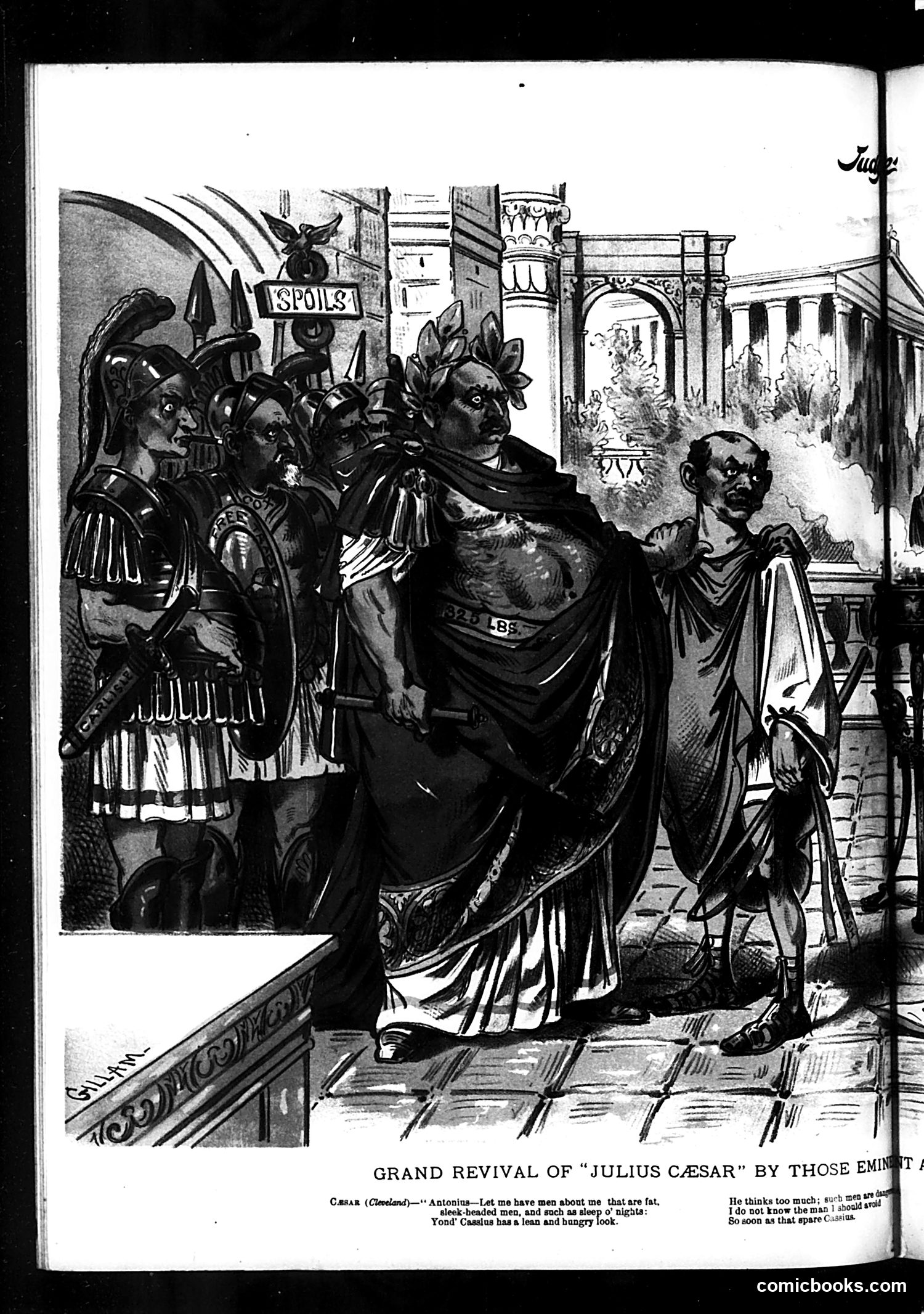
This political cartoon satirizes a contemporary theatrical production of Shakespeare's *Julius Caesar*, using the play as a vehicle to mock current political figures. The caption identifies "Caesar (Cleveland)" — likely referring to President **Grover Cleveland** — surrounded by senators in classical Roman dress. The satire suggests that Cleveland, like Caesar, is surrounded by scheming politicians ("lean and hungry" senators like Cassius) who view him with suspicion or disloyalty. The "SPOILS" sign visible in the background references the **spoils system** — the practice of rewarding political allies with government positions — a major reform issue of the Gilded Age. By conflating contemporary politics with Shakespeare's tragic play about political betrayal and assassination, Judge magazine creates dark humor suggesting Cleveland's presidency was threatened by his own party members vying for power and patronage.
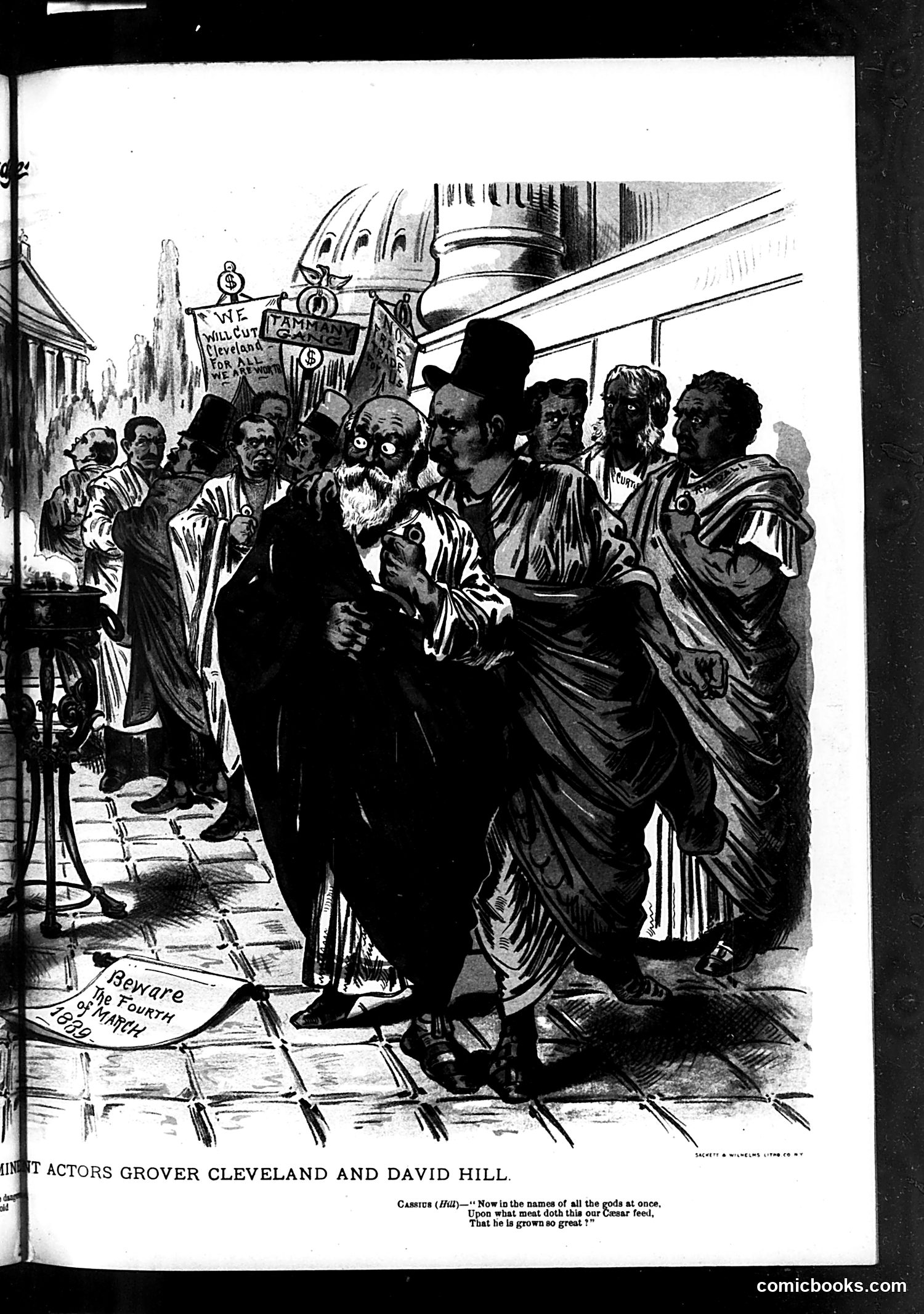
This satirical cartoon depicts a confrontation between two political figures: **Grover Cleveland** (appearing as Caesar, the powerful leader) and **David B. Hill** (as Cassius, questioning Caesar's authority). The classical theatrical reference—quoting Shakespeare's *Julius Caesar*—mocks their political rivalry. Hill, represented as a senator or political rival, questions how Cleveland has become so dominant ("grown so great"). The robed figures surrounding them suggest religious or governmental authority. A banner visible in the background appears to reference political platforms or slogans. The satire critiques the power dynamics within the Democratic Party during the Cleveland administration, using classical allusions to elevate what was essentially an intra-party political struggle into grand dramatic terms—mocking both figures' self-importance.
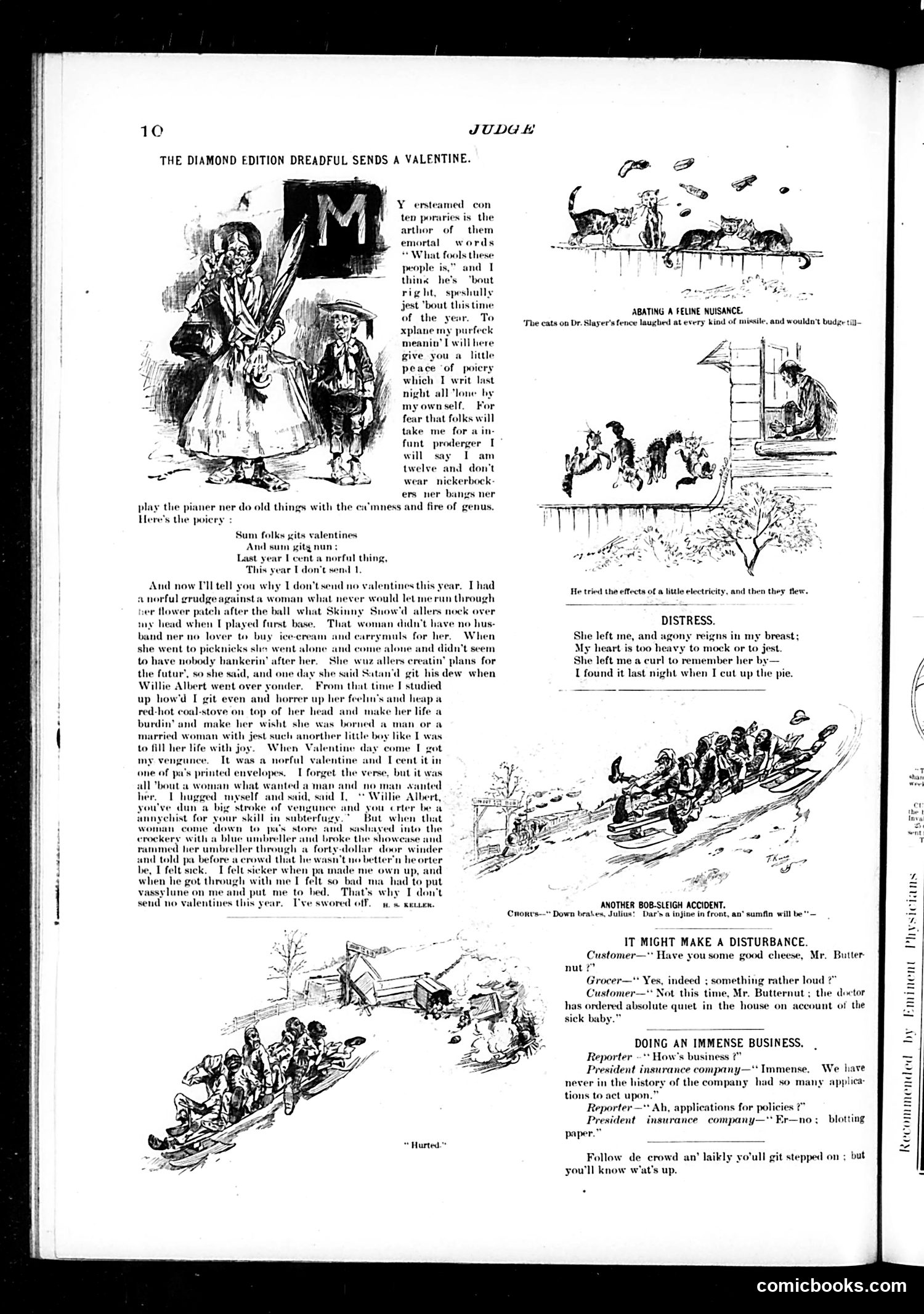
This page contains multiple brief humorous pieces typical of late 19th-century satirical magazines: **Main Story:** "The Diamond Edition Dreadful Sends a Valentine" is a dialect-heavy piece where a boy explains why he won't send valentines. He nursed a grudge against a woman who rejected his advances and humiliated him publicly, so he sent her a cruel "valentine" (a hostile card). Her husband discovered it, beat the boy, and he's now sworn off valentine-sending. **Other Items:** Quick jokes about: - Cats on a fence resisting missiles until electrocuted - A rejected lover's despair - A bobsled accident - A grocer with loud cheese (a pun) - An insurance company flooded with claims rather than policy applications (darkly implying disasters) **Context:** The heavy use of dialect comedy and the casual violence reflect period attitudes. The insurance joke appears to reference accident epidemics or fraud concerns of the era. These are disconnected gag pieces—typical Judge format mixing sentimental verse, crude humor, and topical jabs.
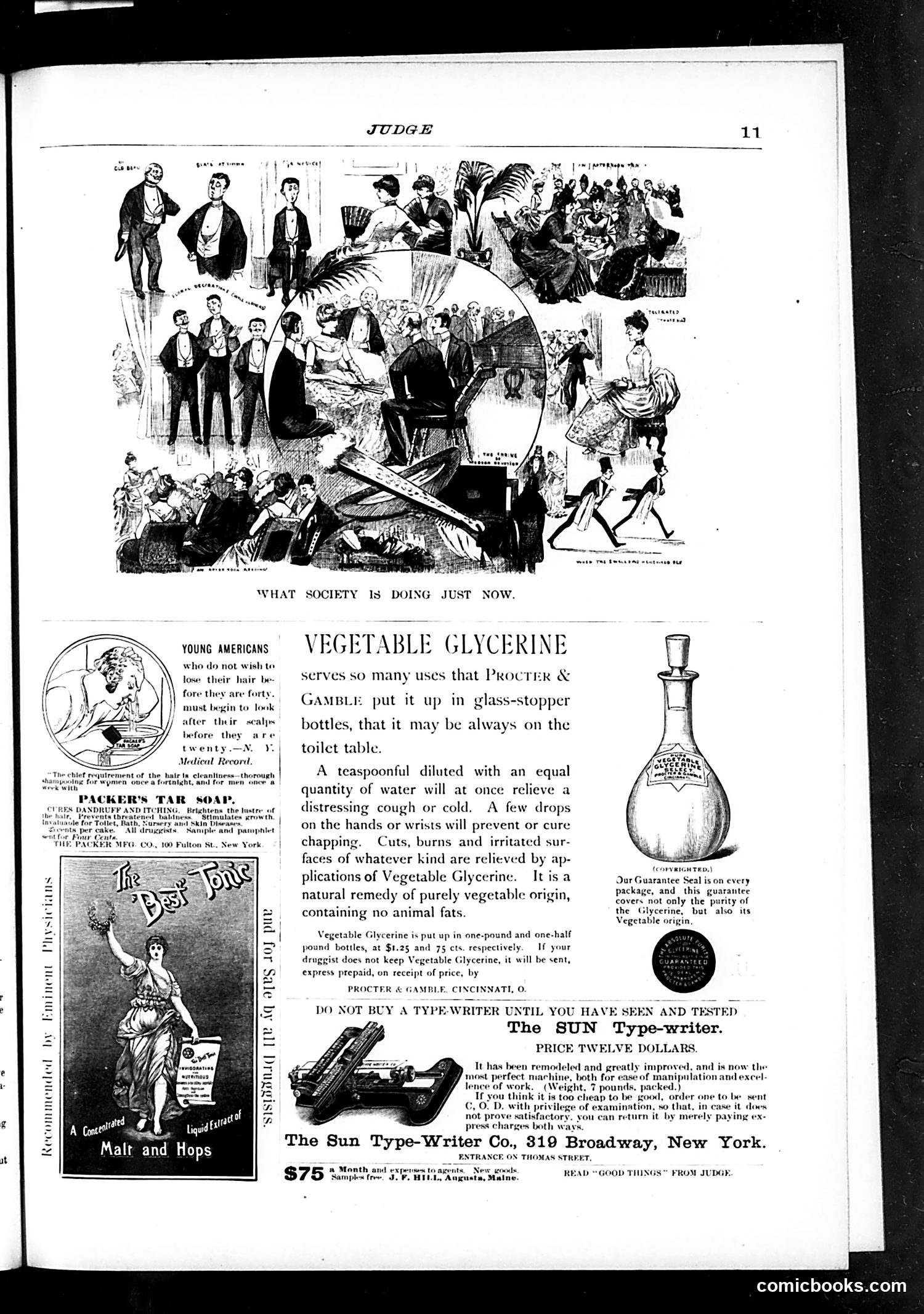
**Main Cartoon:** "What Society Is Doing Just Now" depicts the leisure activities and social gatherings of wealthy Americans—balls, concerts, formal dinners, and theatrical events. The satirical point appears to mock the frivolous preoccupations of high society while ordinary citizens face practical concerns. **Advertisements:** The page is primarily commercial, featuring: - **Packer's Tar Soap** and hair care products, targeting young men worried about premature baldness - **Vegetable Glycerine** by Procter & Gamble, marketed as a multipurpose remedy for coughs, chapping, cuts, and burns - **Sun Type-Writer** at twelve dollars, positioned as an affordable alternative to expensive competitors **Context:** These ads reveal late 19th-century consumer anxieties about appearance, health, and technology access. The juxtaposition of society's extravagance with practical product advertisements subtly critiques class divides—the wealthy enjoy leisure while ordinary Americans manage daily physical concerns through commercial products.
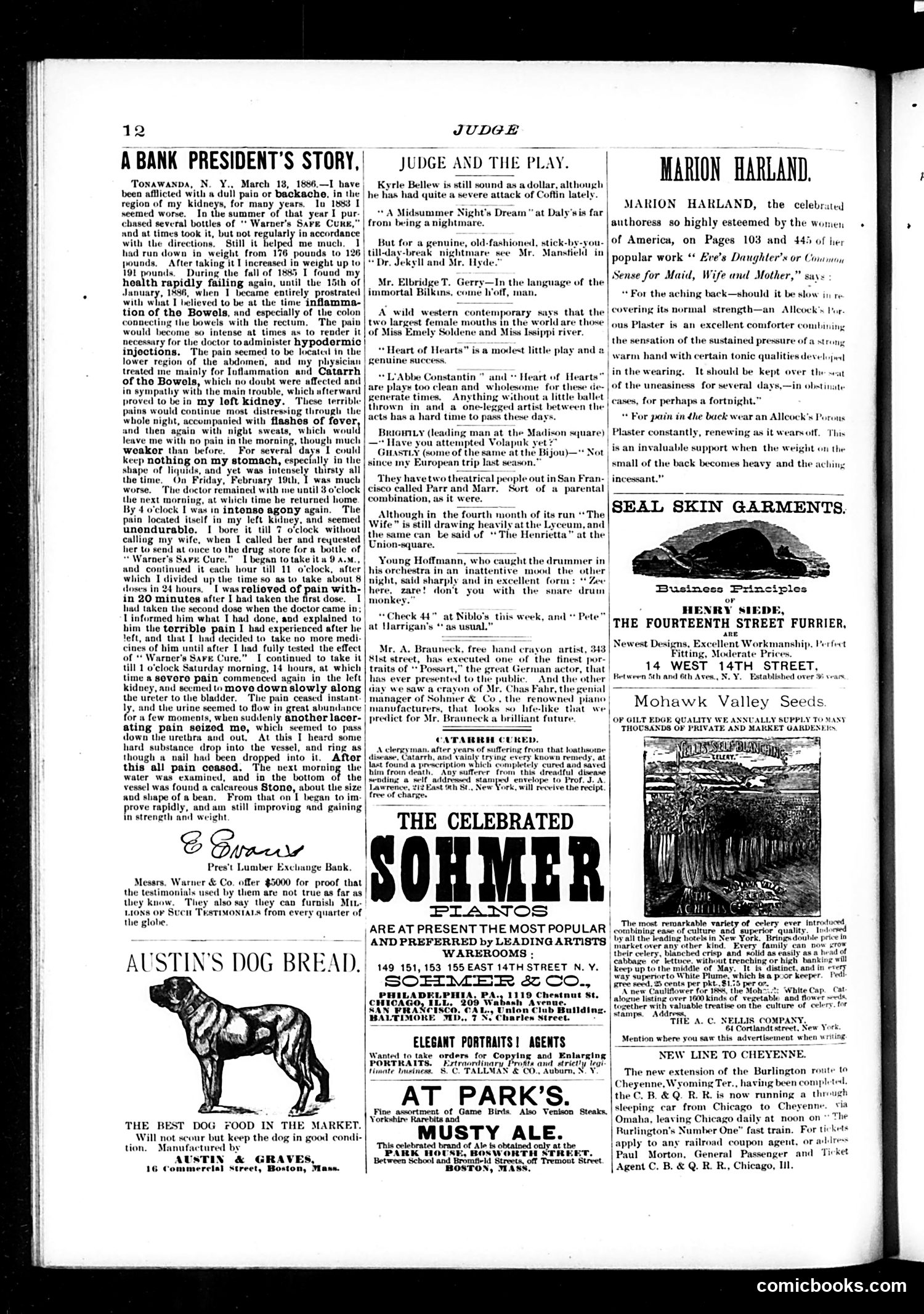
This page is primarily **advertising**, not political satire. The dominant content includes testimonials and product advertisements typical of 1880s magazines. The "Bank President's Story" is a **patent medicine advertisement** for "Warner's Safe Cure," presented as a first-person testimonial from a bank president in Tonawanda, N.Y. describing treatment of kidney stones. Such testimonials were common marketing tactics of the era—often questionable in authenticity. The $5,000 "proof" offer by Warner & Co. was typical advertising hyperbole. Below this are ads for other commercial products: "Austin's Dog Bread" (dog food), "Sohmer Pianos," "Musty Ale," and other goods. These reflect late 19th-century consumer culture. **No political satire or recognizable figures appear on this page.** The content reflects Judge's mixed editorial and commercial model rather than purely satirical intent.
This is primarily an **advertising page** from Judge magazine's February issue, not a satirical cartoon page. The main content consists of period advertisements and magazine promotion. **Key elements visible:** - **The Cosmopolitan magazine** advertises its February issue featuring "The Ballet in Paris" by Theodore Child - **Greenway's India Pale Ale** (American brewery) emphasizes it's "fully equal to the best imported" beer for family use - **Penn Mutual Life Insurance** runs multiple ads highlighting 1887 financial performance and policy benefits - **Piso's Cure** advertises a patent medicine claiming to cure consumption (tuberculosis) and coughs - Minor ads for other products ("Don't be a Clam," "Paradise," "Brentano's") **Historical context:** The ads reflect late-19th-century consumer culture—patent medicines made exaggerated health claims (Piso's Cure was common but ineffective), life insurance was growing, and American breweries competed by claiming equivalence to European imports. No political satire is evident on this page.
This page features **"The German Policeman,"** a serialized story by Julian Ralph illustrated by Judge's artists. The cartoon/text excerpts shown mock German-accented English through dialect humor—a common satirical approach of the era. The visible passages ridicule stereotypical German attitudes: a policeman's obtuse logic about women's laundry needs and worn shoes. The humor relies on broken English ("Der Almighty," "vhen," "vill") and the character's matter-of-fact, bureaucratic reasoning presented as absurdly literal-minded. This reflects late 19th-century American satire's treatment of immigrant groups and foreign stereotypes. "The German Policeman" appears designed to amuse readers through exaggerated ethnic characterization and linguistic caricature—content that would be considered offensive by modern standards. The remainder of the page consists of advertisements for typewriters, railroads, patent medicines, and other period products.
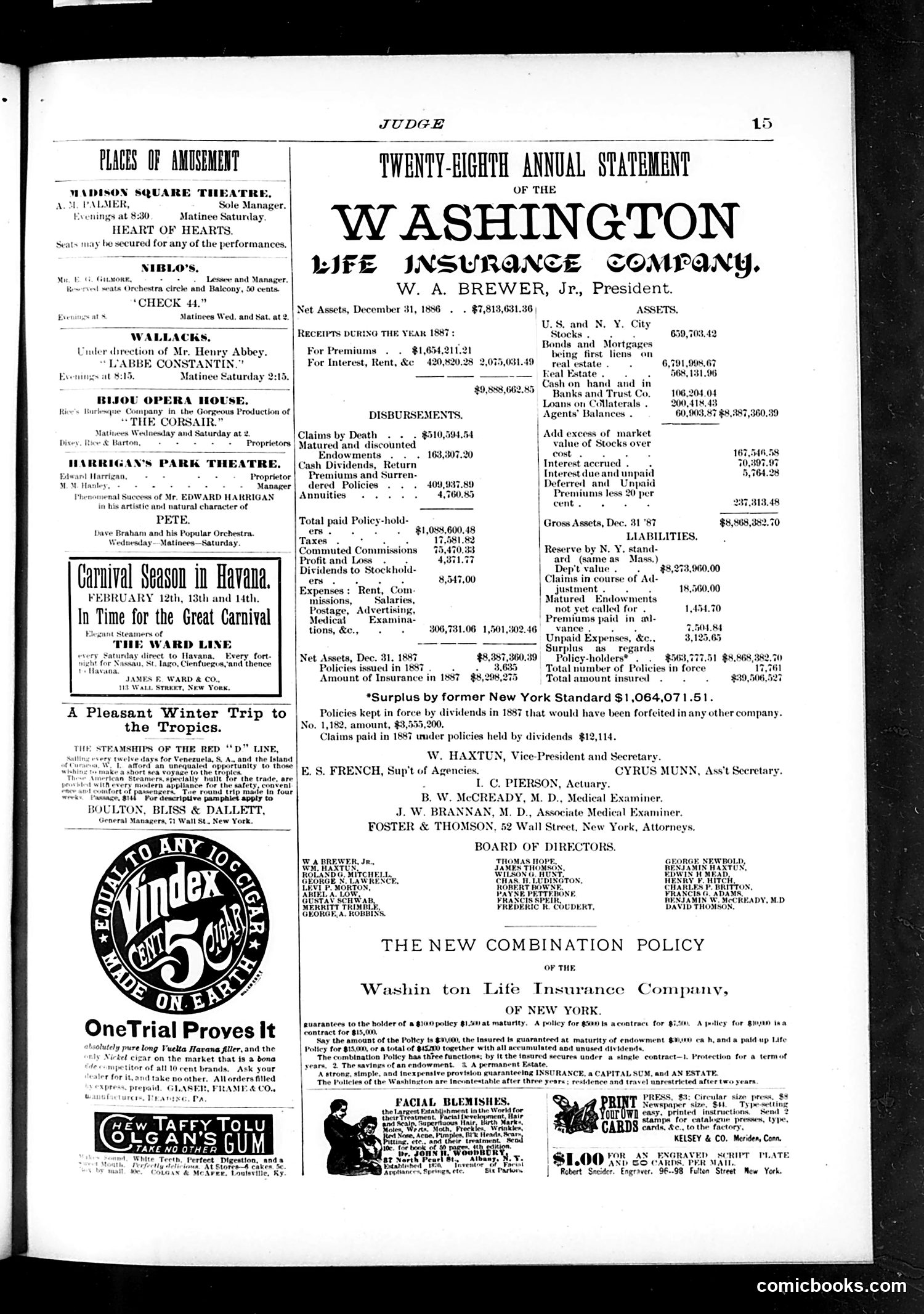
This page is primarily advertising and financial documentation—it's a table of contents/advertisements section followed by an insurance company's 1887 annual report for Washington Life Insurance Company. The entertainment ads (top-left) advertise theater productions and vacation trips typical of 1887 New York. The small product ads at bottom promote consumer goods: a cigar brand ("OneTrial Proves It"), chewing gum, facial blemish treatments, and printing services. The substantial middle-to-right section is the insurance company's financial statement showing assets, disbursements, and their new "combination policy" product—essentially a hybrid life insurance and endowment plan that promised guaranteed payouts at maturity plus accumulated dividends. There are no political cartoons visible. This appears to be a typical Judge magazine contents page, mixing entertainment listings, advertisements, and what amounts to advertorial content (the lengthy insurance report).
This page is primarily **advertising and business directory**, not political satire. The main content lists leading hotels across northeastern American cities (New York, Jersey City, Albany, Rochester, Philadelphia, Baltimore) alongside commercial advertisements. The single illustration—a cherub or baby in a bathtub—accompanies handwritten text reading "He work be happy till he gets it!" This appears to be an advertisement endorsement, likely promoting one of the consumer products advertised below (Epps's Cocoa, Liebig's Meat Extract, or Monon Route railway). The humor is gentle domestic comedy rather than sharp satire: the implication being that using these products brings happiness. This represents typical late 19th-century advertising strategy—associating commercial goods with contentment and well-being. The page reflects Judge's dual nature as both satirical publication and advertising vehicle, with ads subsidizing editorial content.
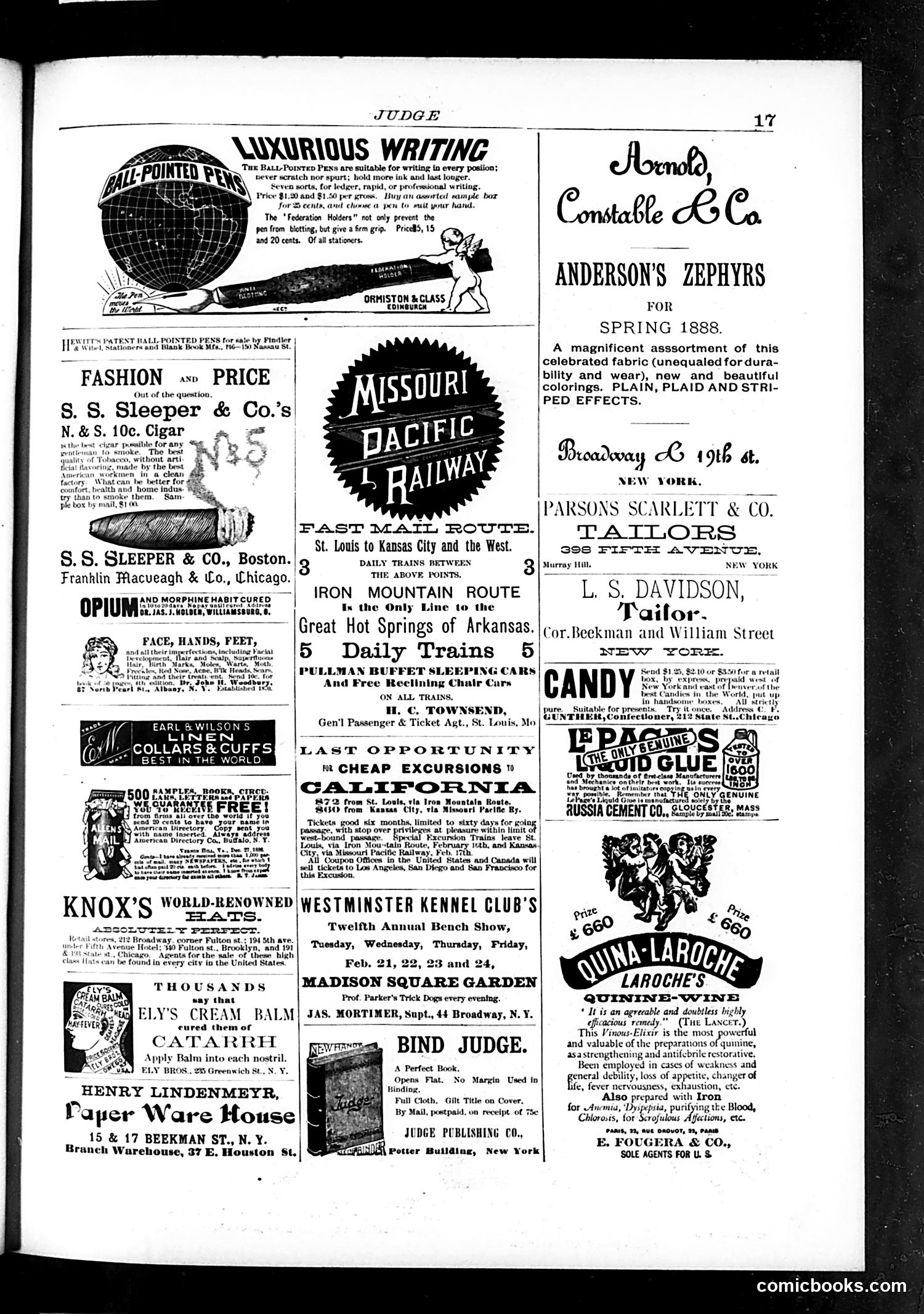
This page is primarily **advertising**, typical of late 19th-century magazines. The content includes: **Notable Advertisements:** - Writing instruments (ball-pointed pens) - Cigars and patent medicines (Ely's Cream Balm for catarrh) - Railroad excursions to California and Arkansas Hot Springs - Tailoring services and fabric (Anderson's Zephyrs for spring 1888) - A quinine wine tonic marketed as a health restorative - The Westminster Kennel Club's dog show at Madison Square Garden **The "Bind Judge" Section:** A small illustrated box promotes Judge Publishing Company's own book product—a perfect-bound volume that "opens flat," priced at 75 cents. The page reflects the commercial ecosystem of *Judge* magazine, which funded itself through advertising while providing satirical content. The advertisements target upper-class readers with disposable income (travel, tailored clothing, patent medicines). **There are no political cartoons or satire visible on this particular page**—it's essentially a commercial advertisement section.
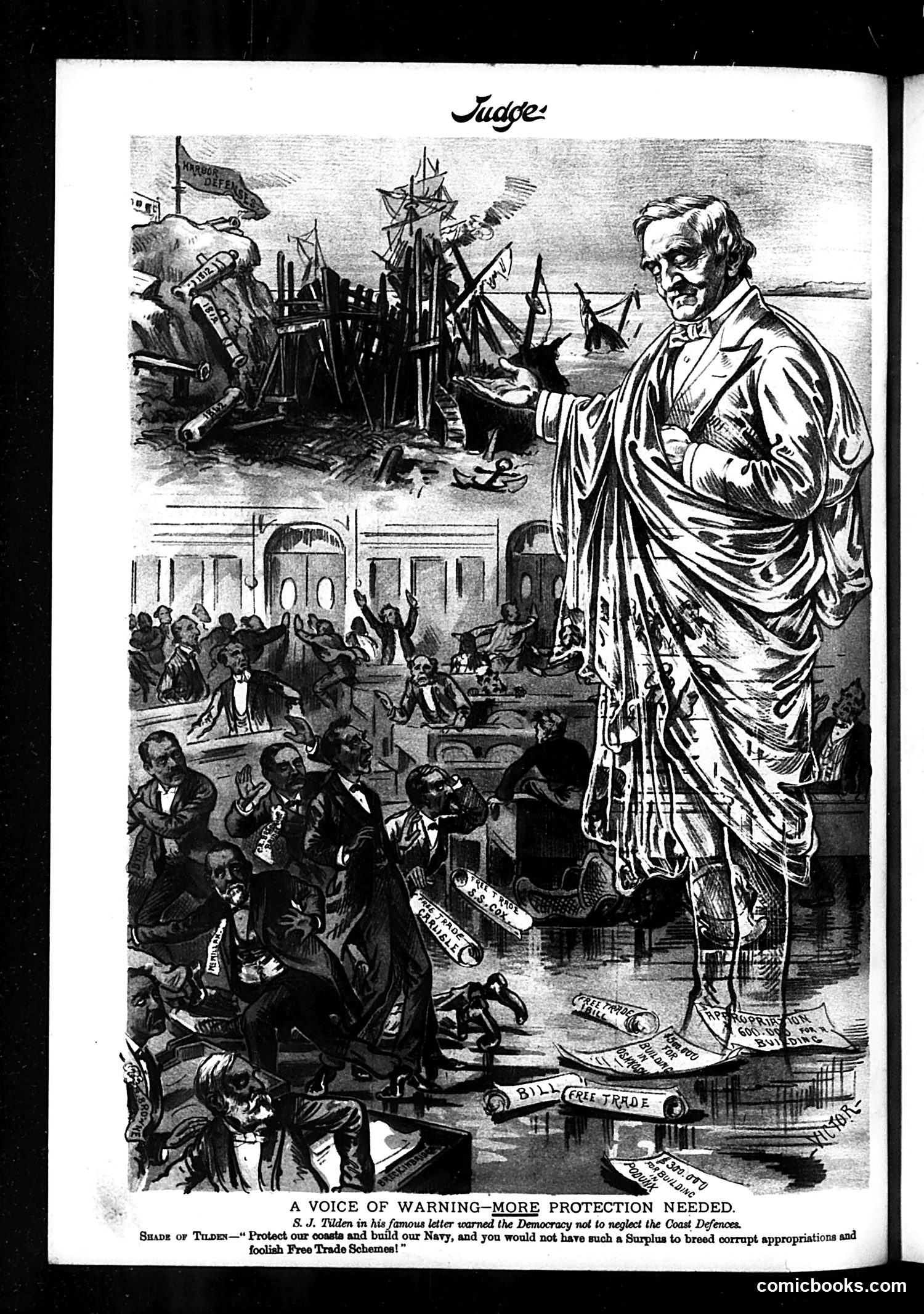
This Judge cartoon satirizes Democratic politician S.J. Tilden's stance on coastal defense. The large robed figure on the right represents Tilden or his political legacy, addressing a courtroom scene below where Democratic politicians (identifiable by period dress and caricature style) appear to be judged or held accountable. The cartoon's argument: Tilden warned Democrats to prioritize naval protection and coastal fortification, yet they failed to do so. Instead, the cartoonist claims, Democrats created a government surplus that enabled "corrupt appropriations" and misguided "Free Trade Schemes." The satire attacks Democratic economic policies—particularly free trade advocacy—as fiscally reckless and corrupt. The "voice of warning" framing suggests Republicans saw themselves as vindicated by Tilden's own cautionary words about Democratic mismanagement. Ships visible in the harbor background reinforce the naval defense theme.