
A complete issue · 16 pages · 1887
Judge — November 19, 1887
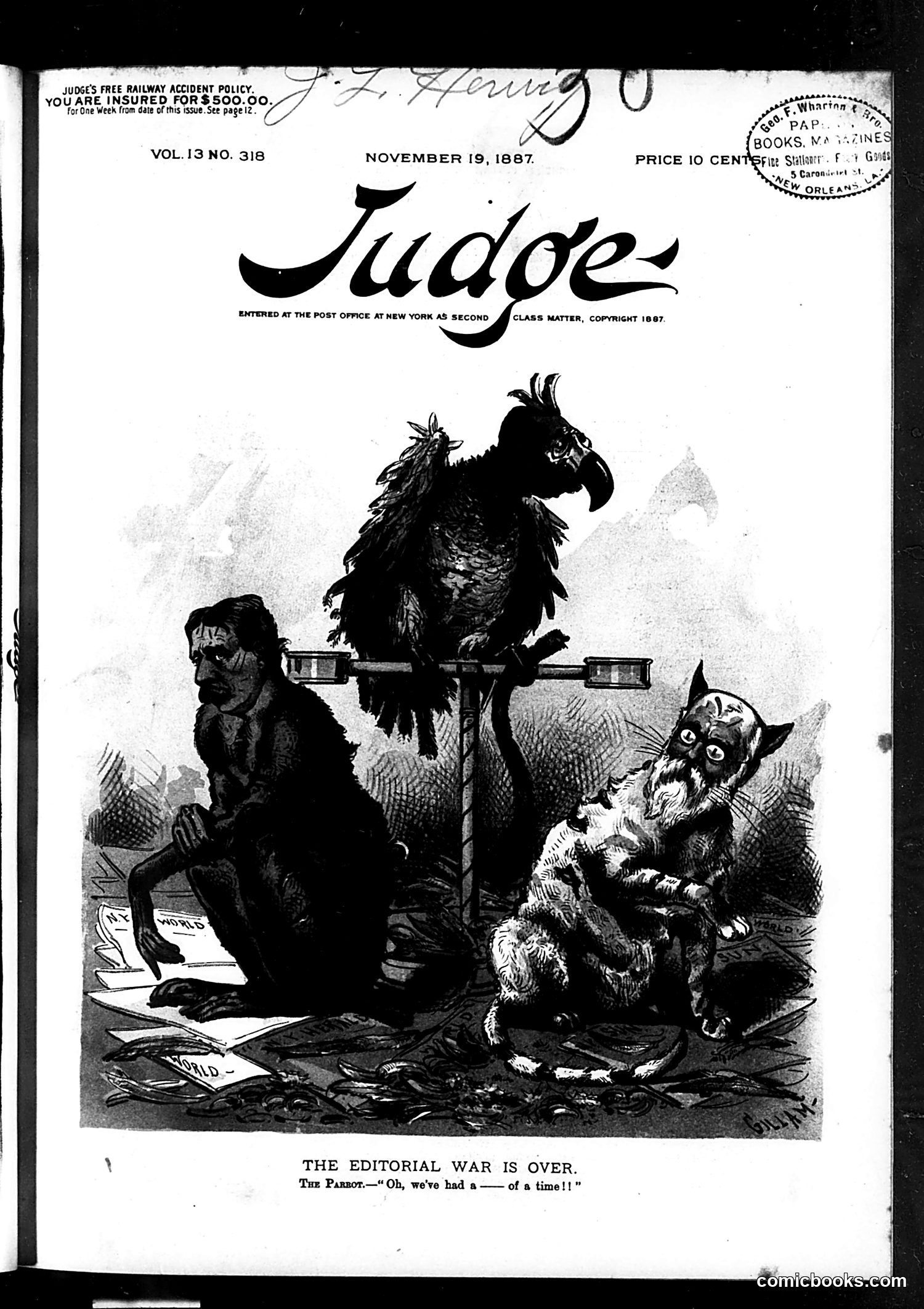
This political cartoon satirizes the conclusion of a heated editorial dispute, likely between competing newspapers or political factions of the era. The image depicts anthropomorphic figures—including what appears to be a monkey and a devil-like creature—positioned on a balance scale with a large bird perched atop, suggesting an unstable or absurd resolution. The caption quotes the parrot saying "Oh, we've had a _____ of a time!!" (the blank likely containing a mild profanity typical of period humor), indicating the editorial conflict was exhausting and chaotic. The specific "editorial war" referenced is unclear without additional historical context, but this reflects Judge magazine's common practice of mocking contemporary newspaper rivalries and political disagreements through grotesque caricature and wordplay.
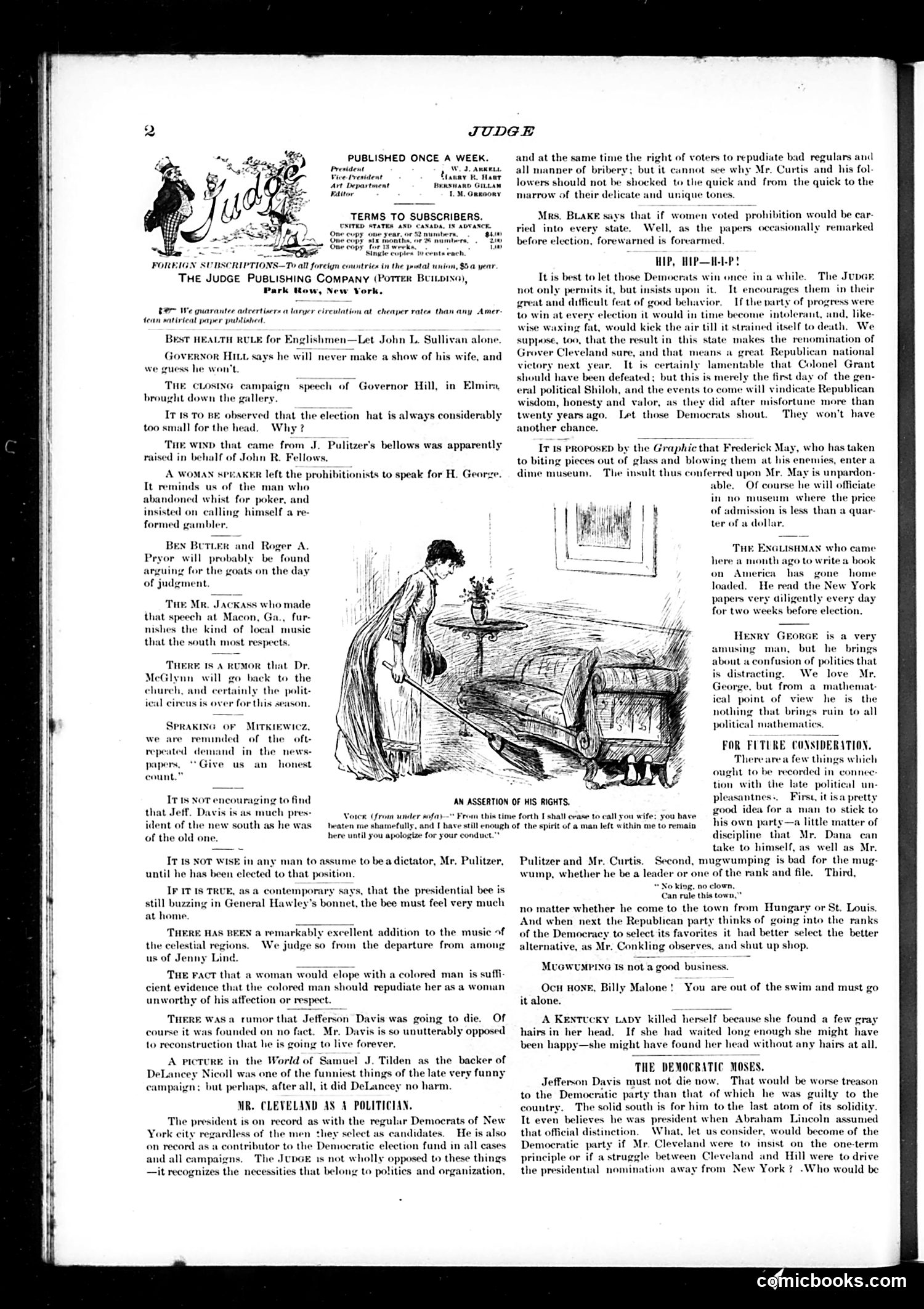
This page contains political commentary and social satire typical of Judge magazine. The main cartoon, titled "An Assortion of His Rights," depicts a man using a large rake or broom on what appears to be scattered items or debris—likely a visual metaphor for political or social "sweeping clean." The surrounding text discusses various political figures and issues, including references to Cleveland, Jefferson Davis, and Democratic politics. One section critiques a colored man being repudiated as a woman, reflecting period racial attitudes. The content addresses Reconstruction-era political tensions and debates about voting rights, party loyalty, and political leadership. Without the publication date visible, the exact historical moment remains unclear, but the references suggest post-Civil War American politics during the late 19th century.
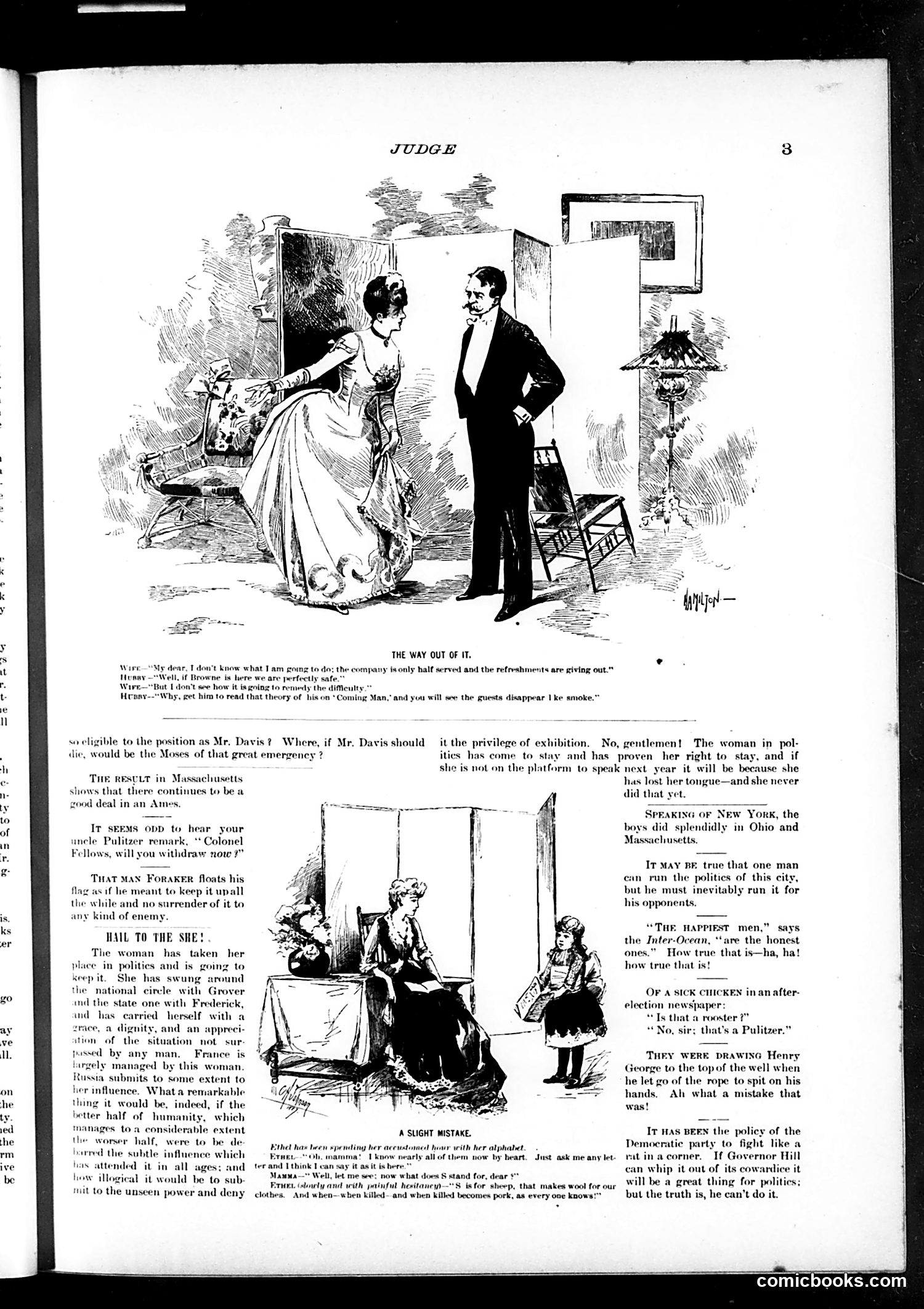
This page contains multiple political cartoons and commentary from the 1880s-90s era. The main cartoon, "The Way Out of It," depicts a woman seated while a man stands—illustrating a joke about a hostess whose refreshments have run out; the solution is to allow her female guests to speak, causing them to "disappear like smoke." The surrounding text contains brief political jabs: references to **Colonel Foraker** (likely Joseph B. Foraker, Ohio politician), **Pulitzer** (Joseph Pulitzer, newspaper publisher), and **Governor Hill** (David B. Hill of New York). Key satirical points include: - Women's growing political influence and public participation - Criticism of Democratic party leadership - Mocking commentary on specific politicians' competence - A joke equating a weak chicken to "a Pulitzer" (implying weakness) The cartoons mock both political figures and social pretensions of the era, using humor to critique contemporary politics and gender politics during the Progressive era.
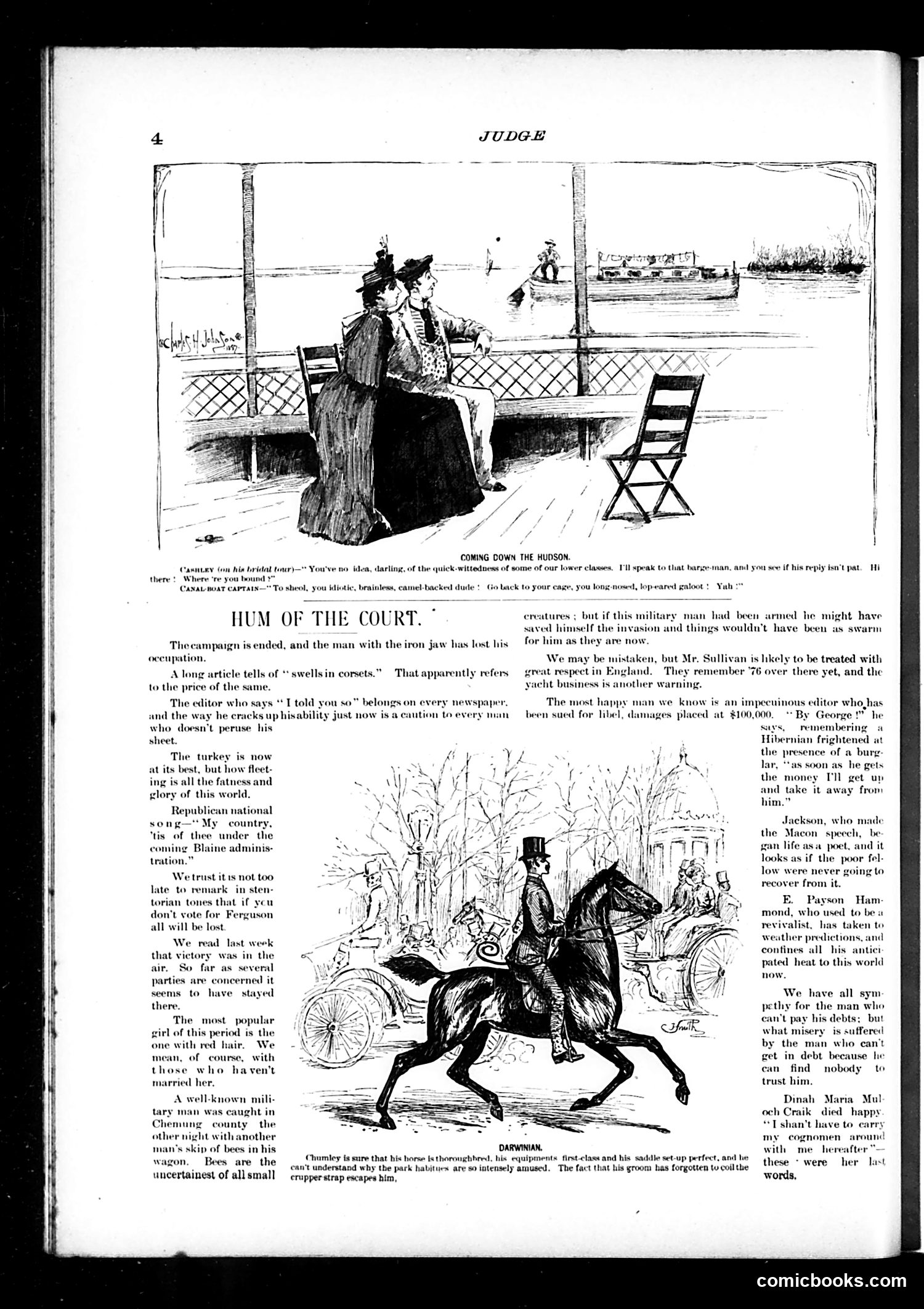
This page from Judge magazine contains social commentary and satirical short pieces typical of the publication's format. **"Hum of the Court"** section references contemporary political figures and events: - "The man with the iron jaw" likely refers to a prominent politician recently out of office following an election campaign - References to "Ferguson" and "coming Blaine administration" suggest this is from the 1884 election period involving James G. Blaine - The Sullivan reference appears to be about Irish-American boxer John L. Sullivan, a celebrity of that era **The cartoons illustrate social satire:** - Top cartoon: A woman and man on a Hudson River boat, mocking lower-class dialectical humor - Bottom cartoon labeled "Darwinian": A horseman unaware his saddle strap is undone, satirizing pretentious show while appearing foolish—a commentary on superficial gentility **The miscellaneous items mock:** - Editors' smugness - Fashion trends ("swells in corsets") - Political hyperbole - Social pretension and vanity The page reflects Gilded Age concerns about class, appearance, and political theater.
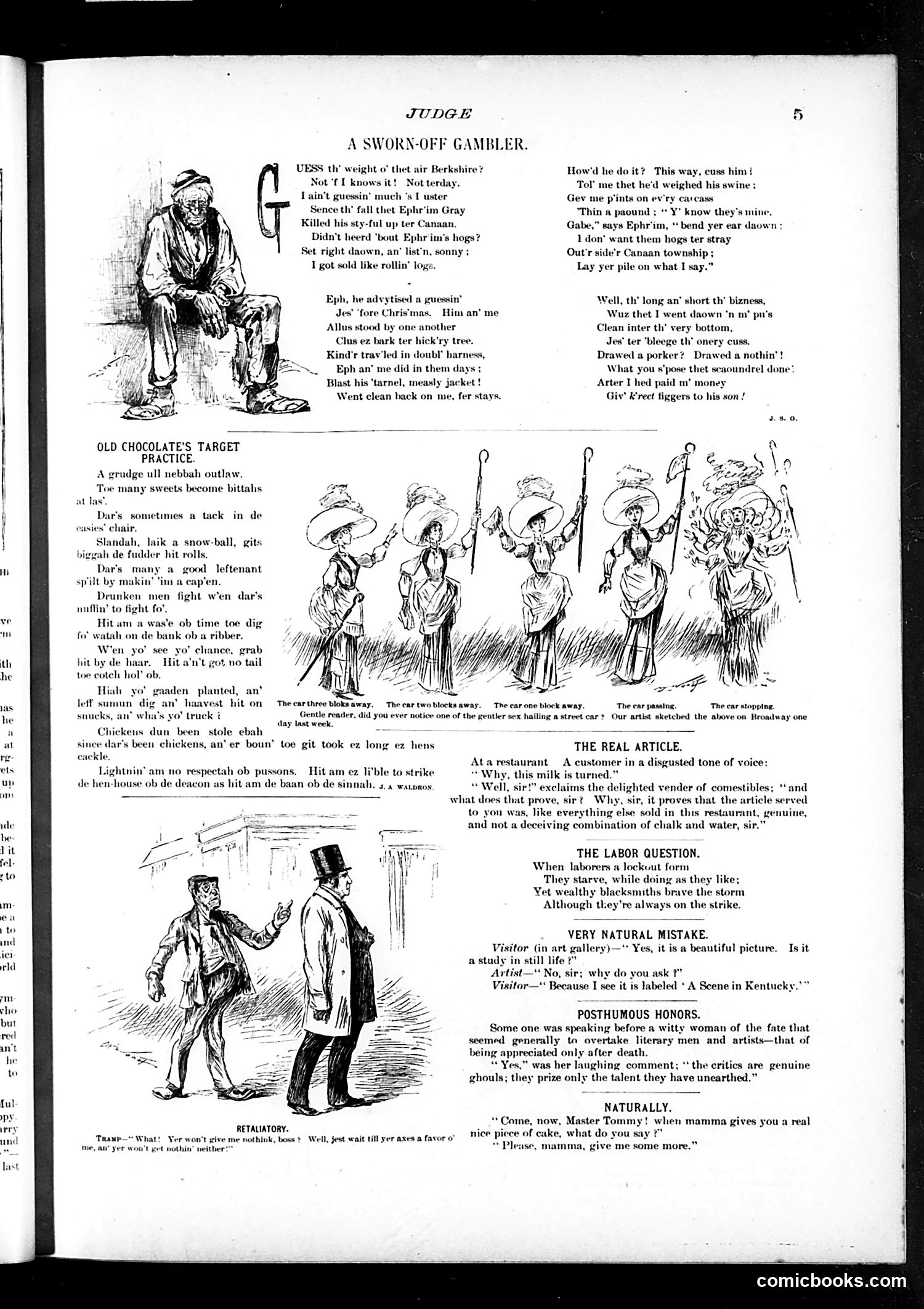
This page contains several satirical pieces typical of Judge's humor: **"A Sworn-Off Gambler"** tells a rural dialect story about a farmer who lost his savings betting on pig weights with a friend named Ephraim. The satire targets gullible gamblers and rural credulity—the narrator trusted his friend's inside information only to be cheated when Ephraim gave accurate figures to someone else instead. **"Old Chocolate's Target Practice"** uses African American dialect (common in period humor, now offensive) to present folk wisdom through contradictory proverbs, mocking pretentious philosophy. The remaining items are brief joke pieces: **"The Real Article"** satirizes restaurant food quality by suggesting even spoiled milk proves authenticity; **"The Labor Question"** mocks labor strikes by contrasting starving lockout workers with wealthy blacksmiths always striking; **"Very Natural Mistake"** plays on a painting titled "A Scene in Kentucky"; and shorter pieces joke about death, art criticism, and children's manners. The page reflects Gilded Age social attitudes and focuses on domestic humor rather than specific political events.
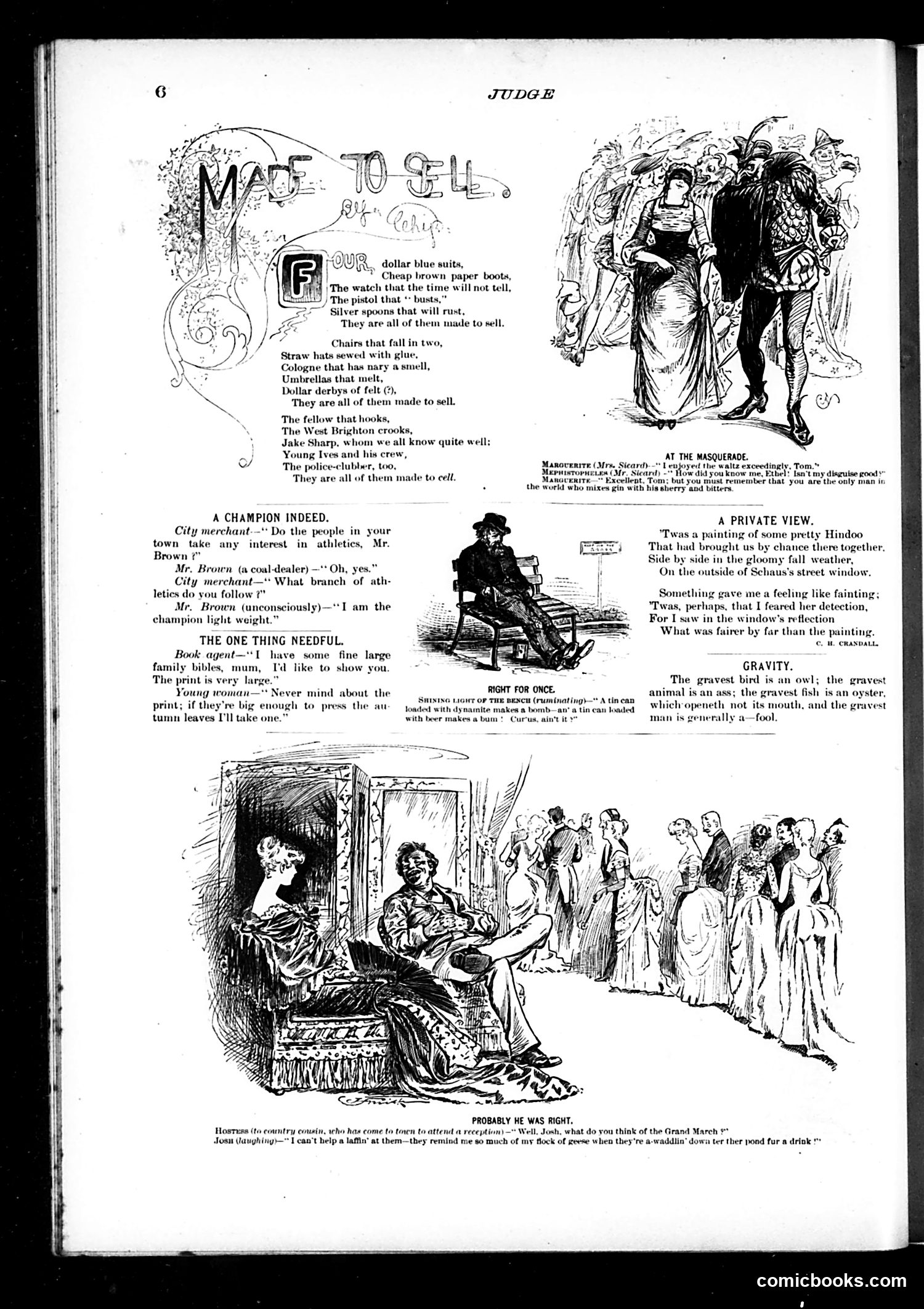
This page from the satirical magazine *Judge* contains several unrelated humorous sketches typical of late 19th-century American humor. **"Made to Sell"** is a poem mocking cheap, fraudulent merchandise and corrupt public figures. It references specific scandals: "Jake Sharp" (likely a corrupt politician), "West Brighton crooks," and "Young Ives" (appears to reference real criminal figures of the era), lumping them with worthless goods as things "made to sell"—suggesting corruption and fraud are commodities. **"A Champion Indeed"** jokes about a coal-dealer claiming to be a "champion light weight"—a pun on athletic competition versus his actual profession. **Other sketches** include a book agent selling large Bibles for pressing autumn leaves, a masquerade where someone is identified by their habit of mixing gin with bitters, and a country cousin comparing debutantes to waddling geese. **"Gravity"** offers wordplay definitions (owl=grave bird, oyster=grave fish, fool=grave man). The page exemplifies *Judge*'s mix of social satire, puns, and contemporary scandal references aimed at educated urban readers.
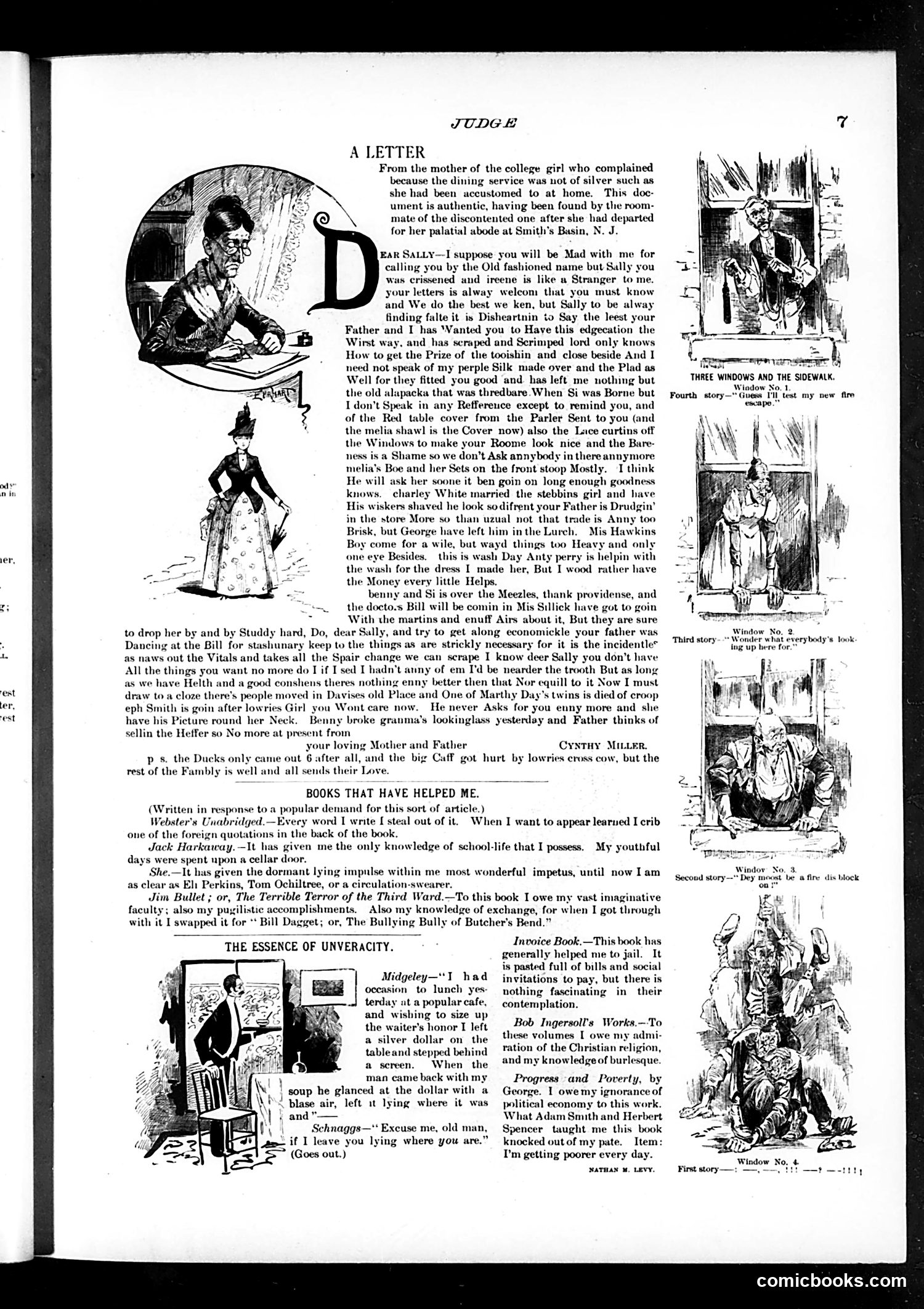
This page satirizes two targets: **"A Letter" (main content):** A mother's complaint letter from a working-class parent to her college daughter "Sally" (who pretentiously calls herself "Ireene"). The satire mocks the daughter's ingratitude—she complained about non-silver dining service despite her family's obvious poverty. The mother's deliberately misspelled, ungrammatical letter (crissened, Disheartnin, tooishin) emphasizes their humble origins while revealing their genuine sacrifice: patched clothing, hand-me-down furnishings, and financial strain. The joke targets entitled wealthy college girls and pseudo-gentility, with the crude letter ironically more dignified in sentiment than the daughter's pretension. **"Books That Have Helped Me":** A brief satirical list where a writer admits stealing from Webster's dictionary to "appear learned," crediting pulp fiction and trashy novels with teaching him to lie convincingly. This mocks literary pretension and intellectual dishonesty in American culture. Both segments critique class-climbing and false gentility—core Judge magazine themes.
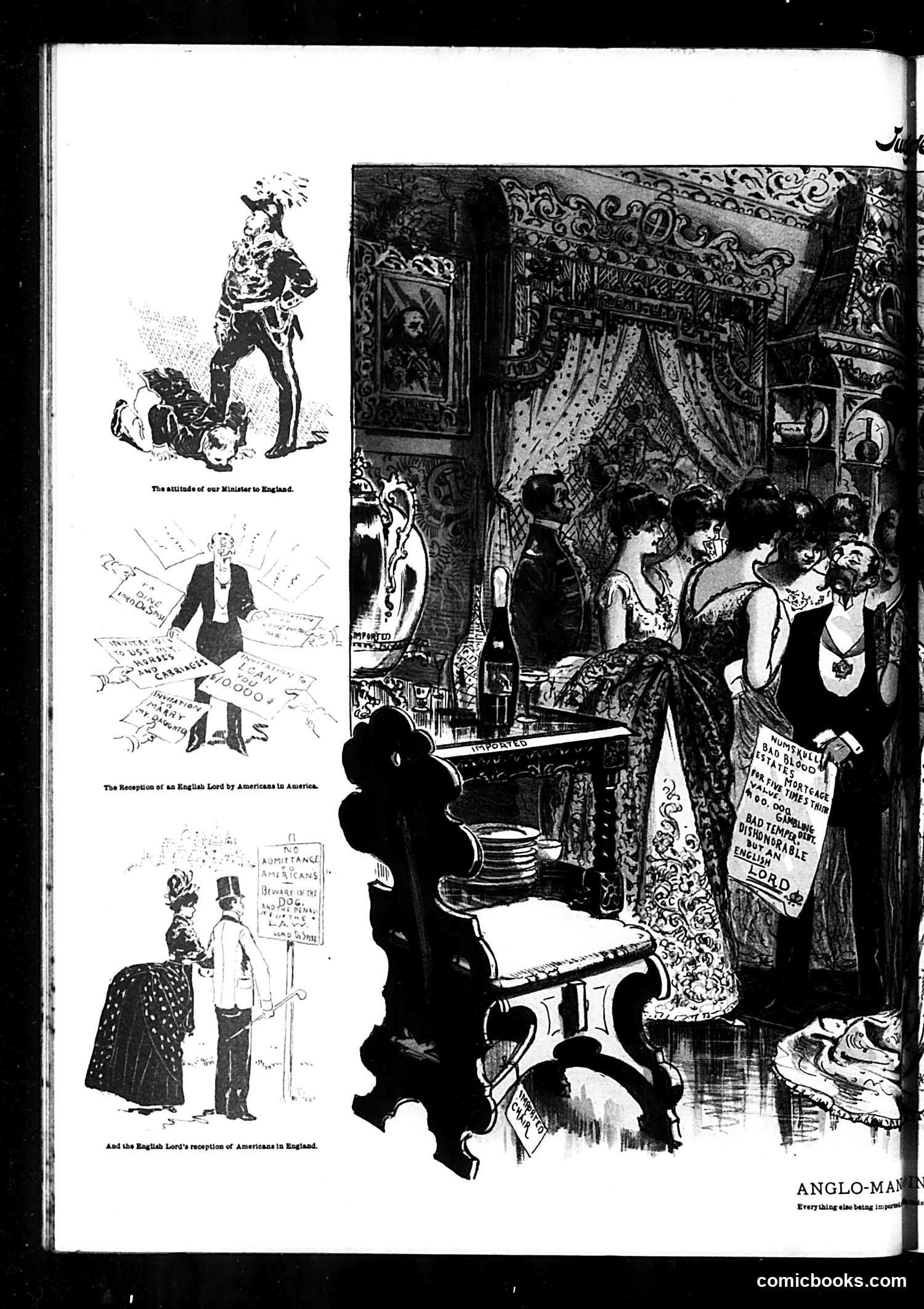
This satirical page compares Anglo-American social attitudes through three cartoons on the left and one elaborate scene on the right. The left cartoons depict contrasting receptions: Americans fawning over an English aristocrat ("The attitude of our Minister to England"), versus an English lord dismissing Americans coldly ("the English Lord's reception of Americans in England"). The large right illustration shows an ornate English drawing room where American women eagerly attend what appears to be a social event hosted by English nobility. The detailed period dress and luxurious furnishings emphasize the setting's prestige. The satire targets American social snobbery and inferiority complex toward British aristocracy—depicting Americans as obsequious toward English lords while English lords regard Americans with disdain. Judge mocks this imbalanced dynamic where Americans desperately seek English social approval despite their nation's independence. The page critiques what was evidently perceived as excessive American deference to British nobility and social conventions.
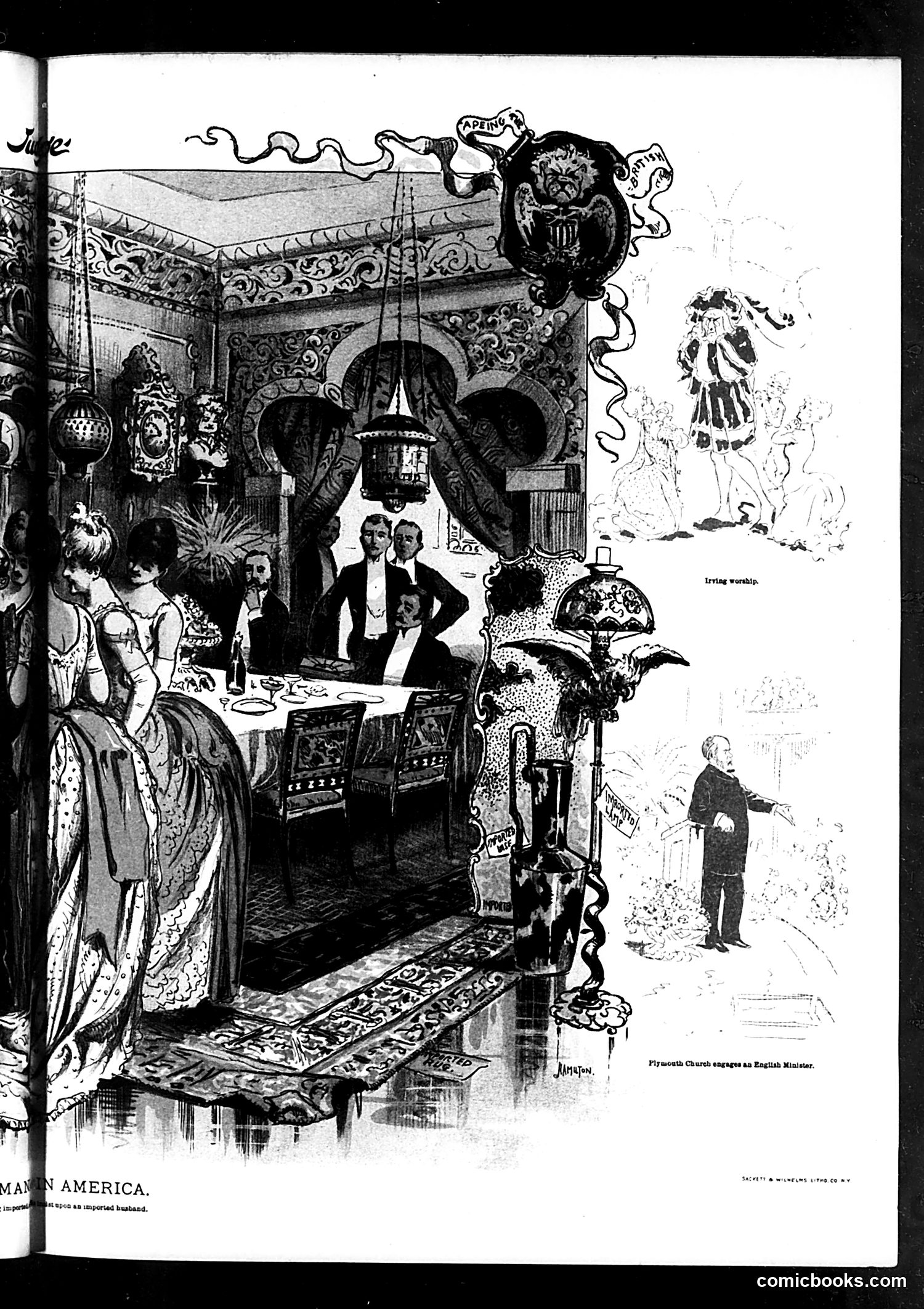
This Judge magazine cartoon satirizes American wealthy women's pursuit of foreign—particularly European—husbands. The elaborate Asian-inspired interior setting (with dragons, ornate decorations, and exotic furnishings) represents the fashionable "Orientalism" prized by wealthy Americans of the era. The central scene shows well-dressed men (likely European aristocrats or titled gentlemen) being entertained by American women in an opulent salon. The caption references "imported husband," mocking the practice where wealthy American heiresses married foreign nobles to gain social prestige, while the men sought American wealth. The side panels labeled "living worship" and references to an "English Minister" suggest commentary on the quasi-religious devotion Americans showed toward European aristocracy and culture. The satire critiques both American social climbing and the commodification of marriage across class and national lines.
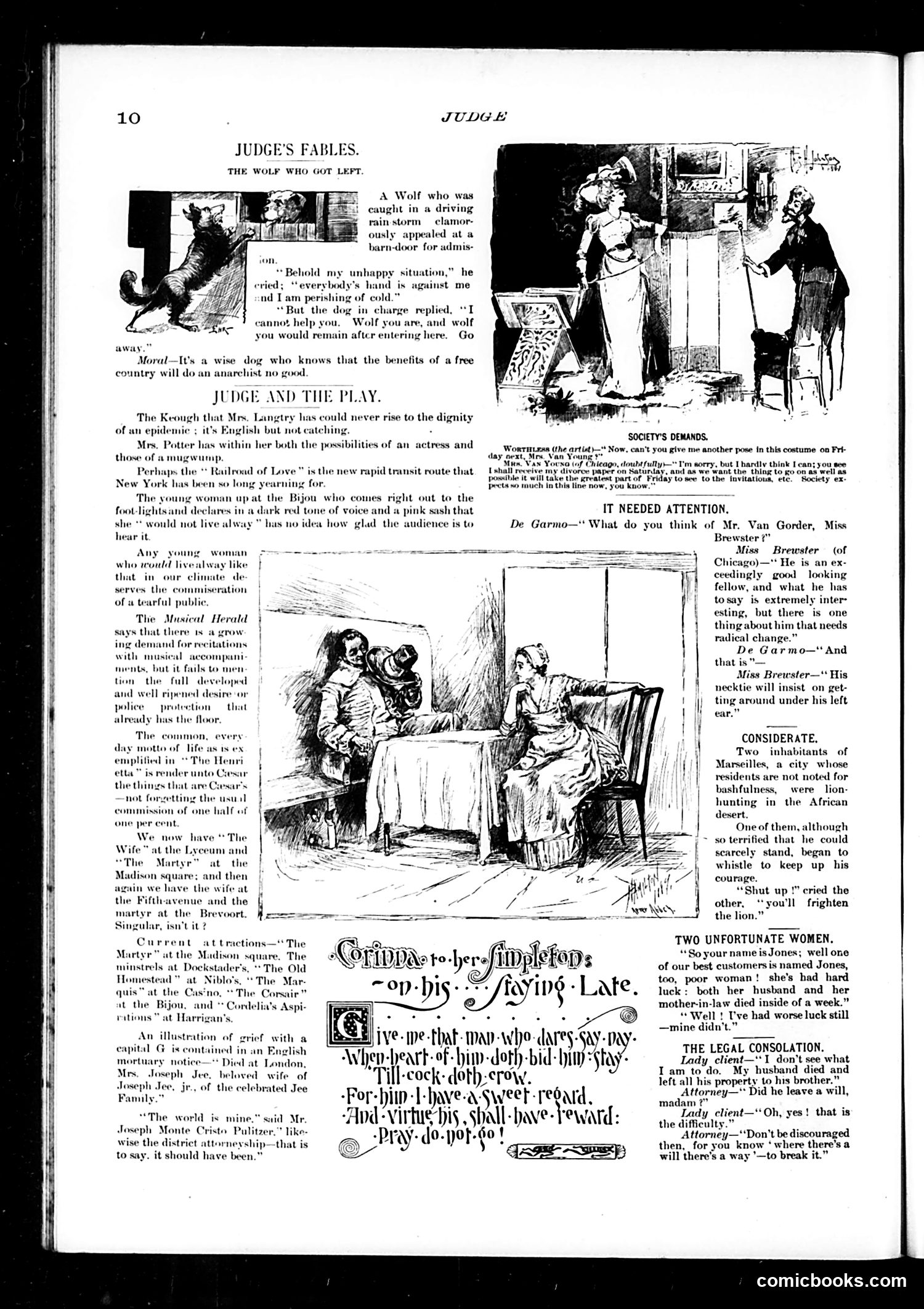
This page from Judge magazine contains several satirical pieces typical of late-19th-century American humor: **"The Wolf Who Got Left"** is a fable warning against anarchism. A wolf seeks shelter from a storm but is refused entry at a barn—the moral being that society correctly excludes dangerous radicals ("anarchist no good"). **"Judge and the Play"** contains theatrical gossip, mocking actresses like Lillie Langtry and Mrs. Potter for their limited talent or inconsistency. **The various brief satirical vignettes** mock social pretension, including "Society's Demands" (about costume fitting), a joke about a lion-hunter whistling nervously, and "The Legal Consolation" (a lawyer's wordplay about breaking a will). The humor relies on contemporary references to theaters, performers, and social customs that would be recognizable to Judge's educated, affluent audience. The overall tone is conservative, mocking both artistic pretension and radical politics.
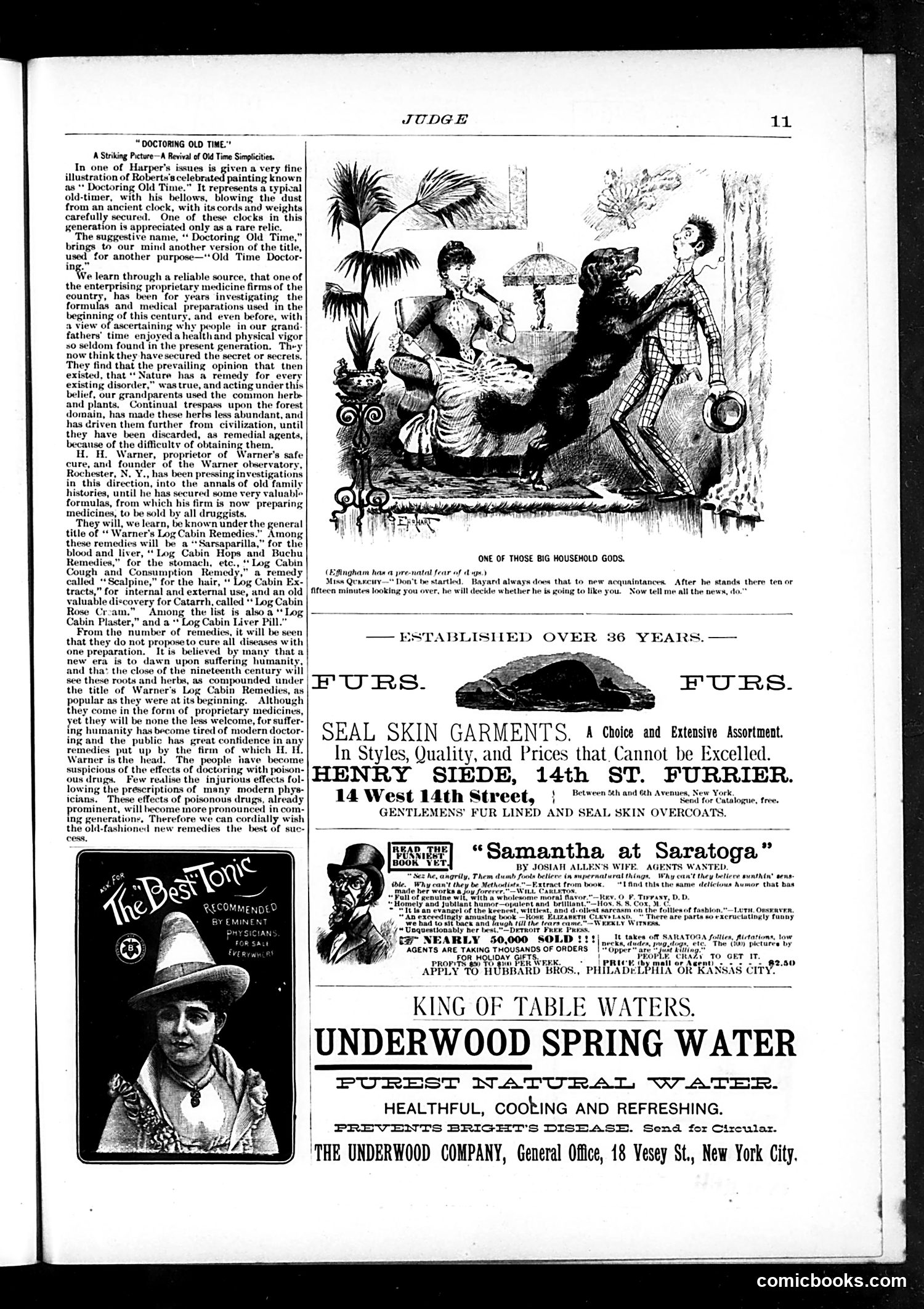
This page primarily showcases **advertising and product promotion** rather than political satire. The main content is an article promoting **Warner's Log Cabin Remedies**, a proprietary medicine line by H. H. Warner, emphasizing "old-time" herbal cures allegedly more effective than modern doctoring. The article satirizes contemporary medicine by contrasting it with grandfather's era, suggesting modern doctors rely on poisonous drugs while natural herbs provided superior health. This reflects **late 19th-century skepticism toward pharmaceutical medicine** and nostalgia for folk remedies. The small cartoon "One of Those Big Household Gods" shows a woman introducing a visitor to her intimidating dog, a humorous domestic scene unrelated to the medicine promotion. The page also advertises **seal skin garments, "The Best Tonic" (a patent medicine), and Underwood Spring Water**—typical product placements for this era.
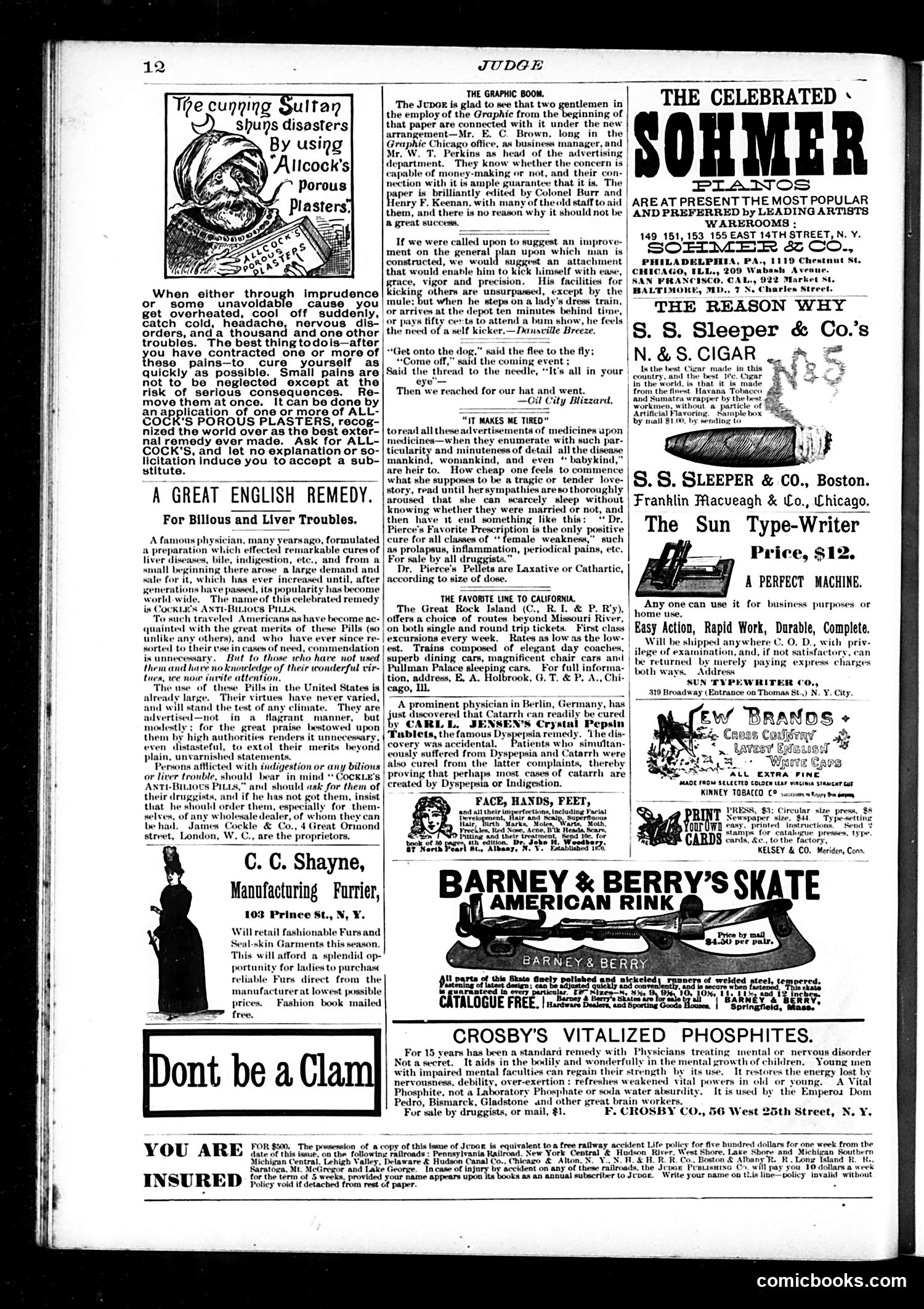
This page is primarily an **advertising compilation** with minimal editorial cartoon content. The main satirical piece is the brief editorial paragraph titled "If we were called upon to suggest an improvement..." This short text humorously proposes that humans should have the physical ability to "kick themselves" with the same ease they kick others or animals (particularly mules). The joke references common frustrations—stepping on women's dress trains, arriving late to train depots, and attending poor theatrical shows—situations where self-directed anger would be justified. The satire gently mocks human nature and our tendency toward self-recrimination. The attribution to the "Dansville Breeze" suggests it's a reprinted piece. The remainder consists entirely of period advertisements: Allcock's Porous Plasters, K. Cockle's Anti-Bilious Pills, Sohmer Pianos, and Barney & Berry's skating equipment. The "Dont be a Clam" insurance advertisement appears at bottom. This is essentially a **late 19th-century advertising page** with minimal satirical content.
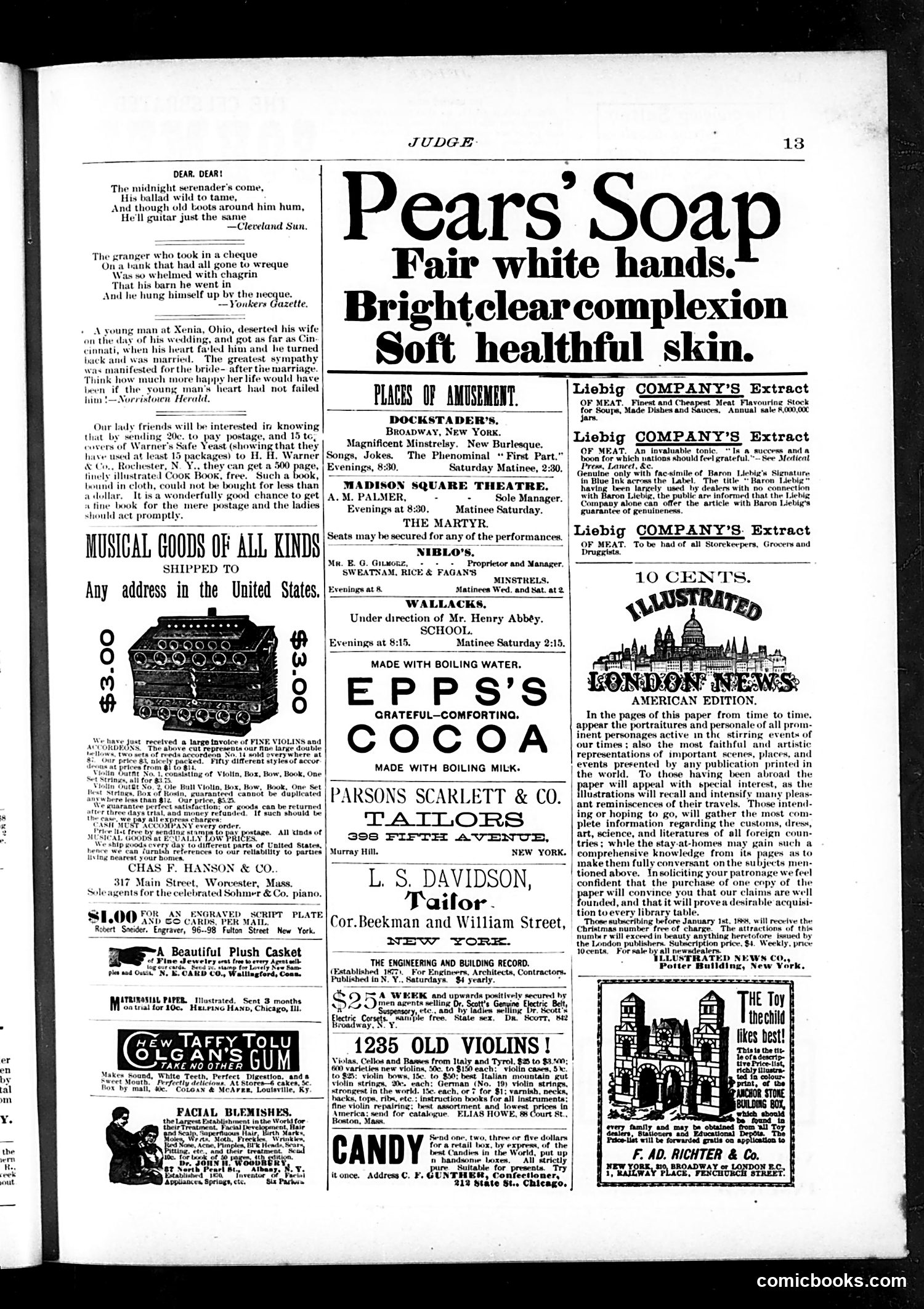
This page is primarily **advertising**, not political satire or editorial cartooning. It's from Judge, a satirical weekly, but this particular page showcases commercial advertisements typical of late 19th-century publications. The notable content includes: **Pears' Soap advertisement** (top): A prominent beauty product ad promoting "fair white hands" and "bright clear complexion"—reflecting Victorian beauty standards and the era's obsession with pale skin as a marker of class and refinement. **Theater listings**: References to popular entertainment venues (Dockstader's Minstrels, Madison Square Theatre, Wallacks) showing period entertainment preferences, including minstrel shows, which we now recognize as deeply racist. **Liebig Company's Extract**: Meat-based food products marketed as tonics and health remedies—typical of Victorian-era "patent medicine" advertising. **Musical instruments, tailors, and novelty items**: Standard period advertisements. The page reveals **social values of the era**: beauty obsession, leisure entertainment preferences, and faith in commercial products as solutions to personal problems. No specific political cartoon or satire is evident on this page.
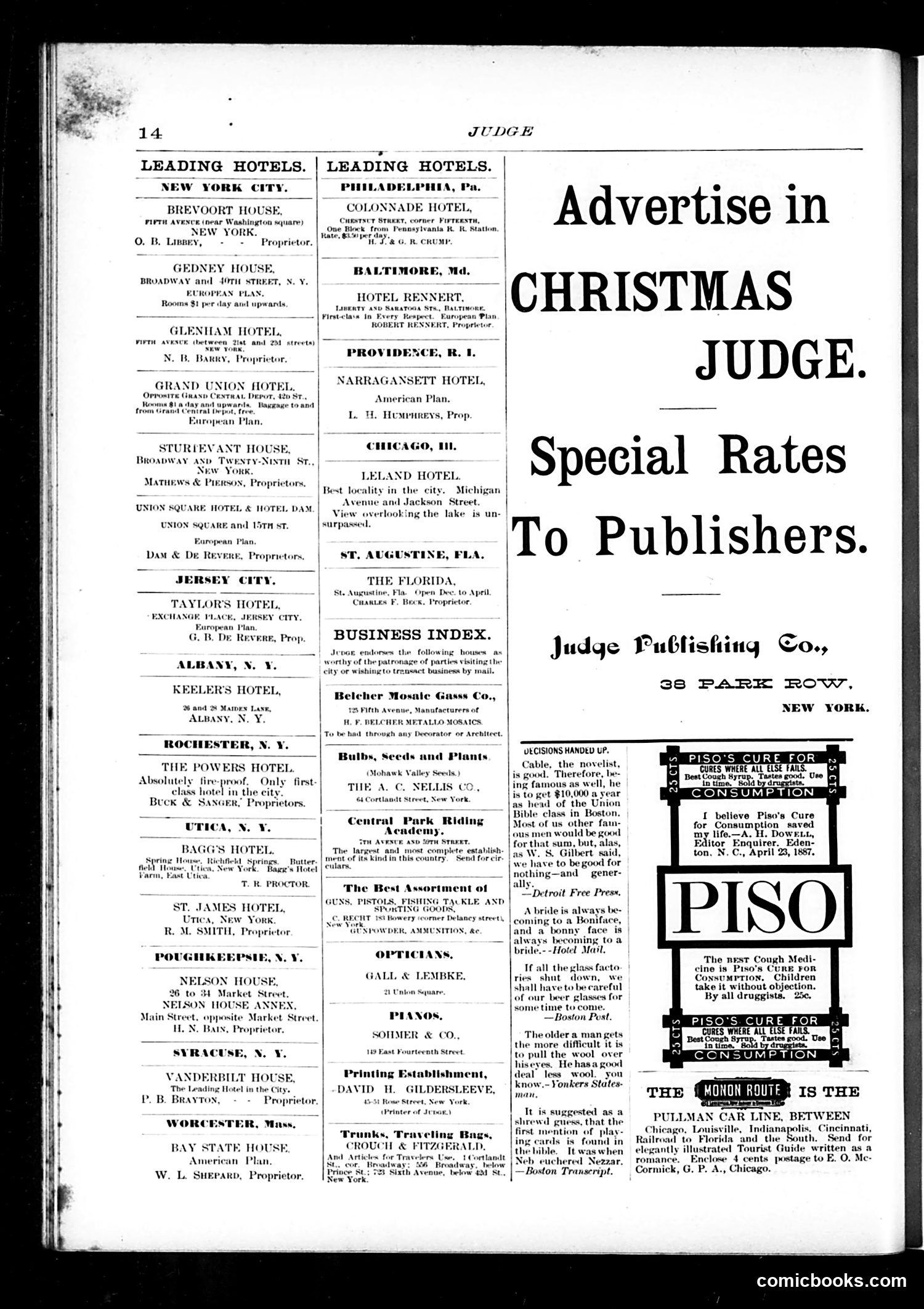
This page is primarily **advertising and business listings**, not a satirical cartoon. It consists of: 1. **Hotel advertisements** for leading establishments in New York, Philadelphia, Baltimore, Providence, Chicago, and other cities—typical trade publication content from the era. 2. **Business index** listing manufacturers and service providers (mosaics, seeds, fishing tackle, pianos, printing). 3. **Judge Publishing Co. advertisement** promoting special advertising rates to publishers in their Christmas issue. 4. **Patent medicine advertisements**, notably **Piso's Cure for Consumption**—testimonial ads claiming the product saved lives and cured coughs. These were common in 19th-century publications, often including dubious health claims. 5. **Minor jokes/epigrams** interspersed, like quips about famous men and brides. The page lacks political satire or caricature. It represents Judge functioning as a general-interest magazine relying heavily on advertising revenue, with product endorsements typical of the era.
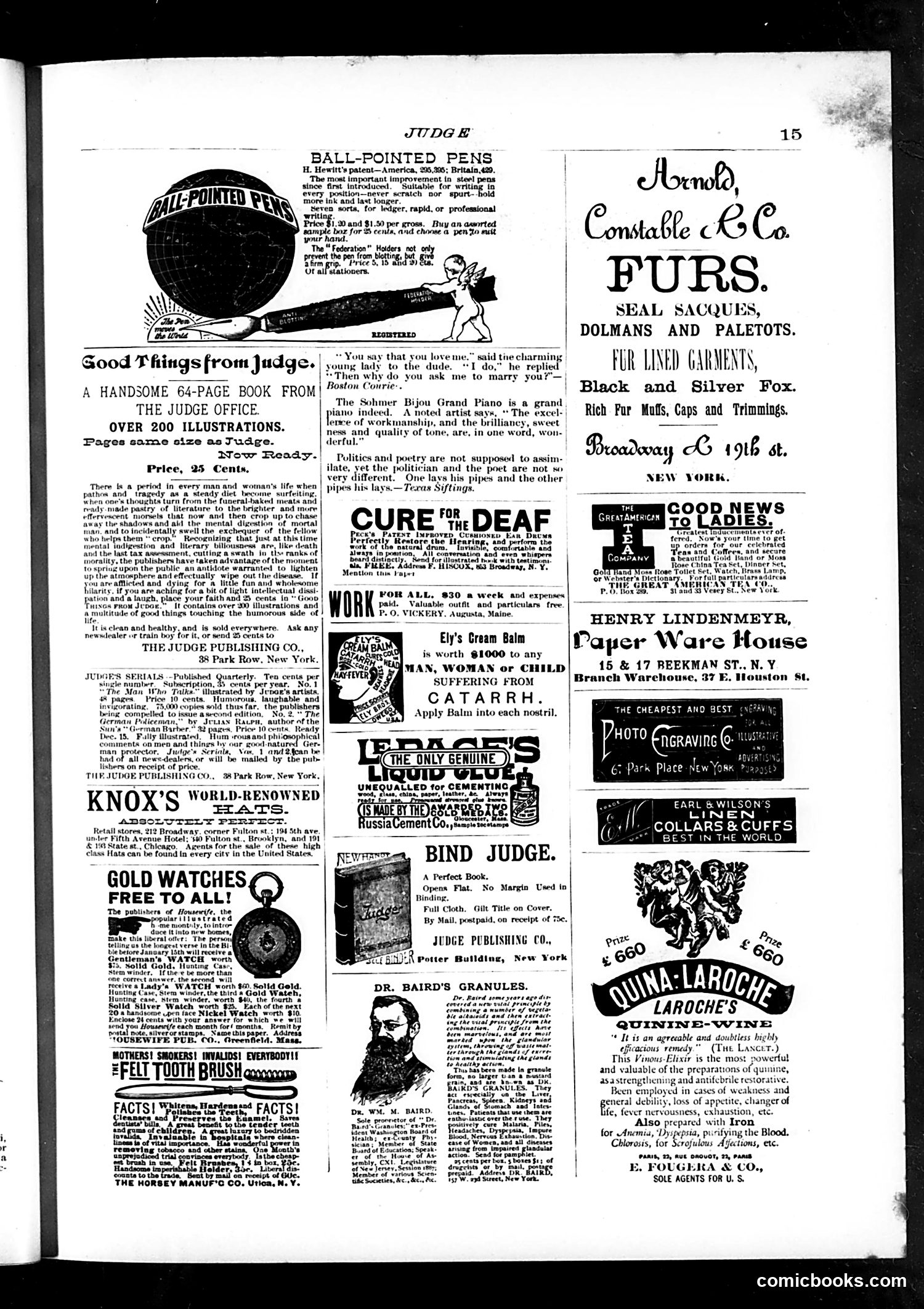
This is primarily an **advertising page** from Judge magazine, with minimal editorial content beyond a brief humorous exchange at top. The small cartoon shows a man presenting a **ball-pointed pen** (a then-novel innovation). The text celebrates Hewitt's patent for this improvement over existing pens—they don't scratch, spurt, or leak, and write in any position. This advertises a genuine commercial product. The page's main content is dense classified and display advertising typical of late 19th/early 20th-century magazines: watches, hair remedies, dental brushes, patent medicines (catarrh cure, "Dr. Baird's Granules"), fur coats, and books. The ads use sensationalist claims common to the era ("worth $1000," "FREE," "ABSOLUTELY PERFECT"). The single joke at top—a woman asking a man to marry her, then rephrasing—is brief and unremarkable. **Historical context**: These ads reveal consumer concerns (baldness, deafness, catarrh) and product solutions typical of the period, many of dubious efficacy by modern standards.
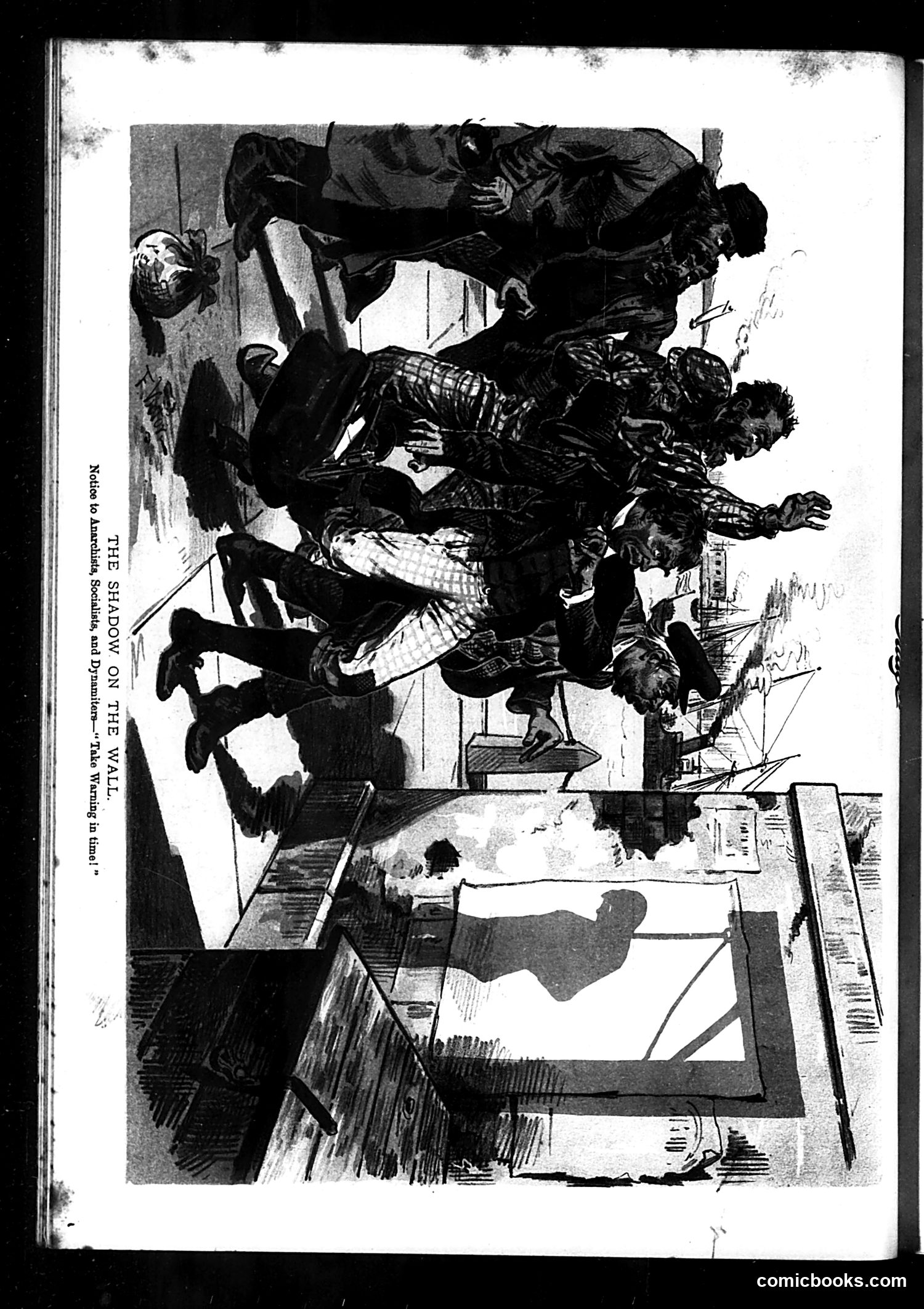
This Judge cartoon uses shadow silhouettes to warn against anarchism, socialism, and dynamite violence. The image shows ominous dark figures cast against a wall—appearing to depict dangerous radicals or revolutionaries. The caption's warning suggests these ideologies pose a threat to society. The cartoon reflects late 19th/early 20th-century American anxiety about immigrant anarchist and socialist movements, particularly following violent incidents like bombings. By using shadows rather than clear faces, the artist emphasizes these as shadowy, sinister threats lurking in society rather than identifiable individuals. The "take warning" message targets adherents of these ideologies, essentially telling them their activities are being watched and will have consequences. This represents mainstream conservative political opinion of the era, viewing radical movements as existential dangers requiring suppression.