
Judge, 1887-11-19 · page 10 of 16
Judge — November 19, 1887 — page 10: what you’re looking at
What you’re looking at
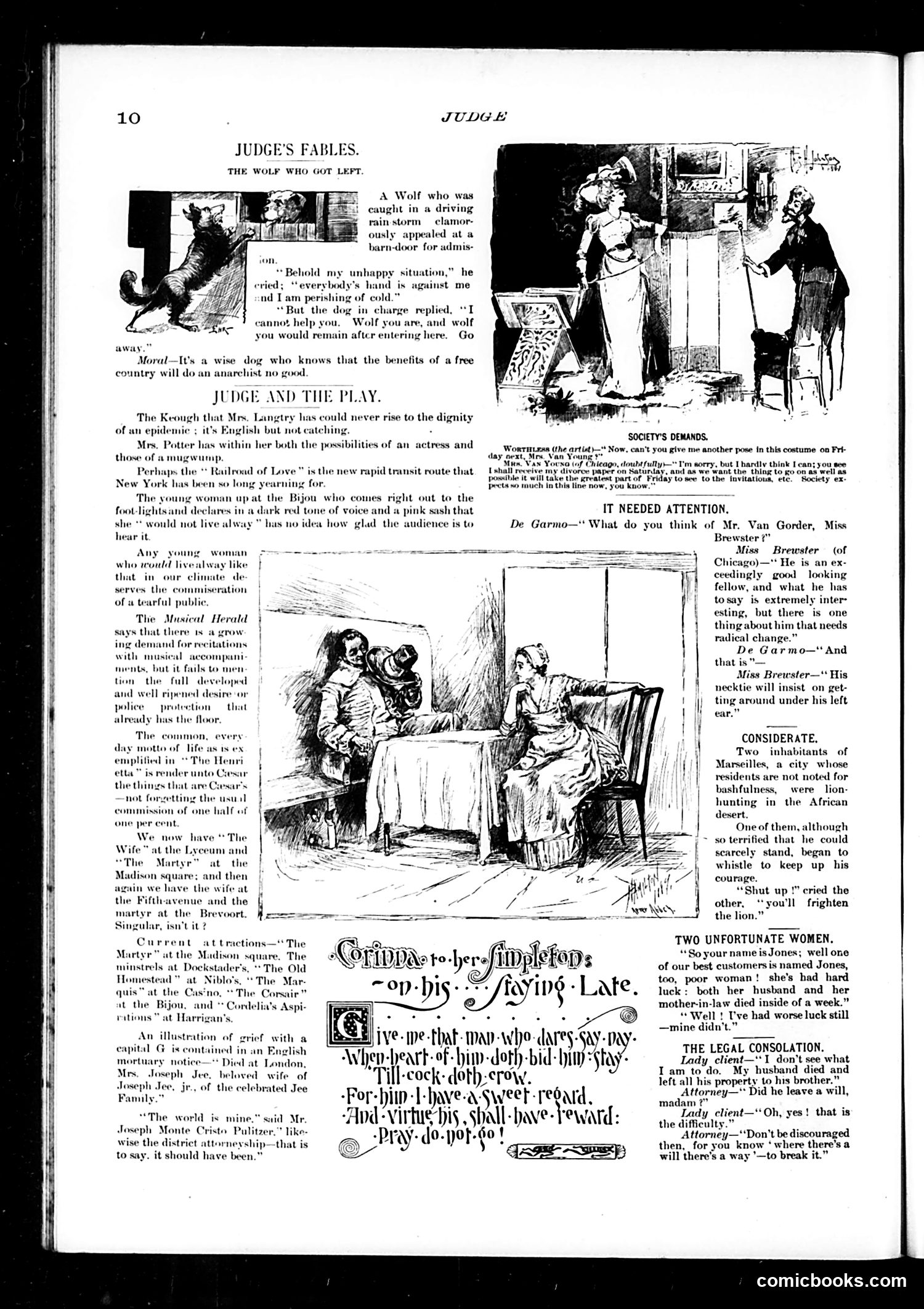
This page from Judge magazine contains several satirical pieces typical of late-19th-century American humor: **"The Wolf Who Got Left"** is a fable warning against anarchism. A wolf seeks shelter from a storm but is refused entry at a barn—the moral being that society correctly excludes dangerous radicals ("anarchist no good"). **"Judge and the Play"** contains theatrical gossip, mocking actresses like Lillie Langtry and Mrs. Potter for their limited talent or inconsistency. **The various brief satirical vignettes** mock social pretension, including "Society's Demands" (about costume fitting), a joke about a lion-hunter whistling nervously, and "The Legal Consolation" (a lawyer's wordplay about breaking a will). The humor relies on contemporary references to theaters, performers, and social customs that would be recognizable to Judge's educated, affluent audience. The overall tone is conservative, mocking both artistic pretension and radical politics.
📄 Transcribed text from this page (OCR, searchable)
Machine-transcribed from the original scan — historical spelling and the odd misread are preserved.
JUDGE JUDGE'S FABLES. THE WOLF WHO GOT LEFT. A Wolf who was ? caught in a driving rainstorm —clamor- ously appealed at a barn-door for admis- : unhappy situation,” he erybody’s hand is against me m perishing of cold.” But the dog in charge replied, ‘1 cannot help you. Wolf you are, and wolf you would remain aftcr entering here. Go away. Moral—It's country will do wise dog who knows that the benefits of a free narchist no good. JUDGE AND THE PLAY. The Keough that Mrs. Langtry has could never rise to the e dignity of an epidemic ; it’s English but not catching. Mrs. Potter has within her both the possibilities of an actress and those of a mugwump. Perhaps the * Railroad of Love” New York has been so lon, The foot she * would not live alway hear it ‘SOCIETY'S DEMANDS, tay NONTILEAR (the artit)—* Now, can’t you give me another pose tn this costume on Fri day next oubtfully— i'm sorry, but Thany think f.can; you see ‘and ax we want the thing to Ko on as well as ytowee to the invitatlous, ete. Bockety ex: is the new rapid transit route that ning for. pects mo much In this line hows you know IT NEEDED ATTENTION. De Garmo—“* What do you think of Mr. Van Gorder, Brewster ¢” Miss Brewster (of Chicago)—* He is an ex- ceedingly good looking fellow, and what he has tosay is extremely inter- esting, but there is one thing about him that needs radical change.” De Garmo—“ And that is "— Miss Brewster—“ His necktie will insist on get- ting around under his left ear.” jou who comes right out to the rk red tone of voice and a pink sash that wus no idea how glad the audience is to Miss Any 4 who w that i serves the commiseration of a tearful public The Musical Herald ing dema with musical ac police already has the floor. CONSIDERATE, Two inhabitants of Marseilles, a city whose residents are not noted for bashfulness, were _lion- hunting in the African desert. One of them, although so terrified that he could scarcely stand, began to whistle to keep up his courage. “Shut up ! other, ‘you'll the lion.” TWO UNFORTUNATE WOMEN. “So your name isJones; well one of our best customers is named Jones, too, poor woman! she's had hard luck: both her husband and her mother-in-law died inside of a week.” “Well | Uve had worse luck still —mine didn't.” The common, eve: day motto of life as ts ex emplified in The Henri etta” is render unto ws that are Coesar's ing the usual minission of one half of the wife at avenue and the ‘tyr at the Brevoort. lar, isnt it? cried the frighten ent attractions—* The atthe Madison square. The minstrels at Dock: The Old Homeste quis” at the Cu it the Bijou, and rations "at Harrigan’s, ~op-b orsair” slin’s Aspi- "5 ving = An illustration of grief with a capital G is ined in an English mortuary notice—** Died at London, Mrs. Joseph Jee. hel wife of Joseph Jee, jr., of the celebrated Jee Family.” “The world is mine.” se Ir. dosepl Monte Crist Patitas lik wise the district at that is am ne- ‘that: ed do-Yor-Gor man-wi iyo. dares: Say may: When: -beart-of-him-dotl-bid- him =Stay- ill-cock- doth:crow., -For- ip --have-asweet re ‘And: Mitte bis. Shall: bave 6 e-| Md, reward: THE LEGAL CONSOLATION. Lady client—‘‘1 don’t see what am to do. My husband died and left all his property to his brother.” Attorney—" Did he leave a will, madam ?” . Lady client—“Oh, yes! that is the difficulty.” ‘Attorney— ‘Don't be discouraged then, for you know ‘ where there's a will there's a way '—to break it.” comicbooks.com