
A complete issue · 16 pages · 1887
Judge — November 5, 1887
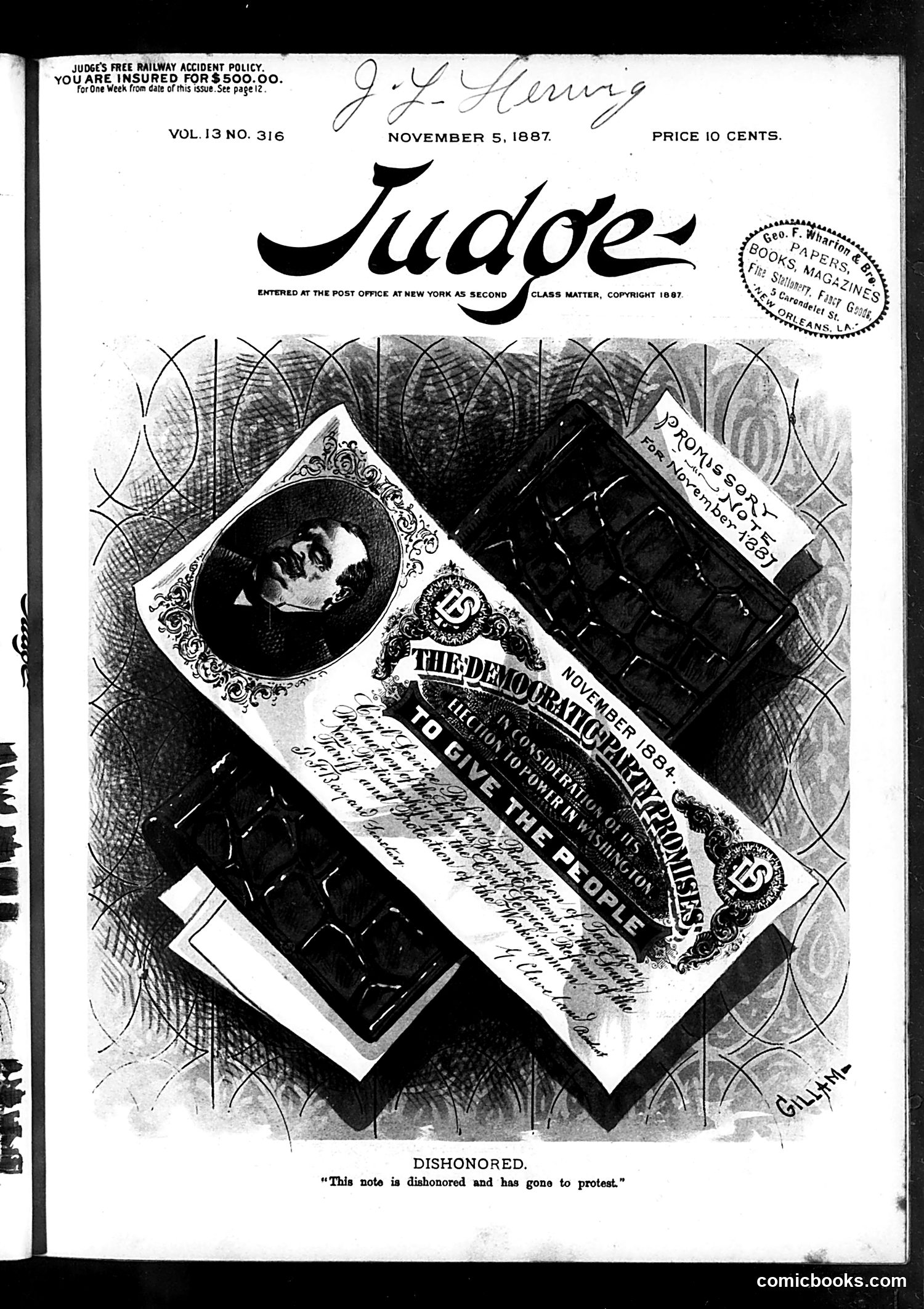
This political cartoon satirizes a **dishonored promissory note** from "The Democratic Party" dated November 1884. The note reads "To Give the People" — referencing Democratic campaign promises. The image shows a portrait (likely of a Democratic leader, though unclear which specific figure) alongside a rejected financial document marked "DISHONORED" with the caption: "This note is dishonored and has gone to protest." The satire suggests the Democratic Party failed to deliver on its 1884 campaign pledges to voters. By depicting broken promises as a literal bounced check, Judge mocks Democratic credibility and competence. This appears connected to the 1884 presidential election and subsequent Democratic governance performance that Republicans found wanting.
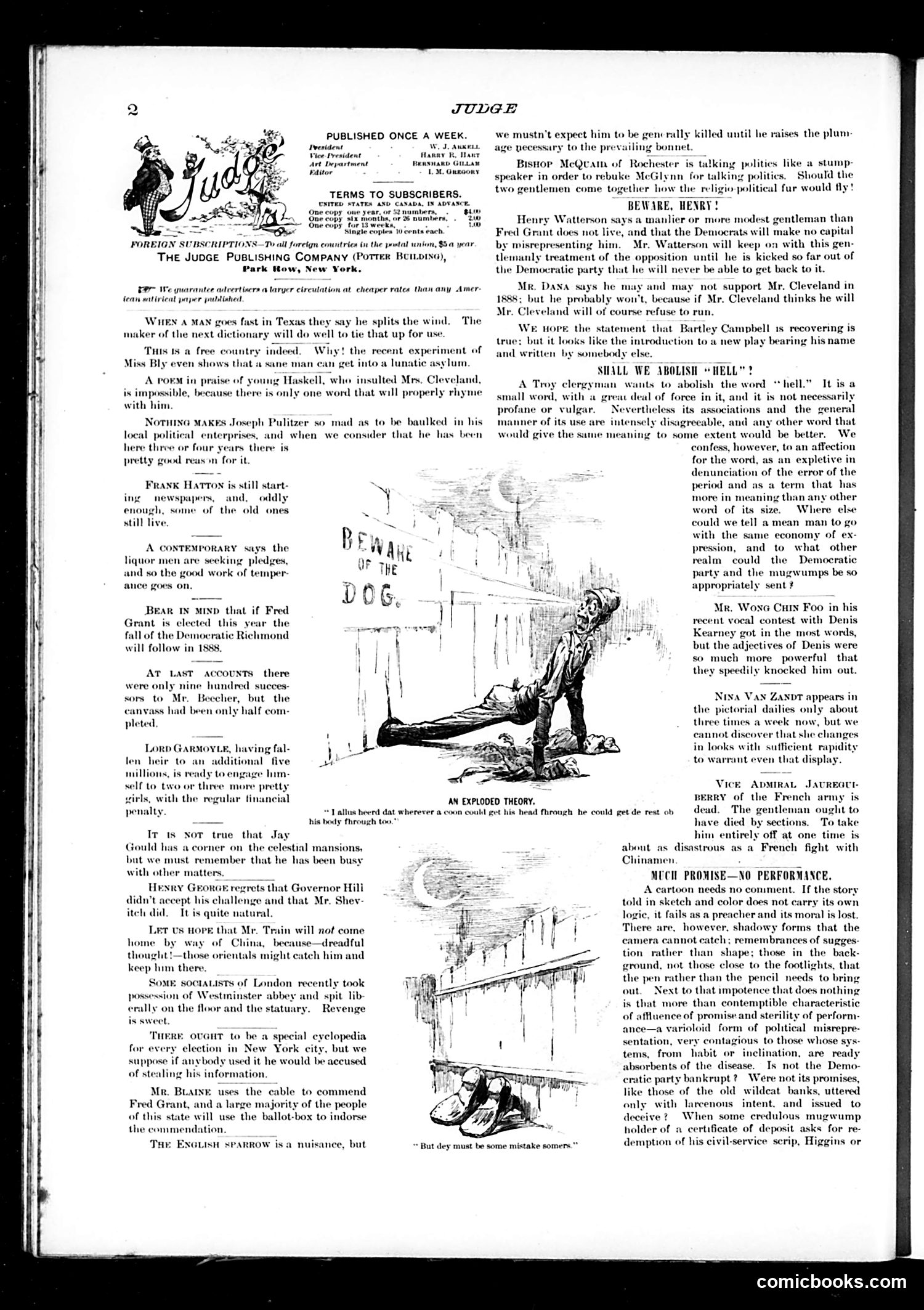
This cartoon depicts a figure labeled "Beware of the Dog," likely representing a dangerous political threat or opponent during the 1880s (based on Judge's publication period). The accompanying text discusses Democratic party vulnerabilities and political maneuvering. The satire appears to reference concerns about an unpredictable or dangerous political force—possibly related to the 1888 presidential election mentioned in the text. References to Cleveland, Grant, and Democratic party dynamics suggest this critiques Democratic political weakness or internal discord. The "dog" metaphor suggests something deceptively dangerous or uncontrollable that poses a threat to political stability. The cartoonist warns readers about this political hazard, though without additional context, the specific identity of the threat remains unclear.
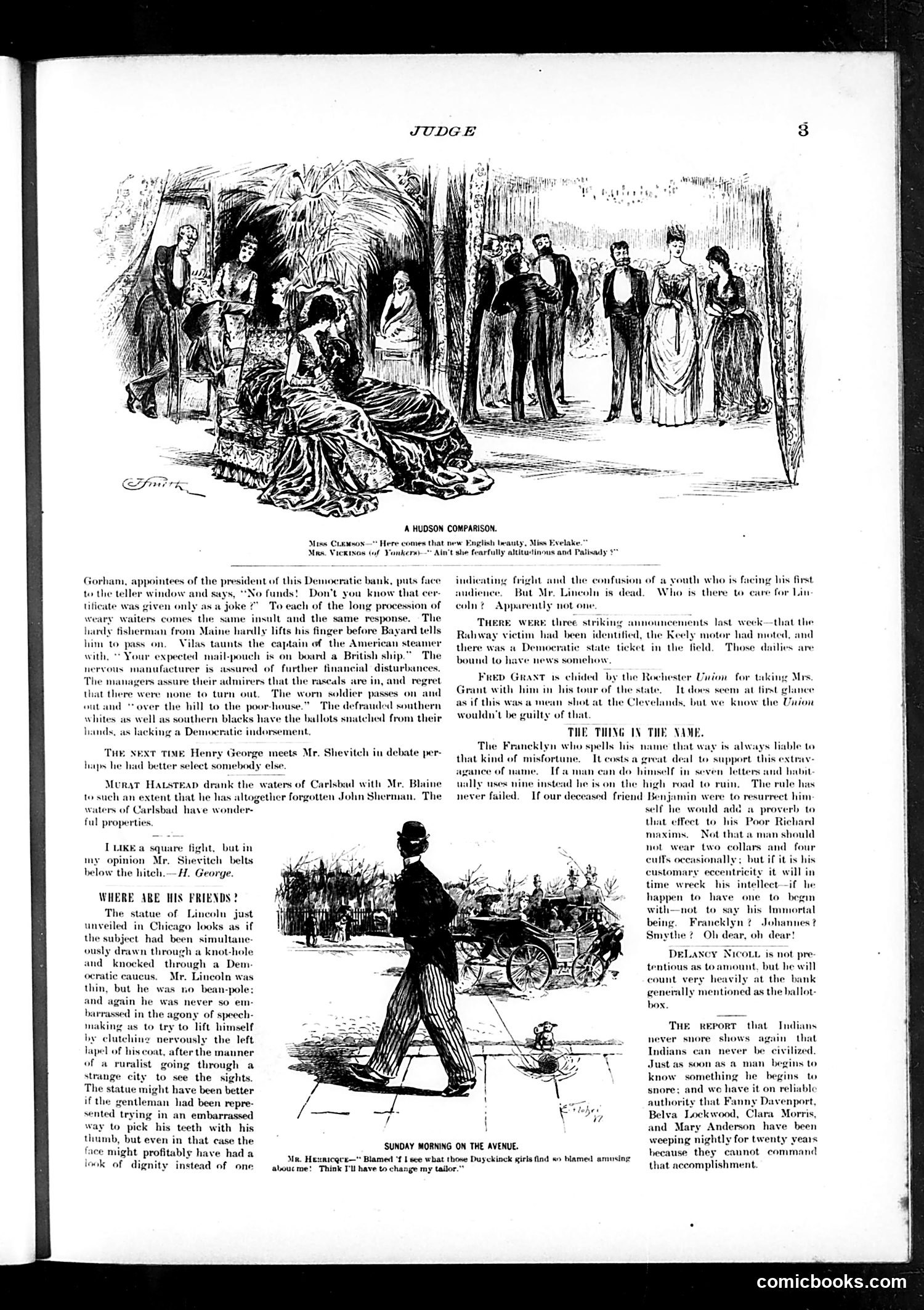
This page contains multiple political satirical pieces from the Gilded Age, likely 1880s-90s. **"A Hudson Comparison"** mocks Democratic Party corruption and patronage. Gorham, a Democratic bank appointee, dismisses common citizens' complaints while favoring the wealthy. The satire critiques how Democrats excluded Black voters and disenfranchised Southern Republicans post-Reconstruction—describing ballots "snatched" due to lack of "Democratic indorsement." **"Where Are His Friends?"** ridicules the Lincoln statue unveiled in Chicago, suggesting its poor artistic quality reflects that Lincoln himself—lean and awkward—lacks political allies or defenders. **"Sunday Morning on the Avenue"** jokes about a gentleman unable to control his tailor's eccentric fashion choices, implying loss of self-direction. **"The Thing in the Name"** satirizes Benjamin Franklin's descendant for poor behavior, arguing that eccentricity damages intellect and morality. The overall page attacks Democratic political corruption, artistic mediocrity, and personal vanity—typical Judge magazine targets.
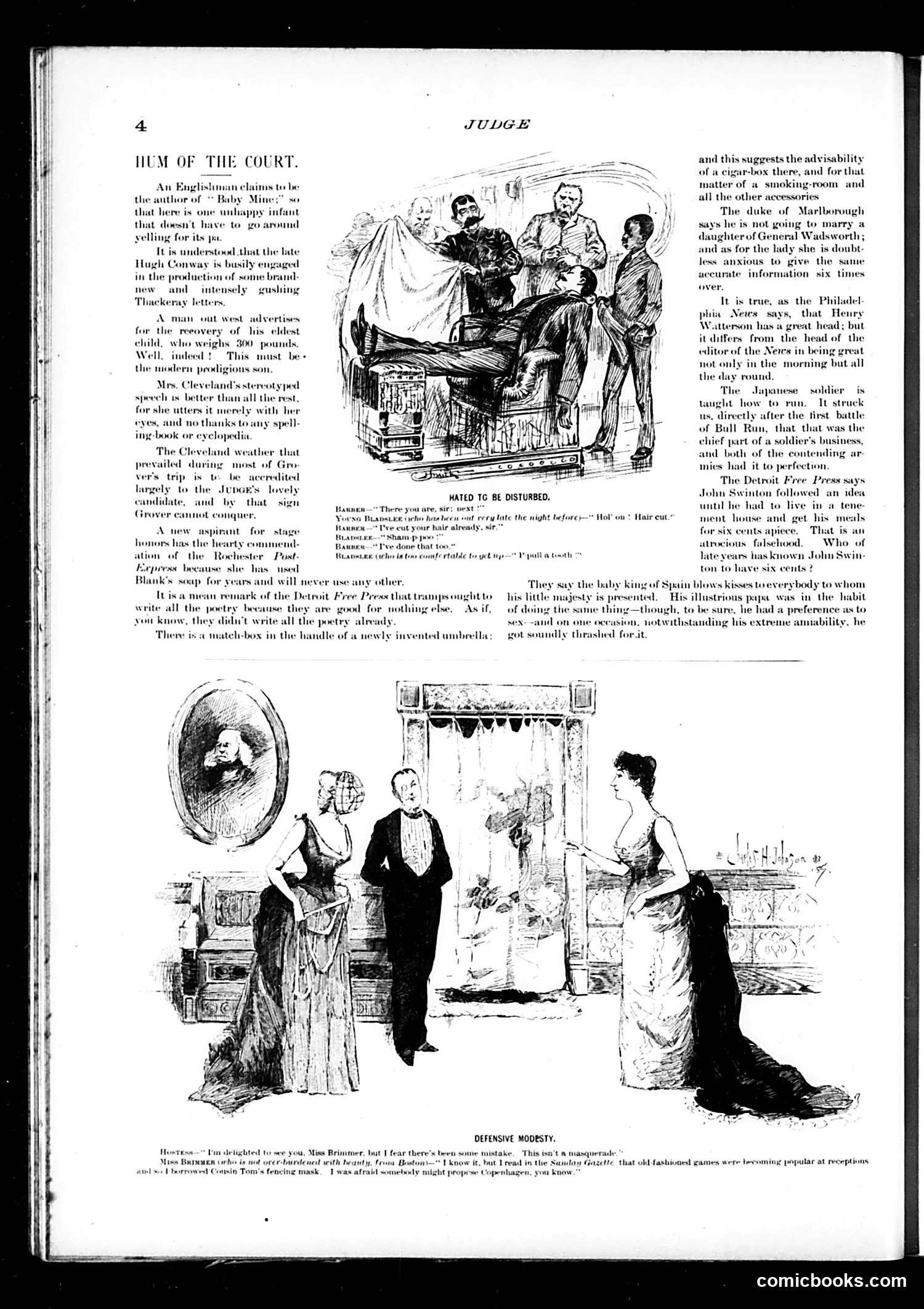
This page from Judge contains several brief social satires typical of the magazine's "Hum of the Court" section: **Top cartoon ("Hated to be Disturbed")**: Depicts a man annoyed at being awakened late at night, with dialogue about hair cutting and tooth-pulling—mocking the trivial complaints of the wealthy. **Bottom cartoon ("Defensive Modesty")**: Shows a hostess apologizing to a guest about her daughter's modest dress, ironically suggesting that old-fashioned propriety in women's fashion is becoming outdated as modern games gain acceptance. **Text items** mock various contemporary figures: an Englishman claiming authorship of "Baby Mine," Hugh Conway's writing, a woman advertising her 300-pound child, and jokes about General Wadsworth's daughter rejecting the Duke of Marlborough. References to the Battle of Bull Run and John Swinton suggest Civil War-era content. The overall tone satirizes Victorian social pretension, changing mores regarding women's dress, and prominent public figures of the period.
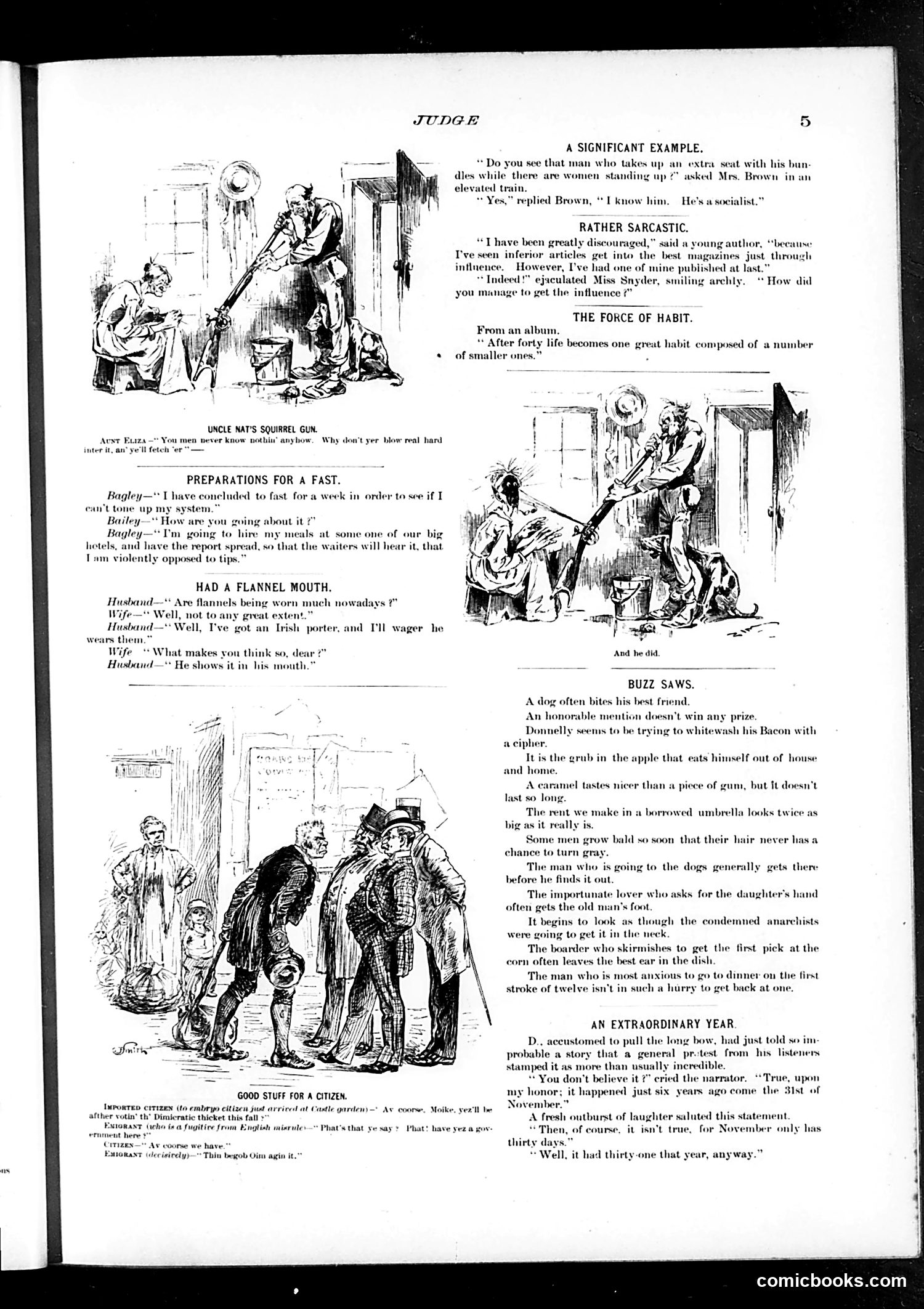
This page contains several short satirical pieces typical of Judge's social commentary: **"A Significant Example"** mocks a man taking a seat while women stand on a train, with Mrs. Brown identifying him as a "socialist"—a jab at socialists as hypocrites who don't practice their stated principles of equality. **"Rather Sarcastic"** jokes about a young author's published work, implying he succeeded through personal connections ("influence") rather than merit. **"The Force of Habit"** uses a domestic scene to comment on how life becomes routine. **"Good Stuff for a Citizen"** depicts Irish immigrants at Castle Garden (the immigration processing center) being encouraged to vote the Democratic ticket—satirizing both machine politics and anti-immigrant stereotypes through exaggerated Irish dialect. **"Buzz Saws"** is a collection of short witticisms on human nature and hypocrisy. **"An Extraordinary Year"** is a joke about a tall tale involving a fictional November 31st. The overall tone targets political corruption, class pretension, immigration politics, and human folly.
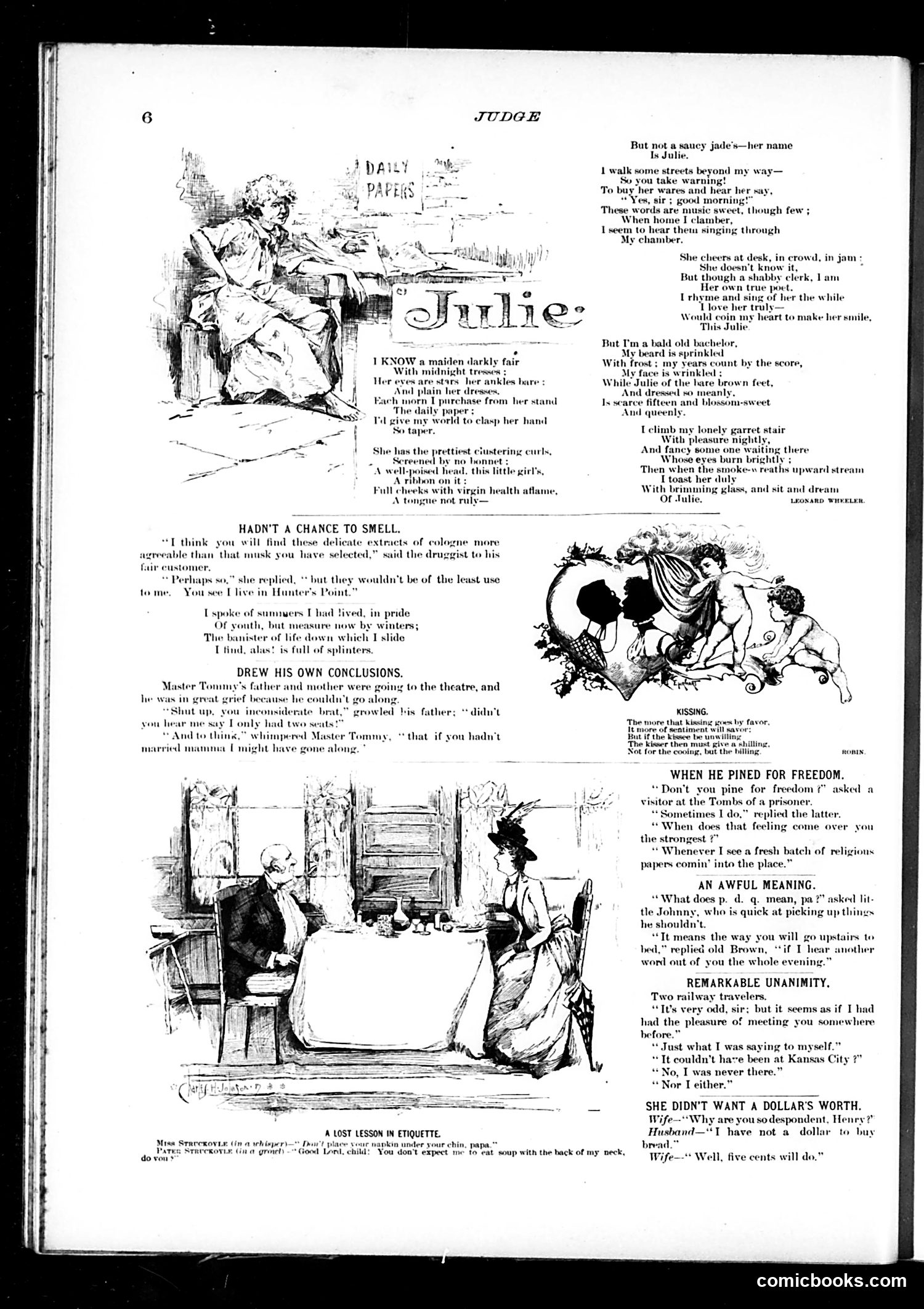
This page from Judge magazine (circa late 19th century) contains primarily **humorous short stories and jokes** rather than political cartoons. The content includes: - **"Julie"** (top): A sentimental poem by Leonard Wheeler about a working-class street vendor the narrator admires from afar—satirizing romantic idealization of ordinary people. - **Small anecdotes** mocking middle-class life: a child's misunderstanding of theater seating, a prisoner's relief at avoiding religious tracts, a father's threat using "p.d.q." as code for punishment. - **Social humor** about marriage, poverty, and urban encounters—including one joke about a wife accepting five cents instead of a dollar, mocking both spousal discord and financial struggle. The sketches accompanying these pieces are generic Victorian illustrations. This appears to be a **humor/satire page without specific political content**—instead targeting universal domestic situations, character types, and romantic pretension familiar to Judge's educated, middle-class readership.
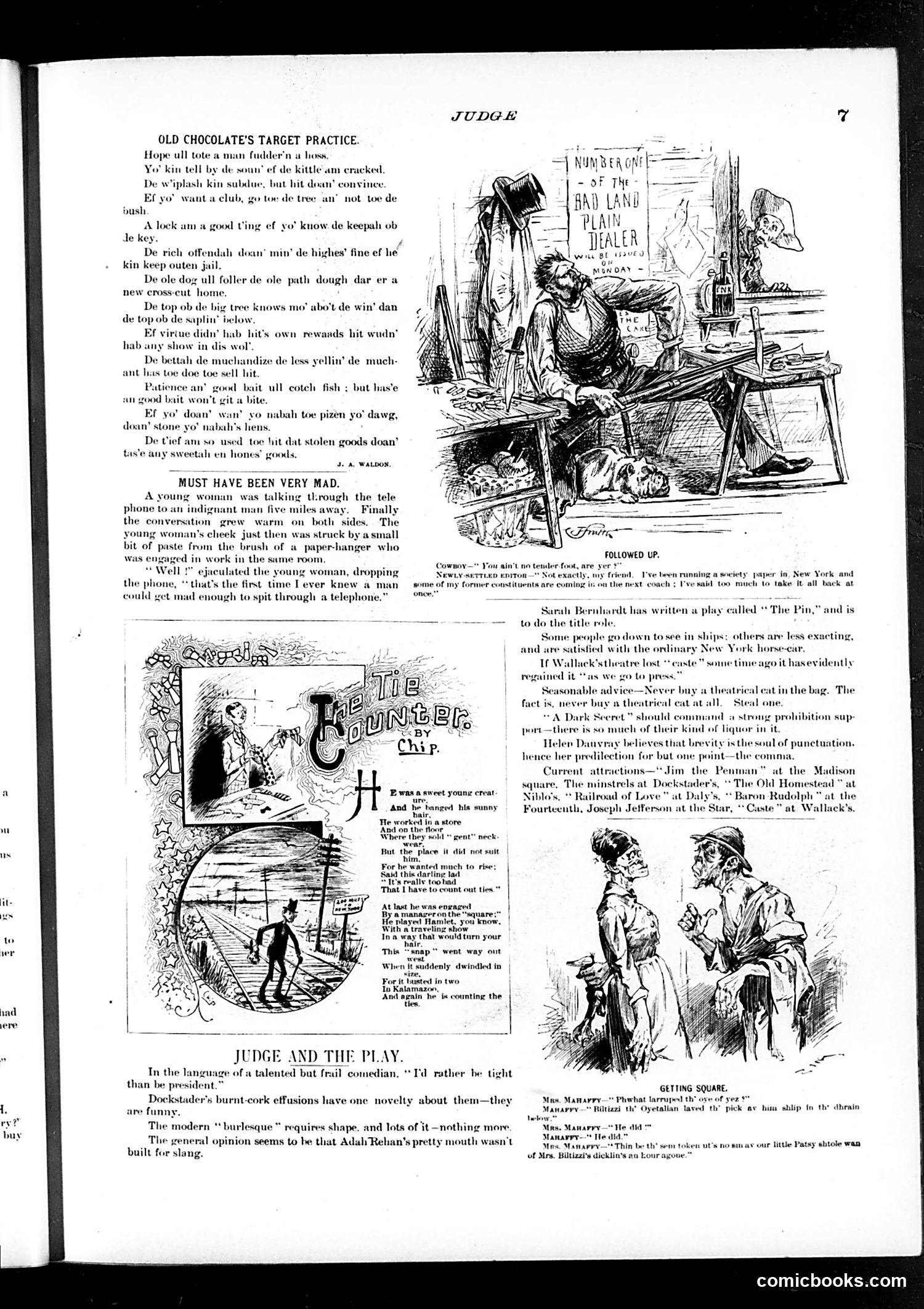
This appears to be a dialect-heavy satirical poem attributed to J.A. Waldron, written in exaggerated African American vernacular common to late-19th-century American humor magazines. The piece consists of folk-wisdom aphorisms ("A lock am a good ting...de key") rendered in a stereotyped dialect. The cartoon likely satirizes either contemporary figures or social attitudes through this vehicle. Without clearer visual identification of specific caricatured individuals in the accompanying illustrations, the exact political targets remain unclear. However, Judge magazine typically mocked politicians, social reformers, and public figures of the era. The title "Target Practice" suggests criticism of someone's policies or public actions, though the connection between title and content is oblique. Modern readers would note the offensive dialect conventions that were considered acceptable—even humorous—in 1890s satirical journalism, reflecting the casual racism embedded in period entertainment.
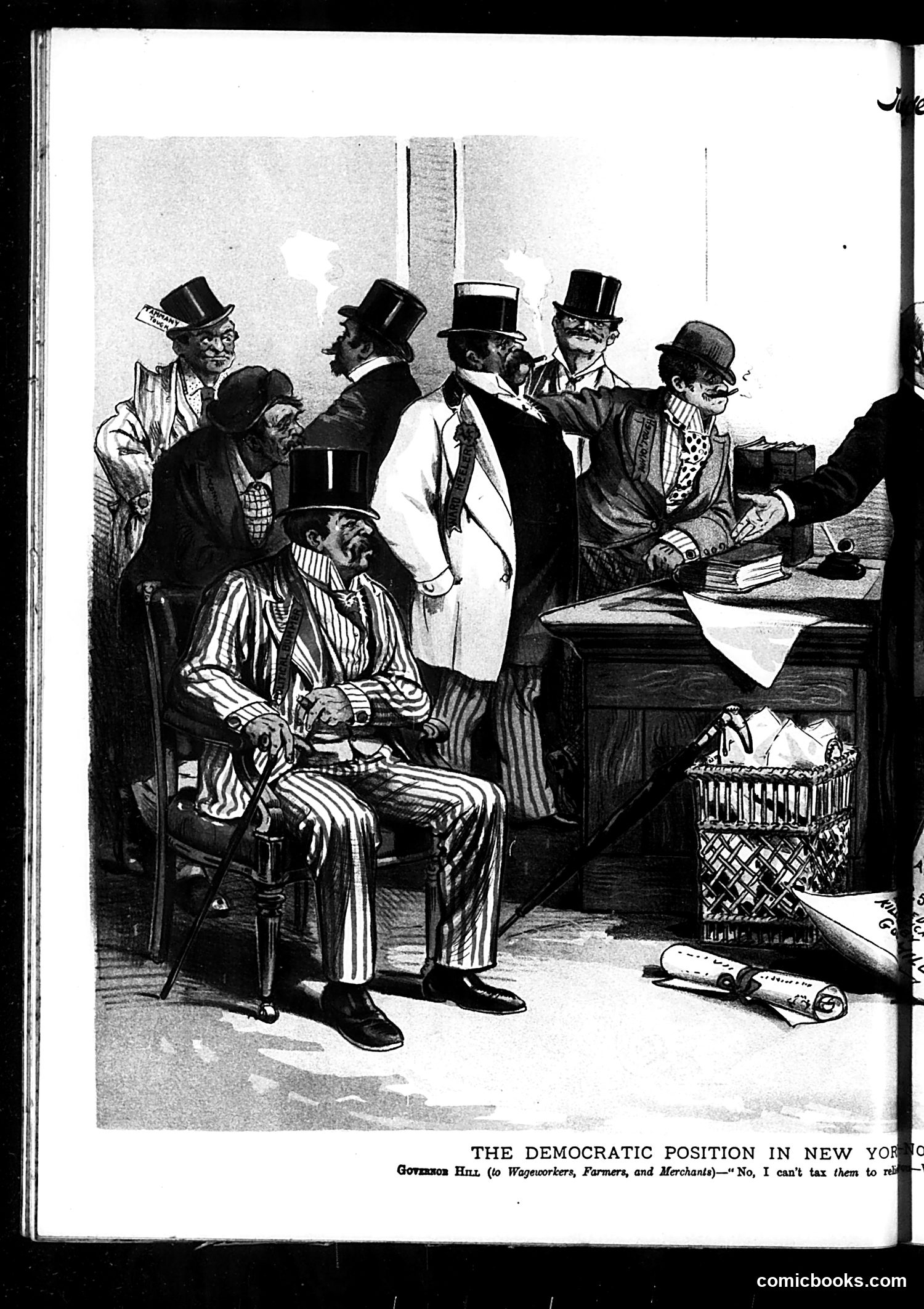
This political cartoon satirizes New York's Democratic Governor's tax policy contradictions. The Governor (seated, in striped suit) addresses three groups—wageworkers, farmers, and merchants—telling each "No, I can't tax them," referring to wealthy interests. The satire suggests Democratic hypocrisy: the party claims to represent working people yet refuses to tax the wealthy elite, leaving ordinary citizens to bear the tax burden instead. The crowded office scene with various figures in top hats emphasizes the influence of privileged classes on Democratic politics. The incomplete caption ("No, I can't tax them to...") likely continued with criticism of the Governor's unwillingness to implement progressive taxation despite Democratic populist rhetoric.
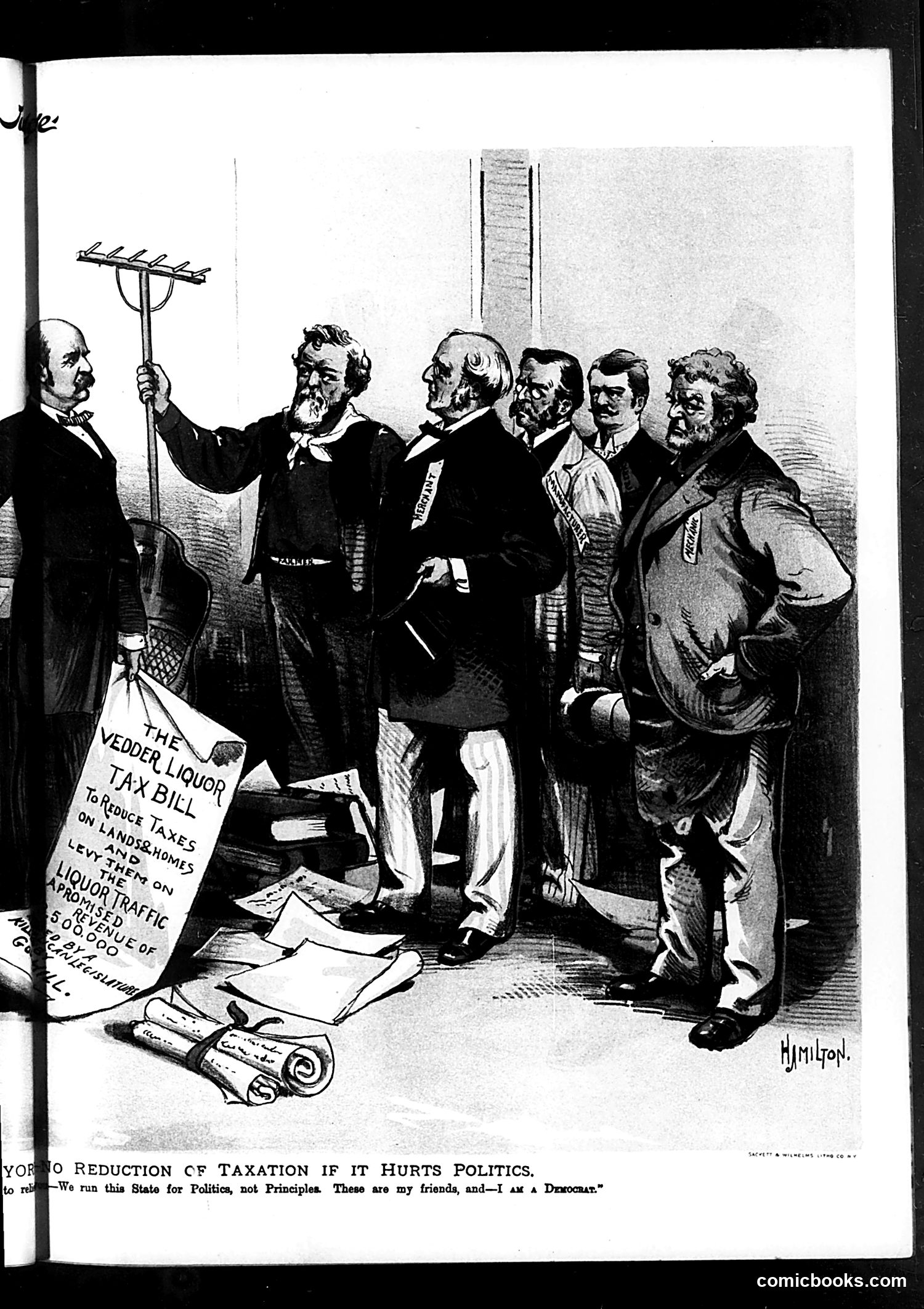
This **Judge** magazine cartoon satirizes political corruption and hypocrisy. A politician (center, in white pants) holds a rake, surrounded by six men examining documents labeled "THE VEDDER LIQUOR TAX BILL" and papers about tax revenue and liquor traffic. The satire targets a leader who claims to be a "Democrat" while openly admitting he runs the state "for Politics, not Principles" to benefit "friends." The cartoon suggests politicians prioritize protecting their allies' financial interests (liquor tax revenues) over ethical governance. The rake-holding figure appears to be "raking in" money or political advantage. This reflects late 19th-century concerns about machine politics, where party bosses used government power for personal gain and patronage rather than public good—a major reform issue of the Gilded Age.
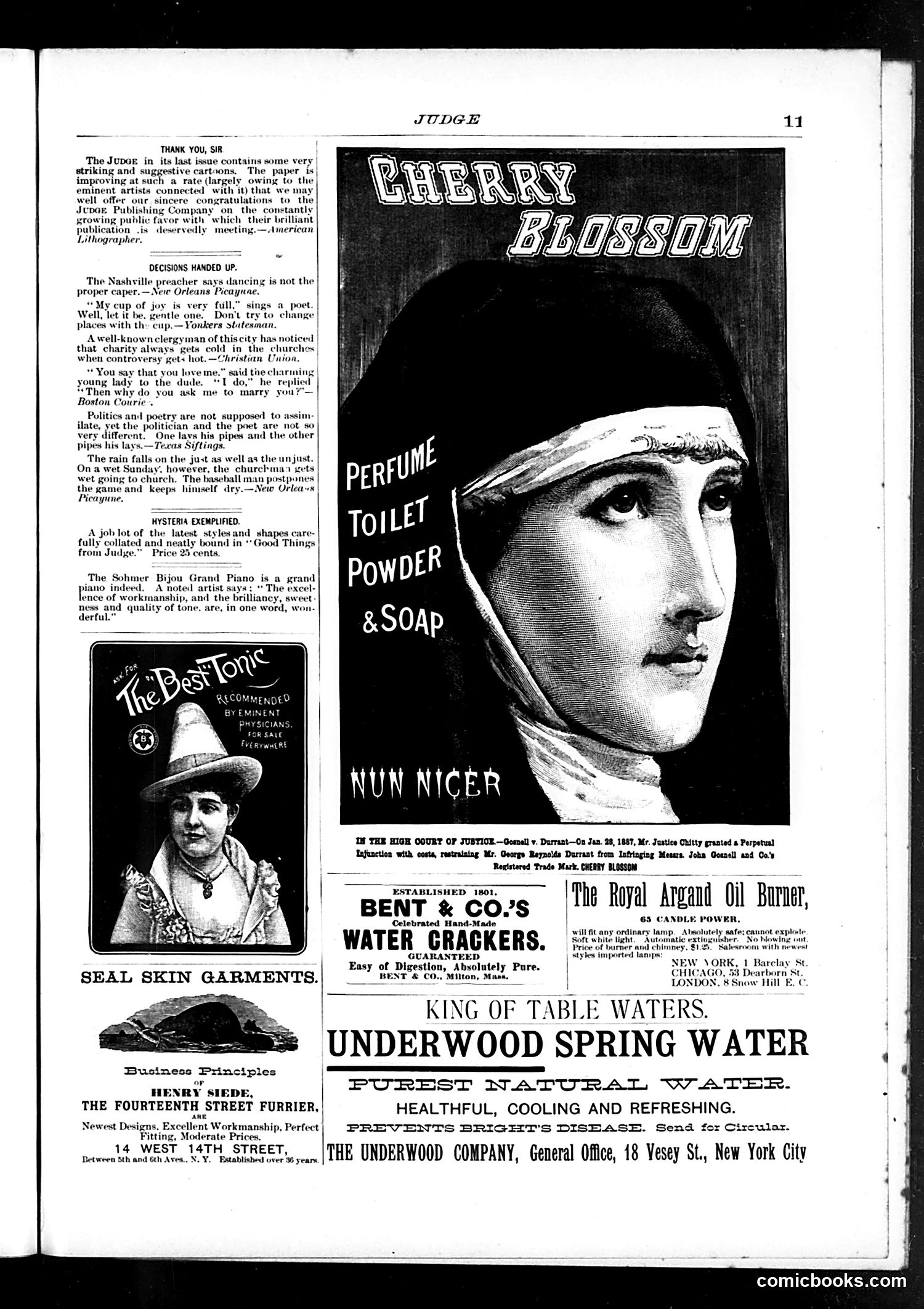
This page is primarily **advertisements** interspersed with brief humorous snippets credited "DECISIONS HANDED UP"—short jokes extracted from various newspapers. The main satirical content consists of **one-liners** mocking social hypocrisy: - A Nashville preacher condemns dancing (moral contradiction) - A clergyman notices charity "gets cold" when controversy heats up (institutional hypocrisy) - A young man claims to love a woman but won't marry her (romantic absurdity) - Rain falls equally on "just" and "unjust," yet churchgoers still get wet on Sundays while missing baseball (religious inconsistency) The dominant visual is a large **Cherry Blossom perfume advertisement** featuring a woman in a bonnet, alongside a legal notice about trademark protection (Gosnell v. Durrant, 1887). The page reflects Judge's formula: light social commentary through jokes about romantic, religious, and moral pretense, surrounded by period product ads. No specific political figures or events are targeted—the satire is general and gentle.
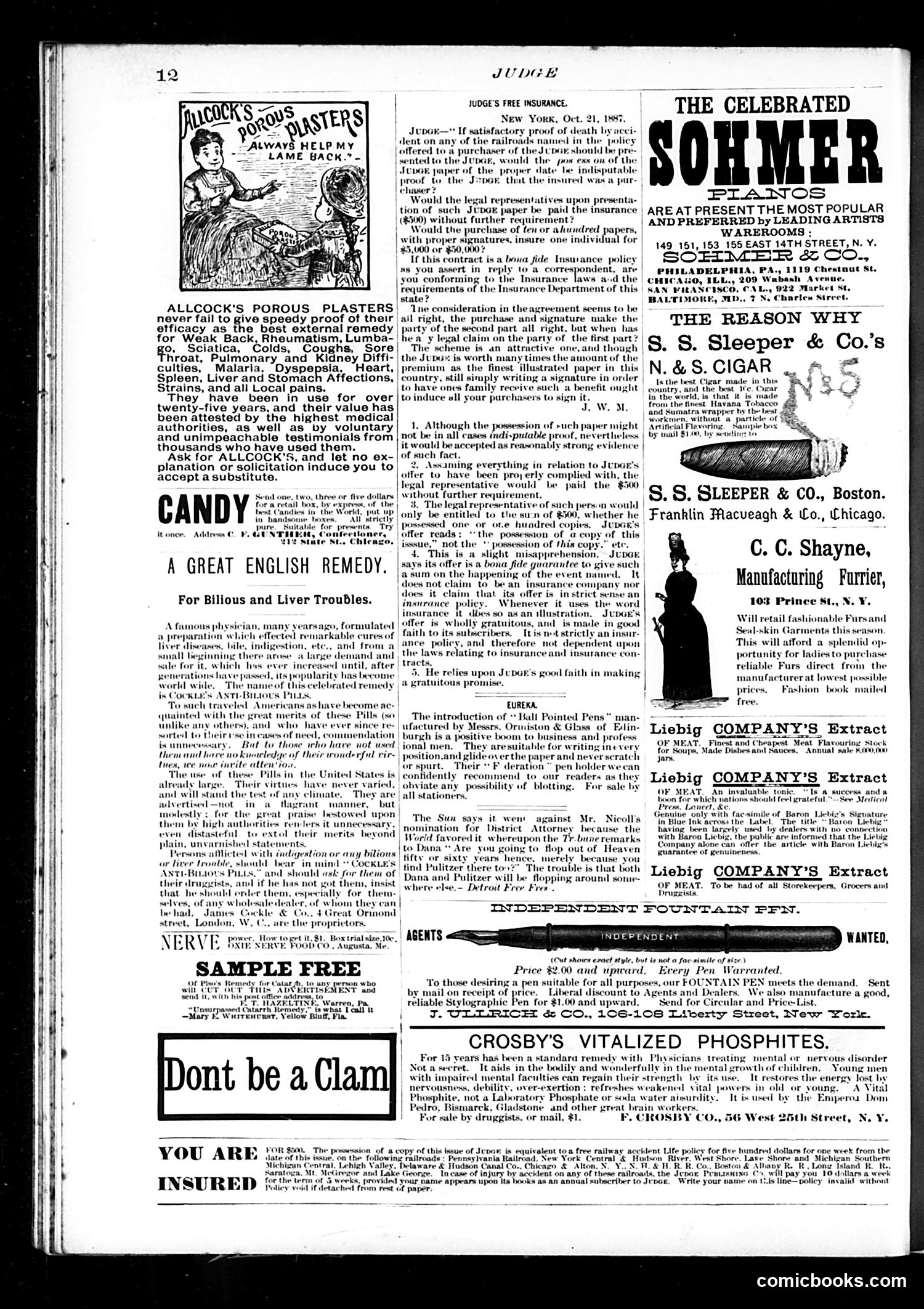
This page features a satirical article mocking *Judge* magazine's own dubious "free insurance" offer. The joke presents readers with absurdist questions: If buying *Judge* counts as an insurance policy, would heirs receive $500 just by presenting a copy as proof of death? Could buying multiple copies insure one person for thousands of dollars? The satire exposes *Judge*'s marketing claim—apparently, they advertised that purchasing the magazine provided some form of life insurance benefit. The correspondent (likely a reader or editor) ridicules this scheme's legal and logical inconsistencies. It's self-satirizing commentary on the magazine's own dubious advertising practices. The remainder of the page consists of period advertisements for patent medicines, pianos, cigars, and remedies—typical late-19th-century magazine fare. The "Don't be a Clam" and insurance-related ads further reinforce themes of dubious commercial promises common to the era.
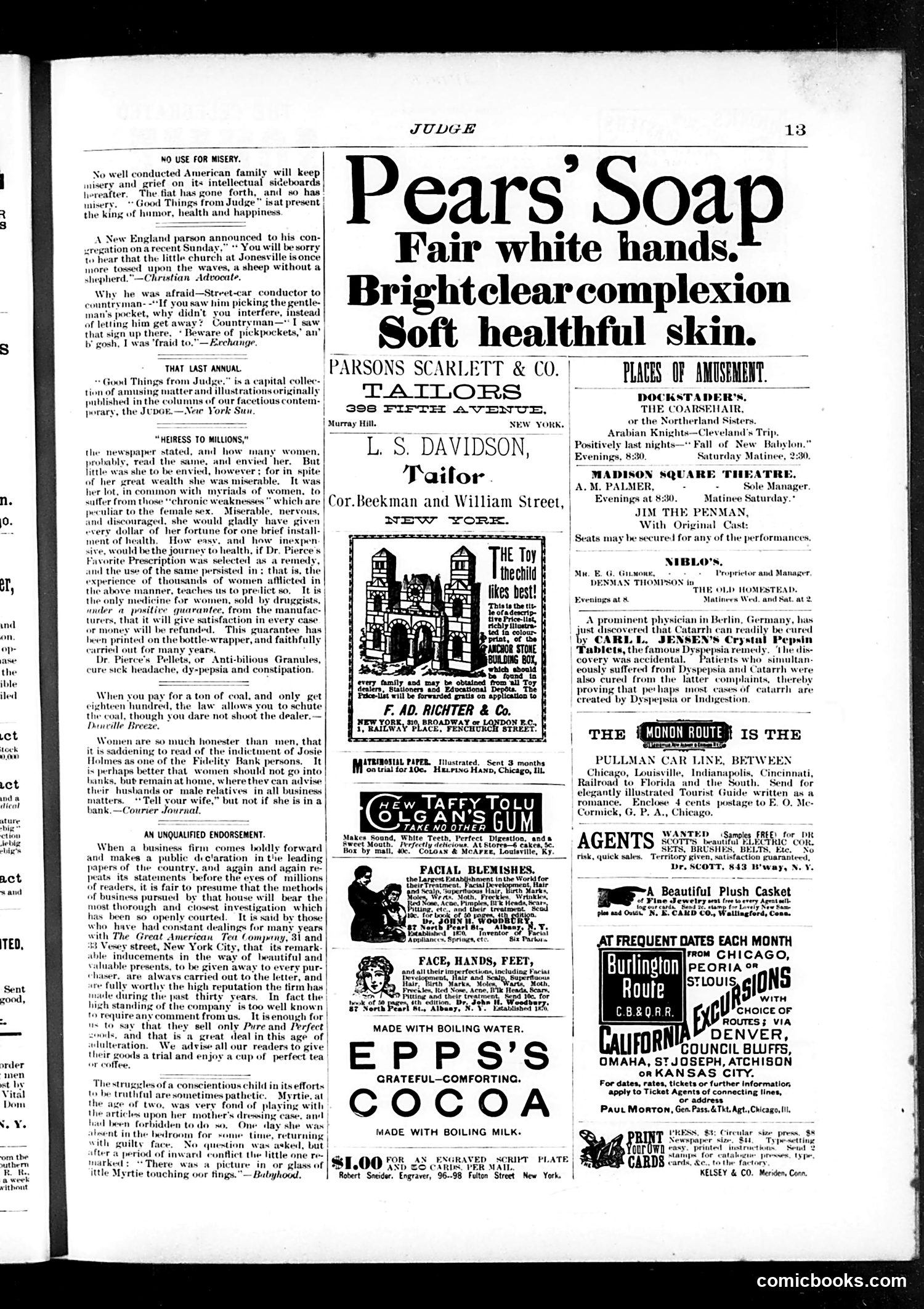
This page is primarily **advertisements and filler content** rather than editorial cartoons. The main elements include: **Major Ads:** - **Pears' Soap** (top): A beauty product promising "fair white hands" and clear complexion—typical period advertising targeting women - **Tailor shops** (L.S. Davidson, Parsons Scarlett & Co.) - **Patent medicines** (Epps's Cocoa, Taffy Tolu Gum, Dr. Pierce's Favorite Prescription)—common in this era - **Theater listings** for venues like Daly's Theatre and Palmer's **Editorial Content:** Brief satirical snippets mock social attitudes: - "No Use for Misery" criticizes how American families consume *Judge* magazine for humor rather than addressing real problems - A joke about pickpocket warnings reflects working-class anxieties - Commentary on wealthy "heiresses" suffering chronic ailments despite fortune **Context:** This reflects Judge's dual nature as both humor magazine and advertising vehicle. The ads reveal period concerns: beauty standards, patent medicines (before FDA regulation), and theater entertainment. The satirical fragments are minor filler between paid advertisements.
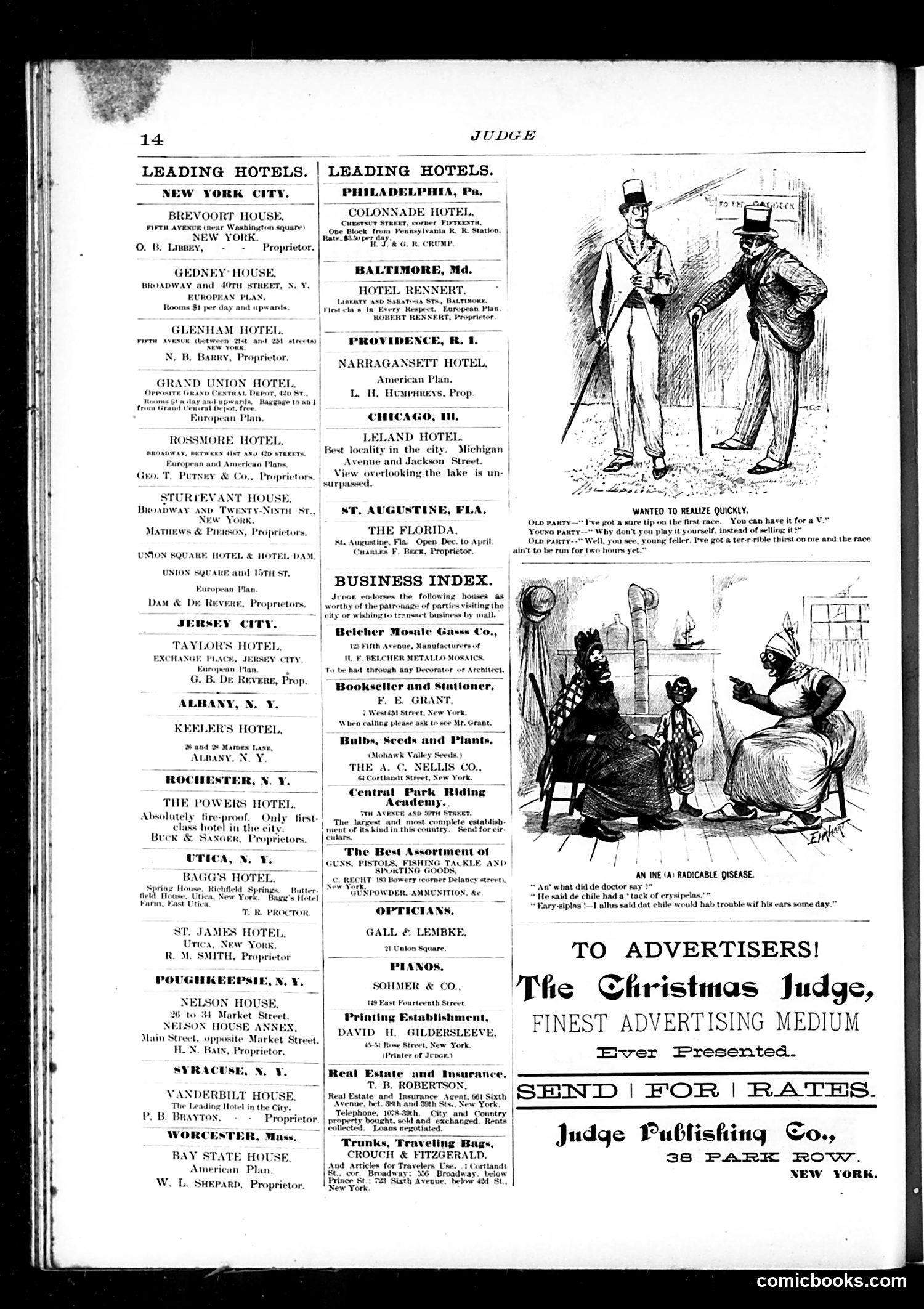
This page is primarily a **business directory and hotel advertisements** with two small satirical cartoons embedded. ## The Cartoons: **Top right cartoon** ("Wanted to Realize Quickly"): Two men in formal dress discuss selling something quickly. The dialogue suggests one man is pressuring the other to sell a racehorse before an upcoming race, implying financial desperation or a scheme to unload a problem asset. **Bottom right cartoon** ("An Incurable Disease"): A doctor tells a patient that "erysipelas" (a skin infection) will cause ear troubles. The patient responds dismissively that he already has ear problems from his wife ("his ears some day"), making a domestic complaint joke—suggesting nagging wives are as unbearable as medical conditions. ## Context: Both cartoons employ common Victorian-era humor: financial scheming and marriage complaints. The page itself is dominated by advertisements for hotels across major American cities (New York, Baltimore, Chicago, etc.) and various businesses, reflecting Judge's role as both satirical publication and advertising vehicle. The cartoons are minor illustrations typical of the magazine's style—quick, accessible jokes for contemporary readers.
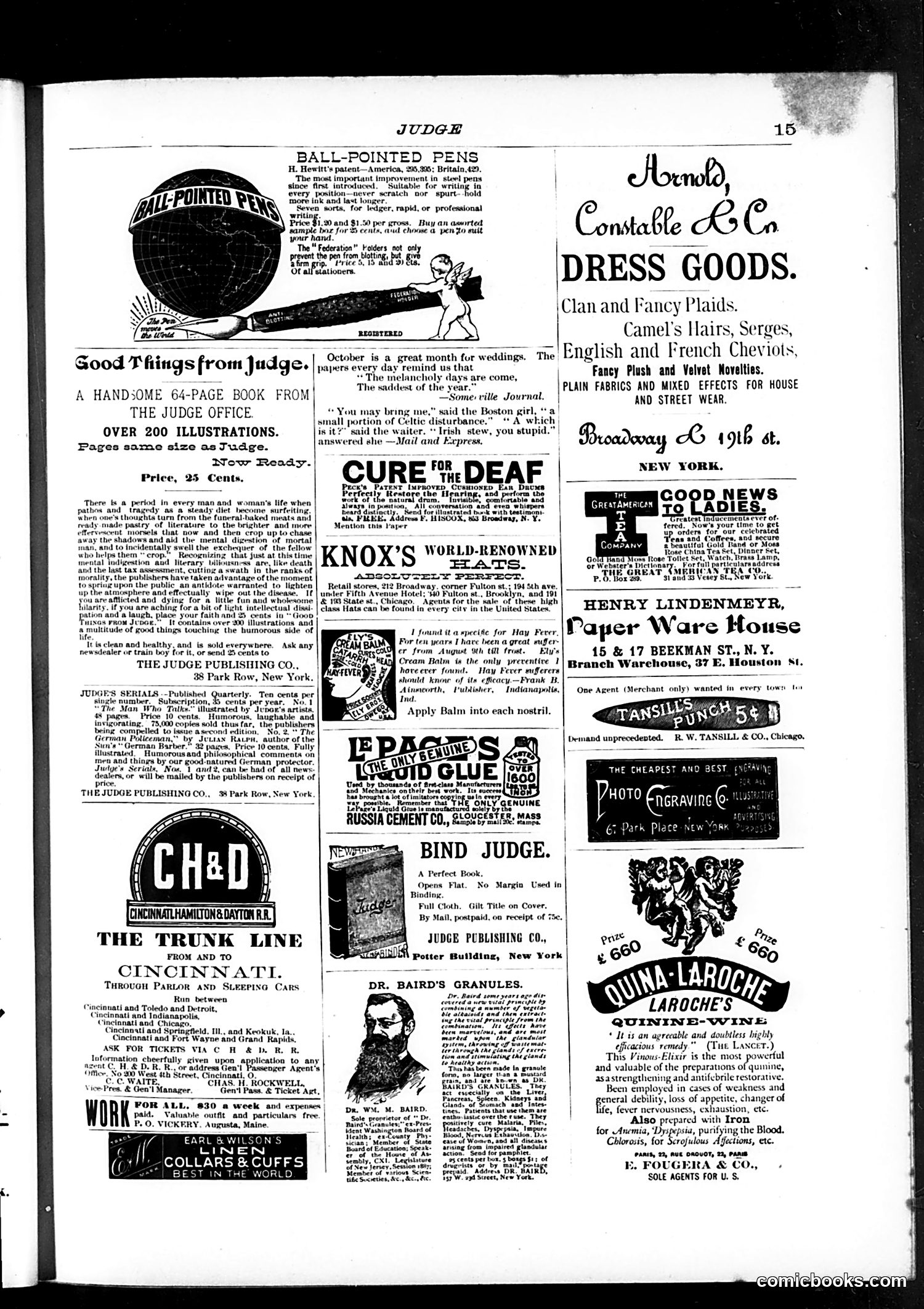
This page is primarily **advertising and promotional content** for Judge magazine itself and various commercial products. There are no political cartoons or satirical commentary to analyze. The main content includes: 1. **Self-promotion**: Judge advertises its own publications—a 64-page book of humorous illustrations (25 cents) and bound collections of back issues (75 cents). 2. **Product advertisements**: Ball-pointed pens, Knox hats, Ely's Cream Balm (for hay fever), Earl Wilson's collars and cuffs, and various other goods typical of early 1900s commerce. 3. **Travel promotion**: The CH&D Railroad's "Trunk Line" service from Cincinnati through various cities. The page reflects Judge's primary function as a **commercial magazine** dependent on advertising revenue. The tone is light and promotional rather than satirical. Without visible cartoons or political commentary, this appears to be a standard advertising page from the magazine's interior.
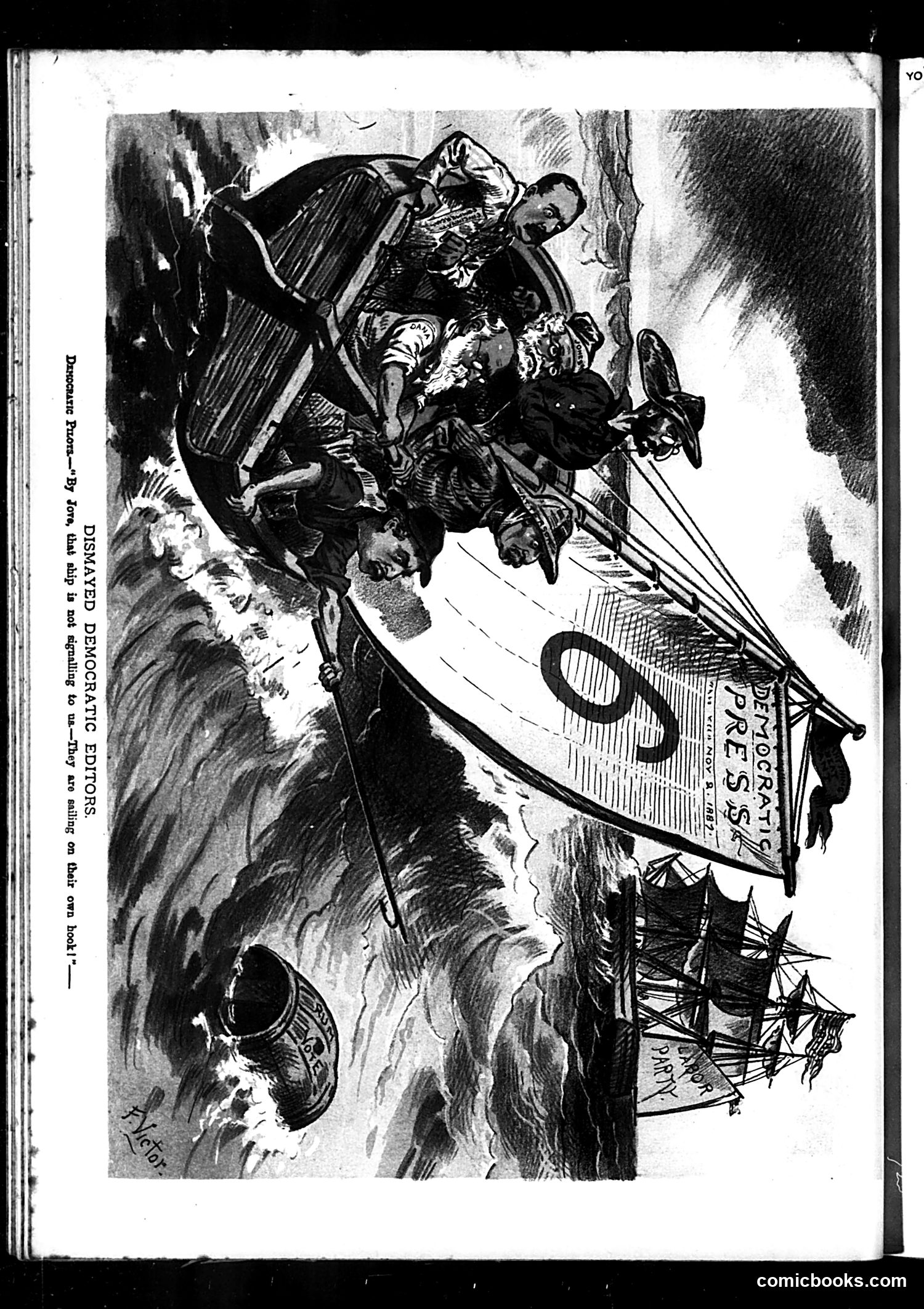
This cartoon depicts "Dismayed Democratic Editors" reacting with shock to a ship sailing independently. The Democratic press editors exclaim that the vessel "is not signalling to us—They are sailing on their own hook!" The satire criticizes Democratic newspaper editors for losing control over the political narrative or party direction. The ship likely represents either the Democratic Party itself or a Democratic political figure who is operating autonomously rather than following editorial guidance. This suggests Democrats were fracturing or not heeding their traditional media allies. Without visible dates or specific named figures, the precise historical moment remains unclear, but the cartoon mocks Democratic press influence and internal party discord during what appears to be a period of political instability or disagreement within Democratic leadership.