
Judge, 1887-11-05 · page 6 of 16
Judge — November 5, 1887 — page 6: what you’re looking at
What you’re looking at
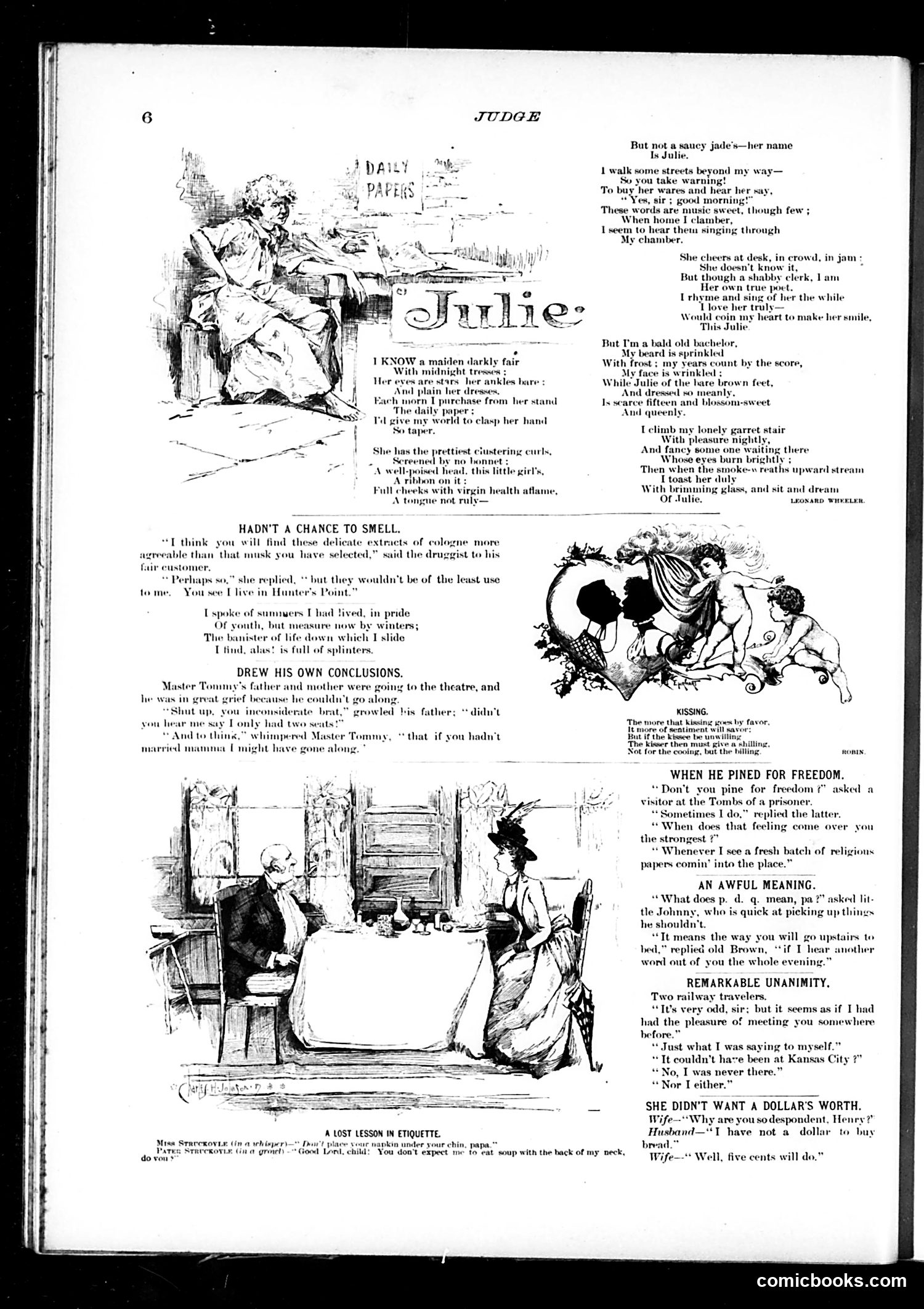
This page from Judge magazine (circa late 19th century) contains primarily **humorous short stories and jokes** rather than political cartoons. The content includes: - **"Julie"** (top): A sentimental poem by Leonard Wheeler about a working-class street vendor the narrator admires from afar—satirizing romantic idealization of ordinary people. - **Small anecdotes** mocking middle-class life: a child's misunderstanding of theater seating, a prisoner's relief at avoiding religious tracts, a father's threat using "p.d.q." as code for punishment. - **Social humor** about marriage, poverty, and urban encounters—including one joke about a wife accepting five cents instead of a dollar, mocking both spousal discord and financial struggle. The sketches accompanying these pieces are generic Victorian illustrations. This appears to be a **humor/satire page without specific political content**—instead targeting universal domestic situations, character types, and romantic pretension familiar to Judge's educated, middle-class readership.
📄 Transcribed text from this page (OCR, searchable)
Machine-transcribed from the original scan — historical spelling and the odd misread are preserved.
Se He: 1 KNOW a maiden darkly fair With midnight tresses stars her ankles bare : And plain her dresses, morn [purchase from her stand Th Jasp her hand She has the prettiest clustering curls, Screened well-poised A ribbon on it Fall cheeks with virgin health aflame, A tongue not rul HADN'T A CHANCE TO SMELL, “TL think you will find these delicate extracts of cologne more that musk you i selected,” said the druggist to his wuldin't be of the least use v's Point. L spoke of summers [had tived, in pride Of youth, but measure now by winters; nister of life down whieh I slide T tind, alas! is full of splinters. DREW HIS OWN CONCLUSIONS. and mother were going to the theatre, and along. led his father; “ didu't rime say Lonly had two seats!” © And to thing,” rpervd Mast nmy, “that if you hadn't married mamma Lmight have long. wh ixper)—"* Dow't place vo ler your chin, pay agrinet onl, You don't expect me’ fo eat soup with the back of my neck, But not a saucy jade’s—her name 1s Julie. 1 walk some streets beyond my way— uu take w: arning! her wares and he 8, sir ; good morn! These words are music sweet, though few ; When home I clamber, I seem to hear them: singing through My chamber. She cheers al , in crowd, in jam : She doesn’t know it, But though a shabby clerk, Lam Her own true poet. I rhyme and sing of her the while Would coin my heart to make her smile, This Julie But I'm a bald old bact My beard is sprinkled With fro: My ith pleasure nightly And fancy some one w Whose eyes burn brig Then when the smoke-» reaths upward stream I toast her duly With brimming glass, and sit and dream OF Julie. LEONARD WHEELER The more that kissing goes by favor, ore of sentiment will sav Lif the Kisee be unwilli ‘The kisser then must give 3 Not for the cooing, but the Ronis WHEN HE PINED FOR FREEDOM. “Don't you pine for freedom ¢” asked a i t the Tombs of a prisoner. Sometimes I do,” replied the latte “When does that feeling come you the strongest ?” “* Whenever I see a fresh batch of religions papers comin’ into the place.” AN AWFUL MEANING. “What does p. d. q. mean, pa?” asked lit- tle Johnny, who is quick at picking up things he shouldn't. “Tt means the way you will go upstairs to bed,” replied old Brown, “if I hes word out of you the whole evening. REMARKABLE UNANIMITY, Two railway travelers, “Tes very odd, but it seems as if I had had the pleasure of meeting you somewhere before.” “ Just what I was saying to myself.” “Tt couldn't have been at Kansas City 7” “No, I was never there.” “Nor I either.” SHE DIDN'T WANT A DOLLAR'S WORTH. Wife—Why are you sodespondent, He1 Husband—"T have not a dollar to 1 bread.” Wife" Well, five cents will do.” comicbooks.com