
A complete issue · 16 pages · 1887
Judge — October 15, 1887
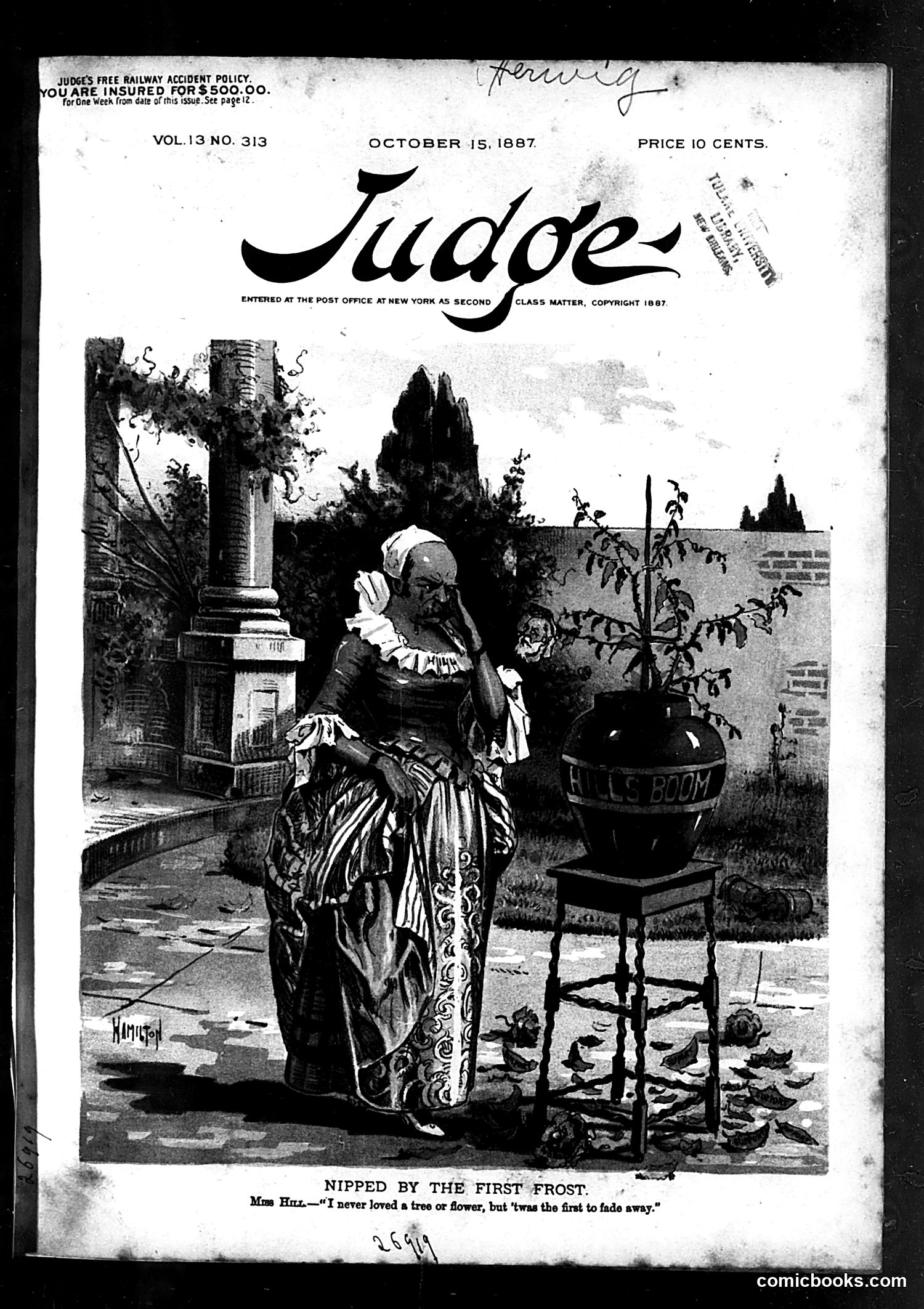
This October 1887 *Judge* cartoon depicts an elderly woman (identified as "Mrs. Hill" by the caption) tending a garden as frost kills her plants. Her quoted lament—"I never loved a tree or flower, but 'twas the first to fade away"—appears to be a personal, melancholic reflection rather than political satire. The image emphasizes themes of loss, aging, and nature's indifference. The withered plants and barren garden symbolize fading beauty and mortality. The elderly woman's elaborate Victorian dress contrasts with the season's destruction, underscoring life's transience. Without additional context about "Mrs. Hill," the cartoon's specific satirical target remains unclear, though it may reference a contemporary public figure or serve as general commentary on human disappointment.
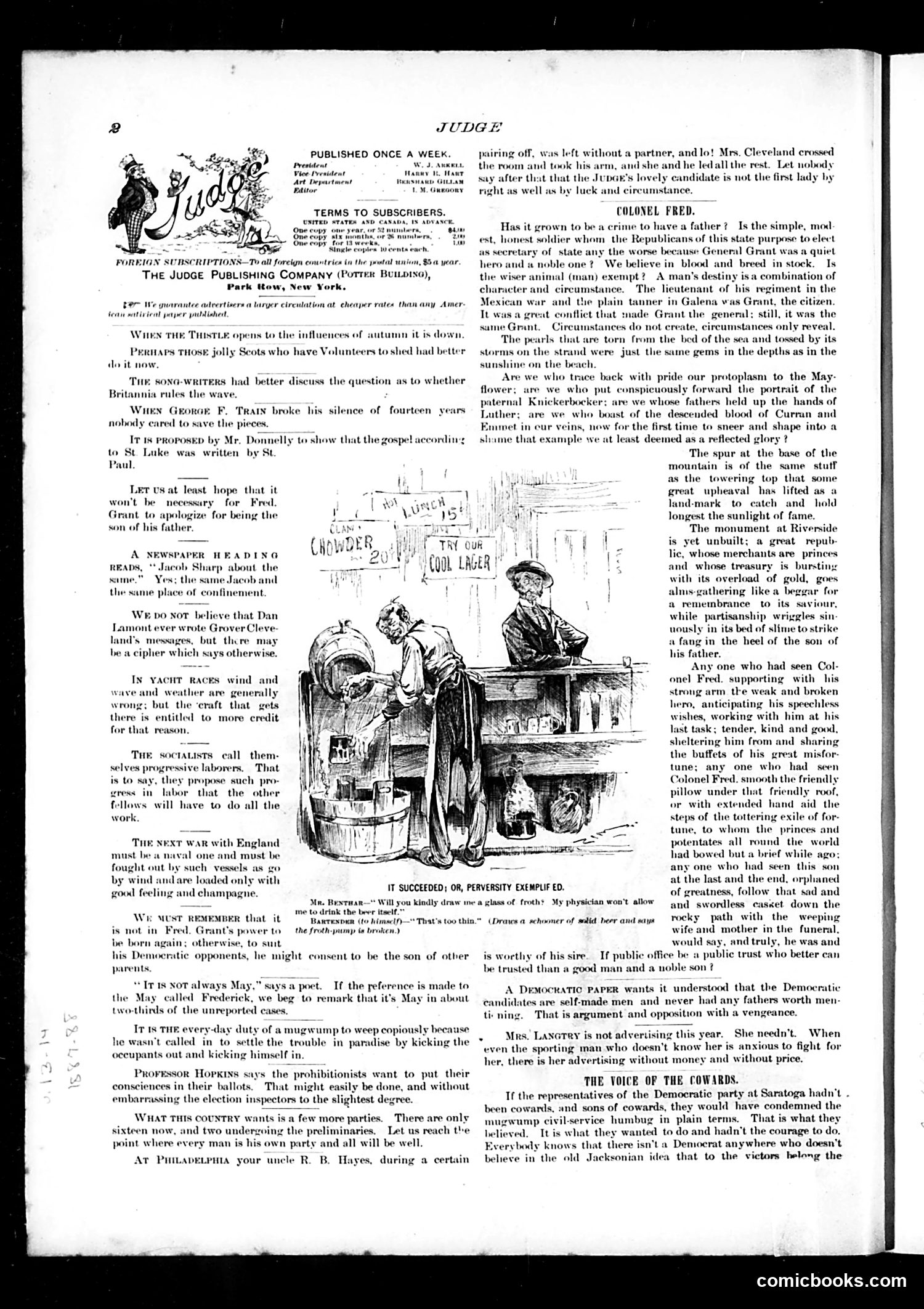
The main cartoon depicts a tavern scene titled "It Succeeded; Or, Perversity Exemplified." A bartender serves a customer who requests "fresh" beer, claiming his physician won't allow him to drink the usual beer. The bartender responds with apparent skepticism about the freshness claim. The satire appears to target hypocrisy around Prohibition or temperance reform—the customer seeks a loophole (claiming medical necessity for "fresh" beer) while the bartender recognizes this as transparent rationalization. The joke relies on readers understanding that "fresh" beer was a common excuse to circumvent alcohol restrictions. The surrounding text discusses Colonel Fred and Democratic politics, though specific figures remain unclear without additional context.
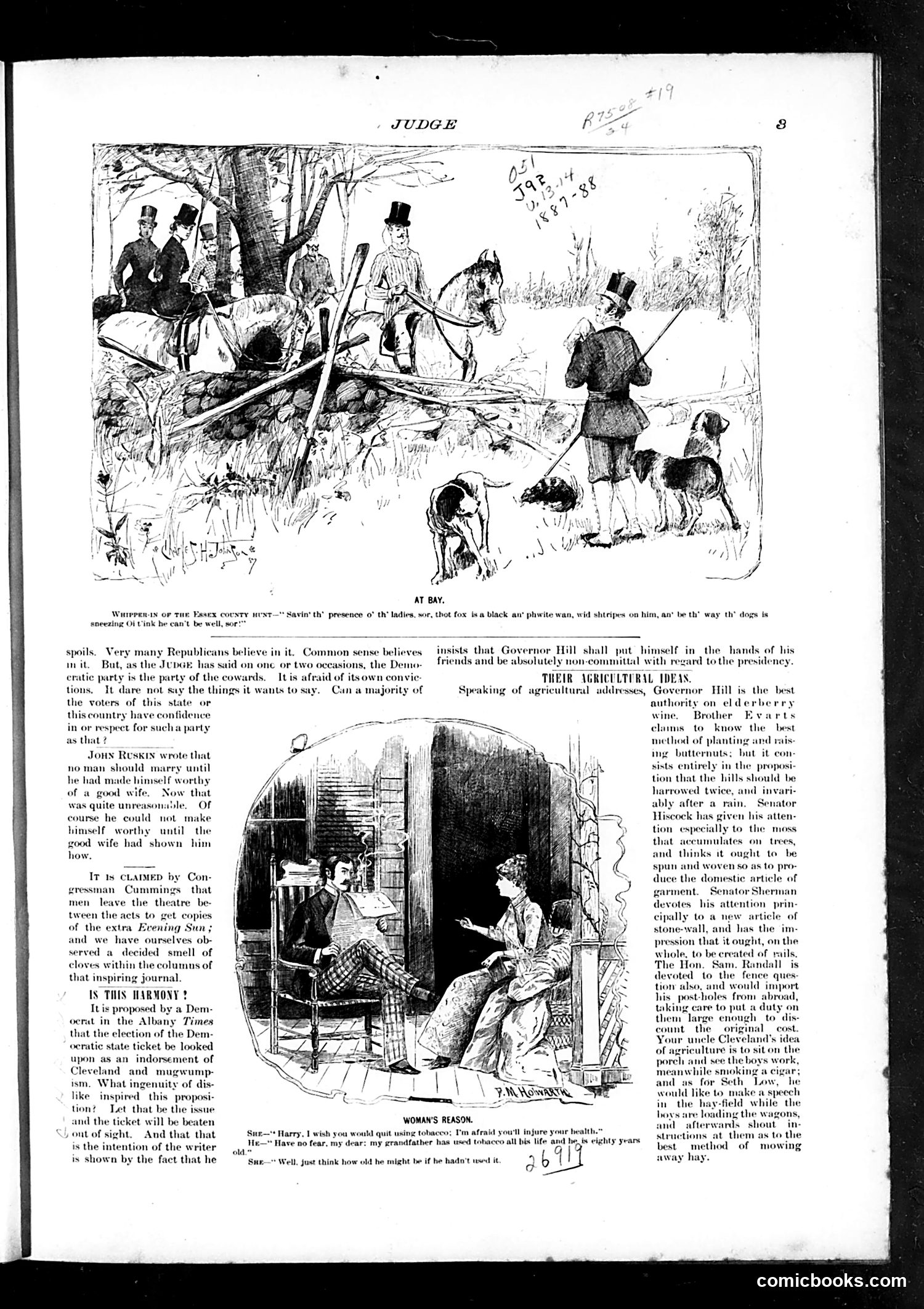
This page contains two distinct satirical pieces: **"At Bay"** (top illustration): A hunting scene mocking rural Irish dialect and working-class perspectives. The caption presents an Irish laborer's malapropism about a fox, satirizing both Irish speech patterns and rural ignorance—typical 19th-century ethnic humor. **Political Commentary (text)**: The bulk critiques Democratic Party hypocrisy. It attacks the party for avoiding clear positions ("dare not say the things it wants to say") while demanding loyalty, particularly regarding Governor David B. Hill's presidential ambitions. Republicans are mocked for believing in "spoils" (patronage). **"Agricultural Ideas"** (bottom illustration): Satirizes prominent Republican politicians—Governor Hill, James G. Blaine ("Brother Evarts"), and others—who publicly claim agricultural expertise they don't possess. It's absurdist political mockery: politicians pretending knowledge of elderberry wine, butternut farming, and moss-weaving to appear relatable to rural voters. The overall message: both parties engage in hypocrisy, but Democrats especially demand blind loyalty while avoiding commitments.
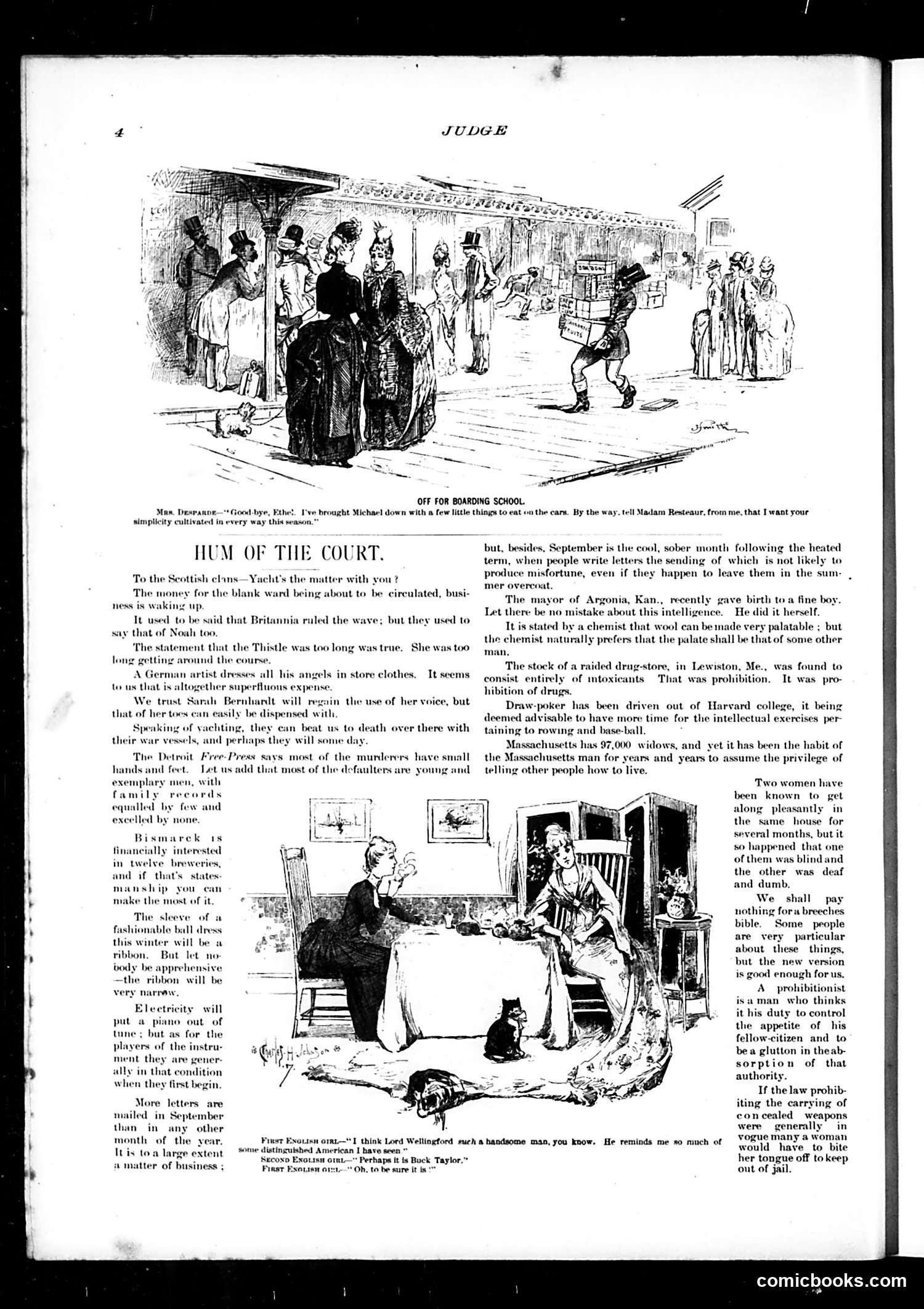
**Top cartoon:** A mother delivers her son to boarding school with provisions. The satire mocks Victorian parental anxiety and the affectations of wealth—the fussy mother fussing over trivial comforts for her child's departure. **"Hum of the Court":** A satirical column mixing social commentary with gentle ridicule of contemporary American life. Notable targets include: - Scottish financial matters ("blank ward" circulation) - References to Sarah Bernhardt's voice - Detroit's crime statistics (murderers allegedly have small hands/feet) - Fashion trends (narrow ribbons on ball gowns) - A Kansas mayor giving birth (absurdist humor) - Harvard banning draw-poker to encourage academics - Massachusetts widows' demographics - Prohibitionist hypocrisy (controlling others' drinking while indulging authority themselves) - Women's constraint under law (the final barb about biting tongues to avoid jail for speaking) The humor ranges from absurdist observations to sharper social critique, particularly regarding prohibition and women's limited legal freedoms.
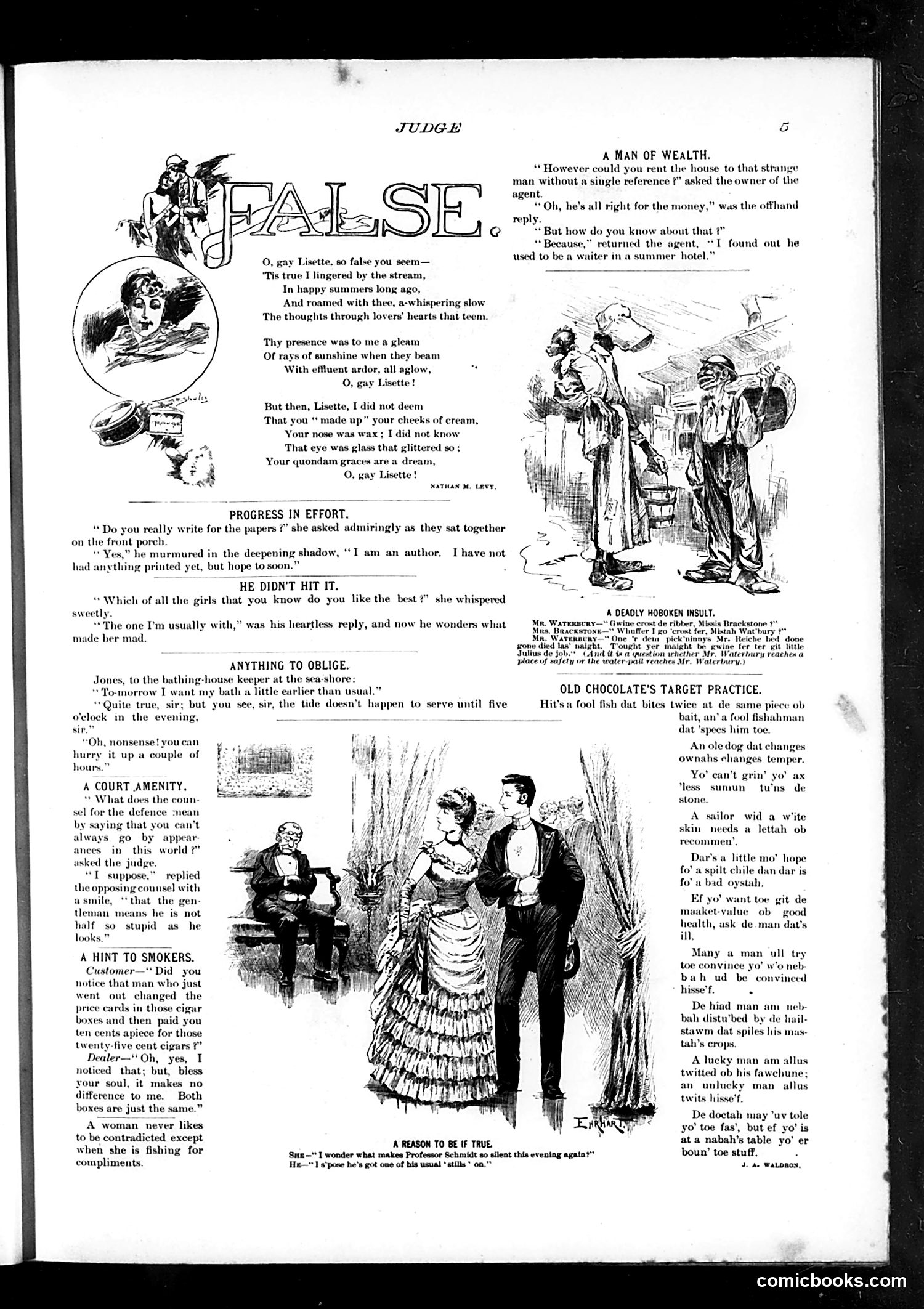
This page contains several short humorous pieces typical of late 19th/early 20th-century American humor magazines: **"False" (poem by Nathan S. Levy)**: A romantic lament about a woman named Lisette who once seemed beautiful but is revealed to wear heavy makeup ("made up your cheeks of cream"), have a wax nose, and glass eyes. The satire targets women's cosmetics and artificial beauty enhancement—reflecting period anxieties about female deception through makeup. **Various short jokes** mock common social situations: an aspiring author with unpublished work, a man's insensitive response to a woman's question, a bather demanding the tide change, and courtroom banter. **"Old Chocolate's Target Practice"**: A column of folk wisdom presented in heavy dialect, likely representing African American vernacular speech—a common (though problematic by modern standards) humor convention of the era. The page reflects period preoccupations: masculine skepticism toward women's appearance, class anxieties, and social etiquette. The dialect pieces represent how mainstream magazines treated marginalized voices as comedy fodder.
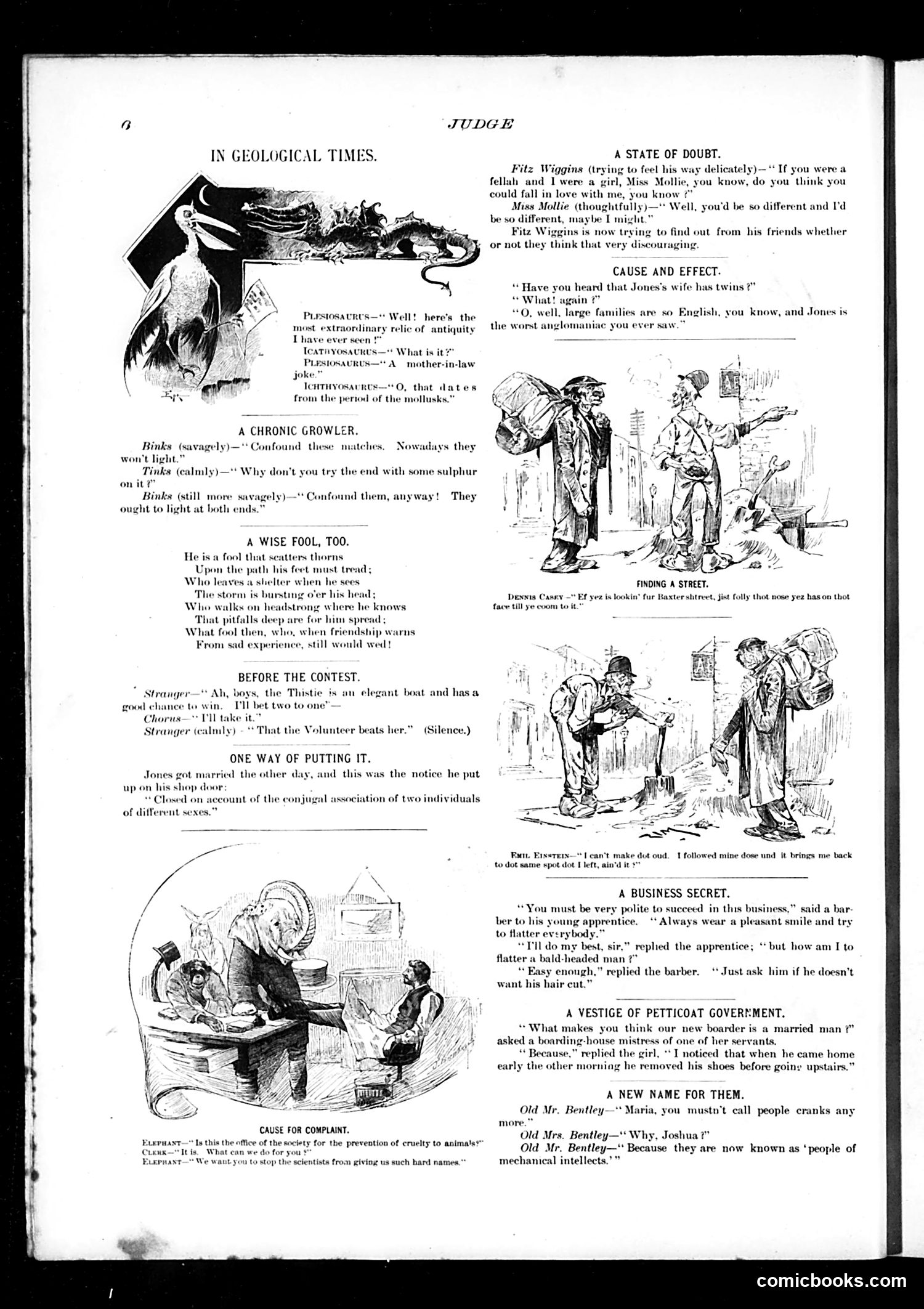
This page contains multiple short jokes and satirical vignettes typical of 1880s-90s American humor magazines: **"In Geological Times"** mocks romantic uncertainty through absurdist hypotheticals about evolution. **"Cause and Effect"** satirizes English social pretension—Jones is ridiculed as an "anglomaniac" for having twins, implying the British obsession with large families was seen as excessive. **"A Chronic Growler"** is simple domestic humor about a perpetually dissatisfied man complaining about matchstick quality. **"Finding a Street"** features an Irish immigrant character (indicated by dialect: "yez," "shtreet") offering colorful directions, reflecting period ethnic comedy stereotypes. **"A Business Secret"** presents barber-shop philosophy about flattering customers, culminating in a bald-man joke. **"A New Name for Them"** pokes fun at scientists giving complex technical names to ordinary things, with "mechanical intellects" as a humorous replacement for "cranks." The overall tone reflects late-Victorian American satire: genteel social criticism mixed with ethnic caricature and mild domestic humor.
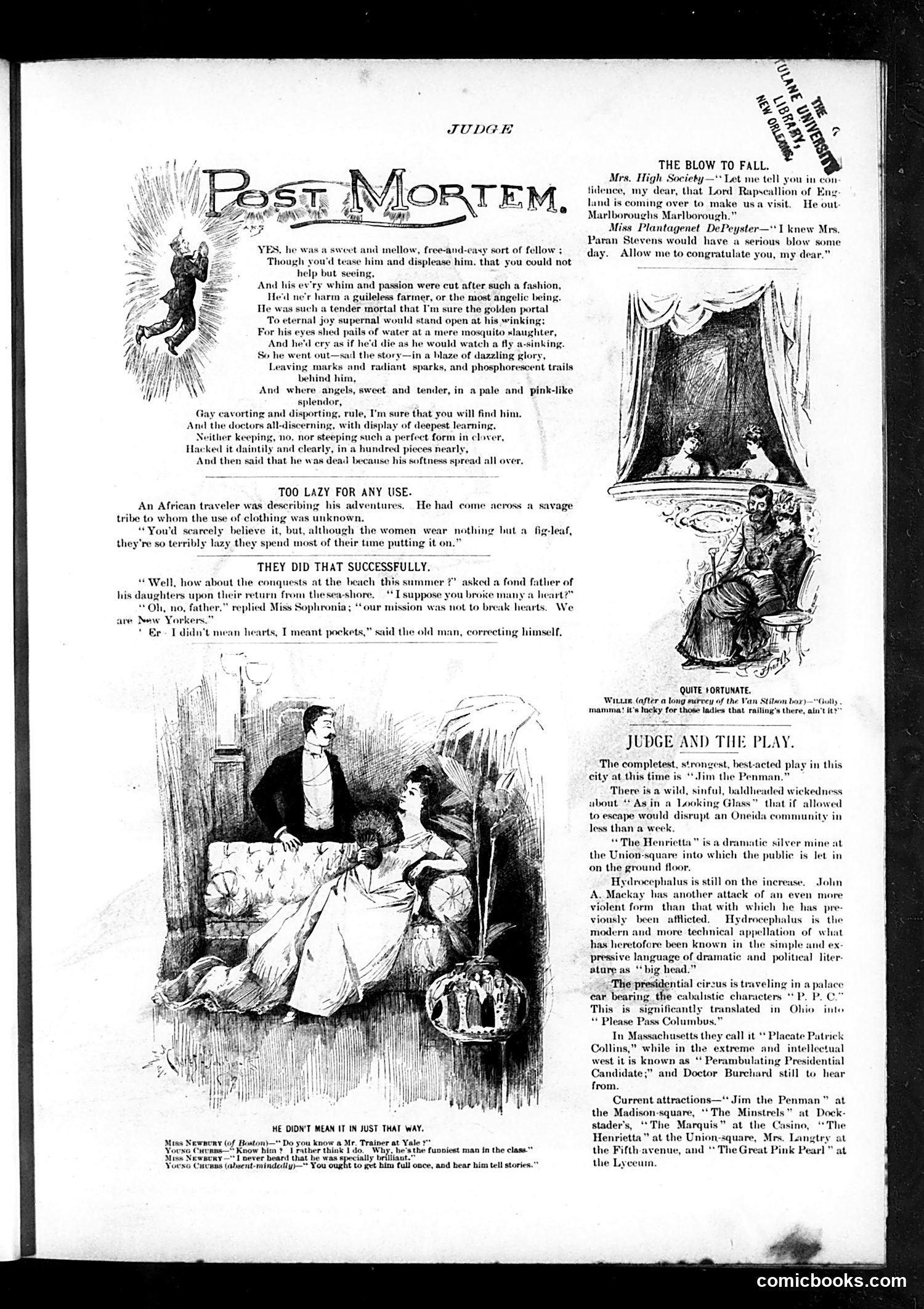
This page from Judge (likely 1880s-90s based on references) contains multiple satirical pieces: **"Pest Mortem"** mocks an idealized, overly-sentimental view of a deceased person—contrasting the flowery poetic description with reality. The satire suggests people exaggerate virtues of the dead. **"Too Lazy for Any Use"** jokes about African colonial attitudes, with a traveler's dismissive comment about indigenous people. This reflects period racist stereotypes common in satirical magazines. **"They Did That Successfully"** plays on a father's misunderstanding: his daughter says their beach mission wasn't to "break hearts" but to break "pockets"—implying young women targeted wealthy suitors for money, not romance. The humor lies in the father's embarrassed correction. **"The Blow to Fall"** satirizes wealthy New York society women discussing a visiting English lord's arrival—suggesting such visits were major social events worthy of congratulation or commiseration. **"Judge and the Play"** reviews contemporary theatrical productions, using "hydrocephalus" (enlarged head) as coded criticism of actors' ego or pretension—a period in-joke about theatrical vanity.
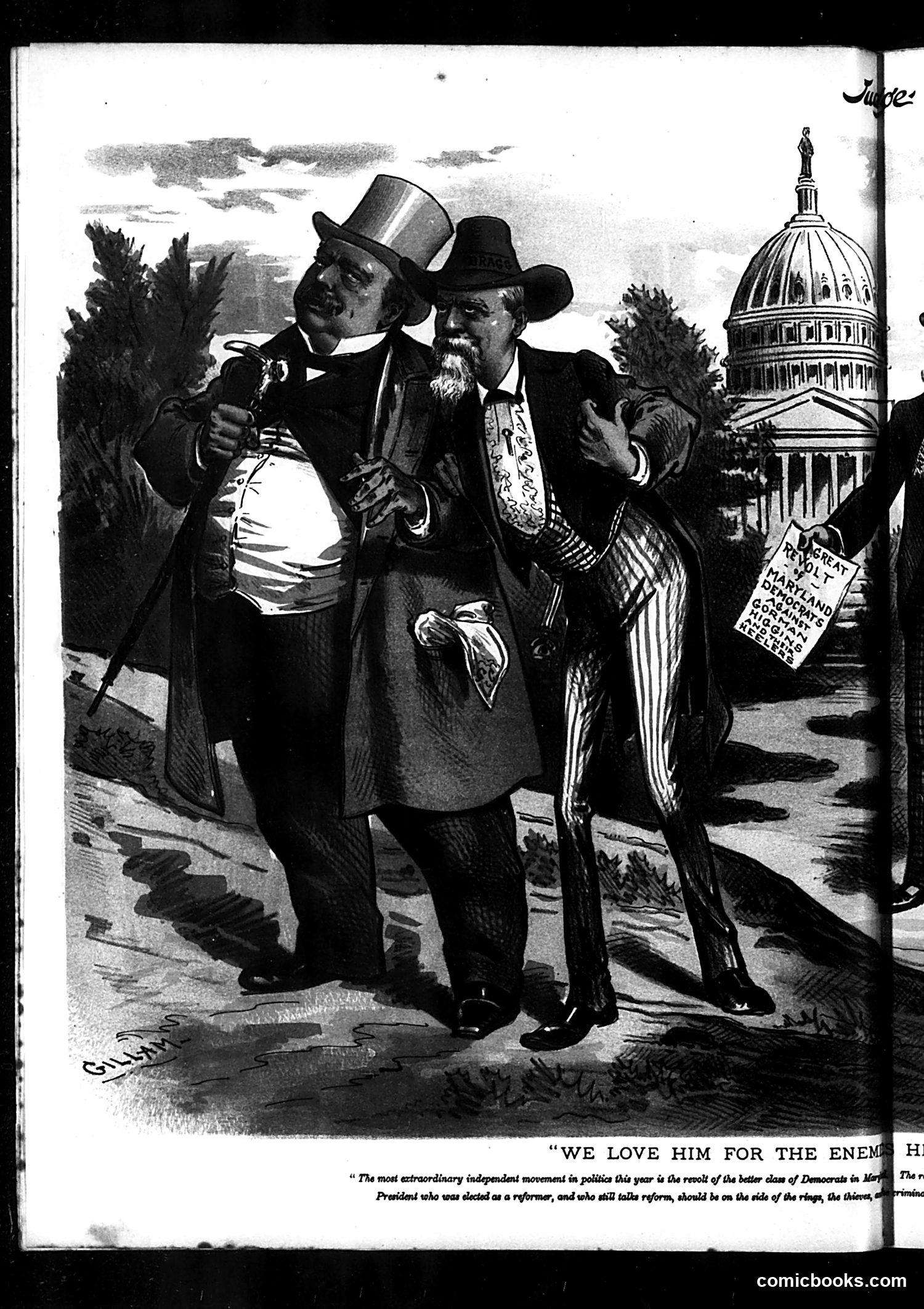
This **Judge** magazine cartoon satirizes Democratic Party divisions over a reformist president. Two well-dressed men (representing "better class" Democrats) stand before the Capitol, embracing a portly political figure in the center—likely depicting a corrupt politician or party boss they paradoxically support. The caption "We Love Him for the Enemies" is ironic: these reform-minded Democrats claim to back this figure *because* of his opponents, not his merits. The partial text references a president "elected as a reformer" who allies with "rings" (political machines) and "thieves." Without the publication date visible, the specific president remains unclear, though the imagery suggests Gilded Age or Progressive Era politics when Democratic reformers battled entrenched party corruption. The satire mocks the contradiction of supporting a compromised leader while claiming moral superiority.
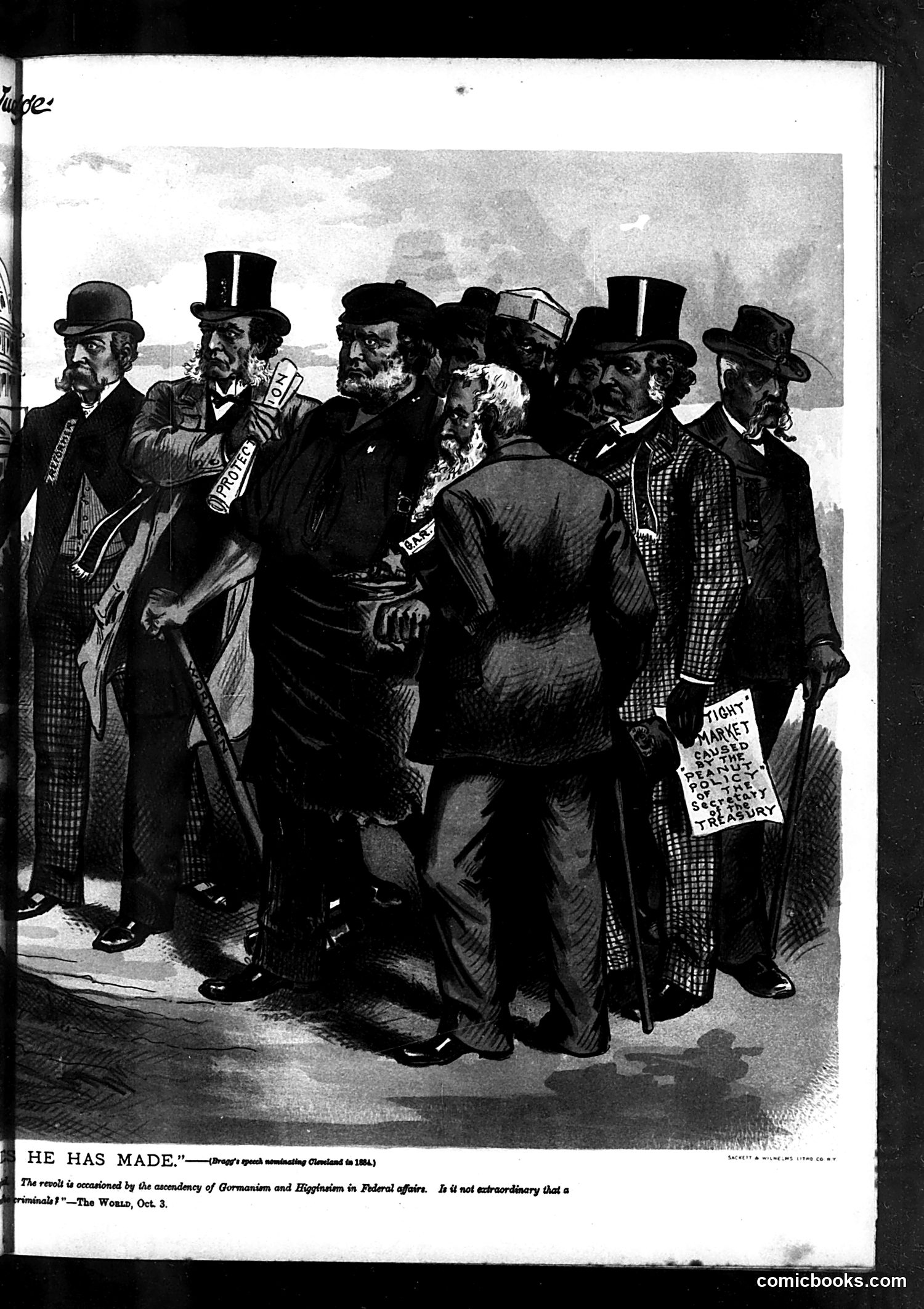
This political cartoon satirizes Republican party divisions around 1884. The caption references Cleveland's nomination (likely Grover Cleveland), and the text mentions a "revolt" caused by "Gormanism and Higginism" dominating federal affairs—these appear to be references to rival Republican factions or political machines of the era. The well-dressed men in top hats surrounding a central figure represent party leaders or power brokers engaged in political maneuvering. One figure holds a sign reading "TIGHT MARKET" and references to the "TREASURY," suggesting economic or financial policy disputes. The cartoon critiques how party bosses and competing interests control politics rather than serving the public interest, a common Progressive-era complaint about machine politics and corruption.
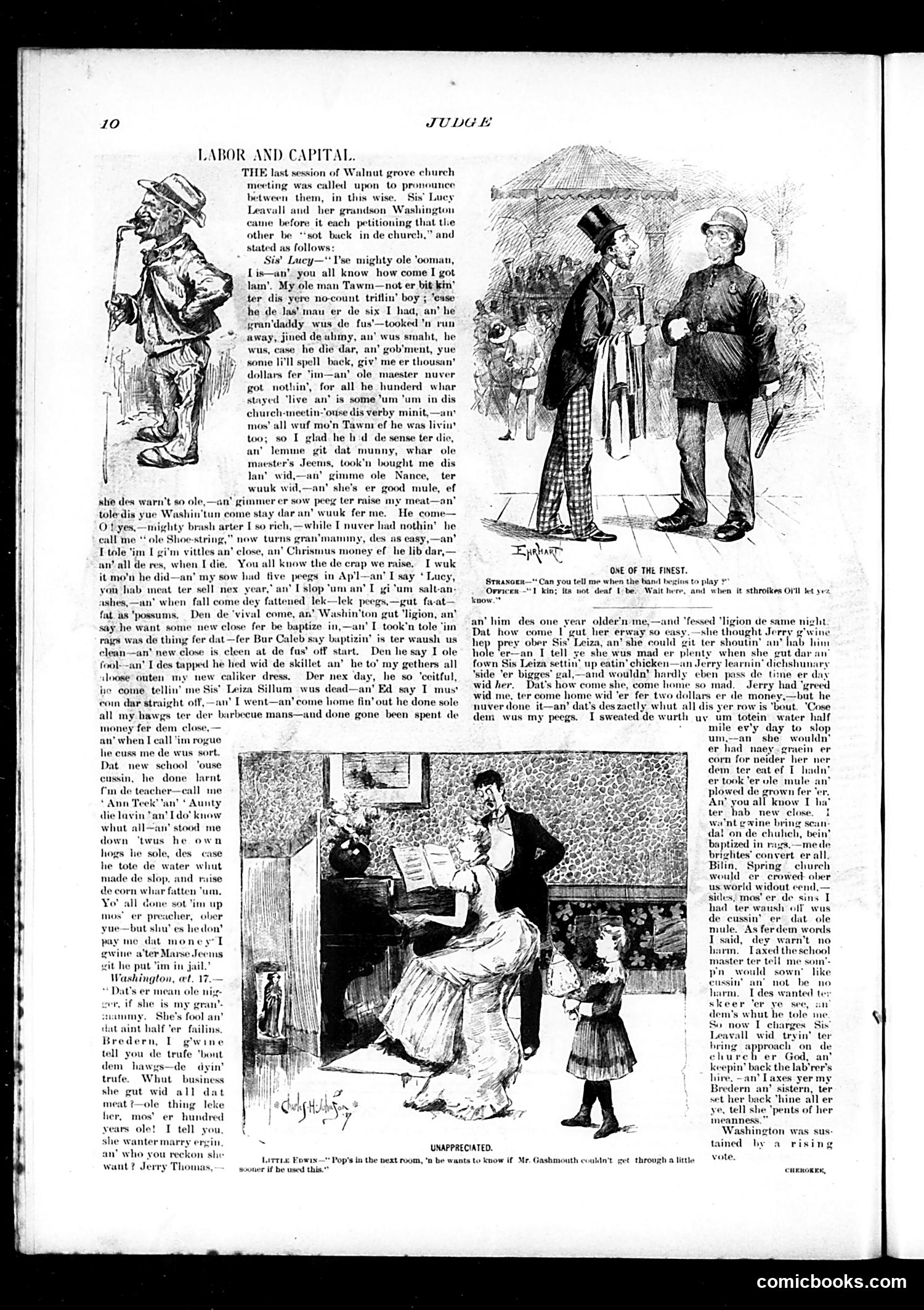
This page presents dialect-heavy rural African American characters in a church dispute, reflecting late 19th-century racial stereotyping common in *Judge*. **The main narrative** depicts an elderly Black woman (Lucy Leavall) and her grandson Washington in conflict. Lucy claims she fed, clothed, and sheltered Washington; he sold her pigs and spent the money on new clothes for baptism without permission. Washington counters that Lucy is cruel and that he owns the pigs since he raised them. **The satire's point** appears to be mocking both "labor" (Lucy's unpaid domestic work) and "capital" (Washington's claim of ownership) as competing claims with no clear resolution—mirroring contemporary labor disputes. However, the crude dialect and caricature reduce the economic argument to a joke about Black rural life. **Secondary cartoon** ("One of the Finest"): A band member asks a stranger about music; the officer mishears—light humor unrelated to the main piece. The page relies entirely on racist caricature for its satirical effect, typical of *Judge*'s editorial approach.
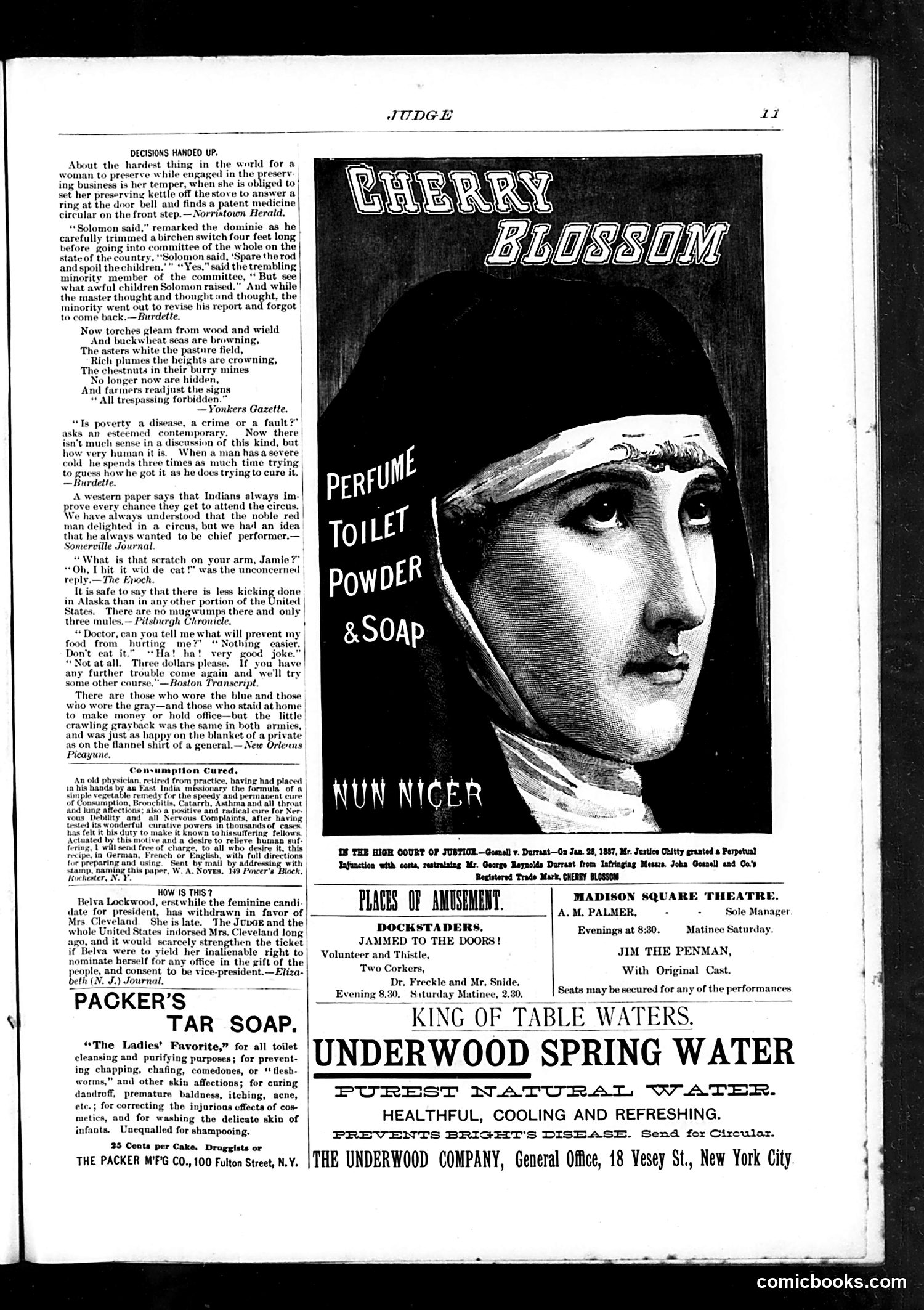
This page is primarily **advertisements and short news/humor items**, with one notable judicial notice. The central image is a large advertisement for **Cherry Blossom Perfume, Toilet Powder & Soap** featuring a woman's face in profile. The fine print indicates this is a legal notice about a trademark infringement case (Gosnell v. Durrant, 1887), republished as advertising. Below are multiple advertisements (Packer's Tar Soap, Underwood Spring Water) and news items, including: - A reference to **Belva Lockwood**, a real historical figure who ran for U.S. President in 1884 as the National Equal Rights Party candidate. The joke suggests she should become vice-president to "strengthen the ticket" — satire on her persistent political ambitions and the novelty of female candidates at the time. - Various humorous one-liners about preserving jams, temperament, children, and poverty — typical Judge fare mocking everyday life and human foibles. The page reflects late-19th-century magazine format: news satire mixed extensively with commercial advertising.
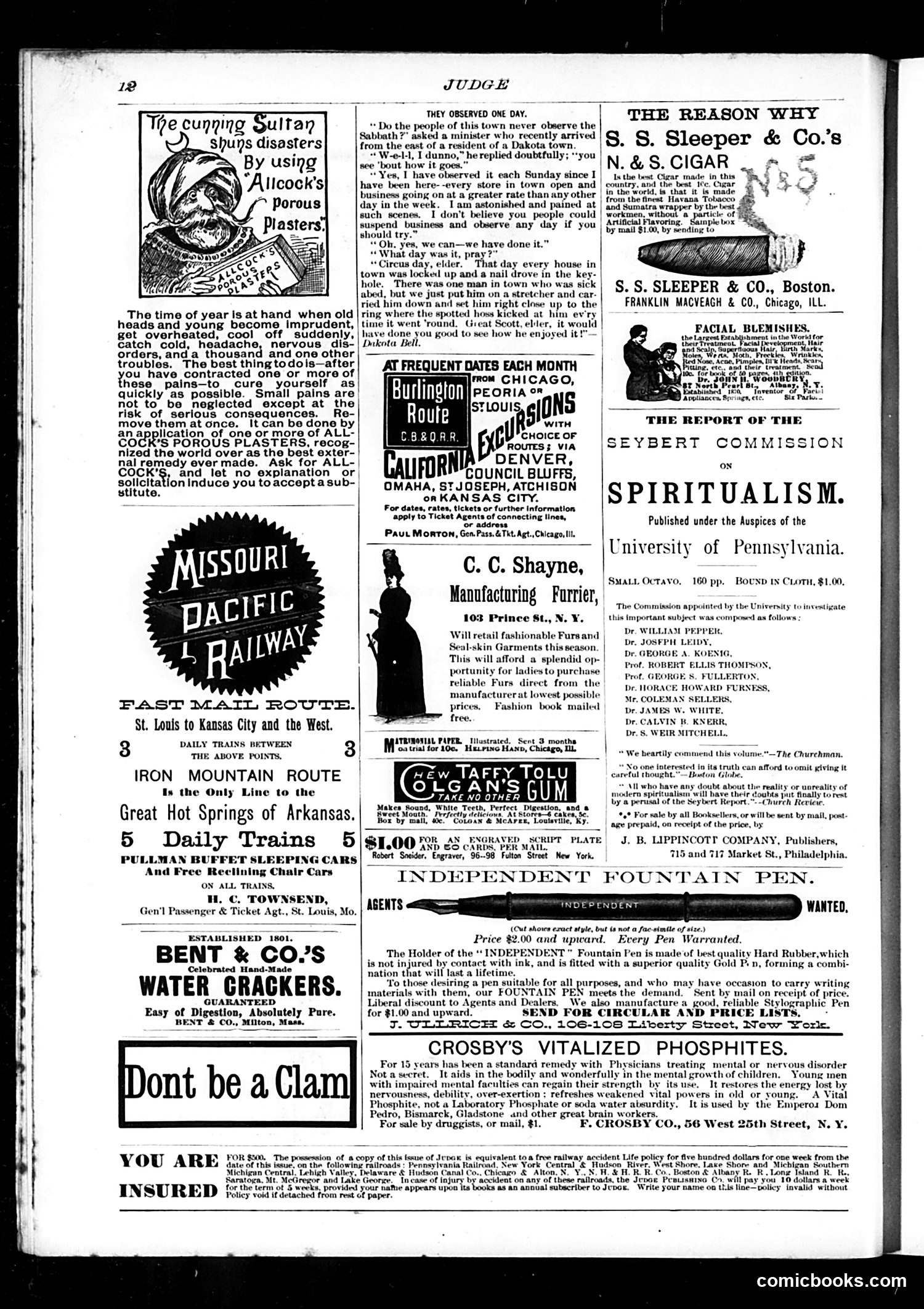
This is primarily an **advertising page** from Judge magazine with one small satirical cartoon at the top. ## The Cartoon: "They Observed One Day" The cartoon depicts a conversation between a visiting minister and a town resident about Sabbath observance. The satire operates on **economic and religious hypocrisy**. The minister is shocked that the town's stores remain open on Sundays, violating religious tradition. However, the resident reframes this as actually honoring the Sabbath—by locking up a troublesome spotted horse in the store one Sunday, they prevented it from disturbing business operations. The joke highlights a rural American attitude of **pragmatic indifference to religious propriety**, finding clever justifications for behavior that technically violates Sunday observance laws while appearing dutiful. The cartoon pokes fun at both clergy (out-of-touch outsiders) and rural sensibilities (creative rationalization). The rest of the page consists entirely of advertisements for period products: cigars, railroads, furs, fountain pens, water crackers, and patent medicines, typical of Judge's revenue model.
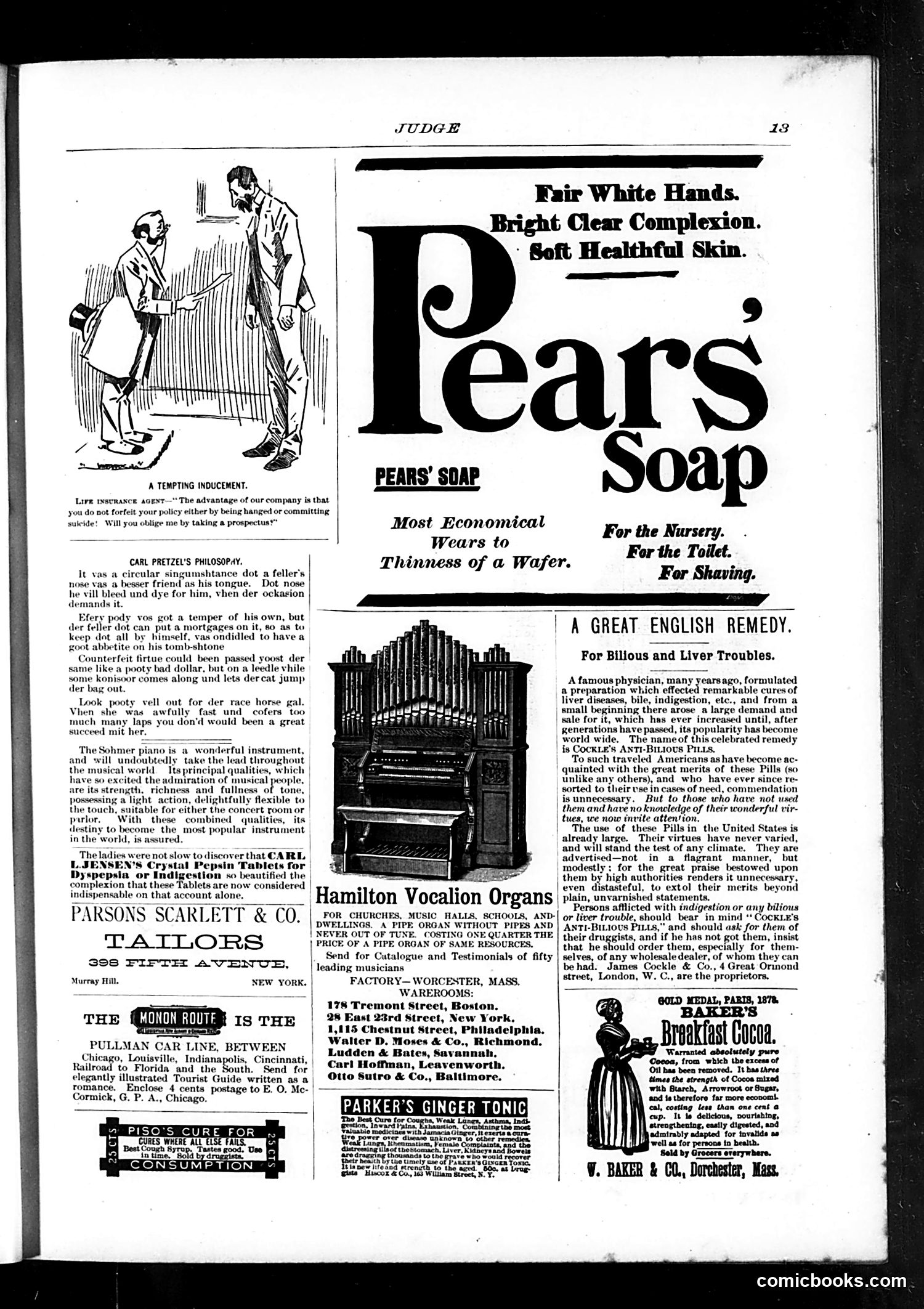
This page is primarily **advertising**, with two satirical cartoons and philosophical humor. **"A Tempting Inducement" cartoon (top left):** A life insurance agent pitches his company's policy to a prospective client, claiming an advantage: you won't forfeit coverage by suicide or hanging. The joke is dark—the agent is literally selling insurance by marketing exemptions for self-destructive acts, making the company's terms sound absurdly appealing. **"Carl Pretzel's Philosophy" section:** These are ethnic humor pieces written in exaggerated German-immigrant dialect ("vas," "dot," "vell out"). Pretzel offers folk wisdom comparing noses to tongues and warns about "race horse gals." This reflects late-19th-century American magazines' tendency toward stereotypical immigrant characters for comedic effect. The remainder is period advertising for products (Pear's Soap, Hamilton organs, Piso's Cough Cure) and services, typical of Judge's revenue model. The ads themselves contain period attitudes, particularly Pear's emphasis on "Fair White Hands" and "Bright Clear Complexion."
This page is primarily **advertising**, not a satirical cartoon. It's page 14 of Judge magazine and consists almost entirely of hotel listings and business advertisements from the late 19th century. The content includes: - **Leading hotels** across major American cities (New York, Philadelphia, Baltimore, Boston, etc.) - **Business index** listings for services like mosaics, printing, real estate, sporting goods, and pianos - **Ridley's department store** advertisement (Grand Street, New York) promoting fall novelties in fabrics, millinery, suits, furs, and underwear The page reflects the commercial nature of Judge—beyond its satirical cartoons, the magazine carried substantial advertising revenue. The hotel listings suggest Judge's readership included wealthy travelers, while the fine goods advertised (French velvets, fur garments, tailored suits) targeted an affluent audience. **No political satire or notable cartoons appear on this page.**
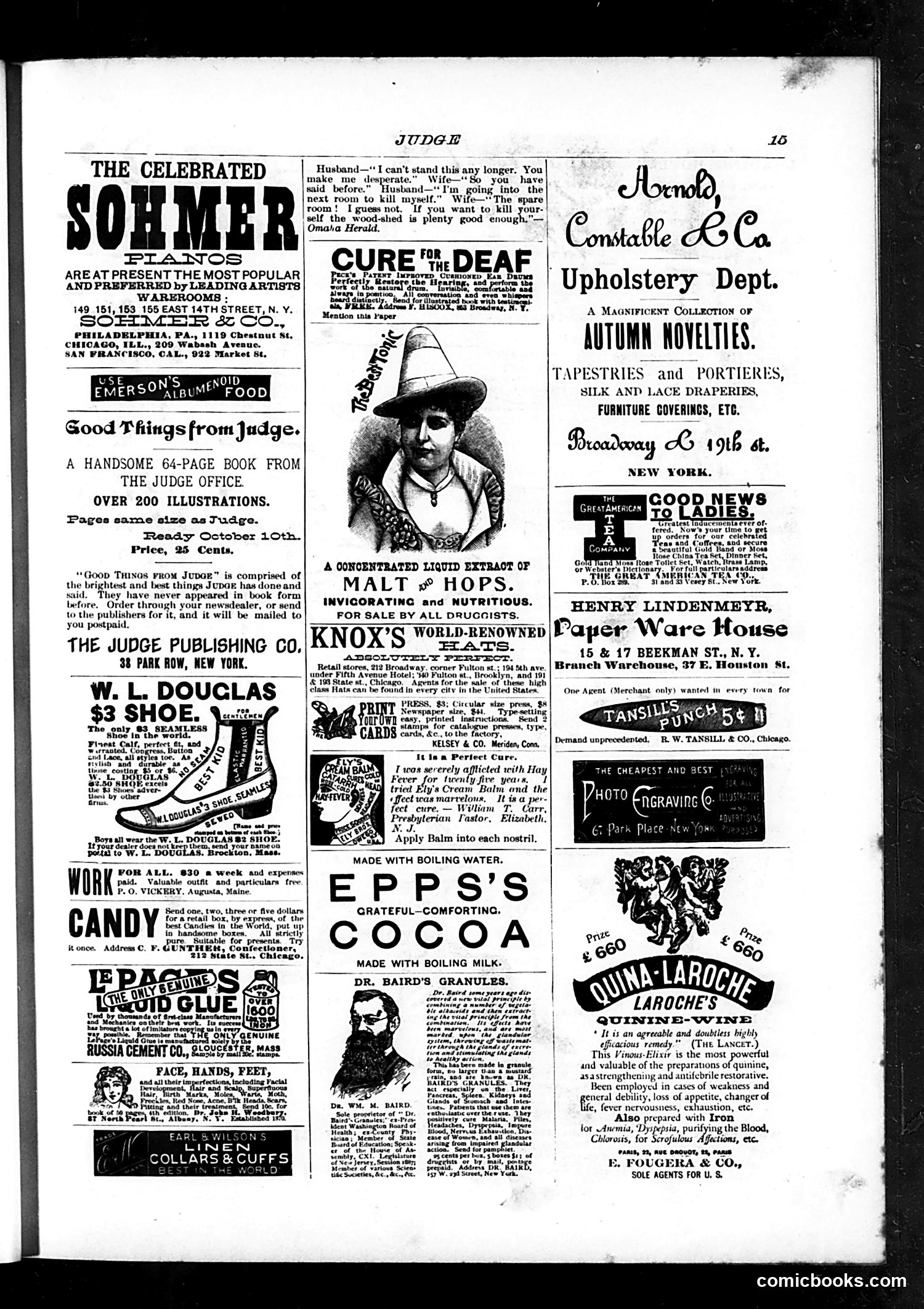
This is primarily an **advertising page** from *Judge* magazine, with one small satirical joke at the top. The one cartoon is a brief domestic humor piece: a husband threatens suicide to escape his wife's nagging. When he mentions going to "the next room to kill myself," his wife dismissively replies the spare room isn't available—he should use the wood-shed instead. The joke plays on the wife's indifference and practical concern for household space over her husband's dramatic threats, typical of period marital satire. The rest of the page consists entirely of **advertisements** for products and services typical of the era: pianos, shoes, candy, printing supplies, hats, medicines (including quinine wine, cocoa, and various tonics and salves), upholstery, and paper goods. These ads reflect late-19th/early-20th-century consumer culture and the ailments people sought remedies for—hay fever, deafness, weakness, and digestive issues were common advertising subjects.
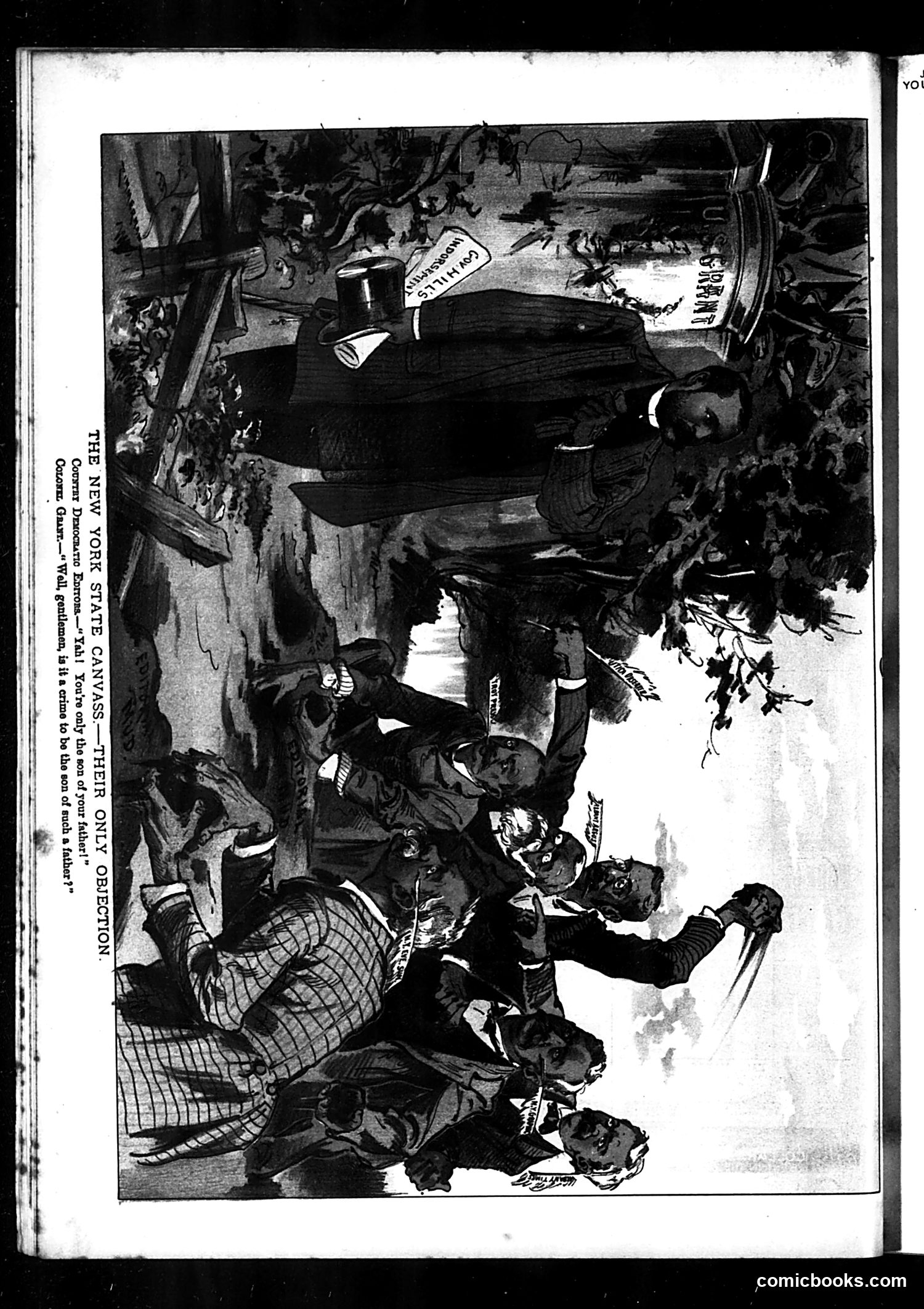
This cartoon satirizes Democratic objections to a candidate during New York State elections. The central figure appears to be a political candidate defending himself against criticism from Democratic editors (shown at left). The satire's point: Democrats are attacking the candidate solely based on his parentage—specifically, that he is "the son of your father"—rather than addressing his actual qualifications or positions. The candidate's defensive response ("is it a crime?") highlights the absurdity of this ad hominem criticism. The cartoon mocks Democratic campaigning tactics as petty and character-based rather than issue-focused. Without knowing the specific election date or candidate names from the image alone, the broader critique is clear: *Judge* magazine is ridiculing what it presents as unfair personal attacks masquerading as political discourse.