
A complete issue · 19 pages · 1887
Judge — September 17, 1887
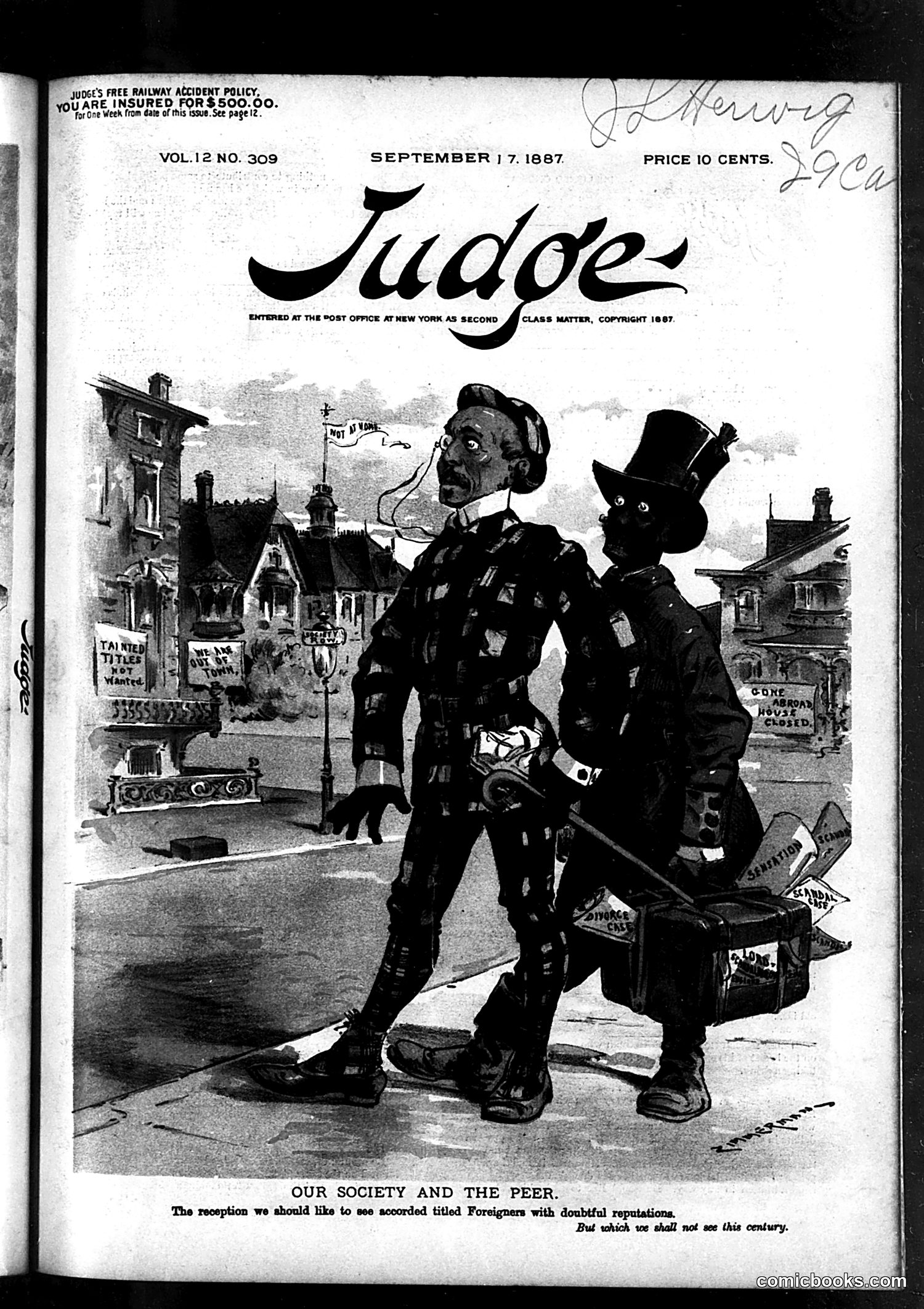
This September 17, 1887 Judge cartoon satirizes American social pretension regarding European nobility. The illustration shows two figures in military dress examining what appears to be a impoverished or disreputable foreign aristocrat in a urban British setting. Signs visible in the background reference "tailor," suggesting financial desperation. The caption's text—"The reception we should like to see accorded titled Foreigners with doubtful reputations. But which we shall not see this century"—critiques American society's tendency to fawn over European titles regardless of character or merit. The satire suggests Americans would never actually reject such figures, despite knowing their reputations are questionable, exposing American social climbing and deference to Old World hierarchy as hypocritical and misguided.
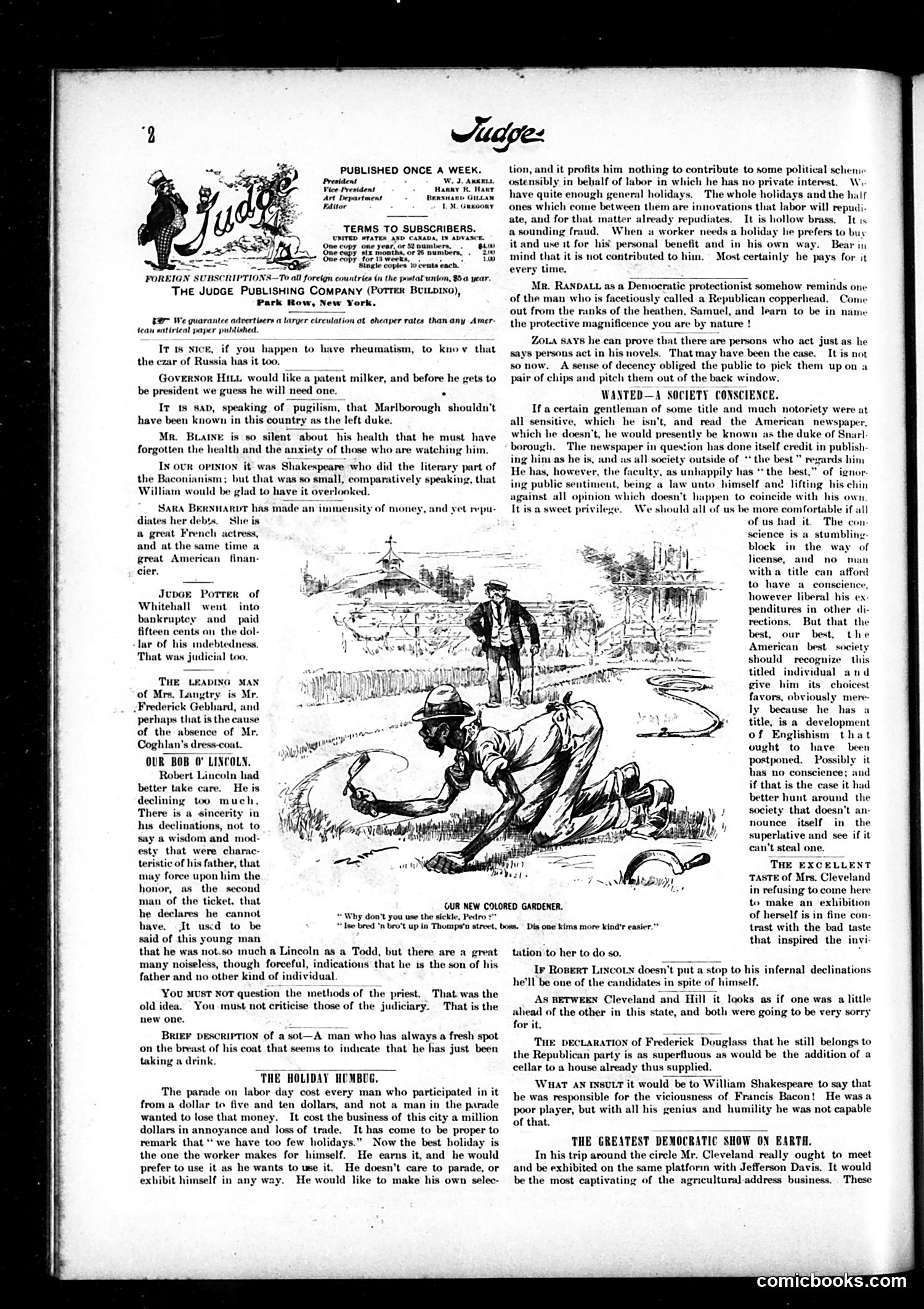
This page contains editorial commentary and one cartoon labeled "OUR NEW COLORED GARDENER," depicting a man digging or working in soil while another figure stands nearby with a cane. The text discusses various political figures and issues of the era, including references to: - The health of the Czar of Russia - Governor Hill and patent milkers - Marlborough's status - Sara Bernhardt's finances - Robert Lincoln's bankruptcy - Frederick Gebhardt - Robert Lincoln (referenced as "OUR BOB") - Cleveland's administration The cartoon appears to satirize labor or racial dynamics, though the specific historical context—whether referencing a particular scandal, employment practice, or political figure—is unclear without additional dating information. The overall page reflects late 19th-century American political satire addressing governance, labor issues, and public figures.
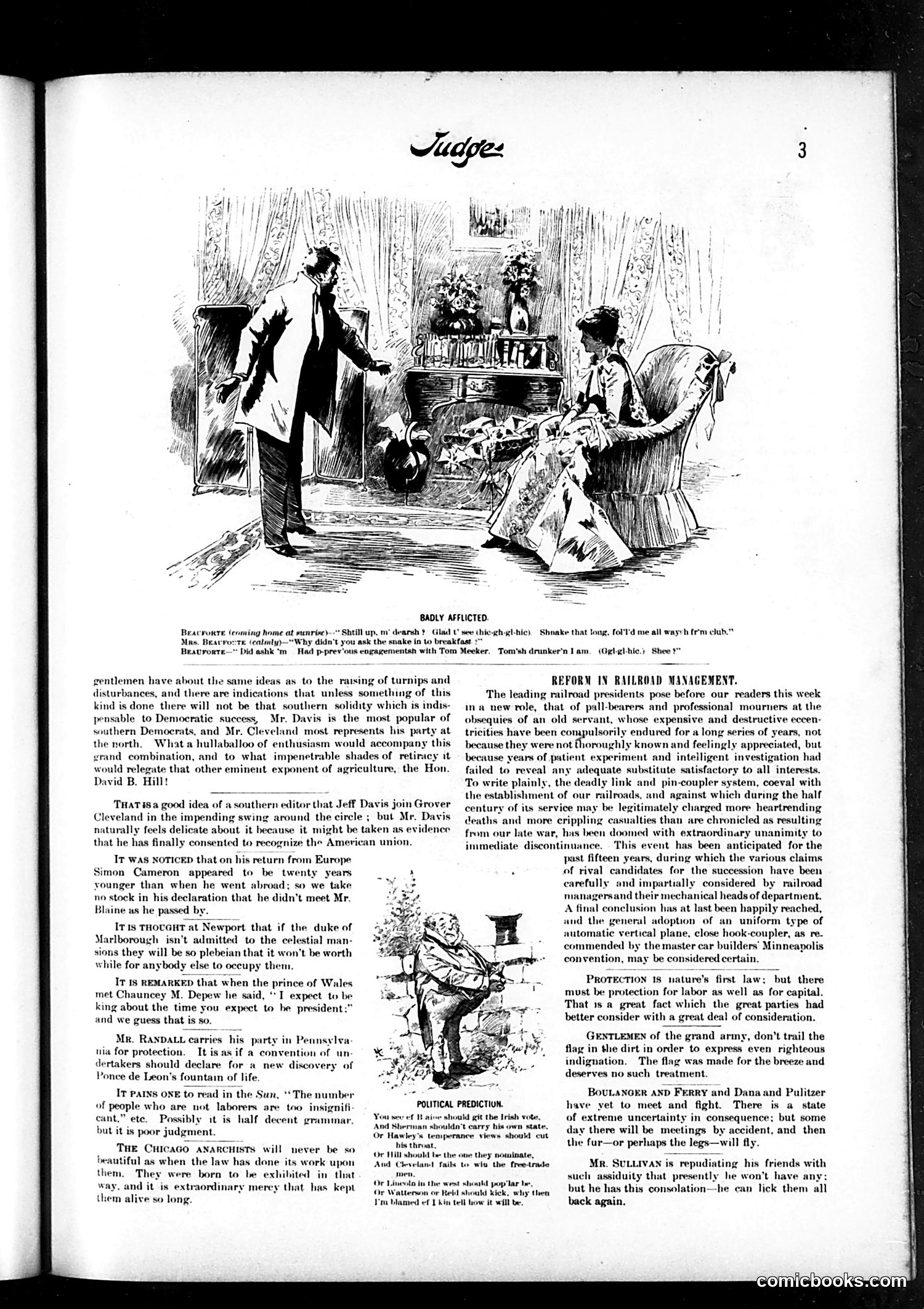
**Top Cartoon ("Badly Afflicted"):** A drunk man staggers home at dawn while his wife waits, furious. The caption jokes that he's "badly afflicted"—a satirical comment on marital discord. The humor targets both his drunkenness and her predictable anger. **Political Commentary:** The text discusses Democratic Party figures—Jeff Davis, Grover Cleveland, David B. Hill—suggesting political combinations and positioning for influence. It mocks the idea of Davis recognizing the American Union (implying Southern Democratic resistance to Reconstruction). **Other Jabs:** References to railroad monopolists posing as "mourners" for the defunct link-and-pin coupling system (an old, dangerous railway technology finally being abandoned), Simon Cameron's suspicious youthfulness, and anarchists executed in Chicago (the 1887 Haymarket executions). The page satirizes late-1880s political alignments, Democratic factionalism, industrial safety reforms, and social hypocrisies—typical Judge content mixing domestic humor with partisan commentary.
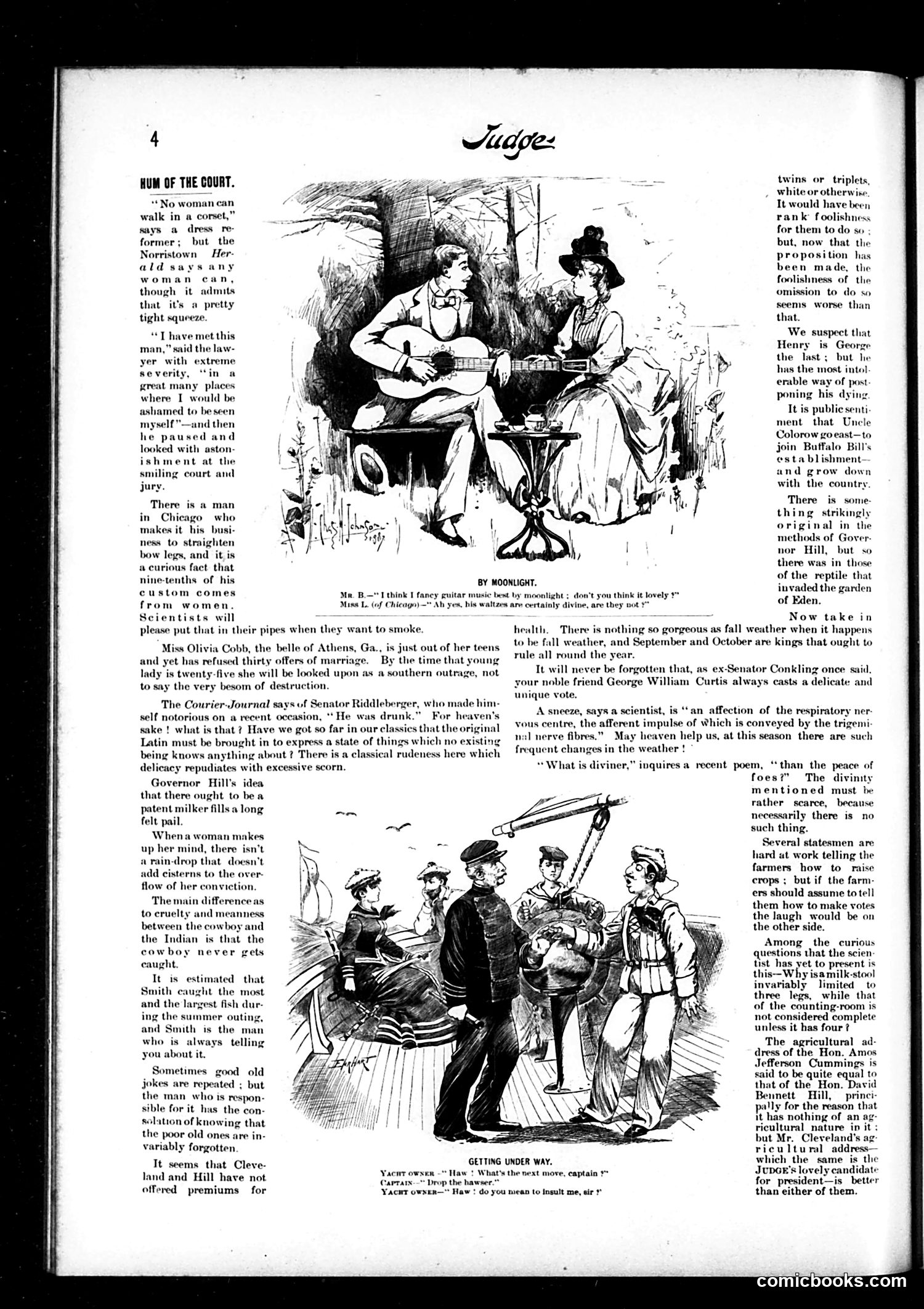
This page contains several brief satirical pieces typical of Judge's social and political humor: **Main Cartoons:** - "By Moonlight" depicts a couple playing guitar, with commentary on romantic music preferences - "Getting Under Way" shows men with a telescope, likely satirizing nautical or observational pursuits **Textual Satire:** The "Hum of the Court" section mocks various topics: women's fashion (corsets), a Georgia belle rejecting suitors, Senator Riddleberger's drunkenness, and Governor Hill's policies. References to Cleveland and Hill suggest 1880s-90s politics. The piece on "Uncle Colorow" joining Buffalo Bill's show references Native American representation in popular entertainment of that era. **Overall Tone:** Light social commentary on contemporary manners, politics, and gender relations—typical Judge fare mocking pretension, fashion absurdities, and political figures through brief anecdotes and observations rather than heavy-handed editorial cartoons.
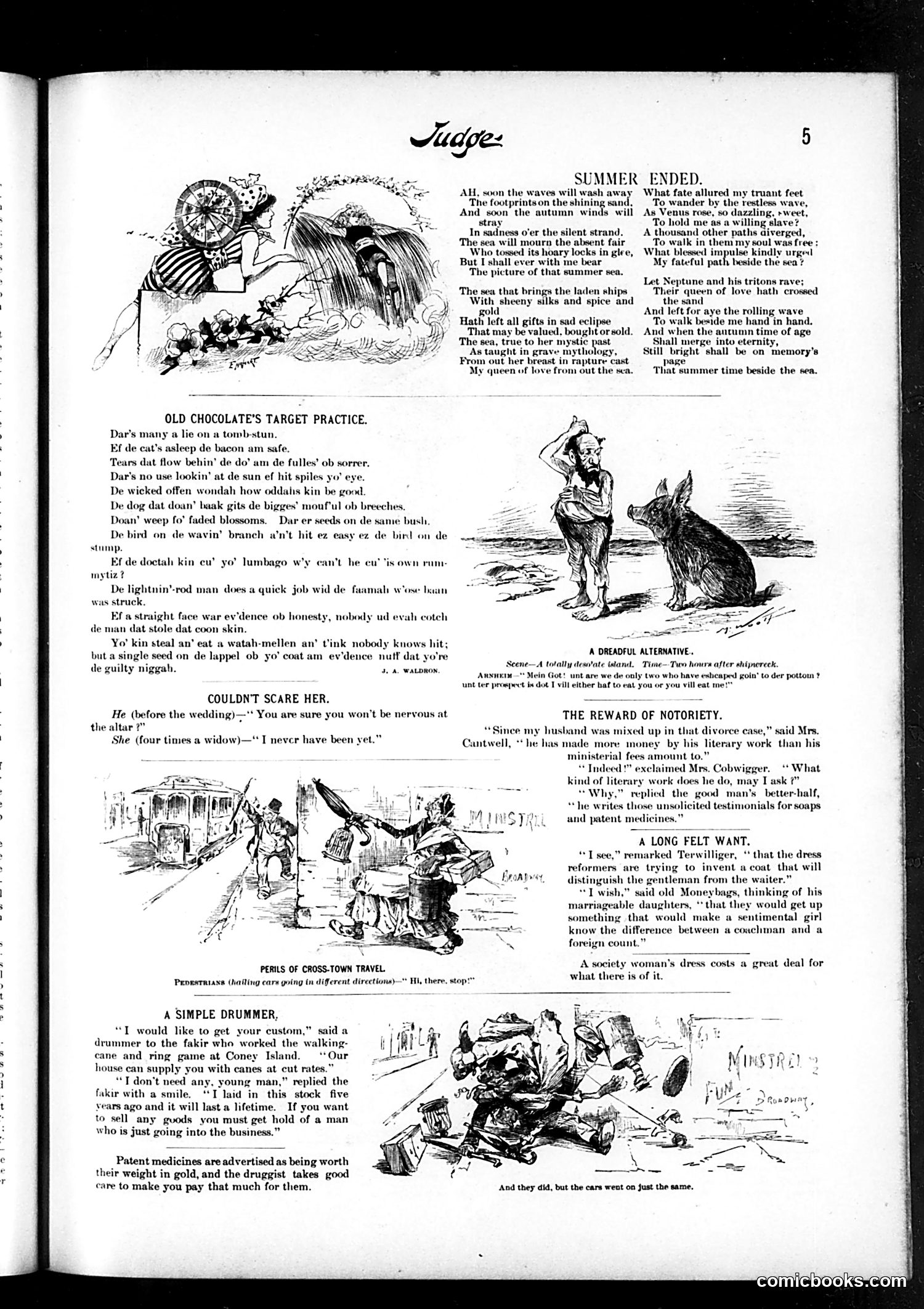
This page contains several satirical pieces typical of late 19th/early 20th-century American humor: **"Old Chocolate's Target Practice"** presents racist dialect humor—a collection of pseudo-philosophical sayings attributed to an African American character. This reflects the era's deeply offensive minstrel tradition common in American publications. **Other short jokes** mock common social types: a widow marrying repeatedly ("Couldn't Scare Her"), traveling salesmen, and a con artist ("Simple Drummer") who admits his shell-game equipment lasts forever because victims keep replacing theirs. **"The Reward of Notoriety"** satirizes ministerial hypocrisy—a clergyman gains wealth through fraudulent testimonials for patent medicines rather than legitimate clergy work, commenting on both advertising deception and clergy corruption. **"A Long Felt Want"** jokes about dress reform debates, suggesting reformers want clothing distinguishing gentlemen from waiters—mocking both class anxiety and the women's dress-reform movement. The page emphasizes Judge's focus: satirizing fraud (patent medicines, con games), social pretension, and contemporary controversies, particularly regarding morality and commercial deception.
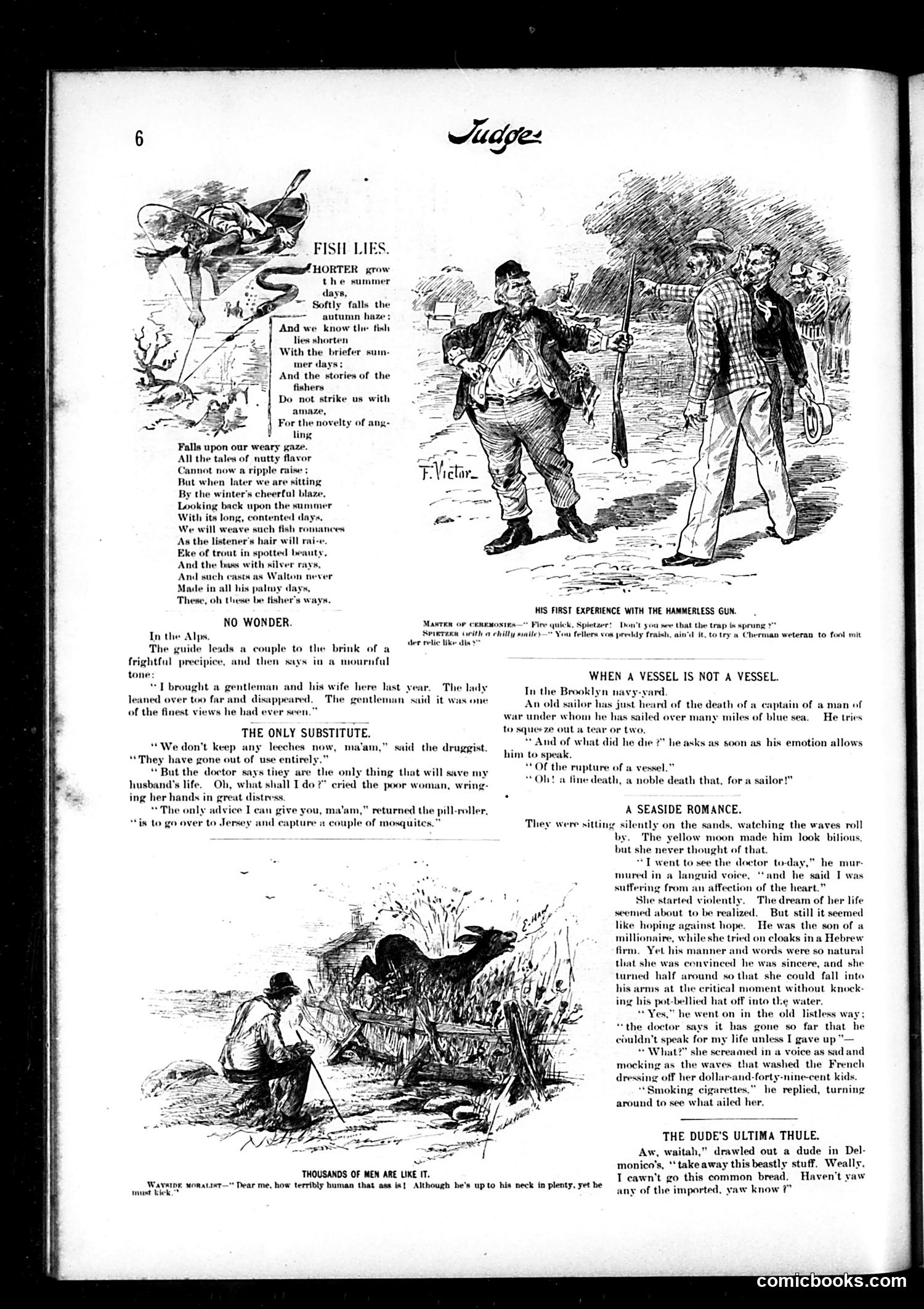
This page contains multiple short comic pieces satirizing American social types and behaviors circa the 1880s-1890s. **"Fish Lies"** mocks fishermen's exaggerated tall tales, suggesting their stories shrink with the fishing season—a timeless joke about angler credibility. **"The Only Substitute"** ridicules a druggist's absurd suggestion to catch mosquitoes instead of leeches for medical treatment, satirizing both quack medicine and commercial corner-cutting. **"When a Vessel Is Not a Vessel"** plays on language: a sailor mourns a captain's death by "rupture of a vessel," only to learn it meant a blood vessel, not a ship—deflating his romantic notions of seafaring death. **"A Seaside Romance"** punctures sentimentality: a wealthy man's confession of heart trouble turns out to be about cigarette smoking, disappointing the working-class woman hoping for romantic drama. **"The Dude's Ultima Thule"** satirizes pretentious wealth: a dandy at Delmonico's (an elite restaurant) snobbishly demands imported bread, mocking affectation and wastefulness among the rich.
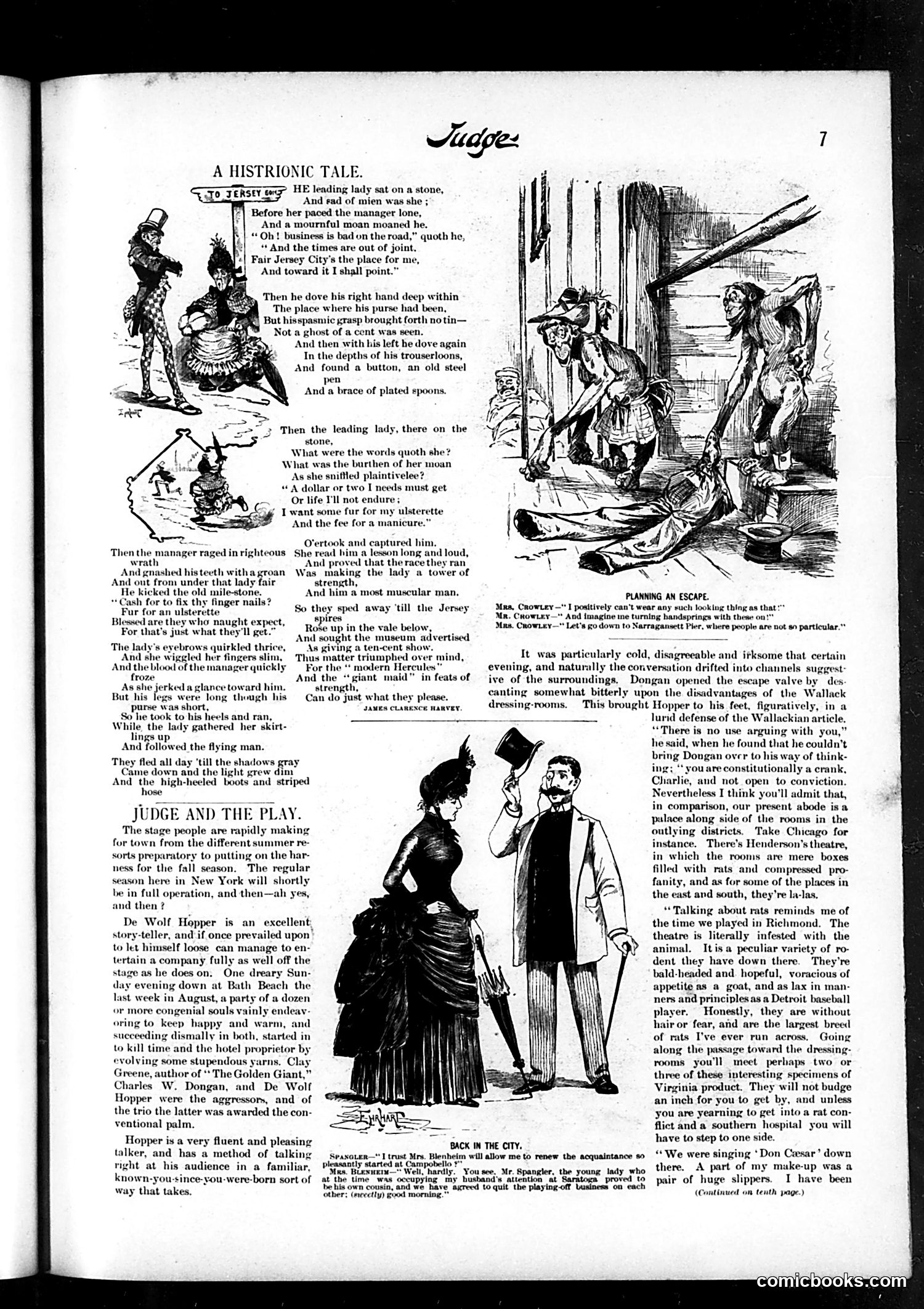
This page contains theatrical satire typical of Judge magazine's entertainment coverage. "A Histrionic Tale" mocks struggling theater troupes and financially desperate actors during the off-season. The narrative poem describes a penniless manager and leading lady touring Jersey City—a low-prestige venue—who engage in farcical desperation when funds run dry. The humor derives from the exaggerated melodrama of their plight (the manager literally runs away when the actress demands money for fur trim and manicures). "Judge and the Play" discusses De Wolf Hopper, a famous actor-comedian of the era, recounting stories at a summer gathering. The accompanying cartoons satirize theatrical life: actors' financial instability, shabby provincial venues infested with rats, and the absurd social dynamics of theater people. References to specific playhouses suggest these were recognizable to Judge's educated, urbane readership who followed theatrical gossip. The satire targets theater's pretension and impoverishment simultaneously—performers demanding luxuries while literally penniless.
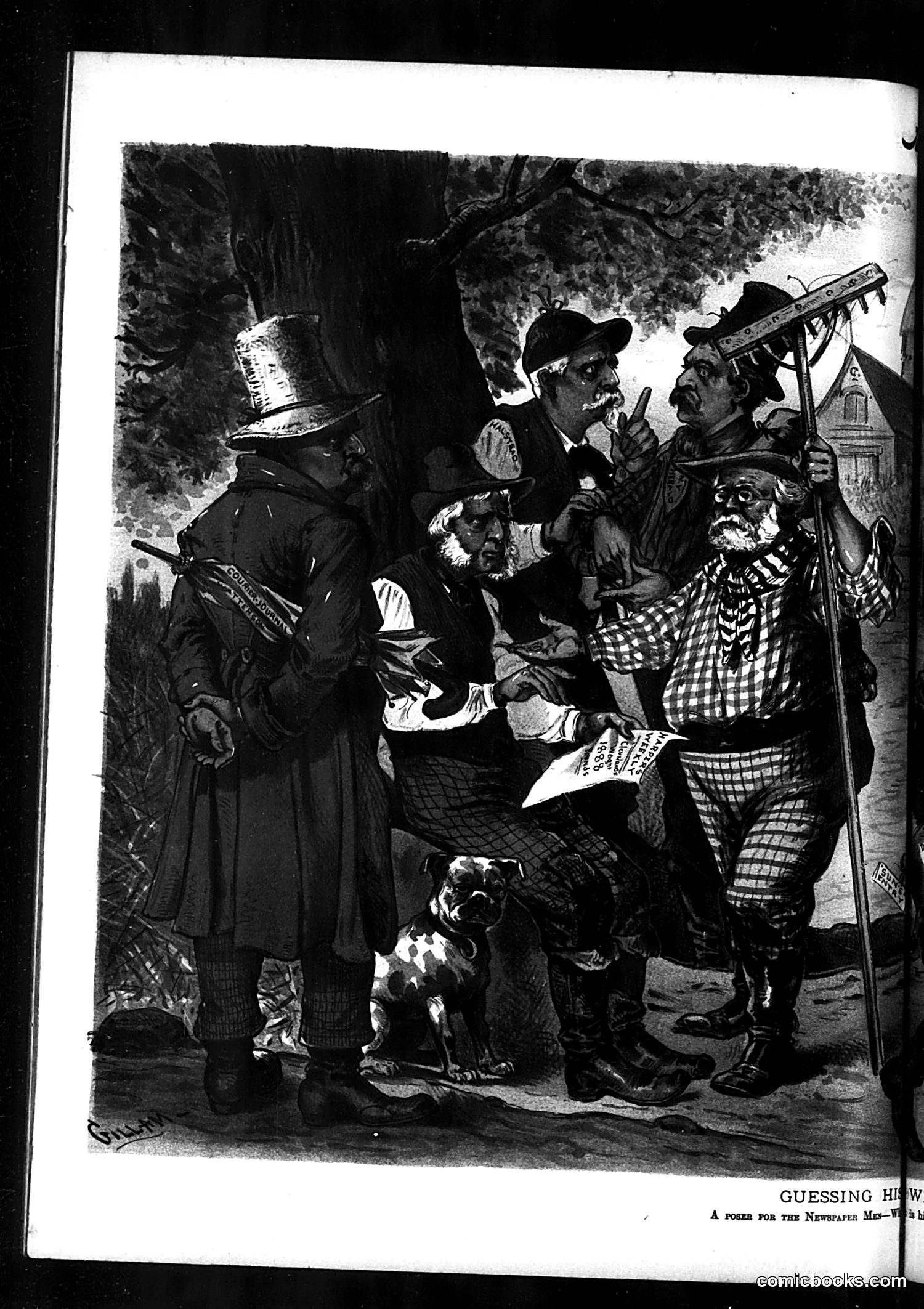
This satirical cartoon depicts several men in period clothing (appearing to be 19th century) in heated discussion outdoors. The caption indicates this is "a poser for the newspaper men"—meaning a puzzling question or challenge for journalists. The figures appear to be political or public figures engaged in debate or negotiation, likely commenting on contemporary news coverage. One man wears a distinctive metallic hat (possibly military or official dress), while others sport period attire including checked patterns and formal wear. A small dog is present in the scene. Without clearer identification of the specific individuals or the exact historical moment referenced, the precise political commentary remains unclear. However, the satire appears to mock journalists' difficulty in determining or reporting on some ambiguous situation or statement made by public figures of the era.
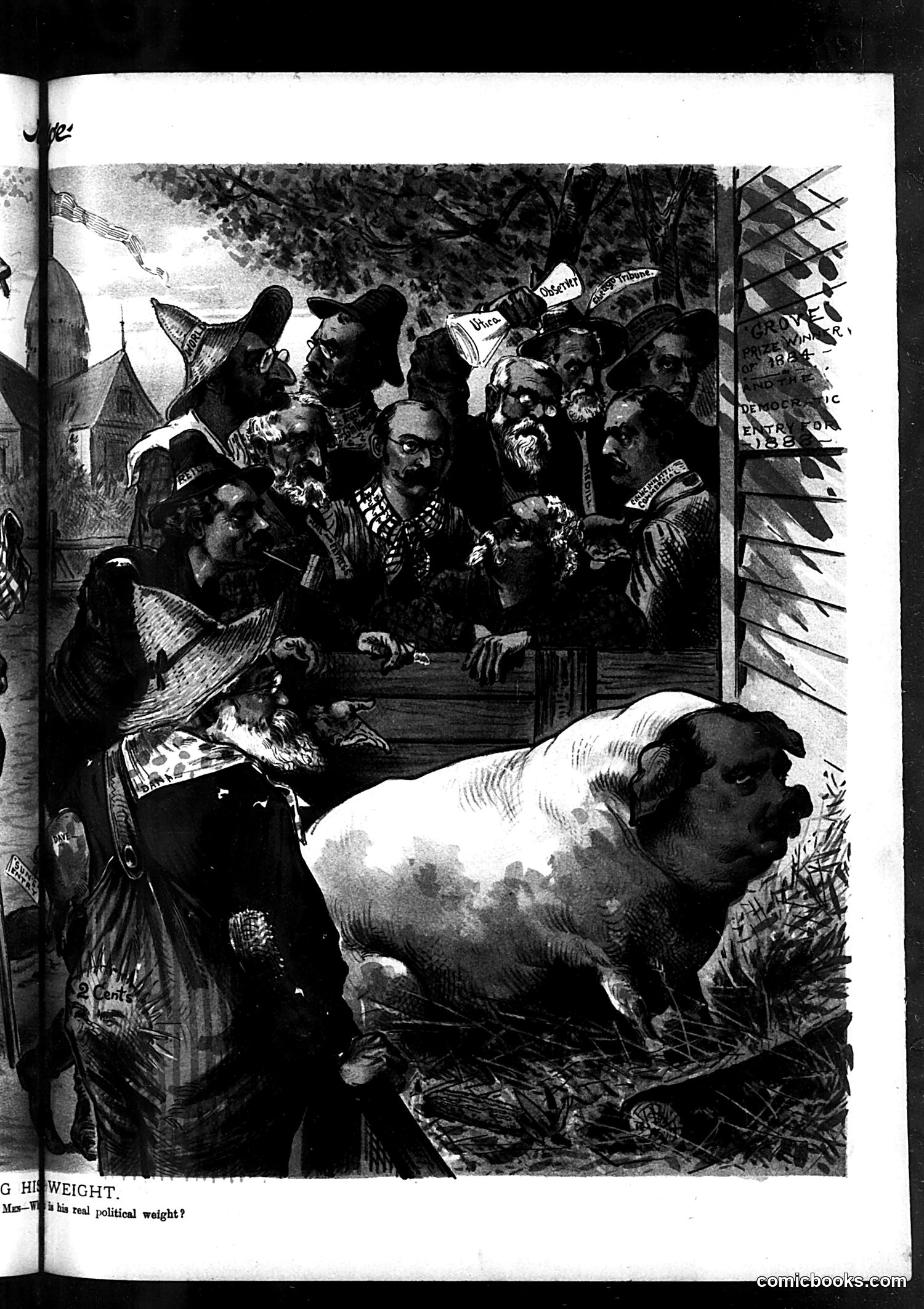
This Judge magazine cartoon satirizes political influence through a weighing metaphor. A large pig is being weighed while a group of well-dressed men in military uniforms and formal attire observe. The caption asks "Has real political weight?" — suggesting the pig represents a political figure or policy whose actual influence is being questioned or mocked. The elaborate dress uniforms and formal setting indicate these are likely government or military officials. The cartoon implies that despite appearances of importance or official backing, the subject lacks genuine political substance or power — it's all show, no weight. The specific figures and historical context remain unclear without additional publication date information.
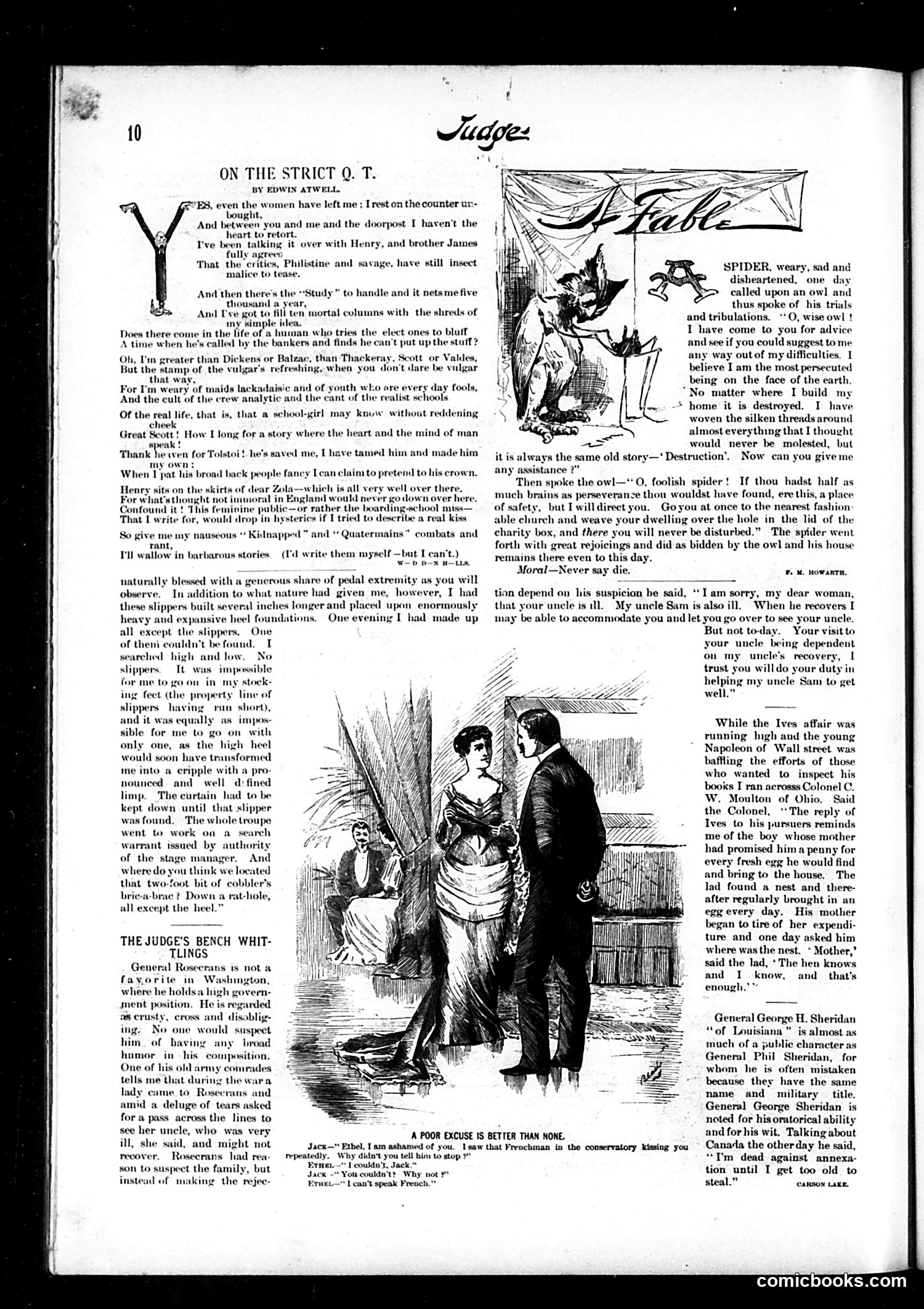
This page from *Judge* contains several distinct satirical pieces typical of the magazine's format: **"On the Strict Q.T."** is a lengthy essay-complaint by a fictional writer lamenting his artistic compromises—he's forced to write commercial drivel instead of serious literature. He name-drops literary giants (Tolstoi, Zola, Dickens) he admires but cannot emulate while meeting commercial deadlines. The satire mocks pretentious writers who blame their audience rather than accepting market realities. **The illustrations** show domestic and social scenes from the era, including one labeled "A Poor Excuse Is Better Than None" depicting a couple discussing a Frenchman kissing in a conservatory—a joke about infidelity and French stereotypes. **"The Judge's Bench Whittlings"** recounts an anecdote about General Rosecrans (a Civil War figure) denying a woman a pass to visit her sick uncle, suspecting deception. The humor lies in his crusty reputation being validated by shrewd judgment. **"The Spider and the Owl"** is a fable where a spider seeks the owl's advice about constant destruction of his webs—likely social commentary on futility or persecution. The page reflects *Judge's* mix of literary satire, social humor, and moral tales.
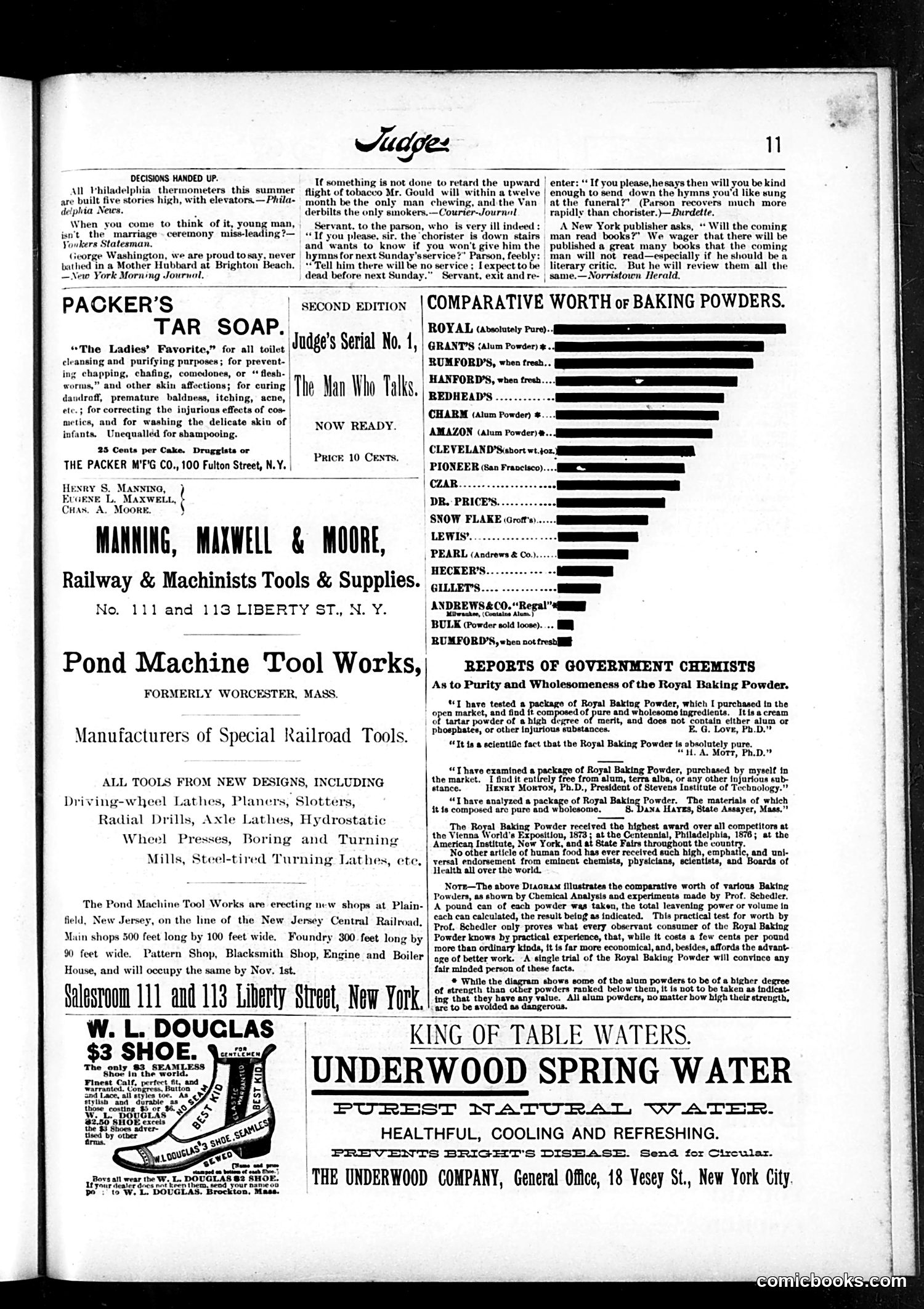
This page is primarily **advertising and filler content** rather than political satire. The top section contains brief humorous observations from various newspapers—what we'd call "jokes of the day": - Philadelphia thermometers being "five stories high" mocks the city's extreme summer heat - A joke about marriage being "misleading" (unclear without more context) - A jab at Jay Gould's wealth, suggesting he'll monopolize even tobacco consumption - Religious humor about a parson requesting funeral hymns The bulk of the page consists of **product advertisements** for industrial tools, soap, shoes, and notably **baking powder**—with "Royal Baking Powder" prominently featured alongside government chemist endorsements claiming its purity and superiority over competitors like Grant's, Rumford's, and others shown in a comparative bar chart. This appears to be a typical 19th-century magazine page mixing light satire, local news humor, and commercial advertising rather than sustained political commentary.
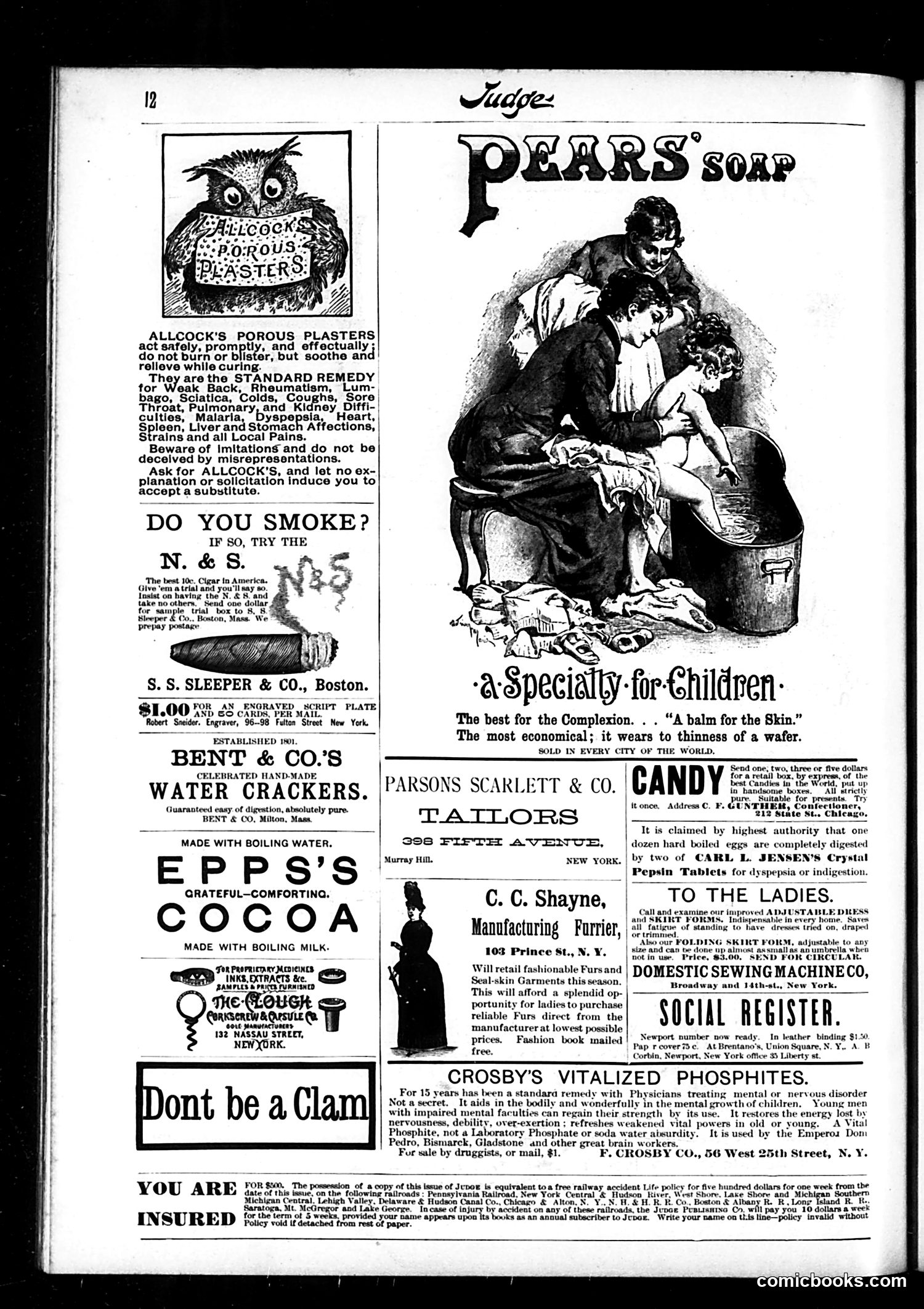
This page is **primarily advertisements** with no political cartoon content. It showcases late 19th-century patent medicines and consumer products typical of the era. Notable ads include: - **Allcock's Porous Plasters**: A medical "cure-all" claiming to treat rheumatism, colds, kidney problems, and numerous other ailments—representing the unregulated patent medicine industry that flourished before FDA oversight. - **Pears' Soap**: Marketed as "a specialty for children" with dubious health claims about complexion and skin. - **Crosby's Vitalized Phosphites**: Another patent remedy claiming to treat mental disorders, nervousness, and debility, endorsed by famous figures like Bismarck and Gladstone (likely falsely). - **Various food products** (cocoa, water crackers, candy) and services (tailoring, furriers, sewing machines). The page illustrates how Judge's revenue came from advertising such products, many making exaggerated or false medical claims—a common practice before modern consumer protection laws.
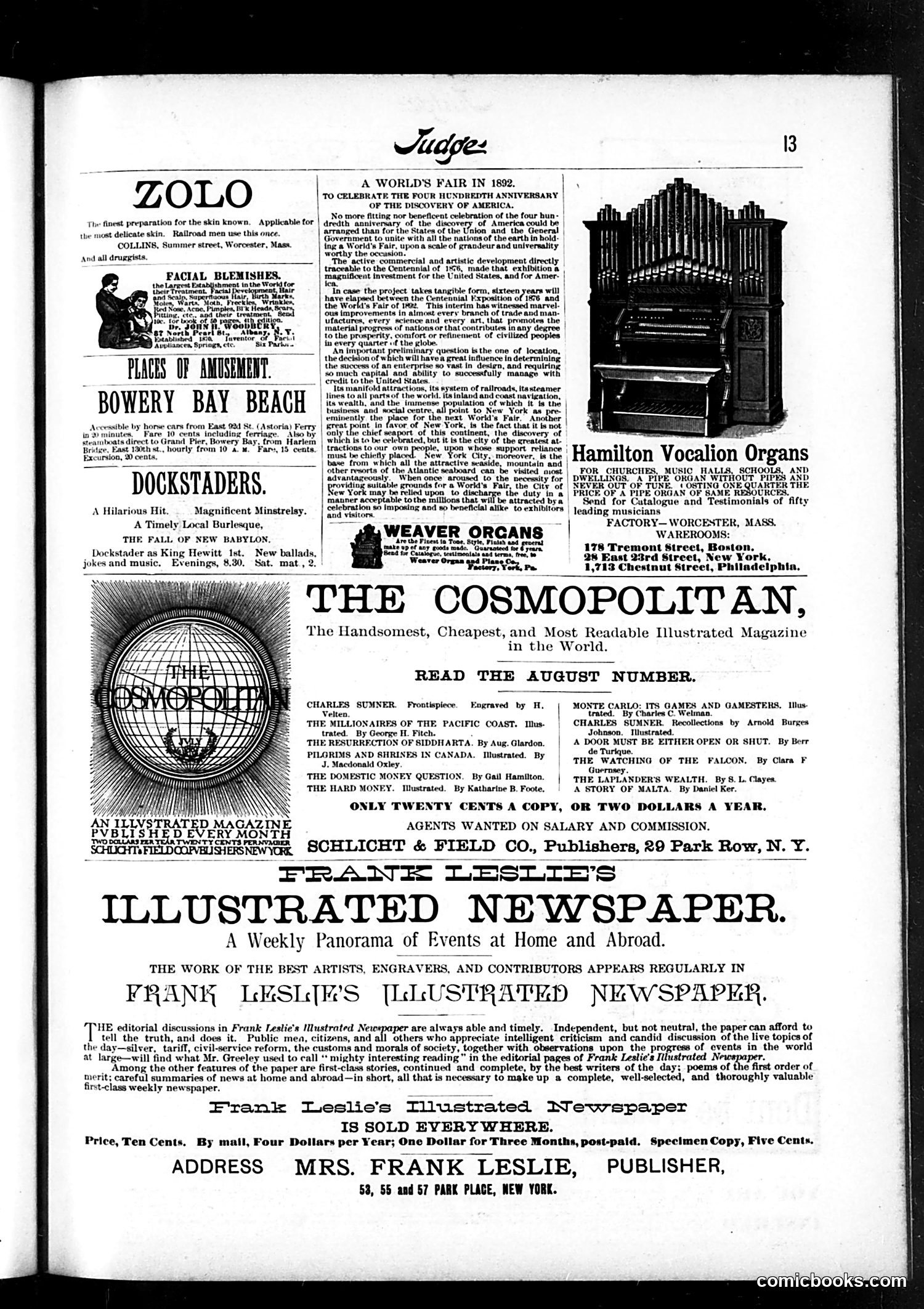
This is primarily an **advertising page** from Judge magazine (page 13), with minimal actual editorial cartoon content. The page showcases various commercial advertisements for products and services typical of 1892. The substantive editorial content is a long article arguing that **New York City should host the 1892 World's Fair** celebrating Columbus's discovery of America. The text emphasizes New York's advantages: superior transportation infrastructure (railroads and steamship lines), population size, and status as "the chief seaport of this continent." The **advertisements** include remedies for skin conditions, organ manufacturers, beach resorts, and theatrical productions like "The Fall of New Babylon" minstrel show. The page demonstrates Judge's dual function: providing satirical political commentary alongside commercial promotions. However, this particular page leans heavily toward business advertising rather than satire or political cartooning.
This page is primarily **advertising**, containing no visible political cartoons or satirical content. It consists entirely of hotel listings organized by city (New York City, Albany, Boston, Philadelphia, Baltimore, etc.) and a business index featuring commercial establishments like the Belcher Mosaic Glass Company and various service providers. The page represents the magazine's commercial revenue model—advertisements subsidized editorial content. The hotels advertised range from luxury establishments (Fifth Avenue Hotel, Palmer House) to mid-range accommodations, reflecting Judge's readership among middle and upper-class Americans of the 1880s. The business index entries note quality credentials ("first-class," "fire-proof"), typical marketing language for the era. There is **no political satire, no caricatures, and no identifiable public figures** on this page—it is simply a commercial directory dressed in the magazine's format.
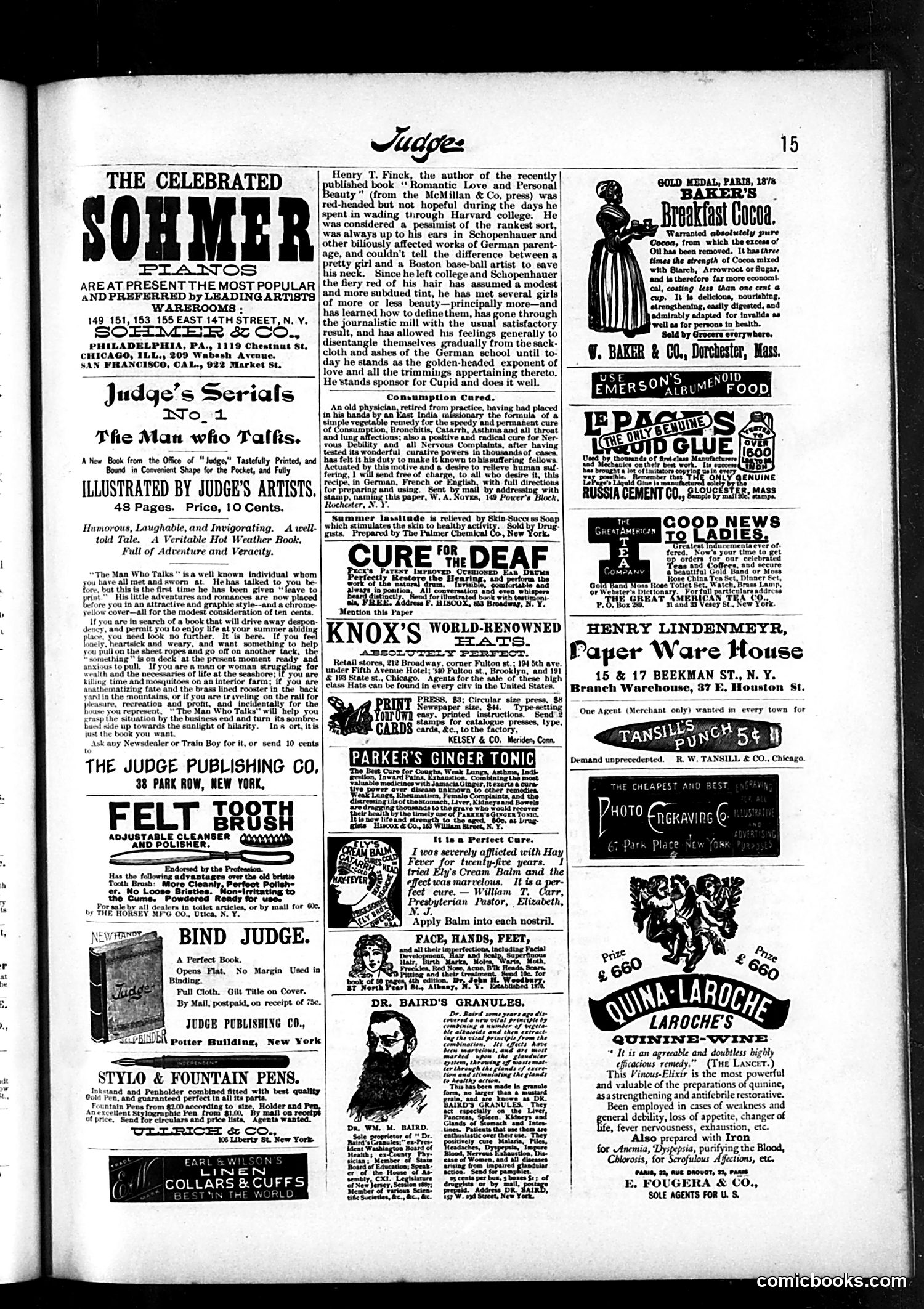
This page is primarily **advertising**, not editorial content or satire. It consists almost entirely of commercial notices for the Sohmer Pianos, Judge Publishing's books and binding services, patent medicines (Parker's Ginger Tonic, Knox's Tobacco), and miscellaneous products like fountain pens and brushes. The only notable editorial content is a brief biographical sketch of **Henry T. Finck**, a real author and music critic (the text references his book "Romantic Love and Personal Beauty"). The piece humorously traces his transformation from a gloomy, Schopenhauer-obsessed Harvard student into an optimistic advocate of love and beauty—suggesting personal maturation and a shift from German pessimism toward American romanticism. The satire is mild and autobiographical rather than political. This appears to be a typical **late 19th-century magazine page** where advertising revenue dominated the publication's content.
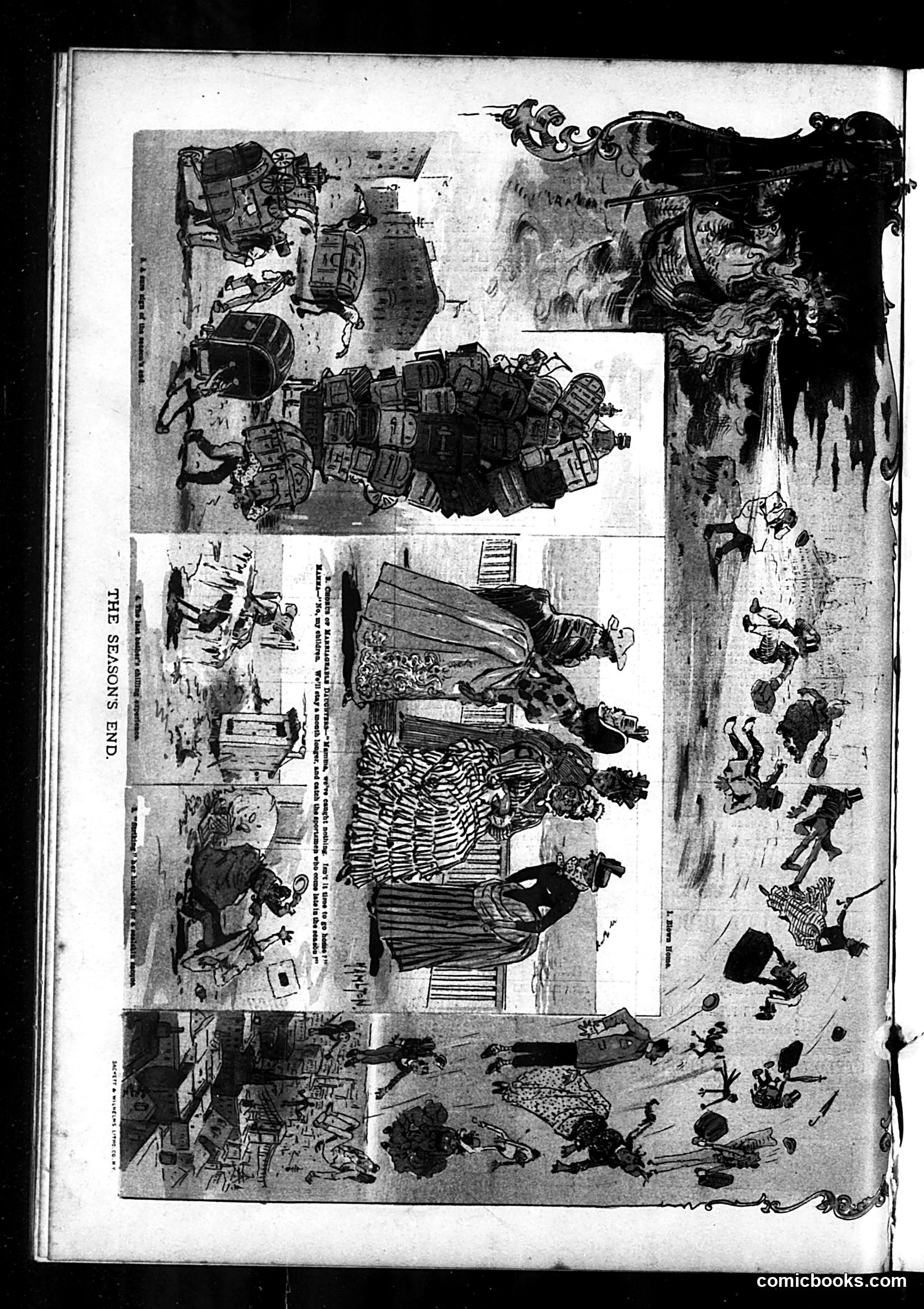
This Judge magazine page appears to depict the conclusion of a theatrical or social season through multiple vignette panels. The imagery shows various figures in period dress (appears to be late 19th or early 20th century) in different scenes of activity and disorder. The title "The Season's End" suggests satirizing the chaotic aftermath when the upper-class social season concludes—showing wealthy figures in disarray, possibly exhausted or caught in undignified moments. The multiple scenes likely contrast the refined pretenses of high society with the messy reality of their lives. Without clearer identification of specific figures or readable captions, the exact political targets remain unclear, though the satire appears directed at aristocratic pretension and social hypocrisy typical of Judge's editorial approach.
I cannot reliably read the OCR text on this page—it appears to contain only scattered letters and symbols without coherent words. The image itself is largely blank or extremely faded, with only faint ghosted impressions visible in the lower portion that are too unclear to identify as specific cartoon figures or content. Without legible text or clear visual elements, I cannot accurately identify the figures, political references, or satirical intent of any cartoon(s) that may have appeared on this page. This appears to be either a blank page, a heavily degraded scan, or a page from the magazine's preliminary materials.
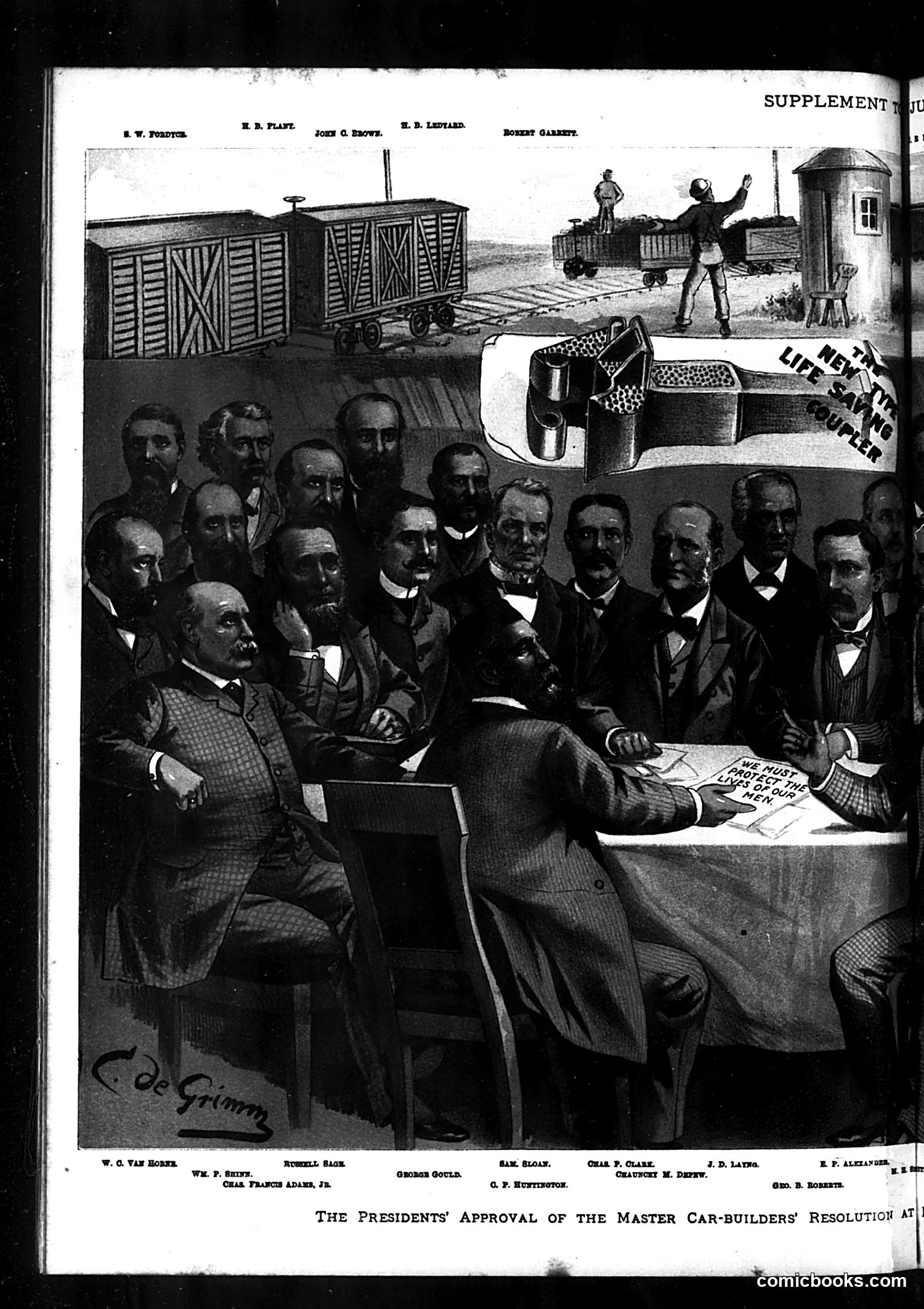
**Title:** "The Presidents' Approval of the Master Car-Builders' Resolution" **Subject:** This appears to satirize a meeting where railroad presidents or car manufacturers approve some industrial resolution. The main cartoon shows a group of formally-dressed businessmen gathered around a table reviewing documents. **The Satire:** The inset illustrations above—showing railroad cars, workers, and industrial equipment alongside what appears to be a "Life-Saving Lifter" device—suggest the cartoon mocks corporate approval of safety measures or labor reforms. The joke likely critiques how presidents *formally endorse* worker protections or industrial improvements while actual conditions remain dangerous. **Context:** Published in *Judge* (a satirical magazine), this targets Gilded Age railroad and manufacturing industries, which faced growing criticism over worker safety and labor practices during this era. **Note:** Without a visible date or clearer OCR of names, the specific resolution and historical moment remain unclear.
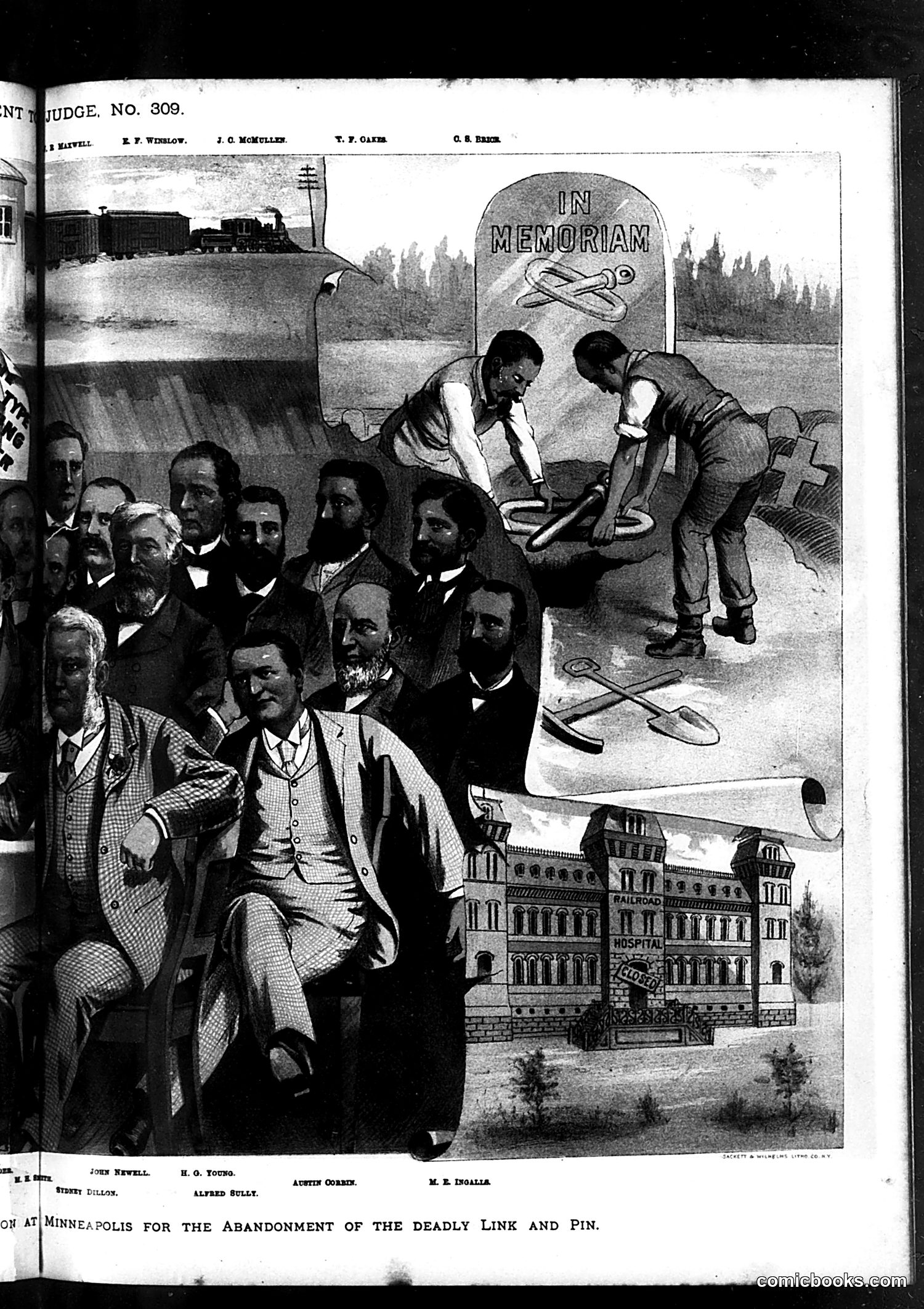
This Judge magazine cartoon satirizes a meeting in Minneapolis regarding railroad safety. The left panel shows well-dressed men (likely railroad executives and politicians) in discussion, while the right panel depicts two workers operating what appears to be a dangerous coupling device near a memorial marked "IN MEMORIAM" with a crossed wrench and hammer. The satire criticizes the "deadly link and pin"—a railroad coupling system responsible for numerous worker injuries and deaths. The contrasting imagery—comfortable executives on one side, dead workers memorialized on the other—highlights the human cost of unsafe industrial practices. The cartoon advocates for abandoning this dangerous technology in favor of safer alternatives. The named individuals appear to be Minneapolis civic or railroad figures involved in this safety debate, though specific identities require verification.