
A complete issue · 16 pages · 1887
Judge — August 20, 1887
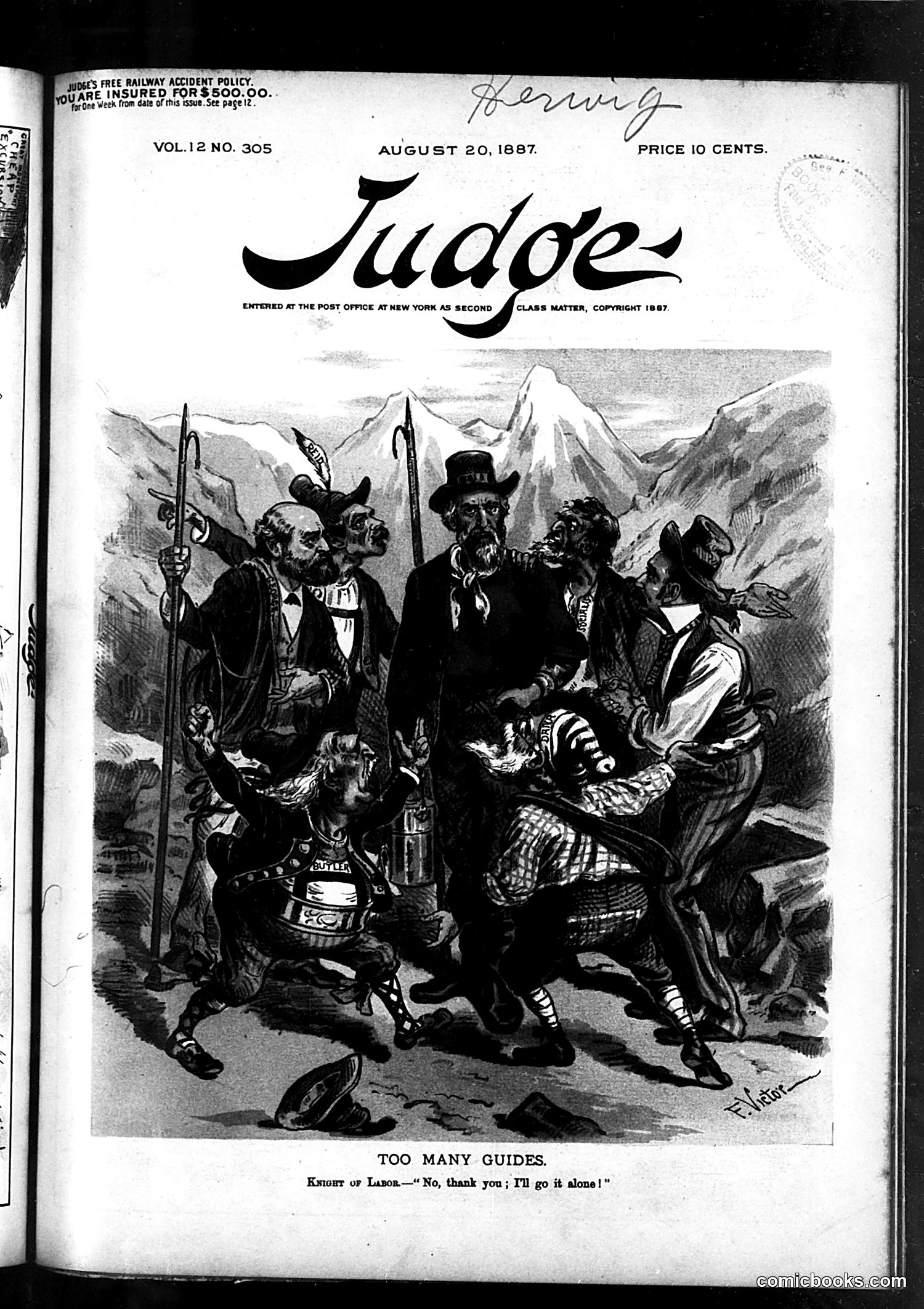
This political cartoon satirizes the "Knight of Labor," a central labor organization of the 1880s. The figure in the center (identifiable by his hat and central position) is surrounded by multiple advisors or guides in a mountainous setting, with the caption quoting him saying "No, thank you; I'll go it alone!" The satire criticizes the labor movement as being hampered by too many competing leaders or factions offering conflicting guidance. The cartoon suggests the Knight of Labor would be better served operating independently rather than following multiple advisors—likely referencing internal divisions within the labor movement during this turbulent organizing period. It's a critique of labor leadership fragmentation.
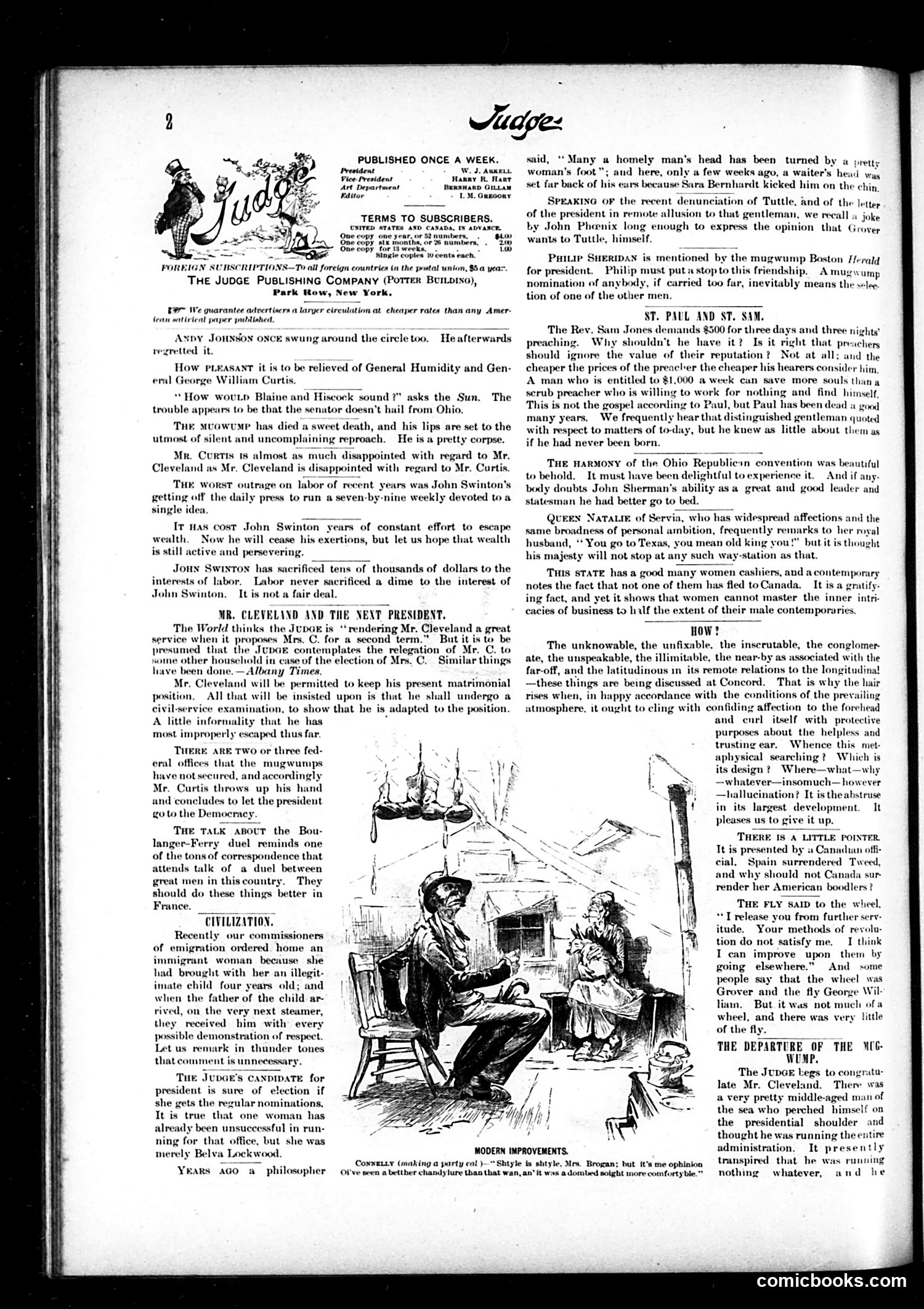
This page contains political commentary and satirical articles rather than a single cartoon. The main illustration depicts a domestic scene with multiple figures in what appears to be a modest home interior, labeled "MODERN IMPROVEMENTS." The text discusses Cleveland, suggesting this is from his presidency era. Articles reference "Mr. Curtis" and debates about Democratic vs. Republican politics. One section criticizes a woman immigrant's treatment and discusses her illegitimate child, reflecting late 19th-century attitudes toward poverty and immigration. The satire targets political figures' incompetence and moral failings—particularly around civil service reform and presidential appointments. References to "the Judge's candidate for president" suggest internal political maneuvering. The overall tone attacks Democratic administration policies and personnel decisions. Without clearer dating or additional context, specific figures remain uncertain, though the Cleveland administration period (1880s-90s) appears likely.
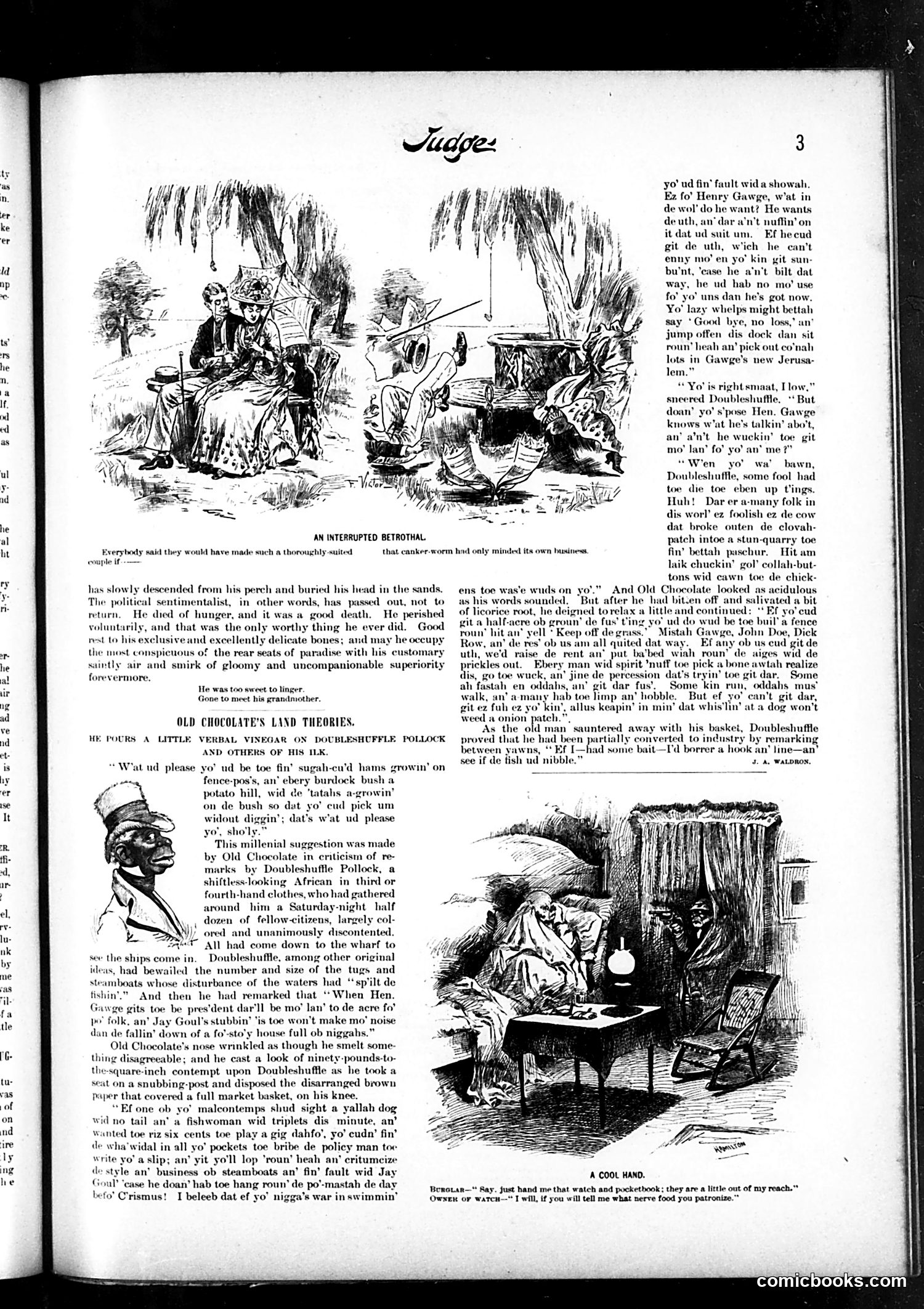
This page satirizes **Henry George's "Single Tax" land reform movement**, popular in late 19th-century America. The main cartoon "An Interrupted Betrothal" depicts two Black characters—**Old Chocolate and Doubleshuffle Pollock**—debating George's theories. Doubleshuffle, a shiftless laborer, idly suggests that under George's system, he'd have land and leisure. Old Chocolate mockingly counters that even with free land, lazy people like Doubleshuffle would fail: they'd build fences, work wouldn't suit them, and they'd remain poor regardless. The satire targets both **Georgism as impractical utopianism** and **working-class laziness**. By using African American dialect characters discussing economic theory, Judge ridicules the notion that systemic reforms alone could overcome individual idleness. The cartoonist argues personal industry matters more than land policy—a common conservative critique of George's single-tax proposals. The humor relies on period racial stereotypes and the irony of simplified laborers debating complex economics.
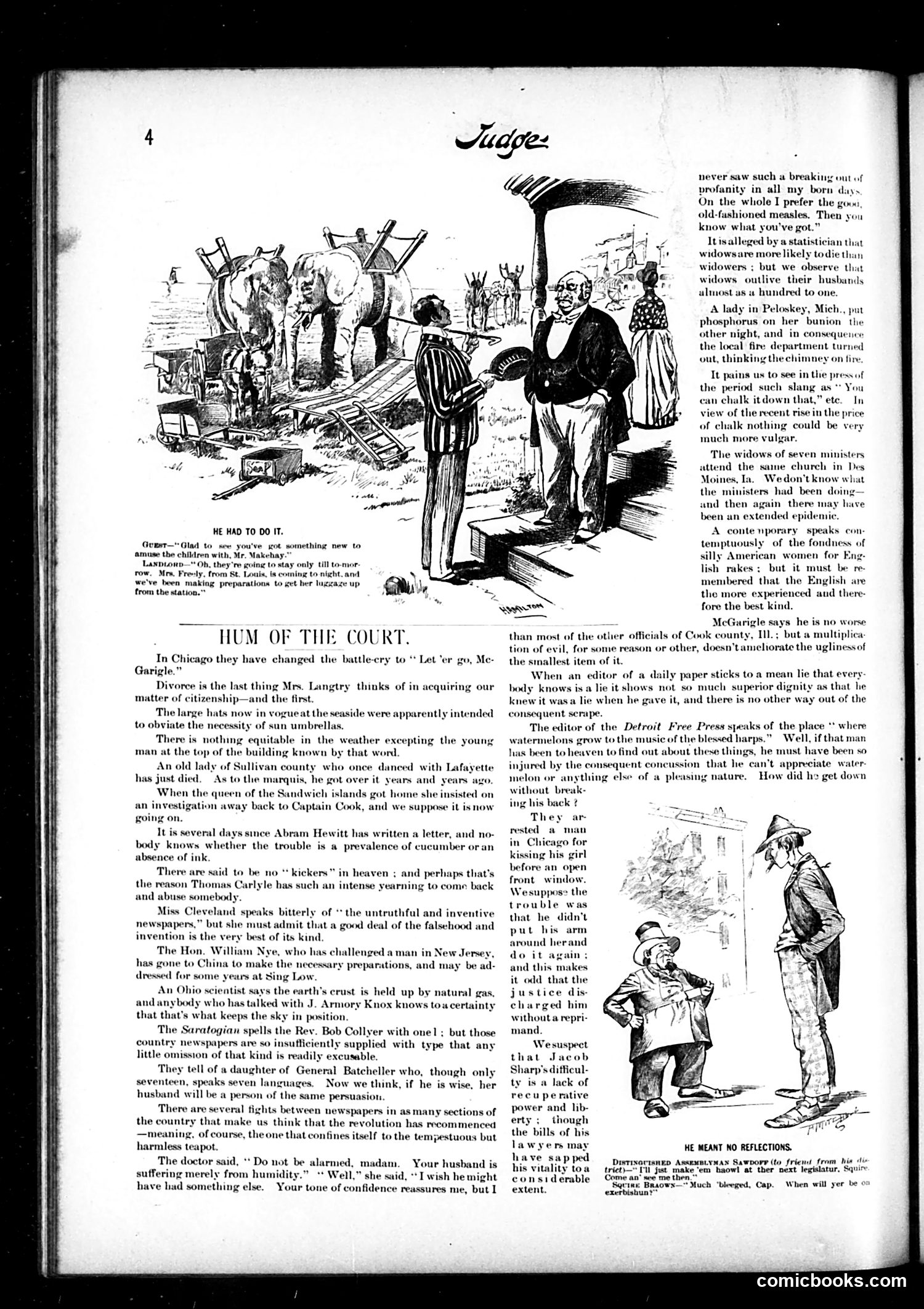
This page from *Judge* magazine contains satirical commentary disguised as casual gossip. The main cartoon, "He Had To Do It," depicts a landlord or innkeeper explaining to a guest that children staying with him must leave tomorrow because Mrs. Frevly from St. Louis is arriving—requiring the servants to fetch her luggage from the station. The satire mocks the elaborate preparations wealthy travelers demanded and the social hierarchies that prioritized them. "Hum of the Court" is a gossip column mixing trivial observations with sharper jabs. References include Mrs. Langtry (likely Lillie Langtry, the famous actress/socialite), McGarigle (appears to be a Chicago divorce case scandal), and various contemporary figures and absurdist observations about society. The column satirizes pretentious wealth, sensationalist journalism, and American social conventions through seemingly innocent anecdotes.
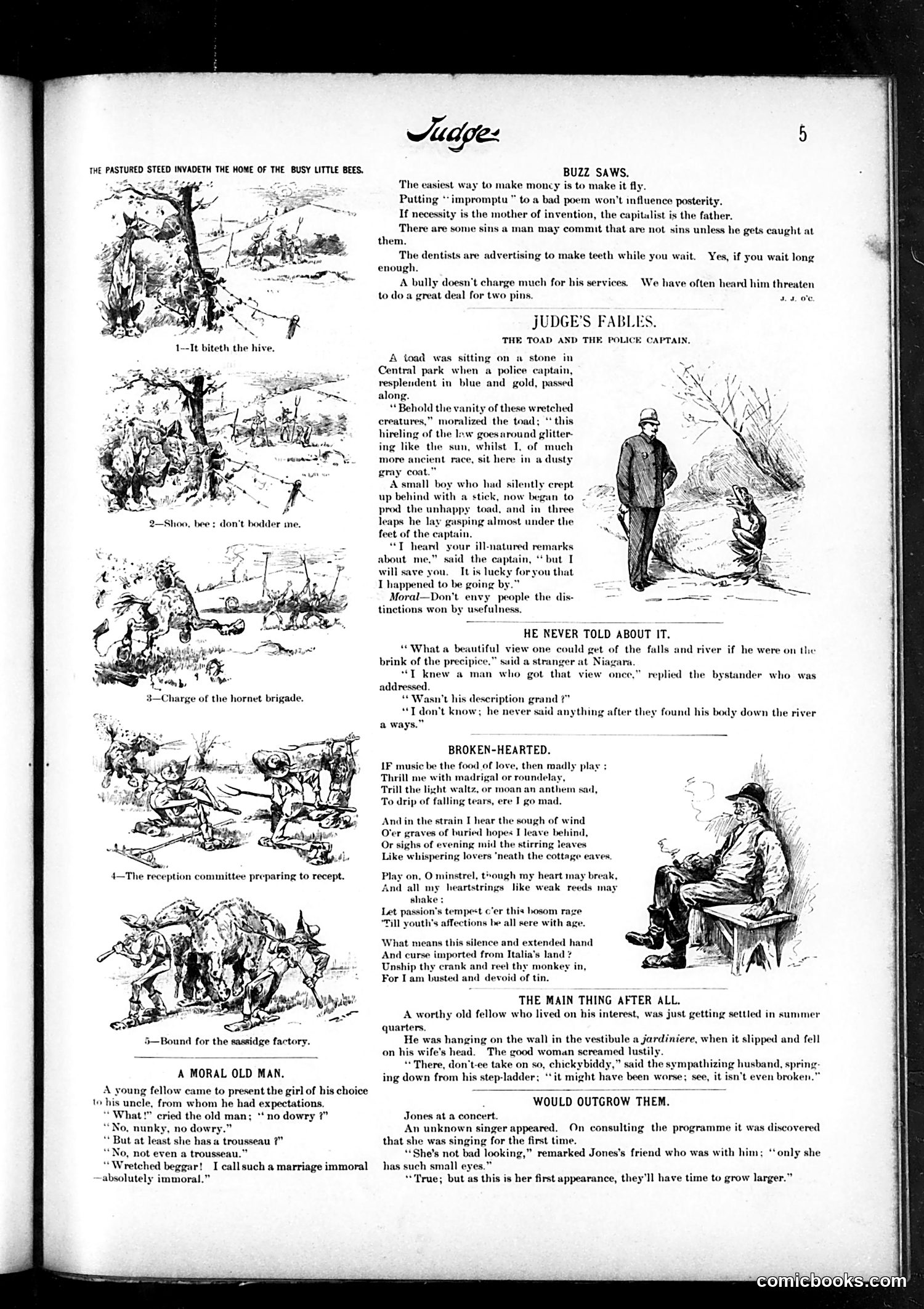
This page contains **short satirical pieces and moral fables** typical of Judge's humor circa late 1800s. **Key content:** 1. **"Buzz Saws"** — Brief aphorisms mocking human nature and commerce (dentists advertising, bullies' pricing, invention). 2. **"Judge's Fables"** — Moral tales: - *The Toad and Police Captain*: A toad envies the captain's uniform; a boy attacks it, the captain saves it. Moral: don't envy those with genuine accomplishments. - *He Never Told About It*: Dark humor about a man who admired Niagara Falls' view from the cliff edge—found dead in the river. 3. **"Broken-Hearted"** — Romantic verse about lost love, ending with a punchline: the narrator is financially ruined ("busted and devoid of tin"). 4. **"The Main Thing After All"** — Domestic humor: a husband reassures his wife a fallen vase "isn't even broken" (ignoring the irony). 5. **"Would Outgrow Them"** — A joke that a new female singer has small eyes, but she'll improve with experience. The illustrations support these pieces with period-appropriate wood-cut style drawings.
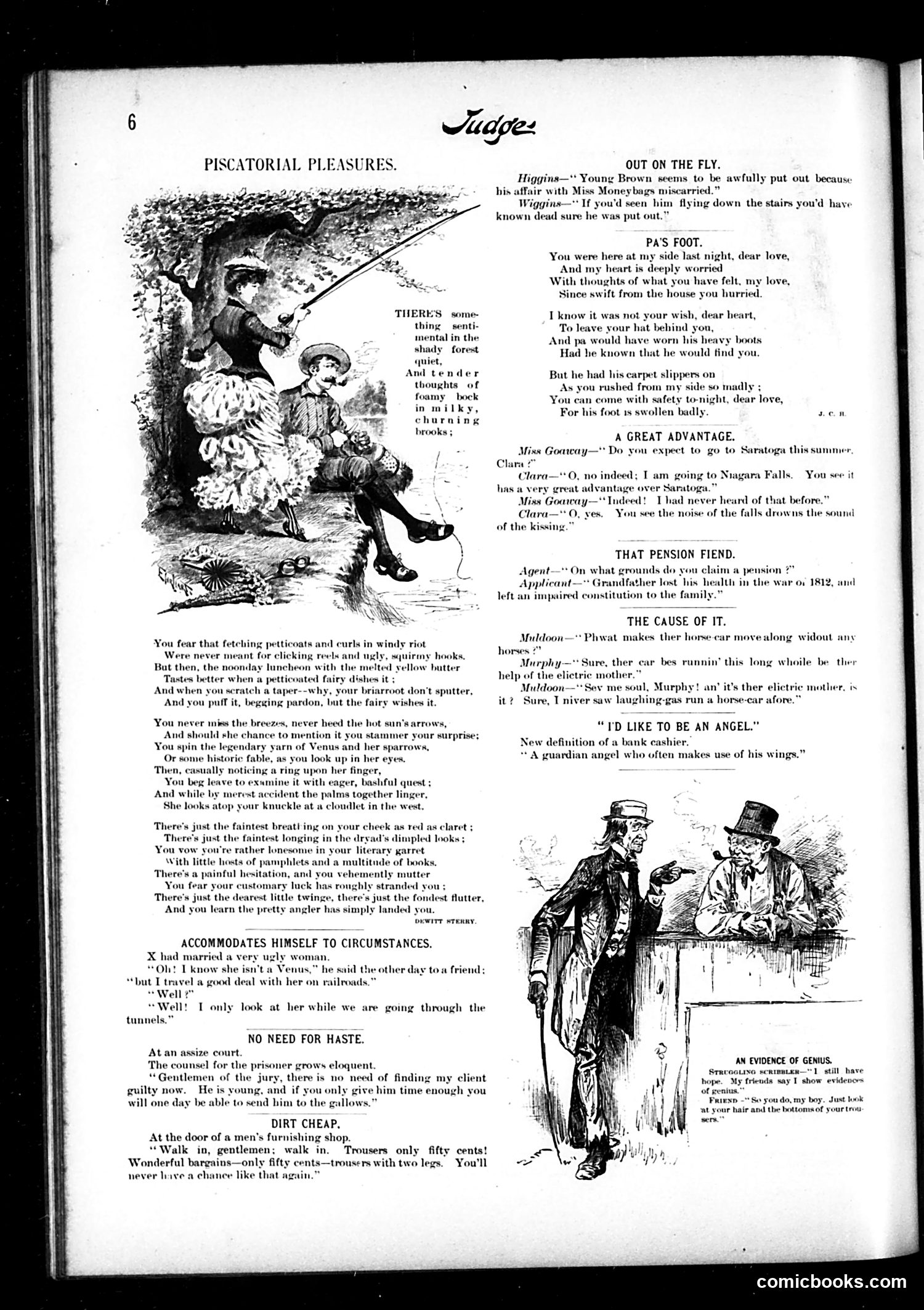
This page contains multiple brief humorous vignettes typical of late-19th century American humor magazines: **"Pa's Foot"**: A romantic poem where a young man visited his sweetheart, who left her hat behind. Her father wore carpet slippers (suggesting he stayed home unaware), and now has swollen feet—implying he discovered the visit and chased the suitor away. **"A Great Advantage"**: Two women discuss vacation destinations. One prefers Niagara Falls over Saratoga because "the noise of the falls drowns the sound of the kissin'"—mocking the romantic expectations women supposedly had. **"That Pension Fiend"**: Satirizes Civil War pension fraud by mocking a man claiming his *grandfather's* war injury warrants him a pension. **"The Cause of It"**: Irish characters (Muldoon and Murphy, identifiable by dialect) discuss electric streetcars, confusing the technology with "laughing gas." **"Dirt Cheap"**: A shopkeeper's absurd sales pitch—trousers for fifty cents with "two legs" presented as an extraordinary bargain. The humor relies on wordplay, romantic clichés, ethnic stereotypes, and everyday absurdities typical of the era.
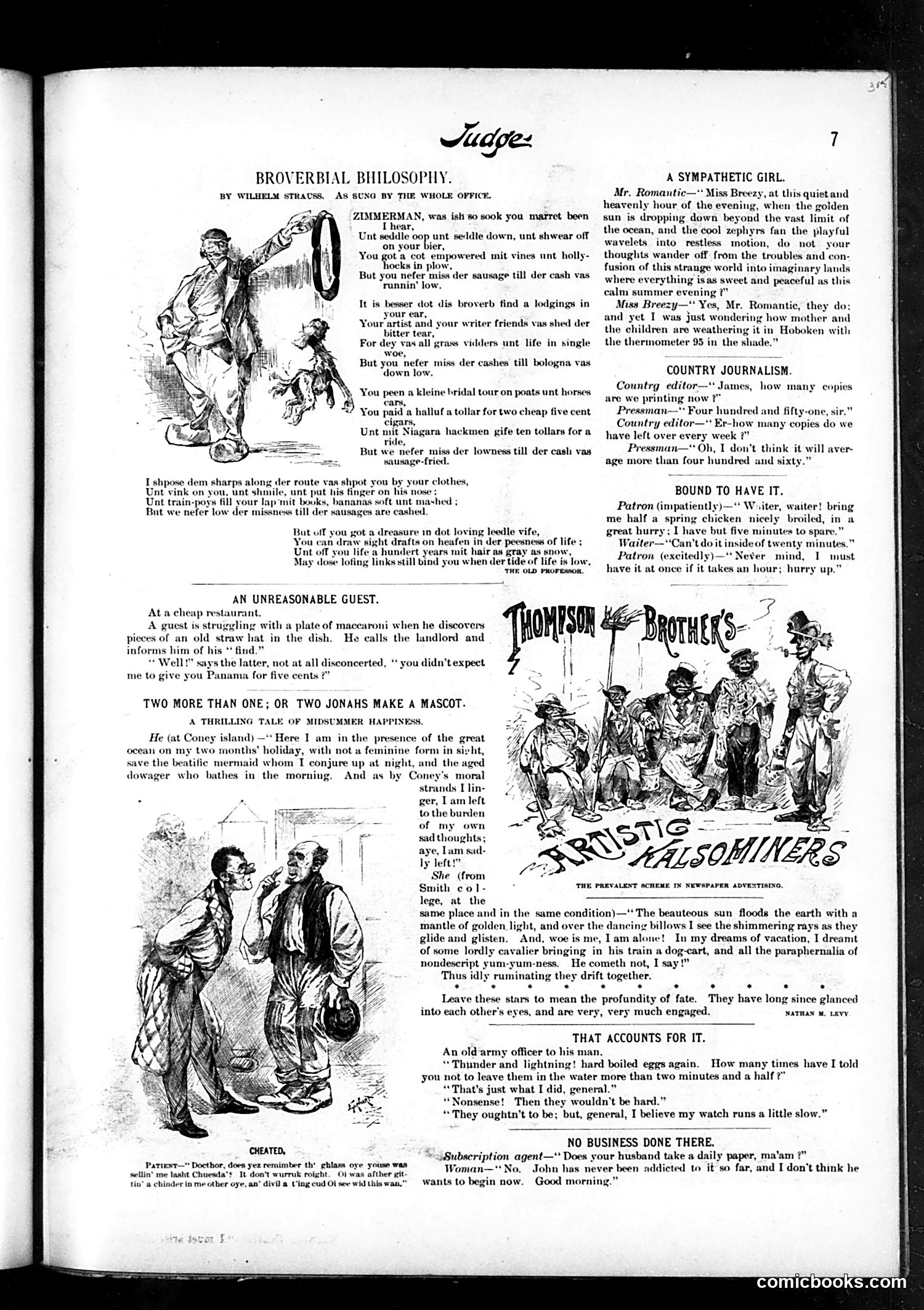
This page from *Judge* (a satirical weekly) contains several humor pieces mocking American life circa the 1880s-90s: **"Broverbial Philosophy"** uses exaggerated German-immigrant dialect to parody both working-class aspirations and marital disillusionment. The repeated refrain about "sausages" and cash suggests satirizing immigrants' materialistic concerns and the gap between romantic ideals and economic reality. **"An Unreasonable Guest"** jokes about a cheapskate expecting quality (Panama hat reference suggests luxury goods) at bargain prices—mocking both the customer's entitlement and the restaurant's indifference to food quality. **"Two Jonahs Make a Mascot"** depicts disappointed vacationers at Coney Island (a popular resort), with the man lamenting solitude and the woman's response revealing practical domesticity over romantic sentiment—satirizing sentimental pretense versus real-world concerns. The remaining brief jokes mock newspaper operations, impatient diners, and romantic posturing undercut by mundane reality. The overall tone targets middle-class pretensions, immigrant stereotypes, and the gap between romantic idealization and practical American life.
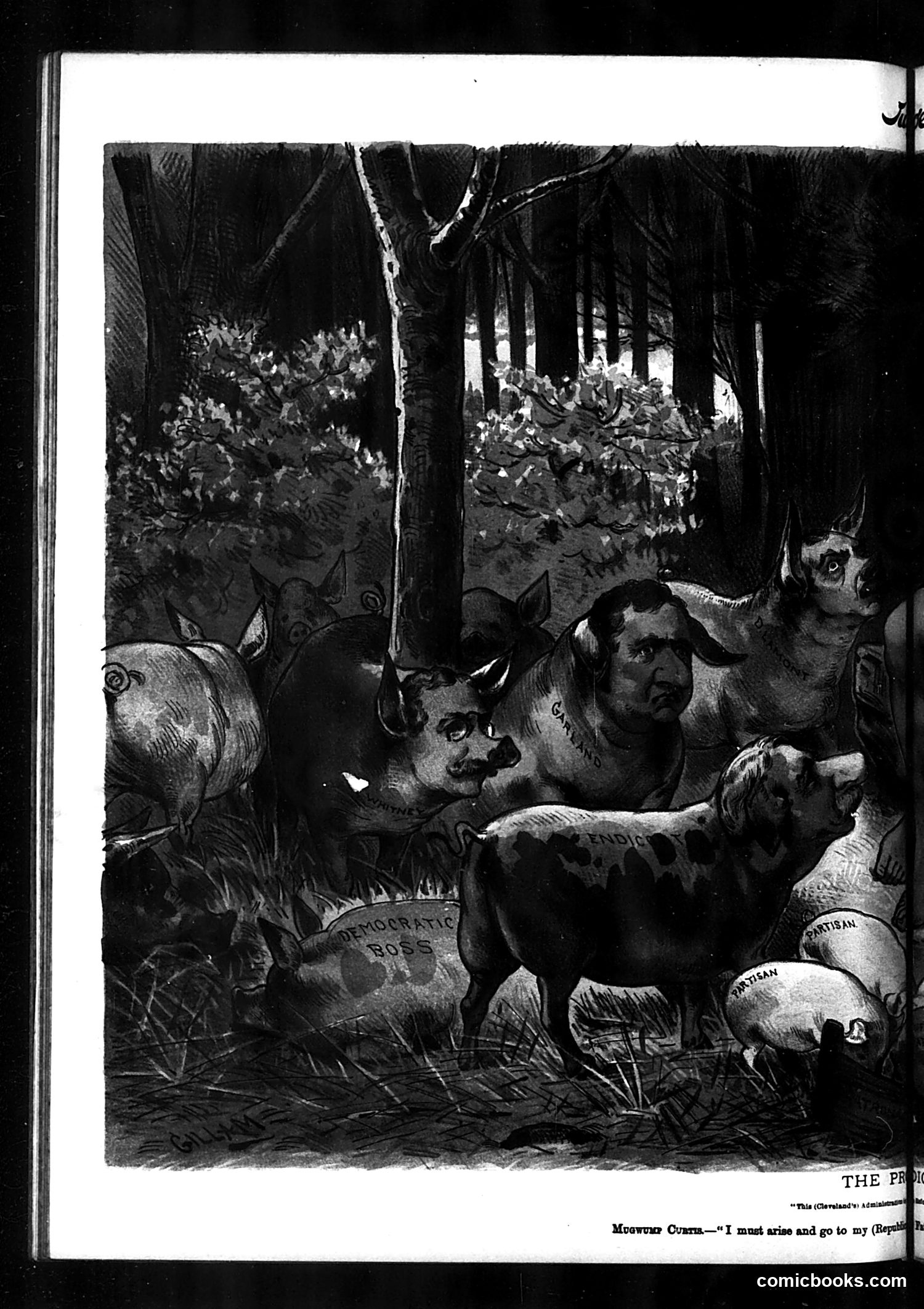
This appears to be a satirical cartoon from *Judge* magazine depicting anthropomorphized animals in what looks like a political gathering or deliberation scene. The visible text fragment reads "I must arise and go to my [Republic]," suggesting commentary on political duty or governance. The animals wear labels including "DEMOCRATIC" and "PARTISAN," indicating this is political satire about party politics. The woodland setting with palm trees and natural elements may reference a specific political location or metaphorically frame political discourse as "wild" or chaotic. Without the full caption and date, the specific historical event being mocked remains unclear, but the overall message appears to critique partisan political behavior and the competing interests within political parties during the early 20th century.
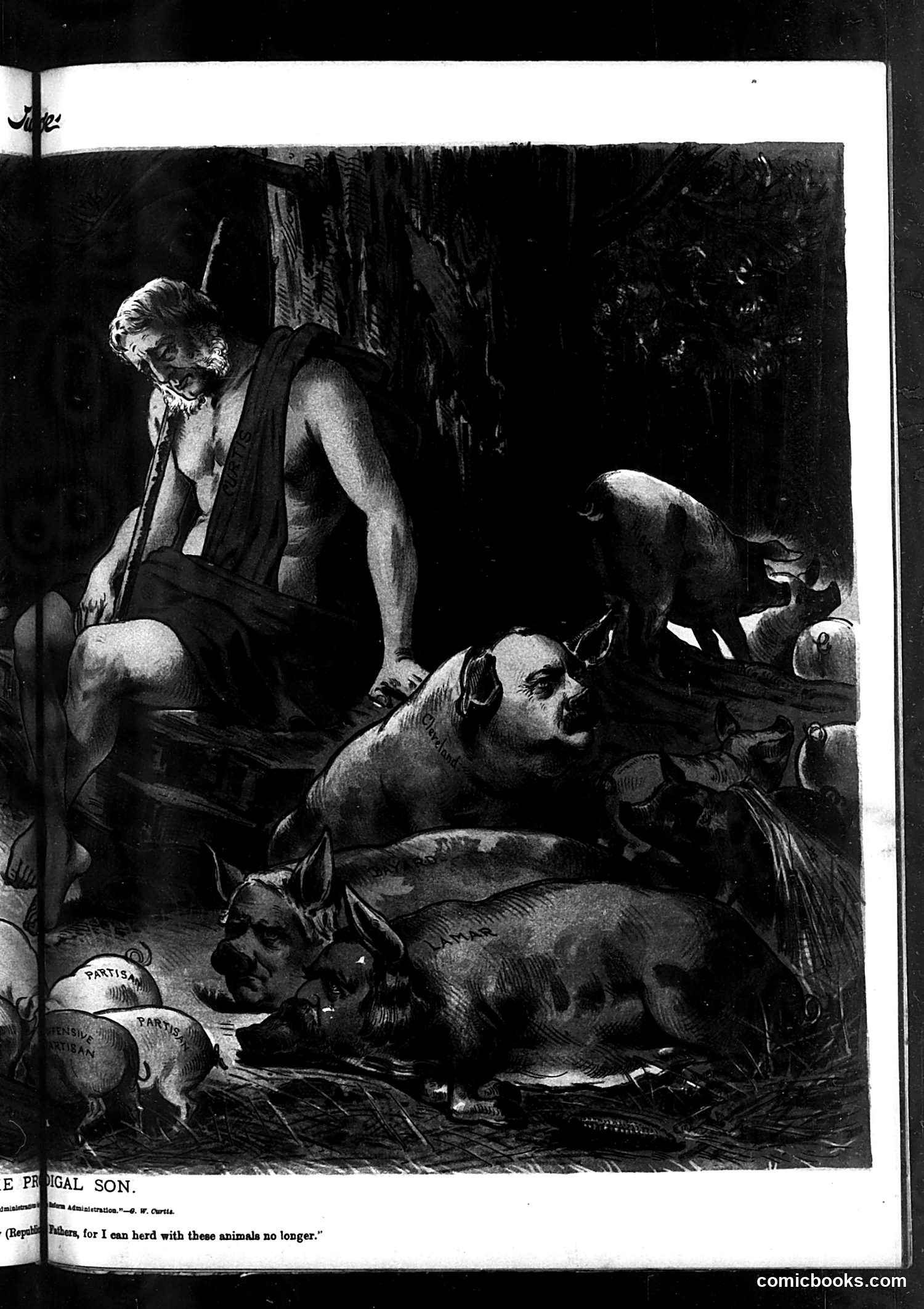
This appears to be a political cartoon titled "The Prodigal Son," attributable to G.W. Curtis. It depicts a man (likely representing a political figure or the public) surrounded by animals—possibly representing political opponents, corrupt officials, or problematic political associations. The man's statement, "I can herd with these animals no longer," suggests he's rejecting or abandoning these corrupt or disagreeable companions. The biblical "Prodigal Son" reference suggests themes of redemption or return. Without clearer identification of the specific animals or historical context, the exact political targets remain unclear, but the cartoon's purpose appears to criticize certain political alliances or associations as morally unacceptable, calling for separation from them.
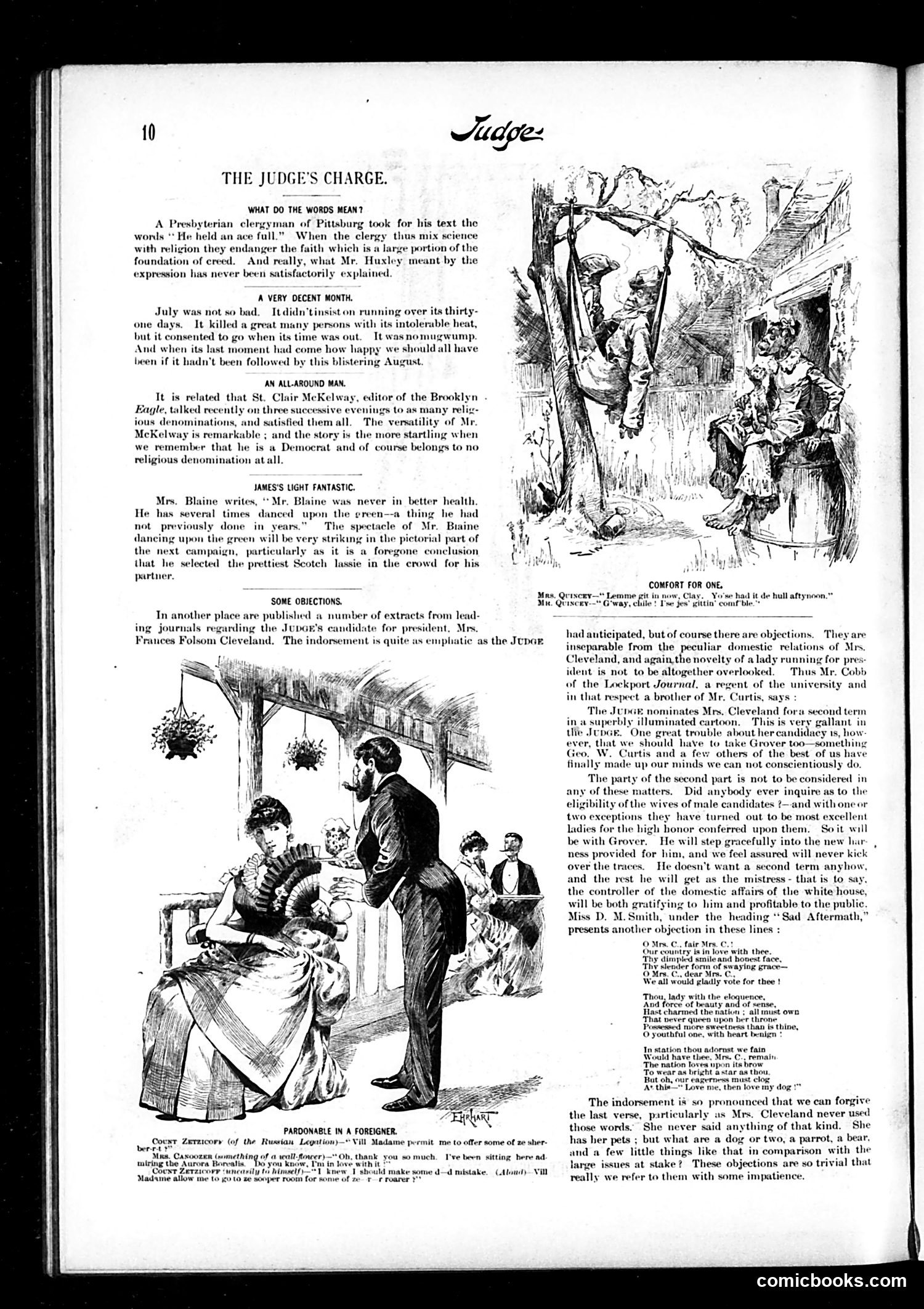
This page satirizes the potential 1884 presidential candidacy of **Frances Folsom Cleveland**, wife of President Grover Cleveland. Judge's editors had nominated her as a joke candidate. The main satire concerns **domestic politics**: the text mocks objections to a woman running for president, particularly that voters would need to accept "Grover too"—a jab at the awkwardness of having a sitting president as First Gentleman. The cartoons illustrate domestic scenes of upper-class life. Key targets include: - **St. Clair McKelway** (Brooklyn Eagle editor), praised for versatility despite being a Democrat with no religious affiliation - **James G. Blaine**, mocked for dancing on the green during his campaign - The hypocrisy of those opposing Mrs. Cleveland's candidacy while previously supporting wives of male candidates The satire's core point: opposition to female political participation is unreasonable and inconsistent with past practice. The page uses humor to highlight gender-based political double standards.
The main cartoon, "The Day We Do Not Celebrate," satirizes what appears to be turn-of-the-century municipal resistance to Fourth of July celebrations. Through attributed quotes from various mayors with ethnic-coded names (Von Schwartzenmeyer, O'Day McQuad, Jean Crapaud, Wun Lung See), the piece mocks immigrant and foreign-born city officials who ban fireworks, parades, and festivities—ostensibly citing safety and order concerns. The satire suggests these officials are suppressing American patriotic traditions. The final verse notes that by 1900, "the Yankee holiday...passed away," implying that immigrant leadership has effectively eliminated traditional Independence Day observance. The accompanying anecdote about the tramp and the bulldog offers lighter humor unrelated to the political message. The remainder of the page consists entirely of period advertisements and promotional content.
This page is primarily **advertisements and filler content**, not a political cartoon. The main editorial content describes "The Man Who Talks"—apparently a popular book or publication that entertained readers so effectively it resolved various social annoyances (mosquitoes, noisy babies, roosters) and calmed frustrated train passengers. The repeated anecdotes suggest this was a widely-known work used humorously to mock overstimulation in modern life. A secondary reference involves preacher **Sam Jones**, a real 19th-century evangelist known for blunt sermons. The text jokes that Jones avoided preaching against "Chi-cut-throats" (corrupt Chicago businessmen) directly, instead calling them "drunks"—satirizing his diplomatic approach to social criticism. The rest is period advertising: Pears' Soap (emphasizing whiteness and "healthy skin" in period-typical language), W.L. Douglas shoes, resort destinations, cocoa, and patent medicines. **No specific political cartoon is visible**—this appears to be a typical Judge issue page mixing light social commentary with commercial content.
This page is primarily a **business directory of leading hotels** across American cities—New York, Albany, Baltimore, Cleveland, Chicago, Kansas City, and others. It contains no visible cartoons or political satire. The page lists hotel names, proprietors, locations, and amenities (European plans, American plans, fireproofing, etc.). Hotels advertise their proximity to train stations, scenic views, and quality accommodations to attract travelers. The right column includes a separate "Business Index" advertising various commercial services: a mosaic company, stationers, riding academy, diamonds, firearms dealers, real estate firms, and insurance companies. This appears to be standard **commercial advertising content** from *Judge* magazine, not satirical editorial material. The humor or satire—if any—would be contained on other pages of this publication.
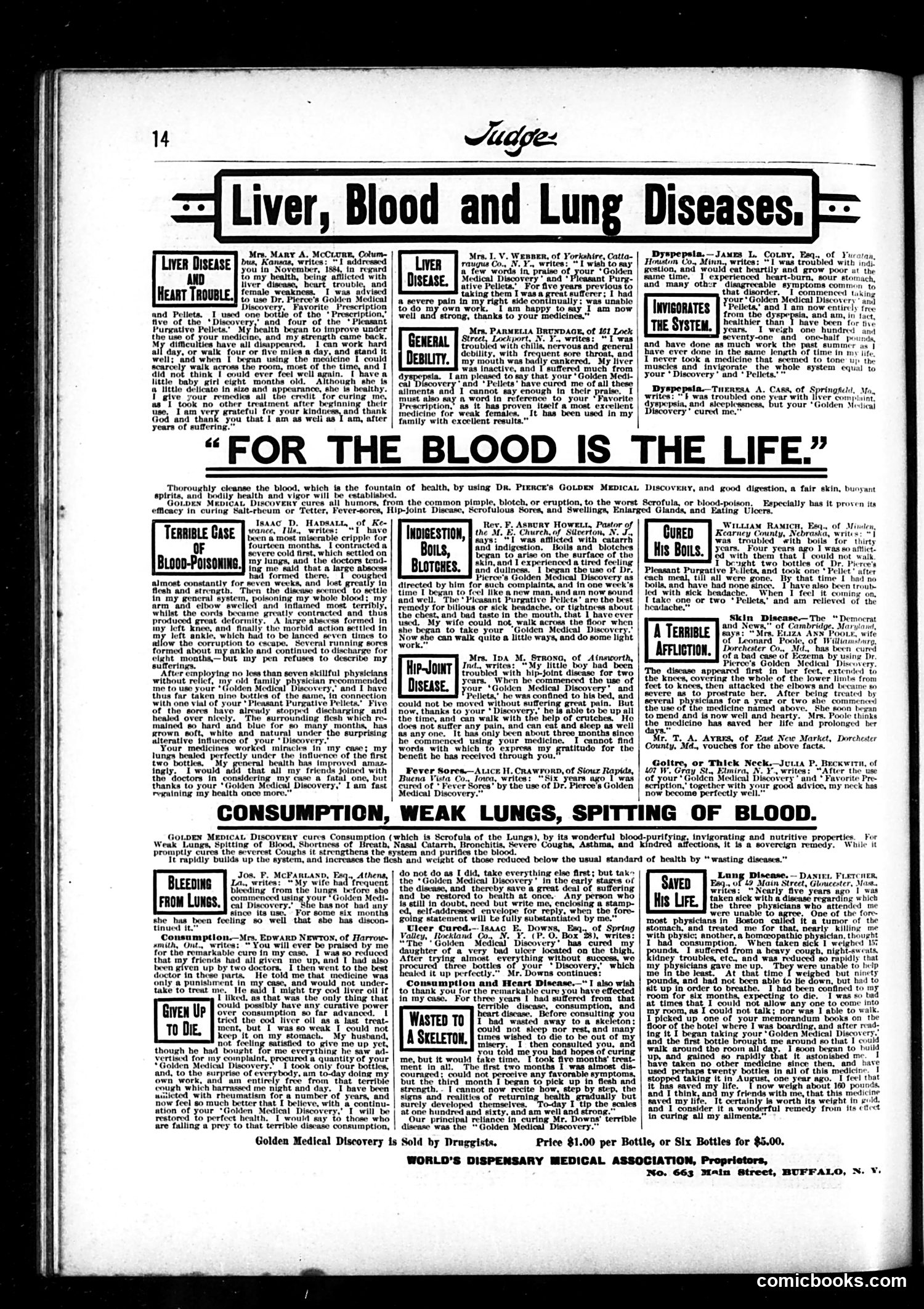
This is a patent medicine advertisement masquerading as testimonial journalism. The page is dominated by **Dr. Pierce's Golden Medical Discovery**, a commercial nostrum marketed as a cure-all for liver disease, lung disease, blood disorders, and female weakness. # The Content The page presents dozens of purported patient testimonials—letters from named individuals (Mrs. Mary A. McClure of Kansas, Mrs. I.V. Wenner of New York, etc.) praising the medicine's miraculous effects. Each testimonial claims the product cured serious ailments after other treatments failed. # Why This Matters Today This represents **pre-FDA regulation snake oil**. No modern reader should believe these claims. The testimonials are likely fabricated or cherry-picked. The product itself was probably worthless or harmful. The quoted "Golden Medical Discovery" was actually a patent medicine containing alcohol and other dubious ingredients—not a legitimate medical treatment. Judge magazine ran this as paid advertising, presenting unverified health claims as credible evidence. This was standard practice before consumer protection laws and the FDA regulated medical claims.
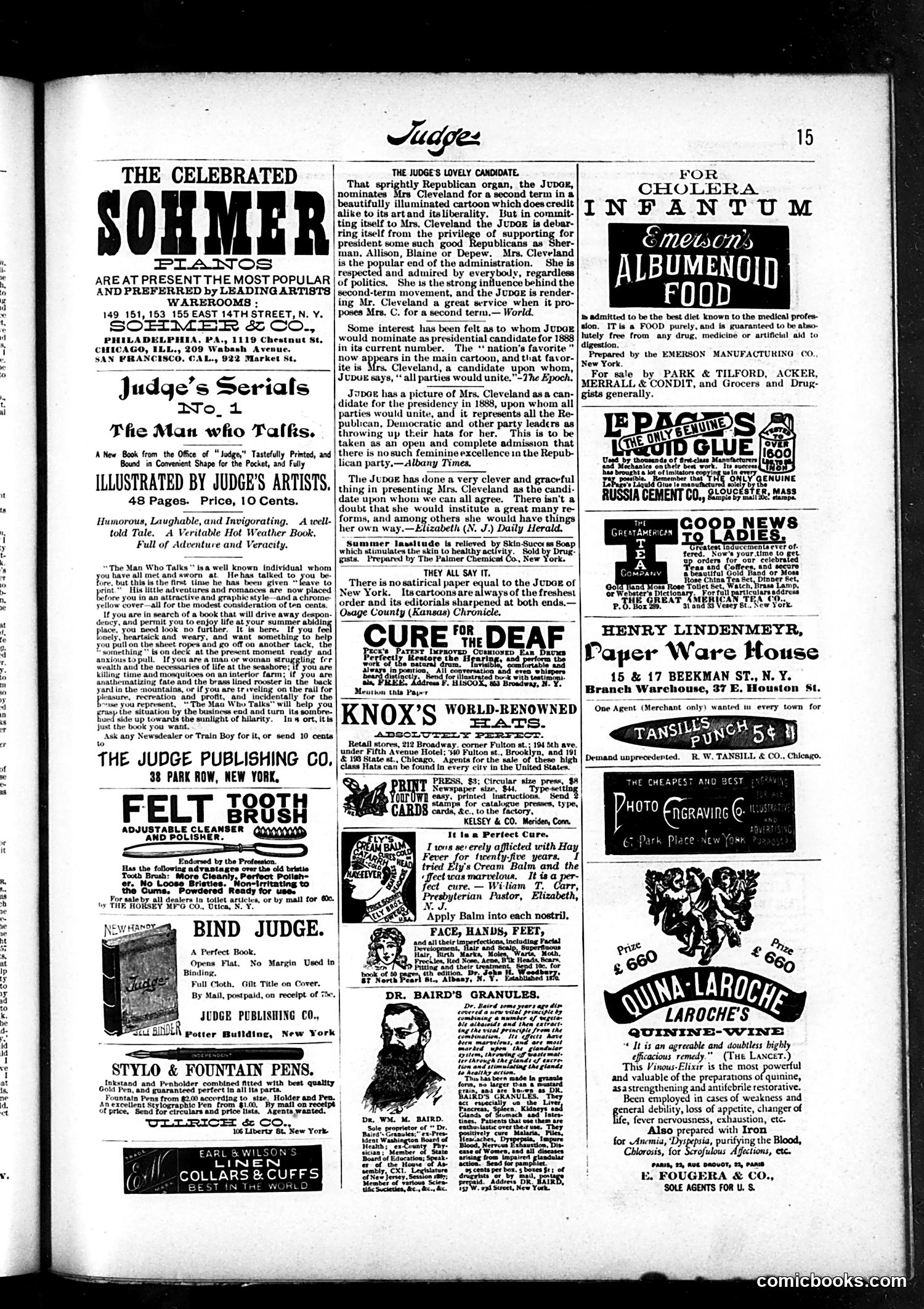
This page is primarily **advertisements and promotional content** rather than satirical cartoons. The main editorial content references a Judge cartoon nominating **Mrs. Cleveland** (wife of President Grover Cleveland) as a humorous presidential candidate for 1888. Contemporary commentary quoted here notes that Judge made this tongue-in-cheek proposal to acknowledge Mrs. Cleveland's genuine popularity and influence—she was respected "by everybody, regardless of politics" and seen as "the strong influence behind the second-term movement." The satire works on two levels: First, it's absurdist humor (nominating a president's wife was preposterous). Second, it's a backhanded compliment to Republicans—by suggesting Mrs. Cleveland represents such universal appeal that even Republicans would support her, Judge implies the GOP lacks comparable popular figures. The rest of the page consists of advertisements for pianos, books, teeth brushes, patent medicines, and other period products typical of Judge's revenue model.
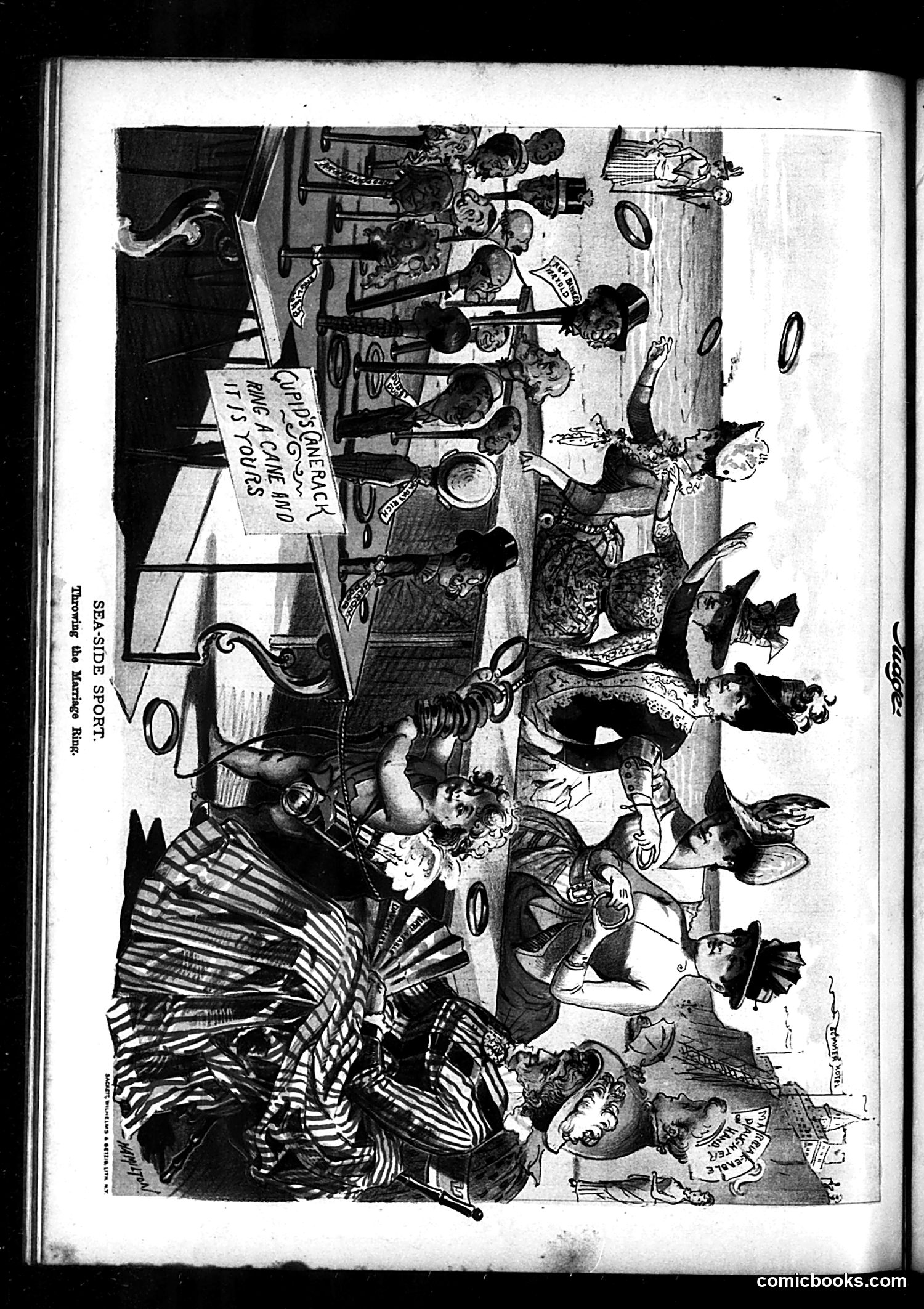
I can see this is a page from *Judge* magazine, but the image is rotated 90 degrees, making it difficult to read clearly. The OCR text provided appears to be corrupted or incomplete, containing only scattered letters and numbers without coherent words. From what I can discern in the rotated image, there appears to be a satirical cartoon scene with multiple figures in period dress, and what looks like a banner or sign in the upper left. However, without being able to read the text reliably or identify specific figures clearly, I cannot accurately explain the political or social references this cartoon is making. To properly analyze this page's meaning and satire, I would need either a correctly-oriented image or legible OCR text identifying the cartoon's title, date, and key figures.