
Judge, 1887-08-20 · page 5 of 16
Judge — August 20, 1887 — page 5: what you’re looking at
What you’re looking at
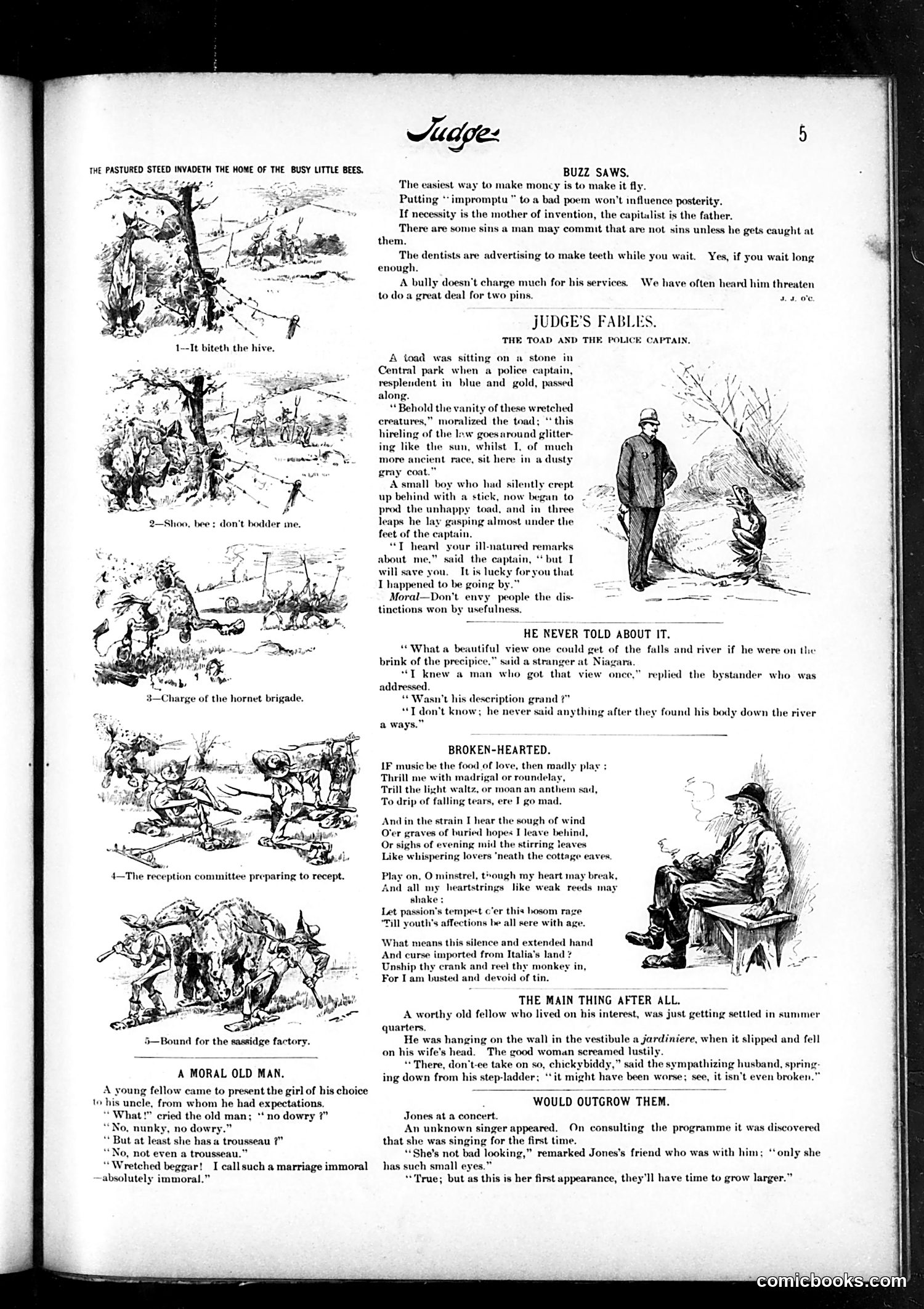
This page contains **short satirical pieces and moral fables** typical of Judge's humor circa late 1800s. **Key content:** 1. **"Buzz Saws"** — Brief aphorisms mocking human nature and commerce (dentists advertising, bullies' pricing, invention). 2. **"Judge's Fables"** — Moral tales: - *The Toad and Police Captain*: A toad envies the captain's uniform; a boy attacks it, the captain saves it. Moral: don't envy those with genuine accomplishments. - *He Never Told About It*: Dark humor about a man who admired Niagara Falls' view from the cliff edge—found dead in the river. 3. **"Broken-Hearted"** — Romantic verse about lost love, ending with a punchline: the narrator is financially ruined ("busted and devoid of tin"). 4. **"The Main Thing After All"** — Domestic humor: a husband reassures his wife a fallen vase "isn't even broken" (ignoring the irony). 5. **"Would Outgrow Them"** — A joke that a new female singer has small eyes, but she'll improve with experience. The illustrations support these pieces with period-appropriate wood-cut style drawings.
📄 Transcribed text from this page (OCR, searchable)
Machine-transcribed from the original scan — historical spelling and the odd misread are preserved.
THE PASTURED STEED INVADETH THE HOME OF THE BUSY LITTLE BEES. 5—Bound for the sassidge factory. A MORAL OLD MAN. A young fellow came to present the girl of his choice to his uncle, from whom he had expectations, * What!” cried the old ma: no dowry ?” “No, nunky, no dowry.” But at least she has a trousseau ?” “No, not even a trousseau.” “Wretched beggar! I callsuch a marriage immoral ~absolutely immoral.” ape: BUZZ SAWS. ‘The easiest way to make moncy is to make it fly. Putting ‘impromptu ™ to a bad poem won't influence posterity. If necess' the mother of invention, the capitalist is the father. There are some sins a man may commnt that are not sins unless he gets caught at them. The dentists are advertising to make teeth while you wait. Yes, if you wait long enough. A bully doesn’t charge much for his services. We have often he: to do a great deal for two pins. nd him threaten aa. oe. JUDGE'S FABLES THE TOAD AND THE POLICE CAPTAIN. A toad was sitting on a stone in Central park when a police captain, resplendent in blue and gold, passed along. “Behold the vanity of these wretched creatures,” moralized the toad; ‘this hireling of the law goes around glitter- ing like the sun, whilst I, of much more ancient race, sit here in a dusty gray coat.” small boy who had silently erept up behind with a stick, now began to - prod the unhappy toad, and in three ¥ gasping almost under the feet of the captain. “T heard your ill-natured remarks about me,” d the captain, “but I will save you. It is lucky foryou that I happened to be going by.” Moral—Don't envy people the dis- tinctions won by usefulness. HE NEVER TOLD ABOUT IT. “What a beautiful view one could get of the falls and river if he were on the brink of the precipice.” said a stranger at Nia: “T knew a man who got that view onec addressed. “Wasn't his description grand ¢” “I don't know; he never said anything after they found his body down the river a ways.” replied the bystander who was BROKEN-HEARTED. IF music be the food of love, then madly play : Thrill me with madrigal or roundelay, Trill the light waltz, or moa nthem sad, To drip of falling tears, ere T go mad. And in the strain I hear the sough of wind Orer graves of buried hopes I leave behind, Or sighs of evening mid the stirring leaves: Like whispering lovers ‘neath the cottage eaves, Play on, O minstrel, And all m sough my heart may break heartstrings like weak reeds may 's tempest c’er this hosom rag Till youth's affections be all sere with aj What means this silence and extended hand And curse imported from Italia’s land Unship thy crank and reel thy monkey in, For I am busted and devoid of tin. THE MAIN THING AFTER ALL. A worthy old fellow who lived on his interest, was just getting settled in summer quarters. He was hanging on the wall in the vestibule a jardiniere, when it slipped and fell on his wife's h The good woman screamed lustily. “There, don't-ee take on so, chickybiddy,” said the sympathizing husband, spring ing down from his step-ladder; ‘it might have been worse; see, it isn’t even broken.” WOULD OUTGROW THEM. Jones at a concert. ‘An unknown singer appeared. On consulting the programme it was discovered that she was singing for the first time. “She's not bad looking,” remarked Jones's friend who was with him; ‘only she has such small eyes.” ‘rue; but as this is her first appearance, they'll have time to grow larger.”