
A complete issue · 16 pages · 1887
Judge — August 13, 1887
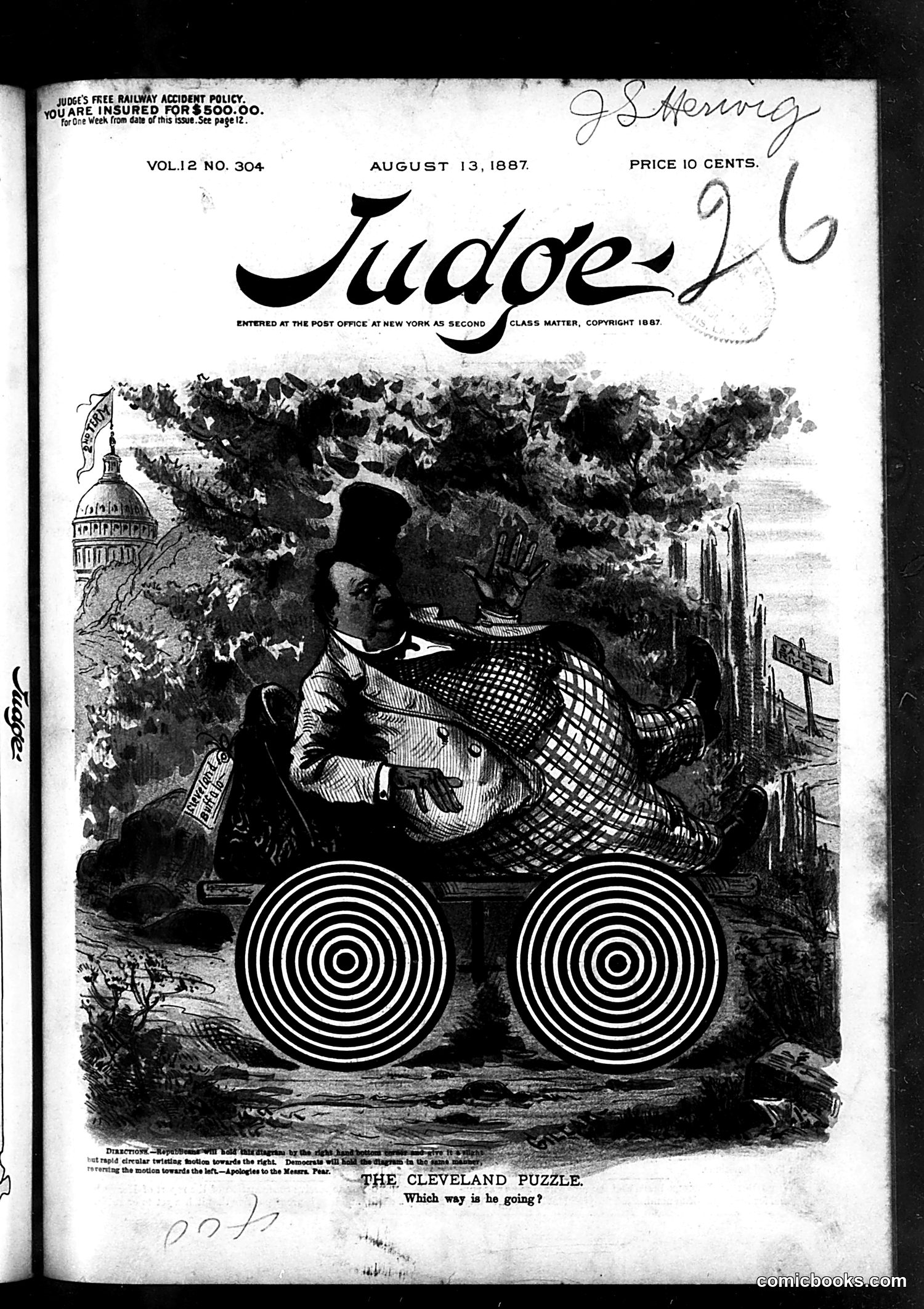
This Judge magazine cover from August 13, 1887 presents a political cartoon titled "The Cleveland Puzzle: Which way is he going?" The image depicts a rotund figure (likely President Grover Cleveland) in a carriage with hypnotic concentric circle wheels, creating optical illusion effects. The satire appears to mock Cleveland's unclear or inconsistent political direction—the spinning wheels suggest confusion about which way he's actually headed. Given the 1887 date during his first presidency, this likely references contemporary debates over his policies, possibly regarding tariffs, civil service reform, or other divisive issues where his administration seemed ambiguous or contradictory to critics. The optical illusion device reinforces the joke: viewers cannot easily determine the carriage's direction, just as observers couldn't determine Cleveland's political course.
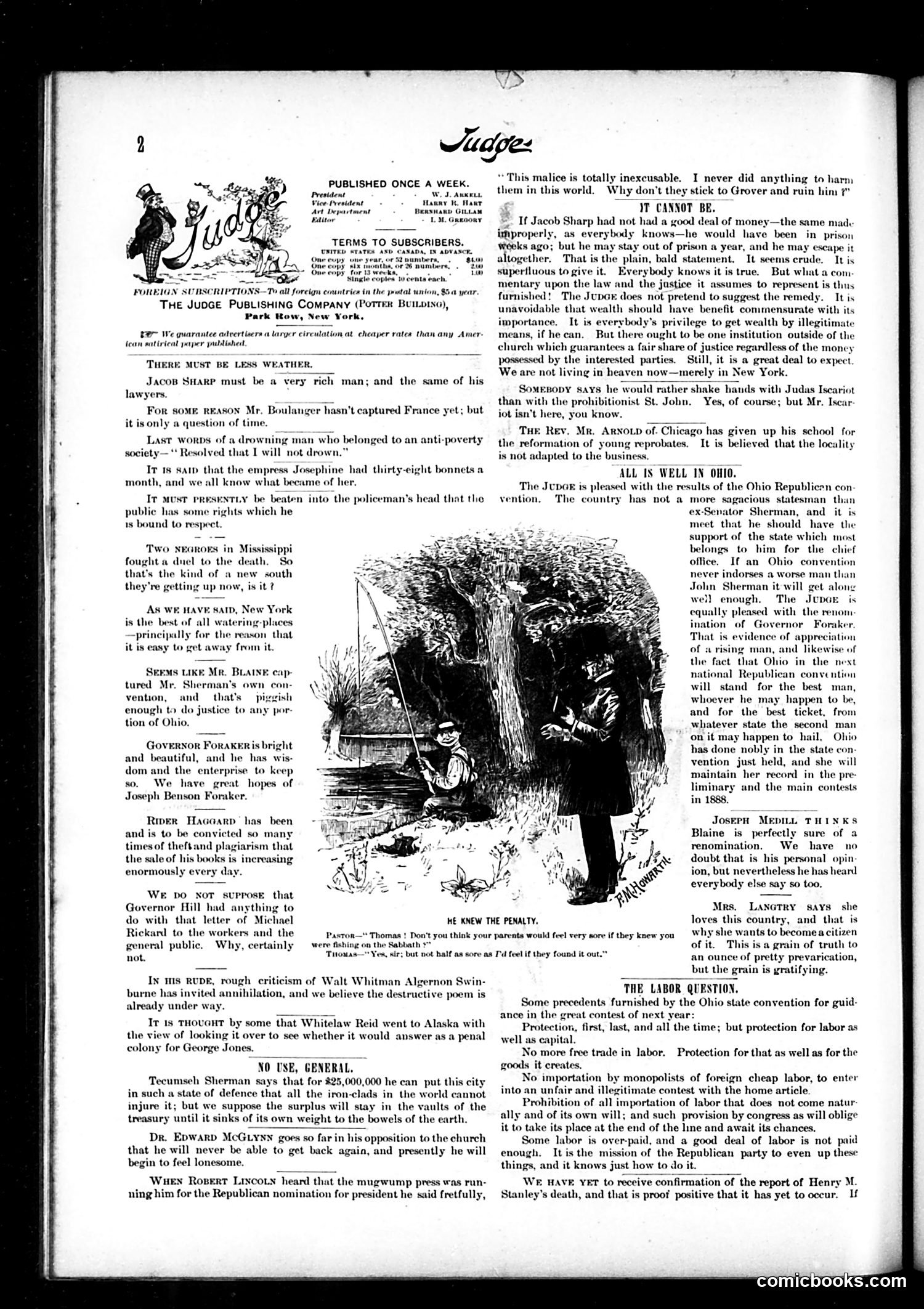
The cartoon depicts a **parrot being punished** (appears to be in stocks or a cage), illustrating the caption's dialogue between Thomas and a parrot owner. Thomas warns that the parrot's parents would be "very sore" if they knew it was "stolen," and the owner responds that the parrot "knew the penalty" and accepted the risk. This appears to be **satirical commentary on theft and personal responsibility**—likely referencing contemporary political or social figures through the animal allegory. The humor relies on treating the parrot as a morally culpable agent who knowingly accepted consequences. Without additional context about the specific figures referenced or the date, the precise political target remains unclear, though the overall message concerns accountability for illegal actions.
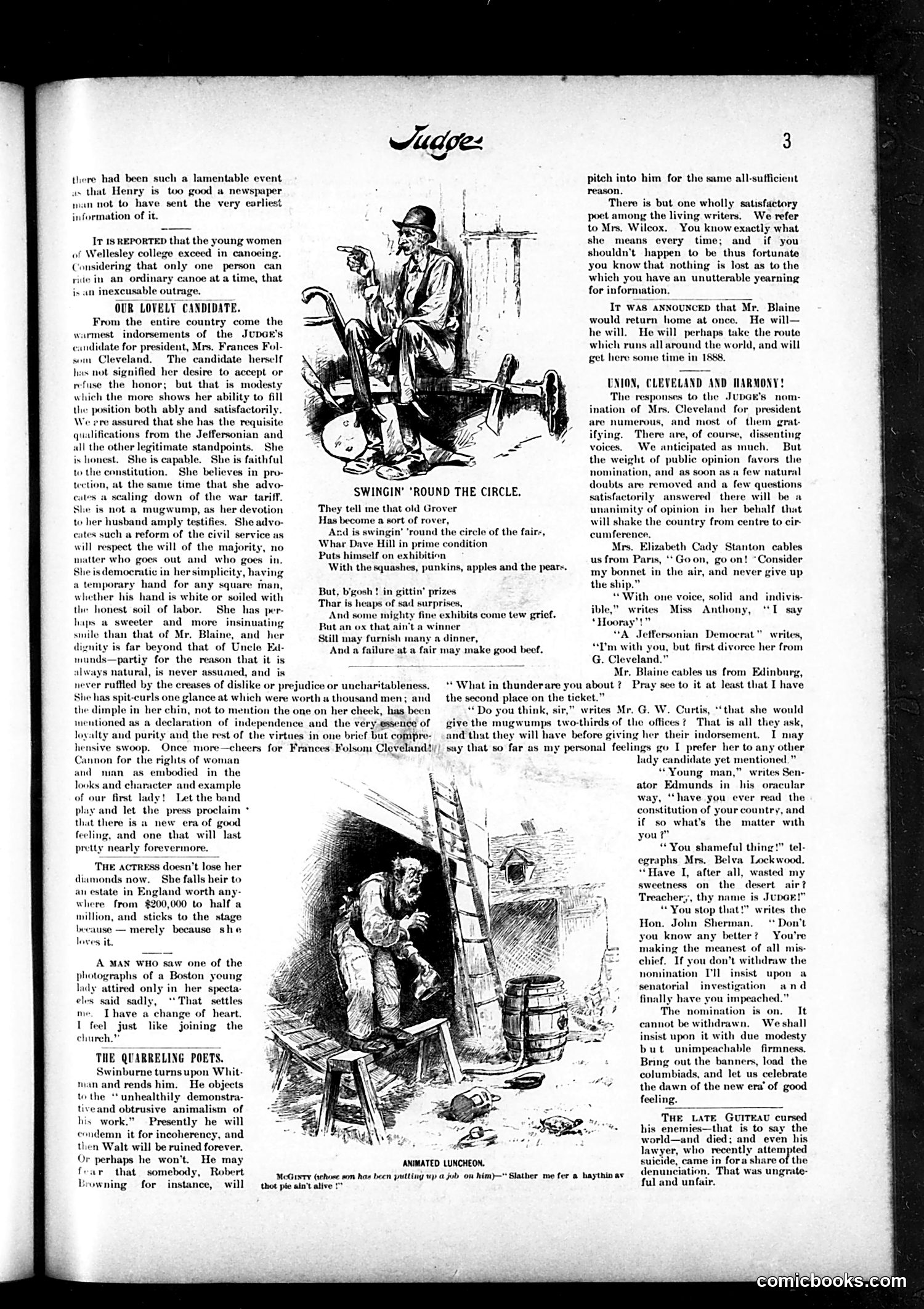
This page satirizes the 1888 presidential race, particularly mocking the Democratic nomination of **Frances Folsom Cleveland** (wife of President Grover Cleveland) as a joke candidate. Judge presents her "qualifications" with heavy irony—praising her honesty and appearance while acknowledging she never actually accepted the nomination, highlighting the absurdity. The cartoons and text mock **James G. Blaine** (Republican rival), depicting him as a perpetual traveler avoiding the race. The "Swingin' Round the Circle" poem ridicules a political tour, referencing Blaine's whereabouts and behavior. The page also satirizes women's activism: **Elizabeth Cady Stanton** and **Susan B. Anthony** are quoted sarcastically supporting Cleveland—but with reservations, mocking their political inconsistency. This reflects real tension in women's suffrage movements of the era. The cartoons show working-class figures, typical of Judge's satirical imagery representing common folk observations of elite political theater.
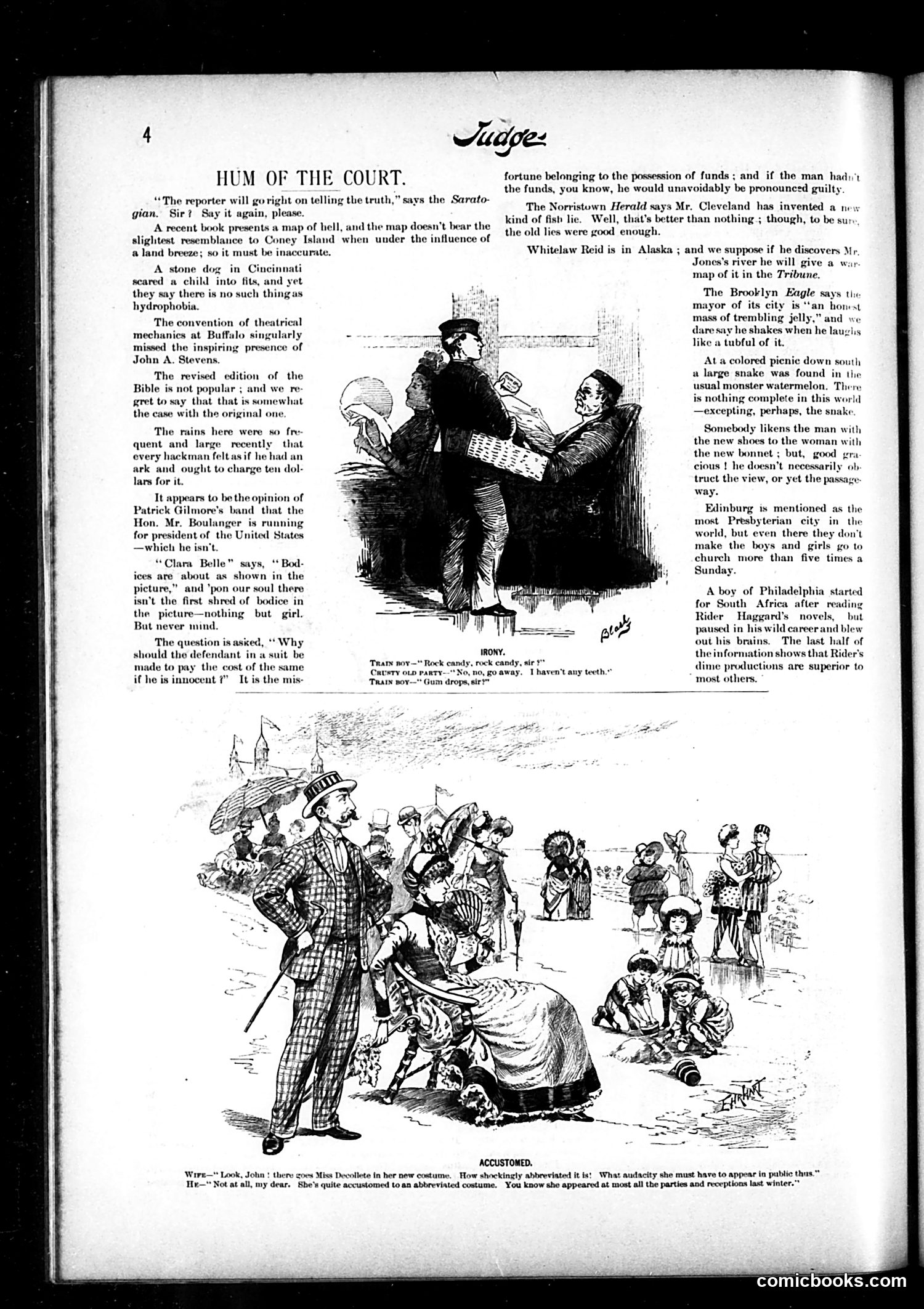
This page contains brief satirical commentary ("Hum of the Court") mocking various public figures and social absurdities of the era. **Key References:** - **Boulanger**: General Georges Boulanger, the French political figure, apparently falsely rumored to be running for U.S. president - **Cleveland**: President Grover Cleveland, joked about as a poor liar - **Whitelaw Reid**: Editor of the Tribune newspaper, mocked for exaggerating discoveries - **Rider Haggard**: The adventure novelist whose sensationalist works apparently inspired a Philadelphia boy's suicide attempt—satirizing the novels' harmful influence - **Brooklyn Eagle mayor**: Criticized as dishonest despite reputation **The cartoons** depict social comedy: the upper illustration shows a street encounter involving someone in an "abbreviated costume"; the lower shows a seaside scene with a man in plaid suit and women in period dress, again commenting on scandalously short clothing. The overall tone ridicules hypocrisy, incompetence among public figures, and the era's moral anxieties about propriety and fashion.
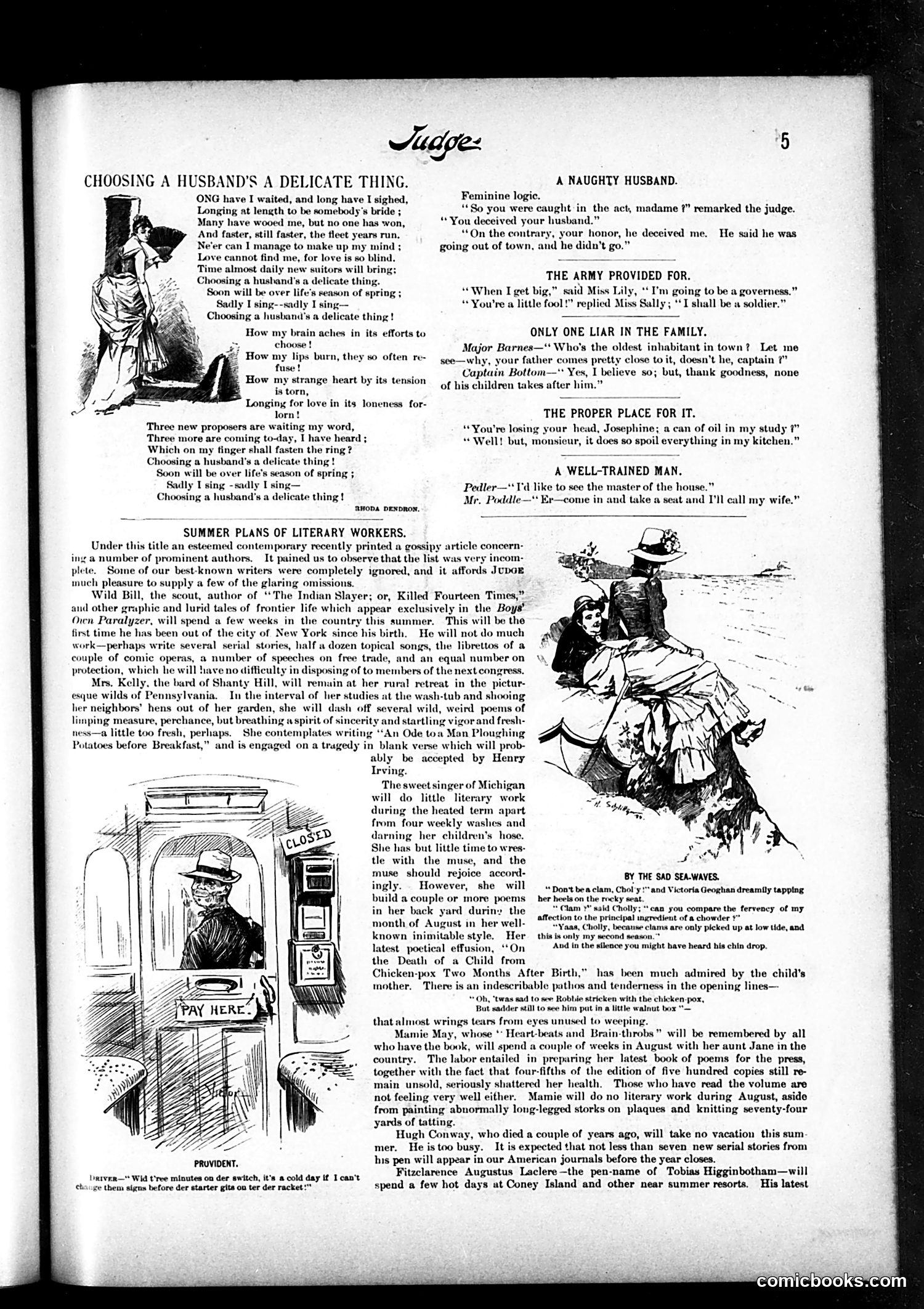
This page from the satirical magazine *Judge* contains several short humor pieces mocking domestic life and gender relations: **"Choosing a Husband's a Delicate Thing"** (left): A woman's poem lamenting her inability to decide among suitors, satirizing indecisive women and courtship anxieties. **"A Naughty Husband"** (top right): A judge's courtroom joke where a wife claims her husband deceived her—not about infidelity, but about supposedly leaving town. The satire targets feminine logic and wives' excuses. **Other brief jokes** mock women's ambitions ("I shall be a soldier"), marital power dynamics (where the wife is clearly in charge), and domestic disputes (oil cans in studies). **"Summer Plans of Literary Workers"** (bottom): Sarcastically profiles prolific but apparently mediocre authors—a "Wild Bill" churning out countless pulp stories, and female writers like "Mrs. Kelly" and "The Sweet Singer of Michigan" who manage poetry writing between housework and childcare. The satire mocks both mass-produced literature and women's limited time for intellectual pursuits, treating domestic drudgery as comic.
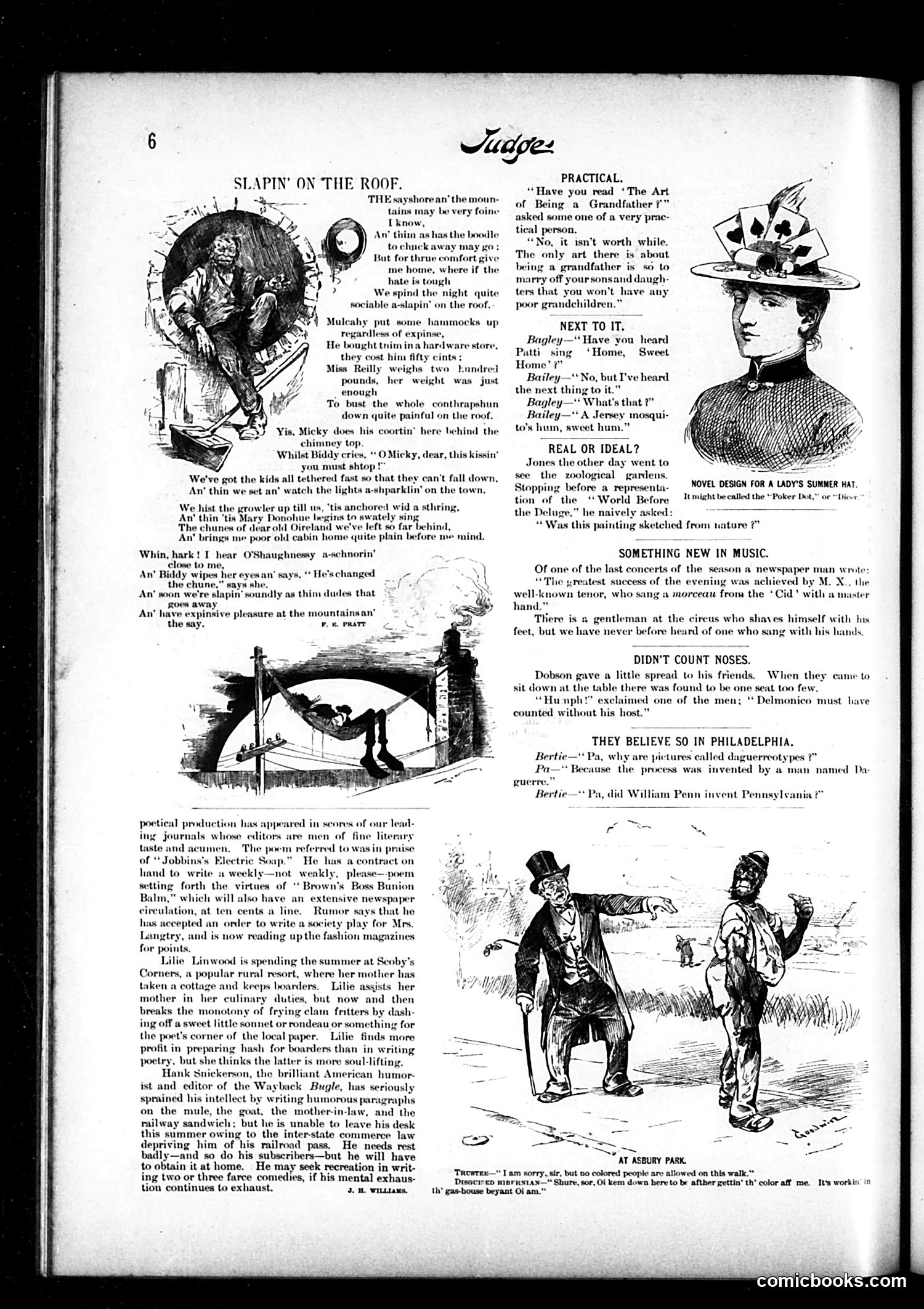
This page from the satirical magazine *Judge* contains several pieces of social humor typical of late 19th-century American journalism. **"Slapin' on the Roof"** (main cartoon/poem): A comic Irish-immigrant narrative in dialect about a poor family enjoying summer nights on their tenement roof—a free entertainment. The humor relies on ethnic stereotyping common to the era, depicting working-class Irish characters with exaggerated dialect ("Oireland," "schnorin'"). **Short humor pieces** include: - A joke about a practical grandfather prioritizing not having poor grandchildren over sentimentality - A Jersey mosquito pun (regional humor) - A zoo visitor naively asking if a prehistoric painting was "sketched from nature" - A circus performer who shaves himself but never sings with his hands **Literary gossip**: Updates on minor writers seeking newspaper work—including someone writing ads for "Jobbins's Electric Soap" and a woman named Lillie Linwood writing poetry while helping her mother run a boarding house. The page reflects *Judge's* mix of social satire, ethnic humor, and celebrity/literary gossip aimed at educated urban readers.
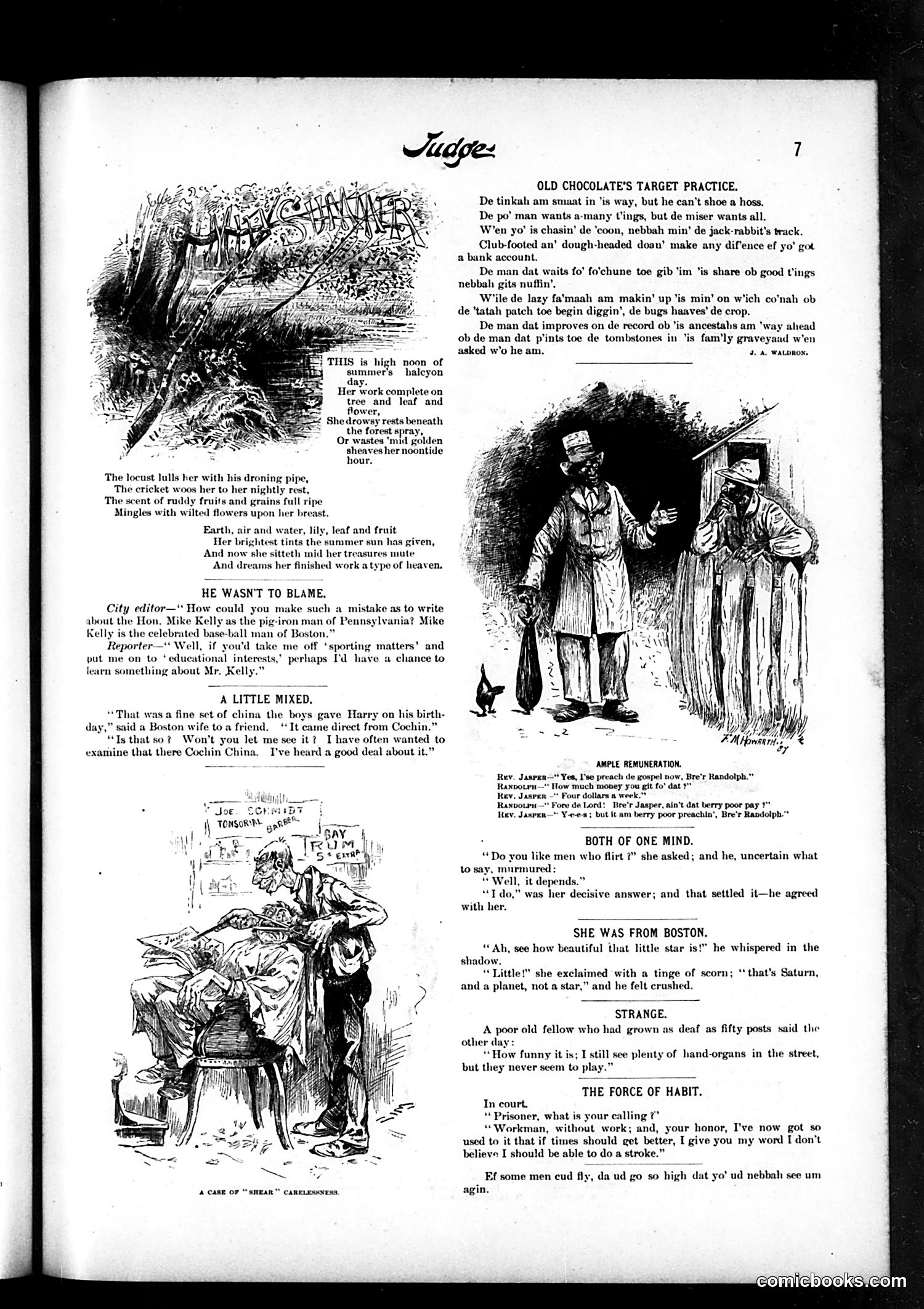
This page contains multiple short humorous pieces typical of 1880s-90s American satirical journalism: **"Old Chocolate's Target Practice"** features dialect humor attributed to an African American character offering folk wisdom. The stereotypical dialect and "Old Chocolate" persona reflect period racial caricature conventions. **"He Wasn't to Blame"** satirizes journalistic incompetence—a reporter confused Mike Kelly (Boston baseball player) with a Pennsylvania pig-iron industrialist, blaming editorial assignment rather than his own ignorance. **"A Little Mixed"** jokes about geographical confusion between Cochin (India) and "Cochin China" (Vietnam). The remaining brief pieces mock social pretension, romantic miscommunication, Boston snobbery, and habitual unemployment. The cartoons show working-class figures in domestic or legal situations. The overall tone is light, punching down at working people, immigrants, and African Americans while occasionally mocking urban sophistication and bureaucratic incompetence.
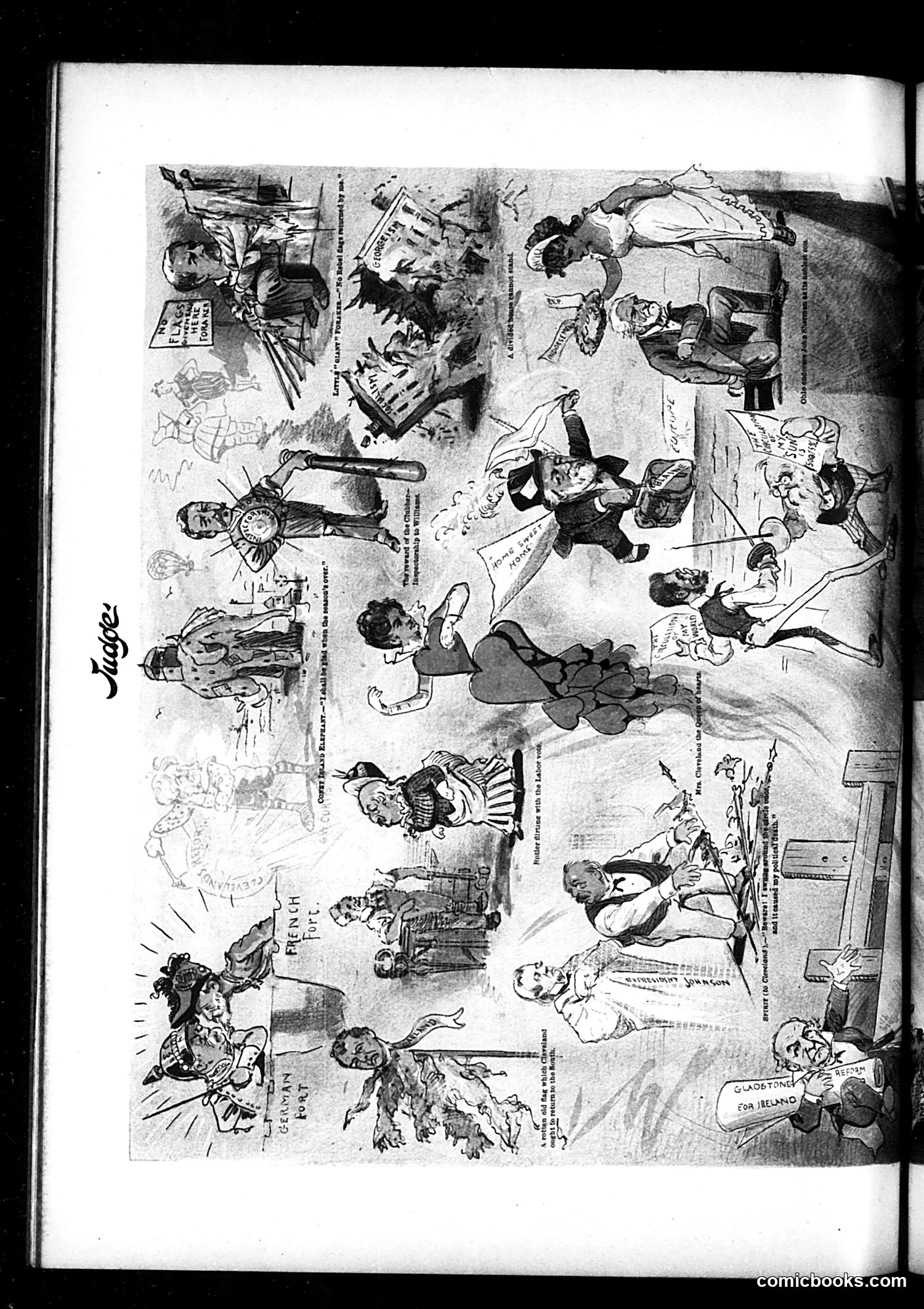
This page from *Judge* magazine appears to be a satirical comic featuring multiple vignettes with caricatured figures engaged in various activities. The OCR text is largely illegible, making precise identification difficult. From the imagery, this appears to be **turn-of-the-century American political satire**, likely from the 1890s-1900s based on the style. The cartoons seem to depict contemporary political or social figures in absurd or compromising situations—a typical *Judge* approach. Without clearer captions or text, I cannot definitively identify specific politicians or events being mocked. The exaggerated character designs and farcical scenarios suggest commentary on public figures' behaviors or scandals, but the **exact subjects and satirical targets remain unclear** from this reproduction.
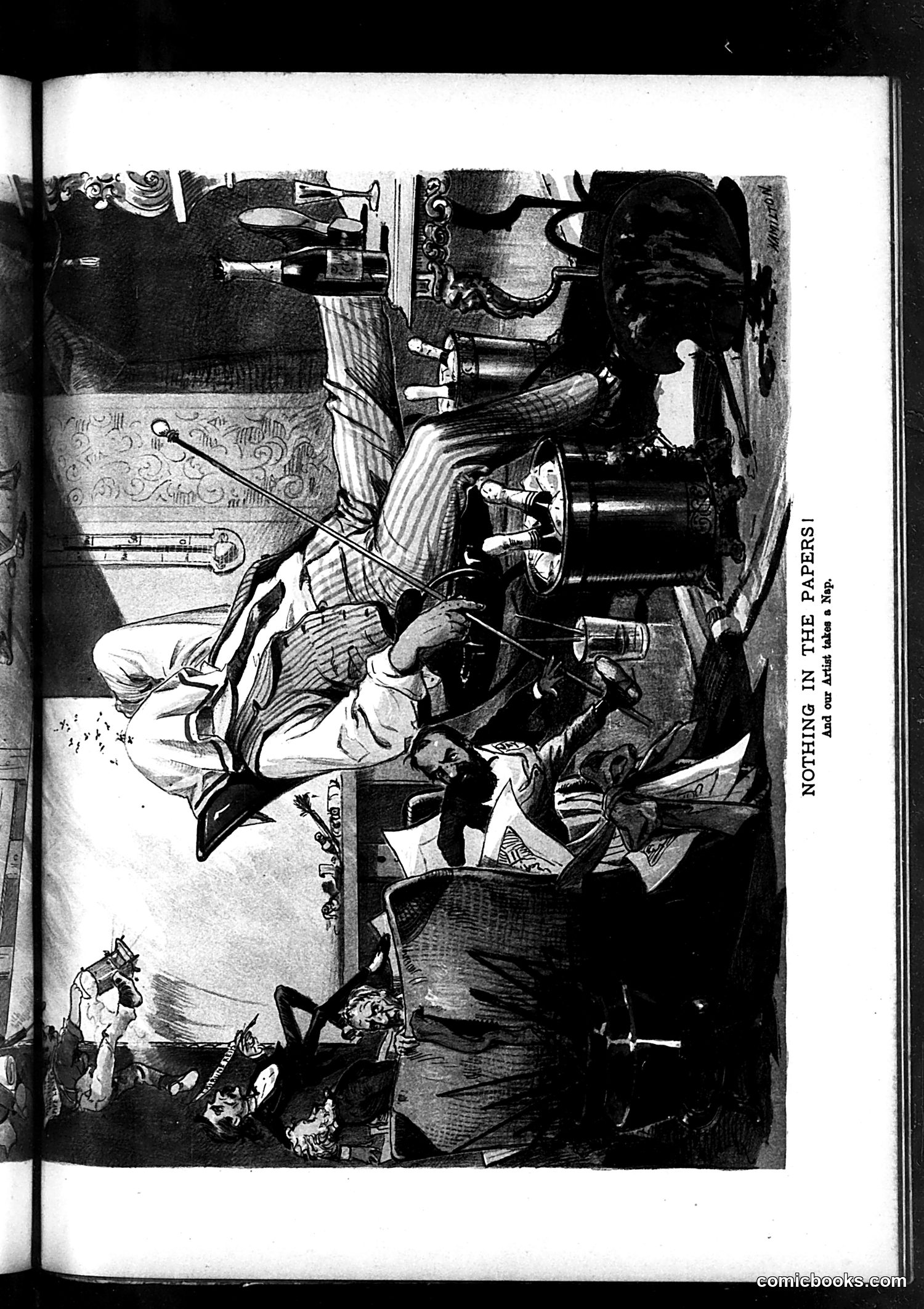
This page displays a single satirical cartoon printed sideways (rotated 180 degrees). The OCR text is largely illegible, making precise interpretation difficult. The image appears to show a chaotic indoor scene with multiple figures in period dress engaged in some form of conflict or commotion. There are furnishings, decorative elements, and what appears to be mechanical or industrial objects visible. The style suggests late 19th or early 20th century American political satire. The caption reads "NOTHING IN THE PEPPESI" (likely "POCKETS" or similar, given OCR errors), suggesting commentary on poverty, financial hardship, or political incompetence. Without clearer text or identified figures, the specific political target remains unclear.
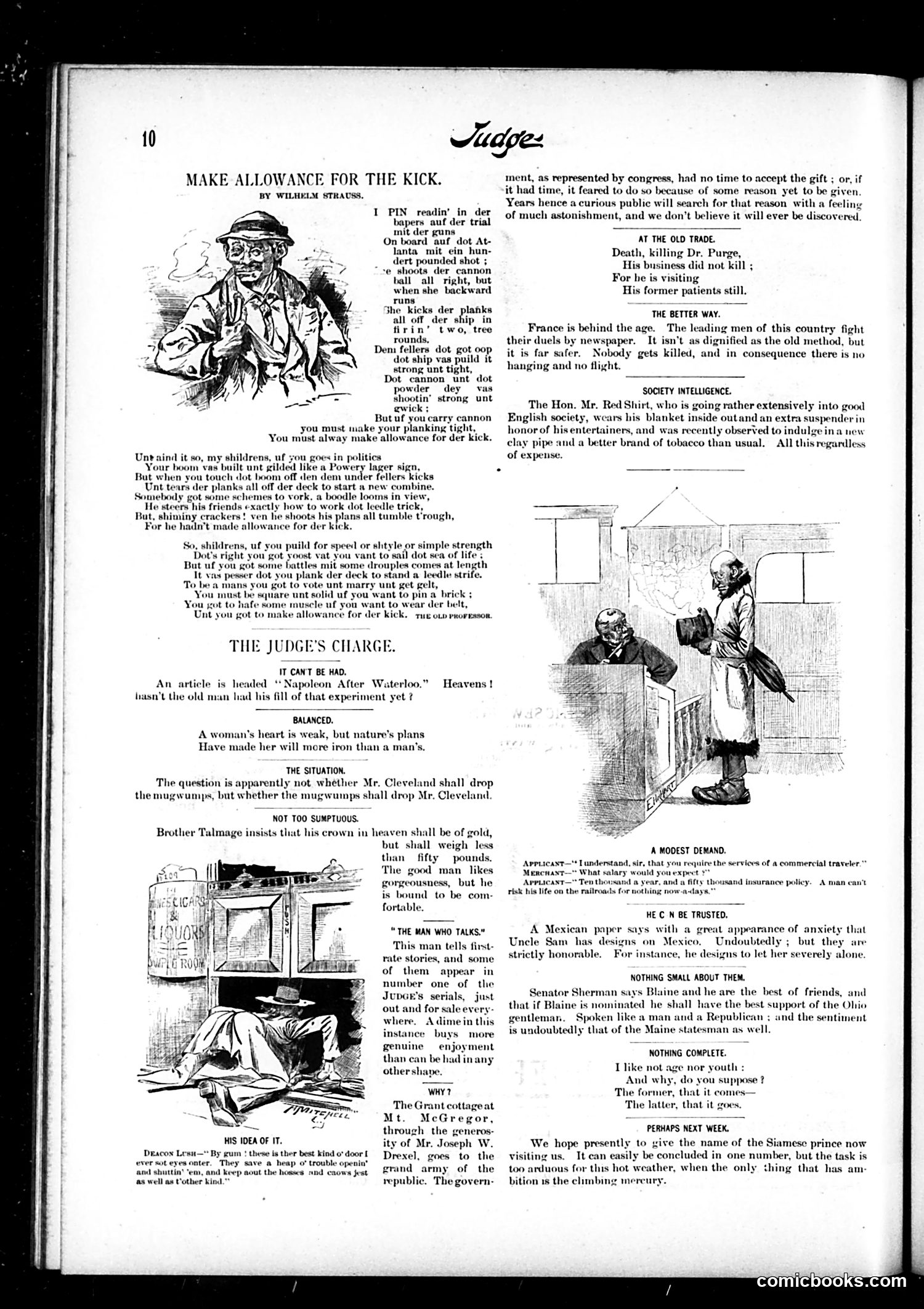
This Judge magazine page contains political satire from the Gilded Age (likely 1880s). The main poem, "Make Allowance for the Kick," uses a German-accented immigrant character ("der Old Professor") to offer folk wisdom: just as a cannon's recoil damages a ship if not properly braced, politicians pursuing corruption ("boodle") without moral foundations will eventually face consequences they didn't anticipate. The cartoon critiques both machine politics and mugwump reformers (Republicans who abandoned their party over civil service reform). Other brief items mock: Grant's refusal of a mansion gift due to congressional timidity; dueling by newspaper rather than pistols (French vs. American methods); and a Native American ("Red Shirt") awkwardly adopting English social pretenses. The humor targets late 19th-century political hypocrisy, immigrant stereotypes, and social climbing—using vernacular dialect for comic effect in ways now considered offensive but then standard satirical practice.
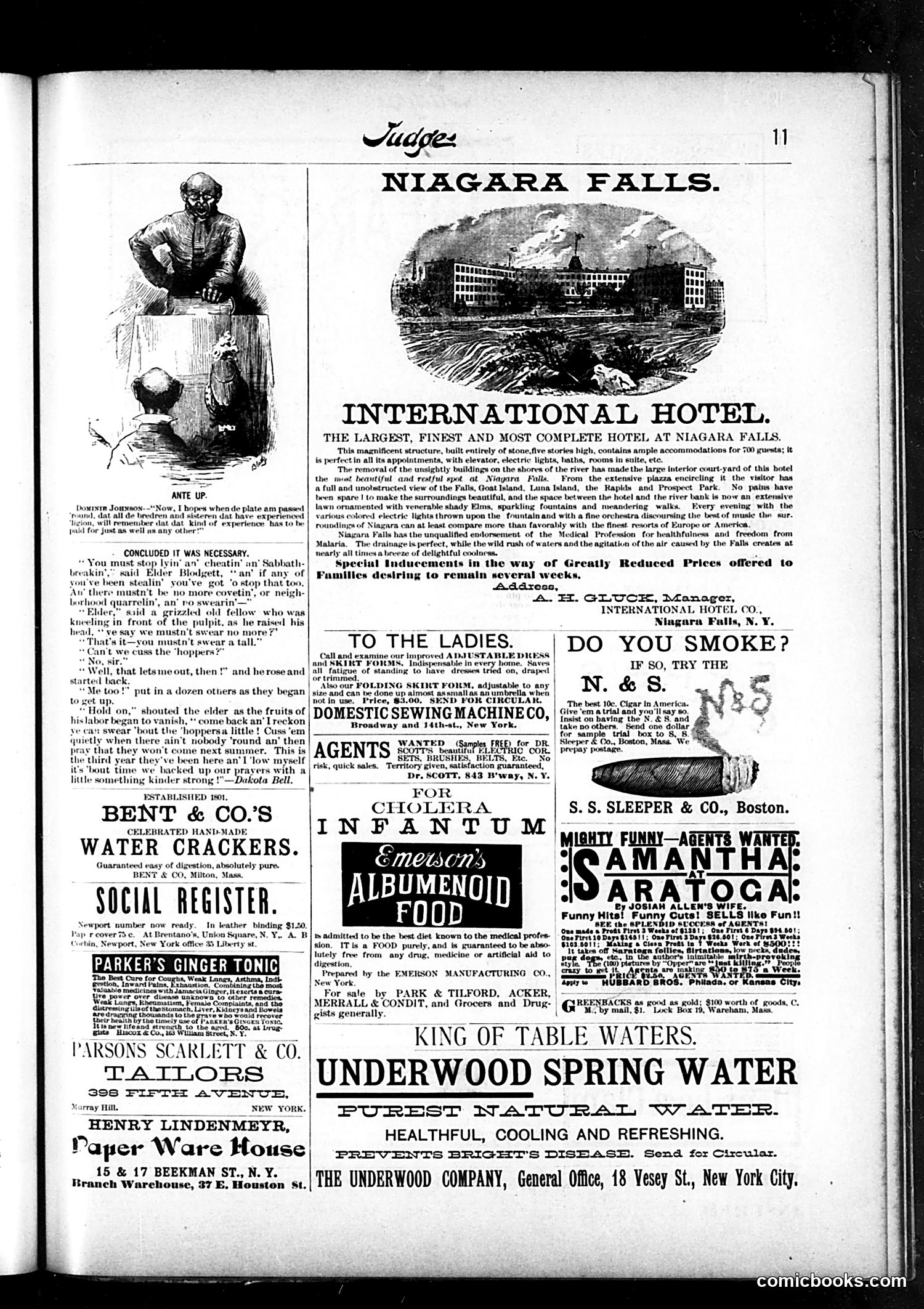
This page is primarily **advertisements and commercial notices** rather than political satire. The main cartoon "ANTE UP" features a rural farmer character (Doraxiam Johnson) in a dialogue with neighbors about crop-destroying locusts. The farmer initially demands neighbors stop "lyin' an' cheatin'" before joining prayers, but when they prepare to leave, he stops them—reasoning that since locusts have plagued three summers, they might as well "back up our prayers with a little something kinder strong," meaning stronger language (cursing) alongside prayer. The joke relies on frontier American humor: the ironic tension between religious piety and practical frustration, and the farmer's admission that sincere prayer apparently requires colorful profanity to be effective. The rest of the page is period advertisements for hotels, crackers, cigars, and patent medicines—typical Judge magazine filler content showcasing goods available to 1880s-90s readers.
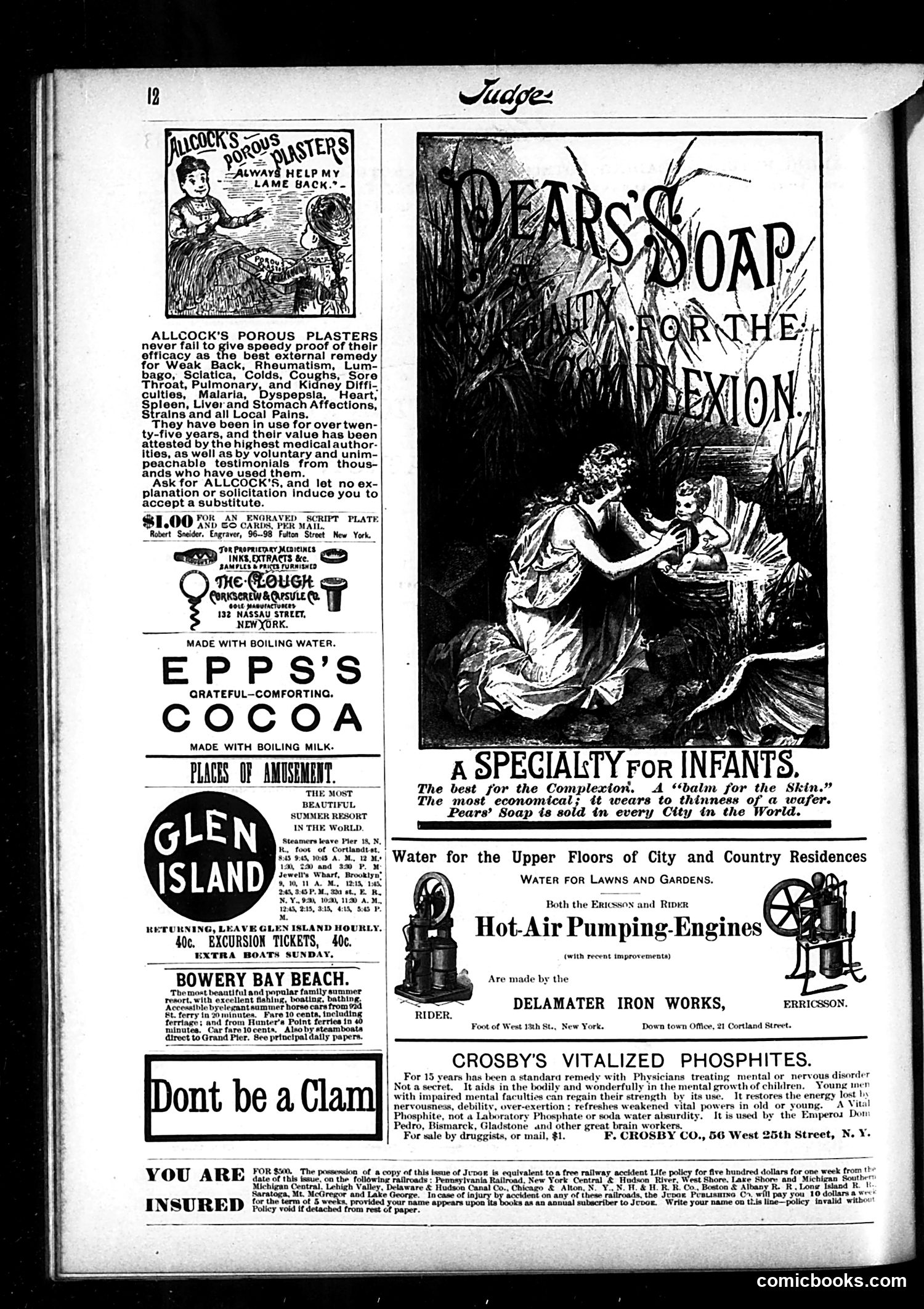
This page is primarily **advertising**, not political satire. The main content consists of product advertisements typical of late-19th-century American magazines. The largest advertisement features **Pears' Soap**, marketed as "A Specialty for Infants" with an illustration showing two classical female figures. The ad emphasizes the soap's gentleness and universal availability. Other notable ads include: - **Allcock's Porous Plasters** for various ailments (rheumatism, back pain, etc.) - **Epps's Cocoa** - **Glen Island** resort promotions - **Delamater Iron Works** pumping engines - **Crosby's Vitalized Phosphites** for nervous disorders and mental fatigue The bottom contains fine-print insurance information: possessing a copy of Judge provides automatic $500 railway accident insurance for one week. The ads reflect period concerns: patent medicines, resorts, and industrial equipment. The "Don't be a Clam" heading appears to be a generic exhortation unrelated to specific satire. This is a commercial page with minimal editorial content.
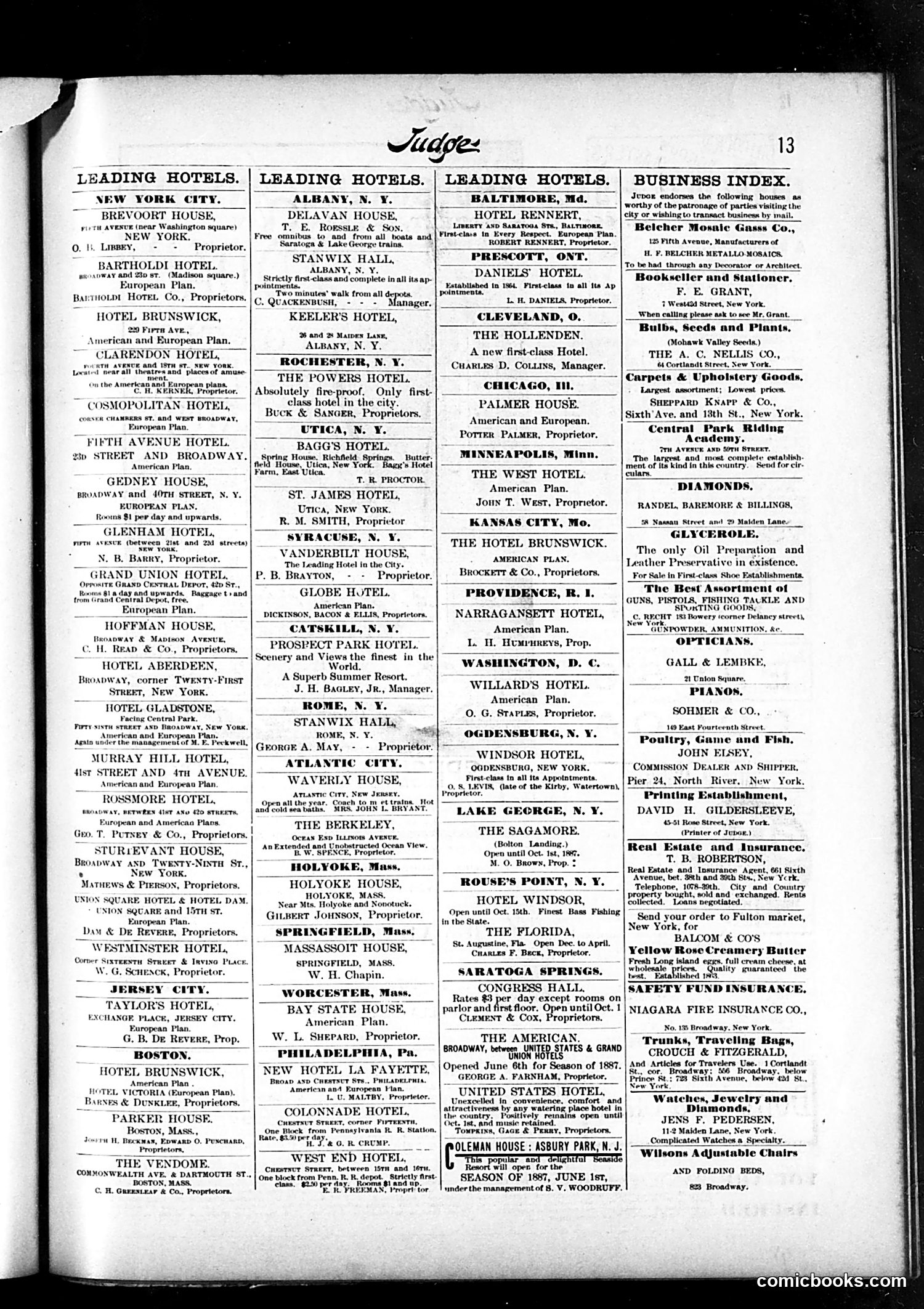
This page is primarily a **business directory**, not a satirical cartoon section. It consists almost entirely of paid advertisements for leading hotels across major American cities (New York, Albany, Baltimore, Boston, Chicago, etc.) and related businesses like carpet dealers, seed companies, and diamond merchants. The only non-advertising element is a small "Business Index" section endorsing specific companies—typical of trade publications and magazines from this era. **For a modern reader:** This represents how 19th-century magazines funded operations through classified advertising. The hotels listed (Waldorf-Astoria, Palmer House, etc.) were luxury establishments catering to wealthy travelers. The directory format and endorsements show Judge's role as both satirical publication and business guide for the affluent readership. No political satire or cartoon content is visible on this page.
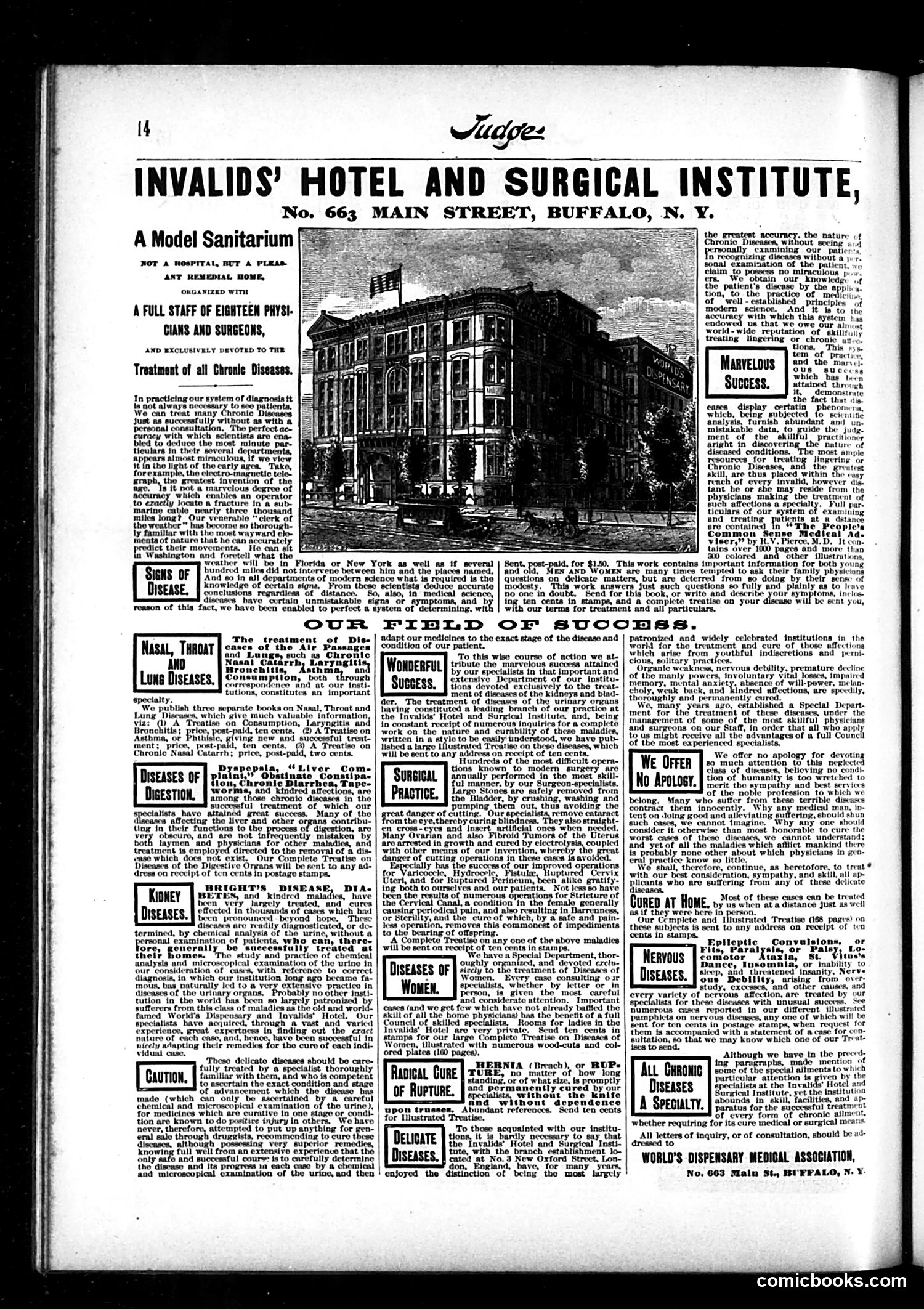
This page is **primarily advertising**, not satirical content. It promotes the "Invalids' Hotel and Surgical Institute" in Buffalo, New York—a mail-order medical practice claiming to diagnose and treat chronic diseases without in-person examination. The key absurdity (which Judge's readers would have recognized as ripe for satire) is the institute's central claim: they can accurately diagnose patients remotely using only written descriptions of symptoms, comparing this to telegraph operators locating submarine cable fractures across thousands of miles. By modern standards, this is obvious quackery. The ad emphasizes they treat chronic diseases through written consultation, offer eighteen physicians, and publish a 1,000-page medical advice book. For 1890s readers, this represented the kind of mail-order medical fraud that legitimate doctors and satirists regularly mocked—promising miraculous cures without seeing patients, exploiting the desperate ill and the medically ignorant. Judge's inclusion of such ads reflected both revenue needs and implicit criticism of such dubious medical enterprises.
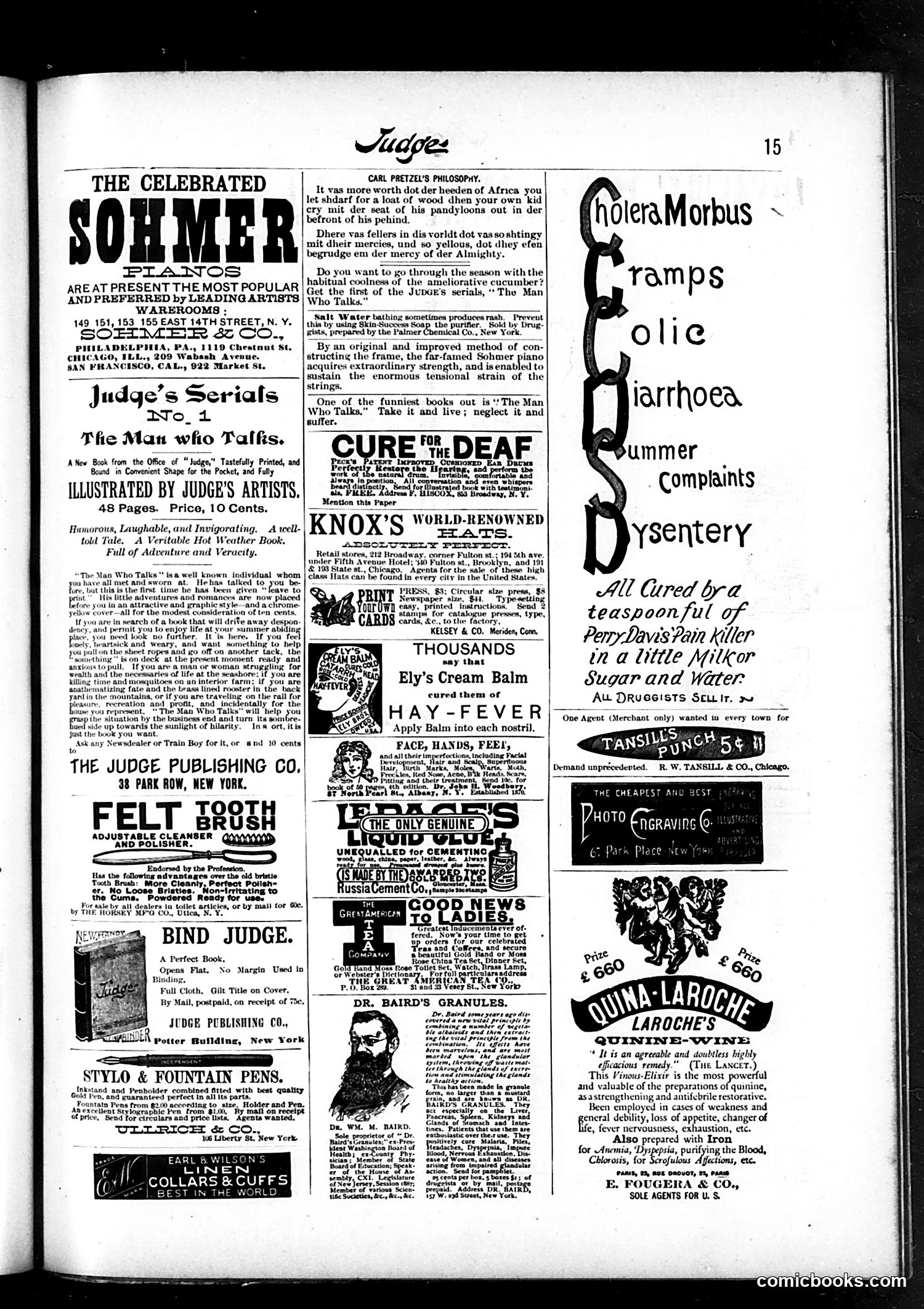
This is primarily a **page of advertisements and serialized content** from Judge magazine. The editorial content consists of brief satirical observations attributed to "Carl Pretzel," apparently a character offering folk wisdom with a German accent (indicated by phonetic misspellings like "vorldt" and "dheir"). The two visible philosophical quips are: 1. A comment on African poverty versus American poverty—suggesting it's worse to watch one's own child suffer deprivation than to witness distant suffering. 2. A jab at stingy people who begrudge others (even) God's mercy. These represent mild social satire typical of the era: commentary on human nature, wealth disparity, and miserliness. The humor relies on the character's exaggerated dialect and homespun wisdom style rather than political reference. The page is otherwise dominated by product advertisements (pianos, brushes, pens, medicines, hats).
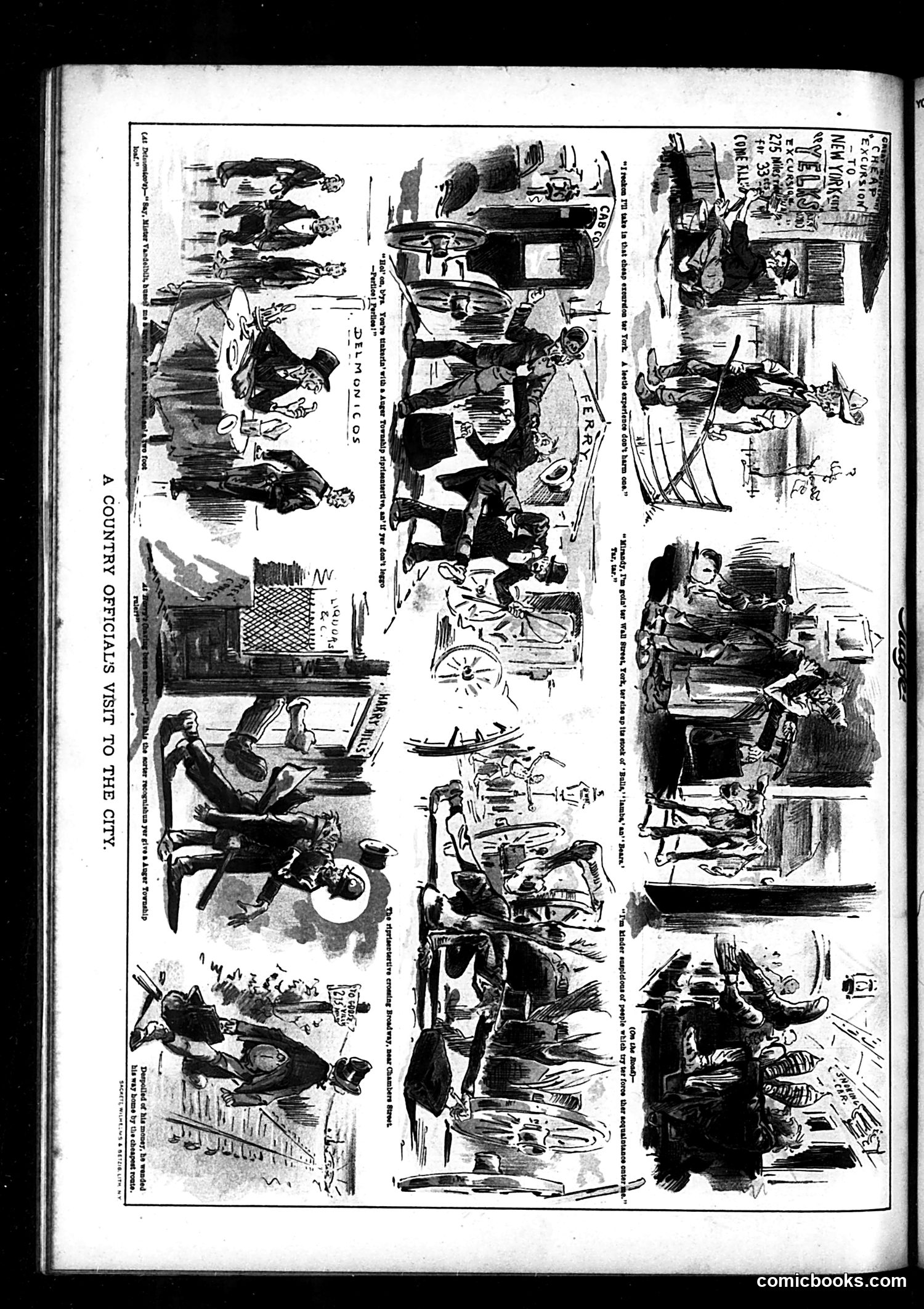
This page appears to feature rural or working-class character dialogue rendered in heavy dialect ("kinder suspicious of people which try ter force ther acquaintance onter ie"). The fragmented OCR text suggests a confrontational scene between characters, with one asserting authority as a "Finger Township representative" and threatening consequences if not obeyed. The repeated exclamation "Pertiee! Perlis!" remains unclear—possibly character names or expressions specific to the satire's context. A Delmonicos Liquors advertisement appears on the page, suggesting late 19th or early 20th-century publication. Without clearer image resolution or dated attribution, the specific political figures or events referenced are difficult to identify with certainty, though the tone suggests commentary on local political power dynamics or rural corruption. The dialect humor was typical of Judge's satirical approach to American regional characters.