
A complete issue · 16 pages · 1887
Judge — May 28, 1887
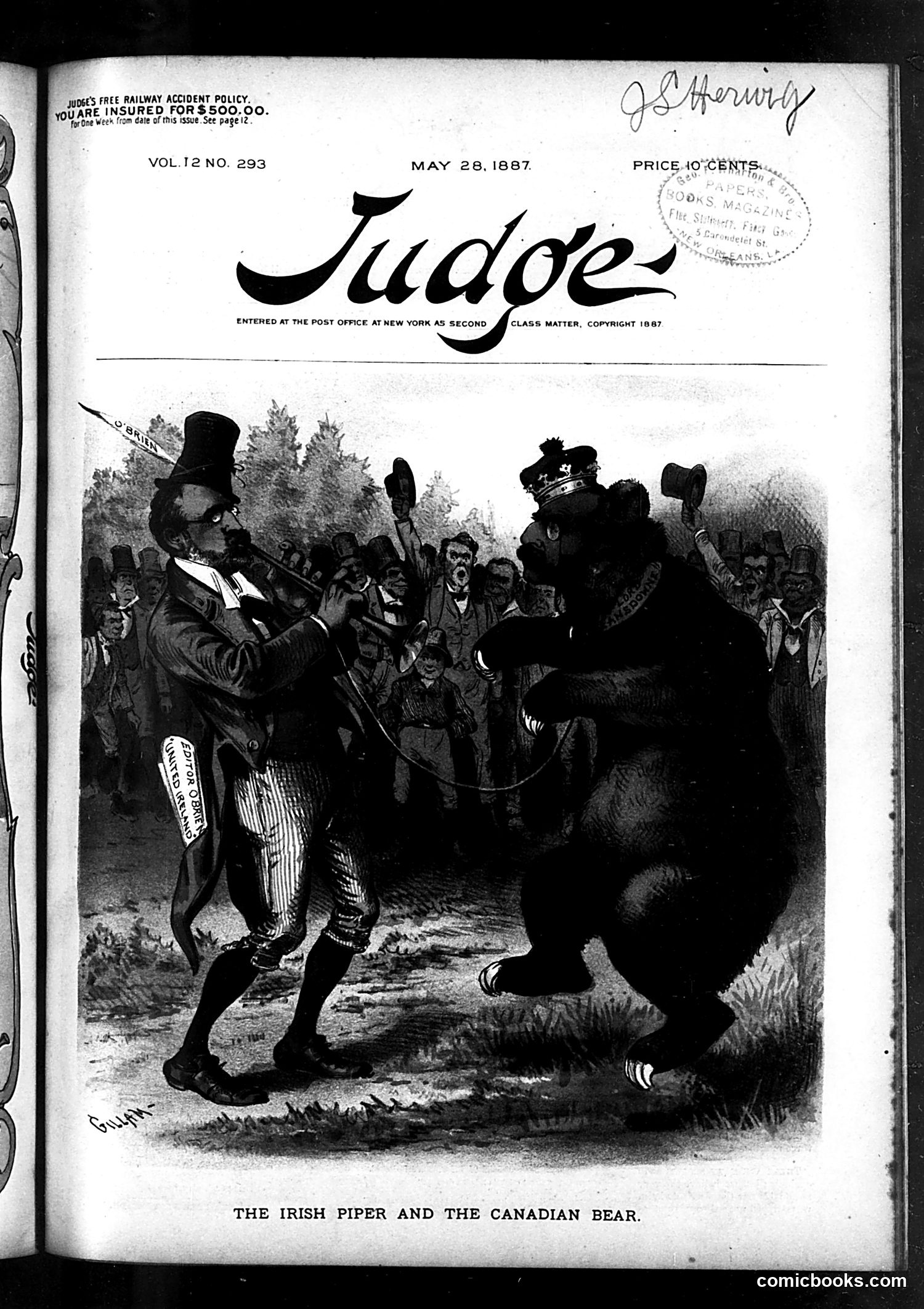
This political cartoon from Judge (May 28, 1887) depicts a confrontation between two figures: an Irish piper in formal dress playing bagpipes, and a large bear wearing a crown. The crowd gathered behind suggests a public spectacle or diplomatic encounter. The title indicates this satirizes Irish-Canadian relations during this period. The Irish figure likely represents Ireland or Irish interests, while the crowned bear represents Canada (a common symbol for the British dominion). The piper's defiant performance suggests Irish resistance or assertiveness toward Canadian authority or British imperial control. The specific political dispute referenced remains unclear without additional historical context from 1887, but the cartoon satirizes tensions between Irish and Canadian interests in the late nineteenth century.
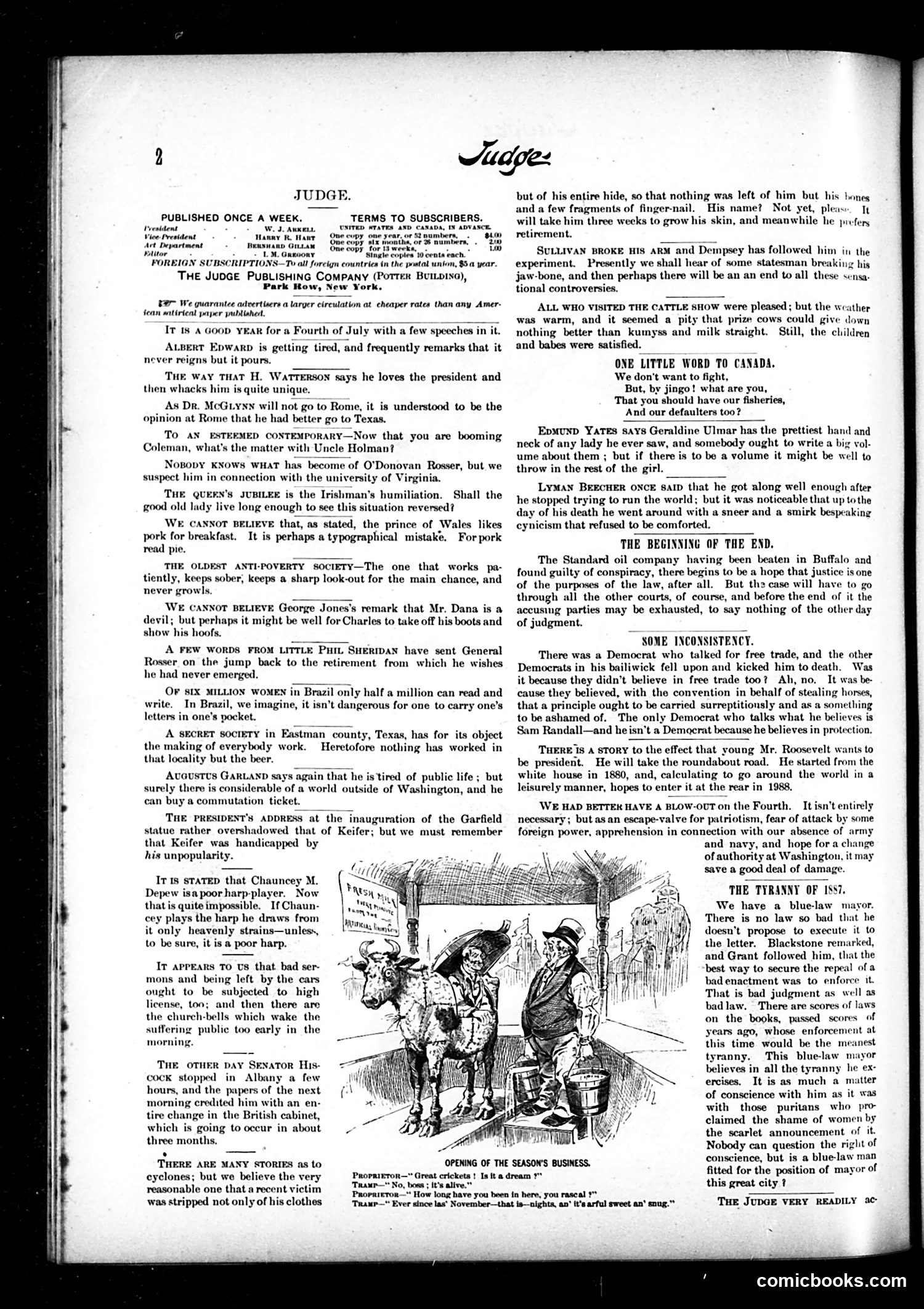
The main cartoon, titled "Opening of the Season's Business," depicts two figures in what appears to be a theatrical or political setting. Based on the accompanying dialogue and Judge's satirical nature, this likely comments on political maneuvering or public affairs circa late 1880s. The text references include criticism of various political figures and social issues: debates over free trade, commentary on a potential Democratic presidential candidate (possibly referencing 1888), and satire about Washington politics and mayoral governance in an unnamed city. The specific identities of the cartoon figures remain unclear from the image alone, though the dialogue suggests commentary on political posturing or backroom dealings. The overall page mixes short editorial quips with the main cartoon's political satire.
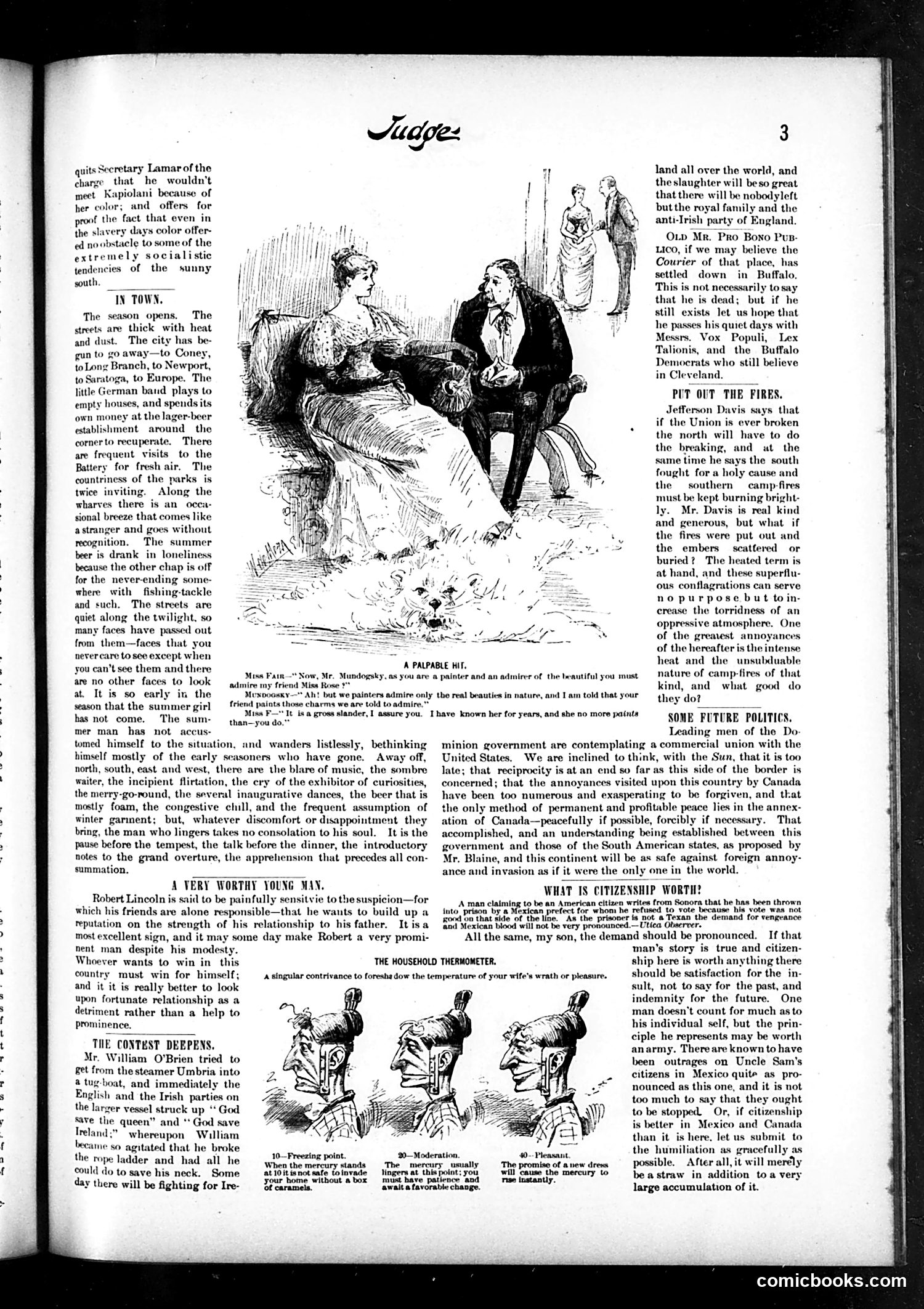
This page contains several satirical pieces typical of Gilded Age humor: **"A Palpable Hit"** depicts a conversation between a woman (Miss Fain) and a painter (Mundogsky). She challenges him about painting her, implying she lacks natural beauty. The joke mocks both artistic pretension and backhanded compliments about women's appearance. **"The Household Thermometer"** is a humorous diagram using mercury levels as metaphors for a wife's emotional states—freezing point requires caramels as appeasement, moderation requires patience. It satirizes domestic dynamics and the notion that husbands must manage their wives' moods through careful behavior. **Miscellaneous items** reference contemporary figures: Secretary Lamar defending against accusations of racial prejudice; Robert Lincoln's sensitivity about nepotism; and Irish-English tensions aboard a ship (the Umbria incident), with competing national anthems creating conflict. The page's overall tone reflects 1880s American magazine humor: domestic comedy, ethnic stereotypes, and political jabs at public figures.
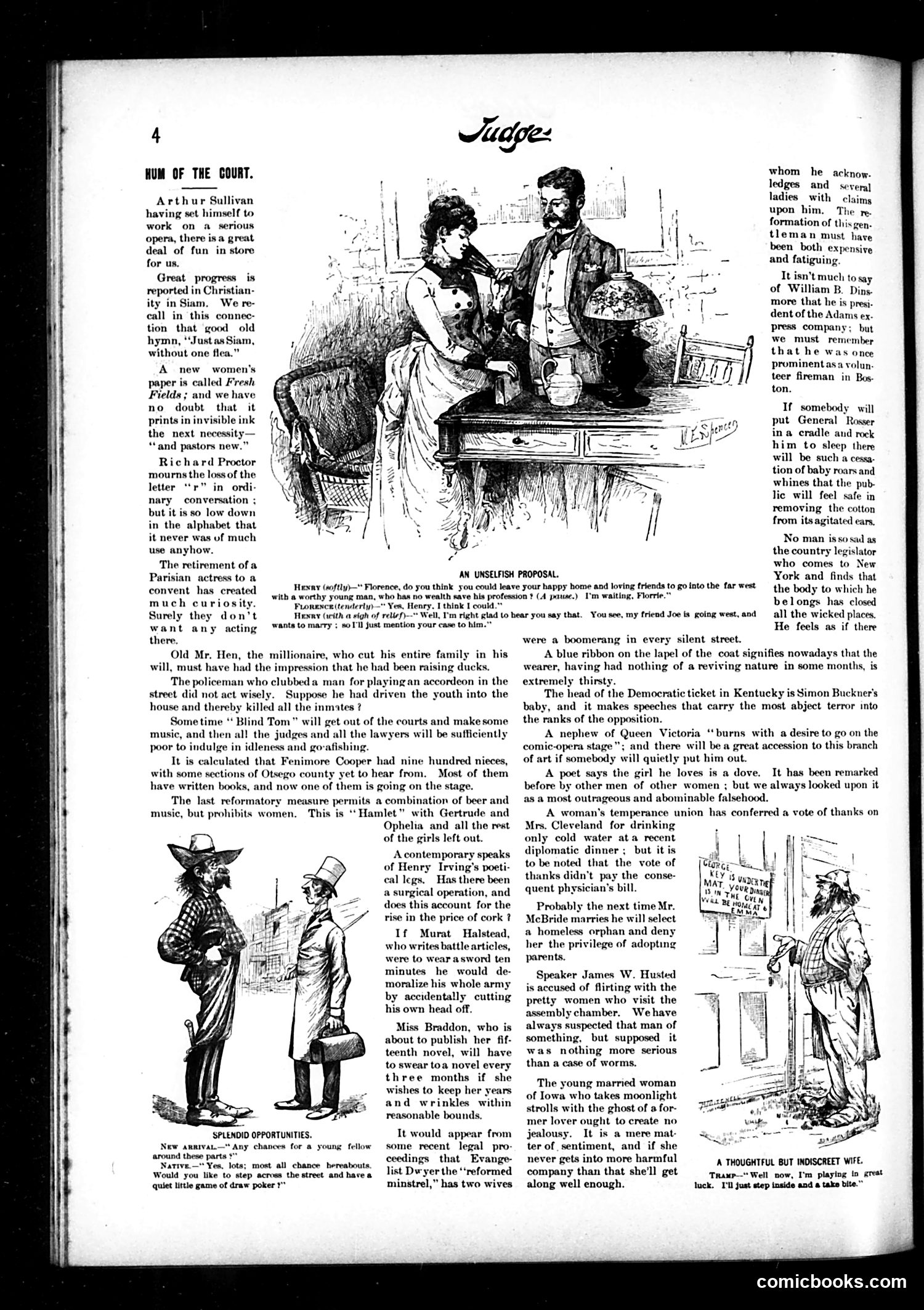
This page contains satirical commentary on contemporary figures and events from the late 1870s-80s era. **Major cartoons:** 1. **"An Unselfish Proposal"** (top): A man asks a woman to abandon her home and marry him, a poor professional, so his friend Joe can marry her instead. The satire mocks self-serving romantic schemes dressed in altruistic language. 2. **"Splendid Opportunities"** (bottom left): A newcomer asks about job prospects; a local offers him gambling. This satirizes frontier opportunism and vice. 3. **"A Thoughtful But Immodest Wife"** (bottom right): Domestic humor about a wife's candid assessment of her husband's importance. **Notable verbal jabs** target Arthur Sullivan (composer), religious hypocrisy, prolific novelist Miss Braddon, and various public figures. The piece mocking Evangelist Dwyer's "two wives" references actual legal scandal. The humor relies on contemporary gossip and social criticism—attacking pretension, reformers, and absurdity in public life typical of Judge's irreverent style.
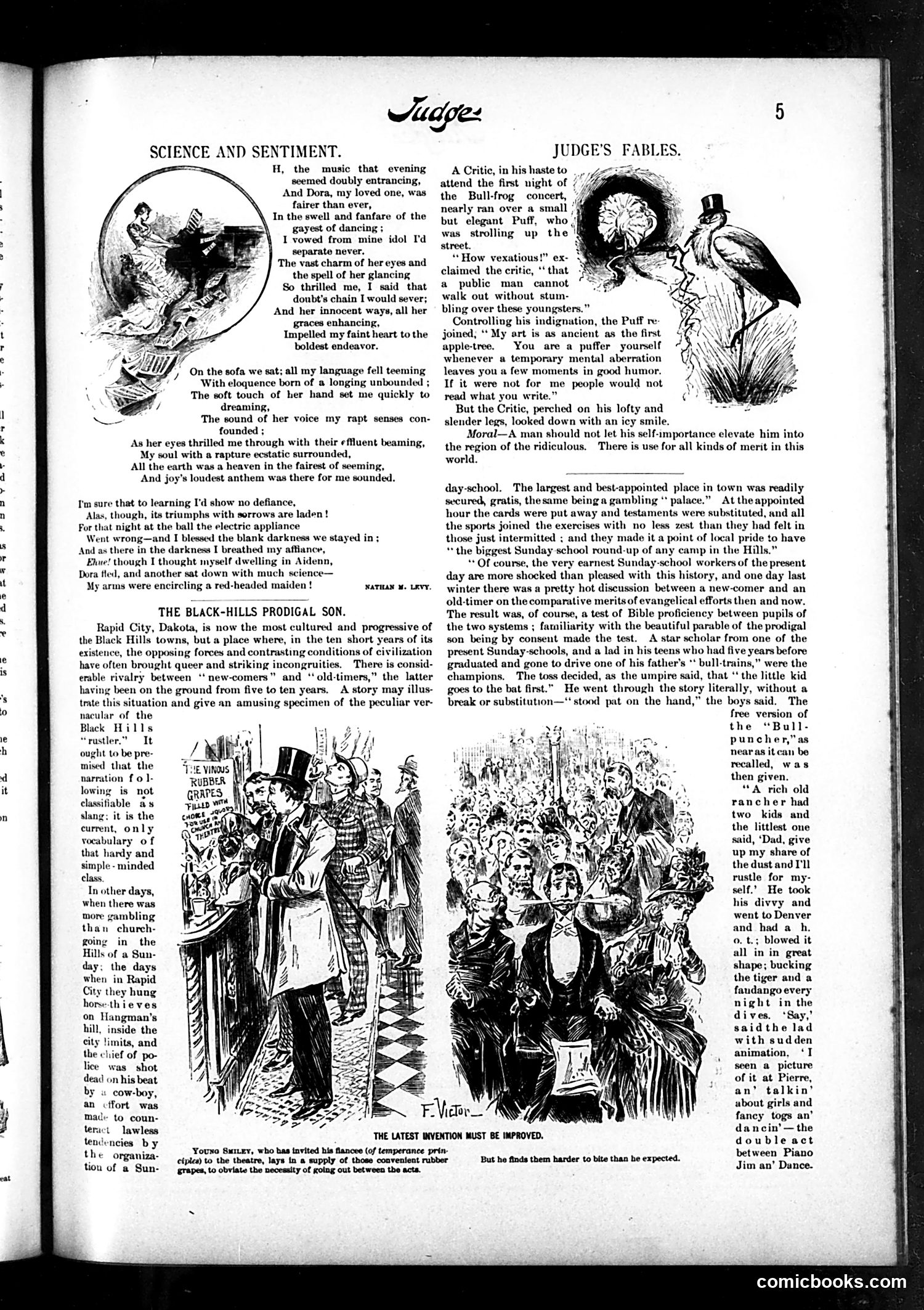
This page contains three distinct pieces of satirical content: **"Science and Sentiment"** (left): A romantic poem mocking sentimentality. The narrator woos "Dora" at a dance with flowery language, then loses her in the darkness when the lights fail—accidentally embracing a "red-headed maiden" instead. The satire targets overwrought romantic sentiment and the gap between poetic idealization and clumsy reality. **"The Black Hills Prodigal Son"** (center): Describes Rapid City, Dakota's cultural tension between rough "old-timers" and refined "new-comers." It promises an amusing anecdote in local dialect about efforts to reform the lawless frontier through Sunday schools, replacing gambling halls with religious instruction. **"Judge's Fables"** (right): A moral fable where a Critic nearly hits a young Puff (a theatrical agent/promoter) and complains about "youngsters." The Puff defends his profession's ancient origins and necessity. The moral: don't let self-importance make you ridiculous—all professions have value. The cartoons illustrate these pieces with period-appropriate satirical drawings.
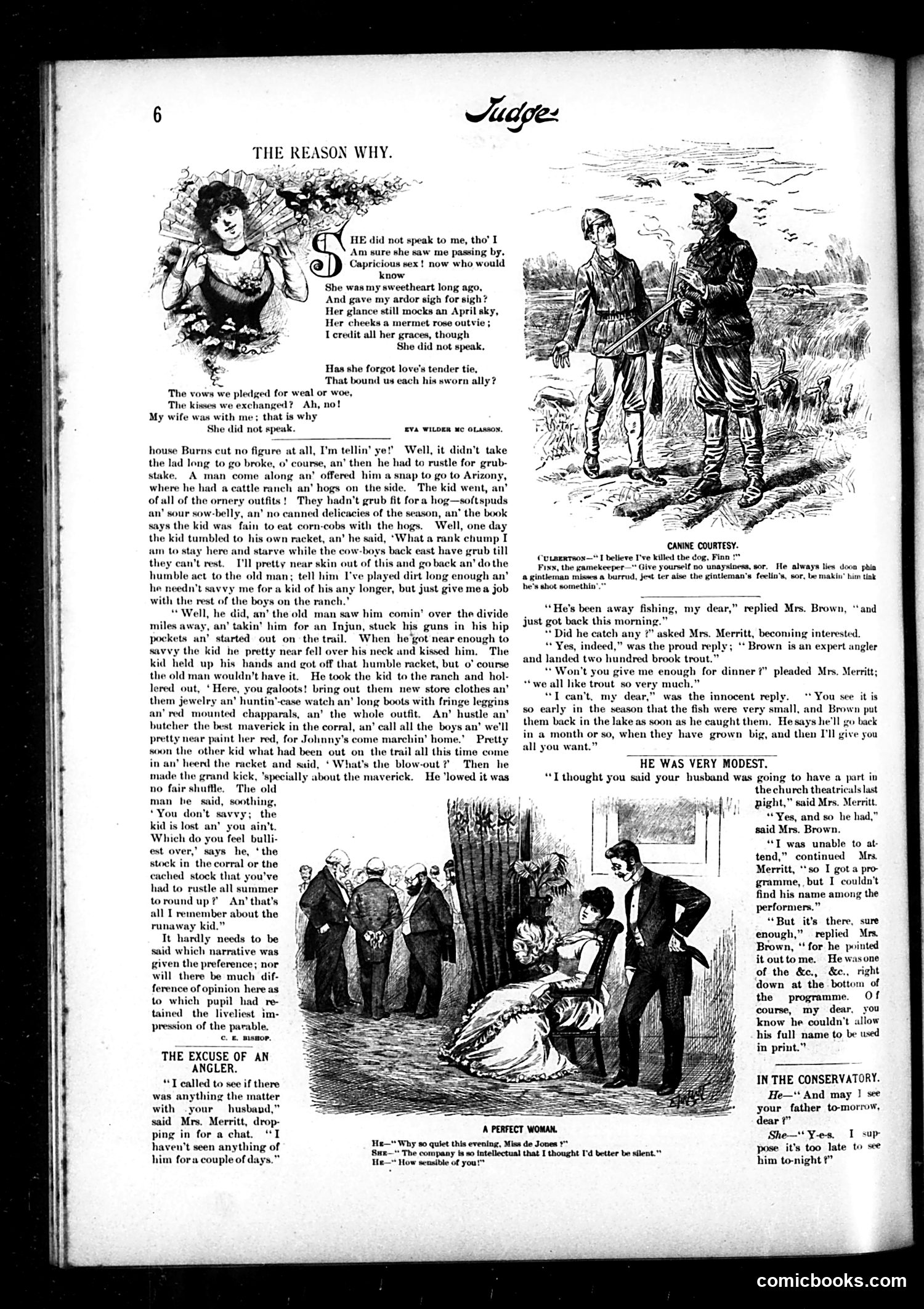
This page contains multiple satirical pieces typical of Judge's humor: **"The Reason Why"** (poem with illustration): A man laments that his former sweetheart ignored him while passing by—the joke's punchline reveals his wife was present, explaining the woman's discretion. **"The Excuse of an Angler"**: A tall tale about a runaway boy who returns home repentant. The father's parable contrasts the "lost" son with "cached stock" (livestock left to fend for itself)—suggesting the prodigal's return is more precious than what was already possessed. Judge satirizes sentimental father-son reconciliation narratives. **"Canine Courtesy"** (illustrated): A gamekeeper consoles a gentleman who fears he's killed a dog, explaining the dog "always lies down" when a gentleman misses a bird "to raise the gentleman's feelin's"—mocking upper-class sporting pretension and servant obsequiousness. **"In the Conservatory"** (dialogue): Brief flirtation joke about a young woman avoiding late-night visits. The page exemplifies Judge's mix of romantic comedy, folk humor, and class satire aimed at 1880s-90s American audiences.
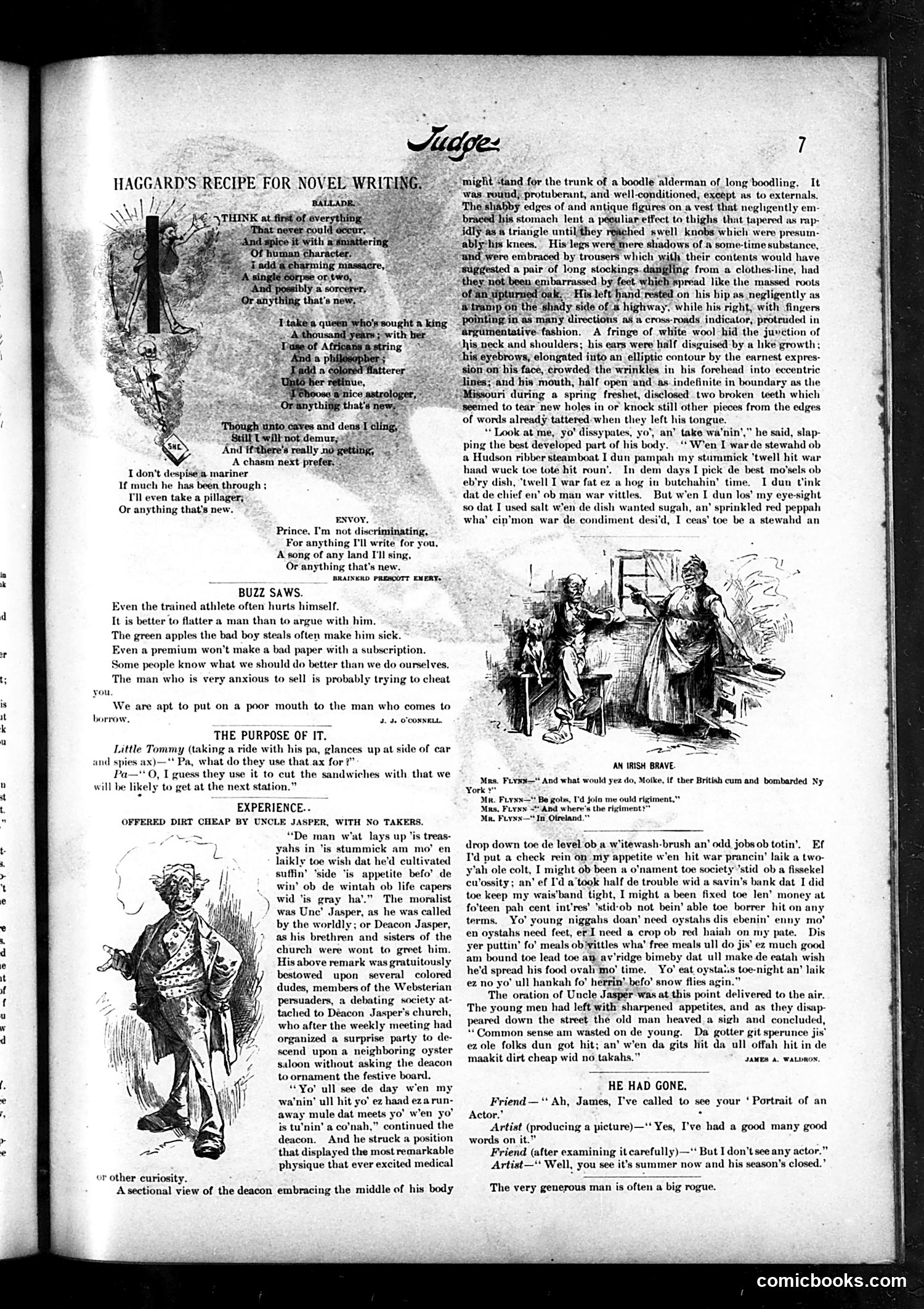
This page satirizes **H. Rider Haggard**, a popular Victorian novelist, through "Haggard's Recipe for Novel Writing"—a mock-serious guide that ridicules his florid, overwrought descriptive style. The lengthy, absurdly complex physical description of a character serves as parody; Haggard was famous for baroque prose that subordinated plot to exhaustive character detail. The other pieces—"Buzz Saws" (aphorisms), "The Purpose of It" (light humor), and "An Irish Brave" (dialect humor)—are typical Judge filler. The substantial section on **Uncle Jasper**, a Black dialect character preaching morality to younger Black men, reflects the magazine's casual deployment of racial caricature common to 1880s-90s American humor, though presented as folksy wisdom rather than cruelty. The final brief joke about an artist's portrait rounds out miscellaneous content typical of satirical magazines of this era.
I can see this is a page from *Judge* magazine, but the image quality and orientation make it difficult to read the specific text or identify particular figures with certainty. The page appears to contain satirical illustrations typical of *Judge*'s style—featuring silhouetted figures and detailed period dress suggesting late 19th or early 20th-century subject matter. Without being able to clearly read the OCR text or definitively identify the specific caricatures and their labels, I cannot accurately explain what political or social events are being satirized here. To provide accurate historical context, I would need either clearer text visibility or additional identifying information about the publication date and issue.
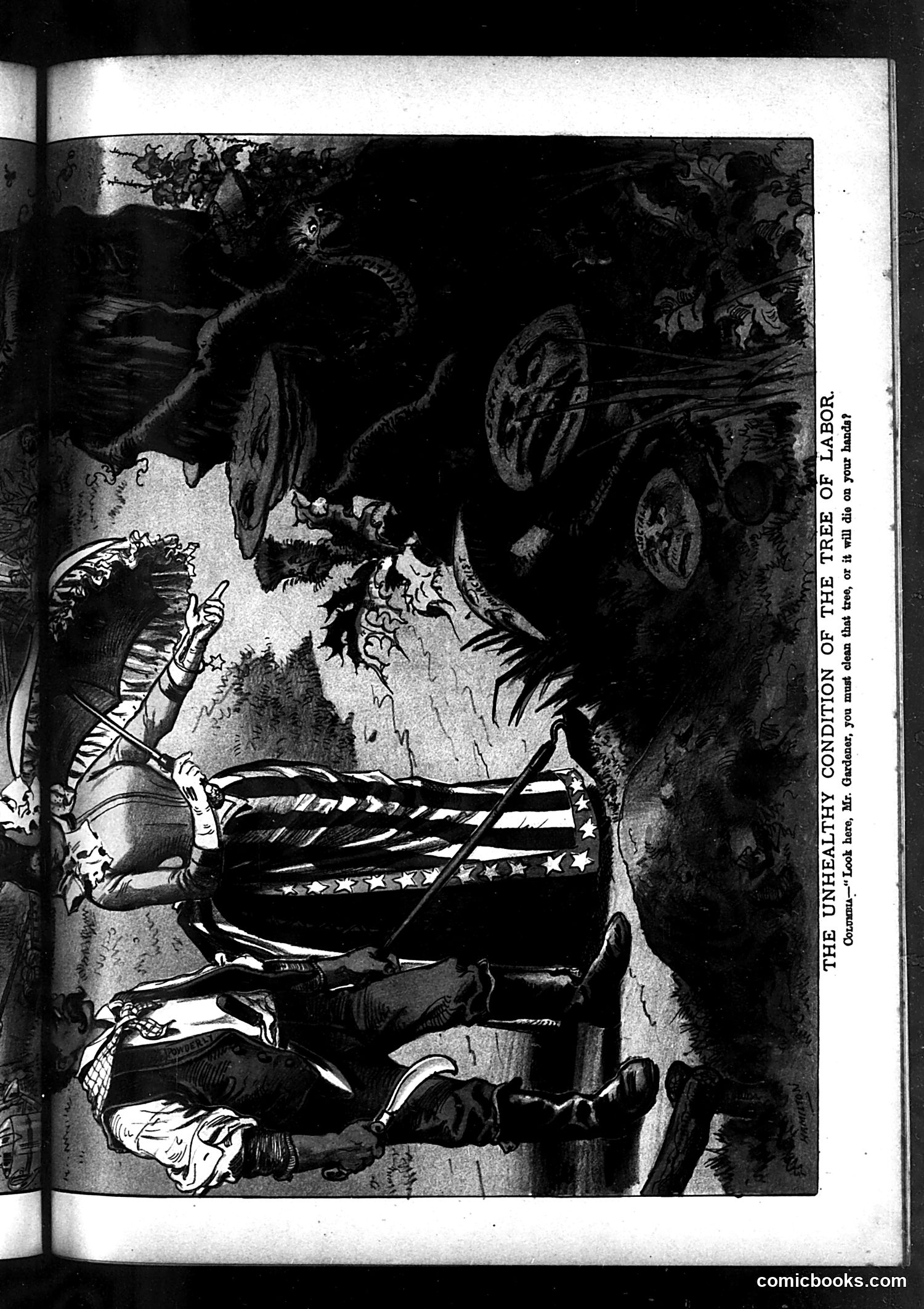
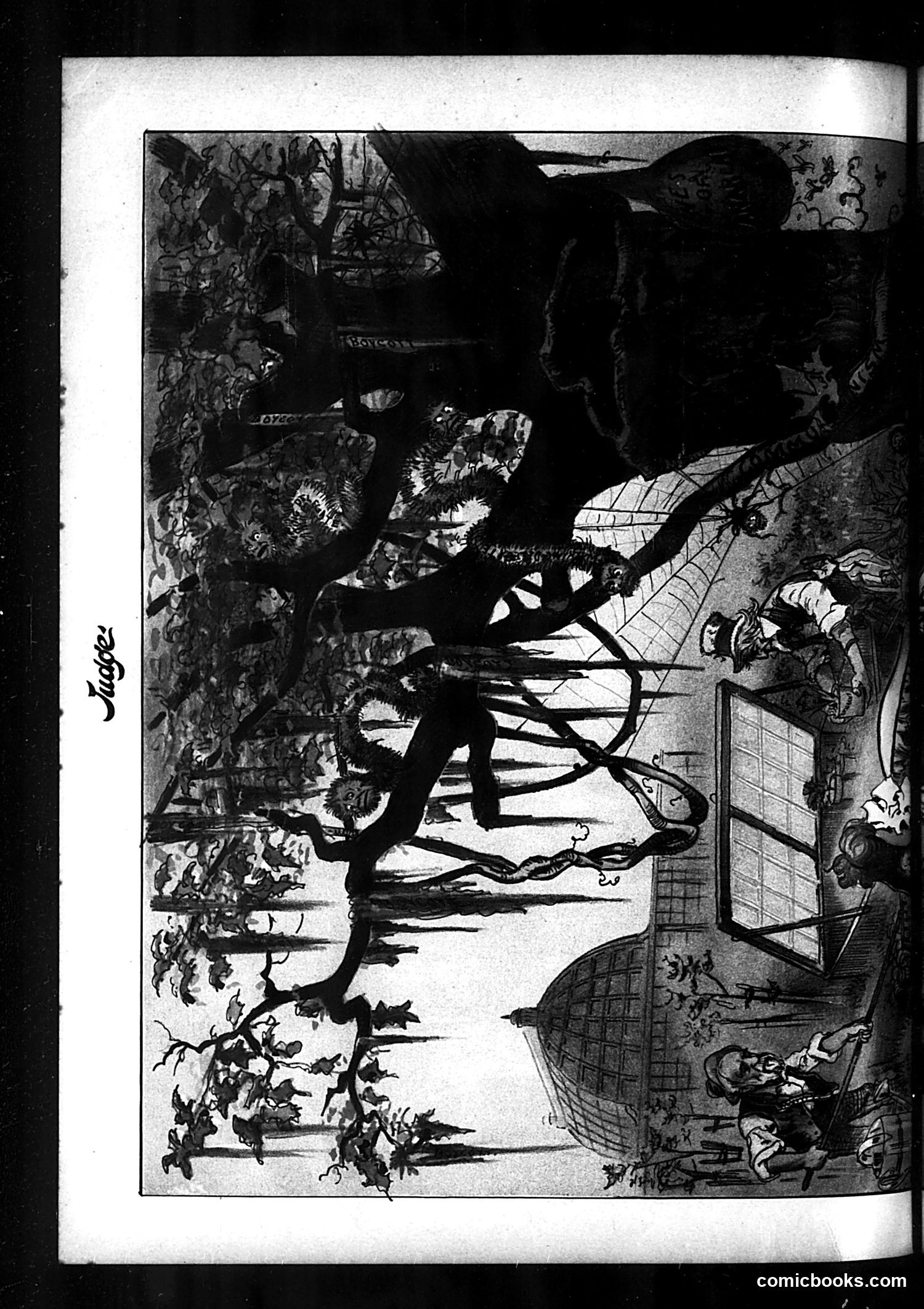
This political cartoon depicts Lady Liberty (identifiable by her starred robe and crown) appearing sickly or dying, surrounded by gnarled, diseased trees. The OCR text is largely corrupted, but the caption clearly indicates this is satirizing the poor condition of labor in America. The imagery suggests that the nation's labor force—metaphorically represented as trees that should be healthy and productive—is instead withering under harsh conditions. The cartoon likely critiques exploitative working conditions, low wages, or inadequate protections for workers during the Gilded Age or Progressive Era when *Judge* was active. Lady Liberty's distress underscores the irony: a nation founded on freedom is failing to protect its workers' wellbeing.
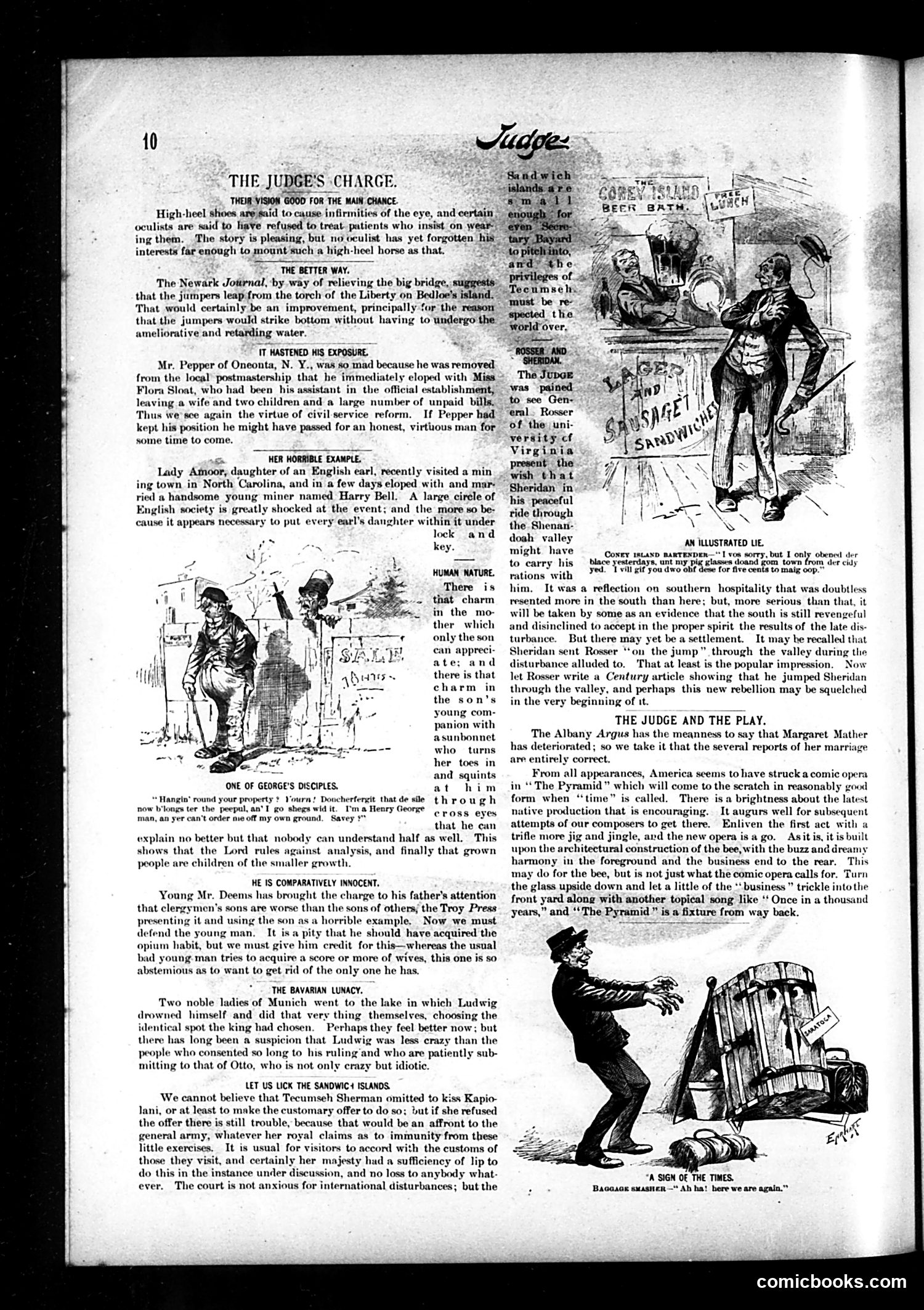
This page contains multiple satirical pieces mocking contemporary (late 19th century) social absurdities: **"The Judge's Charge"** critiques oculists who refuse high-heeled shoe wearers yet ignore obvious moral compromises for profit. **"It Hastened His Exposure"** mocks a postmaster who eloped rather than accept removal, revealing that job security enables moral facades. **"One of George's Disciples"** satirizes Henry George's single-tax philosophy, showing a vagrant claiming ownership of others' property based on George's "land belongs to the people" doctrine. **"The Bavarian Lunacy"** questions whether King Ludwig II was truly mad, given that sane nobles imitate his suicide. **"Let Us Lick the Sandwich Islands"** sarcastically comments on General Sherman's Hawaiian visit and Princess Kapiolani, mocking American imperialism and suggesting visitors should accommodate local customs (while implying impropriety). The cartoons use exaggeration and dark humor to expose hypocrisy, social pretension, and political absurdity of the era.
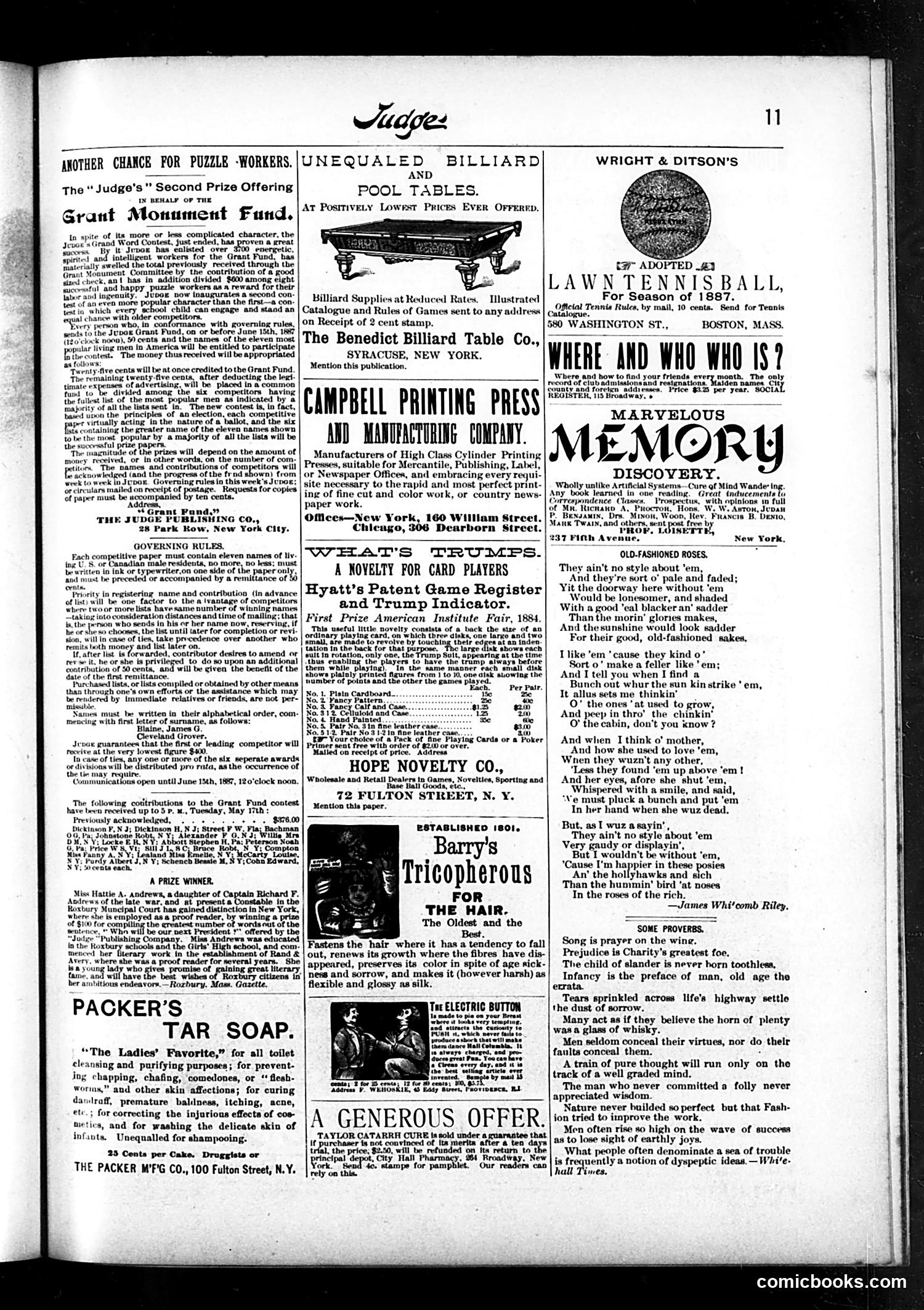
This is primarily an **advertising and promotional page** rather than a satirical cartoon page. The main content is a lengthy announcement for Judge's second prize-writing contest to raise funds for the Grant Monument (honoring President Ulysses S. Grant, who died in 1885). The contest asks readers to submit lists of "eleven most popular living men in America" for 50 cents. The magazine promises to distribute prize money among the six competitors whose lists best match public opinion—framed as democratic "voting." **Notable advertisements** include: - Wright & Ditson's lawn tennis ball (upper right) - Campbell Printing Press Company - Barry's Tricopherous hair product - Packer's Tar Soap **The satirical content** appears in the poetry section "Where and Who Who Is?" and proverbs—light humor unrelated to the contest. The page reflects **late 19th-century popular culture**: contests as fundraising, product advertising density, and nostalgia for Civil War leadership. The Grant Monument Fund context suggests this helped raise substantial sums for the famous New York memorial.
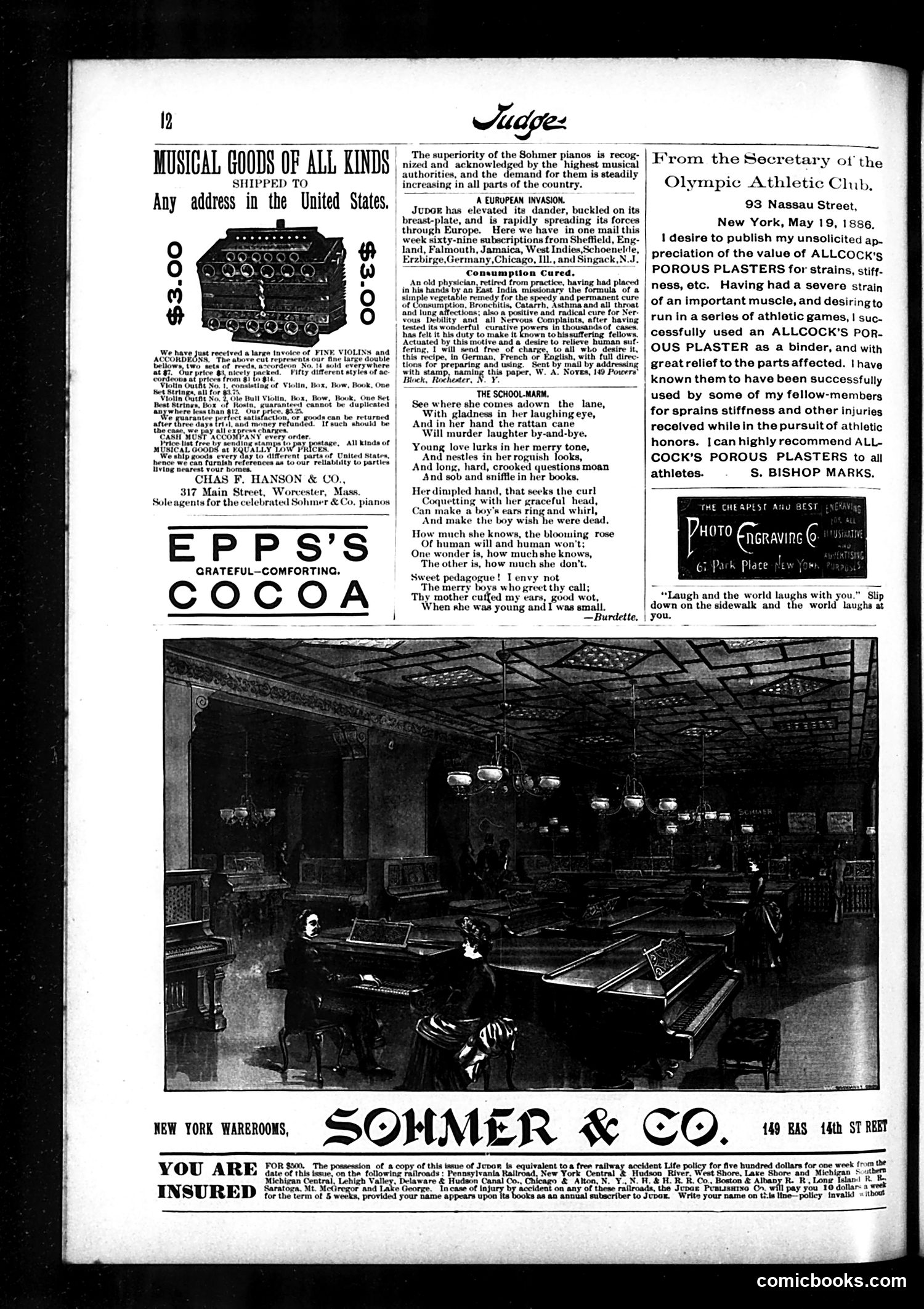
This page is primarily **advertising**, not political satire. It showcases Victorian-era commercial products and services typical of Judge magazine. The main image shows **Sohmer & Co.'s piano warehouse** in New York—a display of their instruments. The text emphasizes that Sohmer pianos were superior and increasingly popular both domestically and internationally ("A European Invasion"). Notable advertisements include: - **Musical instruments** and supplies shipped nationwide - **Epps's Cocoa** (a real Victorian brand) - **Allcock's Porous Plasters** (medical adhesive bandages), endorsed by the Olympic Athletic Club secretary for athletic strains The page includes a sentimental poem, **"The School Marm,"** celebrating a young female schoolteacher's charm and knowledge, reflecting Victorian sentimentality about education. At bottom, there's an insurance notice: possession of Judge's current issue entitled readers to accidental death coverage on specific railroads—a unique period marketing gimmick. This reflects 1880s consumer culture and advertising practices rather than political commentary.
This page is primarily a business directory and hotel advertisement section from Judge magazine. The content consists almost entirely of: 1. **Hotel listings** from major cities (New York, Boston, Jersey City, Syracuse, etc.) advertising accommodation options 2. **Business advertisements** for various goods and services: glass companies, wine vendors, seed suppliers, copy machines, insurance firms, jewelry stores, etc. There is one illustrated advertisement visible - a "Pelt Tooth Brush" product ad featuring a decorative brush design with text about its cleaning qualities. This is not a page containing political or satirical cartoons. It's a straightforward commercial directory/index page typical of 19th-century magazine advertising sections. For a modern reader, it mainly documents what commercial services and products were available during this period and how businesses advertised in era publications. The "Judge" branding indicates this came from a satirical publication, but this particular page serves an advertising rather than editorial function.
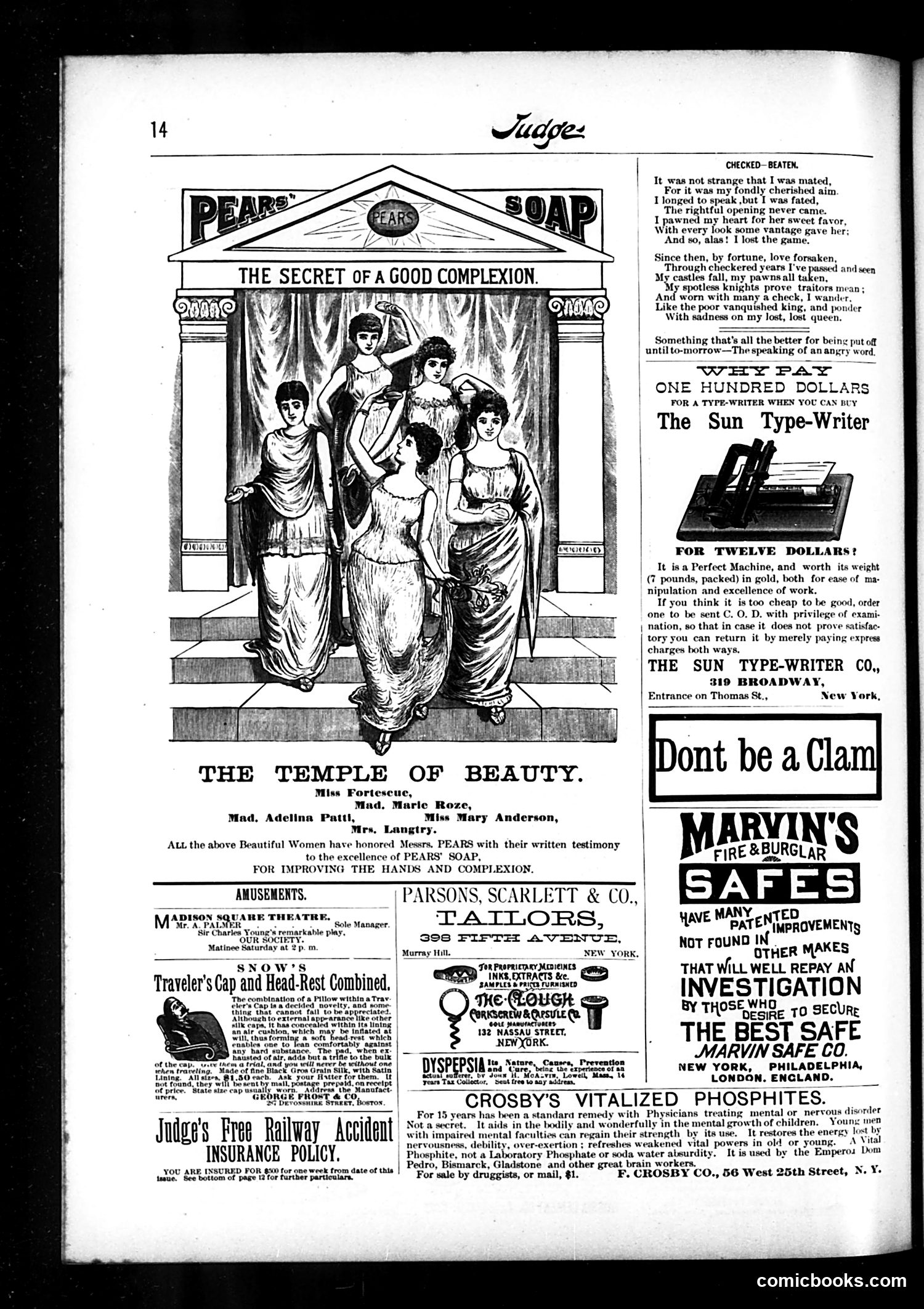
This is primarily a **product advertisement**, not a political cartoon. The central image depicts classical female figures in a temple setting, representing idealized beauty. The text identifies five named women—Miss Fortescue, Mme. Marie Roze, Mme. Adelina Patti, Miss Mary Anderson, and Mrs. Langtry—described as having provided written testimonies endorsing Pears' Soap for improving hands and complexion. These appear to be **prominent actresses and performers of the era** (late 1800s), lending celebrity credibility to the product. The "Temple of Beauty" framing elevates the soap to something almost sacred, appealing to women's aspirations for beauty and refinement. The surrounding page consists entirely of **period advertisements** for typewriters, safes, tailors, medicines, and theatrical productions—typical commercial content from Judge magazine. There is no satirical commentary visible here; it's straightforward Victorian-era marketing designed to associate beauty products with famous, desirable women.
This page is primarily **advertising and editorial content**, not political satire. The upper portion contains testimonial letters praising **Hop Bitters**, a patent medicine, with personal accounts of cures for paralysis and indigestion. These were common 19th-century marketing tactics—unverified claims presented as reader testimonials. The bulk of the page consists of **product advertisements** for various goods: medicinal items (Emerson's Albumenoid Food for constipation, Ely's Cream Balm for colds), writing instruments (Stylo Fountain Pens), household products (Paper Ware House), and novelty items (print cards, sewing machines, cement glue). There is a brief **editorial section** ("The Judge's Side Table") mentioning literary publications and newspaper editors—standard magazine commentary with no apparent satirical intent. No significant political cartoons or social satire appear on this page; it represents typical late-19th-century magazine content dominated by patent medicine promotion and commercial advertising.
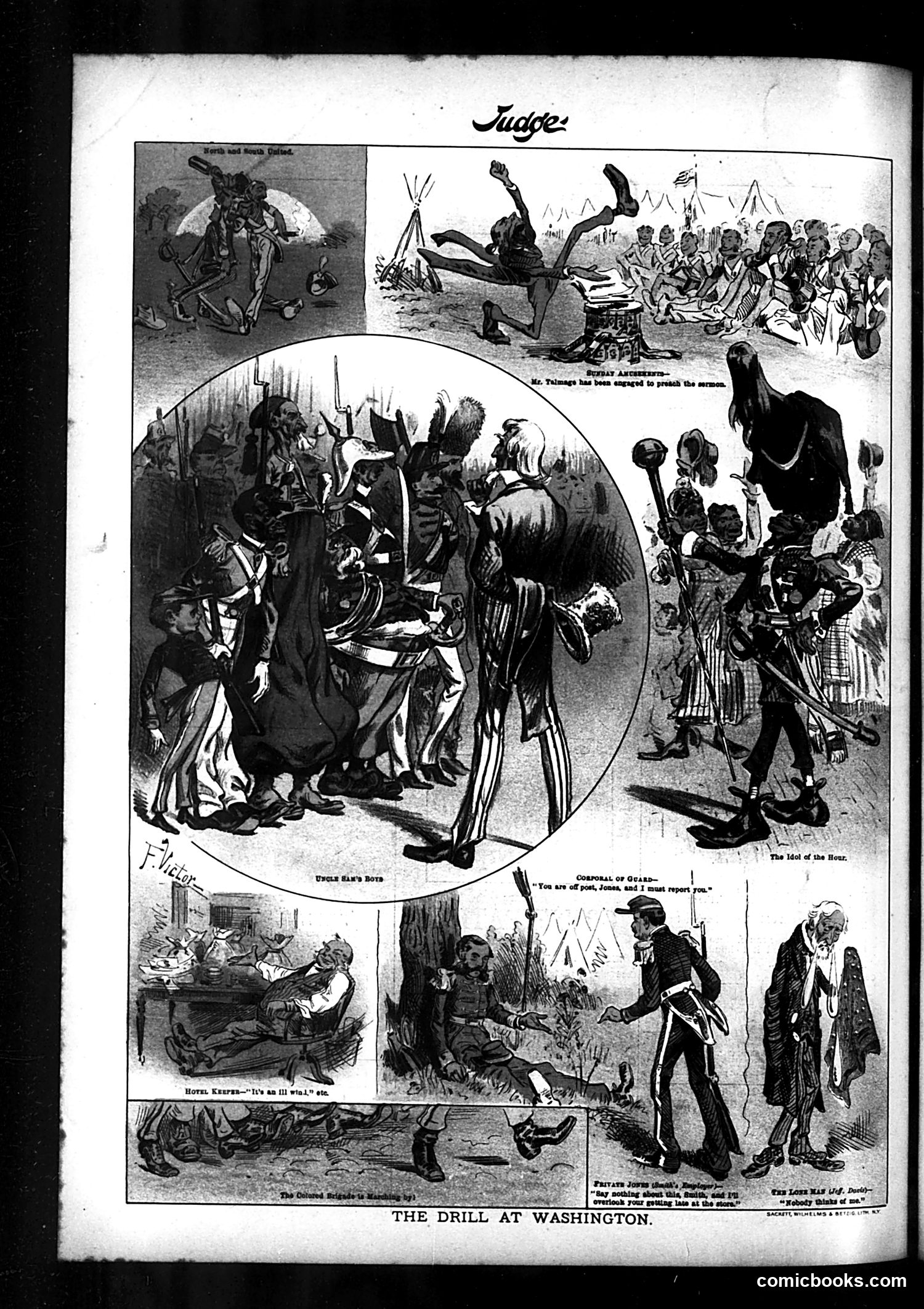
This Judge cartoon satirizes military discipline and protocol in Washington, D.C. The large central panel shows "Uncle Sam's Boys" — soldiers being inspected or drilled by officers. The surrounding vignettes depict various comic scenarios involving military life and authority. Key captions reference a guard being caught off-post ("You are off post, Jones, and I must report you"), hotel-keeping duties, and other mishaps. The satire appears to mock the rigidity of military bureaucracy and the absurdity of enforcing strict regulations in the nation's capital. Without a visible date, the specific historical context remains unclear, but the cartoon criticizes how Washington's military establishment enforces pointless regulations while potentially missing more significant problems — a common Judge theme about governmental inefficiency and military red tape.