
A complete issue · 16 pages · 1887
Judge — May 7, 1887
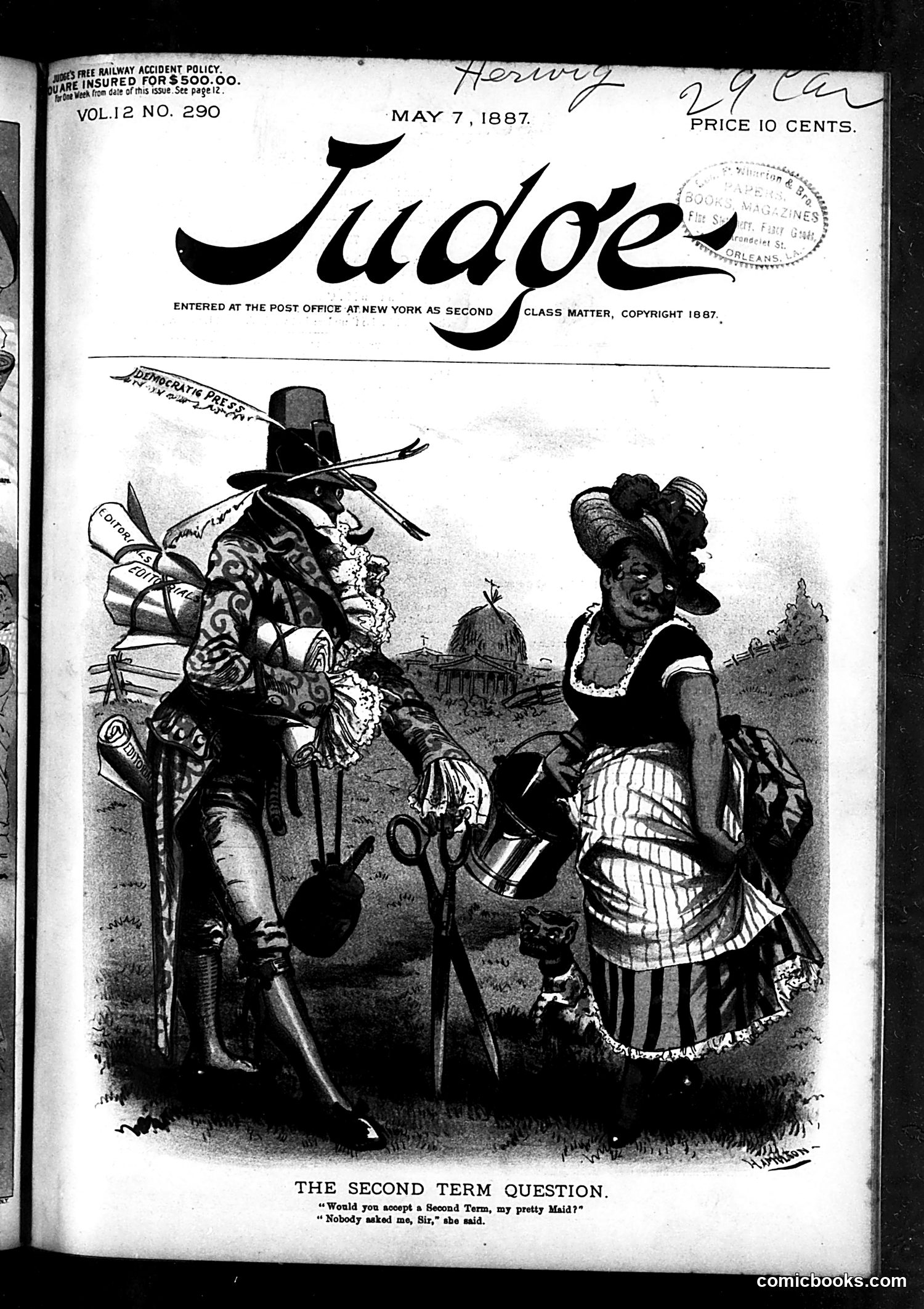
This 1887 Judge cartoon satirizes the "Second Term Question"—whether President Cleveland should seek reelection. The illustration shows a lavishly dressed gentleman (likely representing a political suitor or office-seeker) courting a woman labeled as representing a second presidential term, with the Capitol building visible in the background. The caption reads: "Would you accept a Second Term, my pretty Maid?" and her response "Nobody asked me, Sir," she said." The satire mocks the presumption of politicians assuming the presidency (feminized as an available "maid") would naturally accept their advances. The ornate, almost ridiculous costume of the suitor emphasizes the exaggerated self-importance of ambitious politicians. It's a commentary on political ambition and the audacity of career-seeking during the Gilded Age.
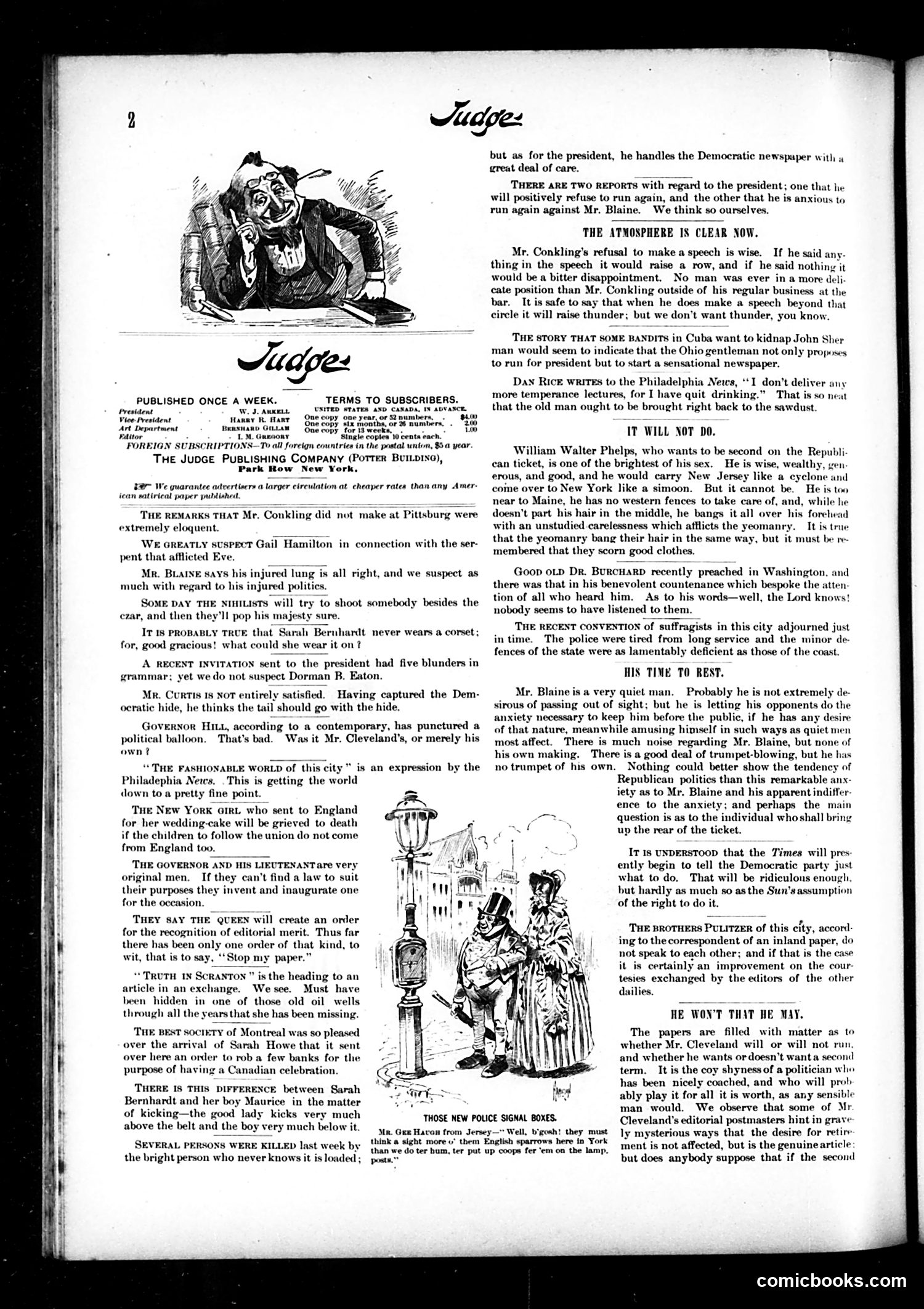
This page contains political commentary rather than traditional cartoons. The main illustrated figures appear to be caricatured politicians in two sketches—one showing a grotesque face (likely representing a political opponent) and another depicting figures near a street lamp. The text discusses various 1890s political figures and issues: Mr. Conkling's refusal to make speeches, allegations about bandits in Cuba and John Slocum, William Walter Phelps as a Republican vice-presidential candidate, and commentary on Mr. Blaine's political health. References to "the Democratic newspaper" and disputes suggest partisan debate during a presidential election cycle. The satire mocks political figures' behavior, ambitions, and contradictions—typical of Judge's irreverent approach to American politics. Without clearer dating or bylines visible, exact figures remain difficult to definitively identify.
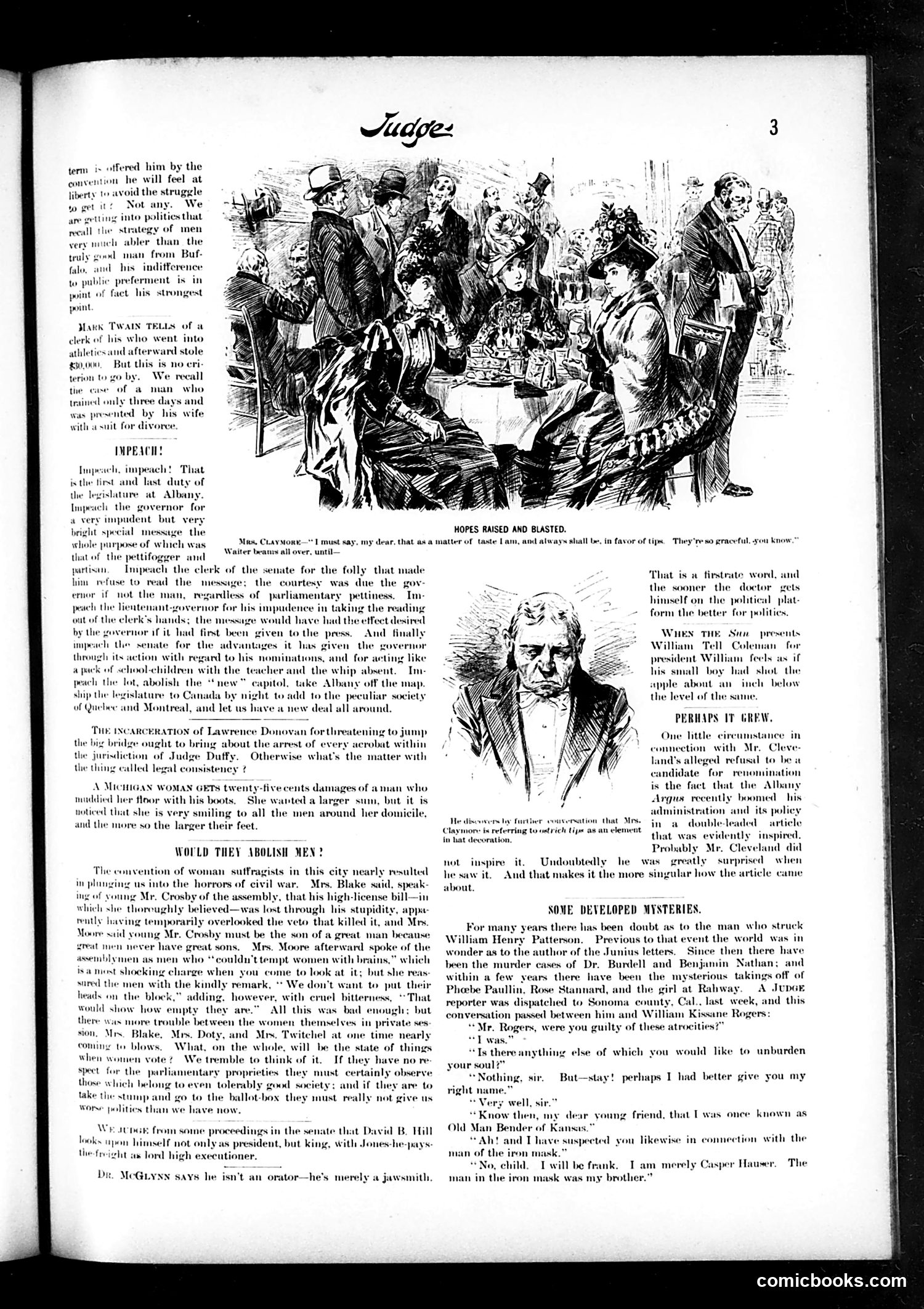
This page satirizes **New York State politics**, particularly **Albany legislature** dysfunction and **Governor** (likely Grover Cleveland, based on "William Tell Coleman" reference). The main cartoon depicts a dinner scene mocking legislative incompetence. The text attacks: 1. **"IMPEACH!" section**: Ridicules the legislature's obsession with impeachment theater—specifically impeaching the governor, senate clerk, and others over procedural grievances rather than substantive issues. The satire suggests Albany functions like "school-children with the teacher absent." 2. **Women suffrage convention**: Mocks female political activists, suggesting women voting will worsen politics. References to Mrs. Blake and conflicts between suffragists portray the movement as contentious and chaotic. 3. **Cleveland/Coleman**: Questions whether William Tell Coleman (apparently a candidate) genuinely refused nomination, or whether the *Albany Argus* newspaper fabricated the story for political advantage. The overall message: Albany is dysfunctional, petty, and corrupt—dominated by partisan maneuvering rather than governance.
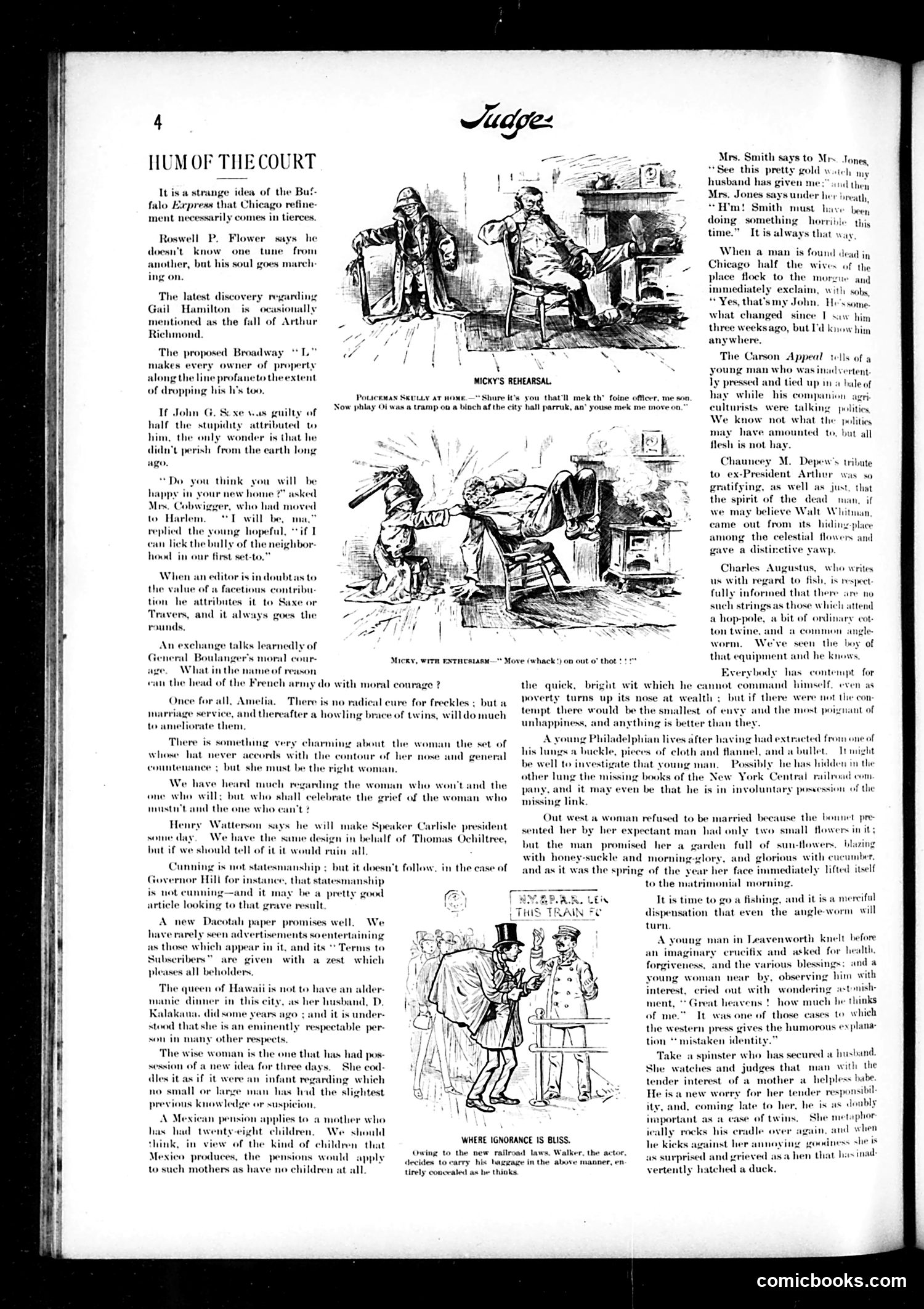
This page collects brief satirical commentary on contemporary issues and figures, typical of Judge's "Hum of the Court" column. The cartoons mock social absurdities: "Micky's Rehearsal" shows a police officer coaching a recruit using street scenarios (the recruit playing a vagrant in the park). "Where Ignorance is Bliss" depicts an actor hiding his luggage to avoid railroad fees—satirizing how people exploit new laws through deception. The text includes jabs at political figures (references to Speaker Carlisle, Governor Hill, Henry Watterson) and social pretension. One item mocks wives' theatrical grief at mortuaries. Another ridicules a young man's obsession with impressing a woman through appearance while discussing "polities" (politics). The overall tone targets hypocrisy, stupidity, and social climbing among various classes—police, politicians, and the nouveau riche—reflecting Judge's satirical stance on American society in the 1880s-90s.
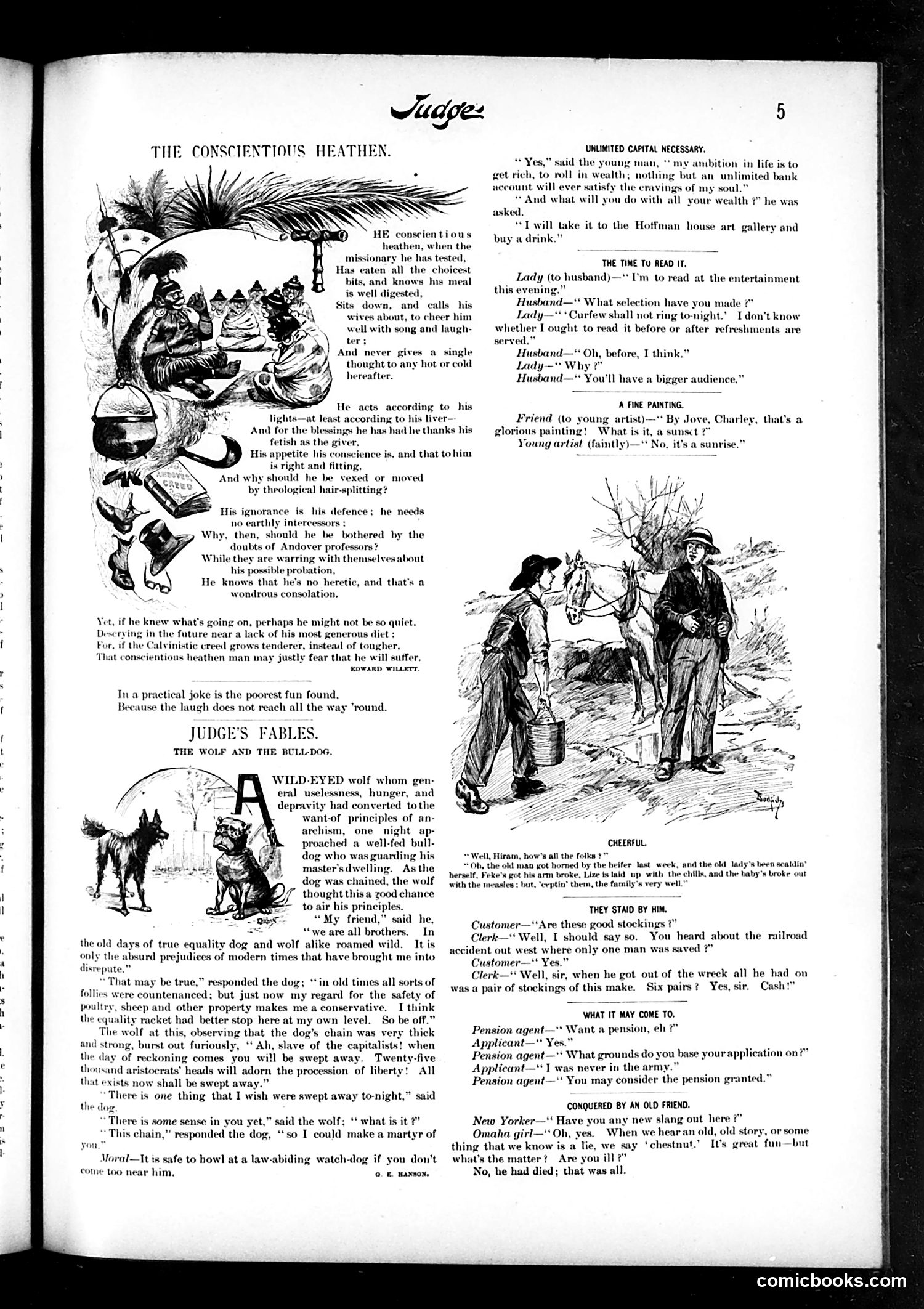
This page contains three unrelated satirical pieces typical of 1880s-90s humor magazine content: **"The Conscientious Heathen"** mocks religious hypocrisy. The poem criticizes Christians (particularly Calvinist theologians from Andover Seminary) who debate doctrine while living immorally, contrasting them unfavorably with a "heathen" who acts according to conscience. The satire suggests educated Christians are hypocritical compared to the "uncivilized." **"The Wolf and the Bull-Dog"** is a fable about anarchism. The wolf represents radical anarchists preaching equality and revolution ("twenty-five thousand aristocrats' heads"), while the bull-dog represents practical conservatism defending property. The moral: radicals safely attack from distance but lack courage for real confrontation. **Minor humor pieces** include jokes about ambition, poetry readings, art, and rural life—typical genteel comedy of the era with no specific political reference. The cartoons are generic illustrations rather than caricatures of specific politicians or events.
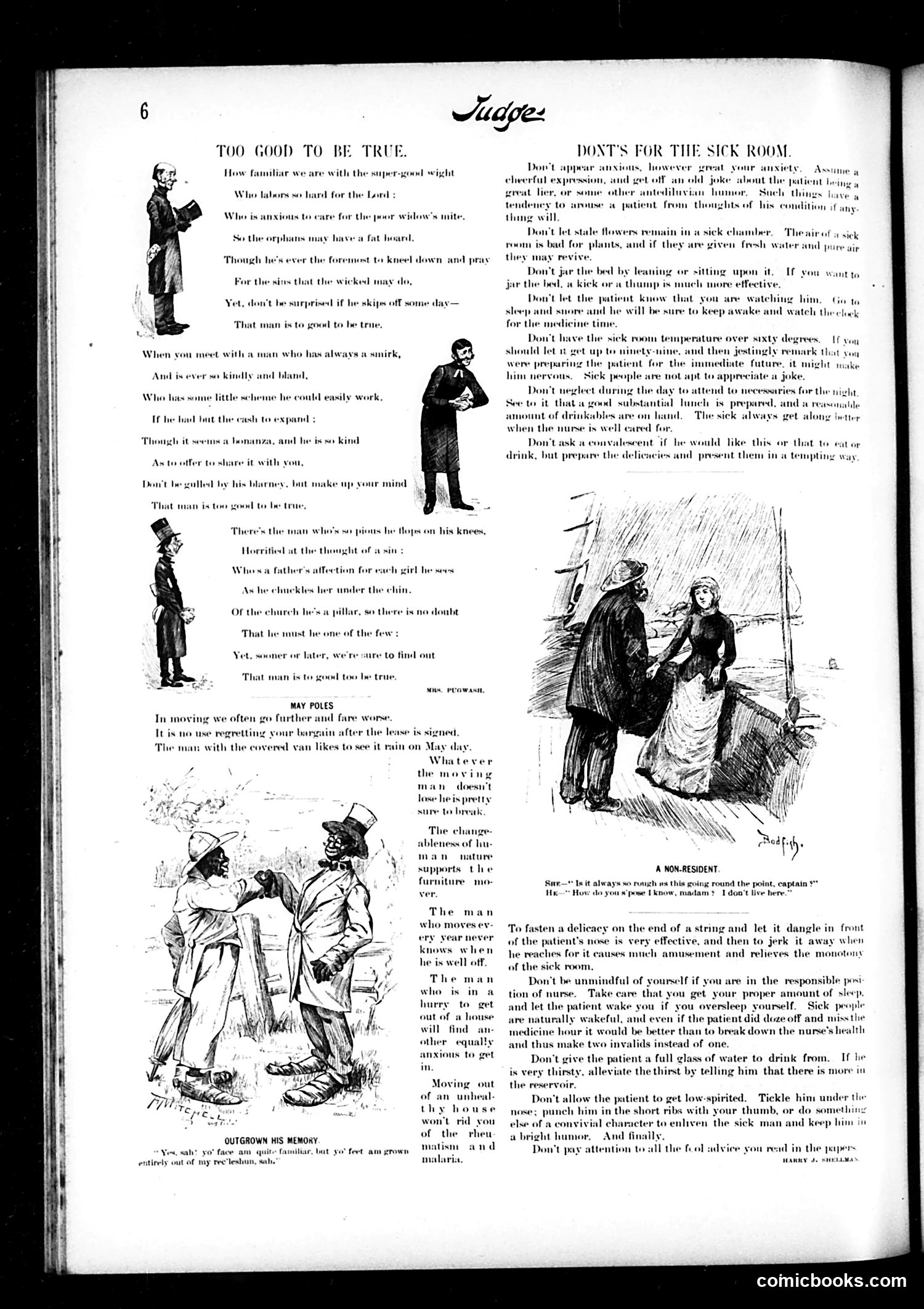
This page satirizes religious hypocrisy and con-artist behavior. The main article warns readers about ostensibly pious men who publicly display virtue—attending church, helping the poor, praying loudly—while secretly engaging in dishonest schemes. The satirist argues that excessive public displays of religiosity ("so pious he flops on his knees") often mask selfish motives and financial fraud. The accompanying illustrations depict stereotypical hypocrites: men with exaggerated pious expressions who are actually opportunists seeking to exploit others' trust. The cartoon's message: beware of the "super-good" who advertise their virtue too aggressively. The secondary content addresses practical domestic matters (moving house, sick-room etiquette) typical of Judge's mixed editorial approach. The overall thrust targets 19th-century American duplicity cloaked in religious respectability.
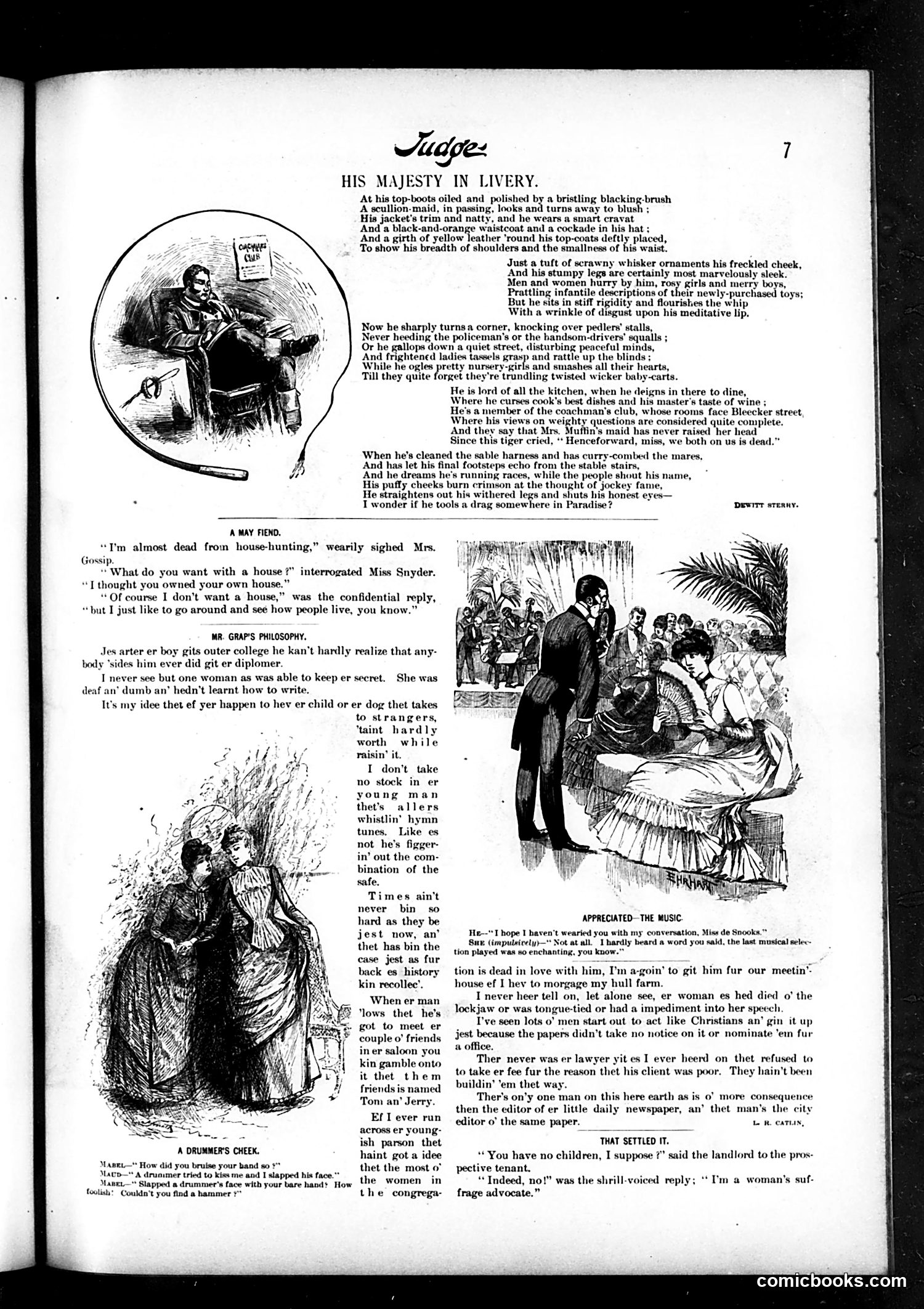
This page contains three separate humorous pieces typical of late 19th-century American satire: **"His Majesty in Livery"** (top): A poem mocking a pompous coachman or livery servant who affects aristocratic airs despite his lowly station. He intimidates pedestrians, flirts with nursemaids, and lords over kitchen staff, yet dreams of jockey fame. The satire targets working-class pretension and social climbing. **"A May Fiend"** (middle-left): A brief joke about Mrs. Gossip, who claims to hate house-hunting while actually enjoying snooping into others' homes—satirizing voyeuristic gossip and hollow pretense. **"Mr. Grap's Philosophy"** (bottom): Folk wisdom in dialect about human nature—college graduates' arrogance, women keeping secrets, suspicious young men whistling hymns. This represents Judge's common "rustic philosopher" feature, using folksy humor to comment on society. **"Appreciated—The Music"** (right): A joke about a woman pretending not to hear a man's boring conversation by crediting the orchestra—satire of social hypocrisy and romantic dishonesty. All pieces employ exaggeration and character types common to period satire.
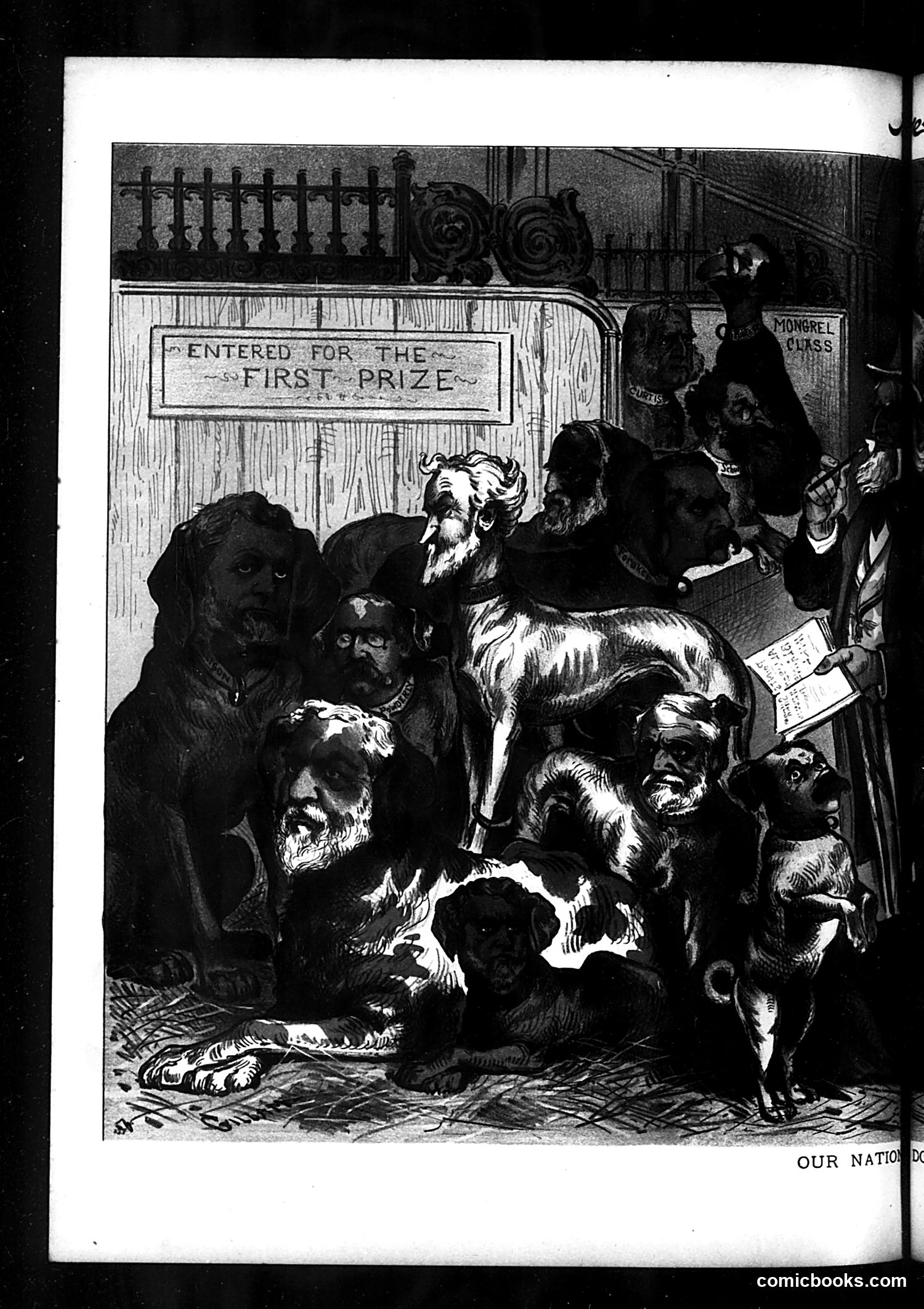
This cartoon satirizes a dog show where various dogs are "entered for the first prize." The humor appears to operate on two levels: literally depicting actual show dogs competing for awards, while simultaneously using the dogs as caricatures of political or public figures of the era. The presence of dogs with distinctly human facial features—particularly bearded gentlemen—suggests these represent specific politicians or personalities whom Judge's editors wished to mock by depicting them as animals competing for recognition. However, without additional context or caption identifying specific individuals, I cannot definitively name which figures are represented. The satire likely critiques either the vanity of political ambition or the questionable "quality" of those seeking high office during this period.
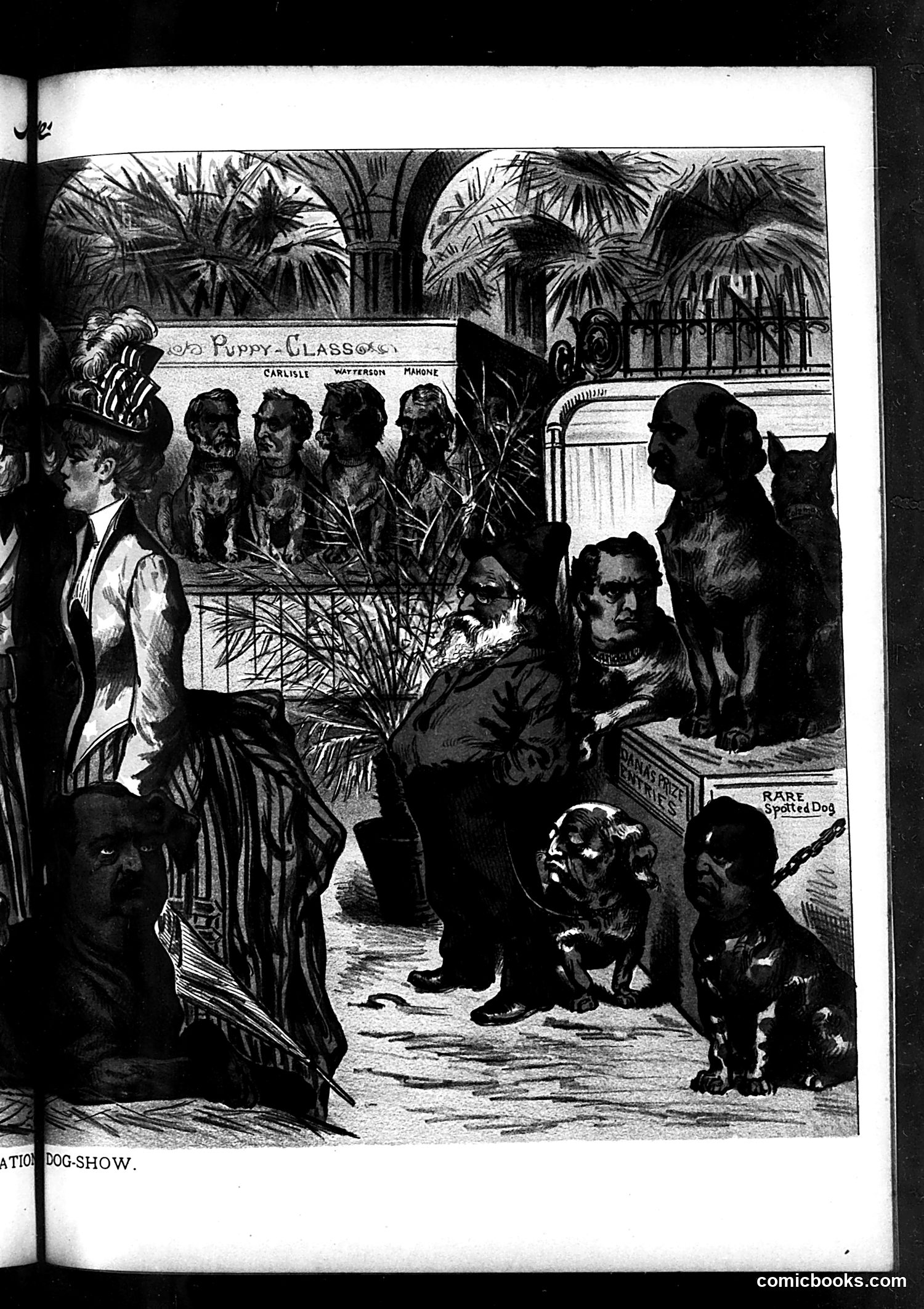
This satirical illustration depicts a dog show with a clear political message. The sign reads "Puppy-Class" with names including "Carlisle, Patterson, Mahone"—likely referencing American political figures of the late 19th century. The cartoon appears to mock prominent politicians by depicting them as dogs on display, suggesting they're being "shown" or judged like prize animals. The colonial architectural setting with palm trees suggests an international or imperial context. A "Rare Spotted Dog" label on one exhibit adds to the satirical comparison. The satire criticizes these political figures—treating them mockingly as specimens to be evaluated rather than serious statesmen. This type of dehumanizing caricature was common in Judge magazine's political commentary, using animal imagery to suggest politicians were beneath human dignity or worthy of ridicule.
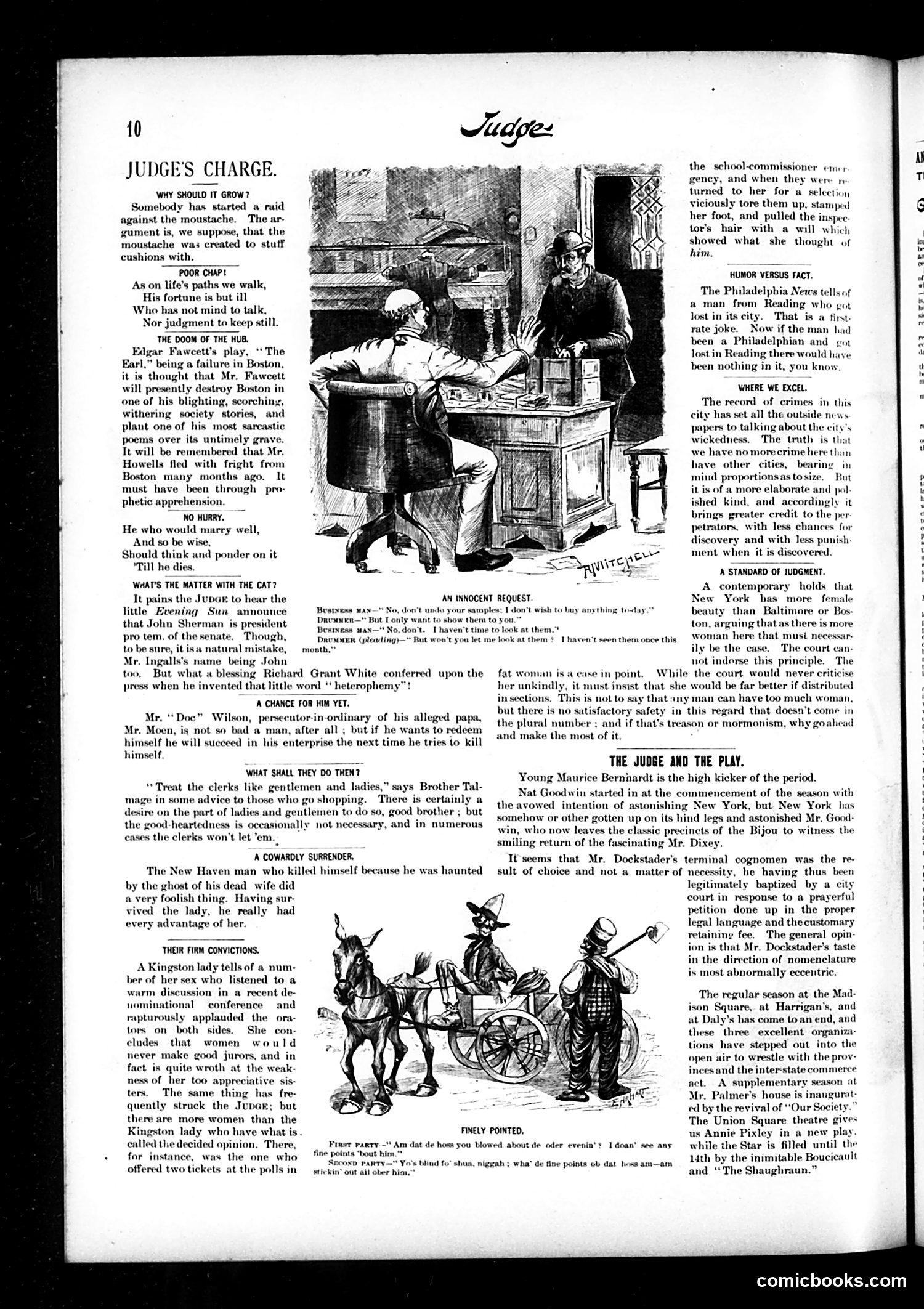
This page from Judge contains several brief satirical pieces targeting prominent figures and social issues of the era. **Main Cartoons/Content:** 1. **"The Doom of the Hub"**: Mocks Boston's cultural pretensions by suggesting author Edgar Fawcett will destroy the city in his writing after his play "The Earl" flopped there—a jab at both Fawcett and Boston's fading literary dominance. 2. **John Sherman reference**: Jokes that the Evening Sun mistakenly called John Sherman "president pro tem of the senate," when it should be John Ingalls. A dig at sloppy journalism. 3. **Social commentary pieces**: Brief satires on marriage advice, retail clerk treatment, women as jurors (questioning their ability to hold consistent opinions), and a New Haven suicide haunted by his deceased wife's ghost. 4. **City crime comparison**: Satirizes Philadelphia's defense of its crime rate, joking that while the city has no *more* crime than others, theirs is more "elaborate and polished"—a backhanded insult to Philadelphia's sophistication. The humor assumes reader familiarity with contemporary figures and local reputation debates now largely obscure.
This page is primarily **advertising and administrative content**, not a satirical cartoon. It contains: 1. **Puzzle Contest Information**: A lengthy editorial response about Judge magazine's "Monument Fund" puzzle competition, addressing contestant disputes over dictionary definitions and word eligibility rules. 2. **Business Directory**: The bulk of the page lists hotels (in New York, Boston, Jersey City) and various businesses (wine merchants, bookstores, insurance companies, etc.). The extended editor's letter discusses procedural complaints—specifically, whether certain words should count in the puzzle based on different dictionary editions. The tone is earnest and administrative rather than humorous. **Context for modern readers**: Judge magazine apparently used puzzle contests as fundraising mechanisms and reader engagement tools. This page documents the serious business of managing competitions fairly while also serving as paid advertising space—a common revenue model for 19th-century magazines. No political satire or caricatures appear on this page.
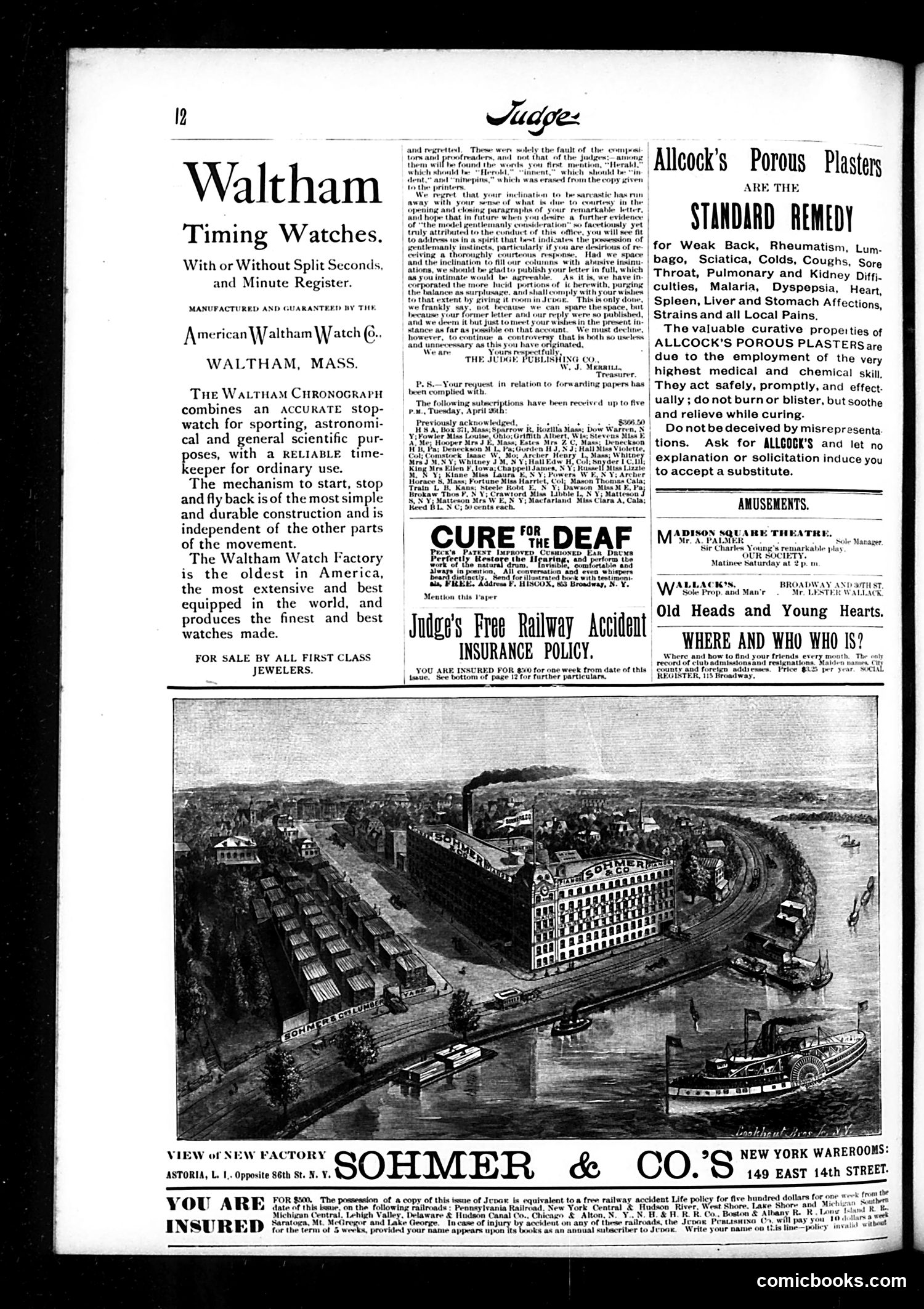
This page is primarily **advertising and announcements**, not political satire. The main content includes: **Advertisements:** - Waltham Timing Watches (chronographs for sporting/scientific use) - Allcock's Porous Plasters (medical remedy for various ailments) - Theater listings (Madison Square Theatre, Broadway) **Notable feature:** A large engraving showing the Sohmer & Co. factory in Astoria, L.I., depicting an industrial complex with railroad access and waterfront facilities—typical corporate promotion for a manufacturing company. **"Free Railway Accident Insurance Policy":** Judge offers subscribers $300 in coverage equivalent to $500 life insurance on specified railroads (Pennsylvania Railroad, New York Central, Hudson River, etc.) for a five-week subscription period. This appears to be a promotional gimmick rather than actual insurance, leveraging contemporary anxieties about rail travel safety during the industrial era. The page reflects late 19th-century consumer culture and emerging corporate advertising strategies in mass-circulation magazines.
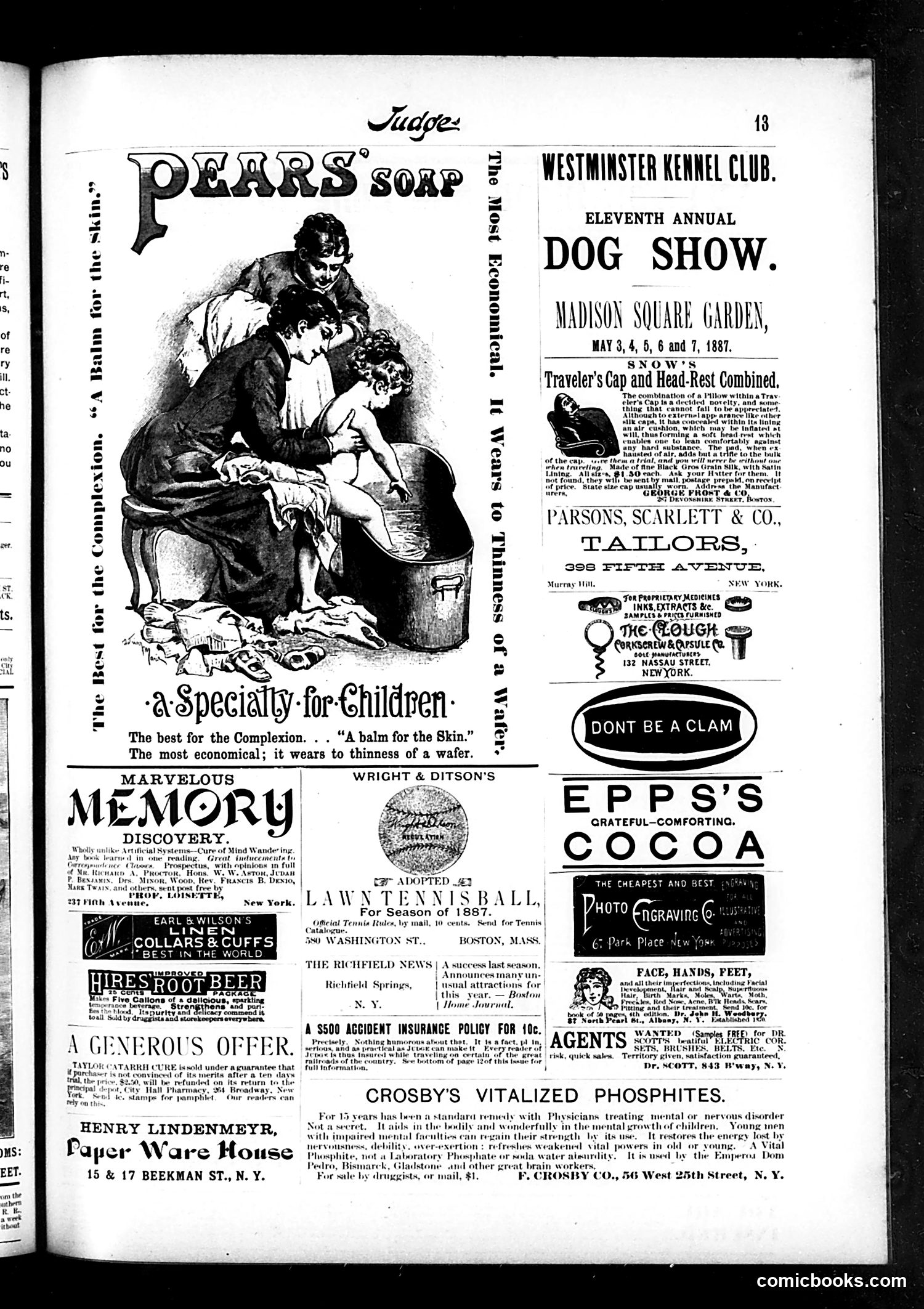
This page is primarily **advertising**, not editorial satire. It announces the Westminster Kennel Club's Eleventh Annual Dog Show at Madison Square Garden (May 3-7, 1887) and features Victorian-era product advertisements surrounding the announcement. The only notable visual element is **Pears' Soap's advertisement** on the left—a sentimental engraving of children bathing, marketed as "A Specialty for Children" with claims it's "a balm for the Skin." This reflects late-19th-century advertising's reliance on emotional imagery rather than substantive claims. Other ads promote mundane products: tailors (Parsons, Scarlett & Co.), cocoa, lawn tennis balls, linen collars and cuffs, and various patent medicines and services typical of the era. The page has no evident political cartoon or satirical commentary—it's a commercial product of the magazine's revenue model, where advertising subsidized publication.
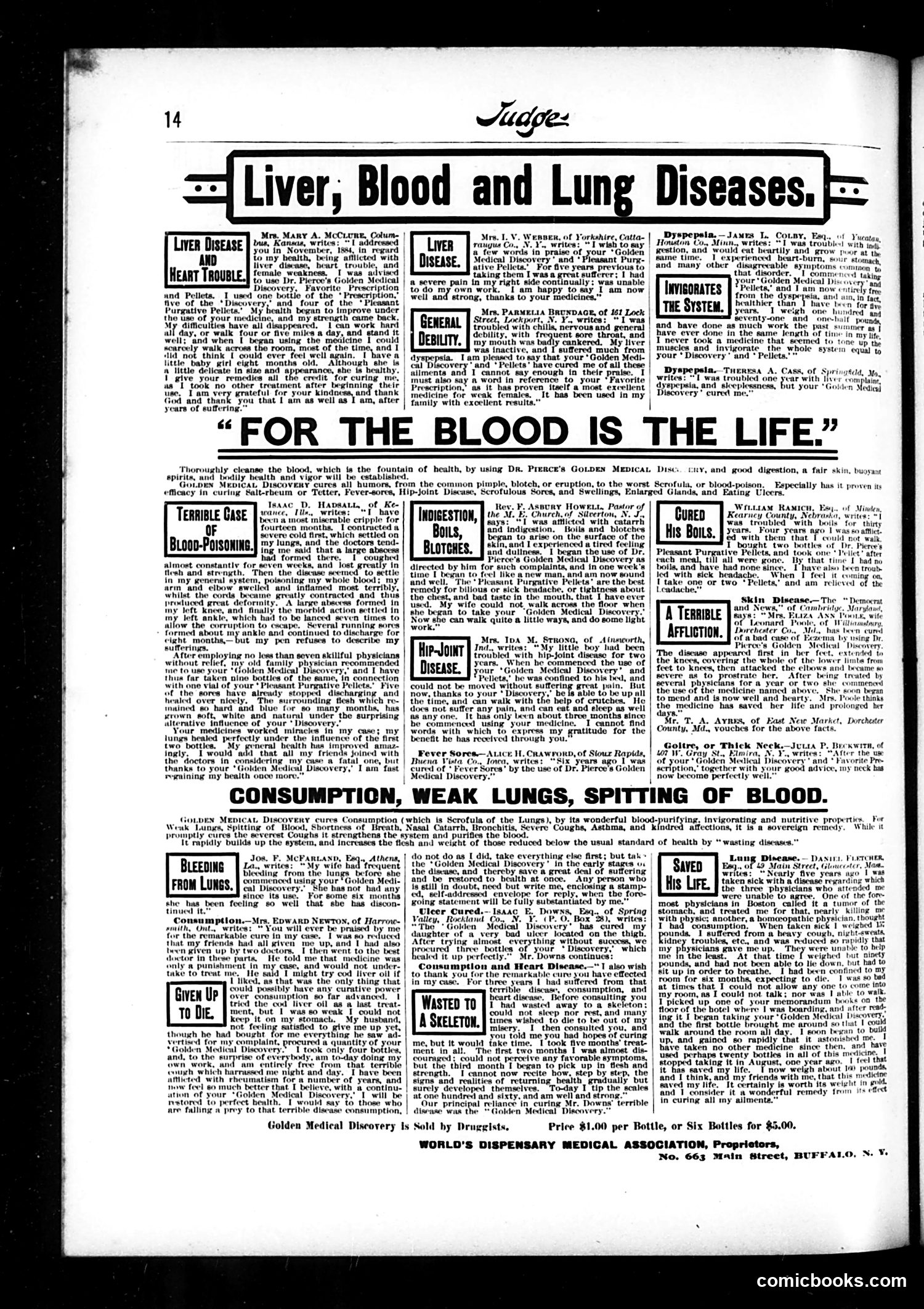
This page is primarily **medical advertising**, not political satire. It promotes Dr. Pierce's "Golden Medical Discovery"—a patent medicine claiming to cure liver disease, blood ailments, lung problems, and various other conditions. The layout mimics Judge magazine's format but contains testimonial letters from satisfied customers describing their ailments and cures. These were common marketing tactics of the era. **Key context for modern readers:** In the late 1800s, patent medicines were largely unregulated and often contained questionable ingredients. Such advertisements filled newspapers and magazines, making exaggerated health claims. The phrase "FOR THE BLOOD IS THE LIFE" reflects period medical theory that bloodpurification could cure systemic disease. This represents not political cartoon satire but rather the **exploitative medical marketing** that Judge and similar publications enabled—a historical artifact of an era before FDA regulations and modern consumer protection standards.
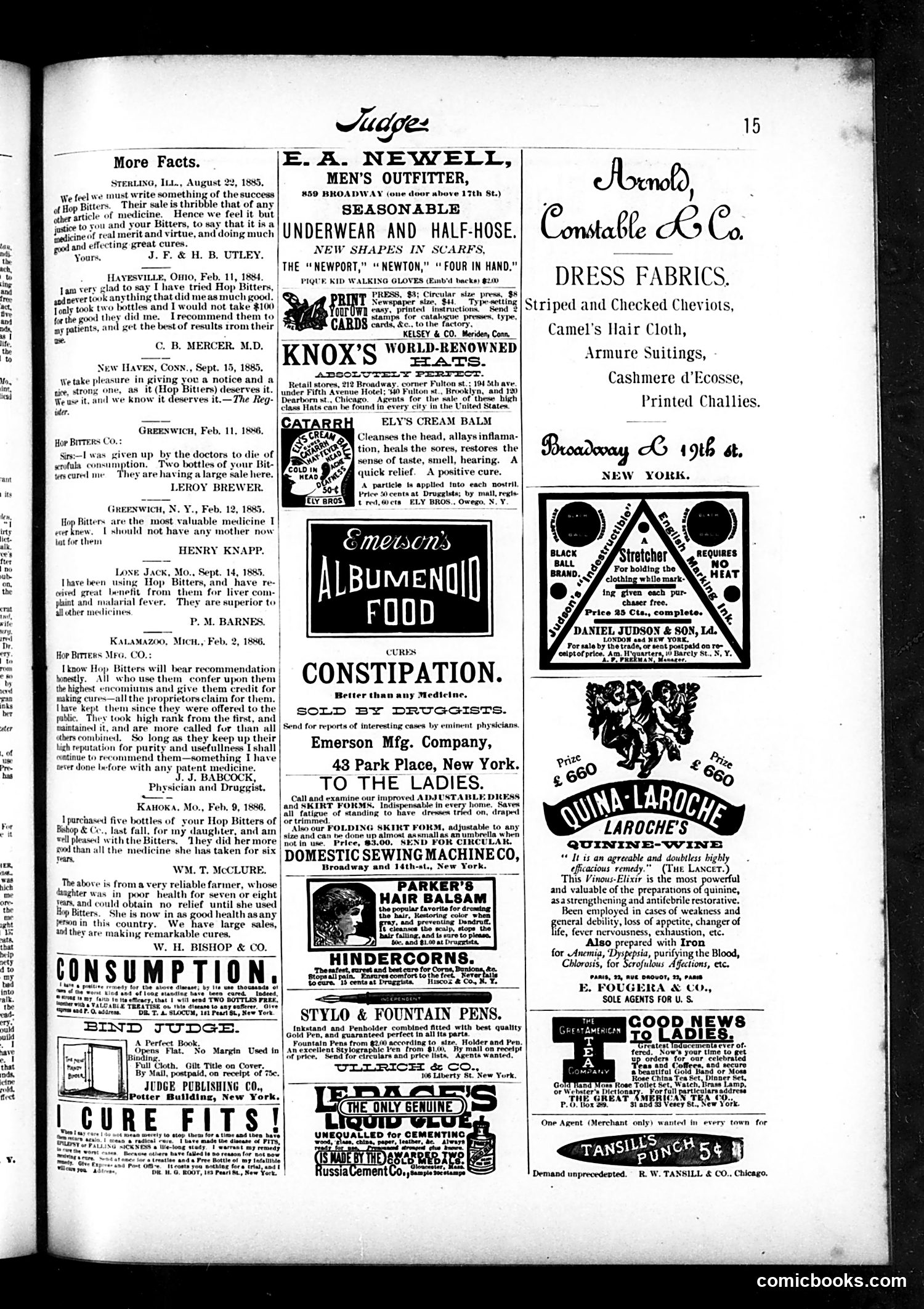
This page is **primarily advertising**, not political satire. It contains testimonial ads for patent medicines popular in the 1880s—chiefly Hop Bitters, a supposed cure-all marketed across multiple pages. The "More Facts" section features fake customer letters praising Hop Bitters for treating ailments from consumption to scrofula to liver complaints. These glowing testimonials from "doctors" and "druggists" were standard advertising deception of the era—no regulation existed requiring product efficacy. Readers would recognize this as typical snake-oil marketing. Other ads promote similarly dubious remedies: Ely's Cream Balm, Parker's Hair Balsam, constipation cures. The right column advertises legitimate retail items (fabrics, menswear). **The satire here is indirect**: Judge's readers understood these testimonials as obvious frauds, yet such ads flooded newspapers. The magazine's irony lies in running them straight-faced, letting readers recognize the absurdity themselves—a common 1880s advertising critique. There are **no identifiable political cartoons** on this page.
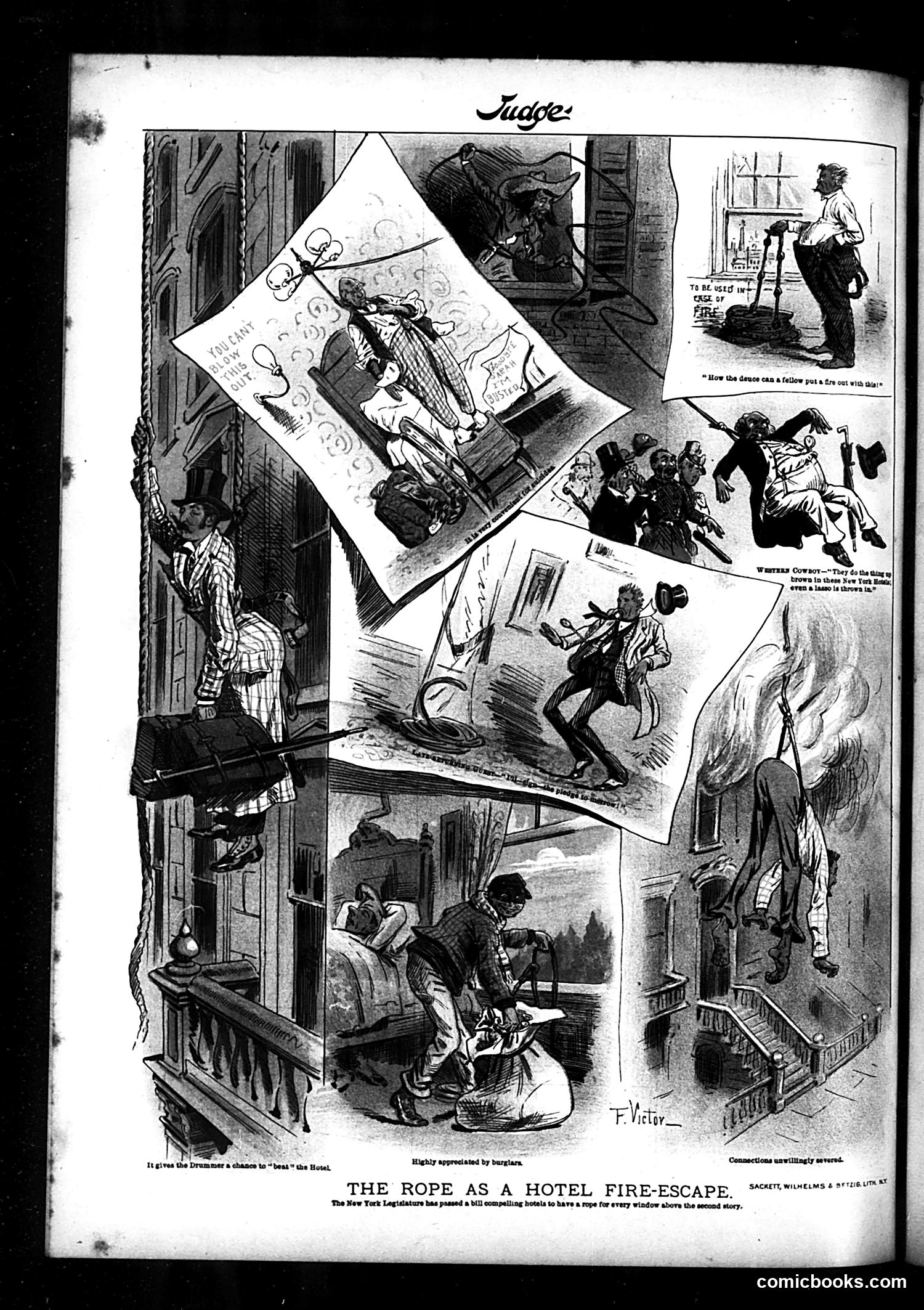
This satirical cartoon critiques a New York legislative requirement mandating ropes as fire-escapes for hotel windows above the second story. The comic panels mockingly depict the rope's impracticality—showing people falling, tangling, or struggling chaotically as they attempt escape during fires. The satire targets what the cartoonist views as an absurd, poorly-thought-out safety regulation. Rather than providing genuine protection, the rope apparently creates new dangers. The cascading scenes of disaster suggest the law was rushed or poorly designed, possibly passed without considering real-world consequences. The caption's pun about "beat" (the drummer beating the hotel) adds wordplay to the critique. Overall, Judge mocks both the ineffective regulation and the legislature's assumption that a simple rope requirement would solve hotel fire safety—a legitimate public concern of the era.