
A complete issue · 16 pages · 1887
Judge — April 23, 1887
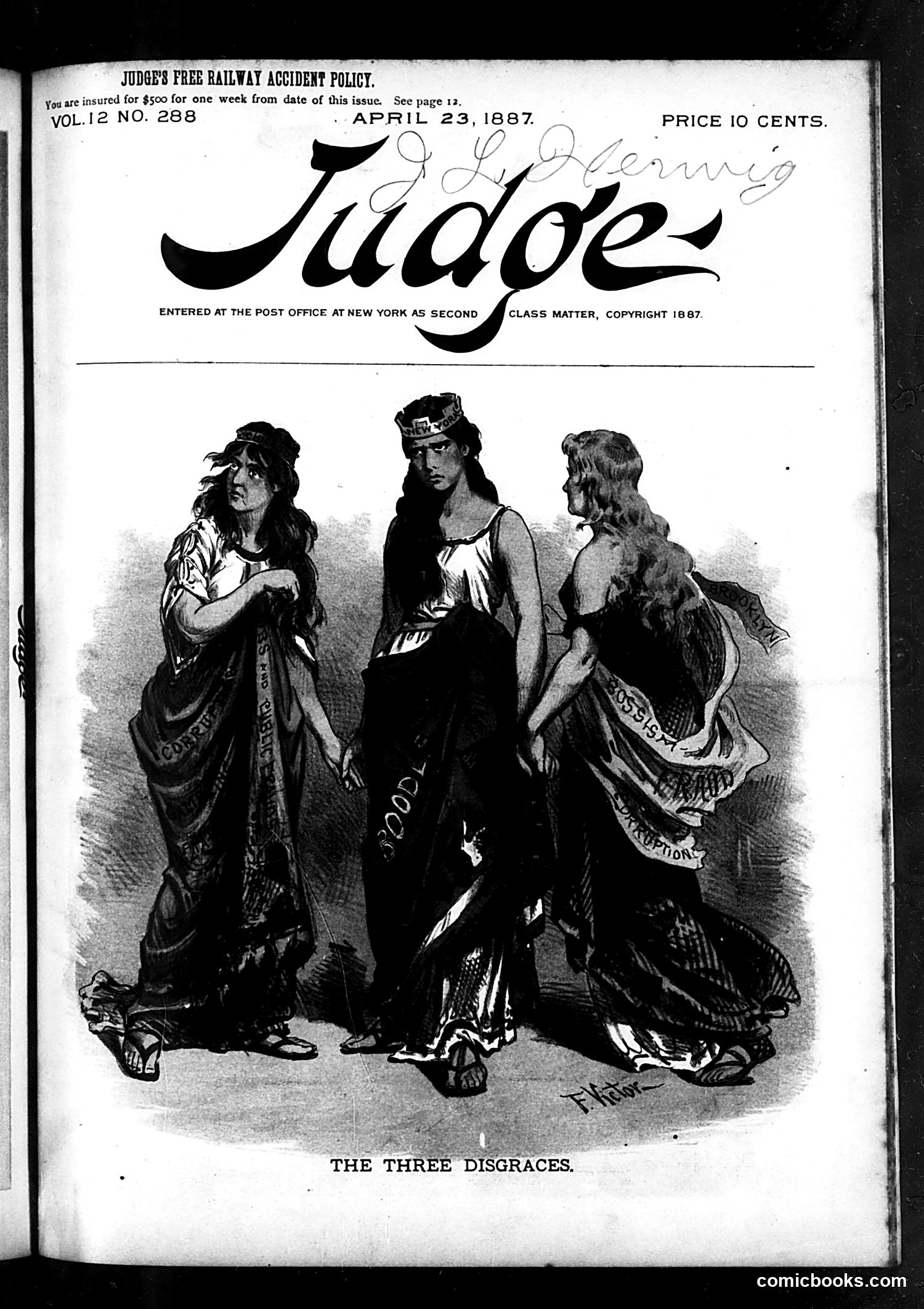
This political cartoon depicts three female allegorical figures labeled as "disgraces." The central figure wears a crown and appears to represent Ireland or Irish governance. The figures on either side wear sashes bearing text (partially legible as "IRISH" and variations), suggesting they represent related political or social failures. The satire likely references Irish political turmoil of the 1880s—possibly scandals involving Irish Land League politics or Home Rule controversies. The "disgrace" framing suggests Judge's editors viewed certain Irish political movements or figures as shameful or damaging to society. Without clearer sash inscriptions or additional context from the issue, the exact targets remain somewhat unclear, though the cartoon clearly expresses editorial disapproval of Irish political movements contemporary to 1887.
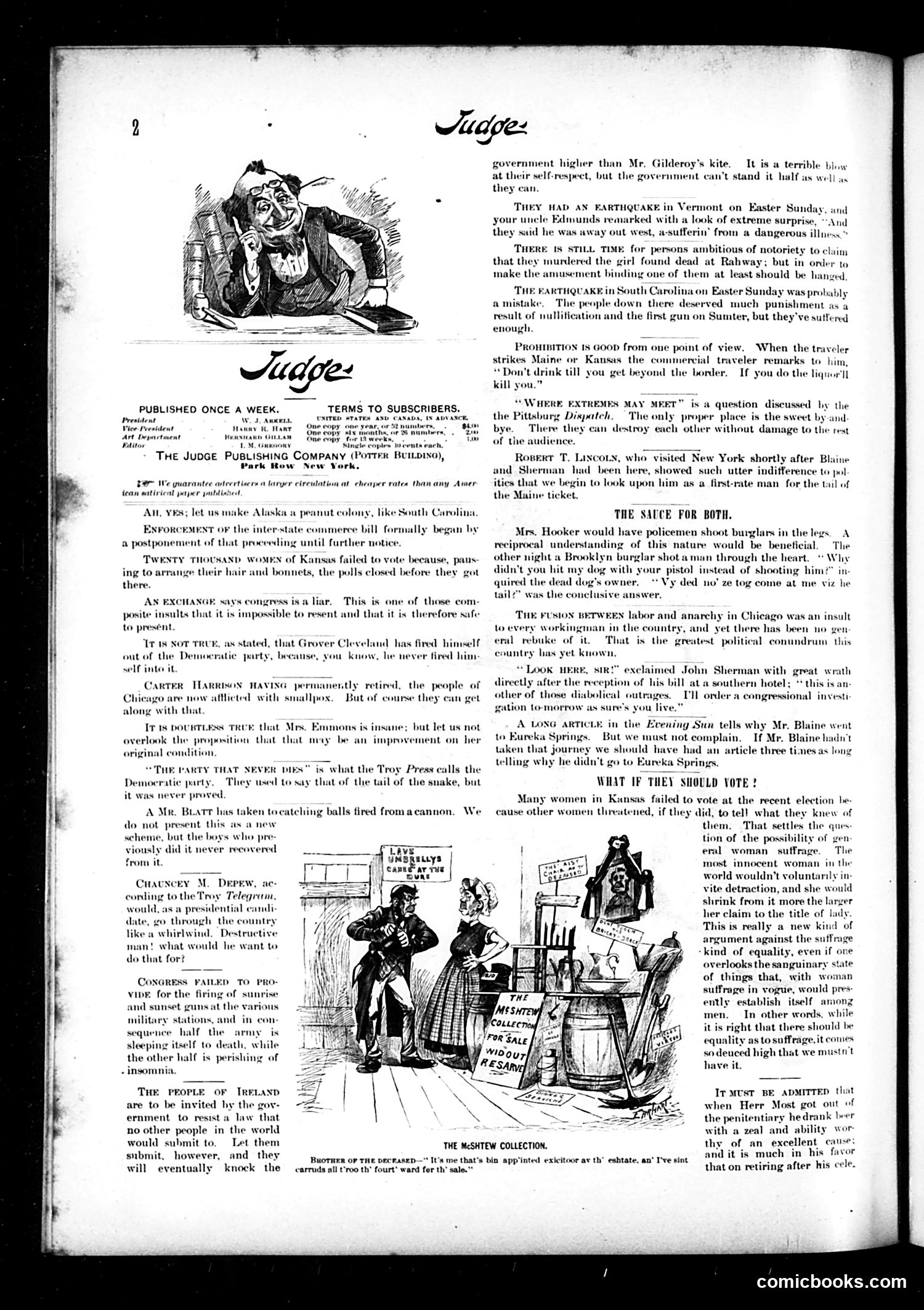
This page contains several satirical columns and two cartoons critiquing contemporary politics and social issues circa late 1800s. The upper cartoon depicts a disheveled figure, likely representing political corruption or incompetence. The lower cartoon, titled "The Scotch Collection," shows a man confronting what appears to be a street vendor or beggar, satirizing either poverty, fraud, or economic inequality. The text discusses various topics: Kansas voting irregularities, Grover Cleveland's political positioning, Mrs. Edmonds' sanity, women's suffrage, and congressional failures. One column references an "earthquake in Vermont on Easter Sunday," though whether literal or metaphorical is unclear. The satire consistently targets government incompetence, electoral fraud, and social contradictions of the era, particularly around women's voting rights and political hypocrisy.
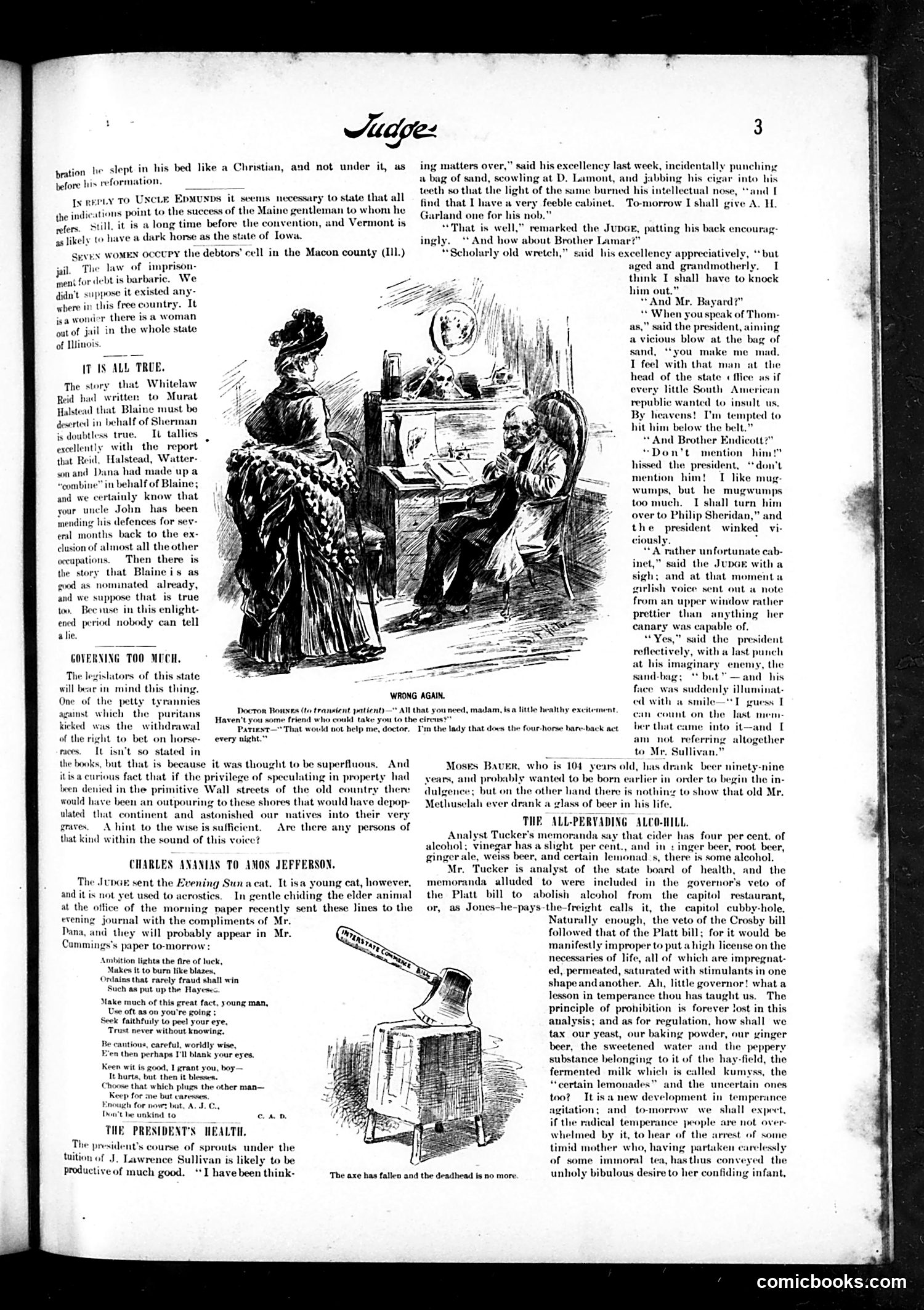
This page satirizes President Cleveland's cabinet and political frustrations through a boxing/pugilistic metaphor. In the main cartoon "Wrong Again," Cleveland (identifiable as the sitting president) is depicted shadow-boxing with a punching bag while venting about his cabinet members. The satire targets: 1. **Secretary of State Bayard** - mocked for incompetence in diplomatic matters, particularly regarding "South American republic" relations 2. **General Endicott** (likely Secretary of War) 3. **J. Lawrence Sullivan** - apparently training Cleveland in boxing as a health regimen The humor derives from Cleveland's crude, violent frustration with his own appointees—he's literally punching a bag while discussing them. The boxing trainer reference adds irony: Cleveland is being coached in physical fitness while his cabinet is falling apart. The surrounding text discusses political maneuvering around Blaine's presidential nomination and criticizes Illinois's debtors' prison system. The overall message: Cleveland's presidency is chaotic and his cabinet incompetent.
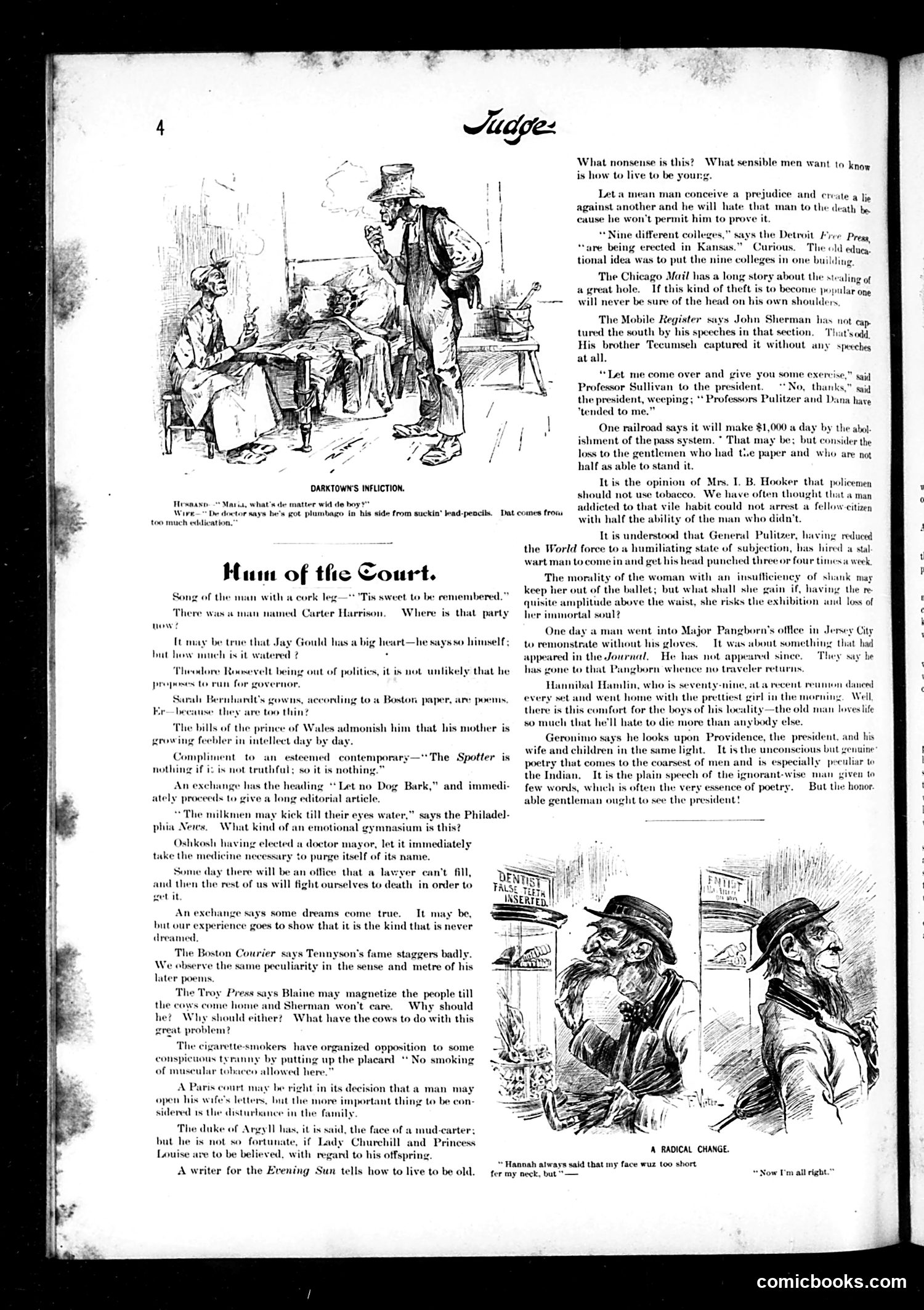
This is a satirical magazine page mixing political commentary with humor pieces. The main cartoon, "Darktown's Infliction," uses racist caricature (common to the era) to mock African Americans, depicting them discussing trivial complaints—a figure claims he has plumbago from "suckin' lead-pencils." The text section "Hum of the Court" collects brief satirical jabs at contemporary figures and issues: - **Jay Gould**: Mocked for claiming to have a "big heart" while being a ruthless robber baron - **Theodore Roosevelt**: Referenced as recently out of politics - **James G. Blaine**: A politician allegedly losing his magnetism with voters - **General Pulitzer** (likely Joseph Pulitzer, newspaper publisher): Criticized for reducing his workforce, then allegedly hiring someone to punch him weekly - Various critiques of railroads, tobacco use by police, and social hypocrisy The satire targets wealthy industrialists, politicians, and social pretension typical of Gilded Age *Judge* content—though delivered alongside deeply offensive racial material.
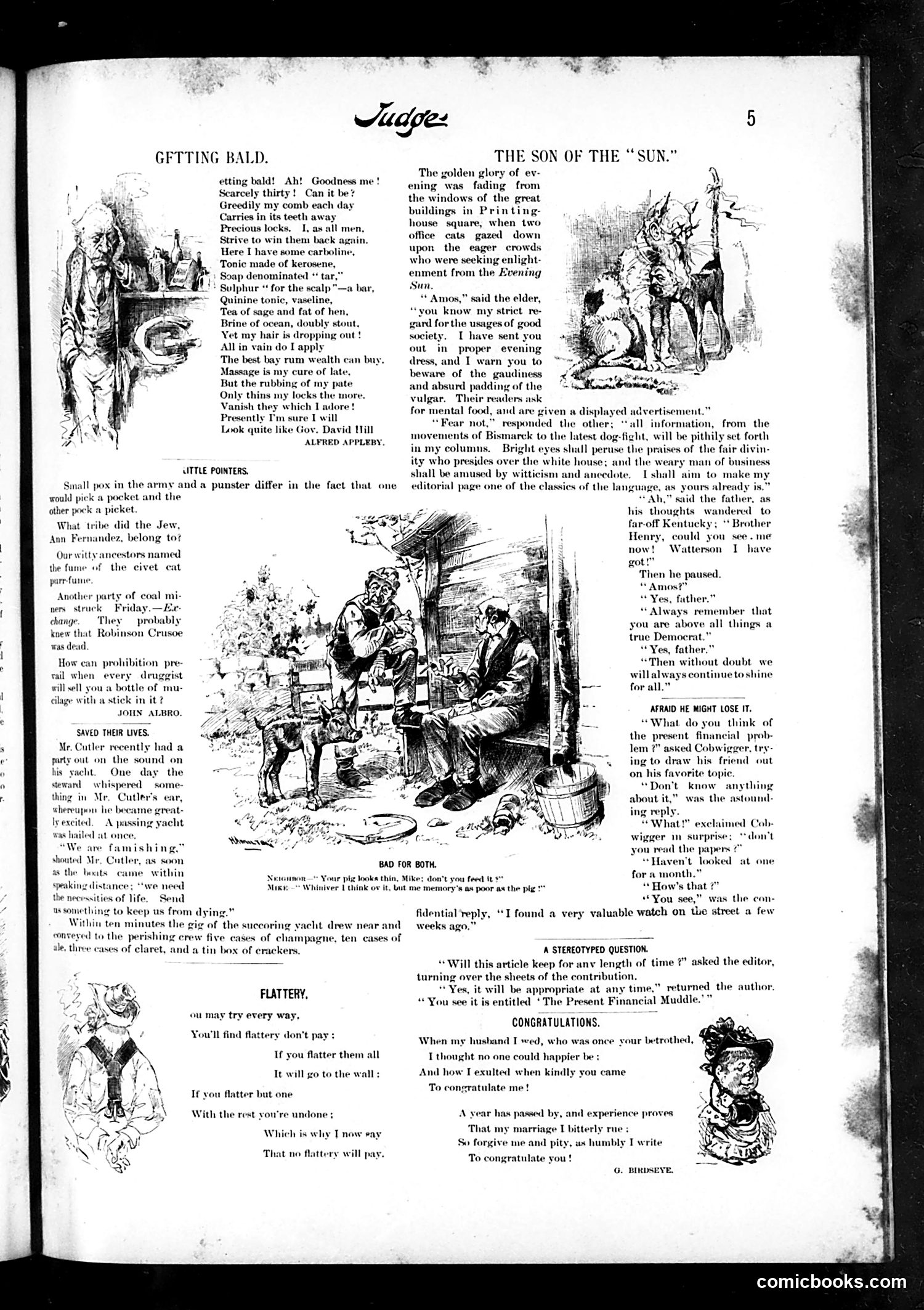
This page contains satirical commentary on contemporary issues and figures from Judge's era. **"Getting Bald"** mocks baldness remedies through absurdist humor—a man tries every supposed cure (kerosene tonic, sulfur, bay rum, massage) yet continues losing hair. The reference to "Gov. David Hill" suggests a contemporary political figure used for comedic effect. **"The Son of the Sun"** satirizes newspaper journalism, particularly the *Evening Sun*. Two cats (representing editors/journalists) discuss maintaining "good society" standards while admitting their content is sensationalist. The joke critiques the gap between newspapers' claimed respectability and actual focus on scandal and "gaudiness" to attract readers. **"Bad for Both"** depicts two men arguing over a pig's care—likely satirizing a dispute where both parties suffer from their conflict. The page also includes lighter pieces on flattery, financial ignorance ("Afraid He Might Lose It"), and congratulations verse. The content reflects Judge's mix of political satire, social commentary, and general humor targeting contemporary American society, journalism, and human folly.
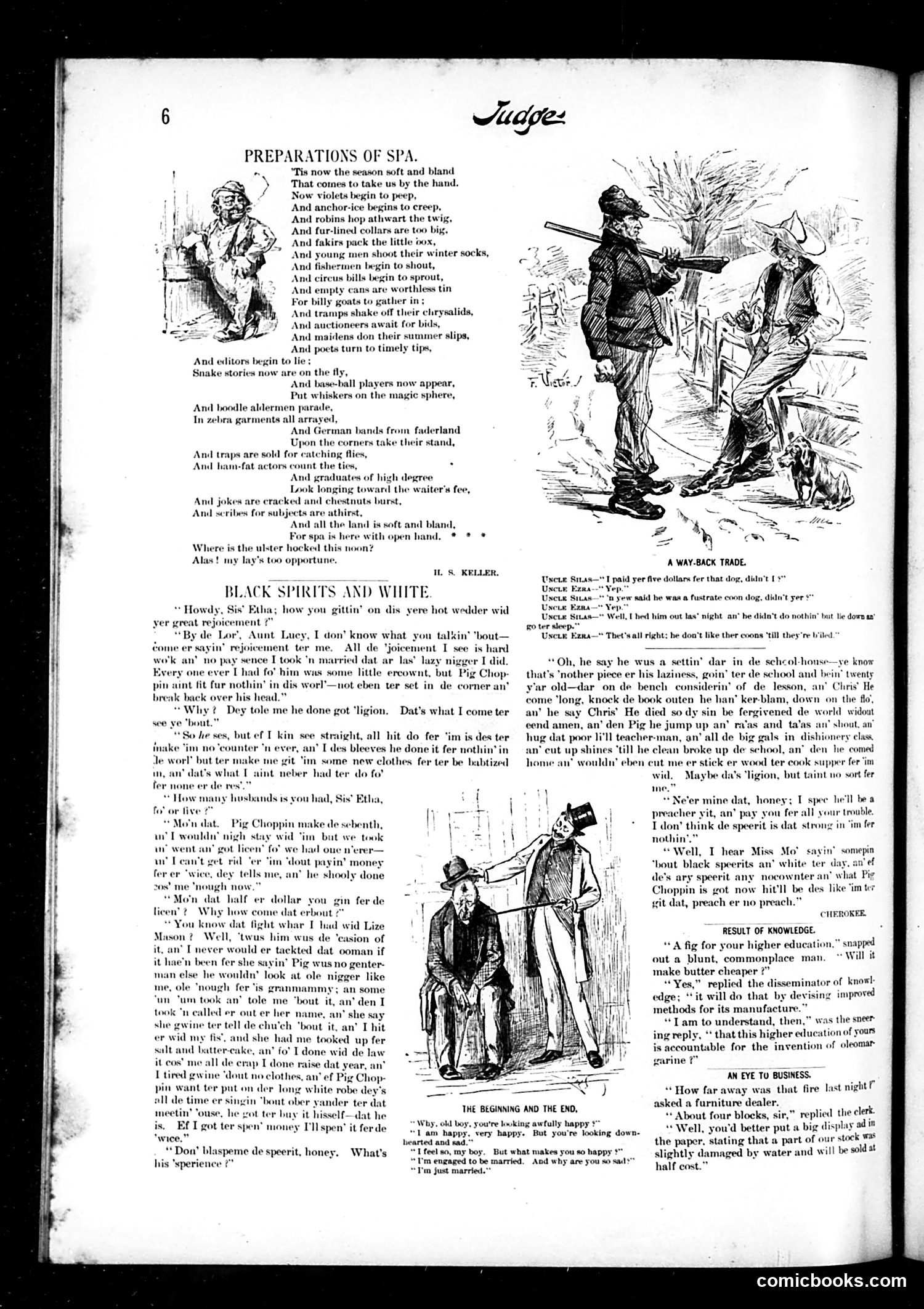
This page contains two satirical pieces reflecting late 19th-century American attitudes: **"Preparations of Spa"** (top): A humorous poem mocking the annual spring migration to spa resorts. It catalogs the absurd preparations and characters emerging—"boodle aldermen," con artists, and fortune-seekers—suggesting spas attracted both genuine tourists and social parasites seeking easy money. **"Black Spirits and White"** (main story): A dialect-heavy piece depicting African American characters in the post-Reconstruction South. The narrative concerns a woman's regrets about her husband's religious conversion and his subsequent behavioral changes. While presenting itself as domestic humor, it relies on dehumanizing racial stereotypes, minstrel-show dialect, and implies criticism of Black religious faith as hypocritical. **"A Way-Back Trade"** (bottom): A brief joke about a defective hunting dog, likely poking fun at rural/Southern commerce. The page exemplifies Judge's era: mixing social satire with deeply offensive racial caricature that was normalized in 1880s-90s American popular media.
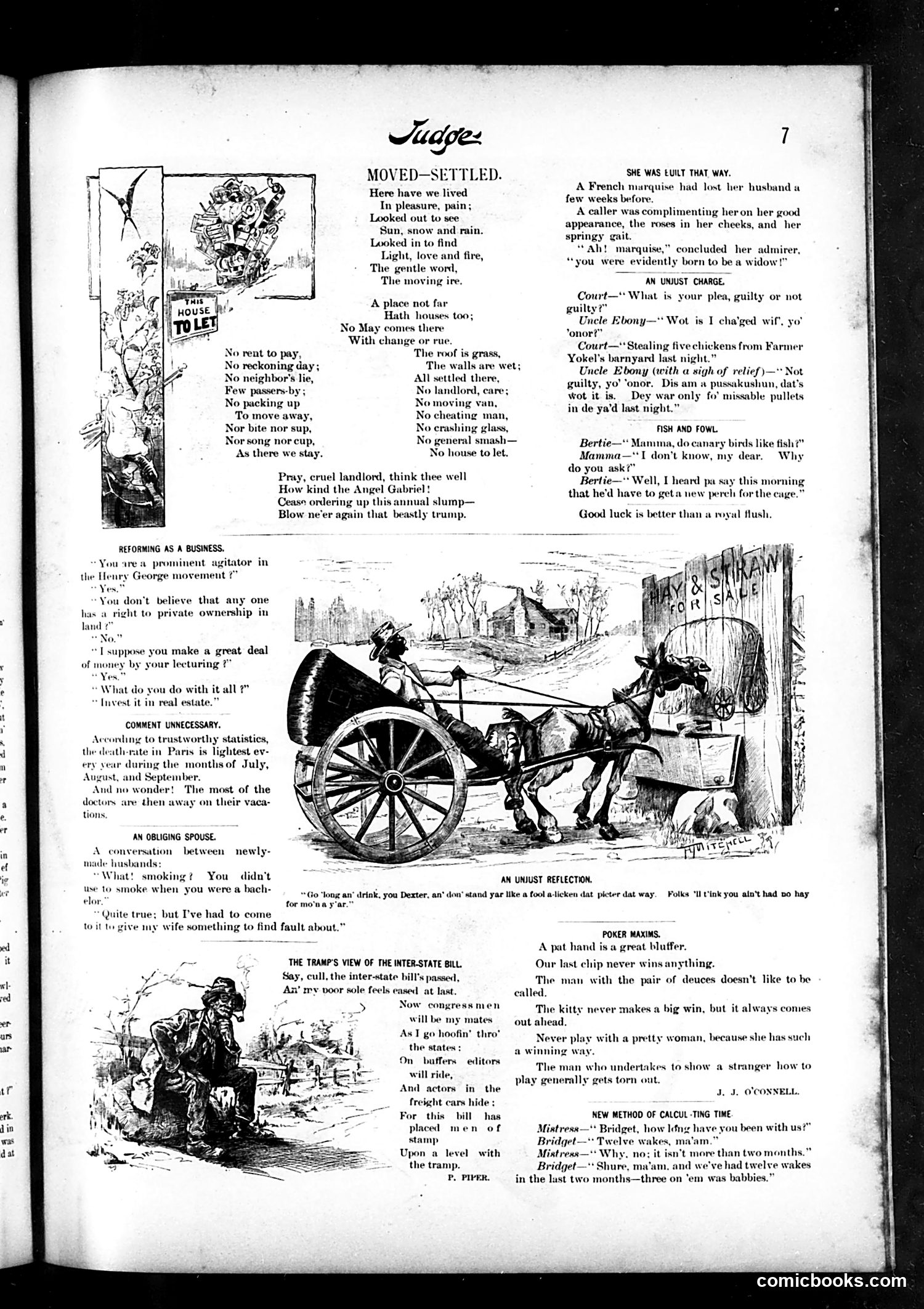
This page contains several satirical pieces typical of Judge's social commentary: **"Moved—Settled"** contrasts temporary housing anxiety with the permanence of a graveyard, satirizing landlord-tenant disputes and working-class housing instability—concerns from the late 19th century. **"Reforming as a Business"** mocks Henry George movement activists (the single-tax land reform movement) who lecture against private land ownership while investing their lecture fees in real estate themselves—exposing hypocrisy. **"The Tramp's View of the Inter-State Bill"** uses a vagrant's perspective to criticize federal railway commerce regulation, suggesting it benefits corporations ("buffers editors," "actors") while leaving working men unchanged. **"Unjust Reflection"** and other minor pieces use ethnic dialect humor (common but offensive in this era) for comedic effect around domestic and farm life. The cartoons depict working-class and rural figures addressing economic inequality, labor conditions, and land reform—Progressive Era concerns from approximately the 1880s-1890s.
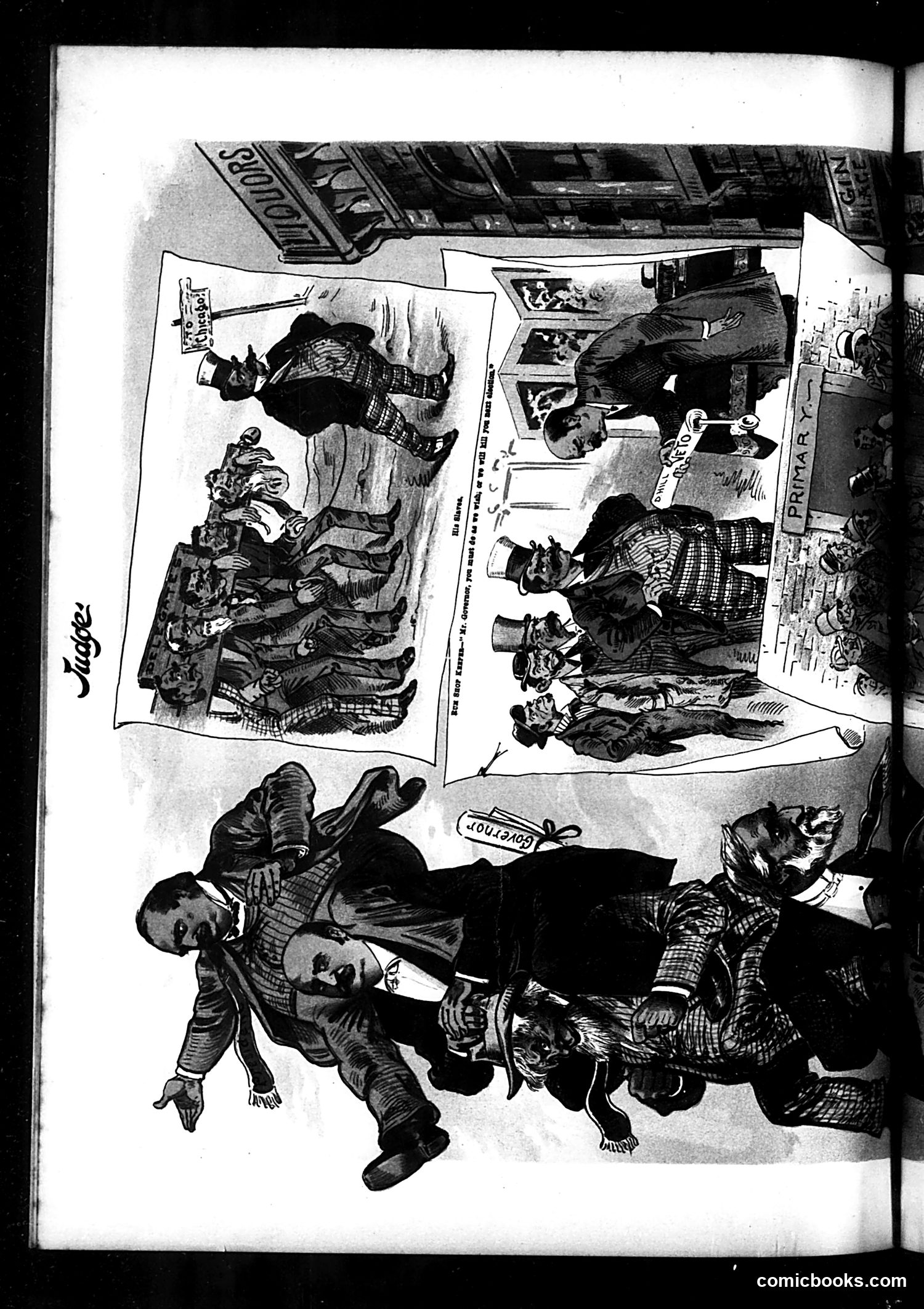
This appears to be a satirical page from *Judge* magazine featuring multiple cartoon panels. The image quality and orientation make precise identification difficult, but the compositions suggest social or political commentary typical of the publication's era. The figures are drawn in exaggerated caricature style wearing period clothing (checkered suits/patterns visible). One panel is labeled "Judge" and another appears to reference "Primary" — suggesting commentary on American political processes, possibly elections or political campaigns. Without clearer text or dated context, I cannot confidently identify specific political figures or pinpoint the exact satirical point. The page appears to mock some aspect of contemporary politics or society through multiple related vignettes, but the specific targets and date remain unclear from this reproduction.
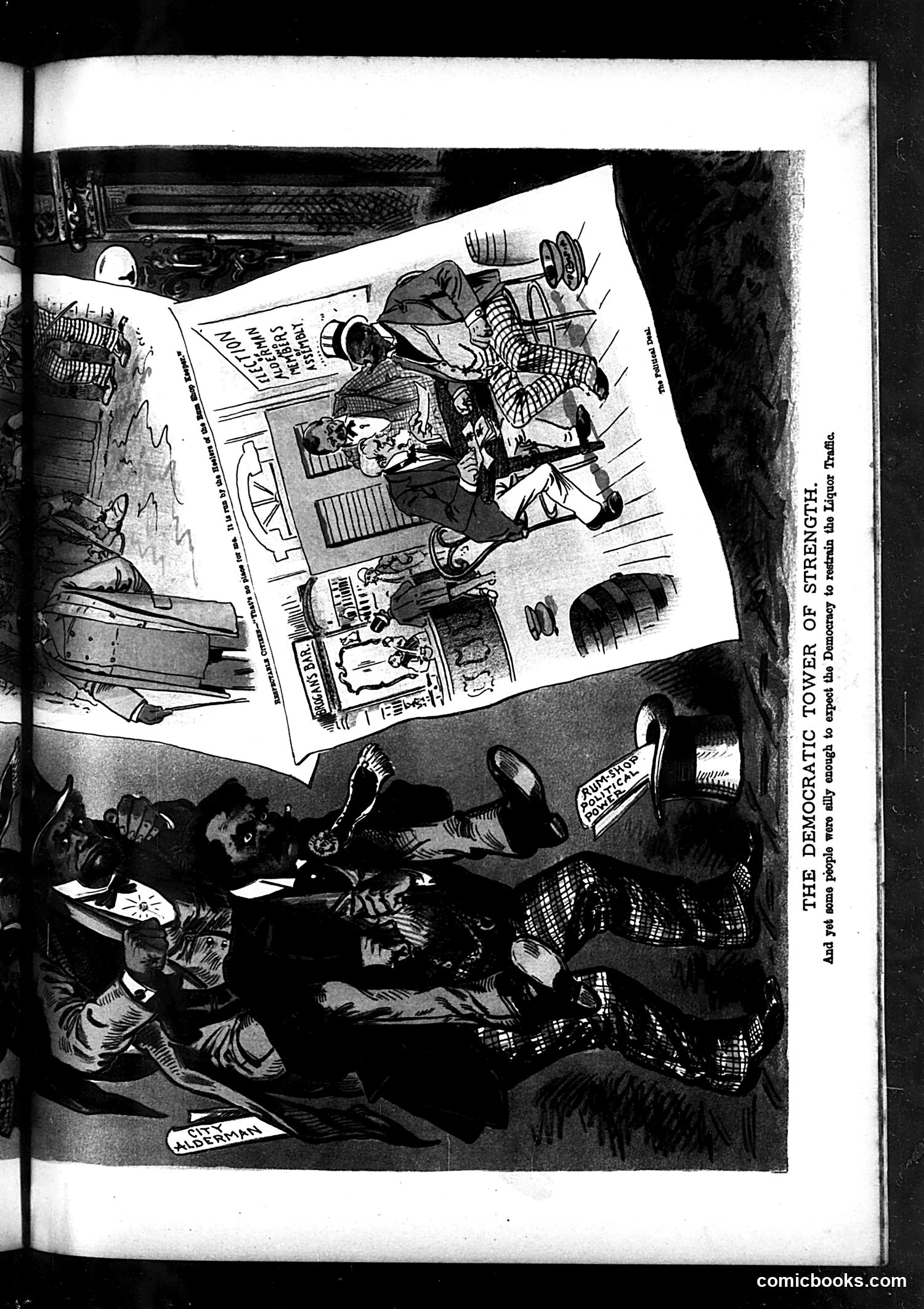
I can see this is a political cartoon from Judge magazine, but the OCR text provided is garbled and unreadable, making it difficult to identify the specific historical reference with confidence. From the IMAGE alone, I can observe: A group of people at the bottom appear to be looking up at a large illustrated poster or placard being held aloft. The poster contains comic-strip style panels depicting what appears to be a chaotic domestic or political scene with multiple figures. The caption on the right reads "THE DEMOCRATIC TOWER OF STRENGTH" with text mentioning "as yet some people are slow to appreciate it Democracy's biggest finish." Without reliable OCR text, I cannot definitively identify which Democratic politicians or events this satirizes, though the composition suggests criticism of Democratic Party leadership or policy during the early-to-mid 20th century. The "tower of strength" title appears ironic—the tower likely represents weakness rather than strength.
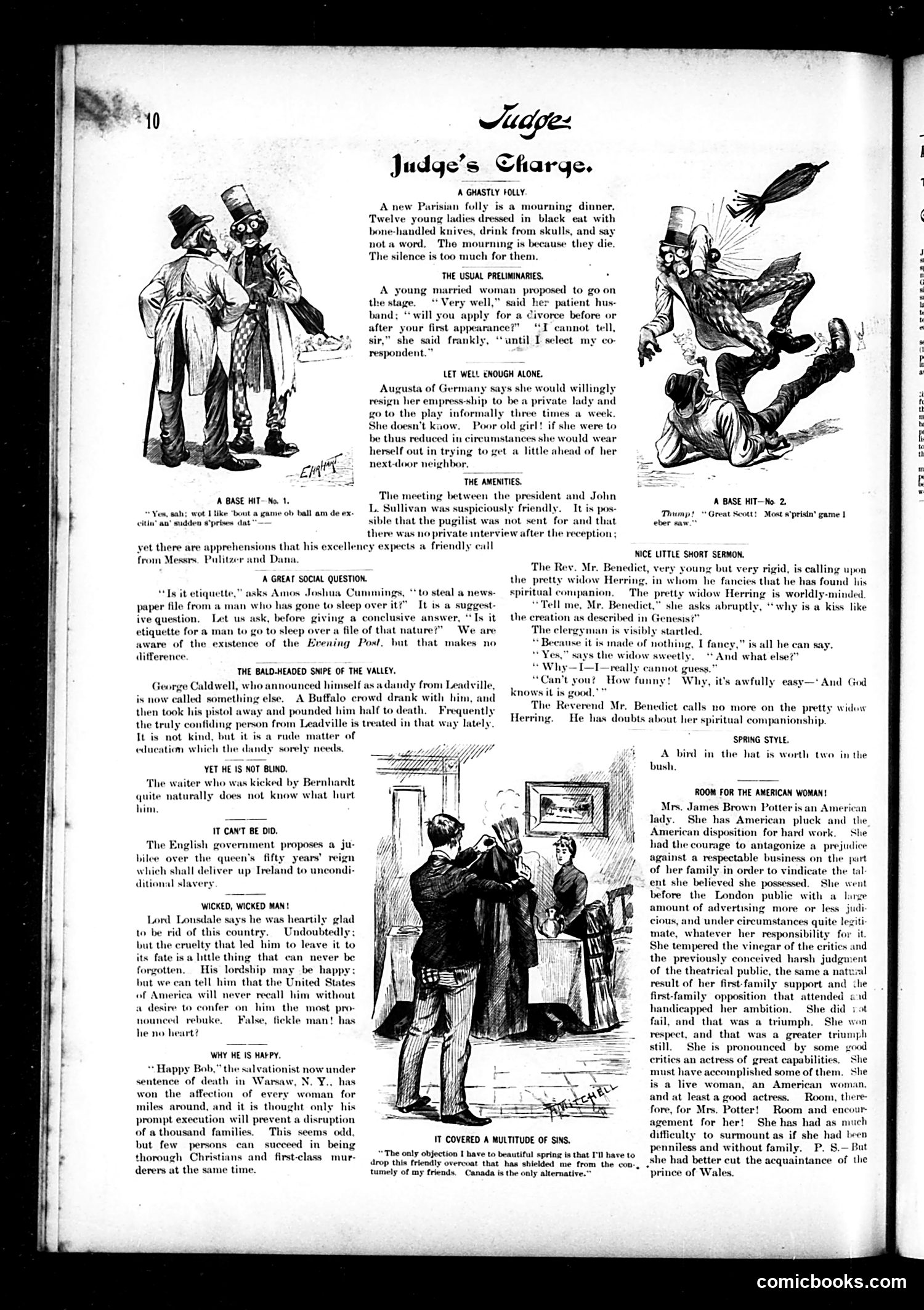
This page from *Judge* contains multiple short satirical pieces mocking contemporary social follies and public figures: **"A Ghastly Folly"** ridicules a new Parisian trend where young women in black dine together while drinking from skulls—absurdist social pretension presented as morbid theatre. **Political jabs** target Lord Lonsdale (criticized for abandoning England), the English government's Irish policies, and an unnamed "Happy Bob," a death-row inmate in Warsaw, New York, whose imminent execution apparently attracts female admirers—the satire being that executing murderers shouldn't be romantic. **Social commentary** includes jokes about divorce etiquette, an Augusta of Germany who romanticizes humble private life without understanding actual hardship, and a "Parisian folly" satirizing European decadence. **The baseball cartoons** ("A Base Hit") appear to be unrelated sporting humor. The overall tone reflects *Judge's* characteristic late-19th-century American perspective: mocking European aristocratic pretension, criminal justice absurdities, and newly wealthy social climbers attempting sophistication.
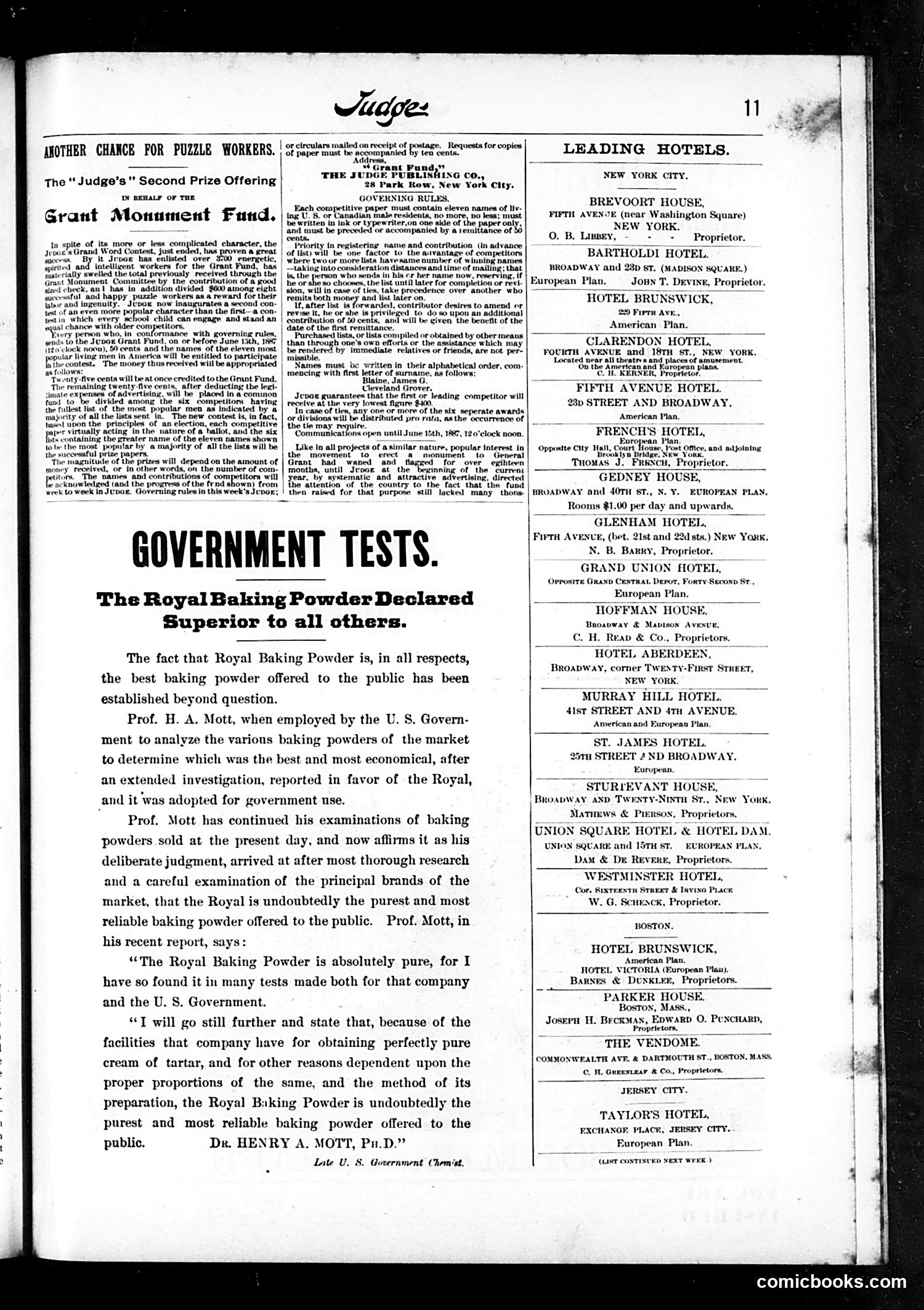
This page is primarily **advertising and administrative content** for Judge magazine, not political satire. The left column announces Judge's "Second Prize Offering" for a **Grant Monument Fund puzzle contest**—readers submit lists of eleven famous people's names for cash prizes. The contest aims to raise money for a Grant Monument while engaging readers in a popular puzzle competition. The center features a major advertisement declaring **Royal Baking Powder superior** based on U.S. Government testing by Prof. H.A. Mott. The ad quotes Mott's endorsement of Royal as "the purest and most reliable baking powder offered to the public." The right column lists **leading hotels** in New York City, Boston, and Jersey City—standard classified advertising. No political cartoons appear on this page. This is a typical issue page mixing reader engagement contests, product advertising (common in late 19th-century magazines), and commercial listings. The baking powder ad reflects the era's practice of citing scientific authority to market consumer goods.
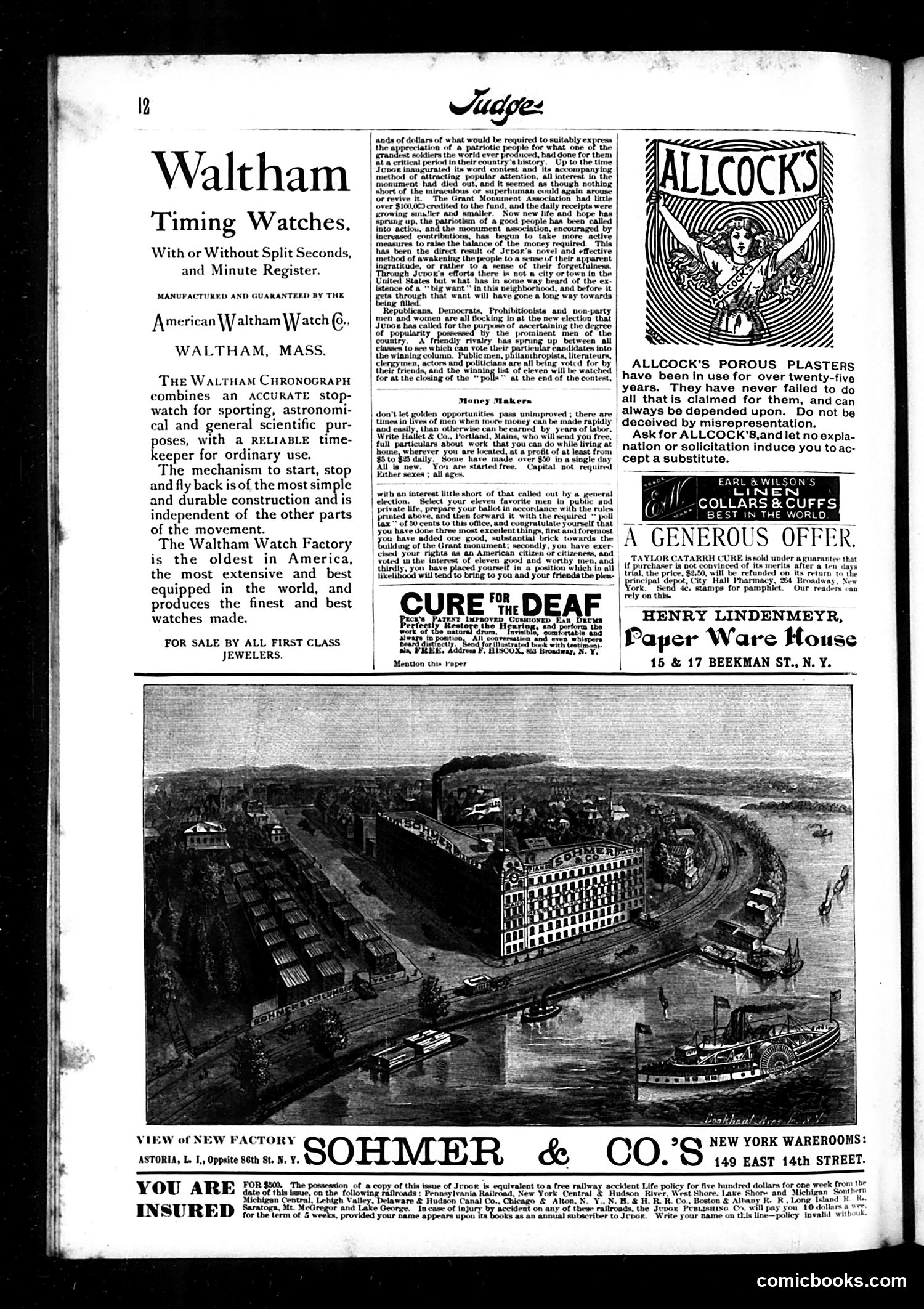
This page is primarily **advertising and announcements** rather than political satire. The main content includes: 1. **Waltham Watch Company advertisement** - promoting their timing watches and factory in Waltham, Massachusetts, highlighting it as "the oldest in America." 2. **Sohmer & Co. factory illustration** - a detailed engraving of their new factory in Astoria, Long Island, showing industrial architecture and waterfront activity. 3. **Various smaller ads** - including Allcock's Porous Plasters, Earl & Wilson's collars, Henry Lindenmeyer's paper warehouse, and a "Cure for the Deaf" medical advertisement. 4. **Text about Grant Monument fundraising** - describing Judge magazine's election contest to raise money for the Grant Monument, encouraging readers to vote for their favorite public figures. The page reflects late 19th-century American industrial pride and demonstrates how Judge mixed satirical editorial content with substantial advertising revenue. No clear political cartoon or satire is visible on this particular page.
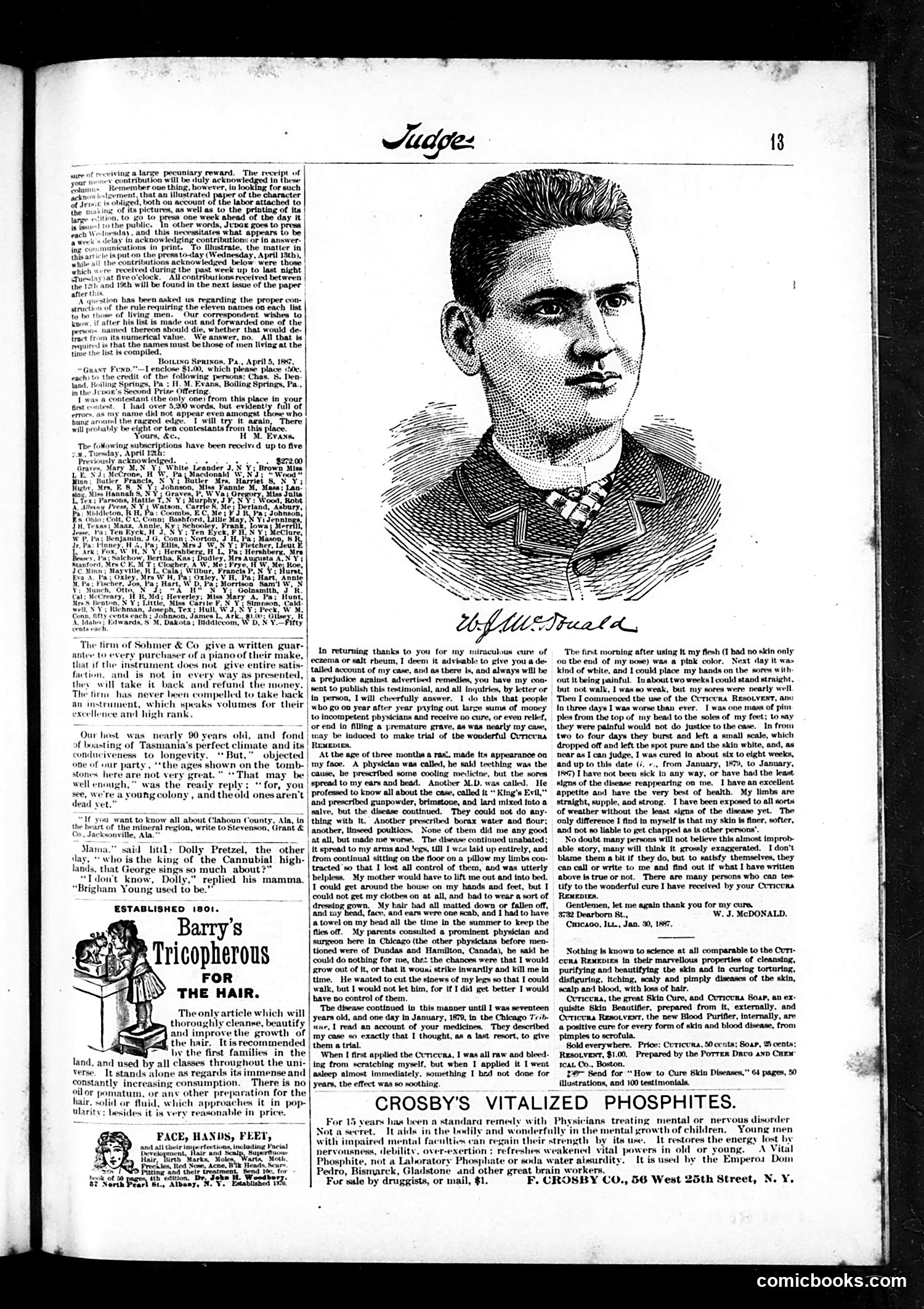
This page from Judge magazine (dated April 1907, based on context) is primarily **advertising and reader correspondence**, not political satire. The main content includes: 1. **A portrait** of an unidentified man with a signature below (appears to be a contributor or notable figure, but the signature is illegible in this reproduction) 2. **Reader letters and acknowledgments** about Judge's contest rules and subscription contributions 3. **Multiple advertisements** for products like Barry's Tricopherous hair treatment and Crosby's Vitalized Phosphites (a patent medicine) 4. **Testimonial letters** from readers describing various personal ailments cured by advertised products The page contains **no visible political cartoons or satire**. It represents the magazine's business operations—acknowledging reader submissions, managing contests, and featuring period advertisements that were typical revenue sources. The medical testimonials reflect early-1900s patent medicine marketing practices, now recognized as largely fraudulent.
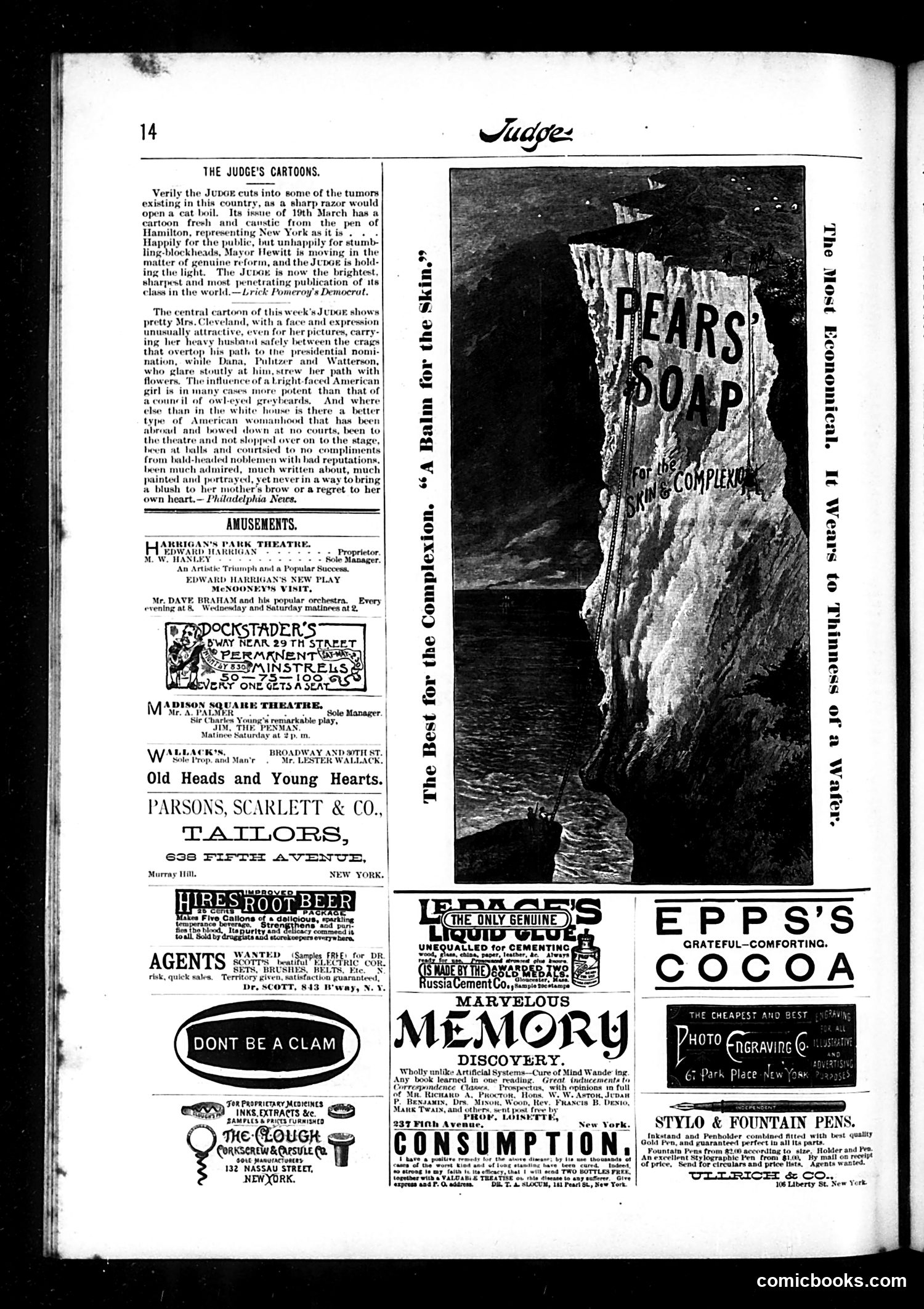
This page is primarily **advertising and theater announcements** rather than political satire. However, the opening text discusses Judge's editorial cartoons. The text describes a cartoon by Hamilton depicting **New York City and Mayor Hewitt's reform efforts**. The passage praises Judge for cutting into "tumors existing in this country" like "a sharp razor," suggesting the magazine's role as social critic. The main satirical reference involves **Mrs. Cleveland** (wife of President Grover Cleveland), portrayed as navigating between political obstacles while maintaining grace and dignity. The cartoon apparently critiques corrupt political figures while celebrating her positive influence in the White House. The rest of the page consists of typical late-19th-century advertisements: theaters (Harrigan's Park Theatre, Madison Square Theatre), a tailor shop, patent medicines, root beer, and fountain pens—standard commercial content for a satirical weekly magazine of this era.
This page is primarily **advertising**, not editorial content, though it opens with testimonial letters promoting Hop Bitters—a patent medicine claiming to cure numerous ailments. The visible text at the top contains three brief humor items or anecdotes, likely typical of Judge magazine's satirical style: 1. A joke about Patti (likely the opera singer) and a Mexican president's wife, playing on the word "chiffre" 2. A quip about Harvard astronomers not recognizing constellations 3. A remark about President Diaz's wife and tortoiseshell combs However, the **page is dominated by advertisements** for Hop Bitters testimonials, clothing, hats, underwear, food supplements, and patent medicines. The social context Judge would exploit here is the era's widespread faith in dubious patent medicine "cures"—a common satirical target for the magazine—but this page appears designed primarily as revenue through advertiser placement rather than satirical content.
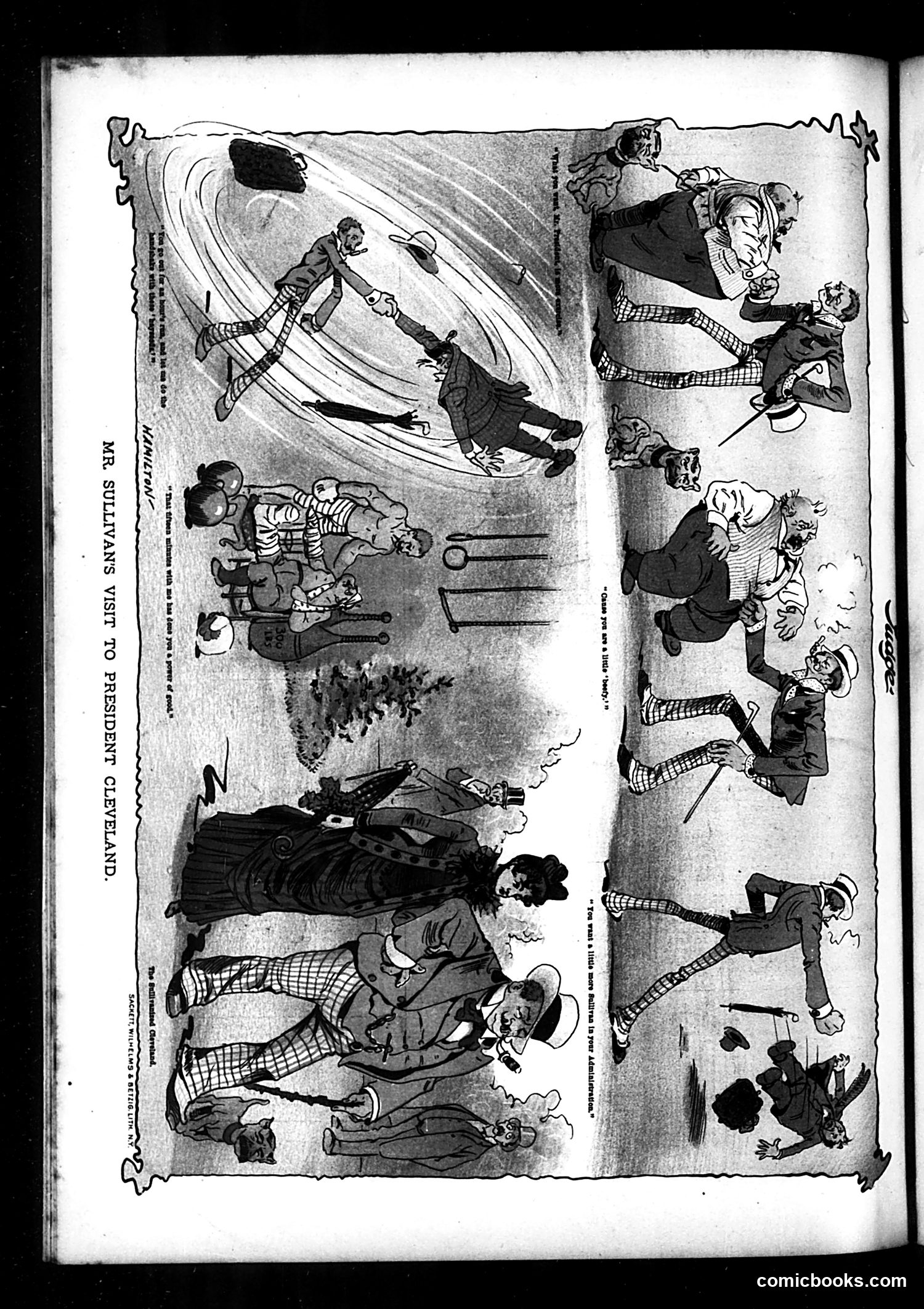
This political cartoon depicts Mr. Sullivan's visit to President Cleveland. The title indicates this is satirizing a real meeting between these figures. The cartoon is arranged as a visual sequence (reading it rotated), showing various characters in conversation and interaction. The caption "That fifteen minutes with me has done you a power of good" suggests the satire mocks claims that a brief presidential meeting provides significant benefit. The figures appear to be politicians or public figures of the Cleveland administration era (1890s). Without clearer identification of "Sullivan," the specific political context remains somewhat unclear, but the cartoon's structure implies skepticism about the supposed positive effects of presidential access or influence. The satirical point appears to be that such meetings are more performative than substantive.