
A complete issue · 17 pages · 1887
Judge — April 9, 1887
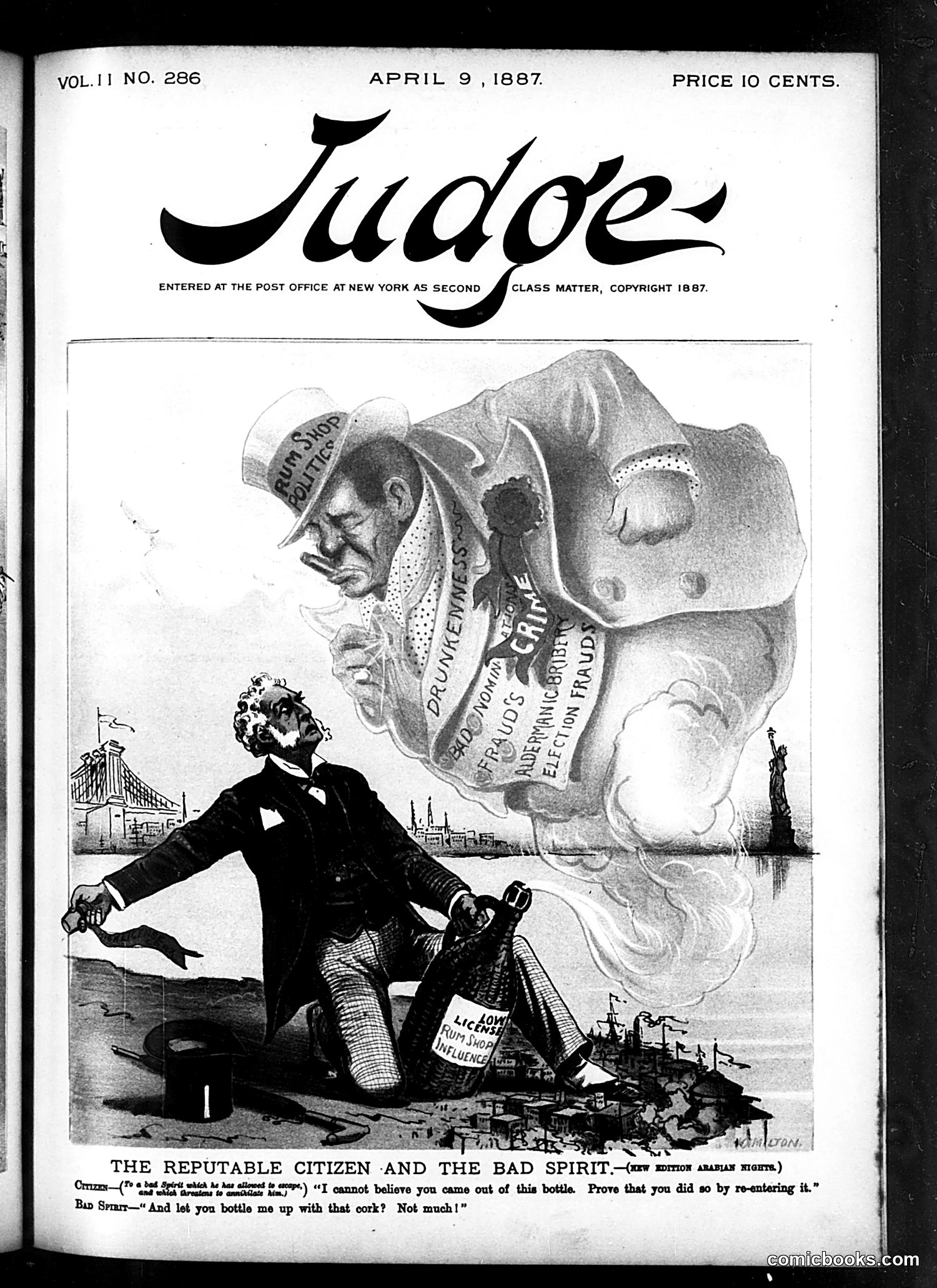
This political cartoon satirizes the conflict between respectable American society and what appears to be immigration or foreign influence. A well-dressed citizen (representing established American values) confronts a genie-like figure emerging from a bottle labeled with various problematic influences: "Darwinism," "Socialism," "Anarchy," and other ideological threats perceived as dangerous in 1887. The citizen demands the genie prove it came from the bottle—suggesting these corrupting ideas are "foreign" intrusions rather than homegrown problems. The background shows American landmarks (Brooklyn Bridge, Statue of Liberty), emphasizing this as a distinctly American concern. The cartoon reflects 1880s anxieties about radical ideologies entering America through immigration, framing them as external "spirits" threatening the nation's established order.
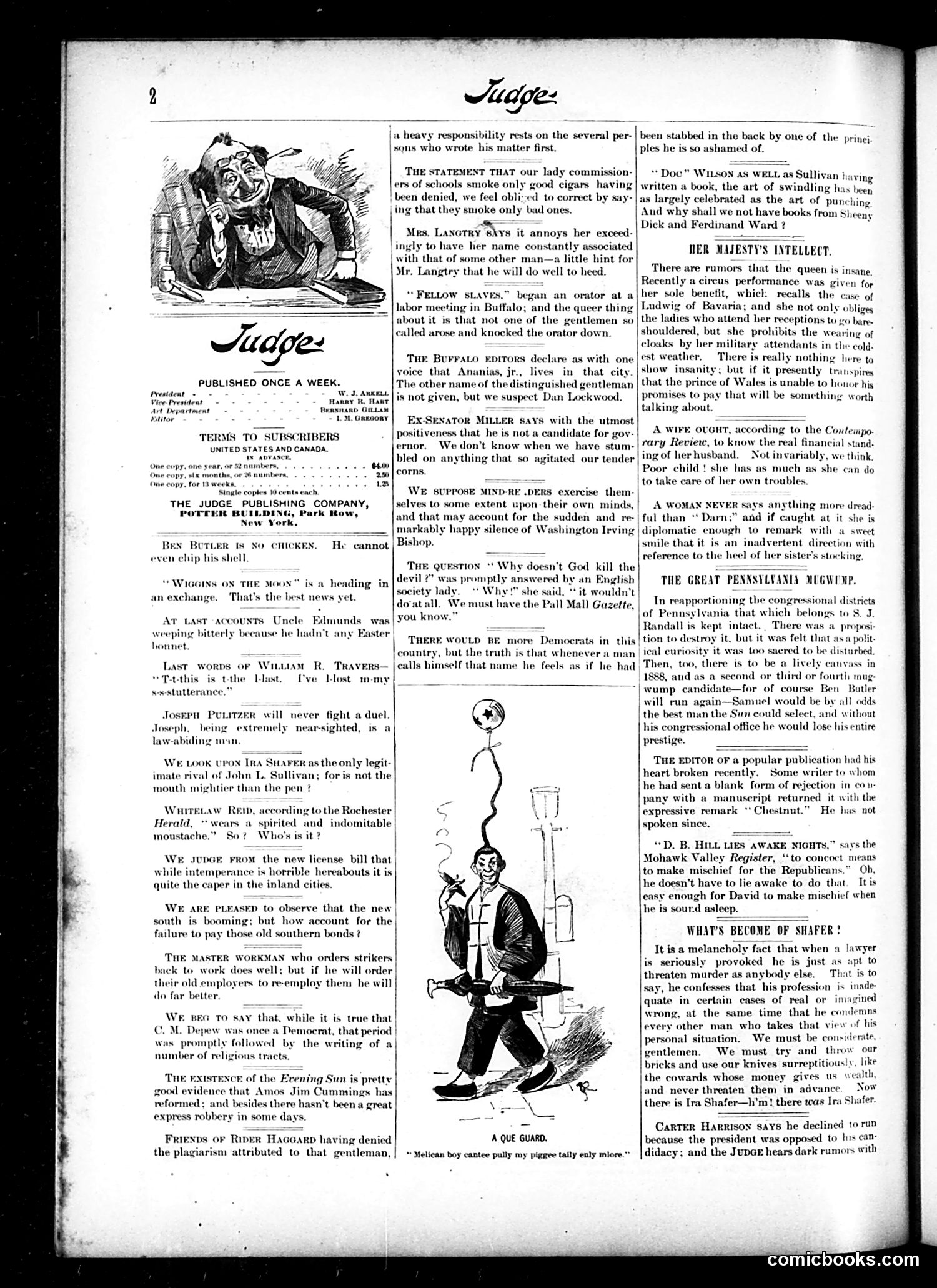
This page contains satirical commentary and editorial items typical of Judge magazine's political humor. The main cartoon titled "A Old Guard" depicts a figure wielding a large syringe or injection device, captioned "Mexican boy carter pally my pigeon tally eely moare" (likely garbled OCR). The accompanying text discusses various political and social topics including critiques of Democratic candidates, commentary on congressional districts, and observations about public figures. References include discussions of Senator Miller, Uncle Edmunds, and commentary on presidential succession and political ambitions. The overall tone is characteristic of Judge's late 19th/early 20th-century satirical approach—mocking political pretension, questionable ethics in public life, and social absurdities. Without clearer context on specific events referenced, precise identification of all targets remains uncertain.
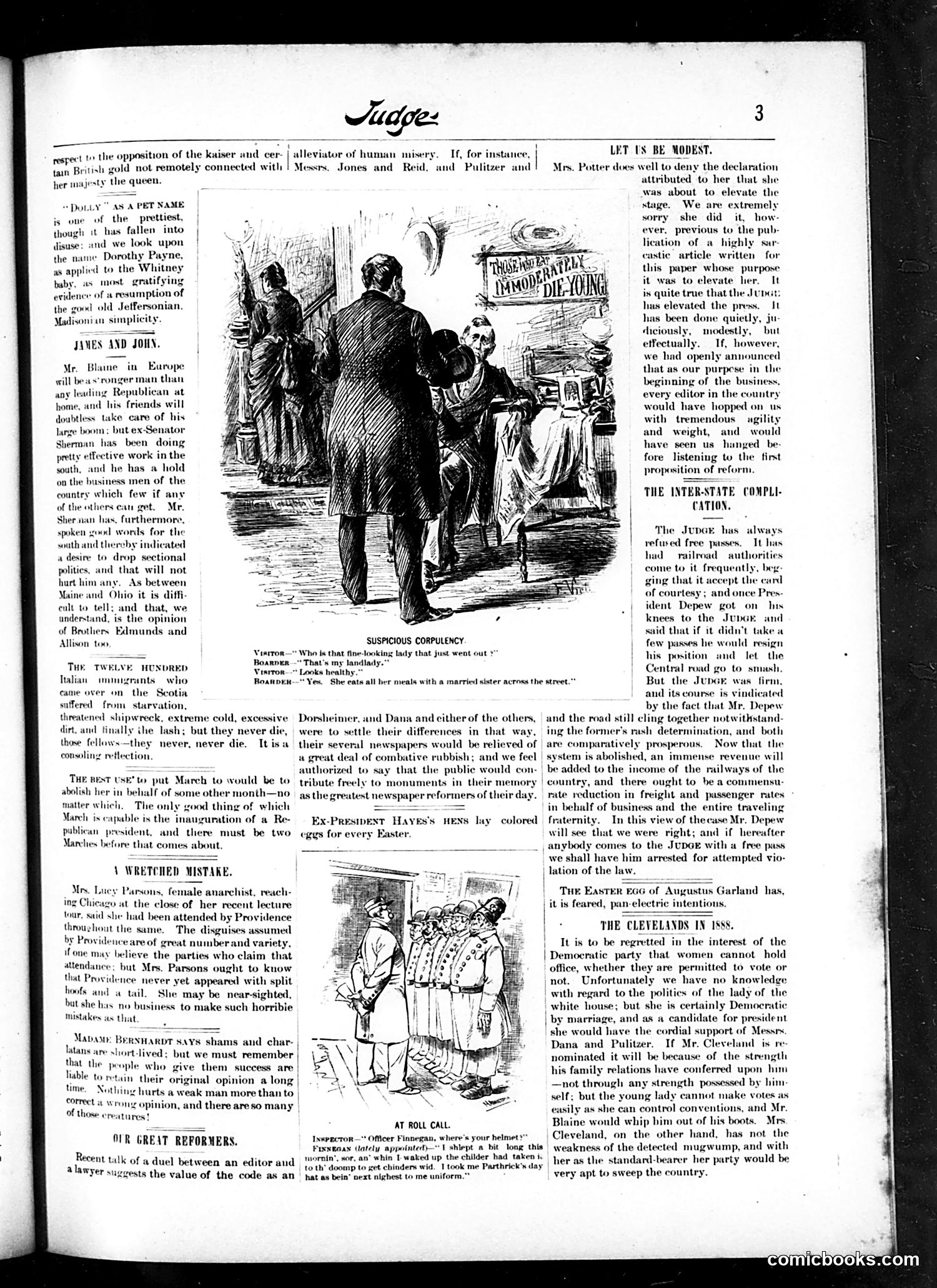
This page contains several brief satirical pieces and cartoons typical of Judge's political humor: **"Suspicious Corpulency"** depicts a visitor commenting on a landlady's healthy appearance, revealing she eats all her meals with a married sister across the street—satirizing either freeloading or suspiciously convenient domestic arrangements. **"At Roll Call"** shows an Irish immigrant officer explaining he slept too long and his children took his helmet, using it as the nearest substitute to his uniform—mocking Irish immigrants and their assimilation challenges. **Political commentary** discusses Republican presidential prospects (Blaine, Sherman, Edmunds, Allison), the 1884 election dynamics between Maine and Ohio candidates, and attacks on reformers and anarchists (Lucy Parsons). **"Let Us Be Modest"** sarcastically credits Judge magazine with elevating both Mrs. Potter and the press itself—self-congratulatory humor. The cartoons use exaggerated physiognomy and ethnic stereotyping typical of 1880s satirical journalism.
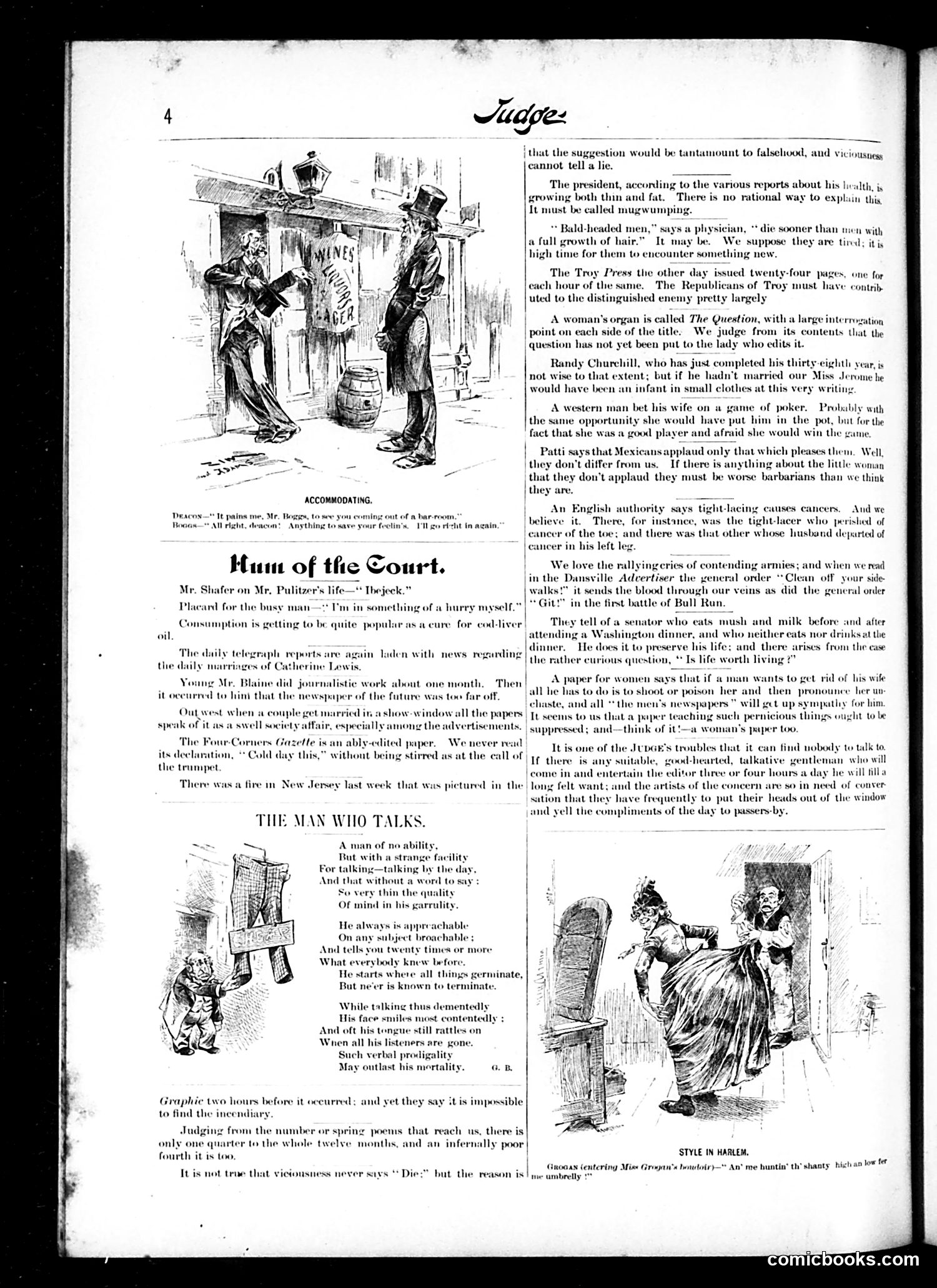
This page from *Judge* contains miscellaneous social satire and editorial commentary typical of the magazine's format. **"Accommodating"** (top cartoon): Shows a landlord offering a tenant an escape from a small room—gentle humor about cramped urban housing. **"Man of the Court"** discusses various contemporary absurdities: President Cleveland's contradictory health reports ("mugwumping"), bald men dying younger, a newspaper issuing 24 pages (one per hour), and references to Randy Churchill and the opera singer Patti. The tone mocks public figures and social pretension. **"The Man Who Talks"** (poem with cartoon): Satirizes a garrulous man of no real ability or substance—someone who talks constantly without saying anything meaningful. This appears to be generic social criticism rather than targeting a specific person. **"Style in Harlem"** (bottom right): A brief caption-cartoon, likely satirizing fashion or social pretension in that neighborhood. Overall, the page emphasizes *Judge's* trademark approach: witty commentary on politics, media, fashion, and social behavior through short pieces mixing text and illustration. Specific references are often ephemeral, targeting immediate news rather than historical figures.
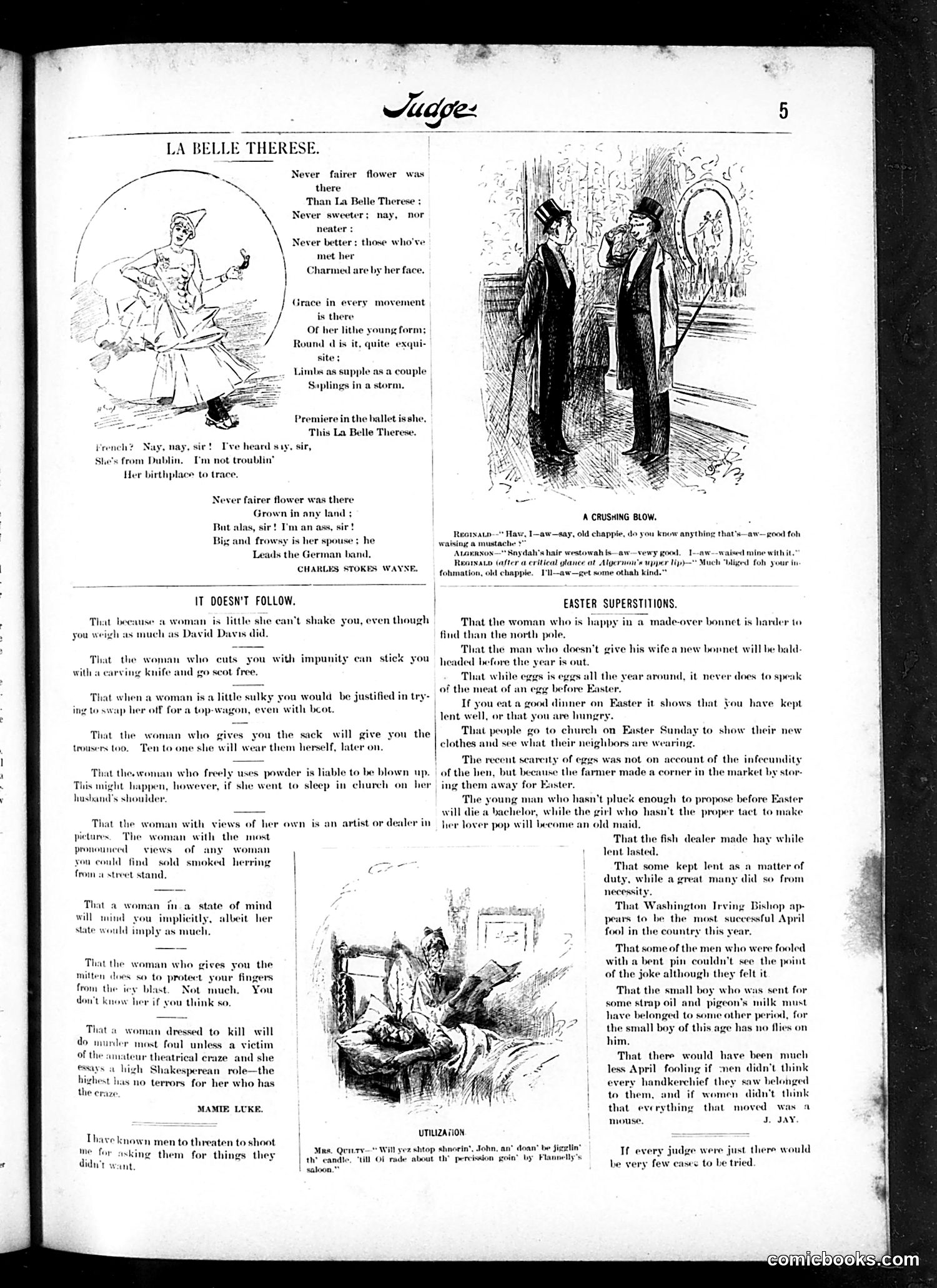
This page contains satirical commentary on contemporary social issues circa the 1880s-90s. **"La Belle Therese"** celebrates an Irish dancer of that name, praising her beauty and grace while humorously noting her spouse leads "the German band"—suggesting a working-class or immigrant performer's life. **"It Doesn't Follow"** (by Mamie Luke) is a series of satirical observations debunking false assumptions about women's behavior—suggesting women who cut you socially won't necessarily spare you physically, that a woman in a temper won't behave logically, etc. This reflects period anxieties about women's unpredictability. **"A Crushing Blow"** depicts two fashionable gentlemen (Reginald and Algernon, stereotypically affected names) discussing mustache care—the "crushing blow" being that Algernon's expensive treatment doesn't work as well as Reginald's homemade method. **"Easter Superstitions"** collects folk beliefs about Easter observance, including egg scarcity, new bonnets, and April Fool's pranks—poking fun at rural superstitions and gullibility.
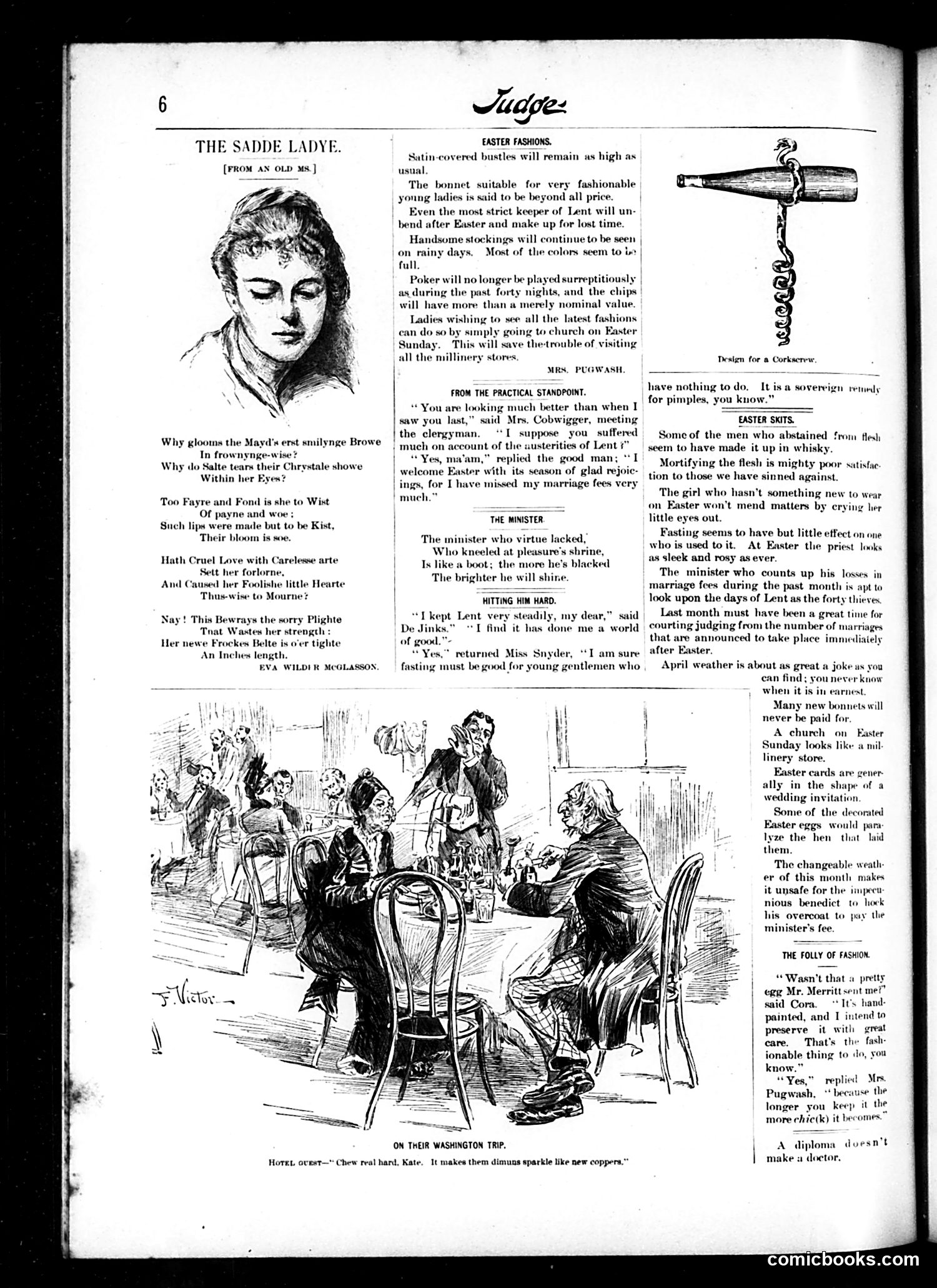
This page satirizes Easter fashions and religious hypocrisy among 1880s-90s Americans. **"The Sadde Ladye"** poem mockingly uses archaic language to reveal that a fashionable woman's sadness stems not from love's cruelty but from her corset being too tight—a jab at the impracticality of extreme Victorian fashion. **The main cartoon** depicts a clergyman dining with parishioners, illustrating the accompanying text about ministers eagerly awaiting Easter to resume collecting marriage fees after Lent's austerities. The humor targets clergy who treat religious observance primarily as a financial matter. **Multiple short items** mock Easter-season behavior: women displaying new fashions exclusively at church, men abandoning Lent's abstinence by drinking whisky, and the broader disconnect between performing religious devotion and actual moral behavior. **"The Folly of Fashion"** ridicules a woman preserving a hand-painted Easter egg merely to appear fashionable—prioritizing appearance over substance. Throughout, the satire exposes how Easter celebrations devolved into consumer spectacle and social posturing among the wealthy, with religious meaning secondary.
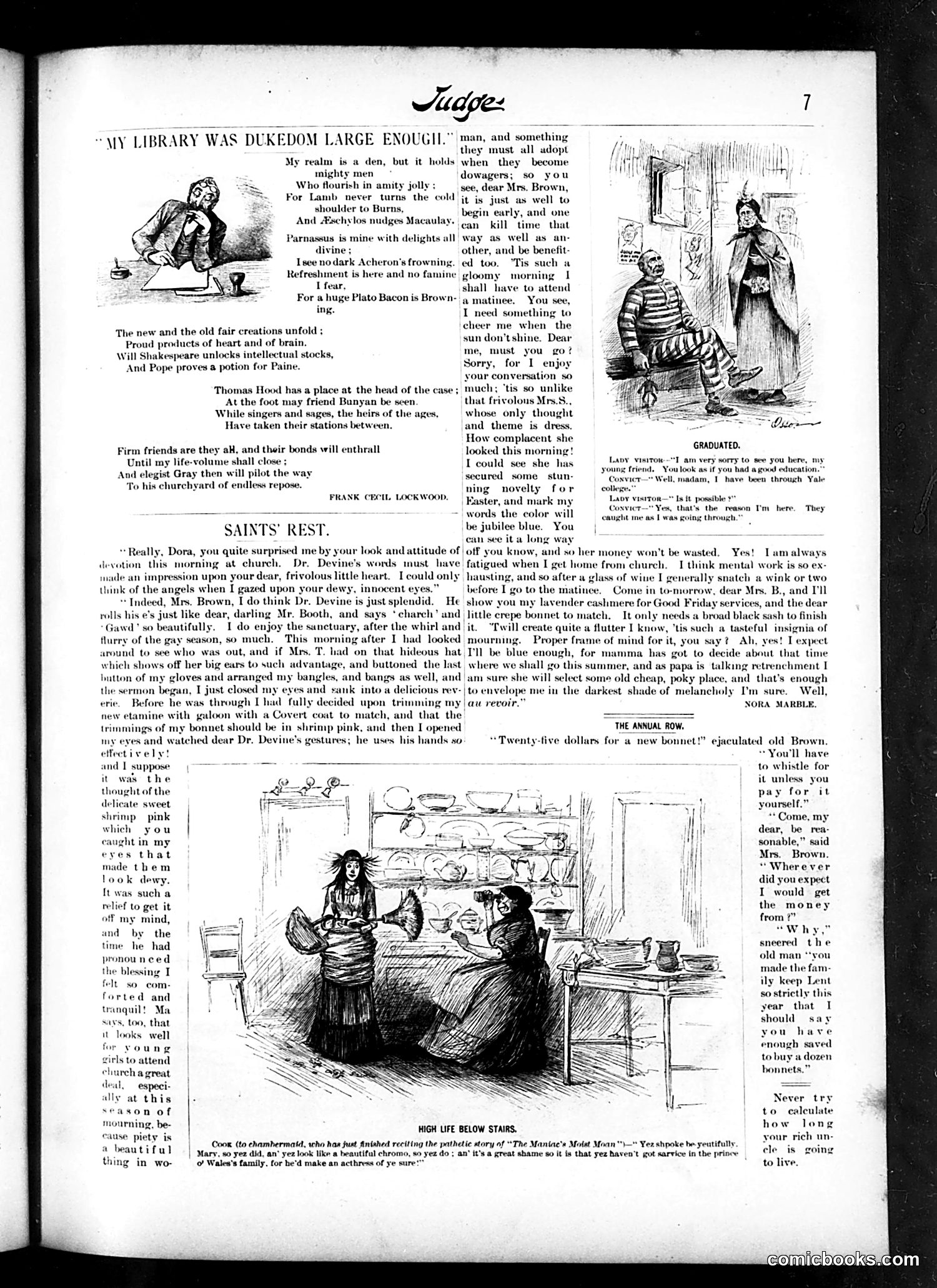
This page satirizes the hypocrisy of wealthy women who attend church for social performance rather than genuine devotion. The dialogue between "Mrs. Brown" and "Mrs. S." (or "Nora Marble") exposes the contradiction: while praising the sermon's spiritual uplift, the characters immediately reveal their actual concerns—dress, social status, and observing others' clothing and jewelry. The satire targets fashionable society women who use church as a social venue. They admire the minister's theatrical delivery ("rolls his e's") while their minds wander to outfit details, Easter bonnets, and vacation plans. The "annual row" (family dispute) over household expenses adds another layer: these women demand luxury despite financial constraints. The illustrations show the women gossiping comfortably indoors, contrasting with the pious poetry about literature that opens the page. Judge's joke: religion becomes merely another fashion accessory for the superficial wealthy.
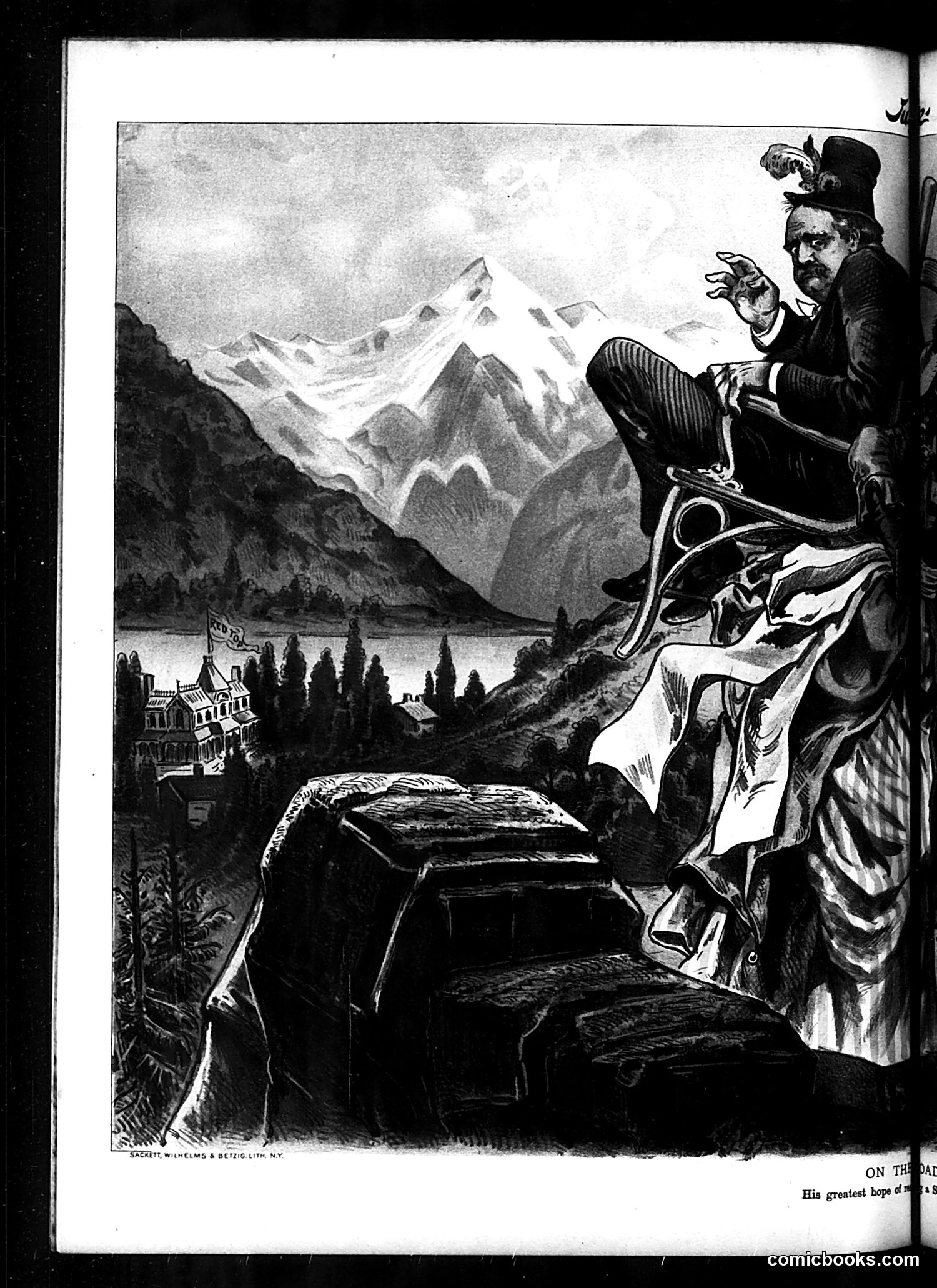
This appears to be a satirical illustration from *Judge* magazine showing a man in formal Victorian dress and top hat gesturing dramatically toward an Alpine mountain landscape with a castle below. The figure's theatrical pose and expressive hand gestures suggest he's presenting or promoting something. The visible text fragment "His greatest hope" suggests this cartoon comments on someone's ambitions or aspirations. The Alpine setting with the castle may reference European politics or real estate, though the specific subject and target of satire are unclear from the incomplete text visible on this page. The artist is credited as "Sackett, Wilhelms & Bettie, Lith. N.Y." The cartoon's exact political meaning requires the full caption to determine.
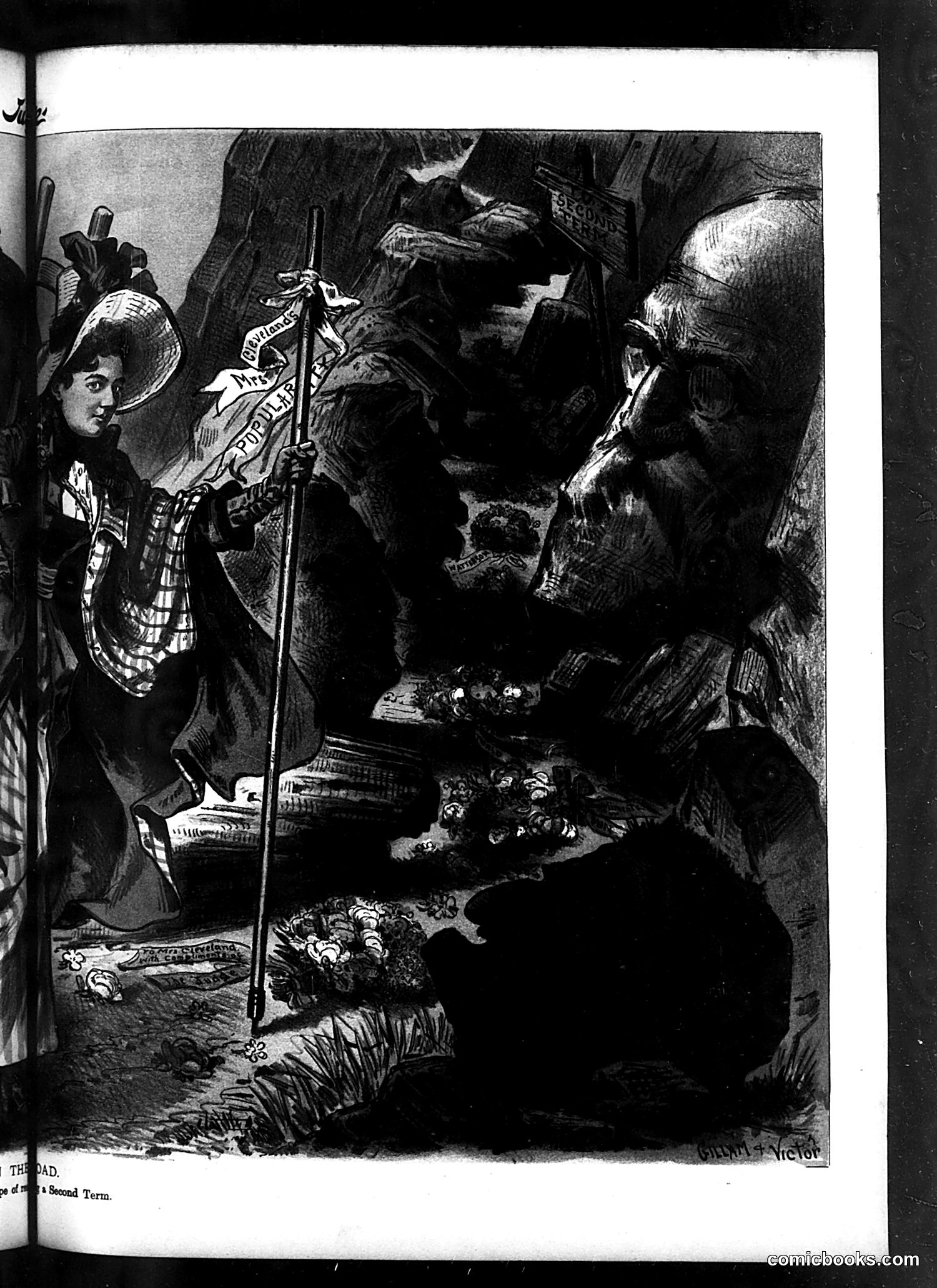
This appears to be a satirical illustration depicting a dramatic scene with multiple figures in period dress. On the left stands a young person in elaborate costume with a halo-like headdress. Central figures appear to be engaged in some kind of confrontation or negotiation, rendered in heavy shadow and dramatic lighting characteristic of Judge's style. The text reference to "THE BAD" and "a Second Term" suggests this critiques a political figure or administration seeking reelection. However, without clearer OCR text or visible publication date, I cannot definitively identify which specific politician or historical moment this targets. The artistic style—dark crosshatching and theatrical composition—emphasizes the cartoon's moral judgment of the depicted events.
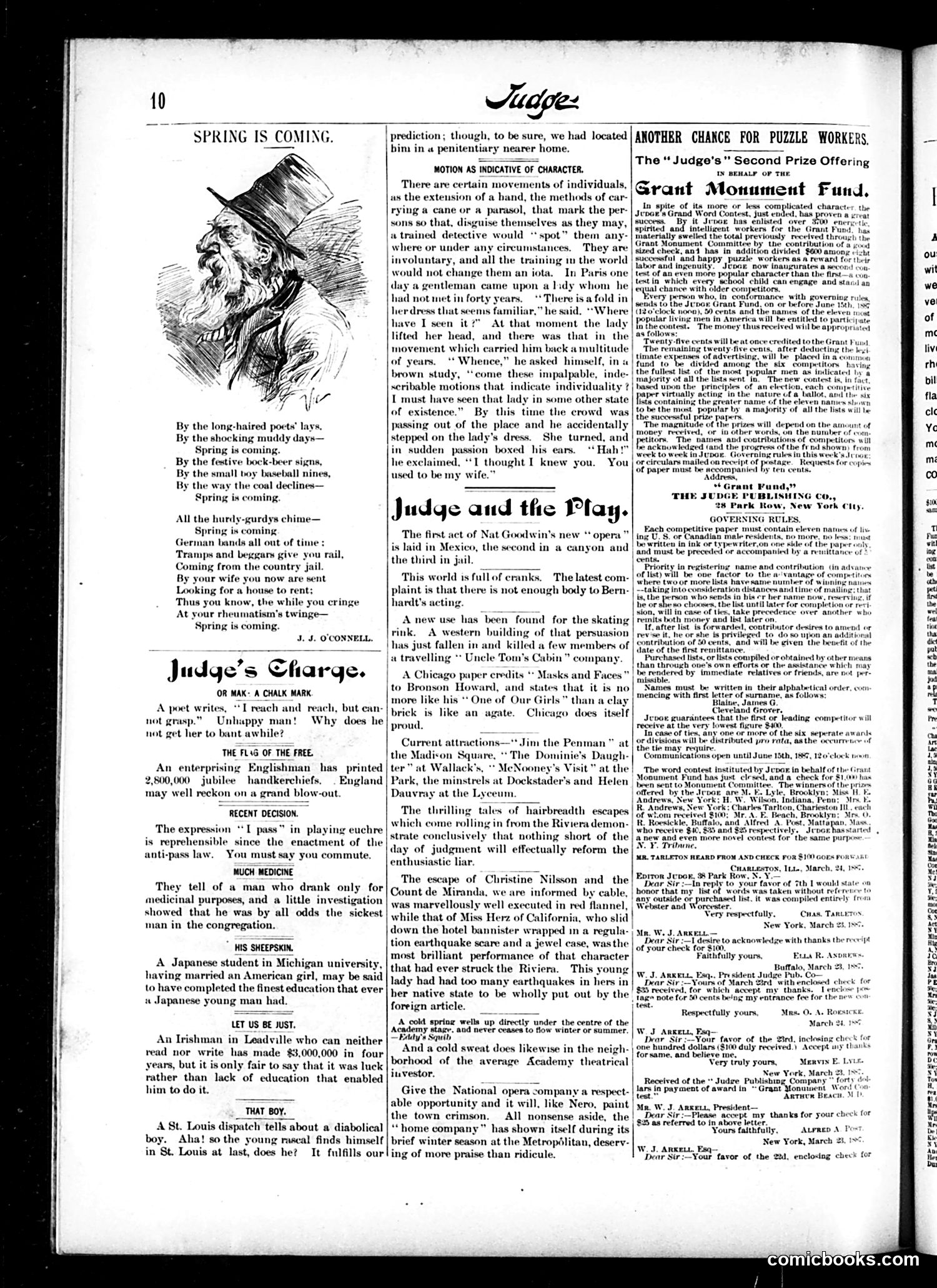
This page from Judge contains multiple brief satirical pieces typical of the magazine's format. **"Spring is Coming"** (left column): A humorous poem by J.J. O'Connell uses spring's arrival as framing for social observation—muddy streets, beer gardens reopening, hobos returning from jail, and husbands being sent house-hunting. It's gentle domestic satire. **"Judge's Charge"** section: Various short jokes mocking contemporary life. Notable examples: a meditation on how involuntary gestures betray identity (illustrated with the story of a man recognizing his ex-wife by her dress movement before she boxes his ears); mockery of medicinal drinking excuses; and a jab at a St. Louis boy described as "diabolical." **Theater reviews**: Brief commentary on current plays and performers, including jokes about Nat Goodwin's opera set in jail, Sarah Bernhardt's acting style, and a skating rink disaster killing a traveling minstrel troupe. The overall tone is light, topical humor targeting middle-class American life and popular entertainment of the era.
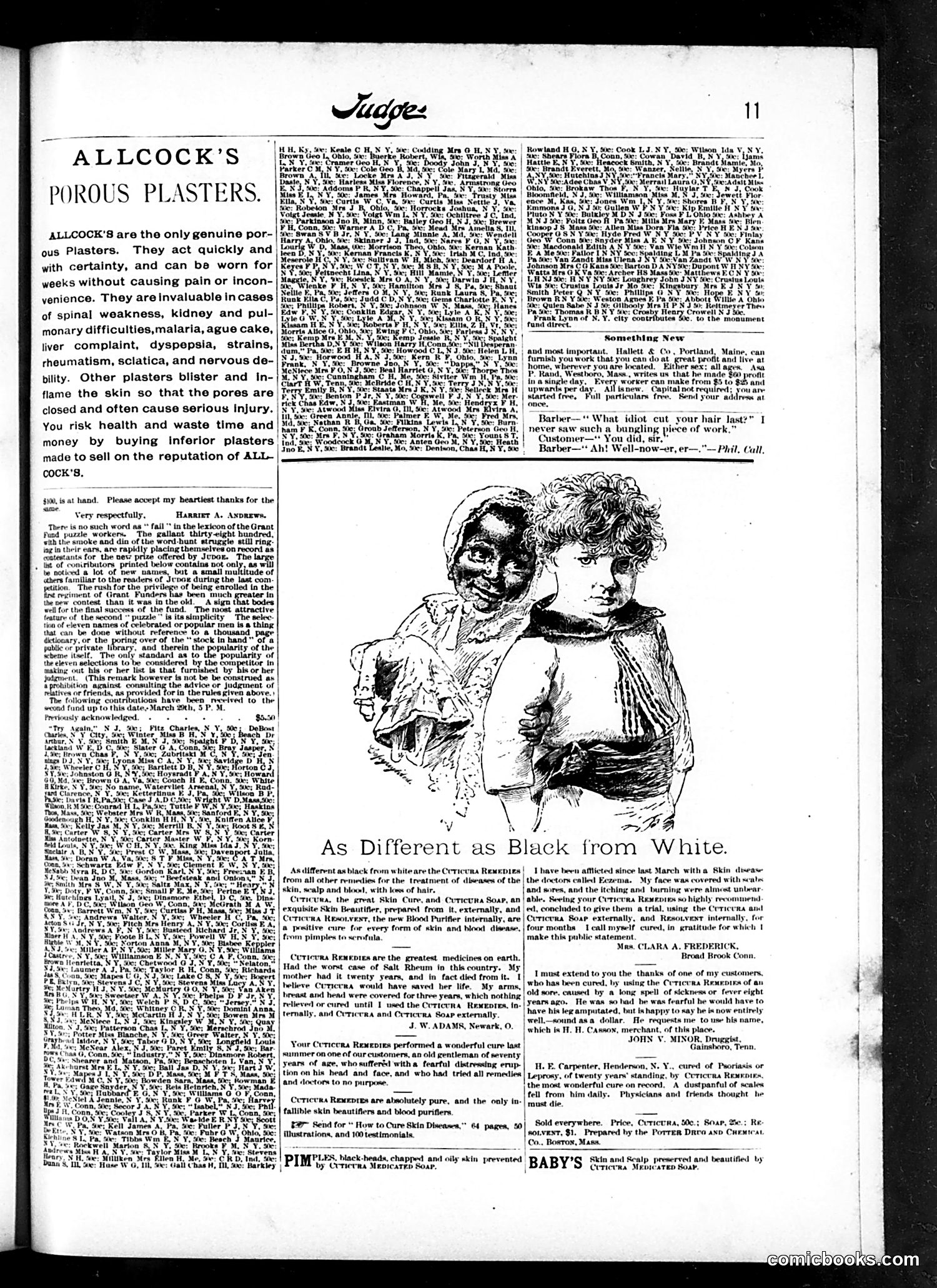
This page is primarily **advertising and administrative content**, not political satire. The dominant feature is an **Allcock's Porous Plasters advertisement** (top left)—a medical product claiming to treat various ailments without the side effects of competing plasters. The illustration captioned **"As Different as Black from White"** depicts what appears to be a **before-and-after testimonial**, showing skin conditions allegedly cured by Cuticura Remedies (a competing skin treatment product). The accompanying testimonials from satisfied users—Clara A. Prepperton and others—reinforce marketing claims about treating skin diseases. The bulk of the remaining text comprises **lists of contributors to Judge's "Grant Fund" puzzle competition**, a reader-participation contest. This reflects how 19th-century magazines engaged audiences through puzzles and fundraising drives. The page demonstrates how Judge mixed satirical editorial content with extensive advertising and reader engagement mechanics—typical magazine practice of the era. There is no discernible political or social satire on this particular page.
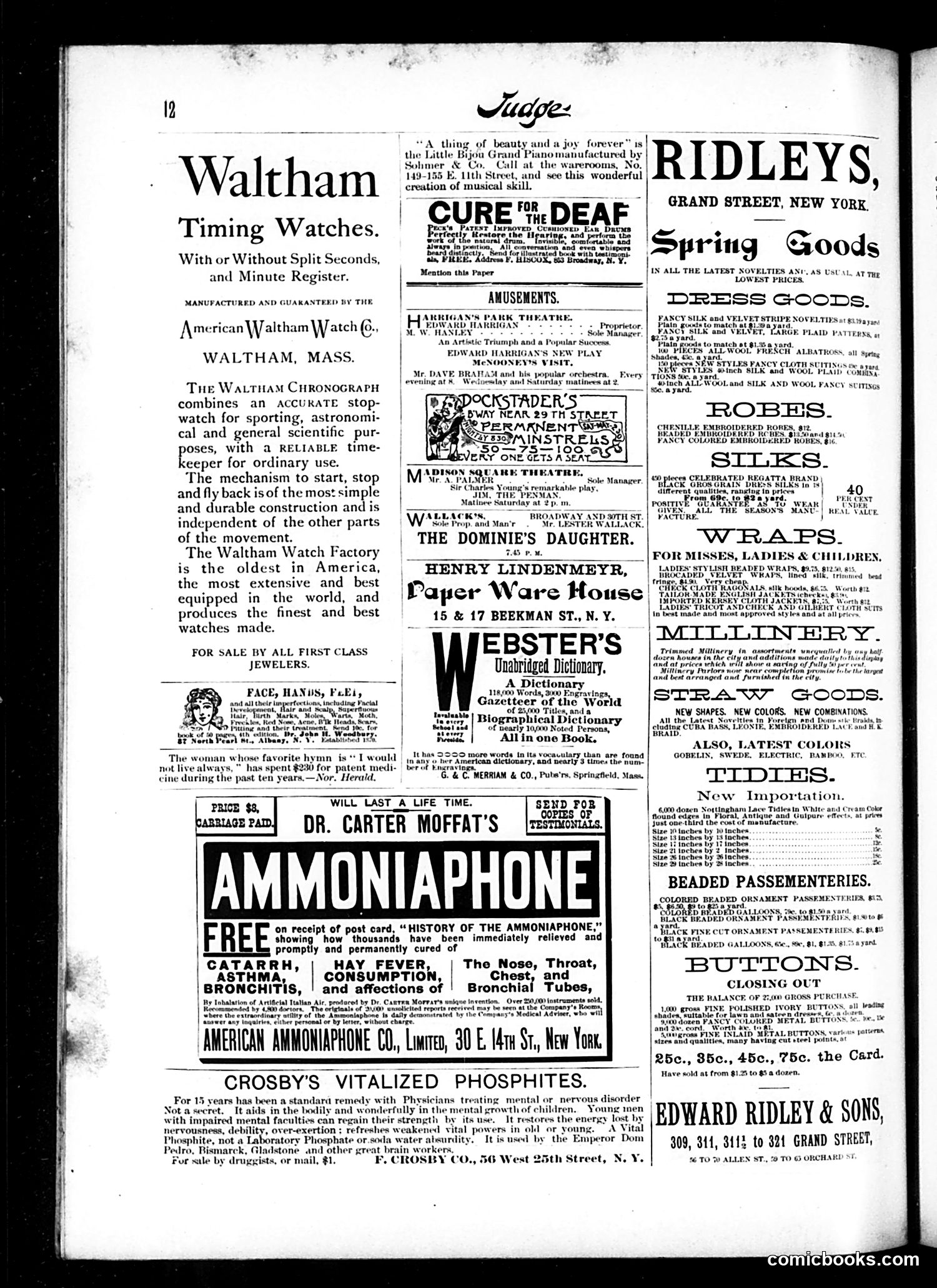
This is primarily an **advertising page** from Judge magazine, not a satirical editorial page. The page contains commercial advertisements for products and services typical of the late 19th or early 20th century. The main advertisements include: - **Waltham Timing Watches** (top left): promoting precise American-made chronographs - **Ammoniophone** (center, large): a patent medicine claiming to cure respiratory ailments (catarrh, hay fever, asthma, bronchitis) — a common type of dubious health product from this era - **Webster's Dictionary** and other reference books - **Ridleys department store** (right side): advertising spring goods, dress fabrics, millinery, and imported lace There are also theater advertisements (Harrigan's Park Theatre, Dockstader's Minstrels). **Notable for modern readers:** The Ammoniophone ad exemplifies the patent medicine fraud that plagued the era before FDA regulation. The exaggerated health claims, testimonials, and free literature offers were typical marketing tactics that exploited consumer desperation.
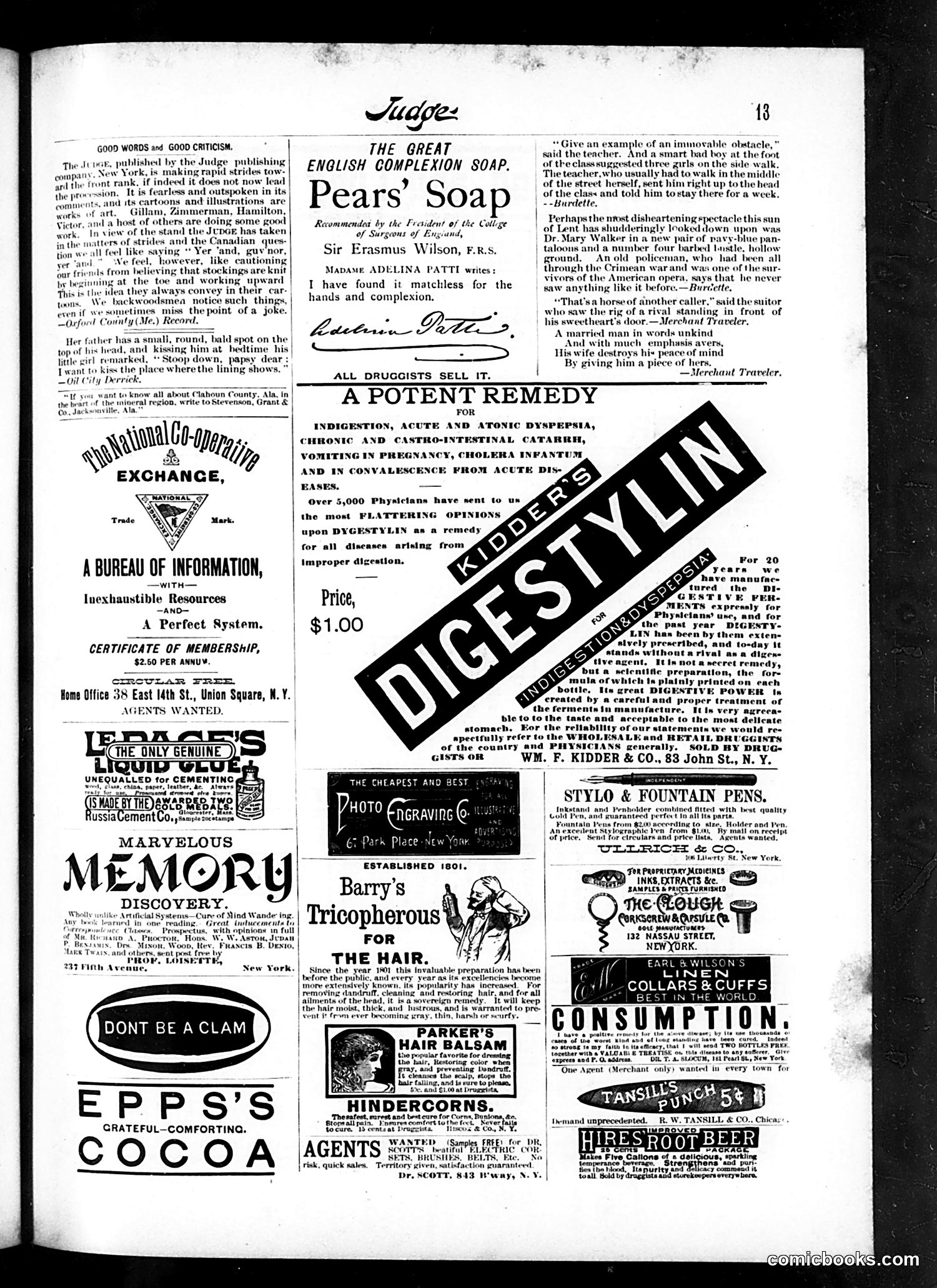
This is primarily an **advertising page** from Judge magazine, with minimal editorial content. The small editorial items are humorous anecdotes rather than political satire: **Notable Content:** - A joke about a girl kissing her bald father, asking him to "stoop down" to see "where the lining shows" (the hair-line) - A quip about a smart student suggesting "three girls on the sidewalk" as an example of an "immovable obstacle" - A joke about a married man's wife giving him "a piece of her mind" **Advertisements dominate**, promoting period products: Pears' Soap (endorsed by Sir Erasmus Wilson and opera singer Adelina Patti), Dygestylin digestive remedy, Barry's Tricopherous hair treatment, Epps's Cocoa, and various other tonics and services. The page reflects **late 19th/early 20th-century consumer culture** with heavy reliance on celebrity endorsements and pseudo-scientific health claims. There is **no significant political cartoon or satire** visible—just light domestic humor typical of the era.
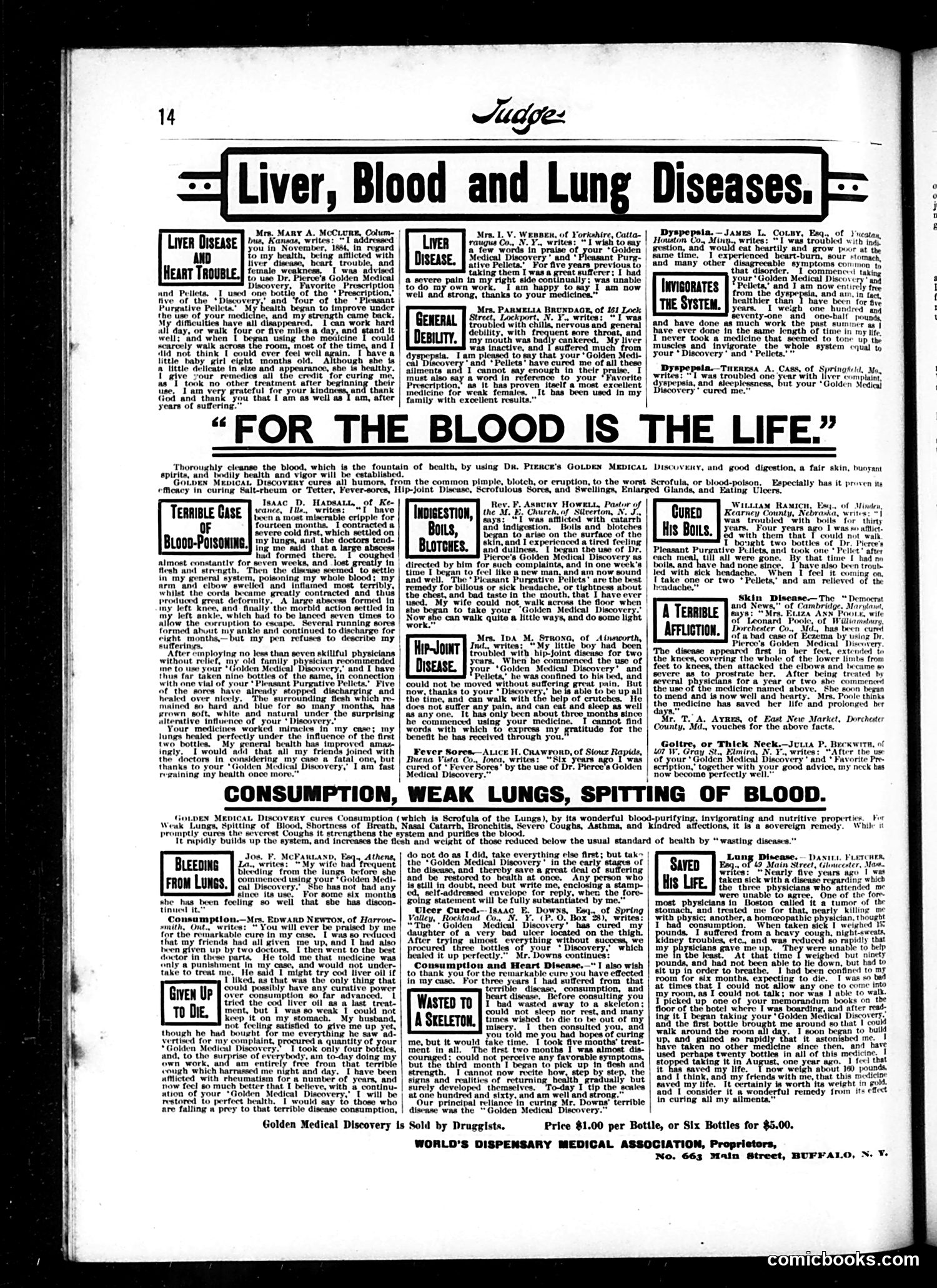
This page is primarily **advertising, not political satire**. It's a full-page advertisement for Dr. Pierce's "Golden Medical Discovery"—a patent medicine sold by the World's Dispensary Medical Association in Buffalo, New York. The page contains **testimonial letters** from patients (with names and locations) claiming the product cured various ailments: liver disease, heart trouble, female weakness, dyspepsia, consumption, and "blood poisoning." The large central text proclaims "FOR THE BLOOD IS THE LIFE," promoting the idea that purifying the blood treats all diseases. **Historical context**: This represents **19th-century patent medicine marketing**—before FDA regulation (1906+). Such ads were common in magazines like *Judge*. The testimonials and medical claims would be illegal today. The vague ailments ("female weakness," "general debility") and miraculous cures reflect the era's medical ignorance and aggressive advertising practices. This isn't satire—it's authentic period advertising that modern readers find absurd precisely because the claims are unsubstantiated and the medicine's actual contents unknown.
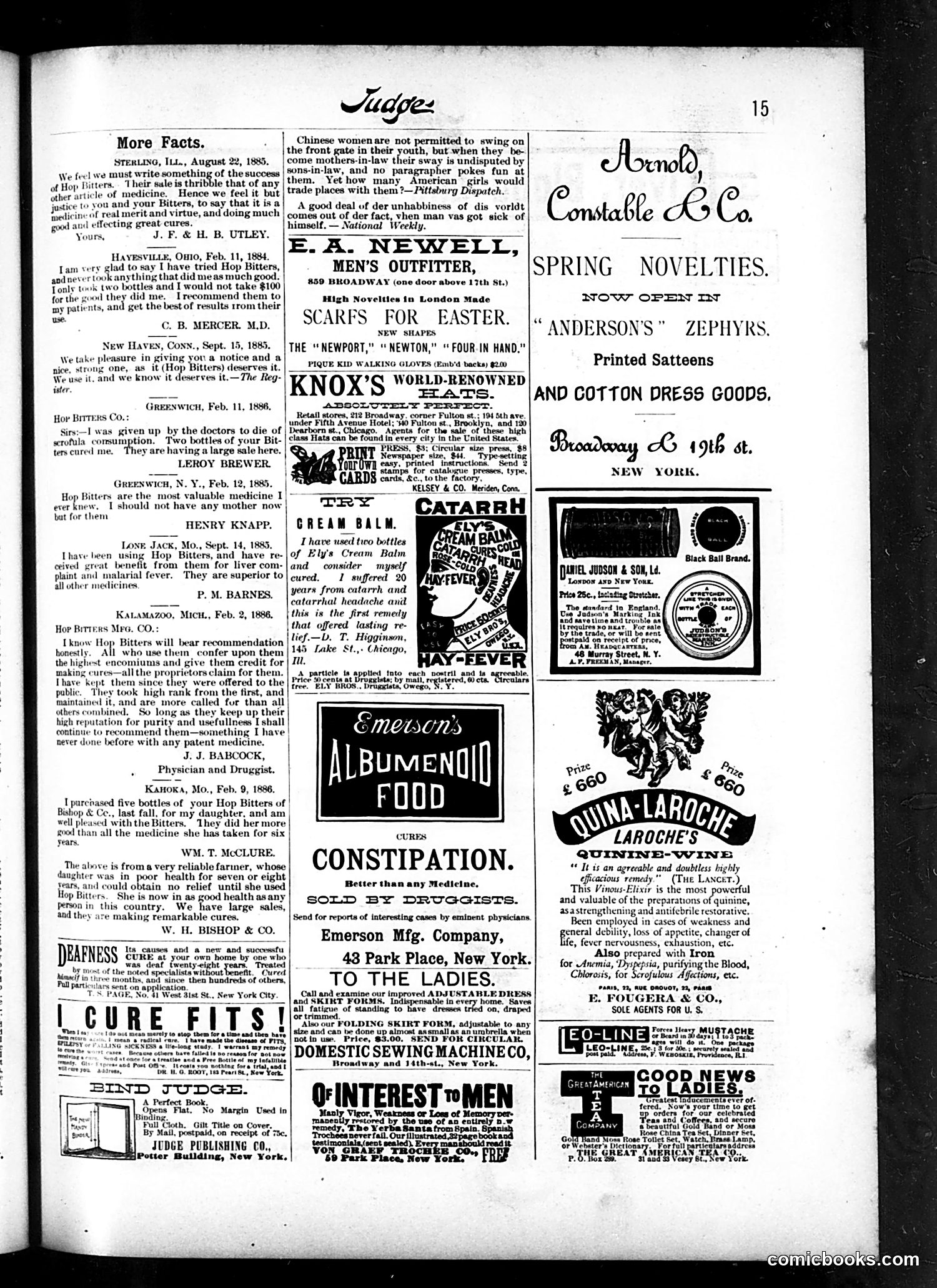
This page is predominantly **advertising**, not political cartoons. It consists almost entirely of testimonial ads and product advertisements typical of 1880s magazines. The content includes: - **Hop Bitters testimonials**: Fake or real endorsements from doctors and ordinary people praising this patent medicine for various ailments (liver complaints, malarial fever, etc.). This reflects the era's unregulated patent medicine industry, where such drinks were marketed as cure-alls. - **Product ads**: Knox's hats, Emerson's Albumenoid Food (for constipation), Ely's Cream Balm (for catarrh), sewing machines, and other goods. - **Two brief quoted quips** about mothers-in-law and personal unhappiness—mild social humor rather than political satire. There are no identifiable political figures or satirical cartoons on this page. The only "satire" is implicit: the page itself satirizes the era's credulous advertising culture and dubious medical claims, though Judge magazine itself carried such ads to fund publication.
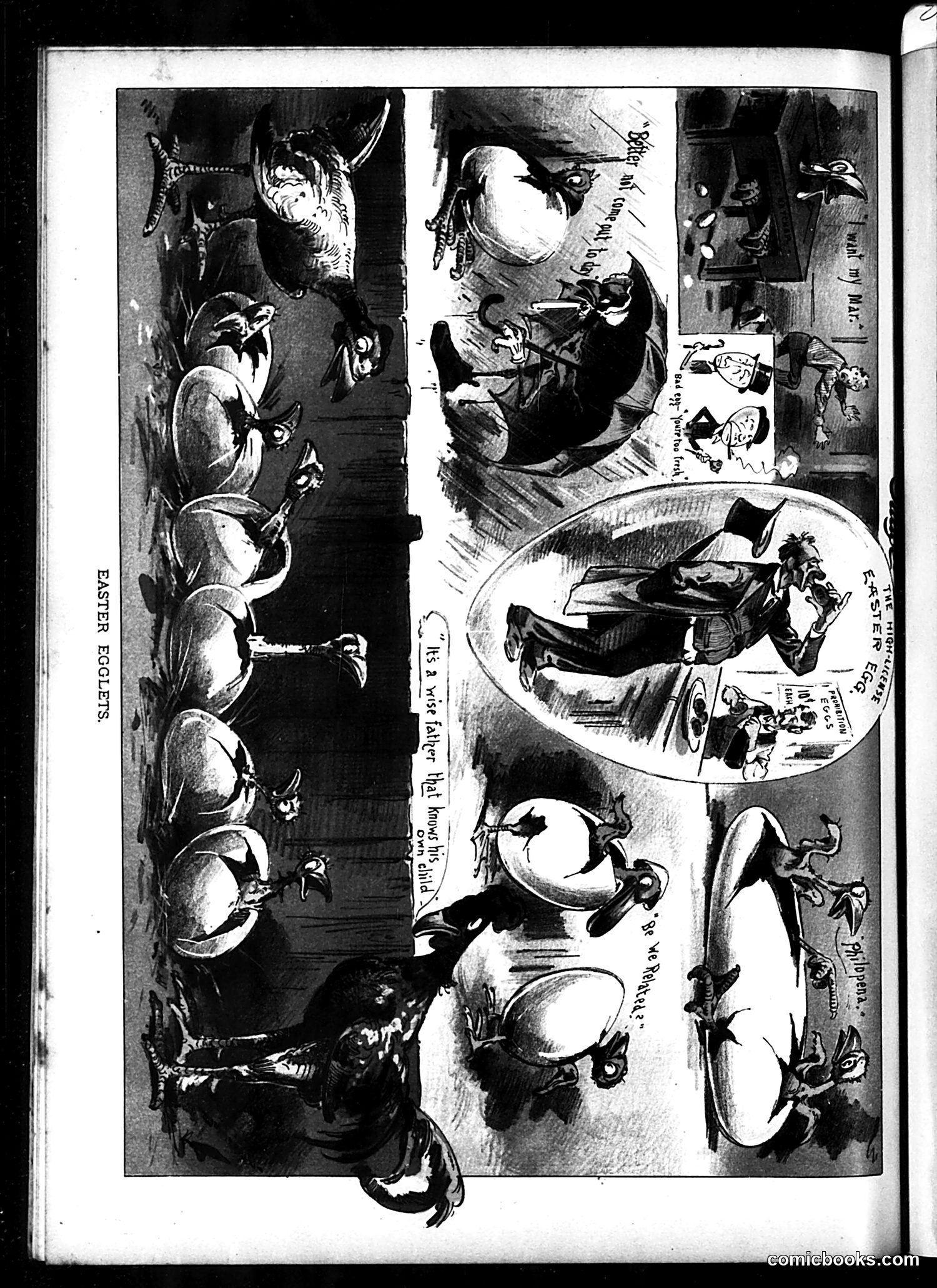
I can see this is a satirical page from Judge magazine, but the image quality and OCR limitations make it difficult to read the text clearly. The page appears to contain multiple cartoon panels arranged vertically on the left side and includes what looks like an oval-framed illustration on the right side. The left margin shows "EASTER EGGLETS" as a heading. The cartoons appear to use exaggerated character drawings typical of late 19th/early 20th-century American political satire, but without clearer text or identifying labels visible in the image, I cannot confidently identify specific figures, political references, or the intended satirical message. The Easter-related heading suggests seasonal humor, but I cannot specify what social or political commentary is being made.

I can see this is a page from *Judge* magazine, but the image is almost entirely black with only a white spine/binding visible on the left side. The OCR text only shows "comicbooks.com," which appears to be a watermark rather than actual page content. Without visible cartoon imagery, text, captions, or illustrations on the page itself, I cannot identify specific figures, political references, or explain any satire or jokes. The page either failed to scan properly, is a blank/mostly blank page, or the image quality is too dark to discern content. To provide the historical analysis you're requesting, I would need a clearer image showing the actual cartoon(s) and accompanying text.