
A complete issue · 16 pages · 1887
Judge — January 29, 1887
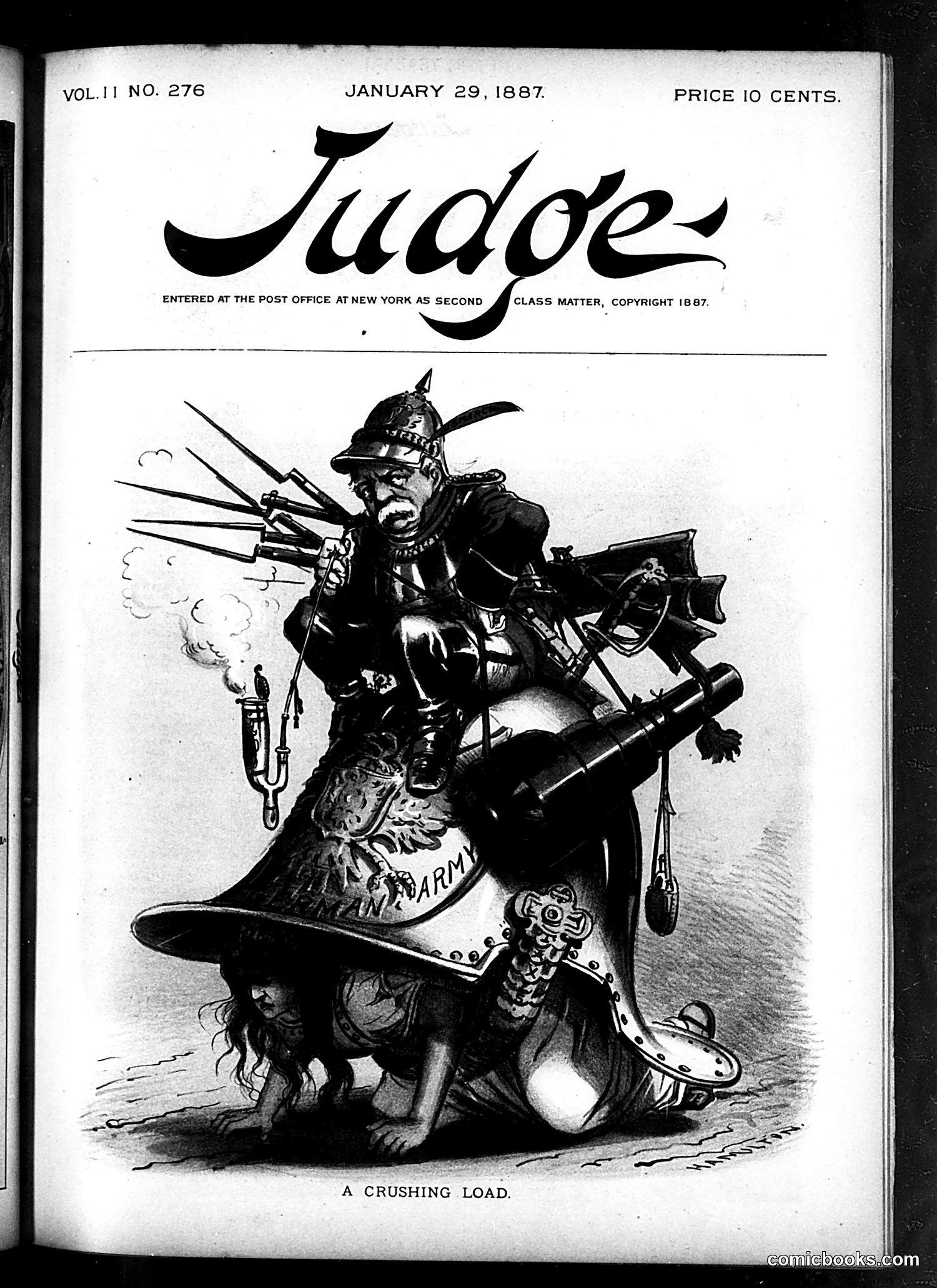
This political cartoon depicts a German military figure (identifiable by the spiked Prussian helmet) bearing an enormous burden of military weaponry, armor, and fortifications labeled "ARMY." A small figure underneath strains under the weight. The satire critiques German militarism and the crushing expense of maintaining a massive standing army during the late 19th century arms race. The cartoon suggests that military buildup—while projecting strength—actually oppresses the nation economically and socially. The figure's exaggerated load of weapons, cannons, and martial equipment symbolizes how military expenditure became an unsustainable burden on European powers competing for dominance during this period of imperial tension preceding World War I.
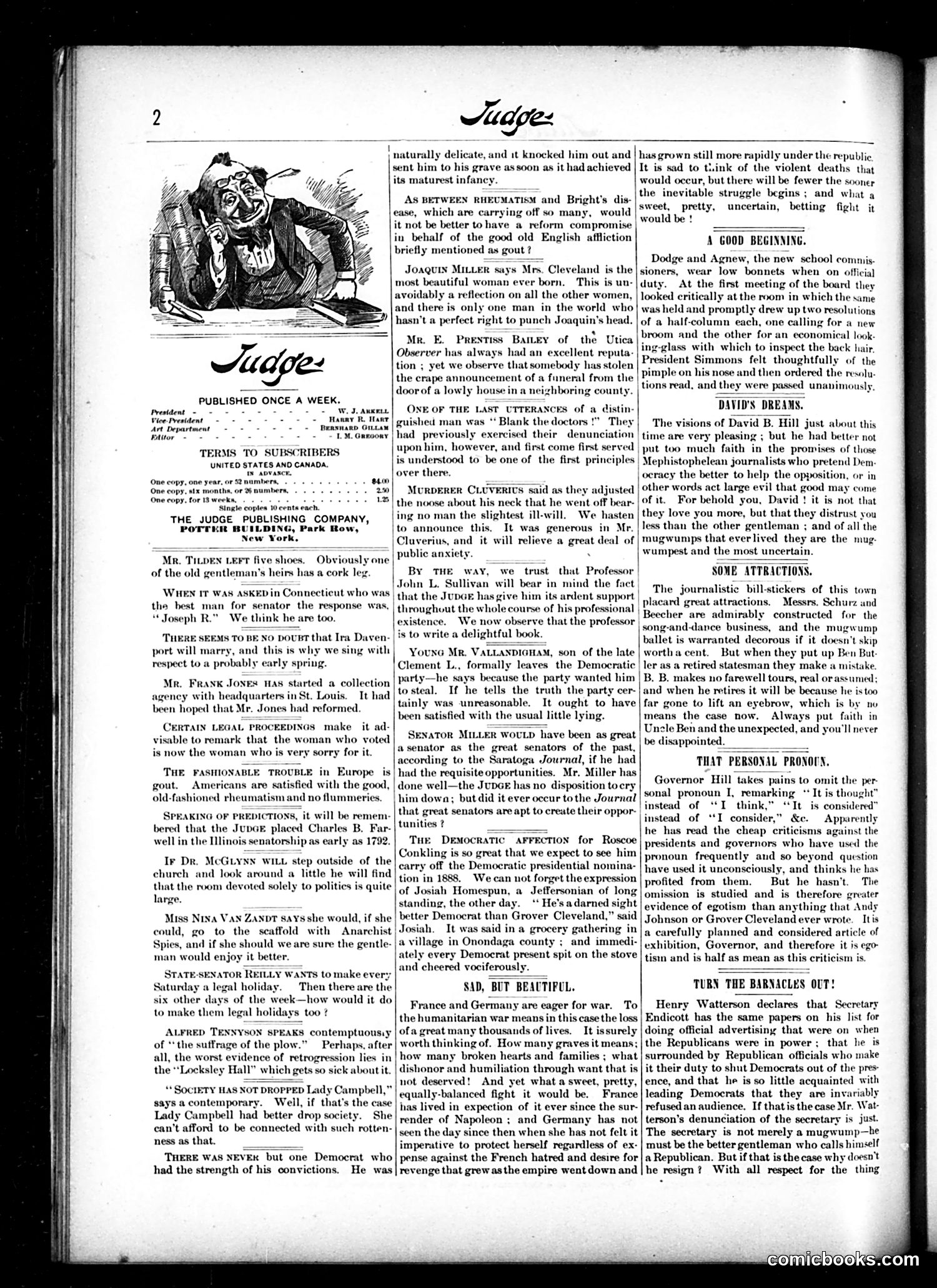
This page contains political commentary and social satire typical of Judge magazine's satirical format. The main cartoon depicts a grotesque caricatured figure, likely representing a political opponent or social type that Judge's editors wished to mock. The text discusses various political and social topics of the era, including references to rheumatics, Bright's disease, Democratic party politics, and satirical commentary on public figures. One section notes criticism of "Blank the doctors," suggesting medical or political incompetence being ridiculed. The page also includes advertisements for subscriptions and the Judge Publishing Company, indicating this is from the magazine's standard format mixing editorial cartoons, commentary, and business notices. Without clearer identification of specific figures or dated references in the visible text, precise political context remains difficult to determine with certainty from this single page.
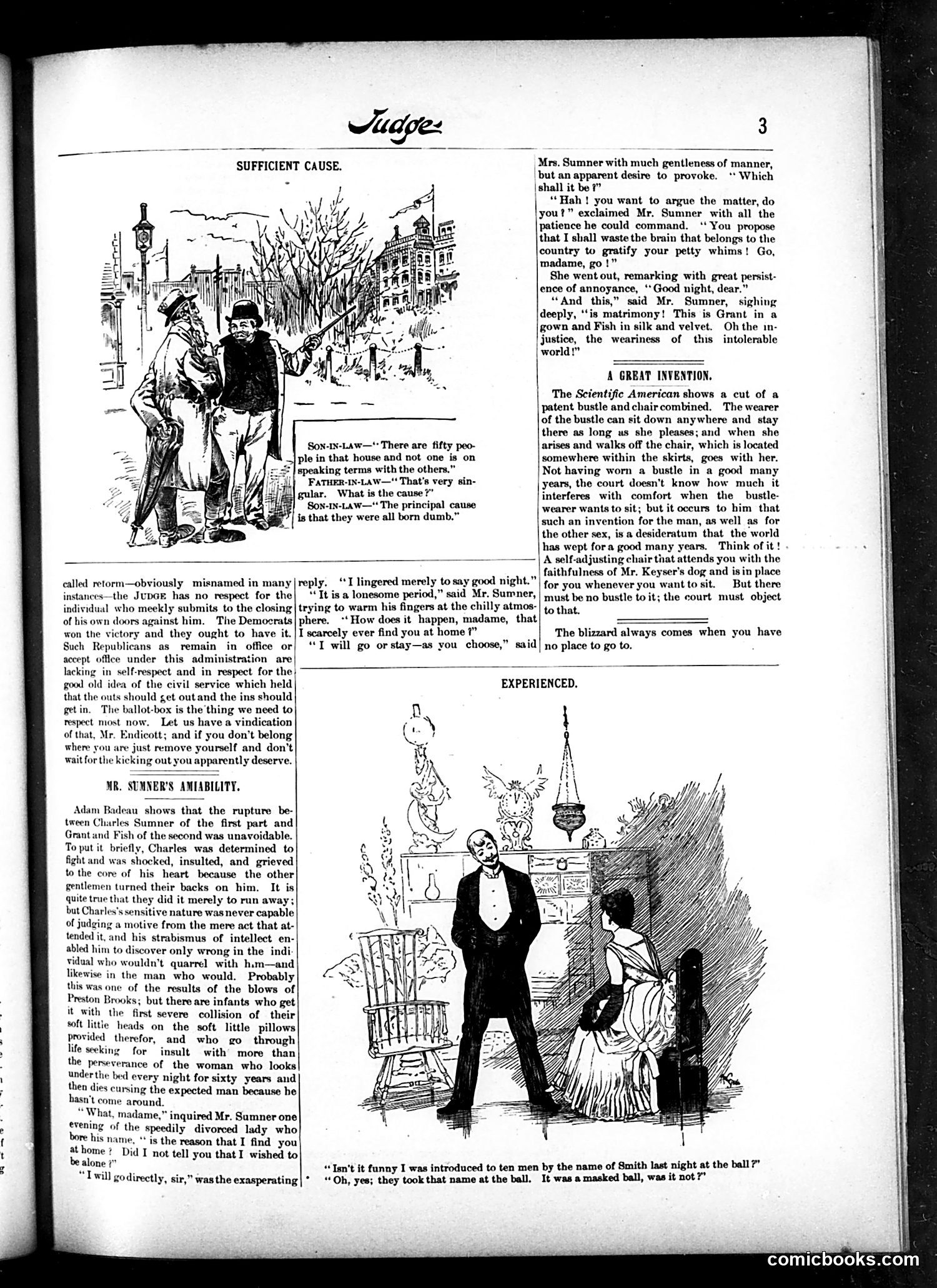
This page contains three satirical pieces typical of 1880s American humor: **"Sufficient Cause"** (top cartoon): A son-in-law and father-in-law discuss why fifty people in a house don't speak to each other. The punchline—"they were all born dumb"—is a straightforward insult joke requiring no historical context. **"Mr. Sumner's Amiability"** (main article): This attacks Senator Charles Sumner, depicting him as pathologically quarrelsome and emotionally unstable. The piece references his famous 1856 caning by Preston Brooks (a real historical incident) and suggests Sumner's sensitivity makes him impossible to live with—even his wife cannot please him. The satirical dialogue shows him unreasonably hostile toward his spouse, blaming her for his unhappiness. **"A Great Invention"** (bottom): A brief joke about a combined bustle-chair, allowing women to sit while wearing the fashionable (but cumbersome) bustle garment. The page reflects Judge's characteristic blend of political satire and social humor targeting both public figures and contemporary customs.
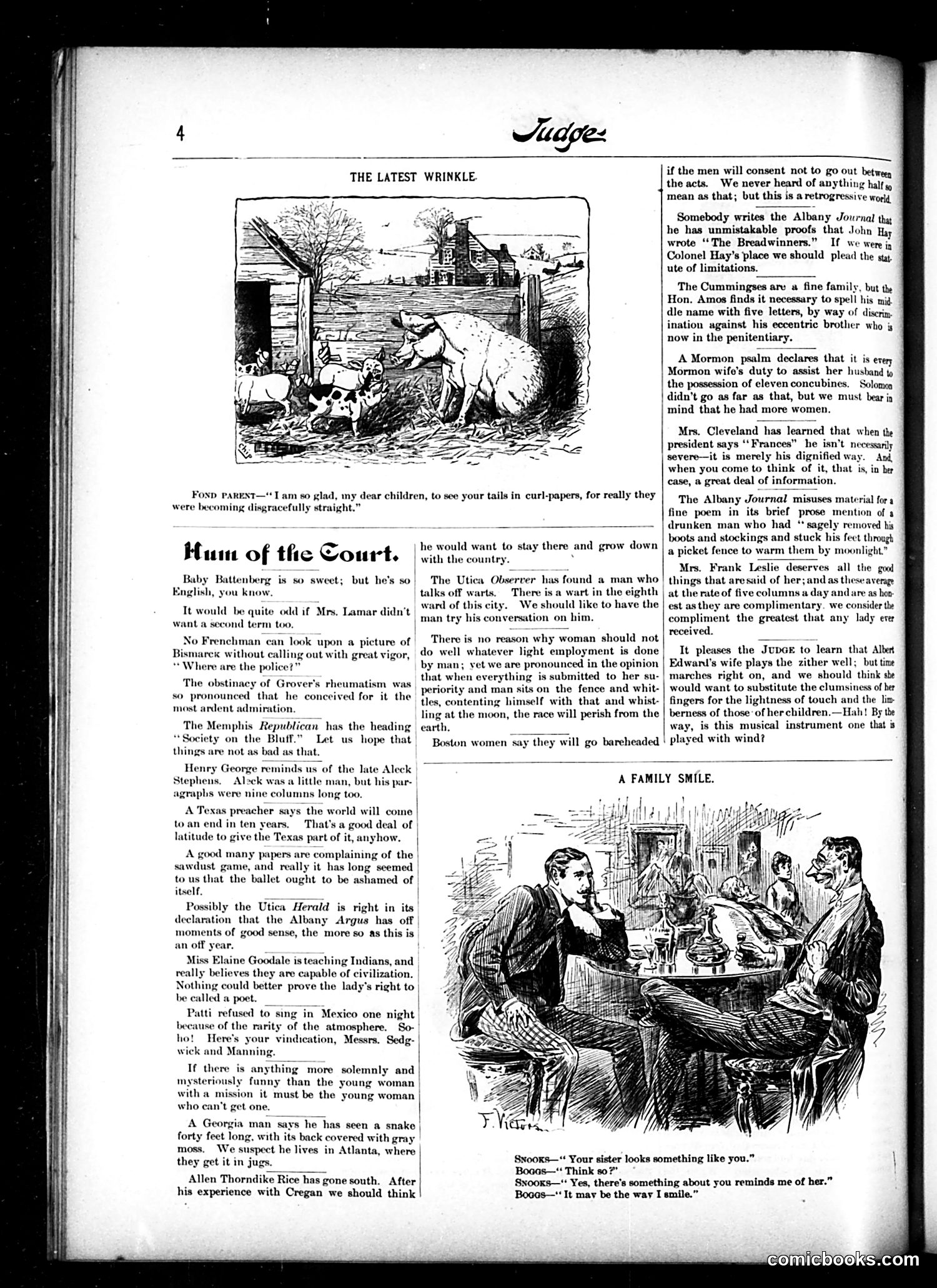
This page from Judge (a 19th-century American satirical magazine) contains multiple short commentary pieces mocking contemporary public figures and social trends. **Top cartoon** ("The Latest Wrinkle"): Shows a farmer addressing his children about their posture, satirizing concerns about youth discipline and "proper" behavior. **"Hint of the Court" section**: Brief satirical jabs at various subjects, including: - Baby Battenberg (likely the infant son of Queen Victoria's daughter, mocked as overly English) - Mrs. Lamar (unclear reference, possibly political) - Grover Cleveland's rheumatism - Miss Elaine Goodale teaching Native Americans - Various newspaper editors and public figures **Bottom cartoon** ("A Family Smile"): Three men dining, with banter about family resemblance—likely a gentle social comedy about manners or appearance. The satire targets politicians, journalists, religious figures, and women's rights advocates with typical period humor: political gossip, personal quirks, and commentary on social issues like women's employment and Mormon polygamy. Without specific date or clearer context for some references, precise identification remains uncertain.
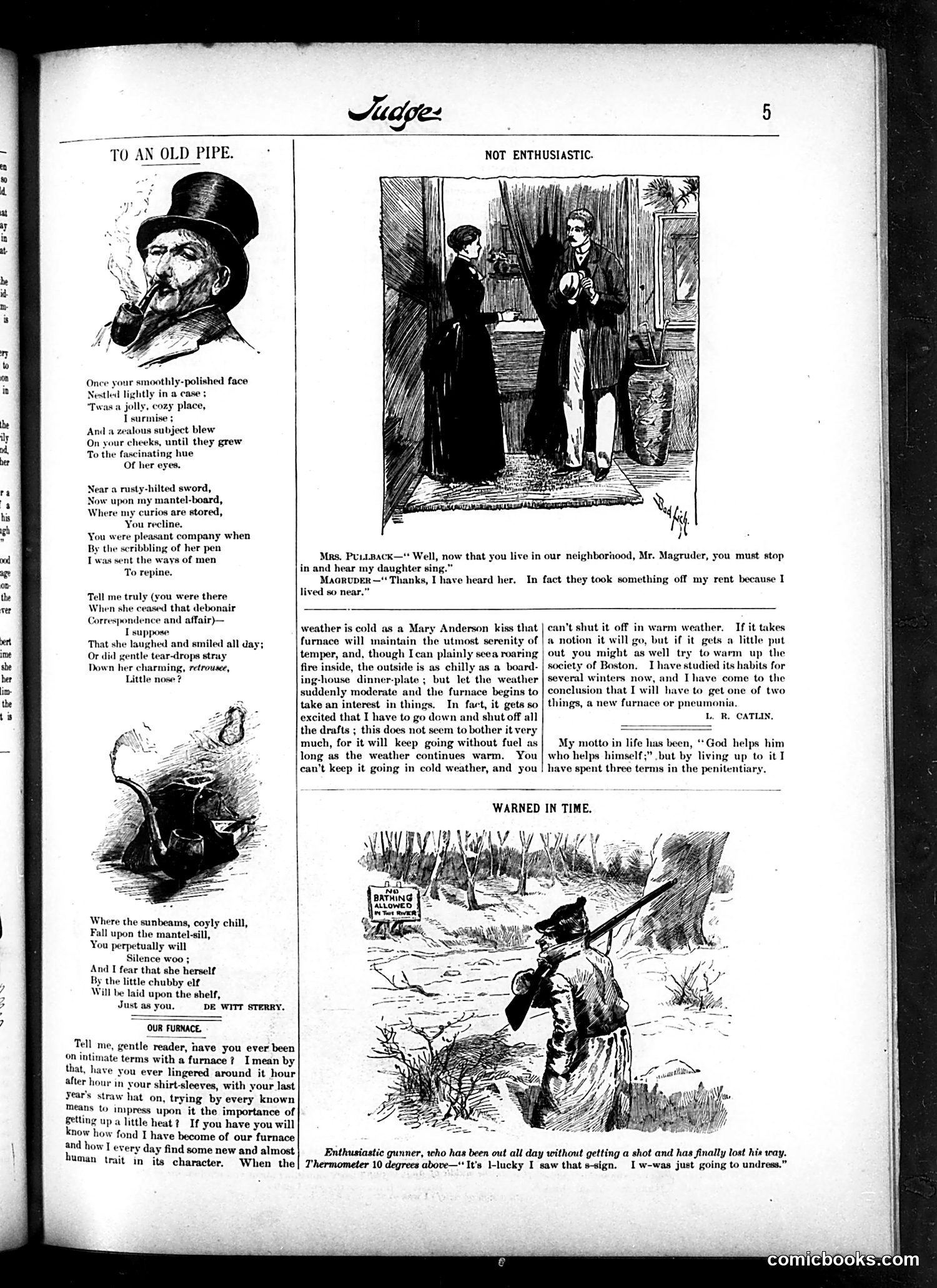
This page contains three distinct satirical pieces: **"To an Old Pipe"** (left): A sentimental poem addressing a discarded smoking pipe, personifying it as a cherished companion from romantic encounters. The satire likely mocks Victorian sentimentality and excessive nostalgia for objects. **"Not Enthusiastic"** (top right): A brief cartoon joke about a neighbor, Mrs. Pullback, pressuring Mr. Magruder to visit and hear her daughter sing. The humor lies in Magruder's deadpan revelation that he's *already* heard her—and the family even reduced his rent because of it, implying the daughter's singing is unbearably bad. **"Our Furnace"** and **"Warned in Time"** (bottom): Humorous pieces about household frustrations. The first satirizes temperamental home furnaces that won't heat in cold weather but won't stop in warm weather. The second cartoon shows a lost hunter nearly undressing in freezing weather, saved only by spotting a warning sign—mocking both the hunter's poor judgment and extreme cold. These target everyday domestic annoyances and human foolishness rather than political issues.
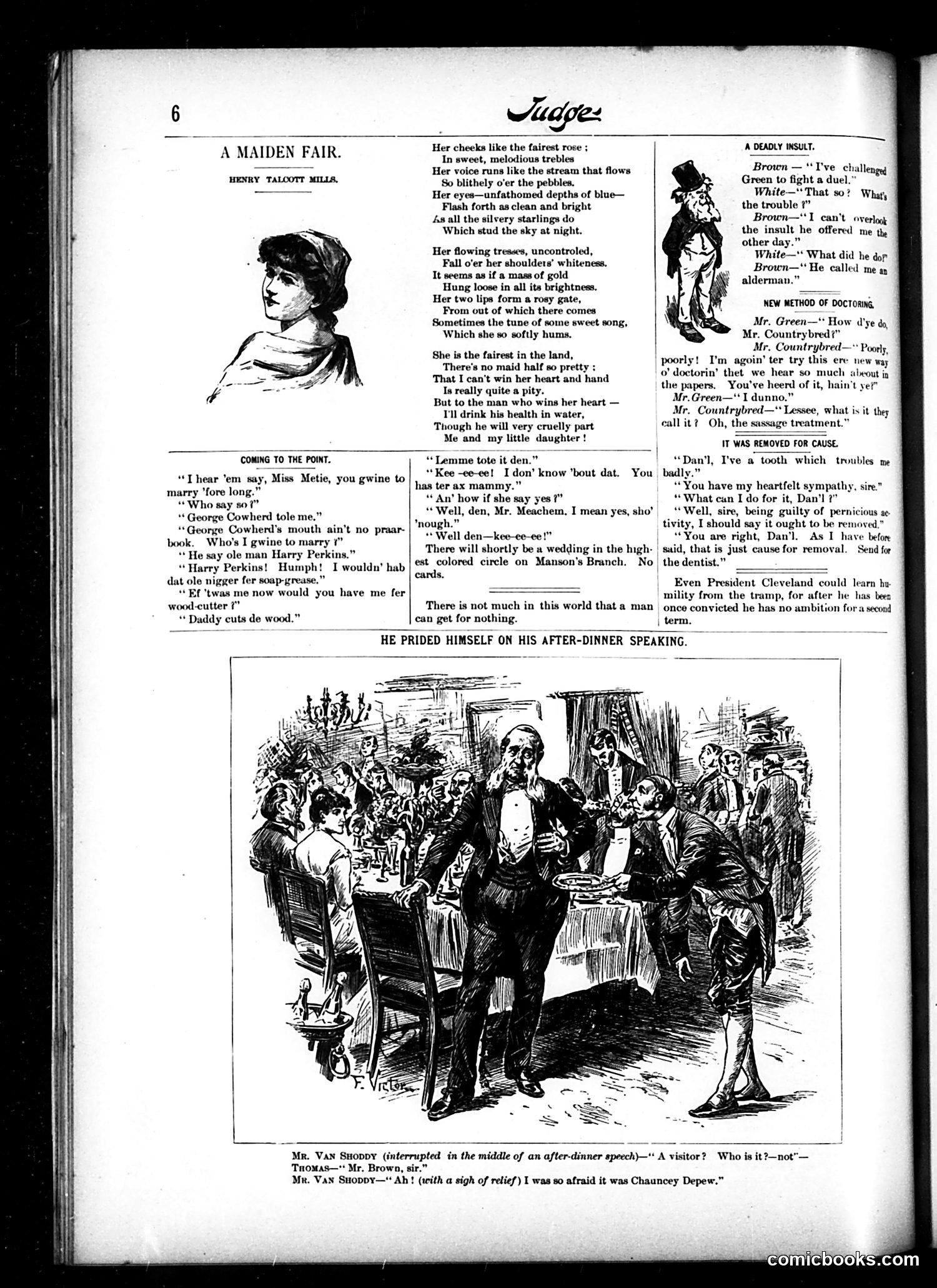
This page from Judge (likely 1880s-90s) contains three unrelated satirical pieces: **"A Maiden Fair"**: A sentimental poem with accompanying sketch mocking romantic verse popular in the era. **"A Deadly Insult"**: A brief joke where being called an "alderman" is treated as such an grave insult it warrants a duel—satirizing both the absurdity of dueling culture and the low social standing of aldermen (local politicians). **"He Prided Himself on His After-Dinner Speaking"**: The bottom cartoon shows Mr. Van Snoopy interrupted mid-speech. His relief at learning the visitor is "Mr. Brown" rather than "Chauncey Depew" satirizes Depew, likely a contemporary politician or public figure known for tedious oratory. The joke: being interrupted by a stranger beats enduring Depew's notorious speeches. The page also contains dialect-heavy vignettes about rural/working-class characters, typical of Judge's broad comedy spanning refined satire to broad ethnic humor.
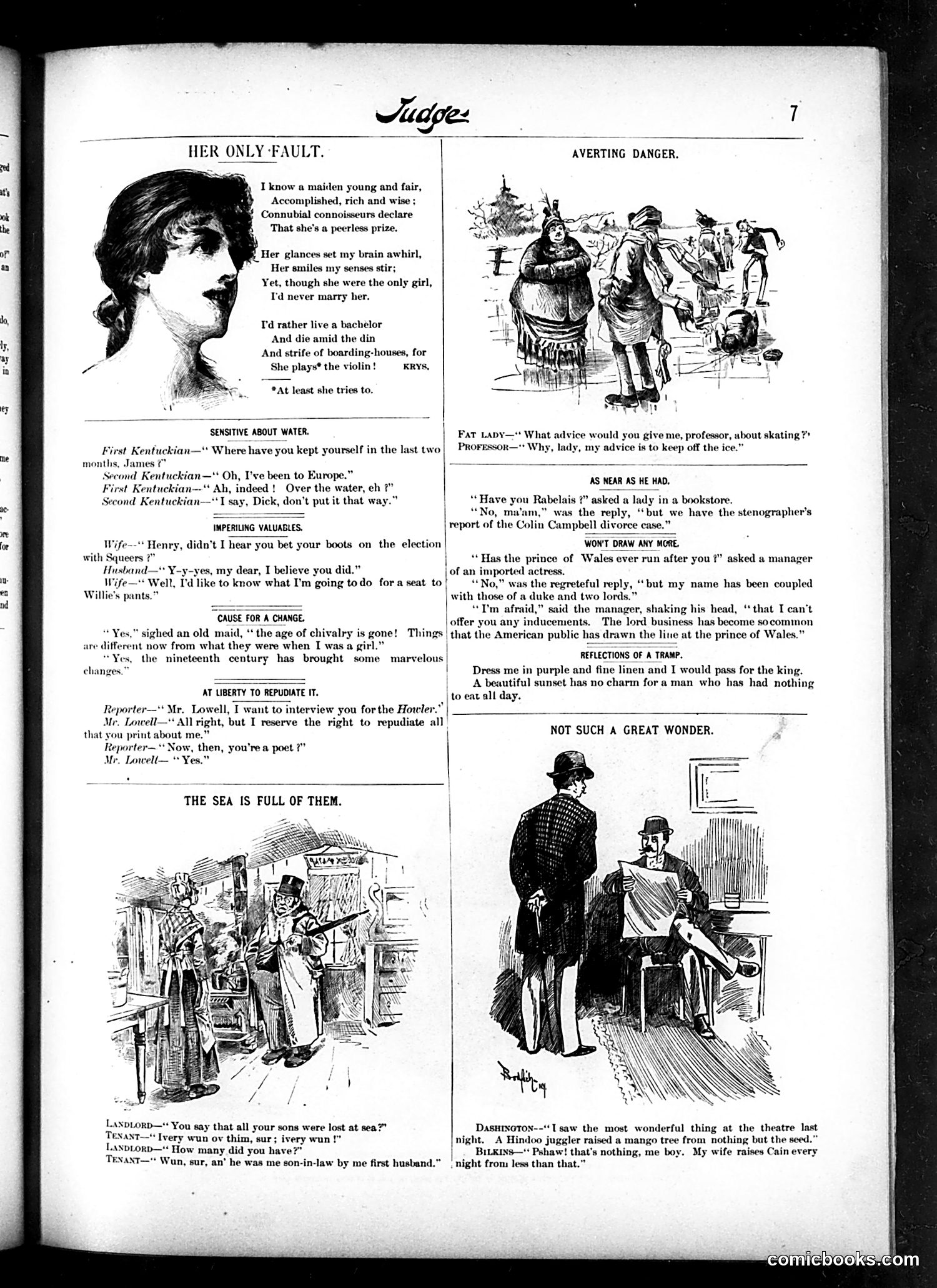
This page from *Judge* (likely late 19th century) contains several brief satirical jokes typical of the era: **"Her Only Fault"**: A man rejects an otherwise perfect woman because she plays violin badly—satirizing both the importance of accomplishments in marriage prospects and the torture of amateur violin music. **Kentucky dialogue**: Makes light of sensitivity about the phrase "over the water," likely referencing Irish immigrants' fraught relationship with ocean crossings. **"Imperiling Valuables"**: A wife complains her husband bet his boots on an election, leaving her without fabric for their son's pants—mocking husbands' reckless gambling. **Other snippets mock**: changing standards of chivalry, a poet's right to deny his own words, marital arguments, imported actresses' dubious social connections, and a wife's domestic chaos. The page emphasizes domestic comedy and class humor typical of *Judge*'s audience—middle and upper-class Americans amused by exaggerated marital strife, Irish stereotypes, and social pretension.
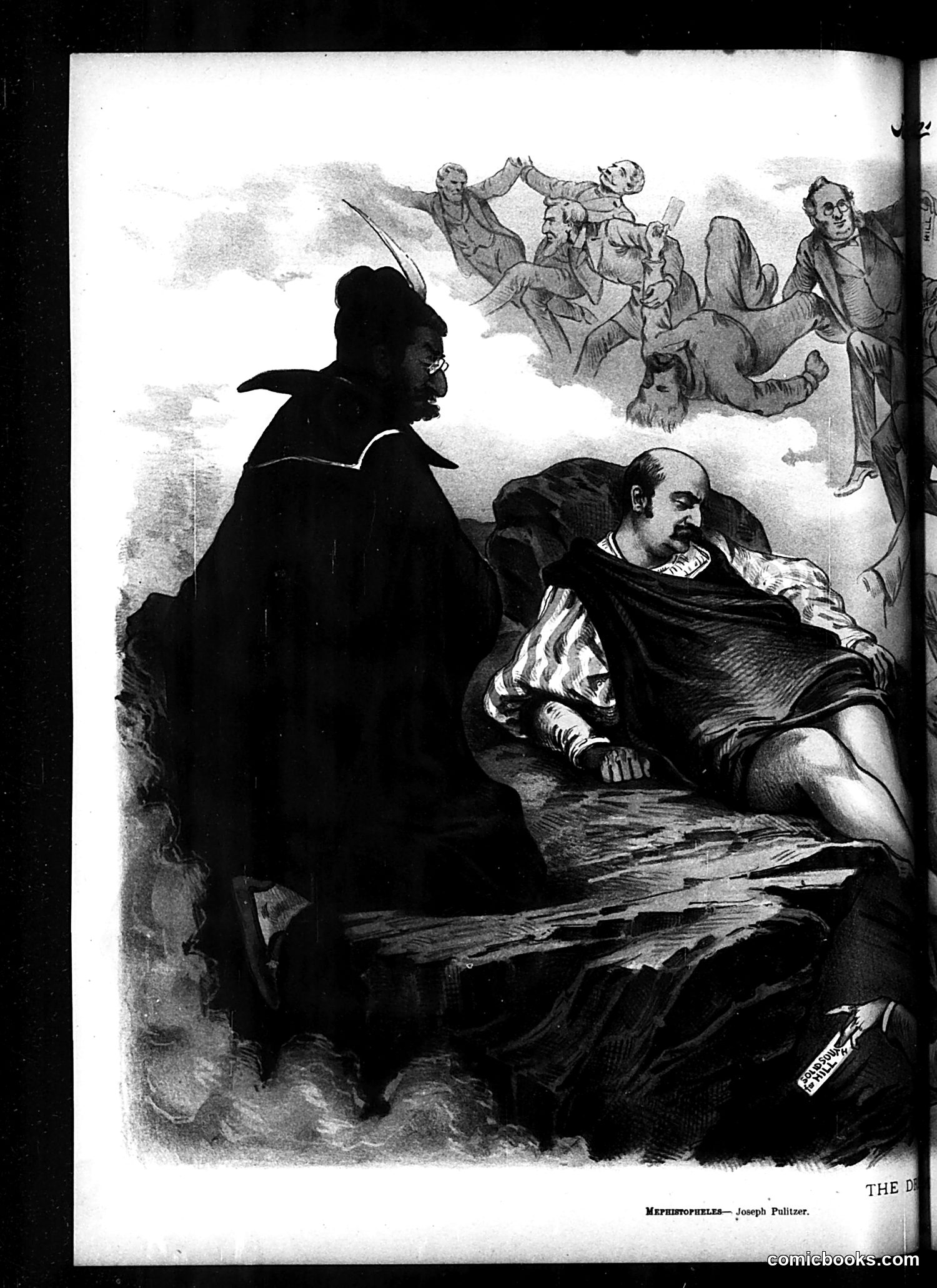
This appears to be a satirical illustration titled "Mephistopheles" depicting Joseph Pulitzer (the famous newspaper publisher). The cartoon shows a demonic or Faustian figure in dark robes on the left confronting a reclining man on the right, with chaotic scenes of revelry and excess depicted above in clouds. The satire likely critiques Pulitzer's sensationalist journalism methods and his influence over public opinion—comparing his media power to the devil's corrupting influence. The reference to Mephistopheles (Faust's demonic tempter) suggests Pulitzer is portrayed as a seductive corruptor of society through his newspaper empire. The scene above may represent the chaos and moral degradation the cartoonist believed resulted from his yellow journalism tactics. This reflects late 19th-century tensions regarding media moguls' growing social power.
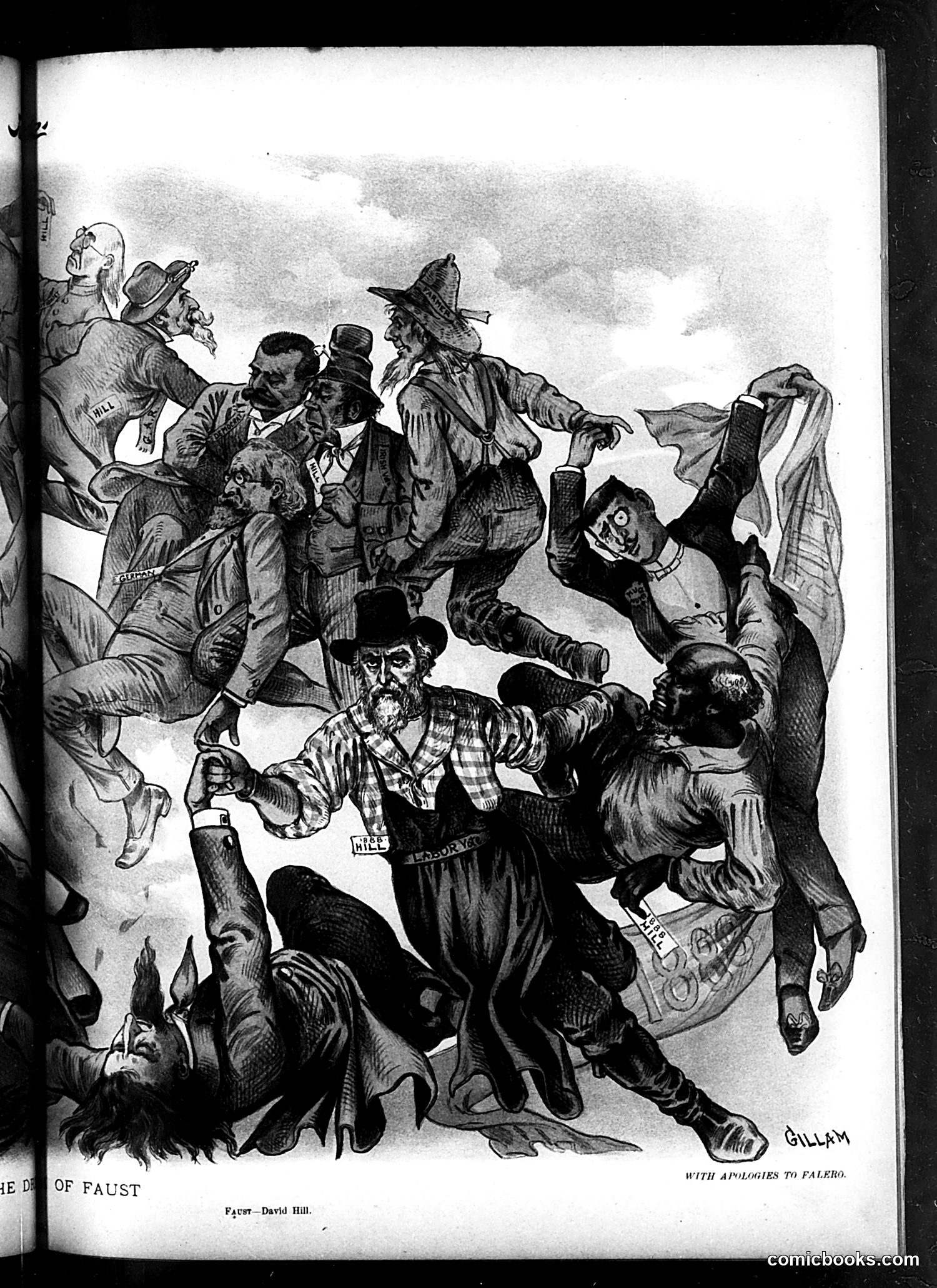
This political satire, signed by Gillam, depicts a chaotic scene labeled "The Dream of Faust" featuring David Hill (likely a contemporary political figure). The cartoon appears to parody Goethe's *Faust*, with Hill as the protagonist surrounded by demons, devils, and grotesque figures in a hellish vision. The "apologies to Falero" reference suggests this mimics the style of Luis Falero, a painter known for fantastical supernatural scenes. The surrounding figures—caricatured as devils and demons—likely represent Hill's political opponents or consequences of his actions/policies. Without more specific historical context, the exact political grievances remain unclear, but the imagery suggests *Judge* magazine viewed Hill's situation or legacy as damnable or nightmarish, using the Faust legend to suggest a deal with dark forces.
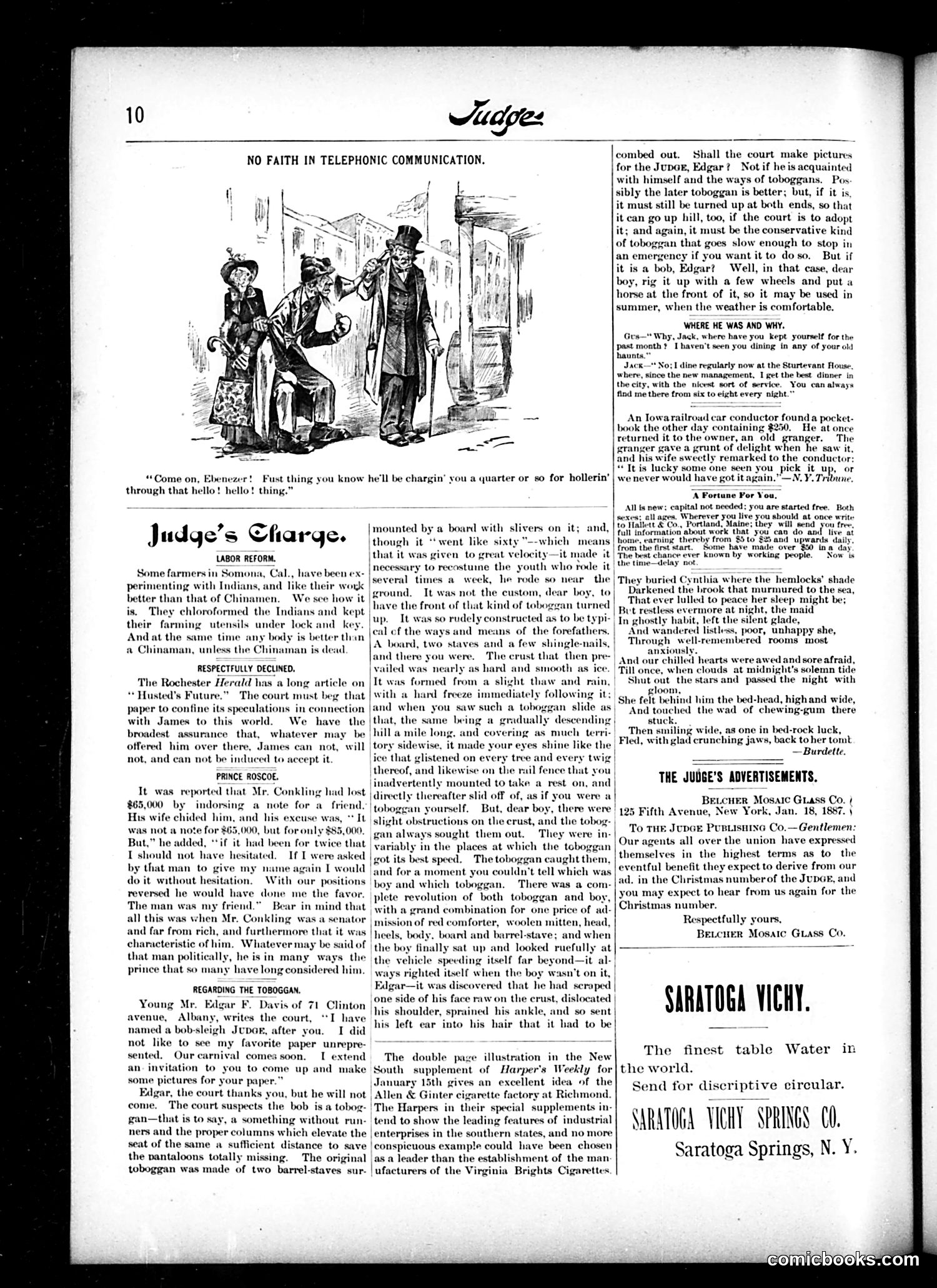
This page contains three satirical pieces from Judge magazine: **"No Faith in Telephonic Communication"** (cartoon, top left): Shows a well-dressed man and woman on a street. The caption mocks early telephone technology, suggesting people don't trust it—the man warns not to use "that hello! hello! thing," implying phones are unreliable for serious communication. This reflects 1880s skepticism about the novel telephone technology. **"Judge's Charge" section**: Four brief editorial pieces critiquing contemporary issues: - Labor reform in California exploiting Native Americans - Political figures (likely Roscoe Conkling, a senator) and their financial dealings - Tobogganing safety concerns—the author humorously refuses to create carnival pictures featuring toboggans due to their danger The page also includes advertisements for Belcher Mosaic Glass Company and Saratoga Vichy Springs water. The overall tone reflects Judge's role as political and social satire targeting contemporary American issues, technological anxiety, and public figures.
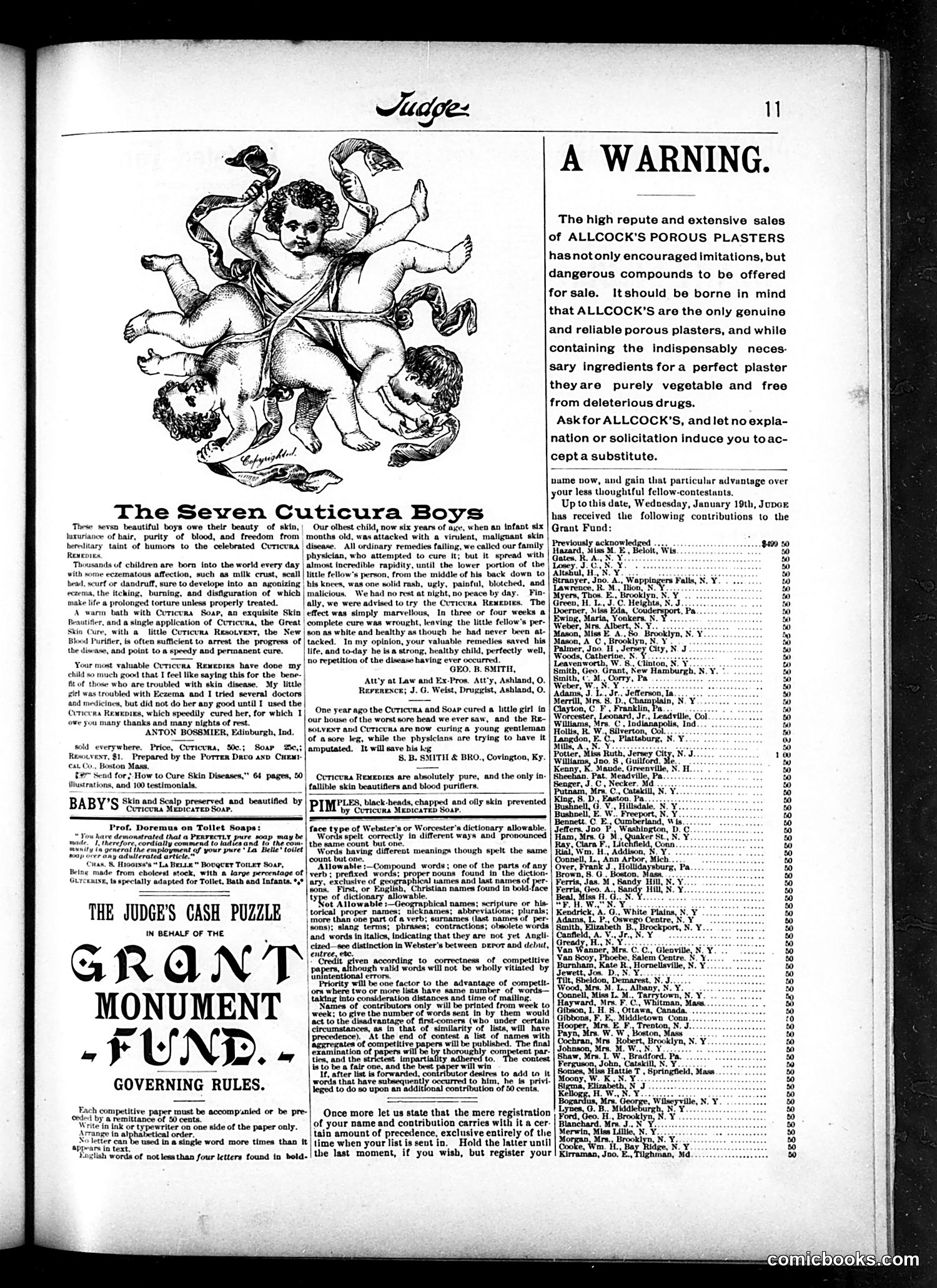
This page is primarily **advertising**, not political satire. The main content features testimonials for Cuticura medical products (skin remedies and soap), presented as genuine case studies of children supposedly cured of serious skin conditions like eczema. The illustration, "The Seven Cuticura Boys," depicts cherubs/putti celebrating the product's success—a common Victorian advertising device meant to convey health, happiness, and purity. **What's notable historically**: This represents late 19th-century patent medicine marketing, when such products made dramatic medical claims with minimal regulation. The testimonials cite real names and locations to appear credible, though their authenticity is questionable by modern standards. The page also includes a separate puzzle competition for Judge's "Grant Monument Fund"—unrelated advertising content typical of magazine layout from this era. **Modern context**: These pages illustrate how differently medical advertising operated before FDA oversight and modern consumer protection laws.
This is primarily an **advertising page**, not a cartoon or political satire. It features: **Main Advertisements:** - **Henry Siede's sealskin garments** (luxury fur coats/clothing from London dye) - **Lactated Food** for infants and invalids, promoted as the "physician's favorite" - **German Asthma Cure** patent medicine - **Domestic Sewing Machine Co.** dress forms for seamstresses **Theater Listings:** - Various Broadway productions including *School for Scandal* **Bottom Section:** A long list of customer testimonials/names with addresses—typical advertising material touting product endorsements. The **Digestion Tonic** ad features diagonal black banner text promoting a digestive remedy for various gastric complaints. This represents Judge's revenue model: while known for satirical cartoons, the magazine's pages included substantial advertising to subsidize publication. The products—luxury goods, medicines, theatrical entertainment—target affluent readers.
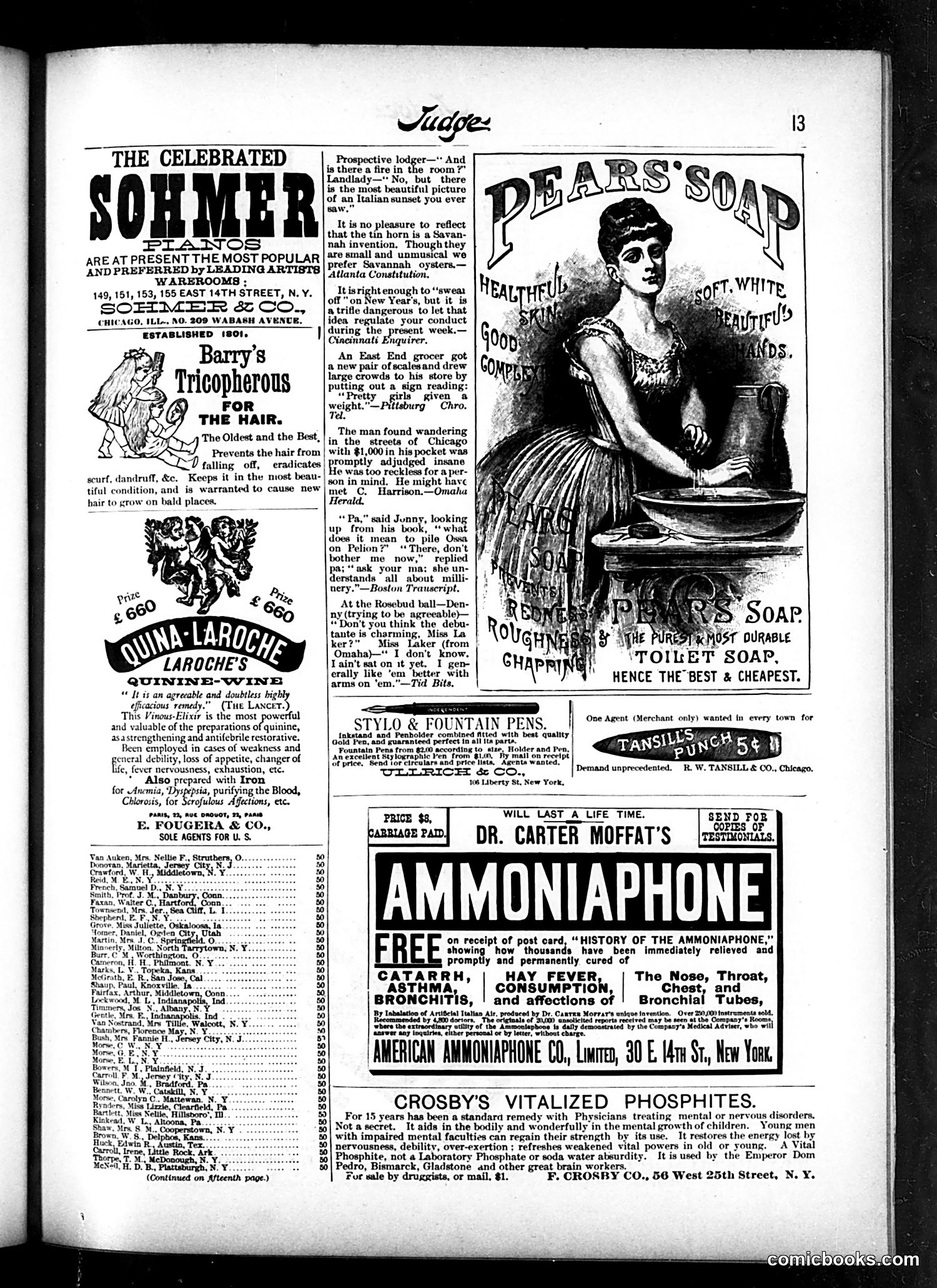
This page is primarily **advertising**, with a section of brief humorous anecdotes typical of Judge magazine. The main satirical content consists of short jokes exploiting period stereotypes and prejudices: - A rural character misunderstands "pile Osa on Pelion" (an allusion to stacking mountains) - A debutante from Omaha is portrayed as crude and unfamiliar with social conventions - References to Chicago and Savannah invoke regional character types - A man with $1,000 is deemed insane—likely satire of economic excess or poor judgment during the Gilded Age The dominant content, however, is patent-medicine advertising—particularly Dr. Carter Moffat's "Ammoniaphone" for respiratory ailments, and Pear's Soap alongside Barry's Hair Tonic and Quinine Wine tonics. These were common Judge features reflecting the magazine's revenue model. The cartoons or illustrated advertisements (Pear's Soap features a classical female figure) were typical turn-of-the-century marketing, not political satire.
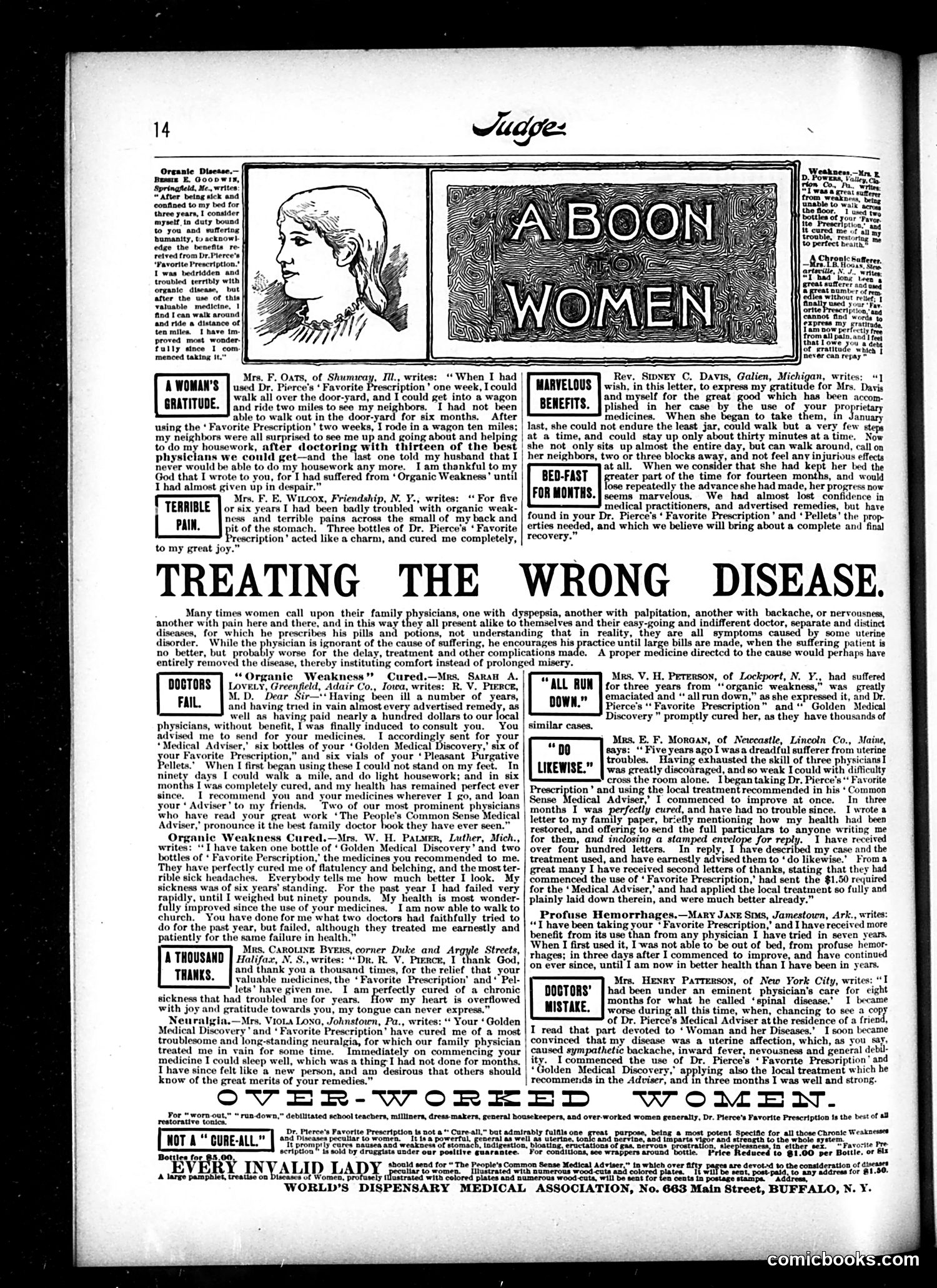
This page is **primarily a patent medicine advertisement**, not a political cartoon. It promotes Dr. Pierce's "Favorite Prescription"—a proprietary remedy marketed to women for "Organic Weakness" and female ailments. The content consists of testimonial letters from women claiming the medicine cured conditions like being bedridden, chronic pain, and inability to walk. The central headline, "TREATING THE WRONG DISEASE," argues that doctors misdiagnose women's ailments while Dr. Pierce's products succeed where physicians fail. This represents typical late-19th/early-20th-century quack medicine marketing: exploiting women's real health struggles with unproven tonics while undermining legitimate medicine. The satirical framing (the section titled "DOCTORS FAIL") is the *advertisement's own satire*—not Judge magazine satirizing the product, but the product's marketing using satirical rhetoric to sell itself. The page reflects how Judge's pages mixed genuine satire with lucrative patent medicine ads.
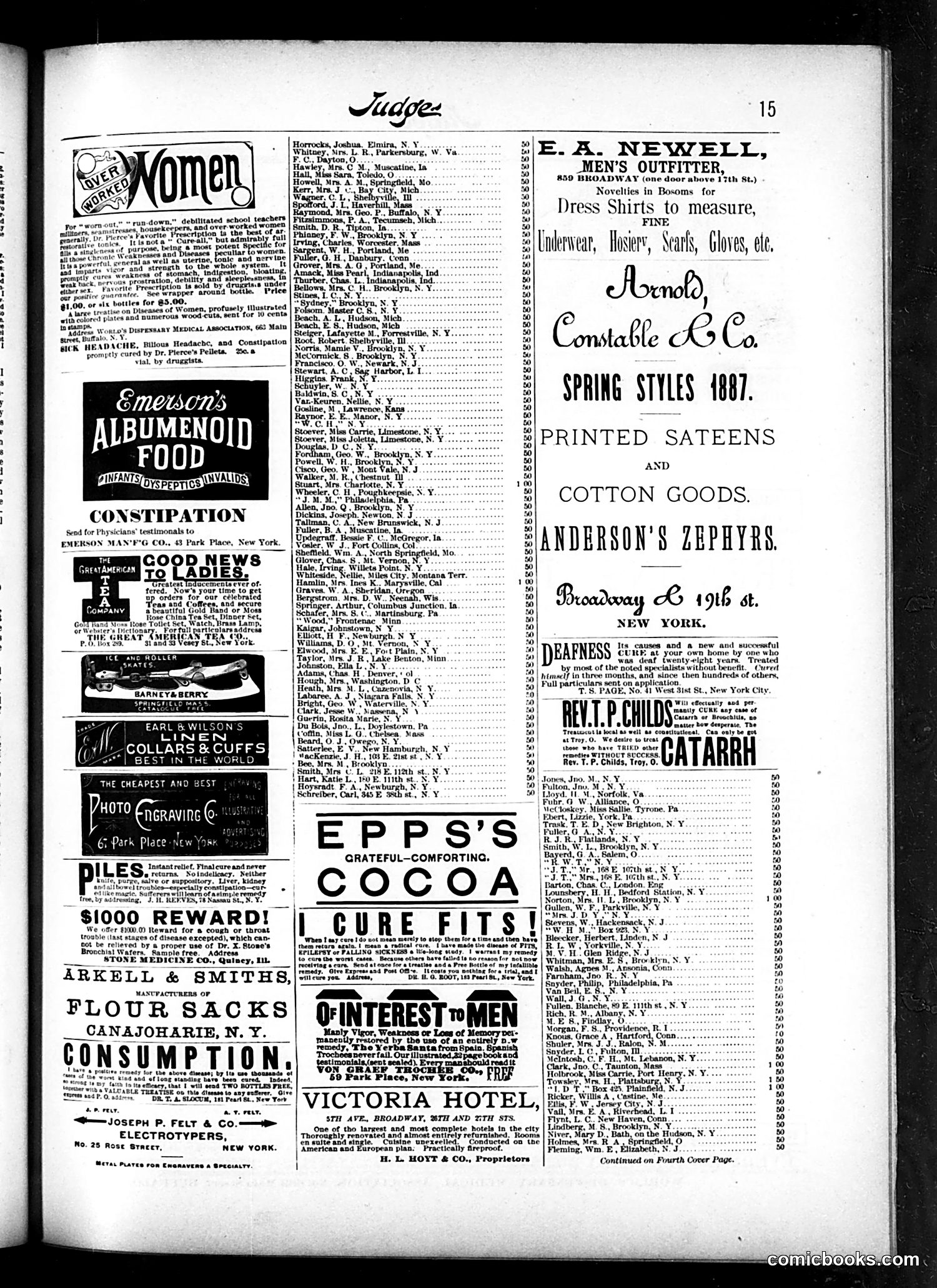
This page is primarily **advertising**, not political satire or editorial cartoons. It's from Judge's Spring 1887 issue. The visible ads include: - **E.A. Newell** (men's clothing on Broadway) - **Arnold, Constable & Co.** (fabric/textiles) - **Anderson's Zephyrs** (cotton goods) - **Patent medicines**: Emerson's Albumenoid Food, Dr. Pierce's pellets for constipation/headache, Epps's Cocoa, and various "cure-all" remedies claiming to treat deafness, piles, and other ailments There's also a directory of names (likely subscribers or contributors) running down the center and right columns. The sole apparent editorial content is a small boxed item titled **"Of Interest to Men"** (partially visible), though its content is unclear in this reproduction. This page reflects the era's reliance on patent medicine advertising and the magazine's business model of mixing editorial with commercial content.
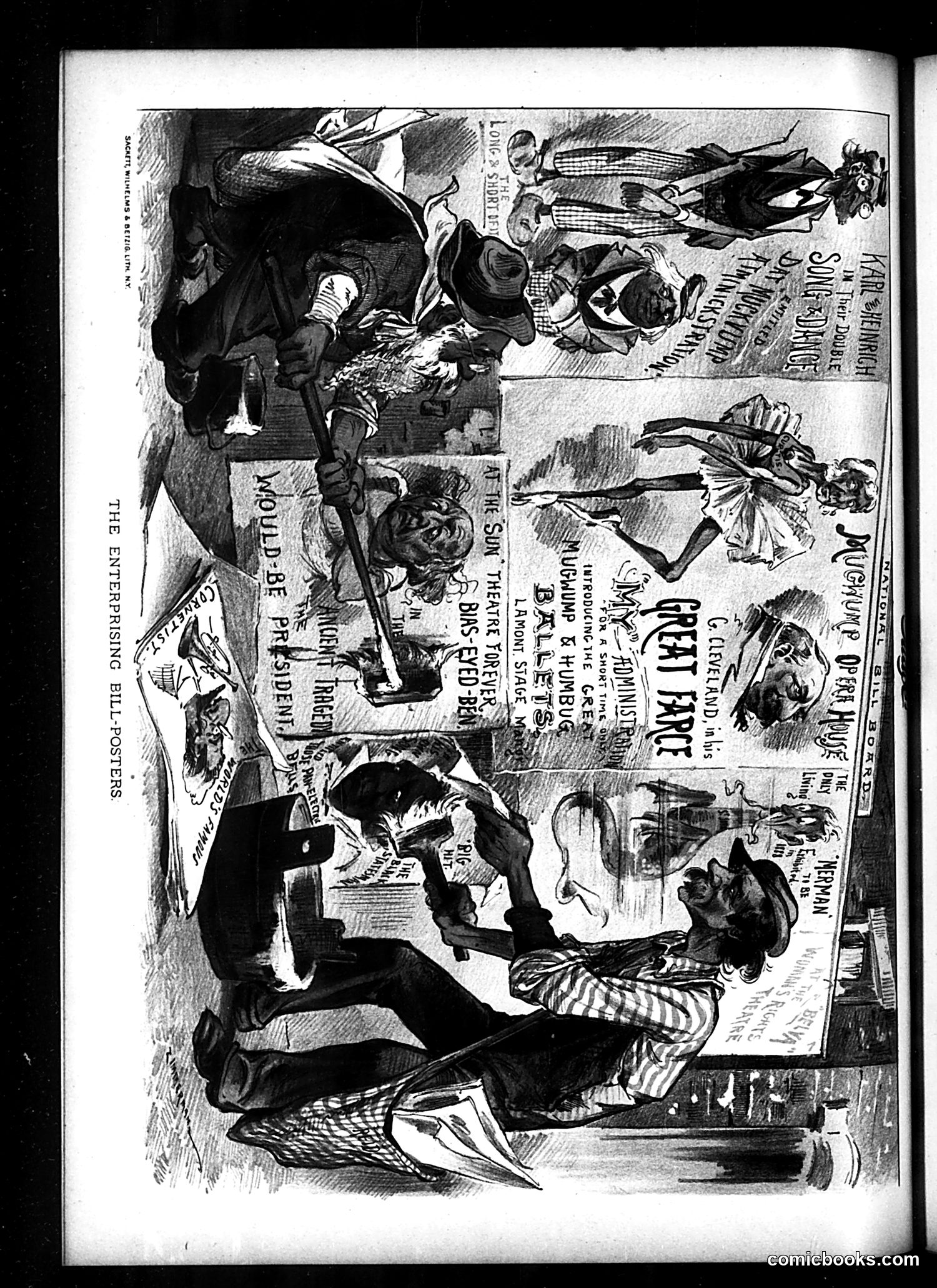
This appears to be a satirical theatrical scene from *Judge* magazine, likely from the 1880s-90s, given the reference to "G. Cleveland" (President Grover Cleveland). The cartoon uses theatrical staging as metaphor for political performance. The main figure appears to be Cleveland, depicted in a comedic theatrical context with other characters. The satire likely critiques Cleveland's political maneuvering or public persona as theatrical "performance" rather than genuine governance. References to "stage," "theatre," and "introducing" suggest the cartoon mocks politicians for grandstanding or presenting false public images. The lower vignettes appear to show related satirical scenes, though the OCR text is too corrupted to identify specific references with confidence. The overall message seems to equate political leadership with cheap theatrical spectacle.