
Judge, 1887-01-29 · page 3 of 16
Judge — January 29, 1887 — page 3: what you’re looking at
What you’re looking at
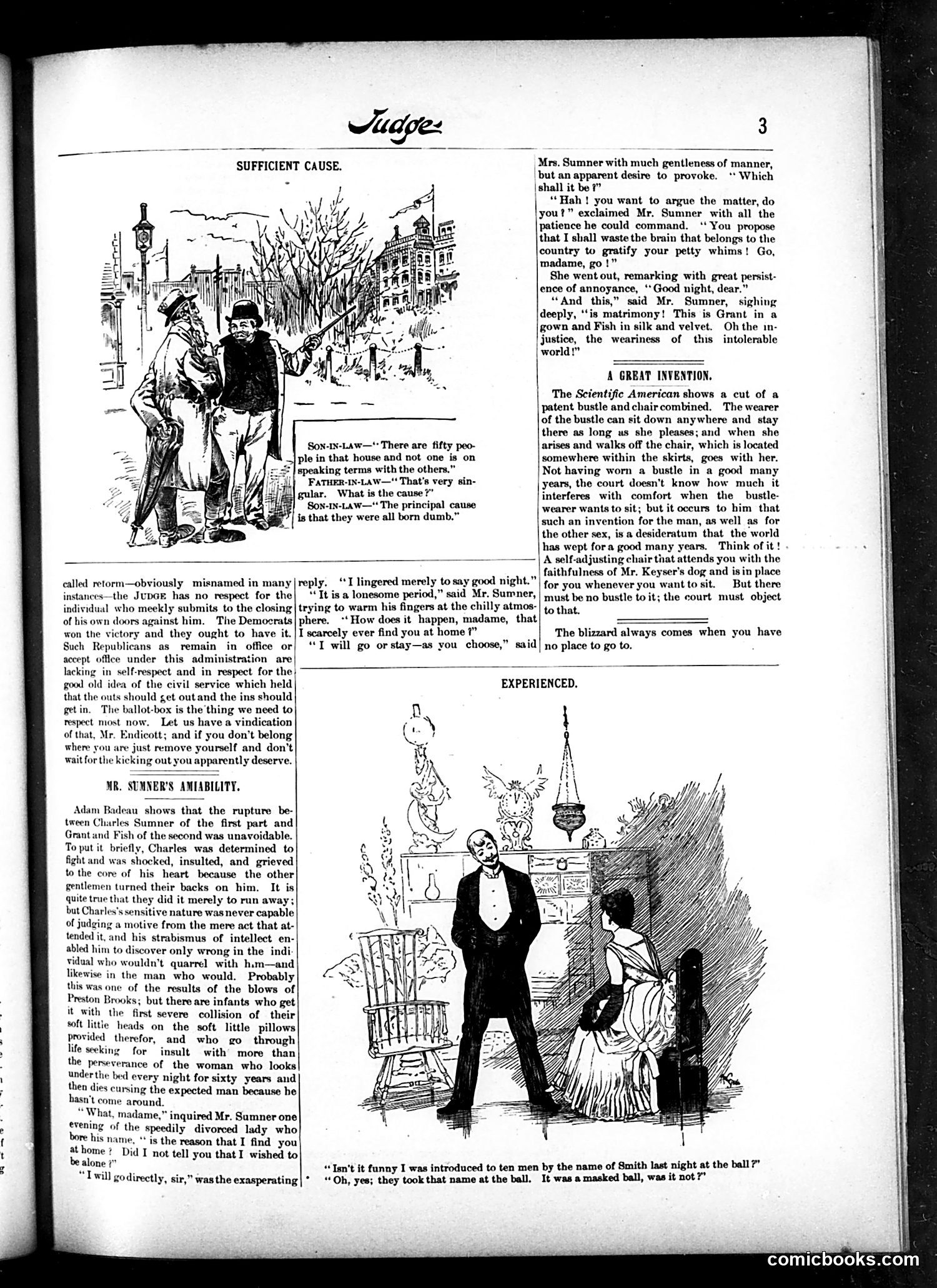
This page contains three satirical pieces typical of 1880s American humor: **"Sufficient Cause"** (top cartoon): A son-in-law and father-in-law discuss why fifty people in a house don't speak to each other. The punchline—"they were all born dumb"—is a straightforward insult joke requiring no historical context. **"Mr. Sumner's Amiability"** (main article): This attacks Senator Charles Sumner, depicting him as pathologically quarrelsome and emotionally unstable. The piece references his famous 1856 caning by Preston Brooks (a real historical incident) and suggests Sumner's sensitivity makes him impossible to live with—even his wife cannot please him. The satirical dialogue shows him unreasonably hostile toward his spouse, blaming her for his unhappiness. **"A Great Invention"** (bottom): A brief joke about a combined bustle-chair, allowing women to sit while wearing the fashionable (but cumbersome) bustle garment. The page reflects Judge's characteristic blend of political satire and social humor targeting both public figures and contemporary customs.
📄 Transcribed text from this page (OCR, searchable)
Machine-transcribed from the original scan — historical spelling and the odd misread are preserved.
Son-IN-Law—' There are fifty peo- ple in that house and not one is on speaking terms with the others.” FATHER-IN-LAW— That's very sin- gular. What is the cause ?” Son-IN-LAW—*‘ The principal cause is that they were all born dumb.” called retorm—obviously misnamed in many instances—the JupGE has no respect for the individual who meekly submits to the closing of his own doors against him. The Democrats won the victory and they ought to have it. Such Republicans as remain in office or} accept office under this administration are| lacking in self-respect and in respect for the} good old idea of the civil service which held that the outs should get out and the ins should getin. The ballot-box is the ‘thing we need to respect niost now. Let us have a vindication of that, Mr. Endicott; and if you don’t belong where you are just remove yourself and don't wait for the kicking out you apparently deserve. MR. SUNNER'S AMIABILITY. Adam Badeau shows that the rupture be- tween Chi Sumner of the first part and Grant and Fish of the second was unavoidable. To put it briefly, Charles was determined to fight and was shocked, insulted, and grieved to the core of his heart because the other gentlemen turned their backs on him. It is quite true that they did it merely to run away; but Charles's sensitive nature was never capable of judging a motive from the mere act that at- tended it, and his strabismus of intellect en- abled him to discover only wrong in the indi vidual who wouldn't quarrel with him—and likewise in the man who would. Probably this was one of the results of the blows of Preston Brooks; but there are infants who get it with the first severe collision of their soft little heads on the soft little pillows provided therefor, and who go through life seeking for insult with more than the perseverance of the woman who looks under the bed every night for sixty years and then dies cursing the expected man because he hasn't come around. = What, madame,” inquired Mr. Sumner one evening of the speedily divorced lady who! re his name, ** is the reason that I find you athome? Did I not tell you thatI wished to be alone 7” reply. ‘I lingered merely to say good night.” “Tt is a lonesome period,” said Mr. Sumner, trying to warm his fingers at the chilly atmos- phere. ~‘How does it happen, madame, that I scarcely ever find you at home ?” ““T will go orstay—as you choose,” said 3 Mrs. Sumner with much gentleness of manner, but an apparent desire to provoke. ** Which {shall it be ?” “Hah ! you want to argue the matter, do you?” exclaimed Mr. Sumner with all the patience he could command. ‘You propose that I shall waste the brain that belongs to the country to gratify your petty whims! Go, madame, go !” She went out, remarking with great persist- ence of annoyance, ‘Good night, dear.” “And this,” said Mr. Sumner, sighing deeply, ‘is matrimony! This is Grant in a gown and Fish in silk and velvet. Oh the in- justice, the weariness of this intolerable world!” A GREAT INVENTION. The Scientific American shows a cut of a patent bustle andchaircombined. The wearer of the bustle can sit down anywhere and stay there as long as she pleases; and when she arises and walks off the chair, which is located somewhere within the skirts, goes with her. Not having worn a bustle in a good many years, the court doesn't know how much it interferes with comfort when the _ bustle- wearer wants to sit; but it occurs to him that such an invention for the man, as well as for the other sex, is a desideratum that the world has wept fora good many years. Think of it! A self-adjusting chair that attends you with the faithfulness of Mr. Keyser's dog and isin place | for you whenever you wantto sit. But there must be no bustle to it; the court must object to that. The blizzard always comes when you have no place to go to. EXPERIENCED. “Isn't it fanny I was introduced to ten men by the name of Smith last night at the ball 7” “Iwill godirectly, sir,” was the exasperating “Oh, yes; they took that name at the ball. It was a masked ball, was it not?” comicbooks.com