
A complete issue · 16 pages · 1886
Judge — November 20, 1886
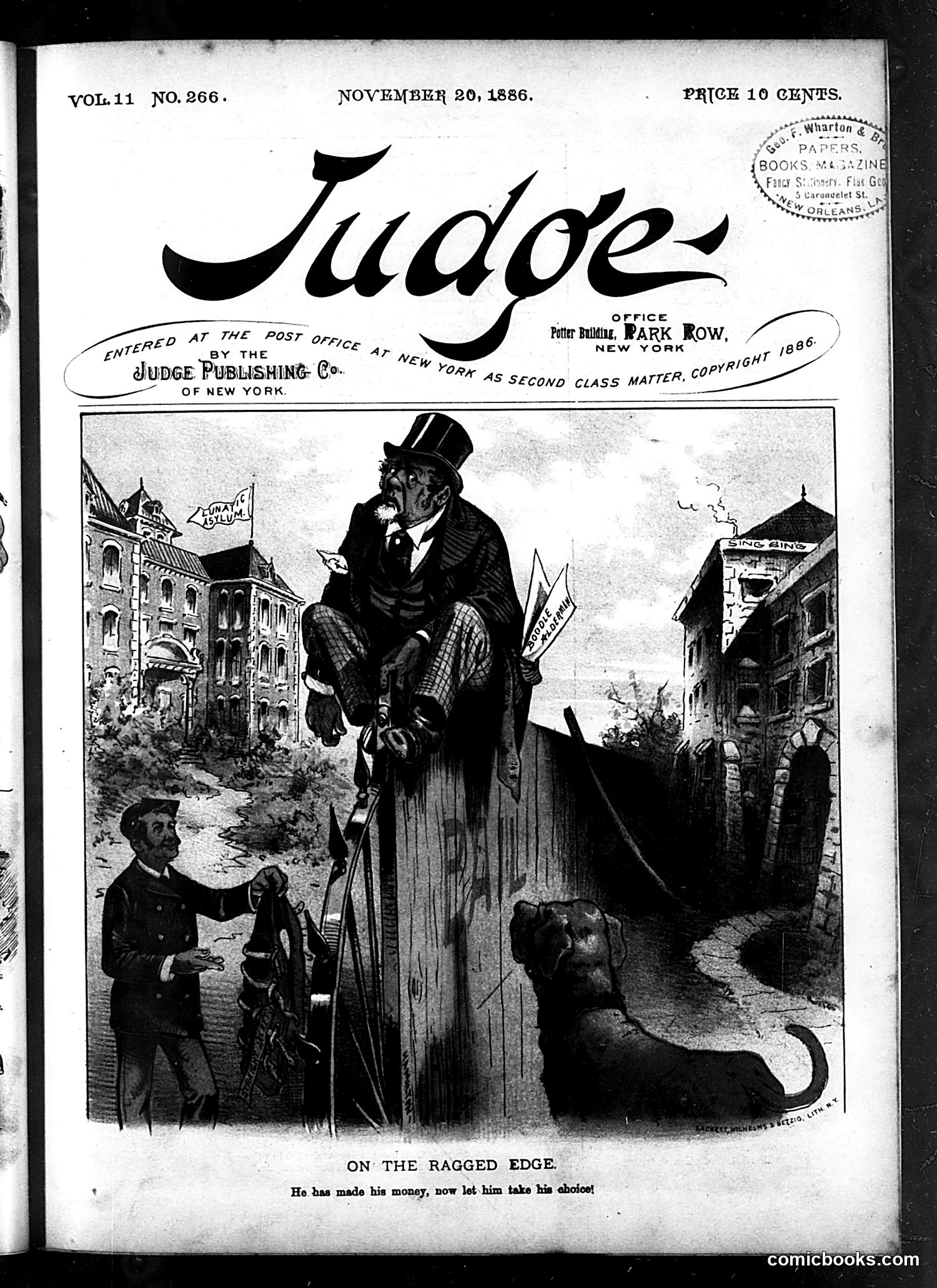
**Title:** "ON THE RAGGED EDGE" **Caption:** "He has made his money, now let him take his abode!" This cartoon depicts a wealthy capitalist (identifiable by his top hat, formal dress, and exaggerated facial features typical of Gilded Age caricature) perched precariously on a jagged cliff edge above a cityscape. A working-class figure below holds what appears to be a rope or chain. The satire critiques the instability of wealthy industrialists who have accumulated fortunes, suggesting their position is precarious and unsustainable—they're literally on the "ragged edge" of disaster. The composition implies that those who've exploited labor to build wealth face inevitable consequences or collapse. This reflects 1880s anxieties about labor unrest, economic inequality, and the vulnerability of the newly rich during America's industrial boom.
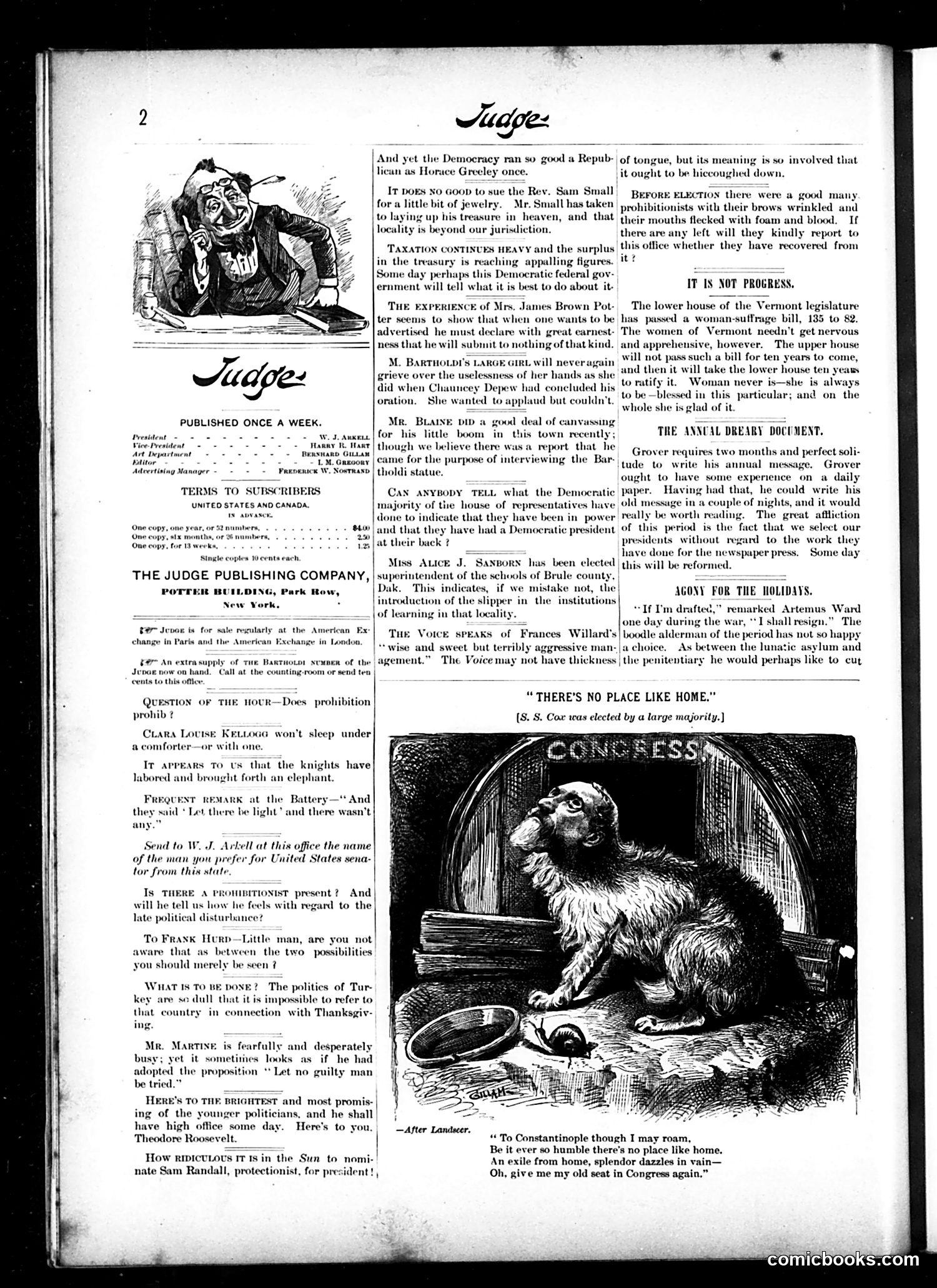
This page contains political commentary and humor typical of Judge magazine's satirical approach. The main cartoon titled "There's No Place Like Home" depicts a dog labeled "Congress" looking longingly out a window, apparently homesick. The accompanying verse references Constantinople and suggests the dog (Congress) yearns to return home to its seat in Congress. The surrounding text includes several "Questions of the Hour" addressing contemporary political issues: prohibition debates, Democratic majority concerns, and various political figures and proposals. References include discussion of a woman-suffrage bill and commentary on Democratic leadership. The satire suggests Congress members were absent from their duties or distracted from proper governance, using the homesick dog as metaphor for their divided attention or wandering focus from legislative responsibilities.
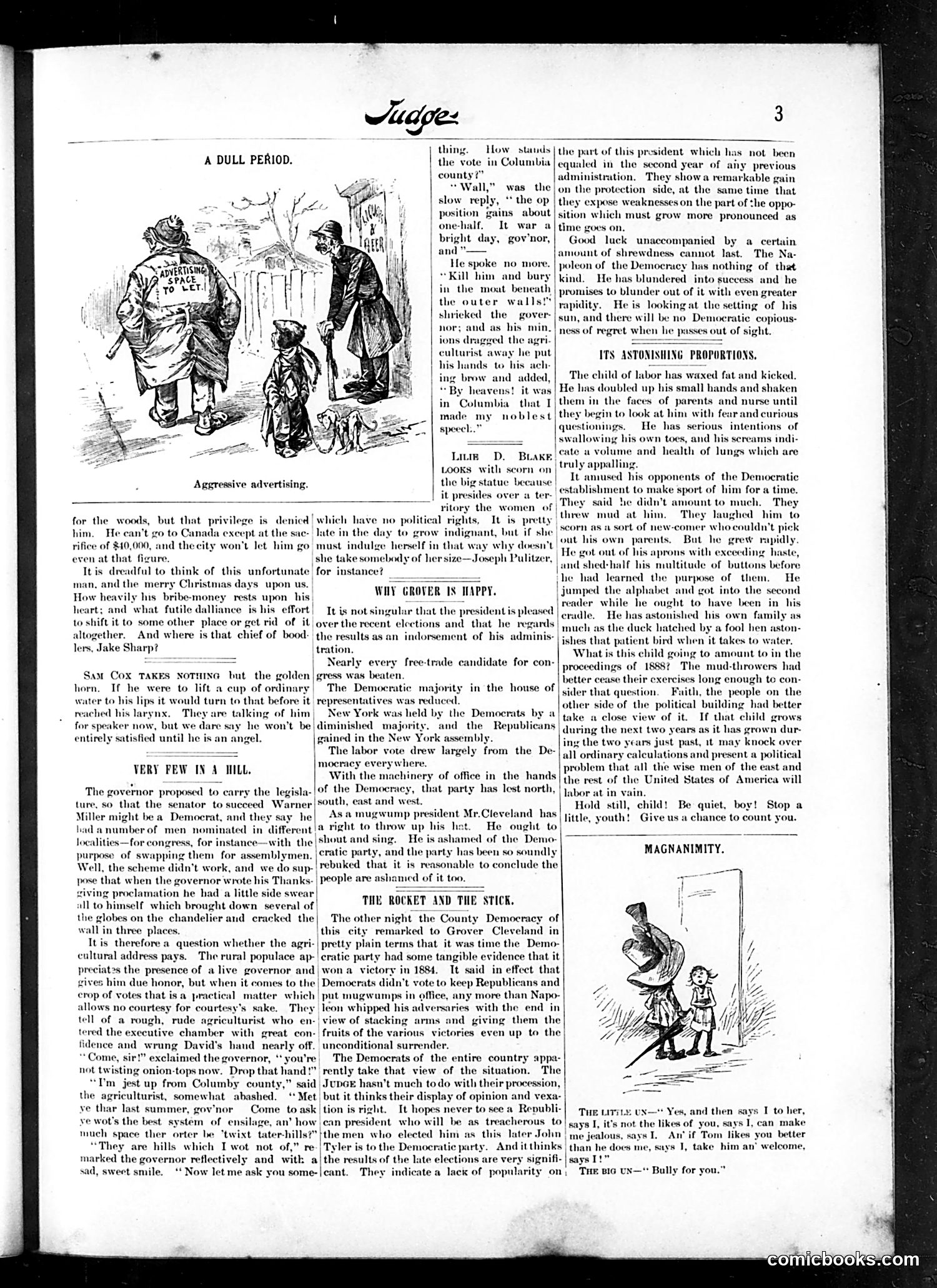
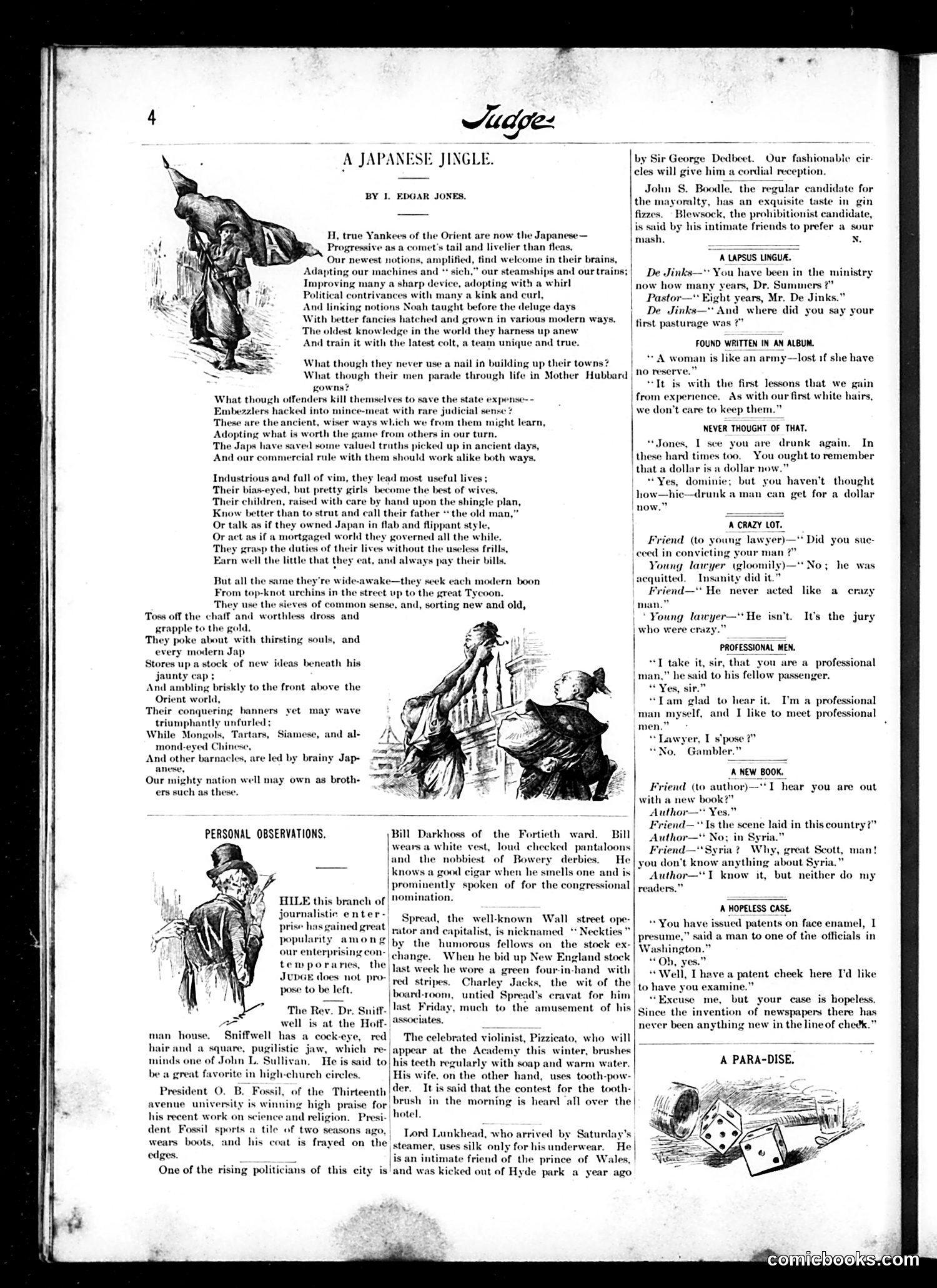
This page contains a poem by I. Edgar Jones praising Japanese culture and work ethic as a model for America. The central satirical point: while Japan adopts modern Western technology and ideas, Japanese people maintain discipline, frugality, and respect—virtues Americans supposedly lack. The poem contrasts Japanese virtues (using no nails in construction, self-discipline, respect for fathers, sorting "new ideas" from "worthless dross") with implied American excess and moral decline. The subtext reflects late 19th-century anxieties about Japan's rapid modernization and growing power, presented here as both admirable and implicitly threatening. The page's sidebar contains satirical "Personal Observations" mocking specific New York figures—politicians, clergy, and society men—depicted as corrupt, pretentious, or ridiculous. The contrast reinforces Judge's message: while Japan progresses through virtue, America's leadership is frivolous and debased.
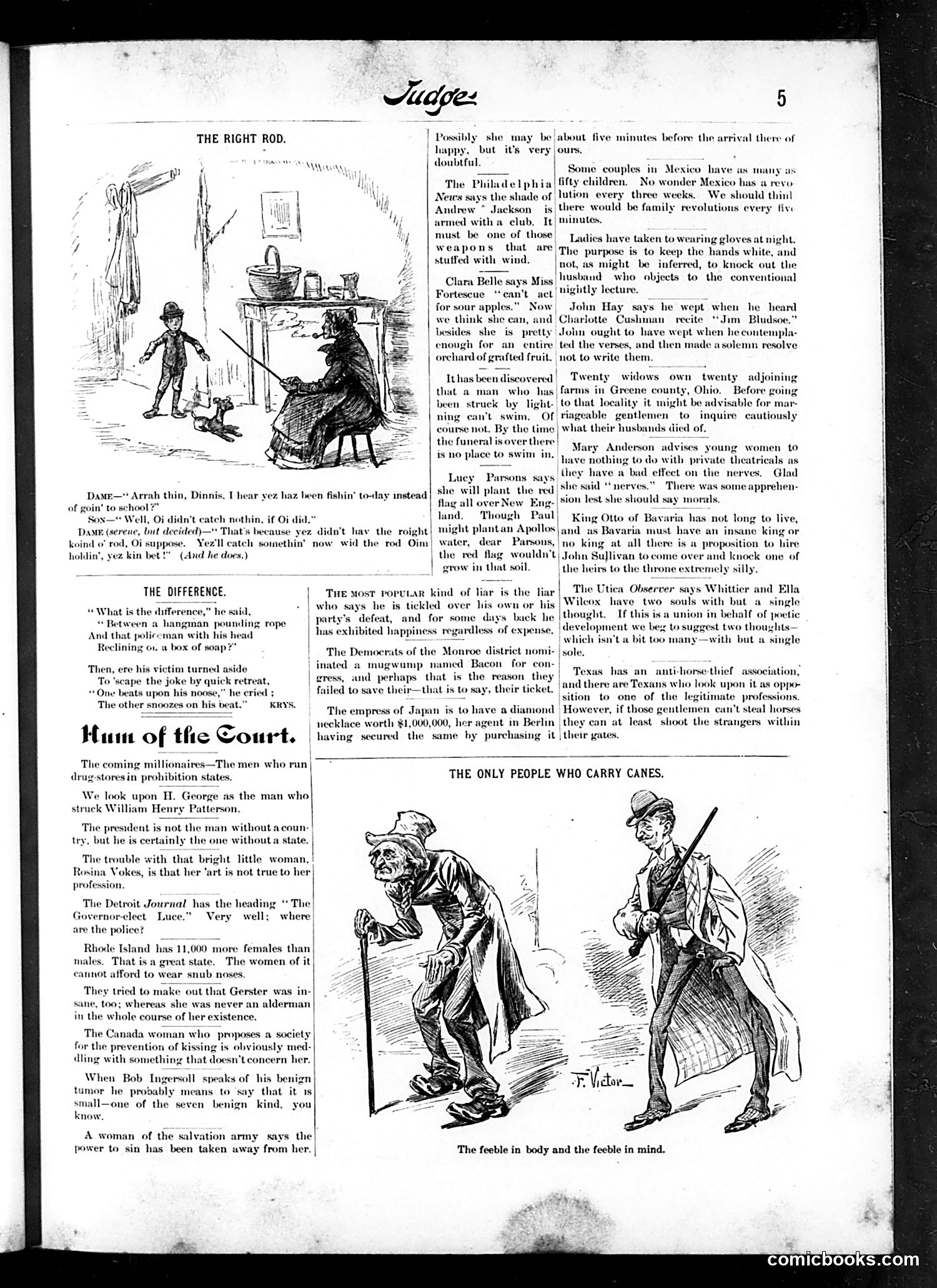
This page from the satirical magazine *Judge* contains several short jokes and commentary typical of late 19th-century American humor. **"The Right Rod"** depicts a dialogue between two Irish characters (suggested by dialect spelling "Oi" for "I"). The joke plays on the word "rod"—a fishing rod versus a "rod" as punishment—with the implication that proper parenting requires physical discipline. **"Rum of the Court"** is a gossip column featuring brief, acerbic observations about public figures. References include H. George (likely Henry George, the economist), William Henry Patterson (unclear), and various theatrical performers like Rosina Vokes and Gerster. The humor relies on contemporary knowledge of these minor celebrities and political figures. **"The Only People Who Carry Canes"** is a cartoon captioned "The feeble in body and the feeble in mind," depicting two elderly men with canes—satirizing cane-carrying as a sign of physical or mental weakness. The page exemplifies *Judge*'s style: topical, sometimes mean-spirited humor targeting recognizable public figures and social pretensions of the era.
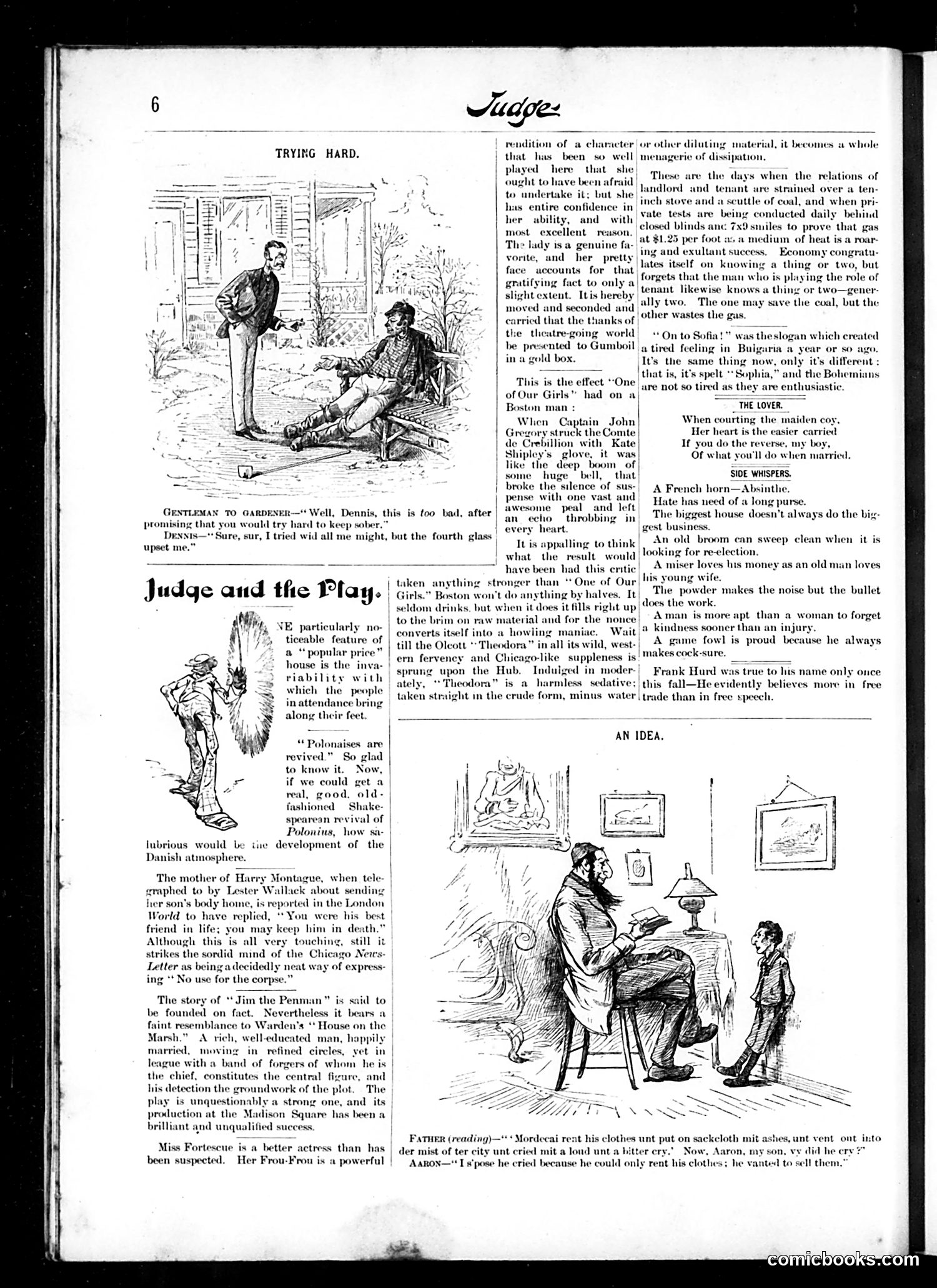
This page contains theater reviews and social commentary from Judge, the American satirical magazine. The main cartoons mock contemporary theatrical productions and social pretensions. **"Trying Hard"** depicts a gentleman trying to impress a seated woman—likely critiquing affected behavior or failed seduction attempts in fashionable society. **"Judge and the Play"** section reviews various theatrical productions, particularly praising an actress's performance in "One of Our Girls" (so popular a Boston man claims it affected his drinking). The reviews mock dramatic excess and overwrought acting styles of the era. **"An Idea"** cartoon shows a father lecturing a son about proper dress and behavior—satirizing middle-class Victorian parenting and moral instruction. The **"Side Whispers"** section contains quick aphoristic jokes about human nature (marriage, money, vanity), a common Judge feature. Overall, the page targets theatrical pretension, middle-class social climbing, and Victorian morality—typical Judge satire of the period.
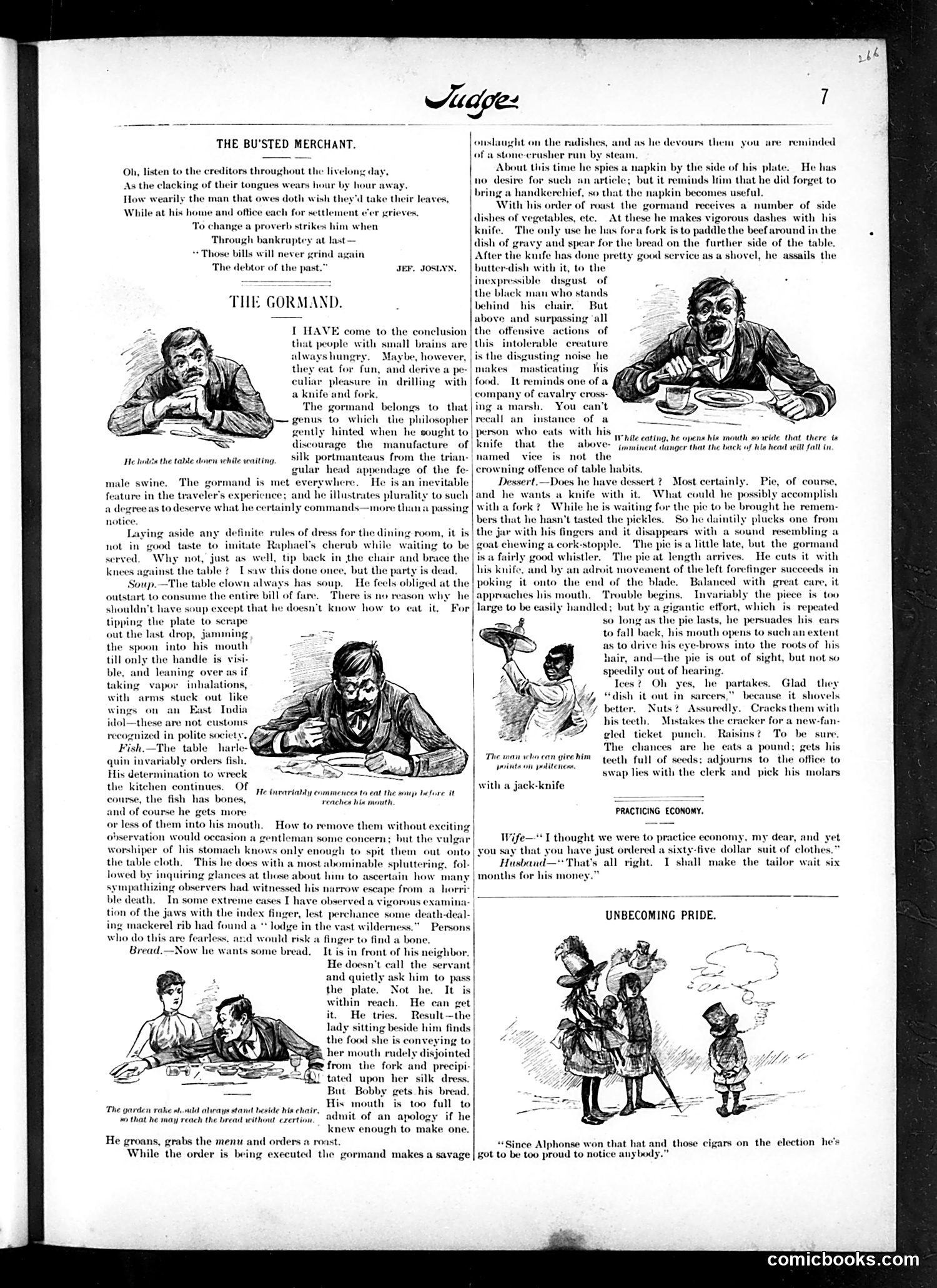
This page satirizes bad table manners through the character of "the gormand"—a wealthy but ill-bred diner. The central point: crude eating habits reveal low intelligence and vulgar character despite social position. The text mocks specific offenses: tipping soup plates, spitting fish bones onto tablecloths, reaching across other diners for bread (disrupting their meals), using knives as shovels, and butter dishes as paint palettes. The "black man" (servant) watching in disgust represents civilized society's reaction. The accompanying illustrations show the gormand's grotesque table behavior—hunched posture, open-mouthed eating, aggressive fork-wielding. The satire targets the nouveau riche or aspiring middle class who lacked proper etiquette education. Judge's readers—educated elites—are invited to feel superior by recognizing these vulgar behaviors. It's both humor and social instruction: proper table manners signaled breeding and respectability in Gilded Age America.
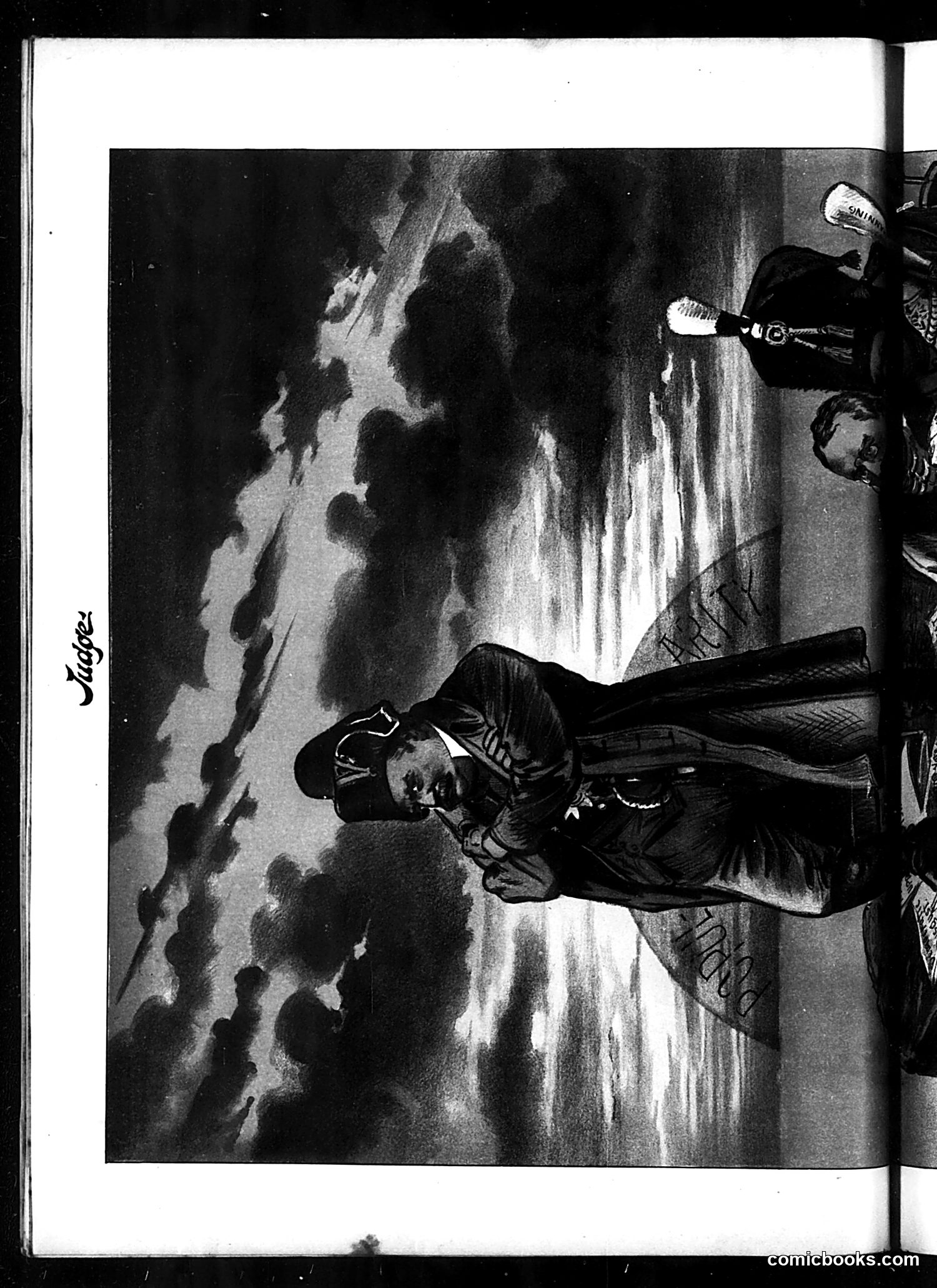
I can see this is a black and white photograph from Judge magazine, rotated 90 degrees, showing what appears to be a person in dark clothing standing on a mountainous or rocky landscape with dramatic sky/clouds in the background. There are other figures visible in the upper right. However, the OCR text provided is essentially unreadable—it appears to be garbled characters rather than actual words. Without legible text identifying the subject, figures, or satirical point, I cannot reliably explain what this cartoon or photograph is meant to convey to a modern reader. To properly analyze this as political or social satire, I would need either clearer OCR text or additional context about the publication date and issue of Judge.
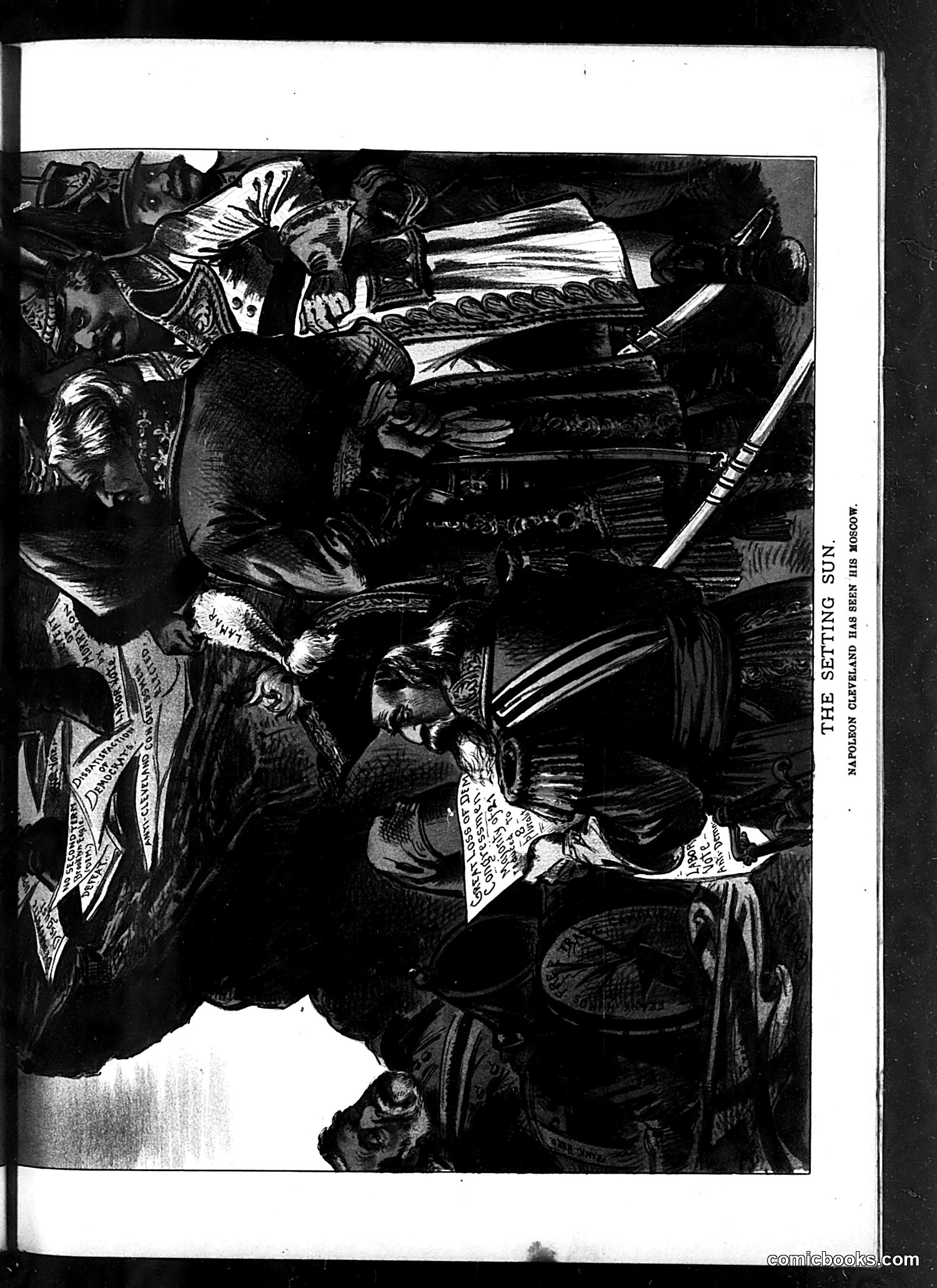
I cannot reliably transcribe the OCR text on this page—it appears corrupted or reversed. The image itself shows a detailed black and white woodcut or engraving depicting multiple figures in period dress arranged around what appears to be a tree. The caption reads "TREE SETTING SUN" with a subtitle mentioning "NARROW CLEVELAND HAS BEEN HIS MIRROR." The reference to Cleveland likely indicates President Grover Cleveland, suggesting this is political satire from the late 19th century. However, without legible text explaining the specific allegory, I cannot definitively identify all figures or the exact satirical point. The artistic style and composition suggest commentary on Cleveland's political legacy or policies, but the specific meaning remains unclear without readable accompanying text.
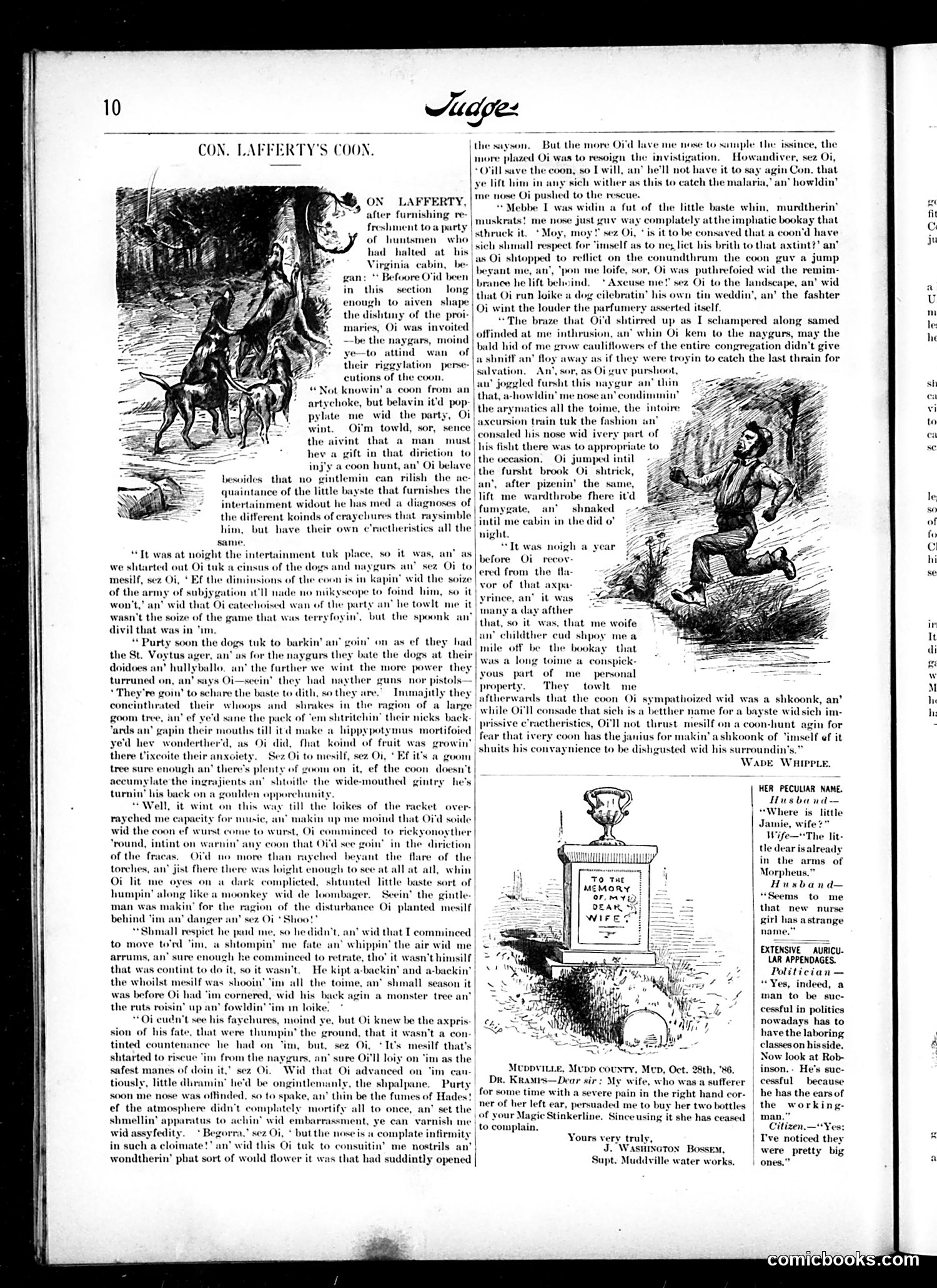
This page contains "Con. Lafferty's Coon," a dialect story using racist caricature typical of late-19th-century Judge magazine. The narrative, written in exaggerated Irish brogue, describes a hunting party where the Irish protagonist ("Con") encounters Black people ("naygurs," using period slurs) during a coon hunt. The "humor" relies on: racist stereotypes about Black people, minstrelsy-style dialect comedy, and physical comedy involving a hunting dog chasing both animals and people. The illustrations show exaggerated caricatures consistent with the era's dehumanizing visual racism. **What we'd miss today:** This represents mainstream American satire of the 1880s-1890s, when such content was considered acceptable entertainment in respectable publications. The piece reflects both anti-Black racism and ethnic mockery of Irish immigrants through dialect. This content is historically significant as documentation of period attitudes but deeply offensive by modern standards.
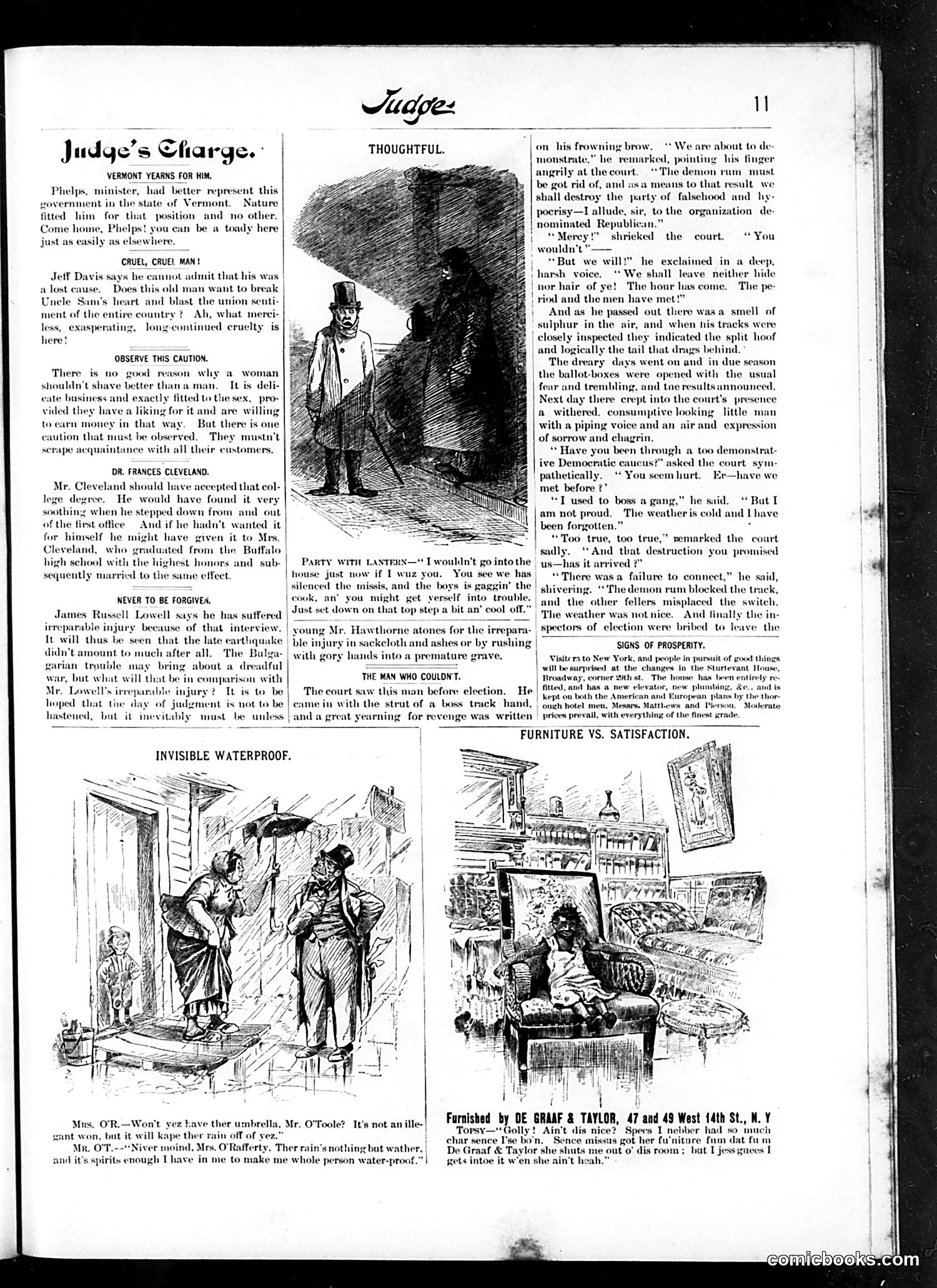
This page from Judge satirizes post-election Democratic disappointment through "The Man Who Couldn't" cartoon sequence. A Democratic zealot arrives at court before election, furiously vowing to destroy the Republican party and "demon rum" (alcohol), his rhetoric so heated that sulfur smells follow him and split hooves mark his path—visual cues identifying him as demonic or fanatical. After the election, he returns as a withered wreck, his promises unfulfilled. He blames his failure on "demon rum blocking the track" and election officials taking bribes, not his own inadequacy. The satire mocks Democratic overconfidence and melodramatic anti-Republican rhetoric, suggesting their grandiose pre-election promises were unrealistic theater. The "failure to connect" implies incompetence masked by convenient excuses. Other brief pieces on the page critique Cleveland (refusing a college degree), Republican politicians like Phelps, and social hypocrisy—typical Judge fare mixing political commentary with genteel social observation.
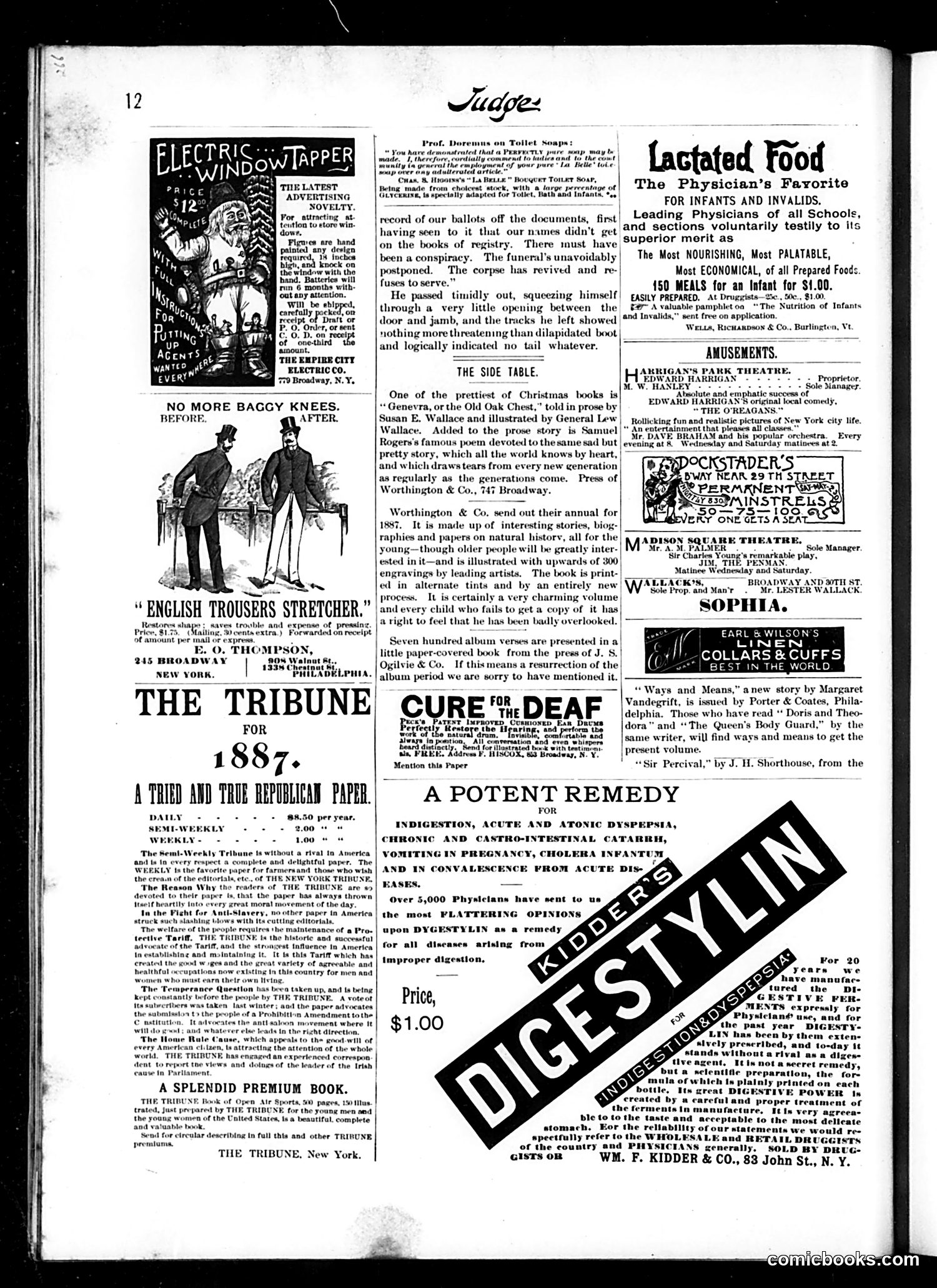
This page is primarily **advertisements and editorial content** from an 1887 Judge magazine, not a political cartoon. The visible cartoon, titled **"No More Baggy Knees,"** depicts a clothes-pressing innovation—a "Trousers Stretcher"—promising to eliminate wrinkles without the "trouble and expense of pressing." This reflects late-Victorian concerns about maintaining respectable appearance and masculine dignity through improved consumer technology. The page also includes satirical prose about a corpse that mysteriously "revives and refuses to serve," apparently referencing voting registry fraud—a common 1880s political scandal where bodies or ineligible voters appeared on rolls. The dialogue suggests someone prevented registration through conspiracy, a jab at contemporary election corruption. Most content comprises advertisements for patent medicines (notably "Dygestylin"), books, and the Tribune newspaper's subscription pitch, which emphasizes its Republican editorial stance and advocacy for tariff protection and Prohibition—major 1887 political debates. The overall effect captures the commercialism and partisan messaging characteristic of Gilded Age print media.
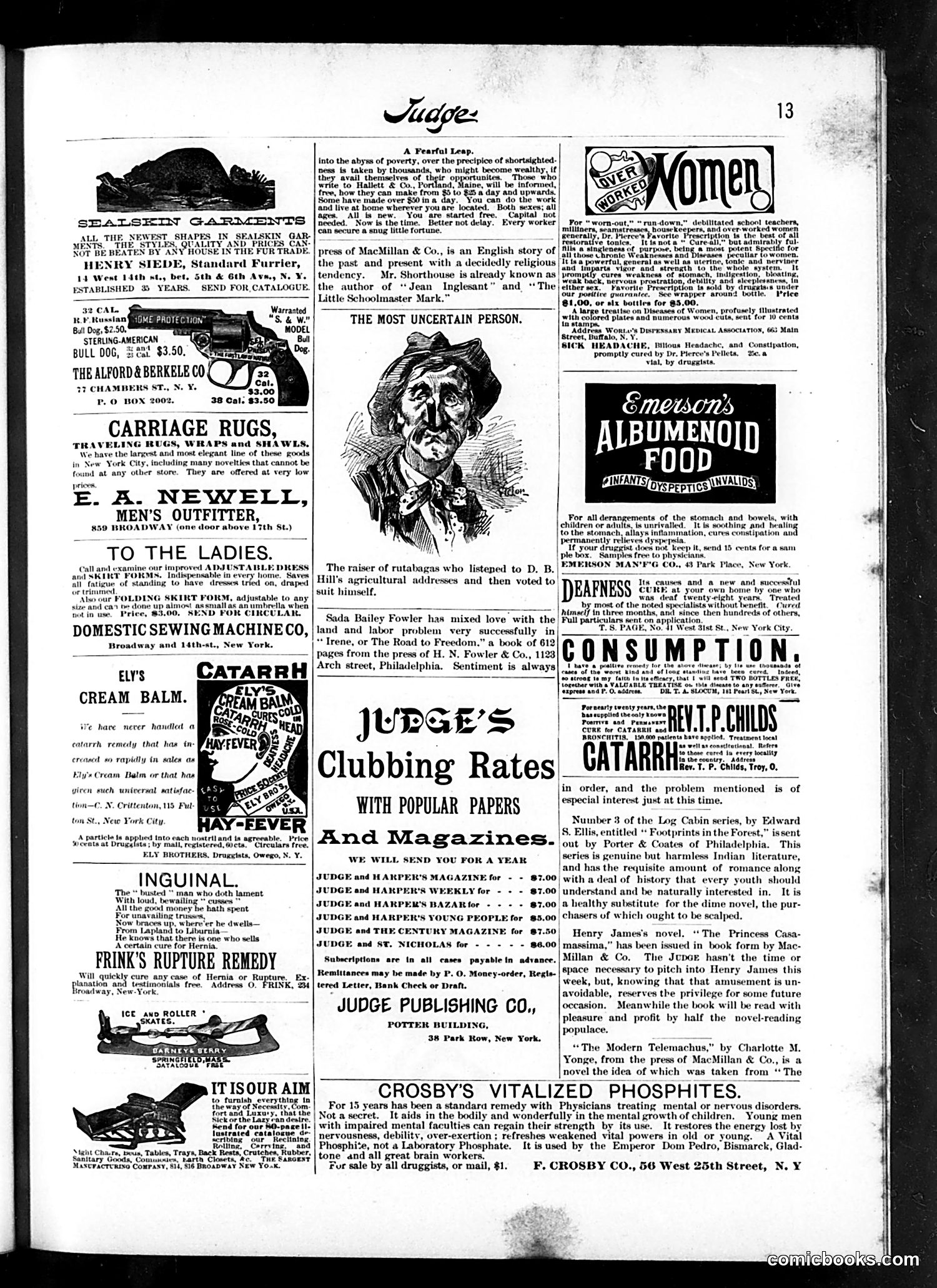
This page is primarily **advertising**, with one notable editorial cartoon titled "THE MOST UNCERTAIN PERSON" centered in the layout. The cartoon depicts a disheveled, worried-looking man—appearing to represent an uncertain or anxious everyman figure, though no specific identity is labeled. The style suggests he embodies general anxiety or indecision rather than a particular political figure. The surrounding advertisements—for medical remedies (Emerson's Albumenoid Food, cures for catarrh, consumption, deafness), household goods, sewing machines, and dubious "get-rich-quick" schemes—are typical of late 19th-century publications. These ads often made exaggerated health claims now recognized as fraudulent. The page's satire appears implicit: *Judge* magazine likely used such advertising to mock consumer gullibility while simultaneously profiting from it—a tension between editorial skepticism and commercial necessity.
This page is primarily **patent medicine advertising**, not political satire. It promotes Dr. Pierce's "Favorite Prescription," a heavily marketed remedy marketed toward women in the late 19th/early 20th century. The satirical element appears in the bottom article, "TREATING THE WRONG DISEASE," which critiques (likely sincerely rather than satirically) how family physicians misdiagnose women's complaints—attributing separate symptoms (dyspepsia, palpitation, backache, nervousness) to distinct diseases when they're actually caused by "uterine disorder." The page features numerous testimonials from women describing dramatic recoveries from "organic weakness" after using the product. While modern readers would recognize this as dubious medical claims, the page presents these as genuine endorsements proving the prescription's efficacy. The masthead "A BOON FOR WOMEN" promises relief for female ailments through a proprietary medicine—a common and largely unregulated practice of the era. No political figures or specific satire is evident here.
This page is primarily **advertising and literary content**, not political satire. The main visual element is a poem titled "THE SPINNING WHEEL" (center-right), depicting a young woman at her spinning wheel dreaming of romance while working—a sentimental, domestic narrative typical of the era. The surrounding content consists almost entirely of **advertisements** for products (fountain pens, theatrical plays, ink, cocoa, hotel services, clothing) and literary notices. There is one small section titled "DECISIONS HANDED UP" discussing minor legal/social observations (church chants, gamblers, railroad tickets), but these are brief, lighthearted quips rather than political commentary. **No significant political cartoons or satirical commentary are visible on this page.** It appears to be a typical interior page from Judge magazine featuring commercial content alongside period literature and humor, representing the magazine's mixed model of entertainment and advertising revenue.
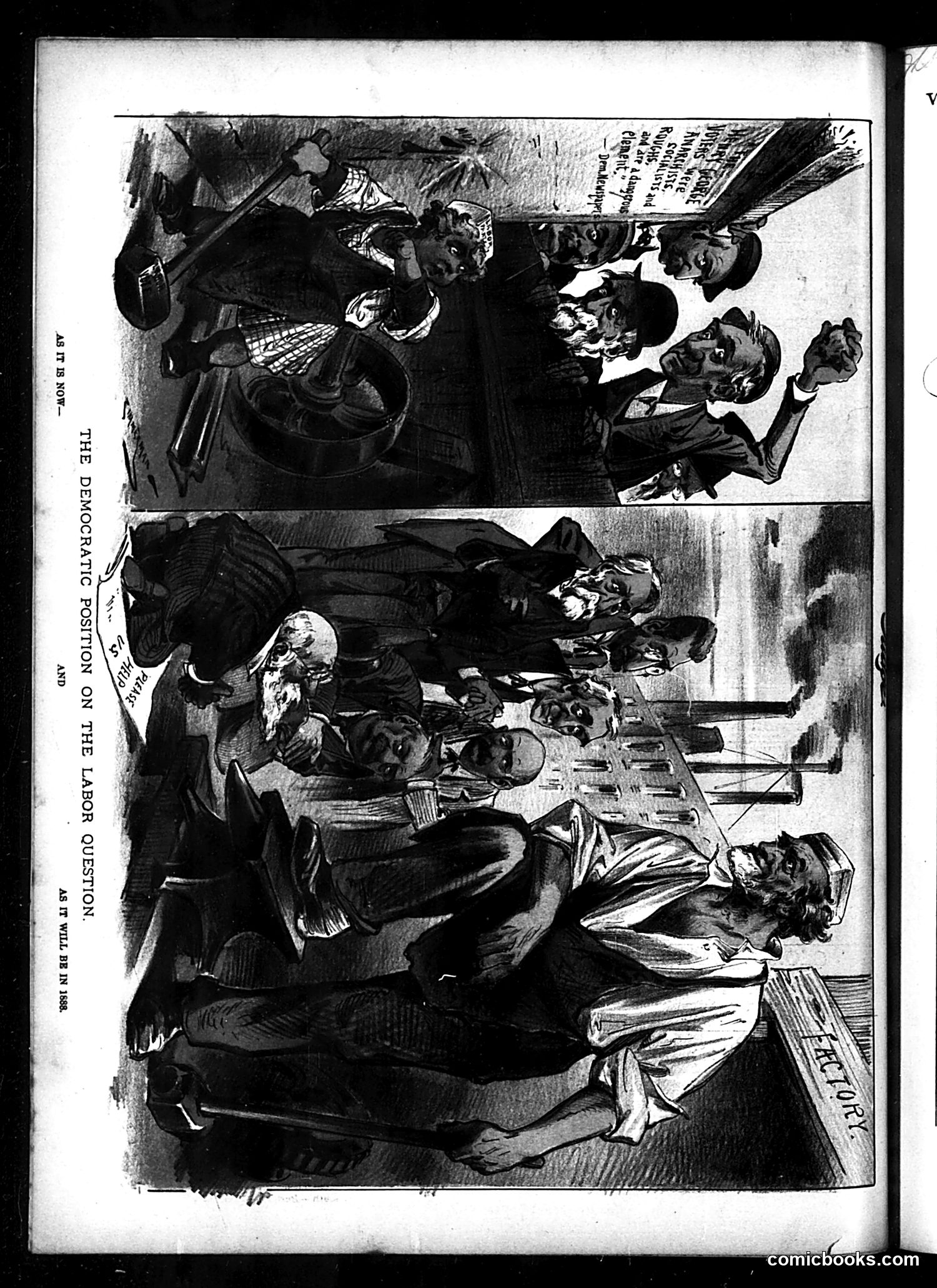
This satirical cartoon depicts "The Democratic Position on the Labor Question" as predicted for 1888. The two panels appear to show contrasting Democratic stances on labor issues. The top panel shows what seems to be political figures in discussion or debate about labor matters. The bottom panel depicts working-class laborers or the general public, suggesting commentary on the gap between Democratic rhetoric and actual worker conditions. The cartoon's satire likely critiques Democratic inconsistency on labor reform—positioning the party as either indifferent to workers' actual suffering or making empty promises. The "as it will be in 1888" subtitle suggests cynical prediction that Democratic positions would not genuinely improve by that election year. Without clearer identification of specific figures, the exact targets remain unclear, but the overall message criticizes Democratic hypocrisy regarding labor advocacy during the Gilded Age period.