
A complete issue · 16 pages · 1886
Judge — August 28, 1886
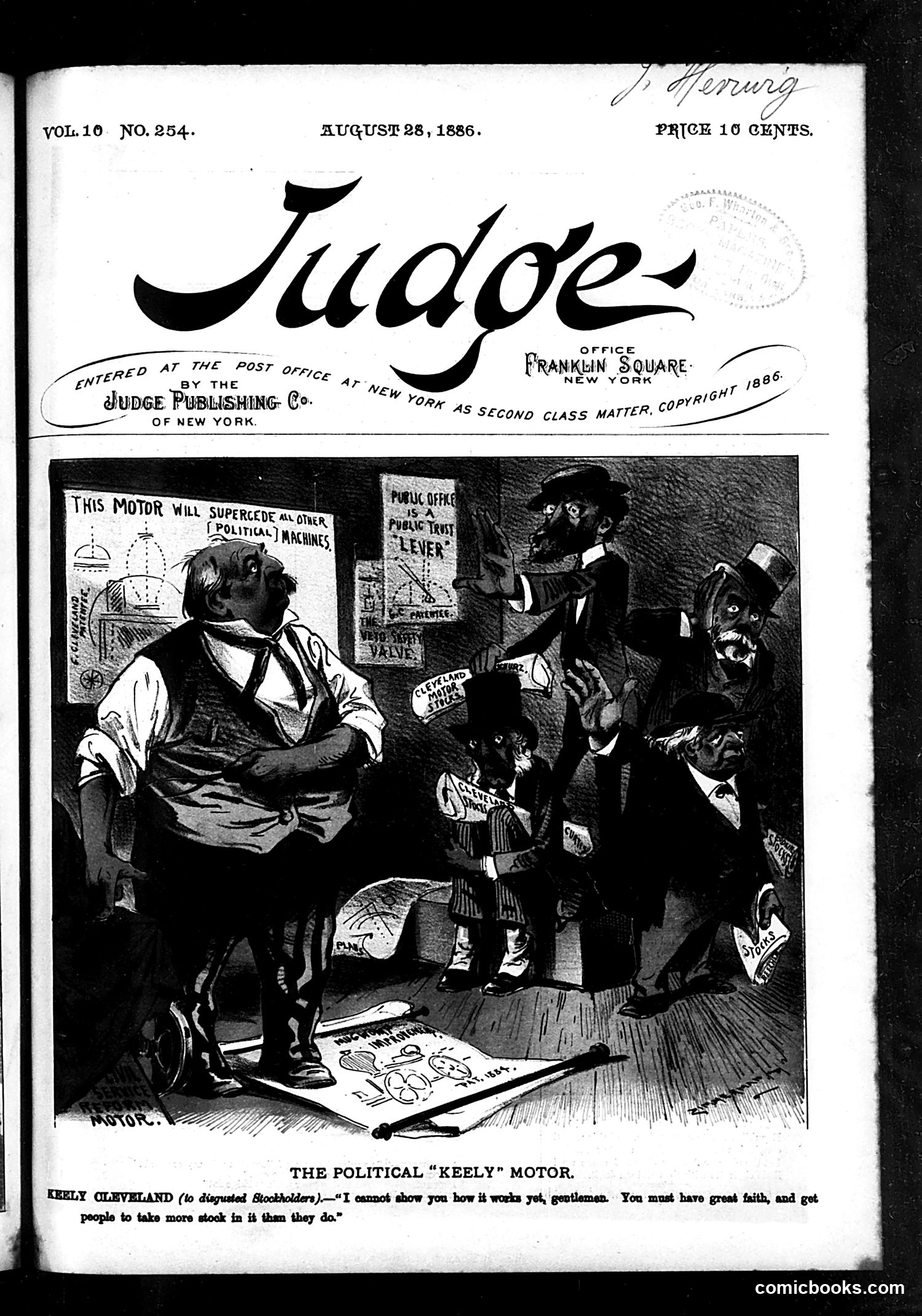
This cartoon satirizes John Worrell Keely, an inventor who claimed to have created a revolutionary "motor" powered by "etheric force." The caption quotes Keely Cleveland (likely a pun combining the inventor's name with President Grover Cleveland) saying he cannot demonstrate the motor but needs people's faith and investment. The cartoon mocks both Keely's fraudulent invention scheme and, by extension, politicians who make grand promises without delivering results. The caricatured figures in formal dress represent credulous investors or politicians being duped. The motor appears on the floor as a mere drawing—suggesting it exists only in theory, never in working reality. The satire targets gullible faith in unproven schemes.
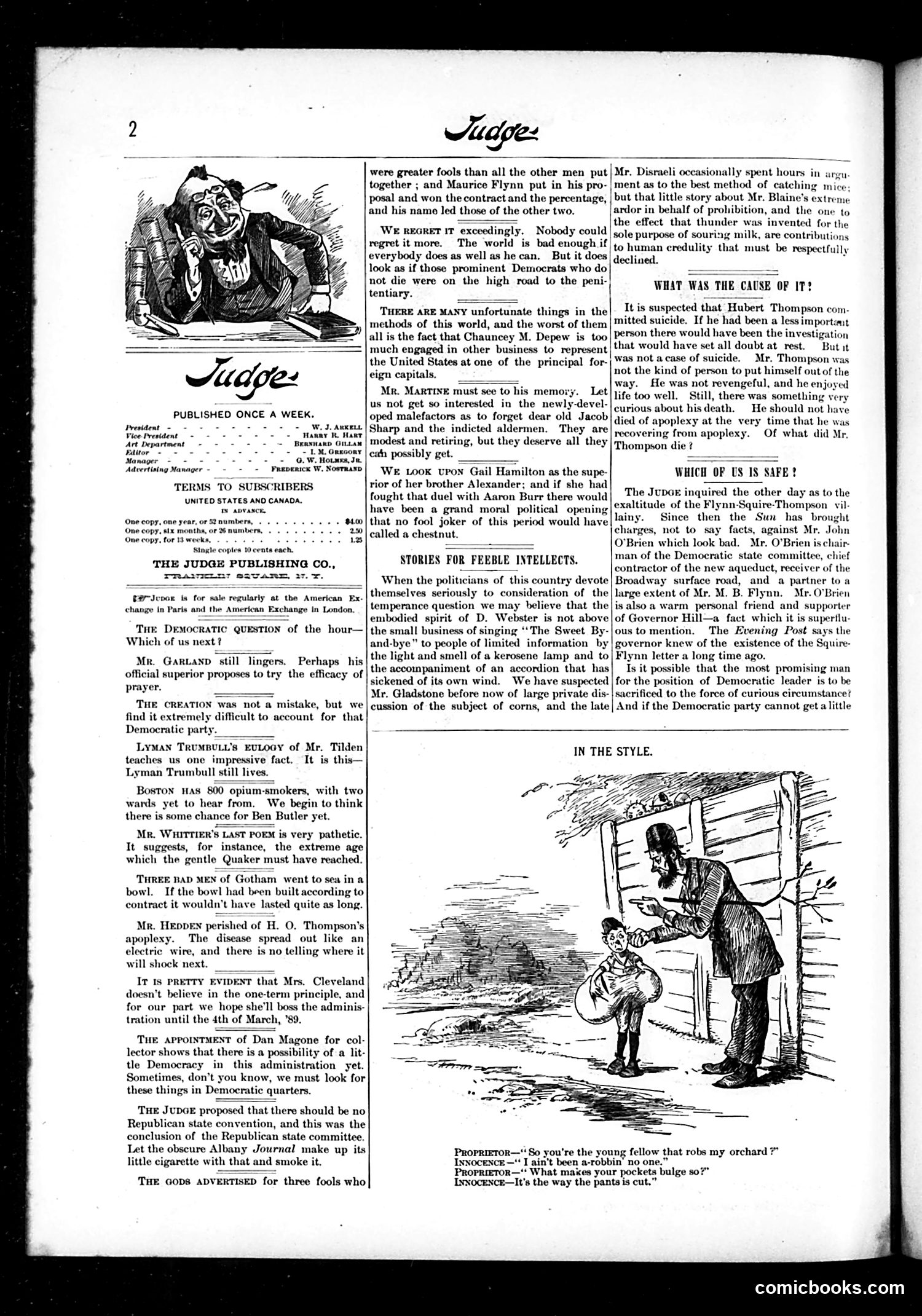
This page contains political commentary and a cartoon titled "In the Style." The main cartoon depicts a conversation between a "Proprietor" and "Innocence" (a young boy) about stolen orchard fruit, with the punchline playing on how "pants are cut" — a crude joke about the boy's appearance or clothing. The text columns discuss various political matters including references to M.M. Depew, Alexander Hamilton, and Democratic Party issues. One section titled "Stories for Feeble Intellects" sarcastically critiques politicians' simplistic rhetoric. The overall tone is typical Judge satire: mocking political figures, social hypocrisy, and public discourse of the era. Without clear dates or specific current events mentioned, the precise targets remain unclear, but the general thrust attacks Democratic leadership and celebrates cynicism about politics.
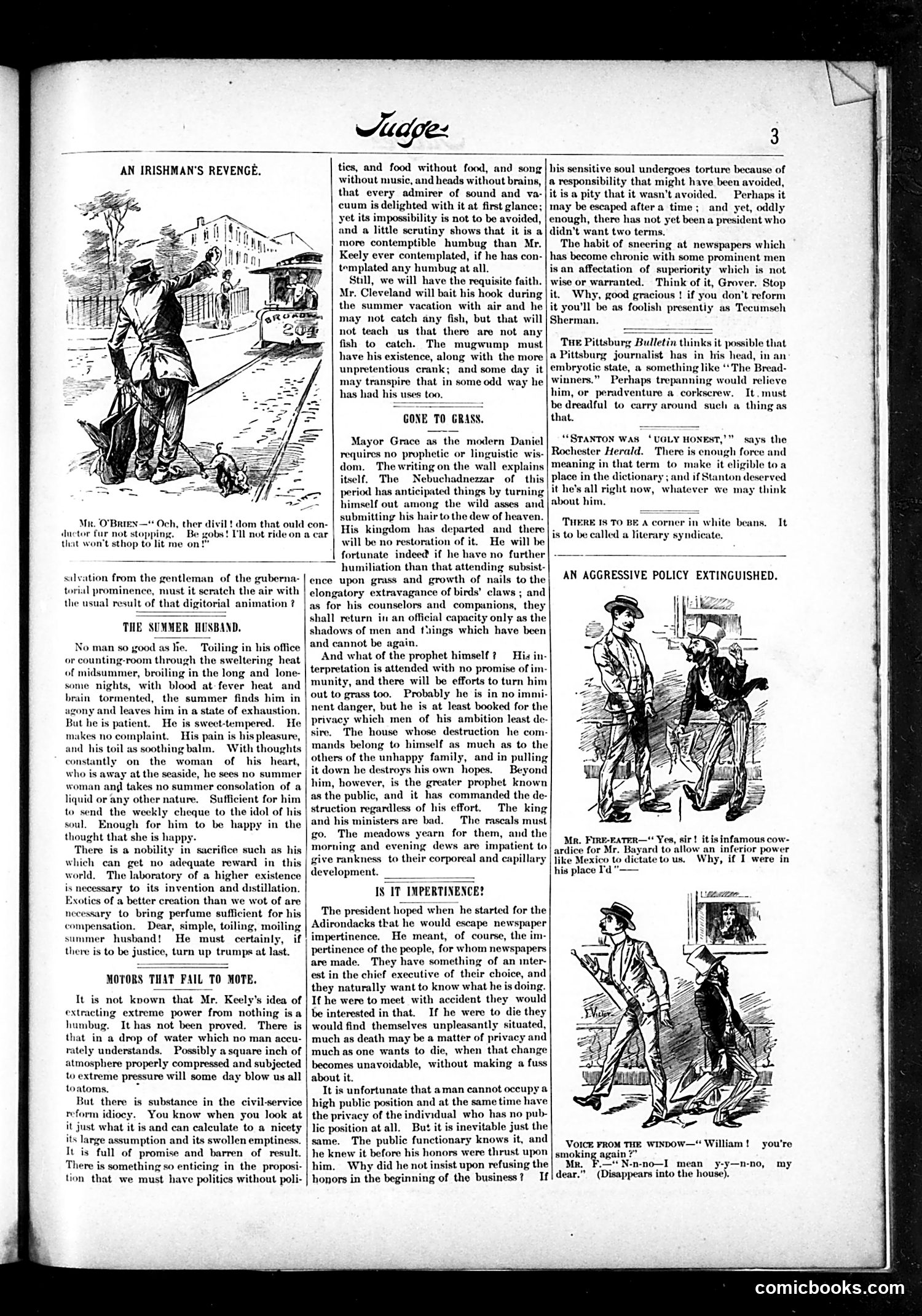
This page contains three distinct satirical pieces: **"An Irishman's Revenge"** (top): A cartoon mocking an Irish immigrant (Mr. O'Brien) who, spurned by a streetcar conductor, vows revenge—typical ethnic humor of the era, playing on Irish stereotypes and class tensions. **"Gone to Grass"** (middle): Compares Mayor Grace (of New York) to Nebuchadnezzar, the biblical king who went mad and ate grass. The satire suggests Grace has voluntarily removed himself from power, his "kingdom departed." This references an actual political downfall or disgrace. **"The Summer Husband"** (bottom): Mocks the devoted husband left in the hot city while his wife vacations at the seaside, presenting his self-sacrifice as both noble and absurd—satirizing sentimental domestic ideals. The page also discusses civil-service reform and Keely's perpetual-motion machine as empty political/scientific promises, typical Judge targets of ridicule.
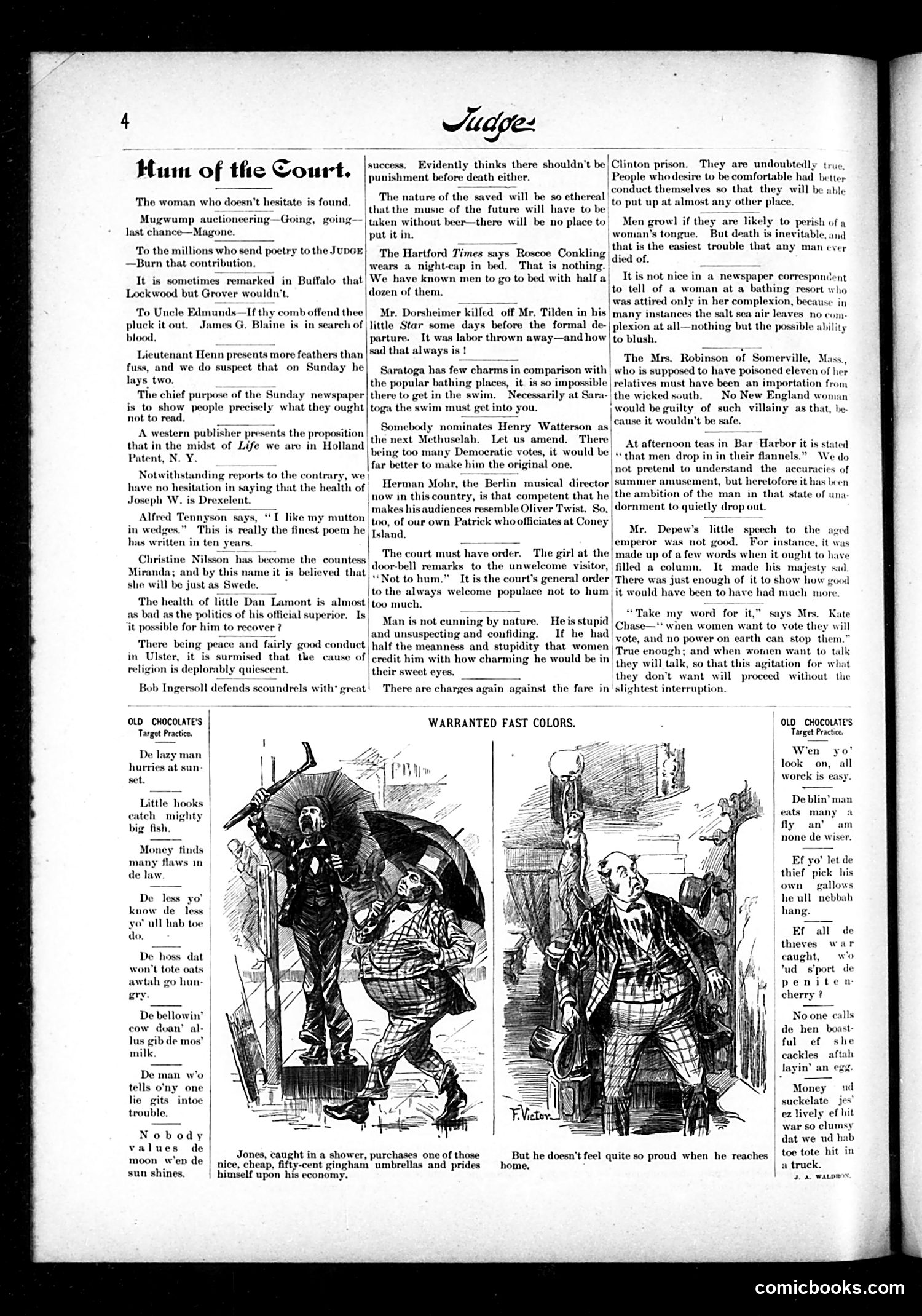
This page from the satirical magazine **Judge** contains brief political commentary and social humor typical of late 19th-century American journalism. **Key targets include:** - **Mugwumps** (independent Republicans): mocked for their political inconsistency - **Roscoe Conkling**: a prominent Republican politician, ridiculed for wearing a nightcap - **James G. Blaine**: referenced in relation to a personal search (unclear context) - **Henry Watterson**: nominated as "next Methuselah" (too old for office) - **Mrs. Robinson of Somerville, Mass.**: apparently a notorious poisoning case, with the writer sarcastically noting no respectable New Englander would commit such crimes The cartoons illustrate everyday scenes with captions providing social commentary on manners and behavior. The "Warranted Fast Colors" section appears to be a humorous feature about domestic life. Overall, this page reflects Judge's approach: quick jabs at politicians, social criticism, and comedic observations about contemporary life.
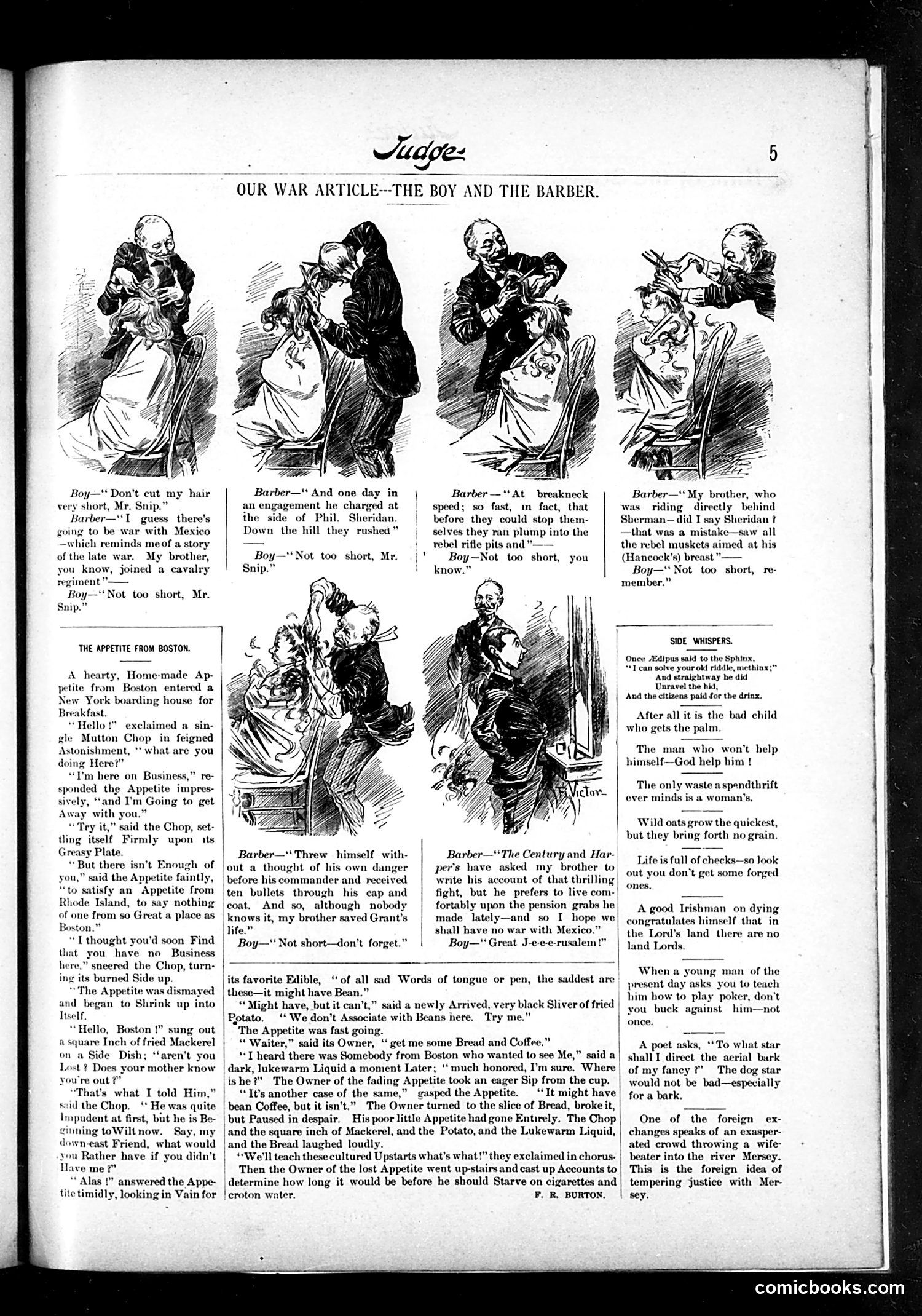
This cartoon satirizes American military boasting and self-aggrandizement during the period of Mexican-American War tensions. A boy repeatedly interrupts his barber's lengthy war anecdotes with the refrain "Not too short, Mr. Snip"—a running gag highlighting how tedious and exaggerated such stories are. The barber claims his brother performed heroic deeds for Grant and Sherman (though he confuses the generals' names), yet admits the brother now lives comfortably off pension fraud rather than pursuing legitimate accounts for *Century* and *Harper's* magazines. The satire mocks both inflated war narratives and officers who profit from military pensions while avoiding honest work. The accompanying "Appetite from Boston" story similarly ridicules pretension—a Boston appetite enters a New York boarding house expecting grand meals but finds itself unwelcome among the food, which mocks its provincial presumption. Together, these pieces lampoon American braggadocio, dubious military claims, and regional snobbery.
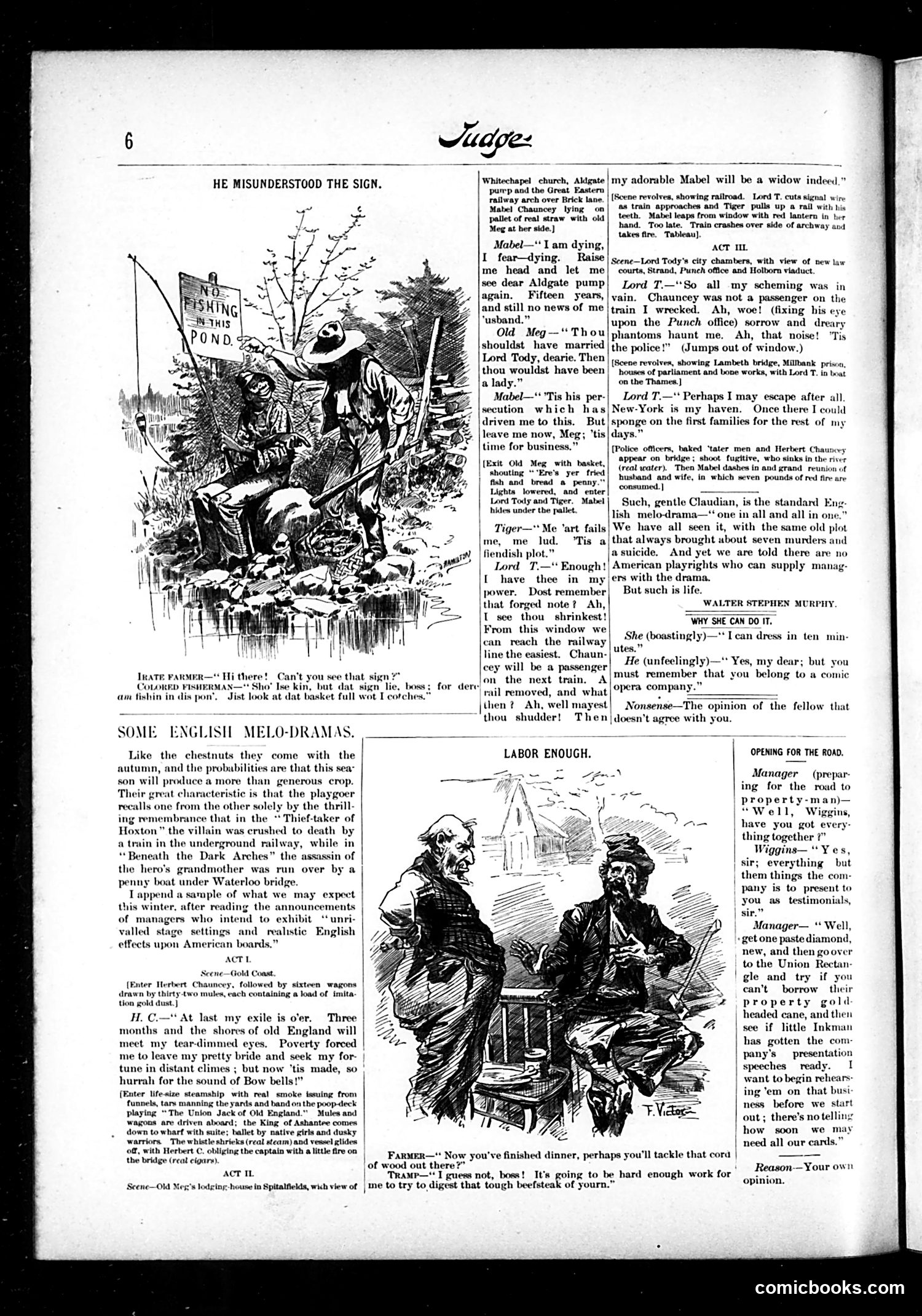
This page satirizes English melodrama's formulaic absurdity. The article "Some English Melo-Dramas" mocks how these plays recycled identical plot devices—the author notes villains are killed differently in each show (train, penny boat) but the structure remains identical. The accompanying sketch parodies this excess: a melodrama featuring "Mabel" set in Spitalfields, involving a forged note, attempted murder via train sabotage, and increasingly ridiculous scene changes (railway, Lord Tody's chambers, Lambeth Bridge, Thames). The villain escapes to New York—a typical overwrought ending. The satire targets both English playwrights' predictability and their lavish, physically impossible staging (real steamships, live animals). Judge ridicules how managers tout "unrivalled" sets while delivering the same tired narrative. This was a familiar American critique of Victorian theatrical excess and formula-driven British drama.
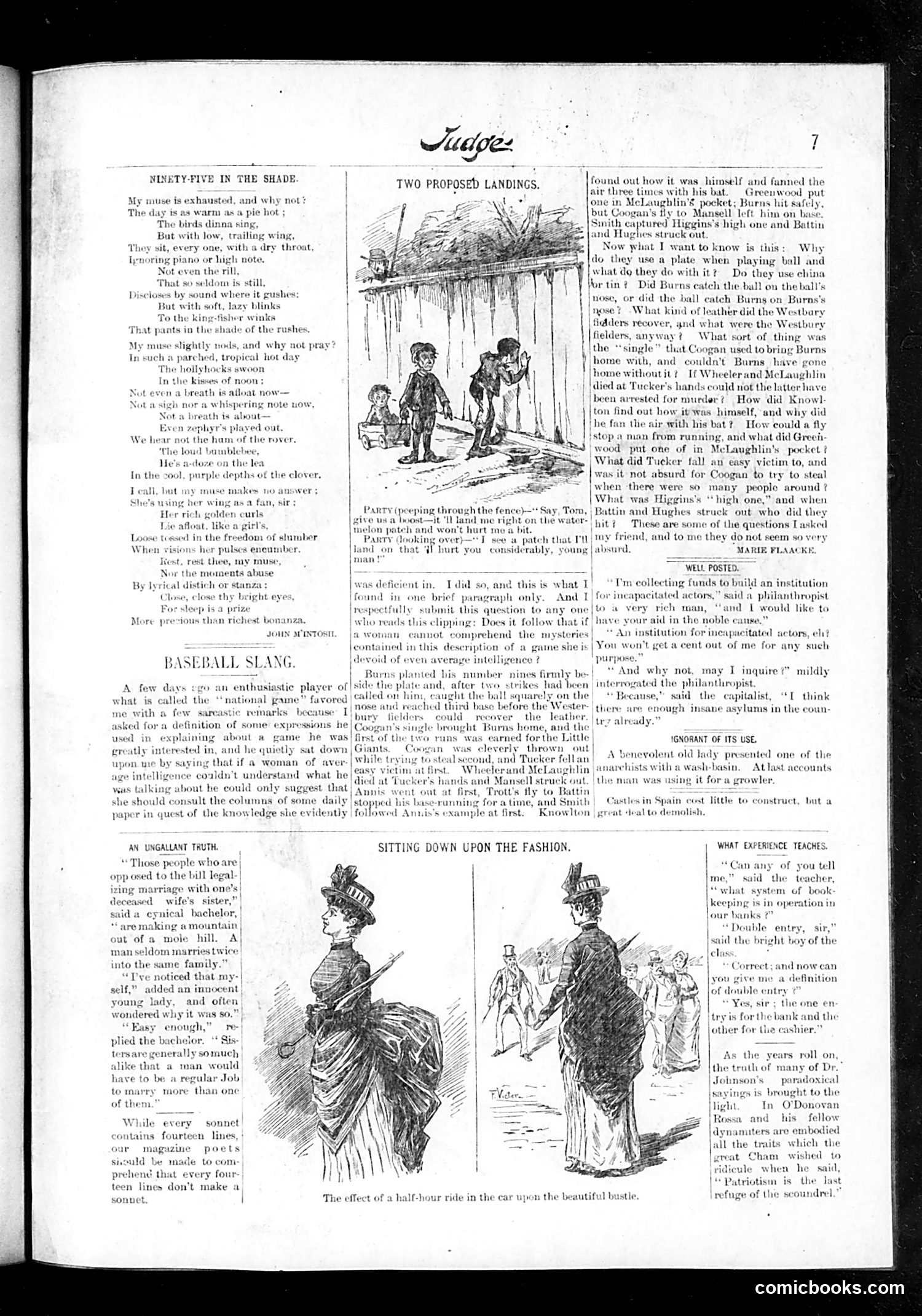
This page from *Judge* contains three distinct pieces of social satire: **"Ninety-Five in the Shade"** is a poem about summer heat exhaustion—a common subject for satirical magazines of the era, mocking how oppressive weather renders even creative inspiration limp and lazy. **"Baseball Slang"** satirizes a woman's confusion over baseball terminology. A male player tries explaining the game to her using technical jargon; she demands clarification of terms like "plate," "base," and "leather." The satire targets both the incomprehensibility of sports jargon and—subtly—the assumption that women cannot understand "masculine" pursuits. Her inability to grasp the game is treated as amusing rather than her legitimate frustration with unclear explanations. **"An Ungallant Truth"** features a cynical bachelor suggesting men rarely remarry into the same family because they already know what they're getting. A young woman agrees, then he adds a cutting remark about men's reluctance to repeat mistakes—a backhanded insult disguised as gallantry. These represent typical *Judge* content: light social commentary on weather, gender relations, and courtship customs aimed at middle-class readers.
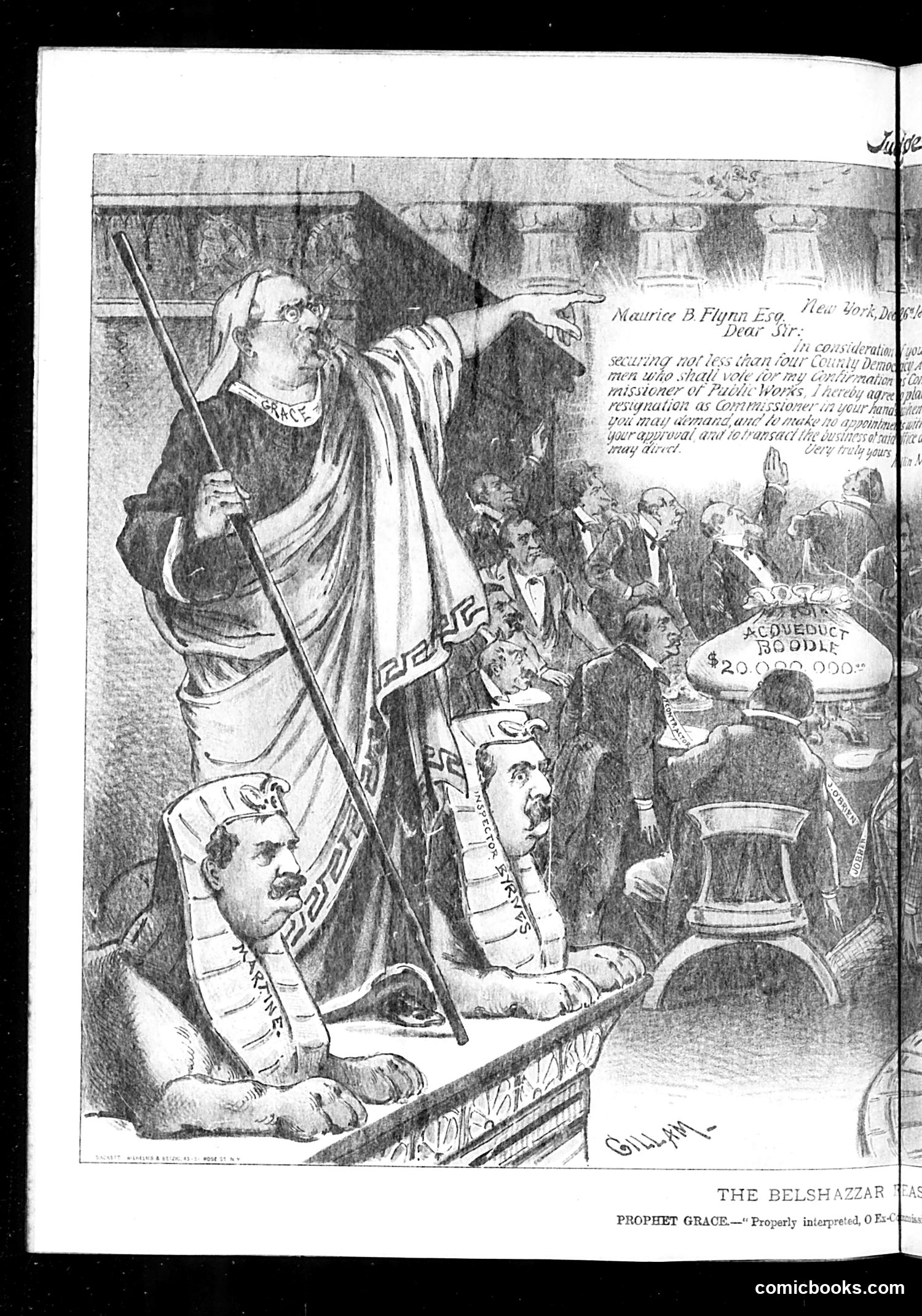
This cartoon, titled "Prophet Grace," depicts a tall figure in robes pointing a staff downward at smaller figures below, who appear to be wearing Egyptian-style headdresses and collars. The scene suggests a biblical or historical authority figure addressing subordinates. The text references "Maurice B Flynn" and mentions "Prophet" and "Grace," though the OCR is heavily corrupted. The style and presentation suggest this is satirizing contemporary political or social figures using classical/biblical imagery. Without clearer text, the specific identities and the precise target of satire are unclear, but the hierarchical composition—with one authoritative figure dominating smaller ones—indicates commentary on power dynamics or hypocrisy regarding claimed moral authority ("grace"). The "$20" price tag visible suggests commercial enterprise underlying the "prophetic" claims being mocked.
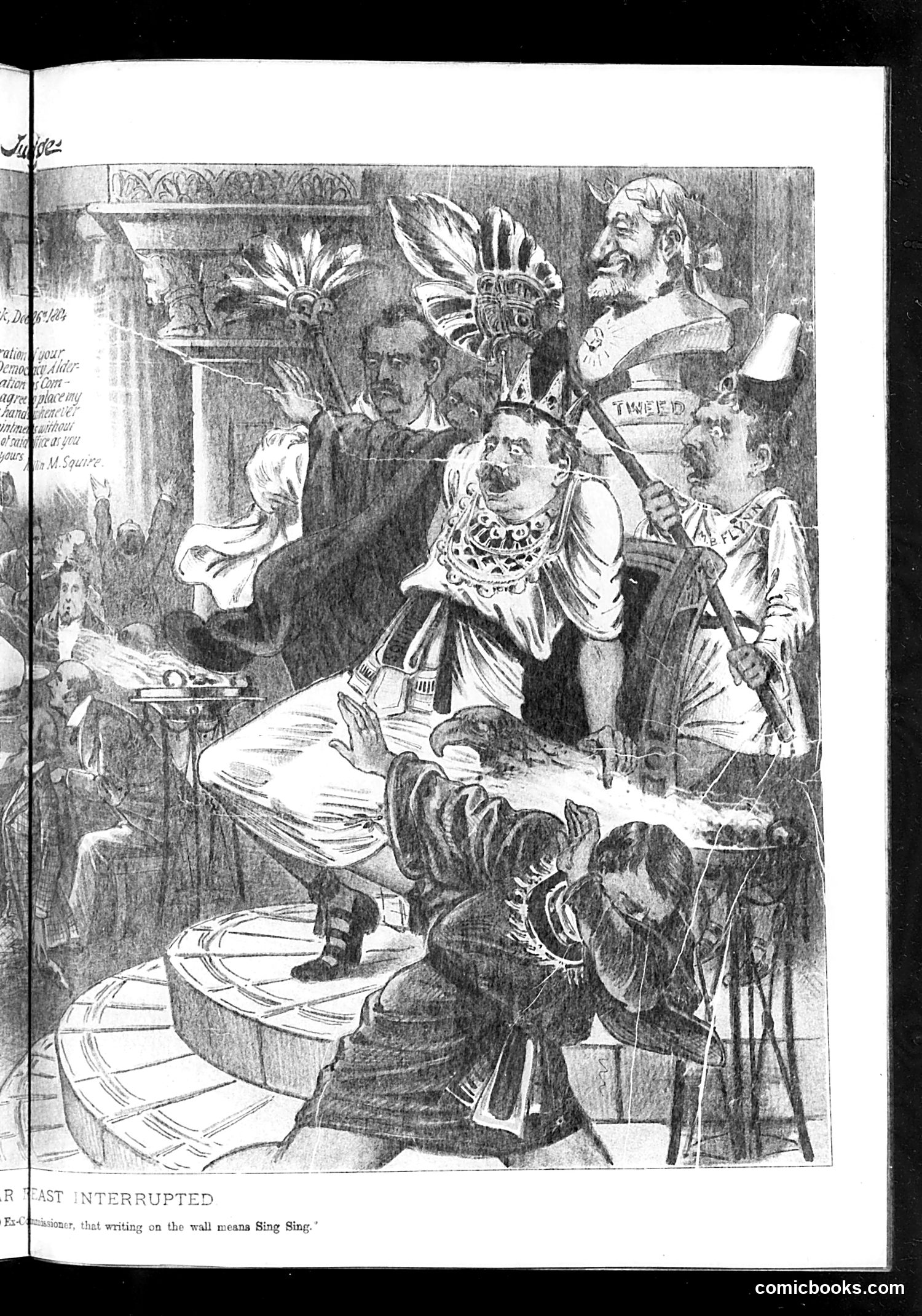
This appears to be a satirical cartoon depicting men in military or formal dress uniforms in what looks like an elegant dining setting. The partially visible caption references "Sing Sing" (a notorious New York prison) and "writing on the wall," suggesting a biblical reference to divine judgment or impending doom. The scene seems to satirize powerful or privileged figures being interrupted during a meal, with the "writing on the wall" serving as a warning of consequences. Without the complete caption and publication date, the specific political figures or events referenced remain unclear, though the tone suggests criticism of those in power facing accountability or retribution for their actions.
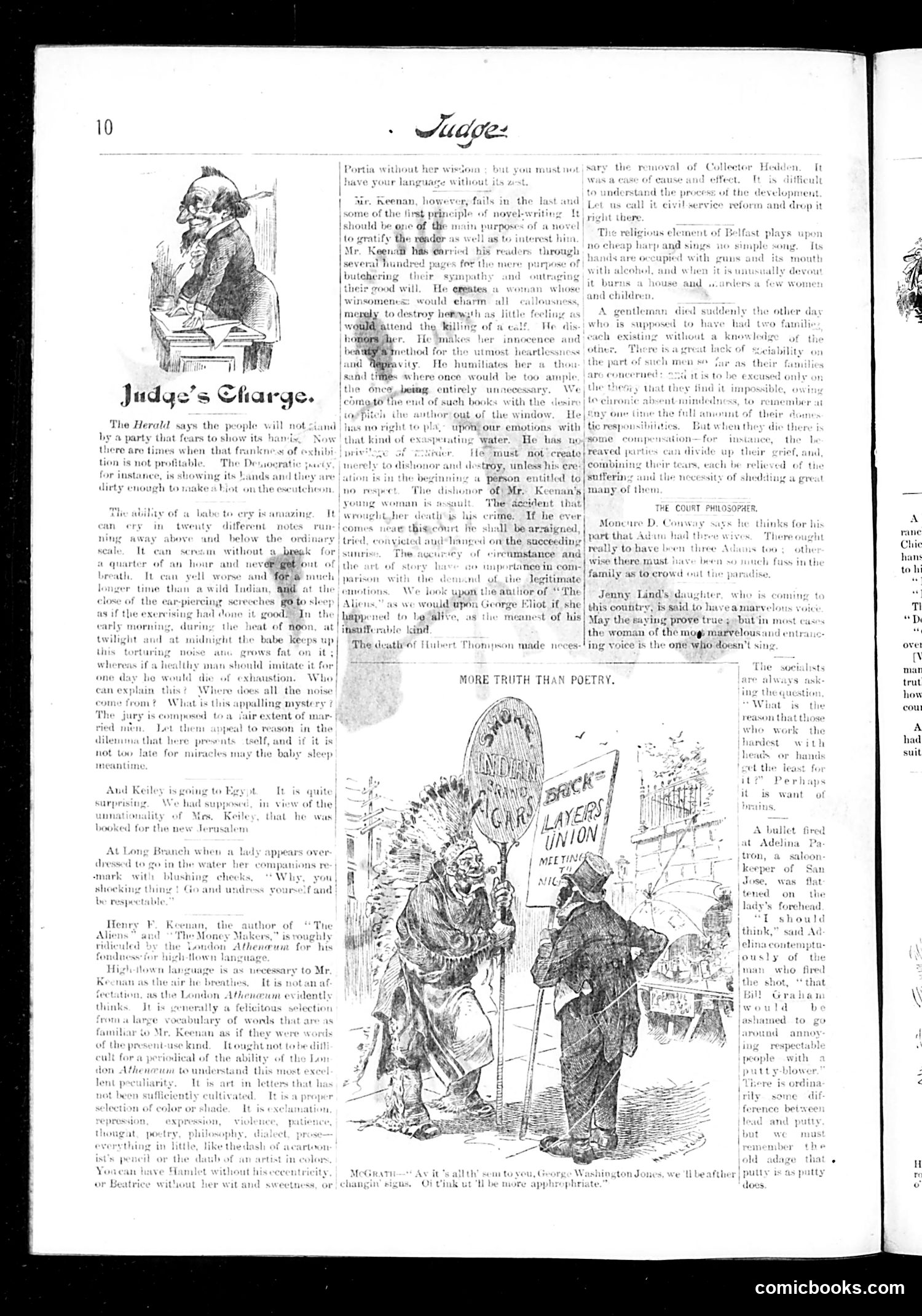
This page contains two distinct satirical pieces: **"Judge's Charge"** (left): A lengthy editorial critique of a novel by Mr. Keenan, arguing that sensational literature—designed merely to manipulate readers' emotions—lacks artistic merit. The satire targets both the author's cynical commercialism and readers' appetite for melodrama. The piece condemns books that destroy "innocence" through "heartless" manipulation rather than genuine artistic purpose. **"More Truth Than Poetry"** (right): The cartoon depicts labor unionists (marked with "BRICK LAYERS UNION" signage) as crude, aggressive figures. The satire suggests that workers' organized demands are uncivilized or unreasonable—a common anti-labor trope of the era. The contrast between the title and the brutish depiction implies that union activity represents blunt force rather than reasoned argument. Both pieces reflect Judge's conservative editorial stance: skepticism toward both sensationalist mass culture and working-class labor organizing.
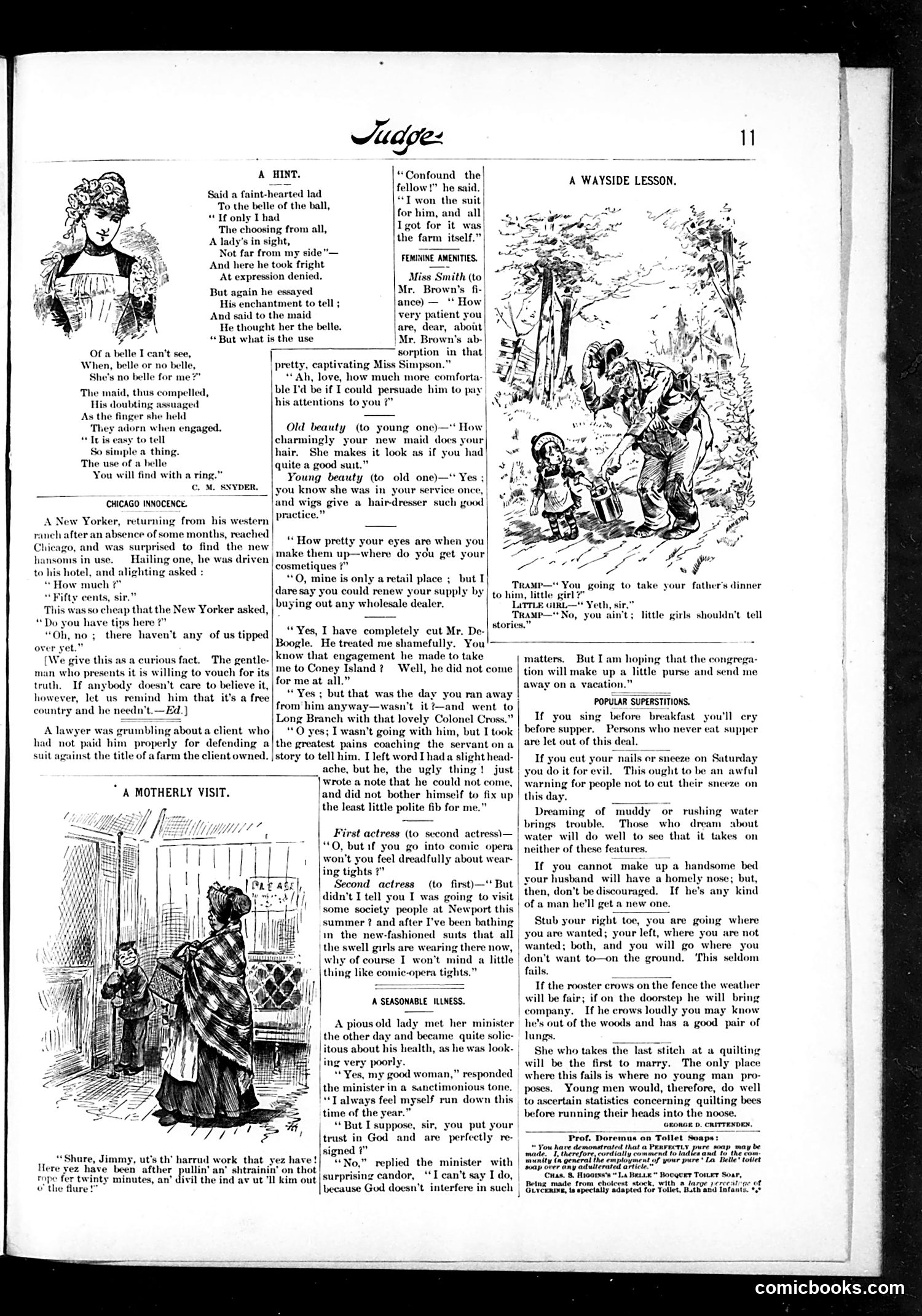
This page contains several satirical pieces typical of late 19th/early 20th-century humor: **"Chicago Innocence"** mocks the cultural difference between New York and Chicago. A sophisticated New Yorker is shocked that Chicago cab drivers don't expect tips—presenting the city as charmingly unsophisticated compared to Eastern standards. **"Feminine Amenities"** features exchanges between women that satirize vanity and cattiness. One woman jokes that her rival's maid is so skilled at hairdressing because practice with wigs taught her well—a backhanded insult suggesting the rival wears false hair. **"A Motherly Visit"** depicts an Irish immigrant mother visiting her son, using dialect humor typical of the era's working-class stereotyping. **"A Seasonable Illness"** satirizes a minister who, despite preaching faith in God, admits he doesn't trust divine providence regarding his health—hypocrisy dressed in sanctimoniousness. The various **"Popular Superstitions"** section offers folk wisdom and old wives' tales for readers' amusement. Overall, the page targets social pretension, female vanity, class differences, and religious hypocrisy through period-appropriate comedy.
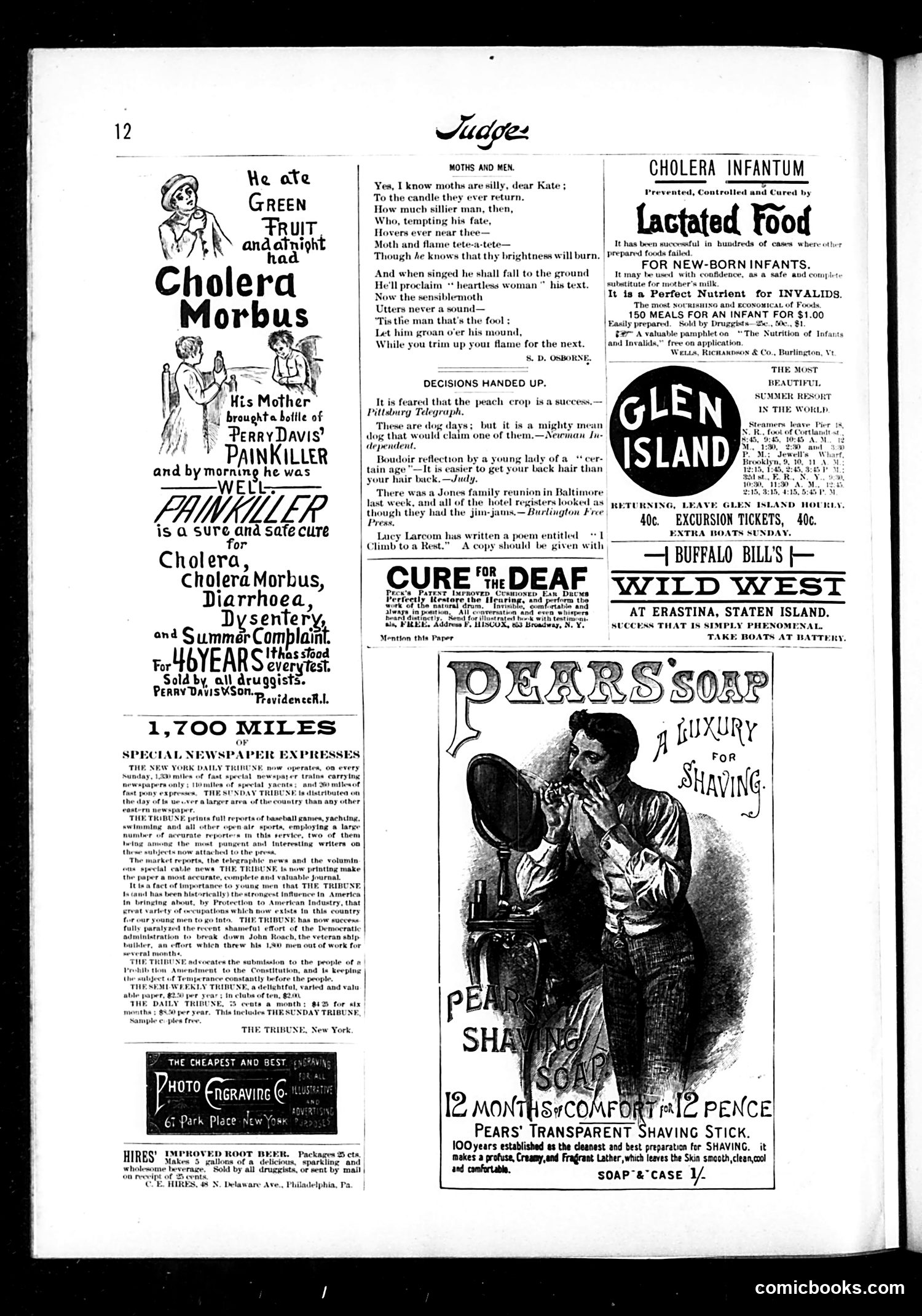
This page is primarily **advertising**, not political satire. The dominant content consists of patent medicine and product advertisements typical of late 19th-century publications. The upper left features a **Cholera Morbus advertisement** for Perry Davis' Painkiller, using crude illustrations of illness to market a cure-all remedy—common quackery of the era. The center contains a poem titled "**Moths and Men**" by S.D. Osborne, drawing a moral analogy: moths are foolish for flying into flames while men are the true fools for pursuing destructive temptations. This reflects Victorian moralizing about human weakness. Other advertisements include the **New York Daily Tribune** (promoting subscription), **Lactated Food** (infant formula), **Pears' Soap** (featuring a man shaving), and **Buffalo Bill's Wild West** show at Staten Island. The page demonstrates how Judge magazine balanced satirical content with commercial sponsorships. The moralizing poem represents the magazine's didactic tone, though satire itself is absent from this particular page.
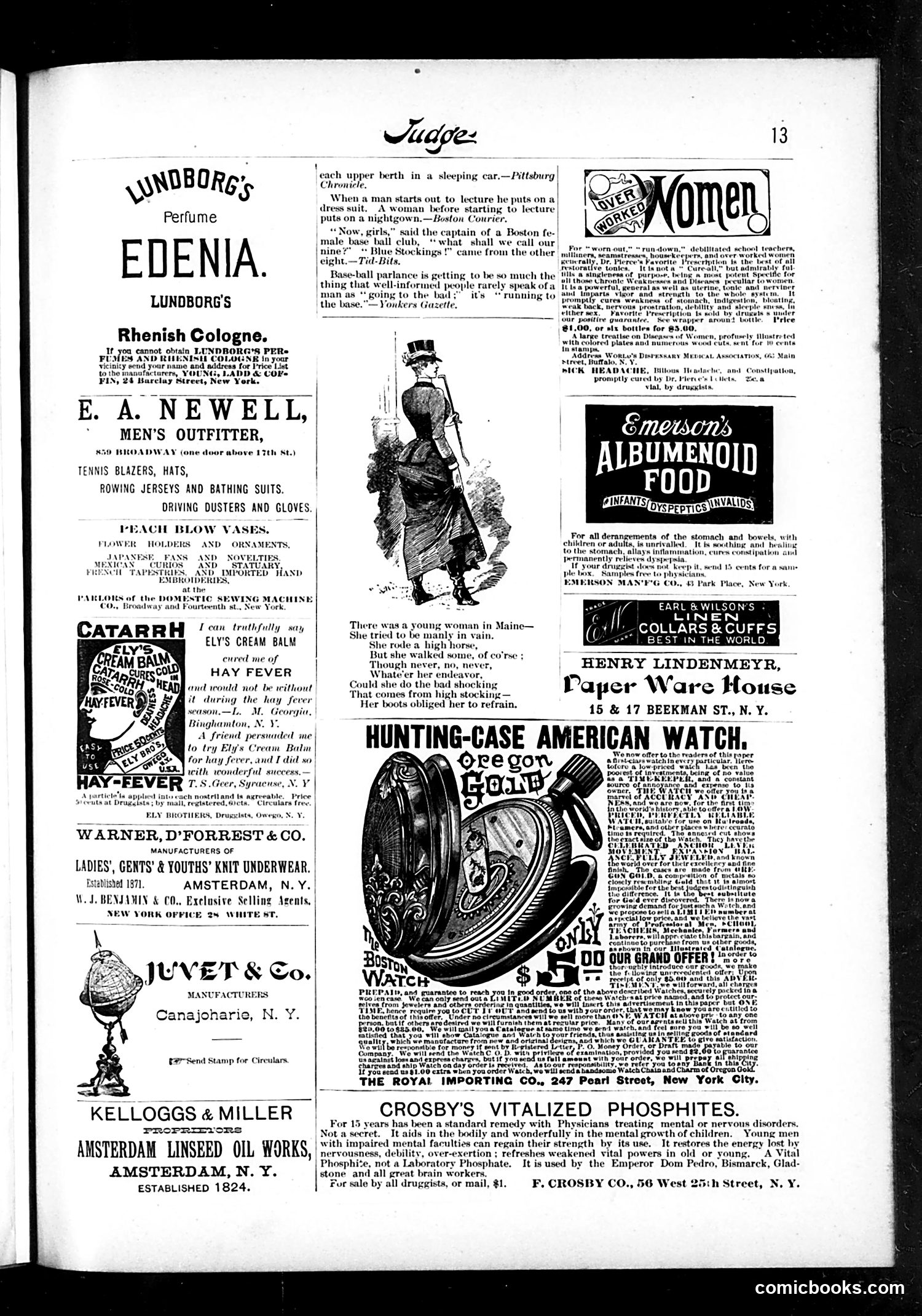
This page is primarily **advertisements** with minimal satirical content. The dominant visual element is a central illustration of a woman in Victorian dress riding a bicycle, accompanying a brief humorous verse about a young woman from Maine attempting masculine pursuits. The verse's joke concerns **gender roles and women's athletics**: she tries to be "manly," rides a horse, but ultimately cannot overcome the physical constraints of Victorian women's clothing—specifically her restrictive boots—which prevent her from engaging in "bad shocking" behavior (likely referring to scandalous or unladylike conduct). The satire is gentle social commentary on the **tension between women's expanding ambitions** (sports, outdoor activities) **and restrictive Victorian fashion and social expectations**. Her clothing literally prevents her from fully achieving masculine behavior, making her aspiration to be "manly" comically impossible. The surrounding advertisements (perfumes, men's outfitters, medical remedies) are unrelated to the cartoon's message. This reflects Judge's typical format of mixing satirical content with revenue-generating advertisements.
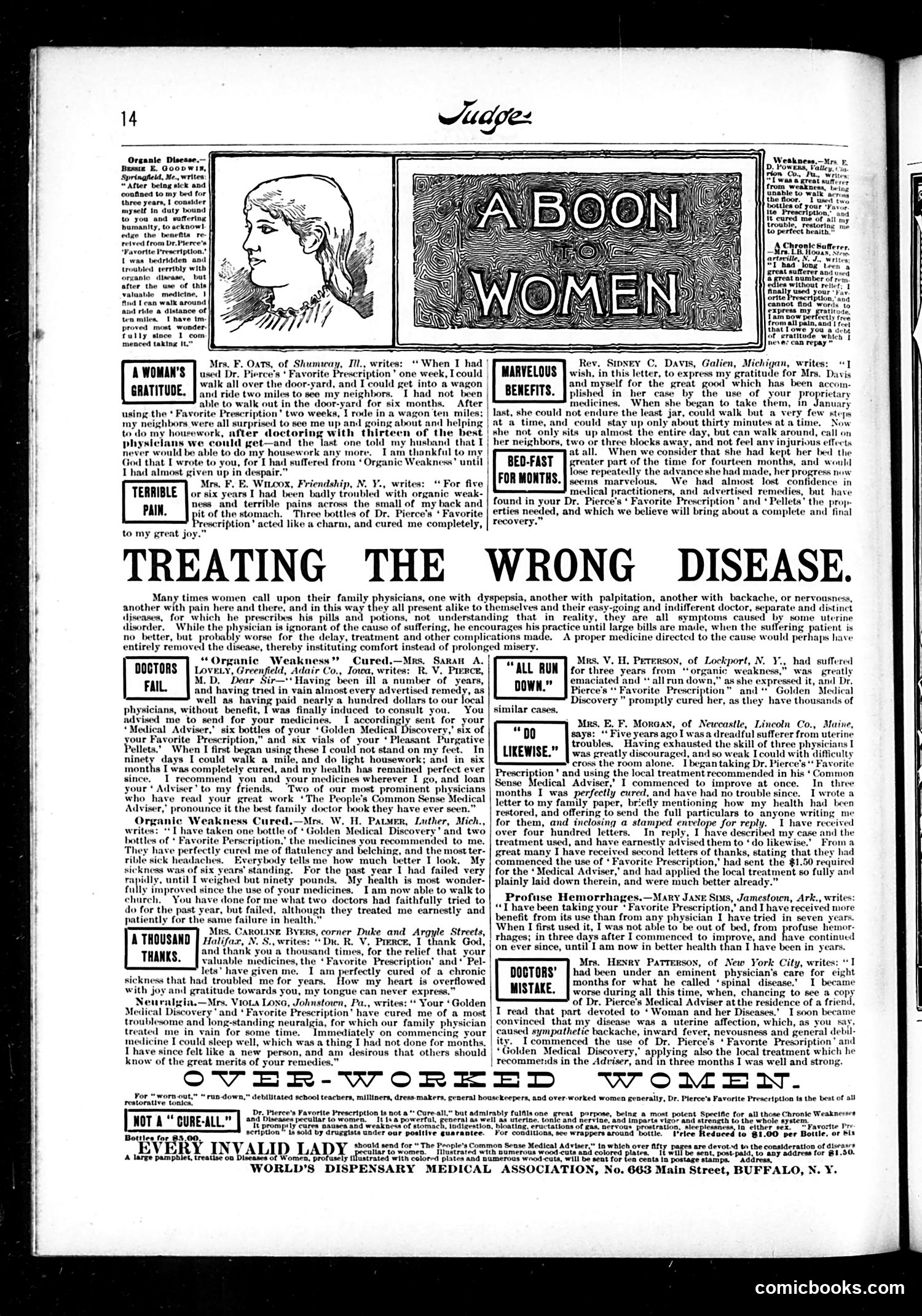
This is primarily **advertising content**, not political satire. The page promotes Dr. Pierce's "Favorite Prescription," a patent medicine marketed to women. ## The Content The large central headline—"TREATING THE WRONG DISEASE"—presents the medicine's sales pitch: women visit multiple doctors complaining of various ailments (weakness, pain, fatigue), but physicians misdiagnose them. Dr. Pierce's product supposedly identifies the *real* problem ("organic weakness") and cures it. ## The Testimonials Surrounding the headline are genuine-looking patient letters praising the medicine's effects—restoring mobility, ending bedridden states, allowing women to resume housework. These testimonials use emotional language ("I am thankful," "marvelous benefits") to build credibility. ## Historical Context for Modern Readers This reflects the **patent medicine era** (late 1800s-early 1900s), when unregulated remedies made extravagant, unproven claims. The targeting of women's health issues and the emphasis on "weakness" reflect period anxieties about female biology. The magazine's inclusion of such ads reveals how mainstream publications profited from—and legitimized—dubious medical claims before FDA regulation.
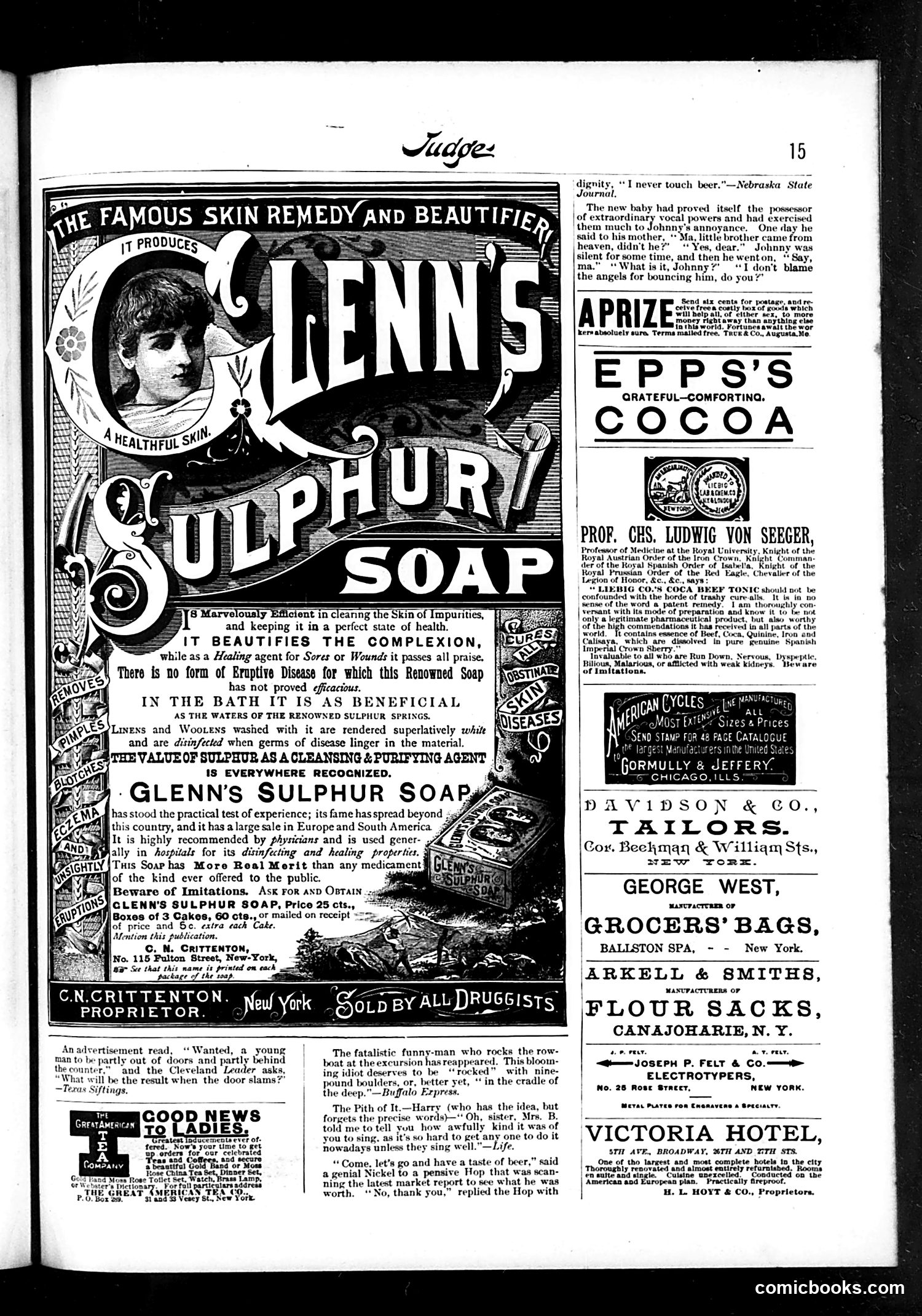
This page is primarily **advertisements and short humor items**, not a political cartoon requiring historical context. The main content includes: **Advertisements:** - Glenn's Sulphur Soap (large, prominent ad claiming medicinal/cosmetic benefits) - Epps's Cocoa - Liebig Co.'s Coca Beef Tonic - Various other product and service ads (tailors, hotels, grocers) **Humor Items:** Several brief, disconnected jokes about: - A young man working both outdoors and behind a counter - A "fatalistic funny-man" rocking a boat at an excursion - A conversation between "Harry" and "Mrs. B." about singing - A baby's loud crying ("I don't blame the angels for bouncing him") - A character called "Nickel" and "the Hop" discussing beer These jokes rely on wordplay and situational comedy but contain no clear political satire or social commentary requiring modern context. The page represents typical late-19th-century magazine filler combining advertisements with light, domesticated humor.
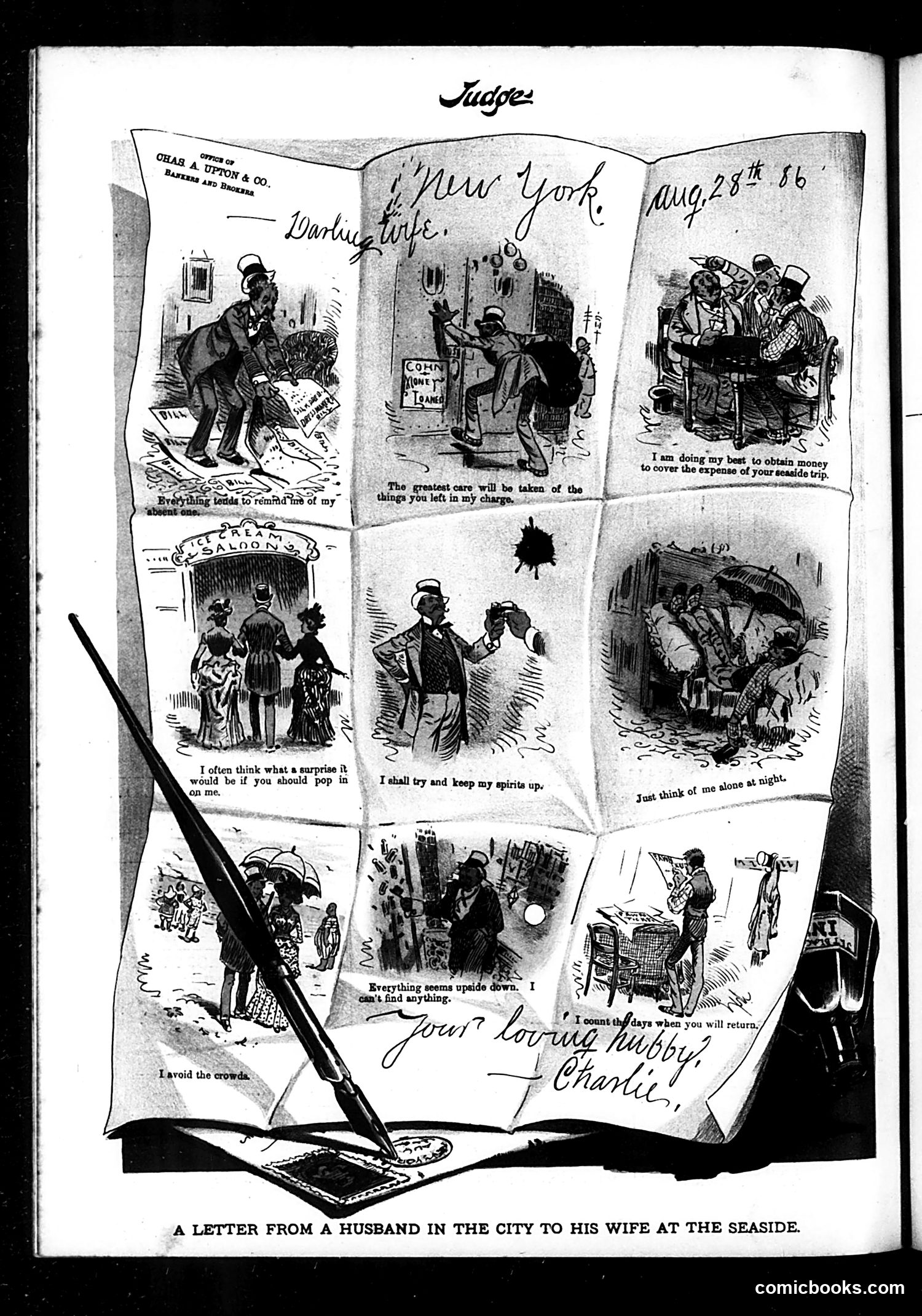
This 1896 Judge cartoon satirizes the financial strain of husbands left managing city life while wives vacation at seaside resorts—a leisure activity increasingly available to middle-class families. The letter's illustrations depict the husband's domestic chaos: managing household expenses, avoiding crowds, dealing with upside-down finances, struggling with loneliness, and counting days until her return. The satire targets both the husband's incompetence managing household affairs without his wife and the economic burden of fashionable seaside trips. The recurring plea to "obtain money to cover the expense" highlights anxieties about conspicuous consumption and wives' spending habits during the Gilded Age, when such resort visits represented status symbols. The tone is humorously sympathetic—portraying the abandoned, struggling husband as pitiful but somewhat deserving of his chaos.