
Judge, 1886-08-28 · page 3 of 16
Judge — August 28, 1886 — page 3: what you’re looking at
What you’re looking at
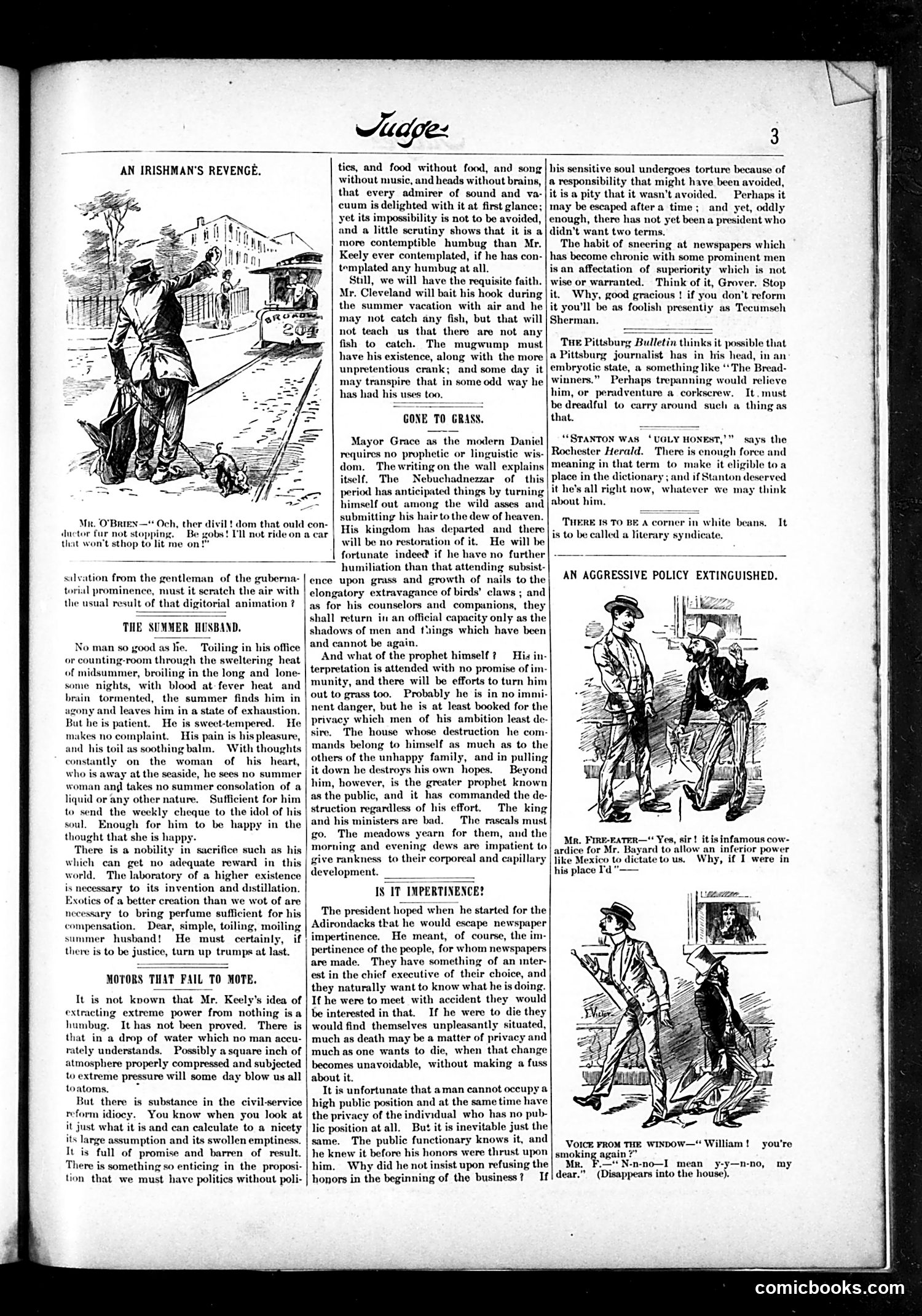
This page contains three distinct satirical pieces: **"An Irishman's Revenge"** (top): A cartoon mocking an Irish immigrant (Mr. O'Brien) who, spurned by a streetcar conductor, vows revenge—typical ethnic humor of the era, playing on Irish stereotypes and class tensions. **"Gone to Grass"** (middle): Compares Mayor Grace (of New York) to Nebuchadnezzar, the biblical king who went mad and ate grass. The satire suggests Grace has voluntarily removed himself from power, his "kingdom departed." This references an actual political downfall or disgrace. **"The Summer Husband"** (bottom): Mocks the devoted husband left in the hot city while his wife vacations at the seaside, presenting his self-sacrifice as both noble and absurd—satirizing sentimental domestic ideals. The page also discusses civil-service reform and Keely's perpetual-motion machine as empty political/scientific promises, typical Judge targets of ridicule.
📄 Transcribed text from this page (OCR, searchable)
Machine-transcribed from the original scan — historical spelling and the odd misread are preserved.
3 AN IRISHMAN'S REVENGE. Mn. O'BriEN—“ Och, ther div’ ductor fur not stopping. Be that won't sthop to lit me on! ! dom that ould con- obs! I'll not ride on a car tics, and food without food, and song without music, and heads without brains, that every admirer of sound and va- cuum is delighted with it at first glance; yet its impossibility is not to be avoided, and a little scrutiny shows that it is a more contemptible humbug than Mr. Keely ever contemplated, if he has con- templated any humbug at all. Still, we will have the requisite faith. Mr. Cleveland will bait his hook during the summer vacation with air and he may not catch any fish, but that will not teach us that there are not any fish to catch. The mugwump must have his existence, along with the more unpretentious crank; and some day it y transpire that in some odd way he has had his uses toc GONE TO GRASS. Mayor Grace as the modern Dani requires no prophetic or linguistic dom. Thewriting on the wall explains itself. The Nebuchadnezzar of this period has anticipated things by turning himself out among the wild asses and submitting his hair to the dew of heaven. His kingdom has departed and there will be no restoration of it. He will be fortunate indeed if he have no further silvation from the gentleman of the guberna- torial prominence, must it scratch the air with the usual result of that digitorial animation ? THE SUMMER Il D. No man so good as lie. Toiling in his office counting-room through the sweltering heat of midsummer, broiling in the long and lone- some nights, with blood at-fever heat and brain tormented, the summer finds him in agony and leaves him in a state of exhaustion. But he is patient. He is swect-tempered. He makes no complaint. His pain is his pleasure, and his toil as soothing balm. With thoughts constantly on the woman of his heart, who is away at the seaside, he sees no summer woman and takes no summer consolation of a liquid or any other nature. Sufficient for him to send the weekly cheque to the idol of his | soul, Enough for him to be happy in the thought that she is happy. There is a nobility in sacrifice such as his which can get no adequate reward in this world, The laboratory of a higher existence is necessary to its invention and distillation. Exotics of a better creation than we wot of are to bring perfume sufficient for his compensation. Dear, simple, toiling, moiling summer husband! He must certainly, if there is to be justice, turn up trumps at last. MOTORS THAT PAIL TO MOTE. not known that Mr. Keely’s idea of extracting extreme power from nothing isa humbug. It has not been proved. There is that in a drop of water which no man accu- rately understands. Possibly a square inch of atmosphere properly compressed and subjected to extreme pressure will some day blow us all toatoms. é But there is substance in the civil-service reform idiocy. You know when you look at it just what it is and can calculate to a nicety its large assumption and its swollen emptiness. It is full of promise and barren of result. There is something so enticing in the proposi- tion that we must have politics without poli- | it down he destroys his own hopes. humiliation than that attending subsis ence upon grass and growth of nails to the elongatory extravagance of birds’ claws ; and as for his counselors and companions, they shall return in an official capacity only as the shadows of men and things which have been and cannot be again. And what of the prophet himself? His in- terpretation is attended with no promise of im- munity, and there will be efforts to turn him out to grass too. Probably he is in no immi- nent danger, but he is at least booked for the privacy which men of his ambition le sire. The house whose destruction he | mands belong to himself as much as to the others of the unhappy family, and in pulling Beyond him, however, is the greater prophet known as the public, and it has commanded the de- struction regardless of his effort. The king and his ministers are bad. — The rascals must go. The meadows yearn for them, and the morning and evening dews are impatient to give rankness_ to their corporeal and capillary development. IS IT IMPERTINENCE? The president hoped when he started for the Adirondacks that he would escape newspaper impertinence. He meant, of course, the im- pertinence of the people, for whom newspapers are made, They have something of an inter- est in the chief executive of their choice, and they naturally want to know what he is doing. If he were to meet with accident they would be interested in that. If he were to die they would find themselves unpleasantly situated, much as death may be a matter of privacy and much as one wants to die, when that change becomes unavoidable, without making a fuss about it. It is unfortunate that aman cannot occupy a high public position and at the same time have the privacy of the individual who has no pub- lic position at all. But it is inevitable just the same. The public functionary knows it, and he knew it before his honors were thrust upon him. Why did he not insist upon refusing the honors in the beginning of the business? If his sensitive soul undergoes torture because of a responsibility that might have been avoided, it is a pity that it wasn’t avoided. Perhaps it may be escaped after a time; and yet, oddly enough, there has not yet been a president who didn’t want two terms. The habit of sneering at newspapers which has become chronic with some prominent men isan affectation of superiority which is not wise or warranted. Think of it, Grover. Stop it. Why, good gracious ! if you don't reform it you'll be as foolish presentiy as Tecumseh Sherman. Tue Pittsburg Bulletin thinks it possible that a Pittsburg journalist has in his head, in an embryotic state, a something like ‘‘The Bread- winners.” Perhaps trepanning would relieve him, or peradventure a corkscrew. It. must be dreadful to carry around such a thing as that. “STANTON WAS ‘UGLY HONEST,’” says the Rochester Herald. There is enough force and meaning in that term to make it eligible toa place in the dictionary ; and if Stanton deserved it he's all right now, whatever we may think about him. THERE 18 TO BE A corner in white beans. is to be called a literary syndicate. It Mr. Fire-katrr—“ Yes, sir! it is infamous cow- ardice for Mr. Bayard to allow an inferior power ike Mexico to dictate to us. Why, if I were in place I'd” Voice FROM THE WINDow—“ William ! smoking again Mr, F<" Nen-no—I_ mean (Disappears into the house you're n-no, my dear.” comicbooks.com