
A complete issue · 16 pages · 1886
Judge — July 24, 1886
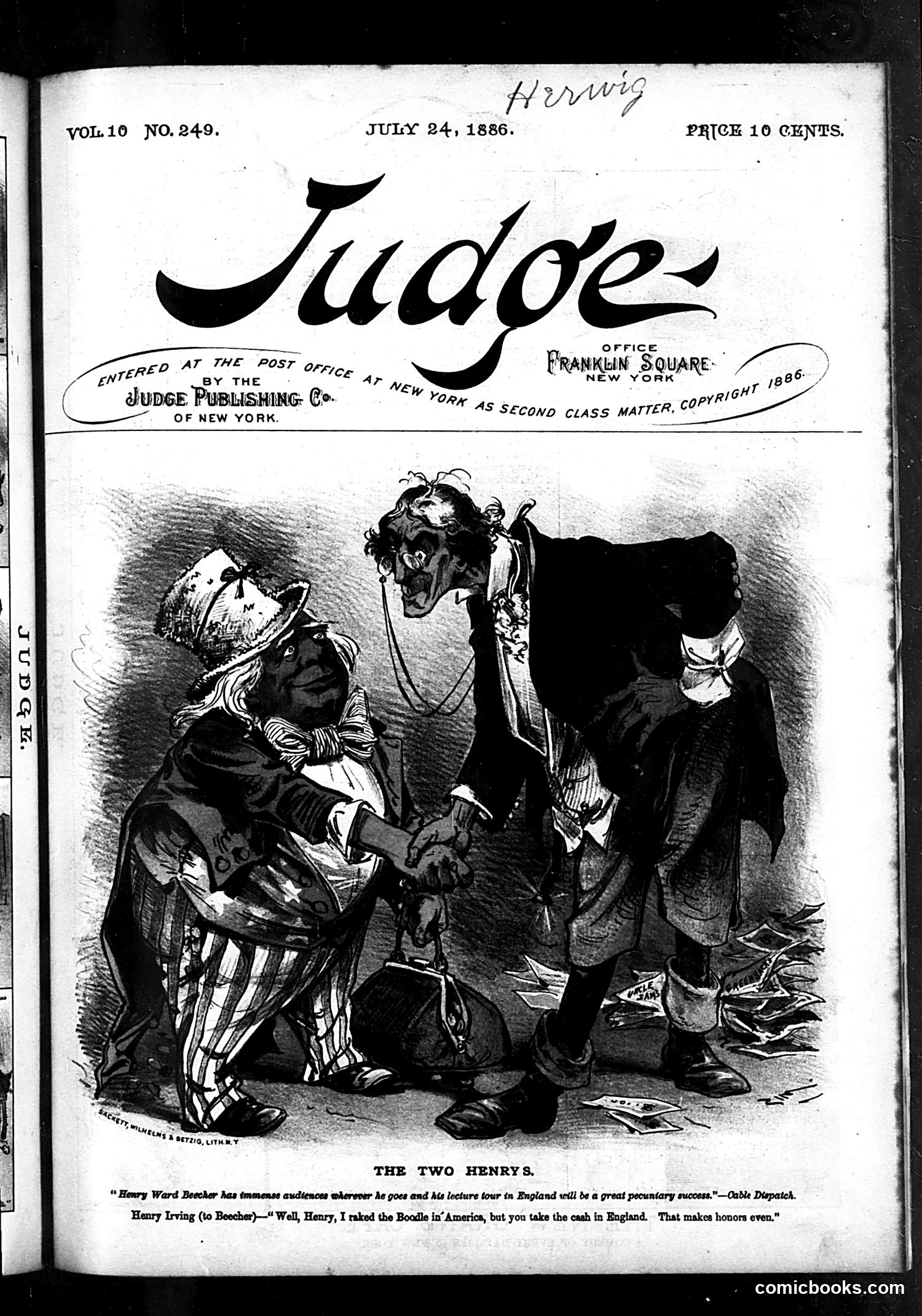
This cartoon satirizes two famous Henrys competing for American audiences. The caption references **Henry Ward Beecher**, a prominent preacher drawing large crowds, and **Henry Irving**, a renowned British actor. The joke plays on Irving's comment (shown in dialogue): he claims to have "took the Boodle in America, but you take the cash in England"—suggesting Irving earned money in America while Beecher profited in England. The cartoon depicts them as rival performers vying for public attention and financial success. This reflects 1880s transatlantic cultural competition, when celebrity lectures and theatrical tours were lucrative enterprises. The "Boodle" reference may allude to financial gain or corruption-tinged profit-making.
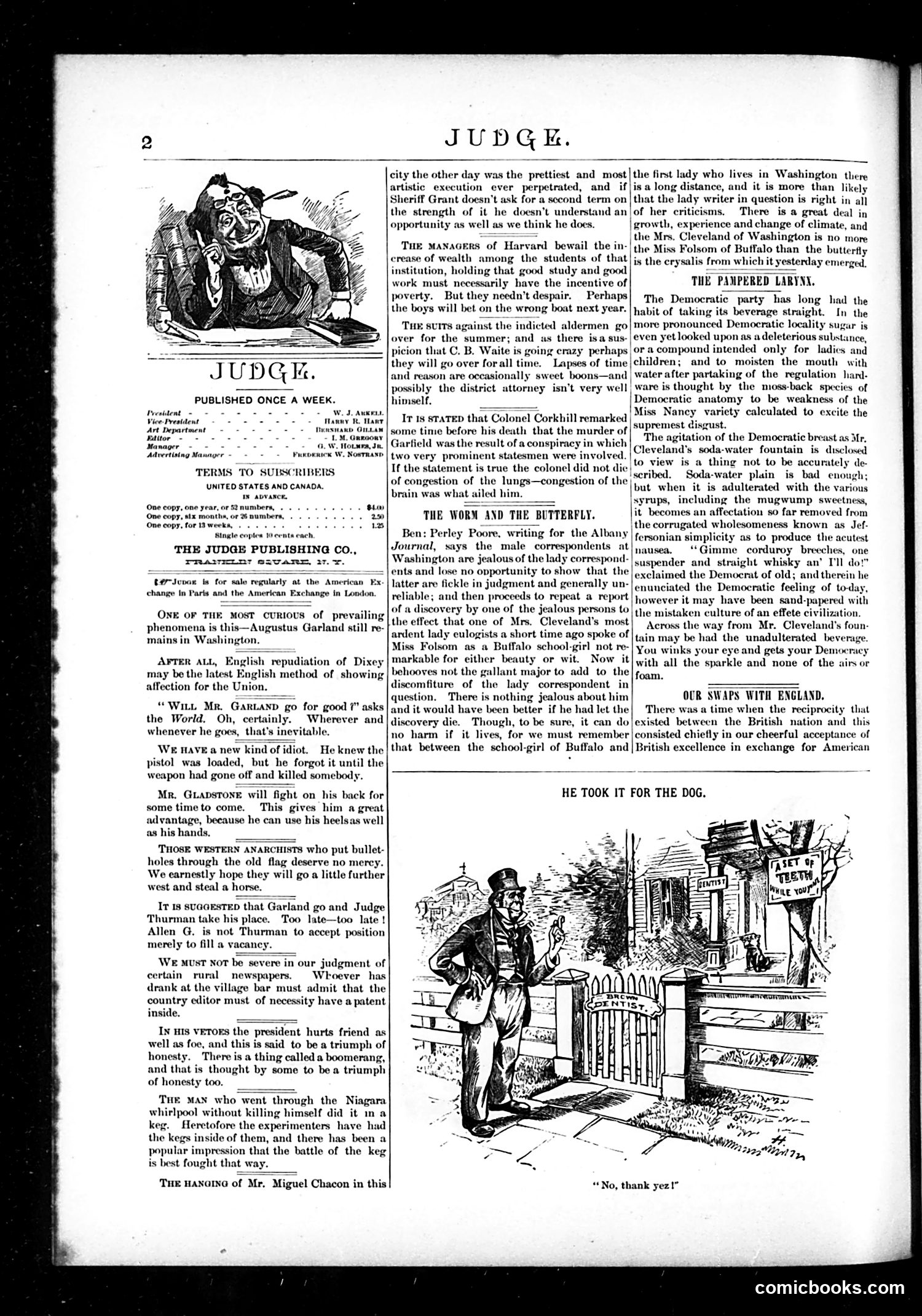
This cartoon satirizes a common urban scenario: a well-dressed man stands outside a dentist's office, having apparently just exited. The caption "No, thank yer!" suggests he's refusing something—likely the dentist's bill or follow-up treatment recommendation. The joke plays on working-class anxiety about dental costs and formal procedures. The man's shabby appearance contrasts with the respectable professional setting, implying he's uncomfortable or out of place in such establishments. The title suggests he may have misunderstood his visit's purpose or is making an excuse to avoid payment, treating the whole affair dismissively—"taking it for the dog" (colloquial for dismissing something as worthless or insignificant). The humor derives from class-based assumptions about attitudes toward professional services.
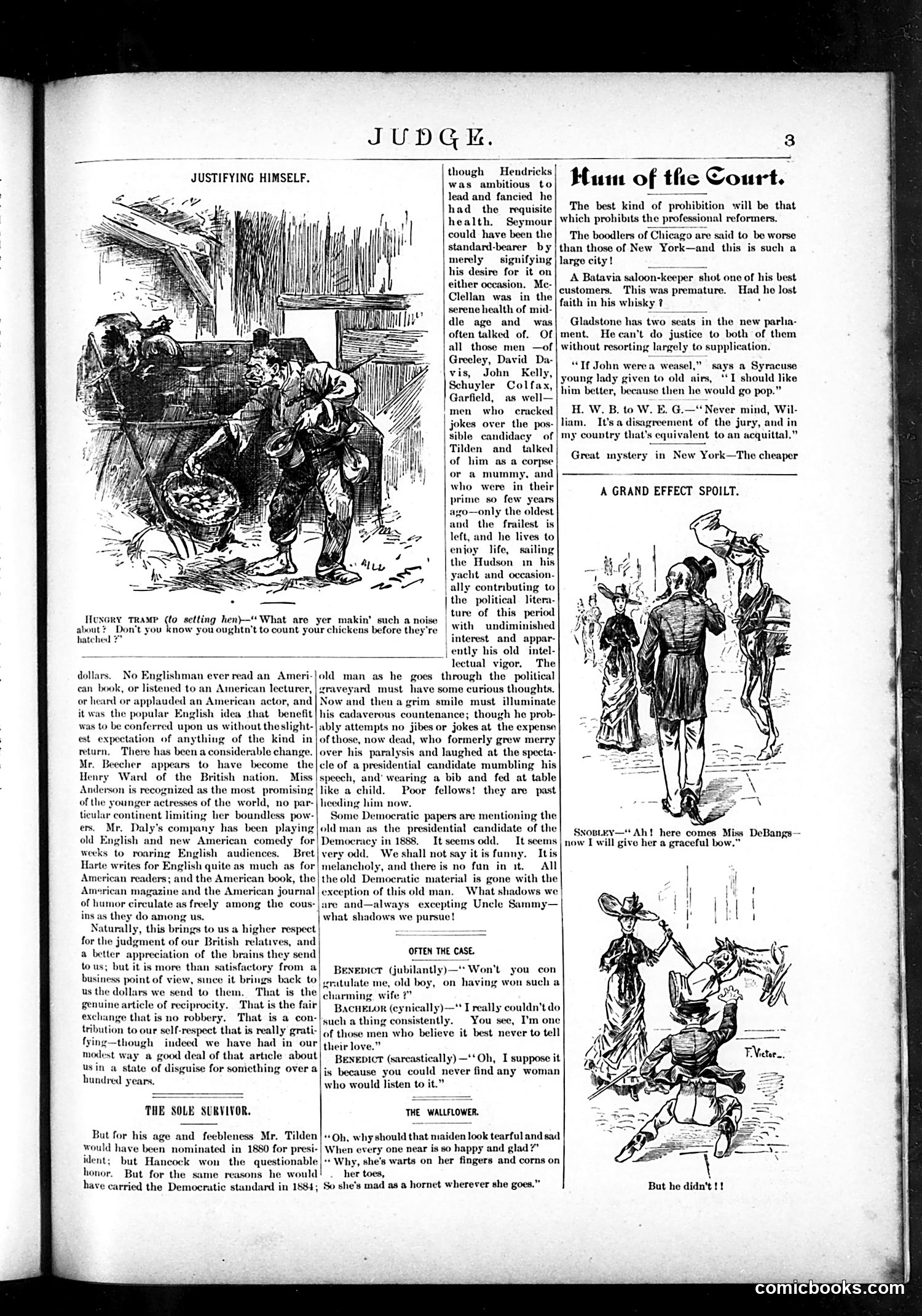
This page contains several distinct satirical pieces about American politics and society. **"Justifying Himself"** (left): A tramp defends making noise by comparing himself to a hen counting chickens before they hatch—a commentary on premature political calculations or counting victories too early. **"The Sole Survivor"** (main text): This discusses Samuel J. Tilden, the elderly former Democratic presidential candidate from 1876. The article mocks that Democrats might nominate him again in 1888 despite his advanced age and poor health. It notes the irony that Tilden—whom political rivals had ridiculed for appearing frail and incompetent (needing a bib at table)—outlived his younger, healthier critics. The satire emphasizes the absurdity of considering such an elderly, infirm candidate. **Right-side cartoons**: Appear to depict social comedy involving courtship and marriage conversations, with typical Victorian-era humor about romantic entanglements. The page reflects Judge's typical blend of political commentary and domestic humor targeting 1880s American audiences.
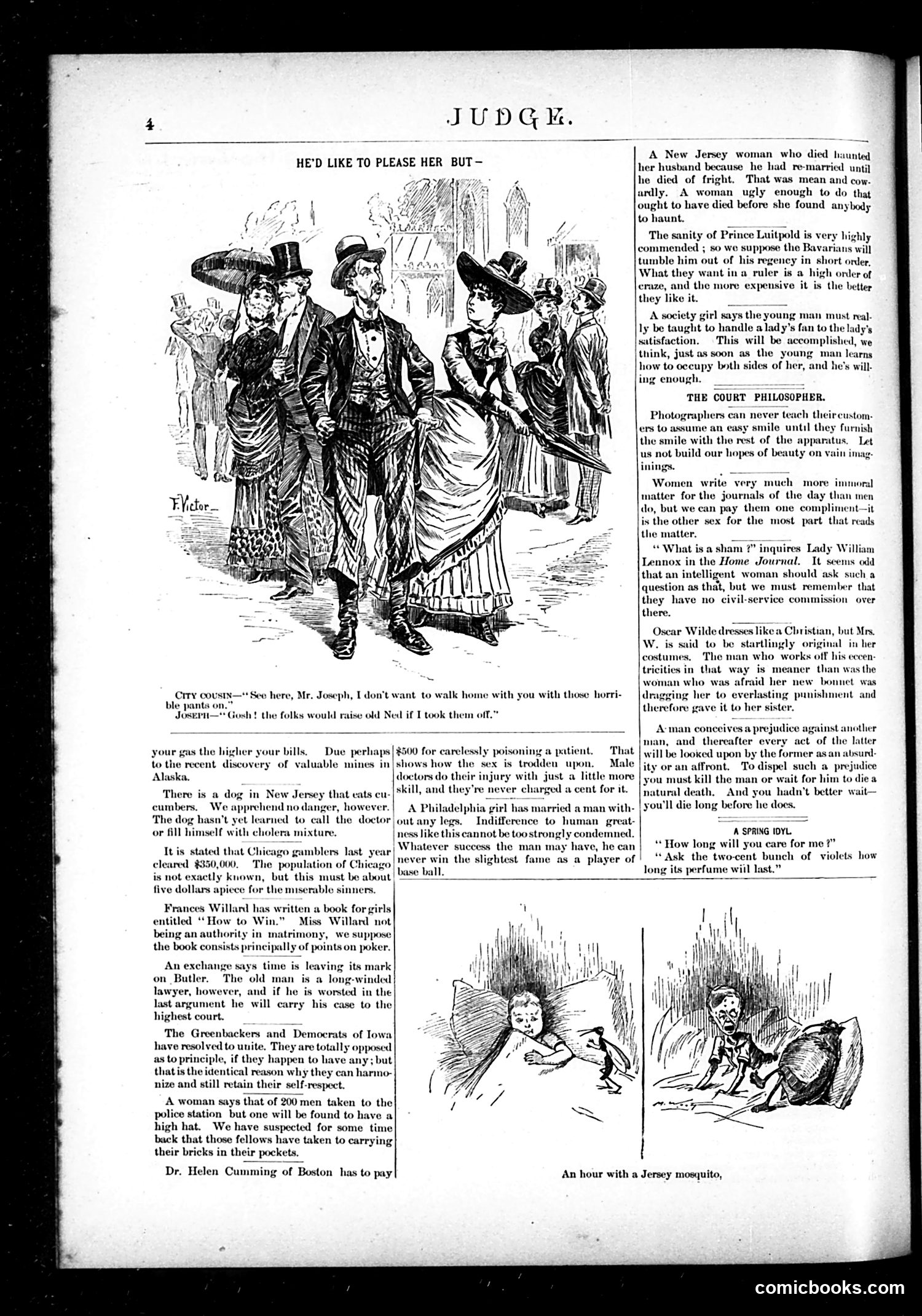
This page from **Judge** magazine (a late-19th-century American satirical publication) contains various brief satirical observations and two cartoons mocking social customs and notable figures of the era. **Key satirical points:** - **Oscar Wilde reference**: Mocks Wilde's flamboyant dress while criticizing his wife's alleged originality, suggesting she vindictively gave away her new bonnet rather than wear it herself—portraying both as ridiculous. - **"He'd Like to Please Her But—"** (top cartoon): Shows a man reluctant to be seen publicly with a woman, likely satirizing social pretension and courtship anxieties among the fashionable classes. - **"An Hour with a Jersey Mosquito"** (bottom cartoon): Depicts the discomfort of mosquito bites, a relatable domestic annoyance. The page also contains satirical quips about women writers, Philadelphia women marrying disabled men, and political figures (Prince Luitpold's sanity). The overall tone reflects Judge's brand of urbane, somewhat misogynistic social commentary typical of the period.
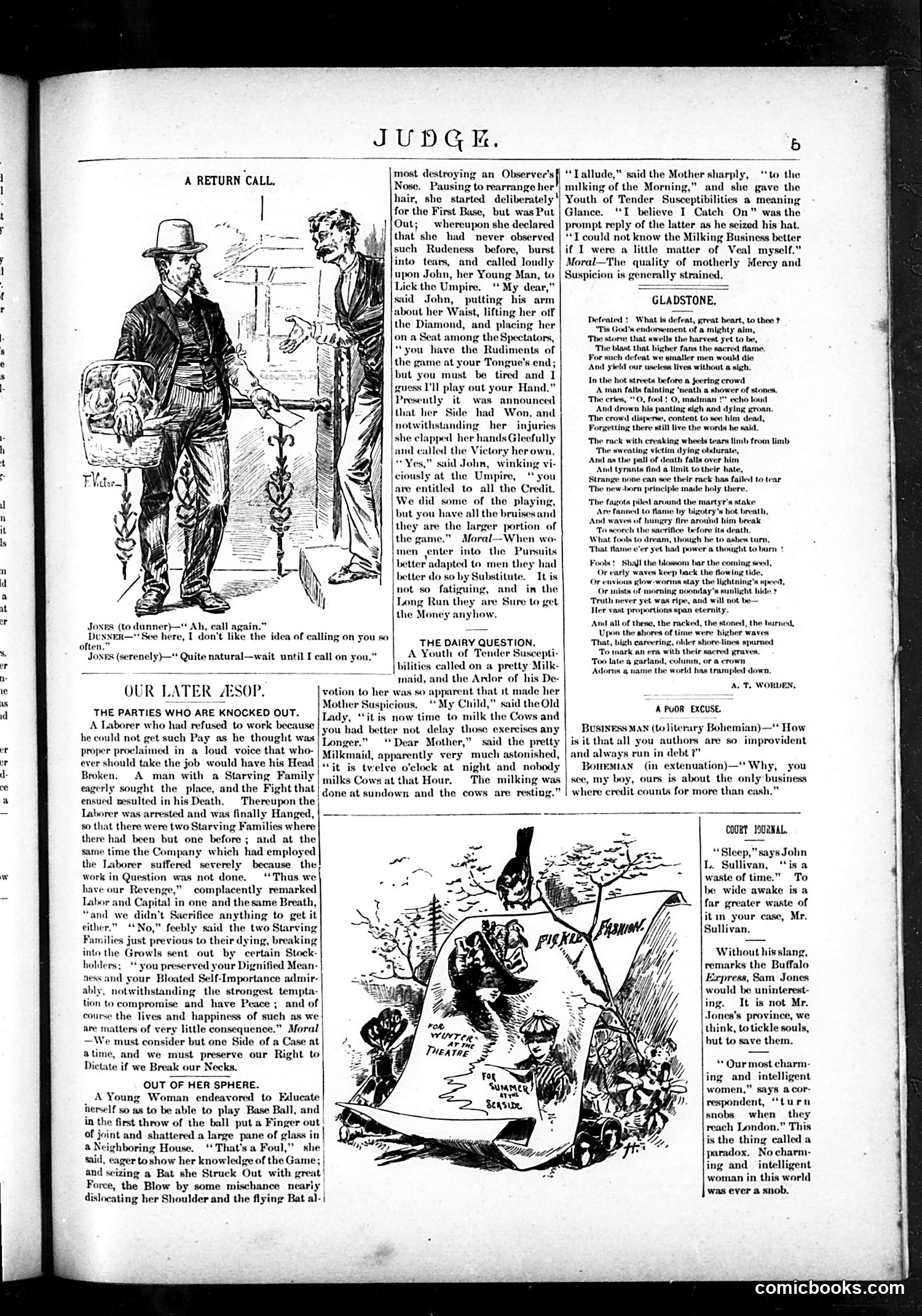
This page contains three satirical moral fables in "Judge's" signature style: **"A Return Call"** (top): A simple dunning joke—a creditor warns a debtor he'll call again; the debtor threatens to call on *him* first, implying violence. It's dark comedy about class conflict. **"Our Later Aesop"** (center): The main piece criticizes both labor and capital. A striking worker kills a desperate replacement worker; both families starve, stockholders profit. The moral: both sides refuse compromise over human suffering. This reflects 1880s labor violence and disputes. **"Out of Her Sphere"** (right): A woman injures an umpire playing baseball, then complains about his "rudeness." Her boyfriend removes her, suggesting women shouldn't attempt men's activities—they lack capability. The moral mocks women's athletics as impractical. **"The Dairy Question"** (bottom right): A young man visits a milkmaid at noon; her mother suspects romance and sends him away, claiming cows are milked at sundown (false), establishing a pretext to separate them. It satirizes maternal suspicion of courtship. The page critiques labor strife, gender roles, and hypocrisy.
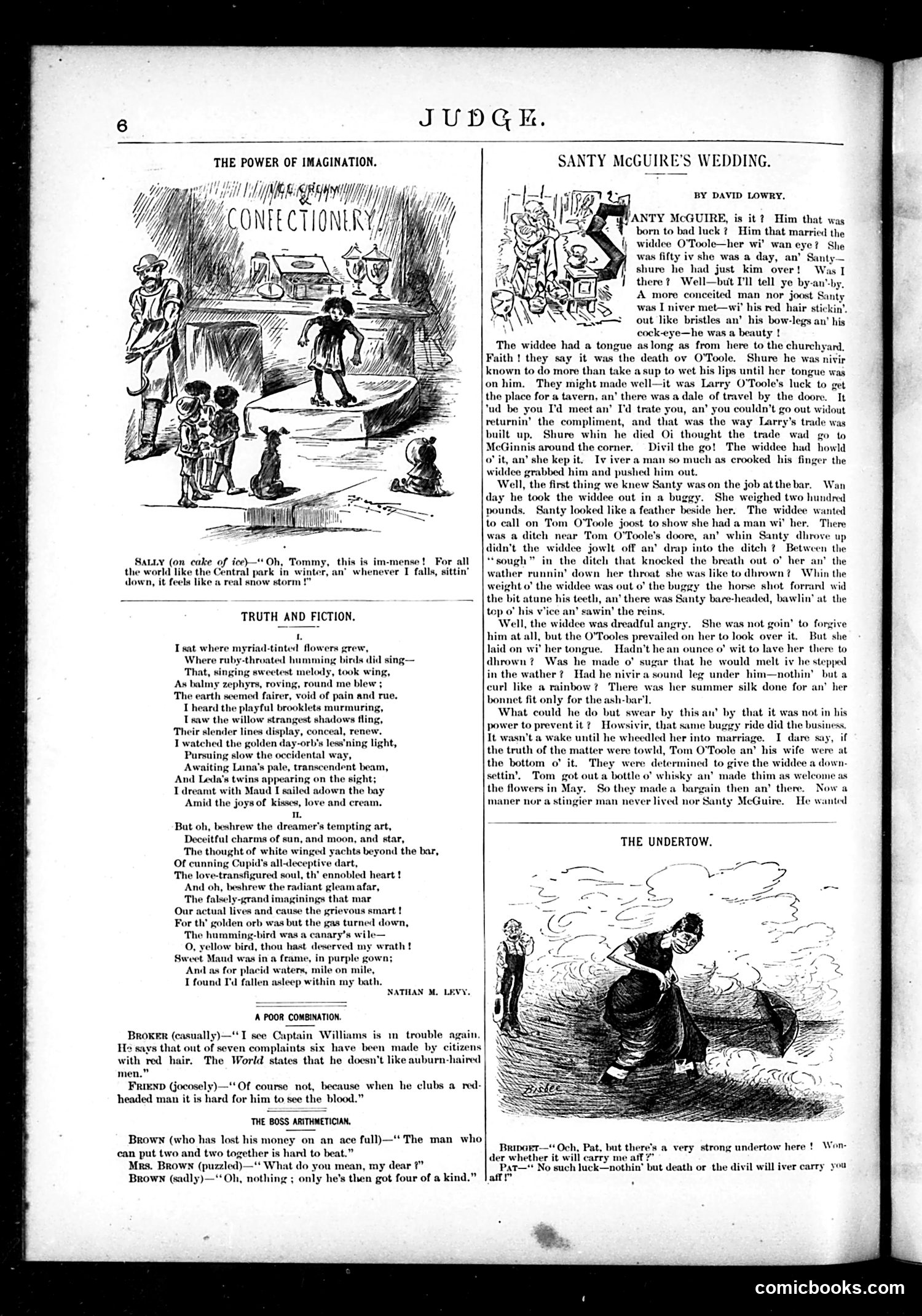
**"The Power of Imagination"** (top left): A simple visual gag showing a child (Sally) on a cake of ice at a confectionery, imagining it's Central Park in winter. The humor lies in childhood imagination transforming an ordinary dessert into an elaborate winter scene. **"Truth and Fiction"**: A romantic poem contrasting idealized daydreams with mundane reality—the speaker fantasizes about natural beauty and romance with "Maud," only to awaken in a bathtub. The satire mocks sentimental Victorian poetry and the gap between romantic ideals and everyday life. **"A Poor Combination"** and **"The Boss Arithmetician"**: Brief joke items about a man disliking redheads and someone unable to do basic math—light humor with no obvious political content. **"Santy McGuire's Wedding"** (right): An Irish-dialect narrative story (by David Lowry) about an awkward marriage between the ungainly Santy and a domineering widow. This appears to be serialized humorous fiction, likely containing ethnic stereotypes typical of the era. **"The Undertow"**: An illustration accompanying the wedding story (unclear narrative function from this page alone).
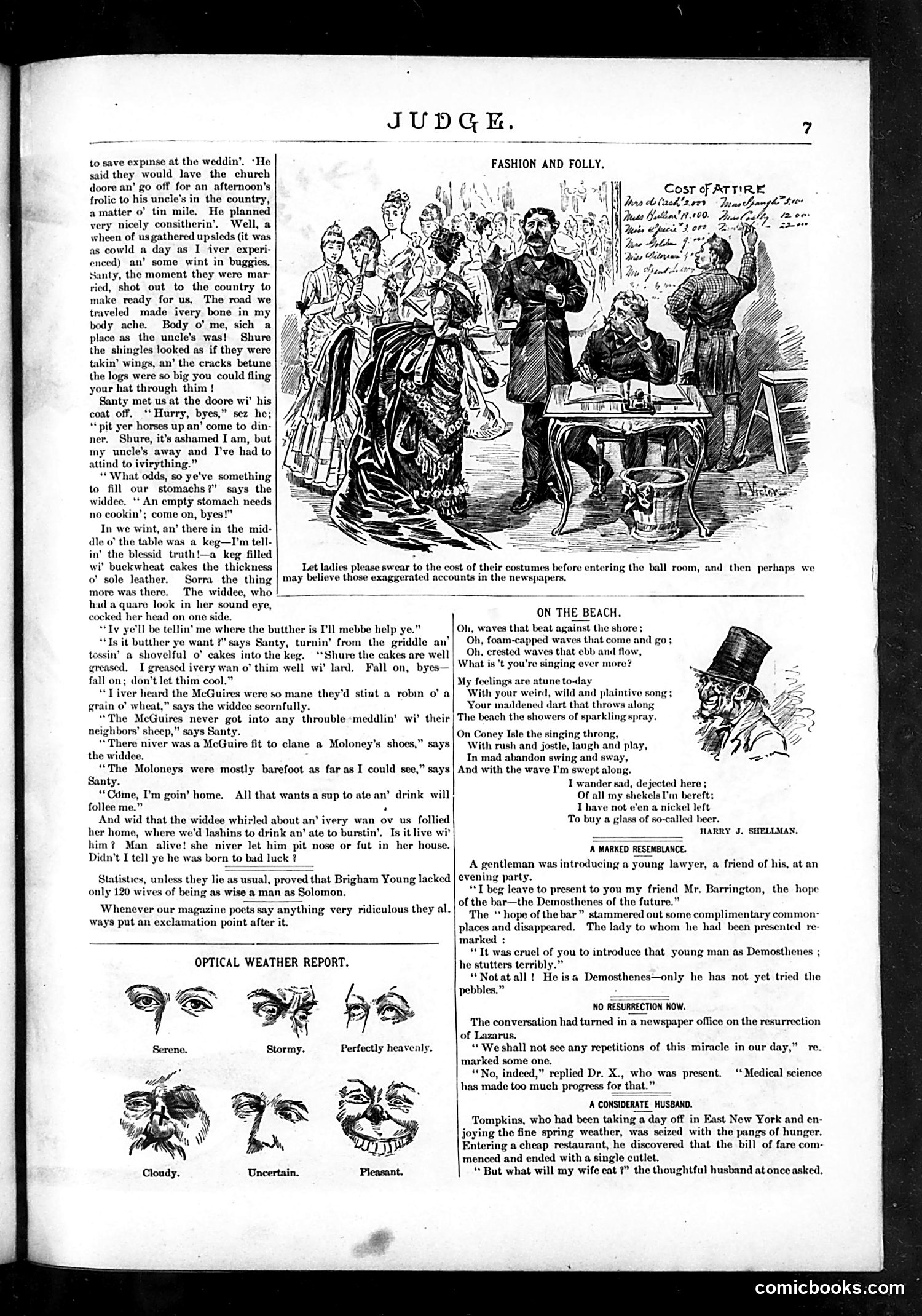
This page from *Judge* satirizes Irish-American rural life and social pretension through two main pieces: **"Fashion and Folly" cartoon:** Mocks wealthy women's exaggerated claims about dress costs. The illustration shows fashionably dressed ladies entering a ball, with accompanying handwritten "cost" annotations. The caption sarcastically suggests ladies should swear to their costume expenses before entering, implying the newspaper society accounts of dress costs are wildly inflated lies. **Main story:** A lengthy anecdote (in Irish dialect) about a miserly wedding celebration where the groom serves *only* buckwheat cakes with lard—no butter—to guests. When a widow guest complains, she and the other guests leave in protest, refusing to let the groom visit her home. The humor mocks both cheap hospitality and rural Irish behavior, while the dialect itself was typical *Judge* ethnic comedy. The page also includes minor humorous items about weather ("optical weather report" with facial expressions) and a brief joke about Brigham Young's polygamy, reflecting common 19th-century anti-Mormon sentiment.
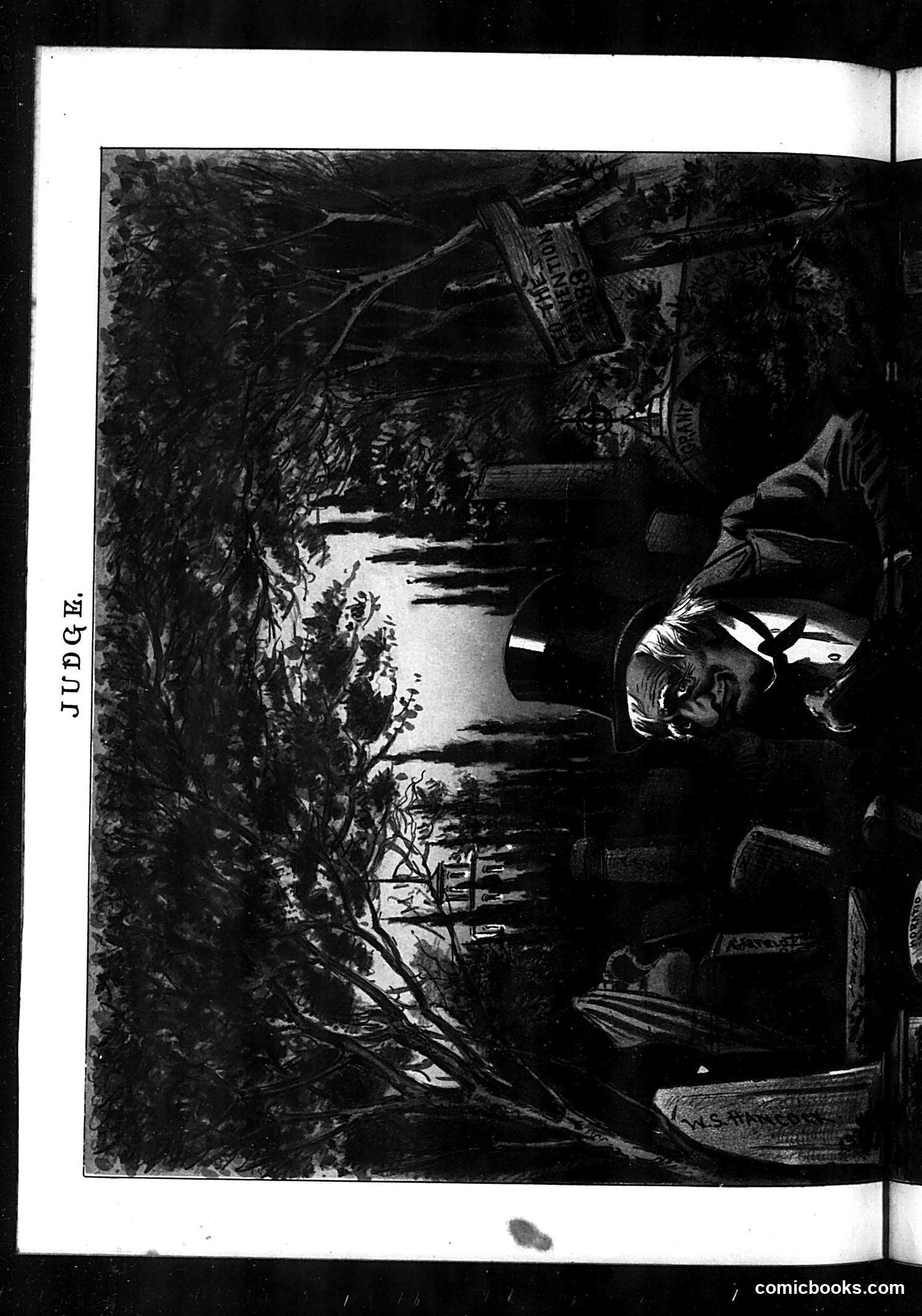
This appears to be a page from *Judge* magazine (visible in left margin), but the image is heavily degraded and rotated, making definitive analysis difficult. The OCR text provides minimal content beyond the source attribution. The photograph shows what appears to be a person in formal attire examining or interacting with natural elements (vegetation, possibly water), but the specific context, date, and satirical point are unclear from this reproduction quality. Without legible text or clearer imagery, I cannot confidently identify the figures, political references, or intended satire. The page may contain a political cartoon or social commentary typical of *Judge's* satirical format, but the specifics are not reliably discernible from this source material.
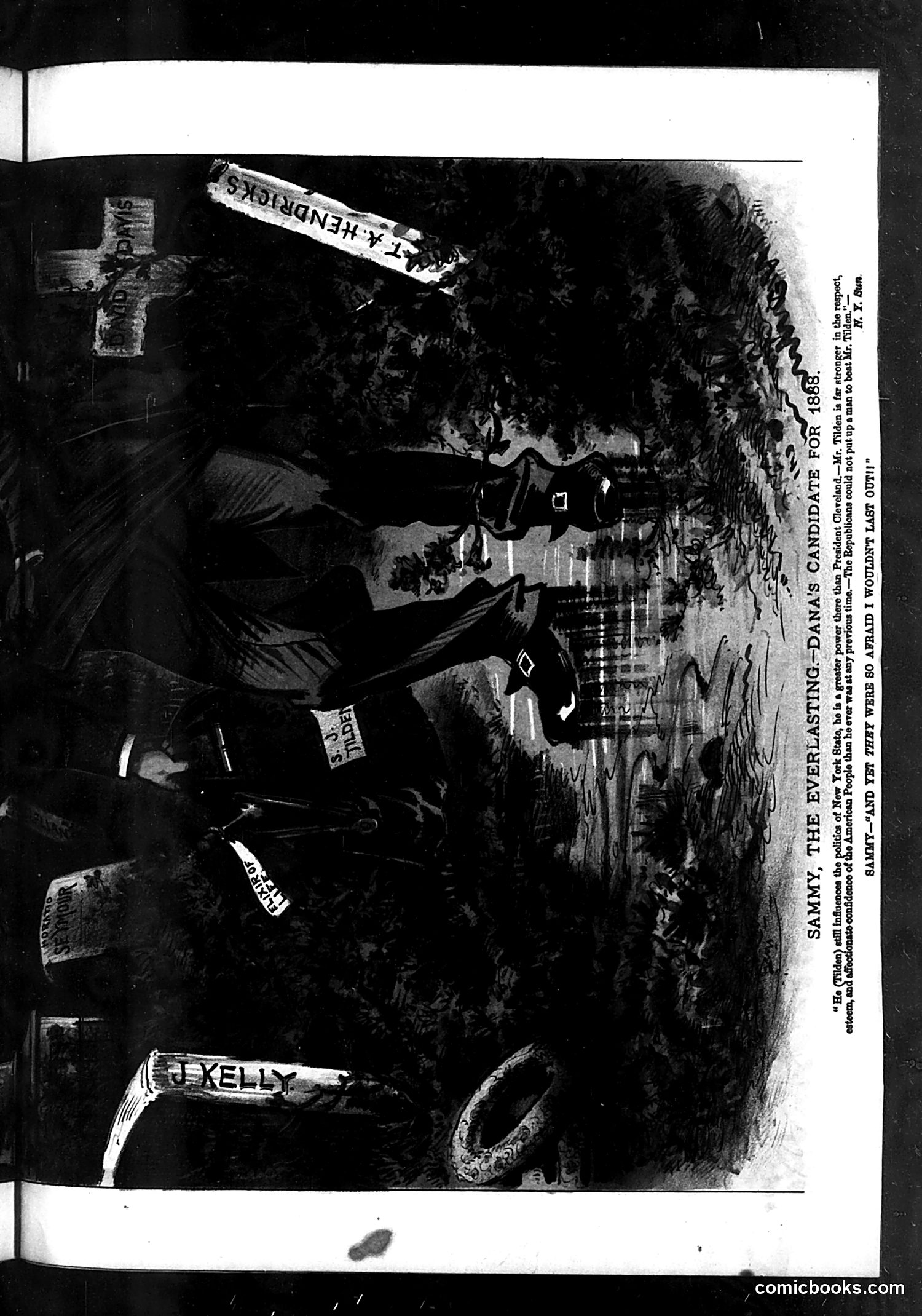
I can see this is a page from *Judge* magazine with what appears to be a political cartoon, but the OCR text is heavily corrupted and largely illegible, making it impossible to read the actual caption or explanation. From the IMAGE alone, I can discern: this appears to be a satirical scene featuring multiple figures in what looks like a domestic or indoor setting. There are crosses visible (suggesting religious or memorial imagery), and labels visible include "KELLY" and what appears to be "HENDRIKOS" on a banner. The style and composition suggest early-to-mid 20th century American political cartooning. However, without legible text identifying the specific figures, political moment, or satirical point being made, I cannot responsibly explain what this cartoon means to a modern reader. The corruption of the OCR prevents me from providing the historical context necessary for accurate interpretation.
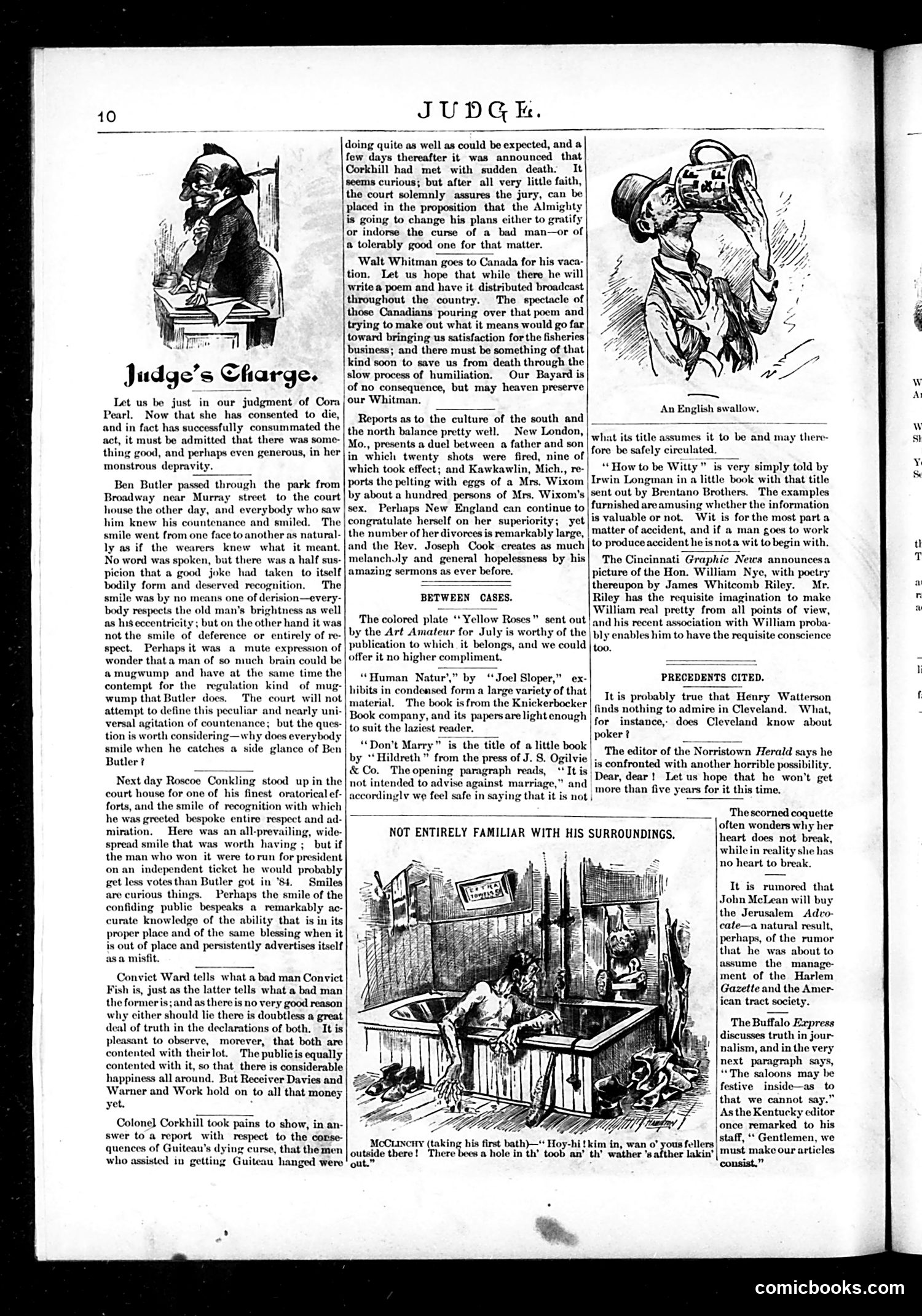
This page from **Judge** magazine contains satirical commentary on American public figures and social issues of the era (appears to be 1880s-90s based on references). **Main Content:** The "Judge's Charge" column mocks several figures: - **Ben Butler**: A politician whose eccentric appearance causes people to smile—not from respect, but from bemused recognition of his oddness and political inconsistency as a "mugwump" (independent) - **Roscoe Conkling**: A rival figure who receives genuine respect and admiration, contrasting with Butler - **Cora Pearl**: A woman who recently died by suicide; the piece darkly suggests her death was her one redeeming act - **Colonel Corkhill**: Allegedly cursed by executed assassin Guiteau; Corkhill died suddenly afterward, prompting satirical commentary on superstition - **Walt Whitman**: Mocked for his incomprehensible poetry The page uses biting social commentary typical of Judge's style, mixing political satire with personal ridicule of public figures.
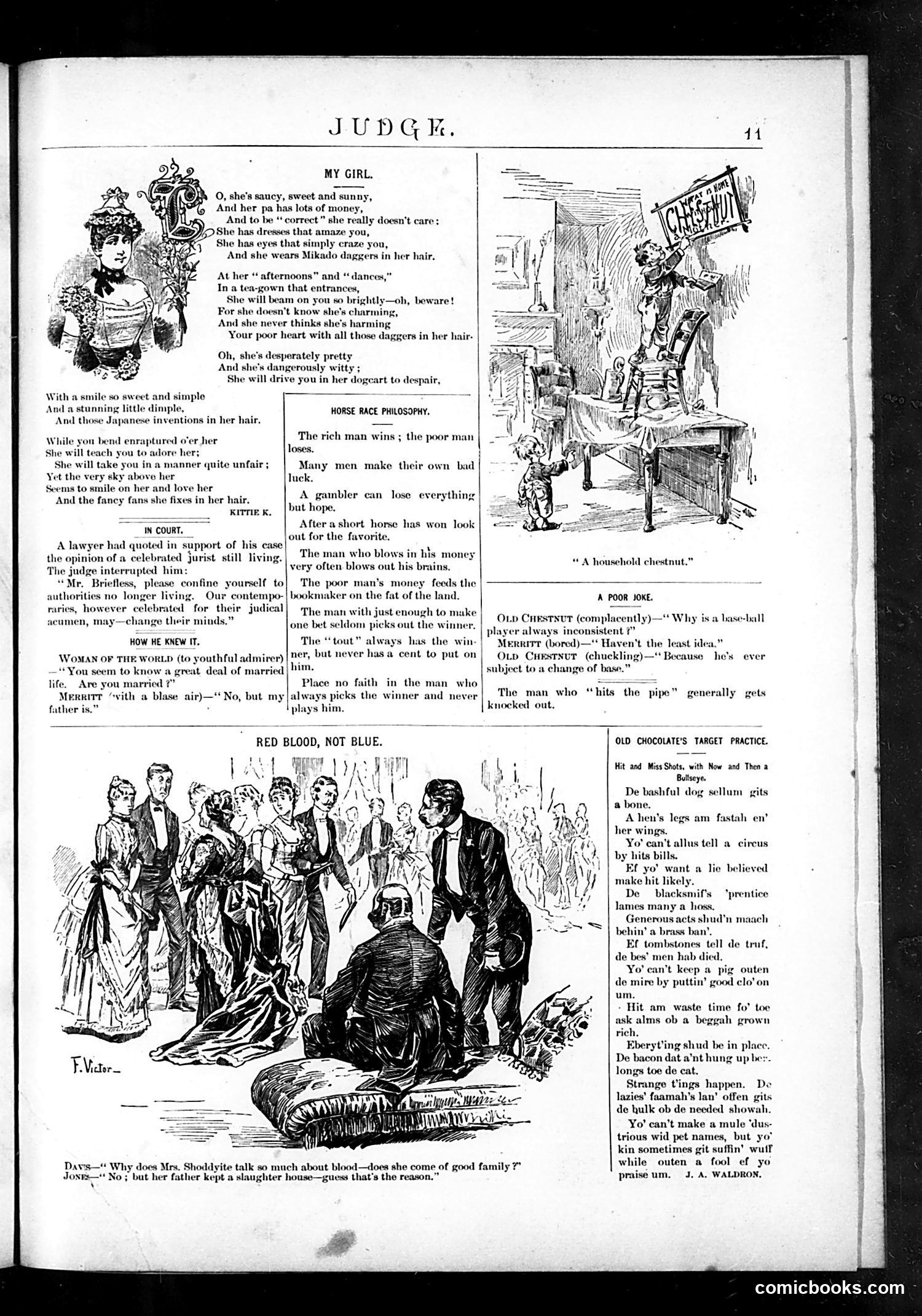
This page mocks the fashionable young woman of the 1880s-90s. The poem "My Girl" ridicules a wealthy, superficially cultured woman obsessed with Japanese aesthetic trends (Mikado daggers, tea-gowns). She's portrayed as dangerously attractive but intellectually hollow—charming yet deliberately harmful to suitors' hearts, unaware or uncaring about her destructive effect. The accompanying cartoons offer miscellaneous satirical commentary: a lawyer is rebuked for citing living jurists (implying they're unreliable), and various aphorisms mock human folly and hypocrisy. "Red Blood, Not Blue" depicts class tension, while the dialect pieces ("Old Chocolate's Target Practice") use African American vernacular for folk wisdom—typical of the era's condescending but philosophically earnest humor. The satire targets vanity, fashionable affectation, and the gap between appearance and substance.
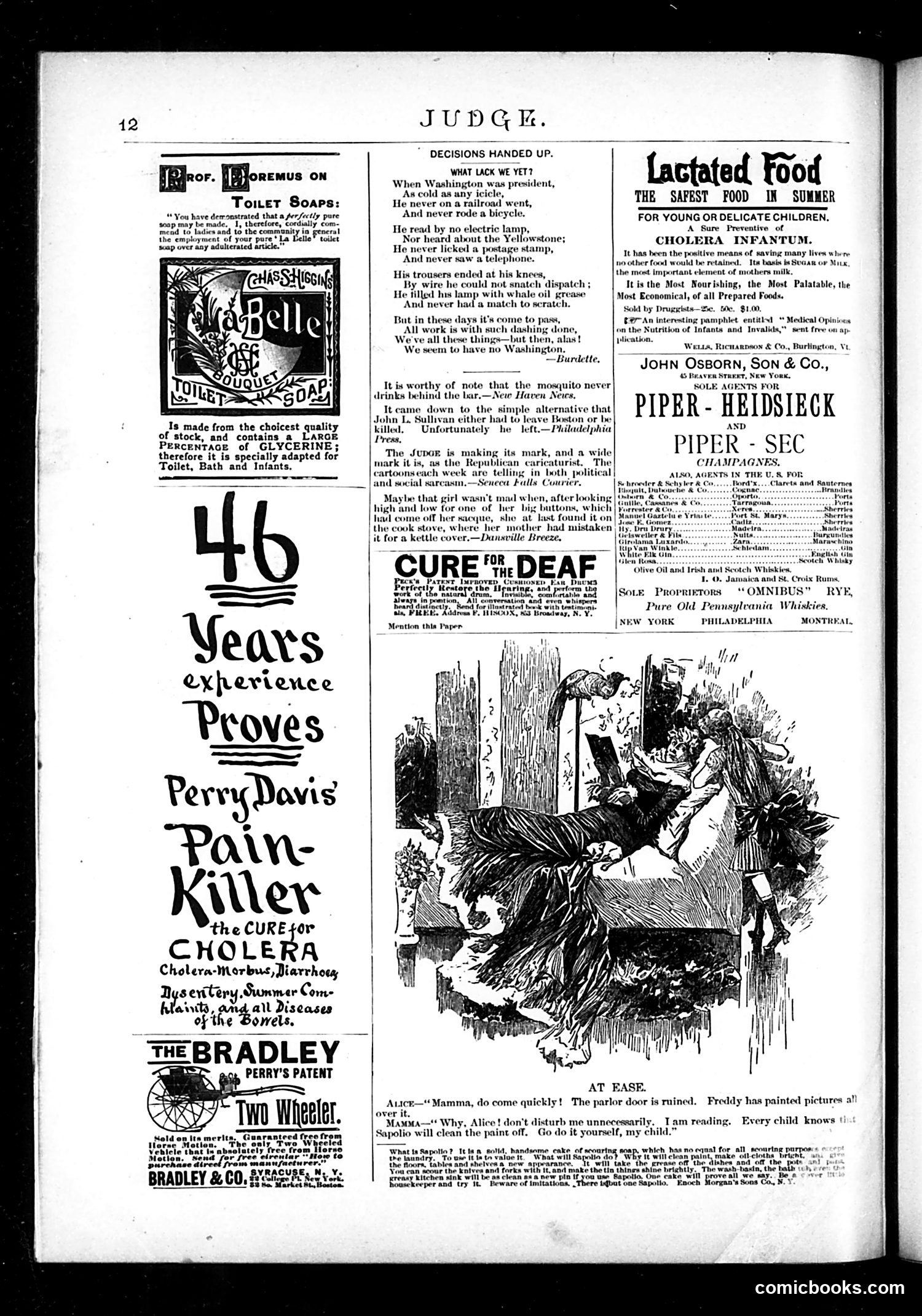
This page is primarily **advertising**, with minimal editorial content. The main cartoon ("At Ease") depicts a mother reading while her child Freddy has painted pictures on the parlor door. The mother dismissively tells him to clean it himself with Sapolio soap—a humorous commentary on parental indifference or modern child-rearing attitudes. The editorial content includes brief satirical snippets mocking contemporary progress. "What Lack We Yet?" contrasts Washington's era (no railroads, electricity, or telephones) with the modern age's conveniences, then ironically notes we still lack good leadership. Other quips mock the boxer John L. Sullivan and the Democratic Party. The page is dominated by period advertisements for patent medicines (Perry Davis Pain-Killer as cholera cure), infant formula, whiskeys, and soap products—typical of 1880s-90s Judge magazine. The satire is light and domestic rather than sharply political.
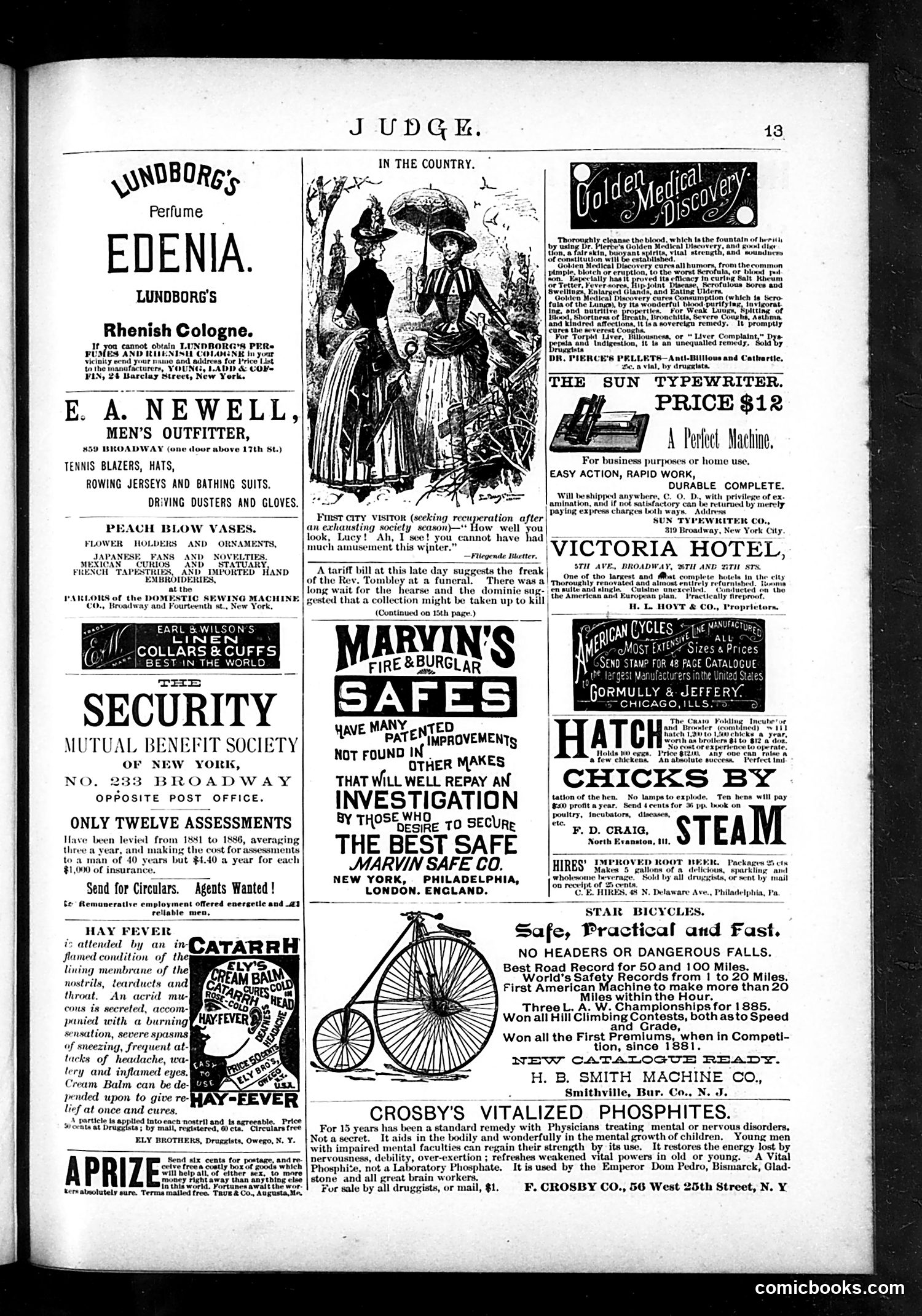
This page is primarily **advertisements** for late 19th-century products (perfume, typewriters, bicycles, safes, patent medicines). The sole satirical content is a small cartoon titled "In the Country," depicting two women in Victorian dress. The caption reads: "First city visitor (seeking recuperation after an exhausting society season)—'How well you look, Lucy! Ah, I see! you cannot have had much amusement this winter.'" **The satire:** This mocks the social expectations and lifestyle of wealthy urban women. The joke suggests that a woman's appearance and health depend entirely on constant entertainment and amusement—implying that society women are idle, pleasure-seeking, and that deprivation of social activities literally affects their looks. It satirizes both the vanity of upper-class women and the shallow values of high society that equate entertainment with health and vitality. The rest of the page consists of period patent-medicine advertisements and commercial notices with no political content.
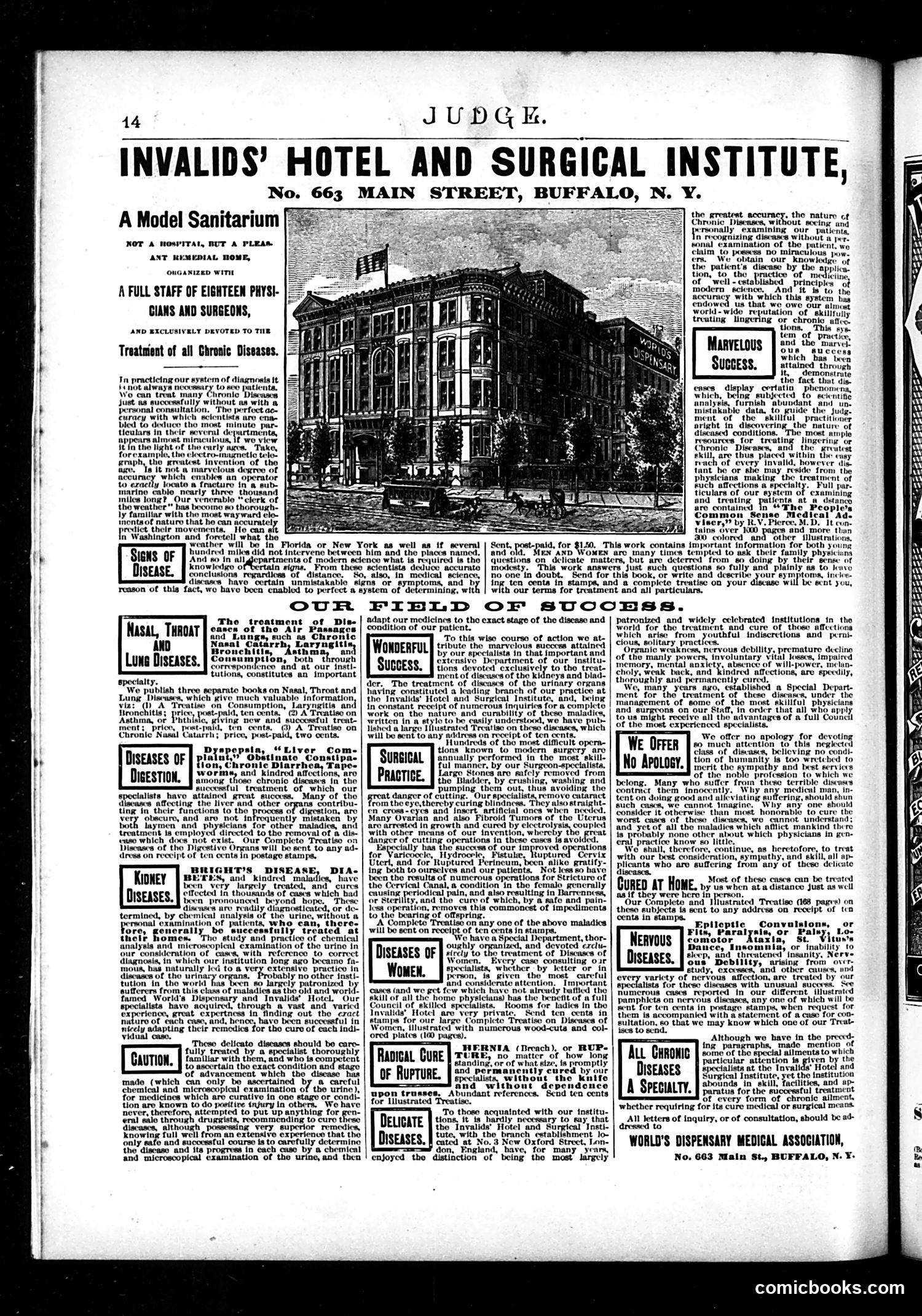
This is a full-page advertisement for the Invalids' Hotel and Surgical Institute in Buffalo, New York—not a cartoon or satirical content. The advertisement promotes a medical facility claiming to treat chronic diseases including nasal/throat conditions, digestive disorders, kidney disease, and other ailments. It emphasizes the doctors' diagnostic abilities, their distance-consultation methods, and published treatises on various conditions. The page includes multiple section headers highlighting different specialties (e.g., "Signs of Disease," "Diseases of Digestion," "Bright Disease," "Radical Cure of Rupture") and uses hyperbolic language typical of 19th-century medical advertising—comparing their diagnostic precision to telegraph operators locating submarine cable fractures. **This appears to be a Judge magazine advertisement rather than satirical editorial content**, showcasing the types of medical claims and promotional language that the magazine's audience would encounter in this era.
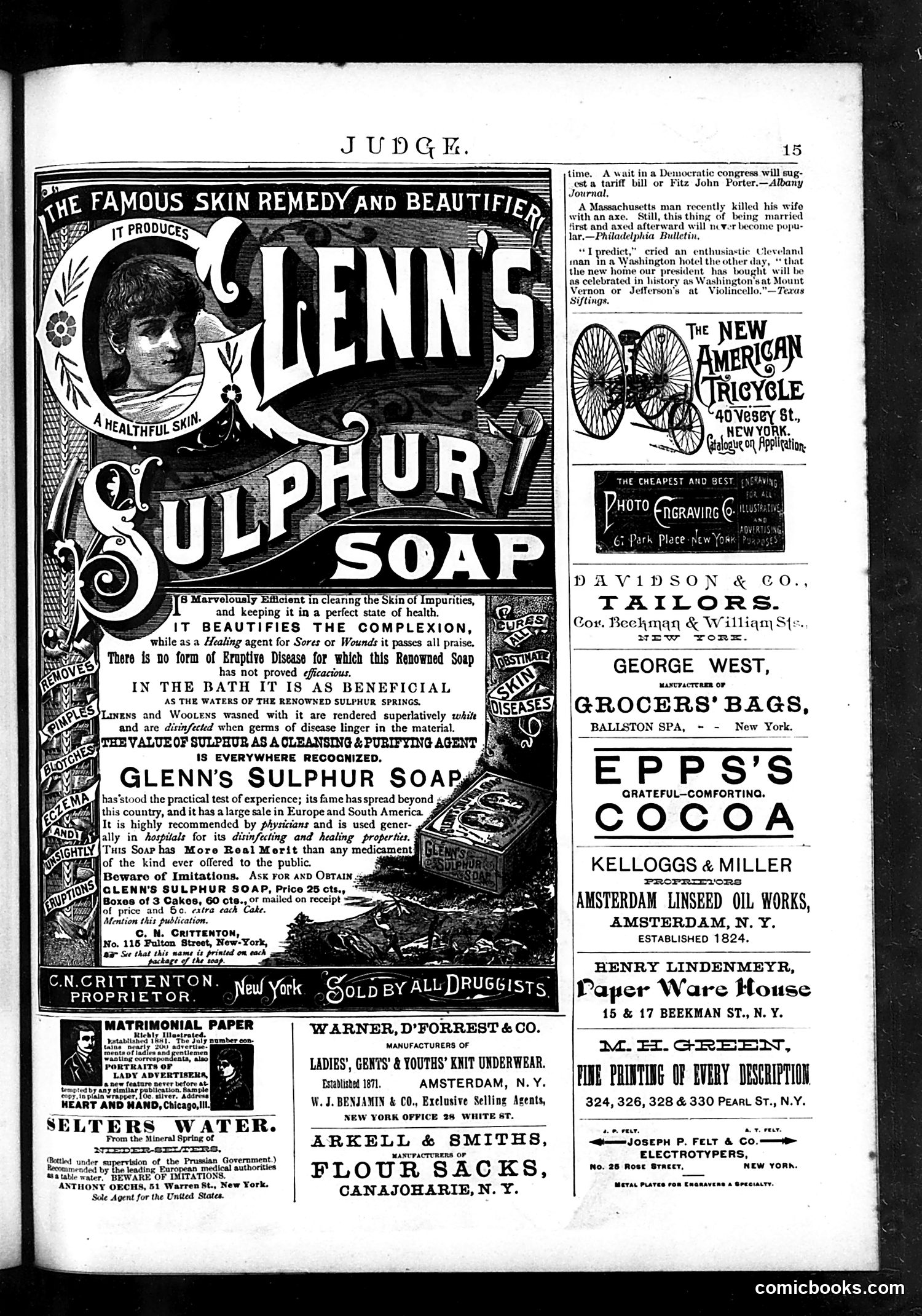
This page is **primarily advertisements** with minimal editorial content. The small text snippets at the top are brief satirical jokes typical of Judge's humor section: - A quip about Democratic congressional delays regarding tariffs or the Fitz John Porter case (a Civil War-era military controversy) - A dark joke about a Massachusetts man who killed his wife with an axe - A prediction about a presidential residence becoming historically significant The dominant content is the large **Glenn's Sulphur Soap advertisement** on the left—a Victorian-era patent medicine ad claiming the soap treats skin conditions, wounds, and disease. The surrounding page features typical late-19th-century commercial ads for tailors, cocoa, linseed oil, printing services, and other goods. This appears to be a **back-of-magazine advertising section**, not a satirical cartoon page. The humor is incidental to the commercial purpose—Judge depended heavily on advertising revenue.
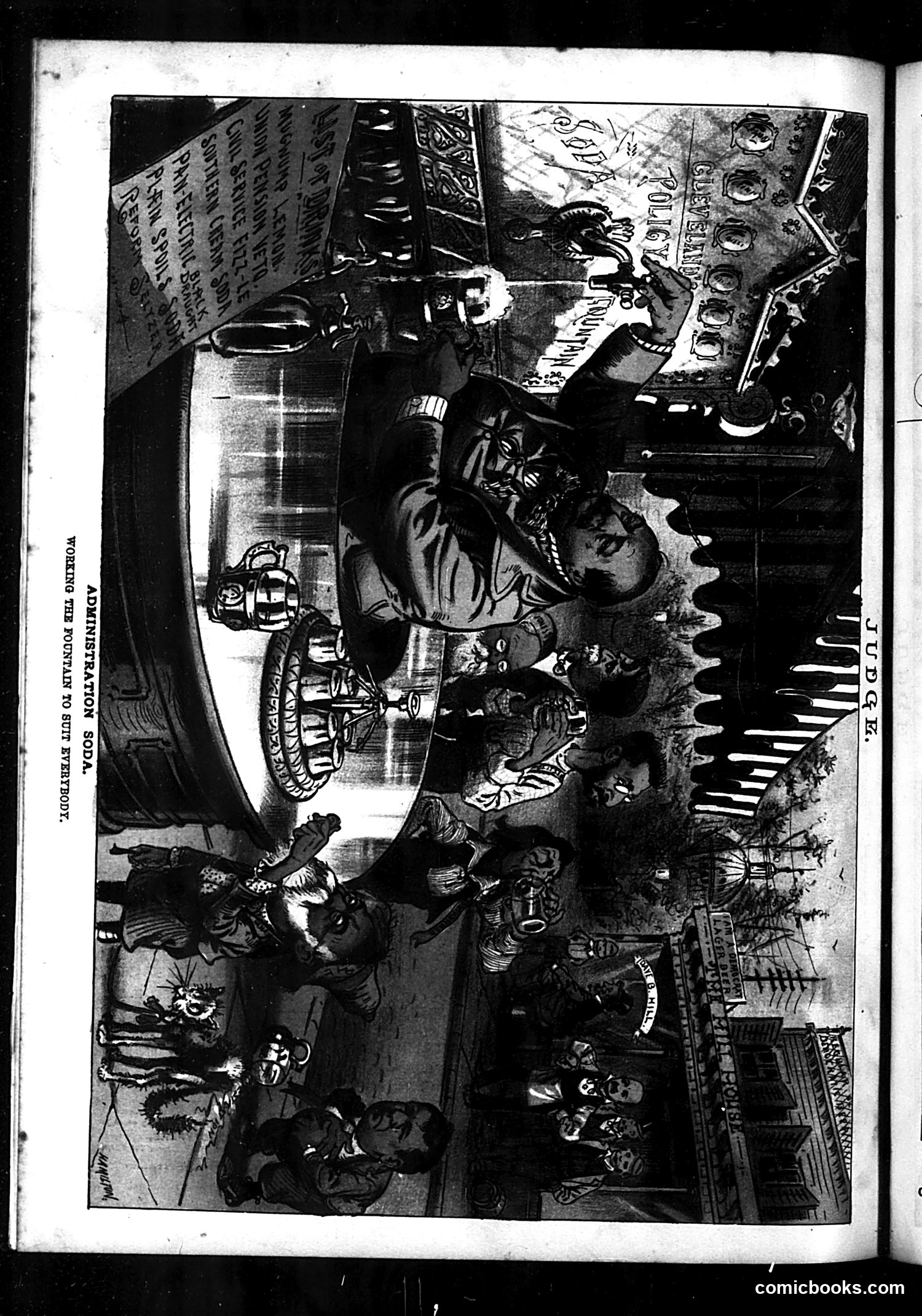
This Judge cartoon satirizes a political administration's attempt to please all constituencies simultaneously. The central image shows a soda fountain operated by a figure (likely representing the administration or a particular president) frantically adjusting multiple spouts and controls to dispense different beverages to various demanding customers. The satire critiques the impossibility of governing by consensus—the administrator cannot satisfy everyone at once. Different groups receive different "flavors," suggesting the administration tailors policies inconsistently or contradictorily to appease different factions. This reflects frustration with political hypocrisy, contradictory promises, or perceived favoritism toward select interest groups while claiming to serve the public broadly. Without a visible date, the specific administration referenced remains unclear.