
A complete issue · 16 pages · 1886
Judge — July 3, 1886
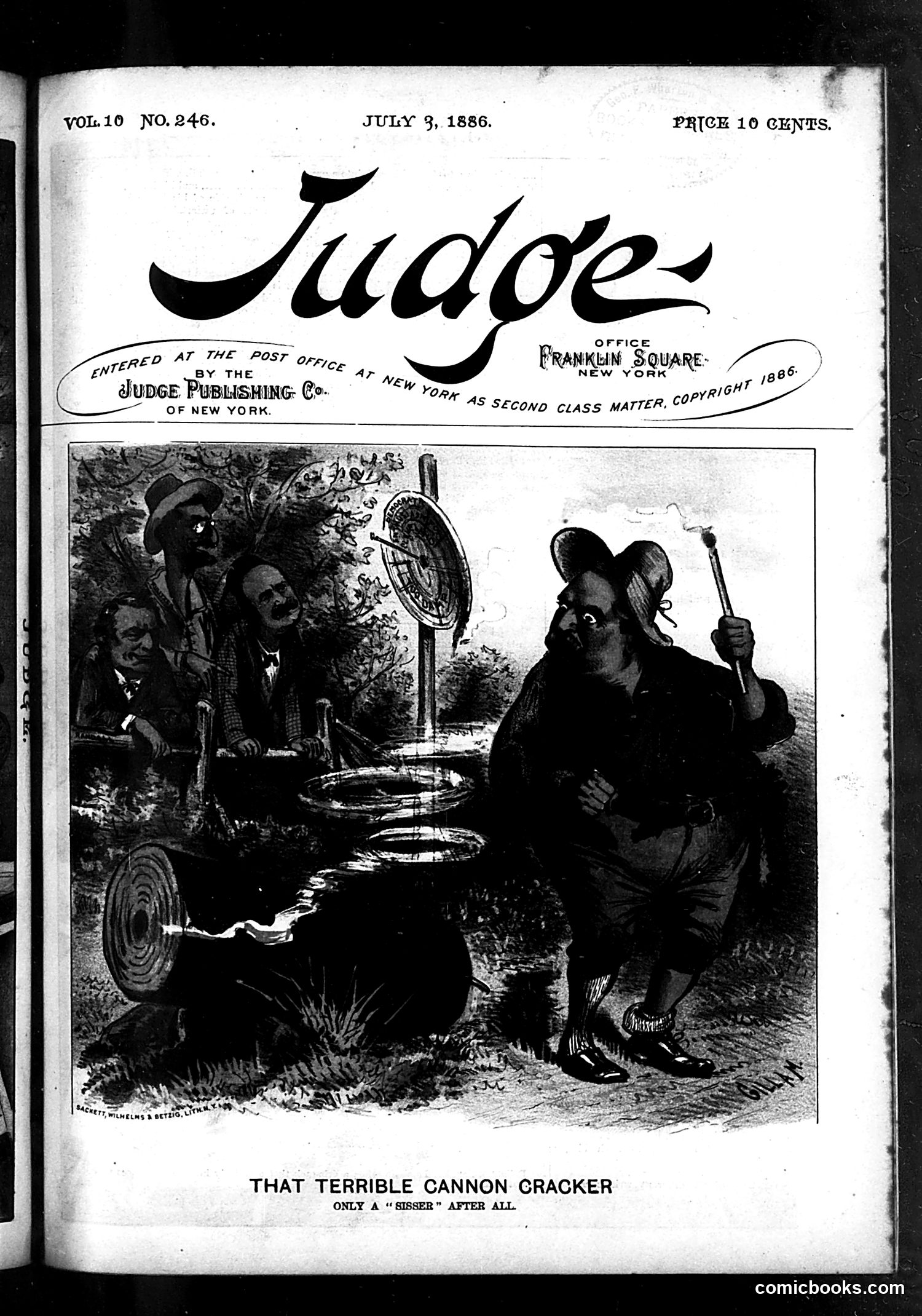
This July 3, 1886 *Judge* cartoon satirizes the dangers of fireworks during Independence Day celebrations. The illustration shows men gathered around a lit firecracker (depicted as a cannon-like device), apparently discussing or reacting to its explosive potential. The caption's subtitle—"Only a 'Sissy' After All"—suggests the joke involves masculine pride and peer pressure: someone is mocked as cowardly ("sissy") for refusing to handle or ignite the dangerous device. The cartoon reflects period anxieties about Fourth of July fireworks injuries, which were common and often severe. It mocks both the reckless bravado of those who played with explosives and the social stigma against showing caution—commenting on how dangerous "masculinity" could be when tied to foolhardy behavior around fireworks.
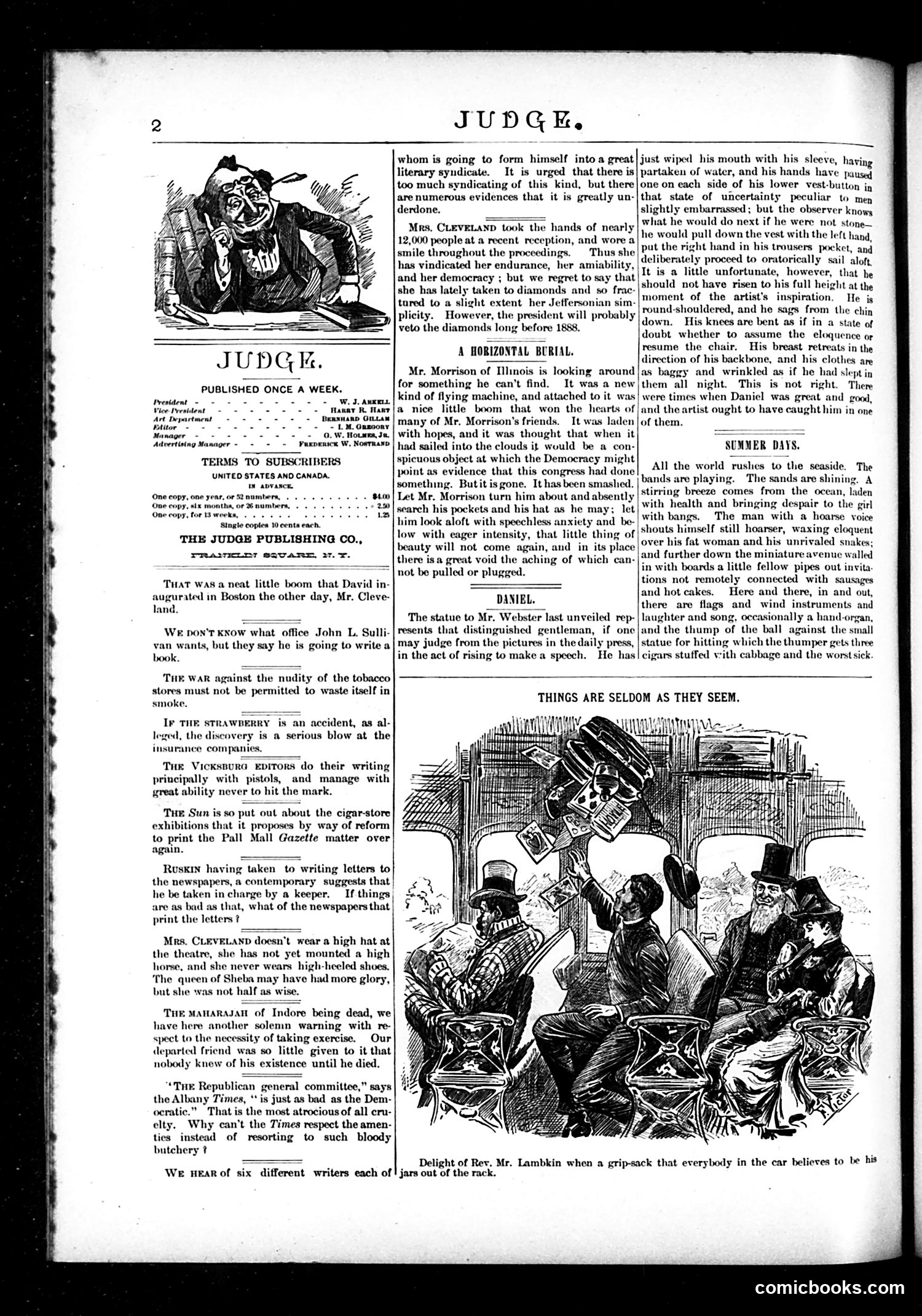
This page contains several brief satirical commentary sections rather than a single cartoon. Key items include: **"A Horizontal Burial"** mocks Mr. Morrison of Illinois, who apparently sought a flying machine invention. The satire suggests his fruitless search and obsessive nature. **"Daniel"** references an unveiled statue to Mr. Webster, a distinguished gentleman, with commentary on public monuments and speeches. **"Summer Days"** describes seaside amusements and social scenes with satirical observations about bands, crowds, and summer behavior. The large illustration titled **"Things Are Seldom As They Seem"** depicts what appears to be a social gathering or train scene where passengers encounter unexpected situations—likely satirizing how reality differs from appearances. The page functions as a humor magazine mixing brief political/social commentary with visual gags typical of late-19th century American satire.
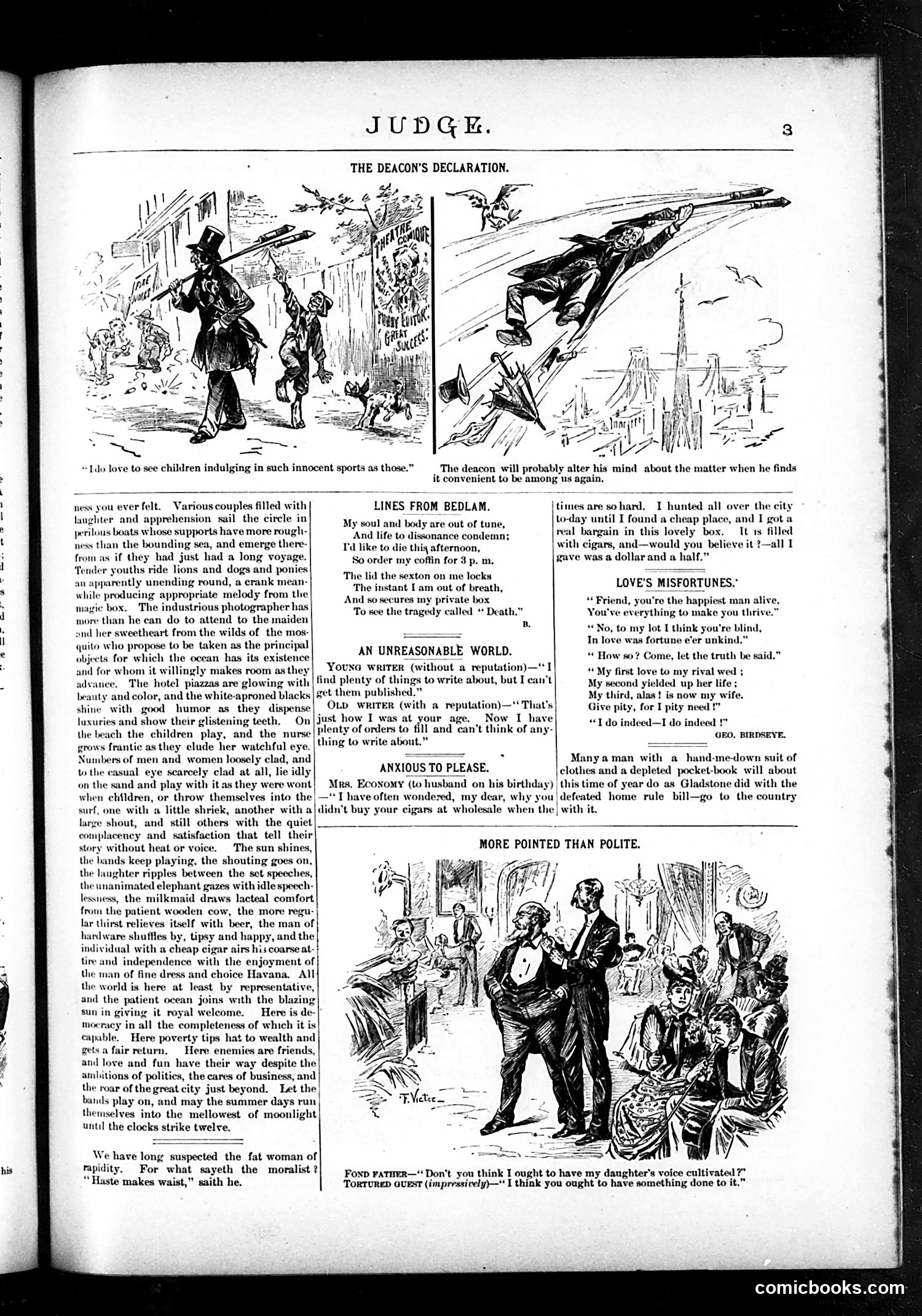
This page from *Judge* magazine contains several satirical pieces mocking social pretense and human nature: **"The Deacon's Declaration"** (top): A moralistic deacon condemns children's innocent amusements, but the caption suggests his objection is hypocritical—he'll happily participate when convenient. The satire targets religious hypocrisy. **"Lines from Bedlam"** and other brief pieces mock melodramatic romanticism and the publishing world's unfairness (established writers get commissions; unknown writers can't get published). **"More Pointed Than Polite"** (bottom illustration): Shows a poorly-dressed man at a social gathering being told he should wear nicer clothes—mocking both class consciousness and tactless social correction. The page's extended prose passage celebrating a seaside resort's democratic mingling of classes, wealthy and poor together, is likely ironic commentary on America's claimed social equality versus actual class divisions. Overall, the satire targets hypocrisy, class pretension, and sentimental excess in late 19th-century American society.
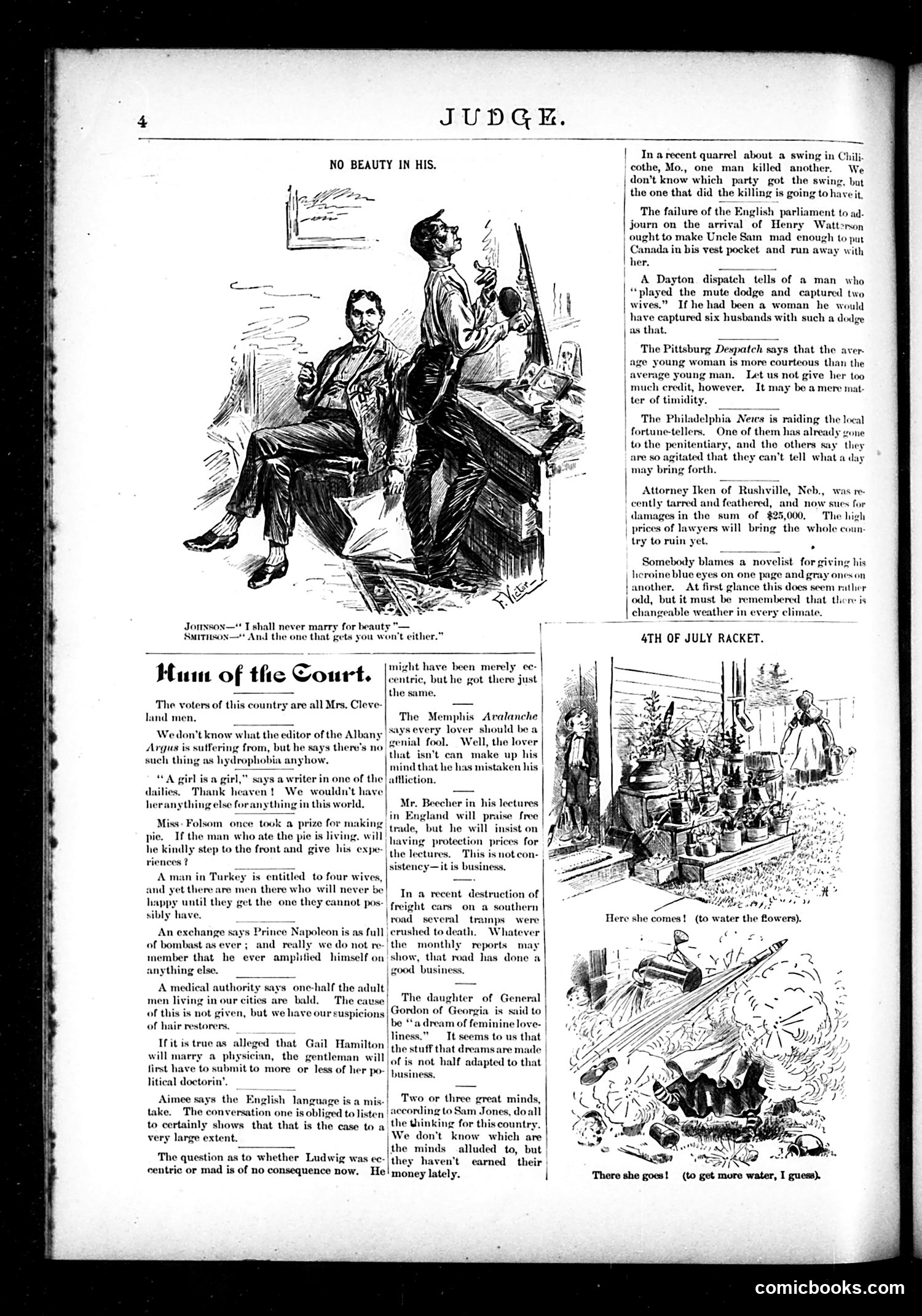
This Judge magazine page contains satirical commentary on contemporary (late 19th-century) social issues presented as humorous briefs. **Main Cartoon ("No Beauty in His"):** Shows two men in conversation. The caption reads: Johnson—"I shall never marry for beauty"; Satterson—"And the one that gets you won't either." This is a straightforward joke mocking Johnson's unattractiveness—the implication being that no woman would marry him for his looks anyway. **"Hum of the Court" Section:** A collection of short satirical items targeting various targets: English parliamentary behavior, con artists (fortune-tellers being arrested), incompetent lawyers, novelist inconsistencies, and Henry Ward Beecher's hypocrisy (preaching free trade while charging high lecture fees—"not consistency—it is business"). **"4th of July Racket":** Two illustrations appear to satirize Independence Day celebrations, though details are unclear from the OCR'd text provided. The overall tone ridicules public figures, social pretense, and everyday absurdities through brief, biting commentary typical of Gilded Age humor magazines.
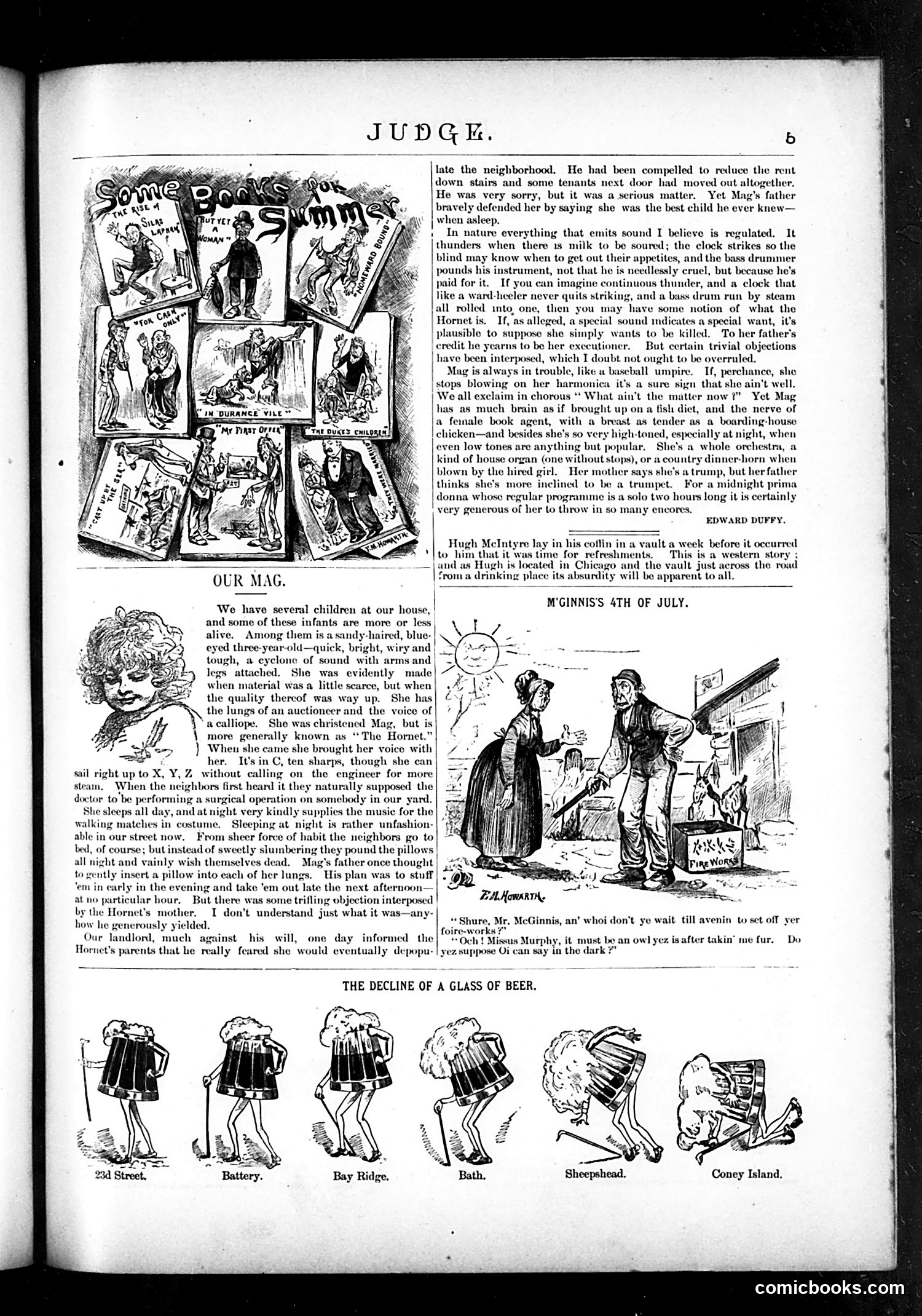
This page satirizes a precocious, loud child nicknamed "The Hornet" (real name Mag) through multiple pieces: **"Our Mag"** (main article): A humorous complaint about a three-year-old girl with exceptional lung capacity and vocal range. The satire mocks both her noise-making abilities (compared to auctioneers and calliopes) and her parents' indulgence. The father defends her as "the best child he ever knew—when asleep," while neighbors suffer sleep deprivation. The piece absurdly suggests the child exists to make sound, like thunder or clock strikes serve natural purposes. **"McGinnis's 4th of July"** (cartoon): Shows neighbors complaining about fireworks, playing on the contrast between holiday noise and Mag's constant noise pollution. **"The Decline of a Glass of Beer"** (bottom): A sequential visual joke showing a woman's progressive intoxication across NYC locations (23rd Street through Coney Island). The humor relies on exaggeration and the common Victorian theme of uncontrolled children disrupting neighborhood peace—a domestic complaint made absurd through hyperbolic description.
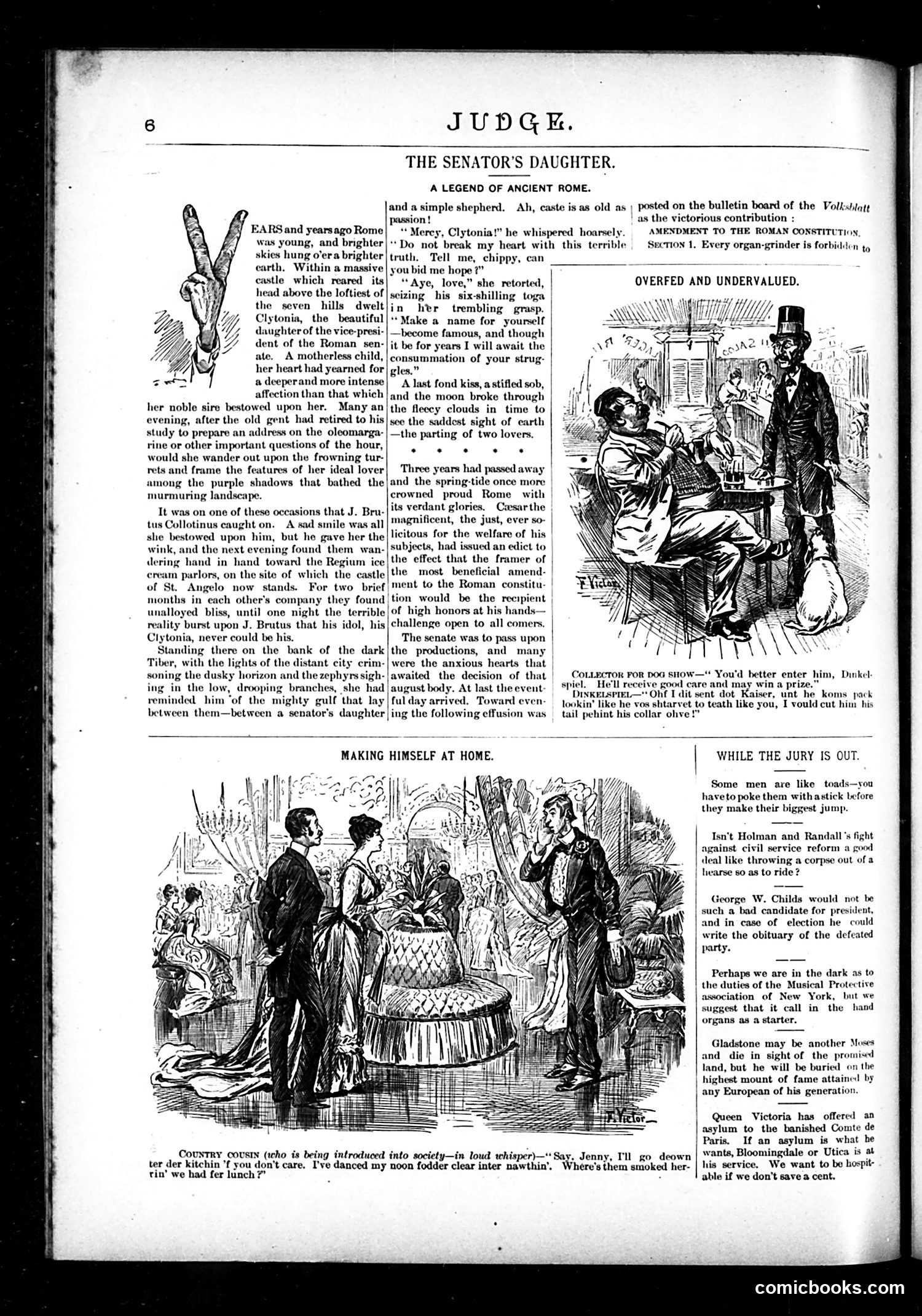
This page contains a mock-heroic serialized story, "The Senator's Daughter: A Legend of Ancient Rome," which satirizes class barriers and social climbing through classical framing. The narrative follows J. Brutus Collotinus, a humble shepherd in love with Clytonia, a senator's daughter—their romance blocked by social hierarchy ("the mighty gulf that lay between them"). The accompanying illustrations show Victorian-era social scenes. The lower cartoons appear to be unrelated humor: one depicts a country cousin's awkwardness at a formal gathering, another features a dog-show collector's pitch, and commentary on civil service reform. **The satire likely targets**: rigid class systems, social pretension, and perhaps contemporary political debates—the civil service reference suggests this is 1880s America using ancient Rome as a thinly-veiled mirror. The ornate language mocking romantic melodrama adds comedic distance. The exact political figures or events referenced are **unclear without additional context**, though civil service reform was a major late-19th-century issue.
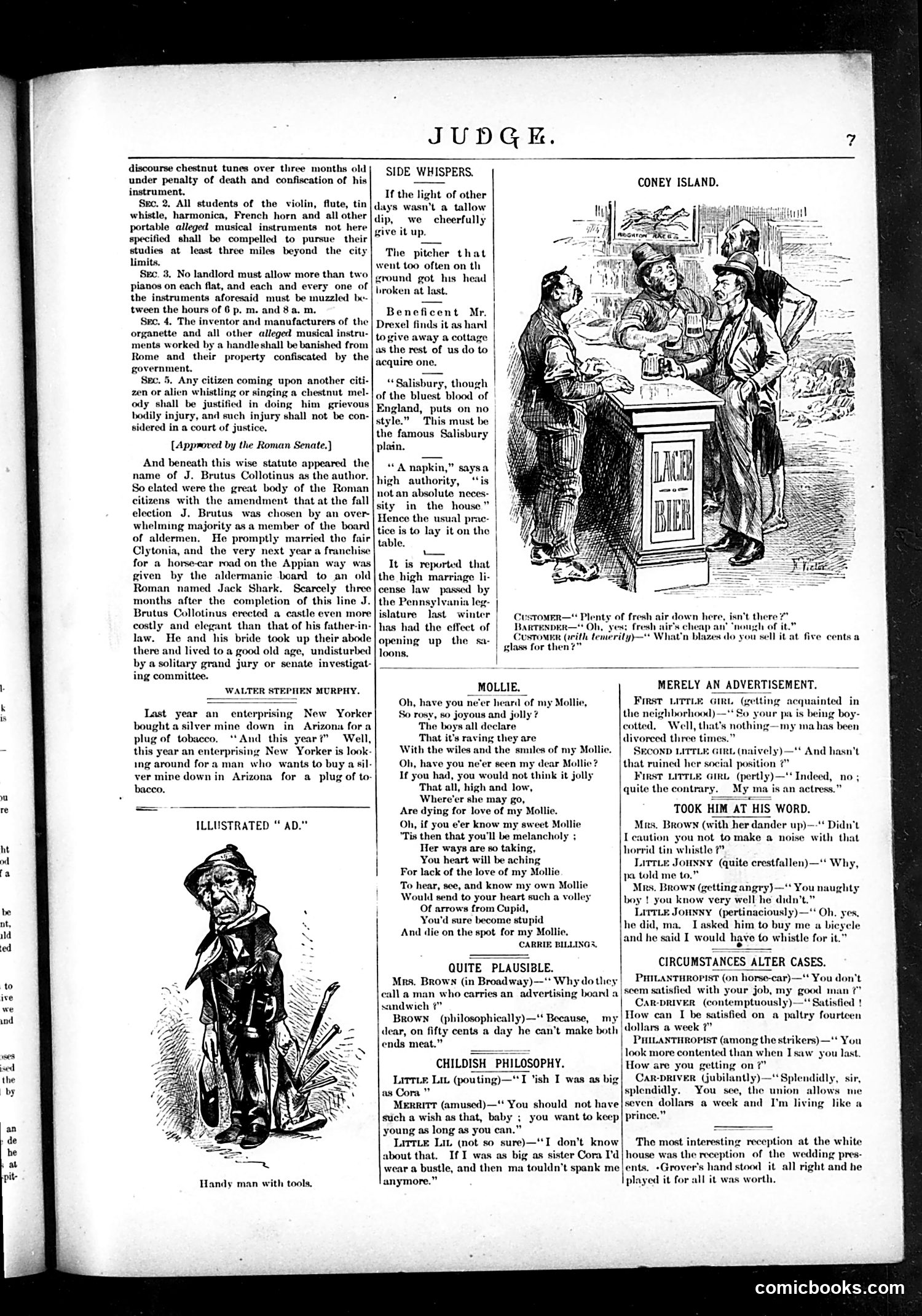
This page from the satirical magazine *Judge* contains several distinct pieces mocking contemporary issues: **Main Feature**: A humorous "Roman Senate" statute proposes absurdly strict regulations on musical instruments—banning chestnut tunes, restricting where students can practice, limiting pianos per apartment, and even authorizing violence against people whistling old melodies. The satire targets widespread urban complaints about noise pollution from street musicians and amateur instrumentalists, a genuine nuisance in densely-packed cities. By attributing these regulations to ancient Rome and showing their apparent success, the piece satirizes how desperate citizens had become for relief. **"Side Whispers"**: Brief witty observations on topical matters, including references to Lord Salisbury (British politician), Pennsylvania's marriage license law, and wealthy philanthropist Drexel. **Other Content**: Includes a sentimental poem about "Mollie," jokes about Arizona silver mines, and dialogue pieces on mundane social matters. The page reflects fin-de-siècle urban anxieties about noise, class, and social regulation.
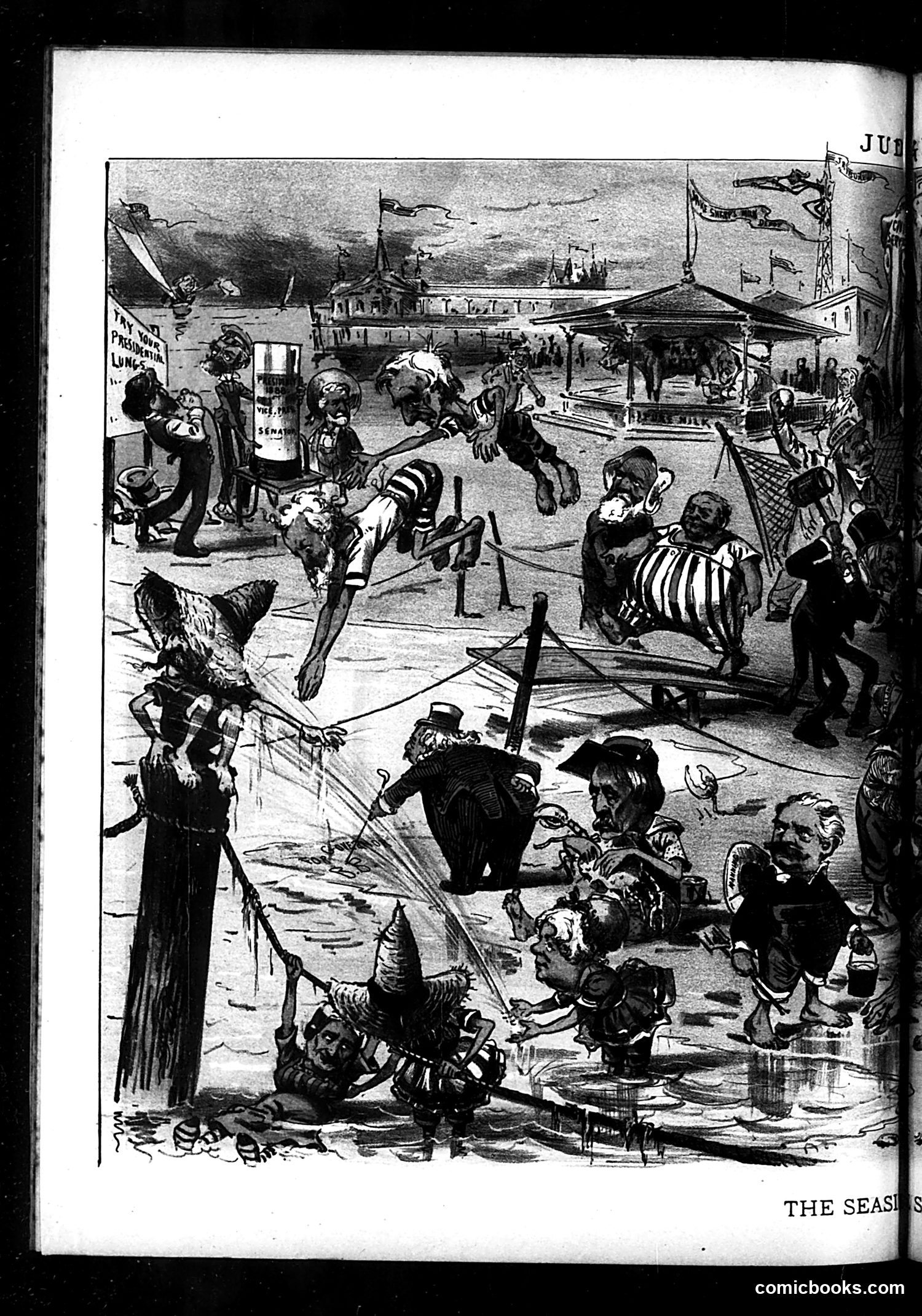
This appears to be a seaside beach scene satirizing summer leisure activities and social behavior, likely from the late 19th or early 20th century. The illustration depicts a crowded beach with various figures engaging in typical Victorian-era seaside entertainment—swimming, bathing machines, vendors, and socializing. The satire likely targets the pretensions and absurdities of resort culture: the elaborate bathing costumes, the social hierarchies visible even at leisure, overcrowding, and commercialization of the beach. Specific caricatures appear present but are difficult to identify without more context. The partial title "THE SEAS[ON]" suggests this commentary on seasonal beach-going culture. However, without clearer OCR text or visible signatures, I cannot identify specific political figures or more precise satirical targets with certainty.
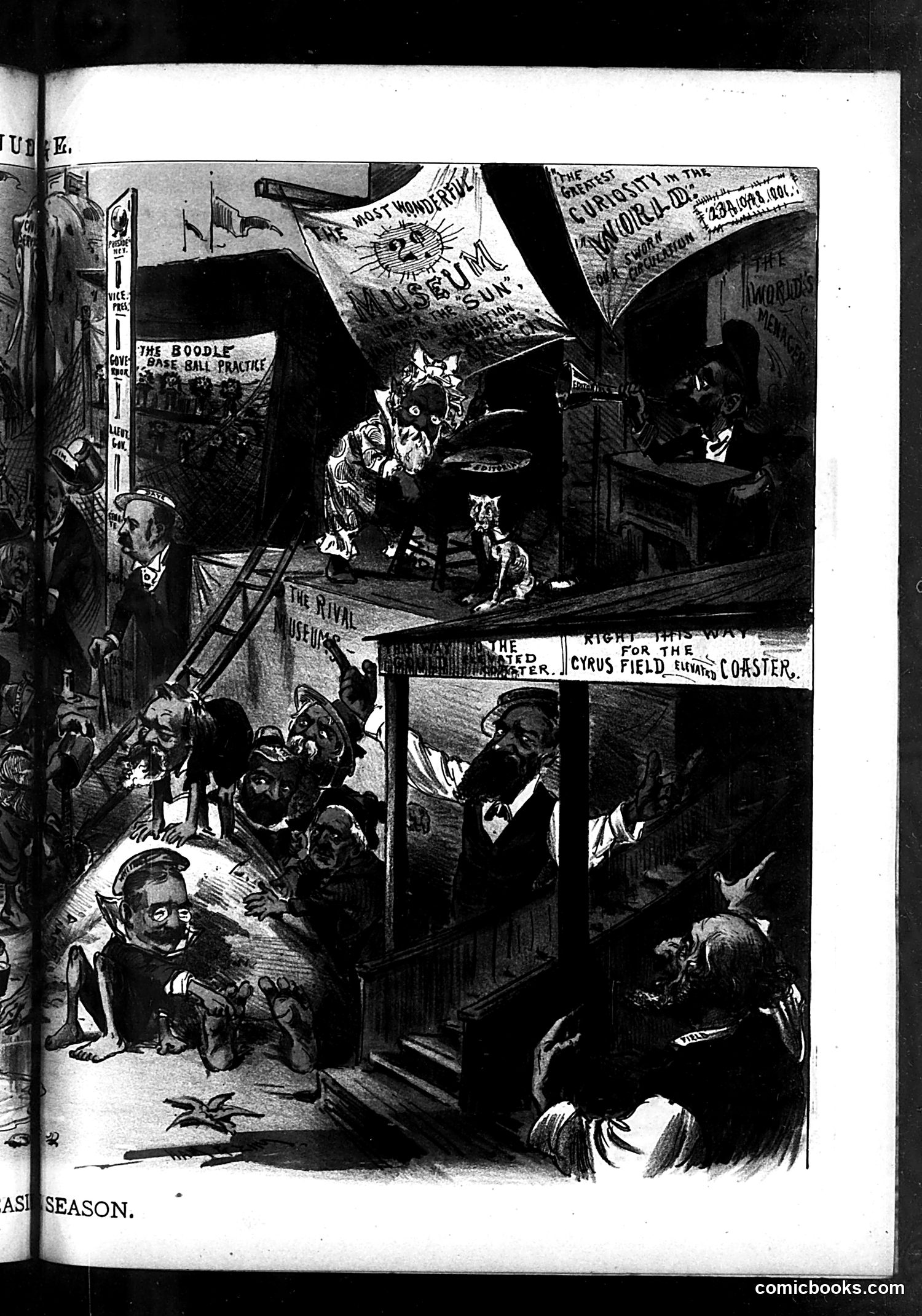
This appears to be a two-panel satirical cartoon from Judge magazine's amusement park or carnival section. The upper panel shows attractions including "The Boodle Cake Ball Practice" and references to "The Most Wonderful Serum" and "Curiosity" exhibits—likely mocking dubious patent medicines or carnival frauds common in that era. The lower panel depicts crowds at what appears to be the "Cyrus Field" coaster attraction, with text reading "Right this way for the Cyrus Field Evening Coaster." The satire likely references financial speculation or market volatility (a "coaster" ride metaphor for economic ups and downs), possibly connecting to Cyrus Field, the prominent 19th-century businessman and telegraph magnate. The overall cartoon mocks both carnival deception and financial scheming as forms of public entertainment.
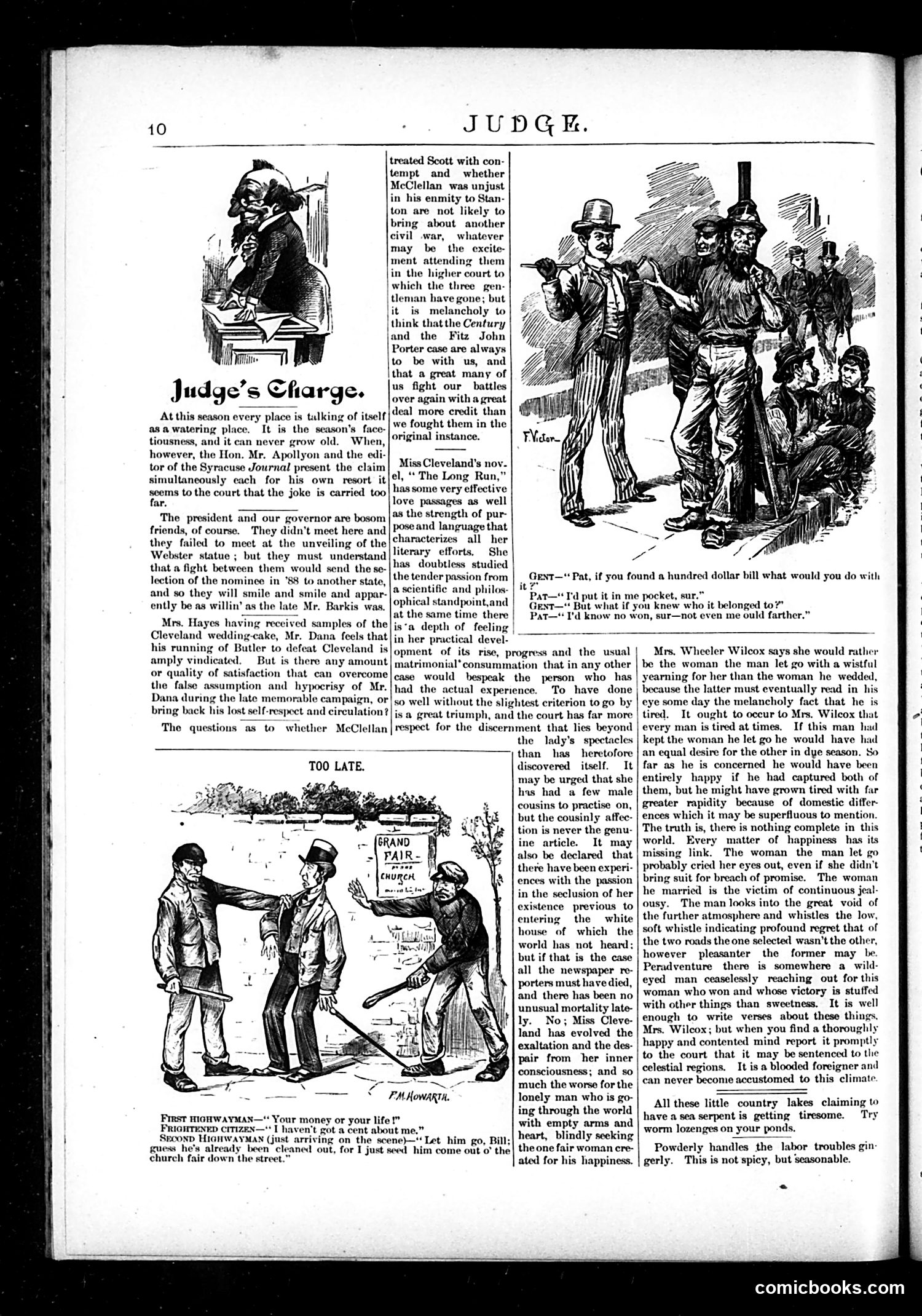
This 1880s page contains two satirical pieces: **"Judge's Charge"** (top): Editorial commentary on contemporary political figures. References include: - President and Governor (appears to be Hayes and another NY official) competing over resort endorsements - Mrs. Hayes receiving Cleveland wedding cake samples - Mr. Dana's "running of Butler to defeat Cleveland" during a recent election - Debates between McClellan, Scott, and Stanton (Civil War-era generals) - Miss Cleveland's novel "The Long Run" The satire critiques politicians' self-serving hypocrisy and argues that old Civil War disputes (like the Fitz John Porter case and Century magazine debates) remain tiresome. **"Too Late"** (bottom): A street robbery joke showing two highwaymen. The humor: the first robber found his victim already cleaned out by a church fair fundraiser, suggesting the church is more effective at extracting money than criminals. Both pieces use the characteristic Judge approach: political commentary mixed with social satire and humor.
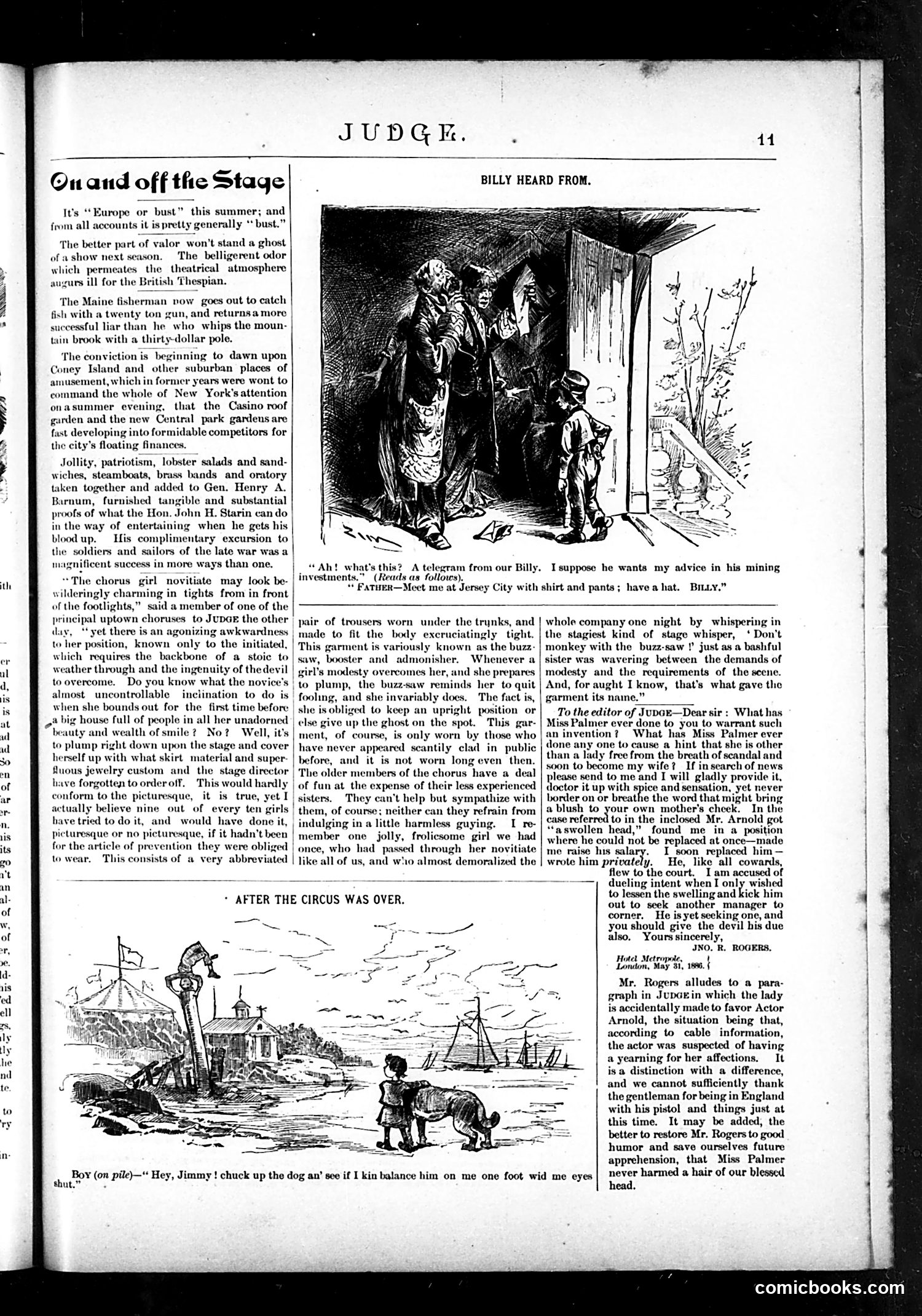
This page contains theatrical gossip and humor typical of Judge's "On and off the Stage" column. The top section discusses summer entertainment in New York—Coney Island competing with new venues like Casino roof garden and Central Park gardens for audiences. The middle illustration captioned "Billy Heard From" shows a telegram from a young man asking his father to meet him at Jersey City with clothing and money, humorously suggesting financial troubles from "mining investments." The longest text block explains the "buzz-saw"—a tight undergarment worn by inexperienced chorus girls to prevent them from instinctively covering themselves on stage. Established performers mock this device, with one girl's joke: "Don't monkey with the buzz-saw!" The piece uses this detail to satirize both theatrical conventions and performers' physical modesty versus professional demands. The bottom illustration depicts a circus scene with acrobats, unrelated to the above content. The satire targets theatrical pretension and the awkwardness of performers navigating professional expectations.
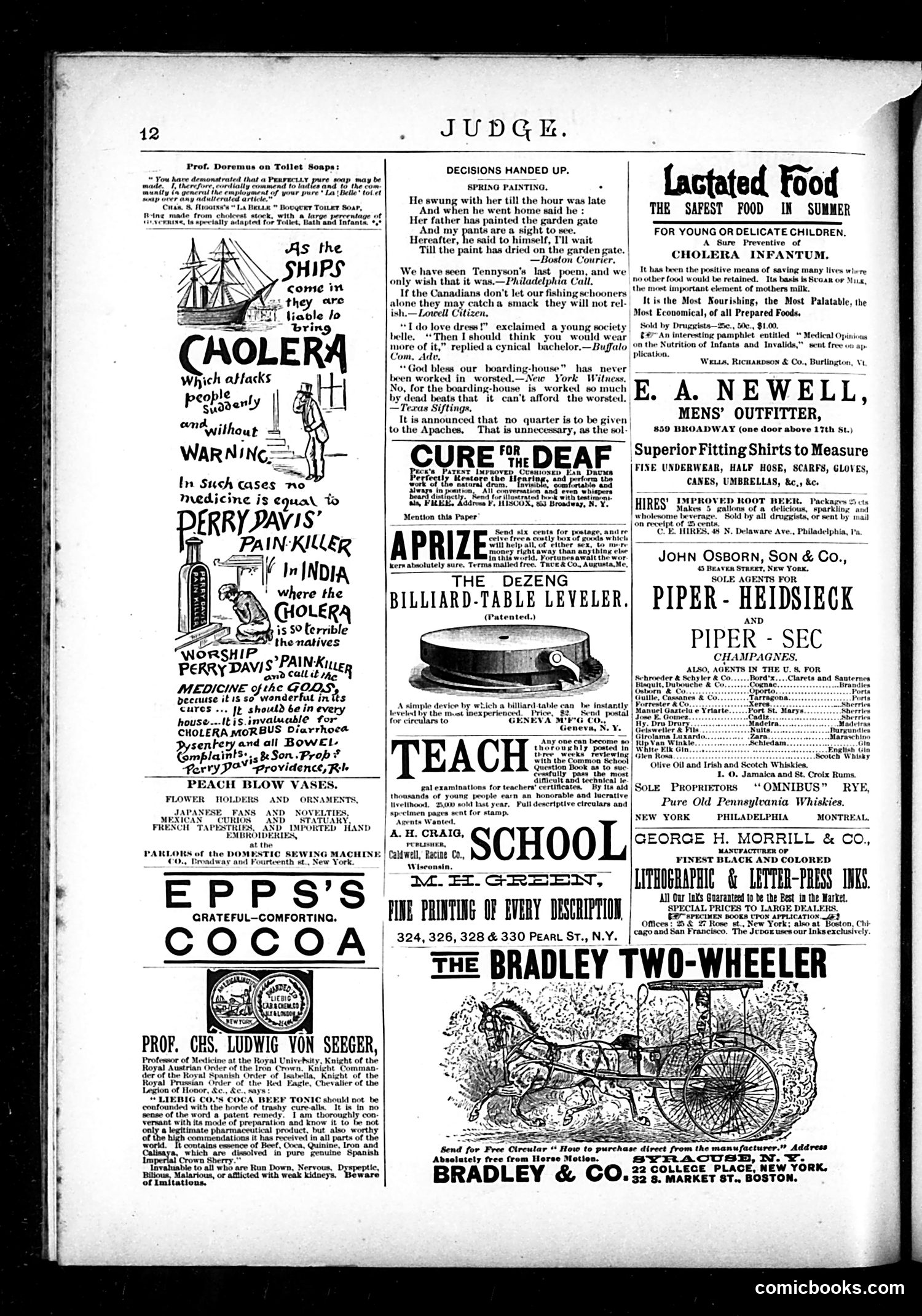
This is primarily an **advertising page** from Judge magazine, with limited satirical content. The main editorial material consists of brief humorous quotes—jokes about Tennyson's poetry, Canadian fishing disputes, and romantic mishaps with wet paint. The left side features a **Perry Davis Pain-Killer advertisement** depicting cholera as a skeletal menace in India, using fear-based marketing common in the 19th century. This reflects historical attitudes about disease and colonial anxiety. Most of the page comprises product advertisements typical of the era: patent medicines (Lactated Food for infants), cocoa, champagne, billiard-table levels, and men's clothing. The quoted endorsement from "Prof. Ludwig von Seeger" (a fictional or barely identifiable authority figure) was a common marketing tactic. The Bradley Two-Wheeler bicycle advertisement at bottom represents emerging transportation technology of the period. The page demonstrates how Judge blended satire with commercial content—typical for American magazines of this era before modern advertising separation.
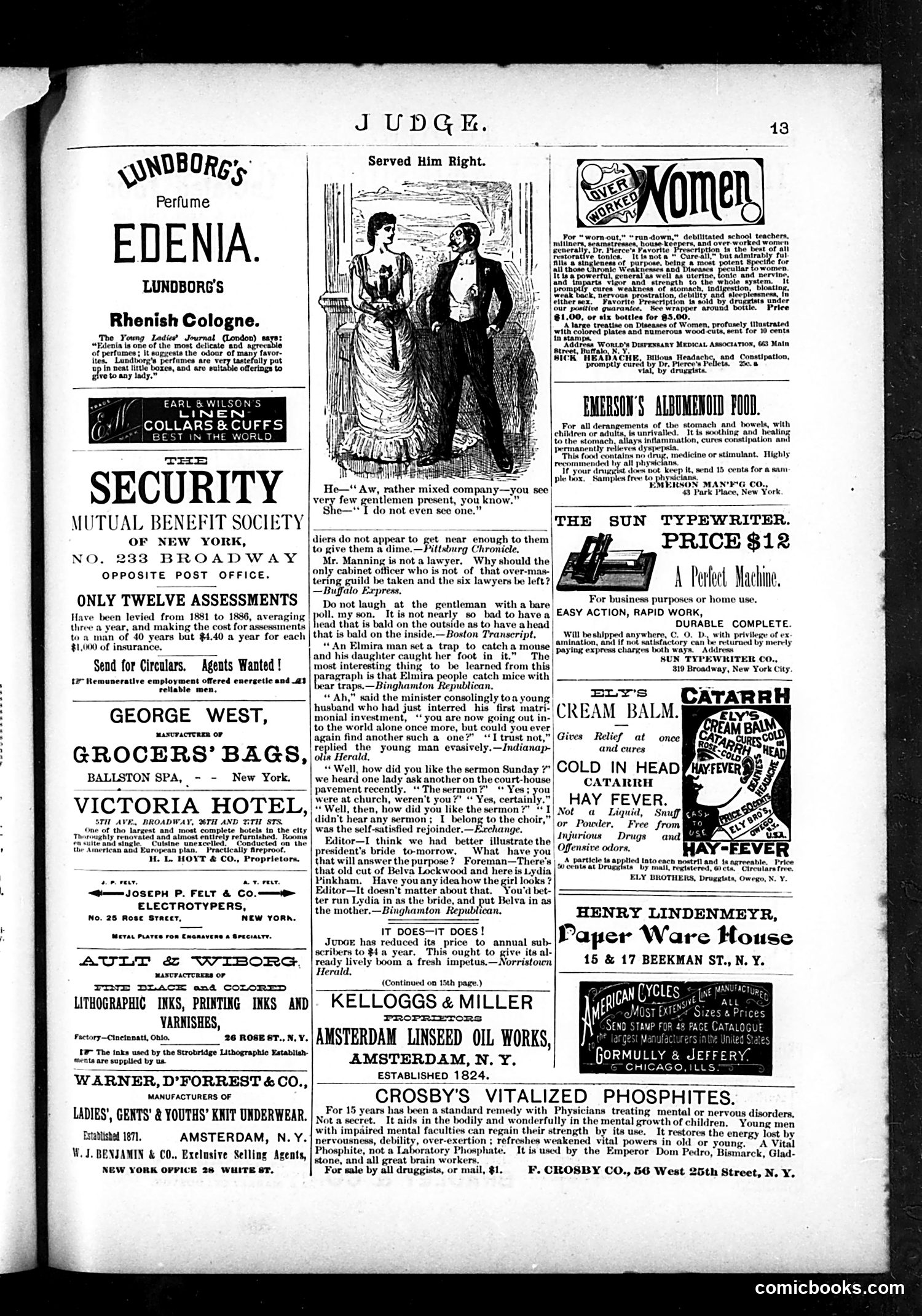
This single-panel cartoon depicts a social commentary on gender and class in late 19th-century America. A well-dressed man and woman are shown in conversation at what appears to be a formal gathering. **The Joke:** The man complains about "rather mixed company" with "very few gentlemen present." The woman responds pointedly: "I do not even see one"—implying the man himself is not a gentleman. **The Satire:** This is a cutting social criticism. Despite his apparent wealth and formal attire, the man reveals poor manners by complaining about other guests. The woman's withering response—delivered without naming him directly—suggests that true gentility is defined by behavior and respect, not by appearance or social position. A "gentleman" wouldn't publicly criticize fellow guests. **Context:** The cartoon reflects Victorian-era anxieties about social mobility and authenticity—the concern that wealth alone doesn't guarantee genuine refinement or morality. The woman effectively "serves him right" through clever, cutting wit rather than direct confrontation.
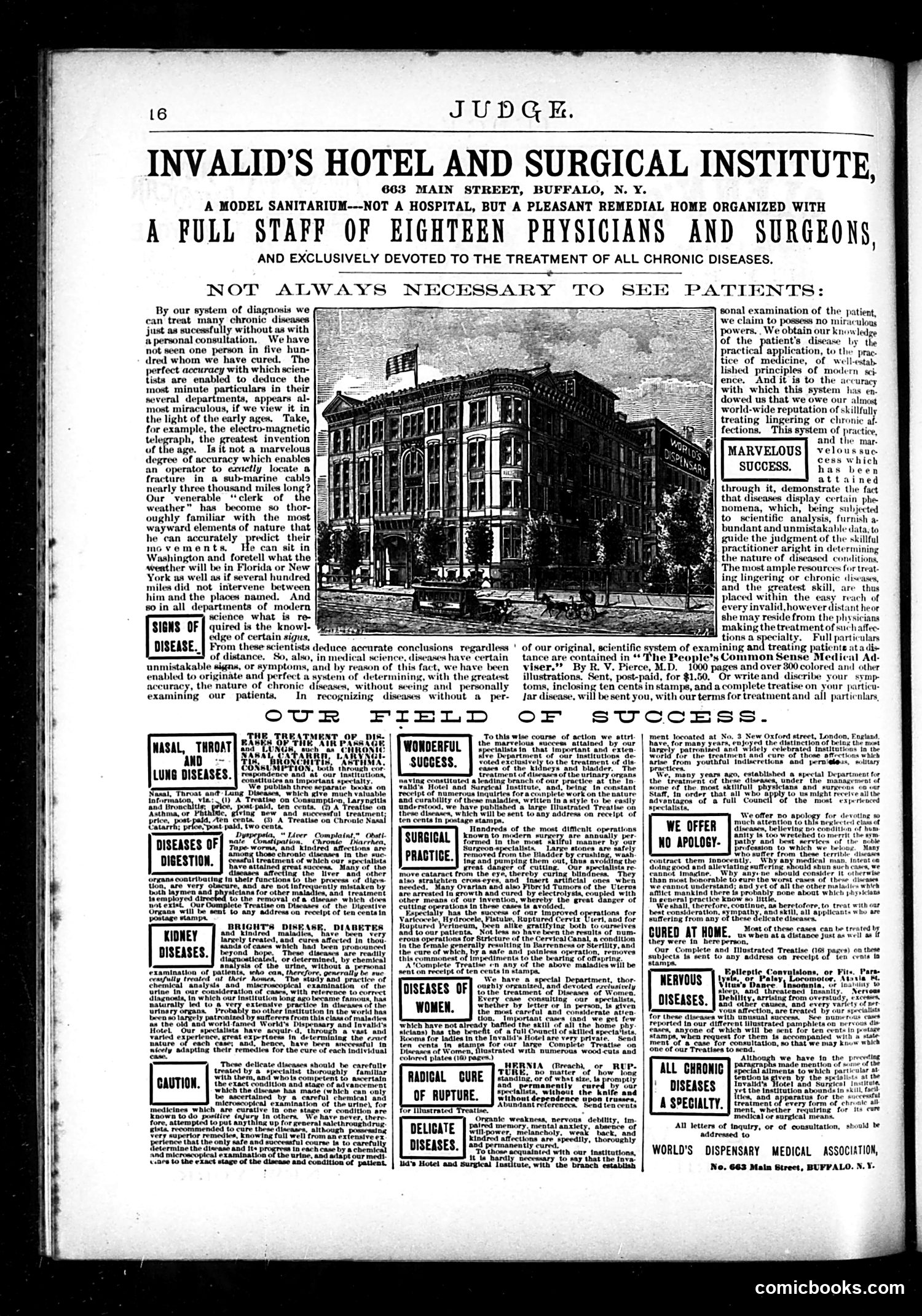
This page is **primarily a medical advertisement**, not a satirical cartoon. It promotes the "Invalid's Hotel and Surgical Institute" in Buffalo, New York—a private sanitarium claiming to treat chronic diseases. The satirical *subtext* (common in Judge magazine) lies in the dubious medical claims: the institute boasts it can diagnose and treat patients **without seeing them in person**, comparing this supposed accuracy to telegraph operators locating submarine cable breaks or weather forecasters predicting distant conditions. This is presented as rational science, but the exaggeration reveals the absurdity of mail-order medical diagnosis—a common quack practice of the era. The building illustration shows an imposing structure designed to inspire confidence. The repeated emphasis on "marvelous success" and "eighteen physicians" suggests satirizing how medical institutes used impressive-sounding credentials to attract desperate chronic-disease sufferers willing to pay for remote "treatment." This represents Judge's ongoing critique of fraudulent or dubious medical practices marketed to the vulnerable ill.
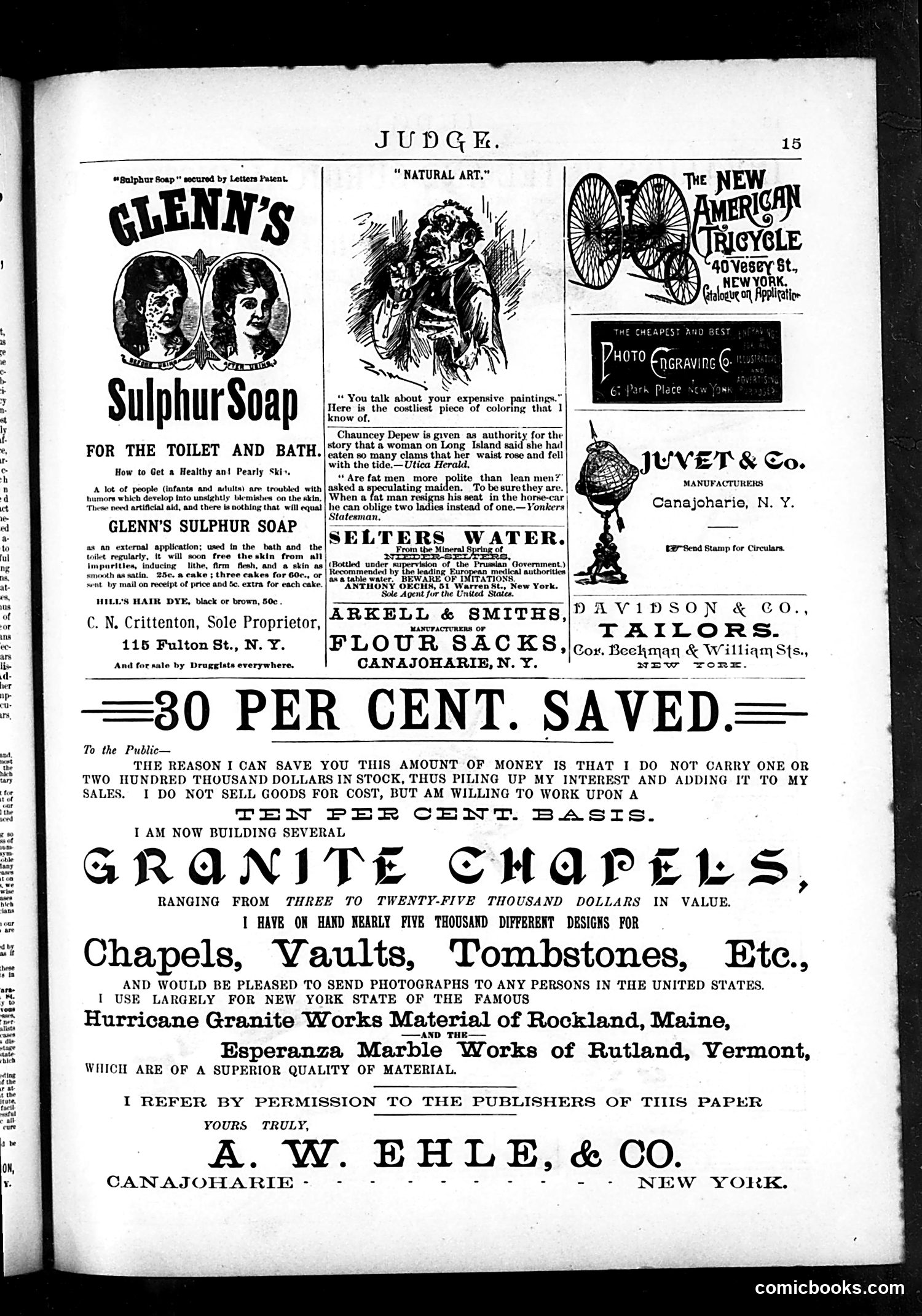
This page is primarily **advertising** rather than editorial content or political cartoons. It contains multiple product advertisements typical of late 19th-century publications. The one cartoon present, titled "Natural Art," appears to be a brief satirical joke. It depicts what seems to be a caricatured woman, accompanied by text attributing to politician **Chauncey Depew** a humorous anecdote about a Long Island woman who claimed to have eaten so many clams that her waist rose and fell with the ocean tides. The joke plays on the absurdity of the claim and uses bodily humor common to the era. The remaining content includes ads for sulphur soap, hair dye, mineral water, flour sacks, a tricycle, and notably a substantial advertisement for granite chapels and tombstones from A.W. Ehle & Co., emphasizing cost savings and superior materials from Maine and Vermont quarries.
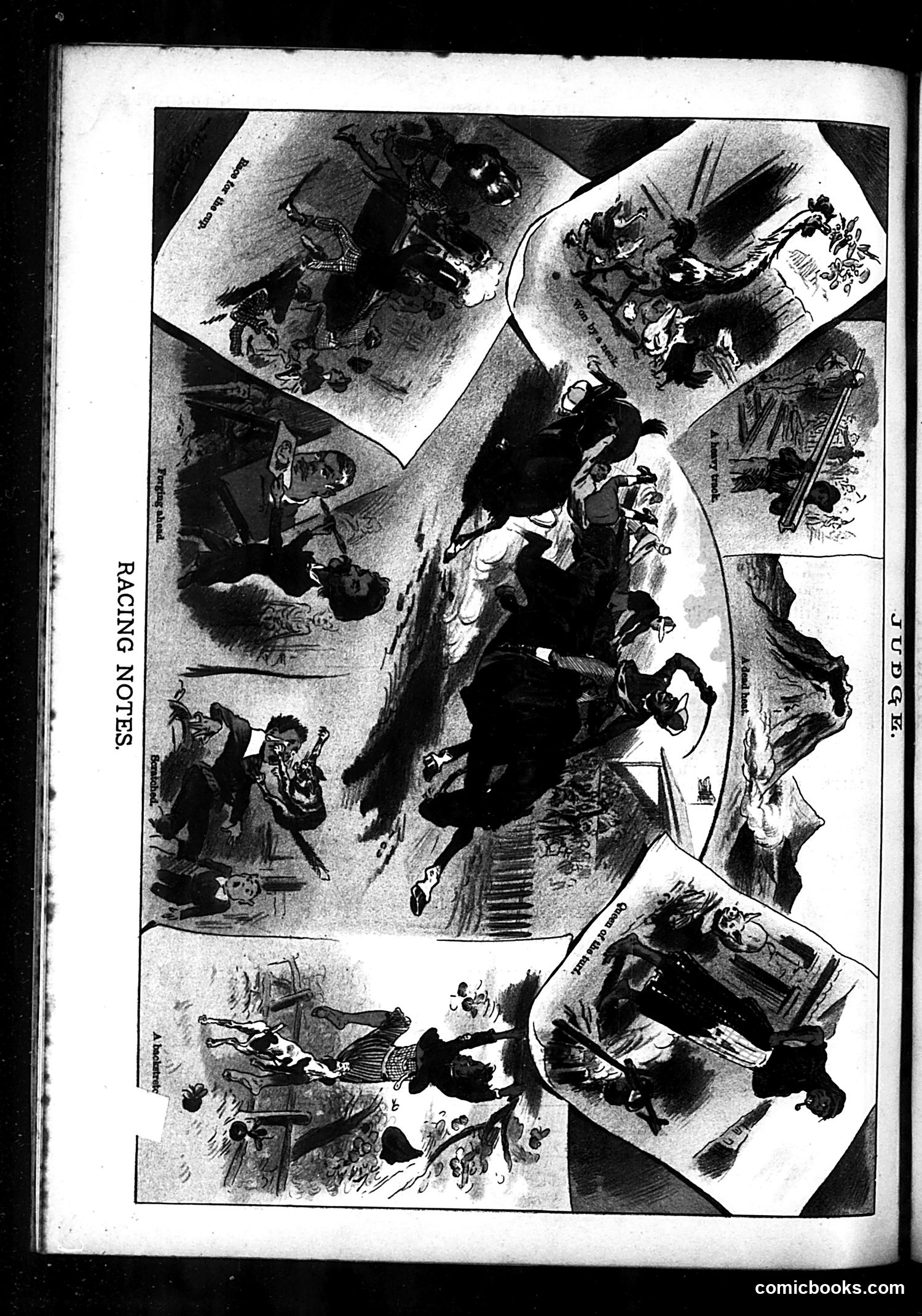
This page appears to be titled "Racing Notes" and contains multiple comic vignettes arranged around a central illustration. The central image shows what appears to be a horse-racing scene with spectators and horses in motion. The surrounding smaller panels seem to satirize various aspects of horse racing culture and gambling. Without clear legible captions in the reproduced image, the specific satirical targets are difficult to identify with certainty. The layout suggests this is commentary on racing-related social activities, possibly mocking betting practices, spectator behavior, or racing personalities popular during Judge magazine's publication period. The black-and-white illustration style and page composition are consistent with early-to-mid 20th century American satirical cartooning, though the specific historical context and identifiable figures require clearer text visibility to interpret accurately.