
Judge, 1886-07-03 · page 7 of 16
Judge — July 3, 1886 — page 7: what you’re looking at
What you’re looking at
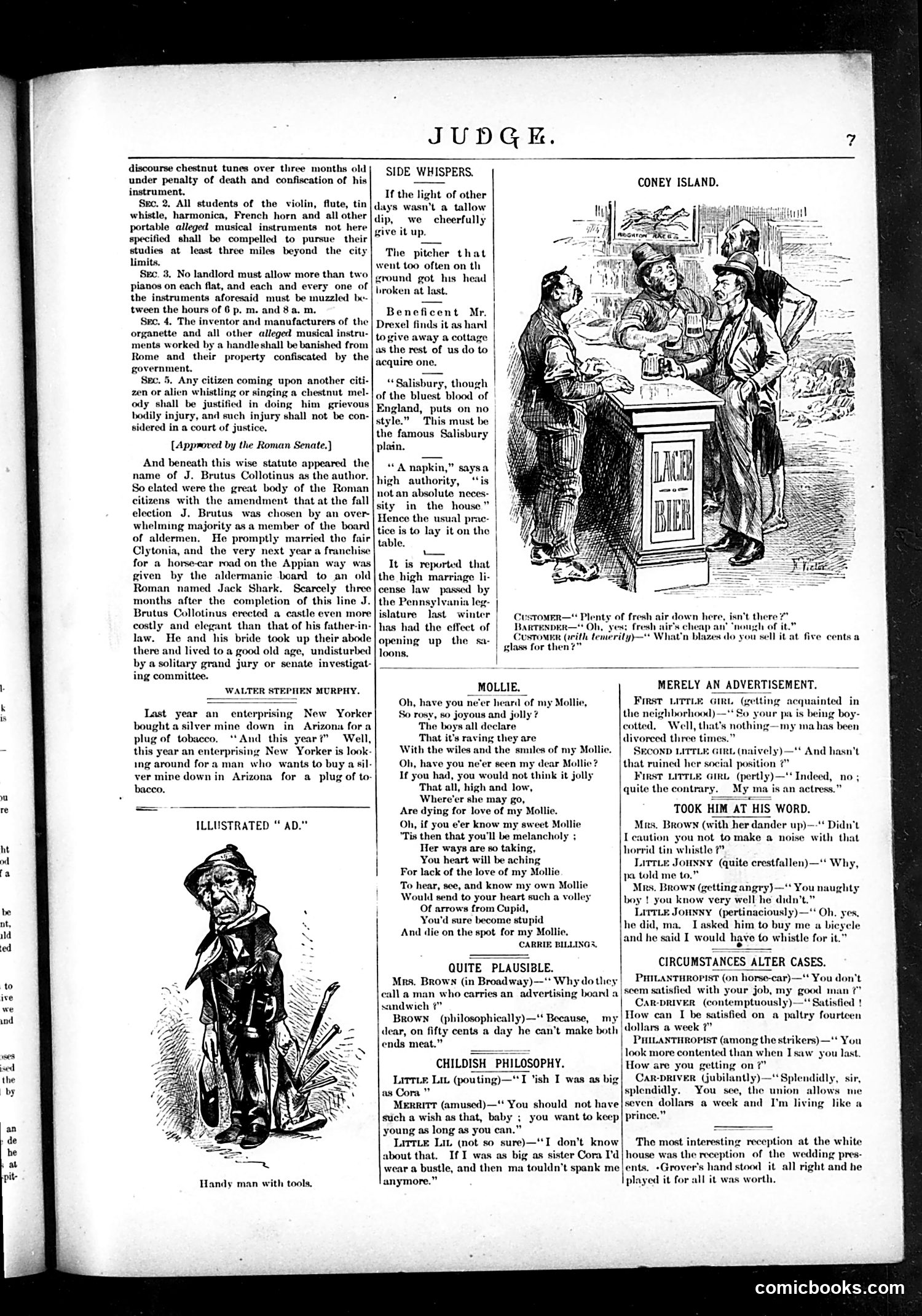
This page from the satirical magazine *Judge* contains several distinct pieces mocking contemporary issues: **Main Feature**: A humorous "Roman Senate" statute proposes absurdly strict regulations on musical instruments—banning chestnut tunes, restricting where students can practice, limiting pianos per apartment, and even authorizing violence against people whistling old melodies. The satire targets widespread urban complaints about noise pollution from street musicians and amateur instrumentalists, a genuine nuisance in densely-packed cities. By attributing these regulations to ancient Rome and showing their apparent success, the piece satirizes how desperate citizens had become for relief. **"Side Whispers"**: Brief witty observations on topical matters, including references to Lord Salisbury (British politician), Pennsylvania's marriage license law, and wealthy philanthropist Drexel. **Other Content**: Includes a sentimental poem about "Mollie," jokes about Arizona silver mines, and dialogue pieces on mundane social matters. The page reflects fin-de-siècle urban anxieties about noise, class, and social regulation.
📄 Transcribed text from this page (OCR, searchable)
Machine-transcribed from the original scan — historical spelling and the odd misread are preserved.
JUDGE. discourse chestnut tunes over three months old under penalty of death and confiscation of his instrument. Sec. 2, All students of the violin, flute, tin whistle, harmonica, French horn and all other portable alleged musical instruments not here specified shall be compelled to pursue their studies at least three miles beyond the city limits. Sec. 3. No landlord must allow more than two pianos on each flat, and each and every one of the instruments aforesaid must be muzzled be- tween the hours of 6 p. m. and 8 a, m. Sec, 4. The inventor and manufacturers of the organette and all other alleged musical instru- ments worked by a handle shall be banished from Rome and their property confiscated by the government. Sec. 5. Any citizen coming upon another citi- zen or alien whistling or singing a chestnut mel- ody shall be justified in doing him grievous bodily injury, and such injury shall not be con- sidered in a court of justice. [Approved by the Roman Senate.) And beneath this wise statute appeared the name of J. Brutus Collotinus as the author. So elated were the great body of the Roman citizens with the amendment that at the fall election J. Brutus was chosen by an over whelming majority asa member of the board of aldermen. He promptly married tho fair Clytonia, and the very next year a franchise for a horse-car road on the Appian way was given by the aldermanic beard to an old Roman named Jack Shark. Scarcely three months after the completion of this line J. Brutus Collotinus erected a castle even more costly and elegant than that of his father-in- law. He and his bride took up their abode there and lived to a good old age, undisturbed by a solitary grand jury or senate investigat- ing committee. STEPHEN MURPHY. Last year an enterprising bought a silver mine down in Arizona for a plug of tobacco, “And this year?” Well, this year an enterprising New Yorker is look: ing around fora man who wants to buy a sil- ver mine down in Arizona for a plug of to- bacco. New Yorker ILLUSTRATED “ AD.” Handy man with tools, SIDE WHISPERS. If the light of other days wasn't a tallow dip, we cheerfully give it up. The pitcher that went too often on th ground got his head broken at last. | Beneficent Mr. Drexel finds it as hard togive away a cottage as the rest of us do to acquire one. | “Salisbury, though of the bluest blood of England, puts on no style.” This must be | the famous Salisbury | plain. “A napkin,” saysa high authority, “ not an absolute neces: sity in the hou: Hence the usual prac: | tice is to lay it on tho table. —_— It is reported that the high marriage li- cense law passed by the Pennsylvania leg- islature last winter has had the effect of | opening up the sa- loons. “Oh, ye he tem MOLLIE. Oh, have you ne'er heard of my Mollie, So rosy, 80 joyous and jolly? The all declare That it’s raving they are With the wiles and the smiles of my Mollie. Oh, have you ne'er seen my If you had, you would not t That all, high and low, Where'er she may go, Are dying for love of my Mollie. Oh, if you e’er know my sweet Mollie “Tis then that you'll be melancholy ; Ter ways are so taking, You heart will be aching For lack of the love of my Mollie To hear, see, and know my own Mollie Would send to your heart such a volley Of arrows from Cupid, You'd sure become stupid And die on the spot for my Mollie, CARRIE BILLINGS. QUITE PLAUSIBLE. Mrs. Brows (in Broadway)—‘ Why do they | 1 a man who carries an advertising board a sindwich ¢” Brown (philosophically)—‘‘ Because, my dear, on fifty cents a day he can’t make both ends meat.” a i CHILDISH PHILOSOPHY. Littie Lit (pouting)—“I ‘ish I was as big as Cora” Merritt (amused)—“ You should not have sich a wish as that, baby ; you want to keep young as long as you can. LittLe Lit (not so sure)—I don’t know about that. If I was as big as sister Cora I'd wear a bustle, and then ma touldn’t spank me |tha CONEY ISLAND. } Ce Plenty of fresh ai fresh MERELY AN ADVERTISEMENT. First LITTLE GIRL. the neighborhood) cotted, Well, that’s divorced three time ECOND LITTL ruined her social positic First Litt.e Girt (pertly)—' Indeed, no ; quite the contrary. My ma is an actress.” TOOK HIM AT HIS WORD. Mrs, Brown (with her dander up)—-‘‘ Didn't n you not to make a noise with that tin whistle ¢” Littie Jouxxy (quite crestfallen)—" Why, pa told me to. Mrs. Brown (getting angry)—“' You naughty boy ! you know very well he didn’t.” Litre JOHNNY (pertinaciously)—“‘ Oh. he did, ma, I asked him to buy me a bi and he said I would have to whistle for it. equainted in CIRCUMSTANCES ALTER CASES. PHILanturopist (on horse-car)—"* You don't seem satisfied with your job, my good man?” Car-pRiveR (contemptuously)—“ Satisfied | How can I be satisfied on a paltry fourteen lollars a week ?” PHILANTHROPIST (among the strikers)—"* You look more contented than when I saw you last. | How are you getting on CaR-DRIVER (jubilantly) splendidly. You see, the union seven dollars a week and I'm living like a prince.” The most interesting reception at the white house was the reception of the wedding pres- ents. -Grover's hand stood it all right and he anymore.” played it for all it was worth, comicbooks.com