
Judge, 1886-07-03 · page 10 of 16
Judge — July 3, 1886 — page 10: what you’re looking at
What you’re looking at
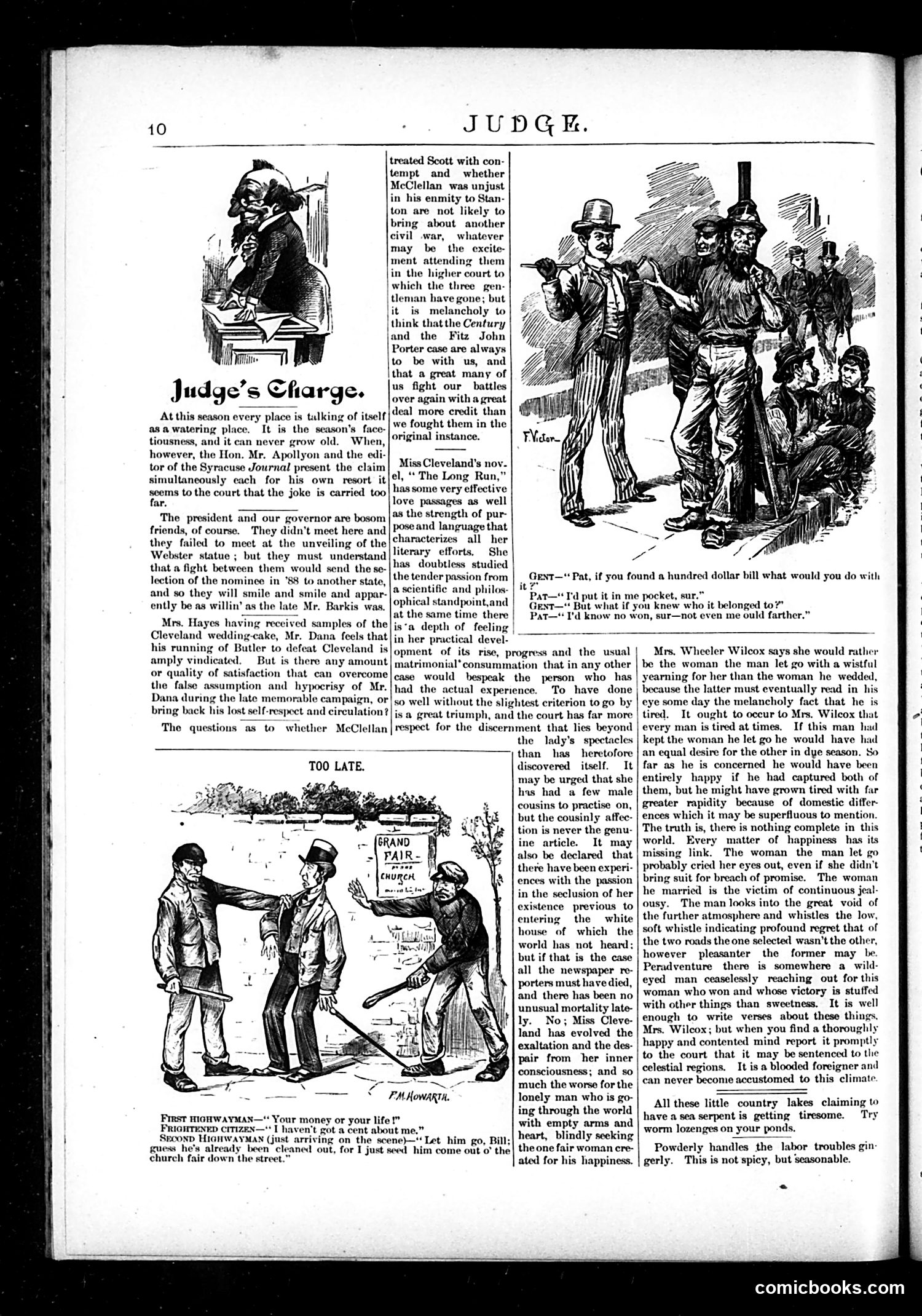
This 1880s page contains two satirical pieces: **"Judge's Charge"** (top): Editorial commentary on contemporary political figures. References include: - President and Governor (appears to be Hayes and another NY official) competing over resort endorsements - Mrs. Hayes receiving Cleveland wedding cake samples - Mr. Dana's "running of Butler to defeat Cleveland" during a recent election - Debates between McClellan, Scott, and Stanton (Civil War-era generals) - Miss Cleveland's novel "The Long Run" The satire critiques politicians' self-serving hypocrisy and argues that old Civil War disputes (like the Fitz John Porter case and Century magazine debates) remain tiresome. **"Too Late"** (bottom): A street robbery joke showing two highwaymen. The humor: the first robber found his victim already cleaned out by a church fair fundraiser, suggesting the church is more effective at extracting money than criminals. Both pieces use the characteristic Judge approach: political commentary mixed with social satire and humor.
📄 Transcribed text from this page (OCR, searchable)
Machine-transcribed from the original scan — historical spelling and the odd misread are preserved.
Judge’s Charge. At this season every place is talking of itself asawatering place. It is the season's face- tiousness, and it can never grow old. When, however, the Hon. Mr. Apollyon and the edi- tor of the Syracuse Journal present the ¢ simultaneously each for his own resort it ems to the court that the joke is carried too far. The president and our governor are bosom friends, of course. They didn't meet here and they failed to mect at the unveiling of the Webster statue ; but they must understand that a fight between them would send the se- lection of the nominee in ‘88 to another state, and so they will smile and smile and appar- ently be as willin’ as the late Mr. Barkis was. Mrs. Hayes having received samples of the Cleveland wedding-cake, Mr. Dana feels that his running of Butler to defeat Cleveland is amply vindicated. But is there any amount or quality of satisfaction that can overcome the falsc assumption and hypocrisy of Mr. Dana during the late memorable campaign, or bring back his lost self-respect and circulation? Tho questions as to whether McClellan JUDGE. treated Scott with con- tempt and whether McClellan was unjust in his enmity to Stan- ton are not likely to bring about another civil .war, whatever may be the excite- ment attending them in the higher court to |which the three gen- tleman have gone; but jit is melancholy to | think thatthe Century jand the Fitz John Porter case are always to be with us, and ithat a great many of us fight our battles over again with a great deal more credit than we fought them in the original instance. Miss Cleveland's nov- el, “ The Long Run,” has some very effective love passages as well as the strength of pur- poseand language that characterizes all her literary efforts, She has doubtless studied the tender passion from ientific and philos- al standpoint,and at the same time there is‘a depth of feeling | _ Gext—“ Pat, if you found a hundred dollar bill what would you do with Pat—"Td put it in me pocket, sur.” Gext—“ But what if you knew who it belonged to?” Pat—* I'd know no won, sur—not even me ould farther.” in her practical devel- opment of its rise, progress and the usual | matrimonial* consummation that in any other case would bespeak the person who has | had the actual experience. To have done so well without the slightest criterion to go by isa great triumph, and the court has far more respect for the discernment that lies beyond the lady's spectacles TOO LATE. «Your money or your life FRIGHTENED CITIZEN. church fair down the street.” —" T haven't got a cent about me.” Second HiGnWaYMAN (just arriving on the scene)—" Let him go, Bill; guess he's already been’ cleaned out, for I just seed him come out 0° the than has heretofore discovered itself. It may be urged that she has had a few male cousins to practise on, but the cousinly affee- tion is never the genu- ine article. It may also be declared that there have been experi- ences with the passion in the seclusion of her existence previous to entering the white house of which the world has not heard; but if that is the case all the newspaper re- porters must have died, and there has been no unusual mortality late- ly. No; Miss Cleve- land has evolved the exaltation and the des- pair from her inner consciousness; and so much the worse for the lonely man who is go- ing through the world with empty arms and heart, blindly seeking the one fair woman cre- r ated for his happiness. Mrs, Wheeler Wilcox says she would rather be the woman the man let go with a wistful yearning for her than the woman he wedded, because the latter must eventually read in his eye some day the melancholy fact that he is tired. It ought to occur to Mrs. Wilcox that every man is tired at times. If this man had kept the woman he let go he would have had an equal desire for the other in dye season. So far as he is concerned he would have been entirely happy if he had captured both of them, but he might have grown tired with far greater rapidity because of domestic differ ences which it may be superfluous to mention. The truth is, there is nothing complete in this world. Every matter of happiness has its missing link. The woman the man let go probably cried her eyes out, even if she didn't bring suit for breach of promise. The woman he married is the victim of continuous jeal- ousy. The man looks into the great void of the further atmosphere and whistles the low, soft whistle indicating profound regret that of the two roads the one selected wasn’t the other, however pleasanter the former may be. Peradventure there is somewhere a wild- eyed man ceaselessly reaching out for this woman who won and whose victory is stuffed with other things than sweetness. It is well enough to write verses about these things, Mrs. Wilcox; but when you find a thoroughly happy and contented mind report it promptly to the court that it may be sentenced to the celestial regions. It is a blooded foreigner and can never become accustomed to this climate. All these little country lakes claiming to have a sea serpent is getting tiresome. Try worm lozenges on your ponds. Powderly handles the labor troubles gin: gerly. This is not spicy, but seasonable. < comicbooks.com