
Judge, 1886-07-03 · page 3 of 16
Judge — July 3, 1886 — page 3: what you’re looking at
What you’re looking at
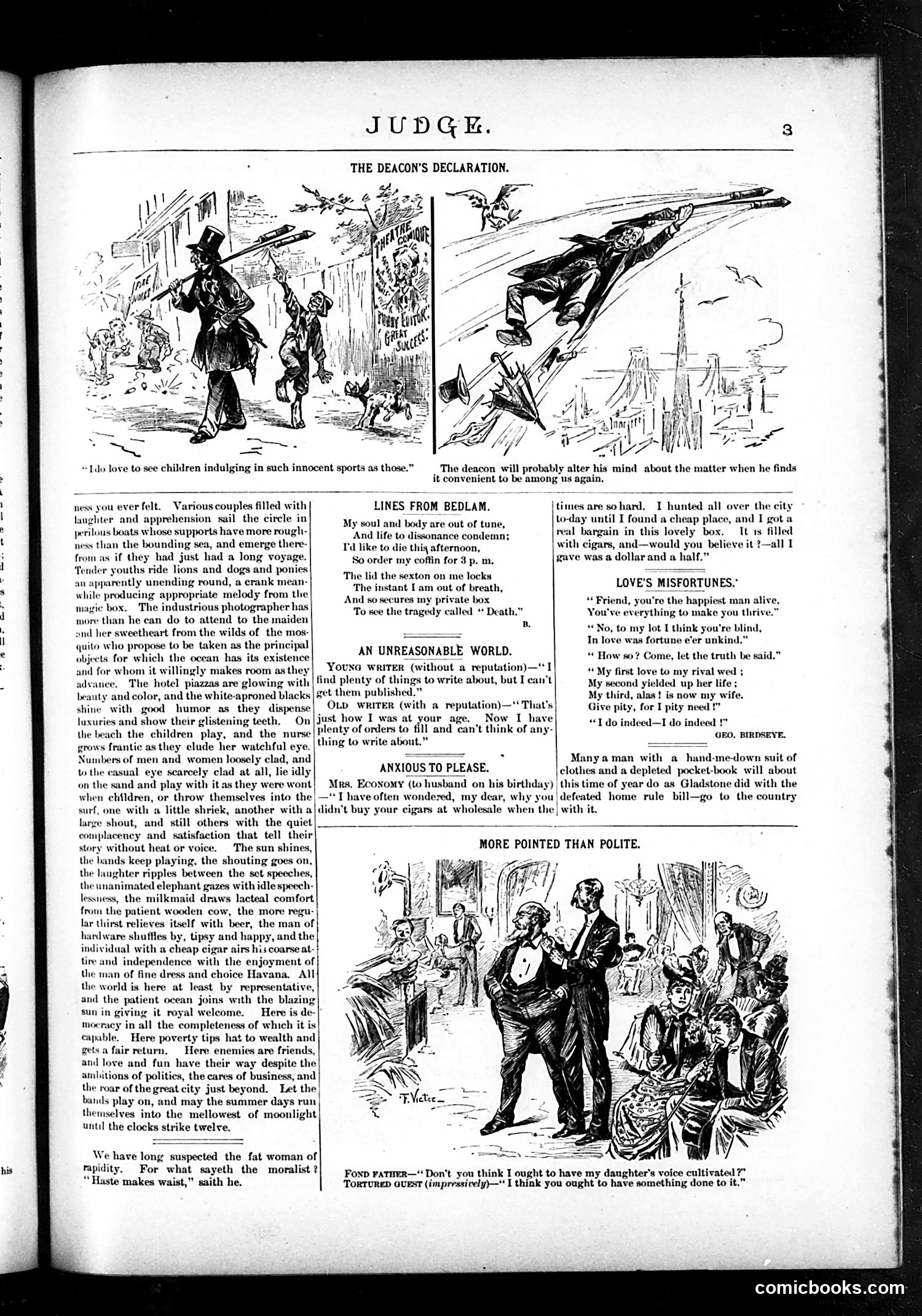
This page from *Judge* magazine contains several satirical pieces mocking social pretense and human nature: **"The Deacon's Declaration"** (top): A moralistic deacon condemns children's innocent amusements, but the caption suggests his objection is hypocritical—he'll happily participate when convenient. The satire targets religious hypocrisy. **"Lines from Bedlam"** and other brief pieces mock melodramatic romanticism and the publishing world's unfairness (established writers get commissions; unknown writers can't get published). **"More Pointed Than Polite"** (bottom illustration): Shows a poorly-dressed man at a social gathering being told he should wear nicer clothes—mocking both class consciousness and tactless social correction. The page's extended prose passage celebrating a seaside resort's democratic mingling of classes, wealthy and poor together, is likely ironic commentary on America's claimed social equality versus actual class divisions. Overall, the satire targets hypocrisy, class pretension, and sentimental excess in late 19th-century American society.
📄 Transcribed text from this page (OCR, searchable)
Machine-transcribed from the original scan — historical spelling and the odd misread are preserved.
JUDGE. “Ido love to see children indulging in such innocent sports as those.” felt. Various couples filled laughter and apprehension sail the circle in perilous boats whose supports have more rough- ness than the bounding sea, and emerge there- from as if they had just had a long voyage. youths ride lions and dogs and ponies »parently unending round, a crank mean- while producing appropriate melody from the box. The industrious photographer has. than he can do to attend to the maiden sweetheart from the wilds of the mos- quito who propose to be taken as the principal h the ocean has its existence whom it willingly makes room as th nee. The hotel piazzas are glowing with leauty and color, and the white-aproned blacks. shine with good humor as they dispense luxuries and show their glistening teeth. On the beach the children play, and the nurse grows frantic as they elude her watchful eye. Numbers of men and women loosely clad, and to the casual eye scarcely clad at all, lie idly on the sand and play with itas they were wont when children, or throw themselves into the surf, one with a little shriek, another with a large shout, and still others with the quiet complacency and satisfaction that tell their ithout heat or voice. The sun shines, ness you ev er ripples between the sct speeches, nimated elephant gazes with idle speech- lessness, the milkmaid draws lacteal comfort. from the patient wooden cow, the more regu- lar thirst relieves itself with beer, the man of hardware shuffles by, tipsy and happy, and the dual with a cheap cigar airs his coarse at- tire and independence with the enjoyment of the man of fine dress and choice Havana. All the world is here at least by representative, and the patient ocean joins with the blazing iving it royal welcome. Here mocracy in all the completeness of which it is capable. Here poverty tips hat to wealth and gets a fair return. Here enemies are friends, and love and fun have their way despite the ambitions of politics, the cares of business, and the roar of the great city just beyond. Let the bands play on, and may the summer days run themselves into the mellowest of moonlight until the clocks strike twelve. We have long suspected the fat woman of rapidity. For what sayeth the moralist ¢ “Haste makes waist,” saith he. THE DEACON’S DECLARATION. The deacon will probably alter his mind about the matter when he finds it convenient to be among us again. LINES FROM BEDLAM. My soul and body are out of tune, ‘And life to dissonance condemn; T'd like to die thig afternoon, So order my cofin for 3 p. m. The lid the sexton on me locks The instant I am out of breath, And so secures my private box To see the tragedy called “ Death.” B. AN UNREASONABLE WORLD. YOUNG WRITER (without a reputation)—‘'I find plenty of things to write about, but I can't get them published.” OLD WRITER (with a reputation)—* That's just how I was at your age. Now I ha' plenty of orders to fill and can’t think of an thing to write about.” ANXIOUS TO PLEASE. —‘T have often wondered, my dear, wh didn't buy your cigars at wholesale when the | | times are so hard. I hunted all over the c to-day until I found a cheap place, and I got a real bargain in this lovely box. It 1s filled with cigars, and—would you believe it ?—all I gave was a dollar and a half.” LOVE'S MISFORTUNES.” “ Friend, ou're the happiest man alive, You've : thing to make you thriv “No, to my lot I think you're blind, In love was fortune e’er unkind.” “ How so? Come, let the truth be said.” “« My first love to my rival wed ; My second yielded up her life ; My third, alas! is now my wife. Give pity, for I pity need !” “Ido indeed—I do indeed !” GEO, BIRDSEYE. Many aman with a hand-me-down suit of LE |clothes and a depleted pocket-book will about Mrs, Ecoxomy (to husband on his birthday) this time of year do as Gladstone did with the ted home rule bill—go to the country ith it. MORE POINTED THAN POLITE. Fonp FATHER—“ Don't you think I ought to have my daughter's voice cultivated 7” Tortonep avest (impressively)—“ I think you ought to have something done to it.” comicbooks.com