
A complete issue · 16 pages · 1885
Judge — June 6, 1885
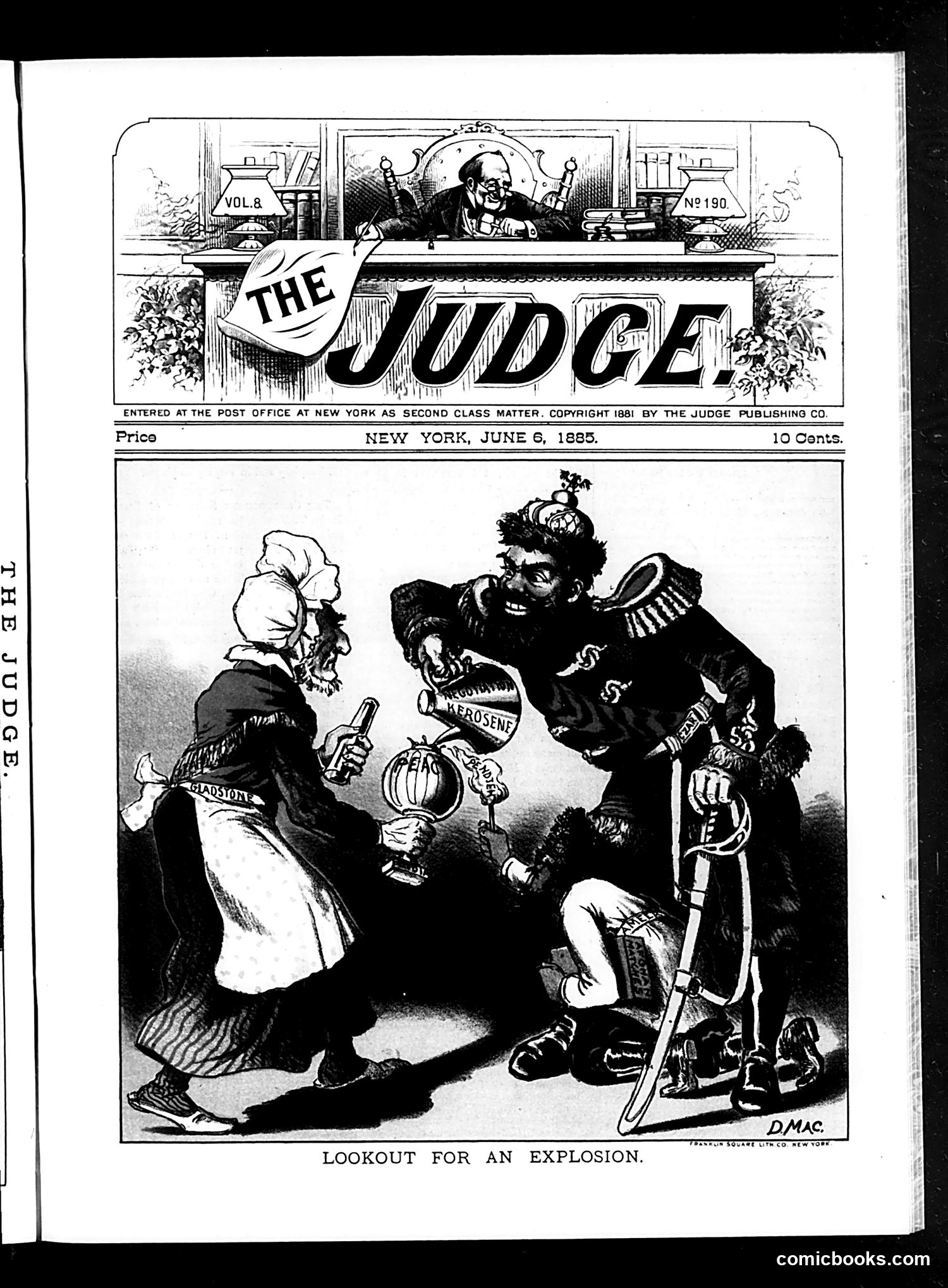
**Title:** "Lookout for an Explosion" **Figures:** The cartoon depicts what appears to be a military officer (identifiable by uniform and epaulettes) holding bottles labeled "Kerosene" and "Pear," speaking with an elderly woman in bonnet and apron. **Context & Satire:** Without additional historical context, the exact political reference is unclear. However, the image suggests a warning about a dangerous mixture—literally and metaphorically. The "explosion" metaphor likely comments on volatile political or social tensions of 1885. The woman's domestic appearance contrasted with the military figure suggests tension between civilian and military interests, or perhaps between traditional society and modernization. **Unclear Elements:** The specific historical event or political figures referenced cannot be definitively identified from the image alone.
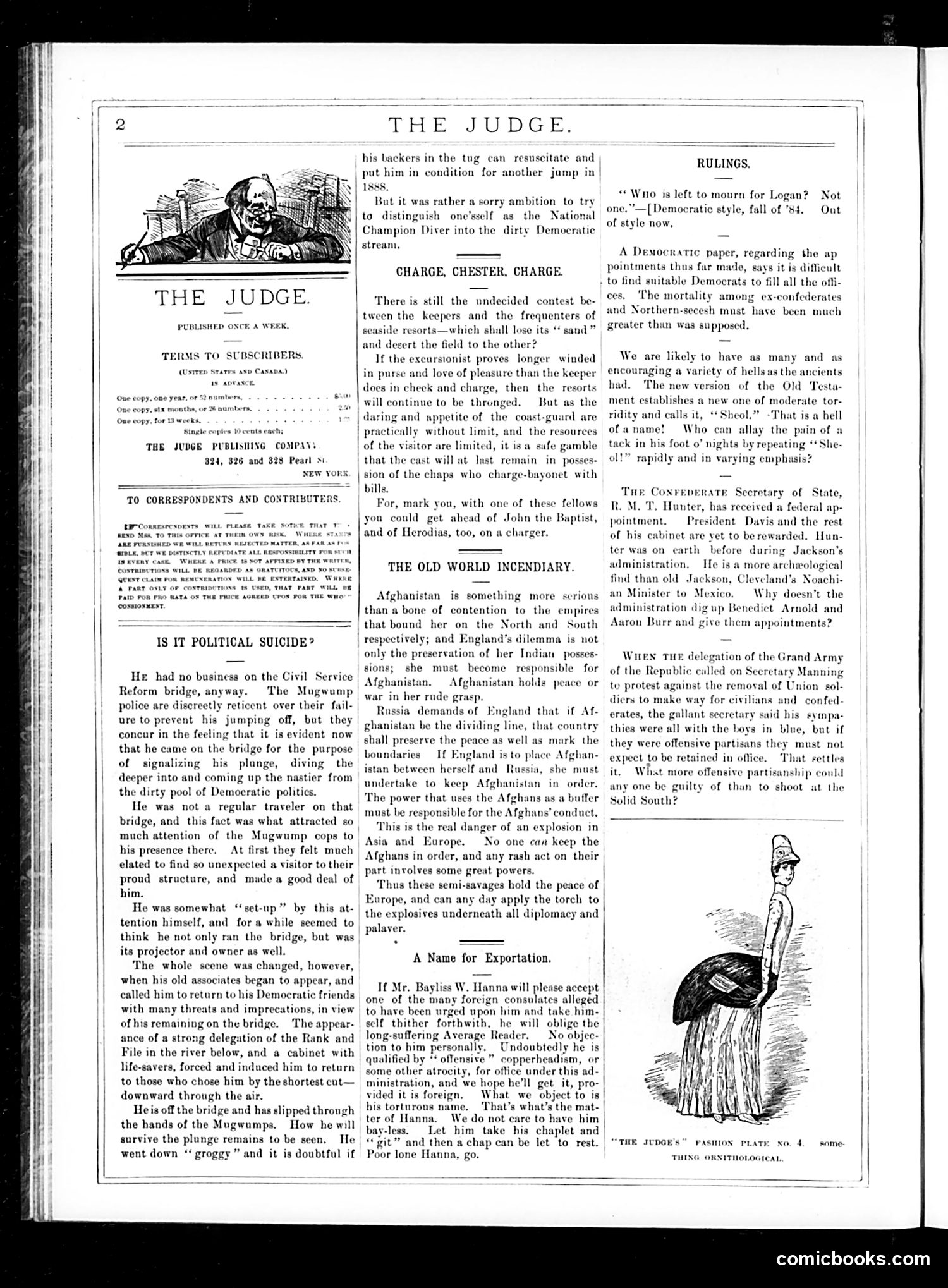
This page satirizes a prominent political figure (identity unclear from image alone) who briefly associated with Civil Service Reform advocates (the "Mugwumps"—a faction of reform-minded Republicans), then returned to Democratic politics. The central metaphor depicts him as a suicide jumper on a bridge: initially welcomed by the Mugwumps, he becomes "set-up" with their attention, but when his old Democratic associates call him back with "threats and imprecations," he plunges into "the dirty pool of Democratic politics." The satire mocks both his political inconsistency and the Mugwumps' naive pride in recruiting him. The piece questions whether this return to Democrats was "political suicide"—career-ending disloyalty—and suggests his Democratic backers may lack resources to "resuscitate" him politically by 1888. Other articles address Afghanistan tensions and diplomatic scandals, typical of this era's coverage.
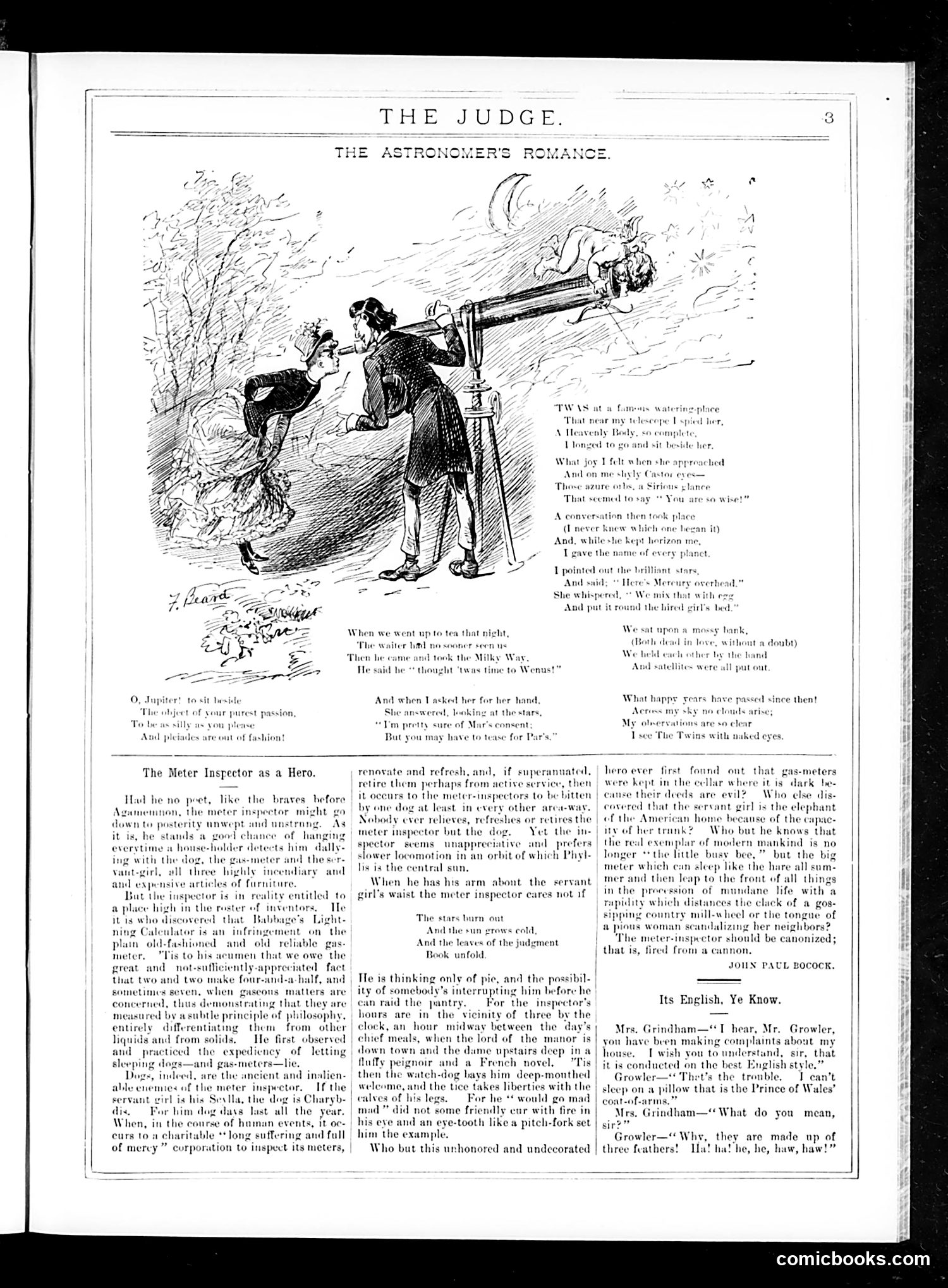
**Top Cartoon:** A romantic comedy about an amateur astronomer wooing a woman through stargazing. He points out constellations (Mercury, Mars, the Twins/Gemini, Sirius) while she gazes through his telescope. The satire mocks sentimental Victorian courtship rituals—the elaborate romantic setup, the woman's breathless responses, the absurd notion that celestial observations constitute seduction. The poetry quoted throughout parodies flowery romantic verse. **Bottom Section:** Two pieces satirizing British social hierarchies. "The Meter Inspector as a Hero" ironically praises the gas-meter inspector as unappreciated—he's actually invisible to his employers despite doing essential work, ignored while the servant girl (truly powerful in running the household) steals credit. "Its English, Ye Know" jokes about English pretension: a lodger complains he can't sleep on pillows fit for royalty (the Prince of Wales), mocking both working-class aspirations and absurd class-consciousness.
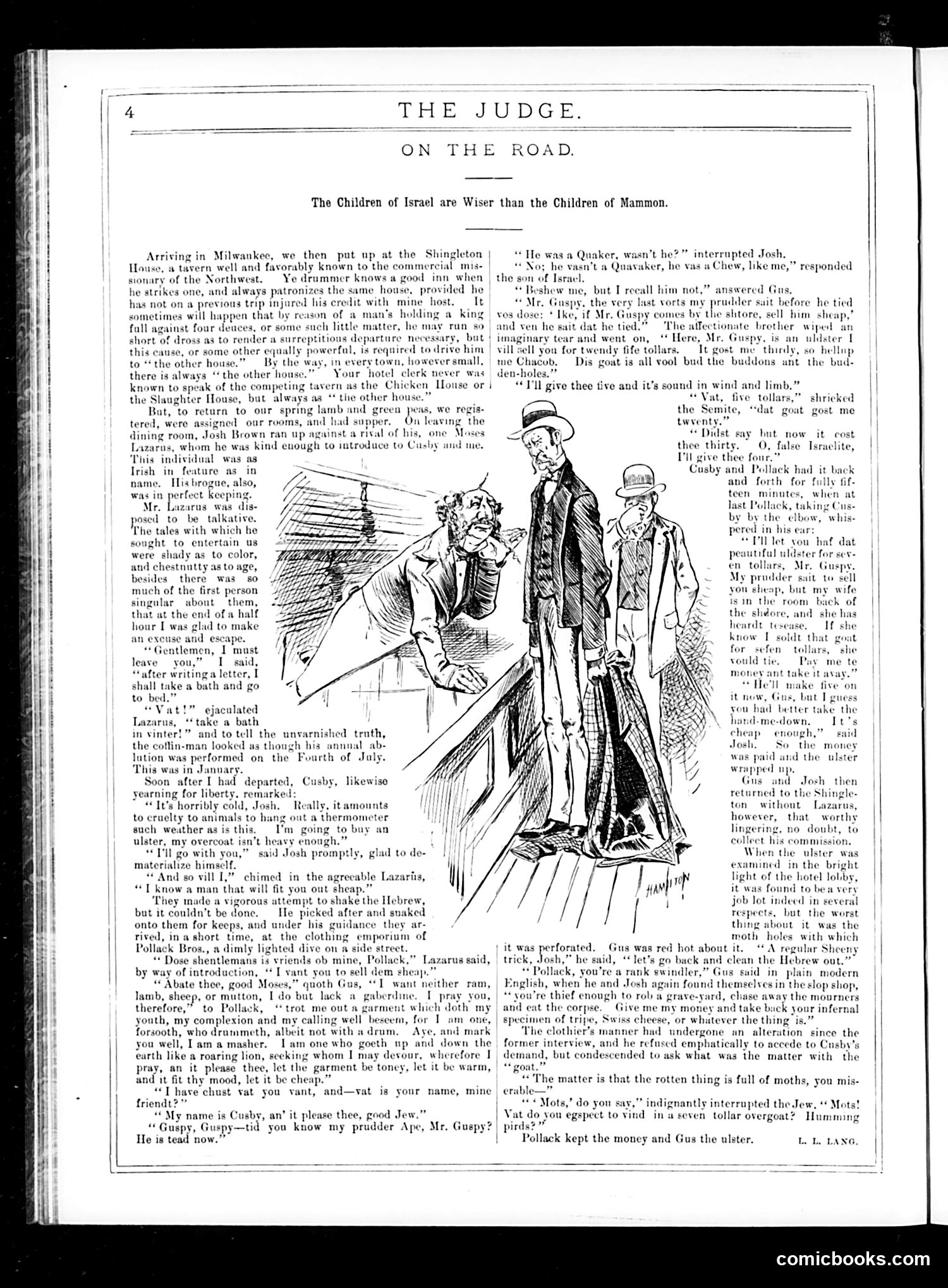
This page satirizes Jewish immigrant merchants and Gentile traveling salesmen ("drummers") in late 19th-century America. The main characters are: - **Josh Brown and Cusby**: traveling salesmen seeking winter coats - **Lazarus and Pollack**: Jewish clothiers who use exaggerated Yiddish-accented English The satire works on multiple levels: Lazarus pesistently attaches himself to the gentlemen despite their disinterest, using his social persistence to steer them to Pollack's shop. Pollack then employs stereotypical Jewish merchant tactics—invoking the dead brother routine, claiming high costs, offering "deals"—while Cusby's pretentious theatrical speech ("shentlemans," biblical references) creates comic contrast. The headline claiming "Children of Israel are Wiser than Children of Mammon" is ironic: the joke is that Lazarus and Pollack are shrewdly manipulative, while the drummers are gullible marks. The humor relies on period ethnic stereotypes about Jewish business practices and accents.
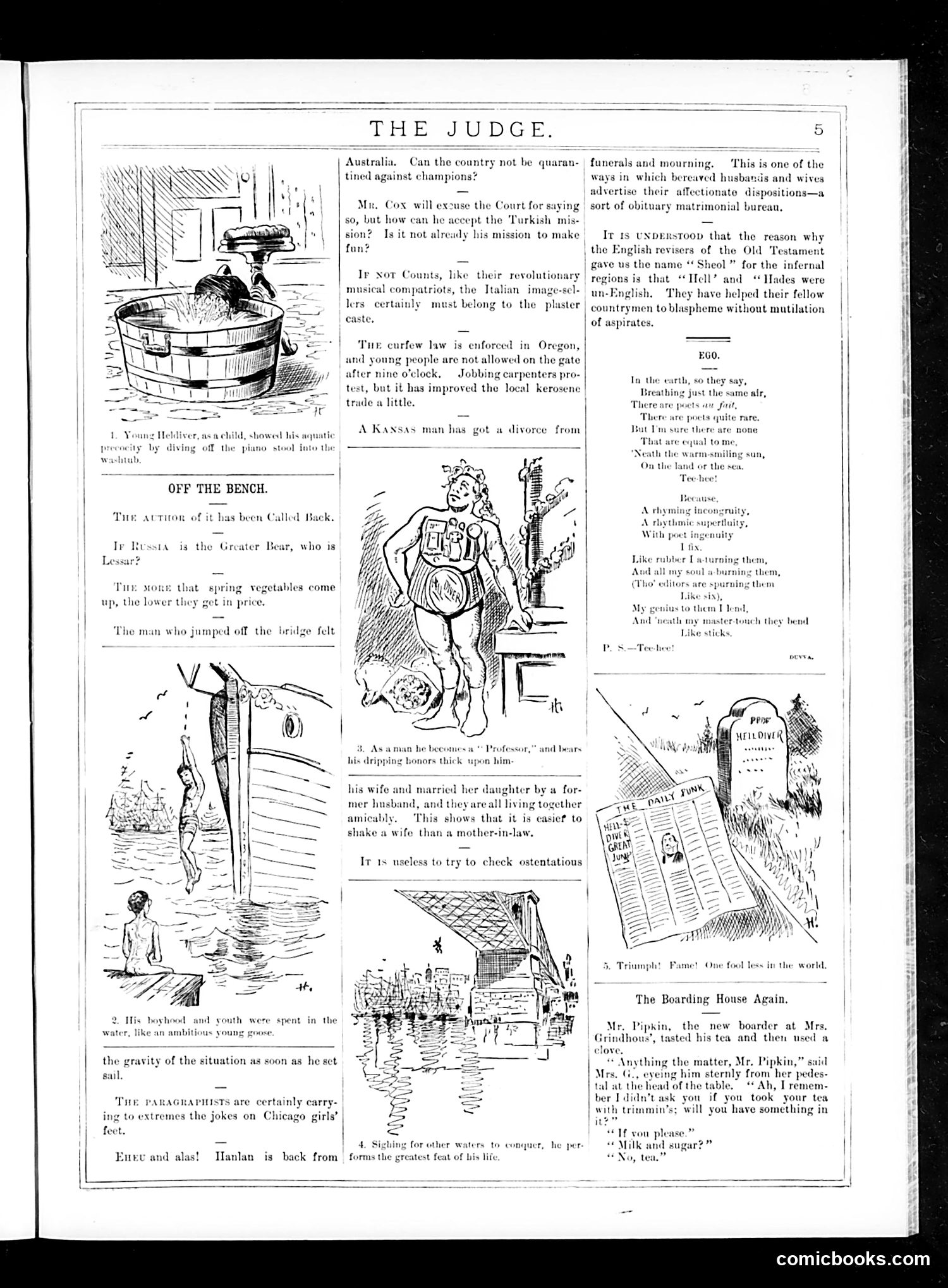
This page contains several brief satirical items typical of Judge's "OFF THE BENCH" section: **Main Political Reference:** The opening quips likely reference Secretary of State John Hay's controversial acceptance of a diplomatic mission involving the Ottoman (Turkish) Empire. The joke suggests accepting such a position contradicts efforts to "quarantine" the country against foreign champions—implying distrust of Ottoman diplomatic involvement. **Social Commentary:** Other items mock contemporary absurdities: spring vegetables getting cheaper as they flood the market; a Kansas man advertising his divorce in the matrimonial bureau section; enforcement of curfew laws on young people in Oregon; and Chicago's extremist jokes. **The "Boarding House" sketch** at bottom depicts typical boarding-house humor: a new tenant (Pipkin) insults his tea by adding sugar, offending the landlady's pride in her hospitality. This reflects common period humor about the indignities of boarding-house life. The cartoons and verse are light satirical fare targeting minor social irritations rather than major political events.
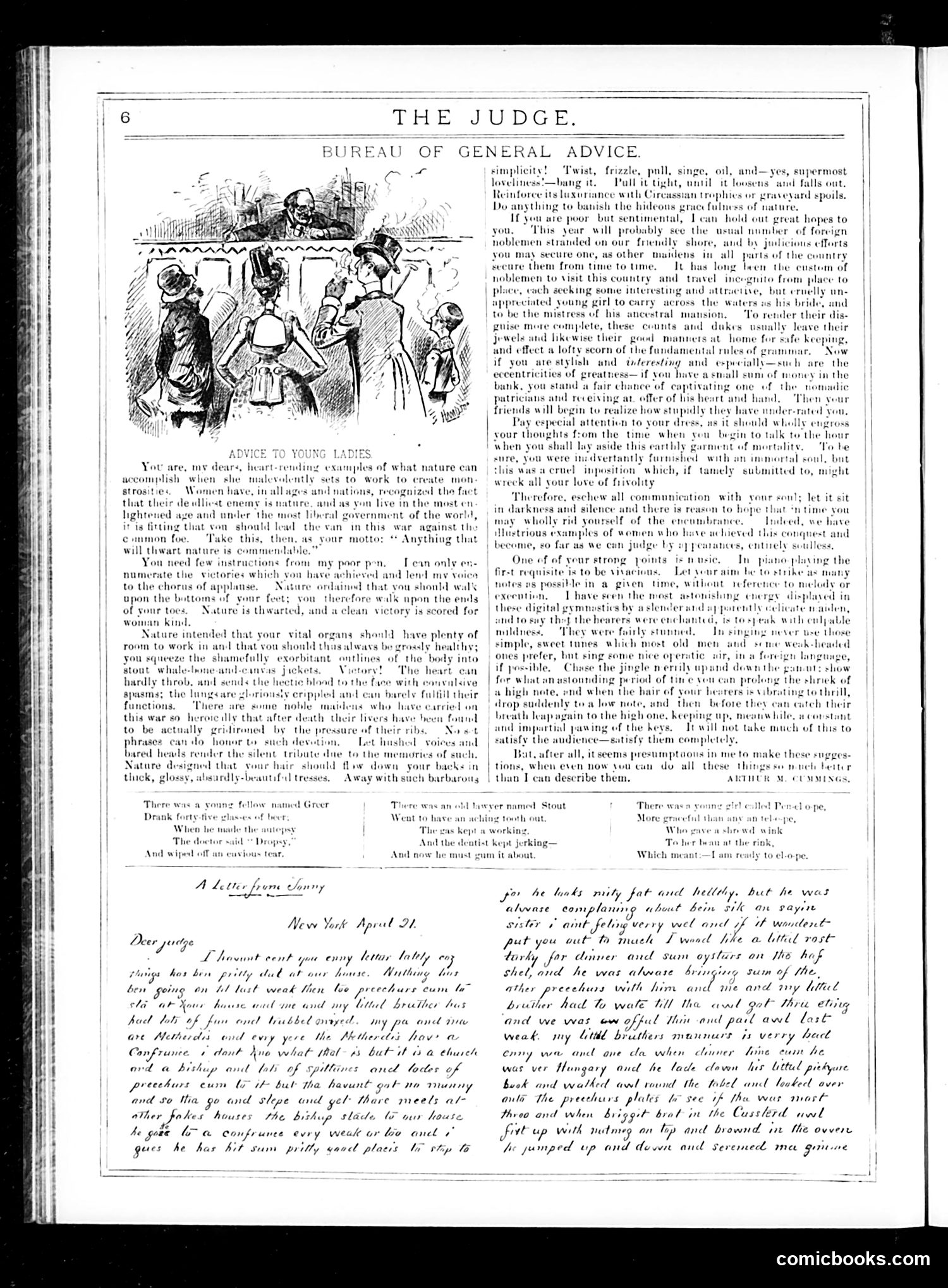
This page satirizes the absurd social expectations placed on young women in the late 19th century. The "advice" column mockingly instructs women to prioritize appearance above all—torturing their hair into fashionable styles, corseting themselves painfully, and remaining vapid and decorative. The satire targets: 1. **Beauty standards**: Exaggerated commands to artificially manipulate natural hair and body through "Circassian" styling (referencing then-fashionable techniques) 2. **Marriage prospects**: Cynical advice that wealthy foreign nobleman visitors seek "unappréciated young girls" as wives, implying transactional marriages 3. **Intellectual suppression**: Mocking instructions to avoid "communication with your soul," suppress thought, and remain frivolous 4. **Physical contortion**: Ridicule of women walking unnaturally on shoe tips and singing with affected mannerisms The handwritten letters below appear to be humorous reader correspondence, maintaining the satirical tone. Judge magazine used such pointed advice columns to critique the restrictive, superficial treatment of women in Victorian society.
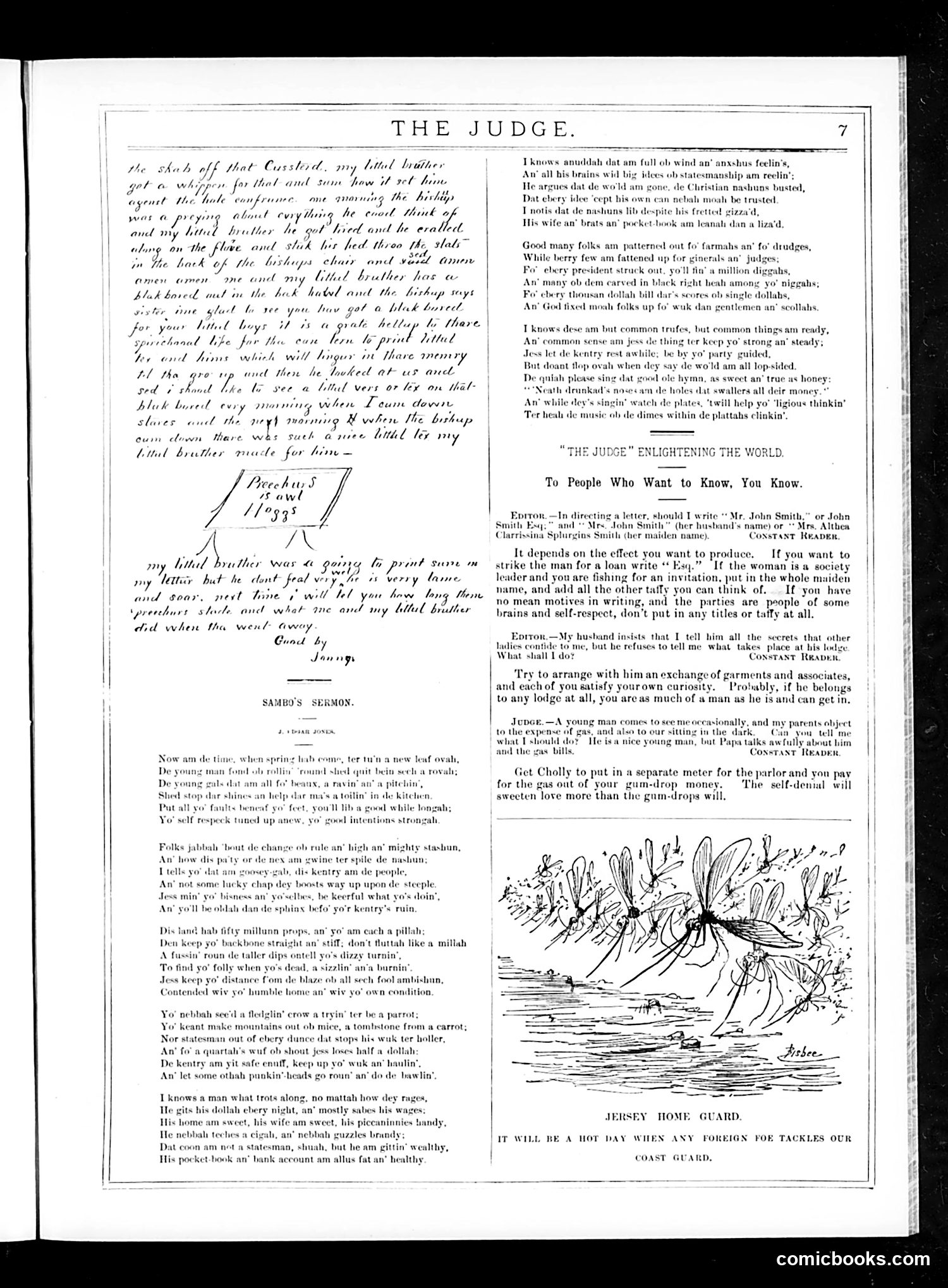
This page from the satirical magazine *Judge* contains two main elements: **Left side:** "Sambo's Sermon," a dialect poem featuring an African American preacher dispensing folk wisdom to his congregation about self-improvement, industry, and contentment. The piece uses heavy phonetic dialect spelling typical of late-19th-century minstrelsy-influenced humor. Topics include respecting oneself, working hard, avoiding frivolous spending, and accepting one's station. **Right side:** An advice column titled "The Judge: Enlightening the World" addressing etiquette questions from readers about letter-writing conventions, social interactions, and domestic disputes. **Bottom:** A sketch labeled "Jersey Home Guard" showing armed men by water, captioned about defending against foreign threats. The sermon reflects period attitudes toward African Americans through stereotypical dialect and paternalistic moral instruction, while the advice column represents typical magazine editorial content of the era.
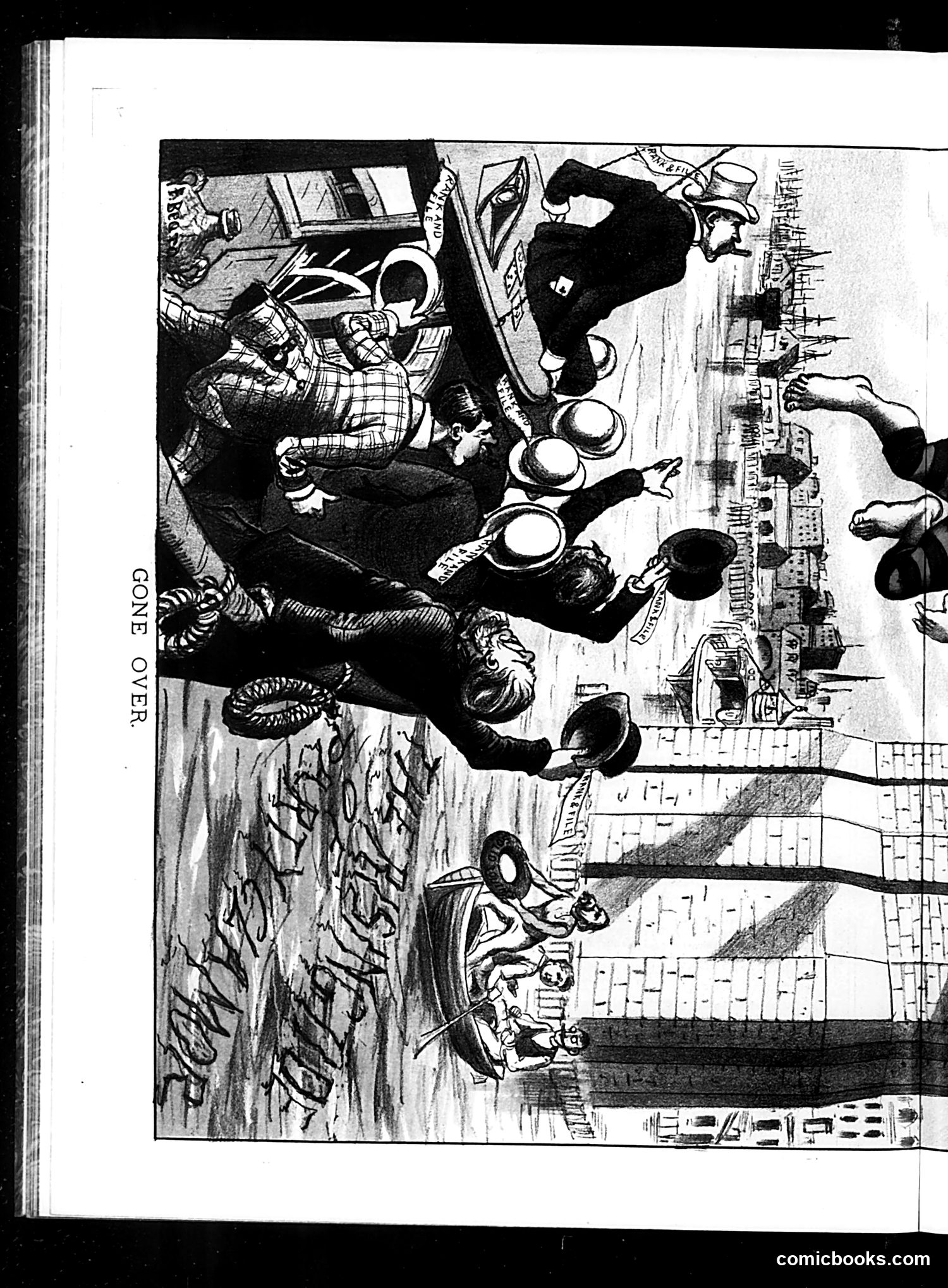
This page appears to be rotated 90 degrees, making full interpretation difficult. The visible text "COME OVER" (in left margin) and "comicbooks.com" (watermark) are legible, but the OCR text is largely corrupted gibberish. The illustration shows what appears to be a street scene with multiple figures in early 20th-century dress, including men in hats and suits. There are buildings in the background and what looks like storefronts or street-level details. However, without legible caption text or clear context, I cannot reliably identify specific political figures, the satirical target, or the intended joke. To properly analyze this Judge magazine cartoon, the page would need to be correctly oriented and the OCR text corrected.
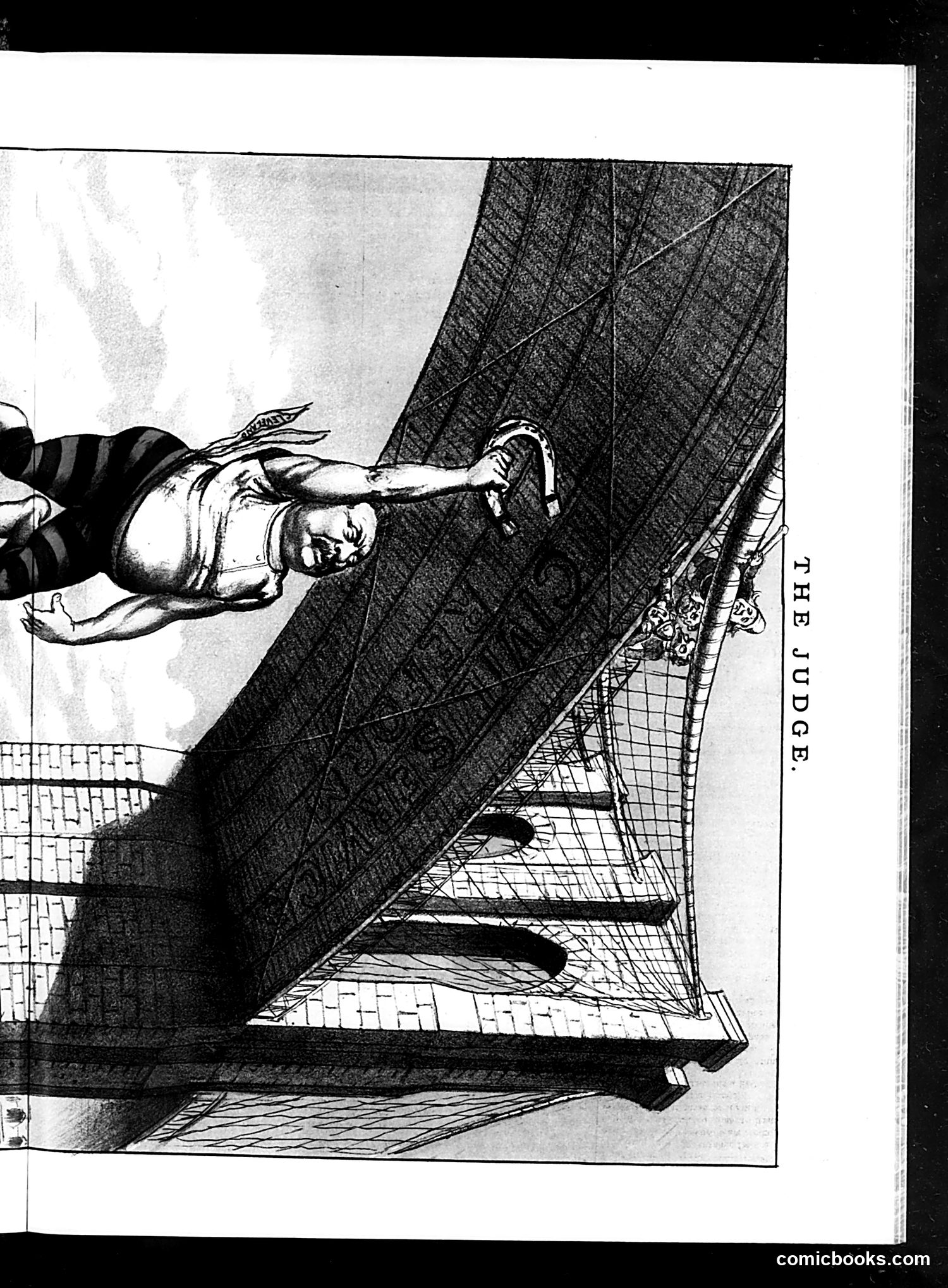
This black and white illustration shows a rotund figure in formal attire (with striped pants) reclining on what appears to be a judge's bench or seat of authority. The figure extends one arm in a gesturing pose, suggesting judgment or pronouncement. The detailed cross-hatching and perspective drawing style is characteristic of late 19th-century satirical illustration. The caption reads "THE JUDGE," likely referring to the magazine's personified mascot or central character. Without clearer OCR text or visible date, the specific political or social commentary remains unclear—though it appears to satirize judicial authority, wealth, or pomposity through the figure's exaggerated physique and imperious posture. The artistic style and format confirm this is from *Judge* magazine's golden age of American political satire.
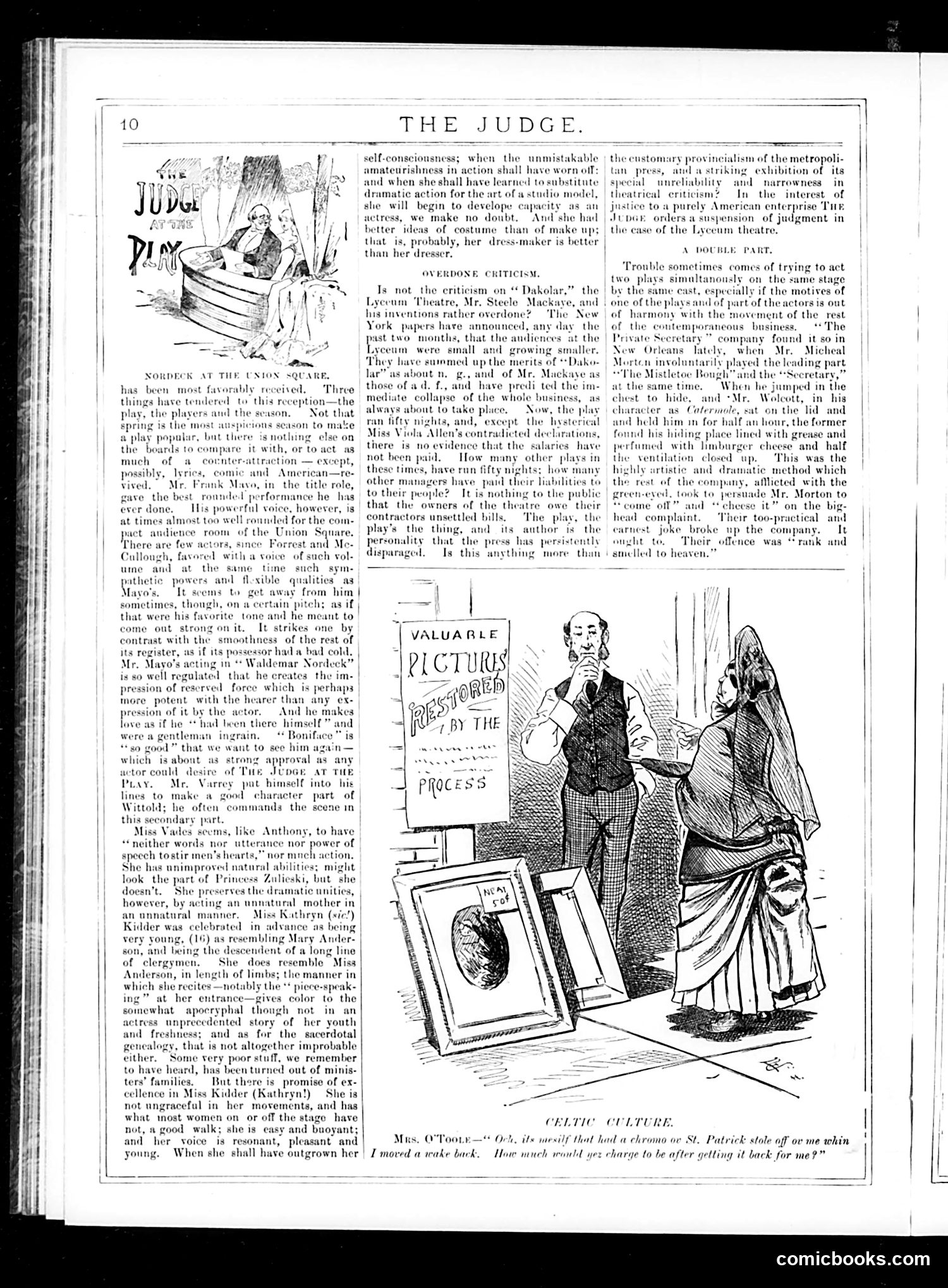
This page contains theatrical criticism from Judge magazine, focused on reviewing stage performances at New York's Union Square Theatre. The main content critiques actor Frank Mayo's performance in "Waldemar Nordeck" and discusses several actresses, including Miss Kathryn Kidder and Miss Valli. The cartoon at bottom right titled "Celtic Culture" shows Mrs. O'Toole discussing picture restoration with what appears to be a picture restorer. She's asking about the cost to restore a damaged painting, making a working-class Irish joke about domestic economics. The magazine criticizes overcriticism of theatrical productions, argues that performers deserve judgment suspension until fully developed, and complains about theater management conflicts (the "double part" section describes a company simultaneously performing conflicting plays). The satire targets both pretentious theater criticism and practical theatrical management failures of the era, while the cartoon provides ethnic humor typical of 1880s American magazines.
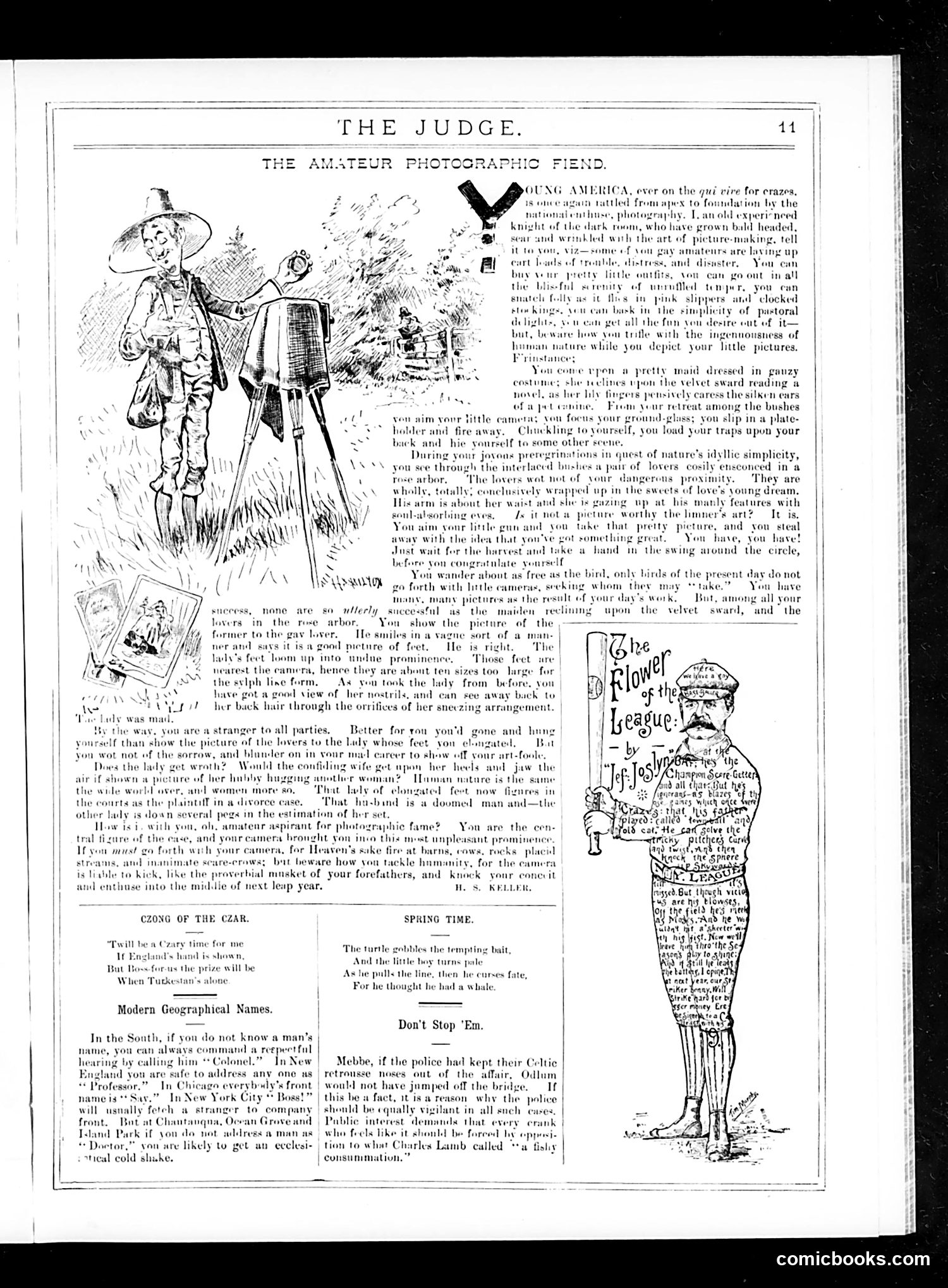
This is a satirical article (attributed to H.S. Keller) mocking amateur photographers of the era. The main illustration shows a comically earnest young man with a large camera on a tripod, representing the "photography craze" sweeping America. The piece ridicules amateur photographers who naively pursue their hobby, often intruding on private moments and failing to understand composition. Keller describes the typical amateur sneaking through bushes to photograph unsuspecting subjects—lovers embracing, women in gauzy costumes—then complaining when their pictures turn out poorly (focusing awkwardly on feet or nostrils instead of proper composition). The satire culminates in warning photographers away from rural subjects: use barns and cows instead, because photographing humans results in unpredictable consequences—"like the proverbial musket of your forefathers" that kicks back and causes injury. The page includes unrelated items: poems ("Czong of the Czar," "Spring Time"), brief humorous pieces about geographical naming conventions and police work ("Don't Stop 'Em"), and an advertisement featuring "The Flower League."
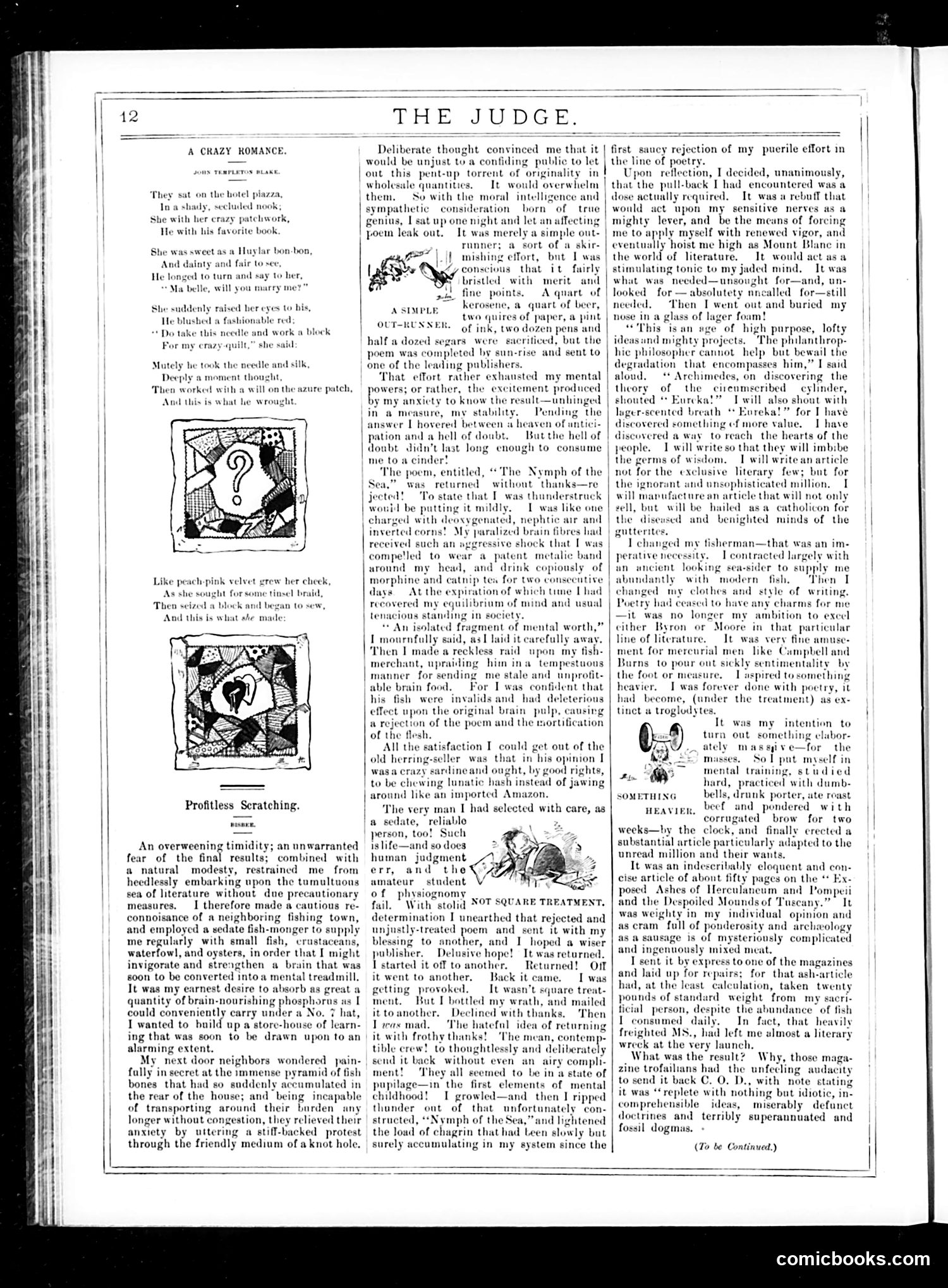
This page contains two satirical pieces mocking literary and romantic pretensions. **"A Crazy Romance"** is a humorous poem about a couple courting on a hotel veranda. The man attempts romance while she works on patchwork quilting. When he tries to propose ("Ma belle, will you marry me?"), she deflects him by asking him to help with her needlework instead. The joke satirizes the awkwardness of Victorian courtship and the gap between romantic idealization and domestic reality. **"Profitless Scratching"** is a longer essay-story mocking an overly cautious would-be writer. The narrator, fearful of publishing mediocre work, consumes enormous quantities of fish (believing phosphorus aids intellect) before attempting his first poem. When publishers reject it, he blames his fish supplier rather than accepting the poem's actual poor quality. The satire targets pretentious amateur writers, their grandiose self-importance, and their reluctance to accept legitimate criticism.
This page from **Judge** (a 19th-century American satirical magazine) contains primarily **short humorous items and jokes** rather than political cartoons. The pieces mock contemporary social absurdities and public figures through brief quips. Key satirical targets include: - **Queen Victoria's etiquette obsession**: Mocking her extreme concern that ladies attended a drawing room without white gloves, calling her "exceedingly angry" over this triviality while facing serious political crises (Afghanistan, Irish troubles). - **Cabinet incompetence**: Describing the Democratic cabinet as among "the seven wonders of the Democracy." - **Henry Irving's vanity**: Joking that the actor claimed a steamship "acted admirably" and should be renamed after him. - **General social hypocrisy**: Items ridiculing elevated railway advocates, medical quackery using gold for ailments, and absurd etymological confusion (skaters as "revolvers"). The humor relies on **exaggeration and irony**—exposing how the powerful obsess over trivial matters while ignoring serious problems. This reflects Judge's satirical mission of deflating pretension through witty criticism of politics, society, and public figures.
This page contains **mostly dialogue-driven humor** rather than political cartoons. The content includes several short comic sketches typical of Judge magazine's satirical style. The most substantive piece is "The General's Article," where a wife critiques her husband's war writing. The satire targets **pretentious military writers and wounded male ego**: the general boasts of his credentials and experience, but his wife methodically demolishes his prose with specific criticisms—his use of "them" instead of "soldiers," awkward phrasing, and a notably absurd detail about a soldier "dragging a gun with a broken leg." The general becomes defensive, insisting his experience should exempt him from editing. Other sketches mock **rural ignorance** (the farmer buying a cow bell as a solution) and **classroom naiveté** (the schoolboy's explanation of spring involving a frog, lizard, and dead cat). The page also contains **period advertisements** for patent medicines and printing services, typical of Judge's era. The overall tone satirizes masculine vanity and the gap between self-perception and actual competence.
This page is predominantly **advertisements** with one short satirical piece titled "A Ludicrous Blunder." ## The Cartoon/Article The main content recounts a humorous anecdote about a **French general** rejecting a manuscript by his wife. She has misread a military situation: a soldier dragging a *gun* with a broken leg, which she interpreted as the *gun* having broken legs and arms. The general, exasperated by her ignorance, burns the manuscript. The piece then pivots to a historical example from the reign of **King Louis-Philippe of France**, describing a printer's error in the *Constitutionnel* newspaper. A letter meant for the King praising his "august person" was accidentally addressed to an arrested murderer instead—creating embarrassing irony since Paris knew the King and his statesman M. Thiers were rivals. **The satire's point**: It mocks both careless reading/writing and the absurdity of printer errors that inadvertently create unintended political humor. The rest of the page consists of period advertisements for pianos, medical remedies, bicycles, and other products.
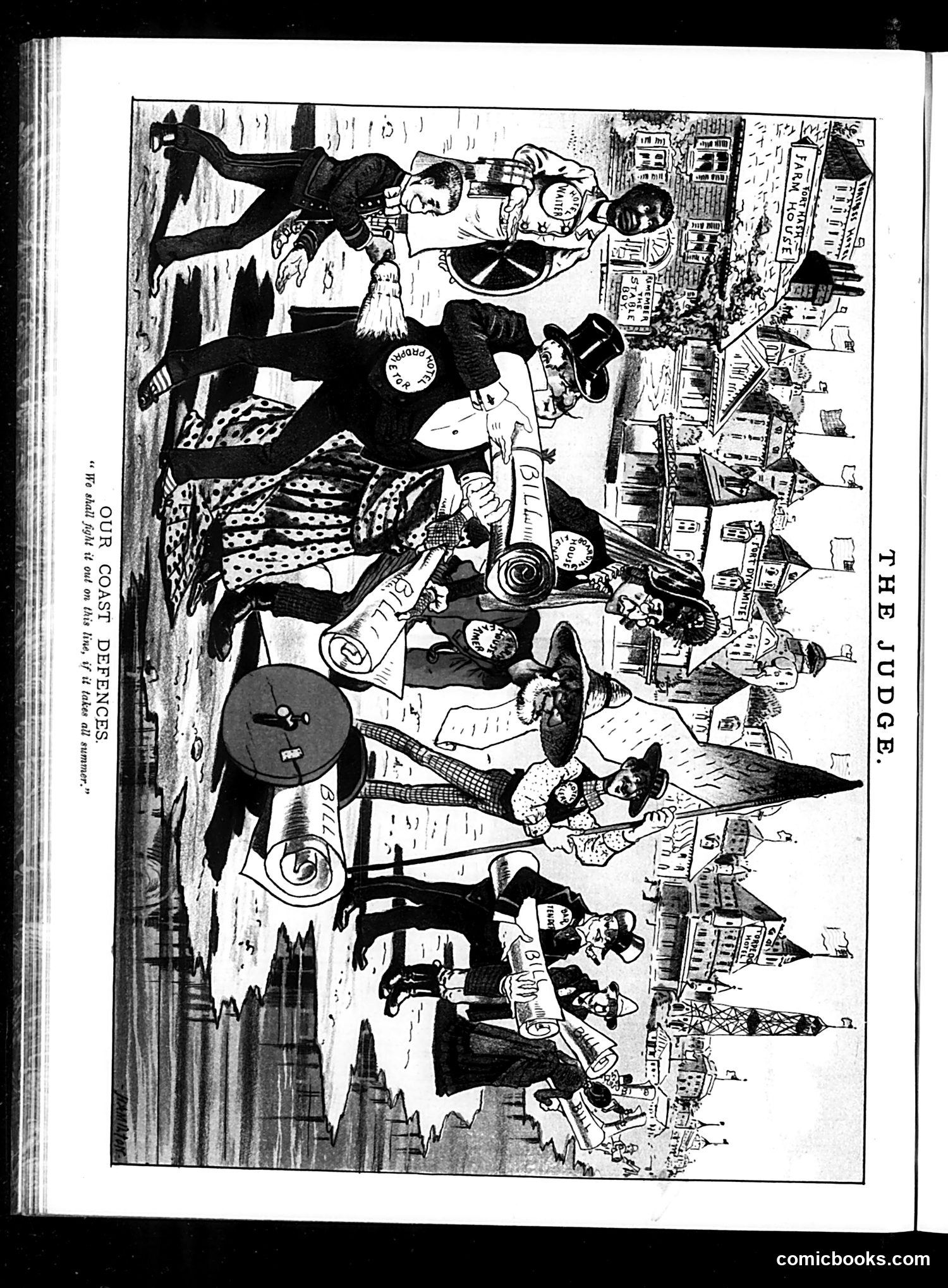
This political cartoon, titled "The Judge" with the caption "We shall fight it out on this line, if it takes all summer," appears to satirize American coastal defense preparations. The image shows a chaotic seaside scene with military figures, fortifications, and various coastal defense mechanisms. The quote references General Ulysses S. Grant's famous Civil War statement, repurposing it for what appears to be early 20th-century military preparedness debates. The cartoon likely mocks inefficiency, bureaucratic confusion, or questionable defense strategies of the era. The jumbled composition—with multiple figures, equipment, and fortifications rendered in disarray—suggests satire of poorly-coordinated or over-complicated coastal protection efforts. Without a visible date, the specific historical context remains unclear, though it reflects period anxieties about naval defense.