
A complete issue · 22 pages · 1885
Judge — March 7, 1885
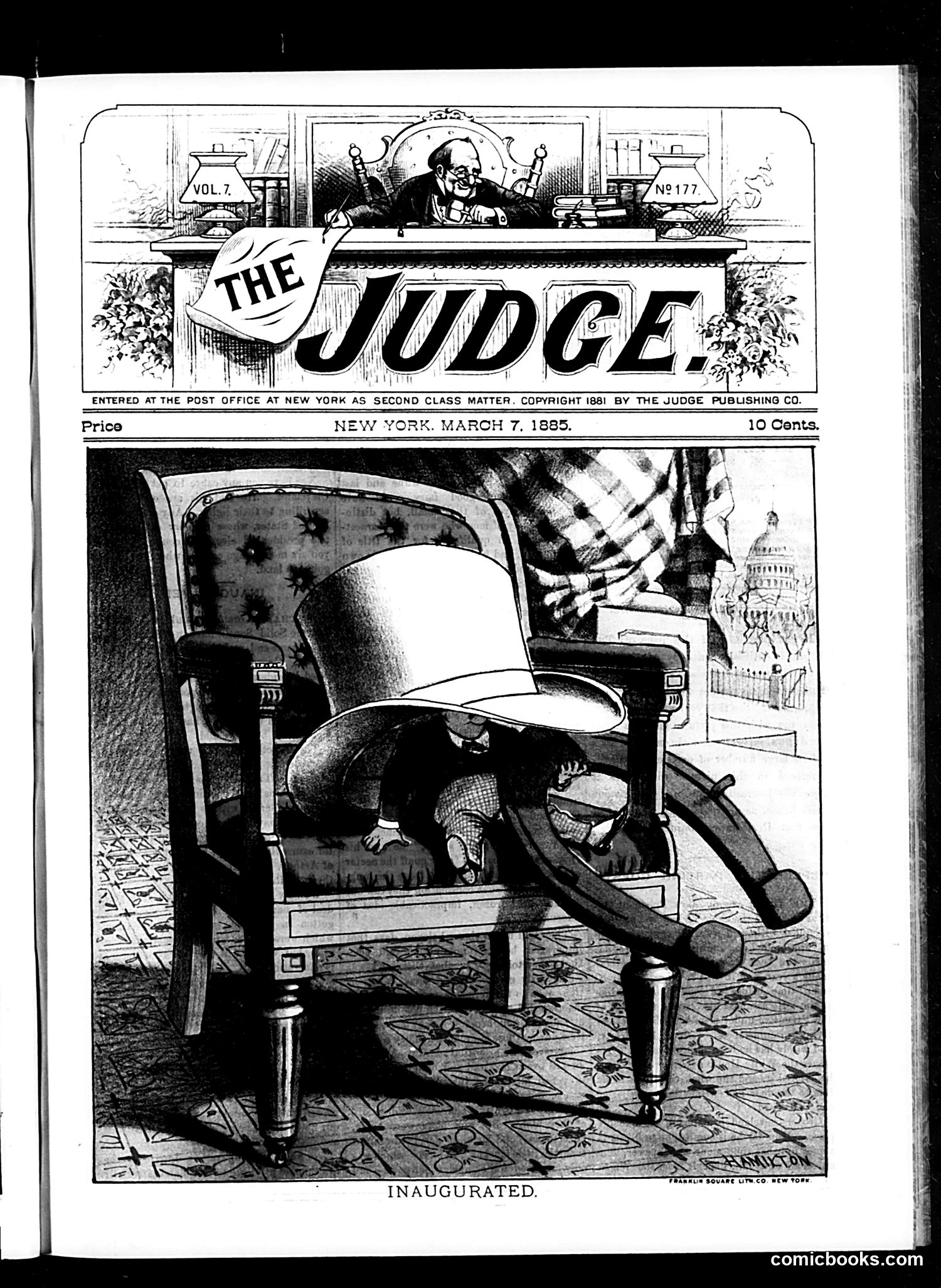
This cartoon, titled "INAUGURATED," depicts a political figure literally sitting in an oversized chair with his legs dangling—a visual pun on taking office. The chair's stars suggest a presidential seat. The figure appears small and inadequate for the position, suggesting the satirist's mockery of whoever recently took office. The Capitol building visible in the background confirms this is about a presidential inauguration. The exaggerated scale—the chair towering over the seated figure—conveys skepticism about the new leader's fitness for the job. This was 1885, following Chester Arthur's presidency (1881-1885) and James Cleveland's first inauguration in March 1885. The cartoon likely mocks Cleveland's readiness or qualifications for the presidency.
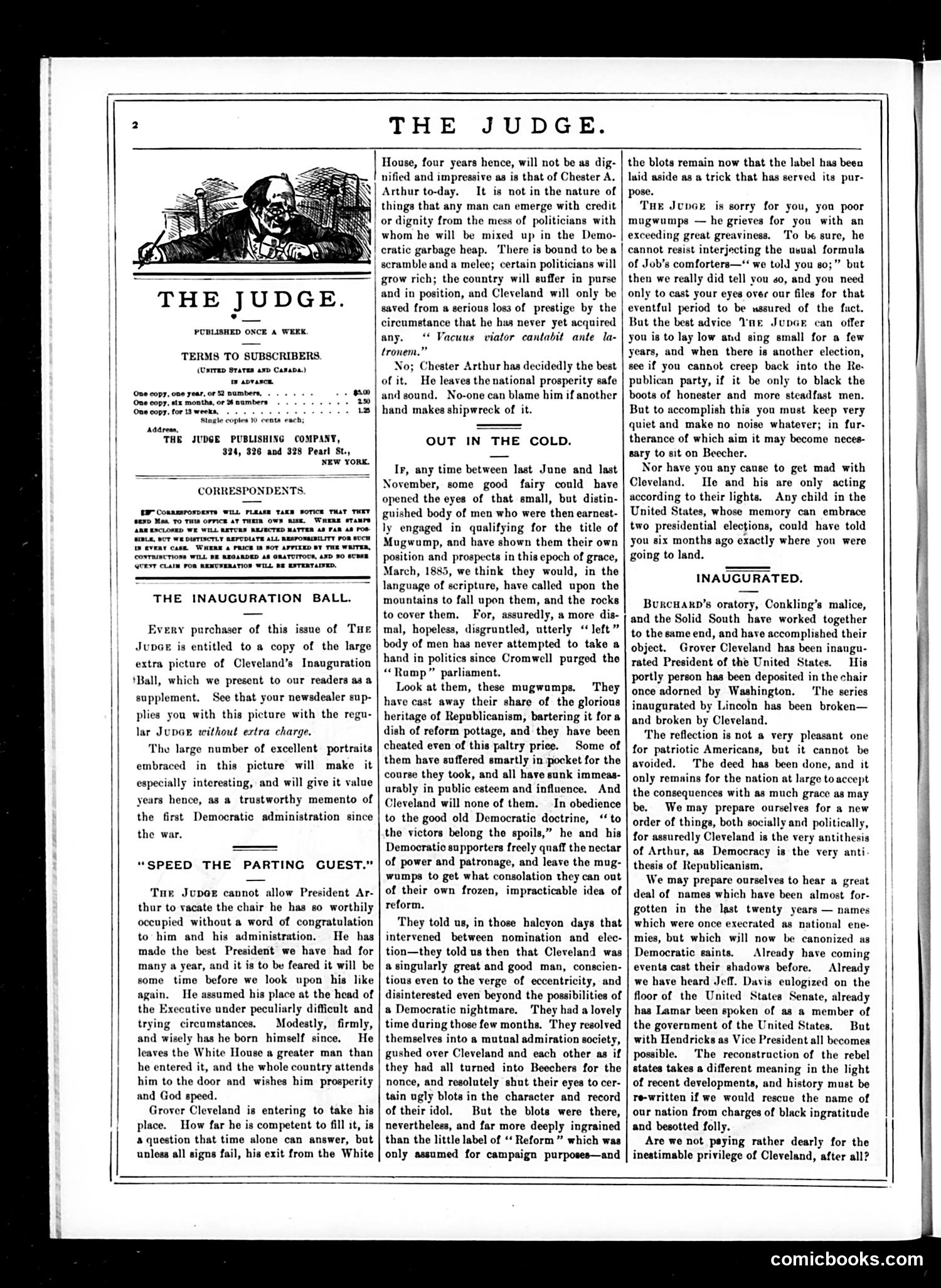
This 1885 *Judge* page celebrates Chester Arthur's departure from the presidency and mocks incoming Democrat Grover Cleveland. The magazine praises Arthur as dignified and competent, predicting Cleveland will bungle the office within four years due to inevitable corruption within the Democratic Party—satirized as a "garbage heap." The "Mugwumps" (reform Republicans who bolted to support Cleveland) receive particular ridicule. The magazine suggests these idealistic reformers foolishly abandoned Republican principles and now find themselves powerless and regretful, having cast aside their political influence for nothing. The satire reflects the fierce partisan divisions of the Gilded Age, where *Judge* promoted Republican superiority while lampooning Democratic incompetence and the naïveté of reform-minded politicians who challenged party loyalty. The Latin phrase translates roughly as "the empty traveler sings before the robber"—implying Cleveland will soon learn harsh political realities.
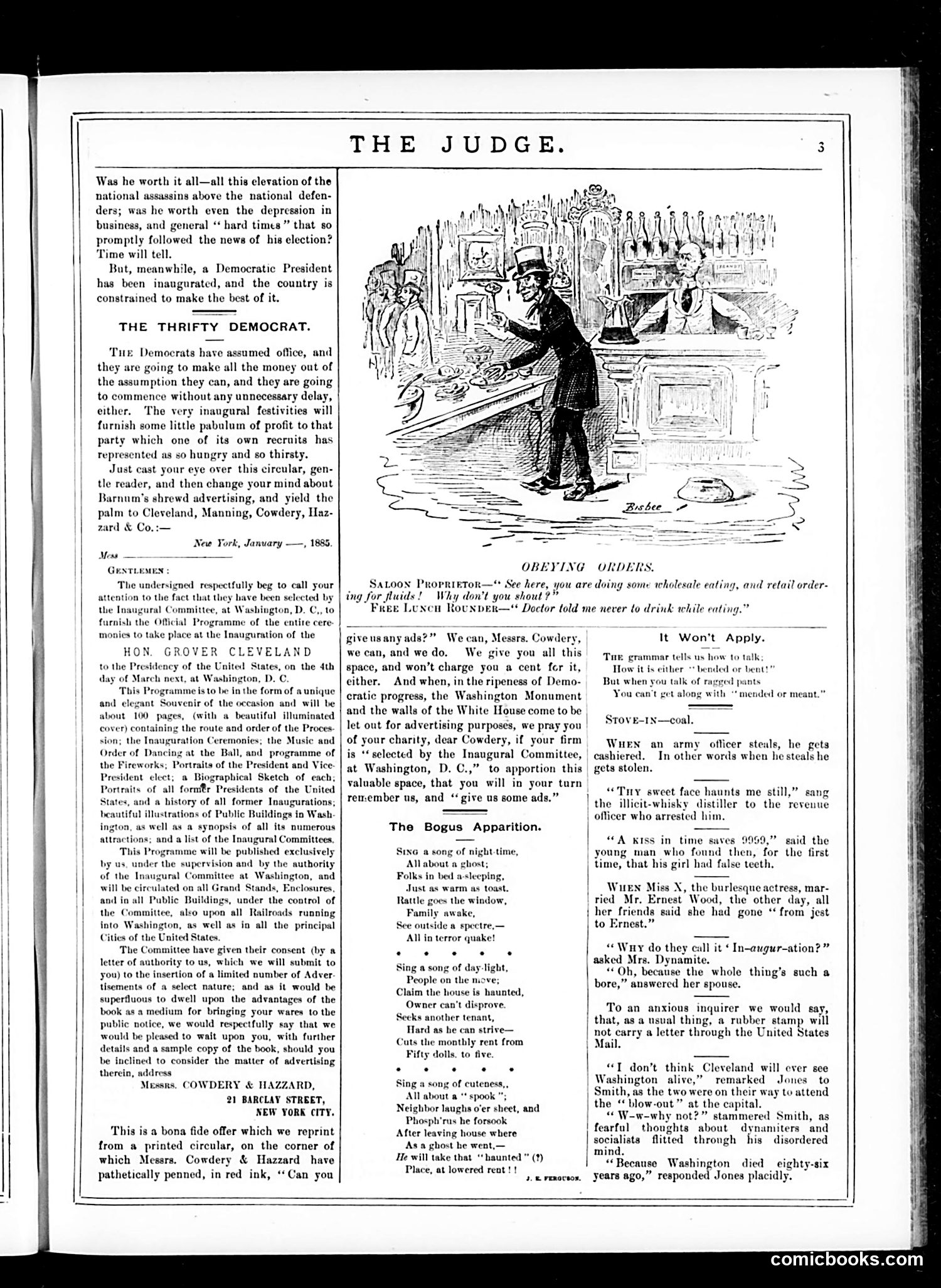
This page satirizes the newly inaugurated Democratic administration under President Grover Cleveland. The main cartoon depicts a saloon proprietor being told by a "fee lunch rounder" (a freeloader who exploits cheap lunch offerings) that his doctor forbade drinking while eating—a joke about Democratic hypocrisy regarding restraint and moderation. The article "The Thrifty Democrat" mocks Democrats for exploiting inaugural festivities for profit. It includes a circular from Cowdery & Hazzard advertising inaugural programs, then ridicules them for seeking advertising space, sarcastically suggesting they'll benefit from White House advertising contracts. The page's overall theme: Cleveland's Democrats, portrayed as economically self-interested and hypocritical, are already commercializing their power rather than governing with genuine reform. The satirical tone suggests Judge viewed the new administration with deep skepticism about its promised integrity and anti-corruption platform.
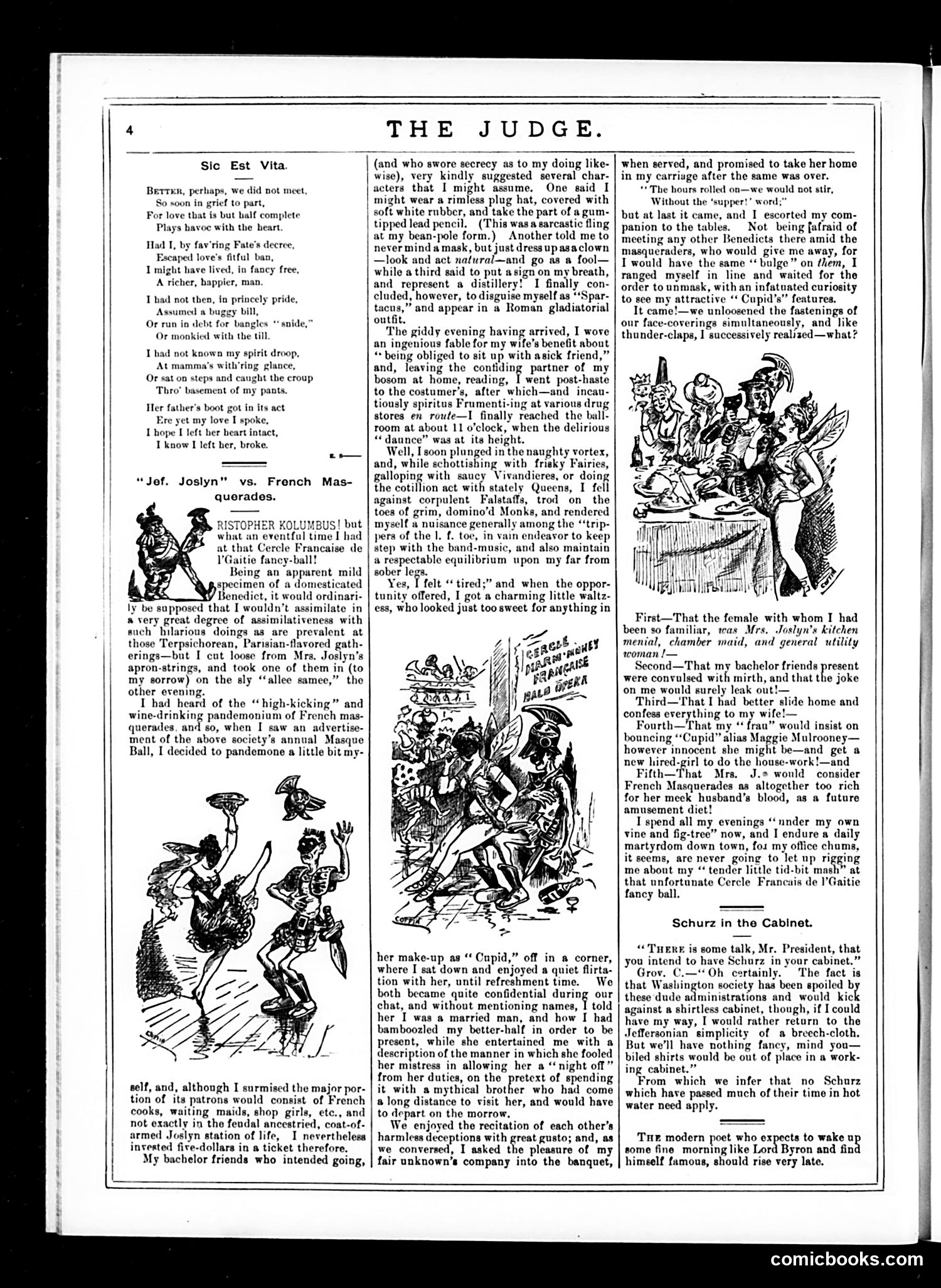
This satirical piece mocks a married man ("Jef. Joslyn") who sneaks away from his wife to attend a fancy French masquerade ball. The humor centers on his deception and subsequent moral complications. The narrator attends the Cercle Francaise ball dressed as a Roman gladiator ("Spartacus"), lying to his wife about visiting a sick friend. After drinking heavily and dancing with various costumed women, he flirts with a "Cupid"-dressed woman, eventually inviting her to a banquet—unaware she's actually his wife in disguise. The satire targets 1890s-era American attitudes about infidelity, marital deception, and pretentious French cultural affectation. The joke hinges on ironic comeuppance: the unfaithful husband is unknowingly caught by his own spouse. The numerous illustrations of costumed revelers emphasize the masquerade's deceptive nature as a metaphor for the narrator's duplicity.
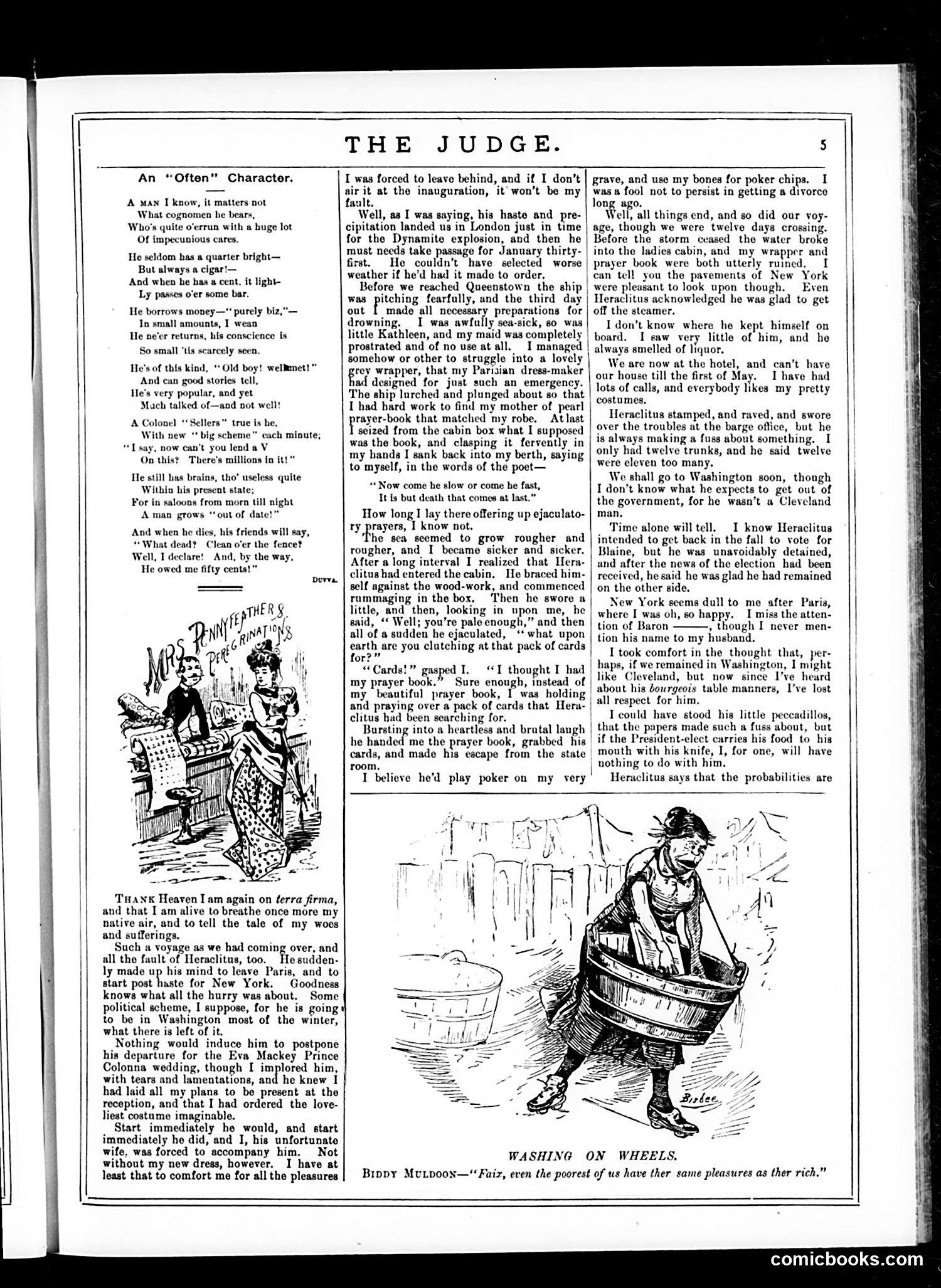
This page contains two distinct pieces of political/social satire from Judge magazine (likely 1880s-90s based on references). **"An 'Often' Character"** (top left): A poem mocking a specific social type—a chronically broke man who constantly borrows money, frequents bars, schemes about business ventures ("There's millions in it!"), yet remains popular despite being unreliable. The satire targets his hypocrisy and the indulgence of society toward such parasitic behavior. **"Washing on Wheels"** (bottom illustration): The sketch shows a man pushing a barrel on wheels—likely depicting a street vendor or laborer. The caption attributes the quote to "Biddy Muldoon," suggesting Irish immigrant commentary on class inequality: "Fair, even the poorest of us have their same pleasures as the rich." **The main article** concerns a woman describing her harrowing Atlantic crossing with her husband Heraclitus, who rushed from Paris to New York for political/governmental reasons ("Washington most of the winter"). The satire mocks her superficiality—her primary concern amid seasickness is wearing her new Paris dress to the presidential inauguration.
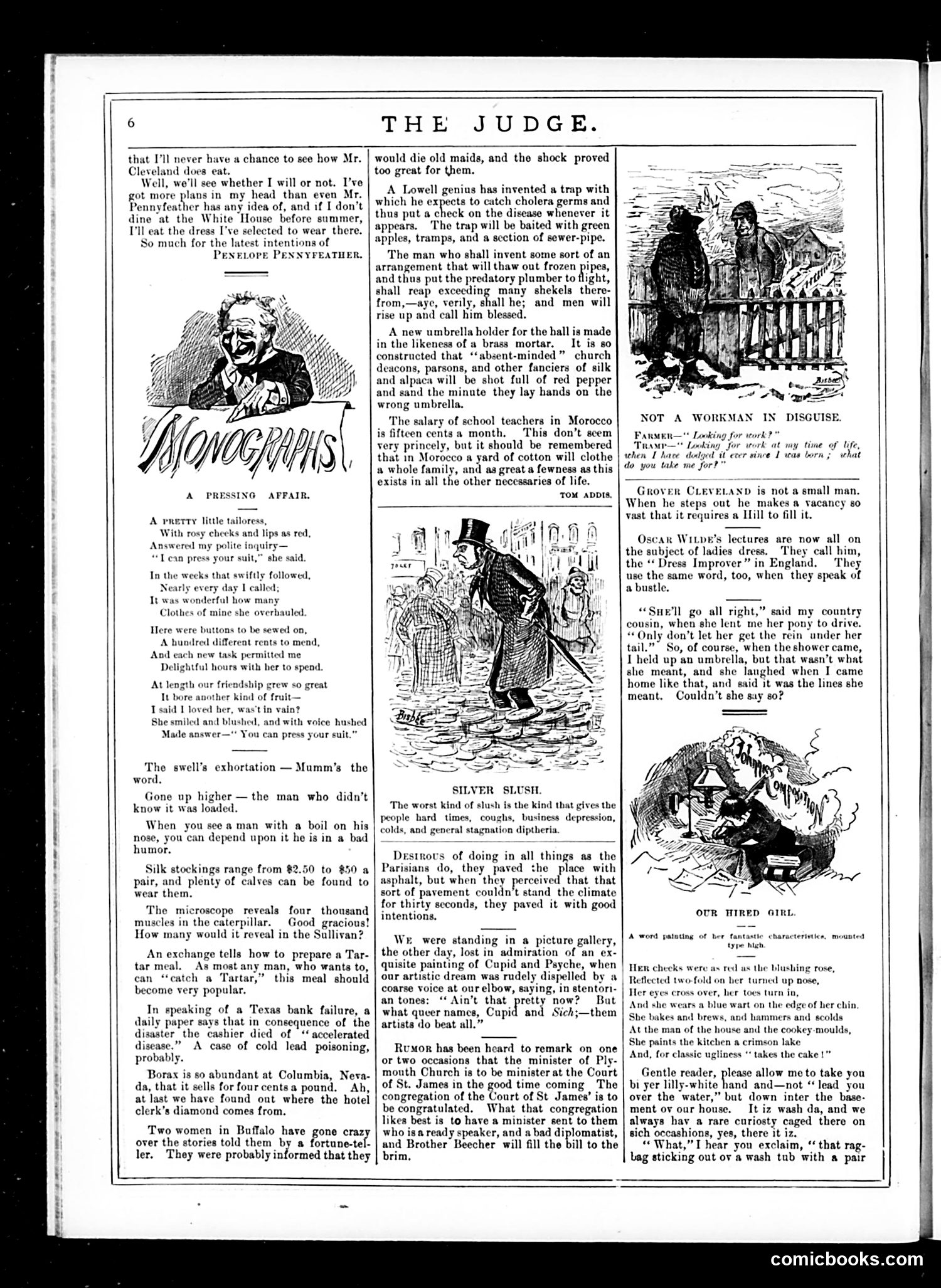
This page contains primarily **humorous essays and social commentary** rather than political cartoons. The content satirizes contemporary American life through various short pieces: **"A Pressing Affair"** is a romantic comedy about a tailor's apprentice who uses garment repairs as an excuse to court a young woman—pun intended with "press your suit." **The scattered one-liners and observations** mock everyday absurdities: Texas bank failures, expensive silk stockings, fortune-tellers, and Moroccan teacher salaries. There's satirical commentary on Parisian attempts at urban improvement and exaggerated inventions (cholera traps, plumber-deterrent umbrellas). **"Silver Slush"** uses "slush" as a metaphor for urban decay and poor city planning—Parisians paving streets with "good intentions" rather than effective solutions. The illustrations appear to be generic Victorian-era decorative vignettes accompanying these texts, not specific political commentary. This represents Judge's typical format: lighthearted social satire targeting middle-class anxieties and contemporary foibles rather than addressing major political figures or events.
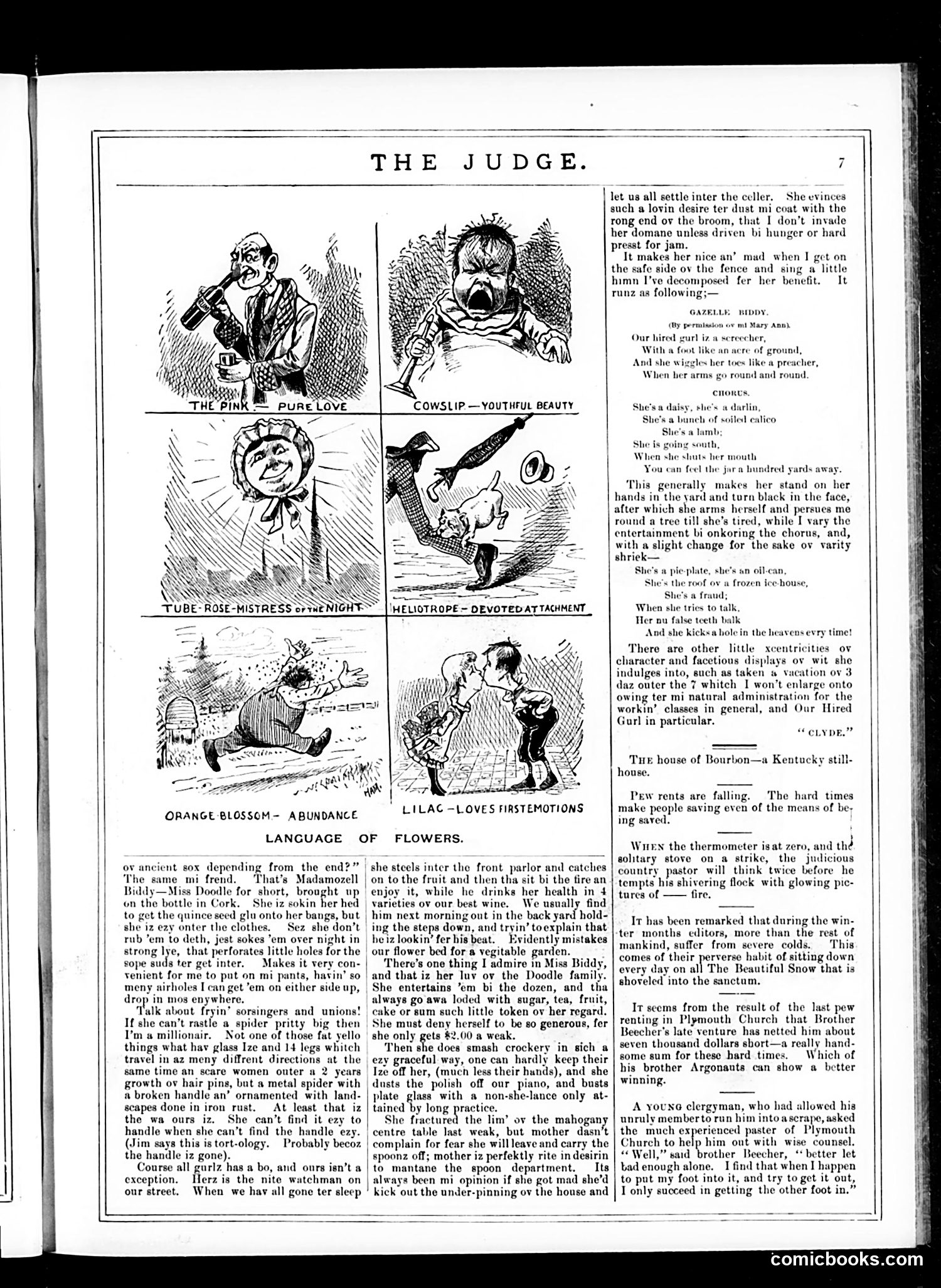
This page from *Judge* magazine features humorous domestic sketches mocking working-class life and servants. The six cartoon panels satirize various "types" of women—a drunk man labeled "Pure Love," an unattractive woman ("Cowslip—Youthful Beauty"), a negligent nanny ("Tube-Rose—Mistress of the Night"), and others. The accompanying text mockingly describes an Irish maid named "Miss Biddy" who breaks household items while cleaning, flirts with the night watchman, and is comically incompetent yet indispensable. The humor relies on ethnic stereotypes (Irish servants), class mockery, and slapstick domesticity. The "Language of Flowers" section uses flowery names as ironic labels for unglamorous working women, playing on Victorian sentimentality while degrading their actual circumstances and appearance. The satire targets both the "help" and their employers' pretensions, typical of late-19th/early-20th century American humor relying heavily on class and ethnic caricature.
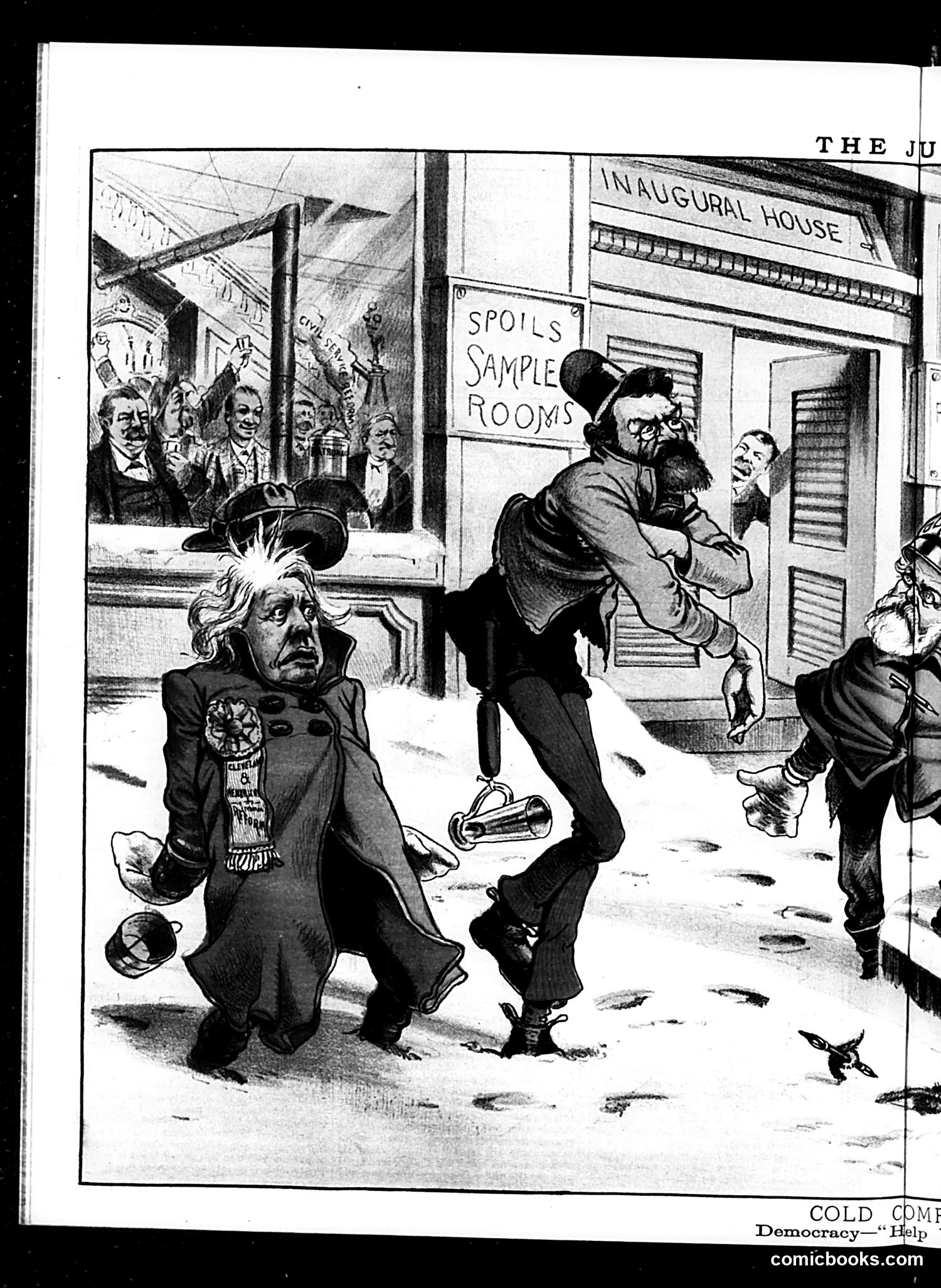
This satirical cartoon from *Judge* magazine depicts a chaotic street scene outside an "Inaugural House" with "Spoils Sample Rooms." A disheveled, wild-haired figure in the foreground—appearing distressed or frantic—is being physically restrained or pulled by another man in a top hat. Onlookers peer from windows and doorways above. The caption "Cold Comfort / Democracy—'Help'" suggests criticism of post-inauguration political patronage. The "spoils" reference alludes to the spoils system—the practice of distributing government jobs and resources to political allies after taking office. The scene satirizes the chaotic, undignified scramble for political positions and favors that follows a new administration, portraying democracy as creating disorder rather than orderly governance. The desperate figure may represent either a jobseeker or a commentary on the system itself.
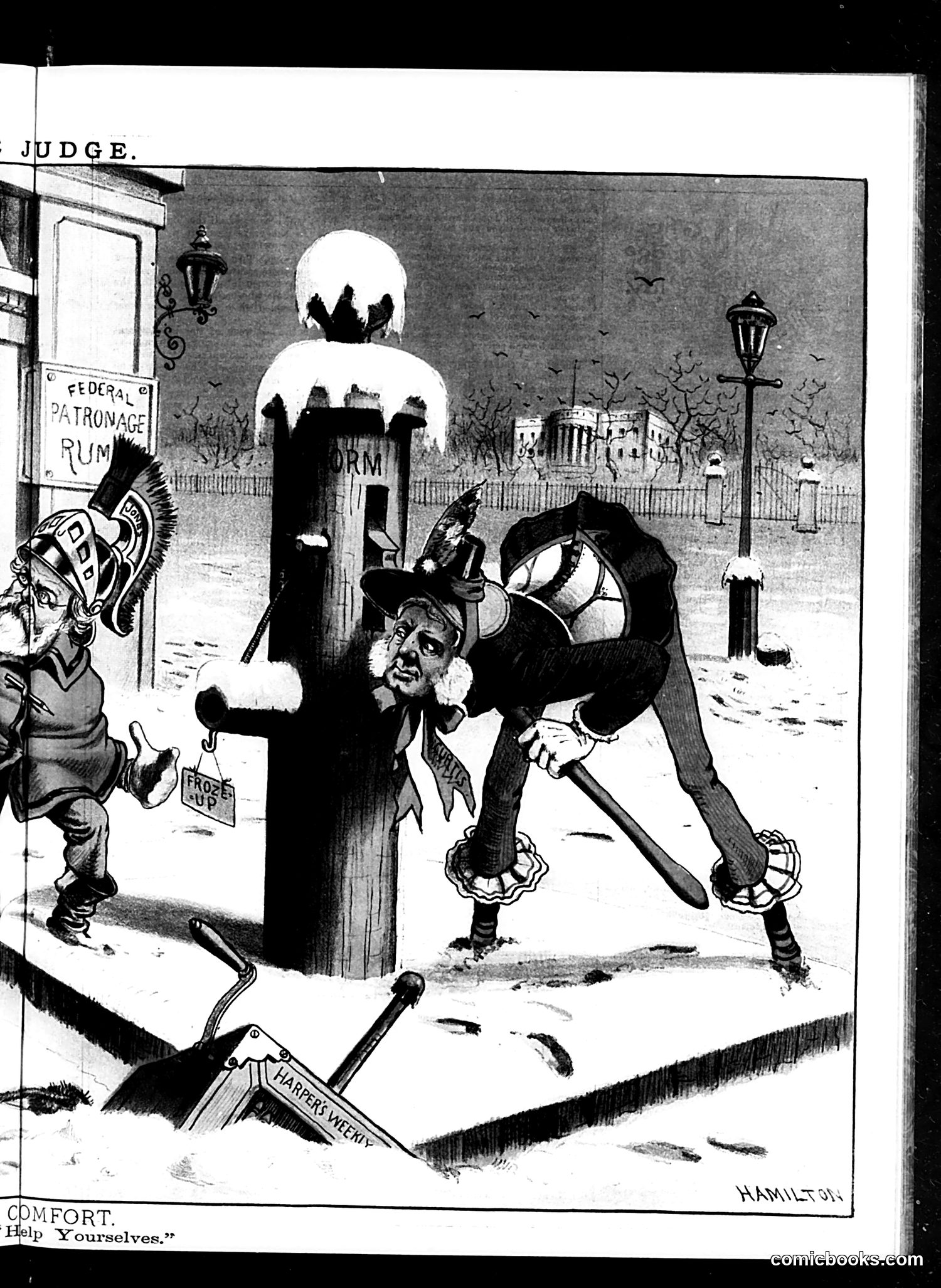
This Judge magazine cartoon satirizes federal patronage corruption during what appears to be the Wilson administration era (circa 1918, based on visible dating). The central figure is a grotesquely large "Federal Patronage Rum" barrel—literally depicted as a massive barrel of liquor—positioned outside government buildings (the Capitol visible in background). Two figures with exaggerated, caricatured features are depicted helping themselves to the barrel's contents, suggesting politicians and appointees plundering public resources for personal gain. The sign reading "Help Yourselves" reinforces the satirical message that federal patronage has become an open invitation for corruption and self-enrichment. The cartoon criticizes how government positions and resources were distributed as rewards to political allies rather than based on merit—a widespread Progressive Era complaint about machine politics and cronyism.
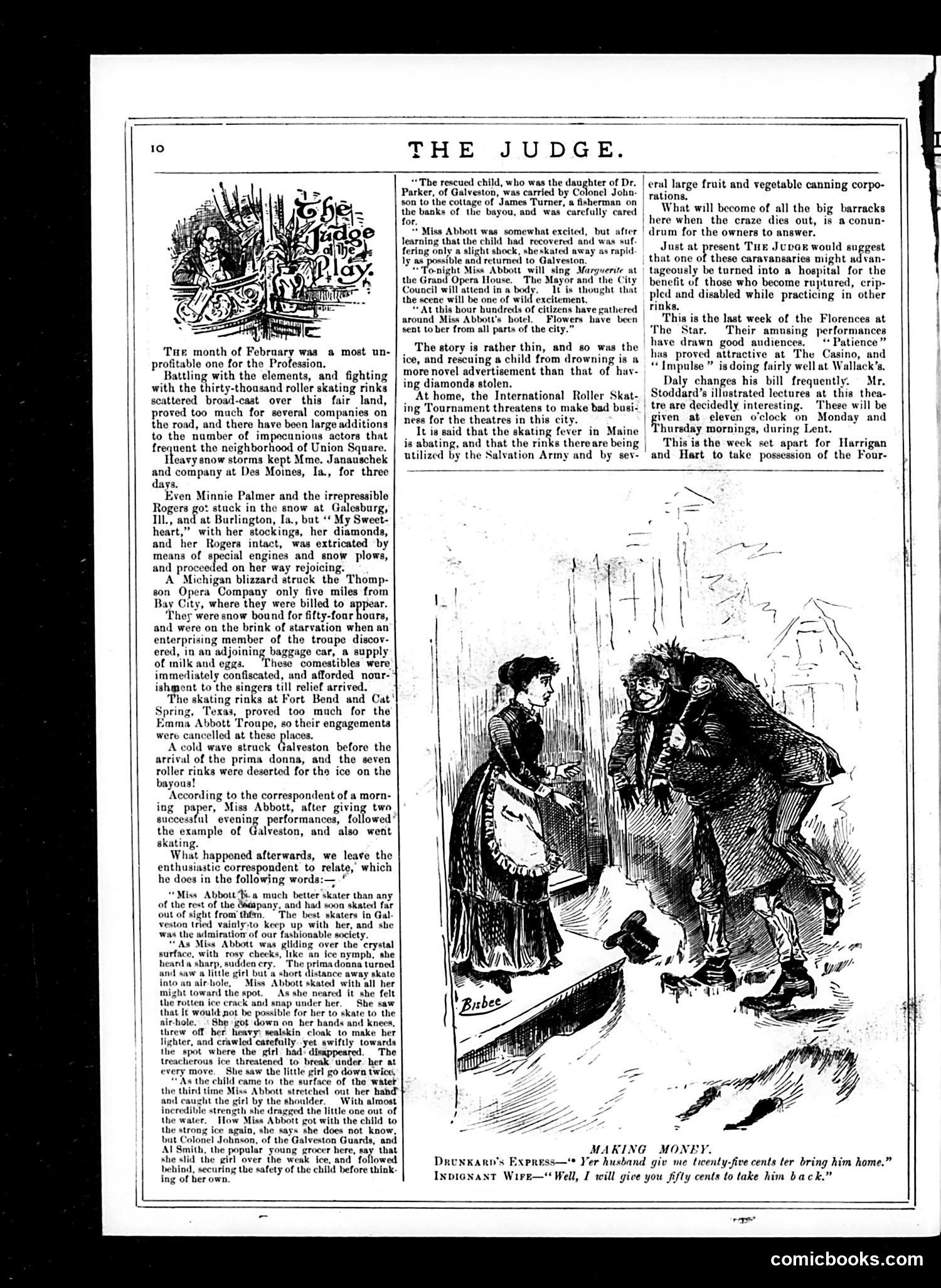
This page from Judge magazine contains theatrical gossip and a heroic anecdote about opera singer **Emma Abbott**. The main cartoon shows a domestic negotiation: a drunken husband asks his wife for money to get home, offering twenty-five cents; she counters that she'll give fifty cents to keep him *away*. The satire targets working-class marital discord and drinking habits. The dominant article recounts how February weather—blizzards and "thirty-thousand roller skating rinks"—devastated touring theatrical companies. Abbott's troupe faced cancellations in Texas. The piece then celebrates Abbott's dramatic rescue of a drowning child on Galveston Bay ice, portraying her as heroically brave and strong despite her glamorous reputation. This appears designed to boost Abbott's public image during a difficult touring season, mixing theatrical industry complaints with feel-good heroism.
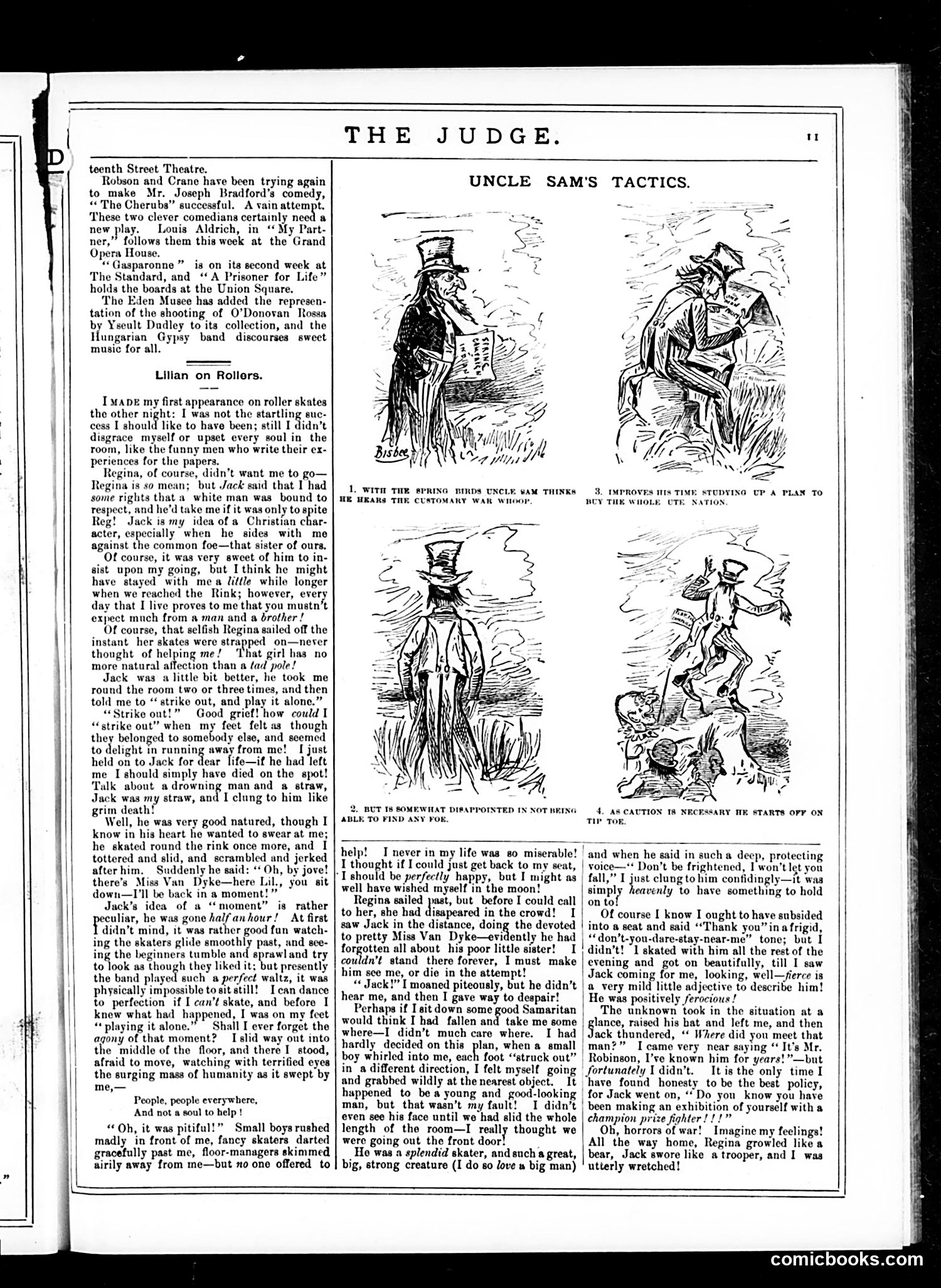
This four-panel cartoon satirizes American military strategy, likely during the Spanish-American War era (the magazine's reference to "O'Donovan Rossa" suggests early 1880s-90s). **The Satire:** Uncle Sam (personified America, identifiable by his characteristic top hat and goatee) attempts warfare using traditional methods—what he assumes are "customary war" tactics. However, panels 2-4 show his repeated failure to locate an actual enemy ("foe"). He searches everywhere: hiding in grass, checking behind trees, looking in water—but finds no opponent. **The Point:** The cartoon mocks American military overpreparedness or misguided strategy during a conflict where the enemy either cannot be found, refuses direct combat, or the war's premises are questionable. This reflects contemporary anxieties about fighting an unconventional enemy—possibly guerrilla forces or colonial insurgents rather than a traditional uniformed army. The humor lies in Uncle Sam's confusion and wasted effort despite his confident readiness.
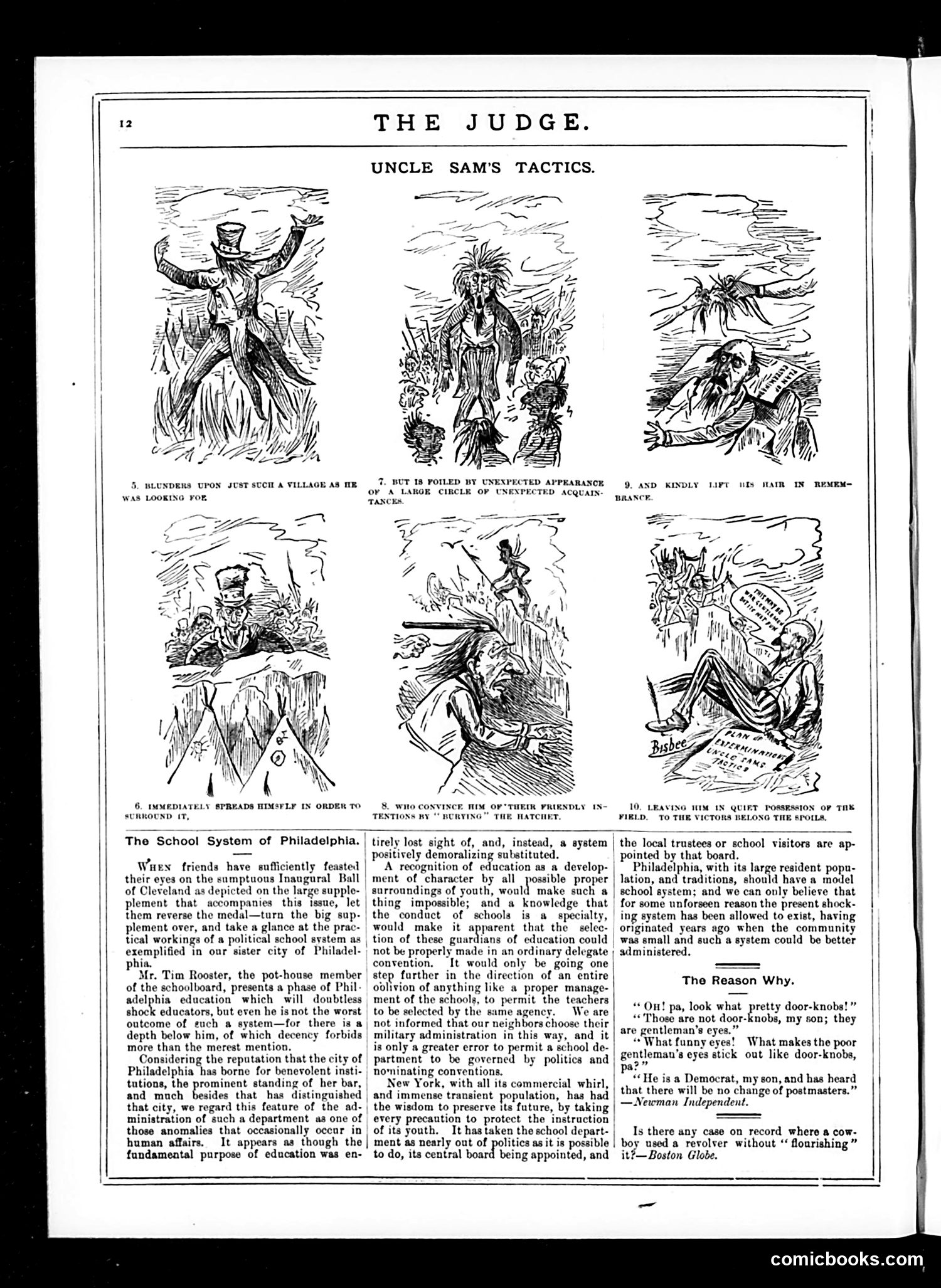
This six-panel comic depicts Uncle Sam (personified America) as a military aggressor. He spots a desirable village, spreads his forces to surround it, but is thwarted when "unexpected acquaintances" (likely representing foreign powers or rival nations) appear in a protective circle. They reconcile through friendly gestures, allowing Uncle Sam to withdraw while claiming victory and "spoils." The satire critiques American imperial tactics—aggressive expansion masked as peaceful diplomacy. The "unexpected acquaintances" likely represent European powers or established interests who constrain American ambitions through international pressure rather than direct conflict. The accompanying articles criticize Philadelphia's corrupt school board appointments made through political patronage rather than merit, and mock Democrats' anxiety over losing patronage jobs under a new administration—comparing political spoils to Uncle Sam's military conquest.
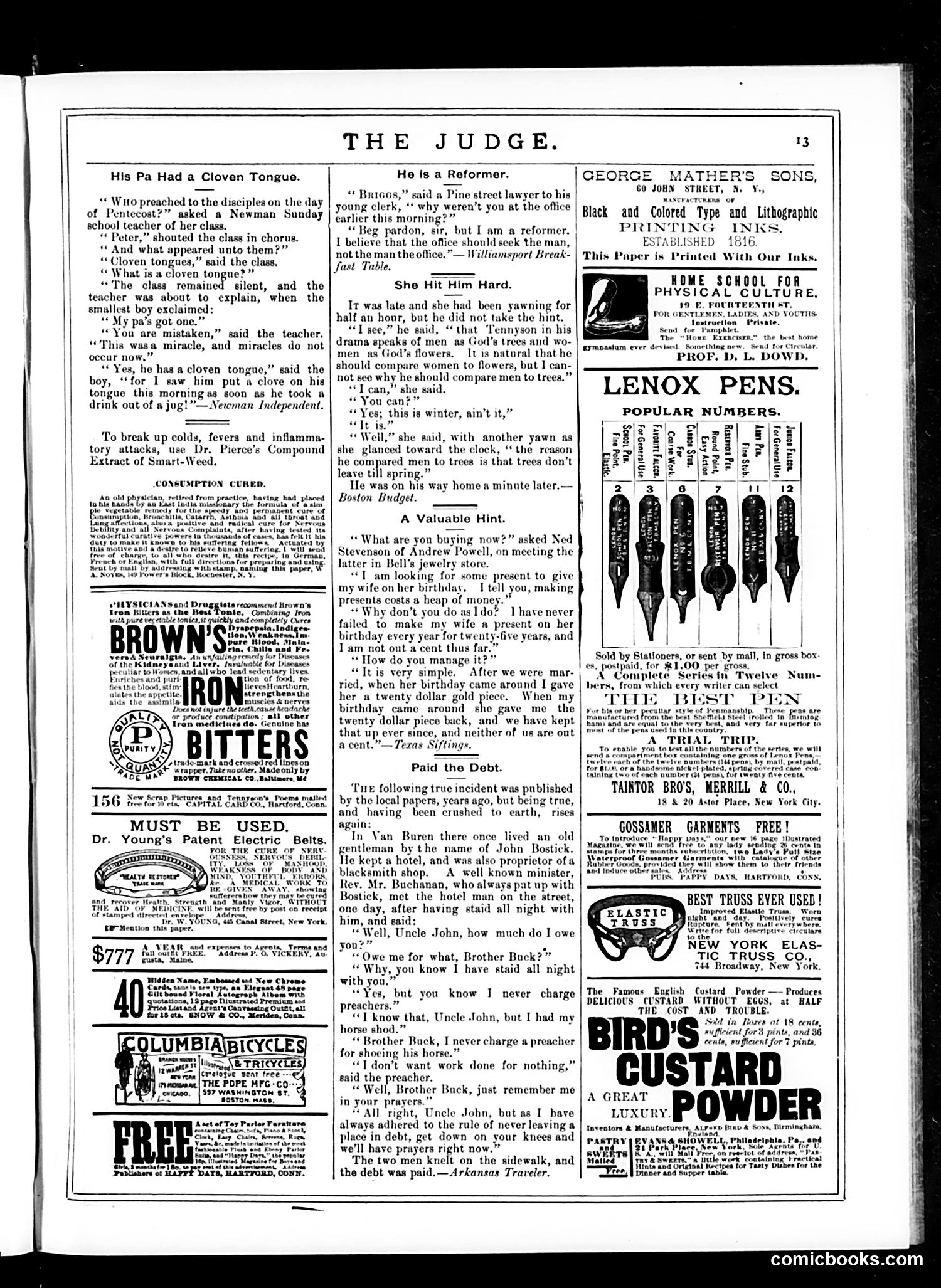
This page contains mostly **humorous anecdotes and advertisements** rather than political cartoons. The main content includes three joke pieces: 1. **"His Pa Had a Cloven Tongue"** — a pun-based Sunday school joke about a child misunderstanding "cloven tongues" (biblical reference to Pentecost) as his father putting a clove spice on his tongue while drinking. 2. **"He is a Reformer"** — satire of a lazy office clerk who claims to be a "reformer" believing the office should seek the man, not vice versa—mocking those who used progressive rhetoric as excuse for idleness. 3. **"She Hit Him Hard"** and **"A Valuable Hint"** — domestic humor jokes about marriage and gift-giving, typical of period magazines. The remainder consists of patent medicine advertisements (Dr. Pierce's Extract, Dr. Young's Electric Belts) and other commercial notices common to 19th-century periodicals. These pages often blended editorial content with advertising revenue.
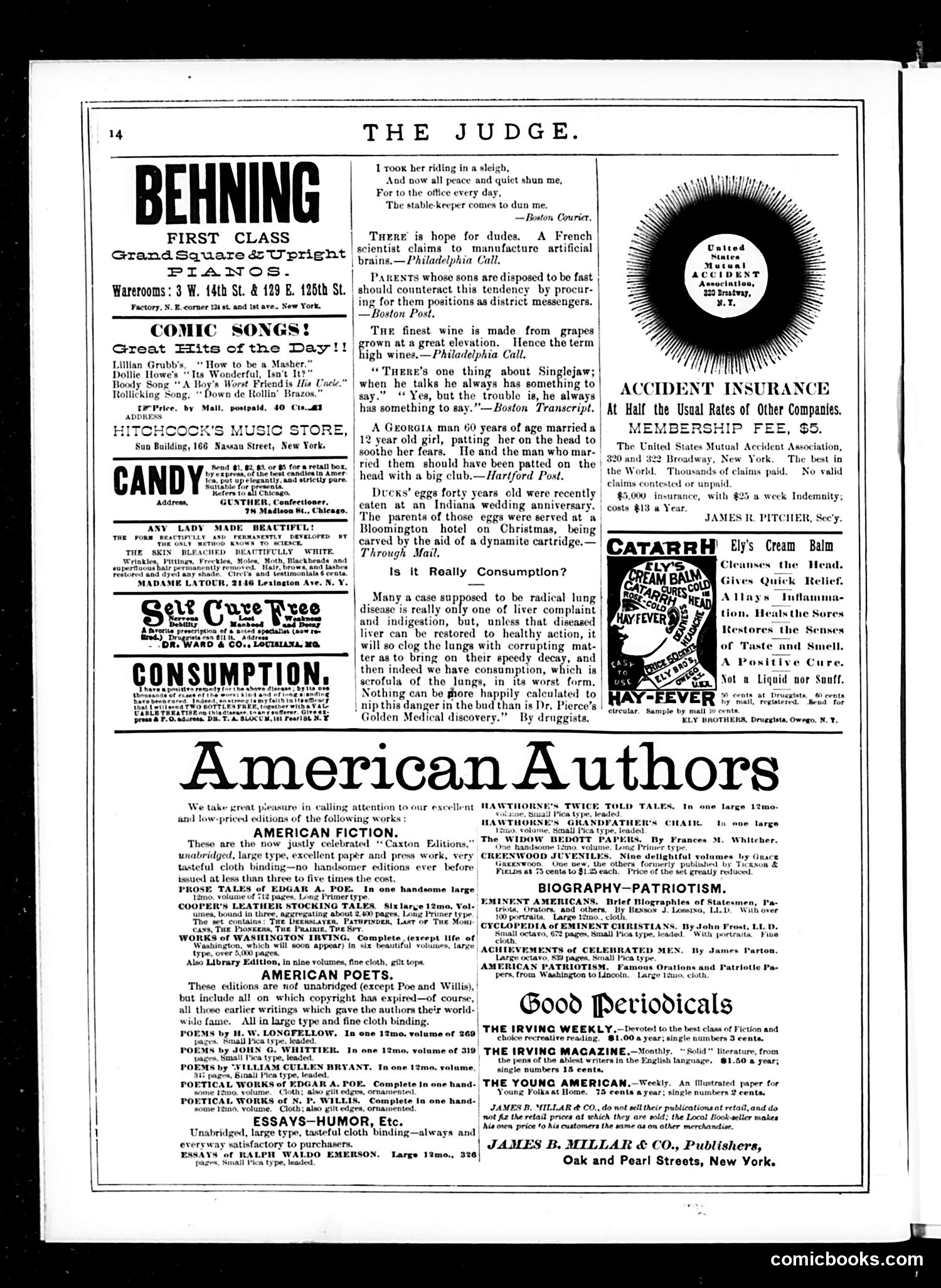
This is primarily an **advertising page** from *Judge* magazine, not a political cartoon. The page contains numerous product advertisements—pianos, candy, patent medicines, insurance, and catarrh cream—with prominent notices for book publishers at the bottom. The **non-advertising content** consists of brief **comic quips and jokes** scattered throughout, touching on contemporary life: a man burdened by stable fees, French scientists making artificial brains, wealthy young men as "dudes," old eggs served at weddings. These are generic observations about American social absurdities rather than political satire. The "American Authors" section advertises cheap editions of classic American writers (Hawthorne, Poe, Cooper) and poetry collections—publishing promotions, not editorial content. **Bottom line:** This appears to be a revenue-generating page from *Judge*, mixing satirical one-liners with commercial advertisements. The humor is mild, domestic, and non-partisan.

I'm unable to provide an analysis of this page because the image appears to be blank or nearly entirely white. While there is a border frame visible, I cannot discern any cartoon illustrations, text, advertisements, or other content that would allow me to identify figures, political references, or satirical points. To give you an accurate historical analysis following the rules you've specified, I would need an image where the actual content is clearly visible. If you have a clearer version of this Judge magazine page, I'd be happy to examine it.
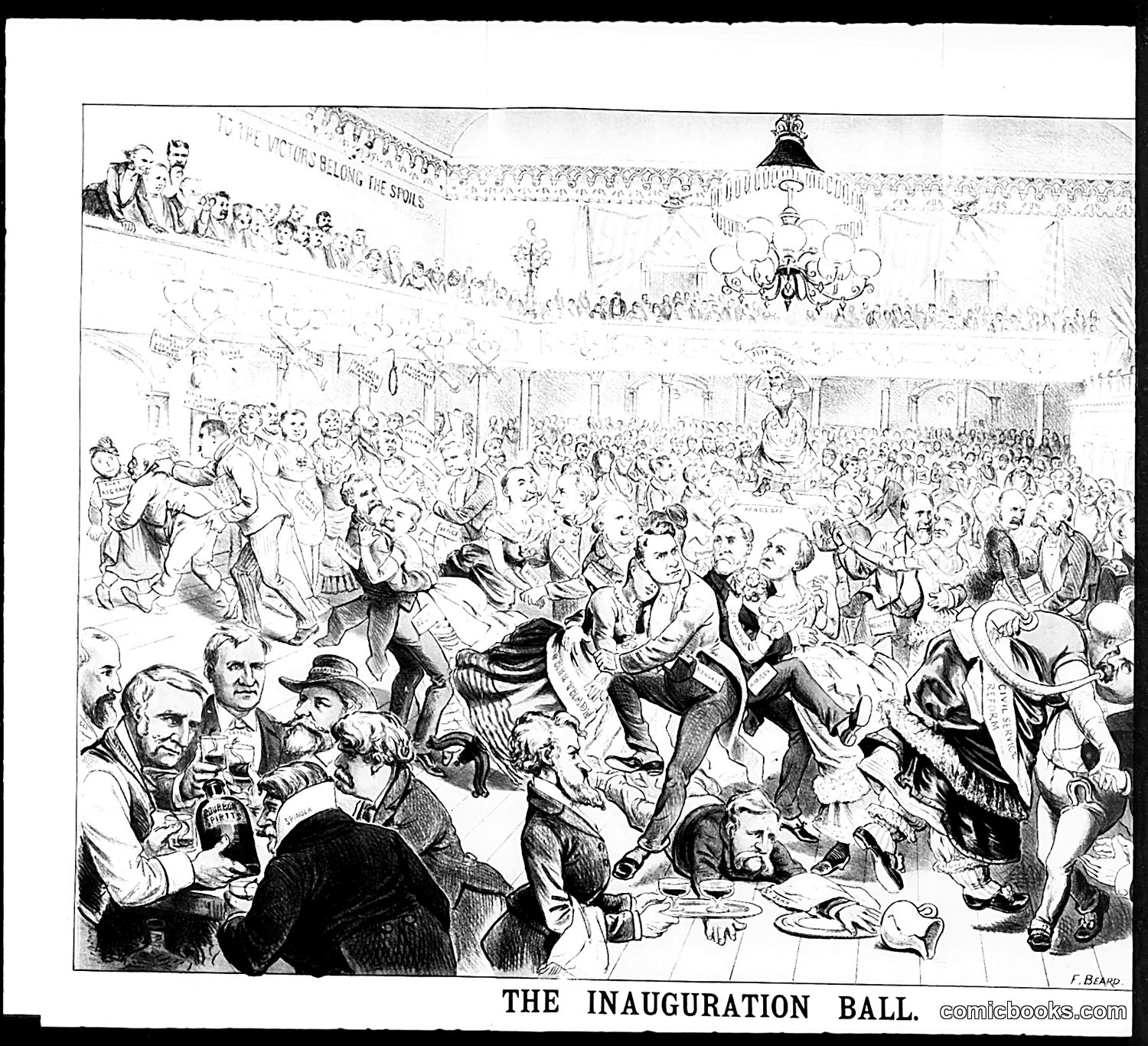
This satirical engraving depicts a chaotic formal ball following a presidential inauguration. The cartoon mocks the extravagance and disorder of the event, showing elegantly-dressed dignitaries and officials mingling amid apparent pandemonium—figures are sprawling, crowded together, and engaged in undignified behavior despite their formal attire. The satire likely targets the contrast between the dignity expected at such a ceremonial occasion and the actual rowdy, self-indulgent conduct of attendees. The crowded, poorly-behaved scene suggests criticism of government elites treating a solemn constitutional event as an excuse for excess and unseemly conduct. Without a clear date visible, the specific inauguration referenced remains unclear, though the engraving style suggests 19th-century publication in Judge magazine.
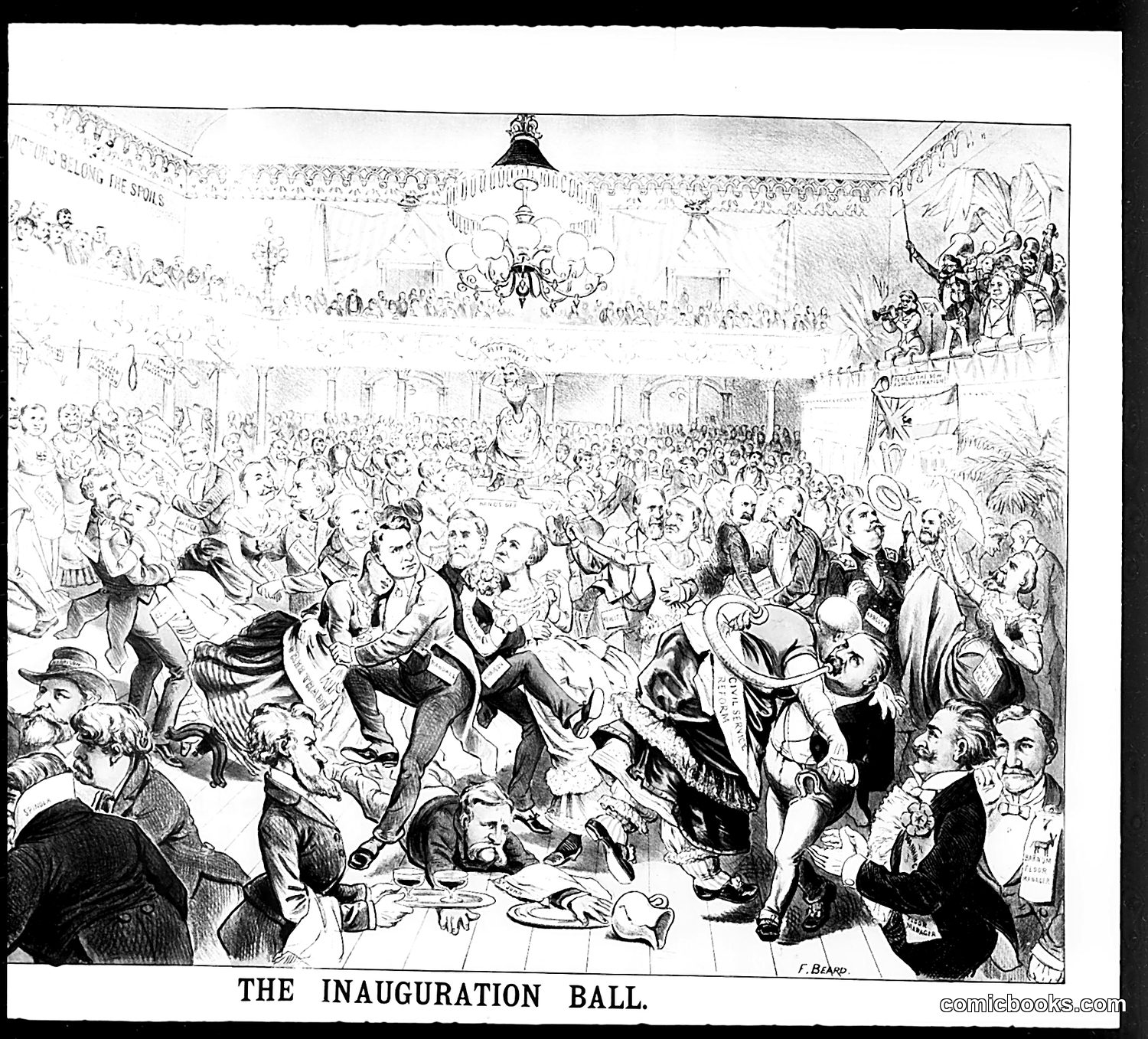
This is a satirical depiction of a presidential inauguration ball, likely from the late 19th century (based on Judge magazine's era and artistic style). The cartoon shows a chaotic, crowded ballroom scene with well-dressed attendees in formal attire, apparently dancing or socializing. The satire appears to mock the spectacle and disorder of the event—the packed, ungainly crowd, the exaggerated postures and expressions, and the general tumult suggest the cartoon is ridiculing either the pretension of the formal ceremony or the unruly behavior of attendees. The crowded composition emphasizes the satirist's point about excess or social chaos masquerading as elegant celebration. Without a visible date, the specific presidential inauguration remains unclear.
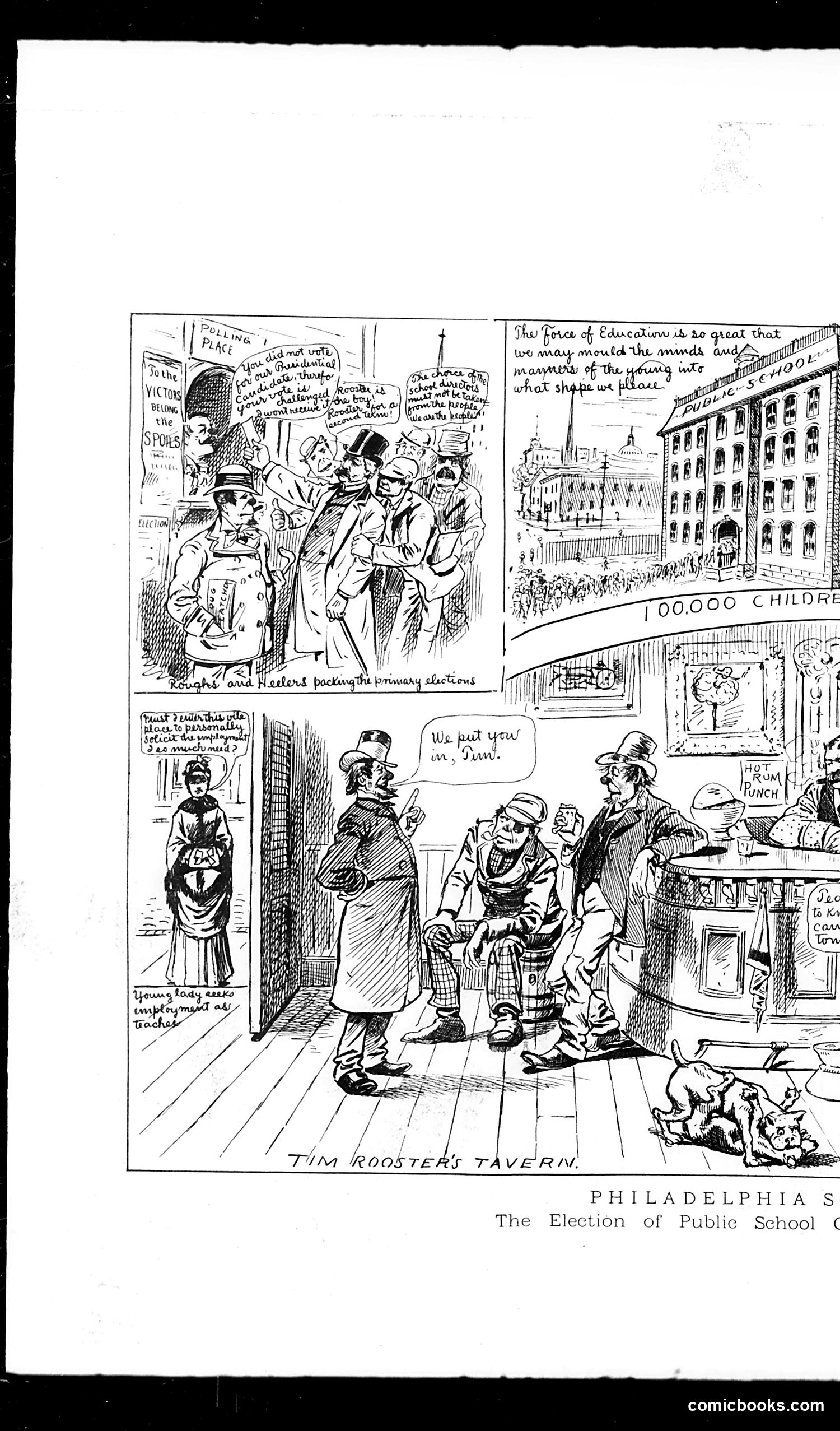
This Judge magazine page satirizes Philadelphia's public school governance through three interconnected scenes. The top left depicts politicians and "ward heelers" (political operatives) manipulating primary elections at a "Polling Place," suggesting corrupt influence over educational institutions. The right panel shows a grand public school building representing the prize—control over "100,000 children"—emphasizing education's importance as a political asset. The bottom scene at "Tim Roosters Tavern" illustrates the actual power brokers: saloon-keepers and working-class men who "put you in" to political office, revealing how machine politics determined school board elections rather than merit or educational expertise. The satire critiques how Philadelphia's political machines prioritized power over education quality, treating schools as spoils to distribute rather than institutions serving children's learning.
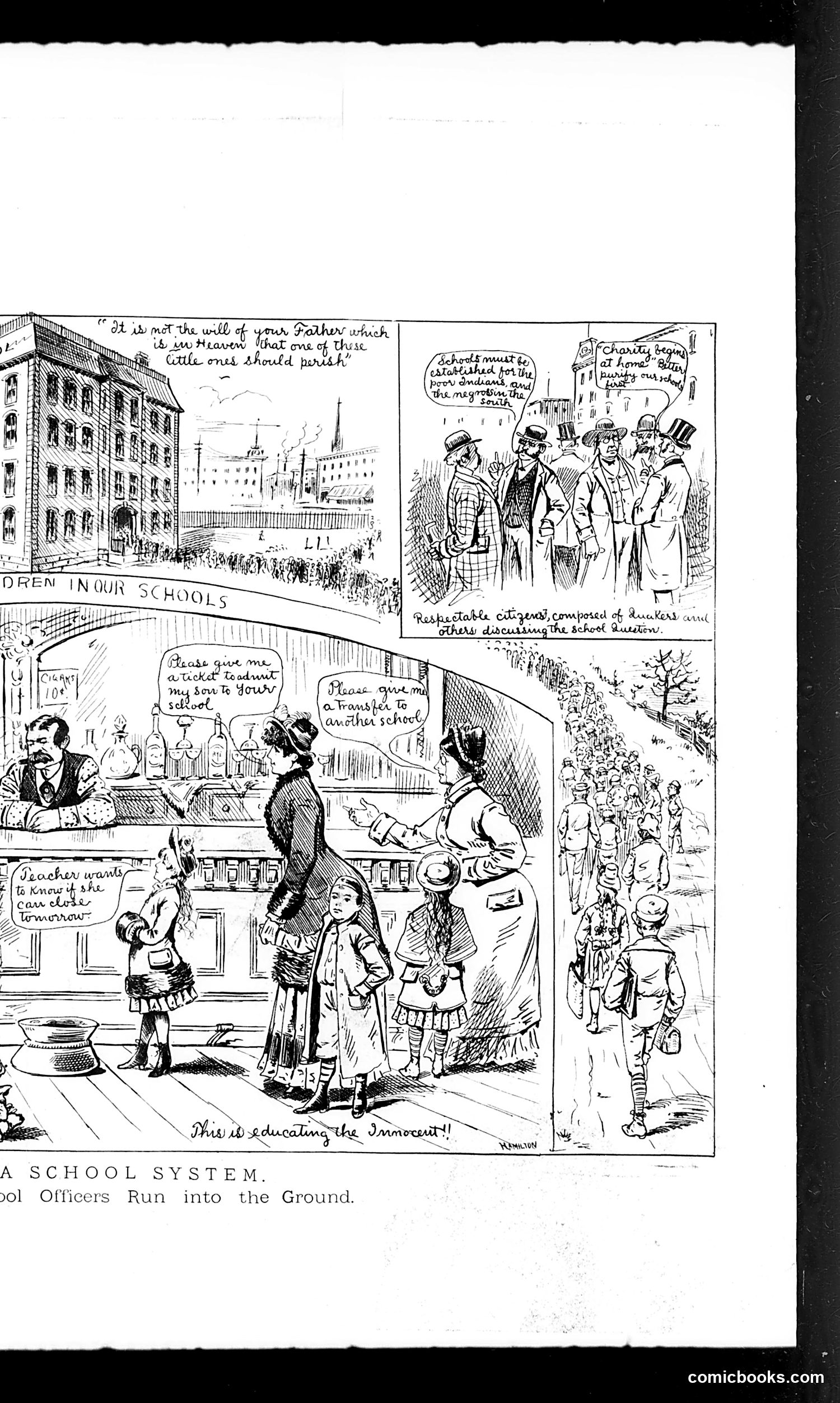
This Judge magazine cartoon satirizes corruption in school administration, depicted through a series of vignettes showing the degradation of educational institutions. The top panels show school officials (appearing to be administrators or board members) discussing how to exploit the system for personal gain. The lower section depicts a schoolhouse where teachers request transfers and basic supplies while facing bureaucratic obstacles. The final panel shows a large crowd of children being herded along, captioned "This is educating the Innocent!!" The satire's point: School administrators are so corrupt and incompetent that they literally run the institution "into the ground"—neglecting actual education while prioritizing personal interests. The innocent children suffer the consequences of this mismanagement. The cartoon critiques Gilded Age-era graft in municipal institutions, particularly how public money meant for schools was diverted through administrative corruption.

I can see this is a page from *Judge* magazine with the comicbooks.com watermark, but the image appears to be almost entirely blank or blank page—I cannot discern any visible cartoon, illustration, text, or other content beyond the watermark at the bottom. Without visible content to analyze, I cannot identify any figures, caricatures, political references, or satirical points. If this is meant to show a specific cartoon or article, the image may not have scanned properly, or this may be a blank page from the magazine's interior. I'd need a clearer or more legible version of the page to provide meaningful historical context.
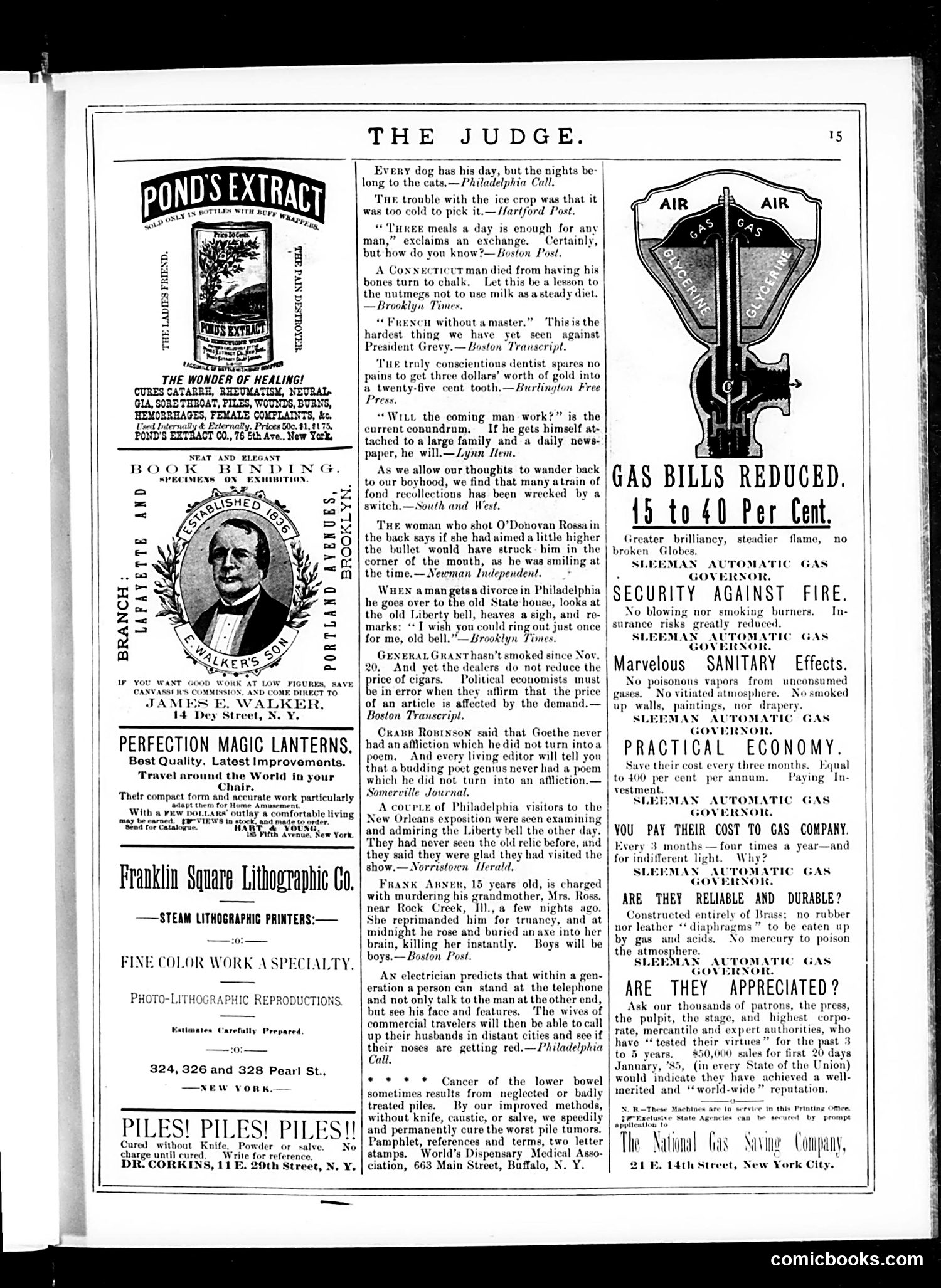
This is primarily an **advertising page** with minimal cartoon or satirical content. The page is dominated by period advertisements (Pond's Extract, magic lanterns, lithography services, etc.) and a collection of brief **humorous quips and anecdotes** rather than political cartoons. The "jokes" are mild observational humor typical of 1880s American periodicals: - Puns about everyday life (ice being "too cold to pick") - Cynical observations (dentists overcharging for gold fillings) - References to contemporary figures like **President Grey** and **General Grant** - Social commentary (divorce in Philadelphia; the O'Donovan Rossa assassination attempt) Most notably, there's dark humor about **Frank Ammen, a 15-year-old who murdered his grandmother** for scolding him, with the quip "Boys will be boys"—a shocking example of how casually violent crime was treated in period satire. The page reflects Judge's mix of advertising revenue and light satirical commentary on news and social mores.
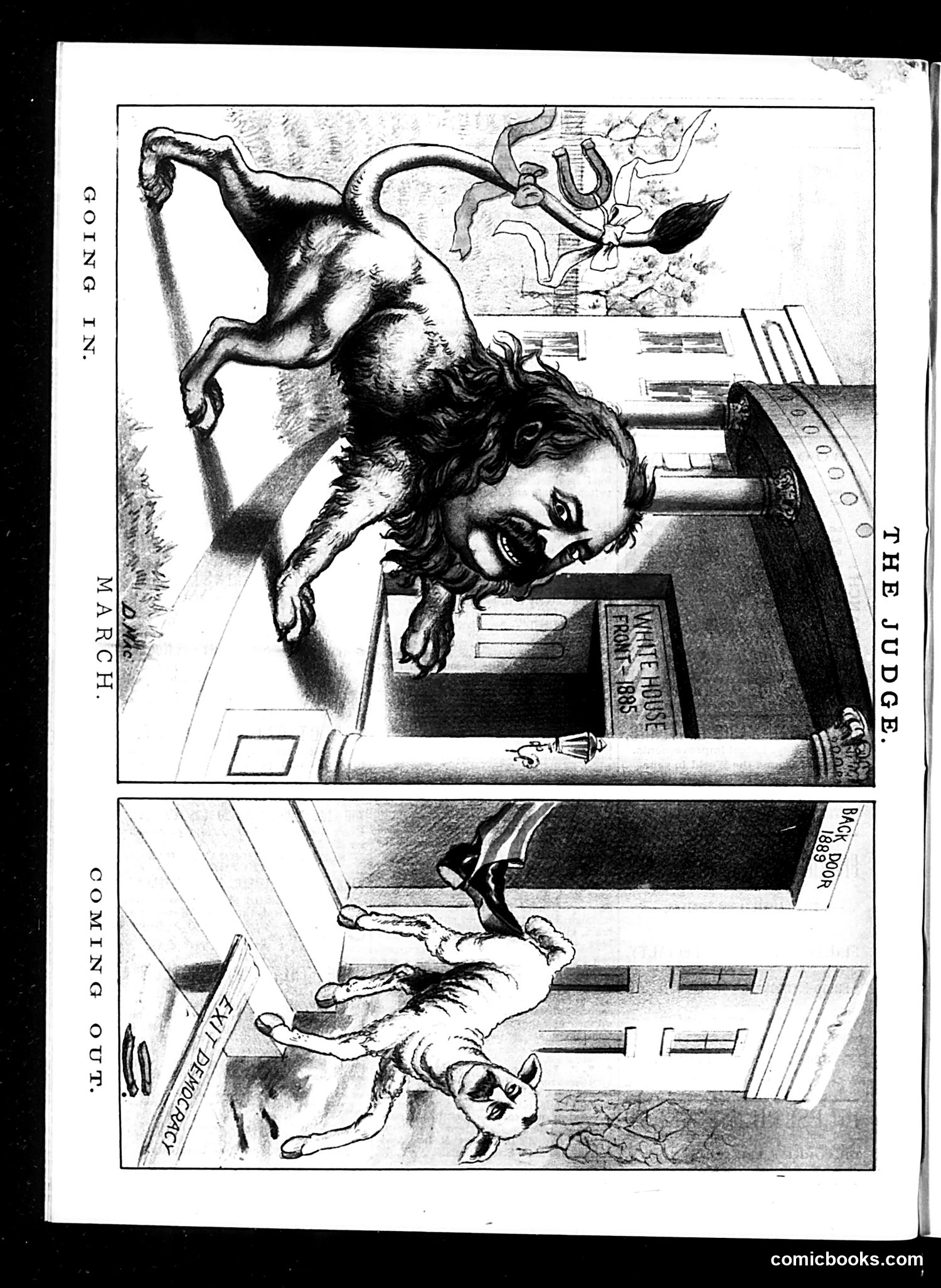
This two-panel Judge magazine cartoon satirizes legal proceedings, likely from the early 20th century. **Top panel ("Going In"):** Shows a donkey in formal attire entering what appears to be a courthouse or judicial building, labeled "The Judge." The donkey carries a document, suggesting it's a plaintiff or defendant. **Bottom panel ("Coming Out"):** Depicts the same donkey emerging battered and diminished, with papers scattered, titled "Coming Out." The satire mocks the judicial system's harsh treatment of defendants or litigants—suggesting that courts strip away dignity and assets from those who enter them. The use of a donkey as the protagonist implies the person involved is foolish or has been made a fool of by the legal process. The cartoon criticizes how litigation can leave participants financially and personally damaged, a common theme in Gilded Age social commentary.