
A complete issue · 16 pages · 1885
Judge — February 21, 1885
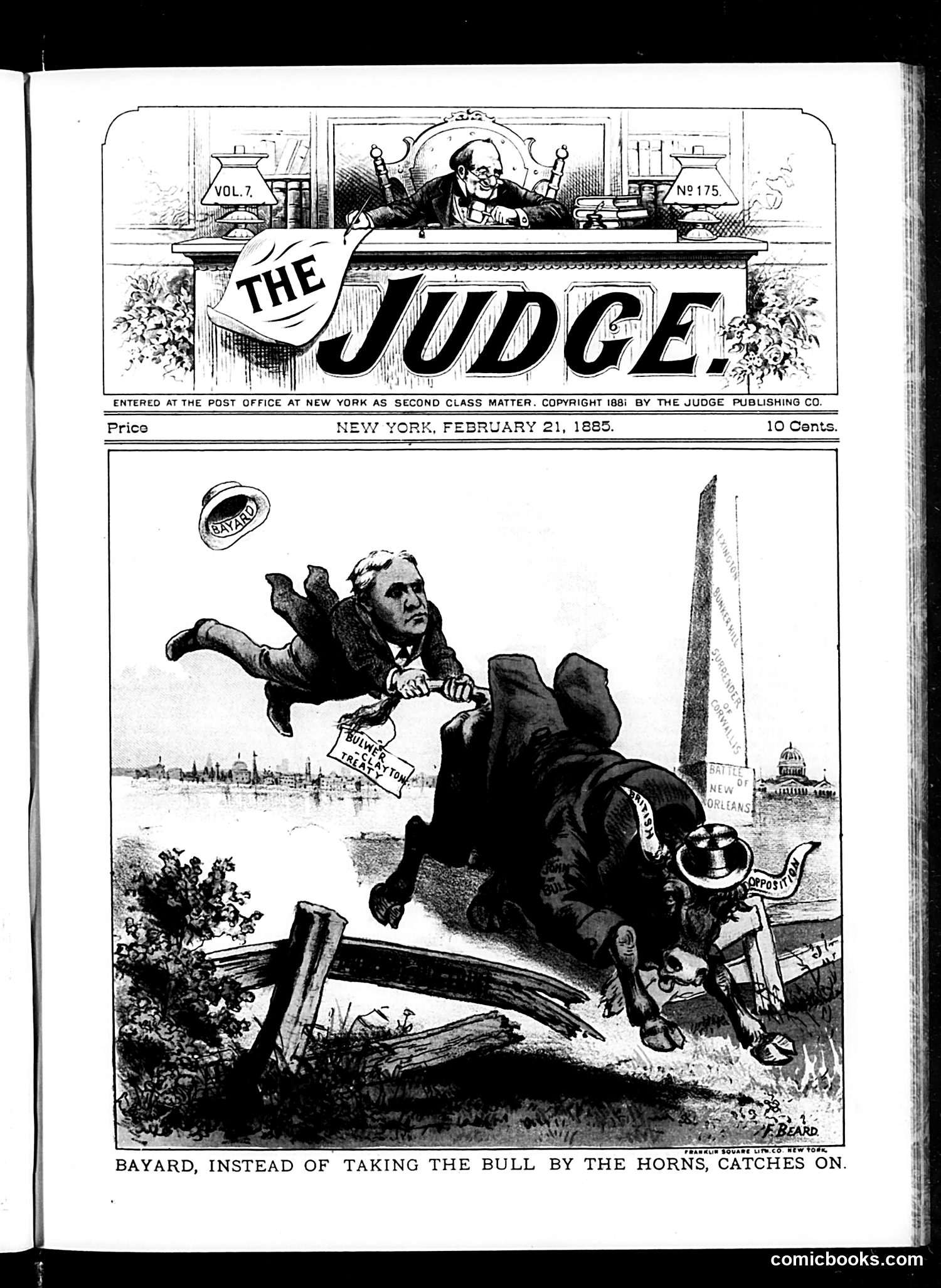
This political cartoon satirizes a figure labeled "Bayard" who is depicted riding a bull while trying to catch it—an absurd, contradictory action. The caption reads: "Bayard, instead of taking the bull by the horns, catches on." The cartoon likely references Thomas F. Bayard, a prominent Democratic politician of the era. The "bull" metaphor suggests a difficult political situation or crisis that requires decisive action. The satire mocks Bayard for attempting an ineffective or illogical approach—literally trying to catch the bull he's already riding—implying his political strategy was backwards or self-defeating. The Washington Monument visible in the background suggests this concerns federal politics. Without additional context about specific 1885 events, the precise political issue remains unclear, but the core joke criticizes fumbling leadership.
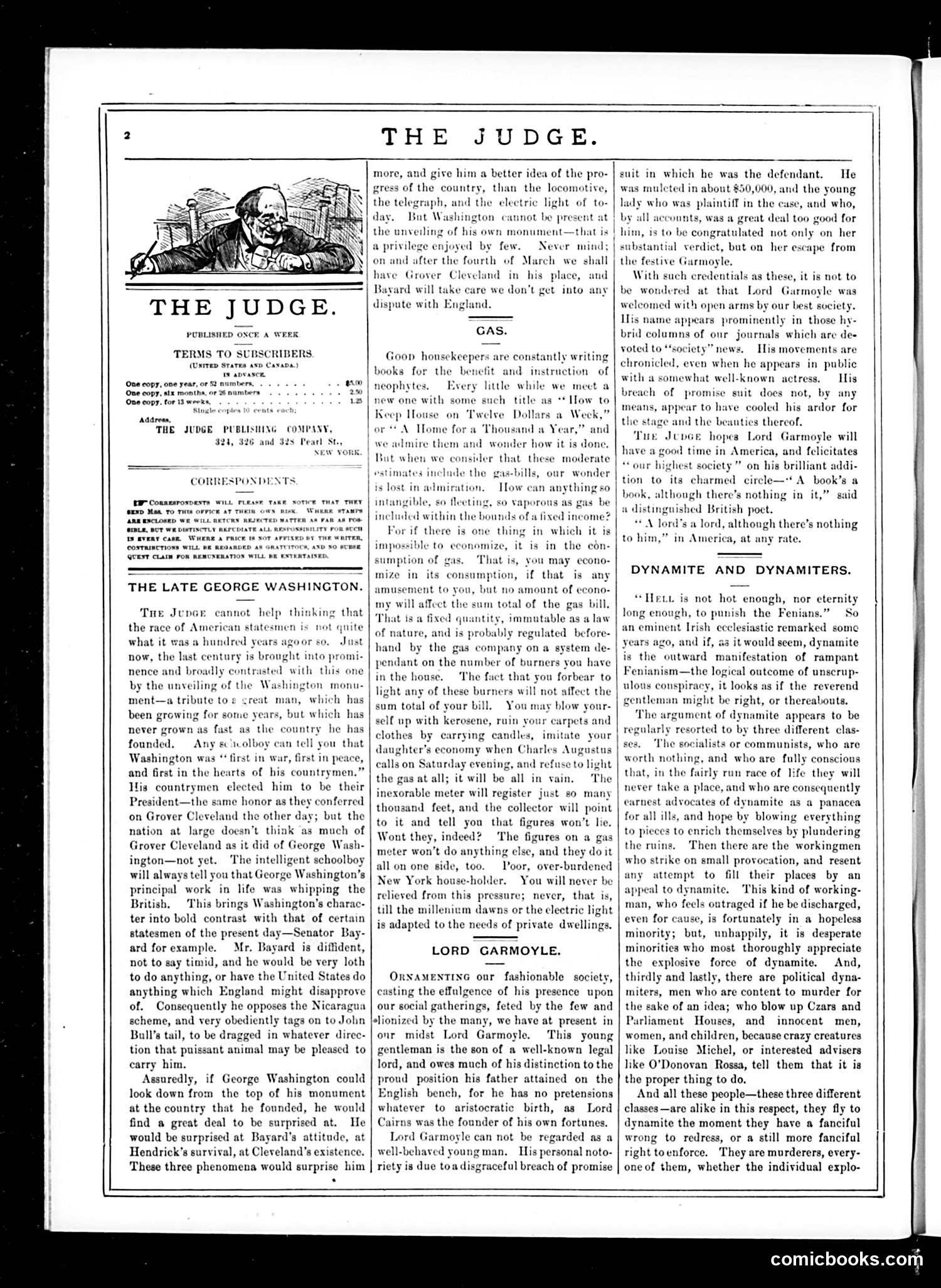
This page contains social/political commentary typical of Judge's satirical approach. The main pieces are: **"The Late George Washington"** criticizes Senator Thomas F. Bayard for his deferential stance toward Britain, contrasting him unfavorably with George Washington's assertive leadership. The article suggests Bayard's timidity represents a decline in American statesmanship compared to the founding generation. It implies concern that with Grover Cleveland's upcoming presidency and Bayard's influence, America will meekly follow British interests rather than assert independence. **"Gas"** is a humorous satire on household economy books that promise to teach women how to live cheaply. The joke: gas bills are fixed costs that cannot be economized—no matter what tricks housekeepers employ (using candles, limiting burners), the gas company's bill remains constant and unavoidable. It mocks the futility of these budget guides when facing inescapable utilities. Both pieces reflect late-19th-century concerns: American diplomatic weakness and the frustrations of household management in the gas-lit era.
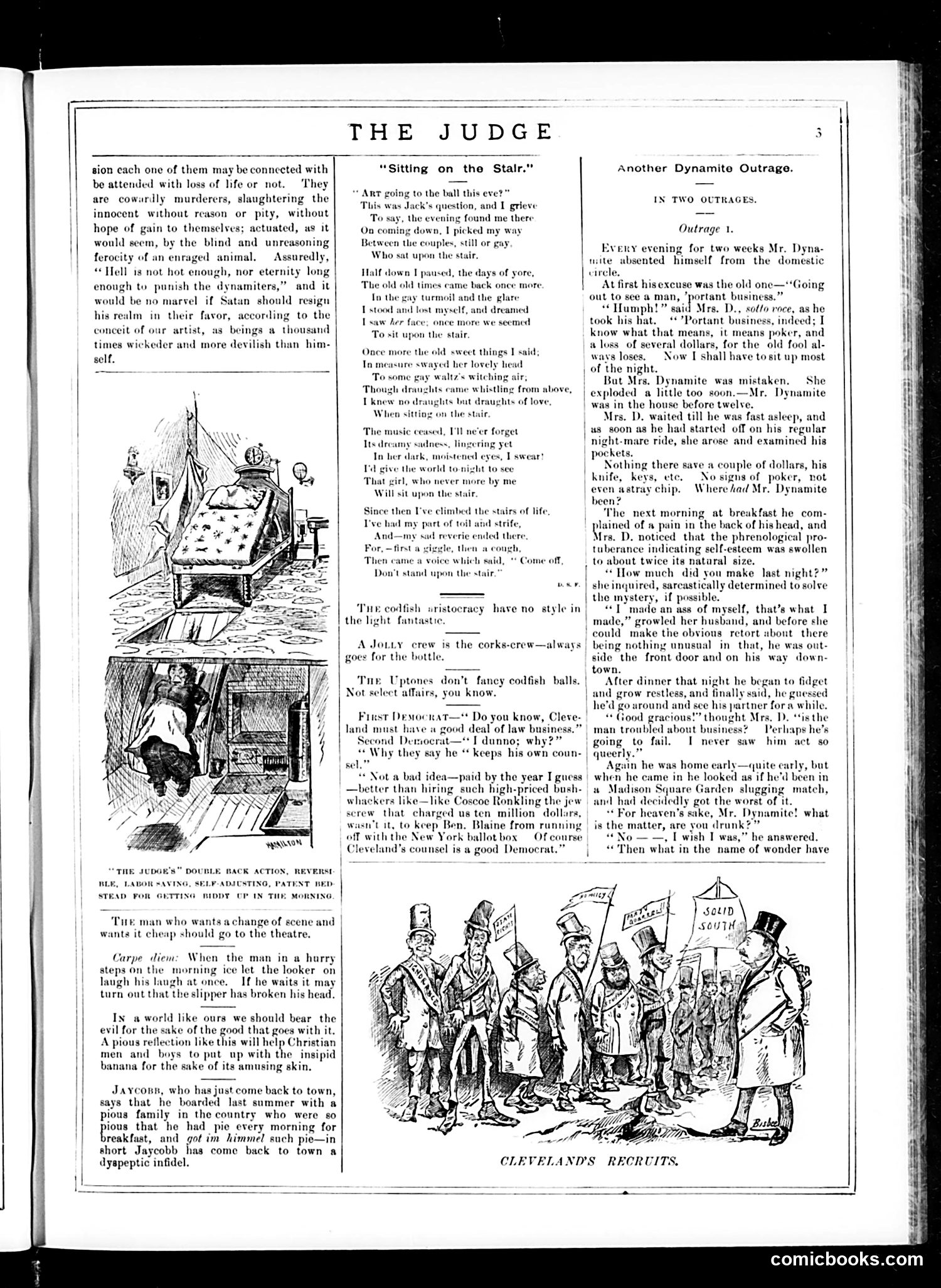
This page from the satirical magazine *Judge* contains multiple items satirizing American society of the period (appears to be 1880s-90s based on references). **Top section** attacks dynamiters/anarchists with inflammatory rhetoric, likely referencing the era's labor violence and bombing campaigns that terrified the public. **"Another Dynamite Outrage"** is a domestic humor piece, not political—it's a two-part joke about a suspicious wife tracking her husband's evening absences. She suspects poker but discovers he's innocent, creating ironic comedy. **Lower text snippets** include satirical quips: mocking the Uptones' pretension, joking about Democratic lawyers' high fees (possibly referencing Roscoe Conkling), and contrasting "pious" country families with actual hypocrisy. **Bottom cartoon** "Cleveland's Recruits" appears to reference President Grover Cleveland's political appointments or supporters, though specifics are unclear without fuller context. The page mixes political commentary with domestic humor and social satire typical of *Judge's* satirical approach.
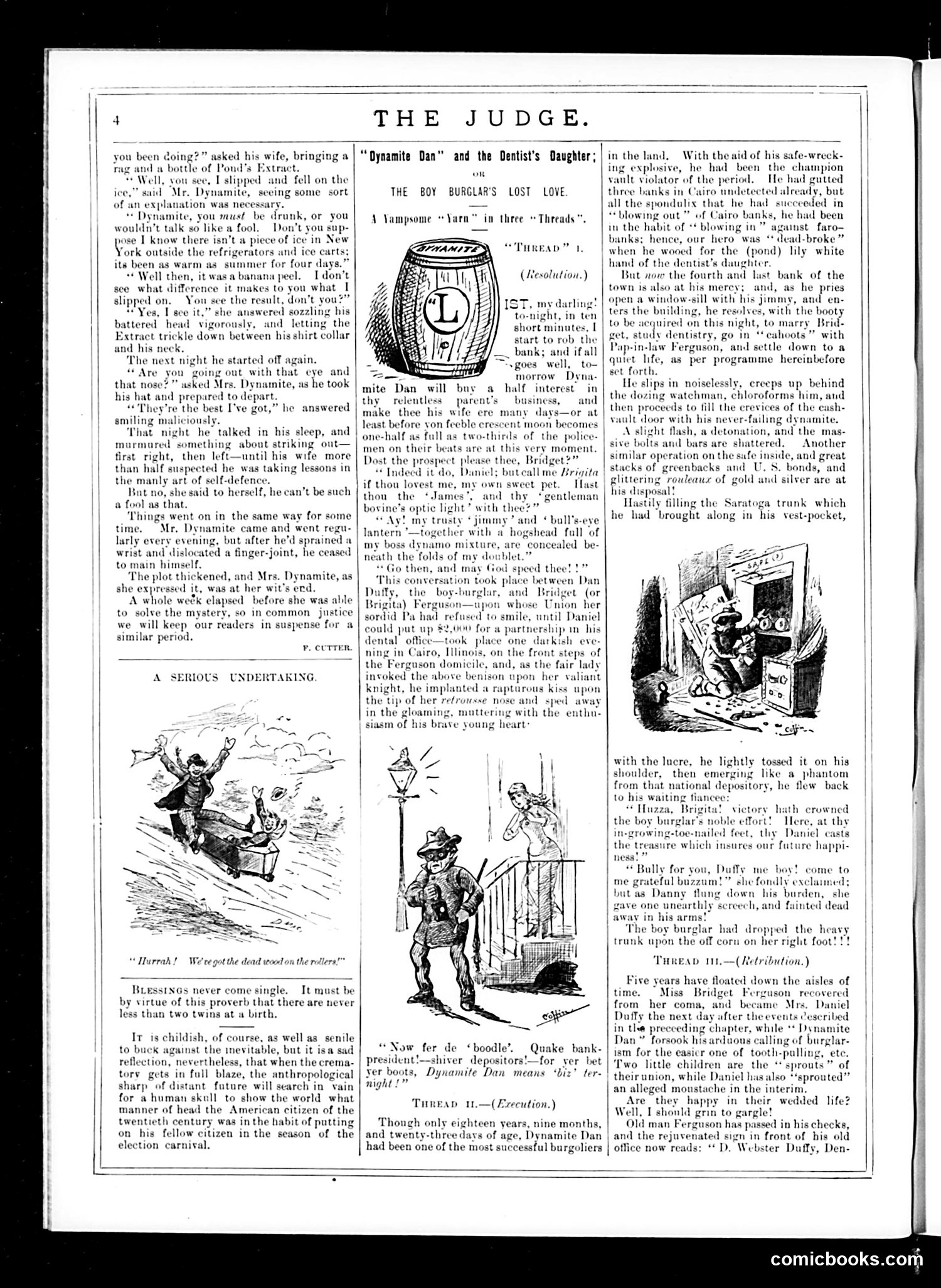
This page from the satirical magazine *Judge* contains two unrelated humorous stories: **"Dynamite Dan" and the Dentist's Daughter** (main story): A serialized tale about a young burglar named "Dynamite Dan" who plans to rob a bank to earn money and win his sweetheart Bridget (the dentist's daughter) from her disapproving father. The narrative uses florid, melodramatic language typical of dime novels. The satire mocks both cheap romantic fiction and the era's criminal underworld glamorization. **"A Serious Undertaking"** (left sidebar): A brief joke about cremation and American election violence. It sarcastically laments that future anthropologists won't find skulls to study because citizens bash each other's heads during election season—critiquing the brutality of 19th-century American political campaigns. **Context**: Both pieces exemplify *Judge's* satirical humor targeting popular literature conventions and social violence. The illustrations support the melodramatic tone of the burglar narrative.
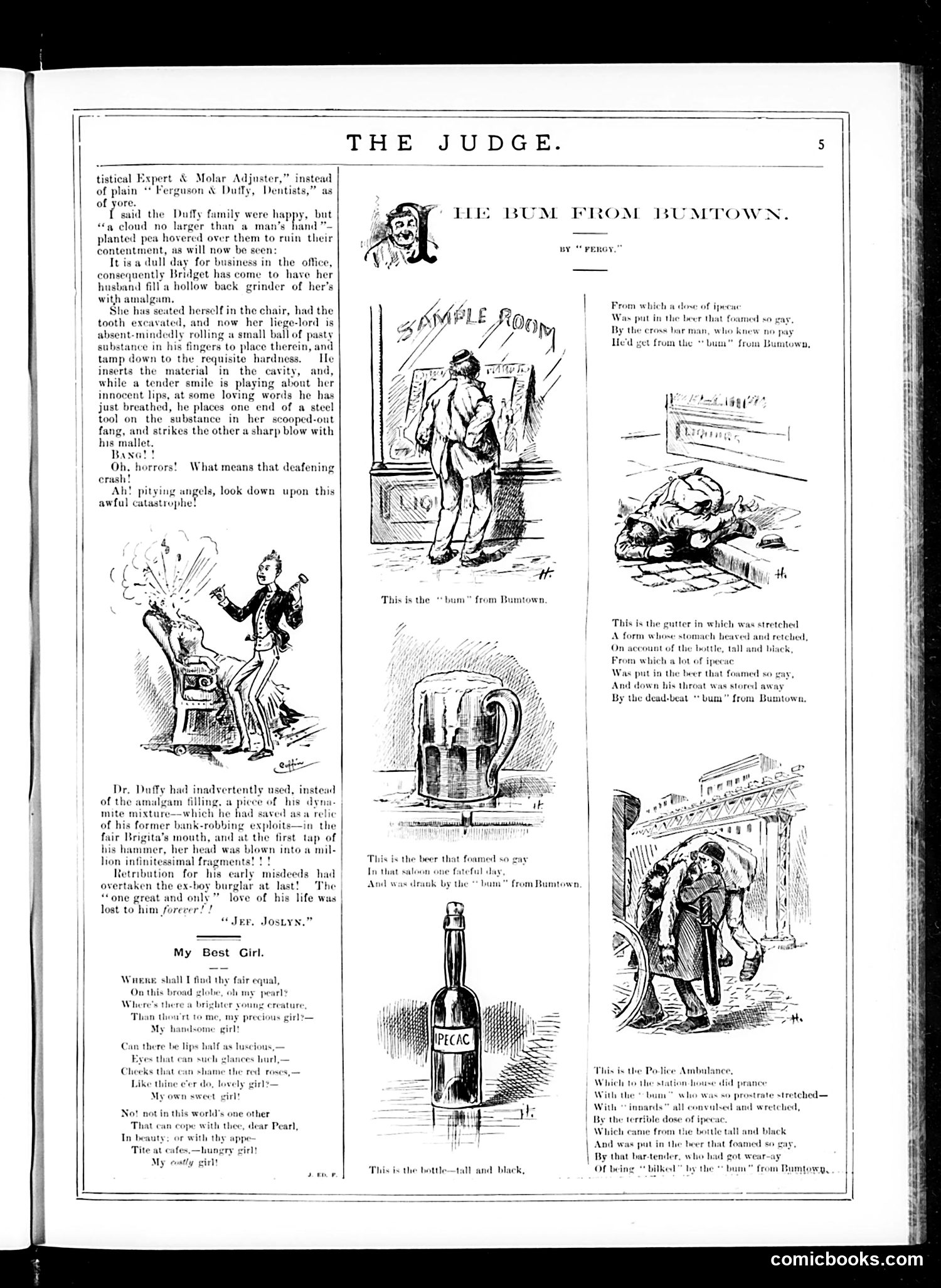
This page contains two distinct pieces of satire: **Left side:** A domestic comedy about Mr. Duffy, a dentist, who accidentally strikes his wife's tooth with a hammer while filling it, destroying her dental work. The joke plays on marital mishap and professional incompetence—his "one great and only" love (his wife) is literally lost when the filling is destroyed. **Right side:** A cumulative poem-and-illustration sequence mocking a vagrant ("the bum from Bumtown"). Someone anonymously doses the bum's beer with ipecac (an emetic), causing him to become ill. The illustrations show the cascading consequences: the gutter where he vomits, the police ambulance that retrieves him. The satire targets both the homeless man (portrayed as a social nuisance) and the unknown prankster who torments him for amusement. It reflects period attitudes treating poverty and homelessness as objects of ridicule rather than sympathy.
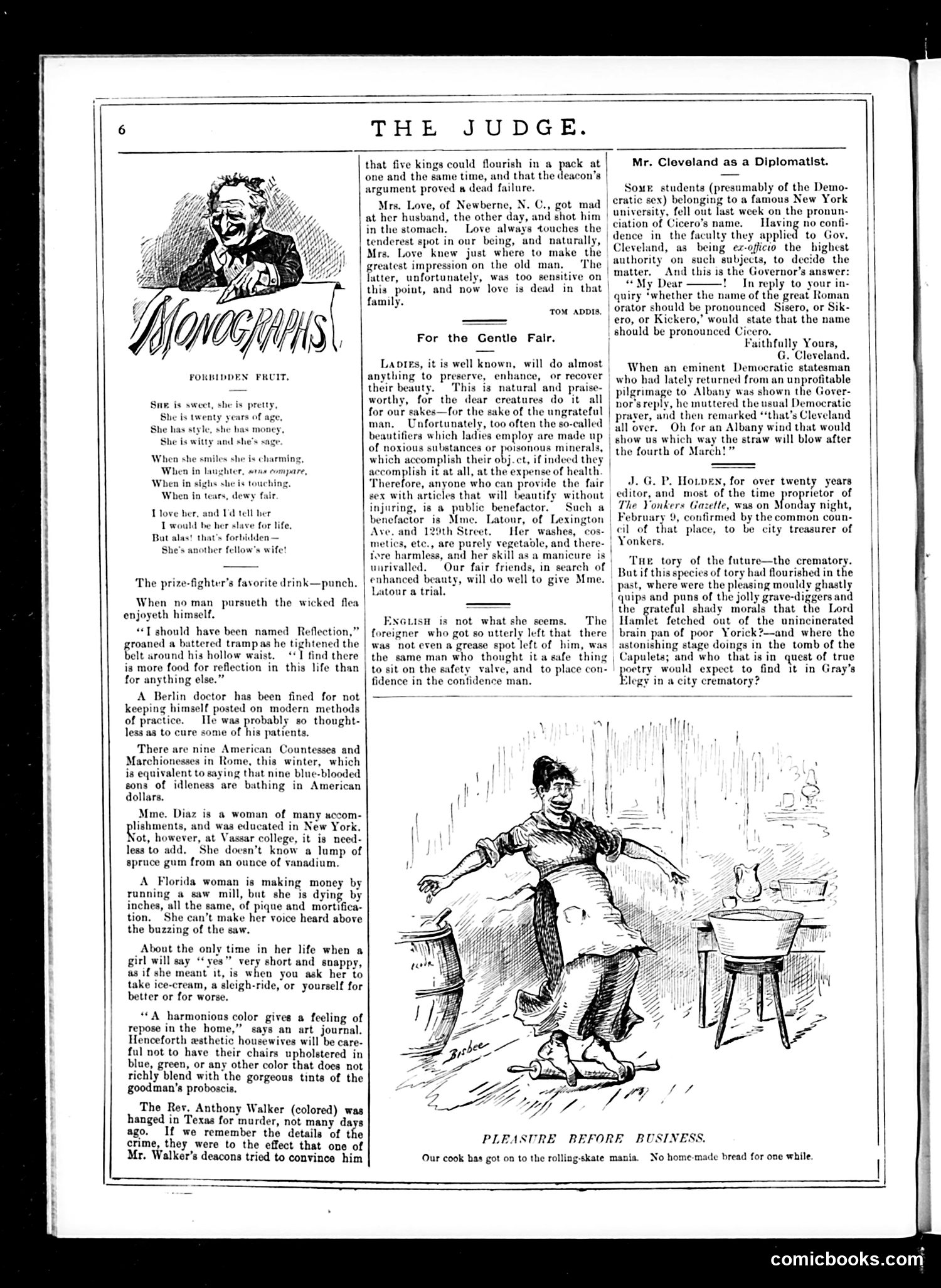
This page contains primarily **humor columns and advertisements** rather than political cartoons, typical of Judge's satirical format. The top illustration, "Forbidden Fruit," satirizes temptation—likely referencing desire for an unavailable woman (married, as the text states). This reflects Victorian-era social commentary on propriety and marital fidelity. The bottom illustration, "Pleasure Before Business," shows a woman on roller skates, satirizing the new leisure activity's popularity, particularly among women. The caption jokes that "our cook has got on to the rolling-skate mania"—poking fun at how this fad had permeated all social classes. The text columns mock various contemporary targets: a Berlin doctor fined for old-fashioned practice methods; wealthy American women marrying European nobility; a woman operating a saw mill ("dying by inches" from wounded pride); and references to an execution of Rev. Anthony Walker in Texas. Overall, the page uses light satire to comment on modern social trends, gender behavior, and the pretensions of the era's leisure class and professional classes.
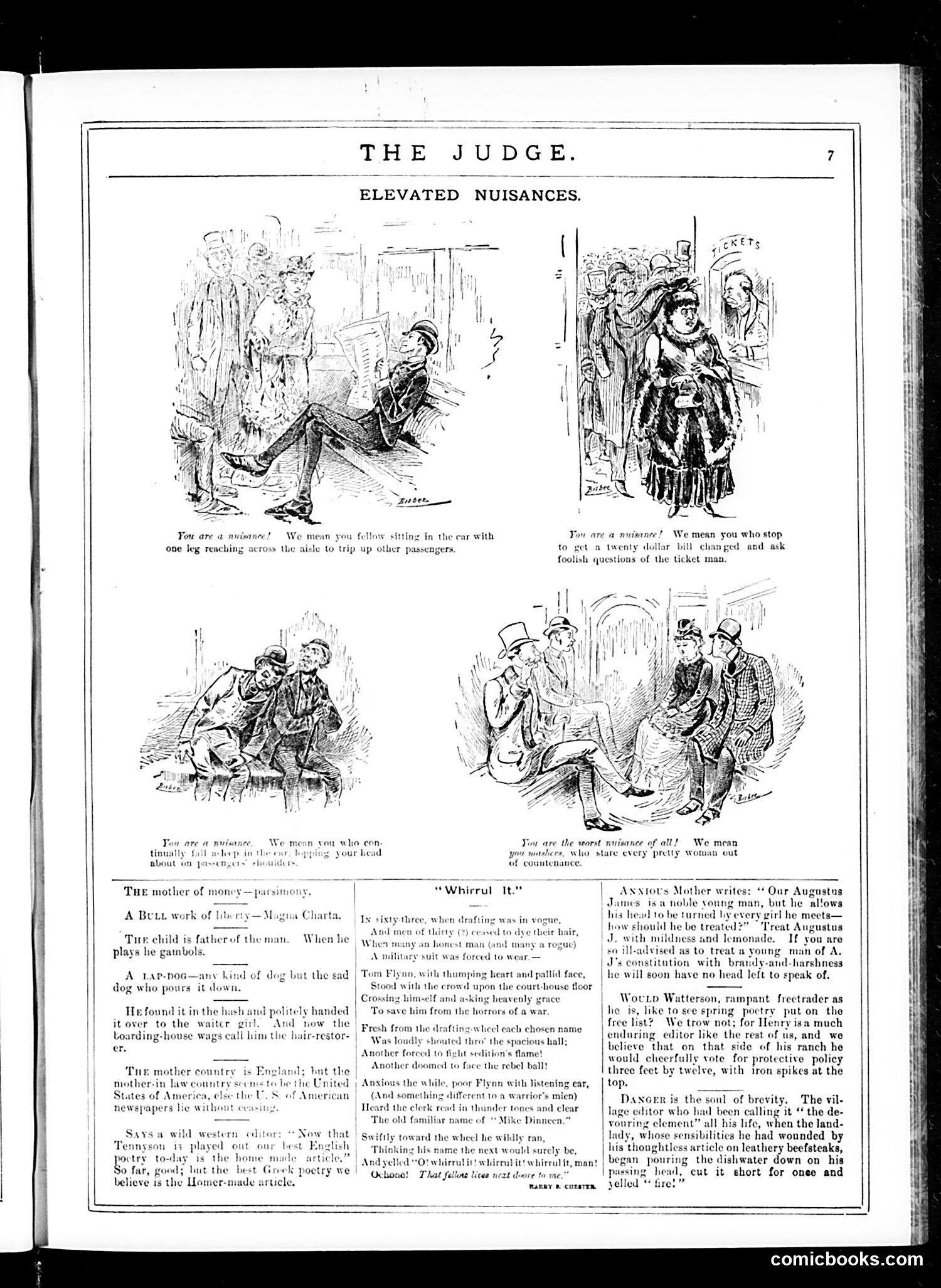
This page satirizes bad behavior on elevated trains (the newly built urban transit system of late 19th-century America). Four cartoon panels ridicule specific passenger types: the man with his leg stretched across the aisle, the loud ticket-bill questioner, the sleeping passenger with his head on others, and the "worst nuisance"—men who stare intently at attractive women. Below, the magazine publishes humorous reader letters addressing social etiquette and character flaws. References include Tom Flynn (appears to be a local figure), Watterson (a "rampant freetrader"), and Mike Dinneen. The satire mocks both transit-specific rudeness and broader Victorian-era social hypocrisy—particularly male impropriety toward women and the absurdity of everyday public conduct.
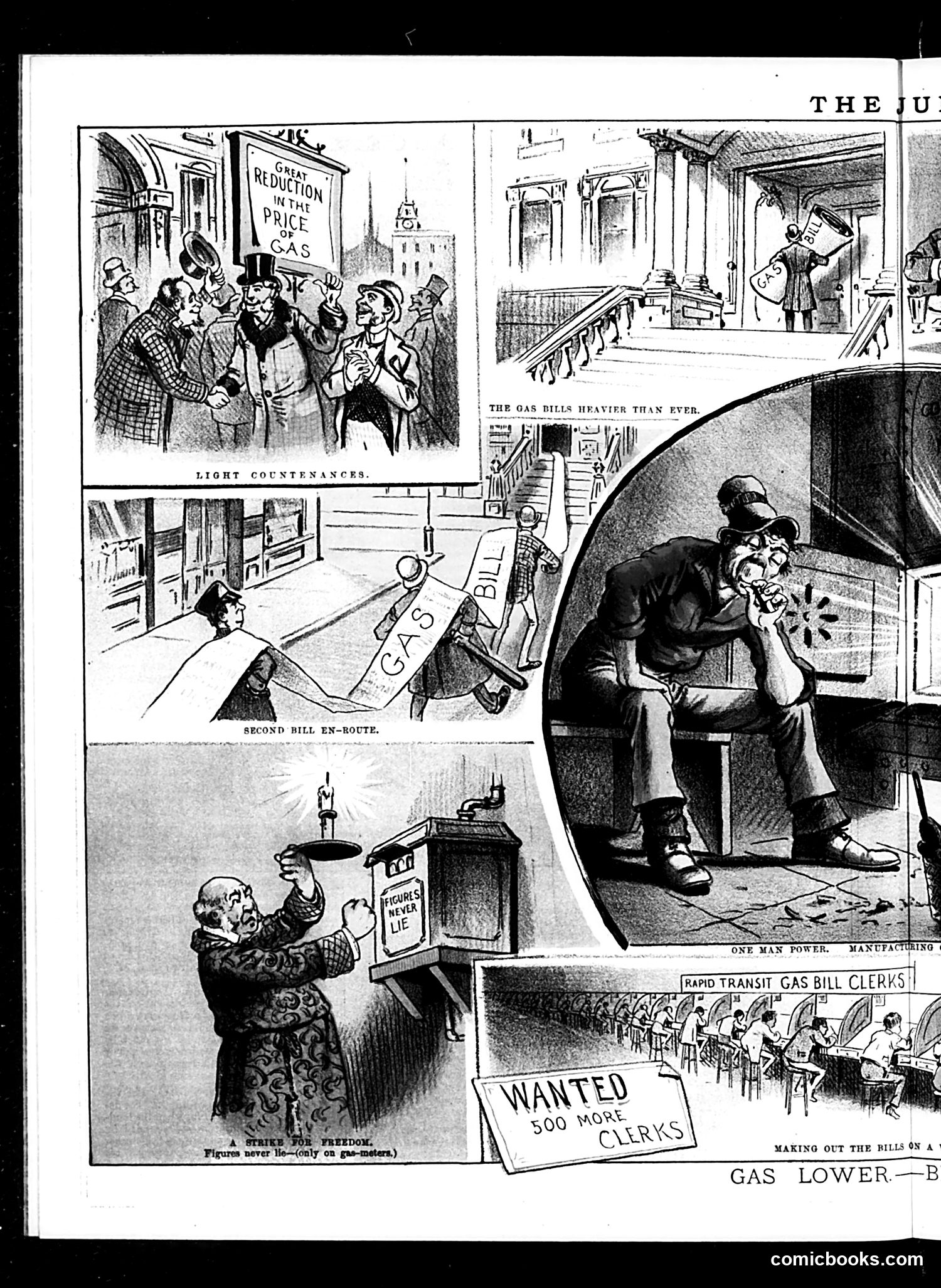
This Judge page satirizes the rising cost of gas bills through multiple cartoon panels. "Light Countenances" shows people celebrating a sign advertising "Great Reduction in the Price of Gas." "Second Bill En-Route" depicts the gas bill's journey through bureaucratic channels, suggesting delays and complications. "A Strike for Freedom" shows a figure holding up a gas meter marked "Figures Never Lie," sarcastically commenting that meters supposedly don't lie—yet bills keep rising. The final panels mock gas company clerks being "Wanted" in large numbers, suggesting the overwhelming administrative burden of processing inflated bills. Overall, the cartoons criticize gas companies for charging excessive fees despite claims of reduced prices, and mock the bureaucratic apparatus supporting these practices.
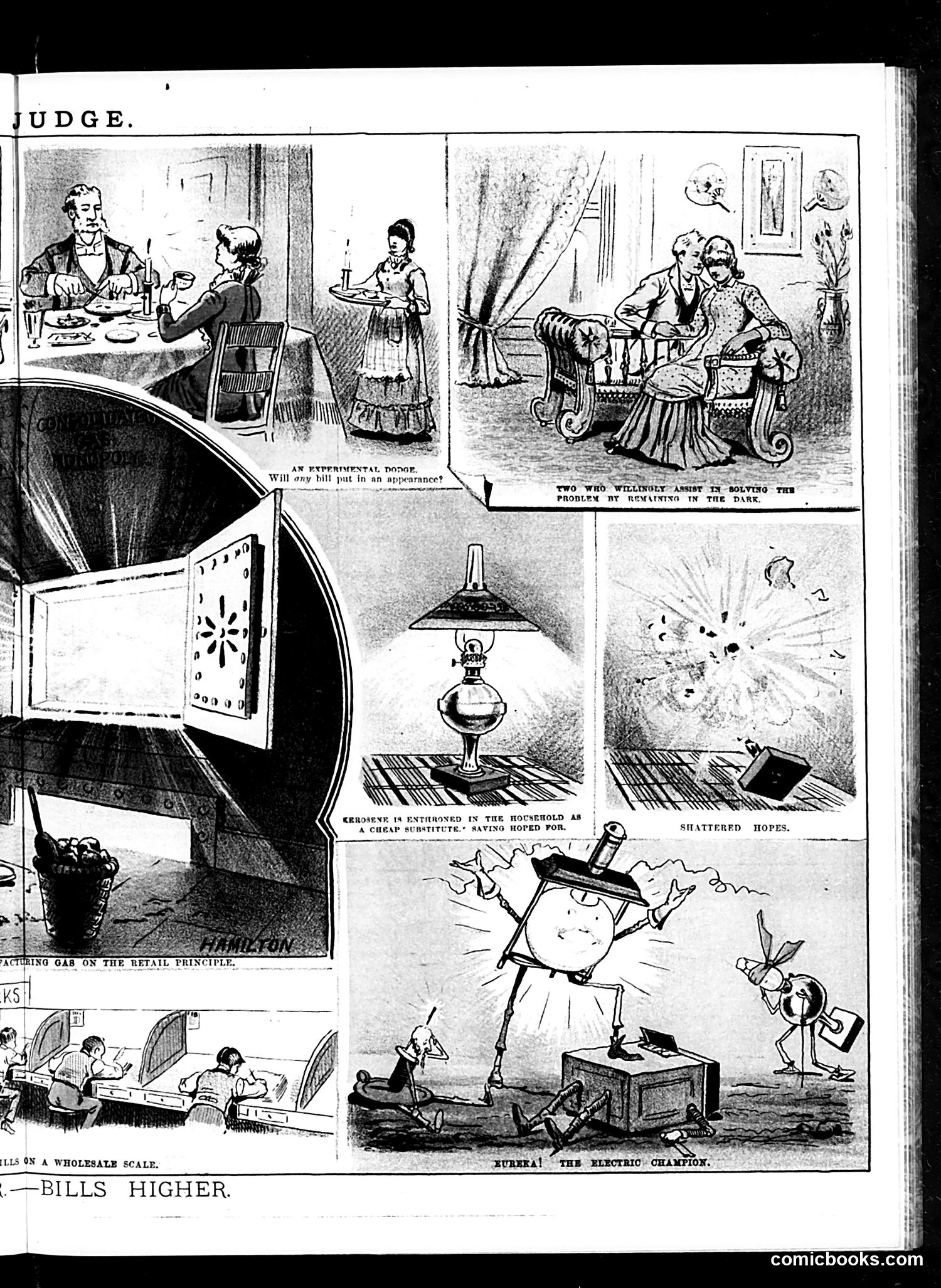
This page satirizes the rising cost of living, specifically household expenses. The cartoon sequence mocks attempts to economize: **"An Experimental Dodge"** shows a dinner where appearance matters more than substance—suggesting false economy through pretense. **"Two Who Willingly Assist in Solving the Problem"** depicts people deliberately remaining ignorant of financial realities. **"Kerosene is Enthroned...as a Cheap Substitute"** shows a lamp replacing gas lighting—a cost-cutting measure that ultimately fails. **"Shattered Hopes"** and **"Eureka! The Electric Champion"** depict people trying various alternatives (electricity, gadgets) seeking savings, only to discover they backfire. The overall message: Despite efforts to reduce household bills through substitutions and experiments, expenses mysteriously keep rising—the page title **"Bills Higher"** delivers the punchline. The satire targets middle-class anxiety about inflation and the futility of penny-pinching solutions.
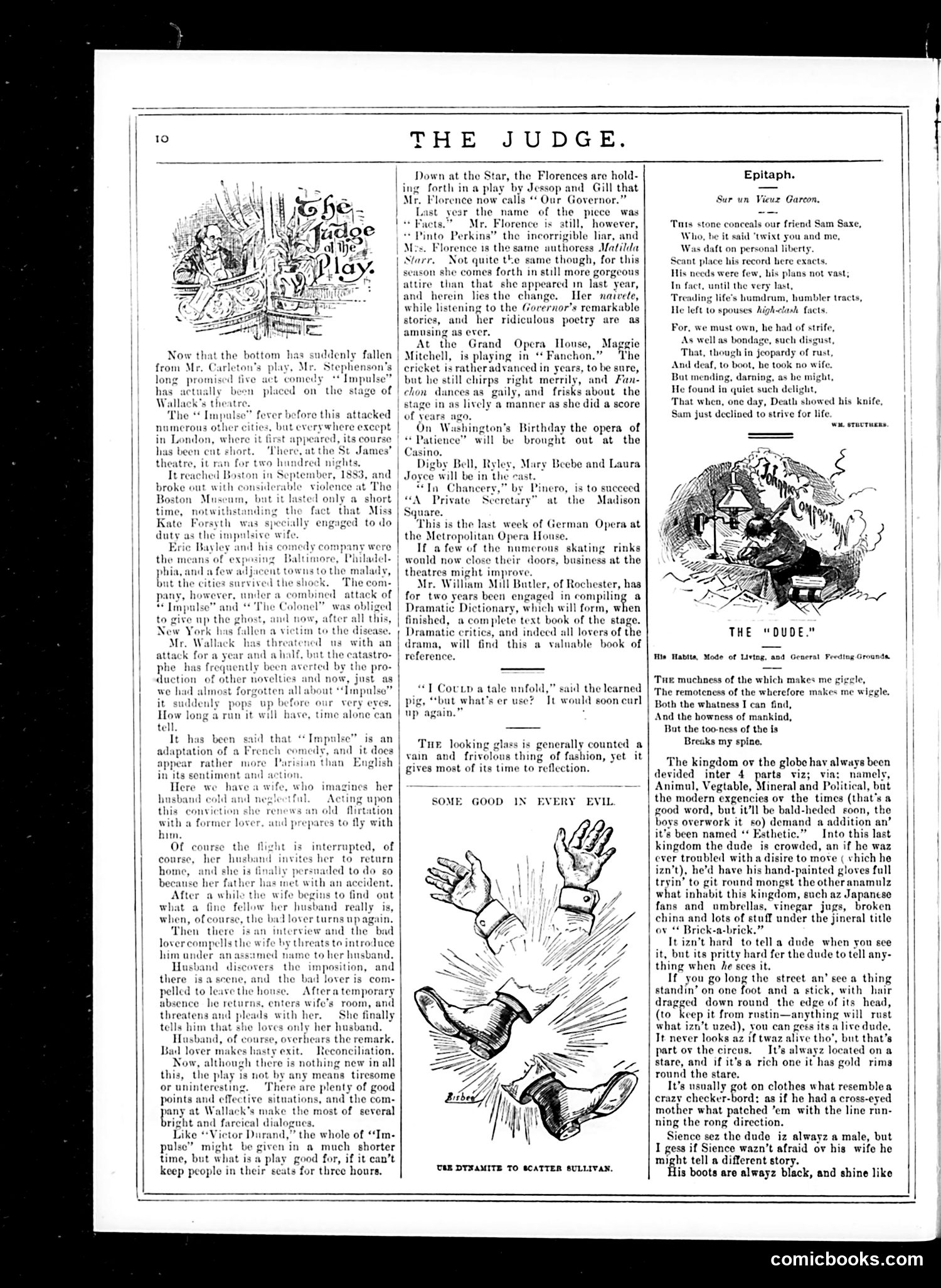
This page from *Judge* satirizes theatrical life in 1880s New York, focusing on the fickle nature of theater-goers and the constant cycle of play openings and closures. **Main Content:** The left column reviews several theatrical productions, including Mr. Carleton's failed play "The Impulse" at Wallack's Theatre, which collapsed after initial success—the satire being that theater audiences are unreliable and venues constantly need new shows to survive financially. **The Cartoon ("The Dynamite to Scatter Sullivan"):** The illustration depicts hands being blown apart, likely referencing boxer John L. Sullivan, the famous heavyweight champion. The title suggests using "dynamite" to "scatter" him—a crude sports joke about defeating Sullivan through explosive force, reflecting the violent language common in 1880s boxing commentary. **Right Column Content:** An epitaph mocking an unmarried man named Sam Saxe, and brief theatrical gossip about upcoming productions and performers like Maggie Mitchell. **Overall Tone:** The page reflects the sensationalist, gossip-focused entertainment journalism typical of *Judge*'s satirical approach to American leisure culture.
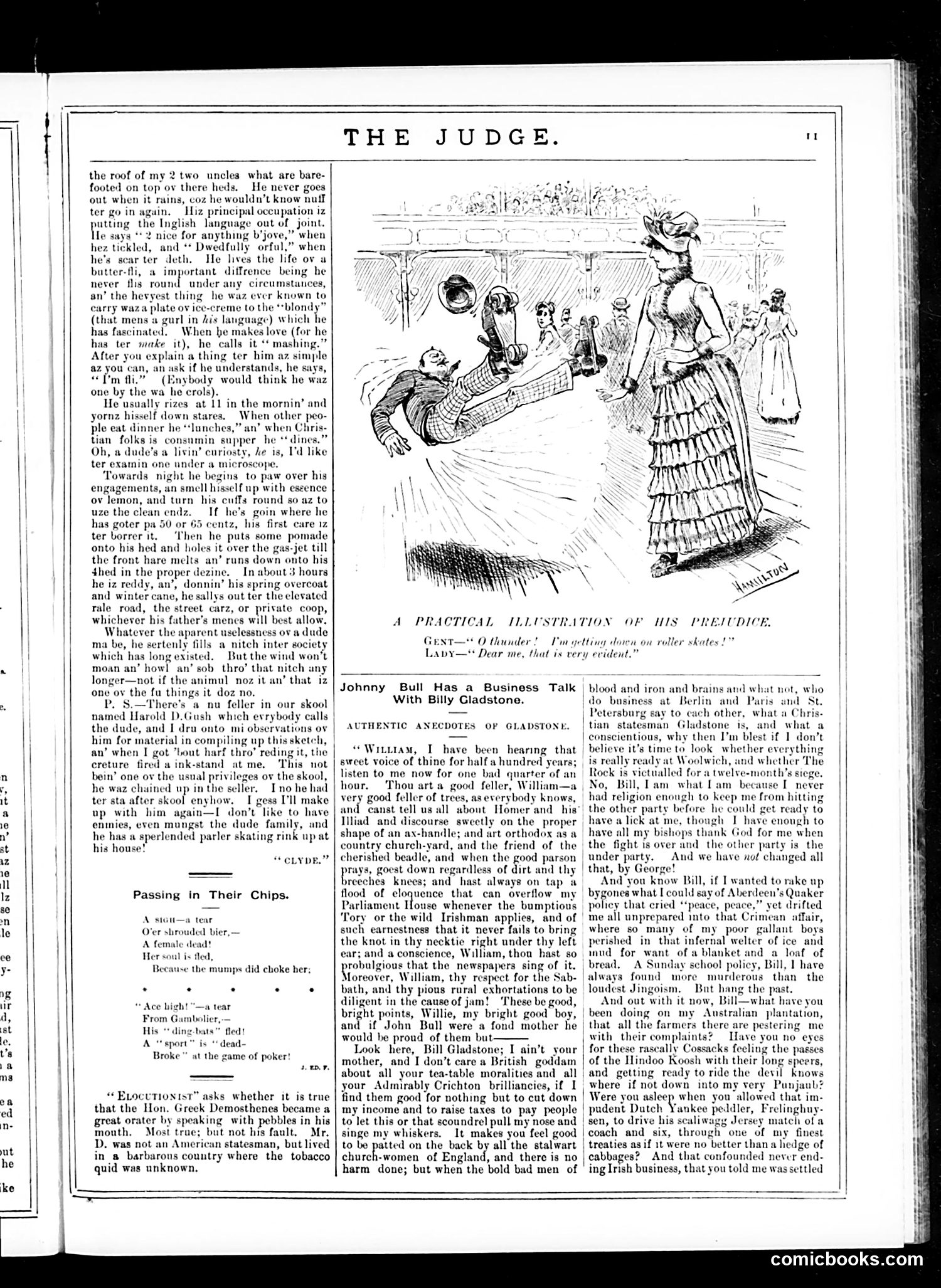
This page from the satirical magazine **Judge** contains multiple pieces of social satire aimed at American readers of the late 19th century. The main illustrated cartoon depicts a **"dude"** — a fashionable but vapid young man obsessed with appearance and social pretension. The accompanying text mocks this social type: a lazy, affected gentleman who sleeps late, uses affected speech ("b'jove," "awfully"), borrows money for social outings, and spends excessive time grooming. The satire ridicules both the dude's uselessness and his absorption in trivial concerns. Below are brief humor pieces and anecdotes, including mockery of Greek oratory and commentary on British politics (referencing William Gladstone). The page represents typical Judge content: satirizing American social types, pretension, and folly through exaggerated characterization and dialect humor. The overall tone reflects Victorian-era class anxiety about shifting social hierarchies and leisured idleness among the wealthy.
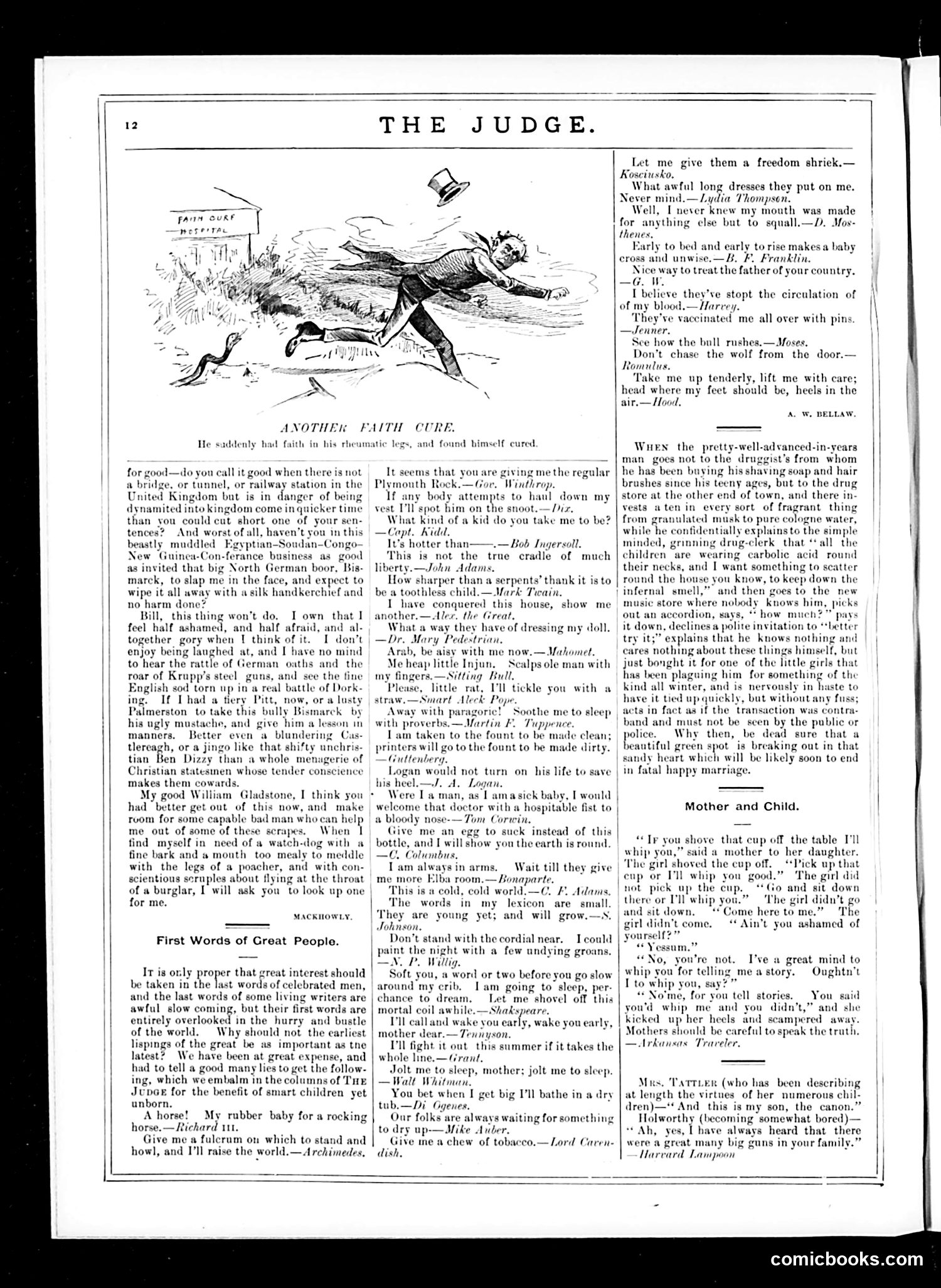
This page from *Judge* magazine contains two distinct satirical pieces: **"Another Faith Cure"** (top cartoon): A political attack on British Prime Minister William Gladstone. The cartoon depicts him being knocked down by various crises—Irish troubles, colonial conflicts, and German aggression under Bismarck. The text mocks Gladstone's pacifist approach to governing, suggesting his reluctance to use military force makes Britain vulnerable. The satirist argues Britain needs a stronger, more aggressive leader (referencing past statesmen like Pitt or Palmerston) rather than Gladstone's "tender conscience." **"First Words of Great People"** (text section): A humorous parody listing fake inaugural quotes from famous historical figures—Richard III, Sitting Bull, Shakespeare, Columbus, etc.—in deliberately anachronistic or absurd styles. The joke relies on readers recognizing these figures and finding humor in the incongruity between their historical personas and the trivial or modern-sounding statements attributed to them. Both pieces use satire typical of *Judge's* political commentary style of this era.
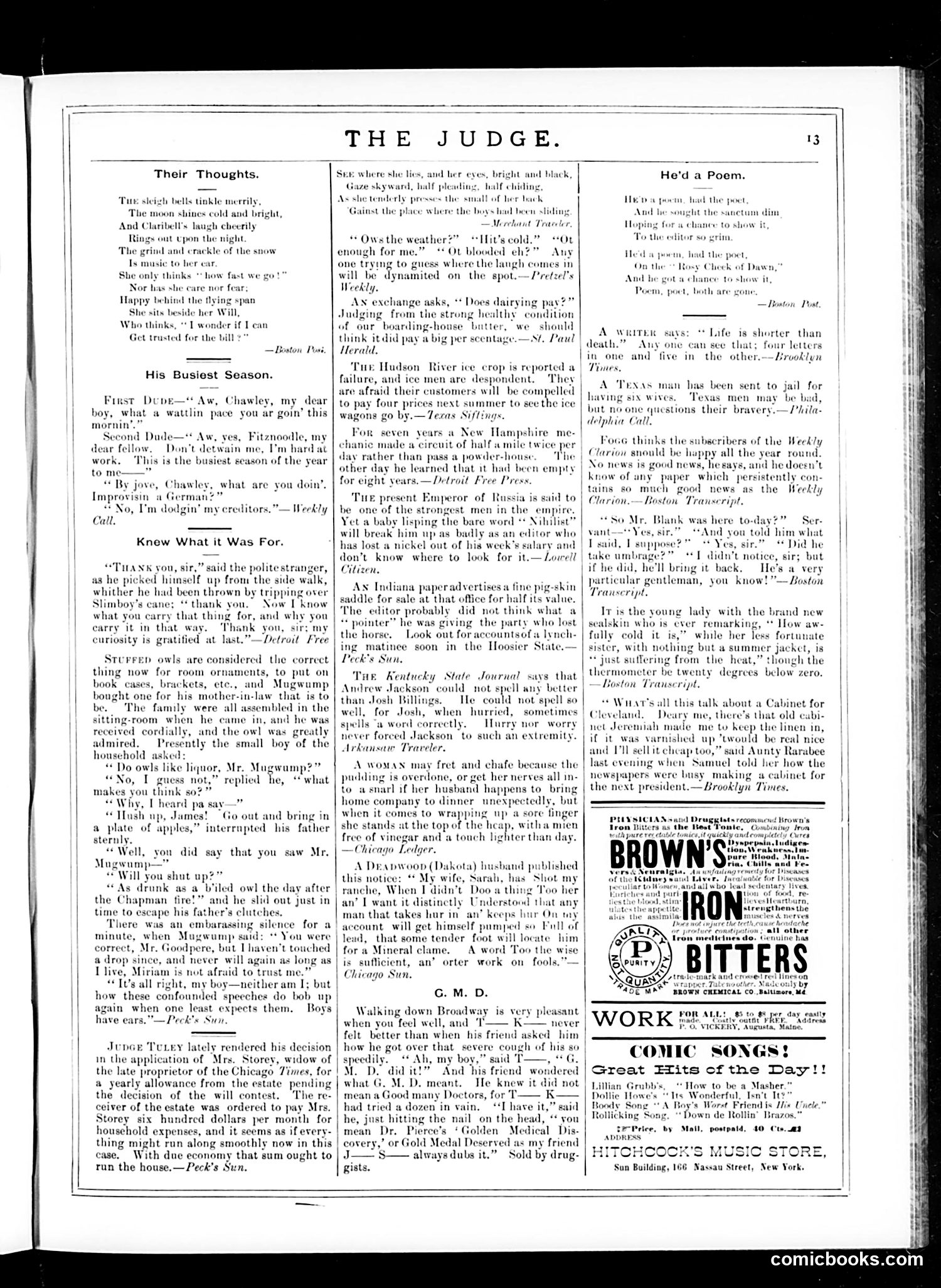
This page from *Judge* (a late 19th-century American satirical magazine) contains several short humorous pieces rather than a single large political cartoon. **"Their Thoughts"** contrasts a couple's romantic sleigh ride: she enjoys the moment while he worries about unpaid bills—satirizing male financial anxiety. **"His Busiest Season"** depicts fashionable young men ("Chawley," "Fitznoodle") claiming to be frantically busy during the social season, though one admits he's actually "dodgin' my creditors"—mocking wealthy idlers who feign importance. **"Knew What it Was For"** jokes about a man tripping over someone's cane, sarcastically thanking them because now he understands the cane's "purpose" is as a weapon/obstacle. **The Mugwump anecdote** involves a stuffed owl decoration. A boy, overhearing his father say the owl was "drunk as a boiled owl," asks if owls drink liquor—embarrassing the adults with innocent literalism. The humor targets both the phrase's vagueness and "Mugwump" reformers' pretentious speech. The remaining items are brief jokes about weather, dairying, and Russian strength—typical light social commentary.
This page consists primarily of **advertisements and humorous anecdotes** rather than political cartoons. The content includes short satirical jokes typical of 19th-century American humor magazines: - **Jokes about temperance** (whiskey prohibition debates) - **Irish stereotypes** (references to Ireland's lack of freedom) - **Marital humor** (wives criticizing husbands) - **Period-specific references** (book agents as disliked figures, catarrh remedies) The advertisements—for pianos, printing ink, physical culture schools, and patent medicines (notably catarrh cures and consumption treatments)—reflect contemporary concerns and commercial practices. **No identifiable political figures or caricatures appear.** The humor relies on universal social situations: spousal banter, failed business ventures, and everyday frustrations. The tone is lighthearted rather than pointed political satire, typical of Judge magazine's mix of advertising and miscellaneous comedic content during this era.
This is primarily an **advertising and promotional page** for *The Judge*, a satirical weekly comic magazine. The left side displays various 19th-century patent medicine and printing advertisements (Pond's Extract, magic lanterns, lithography services, pile cures), typical of the era. The right side promotes *The Judge* itself, emphasizing it as "clever," "witty," and "sarcastic"—targeting educated, affluent readers ("the cream of the purchasing classes"). The center column contains brief satirical quips on contemporary life: absurdities about editors' salaries, barbershop culture, women's life expectations (the "seven ages of woman" progression from desiring dresses to demanding divorces), and lawyer-client interactions. These are gentle social observations rather than hard political satire. **No specific political figures or events are caricatured**—this appears to be a title/advertisement page rather than the magazine's main editorial content. The satire is social and domestic rather than political.
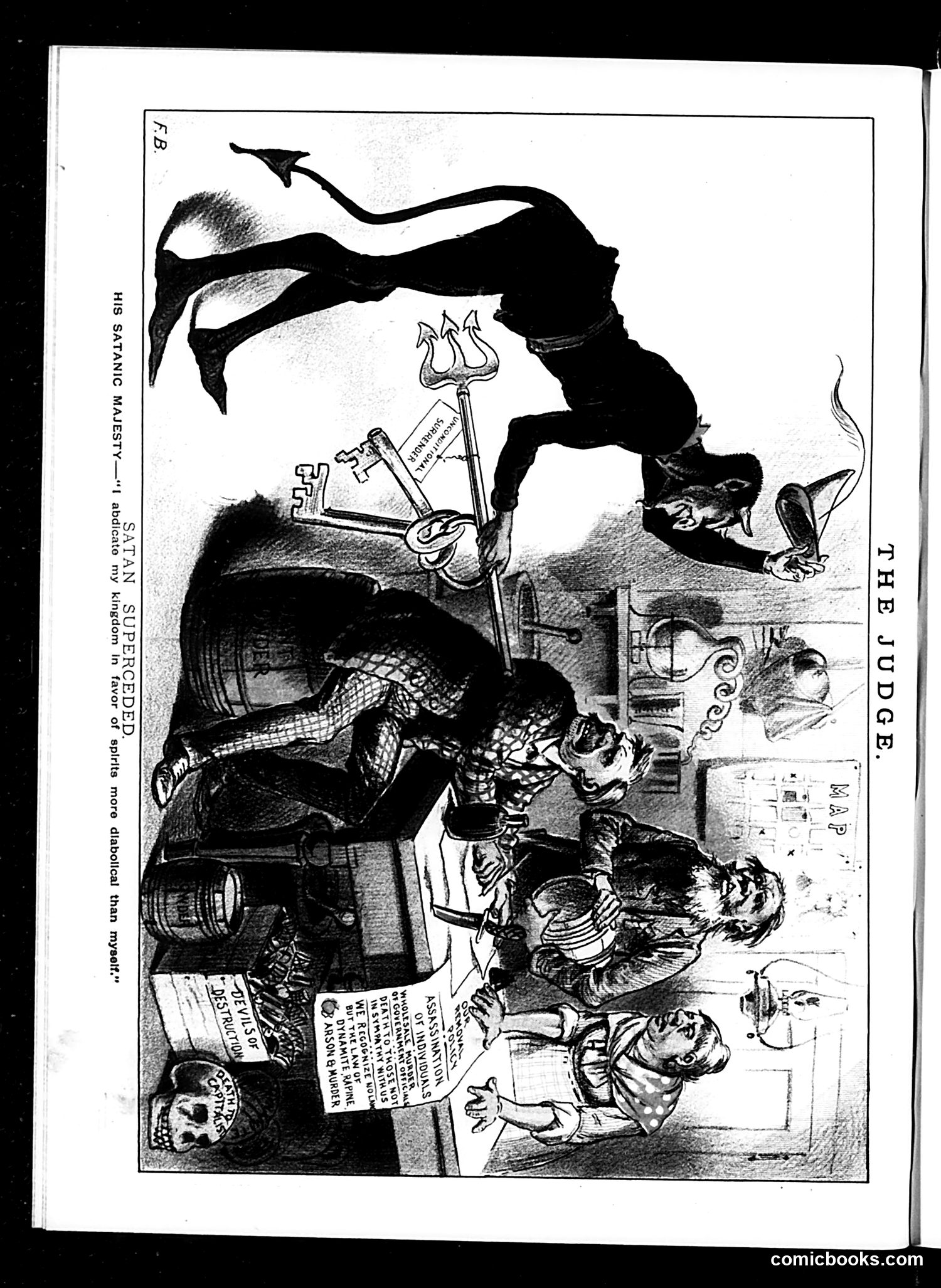
This cartoon satirizes modern American capitalism and corruption as surpassing even Satan himself. The central figure labeled "His Satanic Majesty" abdicates his throne, declaring he yields to "spirits more diabolical than myself." The figures surrounding him appear to represent various corrupt modern forces—likely industrialists, financiers, or politicians engaged in vice and exploitation. The imagery suggests that contemporary greed, fraud, and moral decay have become so extreme they've eclipsed traditional evil. The satire's point: early 20th-century American society had become so corrupted by unchecked business practices and political malfeasance that it rivaled hell itself in depravity. Satan himself would resign in defeat before such human-generated wickedness. This reflects Judge magazine's frequent critique of monopolies, labor abuses, and governmental corruption of the era.