
Judge, 1885-02-21 · page 2 of 16
Judge — February 21, 1885 — page 2: what you’re looking at
What you’re looking at
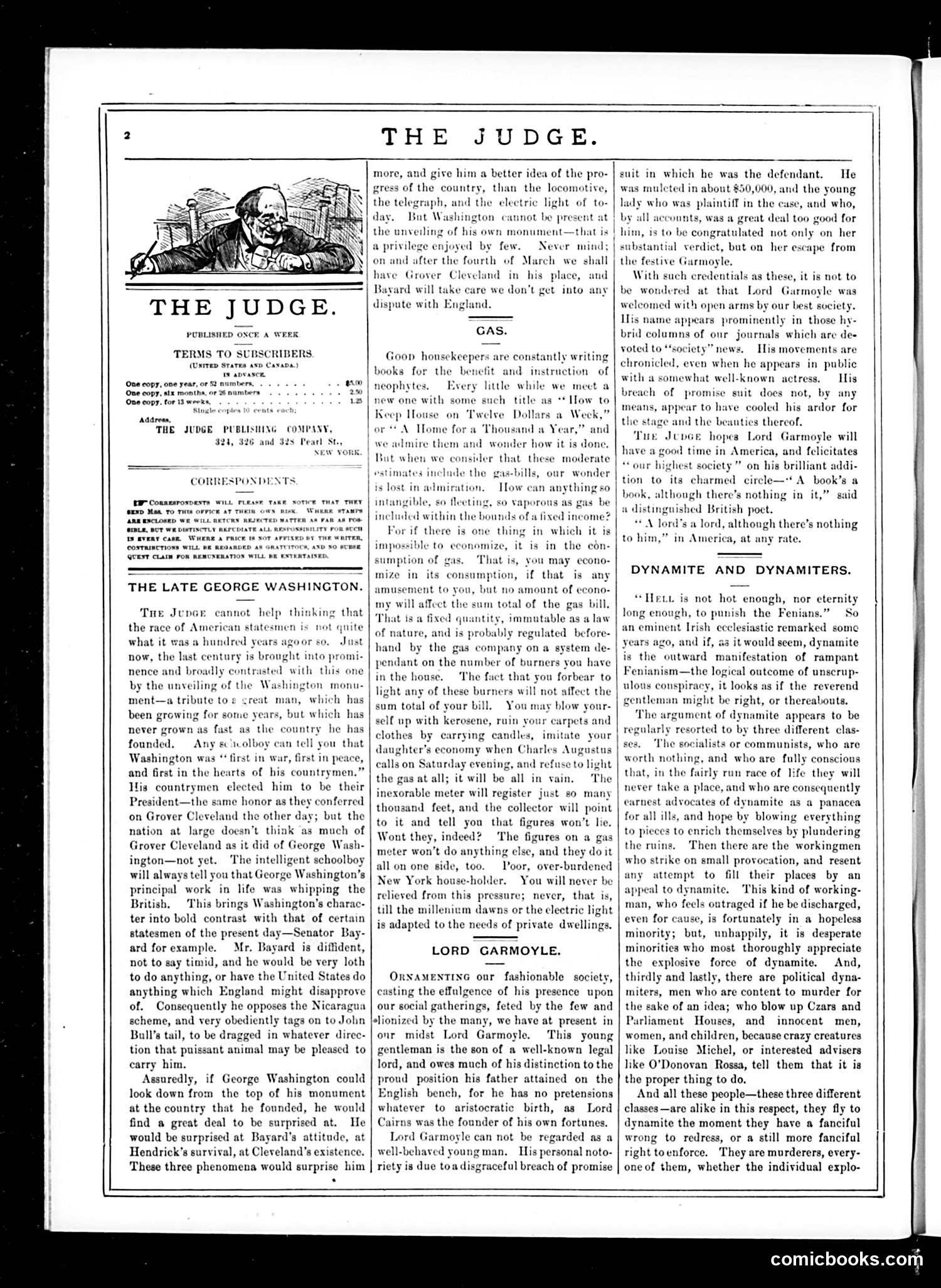
This page contains social/political commentary typical of Judge's satirical approach. The main pieces are: **"The Late George Washington"** criticizes Senator Thomas F. Bayard for his deferential stance toward Britain, contrasting him unfavorably with George Washington's assertive leadership. The article suggests Bayard's timidity represents a decline in American statesmanship compared to the founding generation. It implies concern that with Grover Cleveland's upcoming presidency and Bayard's influence, America will meekly follow British interests rather than assert independence. **"Gas"** is a humorous satire on household economy books that promise to teach women how to live cheaply. The joke: gas bills are fixed costs that cannot be economized—no matter what tricks housekeepers employ (using candles, limiting burners), the gas company's bill remains constant and unavoidable. It mocks the futility of these budget guides when facing inescapable utilities. Both pieces reflect late-19th-century concerns: American diplomatic weakness and the frustrations of household management in the gas-lit era.
📄 Transcribed text from this page (OCR, searchable)
Machine-transcribed from the original scan — historical spelling and the odd misread are preserved.
THE JUDGE. THE JUDGE. TERMS TO (Ustrep States axp Casaba.) asce One copy, one year, One copy, alx months One copy. for 13 wee! Sing Addreas, THE JUDGE PUBLISHING COMPANY, 324, and 323 Pearl Sty NEW YORK. CORRESPONDENTS far Conazsrorpests WiLL PLES euxp Maa To Tus o¥rice AT THEIR ARE ESCLOMED WHE WILL RETCRY RIZECTE: — DURTINCTLY REFUCDIATE ALL RESTON WH AVERY Case, WHERE 4 PRICE APPILED BY THE WRITER, CONTRINCTIONS WILL so aces QUEST CLAD FOR REI THE LATE GEORGE WASHINGTON. Tue Jvupce cannot help thinking that the race of American statesmer not what it was now, the last century is brought into promi- nence and broadly contrasted with this one by the unveiling of th ment—a tribute to creat been growing never grown as fast founded, An Washington was ‘first in war, first in peace, and first in the hearts of his countrymen.” Ifis countrymen elected him to be their President—the same honor as they conferred on Grover Cleveland the other day; but the nation at large doesn’t think ‘as much of Grover Cleveland as it did of George Wash- ington—not yet. ‘The intelligent schoolboy will always tell you that George Washington’s principal work in life was whipping the British, This brings Washington’s charac- ter into bold contrast with that of certain statesmen of the present day—Senator Bay- ard forexample. Mr, Bayard is diffident, not to say timid, and he would be very loth to do anything, or have the United States do anything which England might disapprove of. Consequently he opposes the Nicaragua scheme, and very obediently tags on to John Bull’s tail, to be dragged in whatever direc- tion that puissant animal may be pleased to carry him. Assuredly, if George Washington could look down from the top of his monument at the country that he founded, he would find a great deal to be surprised at. He would be surprised at Bayard’s attitude, at Hendrick’s survival, at Cleveland’s existence. quite hundred years agoor so, Just Washington: monu- man, which has for some years, but which | 3 the country he has y sceolboy can tell you that more, and give him a better idea of the pro- gress of the country, than the locomotive, the telegraph, and the electric light of to- ye But Washington cannot be present at the unveili of his own monument—that is a privilege enjoyed by few. Never mind; on and after the fourth of March we shall have Grover Cleveland in his place, and | Bayard will take care we don't get into any dispute with England. GAS. Goop housekeepers are constantly writing books for the of neophytes. little while we meet a ch title as ** Tow to Keep House on Twelve Dollars a Week,” \ Home for a Thousand a Year,” and them and wonder how it is done, benefit and instruction Every new one with some admi it when we consider that these moderate mates include the gas-bills, our wonder is lost in admiration. How can anything so intangible, so fleeting, so vaporons as gas be included within the bounds of a fixed income? nit is the con- For if there is one thing in wh itis in That is, you may mize in its if that is any amusement to you, but no amount of econo- my will affect the sum total of the gas bill. That is a fixed quantity, of hand by the gas company on a sj dant on the number of burners you have The fact that light any of these burners will not affect the sum total of your bill. You may blow your- self up with kerosene, ruin yo impos to economize, sumption of gas. econo- consumption, ature, and is probably pei in the house. ou forbear to carpets and clothes by carrying candles, imit daughter’s economy when Charles A calls on Saturday evening, and refuse to light the gas at all; it will be all in vain. The inexorable meter will register just so many thousand feet, and the collector will point to it and tell you that figures won’t lie. Wont they, indeed? he figures on a gas meter won’t do anything else, and they doit all on one side, too. Poor, over-burdened New York ho holder. You will never be relieved from this pressure; never, that is, till the millenium dawns or the electric light is adapted to the needs of private dwellings gustus LORD GARMOYLE. ORNAMENTING our fashionable society, ing the effulgence of his presence upon our social gatherings, feted by the few and lionized by the many, we have at present in onr midst Lord Garmosle. This young gentleman is the son of a well-known legal lord, and owes much of his distinction to the proud position his father attained on the English bench, for he has no pretensions whatever to birth, as Lord Cairns was the founder of his own fortunes. Lord Garmoyle can not be regarded as a well-behaved young man. His personal noto- riety is due toa disgraceful breach of promise aristocratic | is the outward manif your | | the ruins. euit in which he the defendant. was mulcted in about $50,000, He and the young y who was plaintiff in the c by all accounts, w ngratulated not only on her rdict, but on her escape from lac , and who, deal too good for him, is to be substantial the festive Garmoyle. With such credentials as these, it is not to be wondered at that Lord Garmoyle was welcomed with open arms by our best society. prominently in those hy- brid columns of our journals which are de- His name appears voted to “society” ne His movements are chronicled, even when he appears in public with a His breach of promise suit docs not, by any means, appear to have cooled his ardor for the » and the beauties thereof. Tux Jevee hopes Lord Garmoyle will have a good time in America, and felicitates our highest society” on his brilliant addi- tion to its charmed circle—** A book’s a book, although there’s nothing in it,” said a distinguished British poet. \ lord’s a lord, although there’s nothing to him,” in America, at any r: somewhat well-known actress. DYNAMITE AND DYNAMITERS. “Het is not hot enongh, nor eternity long enough, to punish the Fenians.” So an eminent Irish ecclesiastic remarked some go, and if, a3 it would seem, dynamite tation of rampant outcome of unscrup- -y, it looks as if the reverend gentleman might be right, or thereabouts. The argument of dynamite appears to be regularly resorted to by three different clas- ‘The socialists or communists, who are years Fenianism—the logic ulous conspin: worth nothing, and who are fully conscious that, in the fairly run race of life they will never take uently earnes nacea for all ills, and hope by blowing everything to pieces to enrich themselves by plundering Then there are the workingmen who strike on small provocation, and resent any attempt to fill their places by an appeal to dynamite. ‘This kind of working- man, who feels outraged if he be discharged, even for cause, is fortunately in a hopeless minority; but, unhappily, it is desperate minorities who most thoroughly appreciate the explosive force of dynamite. And, thirdly and lastly, there are political dyna- miters, men who are content to murder for the sake of an idea; who blow up Czars and Parliament Houses, and innocent men, women, and children, because crazy creatures like Louise Michel, or interested advisers like O'Donovan Rossa, tell them that it is the proper thing to do. And all these people—these three different classes—are alike in this respect, they fly to dynamite the moment they have a fanciful wrong to redress, or a still more fanciful right toenforce. ‘They are murderers, every- oneof them, whether the individual explo- a place, and who are cot vocates of dynamite p These three phenomena would surprise him | ome a | comicbooks.com