
A complete issue · 16 pages · 1884
Judge — November 1, 1884
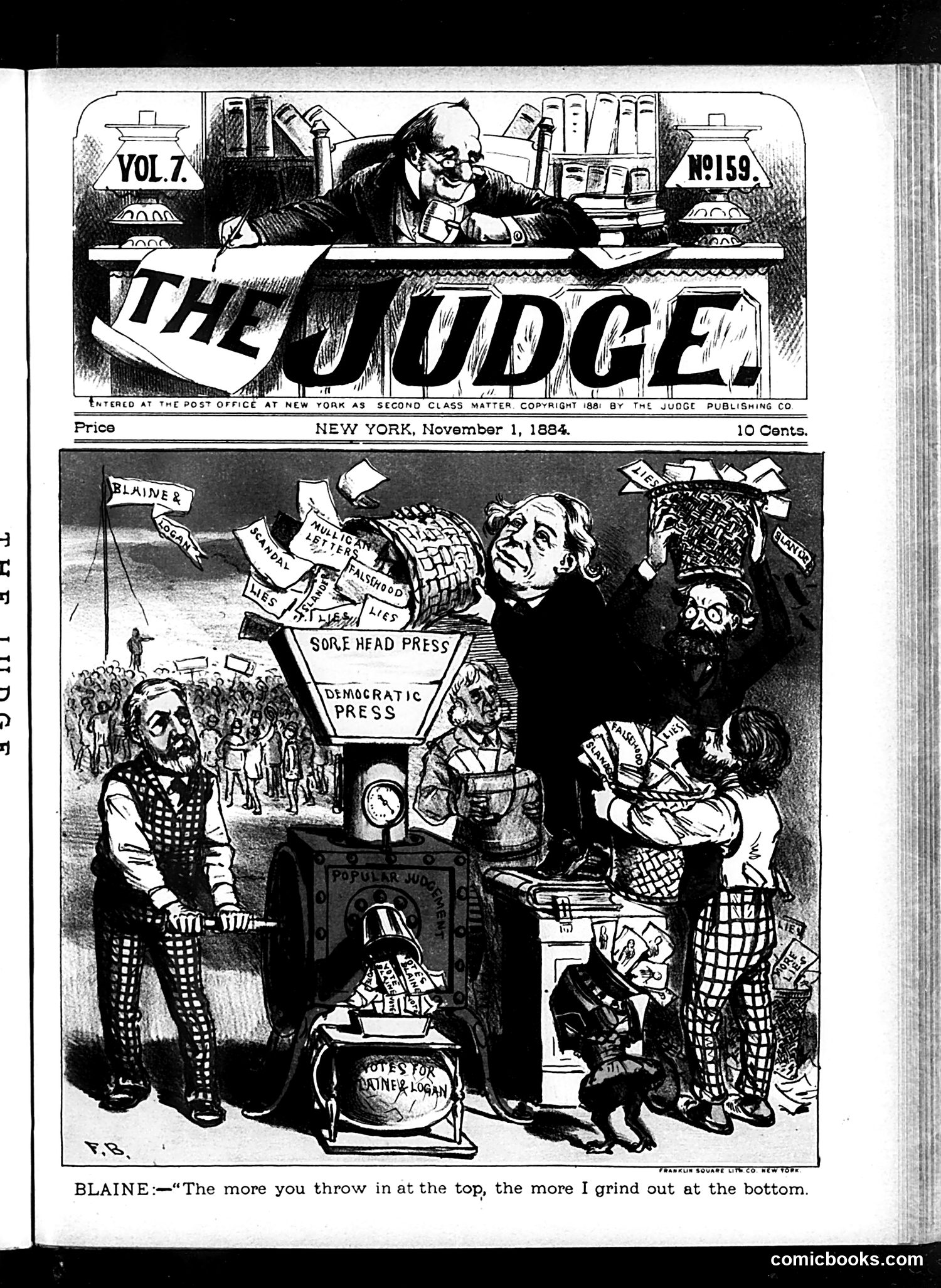
This cartoon satirizes James G. Blaine's 1884 presidential campaign. The central machine labeled "Sore Head Press" and "Democratic Press" depicts Blaine as a grinder processing various scandals and criticisms into political output. The caption—"The more you throw in at the top, the more I grind out at the bottom"—suggests Blaine cynically converts negative press and accusations into political advantage. The figures feeding materials into the machine appear to represent different press outlets and political interests. The crowd in the background likely represents the voting public. This cartoon critiques both Blaine's perceived opportunism and the press's role in amplifying political discord during a contentious election year.
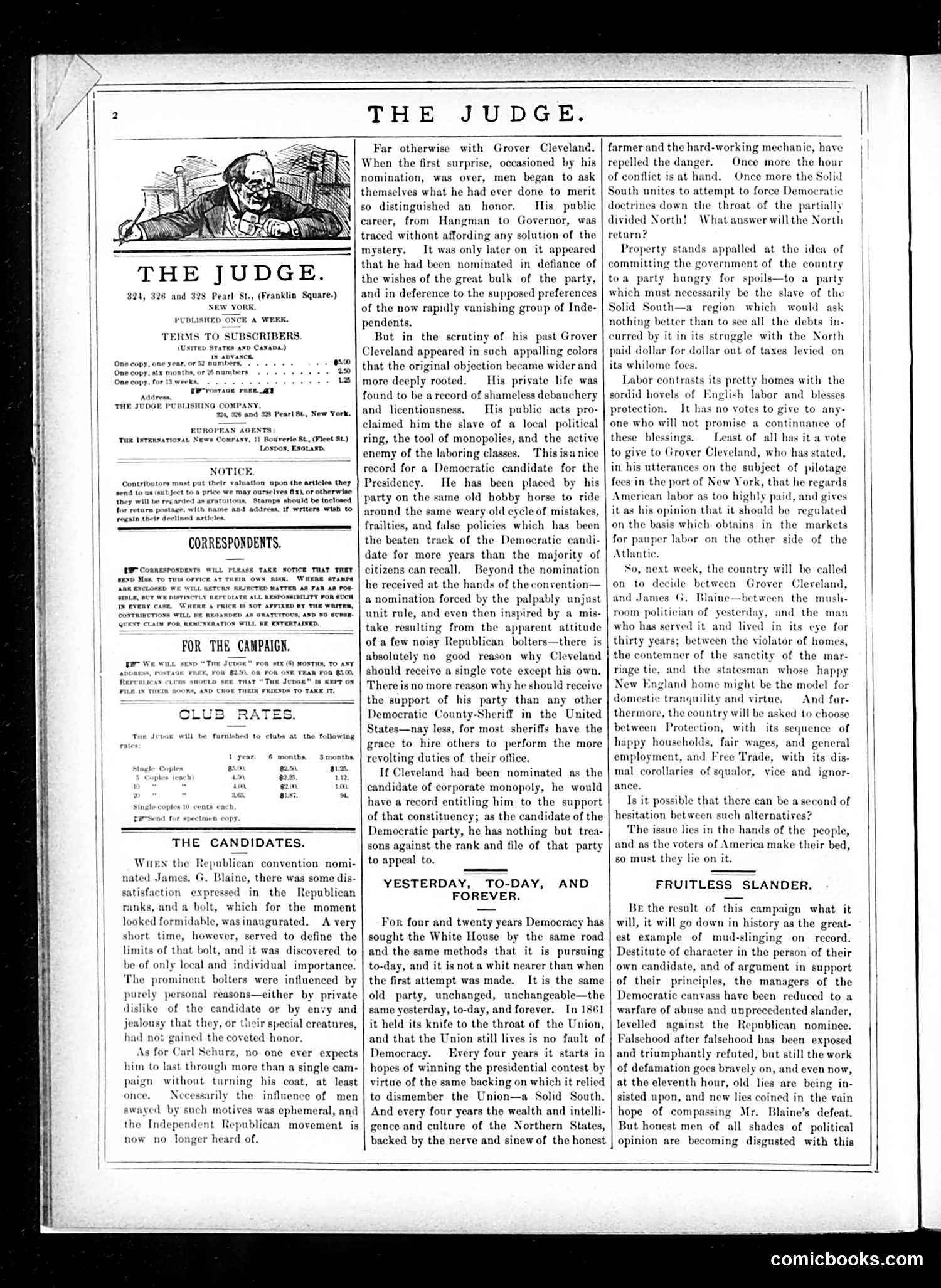
This page attacks Democratic presidential nominee **Grover Cleveland**, contrasting him unfavorably with Republican James G. Blaine. The accompanying text argues that while Blaine's 1884 bolt (party defection) proved ephemeral and based on personal grievance, Cleveland's opposition runs deeper. The satire's central claim: Cleveland deserves no support beyond his own vote. The article alleges his nomination defied party wishes, serving only "Independents" (reform Republicans). More damaging, it charges his private life shows "shameless debauchery and licentiousness," while his public record proves him a tool of local political machines and monopolies—hostile to labor. The irony: Cleveland's Democratic nomination rests solely on the "unit rule" (convention voting mechanism), not genuine party support. The piece concludes he's no better qualified than any county sheriff, yet represents the party's "beaten track" of failed policies. The cartoon's illustration (top left) depicts someone in apparent distress or exhaustion—likely representing Democratic candidates trapped in repetitive cycles of defeat.
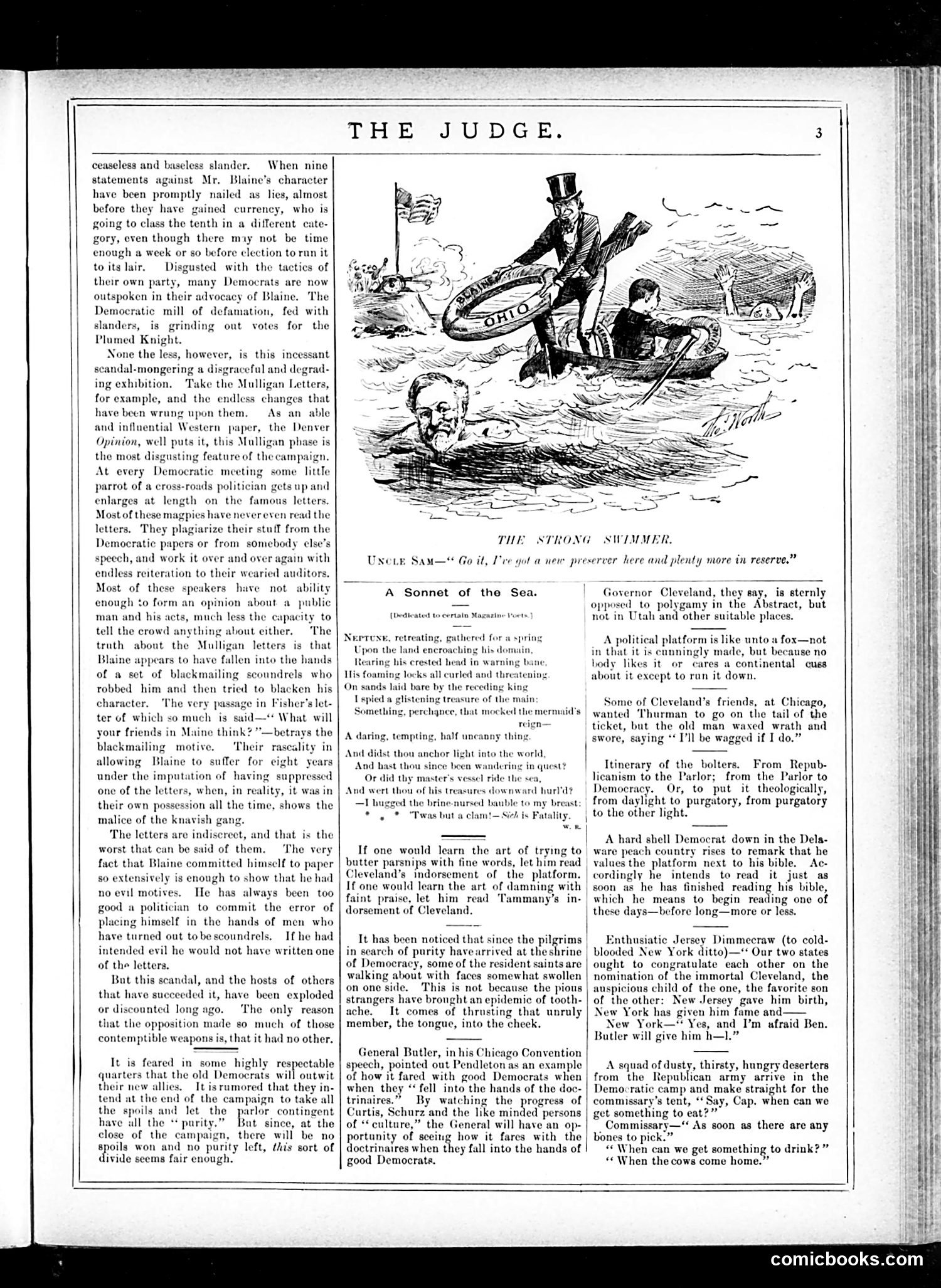
This page attacks Democratic campaign tactics, particularly the repeated use of the "Mulligan Letters"—damaging correspondence involving Republican James G. Blaine (the "Plumed Knight"). **The Main Argument:** The editorial argues Democrats have endlessly recycled nine debunked accusations against Blaine, making a tenth claim untrustworthy. It contends the Mulligan Letters—which actually revealed blackmail schemes *against* Blaine—have been distorted and repeated by Democratic speakers who haven't even read them. **"The Strong Swimmer" Cartoon:** Shows Uncle Sam rescuing Ohio from drowning, labeled as a "new preserver" in reserve—likely referencing Ohio's importance in the 1884 presidential election. **Context:** This defends Blaine (Republican) against Cleveland (Democratic nominee) by portraying Democratic attacks as hypocritical scandal-mongering. The magazine advocates for Blaine despite acknowledging his indiscreet letters showed poor judgment—his real sin was trusting scoundrels, not evil intent.
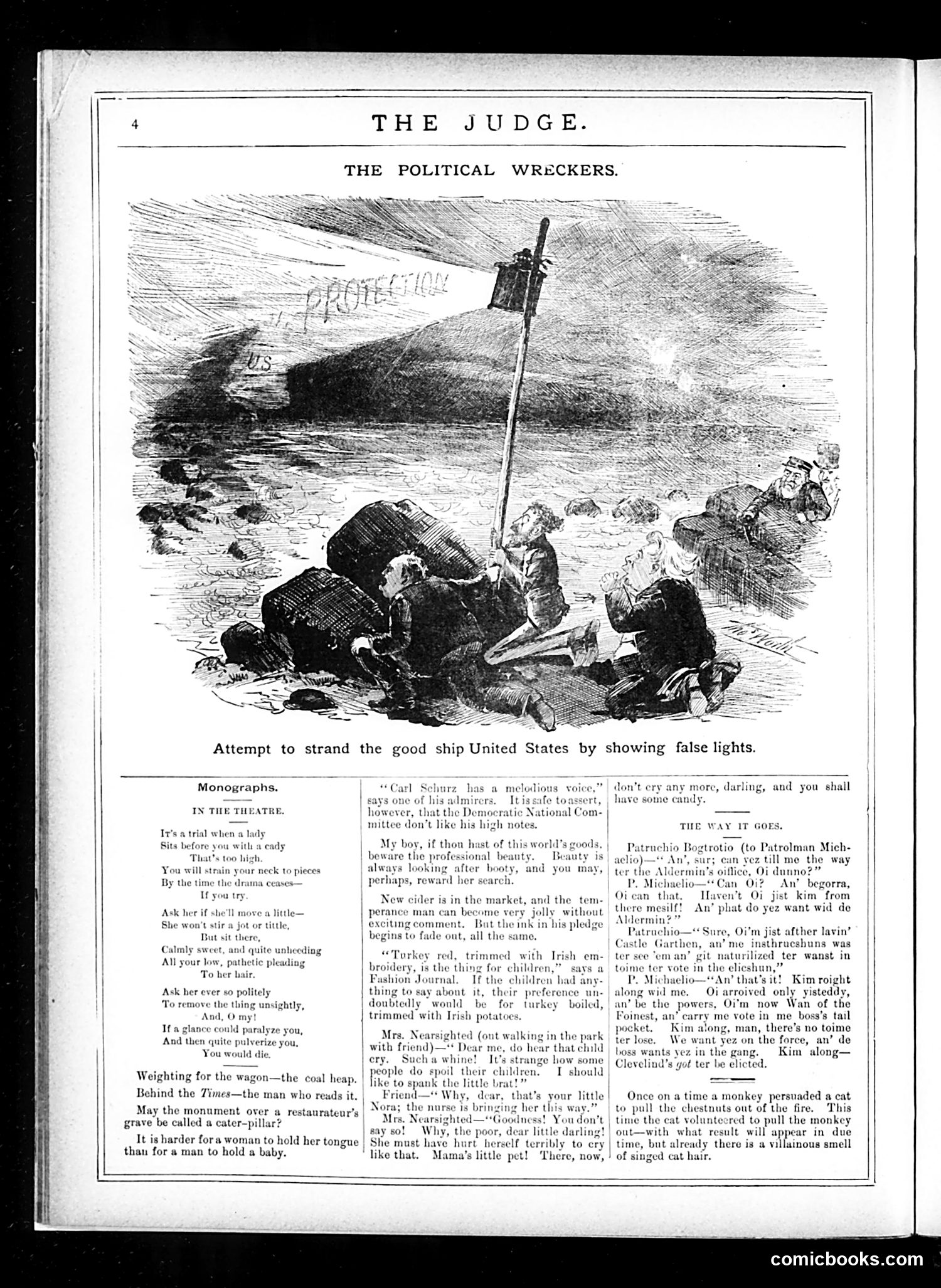
This political cartoon depicts figures attempting to wreck the "good ship United States" by displaying false lights—a metaphor for deceptive political practices. The shipwreck imagery suggests sabotage of the nation. The cartoon likely critiques Democratic politicians or operatives engaged in dishonest tactics to mislead the American public. The "false lights" reference alludes to historical wreckers who lured ships onto rocks using deceptive signals for profit—here applied to political deception. The accompanying text includes satirical commentary on Democratic practices, with particular criticism of political figures using misleading rhetoric and empty promises. However, without clearer identification of the specific figures depicted or the exact historical moment, the precise political targets remain unclear, though the broad message condemns political dishonesty and sabotage.
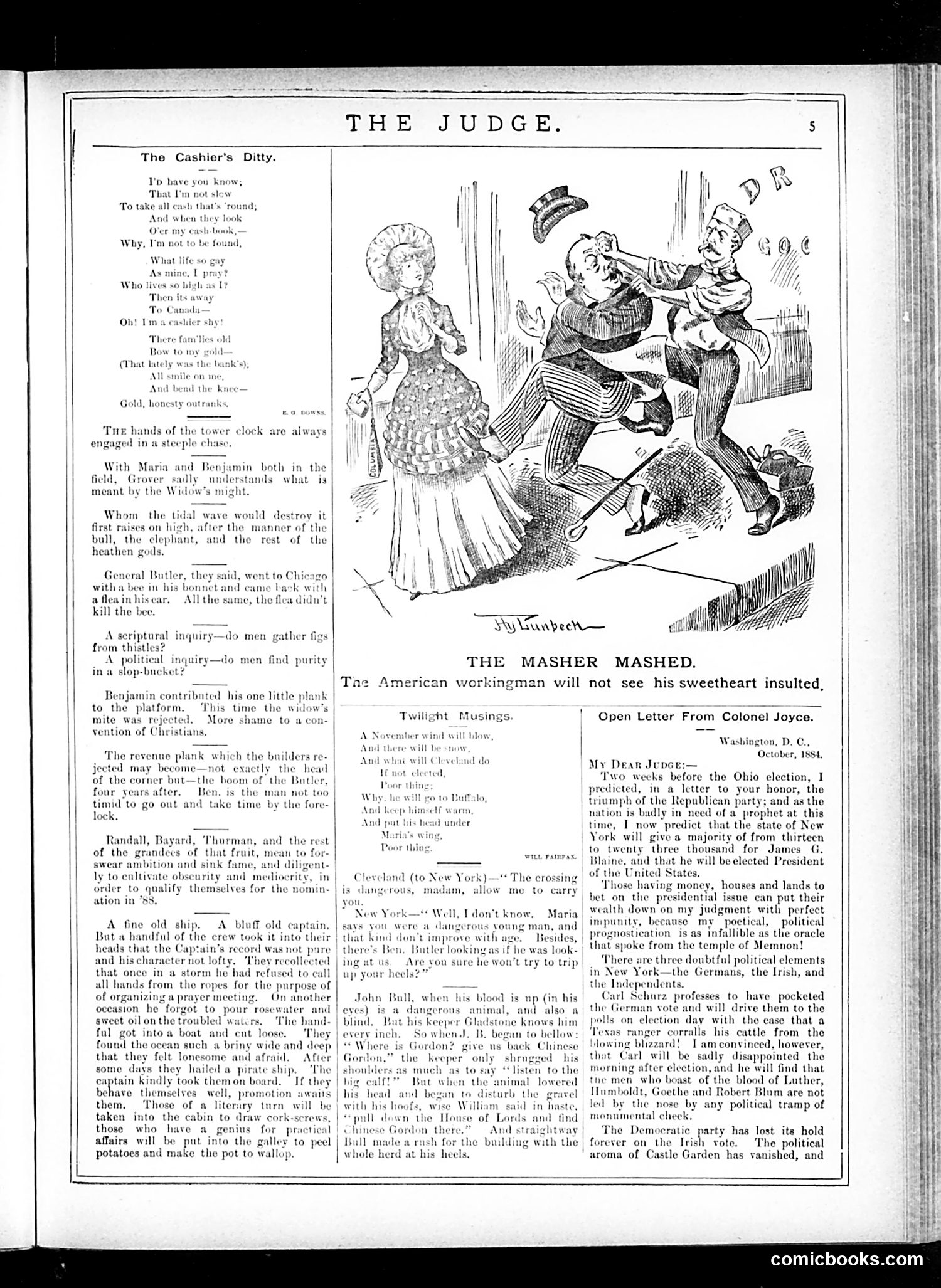
This page satirizes the 1884 U.S. presidential election. The main cartoon depicts a woman forcefully rejecting two men's advances—likely representing Cleveland and Blaine, the competing candidates. The caption warns that "the American workingman will not see his sweetheart insulted," suggesting voters will reject a candidate perceived as disrespectful to working-class dignity. The "Open Letter From Colonel Joyce" predicts Republican James G. Blaine will win New York by 13,000-23,000 votes and become president. It also references political divisions among New York voters, particularly German immigrants and Independents. The scattered prose pieces mock political figures (Grover Cleveland, Benjamin Butler) and contemporary events, including a British reference to General Gordon in China. The humor relies on election-year anxiety and candidate criticism typical of 1884 partisan journalism.
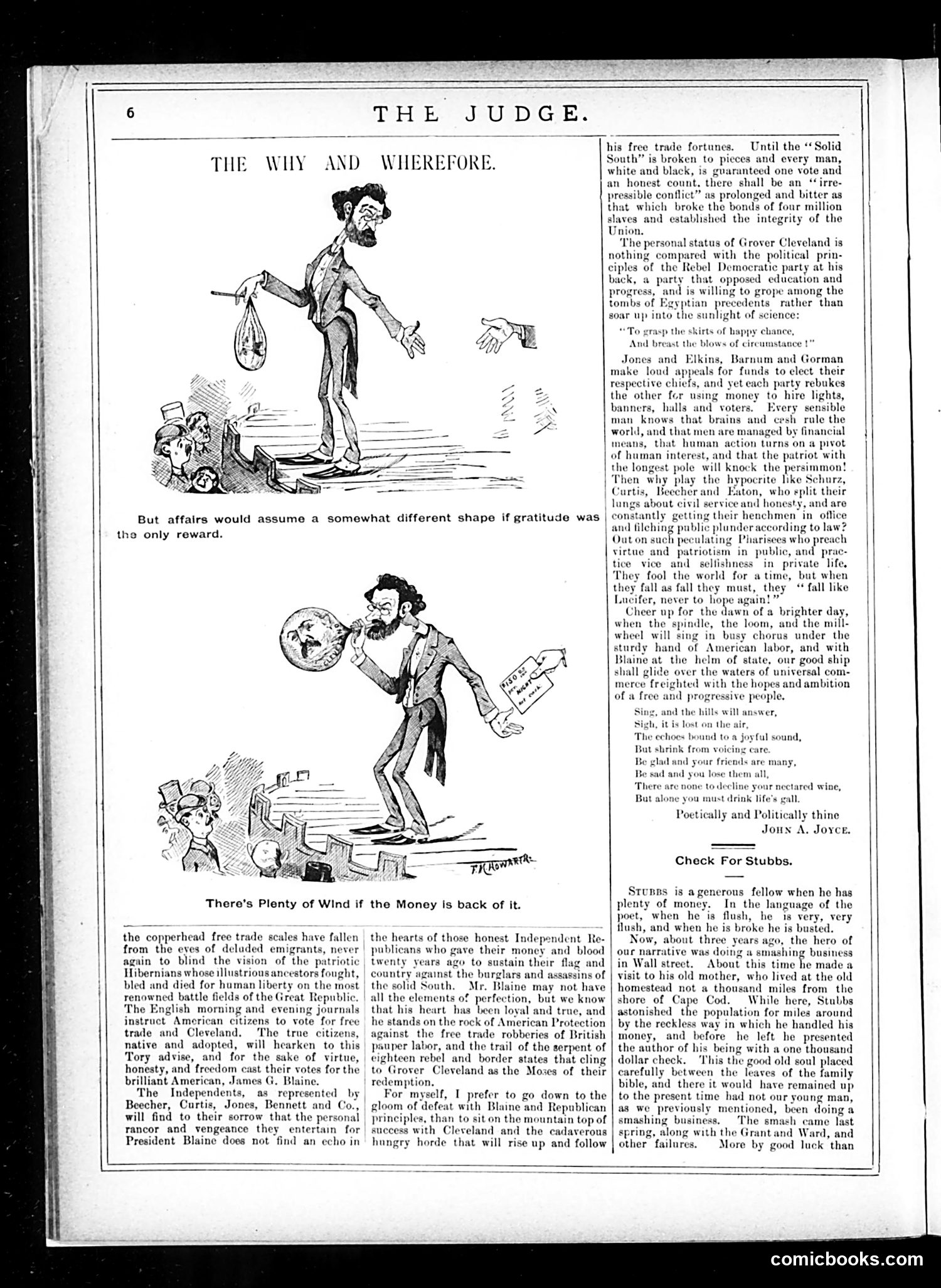
This 1884 campaign material attacks supporters of Democrat Grover Cleveland while promoting Republican James G. Blaine. The cartoons depict Cleveland as a juggler/con artist manipulating voters and resources—satirizing his campaign's use of money and rhetoric despite claims of virtue. The text criticizes "Independents" (reform Republicans like Henry Ward Beecher and E.L. Godkin) who oppose Blaine on personal/ethical grounds, calling them hypocrites who practice the same patronage politics they publicly condemn. The author argues that voting against Blaine means aligning with the "Solid South"—the Democratic South's racist opposition to Reconstruction and protection of former Confederate interests. The piece defends Blaine's commitment to American protectionism (tariffs) against free trade, framing this as patriotic. It presents the choice as moral: loyalty to Republican principles and American labor versus Democratic sympathy to Southern rebels and British commercial interests.
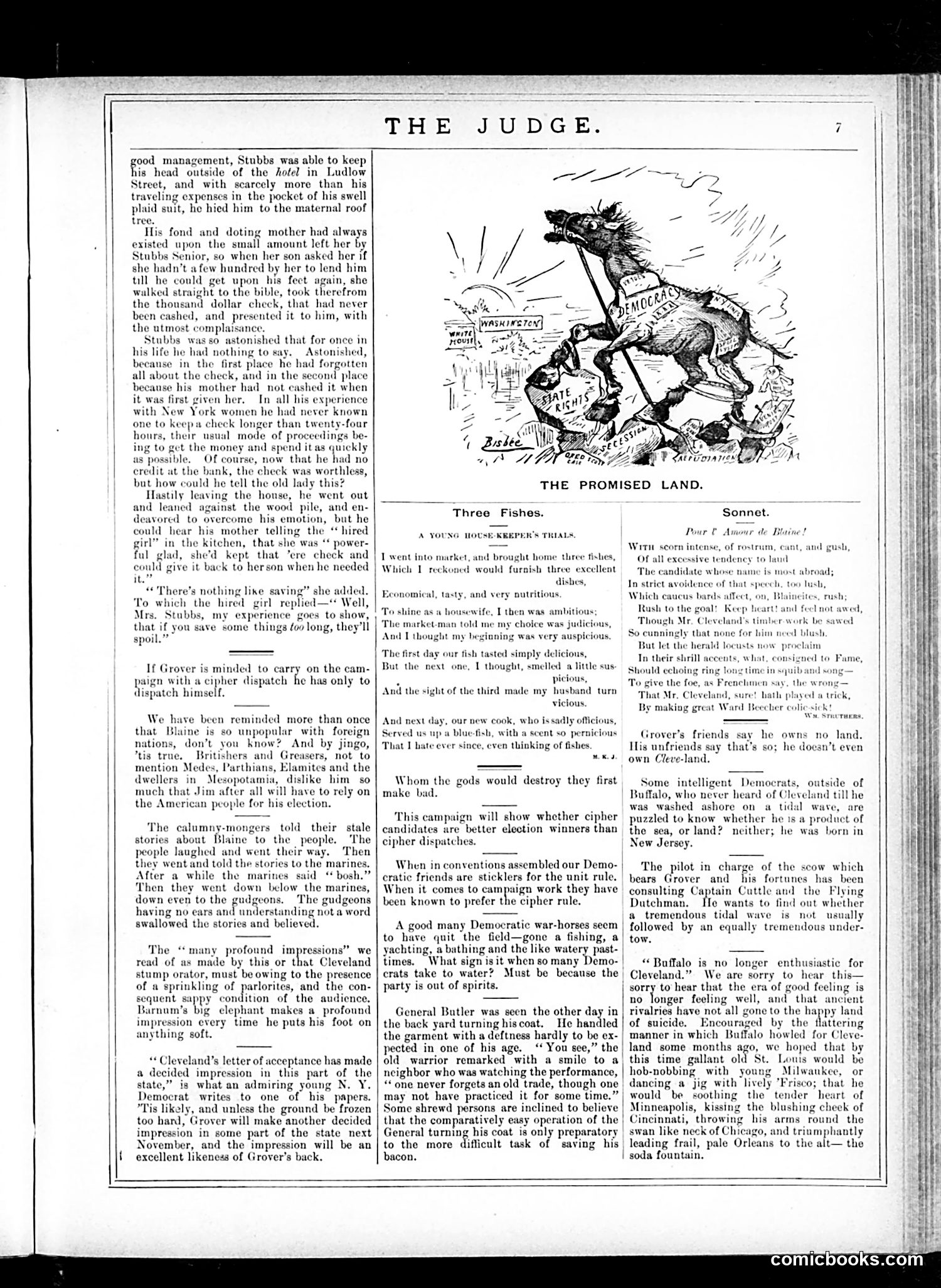
This page contains **political satire about the 1884 presidential election** between James G. Blaine (Republican) and Grover Cleveland (Democrat). The main cartoon, titled "The Promised Land," depicts a donkey (representing the Democratic Party) struggling amid labeled obstacles including "State Debts," "Whiskey Ring," and other corruption issues. The satire mocks Democratic claims that their leadership would solve America's problems. The accompanying text attacks both candidates: it ridicules Blaine's alleged unpopularity with foreign nations, suggesting he must rely entirely on American voters. It also mocks Cleveland and Democratic "stump orators," comparing their rhetorical impact to "Barnum's big elephant" making impressions in soft ground—a crude joke about their ineffectiveness and empty promises. The satire suggests neither candidate offers genuine solutions; instead, voters face empty rhetoric masquerading as leadership. The "Promised Land" title ironically suggests Democratic promises of reform are illusory.
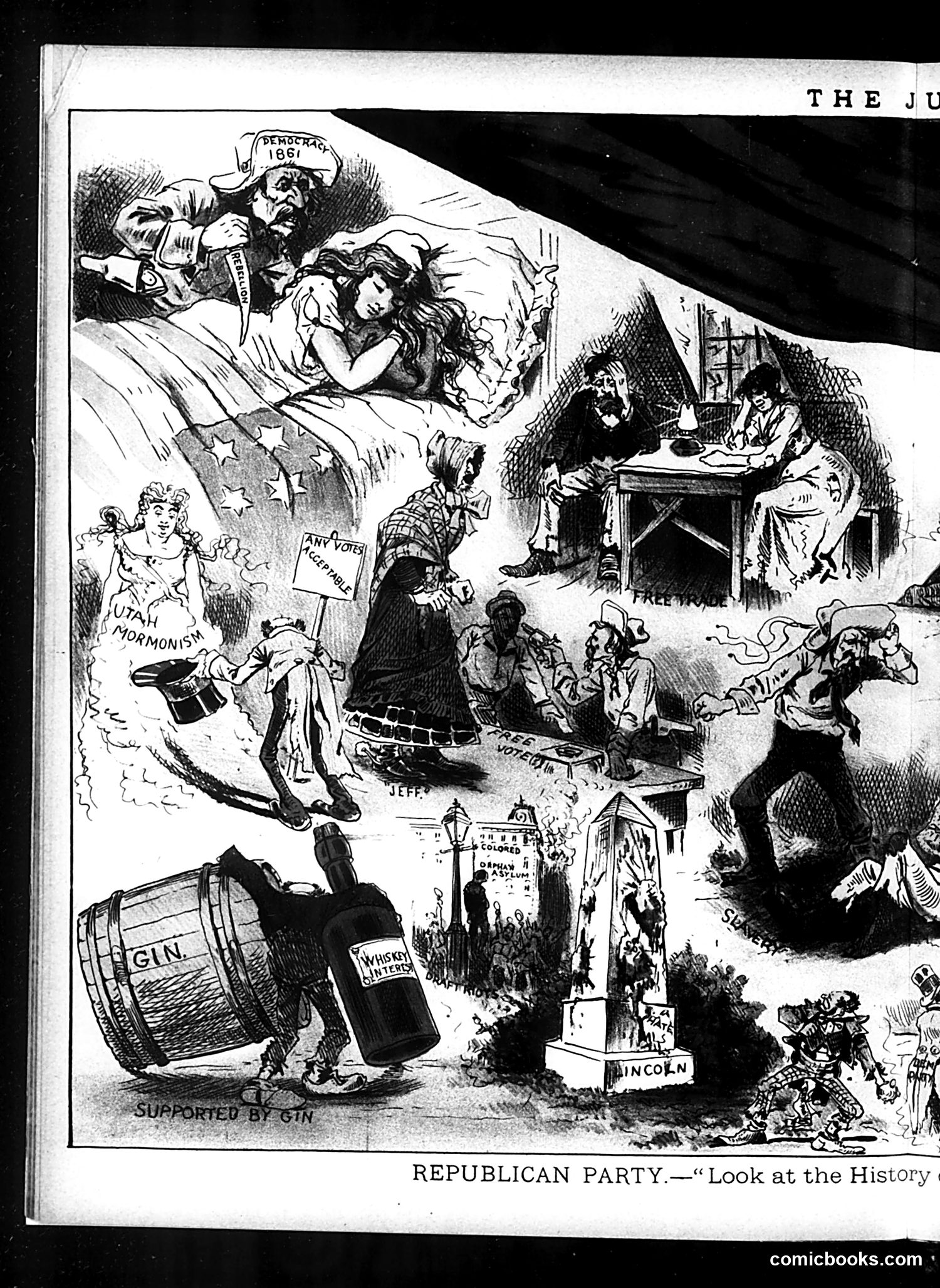
This is a satirical cartoon titled "Republican Party—'Look at the History...'" critiquing Republican political history and associations. The image depicts various scenes with labels including "Democracy 1861," "Mormonism," "Jeff" (likely Jefferson Davis, Confederate president), "Free Trade," "Whisky," and "Gin." A barrel labeled "Gin" is shown tipped over, "Supported by Gin." The cartoon appears to argue that the Republican Party's historical record is morally compromised—associating it with alcohol consumption, religious extremism (Mormonism), and Civil War-era division. The jumbled scenes suggest chaotic, disreputable foundations. The "supported by gin" phrase sarcastically implies the party relies on vice rather than principle. This reflects late 19th-century Democratic criticism of Republican credibility and moral authority.
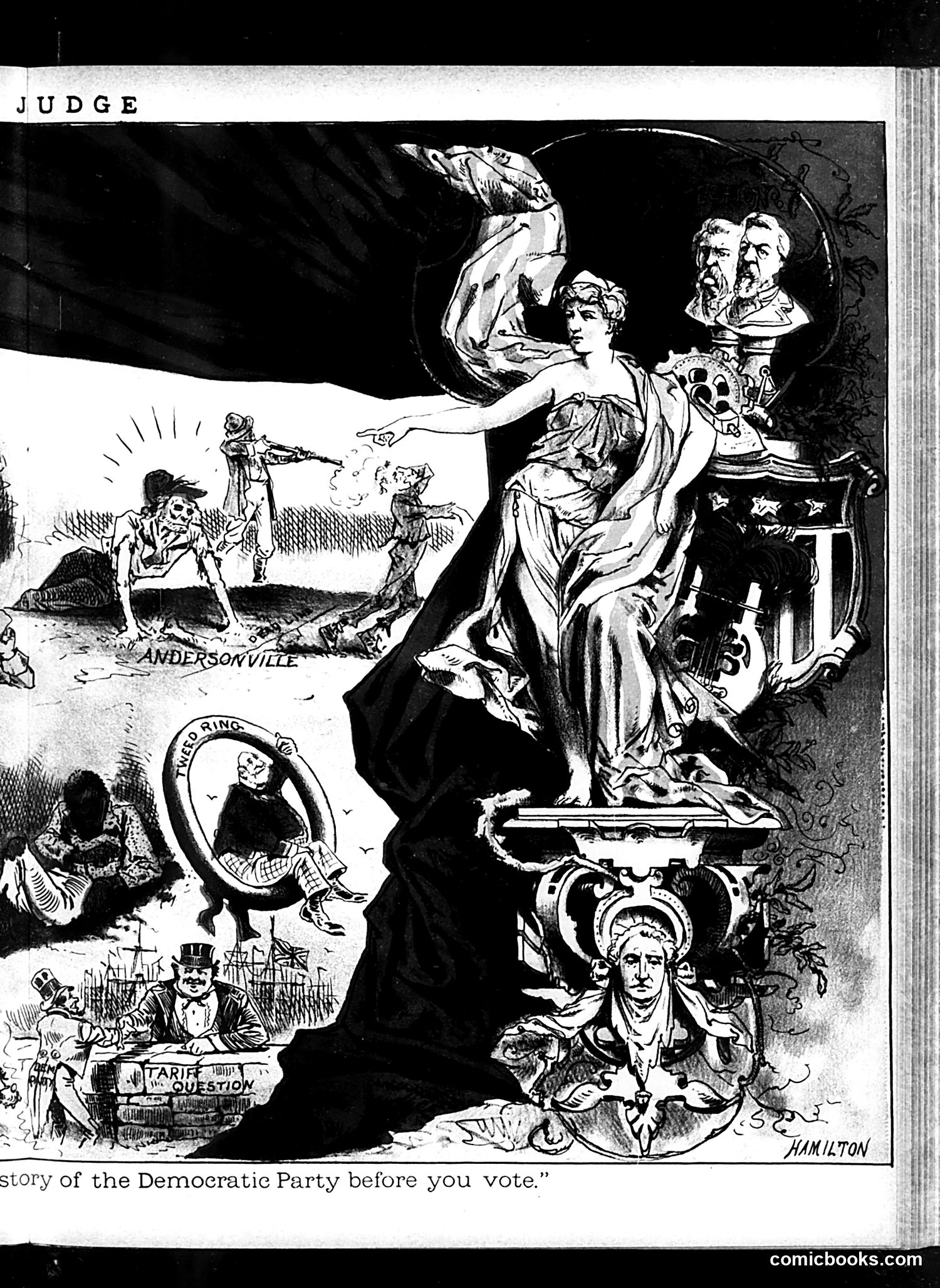
This political cartoon from *Judge* magazine uses allegorical imagery to critique the Democratic Party's history. Lady Justice (the central robed figure) gestures toward a series of scenes depicting Democratic Party actions, apparently inviting viewers to examine this history before voting. The left panel shows "Andersonville," likely referencing the Confederate prison camp—suggesting Democratic association with the Confederacy or Civil War era. Additional vignettes appear to show other controversial Democratic Party moments, including scenes labeled "Tariff Question." The cartoonist (Hamilton, per signature) employs this "look before you vote" framing to argue that Democratic history contains shameful episodes voters should consider. The tone is clearly Republican attack advertising, using historical incidents to delegitimize the opposition party.
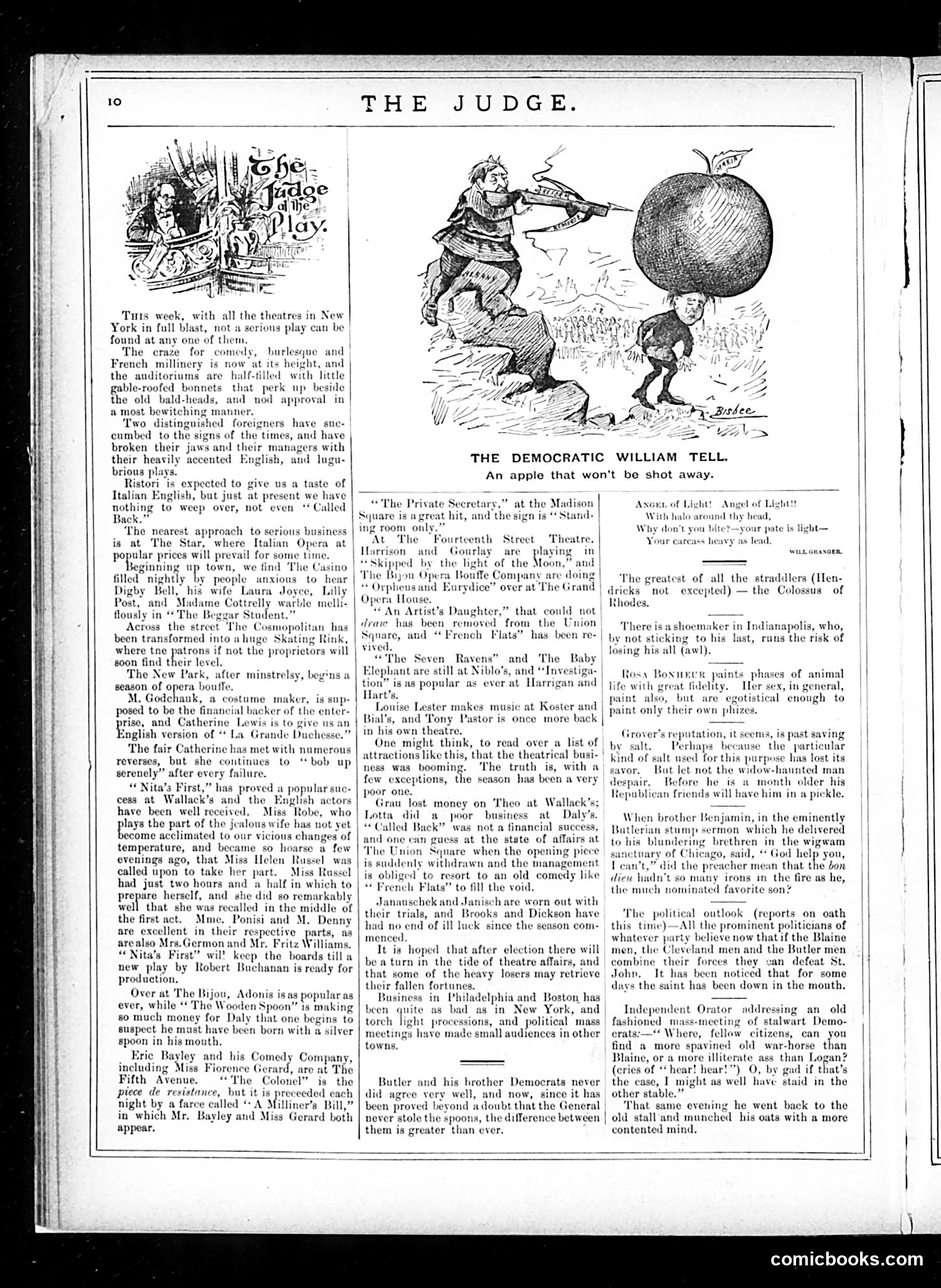
This page's main cartoon satirizes **William Tell**, the legendary Swiss freedom fighter, reimagined as a contemporary American Democrat. The figure attempts to shoot an apple off a smaller person's head using a rifle—a reference to the William Tell legend. The satire targets **Democratic political tactics and incompetence**. The caption "An apple that won't be shot away" suggests the Democrats are attempting something difficult or risky that will fail. The smaller figure below likely represents either a vulnerable constituent or a political rival. The surrounding theater column is unrelated—it discusses Broadway productions and performers of the era, mentioning Italian opera, comedies, and burlesque. This was typical Judge magazine content: mixing political satire with entertainment commentary. **Context**: This appears critical of Democratic leadership or strategy during the Gilded Age, though without the specific date visible, the exact political moment referenced remains unclear. The William Tell reference implies recklessness or dangerous miscalculation.
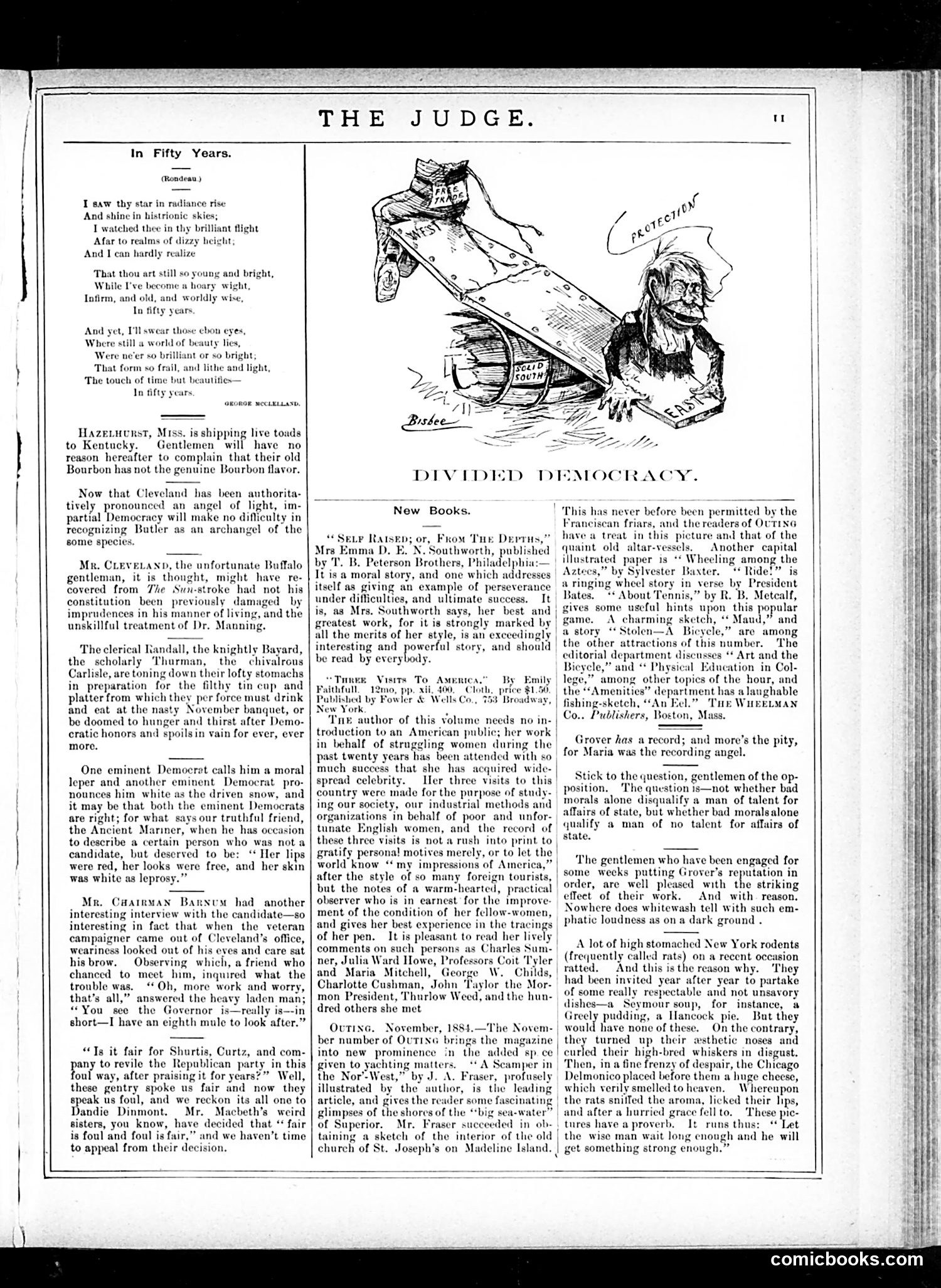
The central cartoon depicts a figure labeled "PROTECTION" struggling to balance a seesaw/plank. On one end sits a boot labeled "TRUST," suggesting the cartoon critiques how protective tariff policies favor monopolistic trusts over fair competition. The surrounding text mocks Democratic Party leadership during what appears to be the 1884 election period (references to Cleveland). The satire suggests Democrats are hypocritical: one prominent Democrat calls Cleveland "a moral leper" while another calls him "white as the driven snow"—the cartoon title "Divided Democracy" captures this internal contradiction. The piece also ridicules Democratic candidates (Randall, Bayard, Thurman, Carlisle) as elitist figures forced to humble themselves for party support, and suggests P.T. Barnum's involvement in campaigning has become exhausting work. The overall message: the Democratic Party is fractured and inconsistent in its principles, particularly regarding economic policy and candidate support.
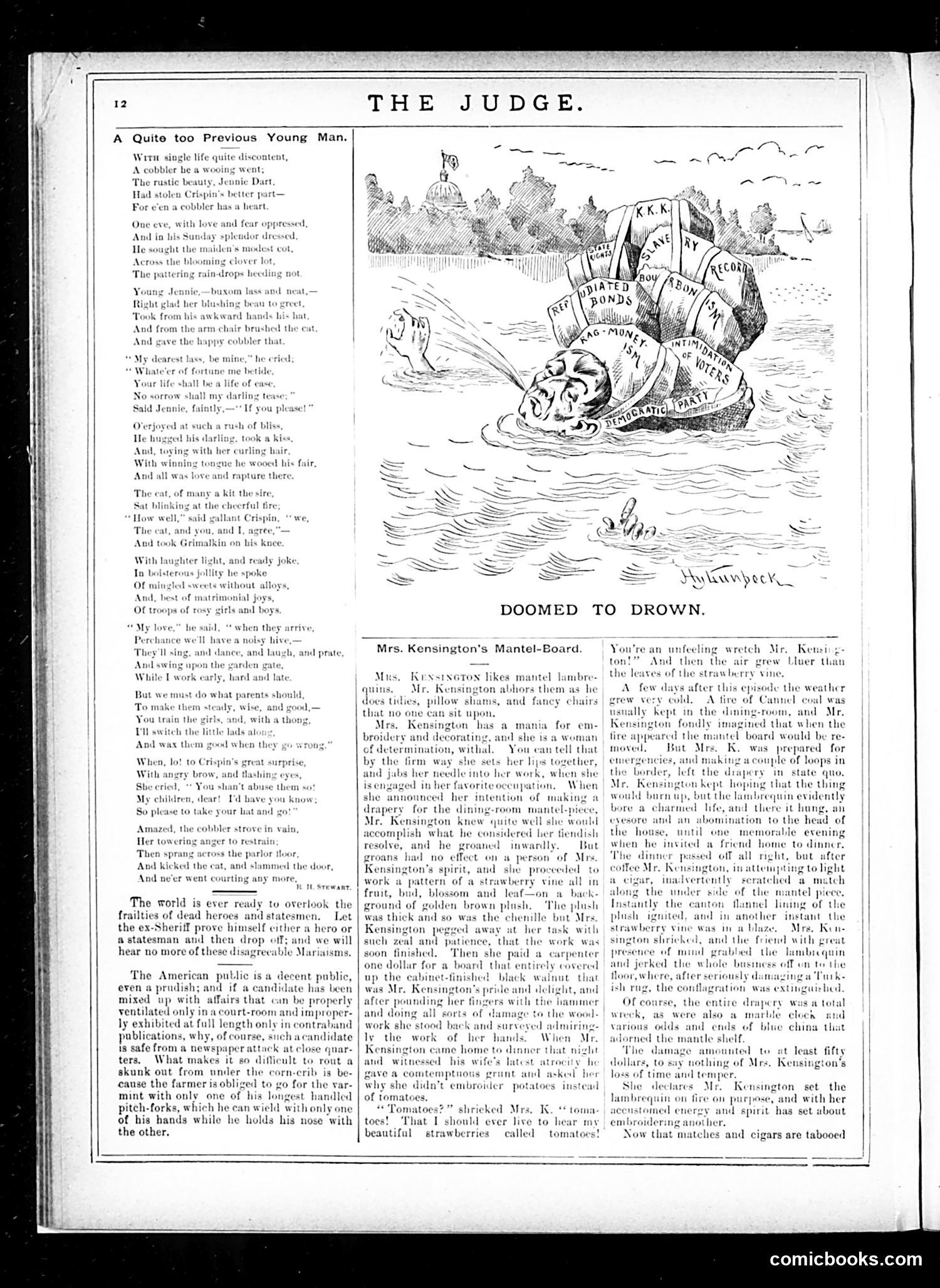
The main cartoon depicts a sinking ship labeled with various financial/social burdens (visible text includes "PANIC," "BONDS," "STOCKS"). A figure appears to be drowning in turbulent waters while struggling with these marked obstacles. The accompanying article "Mrs. Kensington's Mantel-Board" is a humorous domestic story (not primarily political satire) about a wife who embroidered a decorative mantel drape with a strawberry vine pattern. When her husband saw it, he mockingly asked why she hadn't embroidered "tomatoes" instead, insulting her work. The wife became furious. Later, when Mr. Kensington tried to burn the drape in the fireplace to remove it, it caught fire—hence the "doomed to drown" connection: the decoration that caused marital strife literally burned. The page mixes satirical commentary on unnamed political figures (the article about the "ex-Sheriff") with light domestic humor. The cartoon likely references economic panic or financial crisis affecting the nation, though specific figures aren't clearly identifiable from this page alone.
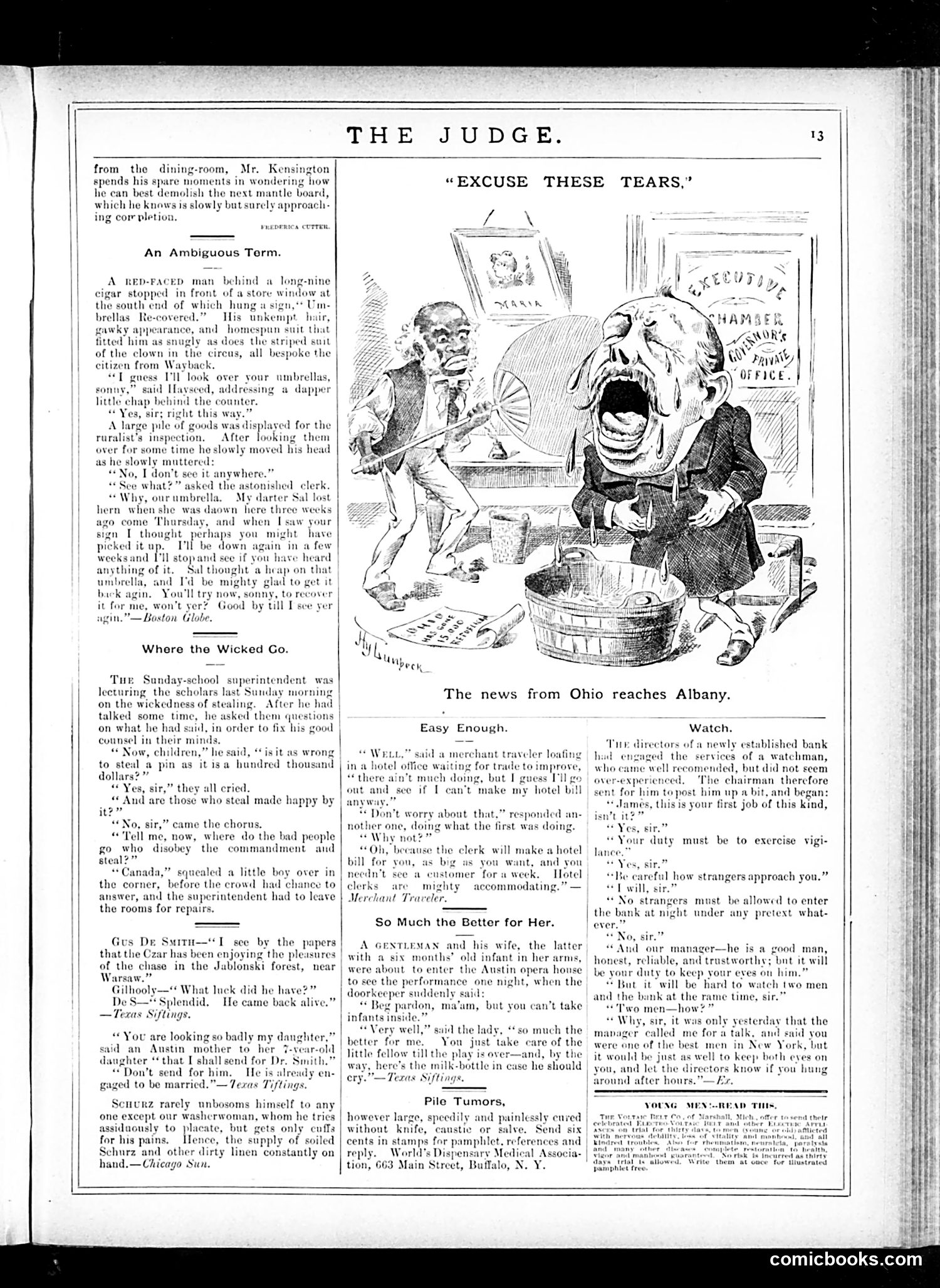
This page from *Judge* contains several short humorous anecdotes and one political cartoon. The main visual element—"Excuse These Tears"—depicts what appears to be a distressed government or political official (likely representing Ohio or Albany politics, based on the caption "The news from Ohio reaches Albany") weeping dramatically before subordinates or constituents. The surrounding text consists of brief satirical stories mocking rural ignorance ("An Ambiguous Term"—a farmer searching for his lost umbrella), moral hypocrisy in Sunday schools, and bureaucratic absurdity. These pieces target late-19th-century American social pretensions and incompetence. The cartoon likely satirizes political melodrama or corruption scandals in state government, though the specific reference remains unclear without more historical context about Ohio-Albany relations during this period.
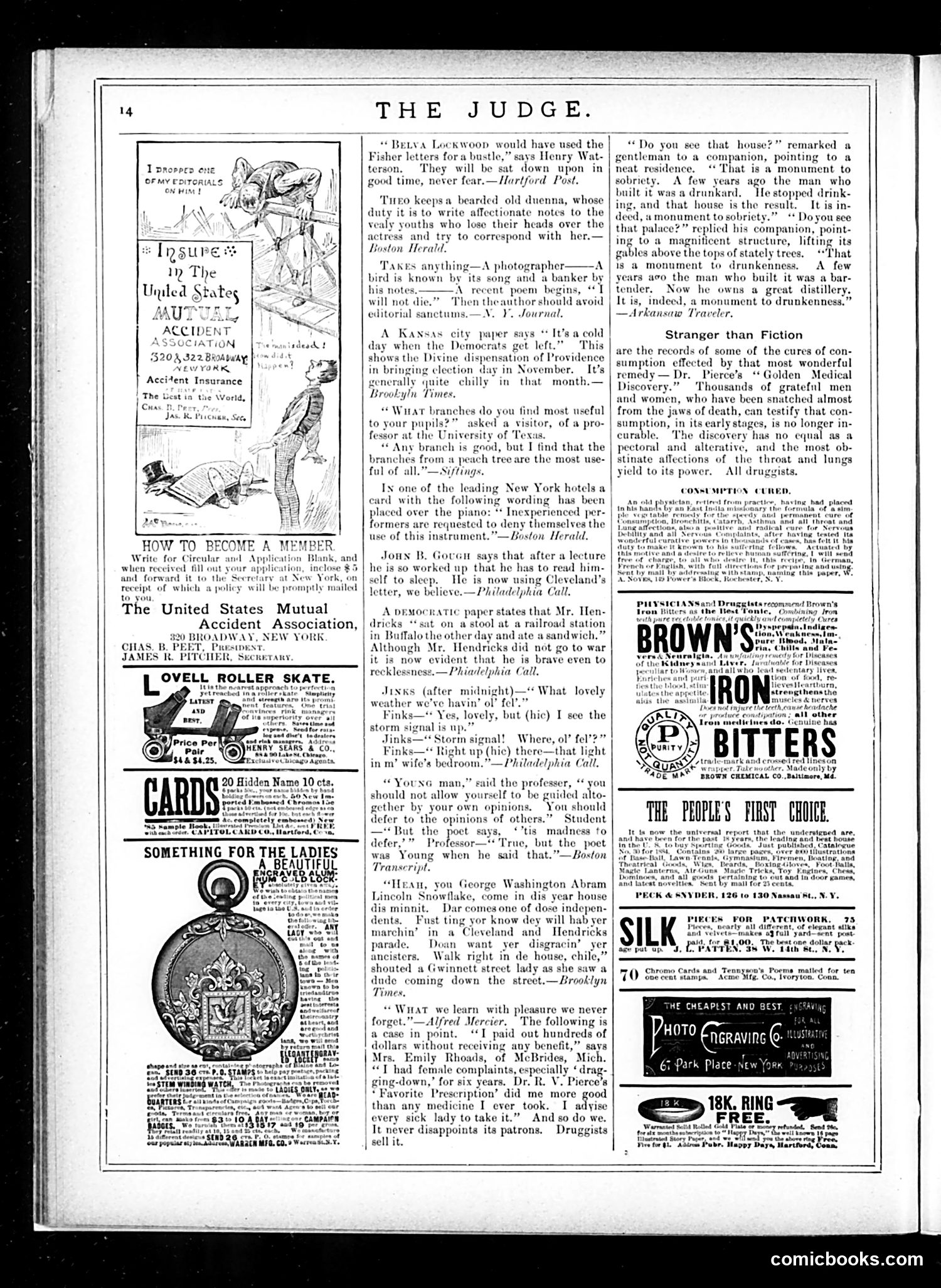
This page is primarily **advertisements and miscellaneous editorial content** rather than a cohesive political cartoon. The visible cartoon appears in the upper left: a simple sketch showing figures in what seems to be a domestic or social scene, though the specific meaning is unclear from the image quality. The bulk of the page consists of **short satirical quips and jokes** typical of Judge's format, touching on contemporary topics: - References to political figures (Hendricks, Cleveland) and the upcoming election - Social commentary on hotels, performers, and urban life - A joke about a man named "George Washington Abram Lincoln Snowflake," satirizing excessive patriotic naming - Advertisements for insurance, roller skates, and patent medicines The repeated anecdote about "monuments"—one to sobriety, one to drunkenness—appears to be a temperance-themed joke typical of the era's moral discourse. Overall, this is a typical **Judge magazine page mixing small advertisements, jokes, and light social satire** rather than focused political commentary or major cartoon illustrations.
This page from *Judge* magazine is primarily **advertisements with satirical commentary**. The satirical content appears in the editorial remarks interspersed between ads—brief, jokey observations on contemporary life. The key satirical moments target: 1. **Political hypocrisy**: A joke about Carl Schurz (a prominent Mugwump/Republican reformer) where his lecture bill is compared to a gas bill—suggesting politicians' speeches are equally wasteful or obscuring. 2. **Gender and courtship**: Multiple quips mock women's reluctance to commit to engagements and mock opera spectators distracted by female performers. 3. **Chicago cleanliness**: A joke about a hotel-keeper's amazement at finding "the first entire cake of soap" in a Chicago hotel—satirizing the city's reputation for filth. 4. **Selective reading**: A quip about someone only believing half of what he reads—specifically, the half supporting his political party. The page is largely filled with period commercial advertisements (cream balms, pianos, bicycles, jewelry) rather than visual cartoons. It's a typical 19th-century *Judge* layout mixing light social satire with commercial content.
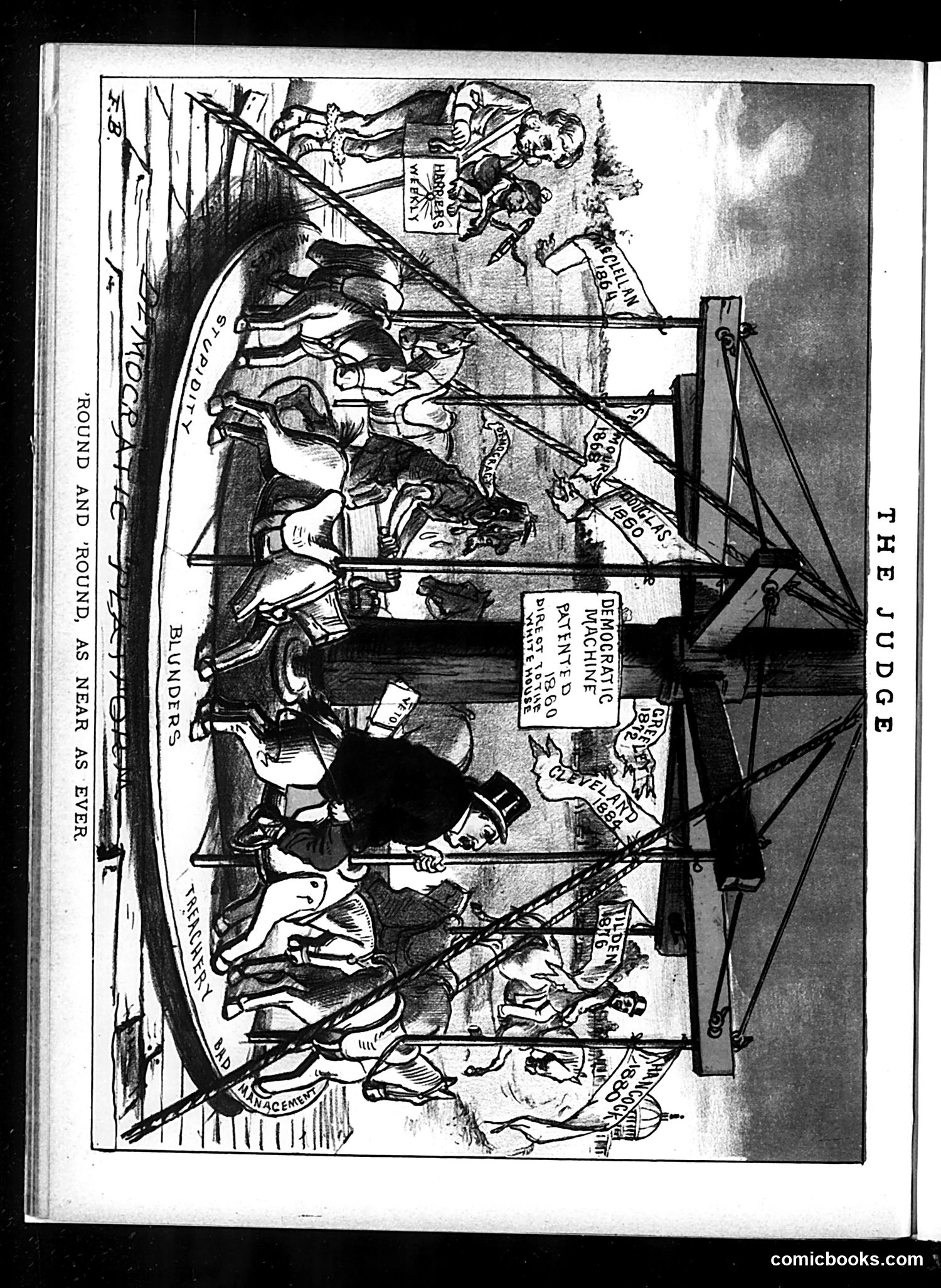
This political cartoon depicts "The Judge Machine," a satirical commentary on judicial corruption or mechanical justice. The image shows figures operating a contraption labeled with patent information, with what appear to be legal or political figures being processed through it like objects on an assembly line. The title "Round and Round, As Near As Ever" suggests the cyclical, repetitive nature of the judicial process—implying that despite appearances of justice, the same outcomes repeatedly occur, likely benefiting the same interests. The machine metaphor critiques how justice had become mechanized and impersonal, serving predetermined purposes rather than genuine fairness. The cartoonist satirizes that the legal system operates like an industrial machine designed to produce predetermined results, with operators controlling outcomes rather than impartial judgment prevailing. Without clear date or specific figures visible, the exact targets remain unclear, but this represents late-19th or early-20th-century skepticism about judicial integrity.