
Judge, 1884-11-01 · page 11 of 16
Judge — November 1, 1884 — page 11: what you’re looking at
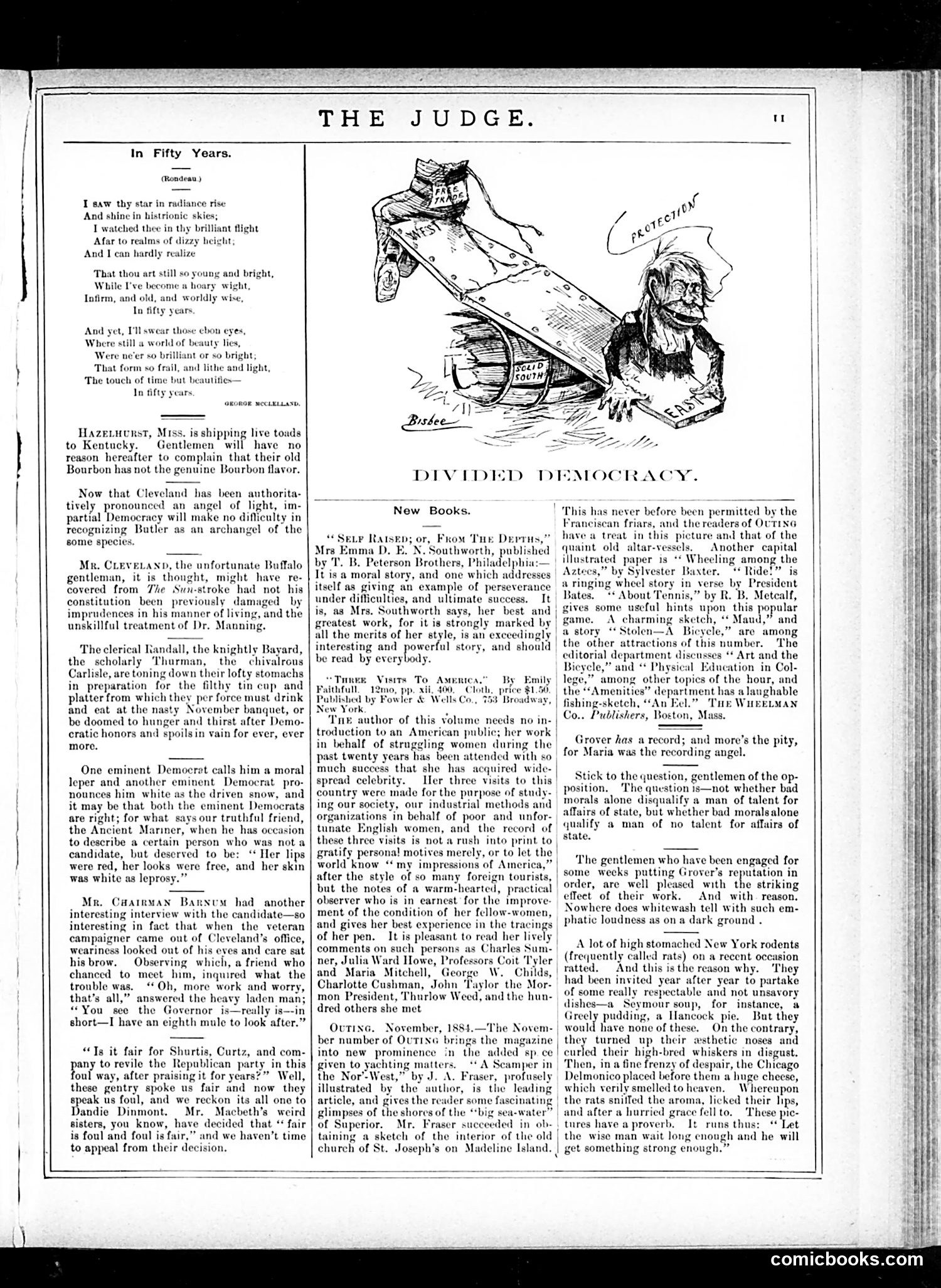
What you’re looking at
The central cartoon depicts a figure labeled "PROTECTION" struggling to balance a seesaw/plank. On one end sits a boot labeled "TRUST," suggesting the cartoon critiques how protective tariff policies favor monopolistic trusts over fair competition. The surrounding text mocks Democratic Party leadership during what appears to be the 1884 election period (references to Cleveland). The satire suggests Democrats are hypocritical: one prominent Democrat calls Cleveland "a moral leper" while another calls him "white as the driven snow"—the cartoon title "Divided Democracy" captures this internal contradiction. The piece also ridicules Democratic candidates (Randall, Bayard, Thurman, Carlisle) as elitist figures forced to humble themselves for party support, and suggests P.T. Barnum's involvement in campaigning has become exhausting work. The overall message: the Democratic Party is fractured and inconsistent in its principles, particularly regarding economic policy and candidate support.
📄 Transcribed text from this page (OCR, searchable)
Machine-transcribed from the original scan — historical spelling and the odd misread are preserved.
aa In Fifty Years. (Rondeau) I saw thy star in radiance rise And shine in histrionic skies; I watched thee in thy brilliant flight Afe ms of dizzy he And dly realize That thou art still so young and bright, While I've become a hoary: wight, Infirm, and old, and worldly wise, In fifty years And yet, I'll swear those eon eye Where still a world of beauty lies, Were ne'er so brilliant or so bright; That form so frail, and lithe and light, ‘The touch of time but beautitie— In fifty years, OKOROR MCCLELLAXD, Hazetucnst, Miss. is shipping live toads to Kentucky. Gentlemen will have no reason hereafter to complain that their old Bourbon has not the genuine Bourbon flavor. Now that Cleveland has been authorita- tively pronounced an angel of light, im- partial Democracy will make no difficulty in recognizing Butler as an archangel of the some species. Mr. CLEVELAND, the unfortuna gentleman, it is thought, might have re- covered from The Sun-stroke had not his constitution been previously damaged by imprudences in his manner of living, and the unskillful treatment of Dr. Manning. The clerical Randall, the knightly Bayard, the scholarly Thurman, the chivalrous Carlisle, are toning down their lofty stomachs in preparation for the filthy tin cup and platter from which they per force must drink and eat at the nasty November banquet, or be doomed to hunger and thirst after Demo- cratic honors and spoils in vain for ever, ever more. e Buffalo One eminent Democrat calls him a moral leper and another eminent Democrat pro- nounces him white as the driven snow, and it may be that both the eminent Democrats are right; for what says our truthful friend, the Ancient Mariner, when he has occasion to describe a certain person who was not a candidate, but deserved to be: ‘ Her lips were red, her looks were free, and her skin was white as leprosy.” Mr. Caatrman Barnum had another interesting interview with the candidate—so interesting in fact that when the veteran campaigner came out of Cleveland’s office, weariness looked out of his eves and care sat his brow. Observing which, a friend who chanced to meet him, inquired what the trouble was. ‘Oh, more work and worry, that’s all,” answered the heavy laden man; “You see the Governor is—really is—-in short—I have an eighth mule to look after.” “Ts it fair for Shurtis, Curtz, and com- pany to revile the Republican ty in this foul way, after praising it for years?” Well, these gentry spoke us fair and now they speak us foul, and we reckon its all one to Dandie Dinmont. Mr. Macbeth’s weird sisters, you know, have decided that “ fair is foul and foul is fair,” and we haven’t time to appeal from their decision. DIVIDED New Books. “Seip Raisep; or, From Tne Devrits,” Mra Emma D, E. N. Southworth, published by T. B. Peterson Brothers, Philadelphia It is a moral story, and one wh itself as giving an example of perse under difficulties, and ultimate su is, a8 Mrs. Southworth says, her best and greatest work, for it is strongly marked b; all the merits of her style, is an exceedingly interesting and powerful story, and should be read by everybody. “Trine Visits To Awentes 2mo, pp. xii, 400. ‘owler & Wells Co., 75 By Emily price $1.50. Broadw New York. * ‘Te author of thi troduction to an Amer: in behalf of struggling women during the past twenty years has been attended with so much success that she has acquired wide spread celebrit: Her three vi to this country were made for the purpose of study- ing our society, our industrial methods and organizations in behalf of poor and unfor- tunate English women, and the record of these three visits is not a rush into print to gratify persona! motives merely, or to let the world know ‘my impressions of Ameri after the style of so many foreign tourists, but the notes of a warm-hearted, practical observer who is in earnest for the improve- ment of the condition of her fellow-women, and gives her best experience in the tracings of her pen. It is pleasant to read her lively comments on such persons rles Sum- ner, Julia Ward Howe, Profe Joit ‘Tyler and Maria Mitchell, George W. Childs, Charlotte Cushman, John Taylor the Mor- mon President, Thurlow Weed, and the hun- dred others she met volume needs no in- an public; her work OvTING. November, 1884.—The Novem- ber number of OuTING b into new prominence in given to yachting matters. ‘¢ A the Nor’-West,” by J. A. F illustrated by the author, is the | article, and gi the reader some glimpses of the shores of the “bj of Superior. Mr. Fraser su taining a sketch of the interior of the old church of St. Joseph’s on Madeline Island, amper in er, profusely DEMOCRACY. ermitted by the This has never before been p Franciscan friars, and the readers of OUTING ea treat in this picture and that of the int old altar-vessels, Another capital Wheeling among the Sylvester Baxter, ‘* Ride!” is heel story in verse by Pre About Tennis,” by R. B, Met some useful hints upon this popular qu illustrated paper is * Aztecs,” bi \ charming sketch, ¢ Maud,” and ‘y **Stolen—A_ Bicycle,” are among the other of this number. The editorial department discusses “ Art and the Bie} nd Phy Education in Col- mong other topics of the hour, and <Amenities” department has a laughable fishing-sketch, “An Eel.” Tie WHEELMAN 30.. Publishers, Boston, Mass. Grover has a record; and more’s the pity, for Maria was the recording angel. | Stick to the question, gentlemen of the op- position. The question is—not whether bad morals alone disqualify a man of talent for affairs of state, but whether bad morals alone qualify a man of no talent for affairs of state. ‘The gentlemen who have been engaged for some weeks putting Grover’s reputation in order, are well pleased with the striking effect of their work. And with reason, Nowhere does whitewash tell with such em- phatic loudness as on a dark ground . A lot of high stomached New York rodents (frequently called rats) on a recent occasion ratte And this isthe reason why. ‘They had been invited year after year to partake of some really respectable and not unsavory dishes—a Seymour soup, for instance, » irecly pudding, a Hancock pie. But they would have none of the On the contrary, they turned up their esthetic noses and | curled their high-bred whiskers in disgust. Then, in a fine frenzy of despair, the Chicago Delmonico placed before them a huge cheese, which verily smelled to heaven. Whereupon the rats sniffed the aroma, licked their lips, and after a hurried grace fell to. The tures have a proverb, It runs thus: the wise man wait long cnongh and he will { get something strong enough.”