
A complete issue · 16 pages · 1884
Judge — September 6, 1884
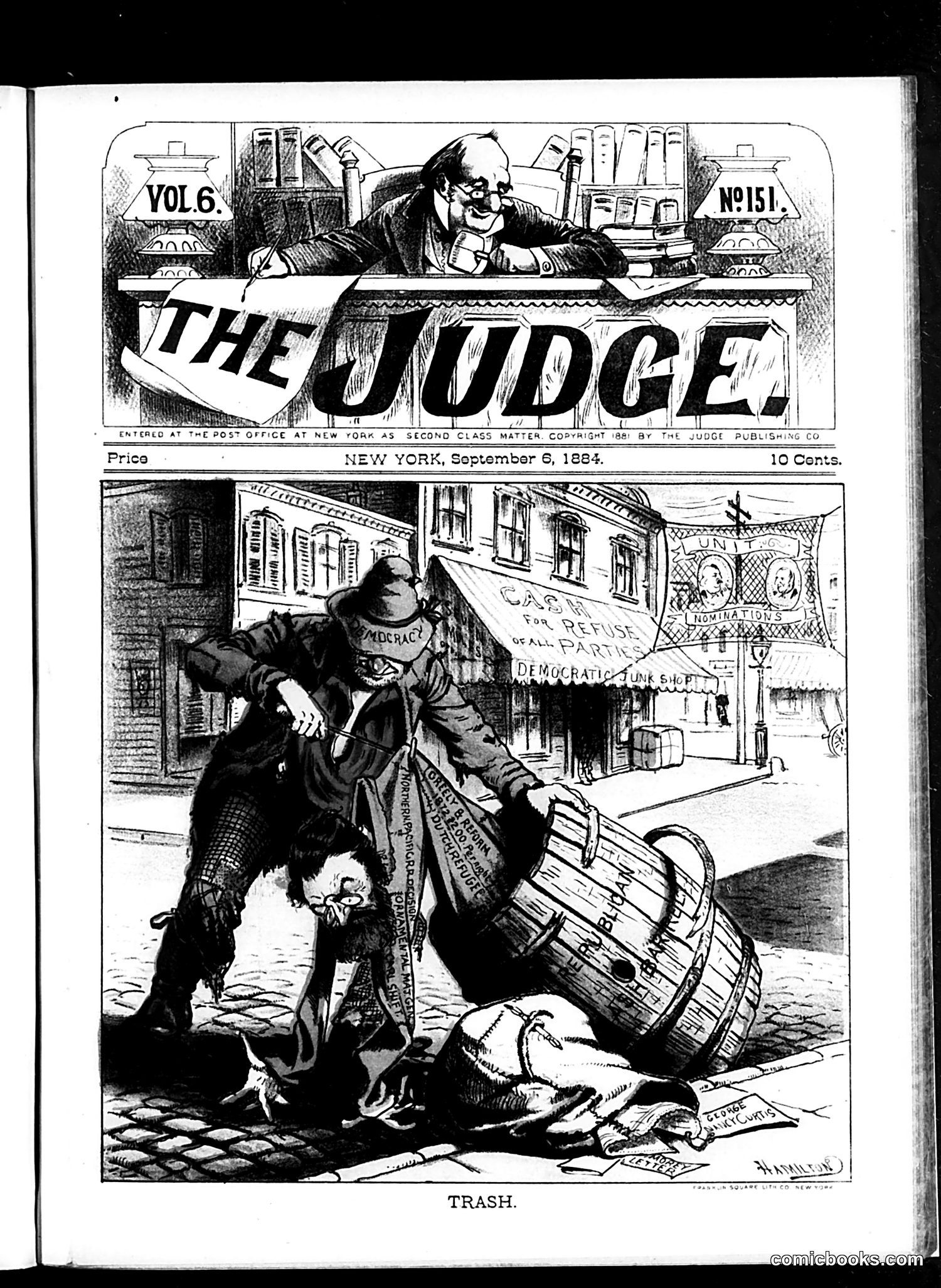
This political cartoon titled "TRASH" satirizes the 1884 presidential election. A figure labeled "DEMOCRACY" is shown dumping refuse into a barrel, suggesting the Democratic Party is discarding its principles or platform. The scattered papers visible include references to "DEMOCRATIC JUNK SHOP" and various political debris. The cartoonist criticizes the Democratic Party's political state during this election cycle, depicting their agenda as literal garbage. The timing—September 1884, just before the November election—suggests this responds to specific campaign controversies or policy positions the magazine deemed hypocritical or worthless. The satirical message: the Democrats are peddling nothing but worthless refuse to voters.
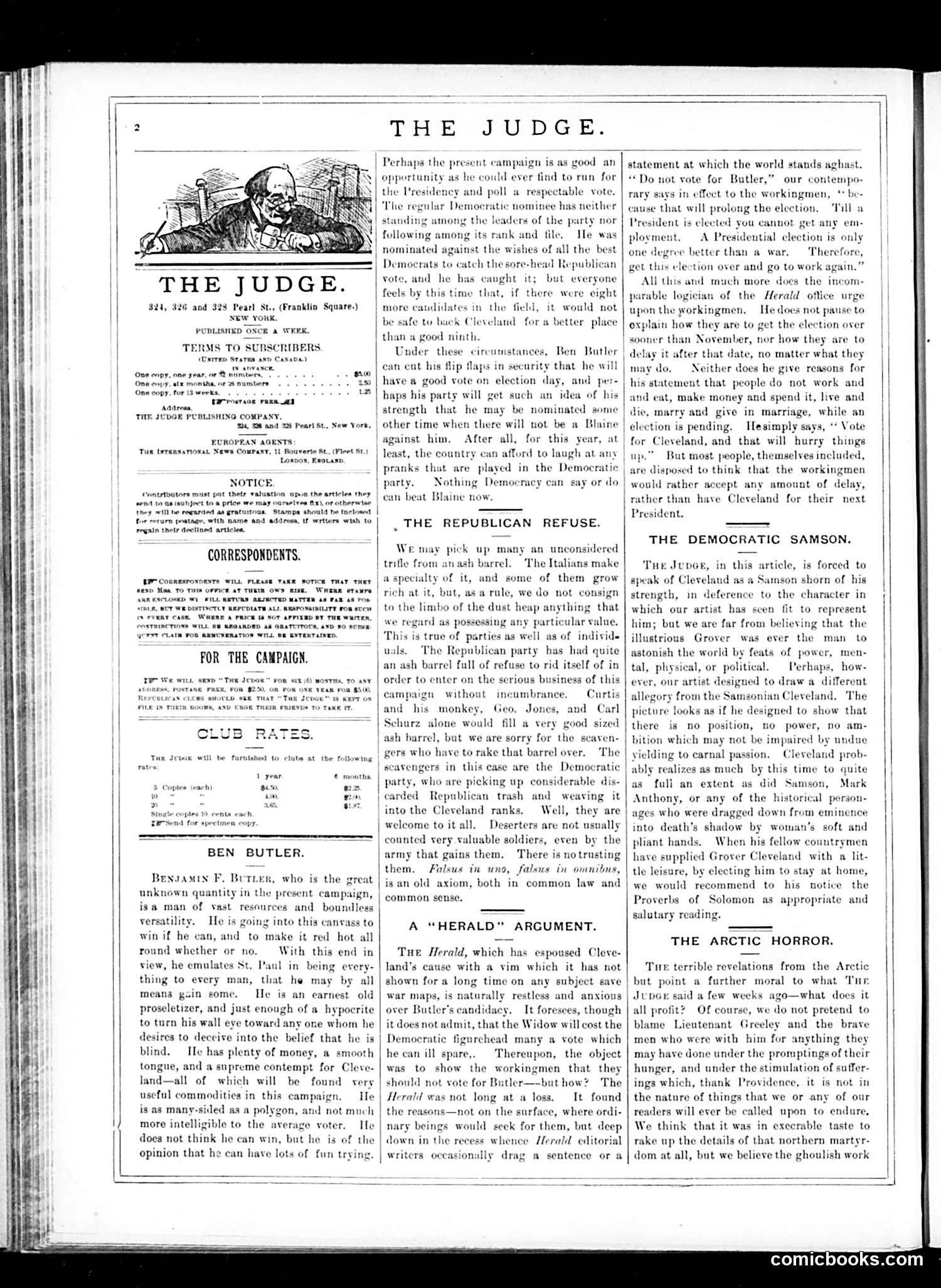
This page from *Judge* magazine contains satirical commentary on the 1884 presidential campaign. The main cartoon depicts **Ben Butler**, a controversial political figure described as "the great unknown quantity" in the race. Butler is caricatured as a scheming operative willing to compromise principles for political gain—he's portrayed with exaggerated facial features suggesting deception ("wall eye," "smooth tongue"). The satire targets Butler's opportunism: he aims to create chaos in the Democratic campaign to benefit Republicans, while maintaining plausible deniability. The text mocks his hypocrisy and adaptability ("many-sided as a polygon"). The accompanying articles criticize the Democratic nominee (appearing to be Cleveland, though not explicitly named) as weak and unpopular among party leadership, while mocking Republican efforts to distance themselves from their own problematic figures—Blaine and others dismissed as "refuse." The overall message: both parties contain self-serving opportunists and compromised candidates, though *Judge* takes particular aim at Butler's shameless political maneuvering during this election cycle.
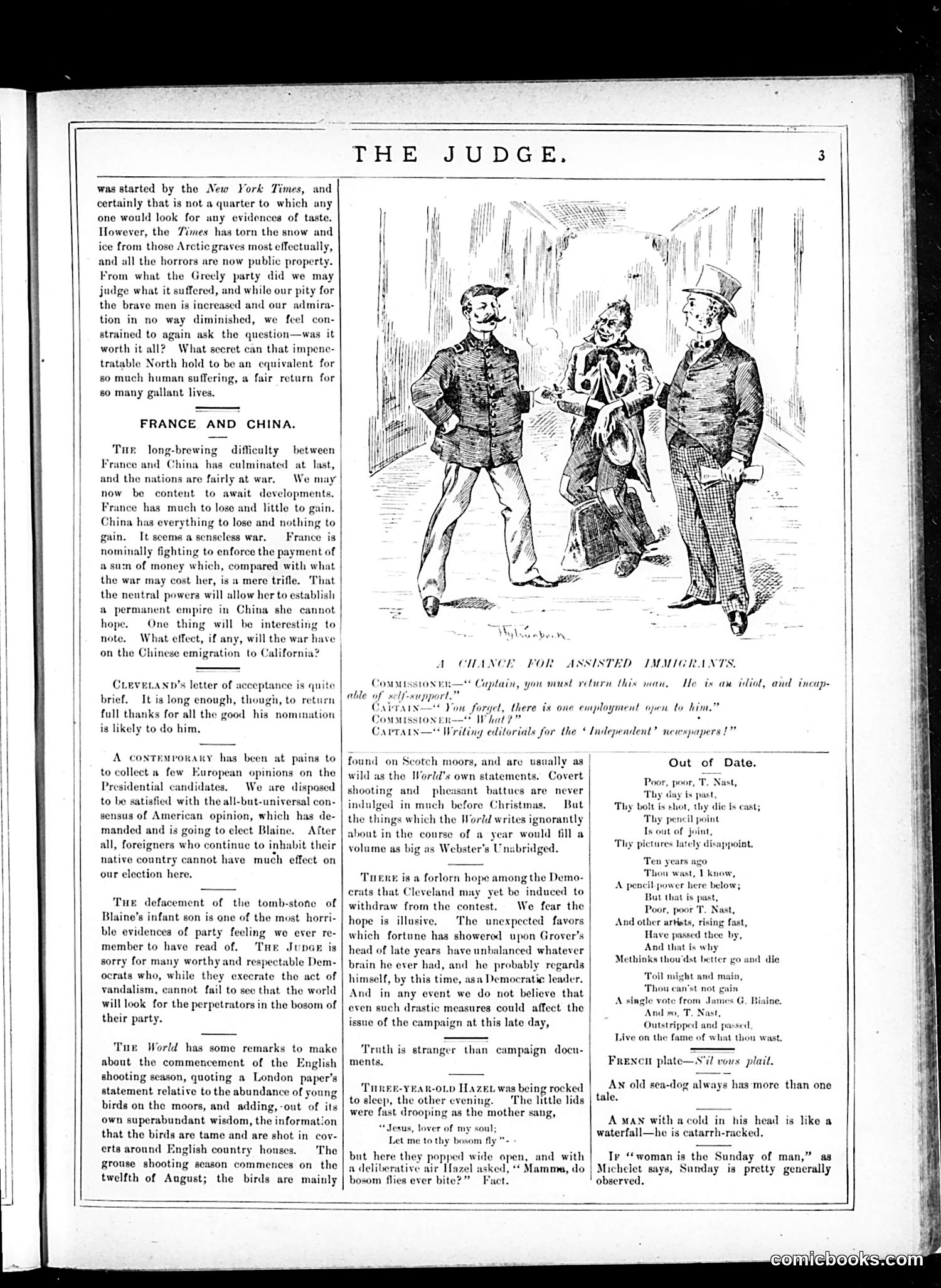
This cartoon satirizes the perceived incompetence of political appointees, particularly those hired through patronage. The dialogue shows a Commissioner attempting to return an "idiot" to the Captain who brought him, claiming he's incapable of self-support. The Captain's retort—that the man could write editorials for "Independent" newspapers—is the punchline: it's suggesting that newspaper editorial work requires so little intelligence it's suitable employment for someone mentally unfit for other labor. The satire targets both incompetent political hires and the perceived low quality of Independent newspaper journalism during this 1884 election period. The cartoonist implies that editorial writing demands no real skill or intellect—a harsh contemporary critique of specific publications' editorial standards.
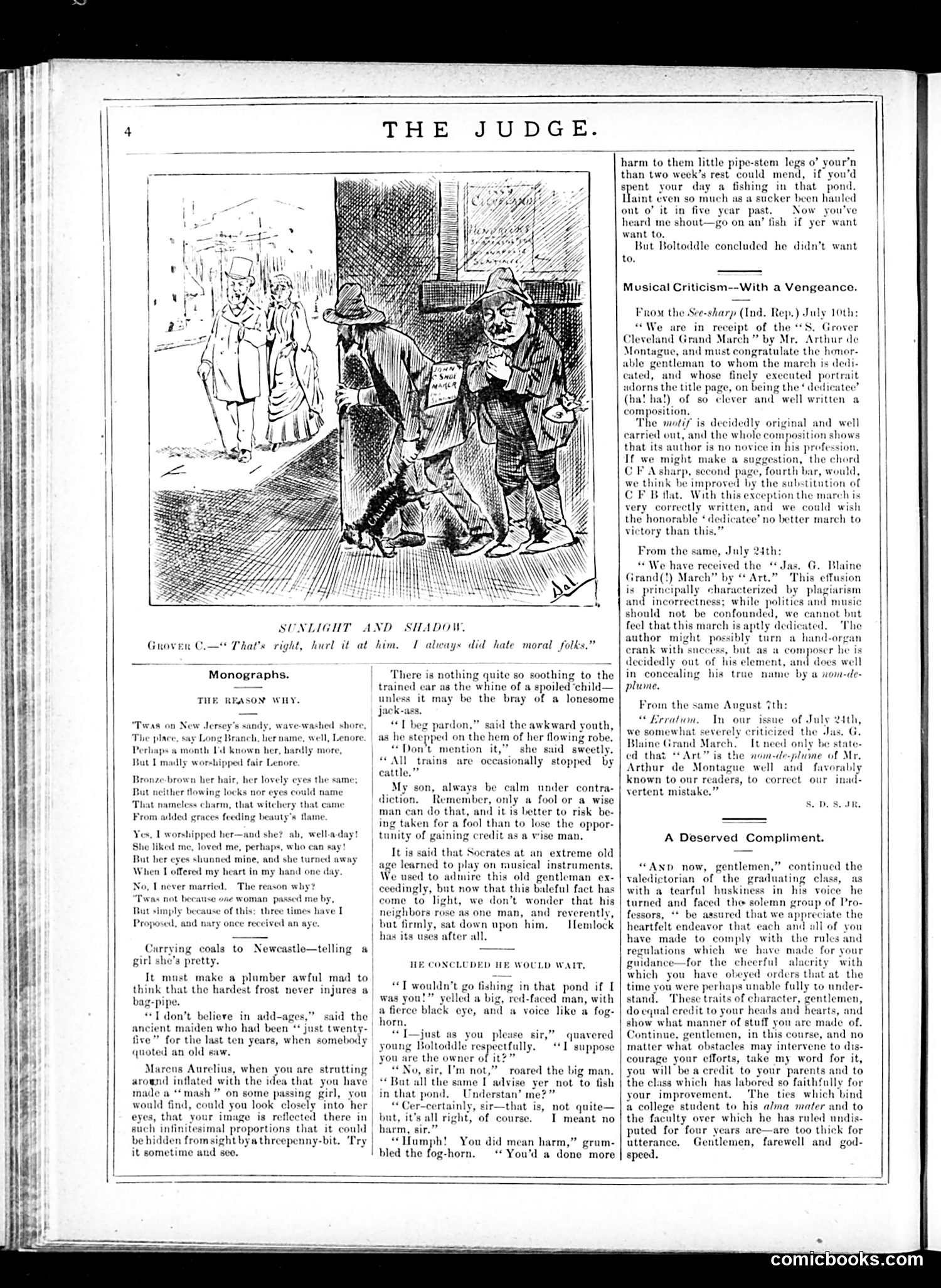
This page from *Judge* magazine contains several satirical pieces typical of late 19th-century American humor: **"Sunlight and Shadow"** features a dialogue between Grover C. (likely President Grover Cleveland) and a young man named Boltoddle. The cartoon depicts Cleveland sternly warning the youth against fishing in a pond, claiming no fish have been caught "in five year." The satire appears to mock Cleveland's authority or a specific policy—possibly relating to conservation or resource management—by showing him aggressively intimidating ordinary citizens. **"Musical Criticism—With a Vengeance"** reviews a "S. Grover Cleveland Grand March" composition. The critic backhanded compliments the work while mocking its dedication to Cleveland, sarcastically praising both the march and Cleveland's "portrait" on the title page. This ridicules the era's tendency toward obsequious flattery of political figures. The other pieces are light humor about courtship, philosophy, and social etiquette, typical of *Judge's* broader satirical content.
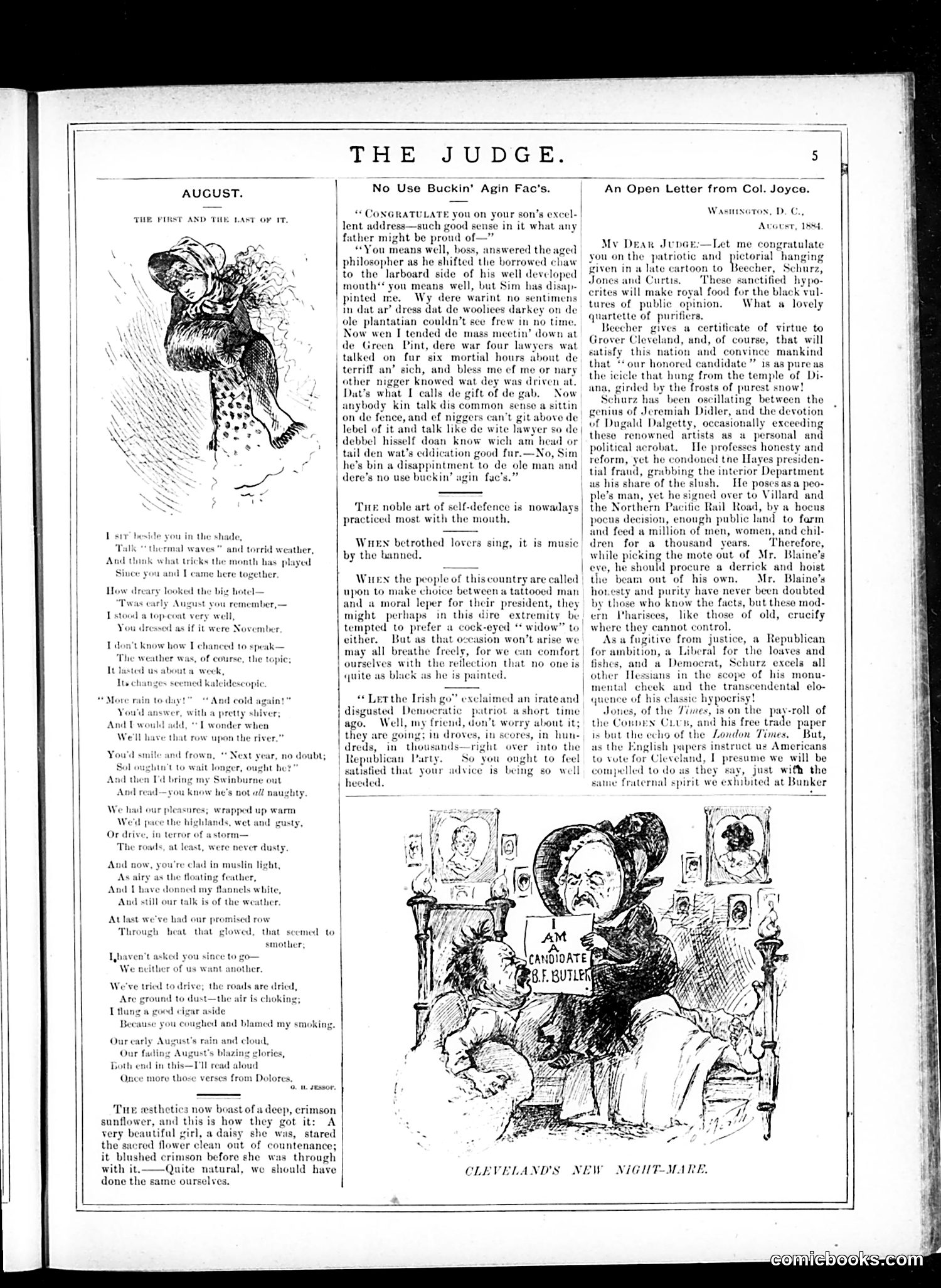
This page contains political satire targeting the 1884 presidential election. The central cartoon, "Cleveland's New Nightmare," mocks Grover Cleveland's candidacy by depicting him surrounded by Republican figures and reform advocates (likely including Henry Ward Beecher and Carl Schurz, referenced in Col. Joyce's letter) who are attempting to use him as their candidate. The "Open Letter from Col. Joyce" sarcastically praises these reformers as "sanctified hypocrites," suggesting they're cynically endorsing Cleveland for political gain rather than principle. The left column's humorous piece "No Use Buckin' 'Agin Fac's" uses dialect comedy to mock political speechmaking and pretense. The overall message: Judge's editors viewed Cleveland's reformist backers as insincere opportunists exploiting the candidate for their own agendas. The satire reflects deep skepticism about the authenticity of the Mugwump (reform Republican) movement that year.
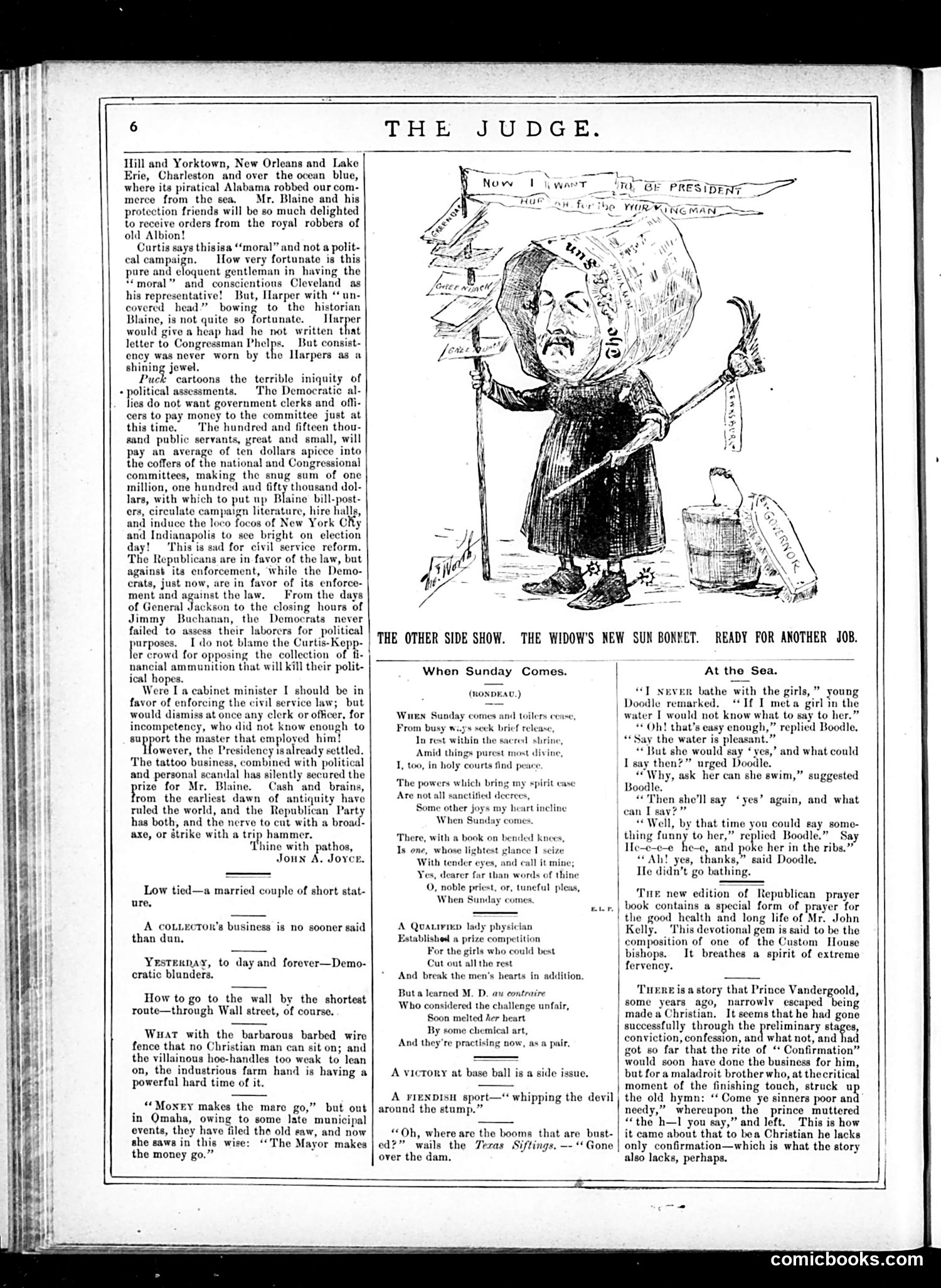
The main cartoon depicts a bloated political figure—likely **James G. Blaine**, Republican presidential candidate—labeled with various scandals and controversies covering his body. The satire attacks Blaine's character and checkered political history, mocking Republican claims that the 1884 election was a "moral" campaign rather than political. The accompanying text criticizes **both parties' hypocrisy**: Judge attacks Democratic opposition to political assessments (forced donations from government clerks to campaign coffers), noting Democrats historically demanded such payments. The satire also jabs at Republican inconsistency—supporting civil service reform while enforcing it selectively. References include the **Alabama** (a Confederate raider that damaged Northern commerce) and attacks on George William Curtis and Harper's Weekly for selective moral positioning in the campaign. The cartoon's point: despite rhetoric about morality, both parties engage in dirty politics and financial corruption. Blaine's literal "baggage" of scandals undermines Republican claims of ethical superiority.
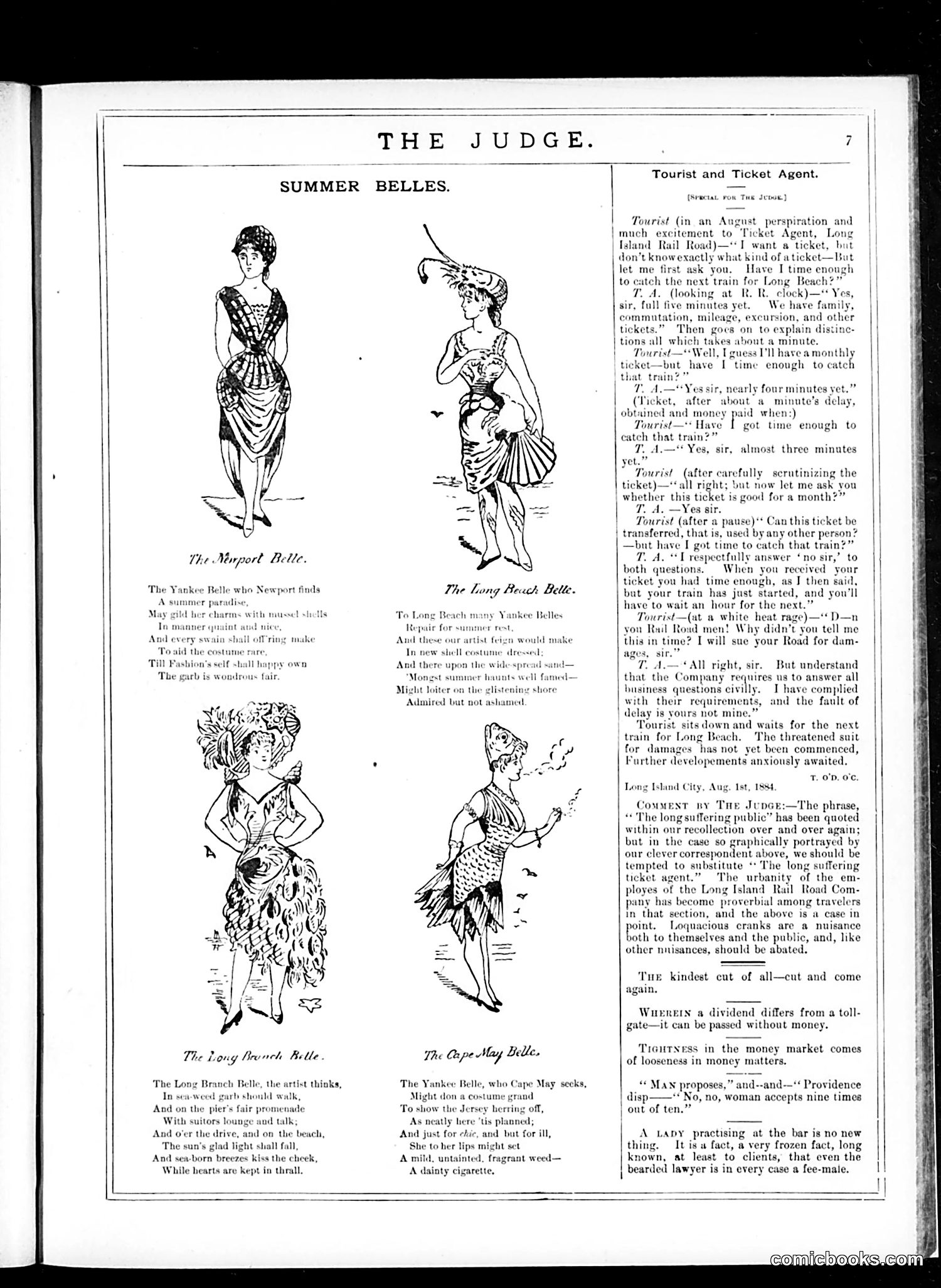
This page satirizes two targets: fashionable women and incompetent railroad service. The upper illustrations mock "Summer Belles"—wealthy women at fashionable seaside resorts (Newport, Long Branch). The verses ridicule their pretentious, ornamental costumes and behavior, depicting them as vain and frivolous. The main satire concerns the Long Island Rail Road's ticket agent. A harried tourist, desperate to catch a train, asks simple questions but the agent wastes precious time with verbose, unnecessary explanations about ticket types and restrictions. By the time the agent finishes, the train has departed, leaving the frustrated tourist waiting an hour. The joke: The agent's excessive politeness and bureaucratic pedantry—answering every question exhaustively when brevity was needed—defeats its own purpose. *Judge* mocks both the tourist's impatience and the railroad company's officious incompetence, a recurring complaint in 1880s travel commentary. The commentary credits the agent's "urbanity" while blaming "loquacious cranks" (talkative complainers) equally.
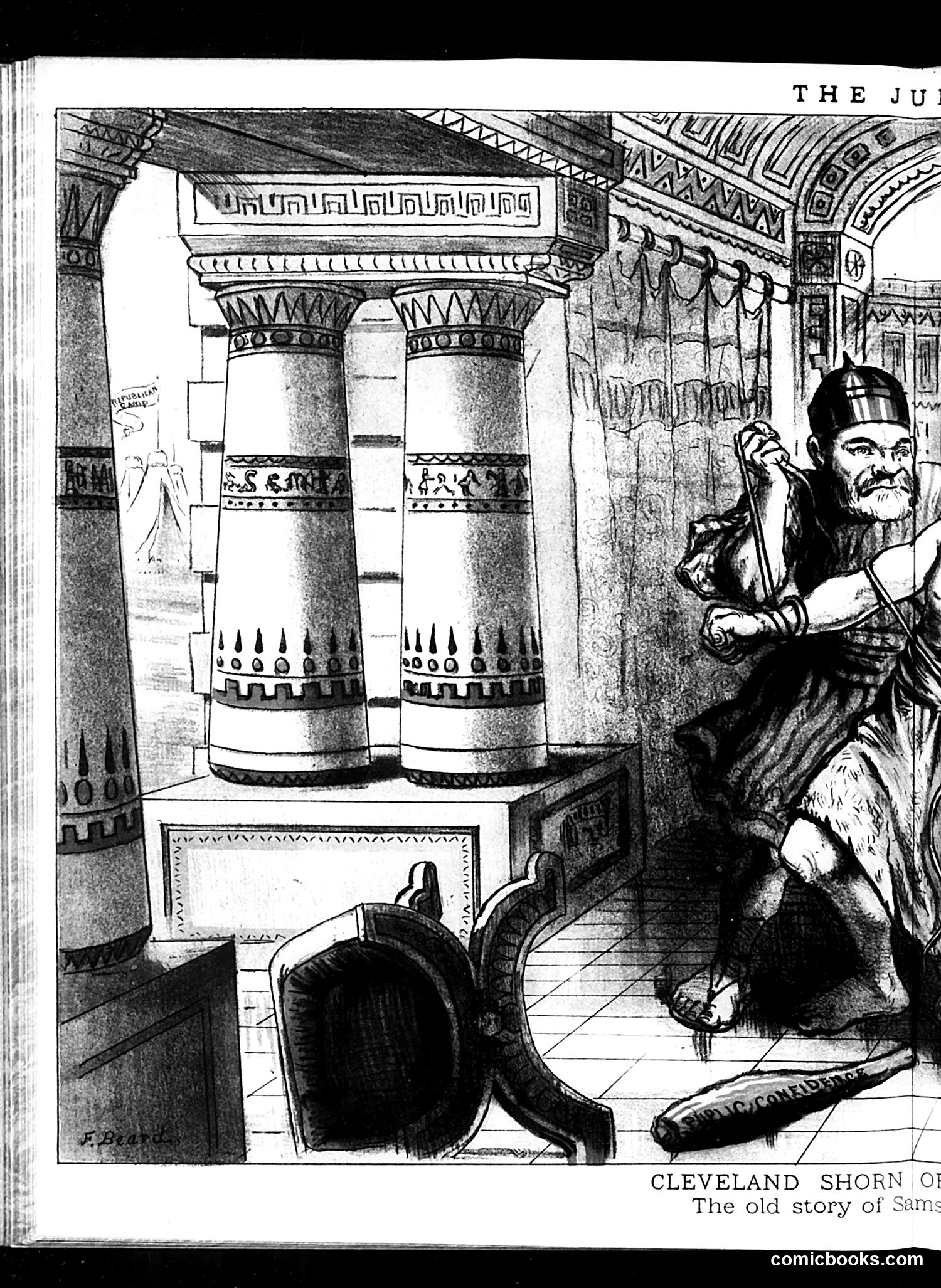
This cartoon from *Judge* magazine depicts a figure (likely representing President Cleveland based on the caption) in what appears to be an ancient temple setting with large decorative columns. The caption references "Cleveland Shorn Of" and "The old story of Sams[on]"—invoking the biblical tale of Samson, whose strength was lost when his hair was cut. The satire compares Cleveland to Samson, suggesting his political power has been stripped away or diminished, similar to how Samson was weakened. The classical architectural setting emphasizes the "fall from power" theme. Without seeing the full page context or date, the specific political loss referenced remains unclear, but this uses the biblical parallel to mock Cleveland's reduced authority or influence.
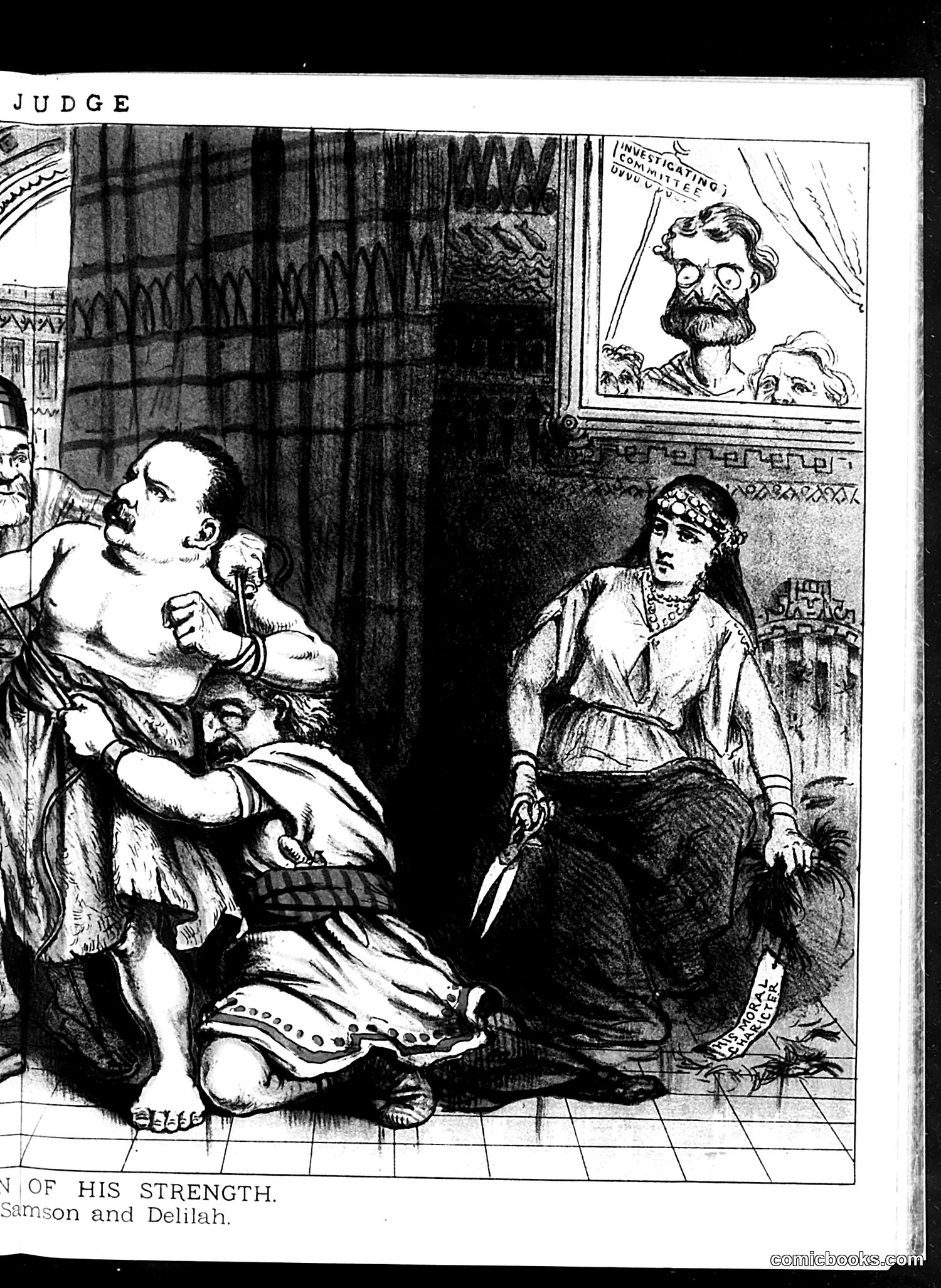
This cartoon depicts the biblical story of Samson and Delilah as a political allegory. The massive, powerful man (Samson) represents strength or a nation's power, while the woman (Delilah) appears to be undermining or betraying him through seduction or manipulation—a classic visual metaphor for how internal weakness or moral compromise can destroy even the mightiest. The framed portrait on the wall labeled "INVESTIGATING COMMITTEE" suggests this is satirizing a specific political scandal or congressional investigation from Judge magazine's era (late 19th/early 20th century). The cartoon warns that investigations or outside pressure can weaken powerful figures, much like Delilah's betrayal weakened Samson. Without the publication date, the specific scandal remains unclear, but the message critiques how power can be undermined.
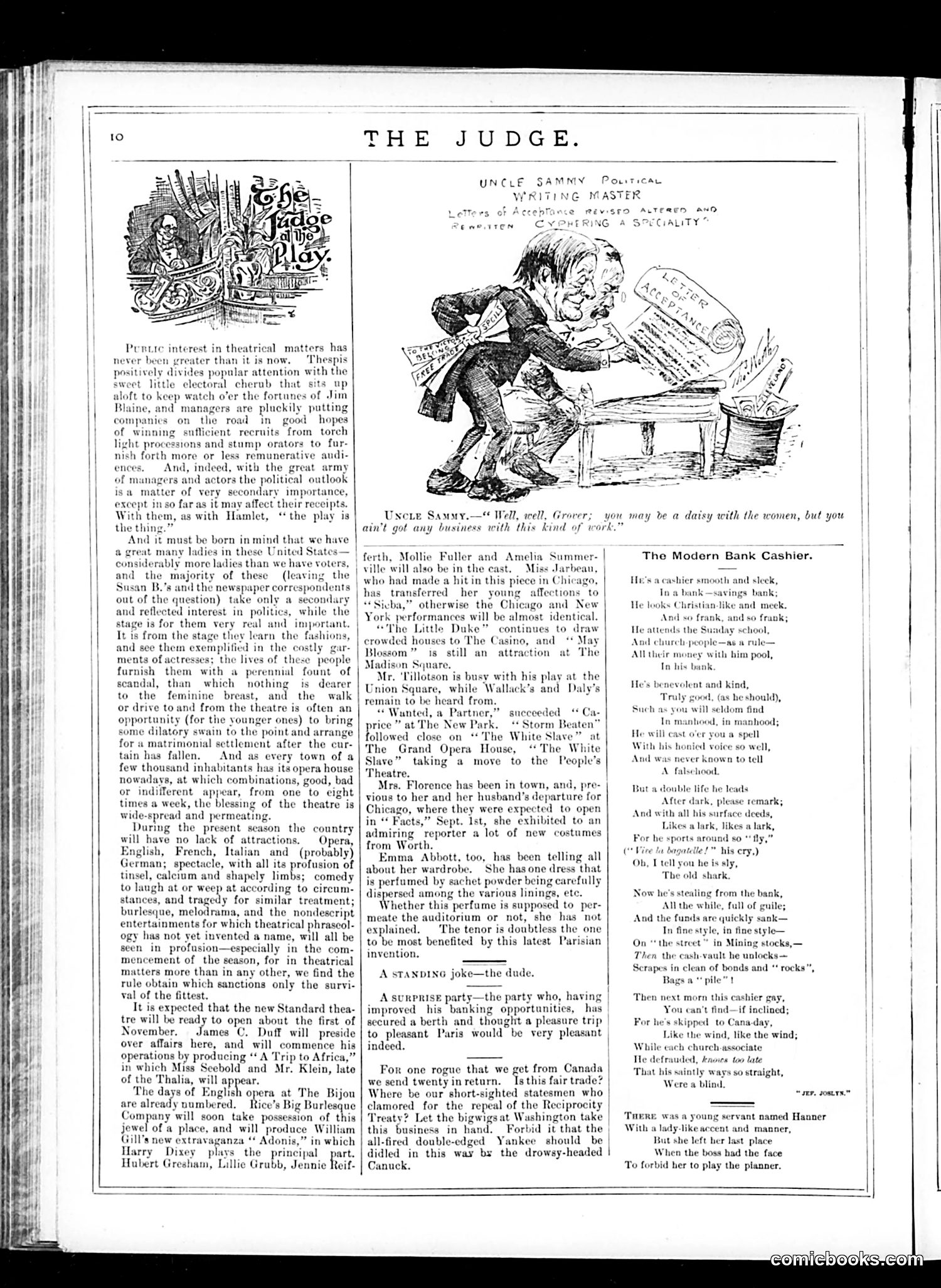
The main cartoon shows a caricatured figure labeled "Uncle Sammy" (representing the U.S. government) instructing a man labeled "Grover" (likely President Grover Cleveland) on how to write political letters. The joke is that Cleveland should stick to politics rather than meddle in theatrical matters—Uncle Sammy is essentially telling him he's unqualified for show business. The surrounding text discusses how theatrical productions have become nearly as popular as electoral politics, diverting public attention from serious political matters like the Blaine campaign (suggesting the 1884 election). The piece satirizes how theatrical performers influence public opinion and how American theater has become a major cultural force rivaling politics itself. The cartoon mocks Cleveland's supposed incompetence outside his proper domain of government.
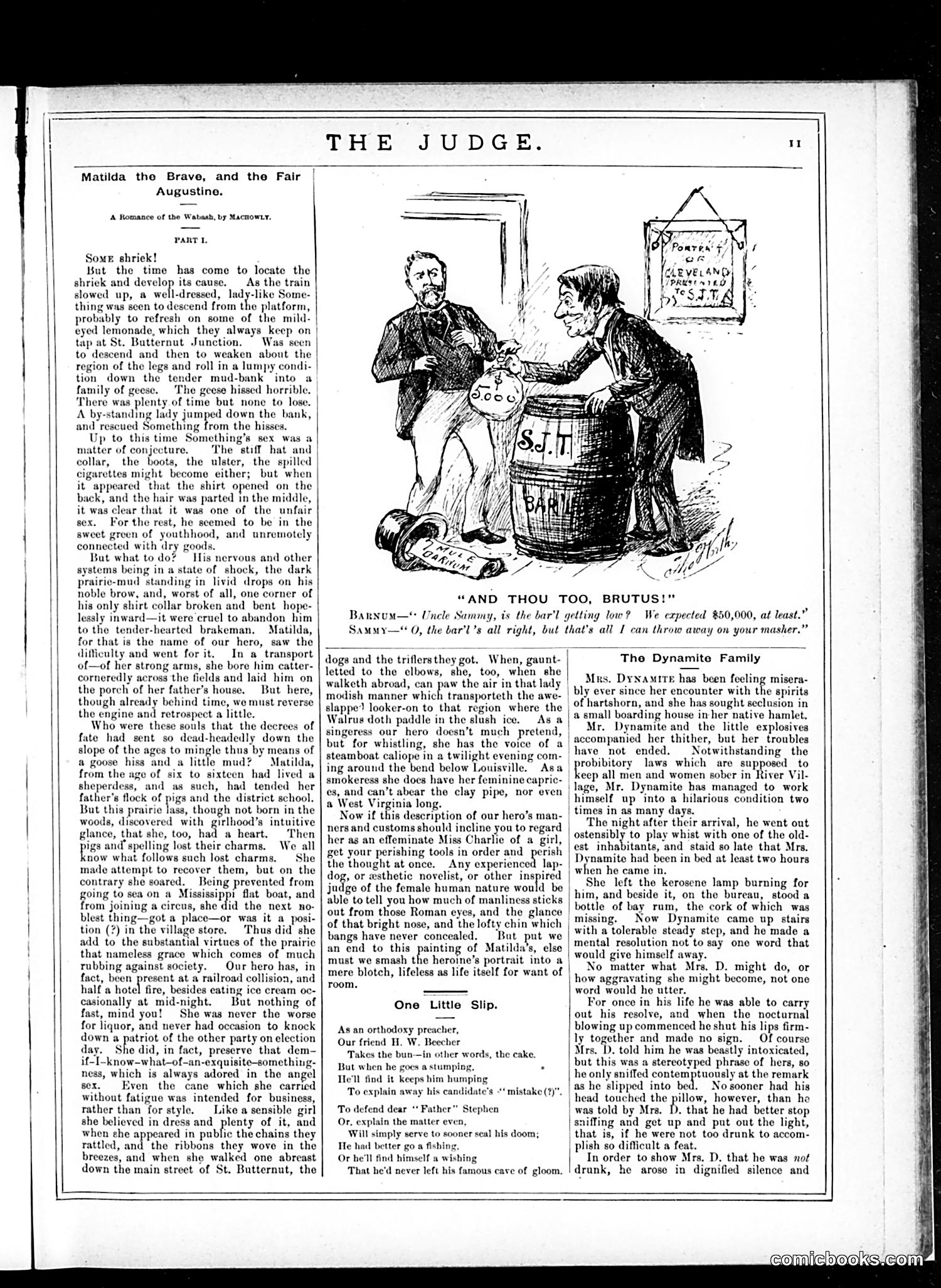
This page presents the opening of a serialized satirical romance titled "Matilda the Brave, and the Fair Augustine," set in the Wabash region. The narrative employs exaggerated, mock-heroic language to satirize sentimental popular fiction of the era. The main cartoon depicts two men (labeled "Uncle Sammy" and "Sammy") discussing a barrel, likely a political allegory about American governance or policy. The specific reference is unclear without additional context, but the dialogue suggests debate over a governmental or political matter. The story itself mocks the conventions of penny-dime novels: the virtuous farm girl protagonist, the chance meeting that will transform her life, and overwrought descriptions of modest character traits as profound virtues. Judge magazine used such parodies to ridicule the popular literary tastes of middle-class America, particularly the romanticization of rural innocence and melodramatic plotting. The humor relies on readers recognizing and finding amusement in the deflation of these familiar literary tropes.
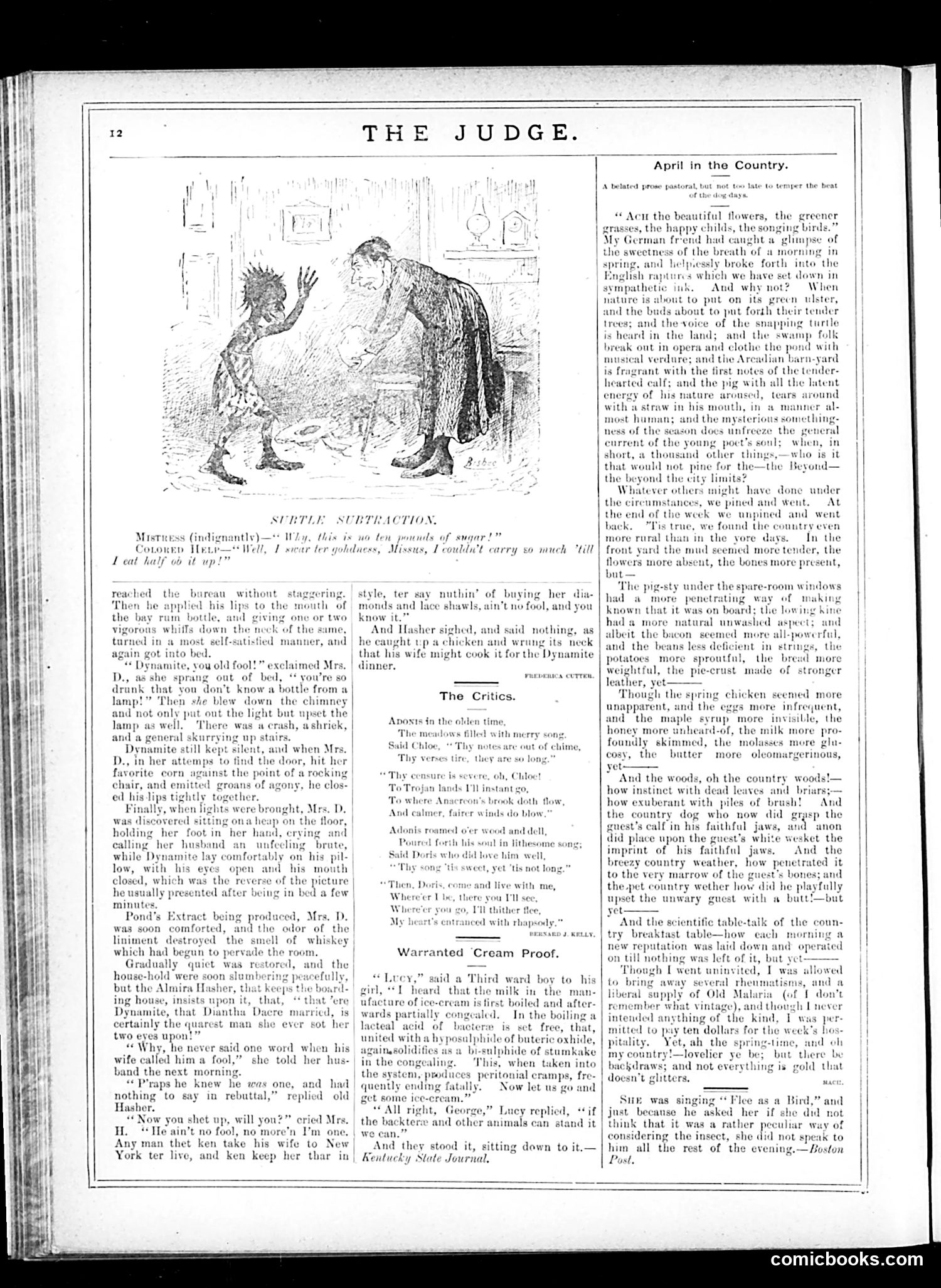
This page from *Judge* contains two distinct pieces: **"Subtle Subtraction"** (top cartoon): A domestic scene showing a husband caught red-handed by his wife. He's claimed to have purchased only ten pounds of sugar, but the wife discovers he's actually bought more—the "subtraction" being his attempt to deceive her about household expenses. The joke plays on marital tension over money and the husband's failed dishonesty. **"April in the Country"** (right column): A nostalgic essay-poem praising rural springtime, contrasting it favorably with city life. The writer romanticizes nature's awakening—blooming flowers, singing birds, farm animals—while poking gentle fun at the reality: muddy yards, pig-sties, and other less-pleasant rural realities that complicate the pastoral fantasy. Both pieces reflect late-19th-century American middle-class anxieties: domestic financial disputes and the idealization versus reality of country living as an escape from urban industrial life.
This page from *Judge* contains several short humorous anecdotes typical of the magazine's satirical style: **"From Beef to Beans"** mocks working-class struggle—a clerk saves money but still subsists on beans, suggesting economic hardship despite frugality. **"She Was Not Alone"** satirizes street harassment; a young woman warns an unwanted "masher" (street harasser) that a policeman is nearby, inverting the power dynamic. **"A Coffin for Sarah"** presents dark humor about suicide—a woman wants a metallic coffin, and an undertaker mistakes her intentions, creating macabre comedy. **"A Kissing Record"** ironically chronicles a French husband's declining intimacy over 20 years of marriage, quantifying romantic decline as a joke about marital deterioration. **"He Insulted Papa"** plays on a father-in-law's dignity—a rejected suitor's insult involves padded slippers, treating the father comically. The remaining sketches use similar comedic formulas: misunderstandings, marital tensions, and social awkwardness. The humor relies on period-specific concerns about courtship, gender relations, and working-class life.
This page from **Judge**, a satirical weekly, contains humor pieces mocking various social types and follies of the Gilded Age. ## Key Content: **"A Sure Cure"** and **"Moral for Husbands"** mock domestic incompetence—husbands who can't find things or manage finances. The second references the **Grant & Ward banking scandal** (1884), where a prominent financier's firm collapsed, ruining many investors. The joke: one woman avoided loss because her husband withdrew funds when she demanded money for wardrobes. **"In a Cincinnati Sanctum"** satirizes newspaper offices, depicting a drunk writer and editorial incompetence—a common Judge target. **"A Golden Strand"** is romantic verse about finding a woman's hair on a man's coat, culminating in the complaint about getting "coat all oil"—the punchline being disappointed romance versus practical laundry concerns. **"What Victory Means"** mocks Democratic anticipation of electoral victory through alcohol consumption—suggesting whiskey during Republican rule, but that Democrats will celebrate with expensive champagne instead. The page is primarily **light social satire** targeting domestic life, journalism, and politics through crude humor typical of 1880s magazines.
This page is primarily **advertising**, with modest satirical content interspersed. The main visible humor pieces are brief anecdotes mocking contemporary social attitudes: - A joke about a young woman disputing with her husband—satirizing marital dynamics and women's agency - A gibe at "democratic politicians" being asked to "cooperate," suggesting political hypocrisy - Commentary on a Kansas woman who died from tight corsetry—dark humor critiquing Victorian fashion's dangers to women - A married couple's dialogue about brigands, seemingly mocking domestic anxiety or marital trust The page reflects **late 19th-century Judge magazine conventions**: mixing sharp one-liners on gender roles, politics, and social fashions with dense advertising for pianos, bicycles, insurance, cocoa, and "magic lanterns." The humor targets are recognizable to period readers—marital tension, fashionable excess, political duplicity—but lack specific contemporary references that would require historical context. The overall tone is gently mocking of bourgeois life rather than hard-hitting political satire.
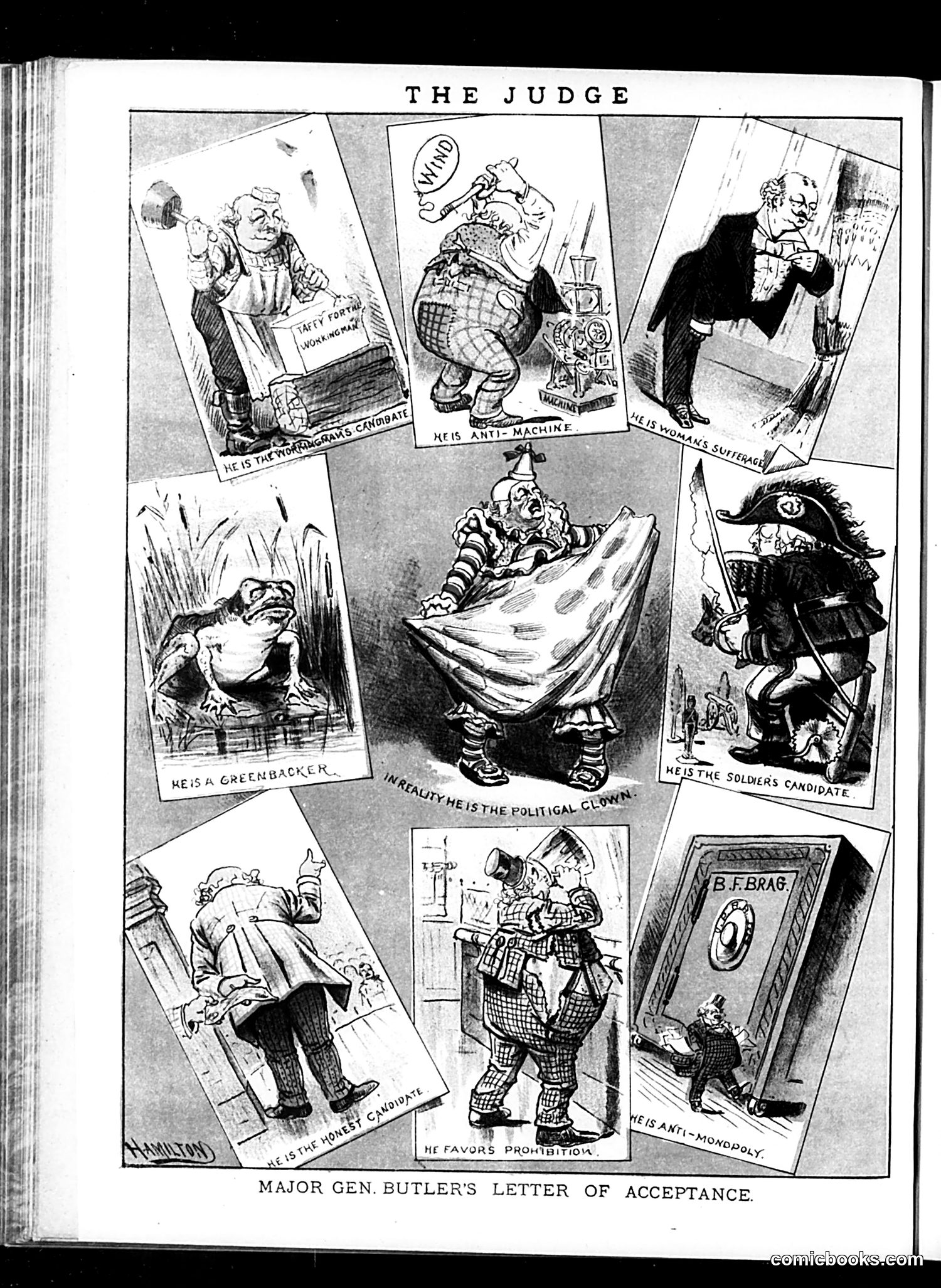
This political cartoon satirizes Major General Benjamin Butler's acceptance of a political nomination. The eight vignettes ridicule his positions and character through caricature: - **"Workingman's Candidate"** and **"Woman Suffragist"**: Shows Butler appealing to working-class and women's rights voters - **"Anti-Machine"** and **"Greenback" candidate**: Positions on political reform and currency - **"Soldier's Candidate"** and **"Political Clown"**: Mocks his military credentials versus perceived buffoonery - **"Honest Candidate,"** **"Prohibition,"** and **"Anti-Monopoly"**: Further policy positions The central panel—**"Insanity is the Political Clown"**—suggests Butler's contradictory stances make him ridiculous. The cartoon implies Butler opportunistically adopts whatever positions appeal to different voter groups, making him an unprincipled political charlatan rather than a genuine leader.