
A complete issue · 16 pages · 1884
Judge — July 19, 1884
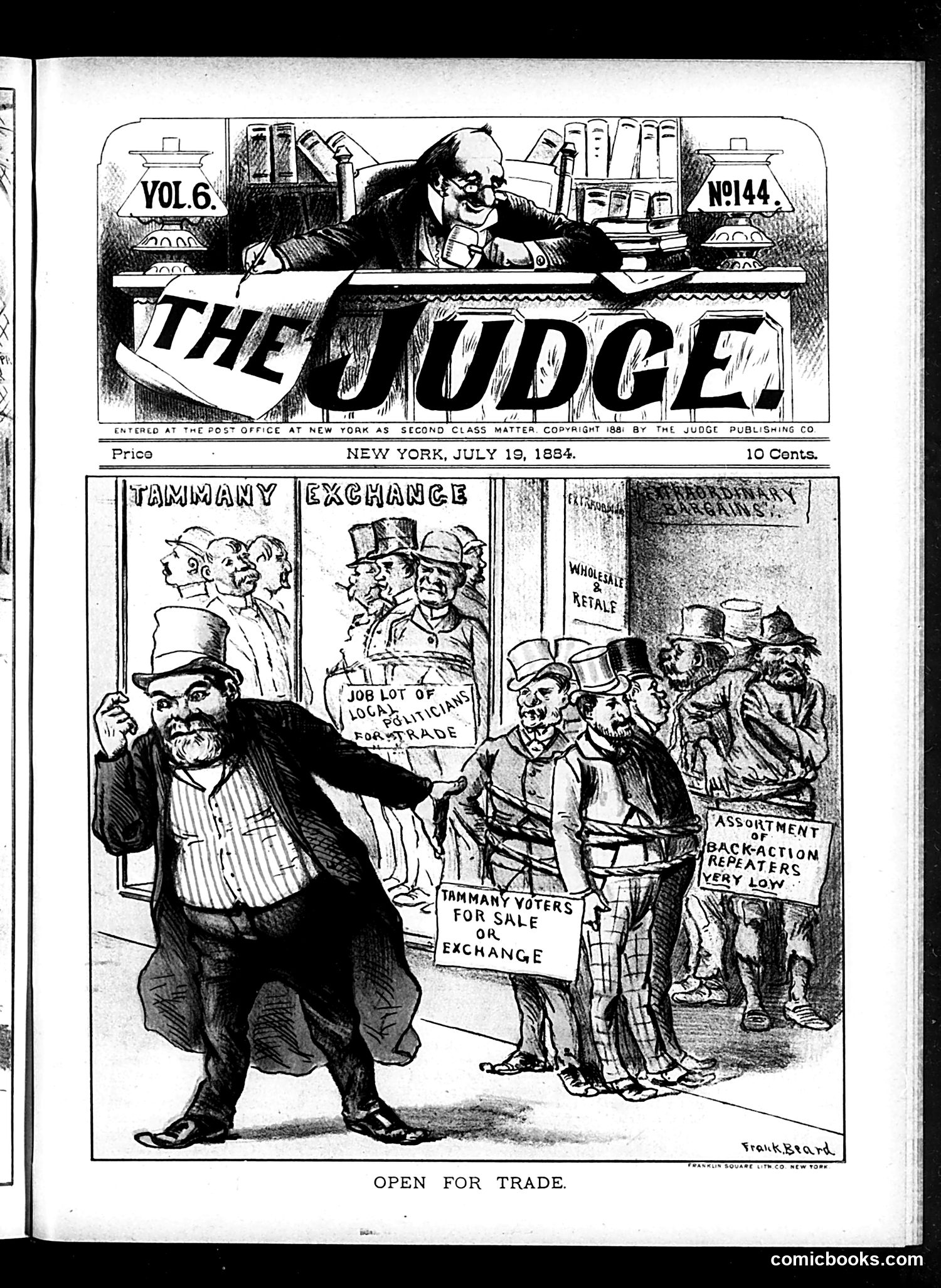
This political cartoon satirizes vote-buying and electoral corruption during the 1884 U.S. presidential election. The large figure on the left, labeled "Tammany," represents Tammany Hall, the notoriously corrupt Democratic political machine that controlled New York City politics. The cartoon depicts Tammany operatives literally selling votes—signs advertise "Tammany Voters for Sale or Exchange" and "Assortment of Back-Action Repeaters Very Low." This references "repeaters," individuals who voted multiple times illegally. The signs mockingly display prices like goods in a shop, titled "Open for Trade." The scene illustrates how Tammany Hall engaged in systematic electoral fraud and vote trafficking, treating voters as commodities to be bought and sold rather than citizens exercising democratic rights. It's a scathing critique of urban political corruption.
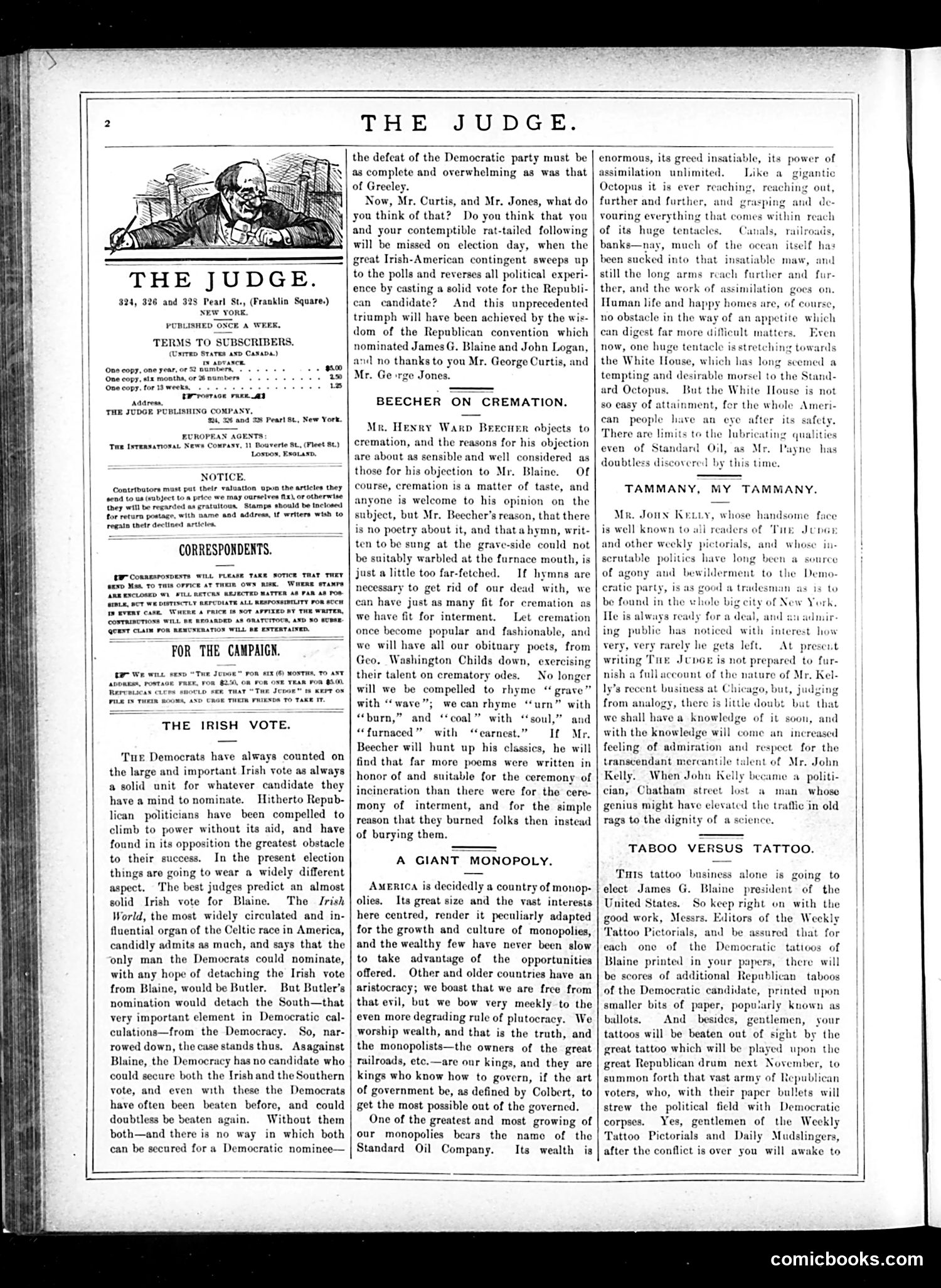
The main cartoon (top left) depicts a grotesque caricature—likely representing Democratic opposition figures—as a scheming rat. The accompanying article "The Irish Vote" argues that Irish-American voters, traditionally Democratic, will defect to Republican James G. Blaine in the upcoming election. Judge claims the Irish World newspaper supports this shift, and that Democrats lack any candidate who could hold both Irish and Southern voters simultaneously. The piece mockingly addresses Democratic critics (Curtis and Jones), suggesting they'll be irrelevant once Irish voters abandon the party. The remaining articles are lighter satire: Henry Ward Beecher's objection to cremation on aesthetic grounds is ridiculed as illogical; a piece on monopolies criticizes Standard Oil and other corporate giants; and commentary on "Tattoo versus Tattoo" discusses campaign ephemera. This reflects Judge's Republican editorial stance during the contentious 1884 presidential race.
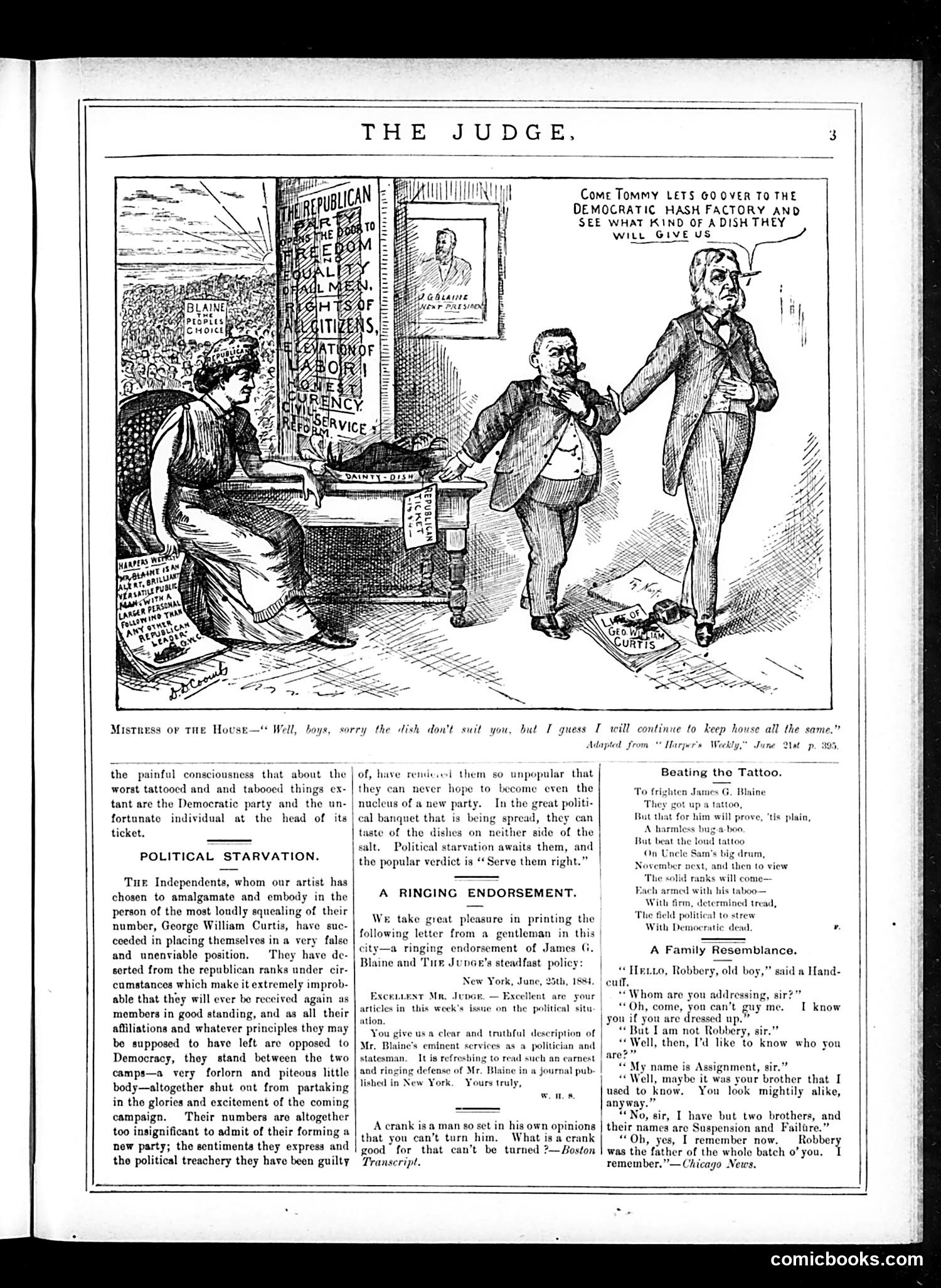
This 1884 page satirizes Republican and Independent politics. The main cartoon depicts the "Mistress of the House" (representing the Republican Party) serving an unappetizing dish to "Tommy" (likely referring to Independent Republicans, particularly George William Curtis, a prominent Independent reformer). The joke: Republicans are warning Independents away from the Democratic "hash factory," but Republicans themselves offer poor fare. The accompanying text attacks Independents for deserting Republicans, leaving them politically isolated—"between the two camps" with "political starvation" awaiting them. Judge argues they're too weak to form their own party and unwelcome elsewhere. A secondary section endorses James G. Blaine (the 1884 Republican presidential candidate), while humorous poems mock Blaine's opponents and make puns about political figures named Suspension and Failure. The page overall defends Republican orthodoxy while ridiculing those who broke ranks.
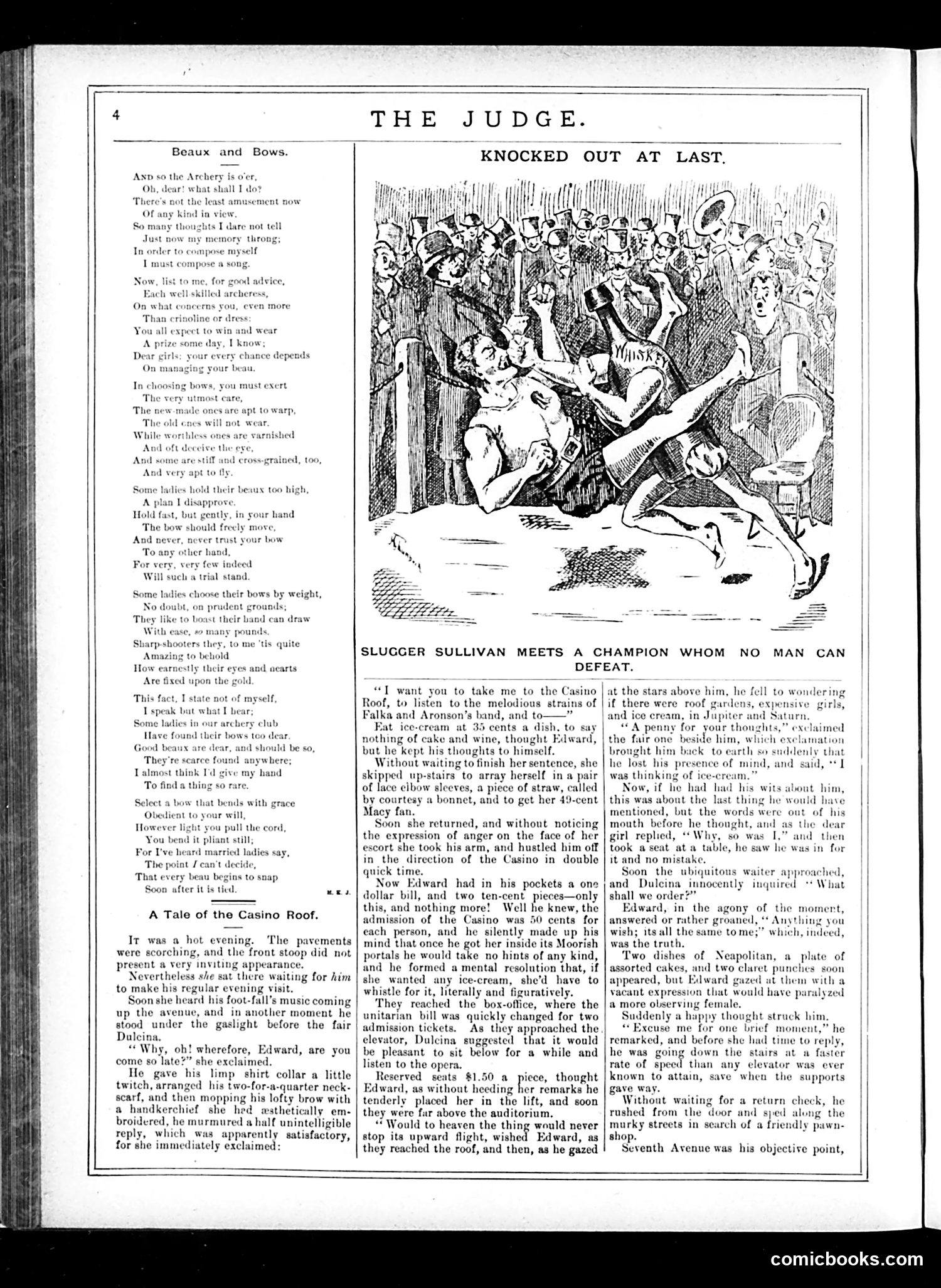
This page contains two distinct pieces. The prominent illustration, titled "Slugger Sullivan Meets a Champion Whom No Man Can Defeat," appears to depict a boxing match or altercation, with "Slugger Sullivan" (likely a reference to the famous boxer John L. Sullivan) being knocked down by an unseen opponent. The crowd's reactions suggest this is presented as a humorous upset. The accompanying story, "A Tale of the Casino Roof," satirizes courtship dynamics and male financial anxiety. Edward, a young man with limited funds (only $1.20), is pressured by his date Dulcina to take her to an expensive Casino Roof venue. The satire mocks his predicament: he must manage admission fees, potential dining costs, and reserved seating while concealing his poverty. The narrative suggests the humiliation of lower-class suitors unable to afford their dates' expectations—a common Judge magazine theme critiquing both feminine materialism and masculine financial insecurity during this era.
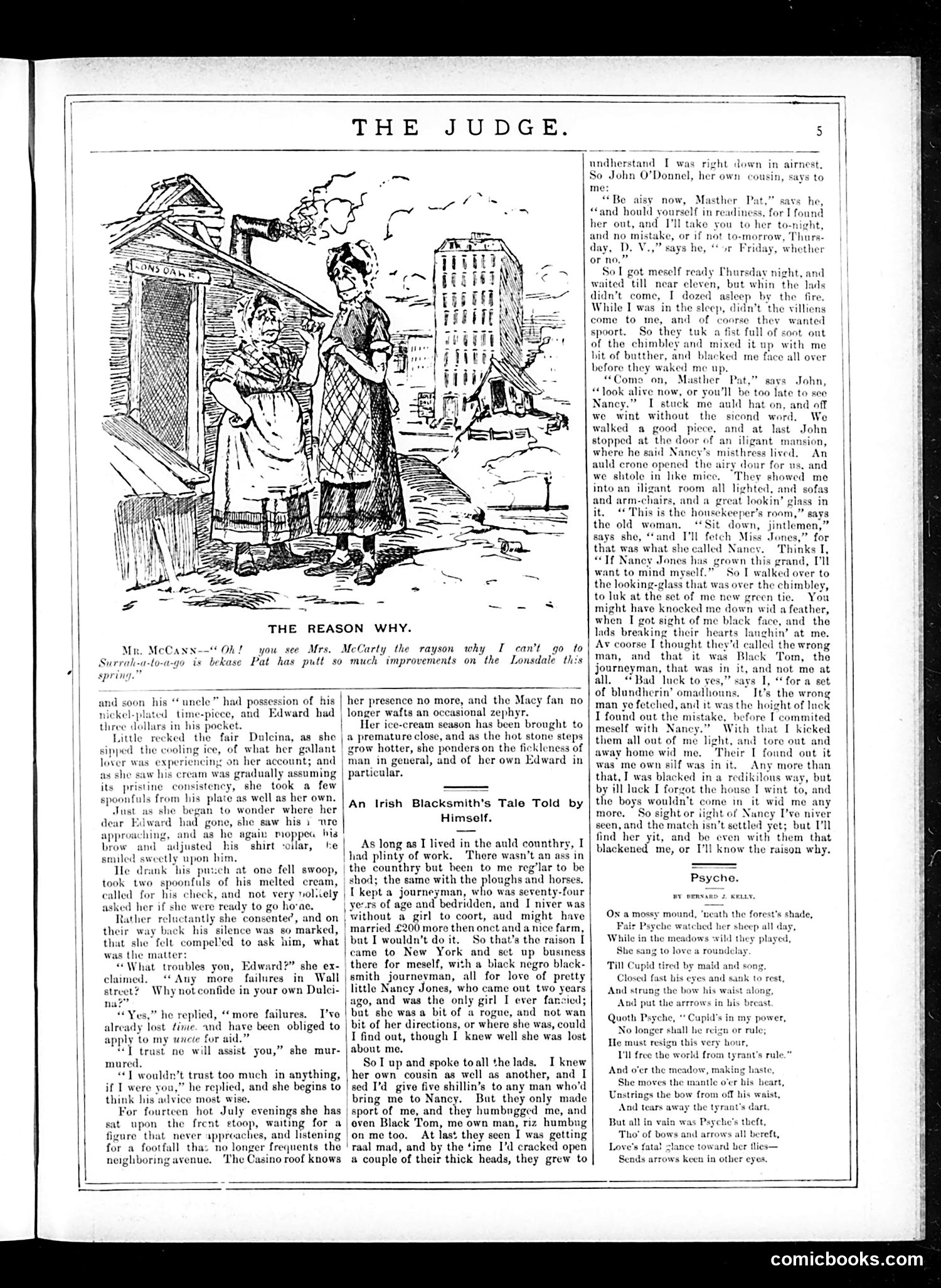
This page contains two distinct pieces of satirical humor typical of late 19th-century Judge magazine: **"The Reason Why"** (top): A cartoon mocking a working-class man's financial irresponsibility. A boyfriend spends money on ice cream dates with his girlfriend, then borrows from his uncle and loses it gambling or speculation. The satire targets both working-class pretensions and the fickleness of relationships—he abandons his patient girlfriend after squandering funds. **"An Irish Blacksmith's Tale"** (bottom): Ethnic humor exploiting Irish immigrant stereotypes prevalent in the era. The narrator speaks in exaggerated Irish dialect ("auld counthry," "Phursday") and describes pursuing a girl named Nancy Jones through increasingly absurd schemes involving physical violence ("cracked open a couple of their thick heads"). The piece ridicules Irish workers as impulsive, violent, and romantically bumbling. Both pieces reflect Judge's approach: punching down at working-class and immigrant communities while presenting their struggles and character flaws as inherently comedic rather than sympathetic.
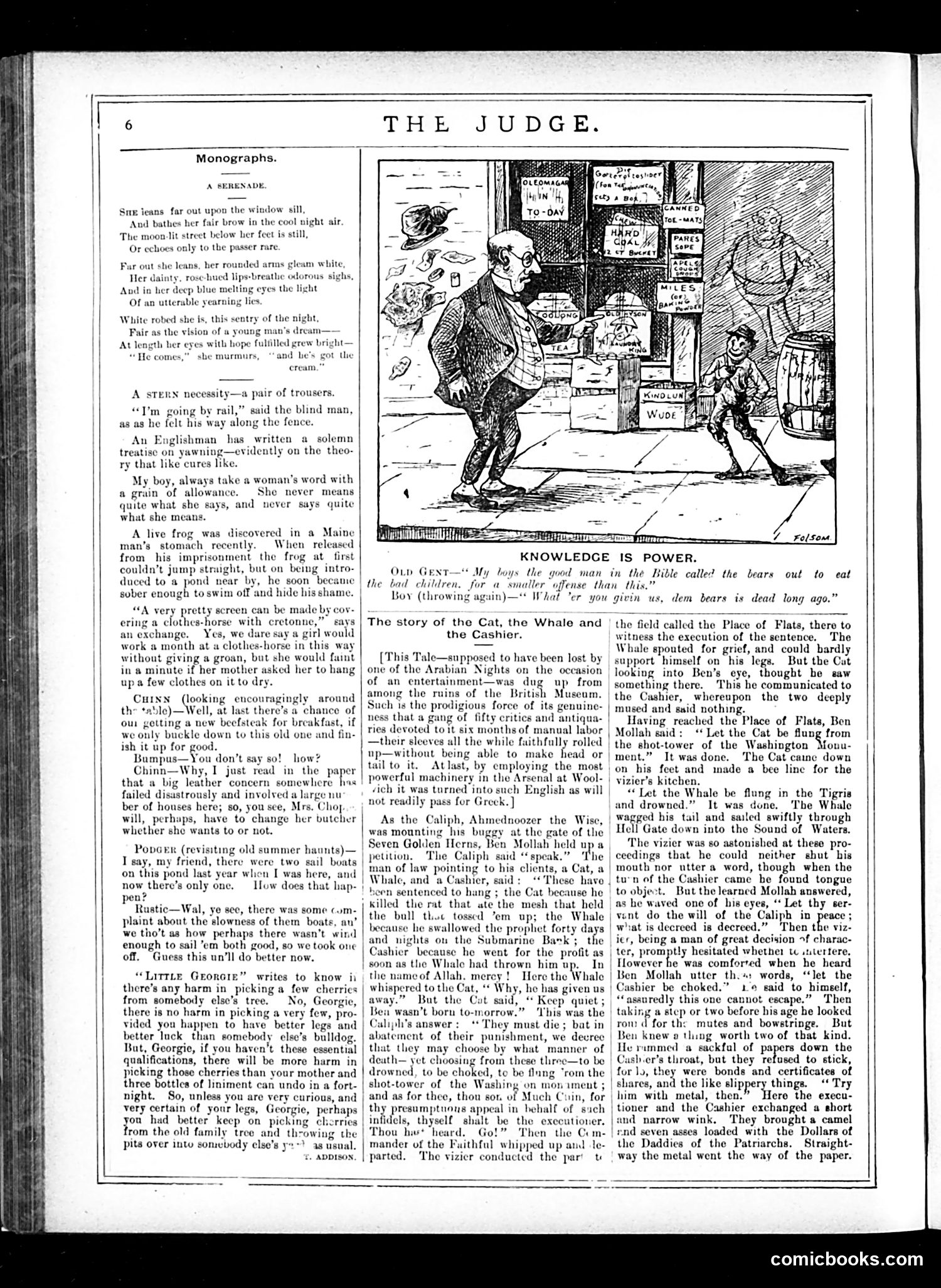
This Judge cartoon depicts a street scene where an old gentleman throws rocks at bears coming from a shop, while a boy repeatedly throws rocks back at him. The caption "Knowledge is Power" sarcastically comments on the interaction. The humor appears to target **class pretension and hypocrisy**. The well-dressed gentleman lectures the boy about morality ("the good man in the book called the bears out to eat the bad children"), yet immediately demonstrates the opposite behavior—violently attacking the bears himself. When the boy mimics his actions, the gentleman protests, revealing his sanctimonious double standard. The cartoon likely satirizes **Victorian moral lecturing** where the wealthy or educated class preached virtue to children and working-class youth while behaving no better themselves. The "knowledge" the gentleman possesses—his education and social standing—fails to produce actual moral conduct, making his authority laughable. This reflects Judge magazine's frequent critique of social hypocrisy during the Gilded Age.
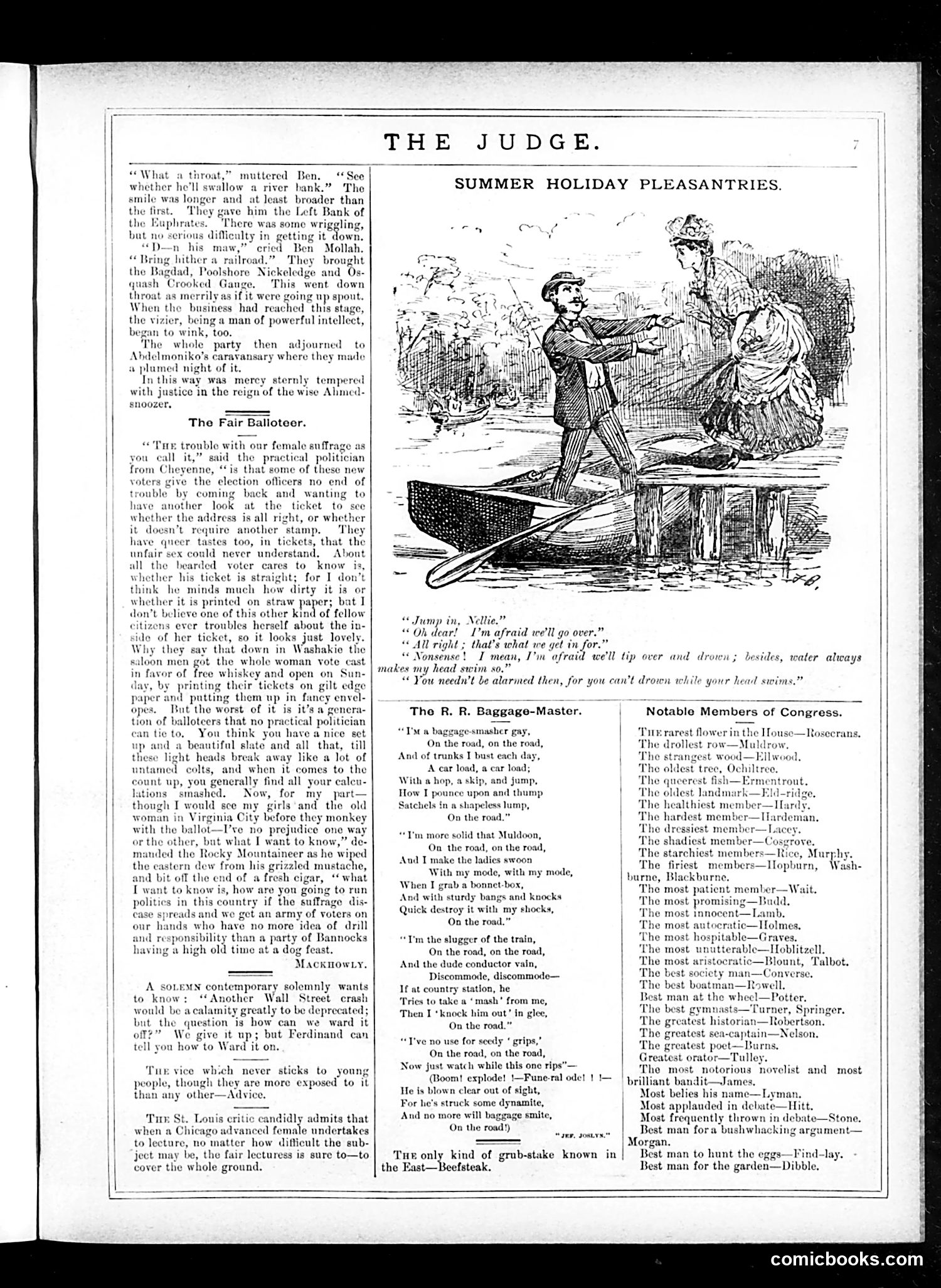
This page from *Judge* contains multiple satirical pieces targeting early women's suffrage and related social issues. **Main Cartoon ("The Fair Balloteer"):** A practical politician from Cheyenne complains that female voters are problematically detail-oriented—examining tickets for addresses, stamps, and appearance—whereas male voters simply care if the ballot is "straight" (politically aligned). The satire mocks both women's newfound voting power and male dismissal of their conscientiousness, suggesting women voters will disrupt established political machinery through their careful attention. **"Summer Holiday Pleasantries":** A humorous dialogue between a couple boating; the woman fears tipping over and drowning, but the man jokes she's safe because her swimming head (dizziness) prevents drowning—crude humor playing on female delicacy stereotypes. **Other Content:** Filler pieces include verse about a baggage-master and a list of "Notable Members of Congress" with mocking physical/character descriptions. The page reflects late-19th/early-20th-century anxieties about women's suffrage, presenting women voters as either dangerously meticulous reformers or frivolous and fragile.
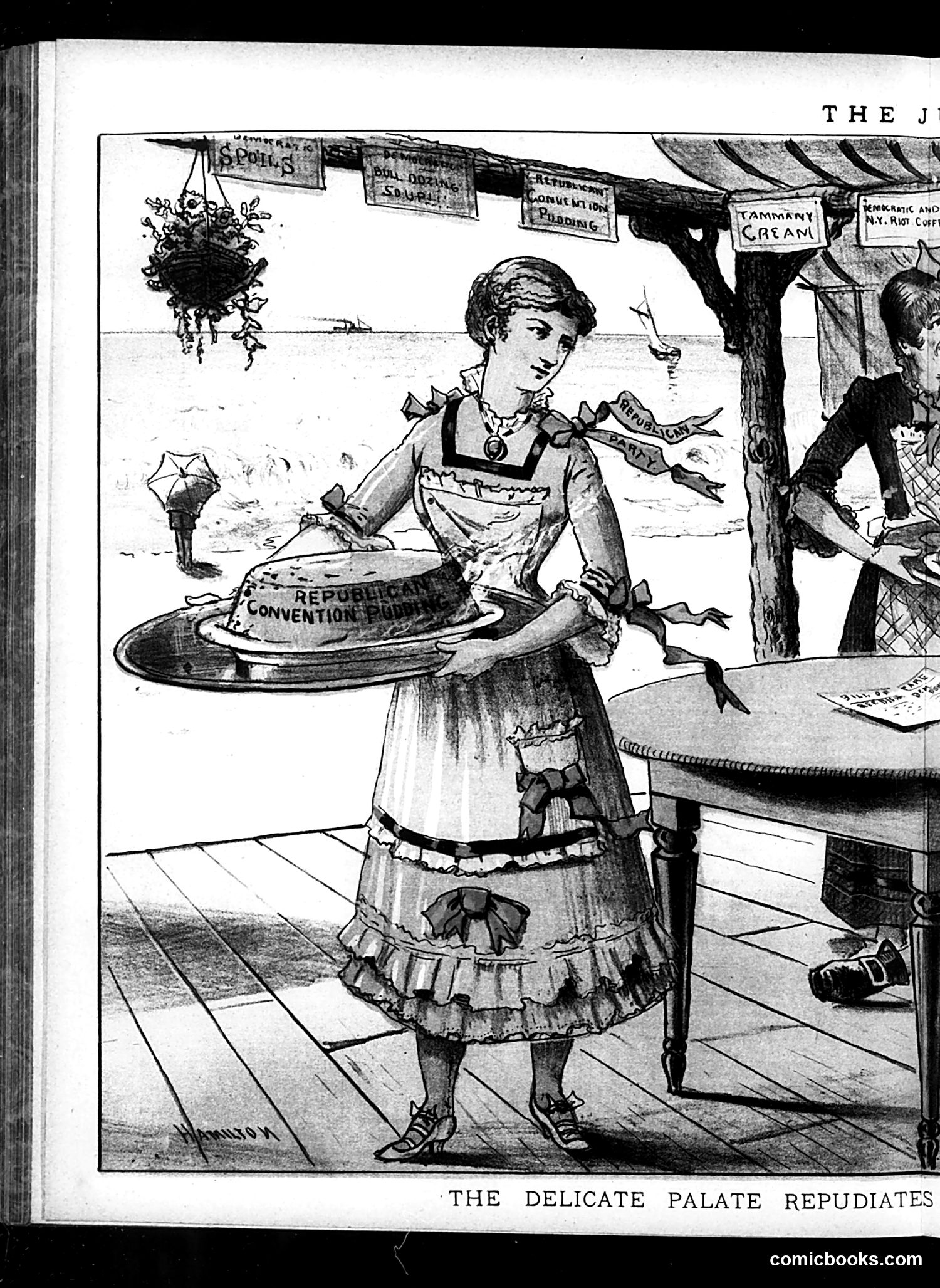
This political cartoon satirizes the Republican Party's rejection of something distasteful. The central figure—a woman in elegant dress—represents either "refined taste" or possibly the Republican Party itself. She holds a plate labeled "REPUBLICAN CONVENTION," which she's pushing away with visible disgust. The caption "The Delicate Palate Repudiates" suggests Republicans are rejecting their own convention's offerings or decisions as unpalatable. The beach setting and various shop signs (including "Tammany Cream") indicate this occurs at a public gathering, likely critiquing Republicans for abandoning mainstream positions or candidates in favor of something their leadership finds objectionable. Without knowing the specific date, the exact target remains unclear, though the satire mocks Republican squeamishness about their own party platform.
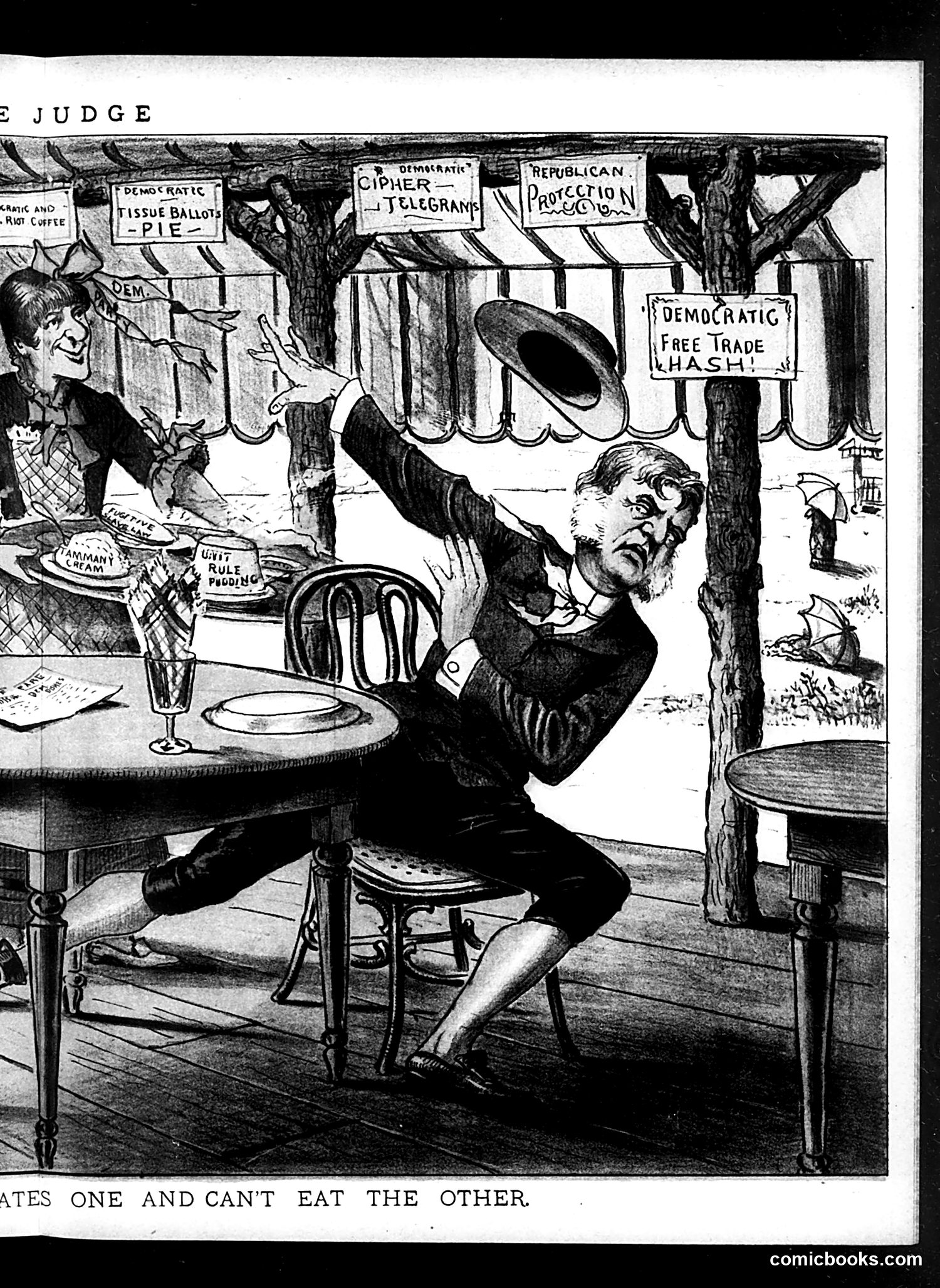
This Judge magazine cartoon satirizes the incompatibility of Democratic and Republican political platforms. The central figure appears distressed, juggling a large hat while seated at a table in what looks like a political "diner" or café. Signs visible include "Democratic Tissue Ballots Pie," "Democratic Cipher Telegram," "Republican Protection," and "Democratic Free Trade Hash." The cartoon's title—"Ates One and Can't Eat the Other"—suggests the two parties offer fundamentally opposing policies that cannot coexist or be reconciled. The juggling and struggle depicted implies political paralysis or the impossibility of satisfying both ideologies simultaneously. This likely references late 19th or early 20th-century debates over tariffs, currency, and trade policy that deeply divided Democrats and Republicans.
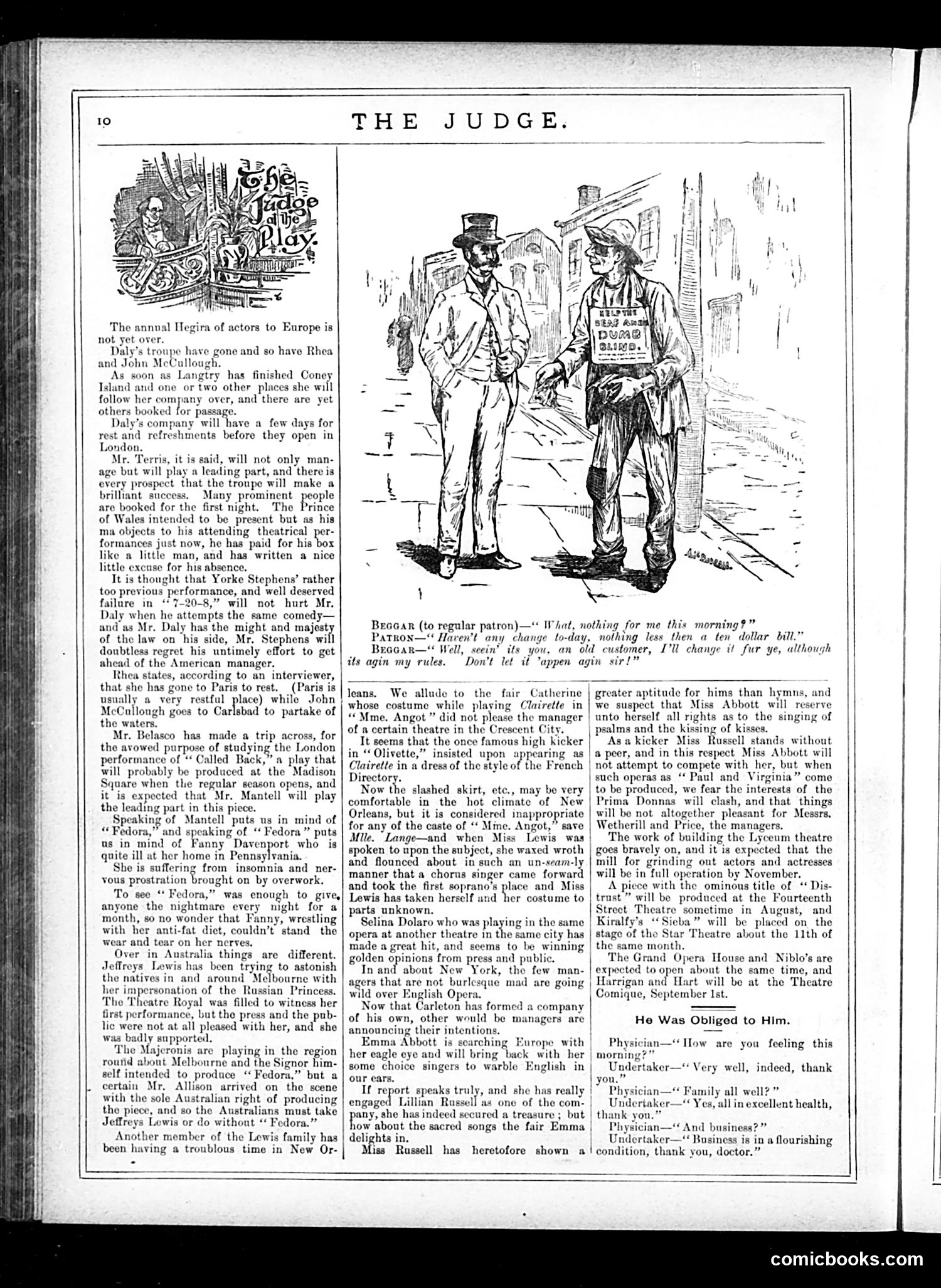
This page from the satirical magazine *Judge* discusses the theatrical world of the 1880s, focusing on actors and actresses traveling to Europe for performances. **Main Cartoon:** The illustrated dialogue shows a beggar and a regular patron. The beggar requests money, the patron claims to have no change except a ten-dollar bill, and the beggar agrees to change it "although it's agin my rules"—a humorous reversal where the poor man accommodates the wealthy one. **Text Content:** The article chronicles theatrical "migrations" to Europe, mentioning performers like Daly's troupe, Langtry, and others. It notes the Prince of Wales intended attending but his mother objected to theatrical performances, so he paid for his box and sent an excuse. The piece also discusses theatrical scandals, including Yorke Stephens' failed performance and various actors' travels to London, Paris, and Australia. **Satire:** The humor targets both theatrical pretensions and social hypocrisy—particularly the Royal Family's public piety conflicting with private indulgence.
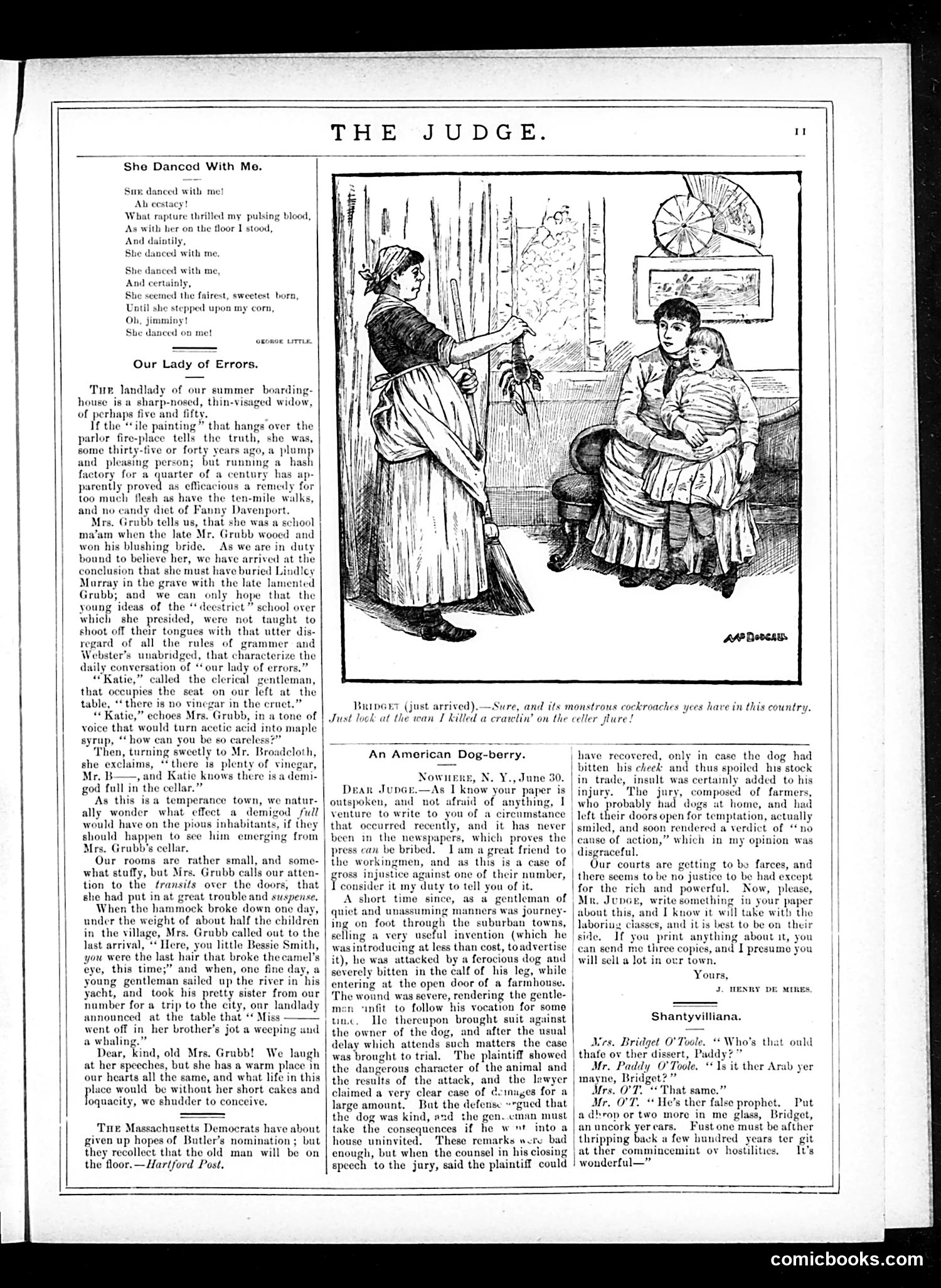
This page contains three satirical pieces from Judge magazine: **"She Danced With Me"** (poem): A humorous romantic poem that subverts expectations—the speaker rhapsodizes about dancing with a woman until she steps on his corn, deflating the sentimentality. **"Our Lady of Errors"** (main article): Mocks a boarding house landlady for her constant grammatical mistakes and malapropisms—she says "deestrict" for "district," "fh" instead of "fish," and "demigod full" instead of "demidemijohn" (a large bottle). The satire ridicules her pretensions to education despite being a former schoolteacher, now reduced to running a boarding house. **"An American Dog-berry"** (letter): Satirizes small-town justice and corruption. A traveling salesman is bitten by a dog; the article implies the press can be bribed to suppress stories and local courts fail workingmen. "Dog-berry" references a bumbling character from Shakespeare, suggesting incompetent local officials. All three pieces mock American social pretension, incompetence, and hypocrisy through exaggeration and wordplay.
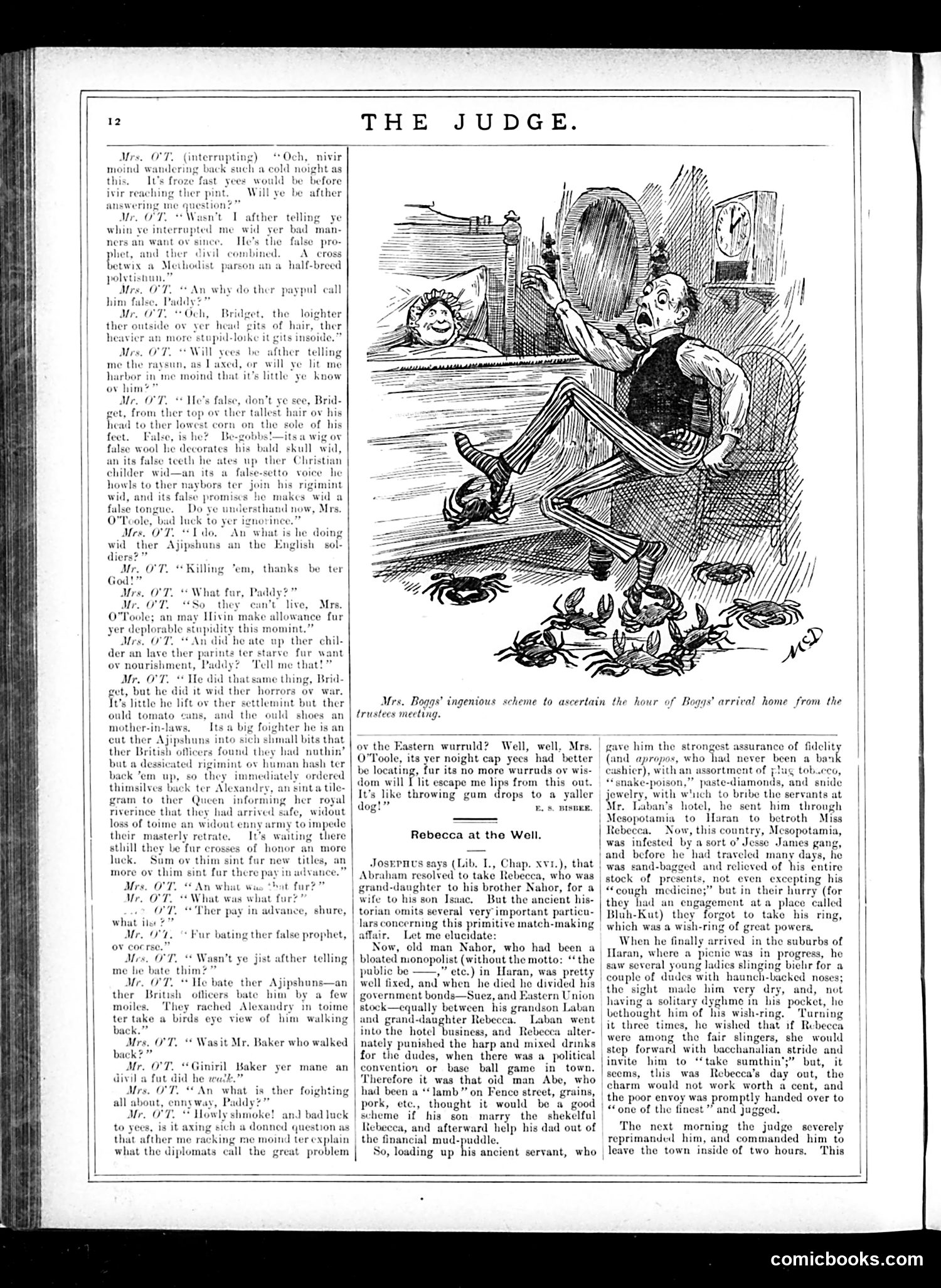
This page contains two separate satirical pieces: **"Mrs. O'Toole's Complaint"** (dialogue with illustration): An Irish-American woman (Mrs. O'T.) complains to her husband about a military officer—likely General Baker—who devastated Egypt during colonial military campaigns. She sarcastically catalogs his destruction and false pretenses ("false teeth," "false wool" wig). The satire mocks both the officer's brutality under the guise of civilization and the Irish immigrant's comic malapropisms, a common Judge stereotype of the era. **"Rebecca at the Well"** (article): A humorous retelling of the Biblical Rebecca's story reimagined as American capitalism. The piece satirizes wealthy monopolists and financial schemes by portraying patriarch Abraham as scheming to marry his son Isaac to the wealthy Rebecca to solve financial troubles—treating ancient scripture through a Gilded Age lens of greed and mercenary marriage. Both pieces use exaggerated ethnic/religious caricature typical of 1880s-90s satirical humor to critique imperialism, wealth inequality, and social climbing.
This page from Judge magazine contains several satirical pieces typical of late 19th-century American humor: **"Only a Dozen Pairs of Pants"** mocks Republican presidential candidate James G. Blaine by suggesting his candidacy is weakened because he owns only twelve pairs of pants—implying unfitness for office based on modest means. The joke references the 1884 election and contrasts Blaine with the wealthier G. William Curtis. **"The Court Was Innocent"** satirizes a rural judge's incompetence. A plaintiff attempts to explain a card-game dispute using euchre terminology ("trumped," "refused suit"), which the judge confuses with literal meanings (refusing to be sued, a physical club). The joke ridicules judicial ignorance and suggests the judge cheats at cards himself. The remaining pieces employ similar gentle mockery of contemporary social situations and public figures. The magazine's humor relies on wordplay, misunderstandings, and critiques of American institutions and politics rather than visual cartoons.
This page from the satirical magazine *Judge* contains multiple short humorous anecdotes mocking various social types and situations: **"The Revolution and the Ticket Agent"** satirizes political upheaval (likely referencing Cuban or Mexican revolutions of the era) by personifying "Revolution" as a chaotic, thoughtless figure unable to decide where it's actually going—a jab at revolutionary movements lacking clear direction or purpose. **"Getting Mixed"** ridicules German immigrants' mangled English through a Biblical anecdote, reflecting period ethnic stereotyping common in American humor. **Other pieces** mock Irish immigrants ("Good Enough for Boarders"), incompetent mourners, and various foolish characters. The ads for Columbia Bicycles and Pennyroyal Pills round out the page. The overall tone reflects *Judge*'s satirical approach: mocking immigrants, the poor, and anyone deemed socially inferior or ridiculous through exaggerated dialect and absurd scenarios. This represents late-19th-century American satirical humor's heavy reliance on ethnic caricature and class-based ridicule.
This page is primarily **advertising with brief satirical commentary**, typical of Judge magazine's format. The small jokes scattered throughout are social satire: - **Tom Ochiltree reference**: A wild hog captured in Georgia is compared to Tom Ochiltree (a notorious 19th-century gambler/scoundrel), suggesting he was equally wild and dangerous. - **Chinese doctor joke**: Mocks American doctors' profit motive—contrasting a Chinese doctor who works on contingency (only paid if patient recovers) with American practitioners who charge regardless of outcomes. - **Sarah Bernhardt suicide quip**: Satirizes the famous actress and sensationalism—suggesting she wouldn't actually harm herself since suicide wouldn't benefit her "next world" appearance. - **Various relationship jokes**: Stock humor about homely wives, elopement, and marital disappointment typical of Victorian-era comedy. - **"Algebra" misunderstanding**: Rural traveler confuses the town name with the math subject. The bulk of the page consists of **period advertisements** for pianos, breweries, lithography services, and patent medicines—essentially a classified ads section with light humor interspersed.
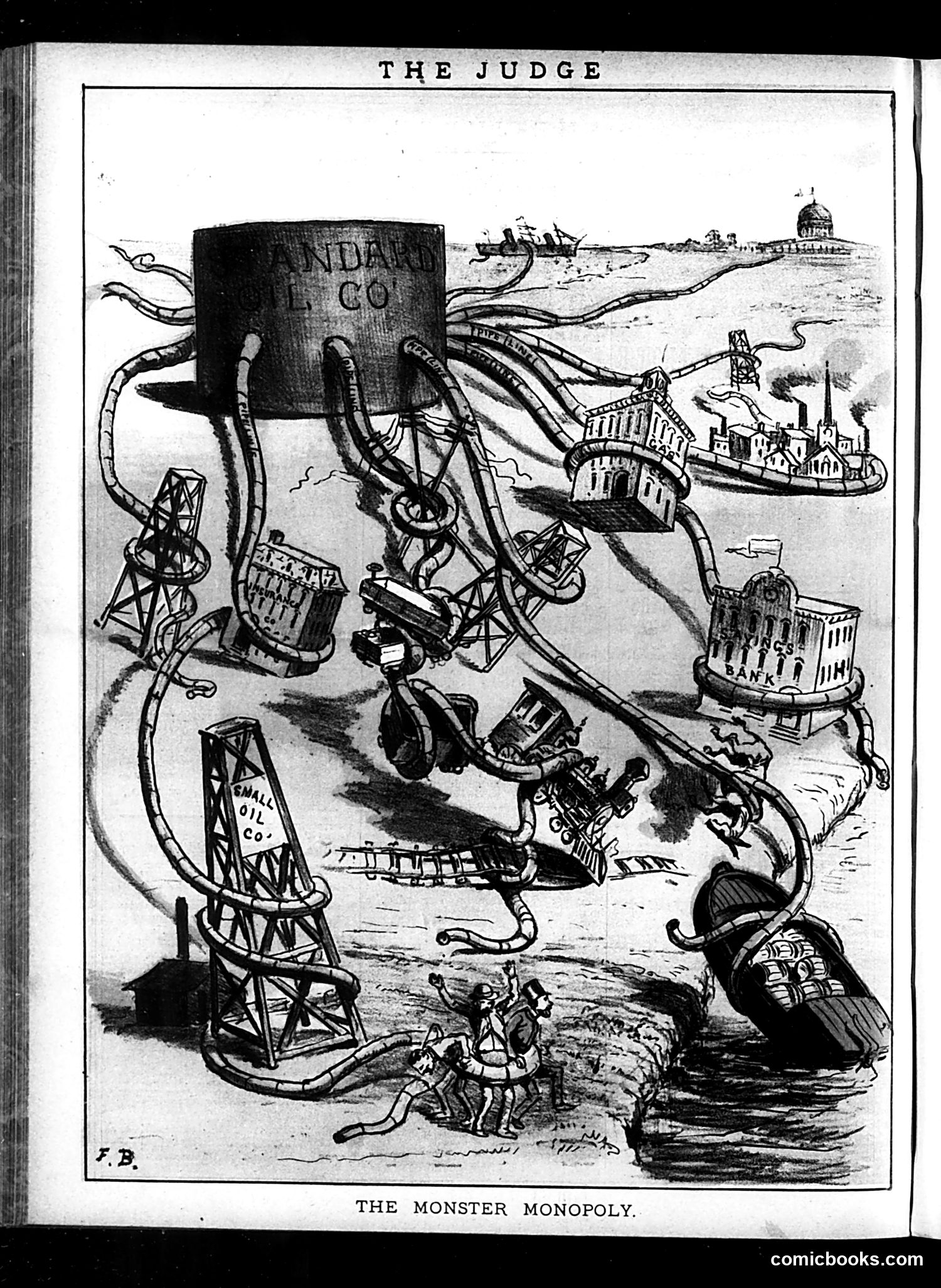
This cartoon depicts Standard Oil Company as a giant octopus strangling American institutions. The octopus's tentacles reach toward various buildings labeled "BANK" and other structures representing major industries and infrastructure. Oil derricks and industrial facilities surround the scene, while tiny human figures appear helpless below. The cartoon critiques corporate monopoly power—specifically Standard Oil's dominance under John D. Rockefeller. The octopus metaphor was a common visual trope for monopolies that "strangled" competition and controlled multiple sectors of the economy. This reflects the Progressive Era's antitrust concerns and public anxiety about unchecked corporate consolidation threatening democratic institutions and economic fairness.