
Judge, 1884-07-19 · page 12 of 16
Judge — July 19, 1884 — page 12: what you’re looking at
What you’re looking at
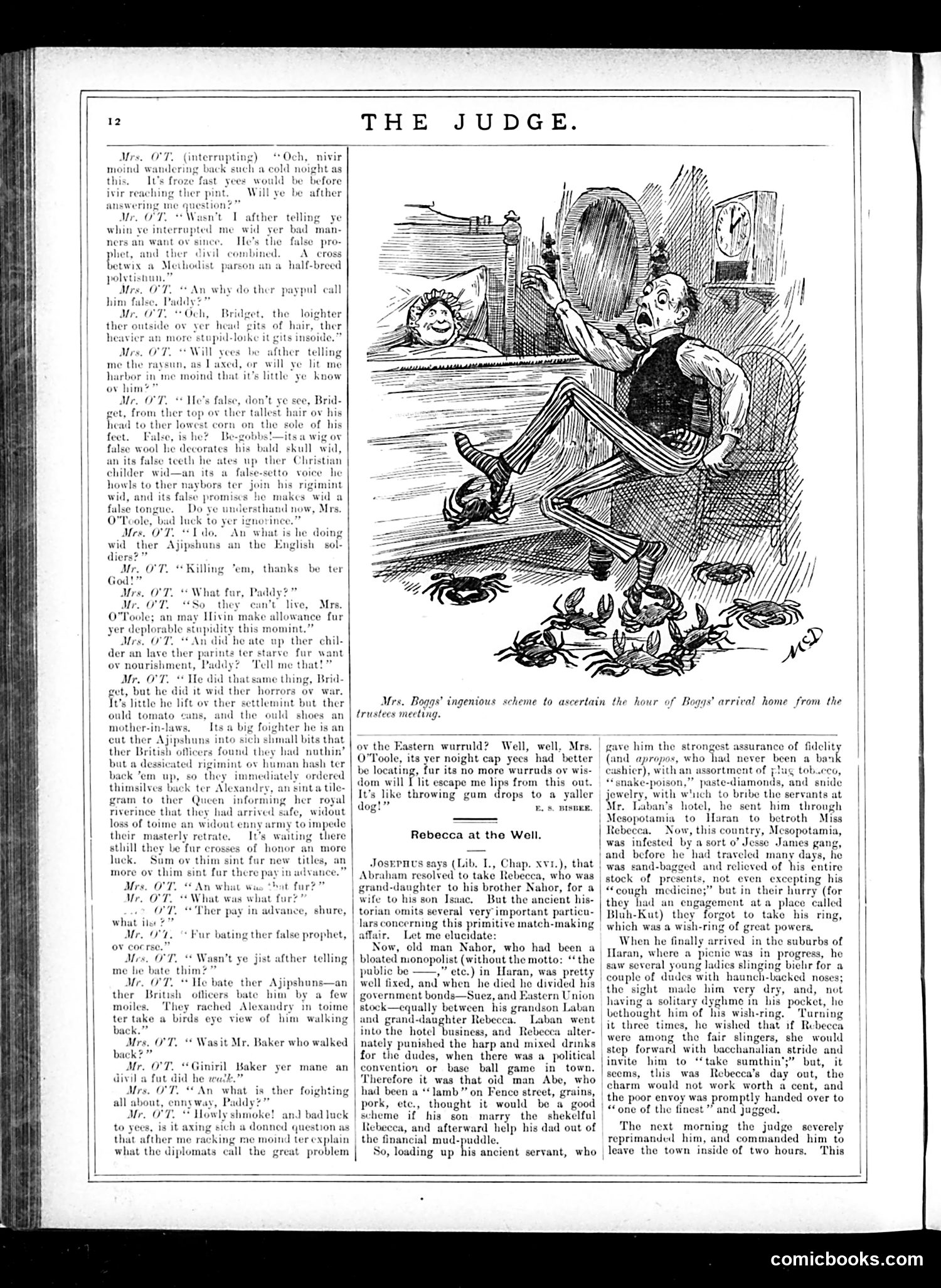
This page contains two separate satirical pieces: **"Mrs. O'Toole's Complaint"** (dialogue with illustration): An Irish-American woman (Mrs. O'T.) complains to her husband about a military officer—likely General Baker—who devastated Egypt during colonial military campaigns. She sarcastically catalogs his destruction and false pretenses ("false teeth," "false wool" wig). The satire mocks both the officer's brutality under the guise of civilization and the Irish immigrant's comic malapropisms, a common Judge stereotype of the era. **"Rebecca at the Well"** (article): A humorous retelling of the Biblical Rebecca's story reimagined as American capitalism. The piece satirizes wealthy monopolists and financial schemes by portraying patriarch Abraham as scheming to marry his son Isaac to the wealthy Rebecca to solve financial troubles—treating ancient scripture through a Gilded Age lens of greed and mercenary marriage. Both pieces use exaggerated ethnic/religious caricature typical of 1880s-90s satirical humor to critique imperialism, wealth inequality, and social climbing.
📄 Transcribed text from this page (OCR, searchable)
Machine-transcribed from the original scan — historical spelling and the odd misread are preserved.
THE JUDGE. Mrs. O'T. moind wander! (i nivir ight befor ivir reac a answerit Ur. OT, I afther telling ye whin ye interrupted me wid yer bad man- ners an want ov since. Ile’s the false pice and ther divil combined. yOtwiX pol Mrs. OT” him false Mr, OT, ther out ich, . the loighter ov yer heal pits of hair, ther tupid-loike it 2 Will afther telling Taxed, or will ye lit me me moind that it’s little ye know insoide. yees be false, don’t ye see, Brid- y ov ther tallest hair ov his » of his Lwig ov false wool he decorates his bald skull wid, an its false teeth he ate childer wid—an its a howls to ther naybors t and its fals tongue. Do ye ur i luck to yer “JT do. Ajipshuns ay his rigimint makes wid a hand now, Mrs. “Killing ’em, thanks be ter Mrs. fur n't live, an may Iivin make allowan yer deplorable stupidity this momint.” Mrs, OT. ** An did he ate up ther chil- lave ther parints ter starve fur want ov nour addy? ‘Tell me that! Mr. € “He did thatsame thing, Brid- get, but he did it wid ther horrors ov war. It’s little he lift ov ther settlemint but ther ould tomato cans, and the ould shoes an mother-in-law 1 big foighter he is an cut ther Ajipshuns into sich shmall bits that ther British officers found they had nuthin’ but a dessicated rigimint ov human hash ter back ’em up, so they immediately ordered thimsilves back ter Alexandry, an sinta tile- gram to ther Queen informing her royal riverince that they had arrived safe, widout | loss of toime an widout enny army to impede asterly retrate. It’s waiting there y be fur crosses of honor an more What was what f ‘Ther pay in advance, shure, “Fur bating ther false prophet, n't ye jist afther telling an oflicers bate him by a few They rached Alexandry in toime a birds eye view of him walking ther British moiles. ter tal back. rs. OT. “* Wasit Mr. Baker who walked Mr. OT. “Giniril Baker yer mane an divila fu he walk.” Mrs. O'T. “An what is ther foighting all about, cnny way, Padd Mr. OT. © Mowly sh to yees, is it axir question as that afther me r ng me moind ter explain what the diplomats call the great’ problem ke! an ich a donned trustees meeting. ov the Eastern wurruld? Well, well, Mrs O'Toole, its yer noight cap yecs had bett. be locating, fur its no more wurruds ov wi dom will I lit escape me lips from this ou It’s like throwing gum drops to a yaller dog!” F. 8. BINDER, Rebecca at the Well. Josernvs says (Lib. 1, |p. XVI), that Ab am resolved to taki cca, who was gran ghter to his brother Nahor, for a wife to his son Isaac. But the ancient his- torian omits several very important part lars concerning this primitive match-ma affair, Let me elucidate: Now, old man Nahor, who had been a bloated monopolist (without the motto: ‘the public be —,” ete.) in Haran, was pretty well fixed, and when he died he divided his government bonds—Suez, and Eastern Union stock—equally between his grandson Laban and grand-daughter Rebecca. Laban went into the hotel business, and Rebecca alter- nately punished the harp and mixed drinks for the dudes, when there was a_ political convention or base ball game in town. Therefore it was that oid man Abe, who had been a ‘‘lamb” on Fence street, grains, | pork, e thought it would be a good scheme if his son marry the shekelful Rebecca, and afterward help his dad out of the financial mud-puddle. So, loading up his ancient servant, who s Mrs. Boggs’ ingenious scheme to ascertain the hour of Boggs’ arrival home from the gave him the strongest assurance of fidelity (and apropos, who had never been a ban hier), withan assortment of ps ke-poison,” paste-diamonds, and snide jewelry, with which to bribe the servants at Mr. Laban’s hotel, he sent him through | Mesopotam to Haran to betroth Miss | Rebecca. Now, this country, Mesopotamia, | was infested by a sort o’ Jesse James gang, and before he had traveled many days, he 1 and relieved of his entire stock of pre + not even excepting his | cough medicine;” but in their hurry (for they had an engagement ata place called Bluh-Kut) they forgot to take his ring, which was a wish-ring of great powers. When he finally arrived in the suburbs of Haran, where a picnic was in progres saw several young ladies slinging biehr for a couple of dudes with haunch-backed noses; the sight made him very d ing a solitary dyghme in hi bethought him of his wish-ring. Turning it three times, he wished that if Rebecca were among the fair slingers, she would step forward with bacchanalian stride and jinvite him to ‘‘take sumthin’;” but, it |seems, this was Rebecca’s day out, the charm would not work worth a cent, and the poor envoy was promptly handed over to “one of the finest ” and jugged. Tho next morning the judge severely reprimanded him, and commanded him to leave the town inside of two hours. This comicbooks.com