
A complete issue · 16 pages · 1884
Judge — July 12, 1884
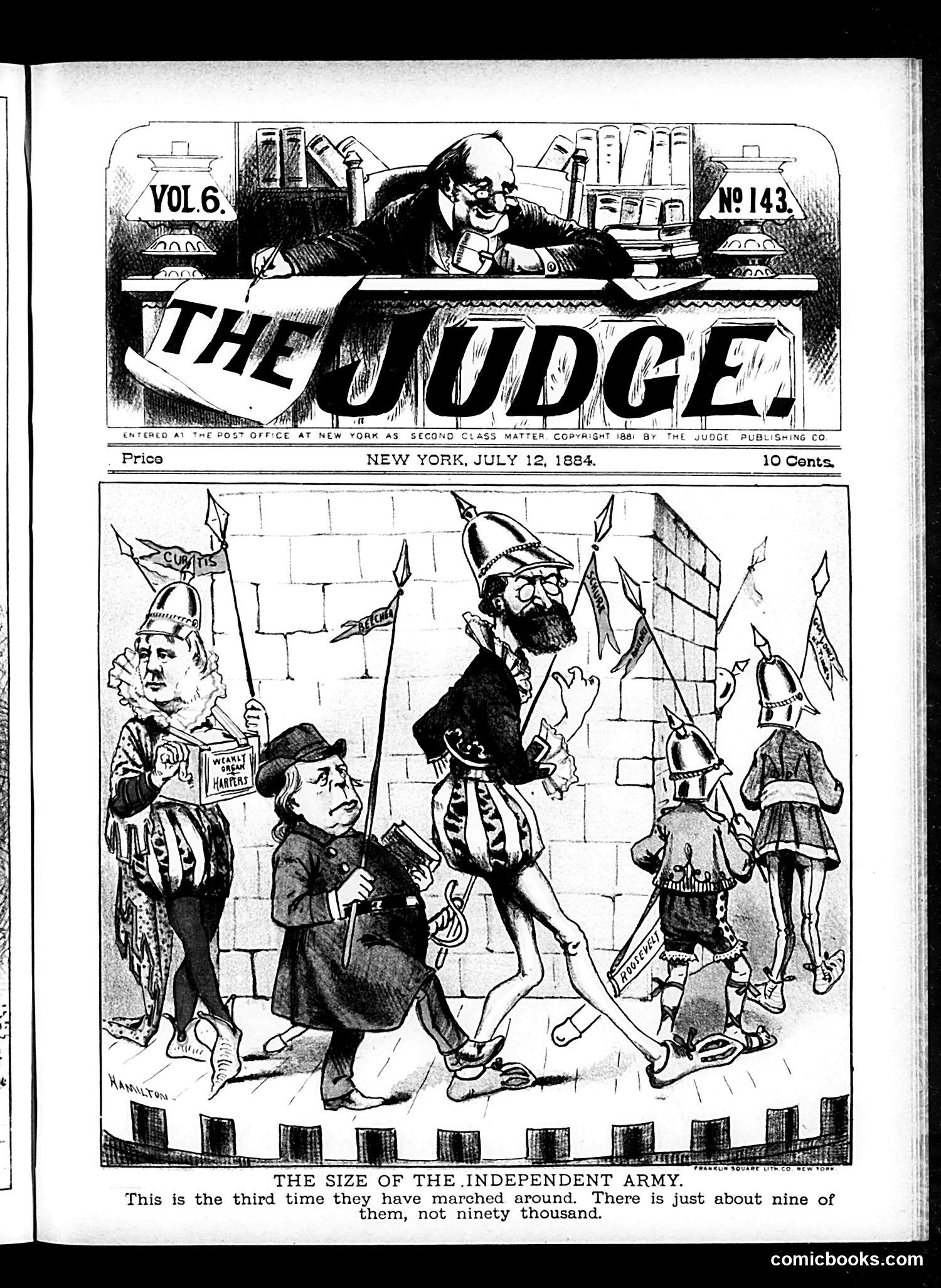
This 1884 *Judge* cartoon satirizes the "Independent Army"—likely referring to independent voters or a splinter political faction during that election year. The caption states this is "the third time they have marched around. There is just about nine of them, not ninety thousand." The joke mocks the group's grandiose self-presentation: tiny figures dressed in military regalia and spiked helmets march around dramatically, suggesting they parade repeatedly with inflated claims about their size and significance. The cartoonist ridicules their actual insignificance—only nine members—versus their apparent aspirations to be a major political force. The satire targets political pretension and exaggeration common to minor parties seeking relevance.
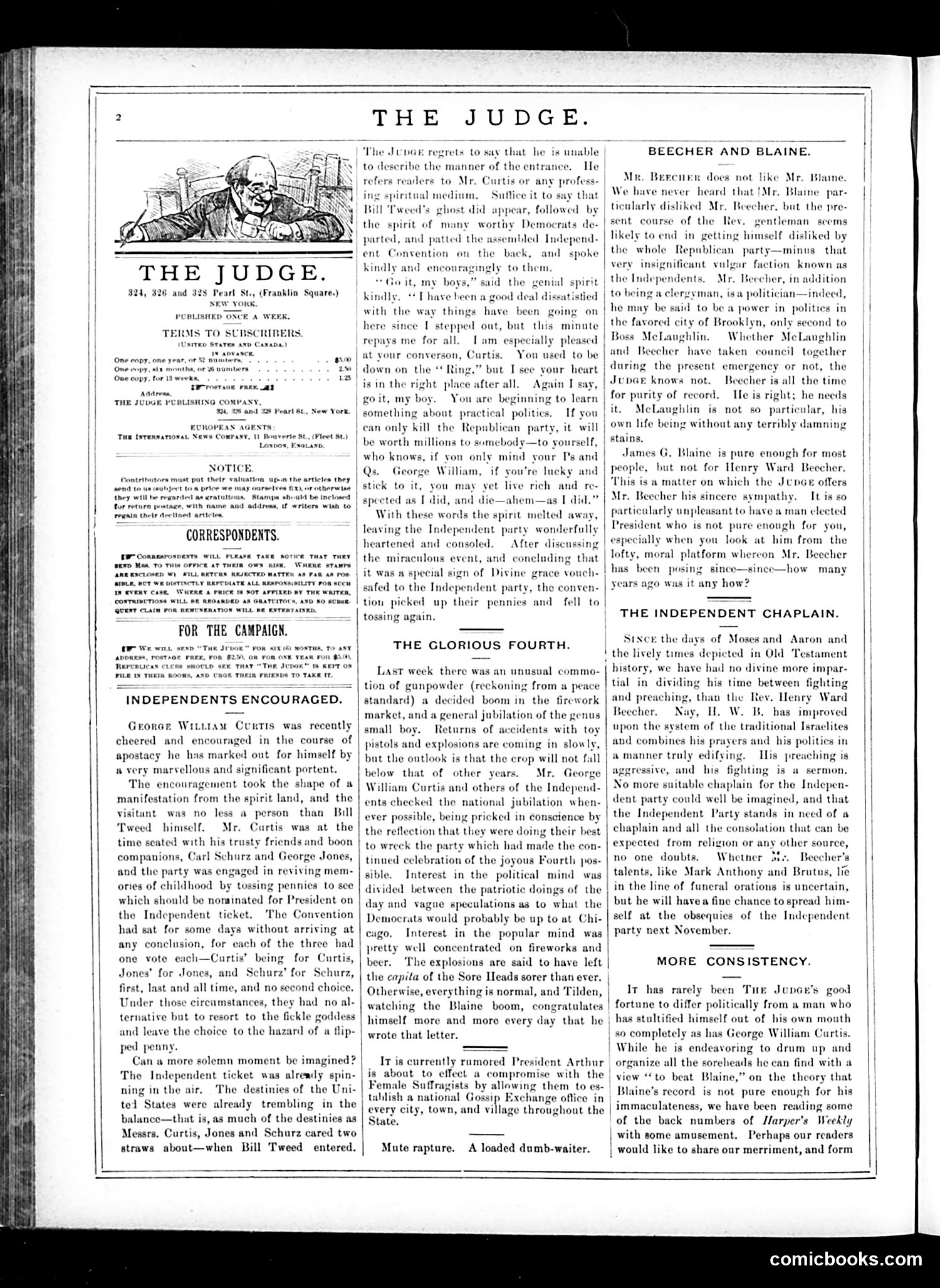
This page satirizes the **Independent political party** and its leaders during what appears to be the 1870s. The main cartoon depicts a spiritualist séance where **George William Curtis, Carl Schurz, and George Jones**—Independent Party figures—flip coins to choose their presidential candidate. The satire's punchline: the ghost of **Boss Tweed** (the notorious Tammany Hall Democrat who had recently died) appears to encourage them, suggesting their "reform" efforts actually benefit corrupt Democrats by splitting the Republican vote. The text mocks the Independents' disorganization and questions their moral authority—if even Tweed's ghost supports them, perhaps they're not truly reformist. The satire also hints that Curtis and others may be motivated by personal political ambition rather than genuine principle. This reflects deep skepticism about the 1870s Independent/"Liberal Republican" movement and its claims to pure governance.
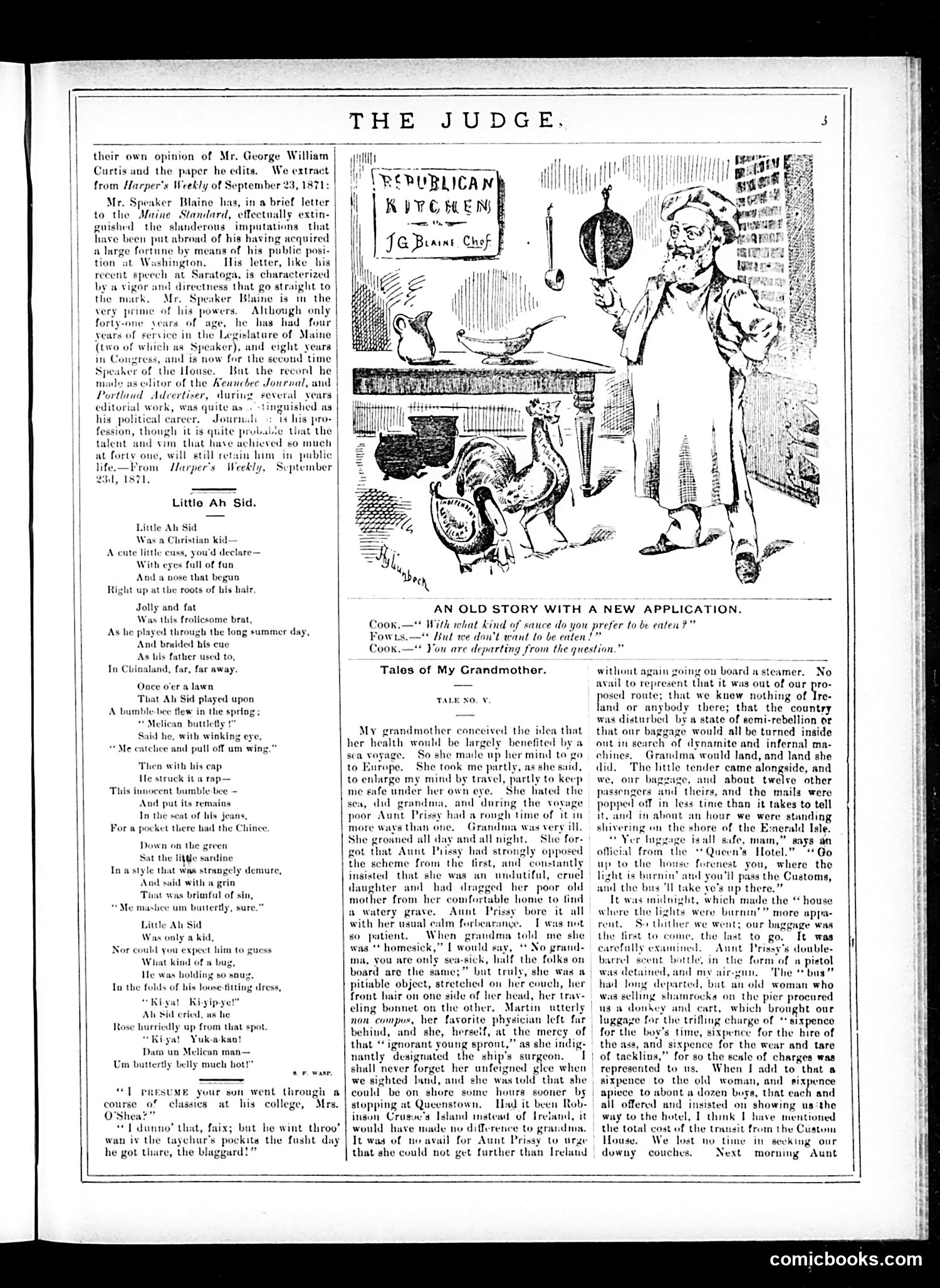
## Main Cartoon: "An Old Story with a New Application" This depicts a cook confronting poultry (likely fowl representing a political figure or group). The dialogue—where the cook asks what sauce the fowl prefers to be eaten with, and the fowl protests "we don't want to be eaten!"—appears to satirize a political scenario where someone is being forced into an unwanted situation despite objections. The "new application" suggests this classic scenario is being reapplied to contemporary 1871 politics, though the specific reference remains unclear from the image alone. ## Supporting Content The page includes poems mocking Chinese immigrants ("Little Ah Sid") through racial stereotypes, and domestic humor pieces. There's also commentary on Speaker James G. Blaine's finances and editorial disputes with George William Curtis of *Harper's Weekly*. The overall page reflects 1870s American satirical humor combining political commentary with ethnic stereotyping typical of the era.
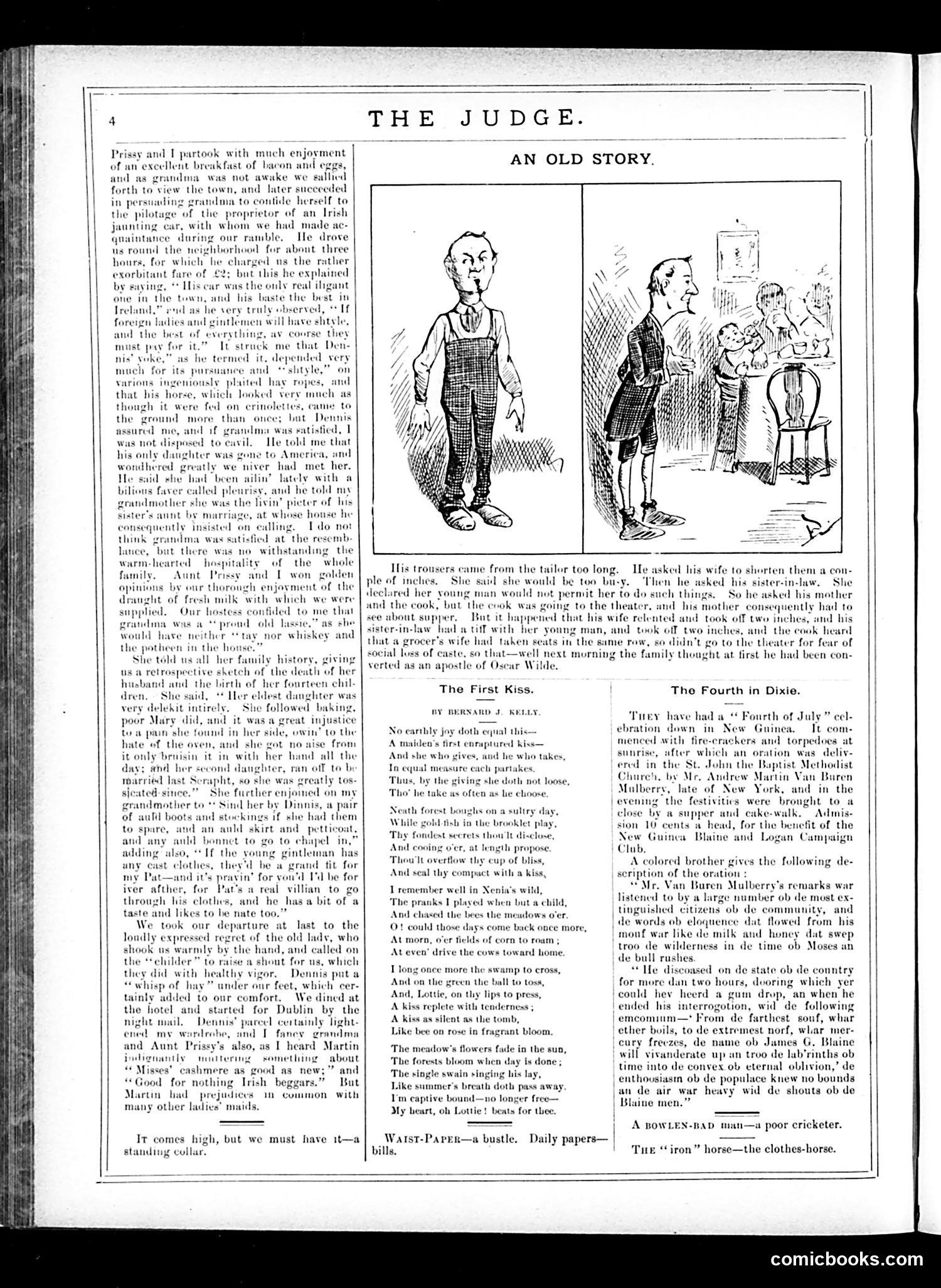
This page from *Judge* contains two separate pieces of social satire: **"An Old Story"** (illustrated): A sketch mocking Irish stereotypes and tourist encounters. The cartoon depicts an Irish jaunting-car driver (appearing to be named Dennis) overcharging foreign visitors while affecting quaint Irish charm. The accompanying text satirizes the Irish tendency toward elaborate storytelling, family gossip, and melancholic reminiscence—portraying the Irish as both hospitable yet prone to financial exploitation of wealthy travelers. **"The First Kiss"** (poem by Bernard J. Kelly): A sentimental Victorian poem celebrating a maiden's first kiss—straightforward romantic verse without apparent satirical intent. **"The Fourth in Dixie"**: A brief notice about Fourth of July celebrations held in New Guinea by American expatriates, including church services and festivities. This appears factual rather than satirical. The page primarily targets Irish stereotypes through genial but pointed ridicule of accent, financial shrewdness, and narrative verbosity.
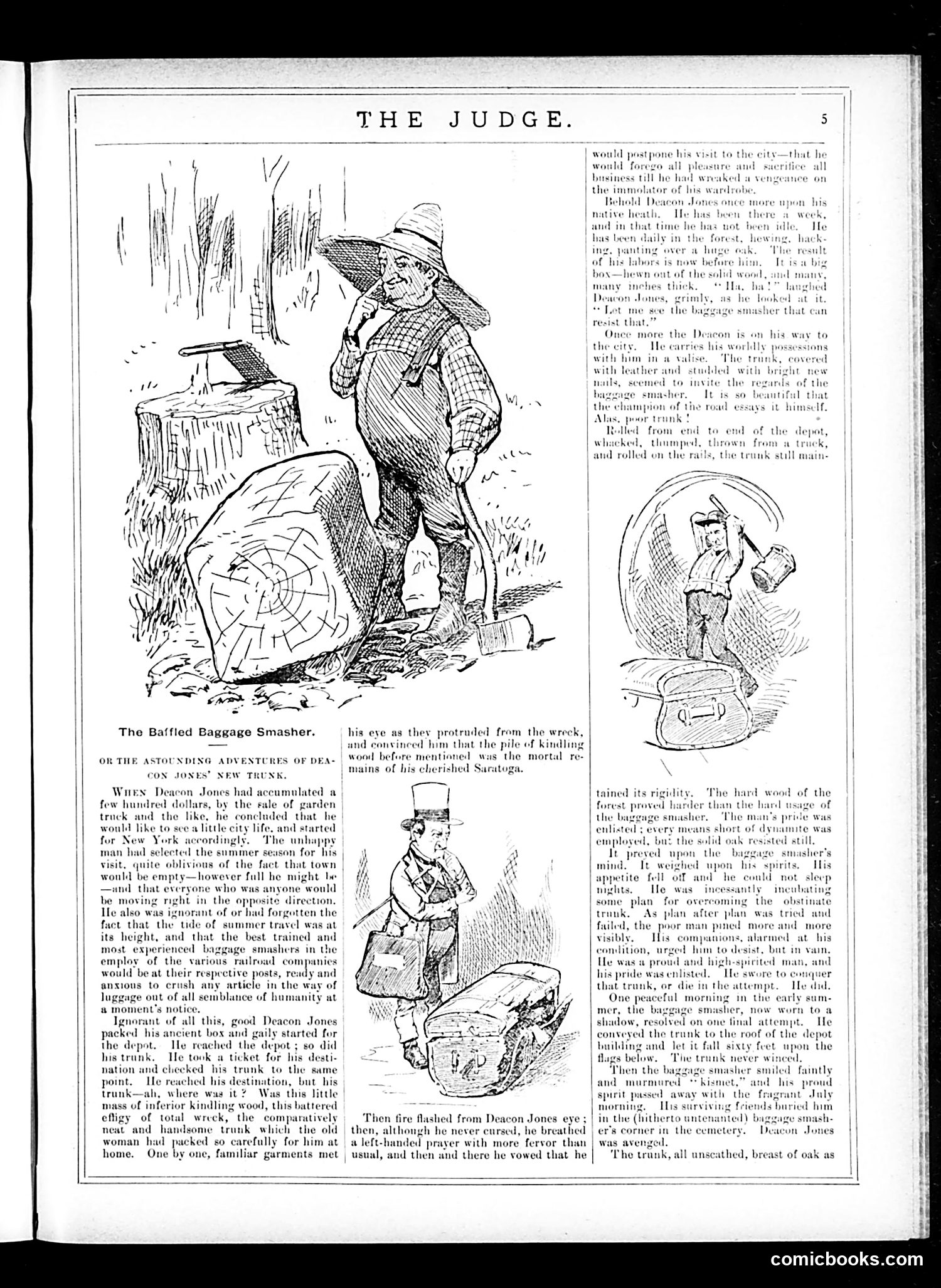
This is a humorous serial story mocking the notorious brutality of railroad baggage handlers in the late 19th century. The protagonist, "good Deacon Jones," a rural character, travels to New York City during peak summer season with a carefully packed trunk. Upon arrival, his trunk has been destroyed—literally reduced to "kindling wood"—by baggage handlers' careless treatment. The satire targets the railroad industry's indifference to passenger luggage damage. Jones attempts repeatedly to recover or protect his trunk, eventually resorting to dropping it from a depot roof in desperation. The dark humor culminates in his death and burial "in the baggage smasher's corner in the cemetery"—suggesting baggage handlers were essentially murderers of travelers' possessions and peace of mind. This reflects genuine public complaint about railroad service standards during the era.
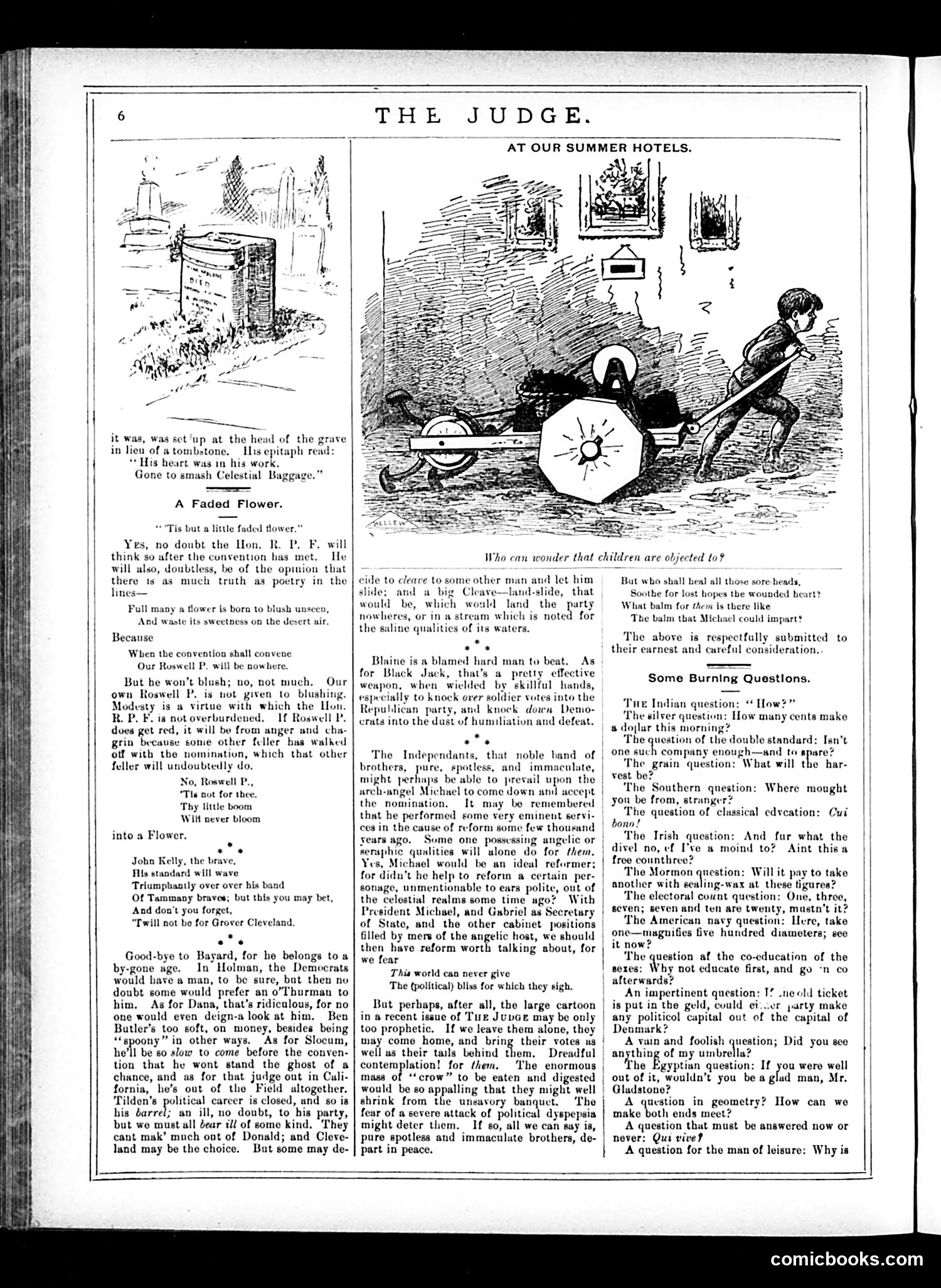
This page primarily contains **political commentary about the 1884 Democratic Convention**, not a traditional cartoon with a single focal point. The main articles mock potential Democratic presidential candidates: - **"Roswell P."** (likely R.P. Flower, NY politician) is ridiculed as having no real chance at nomination—his "boom" will never "bloom into a Flower" - **John Kelly** of Tammany Hall is dismissed, with the quip that his effort won't help **Grover Cleveland** - Various other candidates are rejected: Bayard, Holman, Thurman, Dana, Butler, Slocum, and a California judge The satire **mocks Democratic disarray** by sarcastically suggesting the party might nominate the Archangel Michael as a "reformer," since the Independents (Mugwumps) are so fastidious about purity. The small illustration labeled "At Our Summer Hotels" appears to show children being a nuisance—separate from the political commentary. The overall tone: Democrats are fractured, their candidates inadequate, and their reformist factions absurdly unrealistic.
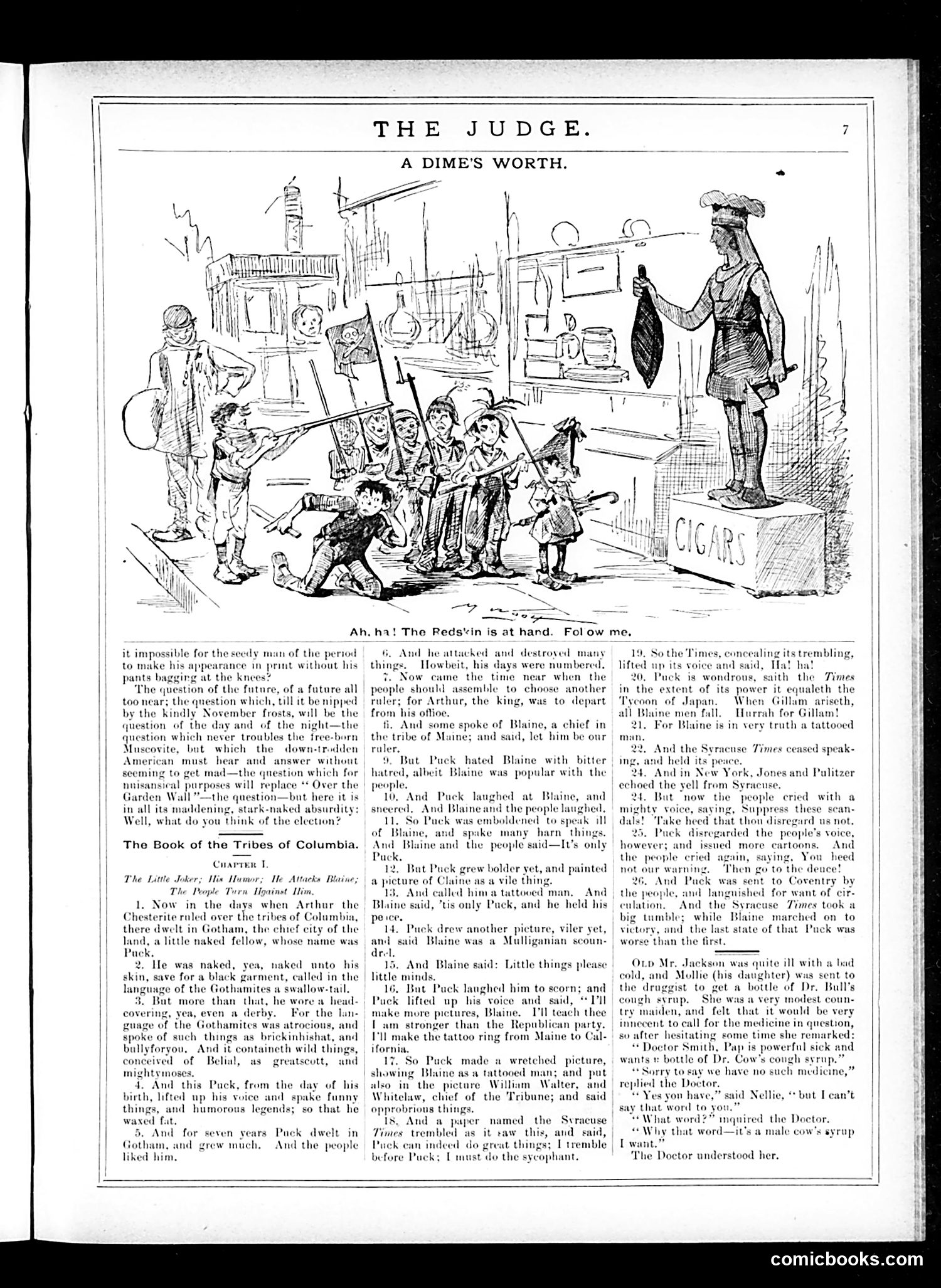
This page satirizes the 1884 presidential election and James G. Blaine's candidacy. The main cartoon depicts Puck magazine (personified as a mischievous naked boy) attacking Blaine, the Republican frontrunner, while supporters rally behind him. The text, styled as biblical parody ("The Book of the Tribes of Columbia"), describes Puck's relentless mockery of Blaine through caricatures and editorial assault. Blaine initially dismisses the attacks—"It's only Puck!"—but they escalate, eventually turning public opinion against him. The Syracuse Times and other papers, initially intimidated by Puck's power, eventually abandon Blaine's cause. The satire critiques both Puck magazine's outsized political influence and Blaine's vulnerability to ridicule. The cartoon's message: despite Blaine's popularity, sustained satirical attacks can shift electoral outcomes. The piece implicitly celebrates Puck's role in influencing the 1884 election, where Blaine ultimately lost to Grover Cleveland.
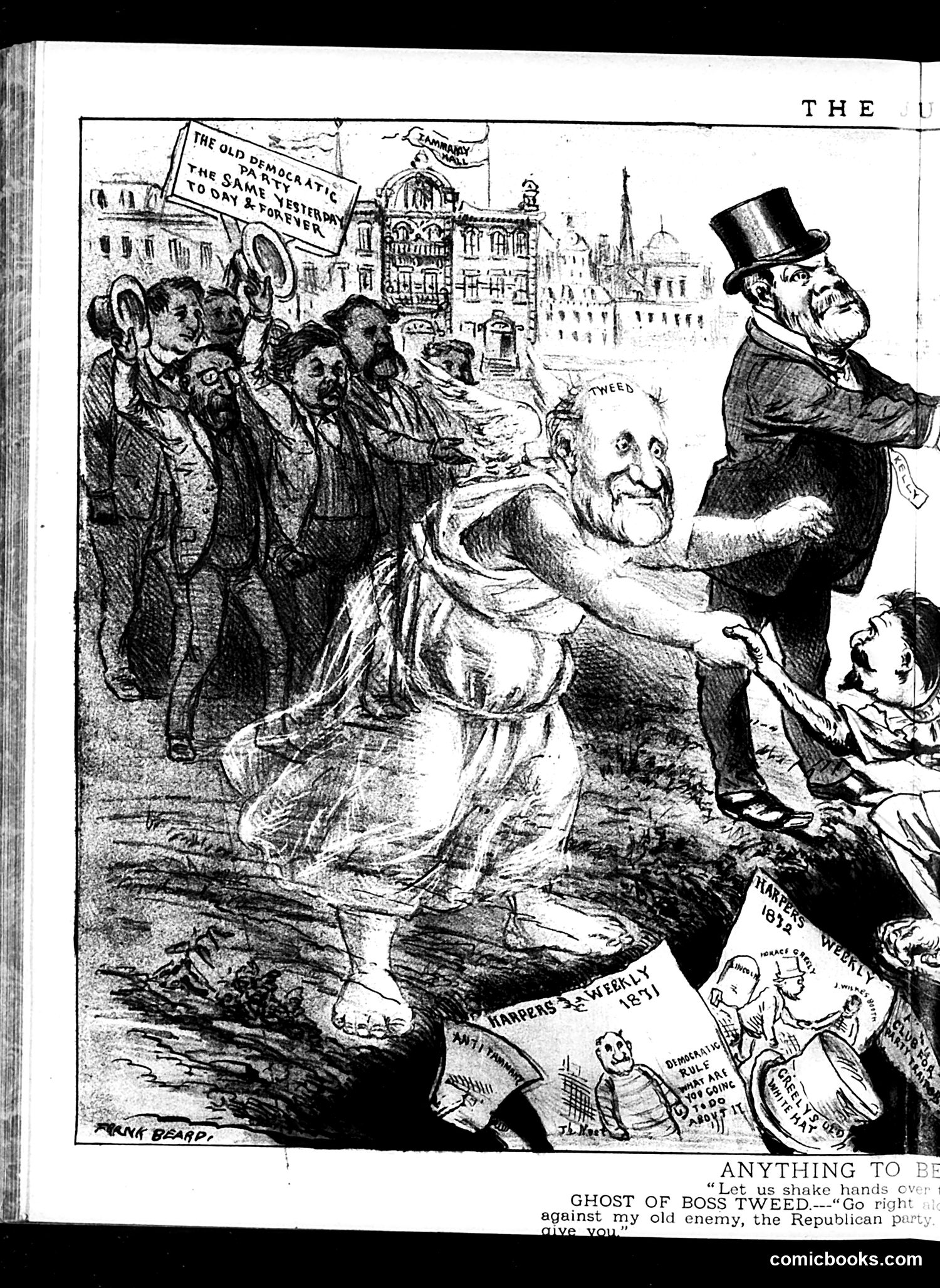
This is a satirical cartoon depicting the "Ghost of Boss Tweed," the infamous Tammany Hall Democratic boss who died in 1878. The cartoon shows a well-dressed Republican figure (right, in top hat) shaking hands with Tweed's ghost, while Democratic figures in the background protest with signs reading "The Old Democracy" and "The Same To Yesterday & Forever." The satire suggests Republicans are hypocritically allying with corrupt Democratic machine politics—specifically invoking Tweed's notorious legacy of graft and patronage—to gain political advantage. The joke critiques Republican claims of moral superiority while they pragmatically embrace the very corruption they ostensibly opposed. Scattered newspapers and political materials at the bottom emphasize the scandal's prominence in contemporary discourse.
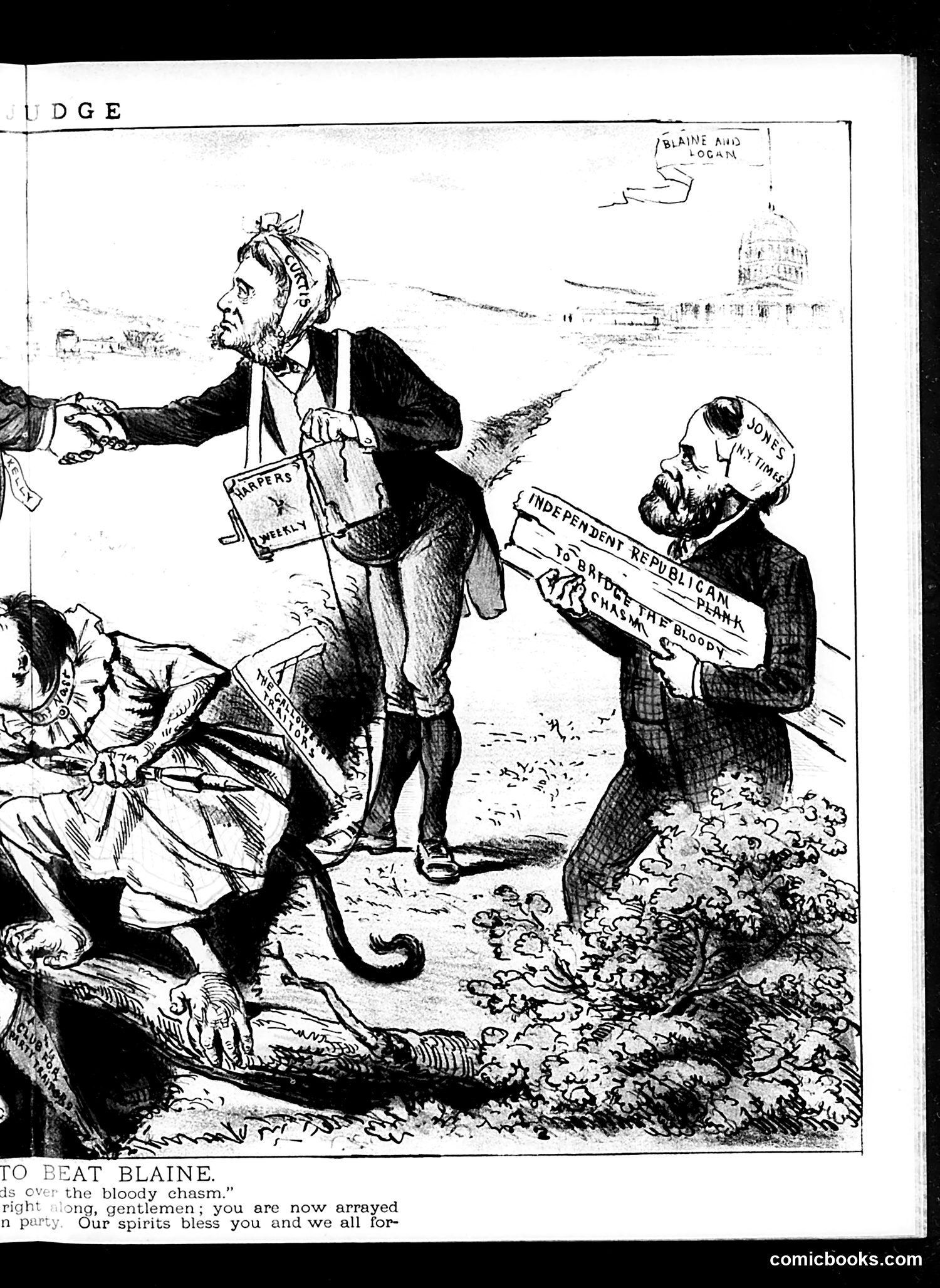
This Judge cartoon satirizes the 1884 presidential election. It depicts two men labeled "JONES" and "INDEPENDENT REPUBLICAN" attempting to "beat Blaine" (James G. Blaine, the Republican candidate). The phrase "over the bloody chasm" references the post-Civil War sectional divide. The cartoon mocks Republican Party fracturing: dissident "Independent Republicans" (called "Mugwumps") are shown conspiring against their own party's nominee. The figures carry banners identifying their factions, suggesting internal party conflict. The satire criticizes these party defectors as willing to cross traditional Civil War divisions to undermine Blaine's candidacy, treating the "bloody chasm" between North and South as negotiable in pursuit of partisan advantage. The text's mock-benedictory tone reinforces the satire.
This page from *Judge* magazine satirizes the theatrical world of late 19th-century America. The main article mocks actors' transatlantic travel habits and theatrical company management. **Key targets:** - **Lawrence Barrett** and other actors traveling to Europe, criticized for not bringing enough English money and failing financially in London - **Theater managers** sending troupes on unprofitable tours, with the satirist sarcastically suggesting they export actors to South Africa instead, joking this would benefit American cities by removing "loafers" - **The Casino theater** and personnel changes involving McCaull, Aronson, and Carleton organizing competing opera companies **The satire's point:** American actors and managers are frivolous spenders and poor businessmen, wasting resources on European ventures while contributing little to society. The suggestion to send them to Africa is dark satire implying they're expendable—comparable to missionaries whom churches "send out" to potentially dangerous places. The page reflects period attitudes toward theater as both prestigious entertainment and a somewhat disreputable profession.
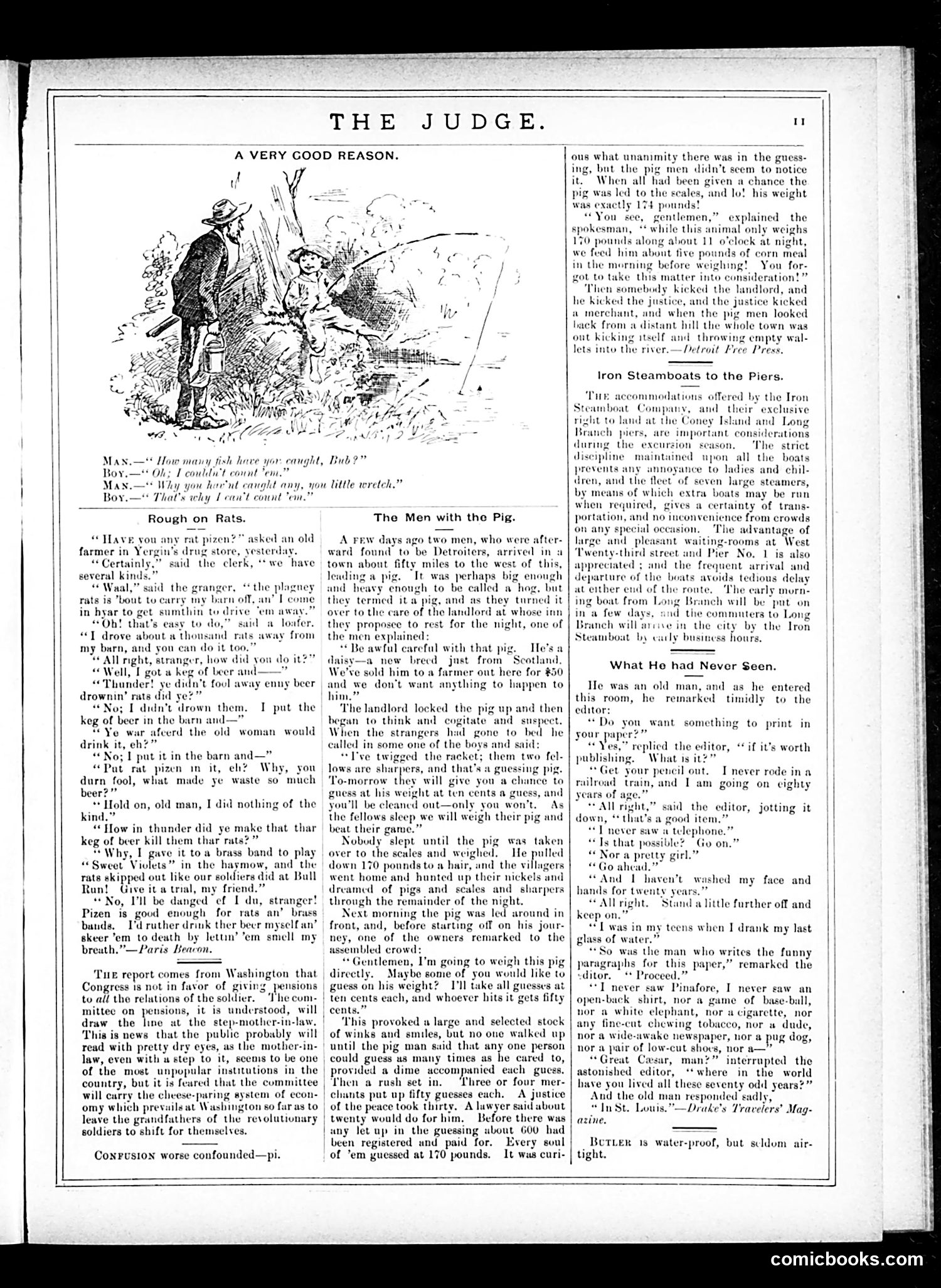
This page contains satirical humor pieces typical of 19th-century American magazines. **"A Very Good Reason"** (top cartoon): A man and boy discuss fishing. The joke plays on the boy's inability to "count on" things—he can't count fish he's caught, therefore can't rely on ("count on") catching any. **"Rough on Rats"**: A farmer seeks rat poison. A con man claims he eliminated rats by having a brass band play "Sweet Violets" in the haymow, driving them away. The farmer refuses, preferring to use poison rather than waste beer on such nonsense. This mocks absurd folk remedies and foolish advice. **"The Men with the Pig"**: Con artists arrive with a pig, claiming it's a rare Scottish breed worth $50. They plan a guessing-game scheme (guests pay to guess the pig's weight). The landlord outwits them by weighing the pig overnight at 170 pounds, so locals can guess accurately. This celebrates rural cunning defeating urban tricksters—a common 19th-century American theme. All three pieces use dialect humor and celebrate practical intelligence over gullibility.
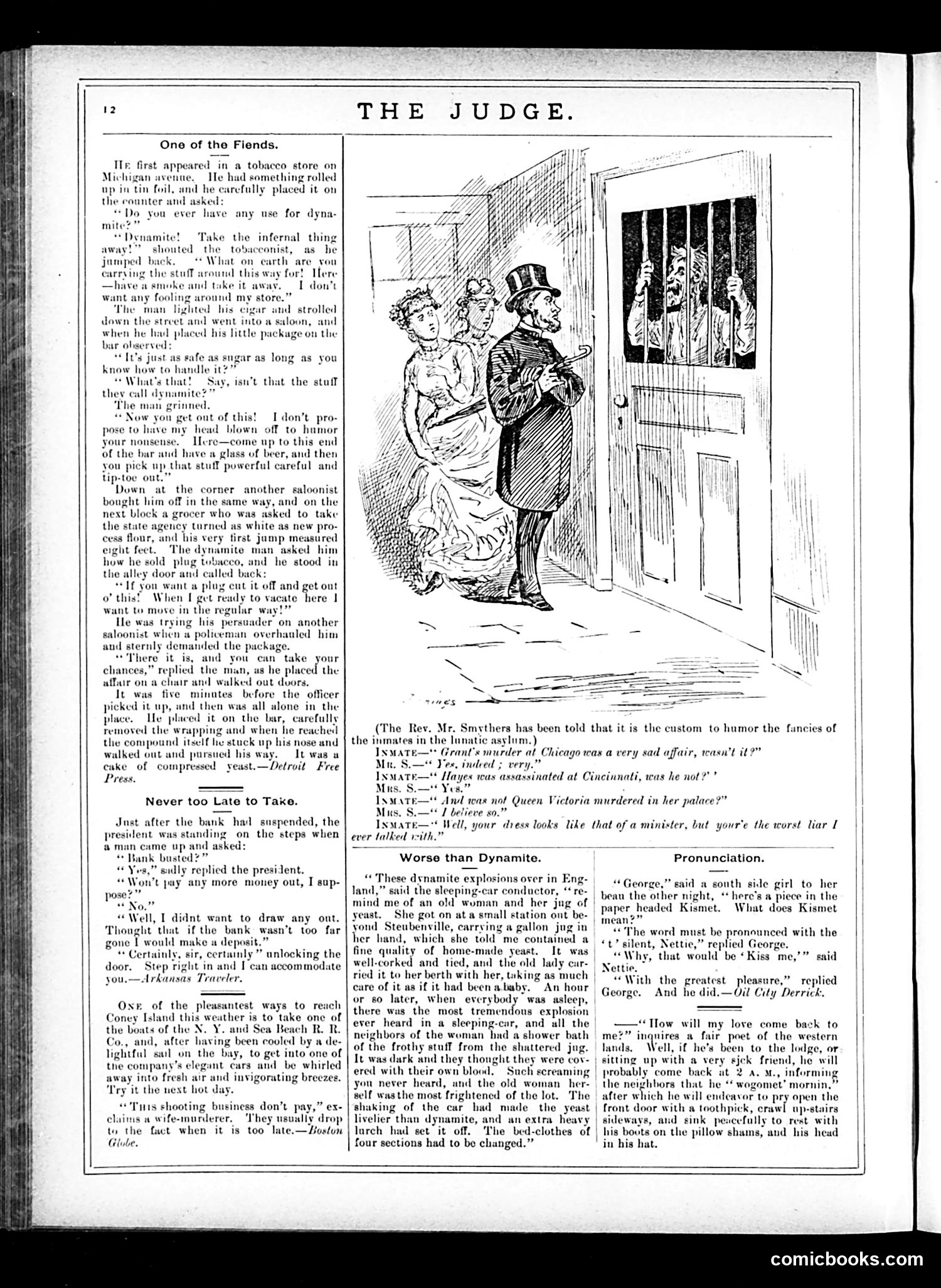
This page contains three separate satirical pieces mocking late-19th-century anxieties, particularly anarchist violence and dynamite threats. **"One of the Fiends"** (main cartoon): A man carrying what he claims is dynamite visits tobacco shops and saloons, causing panic among shopkeepers who eject him violently. The punchline: it's actually compressed yeast. The satire mocks both the genuine fear of dynamite explosions (anarchist bombings were real threats in this era) and the hysteria and overreaction such fears provoked. The man's deliberate deception suggests commentary on how easily public panic could be manufactured. **"Never too Late to Take"** and other brief pieces are unrelated humor snippets about banking and murder. **"Worse than Dynamite"** continues the yeast-as-explosive joke, comparing an old woman's jug of yeast on a train to actual dynamite explosions in England—again satirizing overblown fears. The satire targets both anarchist violence concerns and the public's disproportionate panic response to them.
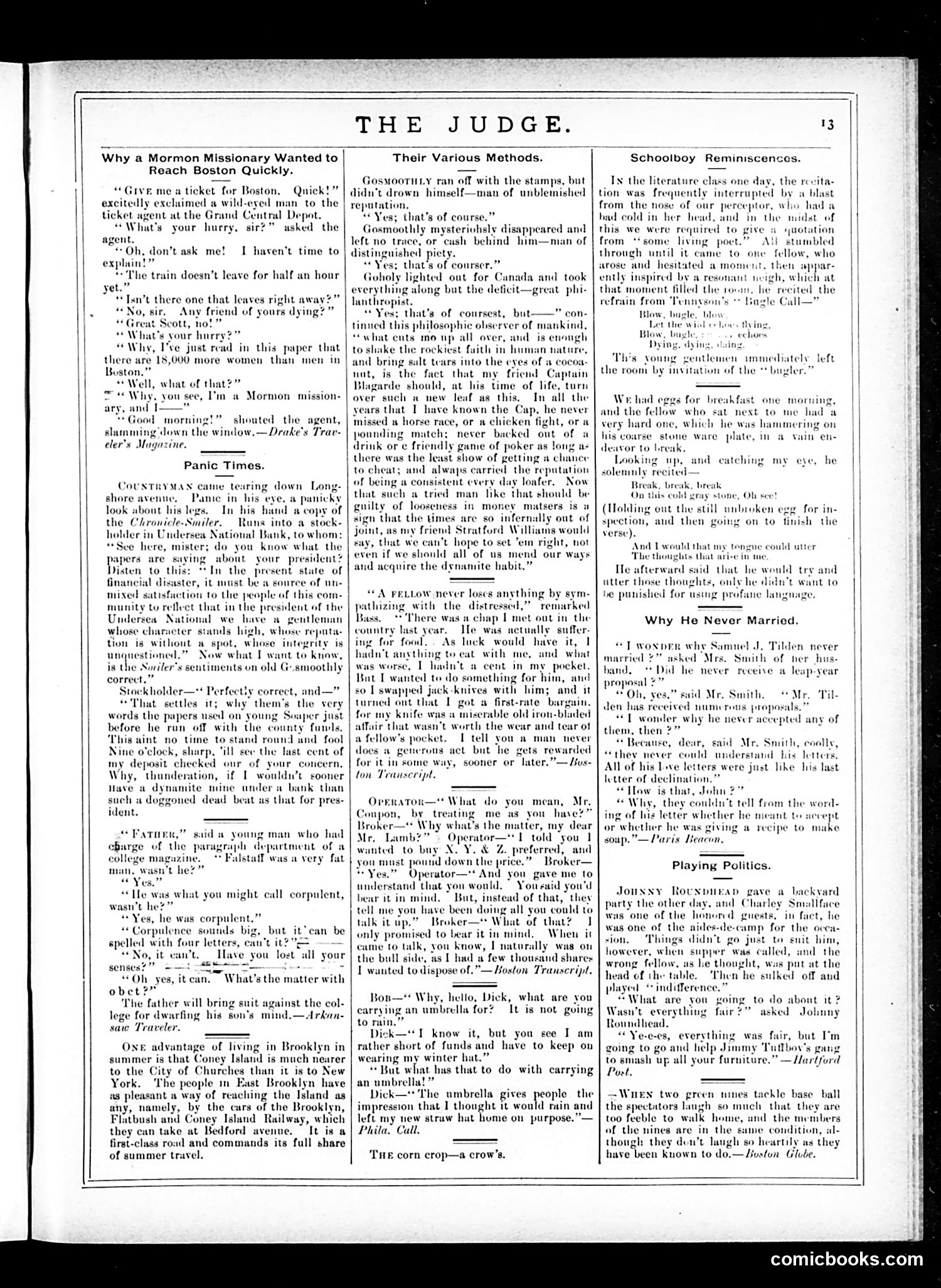
This page from Judge magazine contains several brief satirical pieces typical of late 19th-century American humor: **"Why a Mormon Missionary Wanted to Reach Boston Quickly"** mocks both Mormons and demographic anxiety. A Mormon missionary urgently demands a ticket to Boston upon learning there are 18,000 more women than men there—satirizing both the historical association of Mormonism with polygamy and contemporary anxieties about gender imbalance in certain cities. **"Panic Times"** satirizes financial hysteria. A panicked man misinterprets positive newspaper language about a bank president as sinister (because the same words preceded a previous embezzlement), reflecting real anxieties about banking scandals and economic instability. The remaining pieces mock human vanity and moral inconsistency. "Their Various Methods" satirizes a man bewildered that his friend Captain Blizzarde has suddenly reformed, suggesting that moral improvement is so rare it seems unnatural. These are social satires aimed at contemporary readers' recognition of common types and situations rather than specific political figures or events.
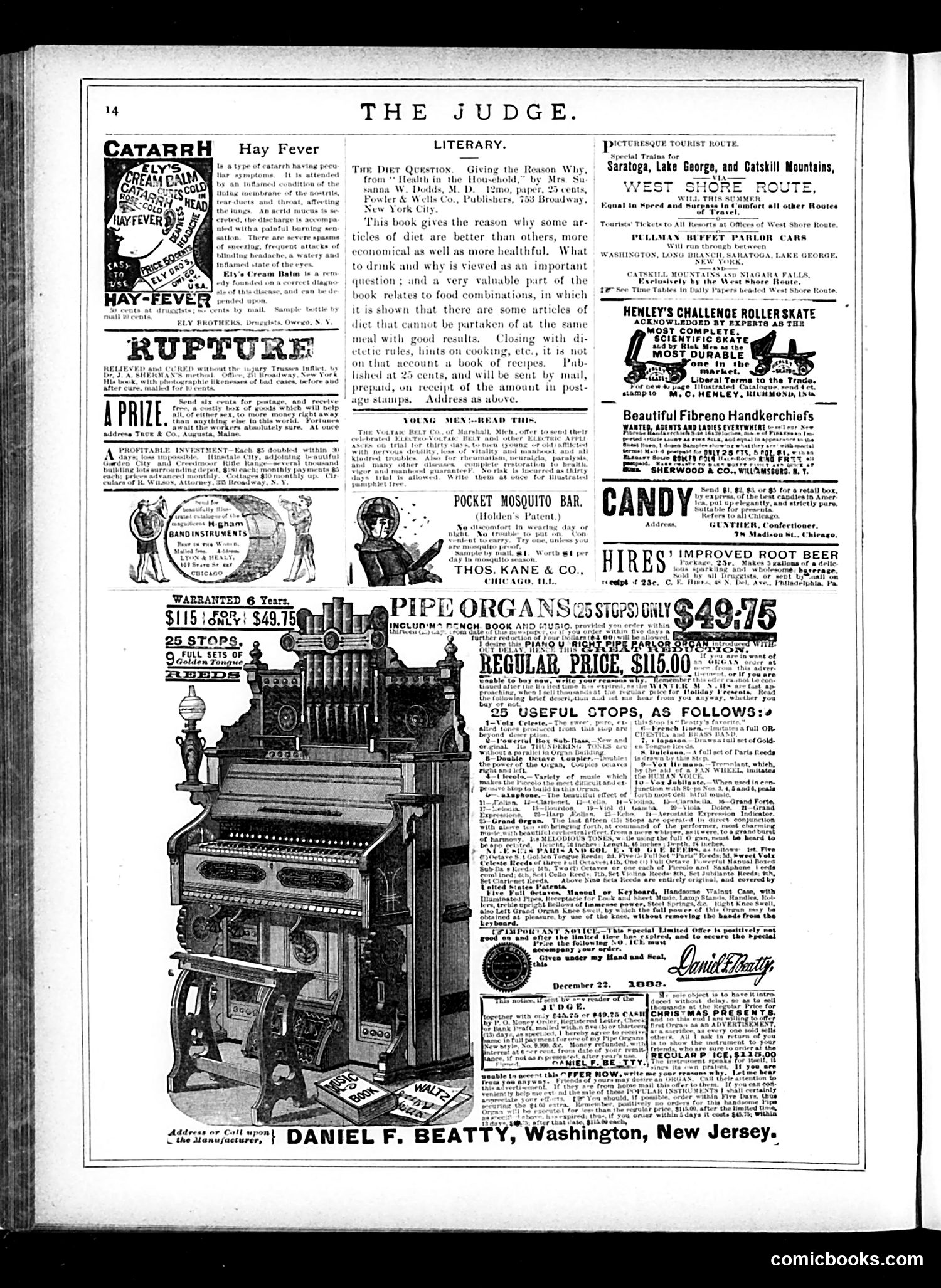
This is primarily an **advertising page** from Judge magazine (dated December 22, 1892), with minimal editorial content. The main visual element is a large **pipe organ advertisement** by Daniel F. Beatty of Washington, New Jersey. The ornate instrument is depicted in detailed engraving style, emphasizing its decorative architectural features and mechanical complexity. The ad promotes organs "warranted 6 years," priced at $49.75 (marked down from $115), and lists "35 useful stops" with technical specifications. Surrounding this central ad are smaller advertisements for consumer products typical of the 1890s: hay fever remedies, roller skates, handkerchiefs, mosquito netting, candy, root beer, and a dietary book about food combinations. The page contains **no political satire or cartoon commentary**—it functions as straightforward commercial advertising, which was common in Judge despite the magazine's satirical editorial mission. These ads reflect consumer goods and health concerns of the Gilded Age period.
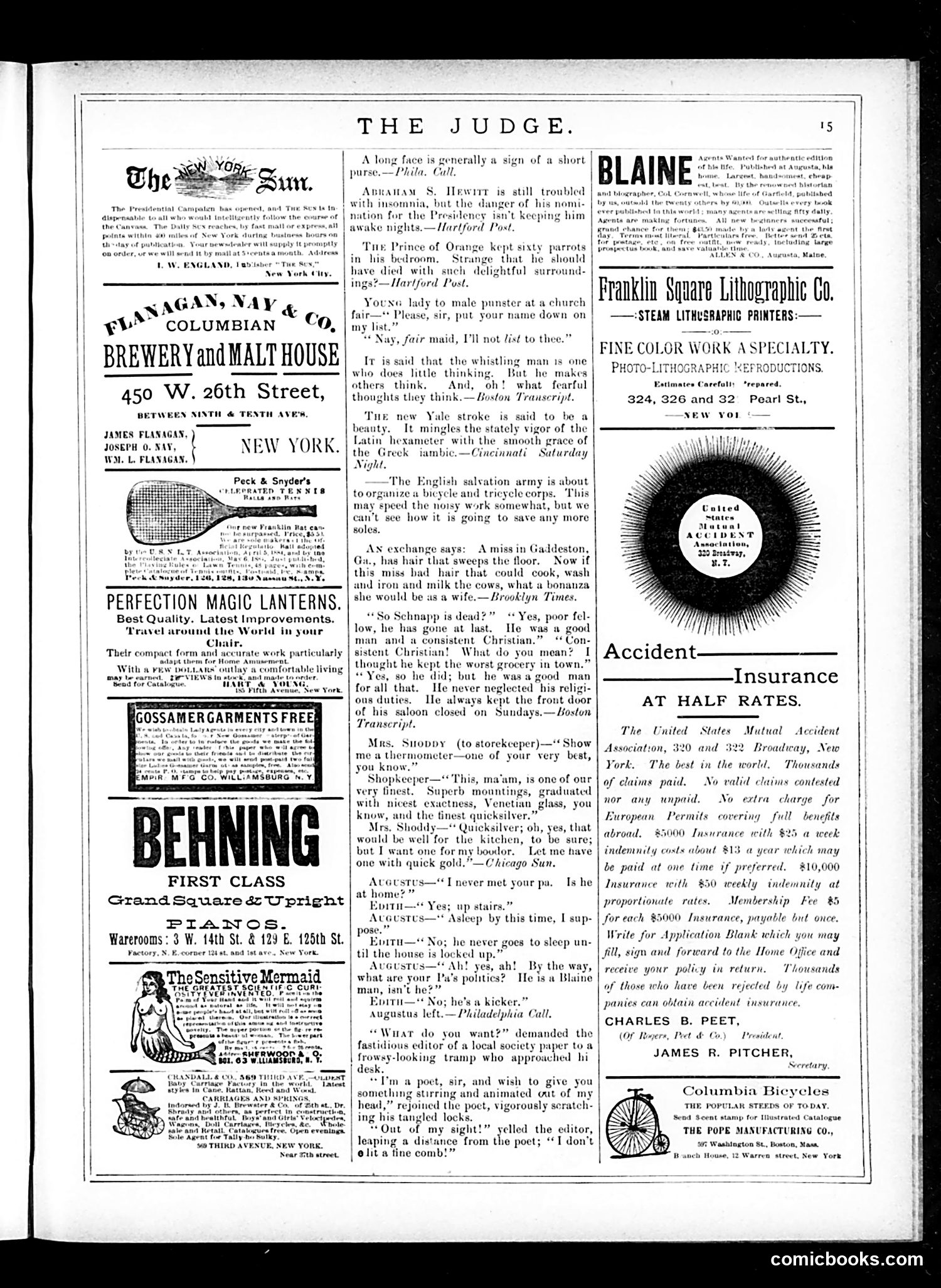
This page is primarily **advertisements and filler content** rather than political cartoons. The masthead identifies it as from the *New York Sun*, and the page features various commercial ads (breweries, bicycles, insurance, pianos) interspersed with short humorous anecdotes and jokes. The scattered humor snippets reference contemporary figures and topics: Abraham S. Hewitt (likely the politician/industrialist) suffering insomnia; the "Prince of Orange" (unclear reference); Yale rowing; and the Salvation Army's bicycle corps initiative. One joke involves a man named "Blaine" (likely referencing James G. Blaine, the prominent 1880s politician), characterized as a "kicker." Another depicts class humor through a Mrs. Shoddy wanting gold rather than silver thermometers. The page's **real content is the accident insurance advertisement**, prominently featuring the United States Mutual Accident Association—a significant commercial concern of the era. The scattered jokes are essentially filler material typical of 19th-century magazine layouts.
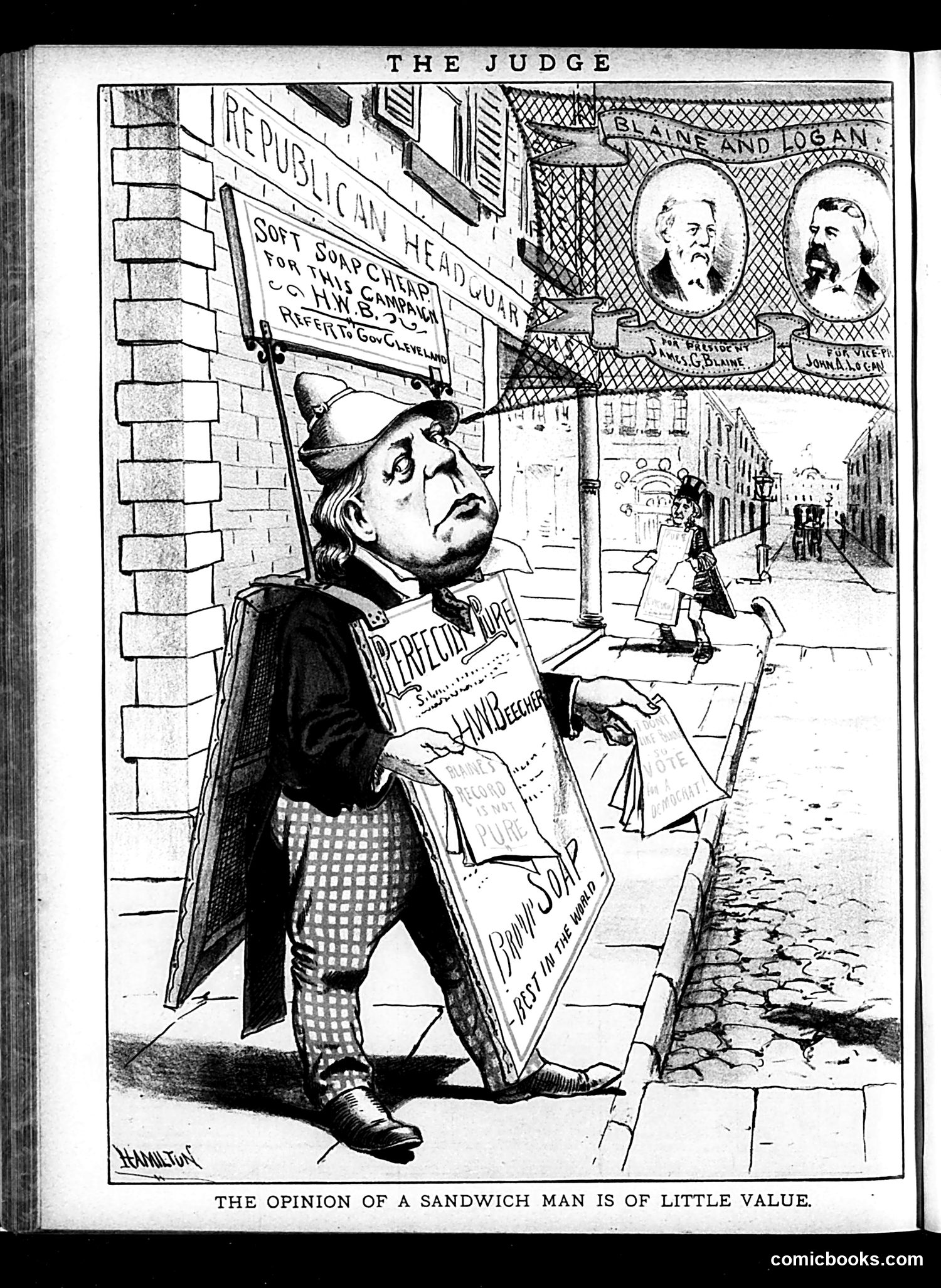
This political cartoon satirizes the Republican Party's disregard for working-class opinion. The central figure is a "sandwich man"—a laborer who walks streets wearing advertising boards front and back. He's shown standing beneath a "Republican Headquarters" sign, laden with political pamphlets and notices. The caption's message is the joke: despite Republicans distributing propaganda to common workers, they consider such ordinary people's views worthless. The portraits of what appear to be Republican leaders in the upper right reinforce that party leadership dismisses working-class perspectives. This critiques Republican hypocrisy—courting common votes while despising common voices. The cartoon reflects Gilded Age tensions between political parties and labor, suggesting Republicans treated workers as mere vote-delivery mechanisms rather than as citizens whose opinions mattered.