
A complete issue · 16 pages · 1884
Judge — May 10, 1884
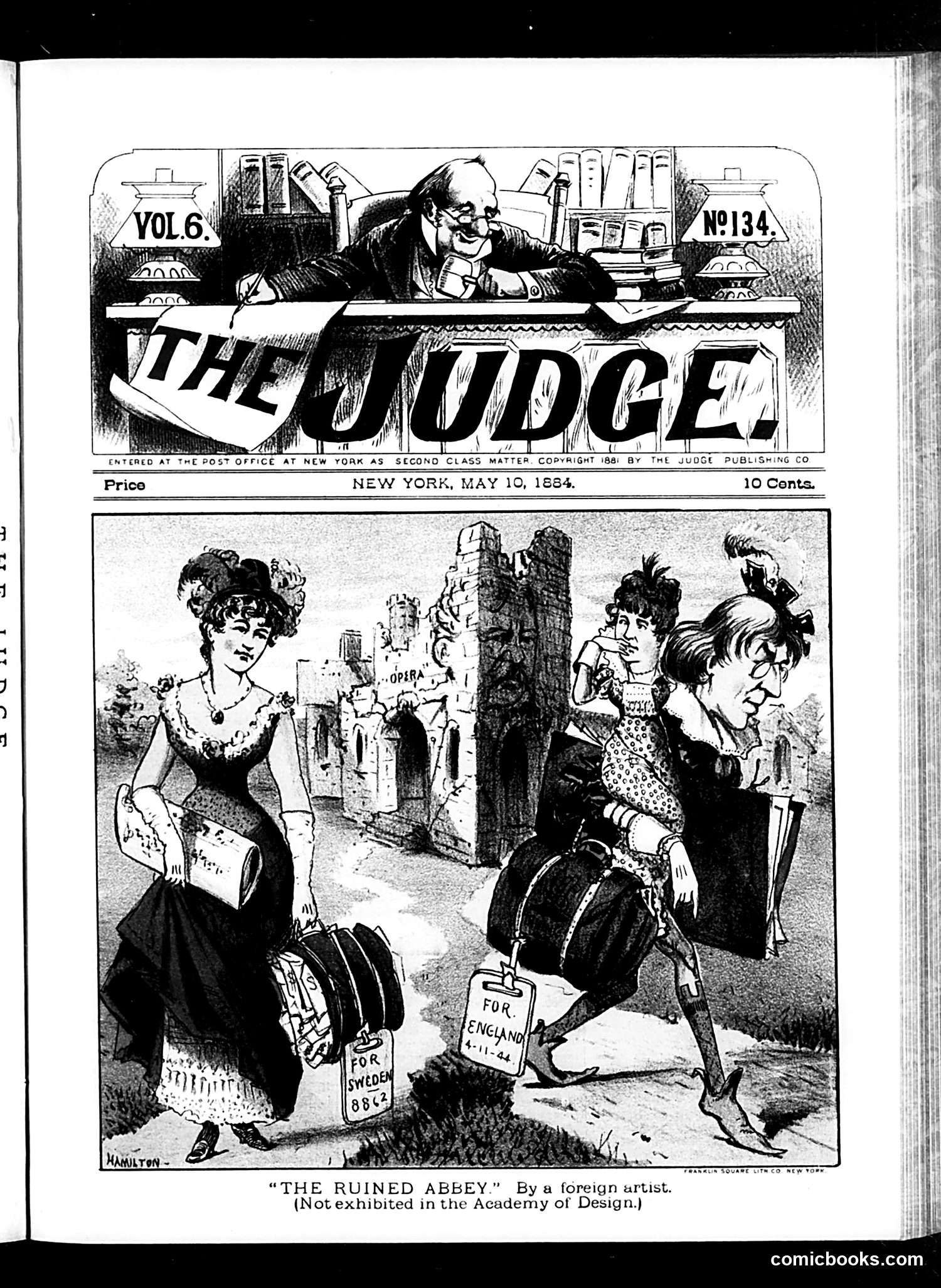
The main cartoon, "The Ruined Abbey," depicts four fashionably dressed women tourists with luggage labeled "For England" standing before a damaged European abbey or castle structure. The satire appears to target wealthy American women traveling abroad—a practice that Judge likely viewed as frivolous or culturally presumptuous. The "ruined" abbey may represent either actual European historical sites being damaged by careless tourism, or satirically comment on American tourists as agents of destruction to European cultural heritage. The header illustration shows a scholarly man at his desk surrounded by books, representing Judge magazine's editorial authority. The 10-cent price and May 10, 1884 date confirm this as a genuine period satirical publication mocking contemporary social pretensions and travel culture.
This page contains editorial commentary rather than cartoons. The main content addresses two topics: **"Henry Abbey's Enterprises"** discusses impresario Henry E. Abbey's financial losses despite a successful theatrical season. Abbey brought European performers (Irving, Ellen Terry, opera singers) to America but made no profit—the money went to foreign artists. The piece criticizes this as typical: Americans fund entertainment but foreigners capture profits. **"The Political Pillory"** laments that worthy citizens avoid politics, viewing political engagement as disreputable. The piece argues that elections are controlled by party "machines" rather than the community's best minds and wealth. It calls for honest candidates with unblemished records. The small illustration at top-left appears decorative rather than tied to specific content. This is primarily a magazine of opinion pieces and commentary, aimed at educated readers concerned with American cultural and political life.
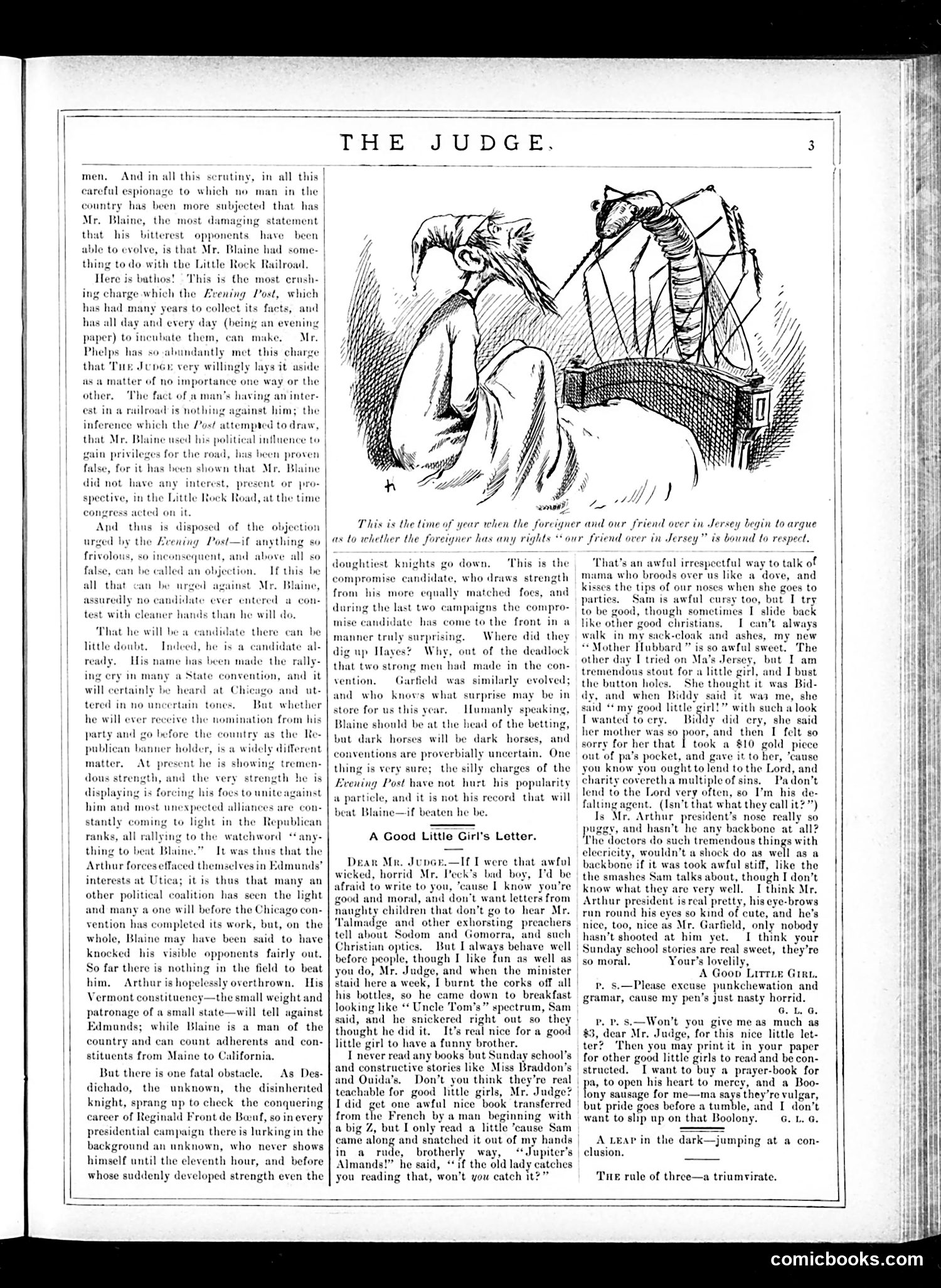
This page discusses the 1884 Republican presidential race, specifically defending **James G. Blaine** against accusations by the *Evening Post* that he improperly used political influence to benefit the Little Rock Railroad while in Congress. The cartoon depicts Blaine being attacked by opponents (represented as a figure pulling/wrestling with him). The text argues the *Post*'s charges are baseless—Blaine had no financial interest in the railroad when Congress acted on it. The article acknowledges Blaine faces a "fatal obstacle": an unknown dark-horse candidate may emerge (as happened with Garfield in 1880). It notes Republican factions—Arthur supporters and Edmunds backers—are uniting against Blaine despite his apparent strength, suggesting party insiders fear his nomination despite his popularity. The satire cuts both ways: defending Blaine's integrity while mocking the chaotic Republican convention dynamics and backroom machinations.
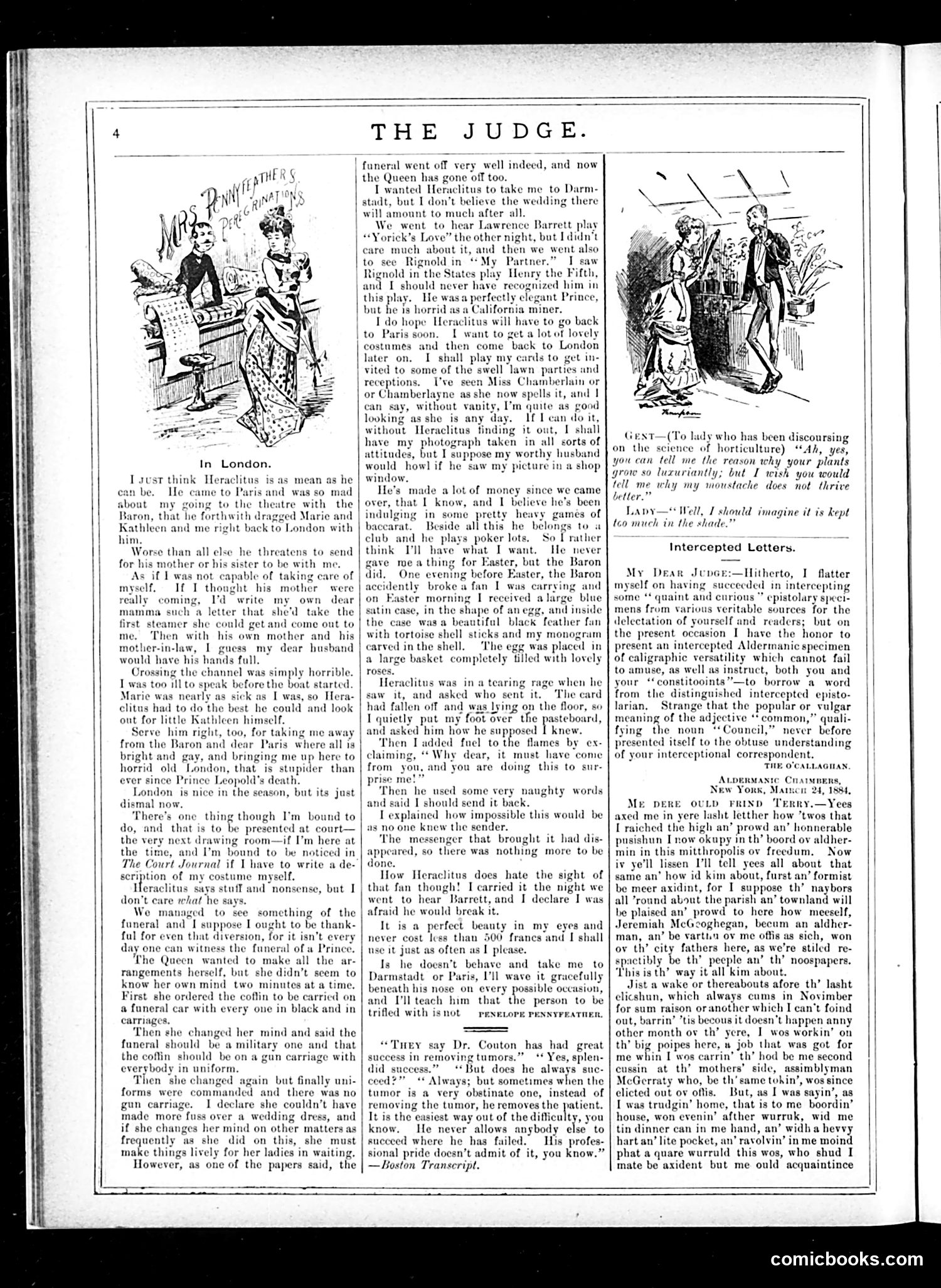
This page features a gossipy letter from a wealthy American woman abroad, likely satirizing the nouveau-riche American expatriate class of the 1880s. The writer complains that her husband "Heraclitus" dragged her from Paris to London, where she finds the social scene disappointing since Prince Leopold's recent death. The satire targets her shallow priorities: obsession with court presentations, theatrical gossip, fashion, lawn parties, and social climbing—while casually mentioning her husband's heavy gambling losses. She's vain ("quite as good looking" as society women), manipulative (planning to have photographs taken without his knowledge), and prioritizes pleasure over propriety. The humor lies in her obliviousness to her own ridiculousness: complaining about being "taken care of" while dependent on her husband's gambling winnings, and treating a prince's funeral as mere entertainment and social opportunity. Judge uses her voice to mock American pretension and materialism abroad.
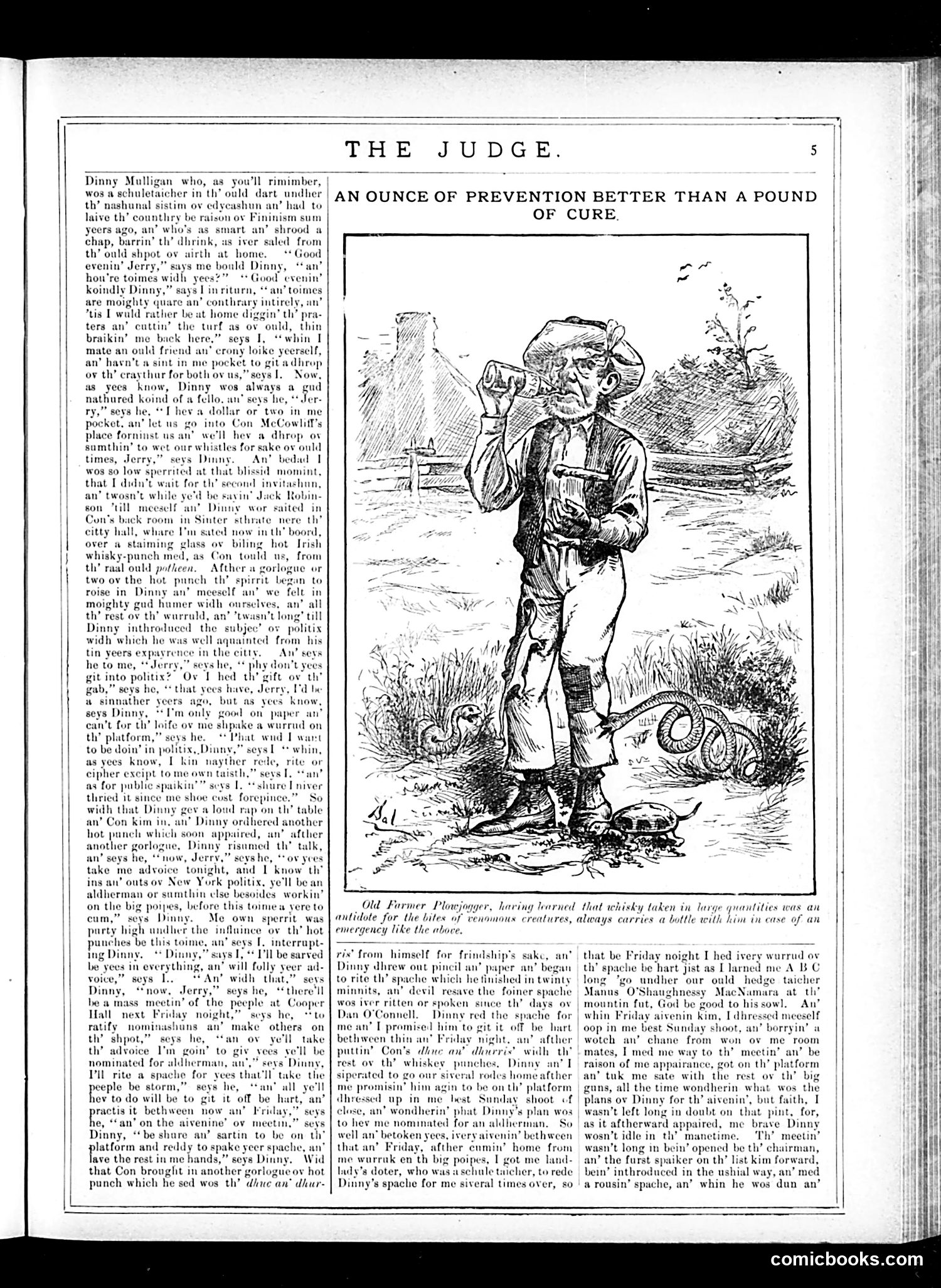
This page from *Judge* contains two elements: a lengthy Irish-dialect story and a satirical illustration. **The Story**: "Dinny Mulligan," a former Irish schoolteacher who emigrated after Irish independence movements, encounters an old friend. Over whiskey, Dinny encourages his friend to enter New York City politics, promising to write a speech that will get him elected alderman at a mass meeting at City Hall. **The Illustration's Satire**: Titled "An Ounce of Prevention Better Than a Pound of Cure," it depicts "Old Farmer Plowjogger" carrying a whisky bottle as protection against snake bites—a darkly comic exaggeration suggesting whisky as a folk remedy or practical necessity in rural America. **The Point**: Both pieces mock Irish-American political participation in early 20th-century New York, portraying it as improvised, alcohol-fueled, and somewhat absurd. The heavy dialect emphasizes ethnic caricature typical of *Judge's* satirical approach to immigrant communities and urban politics.
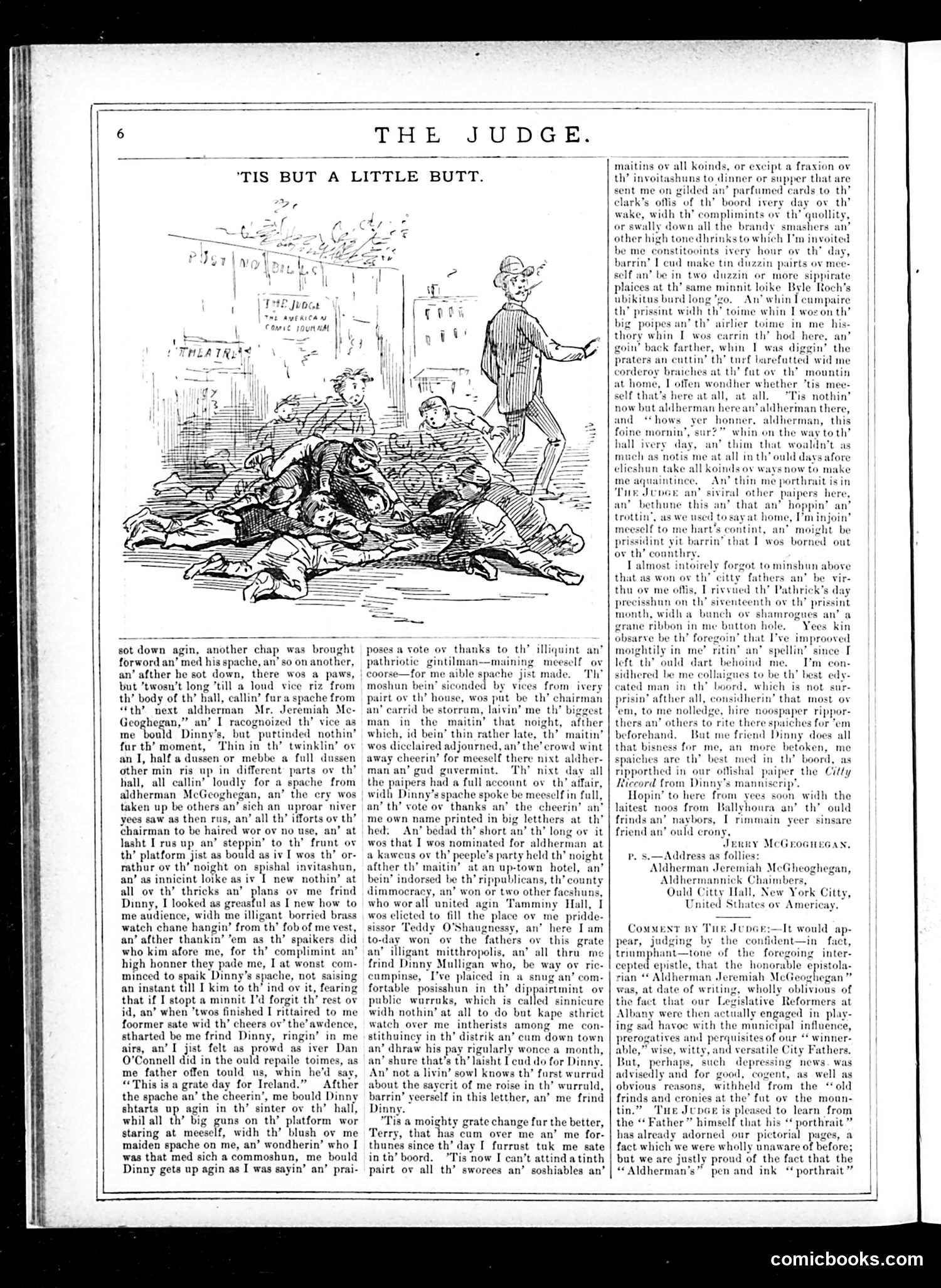
This page satirizes **machine politics and patronage in American cities**, likely from the late 19th century. The cartoon depicts a corrupt alderman who gains political power through a rigged scheme orchestrated by his friend Dinny Mulligan. The satire works as follows: Dinny plants supporters throughout a public meeting to loudly demand the narrator give a speech. The narrator, coached by Dinny, delivers what is actually Dinny's prepared remarks. This manufactured enthusiasm gets the narrator nominated as alderman. Once elected, he repays Dinny with a cushy city job ("sinnicure") requiring no actual work—pure patronage. The piece mocks how **urban political machines operated through orchestrated public performances and kickback systems**, where loyal operatives received government positions regardless of qualifications. The narrator's boastful Irish-dialect narration ("bould Dinny," "grate day for Ireland") emphasizes how transparently corrupt—yet culturally normalized—such practices had become in American cities.
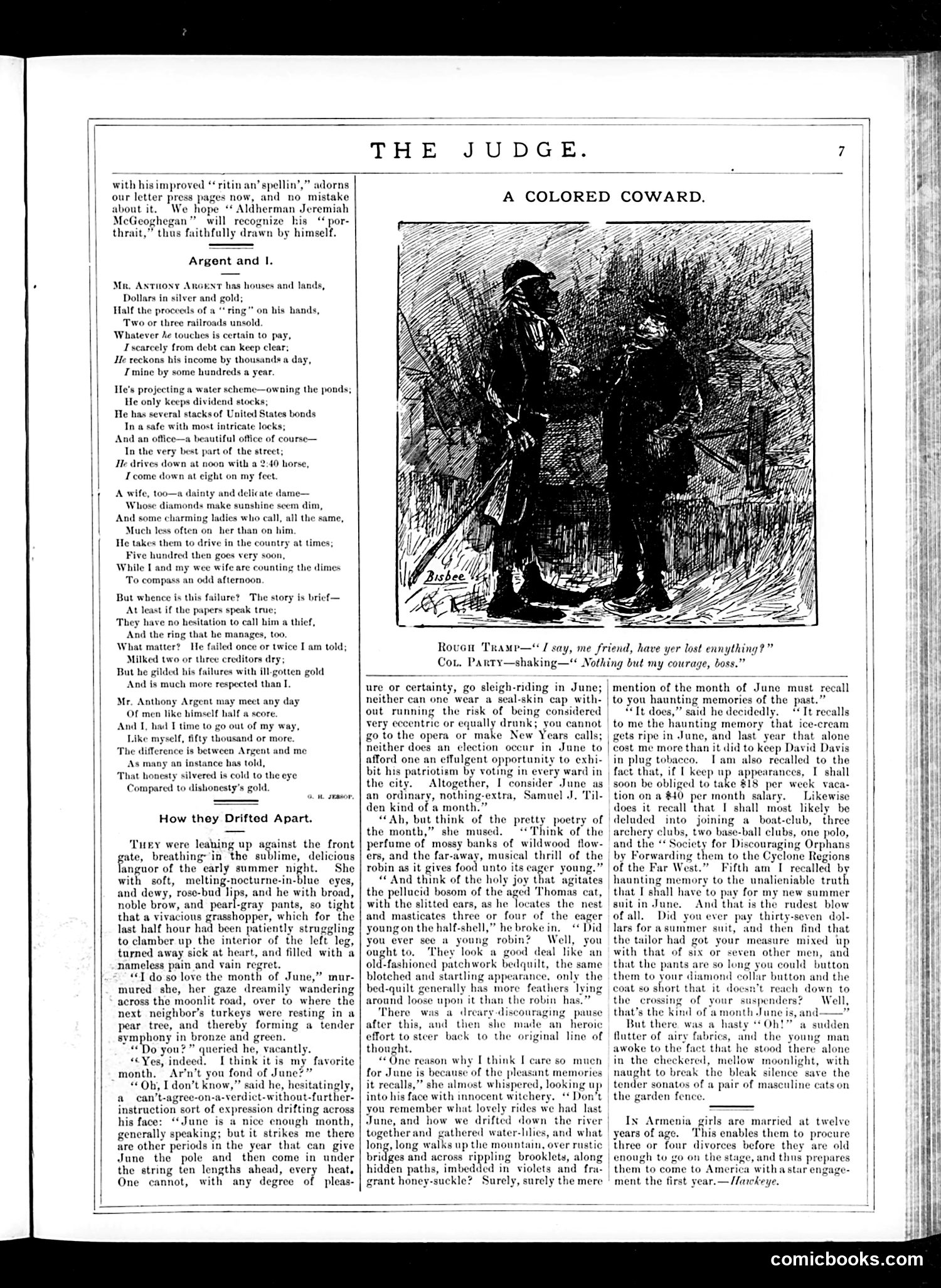
This page contains two distinct pieces of social satire: **"Argent and I"** compares a wealthy financier (Anthony Argent) with an honest working man. The poem mocks how Argent—despite being a suspected thief who "milks creditors dry"—commands respect through ill-gotten wealth, while the honest narrator remains poor and overlooked. The satire critiques Gilded Age values: that "dishonesty's gold" outshines "honesty silvered." **"A Colored Coward"** cartoon depicts a Black man (labeled "Col. Party," likely representing the Republican Party or Black voters) being robbed by a "Rough Tramp," asking if he's "lost anything?" The victim responds "Nothing but my courage, boss"—a racist caricature suggesting political cowardice. This likely refers to erosion of Black political power during Reconstruction's end or suppression of Black voting rights. Both pieces reflect 1880s-era Judge content: cynicism about wealth inequality and racial betrayal dressed in period humor conventions.
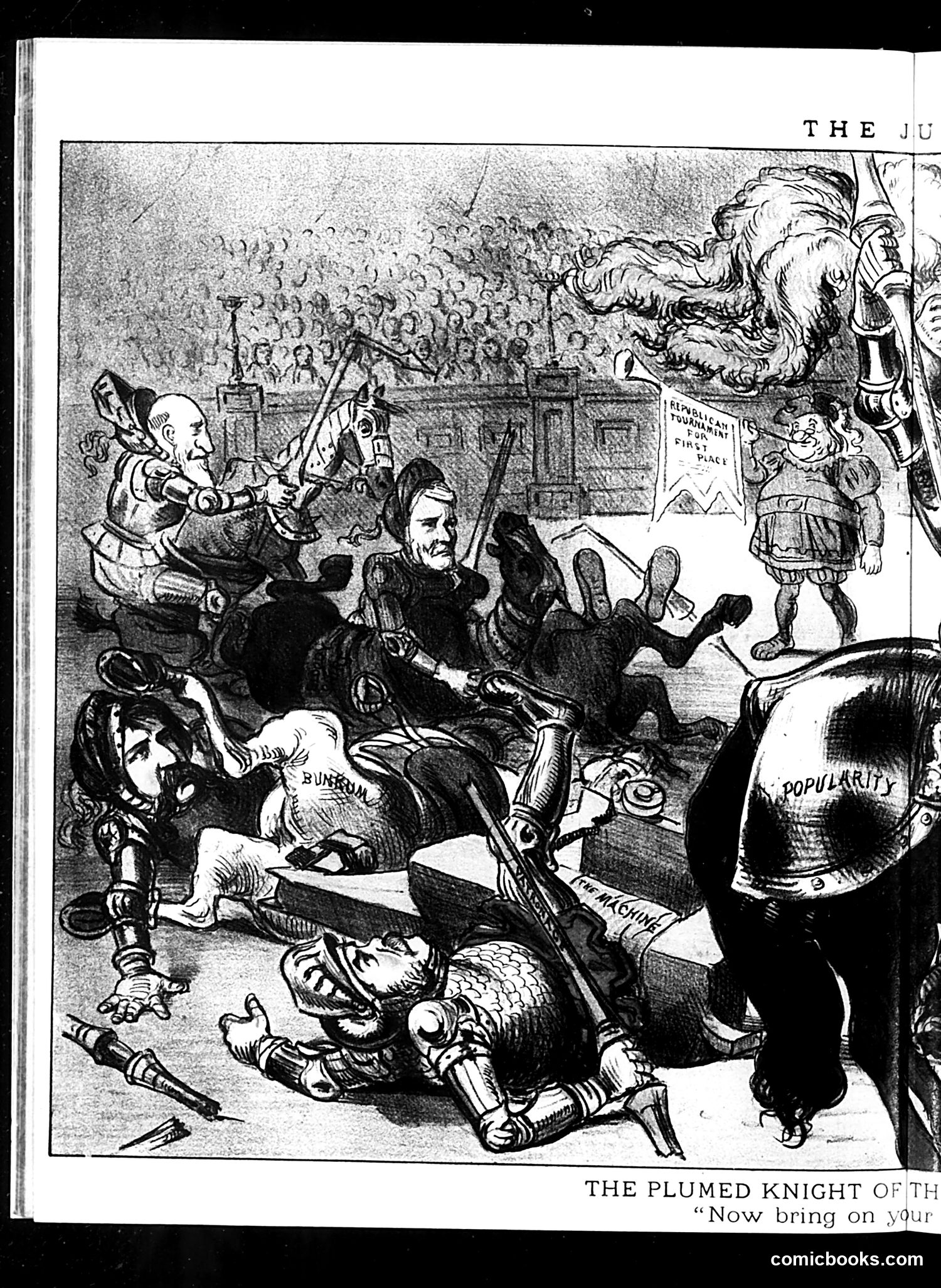
This is a satirical cartoon from *Judge* magazine depicting a scene of political conflict or debate. The central figure appears to be labeled "The Plumed Knight" (visible in the caption), a historical reference to James G. Blaine, a prominent 19th-century Republican politician. The cartoon shows this figure in a dramatic confrontation, surrounded by hostile forces and fallen opponents. Labels visible include "POPULARITY" and what appears to be references to political movements or opposition. The crowded arena setting with spectators suggests public political struggle. Without a precise date, I cannot identify the specific political moment, but the theatrical staging—complete with crowds and physical conflict—satirizes political theatricality and the clash between popularity and political power. The ornate "plume" reference likely mocks pretentiousness or grandiose political posturing.
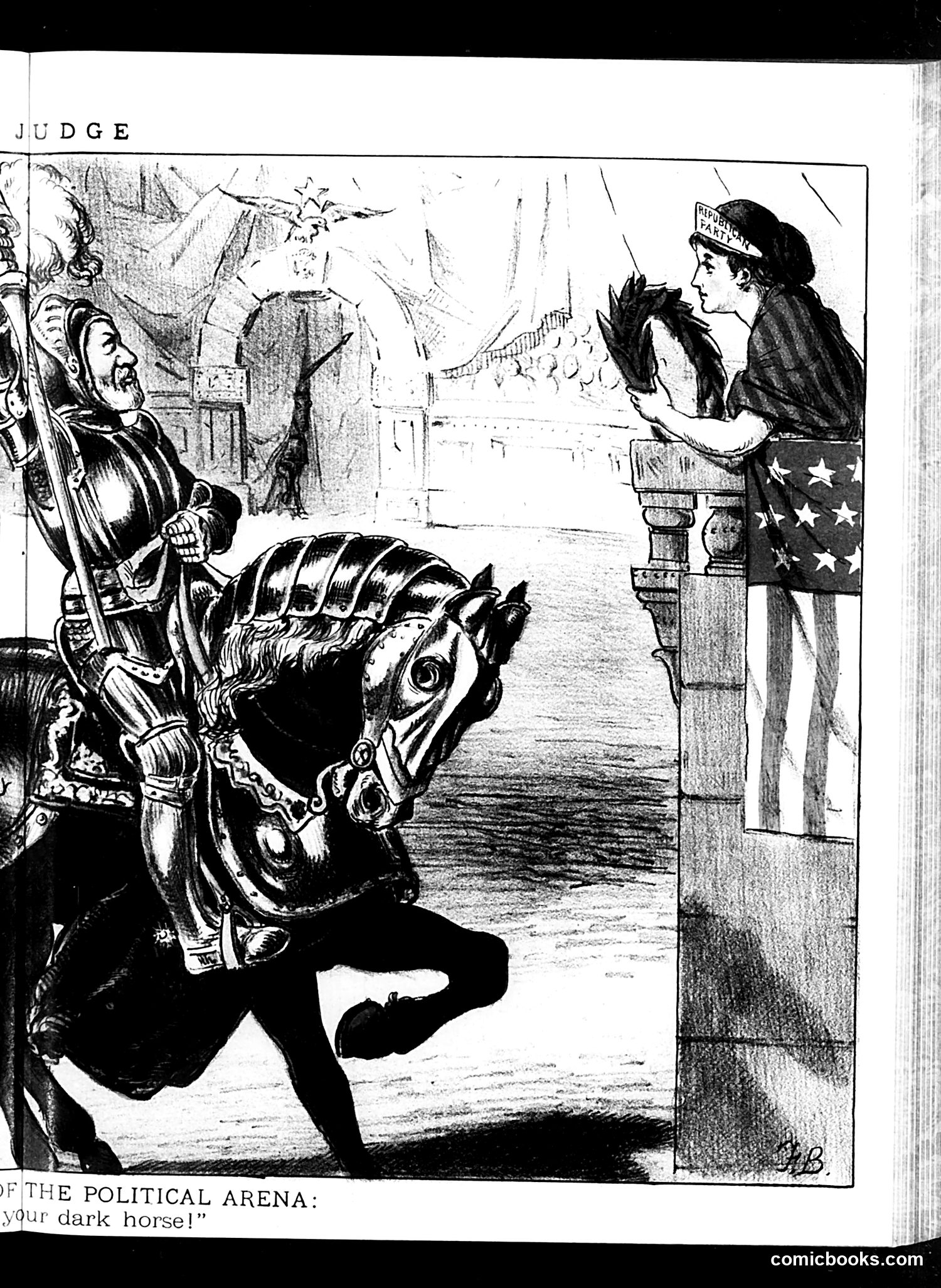
This Judge magazine cartoon titled "Of the Political Arena" depicts a confrontation between two figures: a ornately dressed military or aristocratic figure on horseback (left) and a figure labeled as representing American interests, standing on a pedestal with an American flag (right). The caption "your dark horse!" suggests this is political satire about an unexpected or underestimated candidate emerging in electoral competition. The "dark horse" reference—a political term for a surprise contender—indicates the cartoon critiques how unconventional candidates enter political contests. The contrast between the elaborately armored foreign figure and the American representative suggests commentary on American politics versus foreign influence or competition, though the specific historical context remains unclear without additional dating information.
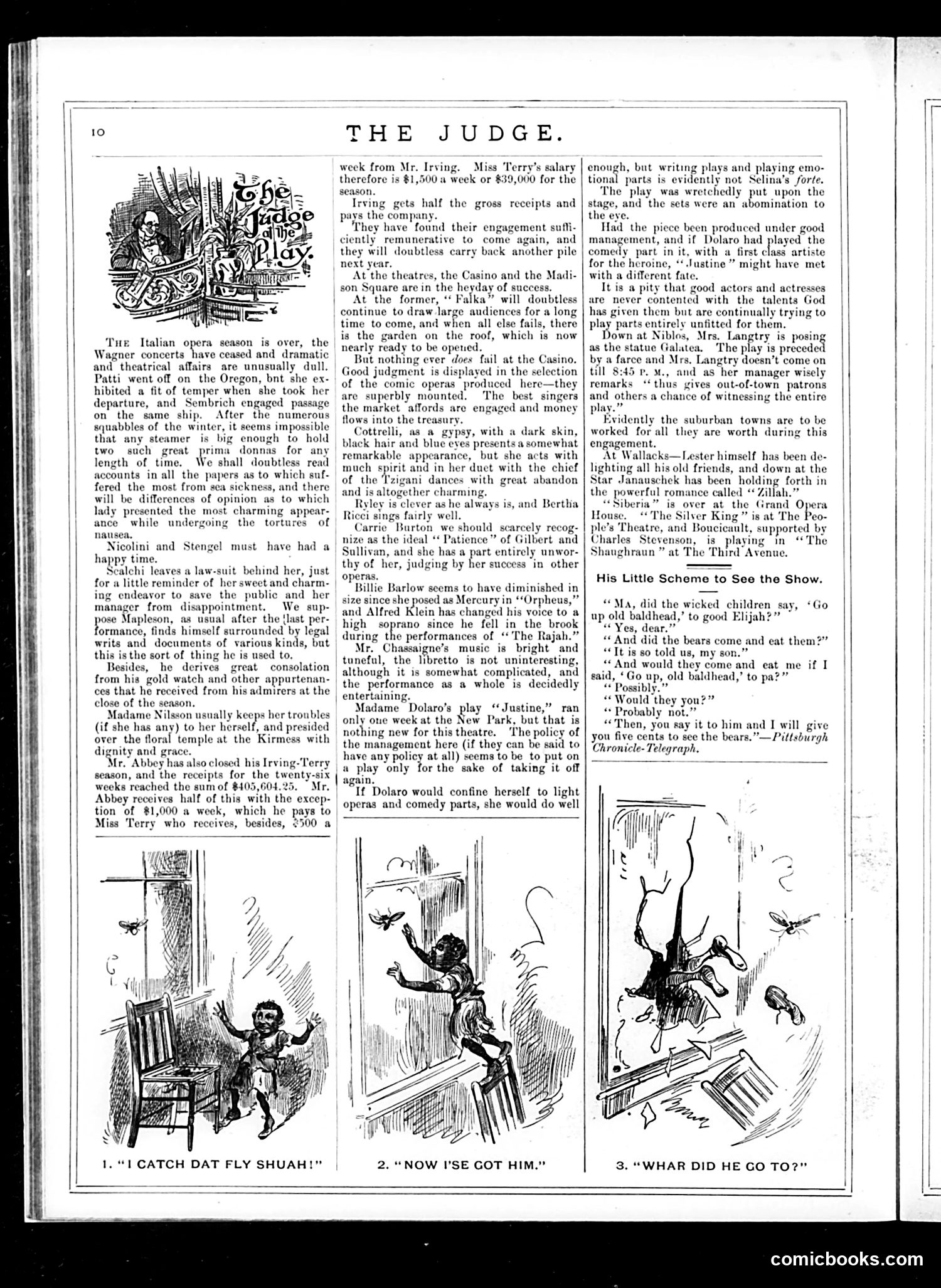
This page from *Judge* magazine reviews the 1884 theatrical season. The main text discusses opera and theater closings: prima donnas Adelina Patti and Marcella Sembrich departing on the same ship (the author jokes about their famous temperaments causing seasickness competition), and impresario Colonel Mapleson's perpetual legal troubles. The three captioned illustrations at the bottom depict a child attempting to catch a fly, with captions in exaggerated dialect ("I CATCH DAT FLY SHUAH!" / "NOW I'SE GOT HIM" / "WHAR DID HE GO TO?"). This appears to be a separate, unrelated comic strip mocking child's speech patterns—a common satirical trope of the era. The review itself is largely straightforward theater criticism praising the Casino and Madison Square theaters' productions, though it gently mocks Madame Dolaro's play "Justine" for lasting only one week. The page is primarily theatrical commentary rather than political satire.
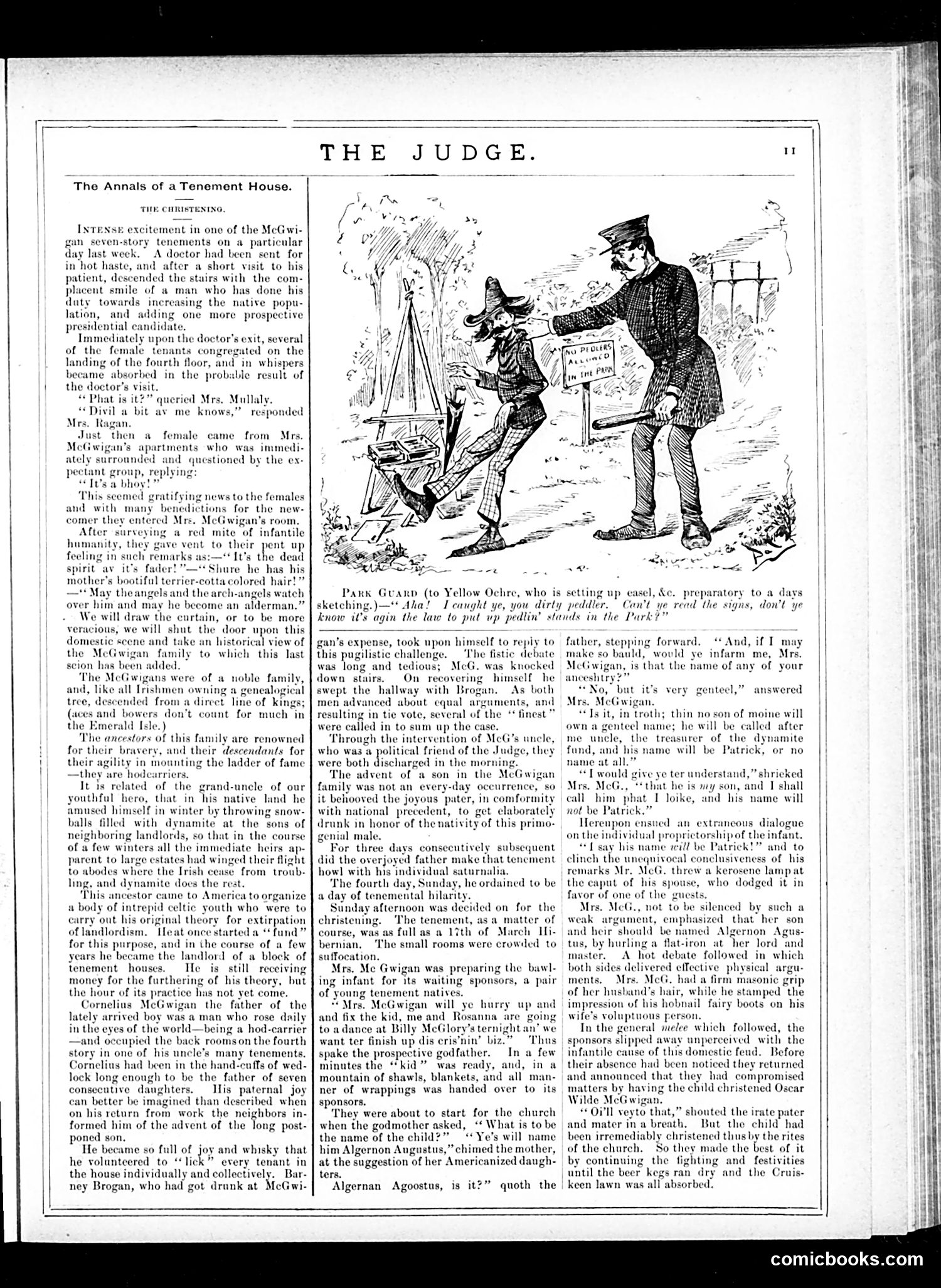
This Judge magazine page satirizes Irish-American tenement life, specifically the McGwigan family. The main cartoon depicts a park guard confronting a street artist, enforcing anti-peddling laws—likely commentary on urban regulation and class conflict. The accompanying text, "The Annals of a Tenement House," uses heavy Irish stereotypes to mock working-class Catholic immigrants. It traces the McGwigan family from violent Irish ancestors who used dynamite against landlords, through their transformation into tenement *landlords* themselves—a satirical commentary on assimilation and hypocrisy. The humor targets Irish-Americans specifically: their accent ("terrier-cotta," "av it's fader"), their supposed connection to violence and drink, their rapid reproduction ("prospective presidential candidate"), and their work as hodcarriers (manual laborers). The piece suggests Irish immigrants embodied the very exploitation they claimed to oppose. This reflects 1880s-90s anti-Irish prejudice common in American satirical publications.
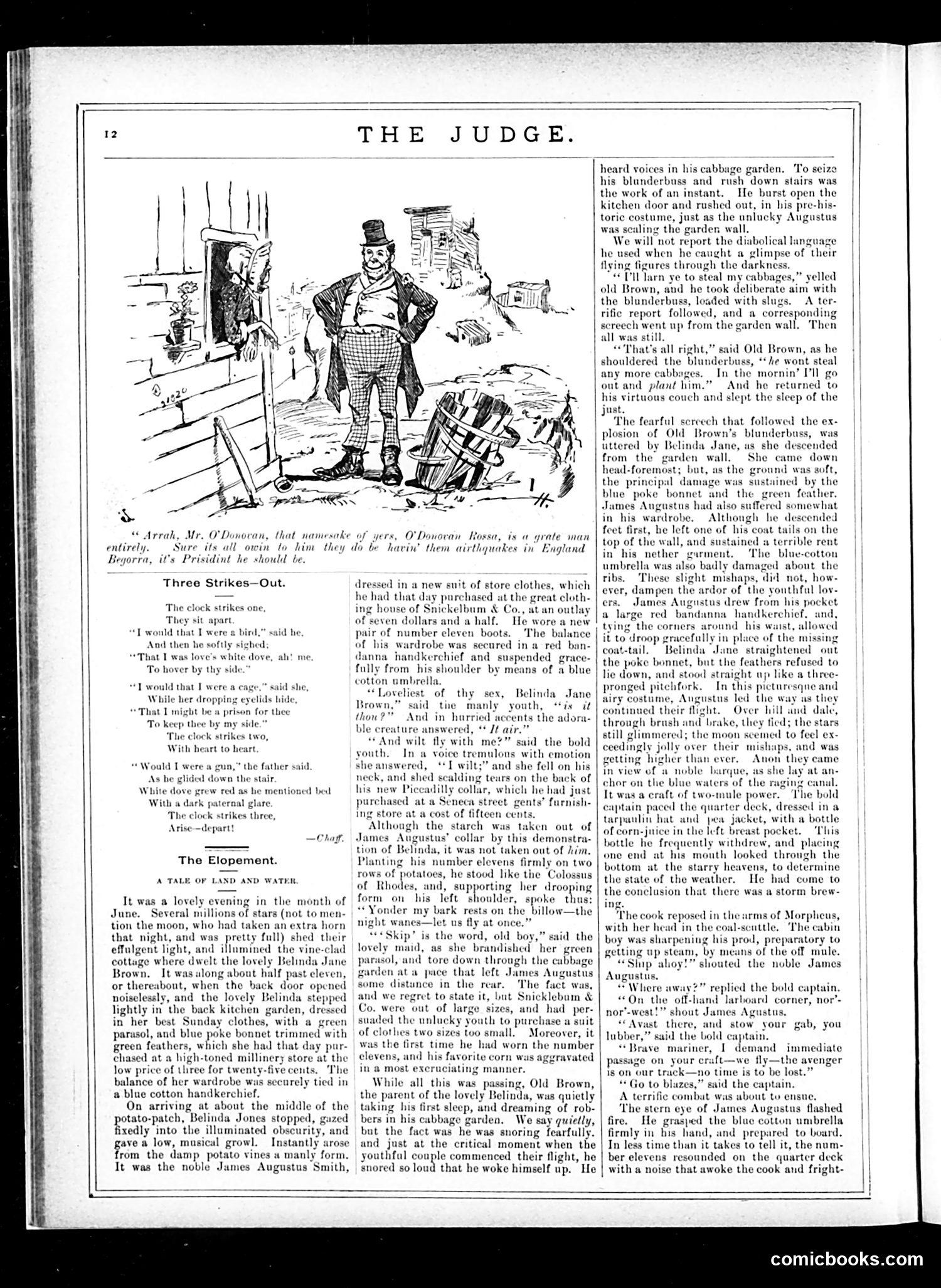
This page contains a serialized humorous story mocking Victorian romance literature. The narrative follows James Augustus Smith and the "lovely Belinda Jane Brown" through an absurdly overwritten elopement, complete with purple prose ("effulgent light," "lumined vine-clad cottage"). The satire targets multiple conventions: melodramatic dialogue, improbable coincidences, and comically trivial details elevated to tragedy—a new suit costing $7.50, a collar ruined by tears, tight boots causing foot pain. The parents' overwrought emotions in the separate "Three Strikes—Out" poem reinforce the mockery of sentimental excess. The top cartoon appears to reference Irish immigration ("Arrah, Mr. O'Donovan"), suggesting one character could become president, though its specific political reference is unclear from the visible portion. The overall effect satirizes the sentimental serialized fiction popular in period magazines.
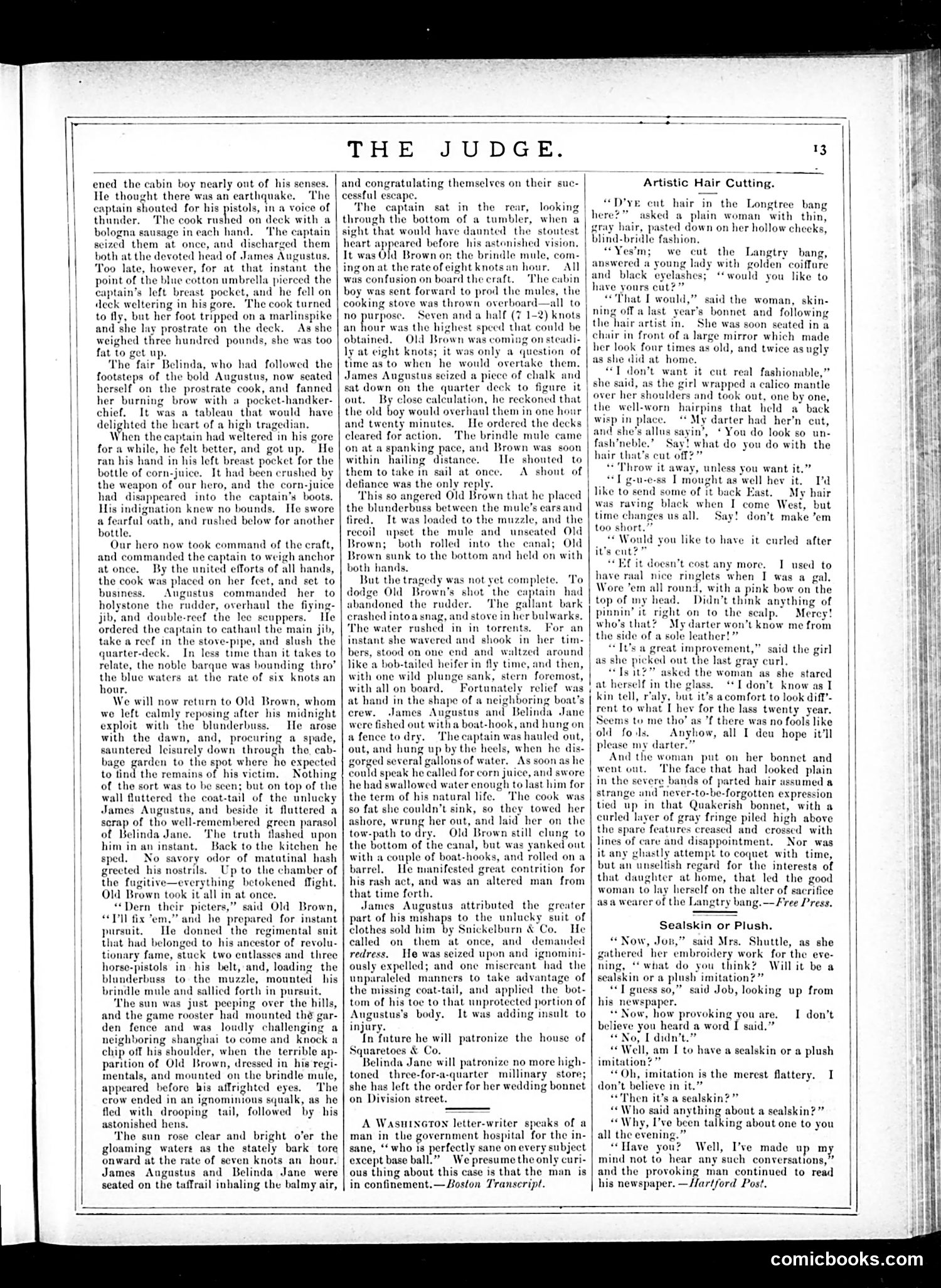
This page from Judge magazine contains serialized fiction rather than political cartoons. The main narrative follows a melodramatic nautical adventure involving characters named James Augustus, Belinda Jane, Old Brown, and a ship's captain. The story satirizes overwrought Victorian romantic fiction—complete with dramatic confrontations, unrequited love, physical comedy (a 300-pound cook, an umbrella weapon), and pursuit scenes. The humor derives from exaggerated plot devices: Augustus pierces the captain with a blue cotton umbrella, the cook becomes an unwitting participant in romance, and Old Brown pursues the lovers in full Revolutionary War regalia on a mule. The secondary "Artistic Hair Cutting" and "Sealskin or Plush" sections appear to be humorous advice columns, with the hair-cutting segment poking fun at fashionable hairstyles of the era. This represents Judge's satirical approach to popular literature and social customs rather than political commentary.
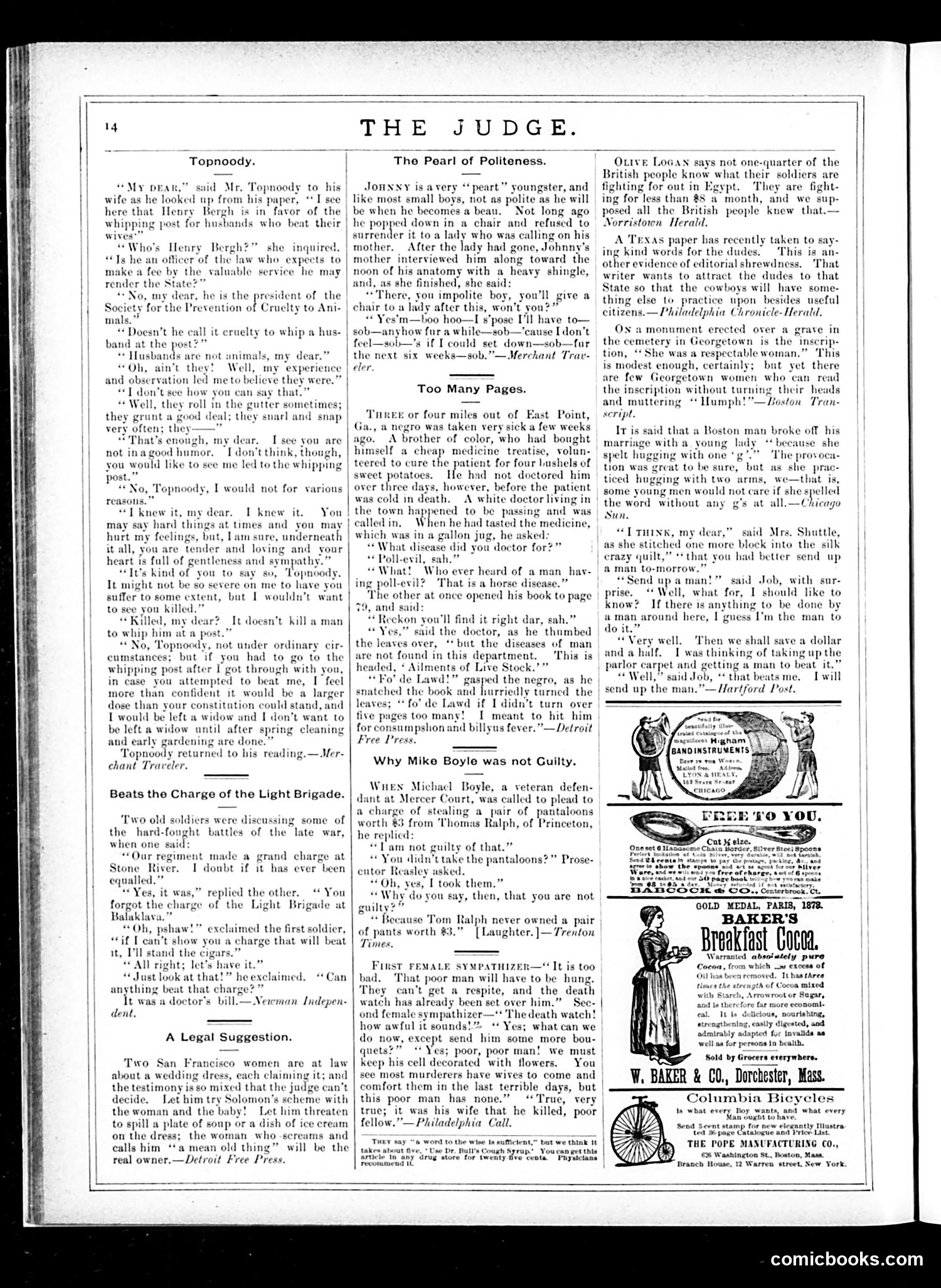
This page contains **multiple humor columns** rather than political cartoons, typical of *Judge* magazine's format. The main pieces mock domestic life and courtship: **"Topnoody"** satirizes a husband's defensive reaction to Henry Bergh (real founder of the ASPCA), sarcastically comparing men to animals deserving discipline—a joke about marital discord and women's frustration with husbands' behavior. **"Beats the Charge of the Light Brigade"** presents a joke comparing a military charge to a doctor's bill—mocking medical expenses as more formidable than battle itself. **"The Pearl of Politeness"** shows a mother beating her son for refusing his chair to a lady, satirizing both child discipline and the era's emphasis on etiquette. The side comment about British soldiers in Egypt and courthouse cemetery maintenance reflect typical magazine humor mixing social commentary with anecdotes. The advertisements below (cocoa, bicycles, manufacturing) are typical period marketing, not satirical content.
This page consists primarily of advertisements and a column of brief satirical items typical of Judge magazine's format. Rather than political cartoons, the content features short quips and observations about contemporary life. The satirical items mock various subjects: Australian rubber boots' durability, Irish theater's lack of actors, the Des Moines fire department's over-zealous driving, and a railway passenger's selfish behavior—all presented as humorous observations from various newspapers. A brief item quotes John Bright expressing dread of the sea and America, with the commentary that Americans will regret his sentiments, as Matthew Arnold would be better regarded than Bright in America—a jab at both figures' relative popularity and their contrasting approaches to culture. The page is largely filled with period advertisements for pianos, magic lanterns, pills, and other goods. There are no clearly identified major political figures or cartoons—instead, this represents Judge's typical satirical commentary on everyday absurdities.
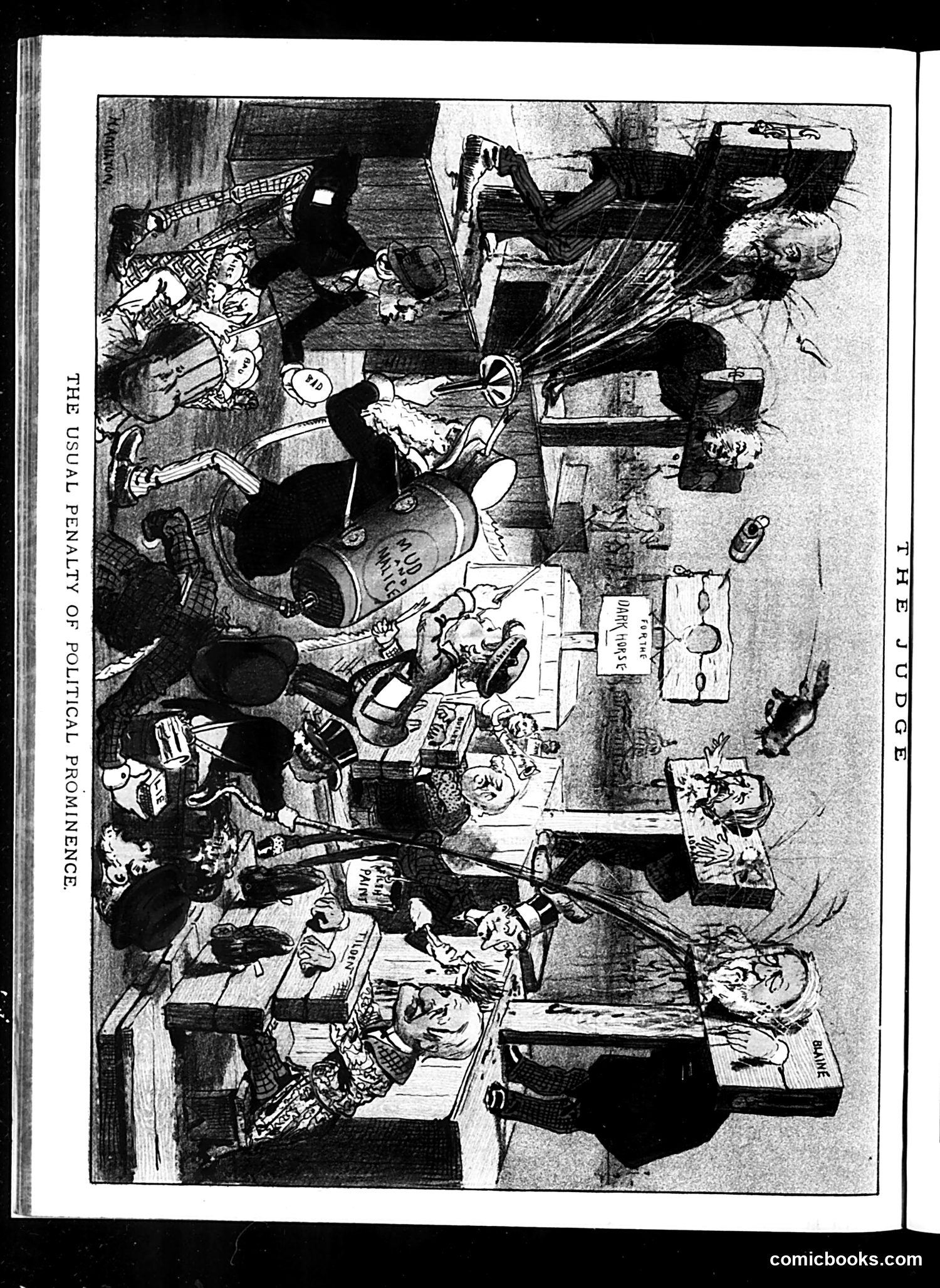
I can see this is a page from *Judge* magazine titled "The Judge" with text reading "THE USUAL PENALTY OF POLITICAL PROMINENCE" on the left margin. The image shows a chaotic scene that appears to be rotated 90 degrees, depicting multiple figures in what looks like a courtroom or public setting engaged in conflict or disturbance. However, the OCR text provided is largely illegible characters and does not contain meaningful content that would help identify specific political figures, events, or the cartoon's satirical point. Without readable text explaining the context, I cannot reliably identify which political figures are caricatured or what specific incident or policy the satire addresses. The composition suggests commentary on political consequences or public scrutiny, but the specific target remains unclear from what's legible here.