
Judge, 1884-05-10 · page 10 of 16
Judge — May 10, 1884 — page 10: what you’re looking at
What you’re looking at
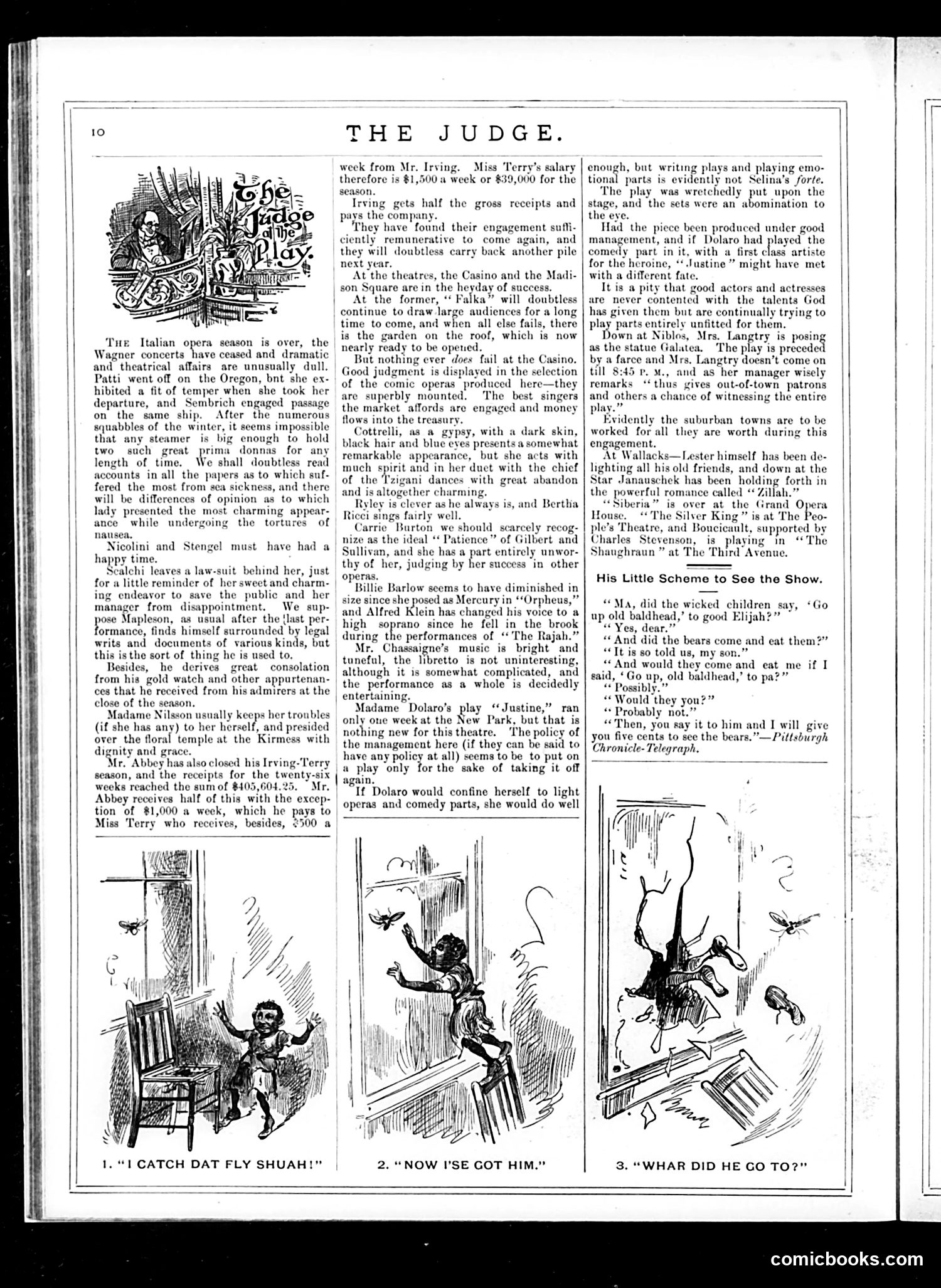
This page from *Judge* magazine reviews the 1884 theatrical season. The main text discusses opera and theater closings: prima donnas Adelina Patti and Marcella Sembrich departing on the same ship (the author jokes about their famous temperaments causing seasickness competition), and impresario Colonel Mapleson's perpetual legal troubles. The three captioned illustrations at the bottom depict a child attempting to catch a fly, with captions in exaggerated dialect ("I CATCH DAT FLY SHUAH!" / "NOW I'SE GOT HIM" / "WHAR DID HE GO TO?"). This appears to be a separate, unrelated comic strip mocking child's speech patterns—a common satirical trope of the era. The review itself is largely straightforward theater criticism praising the Casino and Madison Square theaters' productions, though it gently mocks Madame Dolaro's play "Justine" for lasting only one week. The page is primarily theatrical commentary rather than political satire.
📄 Transcribed text from this page (OCR, searchable)
Machine-transcribed from the original scan — historical spelling and the odd misread are preserved.
{ i Tue Italian opera season is over, the Wagner concerts have ceased and dramatic and theatrical affairs are unusually dull. Patti went off on the Oregon, bnt she ex- hibited a fit of temper when she took her departure, and Sembrich engaged passage on the same ship. After the numerous squabbles of the winter, it seems impossible that any steamer is big enough to hold two such great prima donnas for any length of time. We shall doubtless read accounts in all the papers as to which suf- fered the most from sea sickness, and there will be differences of opinion as to which lady presented the most charming appear- ance while undergoing the tortures of nausea. Nicolini and Stengel must happy time. Scalchi leaves a law-suit behind her, just for a little reminder of hers d charm- ing endeavor to save the public and her manager from disappointment. We sup- pose Mapleson, as usual after the Formance, finds himself surrounded bj writs and documents of various kinds, but this isthe sort of thing he is used to. Besides, he derives great consolation from his gold watch and other appurtenan- ces that he received from his admirers at the close of the season. Madame Nilsson usually keeps her troubles (if she has any) to her herself and presided over the floral temple at the Kirmess with dignity and grace. Mr. Abbey has also closed his Irving-Terry season, and the receipts for the twenty-six weeks reached the sum of $405,604.25. "Mr. Abbey receives half of this with the excep- tion of $1,000 a week, which he pays to Miss Terry who re besides, $500 a have had a 1. “1 CATCH DAT FLY SHUAH!” week from Mr. Irving. Miss ‘Terry's salary therefore is $1,500 a week or $39,000 for the season. Irving gets half the gross receipts and company. ave found their engagement sufli- remunerative to come again, and y will doubtless carry back another pile next year, At the theatres, the Casino and the Madi- son Square are in the heyday of success. At the former, ‘‘ Falka” will doubtless continue to draw large audiences for a long time to come, and when all else fails, there is the garden on the roof, which is now nearly ready to be opened. But nothing ever does fail at the Casino, Good judgment is displayed in the selection of the comic operas produced here—they are superbly mounted. The best singers the market affords are engaged and money flows into the treasury Cottrelli, as a gypsy, with a dark skin, black hair and blue eves presents a somewhat remarkable appearance, but she acts with much spirit and in her duet with the chief of the Peigani dances with great abandon and is altogether charming. Ryley is clever as he always Ricci sings fairly well. Carrie Burton we should. sea recog- nize as the ideal *‘ Patience ” of Gilbert and Sullivan, and she has a part entirely unwor- thy of her, judging by her success in other operas. Billie Barlow seems to have diminished in size since she posed as Mercury in ‘‘Orpheus,”” and Alfred Klein has changed his voice to a high soprano since he fell in the brook during the performances of ‘The Rajah.” Mr. Chassaigne’s music is bright and tuneful, the libretto is not uninteresting, although it is somewhat complicated, and the performance as a whole is decidedly entertaining. Madame Dolaro’s play “Justine,” ran only one week at the New Park, but that is nothing new for this theatre. ‘The policy of the management here (if they can be said to have any policy at all) seems to be to put on a play only for the sake of taking it off again. If Dolaro would confine herself to light operas and comedy parts, she would do well = , and Bertha 2. ‘NOW I’SE GOT HIM.” enough, but writing plays and playing emo- tional parts is evidently not Selina’s forte. The play was wretchedly put upon the stage, and the sets were an abomination to the eve. Had the piece been produced under good | management, and if Dolaro had played the comedy part in it, with a first class artiste for the heroine, ‘Justine ” might have met with a different fate. It is a pity that good actors and actre: are never contented with the talents has given them but are continually try play parts entirely unfitted for them. Down at Niblos, Mrs. Langtry is posin; as the statue Galatea. The play is precedec by a farce and Mrs. Langtry doesn’t come on till nd as her manager wisely “thus gives out-of-town patrons and others a chance of witnessing the entire 3808 od ig to dently the suburban towns are to be worked for all they are worth during this engagement. At Wallacks—Lester himself has been de- lighting all his old friends, and down at the Star Janauschek been holding forth in the powerful romance called “Zillah,” “Siberia” is over at the and Opera Hou “The Silver King ” is at The Peo- ple’s Theatre, and Boucicault, supported by Charles Stevenson, isp! “The Shaughraun ” at The Thir His Little Scheme to See the Show. “Ma, did the wicked children say, ‘Go up old baldhead,’ to good Elijah?” ~ “Yes, dear.” “And did the bears come and eat them?” “Tt is so told us, my son.” “And would they come and eat me if I said, ‘Go up, old baldhead,’ to pa?” “Possibly.” “ Would ‘they you? “ Probably not.” “Then, you say it to him and I will give you five cents to see the bears.”— Pittsburgh Chronic et a, It M fi" ae) 3. ““WHAR DID HE GO TO?” comicbooks.com