
A complete issue · 16 pages · 1884
Judge — March 8, 1884
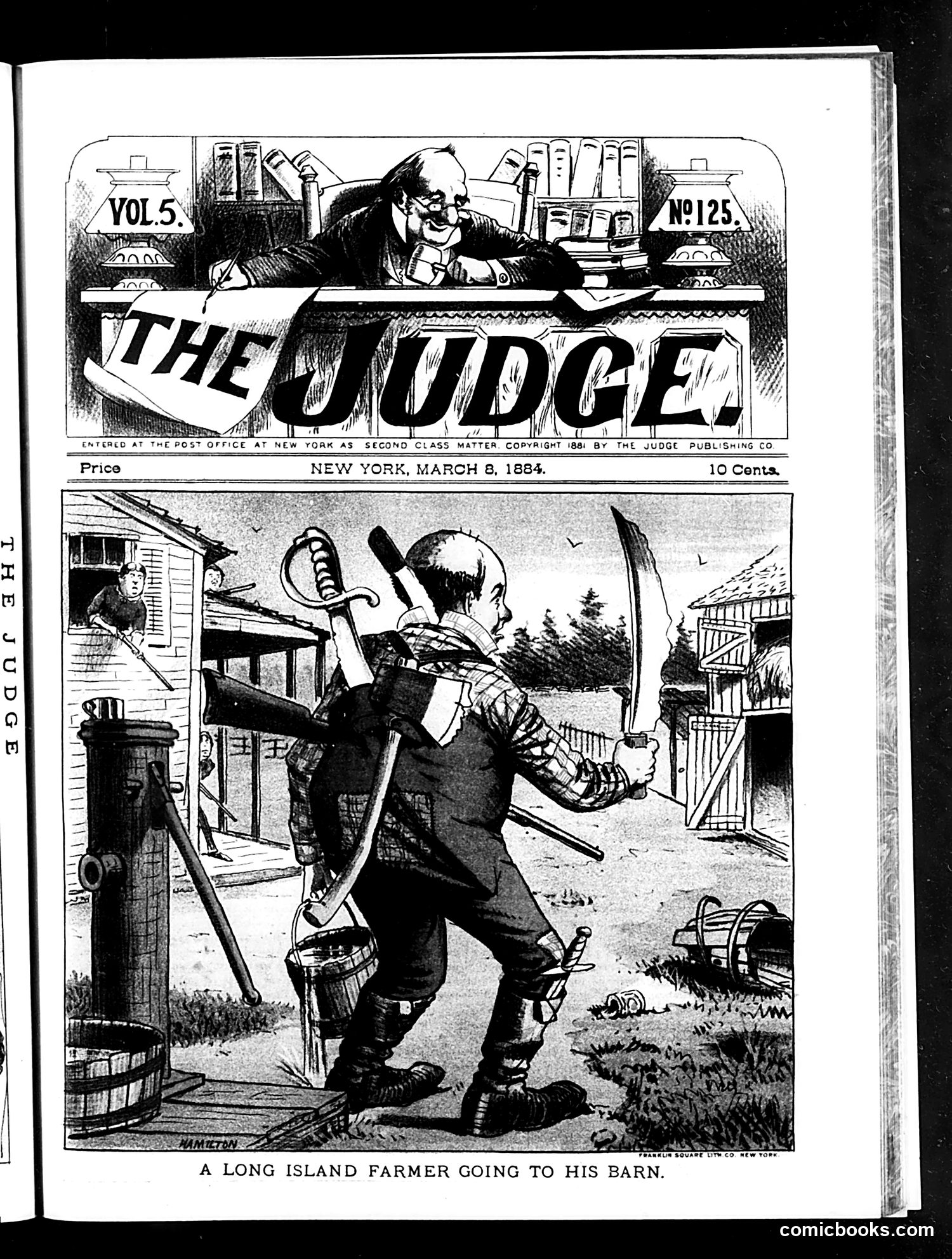
The main cartoon depicts "A Long Island Farmer Going to His Barn," showing a man heavily laden with farming tools and equipment—axes, scythes, buckets, and baskets—struggling under the weight. This appears to be social satire about the burdens facing American farmers in the 1890s. The cartoon likely comments on economic hardship during the depression following the Panic of 1893, when farmers faced debt, falling crop prices, and difficult working conditions. The exaggerated load symbolizes the multiple pressures—financial obligations, labor demands, and resource constraints—crushing rural agricultural workers. The header shows "The Judge" publication office details (Vol. 5, No. 125, dated March 8, 1894, price 10 cents).
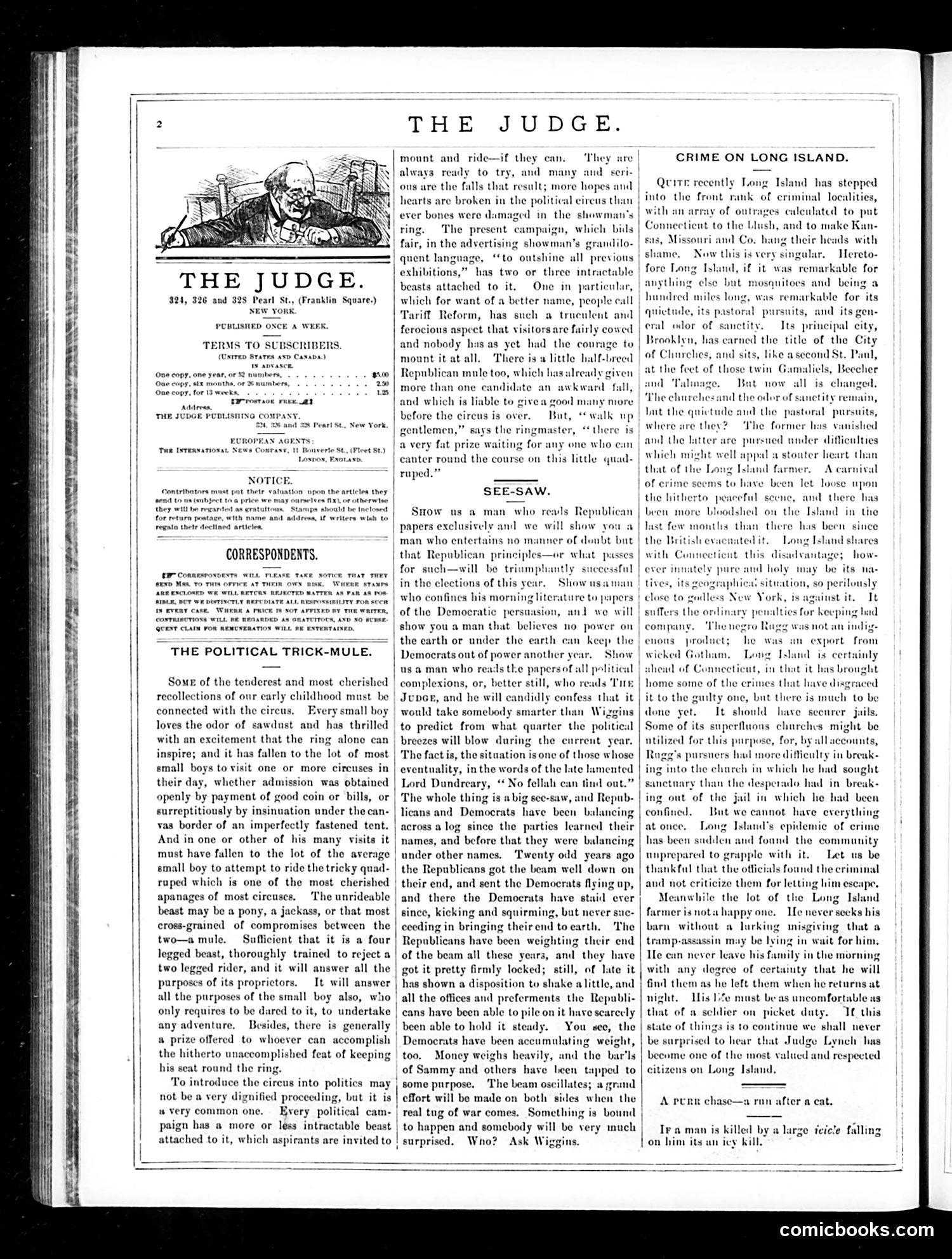
This page contains **two satirical pieces** about 1880s American politics: **"The Political Trick-Mule"** (main cartoon): Uses a circus metaphor to mock political campaigns. The "unrideable mule" represents intractable political issues—specifically **Tariff Reform**—that candidates must navigate. Like a circus performer attempting to stay mounted on a deliberately uncooperative animal, politicians attempt to ride these contentious issues without falling (losing elections). The satire suggests both major parties pretend confidence while these issues consistently throw riders. **"See-Saw"**: Mocks partisan newspaper readers and political operatives. It ridicules the predictable, reflexive certainty of both Republicans and Democrats—each side absolutely convinced their party will win, their principles will triumph, the other party will lose. The "see-saw" implies this back-and-forth certainty is mechanical and absurd. Both pieces express cynicism about political theater and partisan predictability rather than supporting either party. The humor targets the circus-like nature of campaigns and partisan ideology itself.
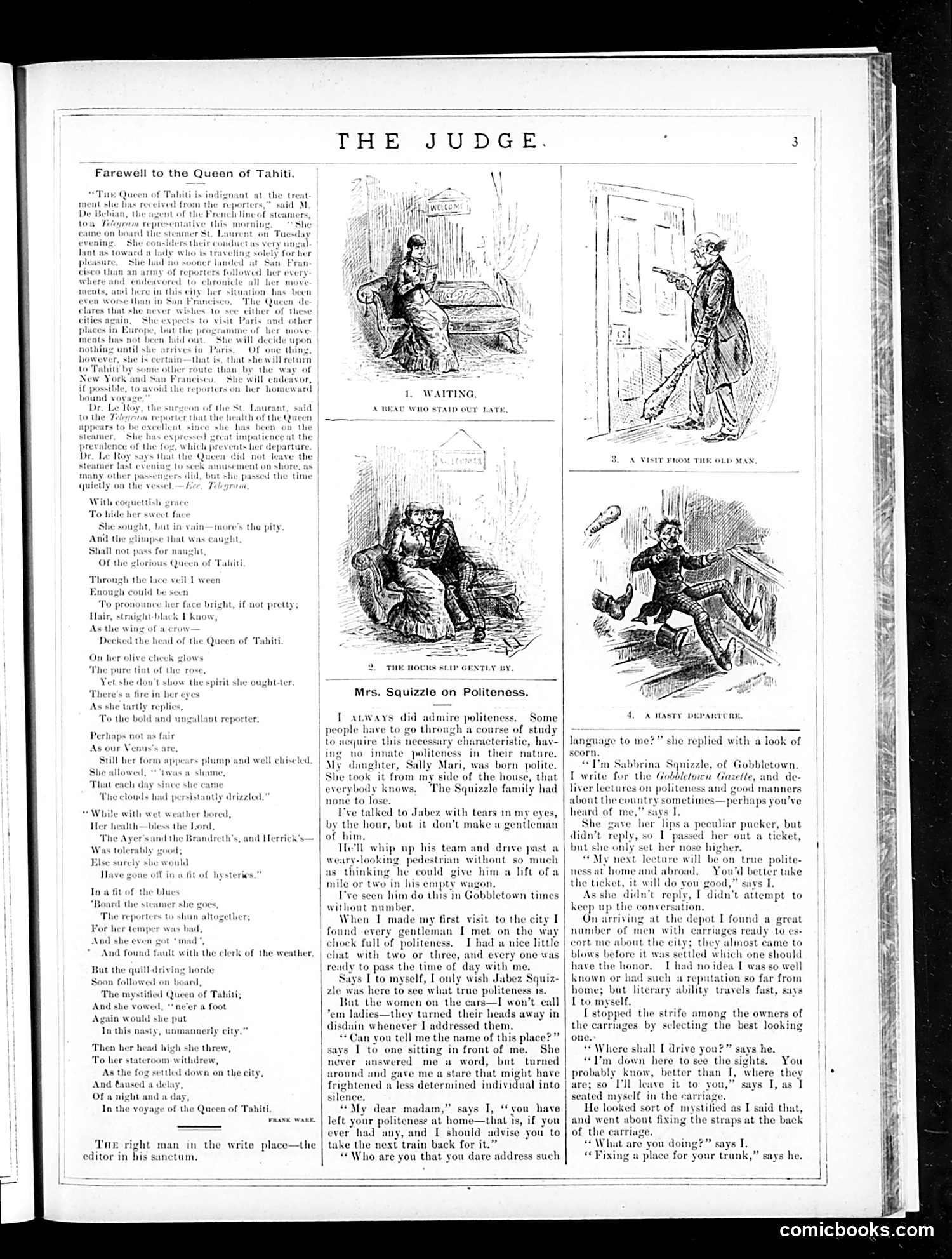
This page contains two satirical pieces from *Judge* magazine: **"Farewell to the Queen of Tahiti"** (left) mocks a visiting Tahitian queen's departure from America. The poem and accompanying sketches ridicule her complaints about American weather and manners—she allegedly criticized the rain, found Americans rude, and expressed relief to leave. The satire targets both the visiting dignitary's presumed snobbishness and implicitly American society's failings in hospitality and civility. **"Mrs. Squizzle on Politeness"** (right) presents a humorous monologue where Mrs. Squizzle boasts about her daughter's natural politeness while recounting her own visit to the city. She encounters what she perceives as rudeness from urban women and men, ultimately deciding city dwellers lack proper manners. The satire mocks both rural assumptions of superiority and urban indifference—poking fun at small-town smugness about "proper" behavior versus city cosmopolitanism. Both pieces reflect turn-of-century anxieties about American manners and civility.
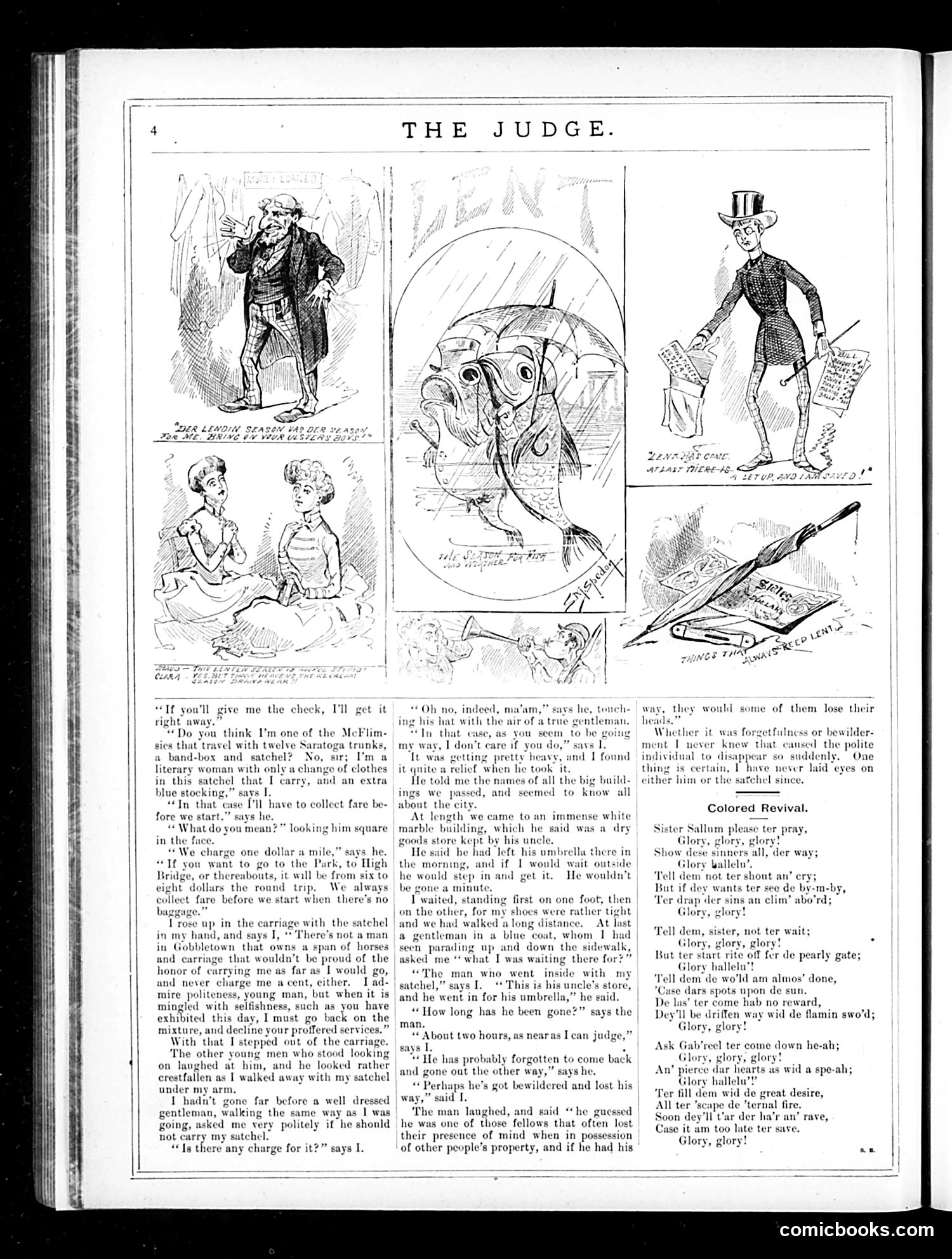
This page contains two distinct satirical pieces: **"The Judge" (main narrative):** A social commentary on class pretension and politeness. A poorly-dressed woman with a satchel repeatedly refuses cab rides, boasting that gentlemen would gladly carry her belongings without charge—yet when a polite gentleman obliges and leaves to retrieve his umbrella, he never returns, abandoning her. The satire mocks her self-importance and exposes the gap between professed gentility and actual behavior. Her insistence on being treated as a "literary woman" worthy of unpaid service becomes the joke when she's left stranded. **"Colored Revival" (right column):** A religious revival hymn, likely satirizing Black Protestant revival meetings through stereotypical dialect ("Gab'reel," "de flamin swo'd"). The verses use exaggerated vernacular speech patterns typical of period racial caricature in American humor magazines. Both pieces reflect *Judge* magazine's era—late 19th/early 20th century—when such content was considered socially acceptable satire, though deeply problematic by modern standards.
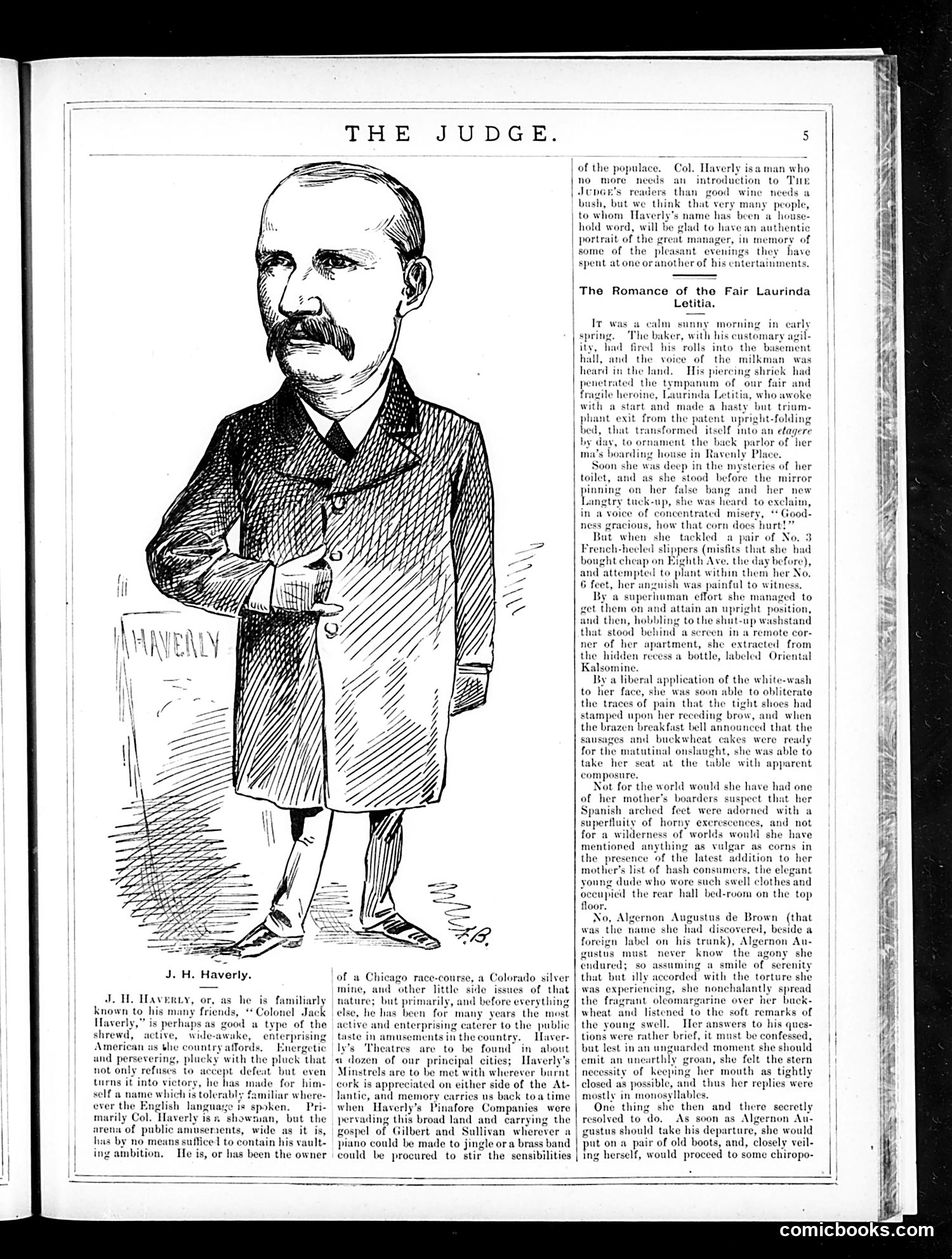
**The Illustration:** This is a portrait caricature of J.H. Haverly, labeled "Colonel Jack Haverly," a prominent American entertainment impresario of the late 19th century. The accompanying text—not satirical—praises him as an energetic theater owner and manager of minstrel troupes and operetta companies that performed across America. **The Satire:** The humor lies in the juxtaposition: the serious, laudatory biographical text about Haverly occupies the *entire page*, leaving the accompanying short story "The Romance of the Fair Laurinda Letitia" crammed into the right column. This story—a comedic domestic sketch about a young woman suffering from corns trying to hide her discomfort at breakfast—is overshadowed and marginalized by the Haverly puff piece, suggesting *Judge* is prioritizing entertainment industry celebrity coverage over actual humorous content for readers.
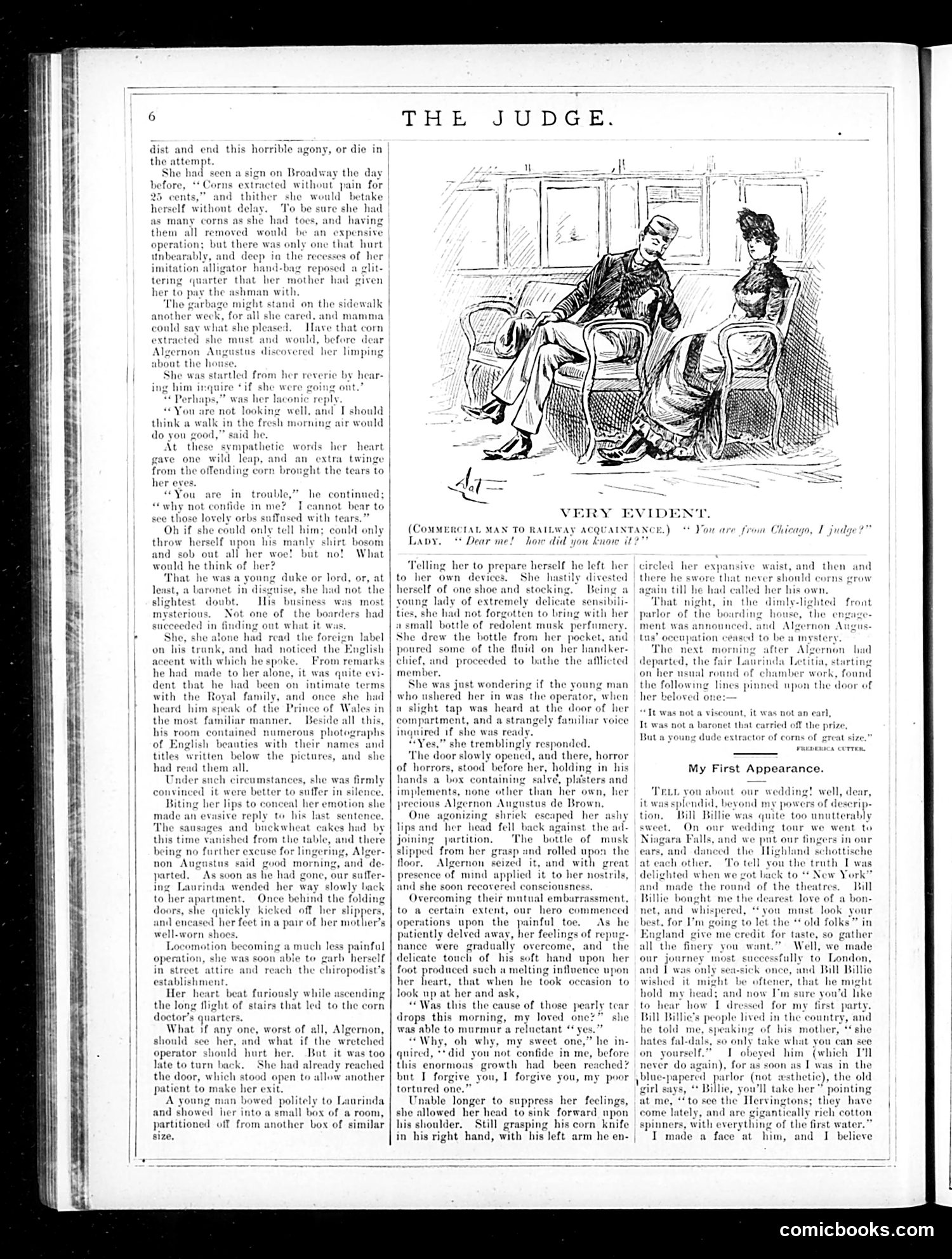
This page satirizes the romantic complications of Victorian courtship, specifically mocking a young woman's embarrassment about a physical ailment. The cartoon depicts a woman ("Laurinda") who has been hiding a painful corn from her suitor, a wealthy gentleman named Algernon Augustus de Brown—likely identified by his aristocratic pretensions (the text mentions his familiarity with the Prince of Wales and his room full of photographs). The satire centers on the humorous irony that Algernon himself is revealed to be a chiropodist (corn doctor). The woman's elaborate efforts to conceal her condition from him—using perfume, delicate sensibilities, and silent suffering—are rendered absurd when she discovers he's the very practitioner she sought out. The "very evident" solution to her romantic dilemma becomes perfectly clear through this coincidental revelation, allowing their relationship to proceed honestly. The humor targets Victorian prudishness and the extremes women endured to maintain appearances of delicacy before potential suitors.
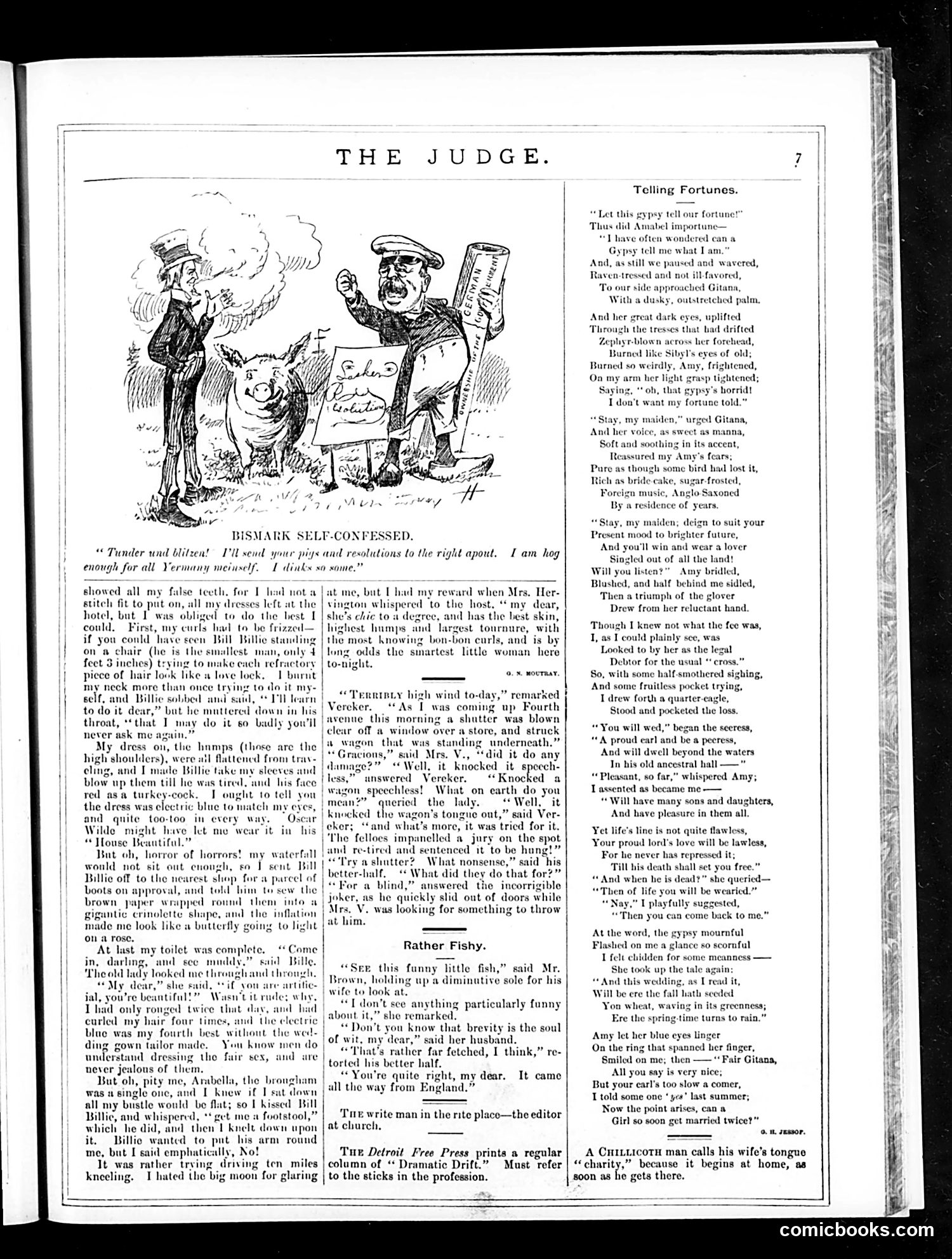
This page contains three humorous anecdotes mocking Victorian social conventions: **"Bismark Self-Confessed"** (main cartoon): A caricatured German figure claims credit for various accomplishments while holding papers labeled with resolutions. The satire ridicules boastful German nationalism and military posturing of the era. **"Telling Fortunes"**: A poem about a gypsy fortune-teller, mocking romantic idealization and women's superstitious pursuits. **"Rather Fishy"** and **"Terribly High Wind Today"**: Brief comedic dialogues where husbands make terrible puns ("brevity is the soul of wit" about a small fish; "knocked the wagon's tongue out" about a shutter damaging a cart). The humor lies in wives' exasperation at such groan-worthy wordplay. The embedded narrative about "Arabella" satirizes women's elaborate Victorian fashion requirements—excessive corseting, bustles, and styling that required male assistance and made simple activities like sitting or riding impossible. Overall, the page mocks gender relations, fashion obsession, and male pomposity through light satire.
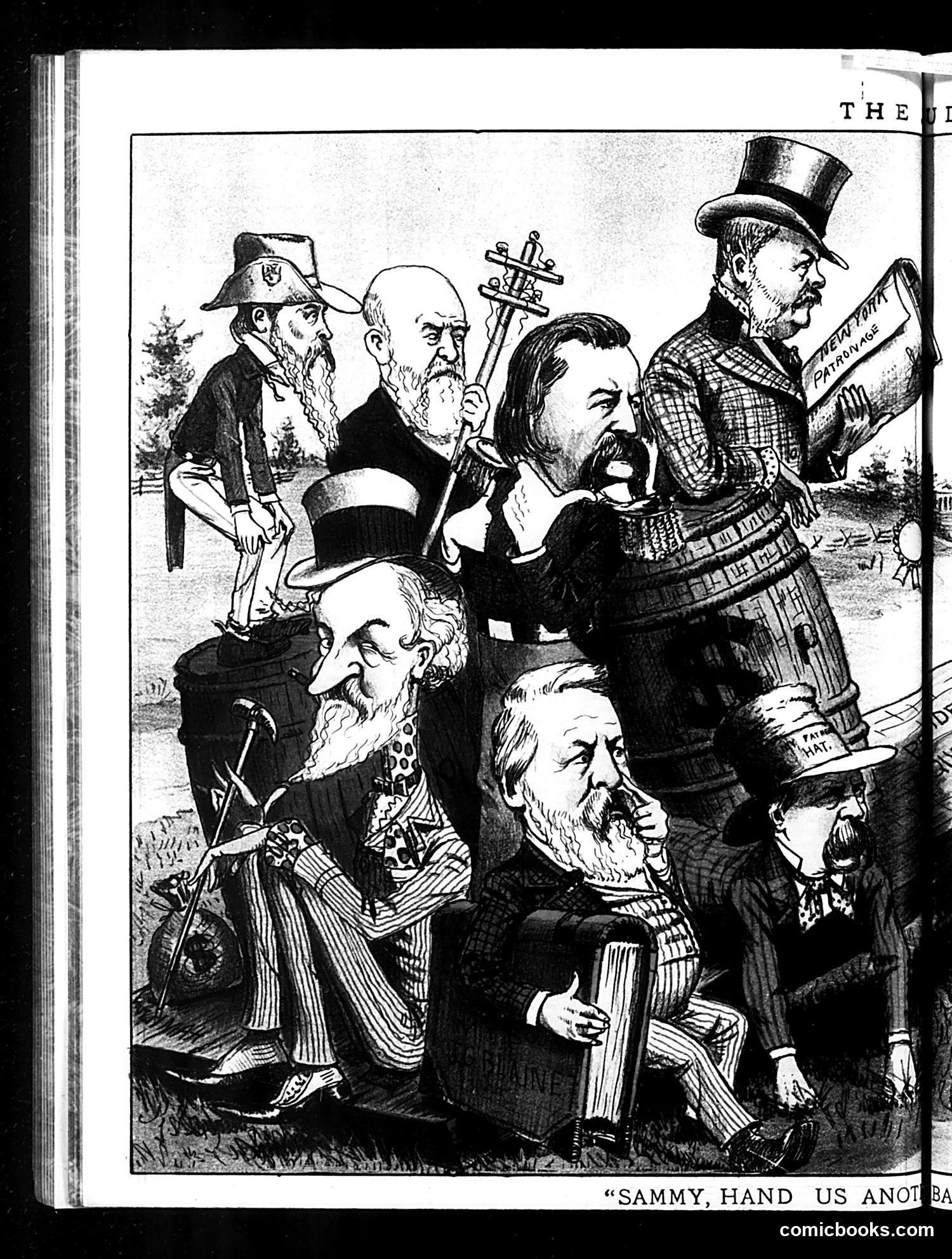
This appears to be a satirical cartoon from *Judge* magazine depicting several bearded men in 19th-century military or formal dress. The caption reads "SAMMY, HAND US ANOT[HER]..." (text cut off), suggesting these figures are requesting something, likely weapons or military supplies. The caricatured men appear to represent political or military leaders of the era. Their exaggerated facial features, formal military uniforms with decorative elements, and the context of "handing" something suggest this is commentary on arms dealing, military alliances, or diplomatic negotiations during a period of international tension. Without the complete caption or publication date visible, the specific historical event or figures remain unclear, though the style and content suggest commentary on late 19th-century European or American military politics.
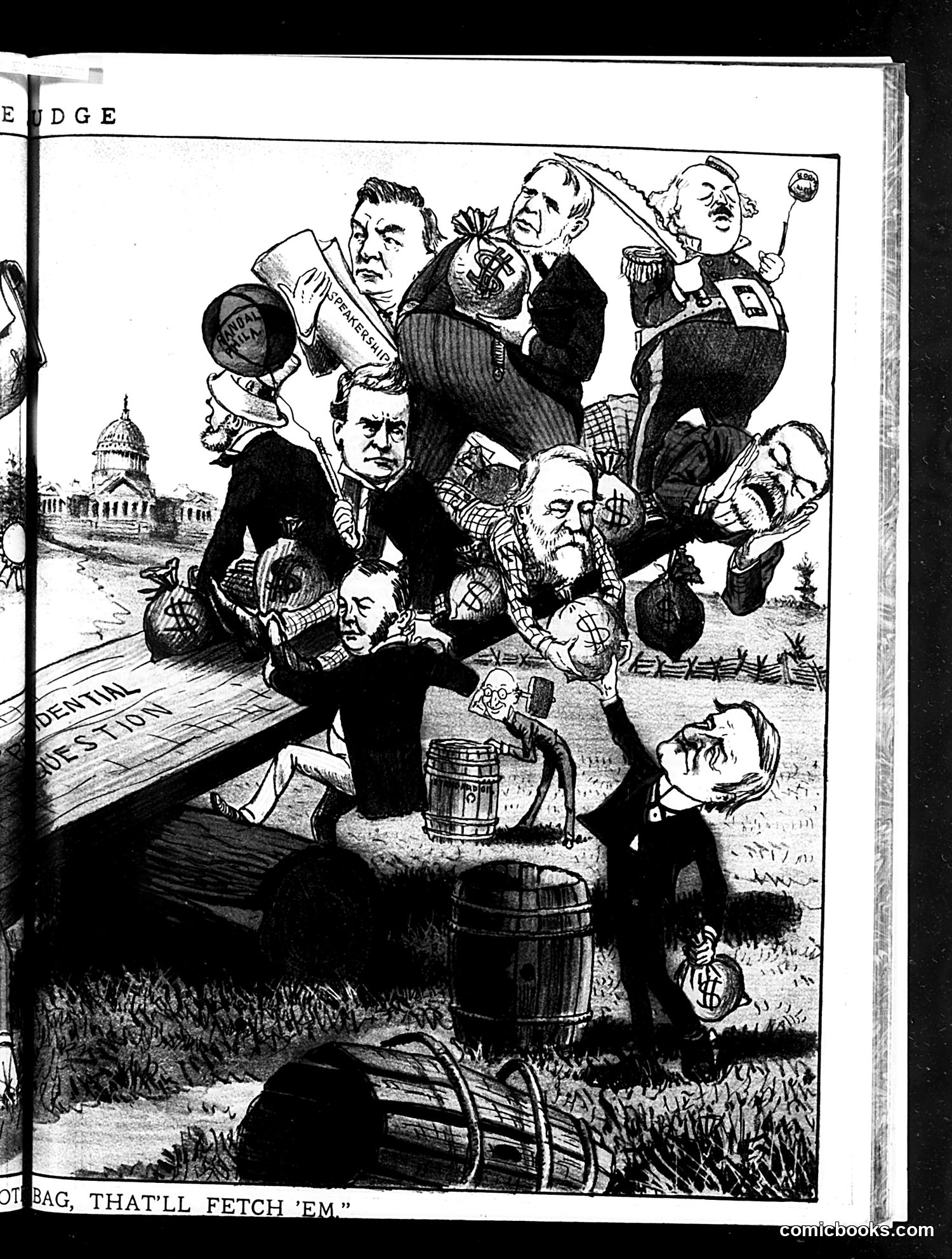
This Judge magazine cartoon, titled "Got Bag, That'll Fetch 'Em," depicts political corruption during what appears to be the Gilded Age. A small figure (likely representing the public or a reformer) stands before barrels labeled with money bags, while various caricatured politicians and military/government officials above juggle money, weapons, and honors. The Capitol building visible in the background emphasizes this is about federal governance. The satire suggests that politicians are literally "juggling" public funds and positions—using money and military appointments as tools to maintain power. The "bag" the small figure references appears to be a money bag, implying that corrupt officials will respond to financial incentives or bribes. The cartoon critiques systemic political corruption and the buying/selling of government positions.
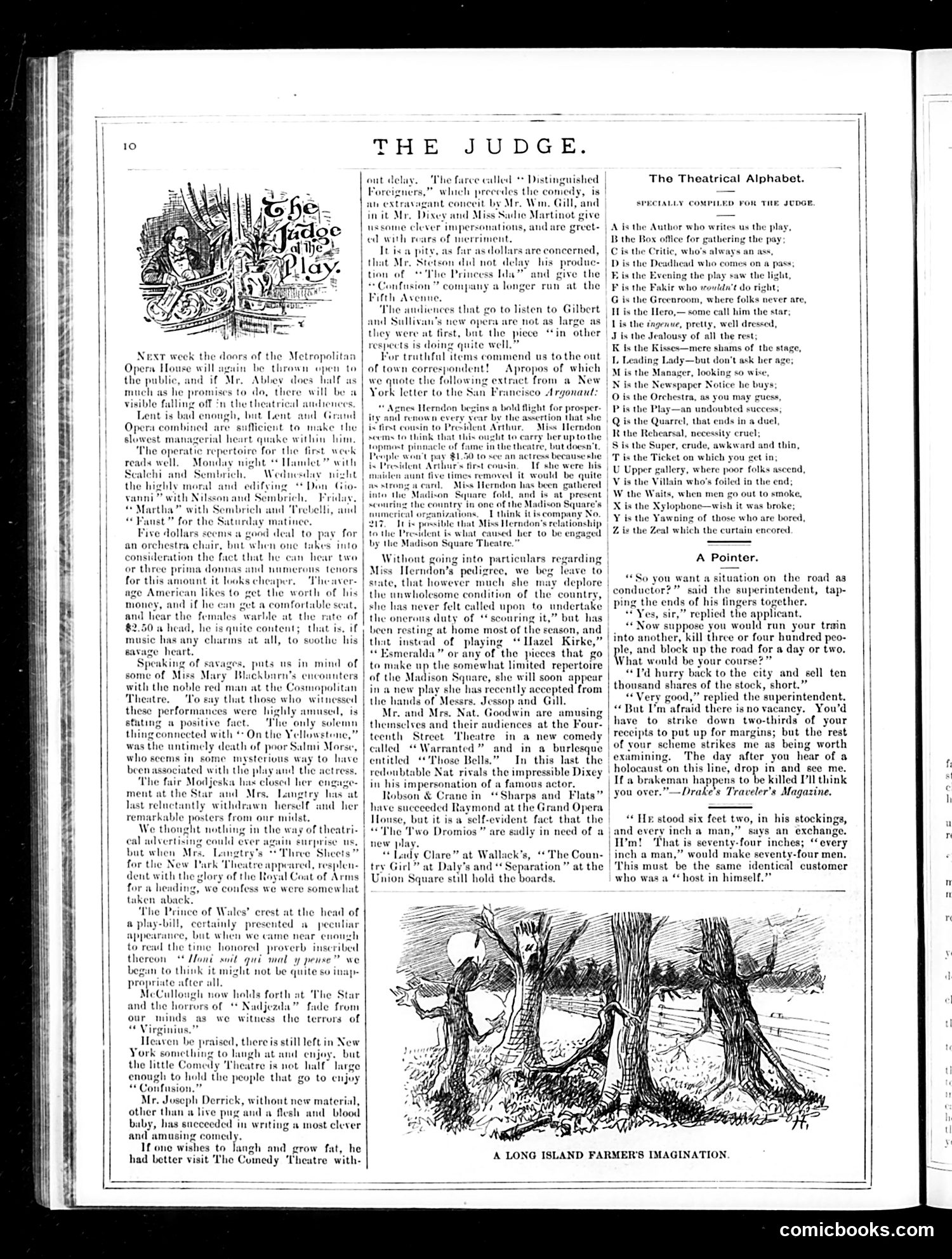
This page from Judge magazine (circa 1880s) is primarily **theatrical criticism and gossip**, not political satire. The main content discusses New York opera and theater productions. **Key references:** - The **Metropolitan Opera House** opening with expensive tickets ($5) - Gilbert and Sullivan's **"The Princess Ida"** opera (mentioned multiple times) - Various theatrical performers: Modjeska, Mrs. Langtry, McCullough, Joseph Derrick - Comedies like **"Confusion"** and **"The Distinguished Foreigners"** **The humor:** The satire is **social/theatrical**, not political. Judge mocks theatrical management's poor financial planning during Lent, skewers overpriced opera, and includes gossip about Miss Hendon's social-climbing through theatrical connections to President Arthur's family. **The cartoon below** ("A Long Island Farmer's Imagination") appears to illustrate a story or joke referenced in the text, though the specific reference is unclear from this excerpt. **For modern readers:** This shows 1880s theatrical culture valued European opera highly while enjoying American comedies—and Judge's audience enjoyed reading theatrical gossip mixed with economic criticism.
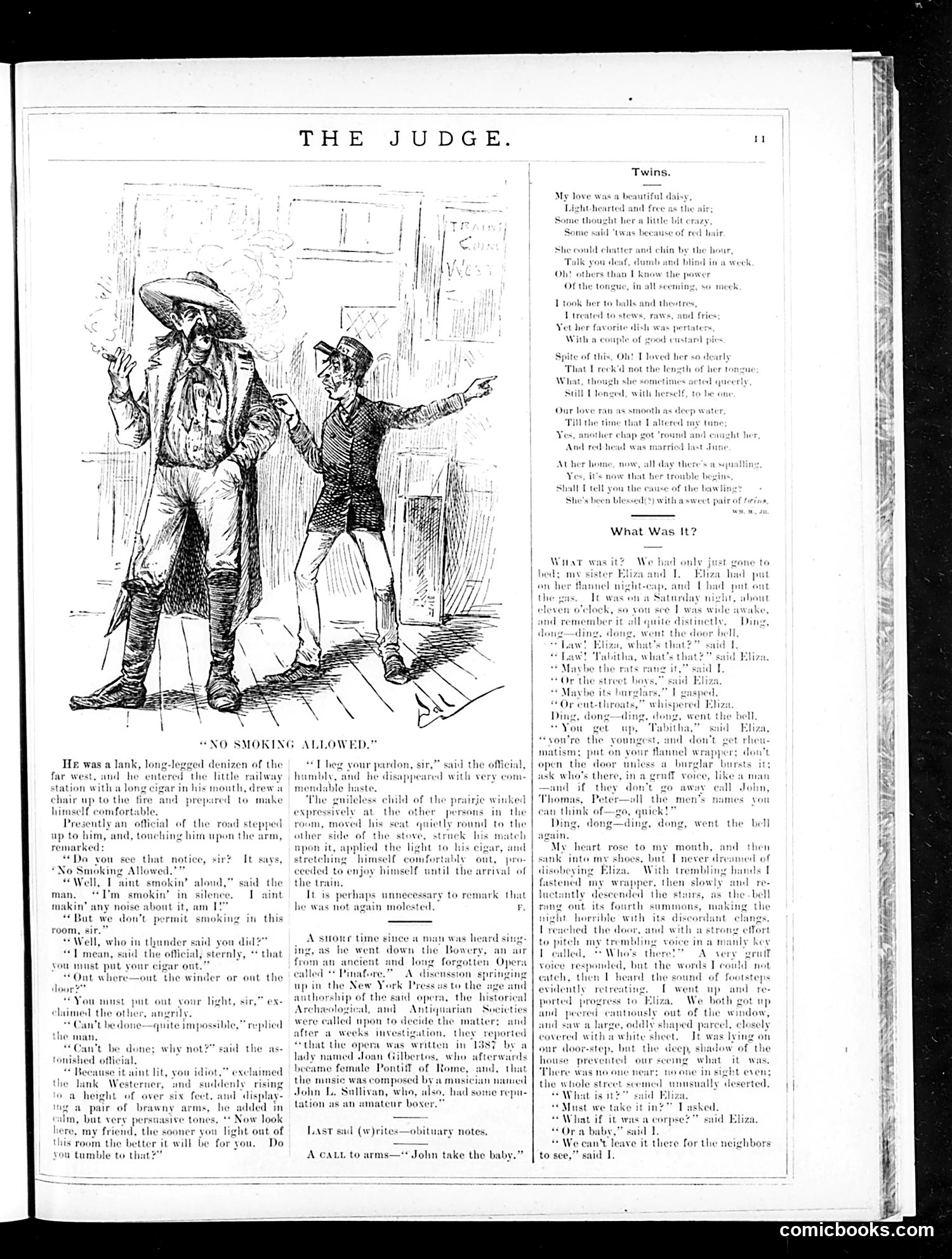
This cartoon depicts a conflict between a long-legged man smoking a cigar in a railway station and an officious attendant trying to enforce a no-smoking rule. The humor lies in the man's defiant refusal: when ordered to extinguish his cigar, he refuses, claiming it's "impossible" to put it out. The attendant grows increasingly frustrated with this absurd logic until the man—in a display of physical intimidation ("brawny" and "persuasive")—causes the official to back down. The satire targets both excessive bureaucratic enforcement of minor rules and the entitled behavior of patrons who ignore them. The exaggerated confrontation reflects period tensions over smoking regulations in public spaces and who had authority to enforce them.
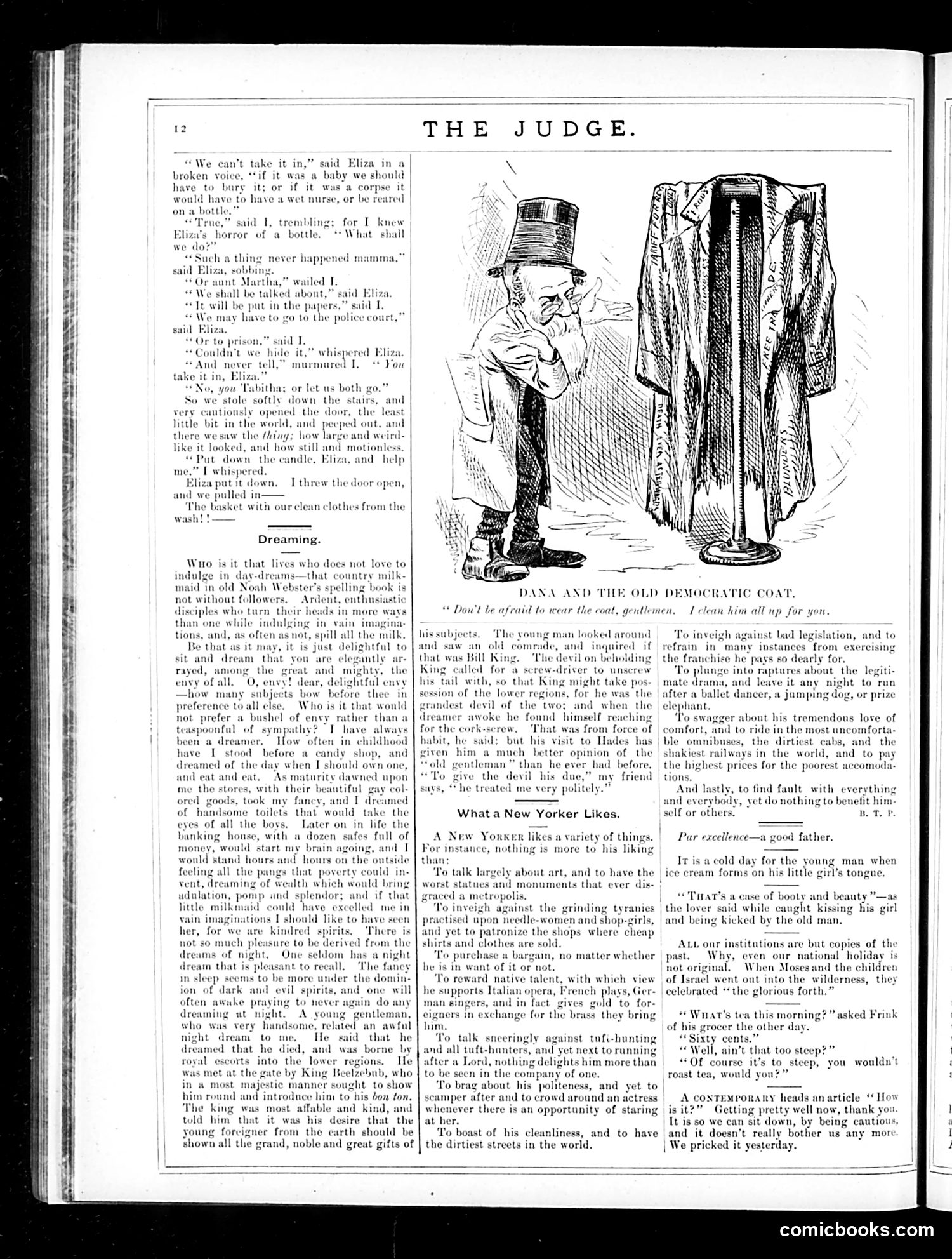
This Judge magazine page contains two satirical pieces: **"Dana and the Old Democratic Coat"** (main cartoon): The illustration shows a thin, elderly man in a tall hat examining a large, shabby coat. The caption warns gentlemen not to be afraid to wear it. This appears to satirize a prominent Democratic politician (likely James C. Dana, based on the title) and the Democratic Party's worn-out political platform or ideology. The "old coat" represents outdated policies the party clings to despite their age and uselessness. **"Dreaming"** (text-heavy section): A satirical essay mocking Americans' tendency toward wishful thinking and fantasy—daydreaming about wealth, status, and comfort they'll never achieve. It uses anecdotes (including one about visiting Hell) to ridicule this escapist mentality as foolish self-delusion. **"What a New Yorker Likes"** (brief list): Biting social satire of New York hypocrisy—exposing how the wealthy claim to champion art and workers' rights while actually patronizing cheap goods and exploitative shops.
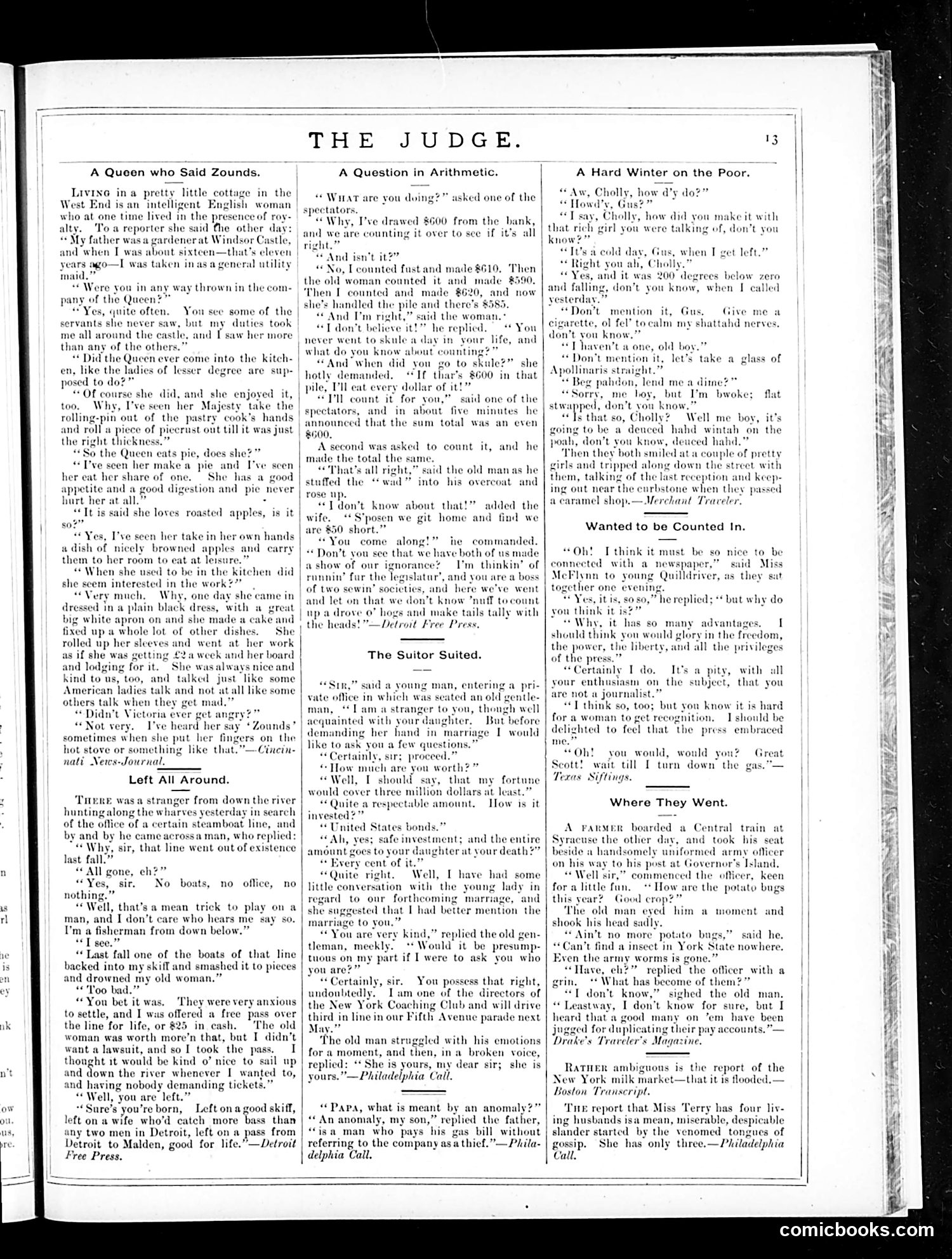
This page from Judge contains several humorous anecdotes rather than political cartoons. **"A Queen who Said Zounds"** features a former Windsor Castle servant recounting Queen Victoria's domestic habits—her enjoyment of pie, roasted apples, and cooking. The humor lies in the informal, undignified portrait of royalty: a queen who eats heartily, works in kitchens, and exclaims "Zounds!" The anecdote presents her as relatable rather than ethereal, which apparently struck Victorian readers as amusing. **"Left All Around"** satirizes a fisherman who accepted a worthless settlement after his wife drowned in a boat accident. The joke is the ironic litany of losses: "left an old woman" (deceased), "left on a pass" (from Detroit to Malden, now worthless). The humor is grim—mocking his gullibility in accepting compensation for irreplaceable losses. **"A Question in Arithmetic"** depicts rural characters repeatedly miscounting $600, arriving at different sums ($610, $590, $620). The satire targets rural illiteracy and the working poor's mathematical incompetence, typical of Judge's class-based humor. These pieces represent Judge's characteristic mix of royalty-baiting and working-class ridicule.
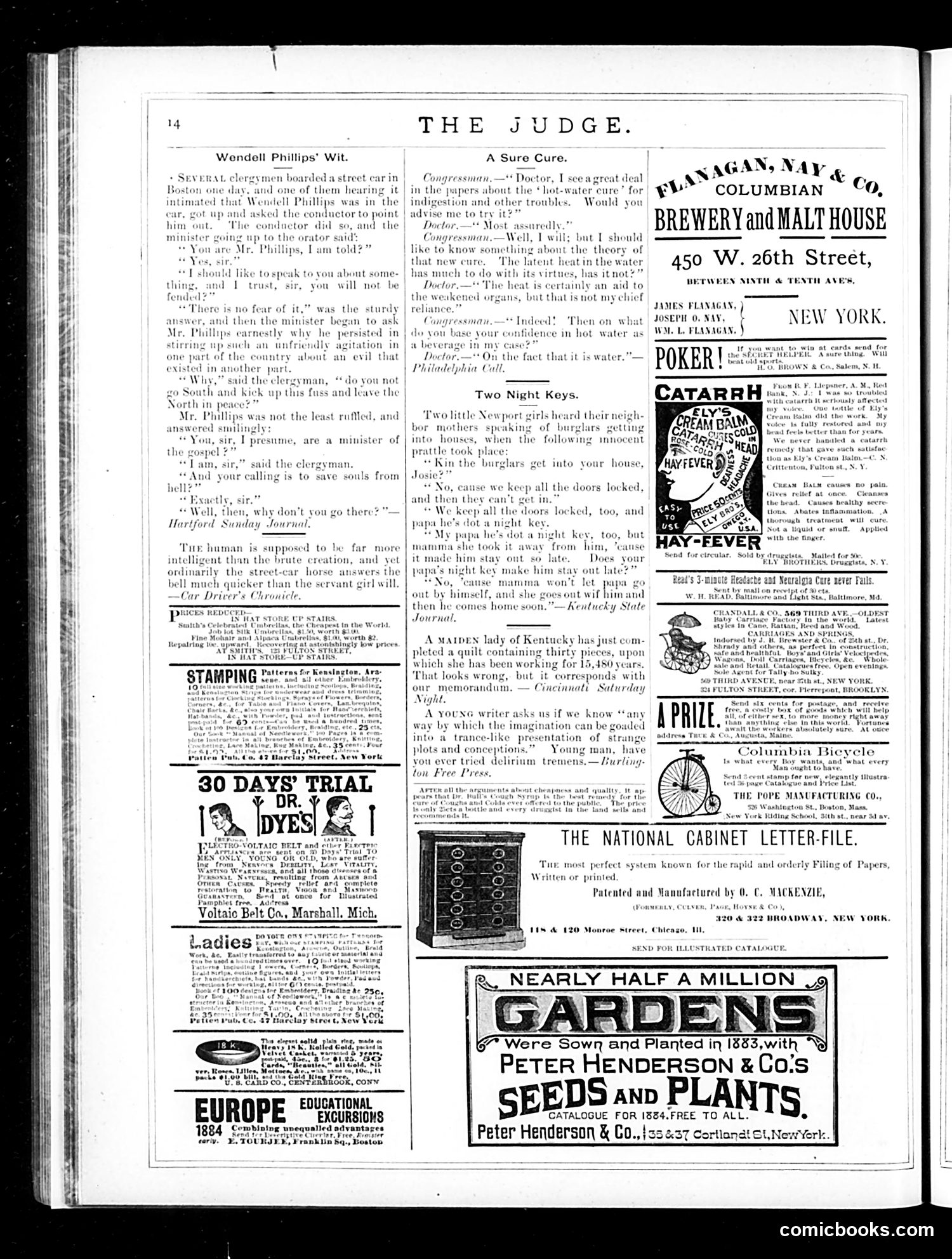
This page contains several humor pieces typical of Judge's satirical style: **"Wendell Phillips' Wit"** presents a dialogue mocking a clergyman's inconsistency. A streetcar conductor describes Phillips (a famous abolitionist orator) silencing a minister's moral objections about slavery by exposing his hypocrisy—the minister himself avoids the South while expecting others to convert it. The satire critiques preachers who preach morality without practicing it. **"Two Night Keys"** jokes about mothers protecting their children from burglars by locking doors, but contradicting themselves (allowing the child a night key). It's gentle domestic humor about parental logic. Other brief pieces mock a Kentucky woman's "quilt containing thirty pieces" (biblical reference unclear without full context) and a young writer seeking inspiration through "delirium tremens" (mocking substance abuse as creative method). The page is primarily **advertising**—for brewery, poker guides, hay-fever cream, cabinet filing systems, and seeds—with satirical content secondary.
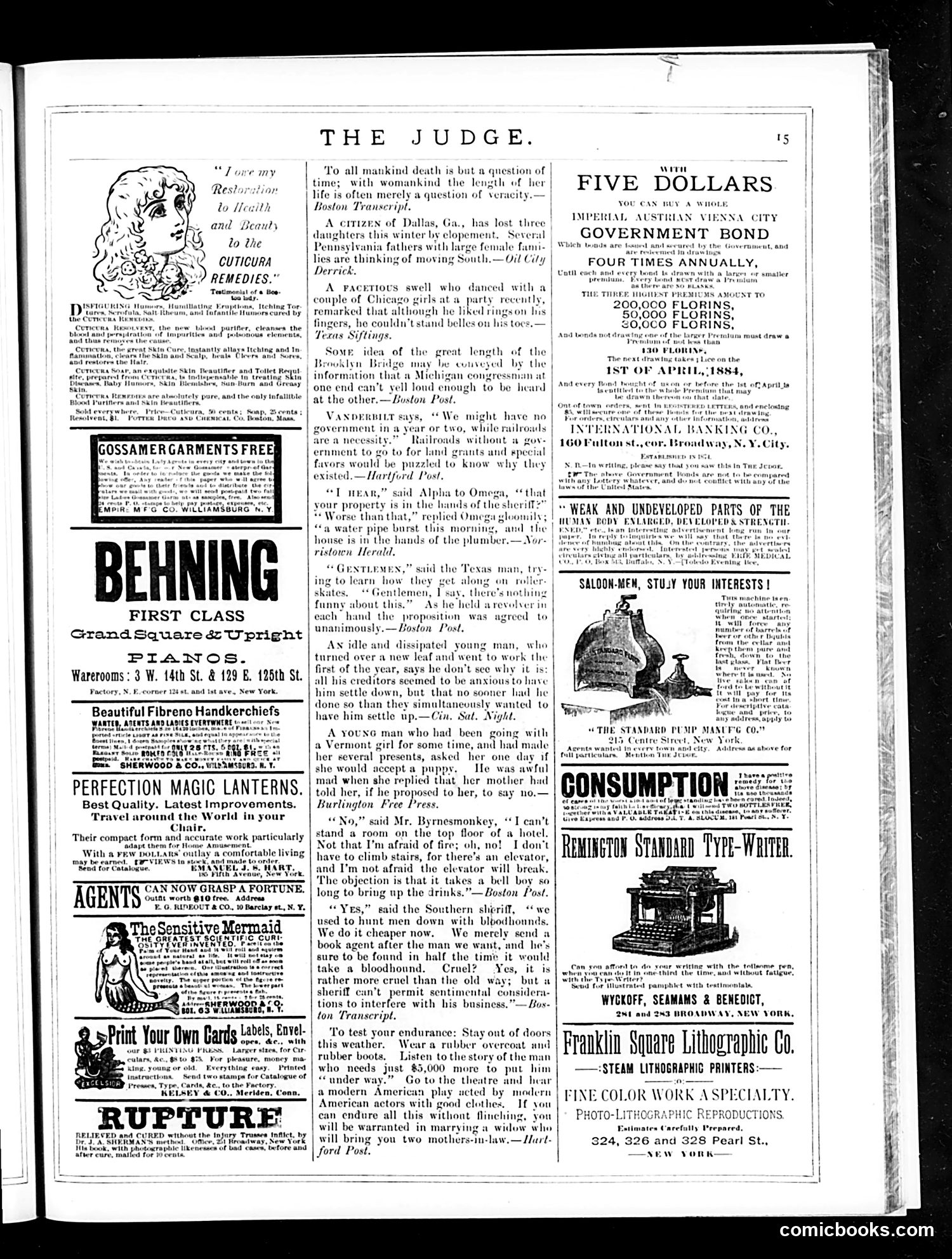
This page is primarily **advertising**, with modest satirical content woven throughout. The main visual element is a classical female head illustration (likely promoting Cuticura remedies for skin health). The satirical section, "THE JUDGE," consists of brief humorous anecdotes mocking social conventions of the era: - **Marriage and courtship**: jokes about elopement, broken engagements, and domestic disputes - **Class and materialism**: a swell (wealthy man) complaining about hotel accommodations and demanding service - **Gender relations**: men's frustration with women's capriciousness and practical concerns - **American bureaucracy**: a sarcastic advertisement for an "Austrian Vienna City Government Bond"—likely mocking American government financial instability by suggesting even Austrian bonds are preferable The humor targets predictable 1880s anxieties: restless daughters, creditor pressures, and skepticism toward modern conveniences like elevators and book agents. The advertisements (pianos, lanterns, remedies, typewriters) occupy most space, reflecting Judge's commercial dependence on advertisers.
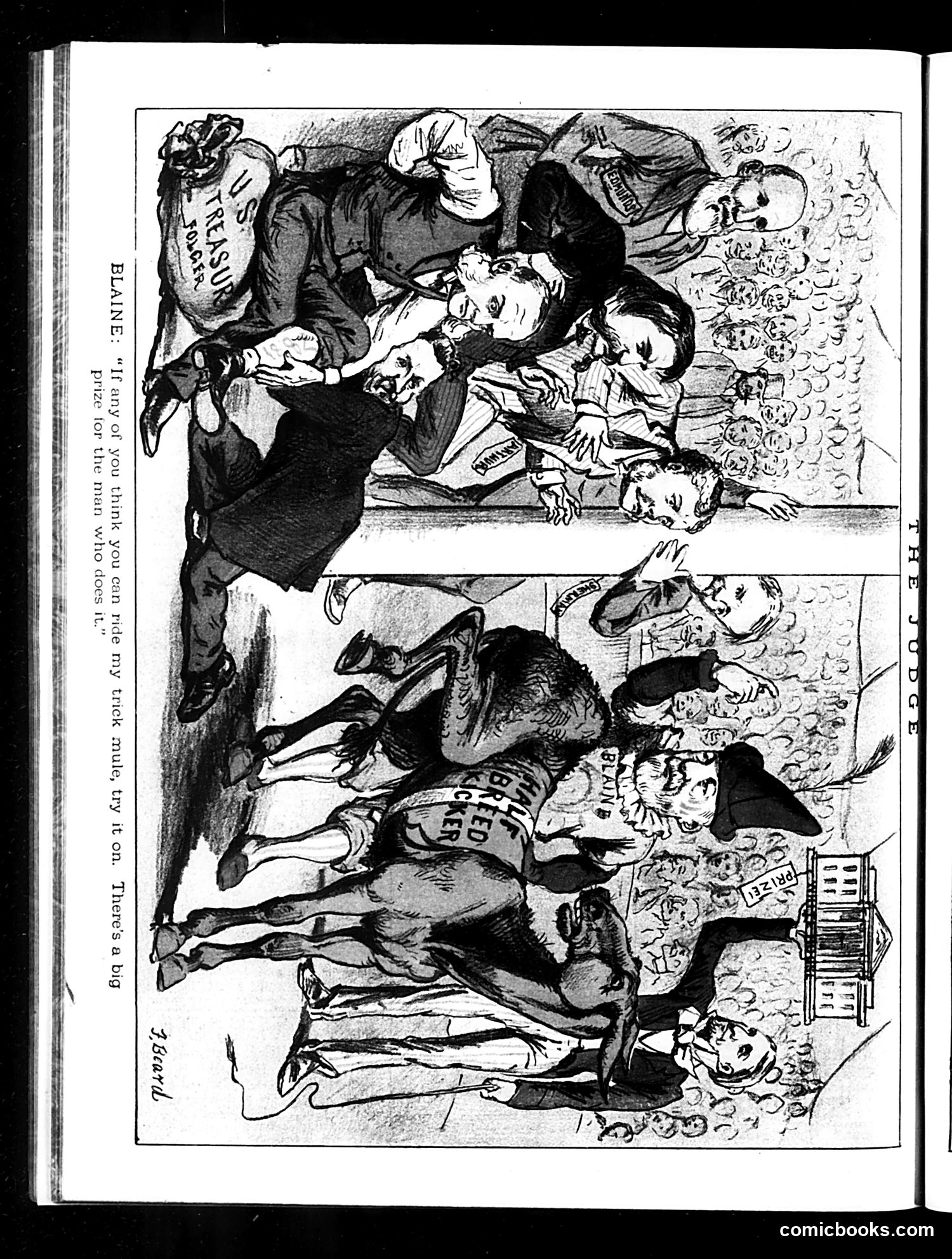
This page contains two satirical cartoon panels stacked vertically. The top panel shows a well-dressed man being attacked or overwhelmed by multiple children and figures, appearing chaotic and violent. The bottom panel depicts what appears to be a contrasting domestic or social scene. The left margin text reads: "BALANCE: The theory of you that my uncle said to cut. There's a bag"—though the OCR is unclear here. Unfortunately, without a visible date, publication details, or clearer text, I cannot definitively identify the specific political figures being caricatured or the exact social/political issue being satirized. The cartoon appears to critique some aspect of power dynamics, social management, or political leadership, but identifying the precise historical reference requires additional context not legible in this image.