
A complete issue · 16 pages · 1884
Judge — February 9, 1884
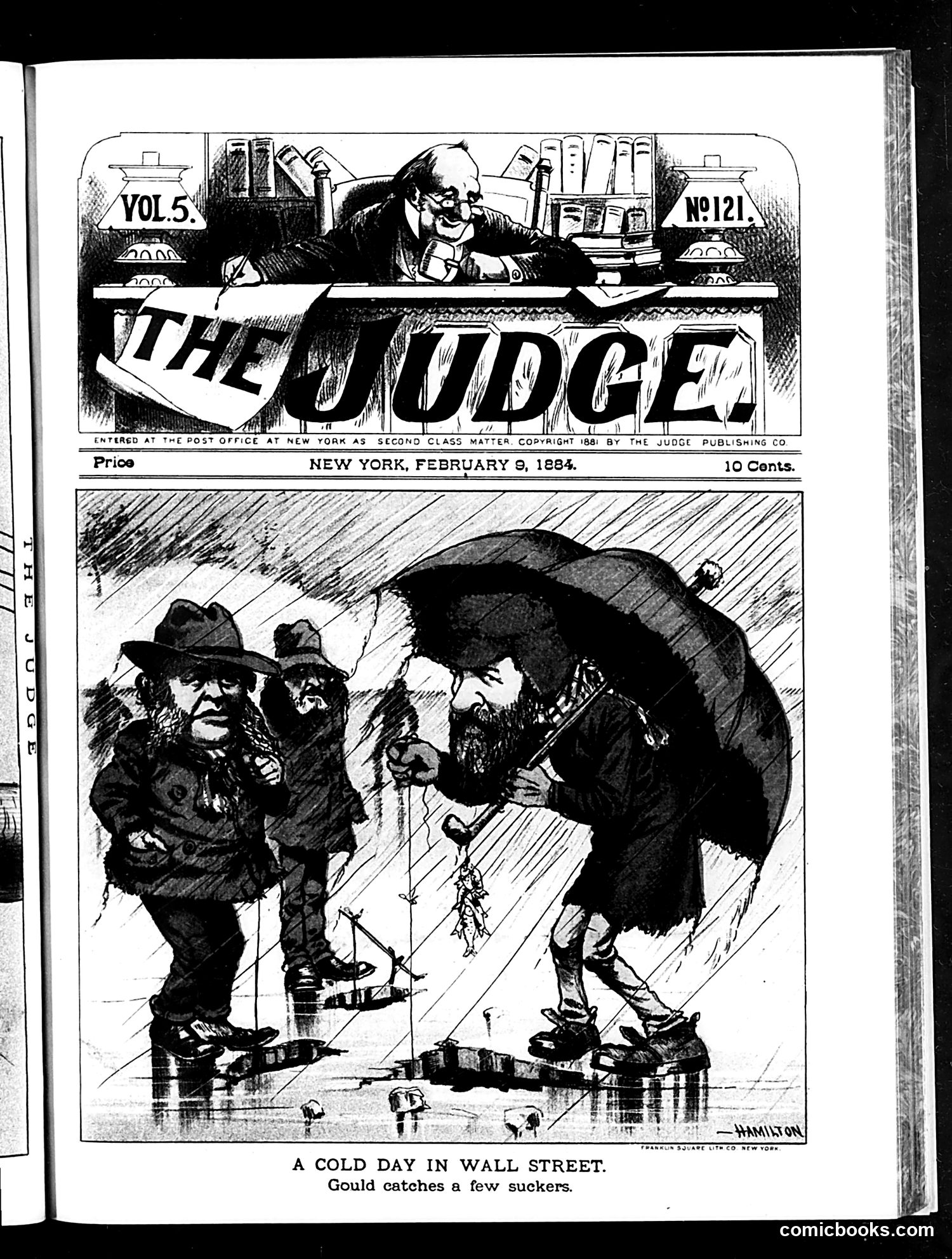
This cartoon satirizes financial fraud on Wall Street. The caption "Gould catches a few suckers" references **Jay Gould**, the notorious railroad magnate and speculator known for manipulating stock markets. The scene depicts men on ice skates during winter—a visual metaphor for slippery, precarious conditions. The figures appear to be investors or speculators who have been duped by Gould's schemes, portrayed as literal "suckers" being caught. The frozen setting reinforces the idea of people losing their footing financially. Published February 9, 1884, this reflects public anger at Gould's predatory business practices and the vulnerability of ordinary people to wealthy manipulators during the Gilded Age. The humor is dark: those caught are literally and figuratively on thin ice.
This page contains two distinct political cartoons satirizing American institutions in the Gilded Age. **"About Church Choirs"** critiques how American churches have become corrupted by theatrical competition. The text argues churches now hire expensive star singers and conductors—mimicking opera companies—to attract congregations, turning worship into entertainment. This commodifies religion and forces parishioners to constantly donate money. The satire targets both the clergy's vanity and wealthy donors' expectations. **"A Cold Day on Wall Street"** addresses economic depression and stock market stagnation. It mocks wealthy speculators (likely including Vanderbilt, mentioned by name) for hoarding wealth while ordinary workers face unemployment and poverty. The cartoon suggests the rich are terrified of losing their fortunes, creating a tense standoff that harms the broader economy. **"The White Elephant of '84"** (title only visible) appears to reference the 1884 presidential election, using animal metaphors to describe political rivalry between Democrats and Republicans—neither wanting responsibility for unpopular positions. All three pieces exemplify Judge's satirical attack on institutional hypocrisy and wealth inequality during the Reconstruction/Gilded Age era.
This page contains a sentimental poem/narrative about dismantling an old church bell, likely reflecting 19th-century anxieties about modernization replacing tradition. The text describes the bell's removal from a ruined church steeple—a scene of physical and spiritual loss. The narrative mourns what is being discarded: the bell that had "rang at moonrise," marked births and deaths, and symbolized community continuity. The poem contrasts the bell's dignified past with its undignified present removal, emphasizing how progress destroys heritage ("the New's young footsteps perished all that decked the Old"). The left column's commentary on actress Lillie Langtry appears separate—critiquing how her fame rests solely on beauty rather than talent, making her a "professional beauty" who profits from manufactured reputation. The satirical point: both pieces explore loss and obsolescence in modern society, whether of cherished institutions or authentic human values.
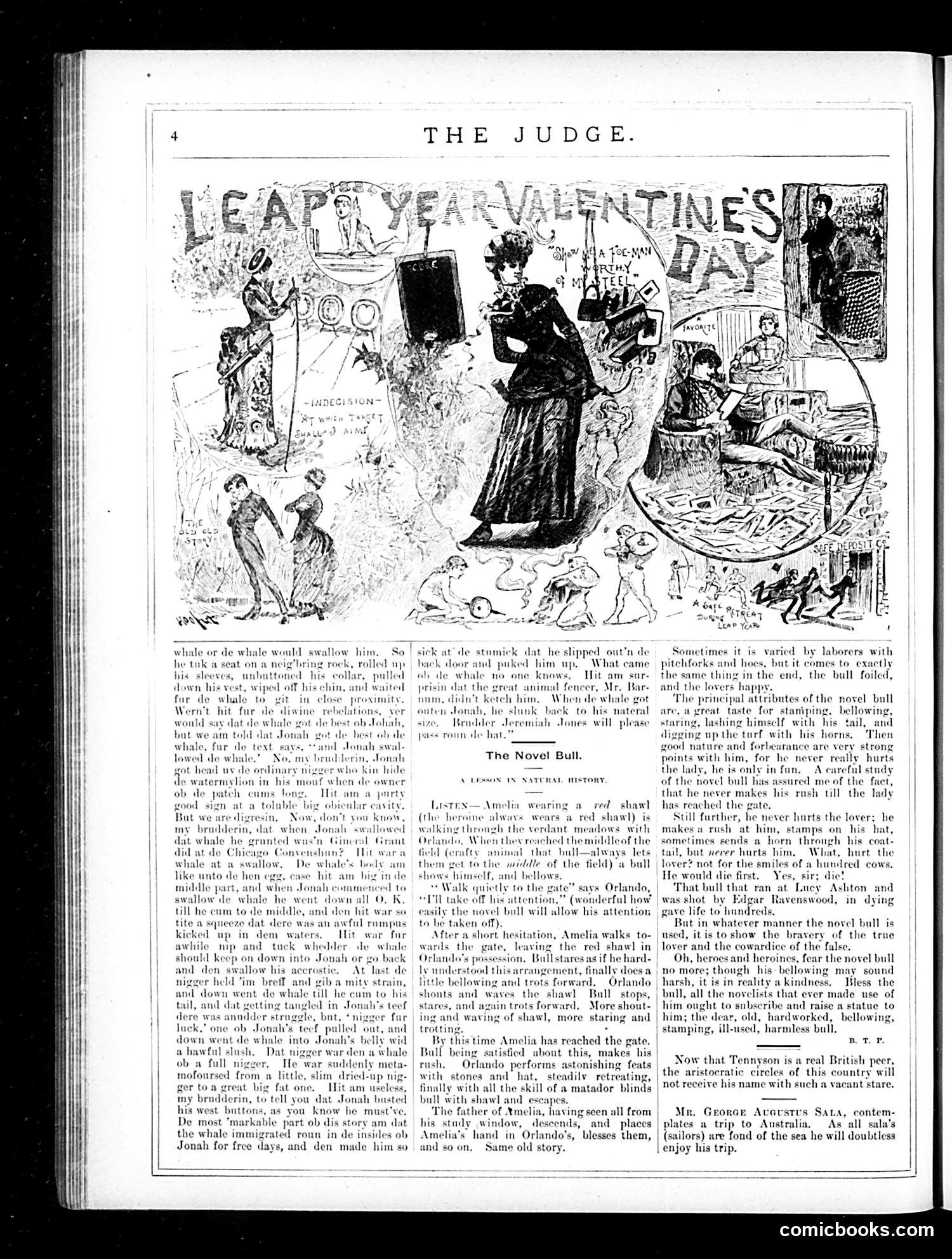
This page contains two satirical pieces. The upper section appears to be a humorous dialect retelling of the Biblical story of Jonah and the whale, written in exaggerated African American vernacular—a common (though offensive by modern standards) comedic style of 19th-century American humor magazines. The main content is "The Novel Bull," which parodies conventions of Victorian romantic literature. The satire ridicules the recurring trope in novels where a heroic lover confronts a bull to prove his bravery while the heroine escapes. The author mockingly catalogs the "novel bull's" implausibly genteel behavior—it conveniently waits until the lady reaches safety before charging, never actually injures the lover (only damages his hat), and generally plays by fictional rules rather than behaving like a real animal. The satire concludes by ironically praising novelists for creating this absurd literary device while condemning the actual "harmless bull" used in reality.
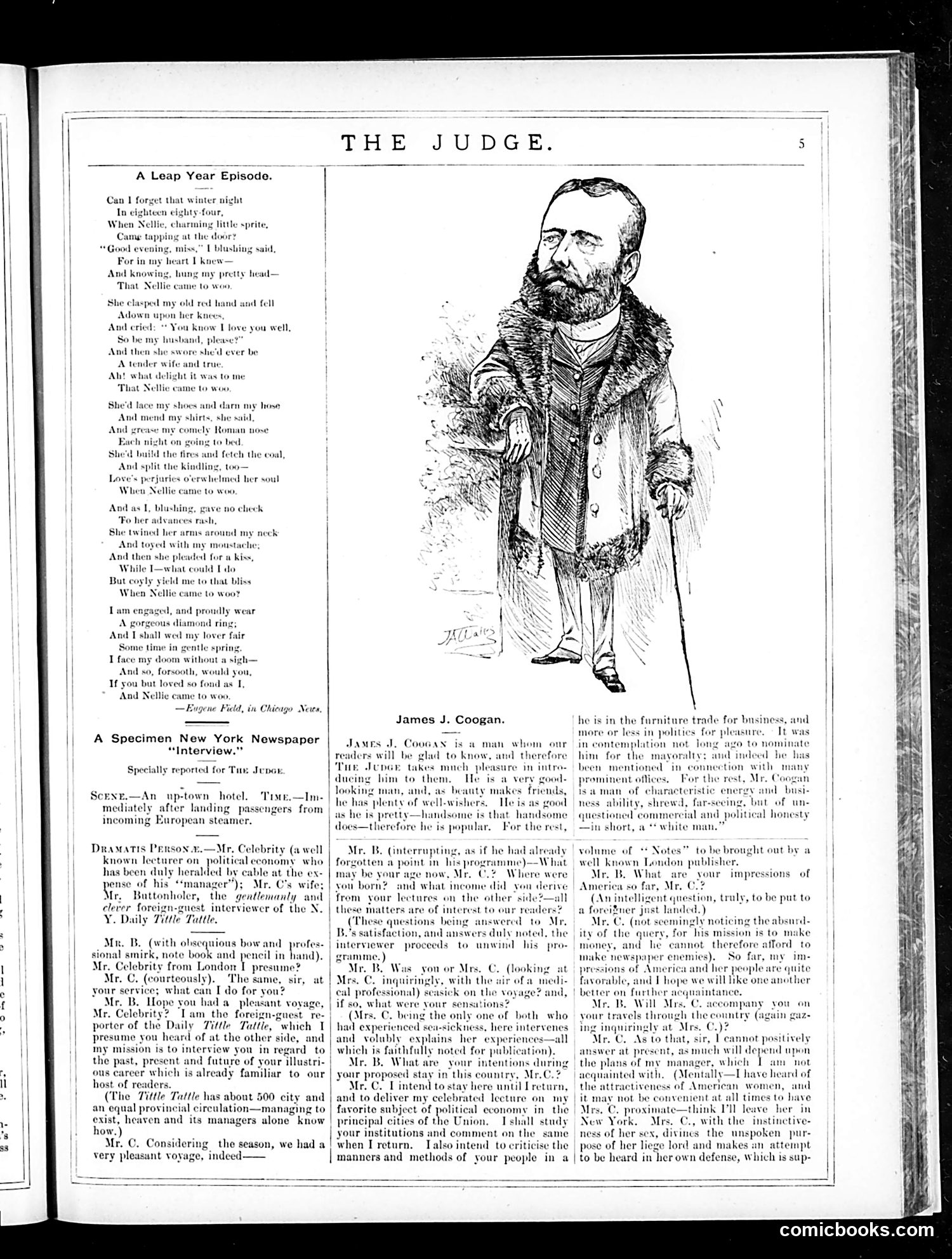
This page contains two distinct pieces of satire: **"A Leap Year Episode"** (left): A sentimental poem mocking Victorian gender conventions. During leap years, tradition allowed women to propose to men. The poem depicts a woman ("Nellie") pursuing a reluctant suitor, reversing expected roles—she initiates kissing, promises domestic labor ("darn my hose," "fetch the coal"), and proposes. The satire gently ridicules both the awkwardness this reversal creates and sentimentality of romantic literature. **"A Specimen New York Newspaper Interview"** (right): Satirizes sensationalist newspaper journalism and celebrity culture. A pushy interviewer from the *Daily Tittle Tattle* (a fictional tabloid) aggressively buttonholes a visiting British lecturer on political economy. The satire targets intrusive reporters, their superficial questions, and how they manufacture "news." The portrait shows **James J. Coogan**, identified as a furniture trader dabbling in politics—likely a minor local figure chosen specifically because his ordinariness contrasts with journalistic hype around "celebrities."
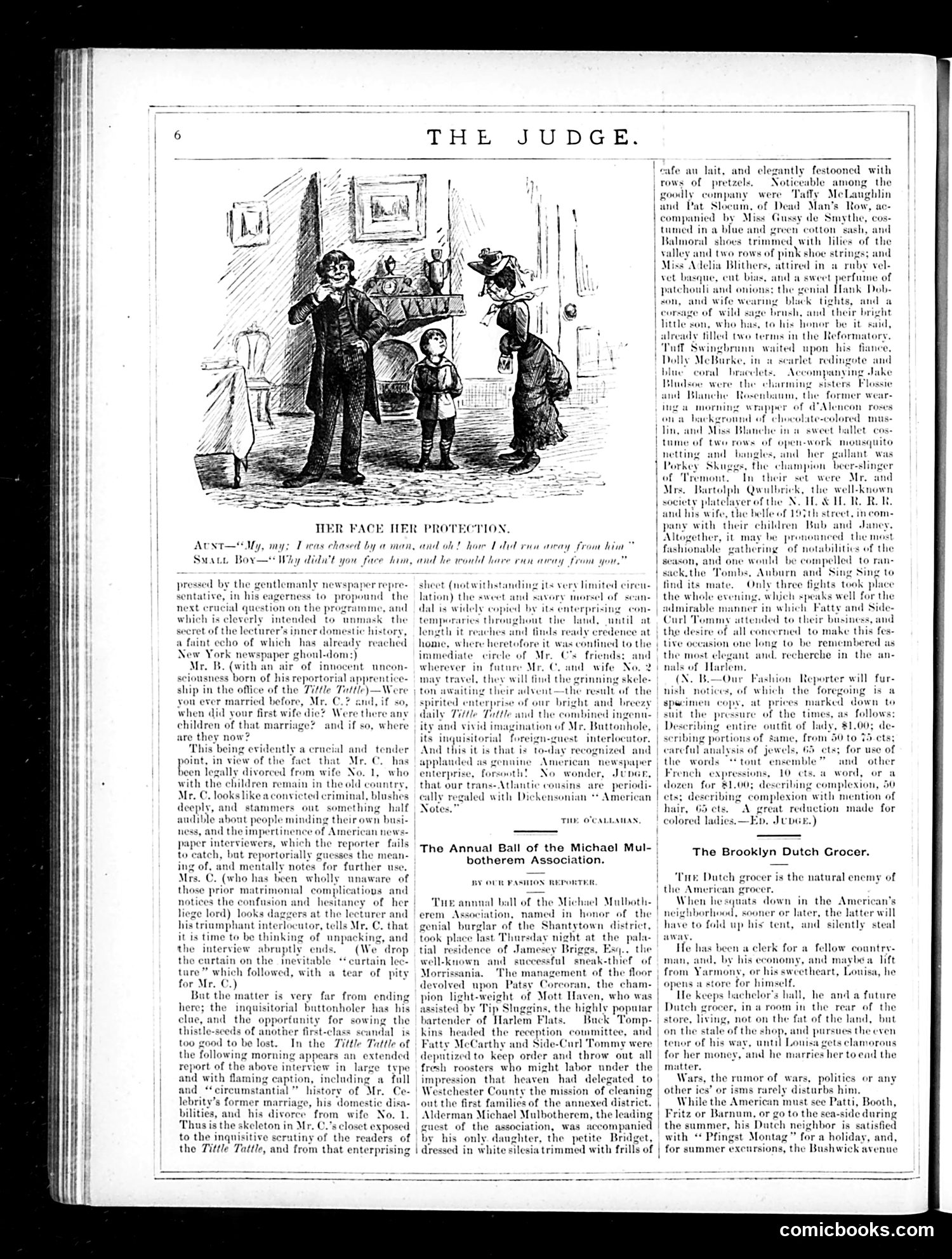
This page from *Judge* magazine contains two satirical pieces: **"Her Face, Her Protection"** (top): A cartoon mocking intrusive newspaper journalism. A nosy reporter from the gossip column *Tittle Tattle* aggressively interrogates a visiting lecturer ("Mr. C.") about his previous marriages and children—embarrassing personal questions asked for public scandal. The satire targets both the reporter's shameless nosiness and the emerging sensationalist press that invaded private lives. The wife's fury at this public humiliation is noted. The point: American newspapers are recklessly irresponsible busybodies. **"The Annual Ball of the Michael Mulbotherem Association"** (bottom): A society-page parody describing a working-class Irish neighborhood dance (Shantytown district). The elaborate, pretentious language mock-elevates ordinary laborers and their modest clothing into faux-aristocratic descriptions. Names like "Patsy Corcoran" and "Buck Tompkins" and absurd fashion details ("patchouli and onions") ridicule both the event's aspirations and the flowery society-column writing style that treated such gatherings as high society. Both pieces satirize American press excess and class pretension.
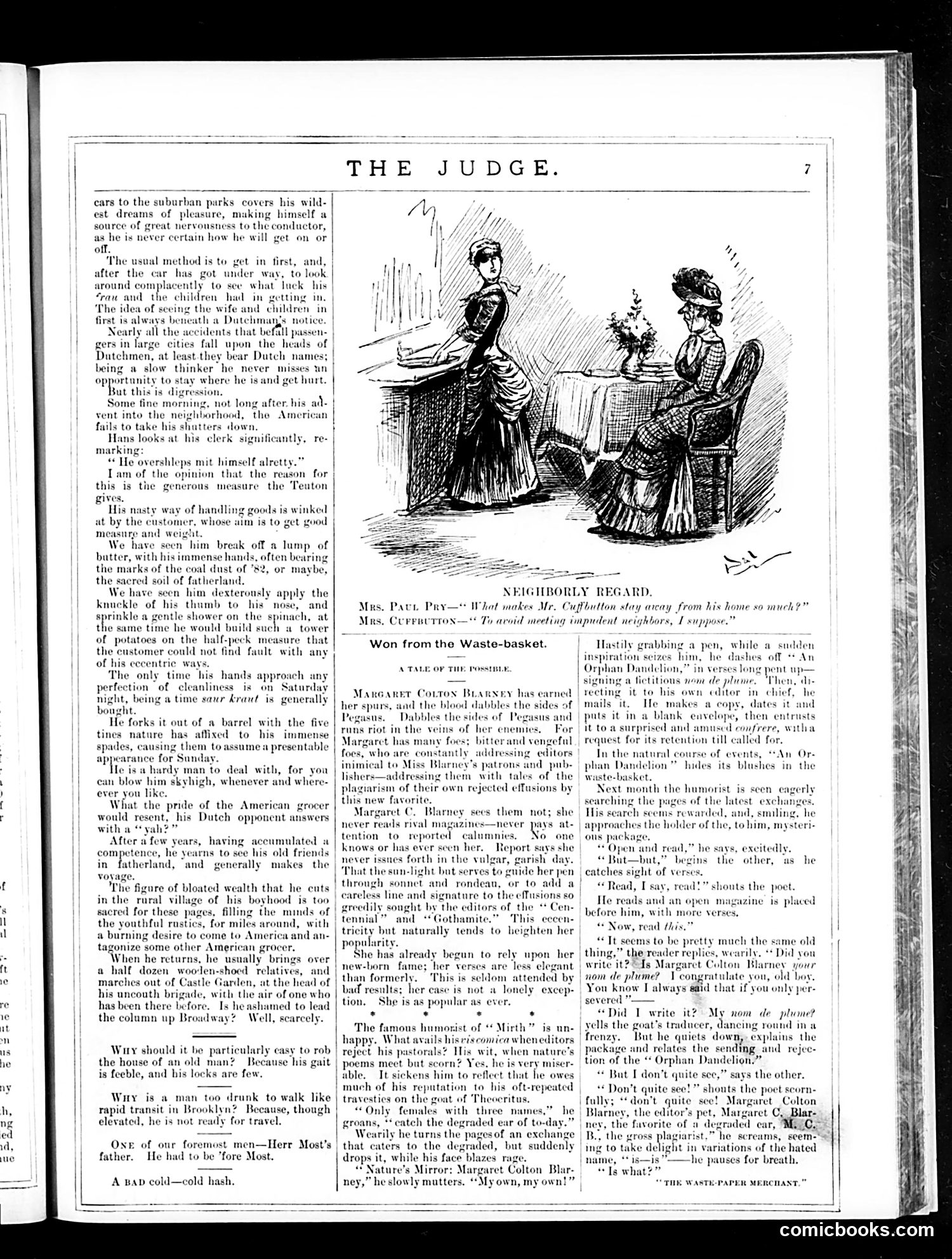
This page contains a satirical cartoon and accompanying text mocking Dutch immigrant grocers in America, likely from the late 19th century. **The Cartoon** depicts "Mrs. Paul Fry" and "Mrs. Cuffstilton," two women gossiping about their neighbor's domestic habits—a common Judge theme ridiculing nosiness and social pretension. **The Main Article** presents ethnic stereotypes of Dutch immigrants, portraying them as crude, unsanitary shopkeepers who exploit customers through dishonest weighing practices and poor hygiene. The satire suggests they accumulate wealth, return to Europe with pride, then send relatives to America to replicate their grocer success—perpetuating immigrant clannishness. **The Tone** is condescending but typical of Judge's era: criticizing immigrants' customs (wooden shoes, broken English), work ethic, and social ambitions while simultaneously mocking American pride wounded by their commercial success. **"Won from the Waste-basket"** discusses Margaret Colton Blarney, apparently a popular female writer whose literary success provokes jealous rivals—offering commentary on women writers and professional competition.
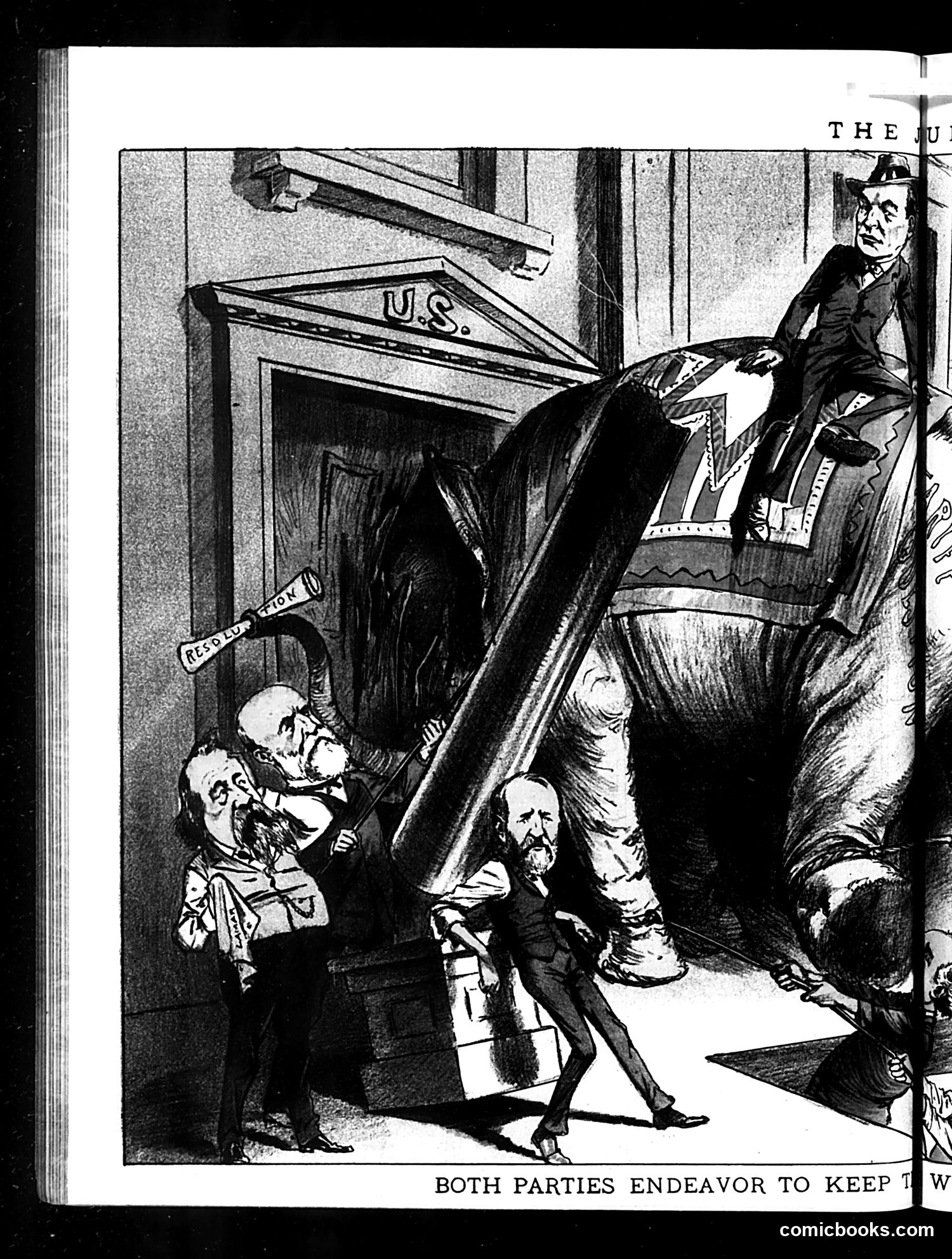
This Judge magazine cartoon depicts a large elephant (the Republican Party symbol) being restrained by two small figures labeled "RESCUE KICK." A man in a top hat stands to the right, observing. The caption reads "BOTH PARTIES ENDEAVOR TO KEEP [text cut off]." The satire appears to mock attempts by both political parties to control or manage the Republican Party, represented as an enormous, powerful beast that requires physical effort to contain. The "rescue kick" suggests intervention or interference in Republican affairs. The cartoon likely comments on inter-party political maneuvering during a specific historical moment—though without the full caption and publication date, the exact political crisis or controversy being referenced remains unclear. The exaggerated scale emphasizes the Republicans' political dominance relative to those attempting to influence them.
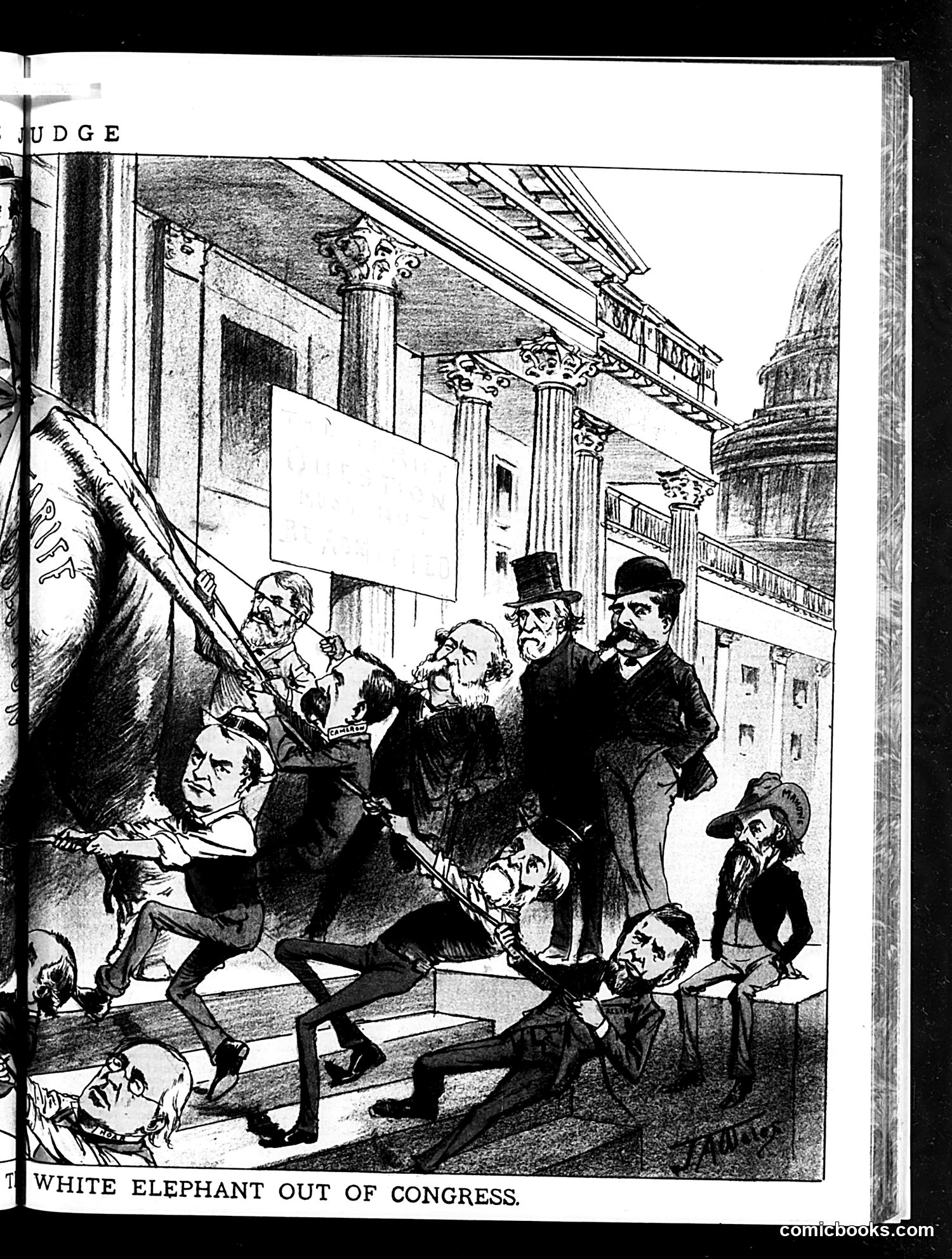
This political cartoon satirizes Congress as wasteful and dysfunctional. The title references a "white elephant"—a useless, expensive burden—suggesting Congress itself has become unproductive. The scene depicts well-dressed congressmen inside the Capitol building, appearing to struggle with or expel a large elephant (representing Congress). Some figures are falling or being knocked down by the chaos. The satire suggests that Congress has become an unwieldy, burdensome institution—expensive to maintain yet delivering little practical benefit to the nation. By showing established politicians literally wrestling with their own governmental body, Judge mocks Congressional ineffectiveness and the difficulty of reforming such an entrenched institution. The specific historical context and date remain unclear from this image alone, but the criticism of Congressional waste was a recurring theme in Gilded Age satire.
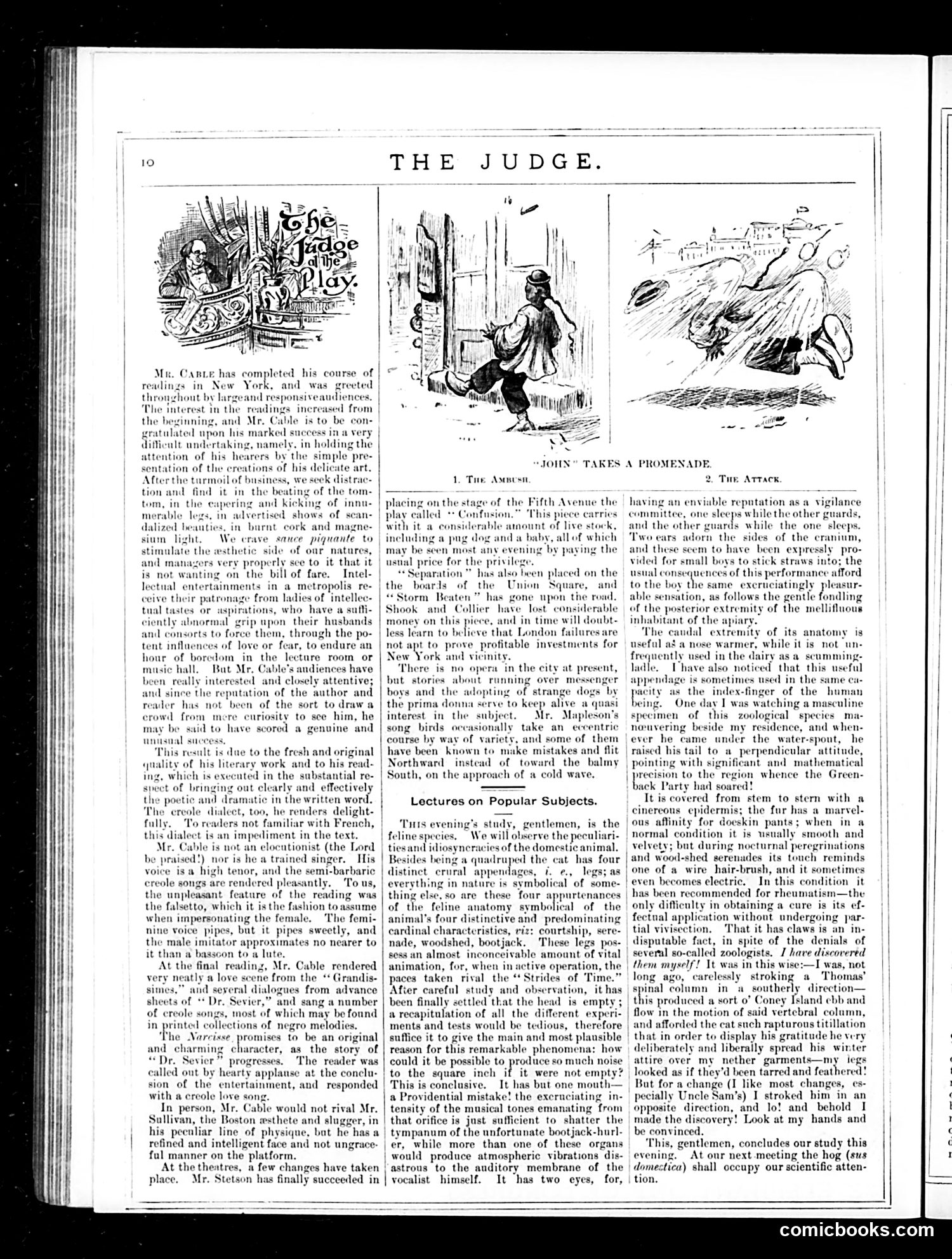
This page from **Judge** magazine contains theatrical reviews and two cartoon panels satirizing popular entertainment. The **cartoons** ("John Takes a Promenade") mock a current play called "Confusion," which featured live animals on stage—notably a pig dog and a baby. Panel 1 shows the chaos of the armored character's awkward entrance; Panel 2 depicts the "attack" during performance, with the audience distracted and disrupted by the animals' unpredictable behavior. The **text reviews** George Washington Cable's public readings of his Creole dialect literature in New York. The critic praises Cable's literary merit and dramatic skill while noting he lacks the theatrical flourishes of professional performers—he's a genuine author, not a trained elocutionist. The review also mentions Broadway productions struggling financially and opera singers behaving eccentrically. The satire mocks the lowbrow spectacle of live animals on stage as entertainment, contrasting it with Cable's more intellectually respectable literary performances.
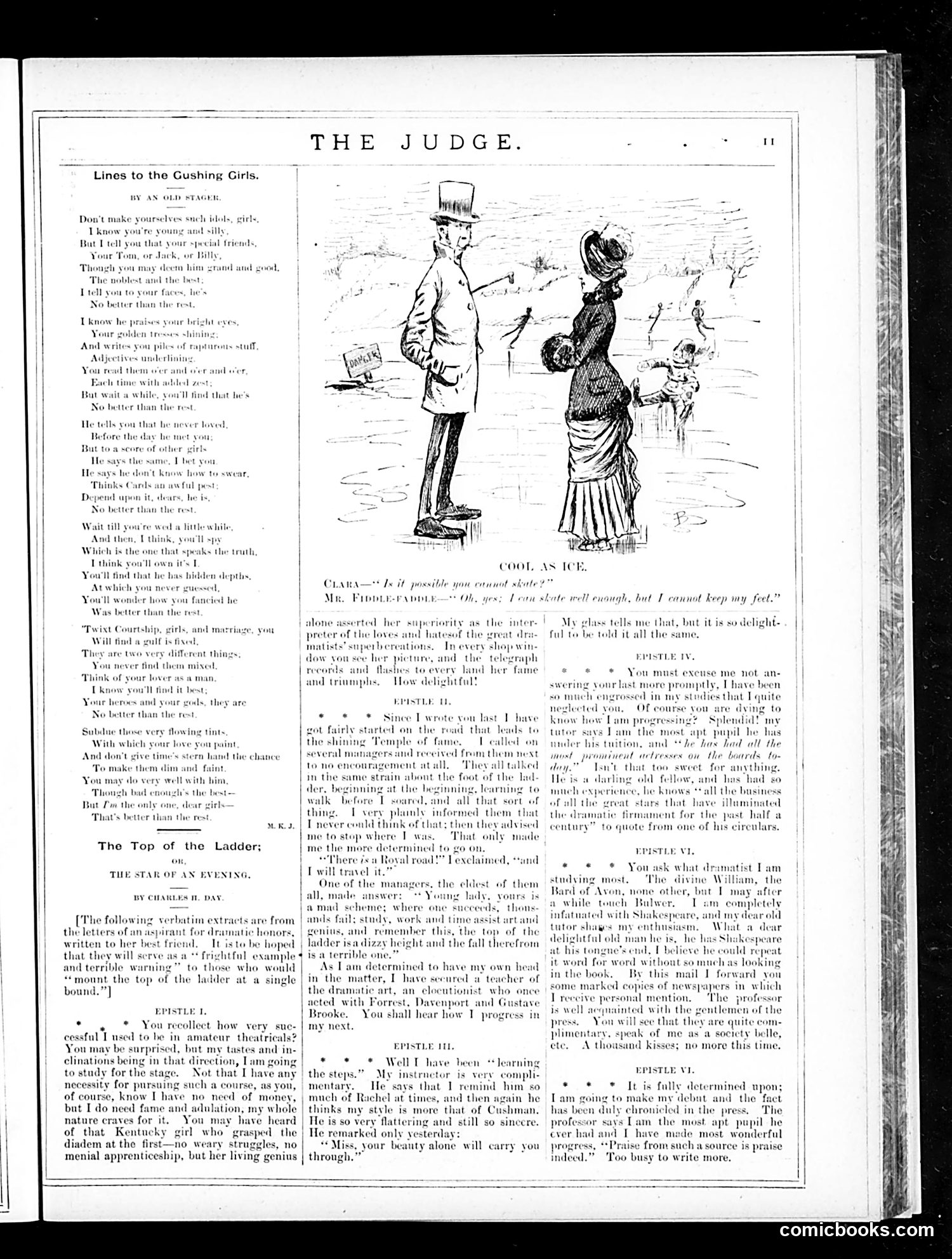
The main cartoon depicts a gentleman in a top hat speaking to a woman on what appears to be an icy surface. She complains she cannot keep her feet while skating, though she can skate adequately. His response—"Oh, yes, I can skate well enough, but I cannot keep my feet"—is clearly a double entendre suggesting romantic/physical instability rather than literal skating difficulty. The surrounding text, "Lines to the Gushing Girls" by an old stager, is a cynical poem warning young women about romantic deception. It advises that men who write flattering letters and declare eternal love are unreliable—they tell every woman the same things and are "no better than the rest." Together, the cartoon and poem satirize both male romantic posturing and female gullibility, suggesting that flowery declarations of affection mask shallow, wandering intentions. The satire targets Victorian courtship conventions and the gap between romantic rhetoric and actual male behavior.
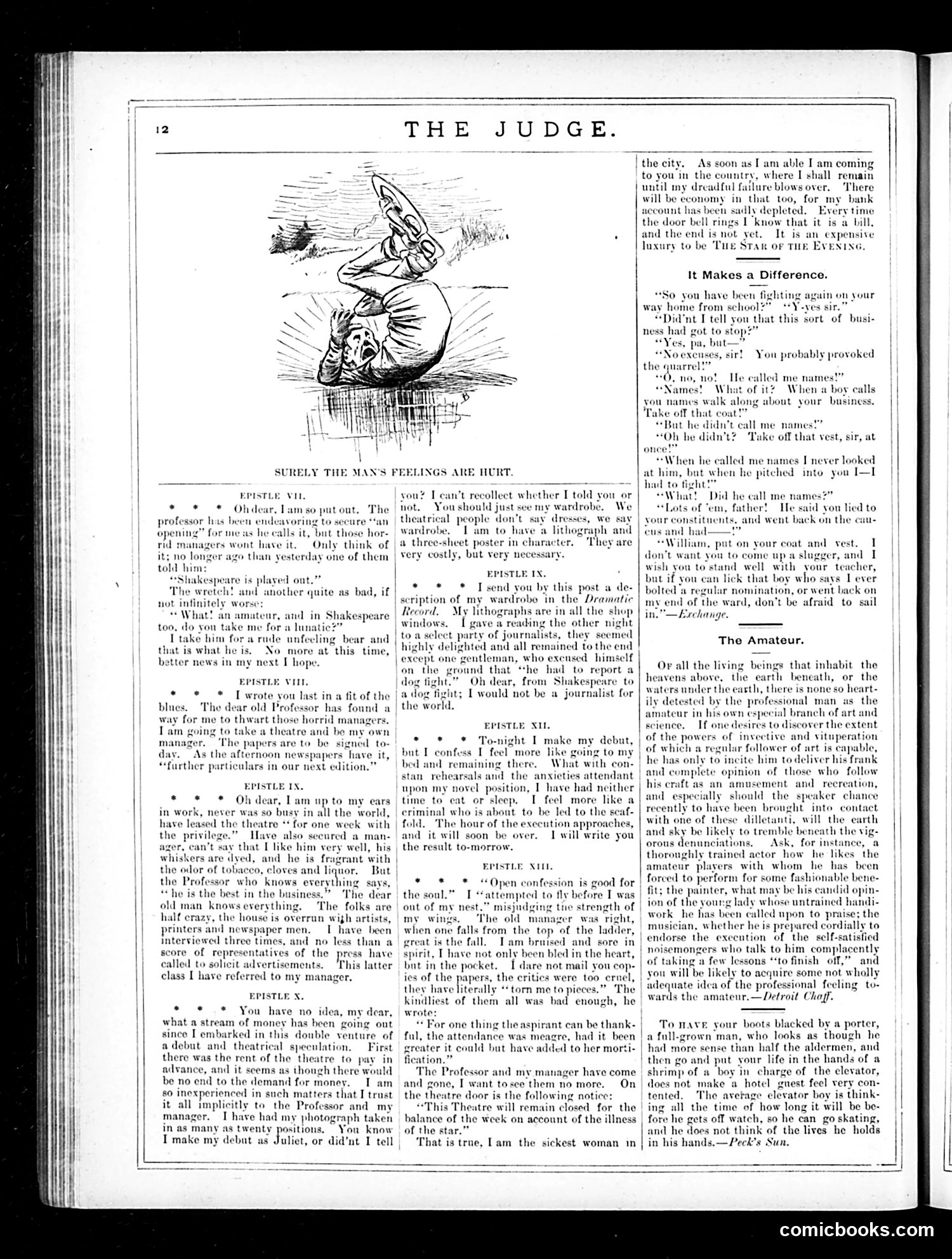
This page features a satirical serial narrative in letter form ("Epistles") mocking aspiring theatrical performers and the entertainment industry's pretensions. **The Main Cartoon** (top left) depicts a woman doing an acrobatic or theatrical pose, illustrating the physical demands and absurdity of amateur theatrical ambitions. **The Satire's Target:** The letters chronicle an unnamed female amateur actress's disastrous attempt at a professional theatrical debut. She chronicles her efforts to secure roles, her manager's incompetence, mounting financial expenses, and ultimately a catastrophic opening night where critics "literally 'torn me to pieces.'" **The Point:** Judge ridicules theatrical pretension and the delusion that wealth and connections can substitute for talent. References to "Shakespeare is played out" and dismissals of amateurs suggest criticism of those attempting serious dramatic work without proper training. The financial desperation and reliance on a dubious "Professor" and dyed-whiskered manager satirize both the fraud endemic to theatrical management and wealthy dilettantes' naive vulnerability to exploitation. The cumulative effect mocks vanity, theatrical ambition, and the gap between society people's self-regard and actual ability.
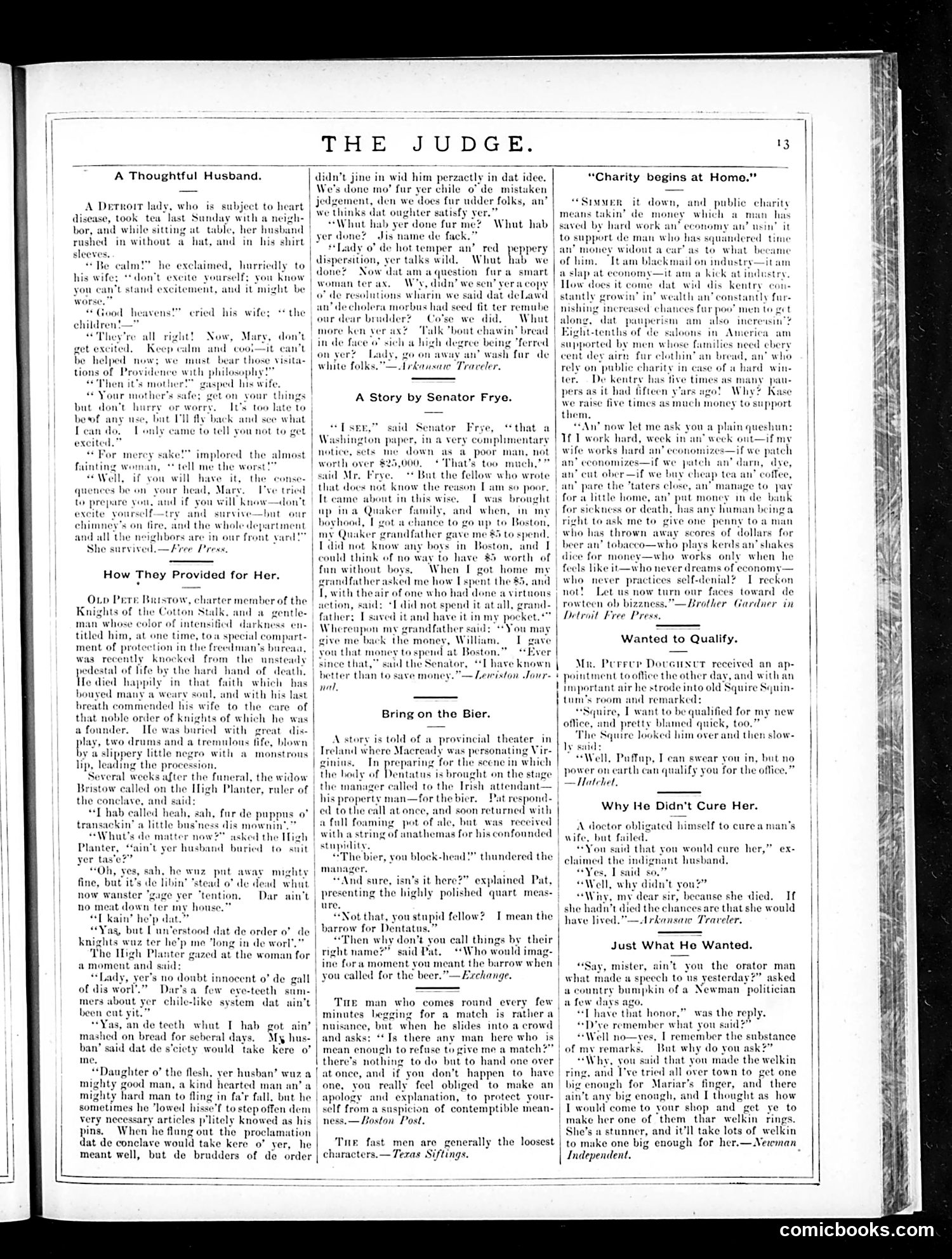
This page from *Judge* magazine contains several satirical pieces typical of late 19th-century American humor. **"A Thoughtful Husband"** mocks domestic anxiety: a wife with a nervous condition asks her husband to stay calm during crises, but he keeps interrupting with increasingly dire emergencies (the chimney's on fire, neighbors gathered). The satire targets both his obliviousness and the Victorian notion that women's "delicate" constitutions require constant male protection. **"How They Provided for Her"** uses dialect humor to satirize both charitable organizations and freedmen's benevolent societies. A widow expects the "Knights of the Cotton Stalk" to support her after her husband's death, but they've already moved on—the "help" promised was merely ceremonial. The piece mocks the gap between charitable rhetoric and actual assistance. The remaining pieces are brief anecdotes (Senator Frye's story, theatrical mishaps, domestic disputes) employing similar period humor: misunderstandings, class commentary, and social pretense exposed. The overall tone reflects *Judge*'s editorial position: skepticism toward institutions, gender dynamics, and human nature presented as humorous failures.
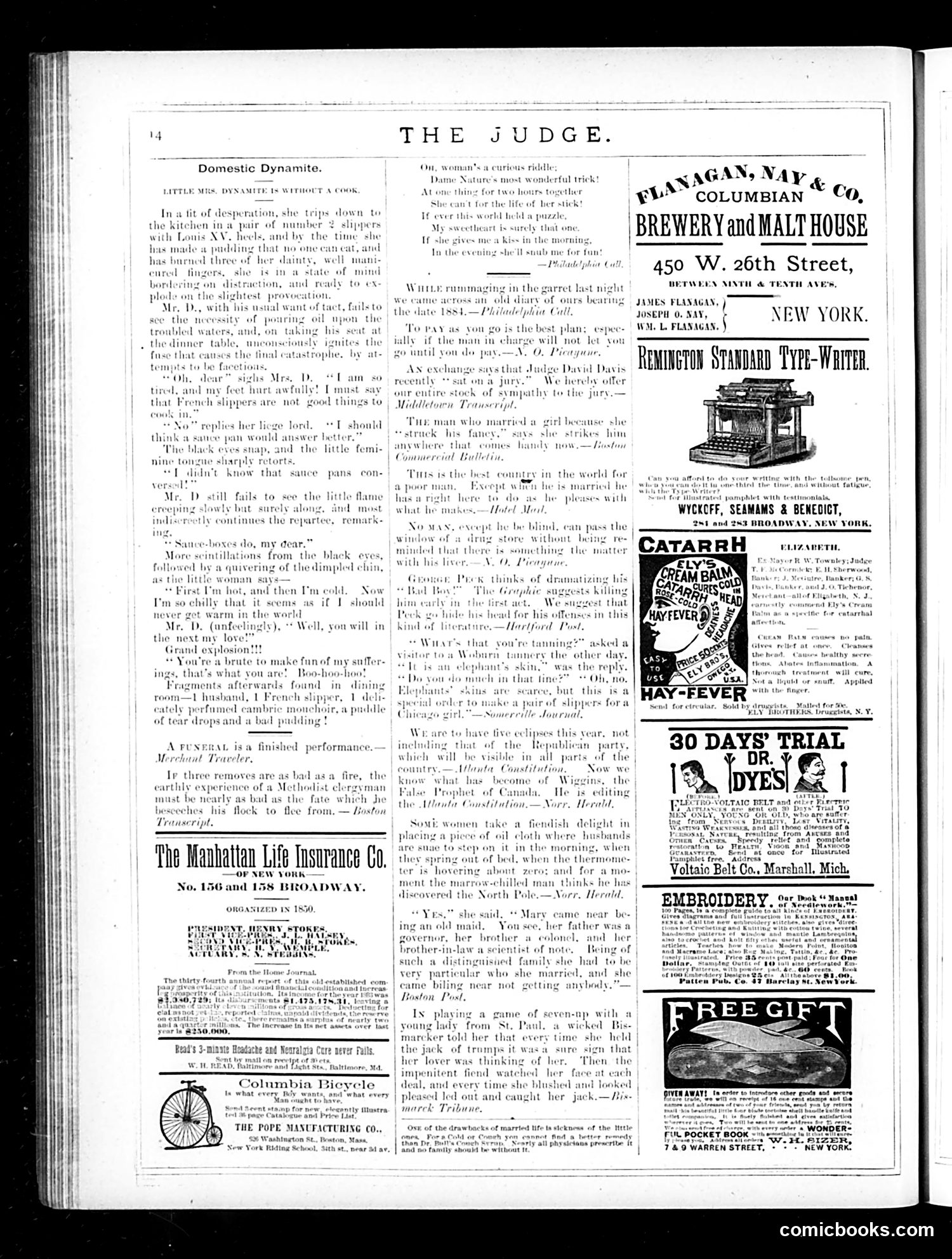
This page's main feature is a humorous article titled "Domestic Dynamite," which satirizes marriage and household life through anecdotes about a wife's volatile temperament. The central joke equates a difficult wife to "dynamite"—unpredictable and explosive. The piece presents comedic vignettes: a wife's incompetence in the kitchen, her emotional volatility (alternating between hot and cold moods), and her manipulation of her husband through tears and complaints. The humor relies on period stereotypes of wives as irrational, demanding, and difficult to manage. A running theme mocks women's logic and their ability to dominate households through emotional manipulation rather than reason. References to judges and legal scenarios suggest marital disputes. The surrounding advertisements (brewery, typewriter, insurance, bicycle) are typical period commercial content unrelated to the satire. By modern standards, this represents dated gender stereotyping that treats female "difficulty" as inherent and marriage as a battle of wills—humor that would be considered offensive today.
This page is primarily **advertising** with interspersed short humor pieces typical of Judge magazine's format. The cartoons/jokes are brief satirical quips rather than visual illustrations. **Content highlights:** The humorous pieces mock contemporary absurdities: a man patenting a hen's nest, someone worried about a toy "double ripper" pistol, and jokes about naming African discoveries and benevolent societies. One piece satirizes newspaper typesetting preferences, another playfully suggests teaching kindergarten to an unruly man. There's dark humor about buying cemetery plots and medical/psychological references to "weak and undeveloped parts" that reflect period attitudes toward self-improvement products. **The advertisements dominate**, offering pianos, fire extinguishers, magic lanterns, and notably an **Austrian government bond** promising returns—typical of late-19th-century financial speculation. Overall, the page reflects Judge's formula: brief satirical commentary on everyday American life mixed with commercial promotion, assuming readers familiar with contemporary social pretensions and modern inventions.
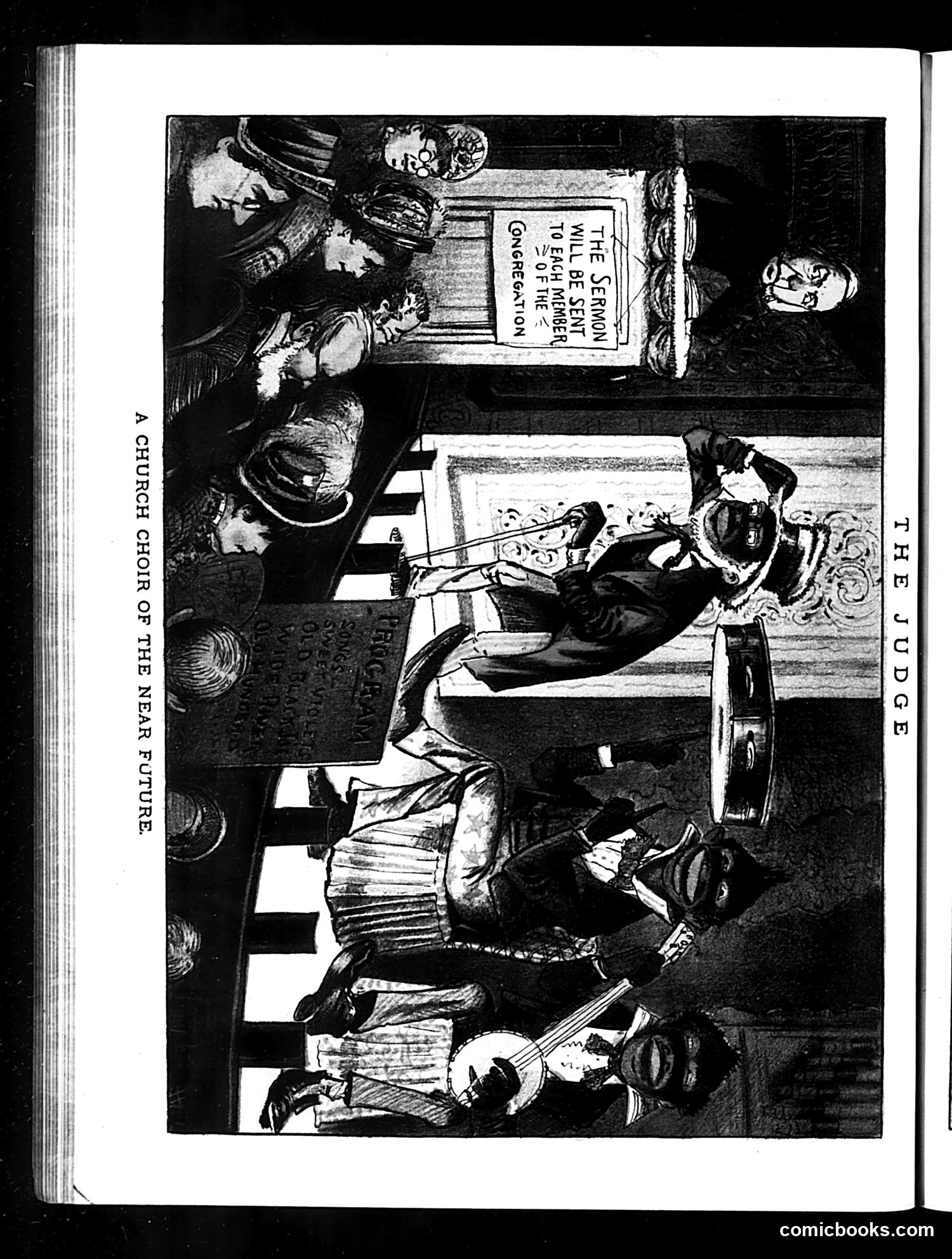
This appears to be a satirical cartoon titled "A CHORUS OF THE NEAR FUTURE" depicting a church choir in an exaggerated, comedic scene. The image shows choir members in robes performing, with what appears to be musical instruments and dramatic posturing. The visible text fragment mentions something "will be sent to each member of the congregation," though the complete context is unclear from this partial OCR. Without clearer identification of the specific figures or a legible date, I cannot definitively identify which contemporary political or social figures are being caricatured. The satire appears to mock either the pretentiousness of church choirs, changes in musical performance styles, or possibly specific clergy/church leadership of the era, but the precise target remains unclear from the visible elements.