
A complete issue · 16 pages · 1883
Judge — December 15, 1883
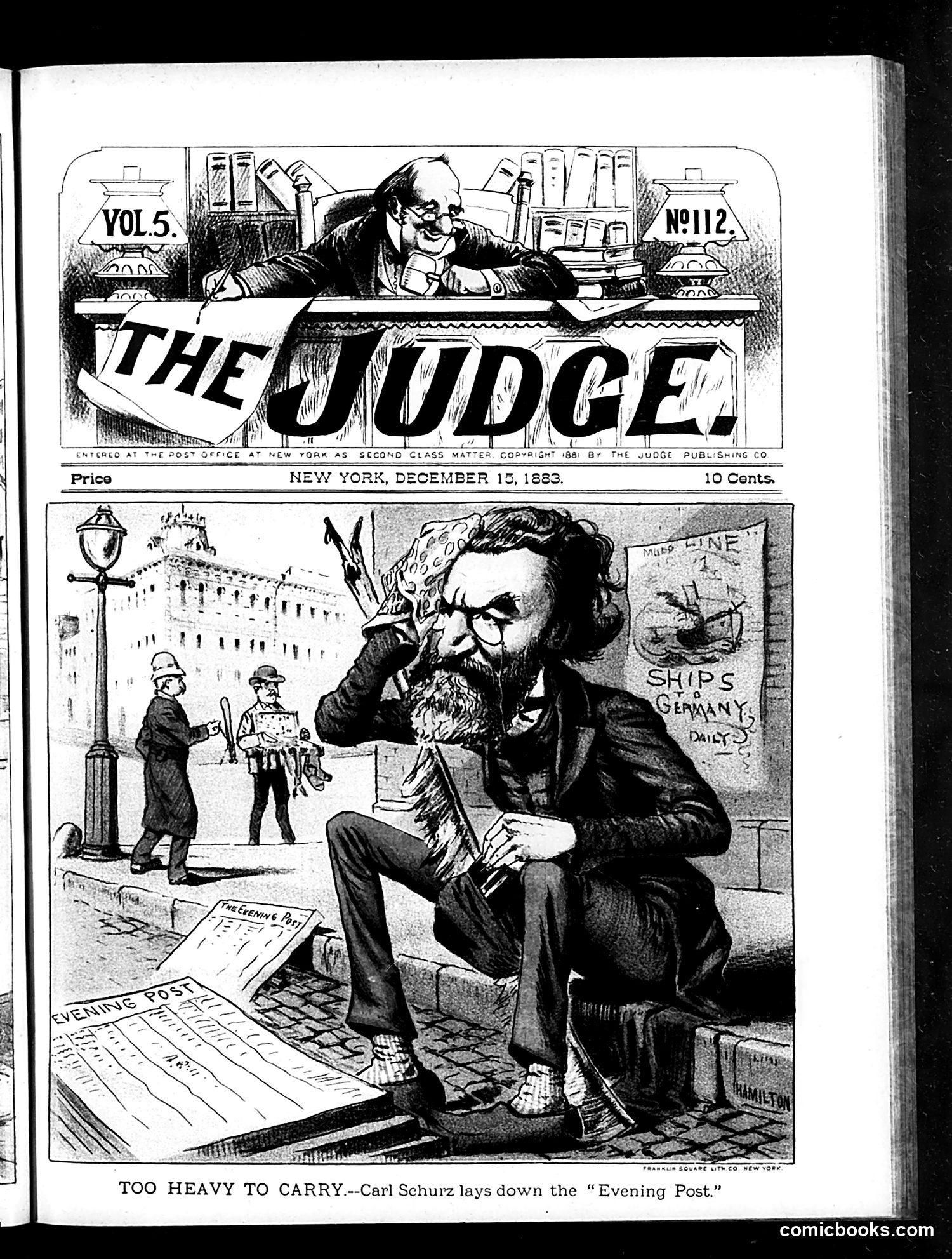
This cartoon from Judge magazine (December 15, 1883) satirizes Carl Schurz, a prominent German-American politician and journalist. The caption "Too Heavy to Carry" depicts Schurz struggling under the weight of the "Evening Post" newspaper, which he appears to have laid down. The visual pun plays on Schurz's difficulty managing or sustaining the publication. In the background, figures at a dock reference his German heritage and connections to shipping/international trade. The scattered papers and his strained posture suggest the burden of editorial responsibility has become overwhelming. This likely comments on contemporary political or business disputes involving Schurz and the Evening Post during the 1880s, though specific details require additional historical context.
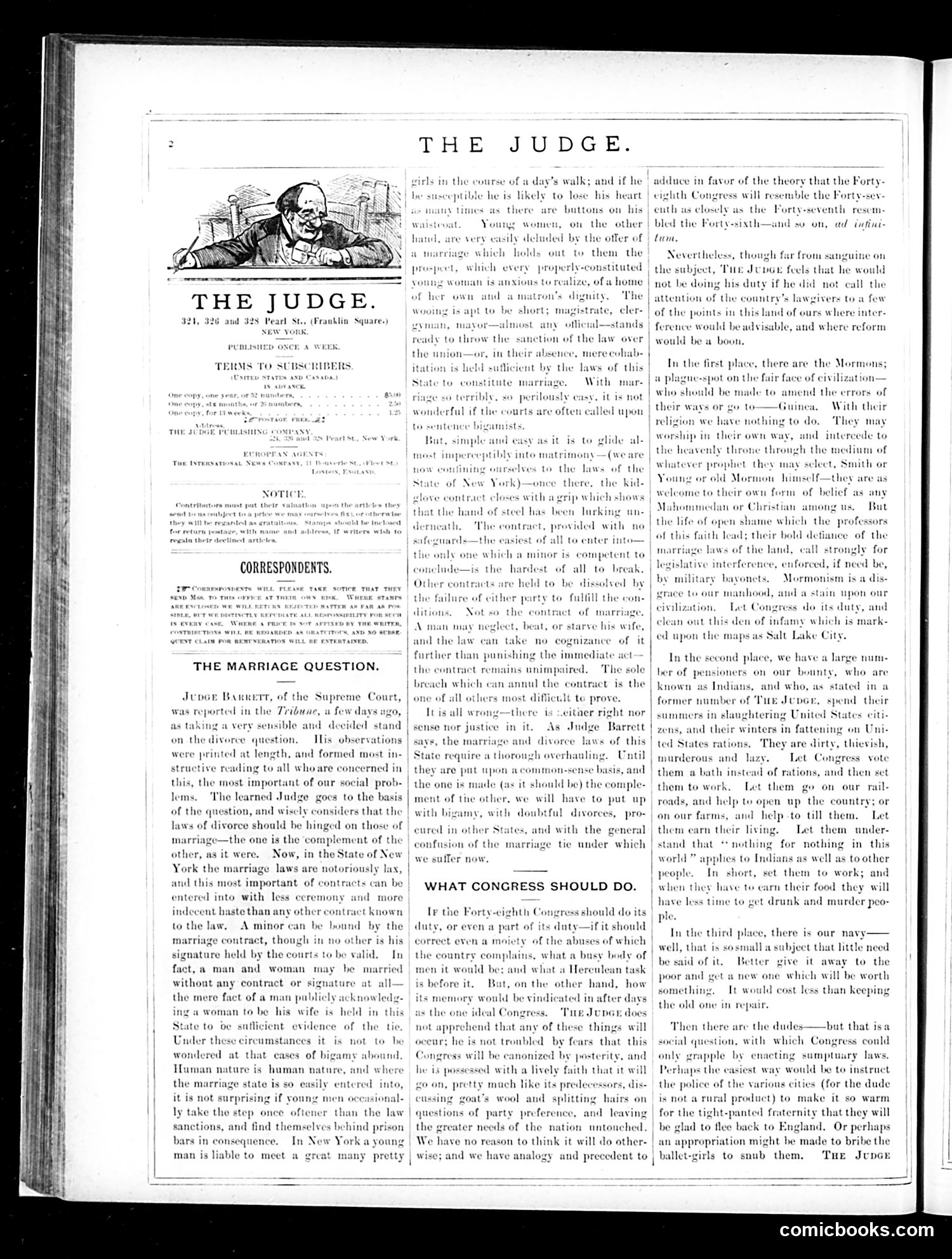
This page from *Judge* satirizes the laxity of American marriage and divorce laws, particularly in New York. The main cartoon (upper left) appears to show a judge or legal figure, accompanying an editorial titled "The Marriage Question." The author critiques how easily marriage contracts can be entered into—minors can marry with less oversight than adults face in other legal matters. Young men and women are easily manipulated into marriage, yet the laws make divorce equally frivolous. The piece mocks New York's particularly loose regulations, where cohabitation alone can constitute marriage. The satire's target is Congress's inability to reform these problems. "The Judge" sarcastically suggests that even if Congress *should* address marriage law, it won't—comparing it cynically to its predecessors, predicting it will merely engage in partisan squabbling while actual reform remains undone. The underlying point: American legal chaos regarding marriage reflects broader governmental dysfunction and indifference to meaningful social reform.
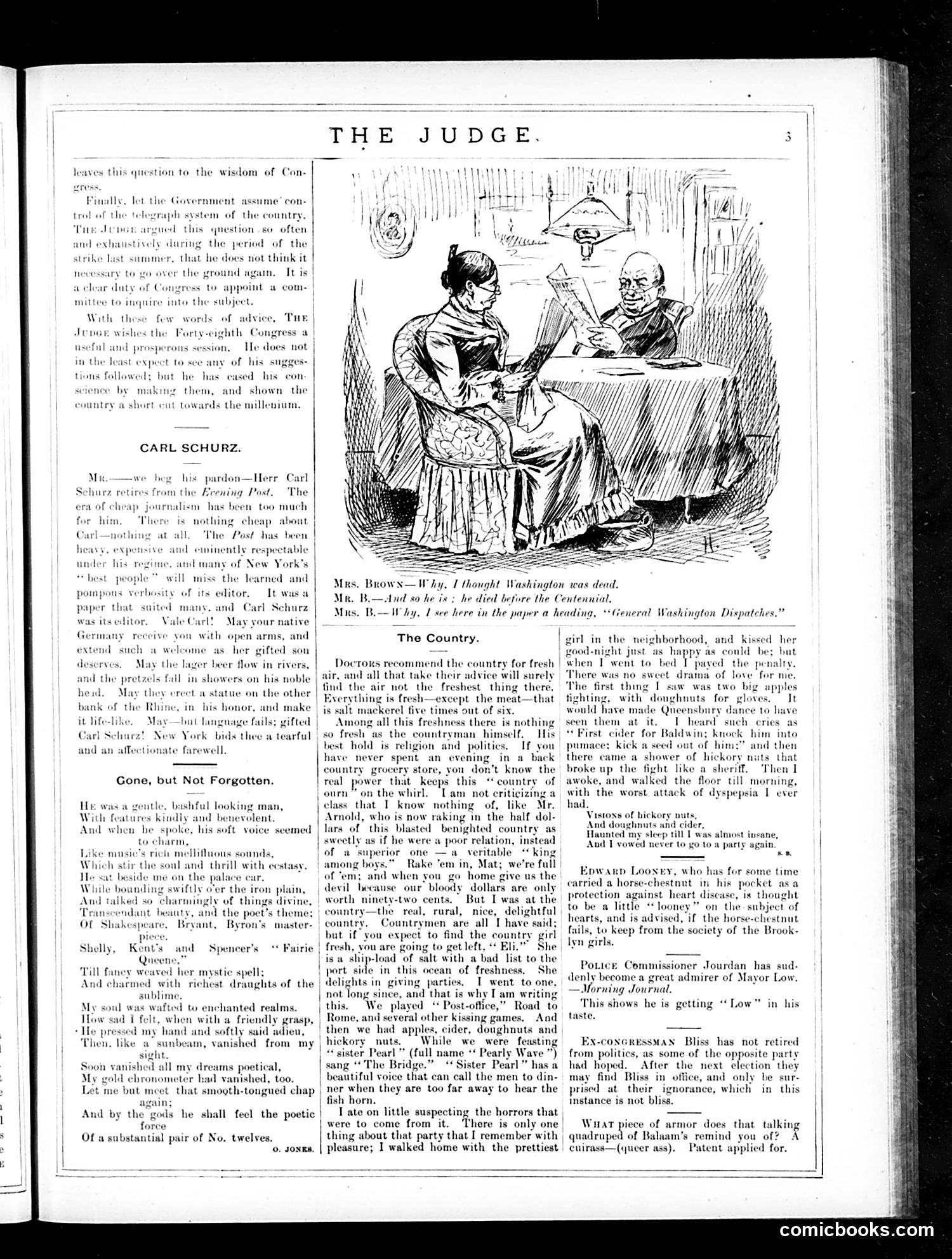
The main cartoon depicts **Mrs. Brown and Mr. B. in conversation**—likely a domestic scene representing middle-class Americans discussing urban versus rural life. The accompanying text "The Country" satirizes rural American life, mocking both the rustic simplicity of country folk and the naive romanticism of city visitors who idealize it. The piece critiques the pretentious "country gentleman" type (possibly referencing someone like Mr. Arnold mentioned in the text) while celebrating authentic rural characters. The humor targets both directions: country people's provincial attitudes and city people's condescending expectations. The page also contains **tributes to Carl Schurz** (a German-American newspaper editor departing New York) and a sentimental poem "Gone, but Not Forgotten." These reflect Judge's role documenting 19th-century American public figures and social commentary on immigration and cultural identity. The satire ultimately mocks the gap between rural reality and urban fantasy, a recurring theme in Gilded Age American humor.
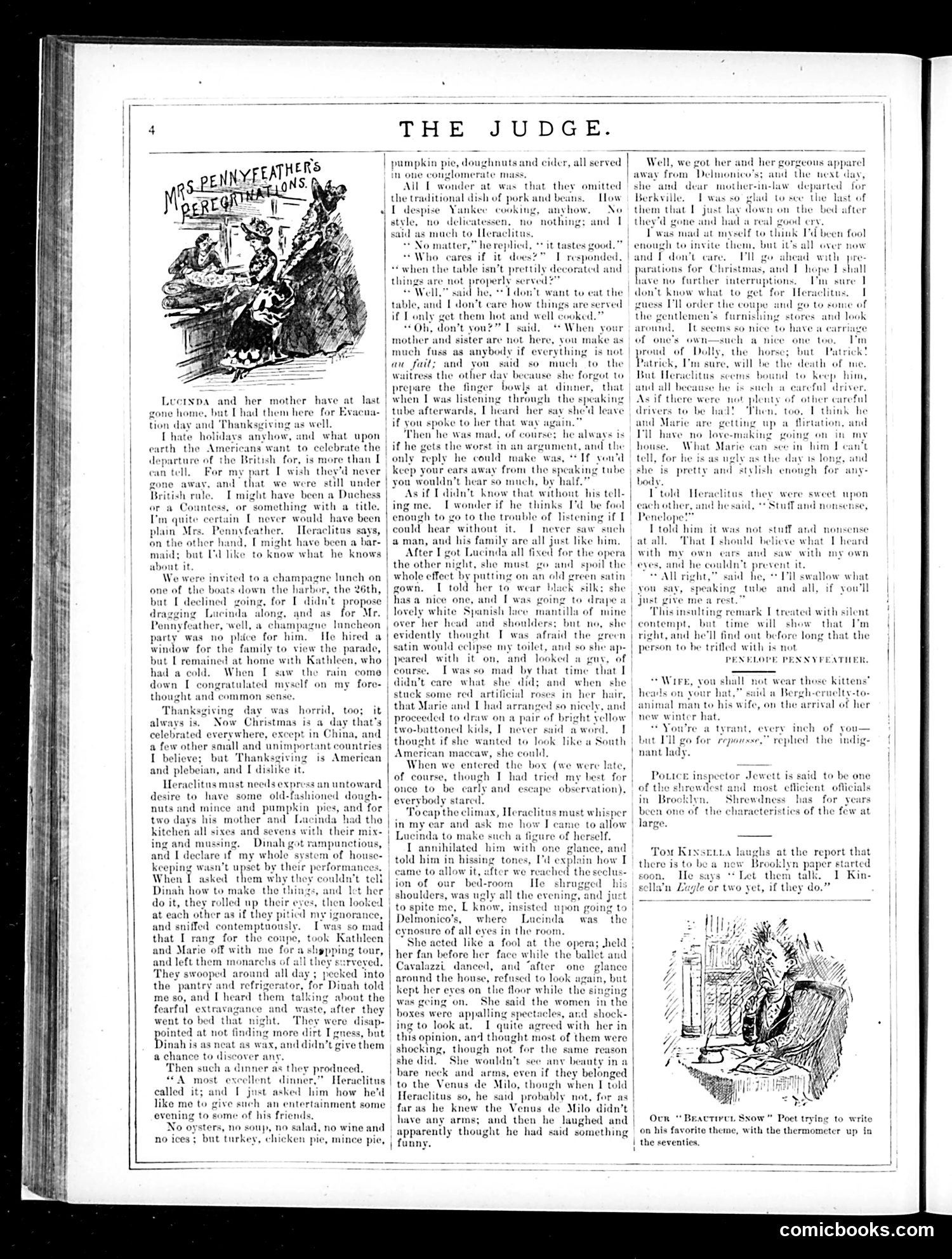
This page contains a serialized story rather than political cartoons. "Mrs. Pennyfeather's Peregrinations" satirizes American upper-middle-class snobbery and social pretension through the complaints of a wealthy, chronically dissatisfied woman. The satire targets Mrs. Pennyfeather's contradictions: she resents Thanksgiving and Christmas as distinctly American holidays (preferring European traditions), yet celebrates them anyway; she demands elaborate preparations while criticizing servants for their efforts; she insists on fashionable display yet worries about appearing overdressed. The humor lies in exposing her as simultaneously class-conscious and ungrateful, desperate to appear refined while behaving boorishly. Her husband Heraclitus becomes a punching bag for her constant criticisms—she even orchestrates a public humiliation at the opera to punish his supposed rudeness. The story mocks the pretensions of Americans seeking European sophistication while remaining fundamentally provincial and ungracious. Mrs. Pennyfeather embodies the nouveau riche stereotype: wealthy but tasteless, aspirational but contemptuous.
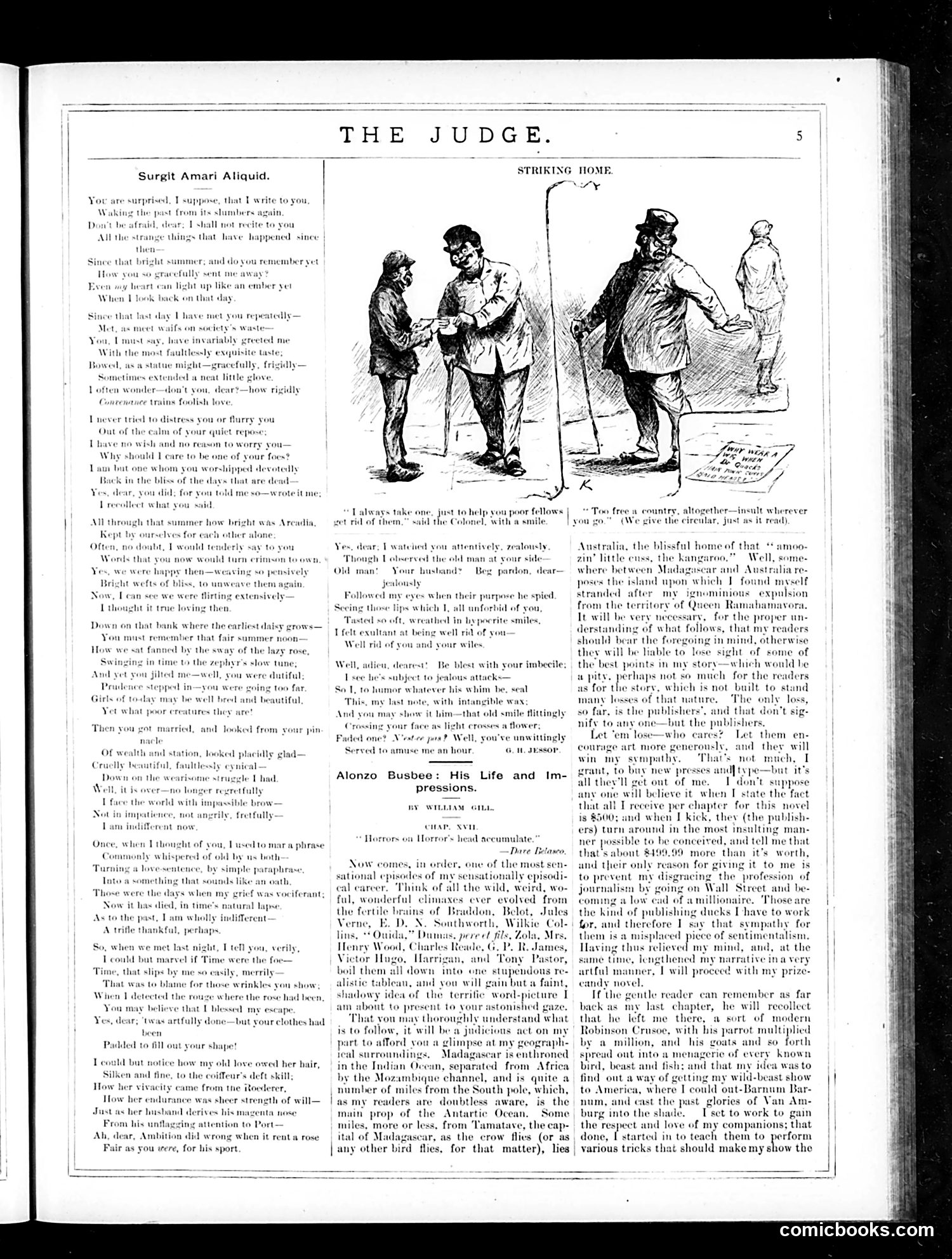
This page from *Judge* magazine contains two distinct pieces: **"Striking Home" (main illustration):** The sketch depicts what appears to be a domestic or social encounter between well-dressed men and women on a street. Without clearer identifying markers, the specific satirical target is unclear, though the title suggests commentary on social propriety or marital dynamics—common *Judge* subjects of the era. **"Alonzo Busbee: His Life and Impressions" (text article):** This is a serialized fictional narrative, not political satire. It's an overwrought melodramatic story referencing Madagascar and exotic adventure—typical of the sensationalist serial fiction *Judge* published to entertain readers alongside its satirical content. The page reflects *Judge's* mixed format: combining visual satire with entertainment fiction rather than focusing exclusively on political commentary.
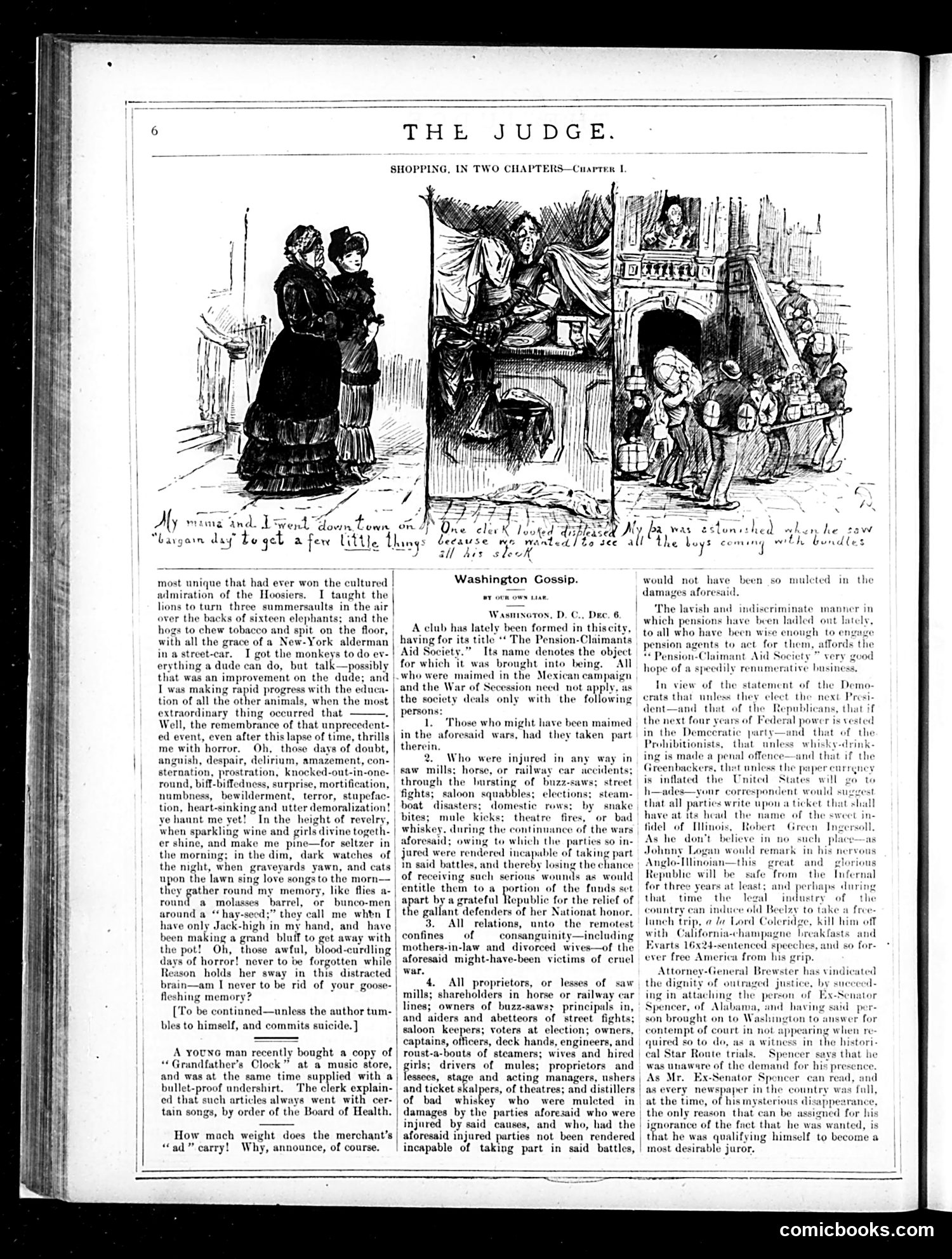
This *Judge* page contains two satirical pieces mocking government pension fraud. **"Shopping, in Two Chapters"** (top illustrations): A humorous anecdote about a woman's shopping mishap, likely establishing conversational tone. **"Washington Gossip"** (main text): The satire targets the newly formed "Pension-Claimants Aid Society" in Washington, D.C. The joke: the organization claims to help Mexican War and Civil War veterans, but its actual membership criteria are absurdly broad and fraudulent. Members include people who were *never* wounded in war, relatives of non-veterans, and even people injured in completely unrelated incidents (saw mill accidents, bar fights, theater mishaps, whiskey-related injuries). The satire suggests that corrupt pension agents and claimants were gaming the system—filing claims for people with tenuous or fabricated connections to military service. This reflects real Gilded Age concerns about pension fraud depleting the federal treasury through false or exaggerated claims. The piece mocks both the scheming claimants and the government's inability to prevent obvious frauds.
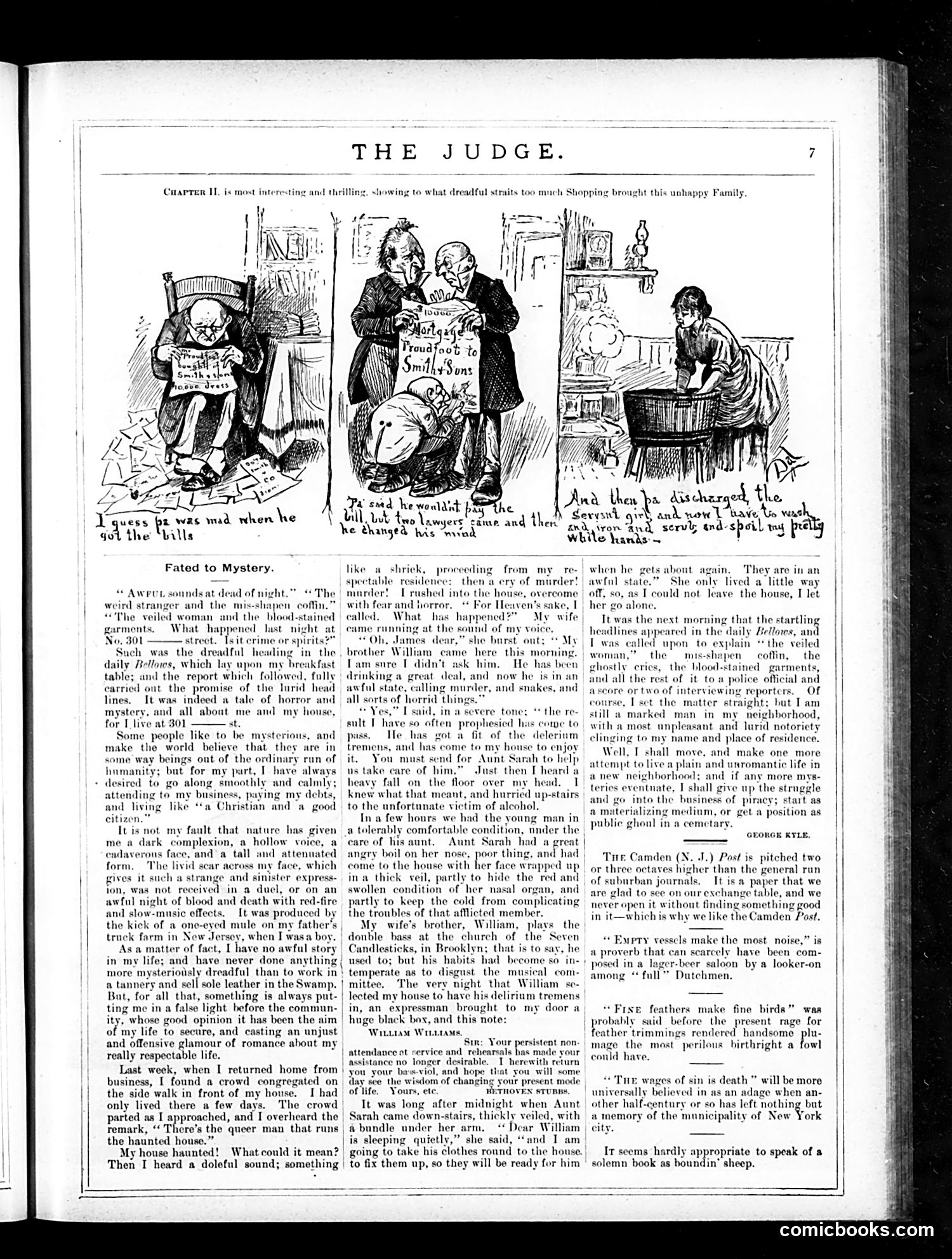
This story satirizes the narrator—a respectable, ordinary man cursed by appearance and circumstance to seem mysteriously sinister. Despite his actual dull life (he works in a tannery, attends to business), his dark complexion, hollow voice, and scarred face make neighbors assume he's a gothic villain. His house becomes "haunted" when his disreputable brother William arrives in a drunken delirium. The humor centers on the gap between reality and perception: what appears to be a thrilling mystery (strange cries, a large suspicious box delivered at midnight) has mundane explanations—William's alcoholic fit and his church choir clothes being cleaned. The satire mocks both the public's appetite for sensational mystery and the unfairness of judging people by appearance. The "respectable" narrator cannot escape romantic notoriety despite his boring, moral life.
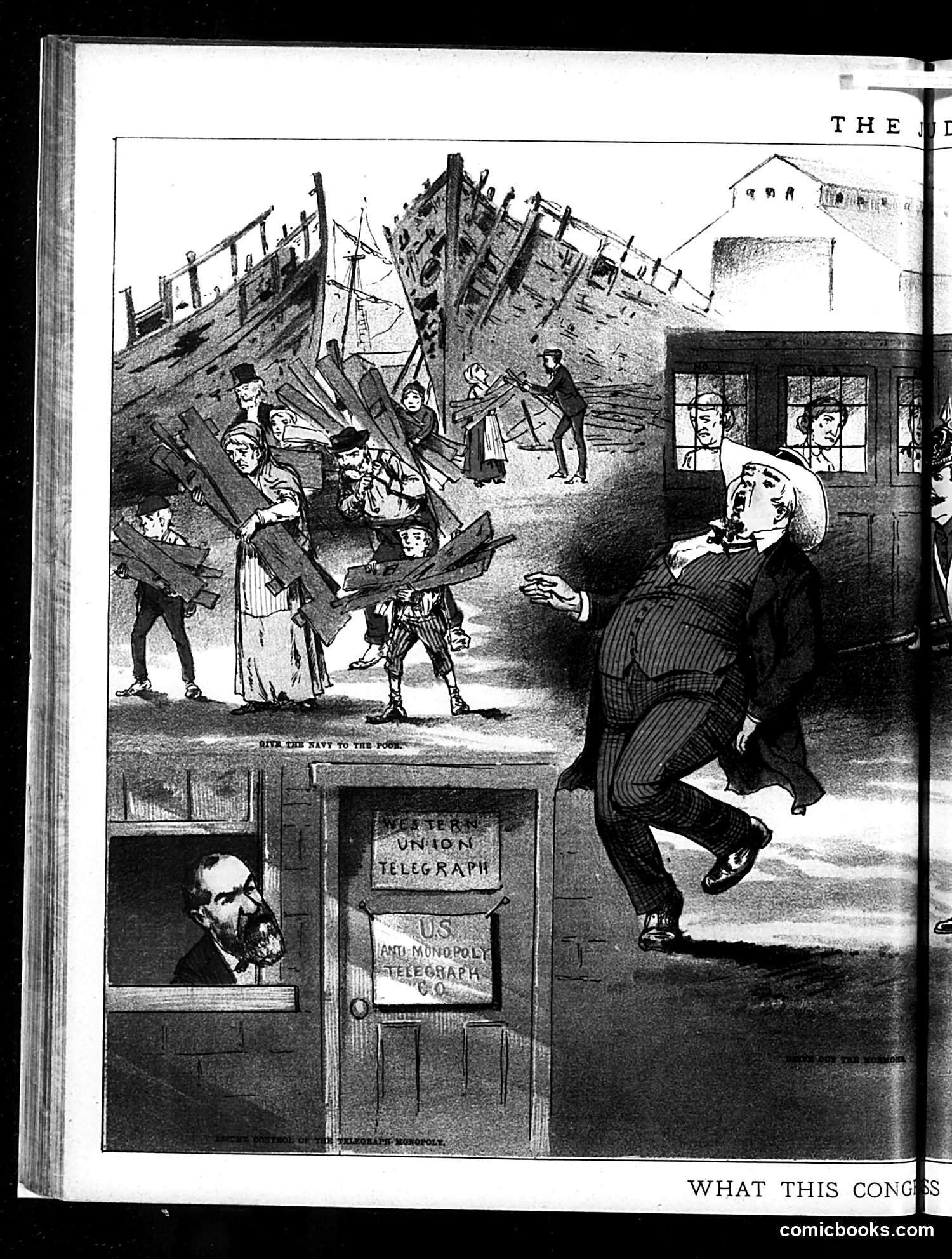
This appears to be a satirical cartoon from *Judge* magazine critiquing telegraph monopoly practices. The main figure on the right—a portly man in striped suit—likely represents a telegraph company executive or politician complicit with monopolies. He recoils in alarm from dock workers and ordinary people on the left, who appear to be protesting or demanding access. The telegraph office boxes visible (marked "Western Union Telegraph" and "U.S. Anti-Monopoly Telegraph Co.") reference the real telegraph monopoly debates of the late 19th century. The cartoon satirizes how wealthy interests resisted competition and public utility reform, showing the disconnect between corporate power and working-class citizens' interests. The caption "What This Congress" (text cut off) suggests criticism of Congress's failure to address monopolistic practices affecting ordinary Americans.
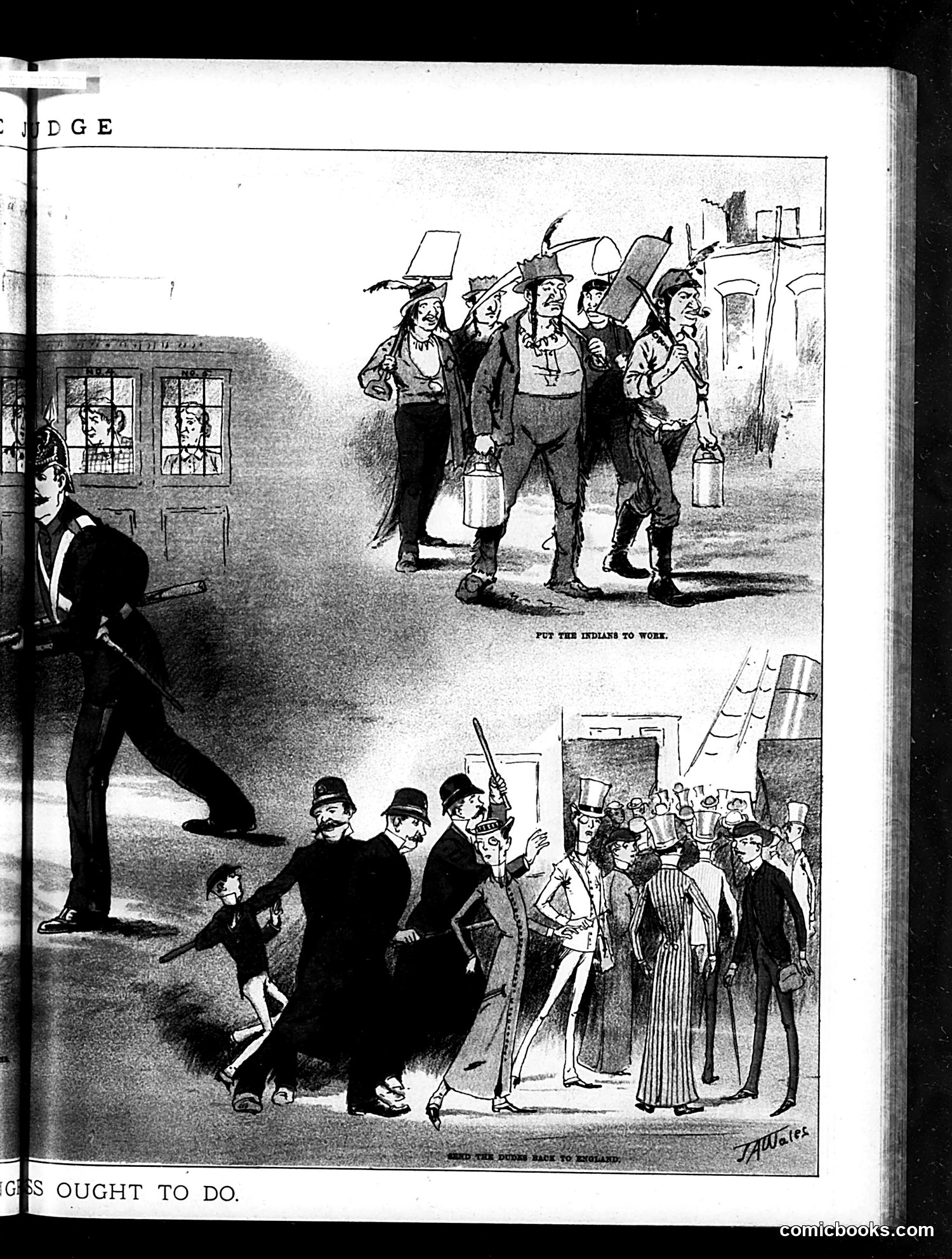
This page contains two connected satirical cartoons about Native Americans and labor. The top panel, captioned "PUT THE INDIANS TO WORK," shows Native Americans being directed toward labor by white authority figures carrying tools and buckets. The bottom panel, "SEND THE INDIANS BACK TO RESERVATIONS," depicts the reverse—Native Americans being escorted away. The satire critiques inconsistent U.S. Indian policy: politicians alternately demanded Native Americans be forced into labor for "civilization" or removed to reservations, depending on economic circumstances. The cartoons mock this contradictory, exploitative approach that treated Native Americans as disposable labor rather than addressing their actual needs or rights. The repeated reversal emphasizes the arbitrary, self-serving nature of government Indian policy.
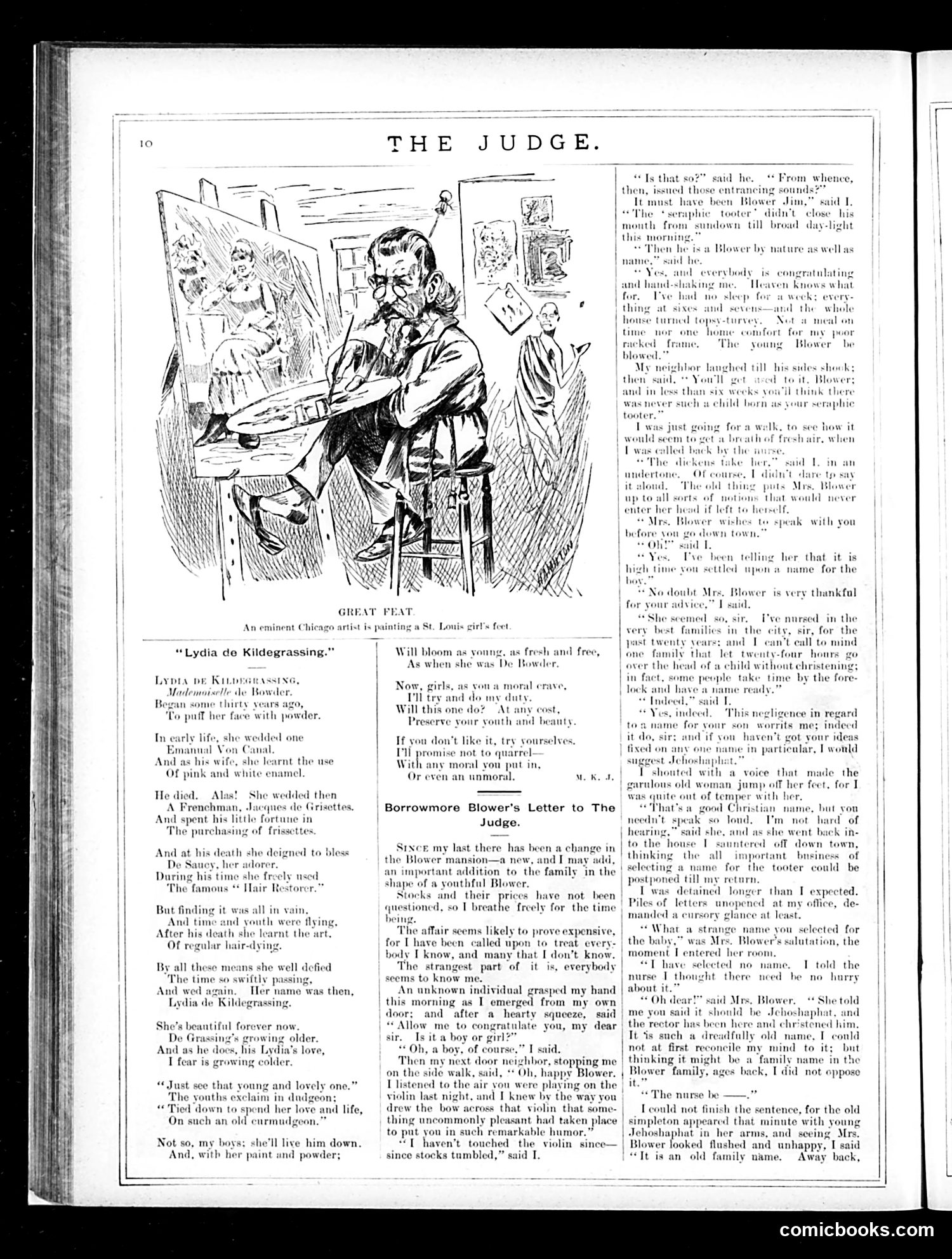
This page contains two distinct satirical pieces from the American humor magazine *Judge*: **"Lydia de Kildegrassing"** (left): A poem mocking an aging woman who repeatedly marries for money and uses cosmetics to maintain her youth. The satirical point targets women's vanity and mercenary marriage practices among the wealthy—common themes in Gilded Age satire. The cumulative name "de Kildegrassing" suggests her serial reinventions through marriage. **"Borrowmore Blower's Letter to The Judge"** (right): A humorous letter about an unnamed newborn causing social upheaval. Blower complains that everyone congratulates him despite his exhaustion, and a nurse insists he must name the child immediately—he hasn't. The satire targets both social pretension (everyone claiming friendship) and the era's obsession with proper naming conventions. The large illustration shows an artist (identified as "an eminent Chicago artist") painting a woman's portrait, likely visualizing the Kildegrassing poem's theme of artifice and beautification.
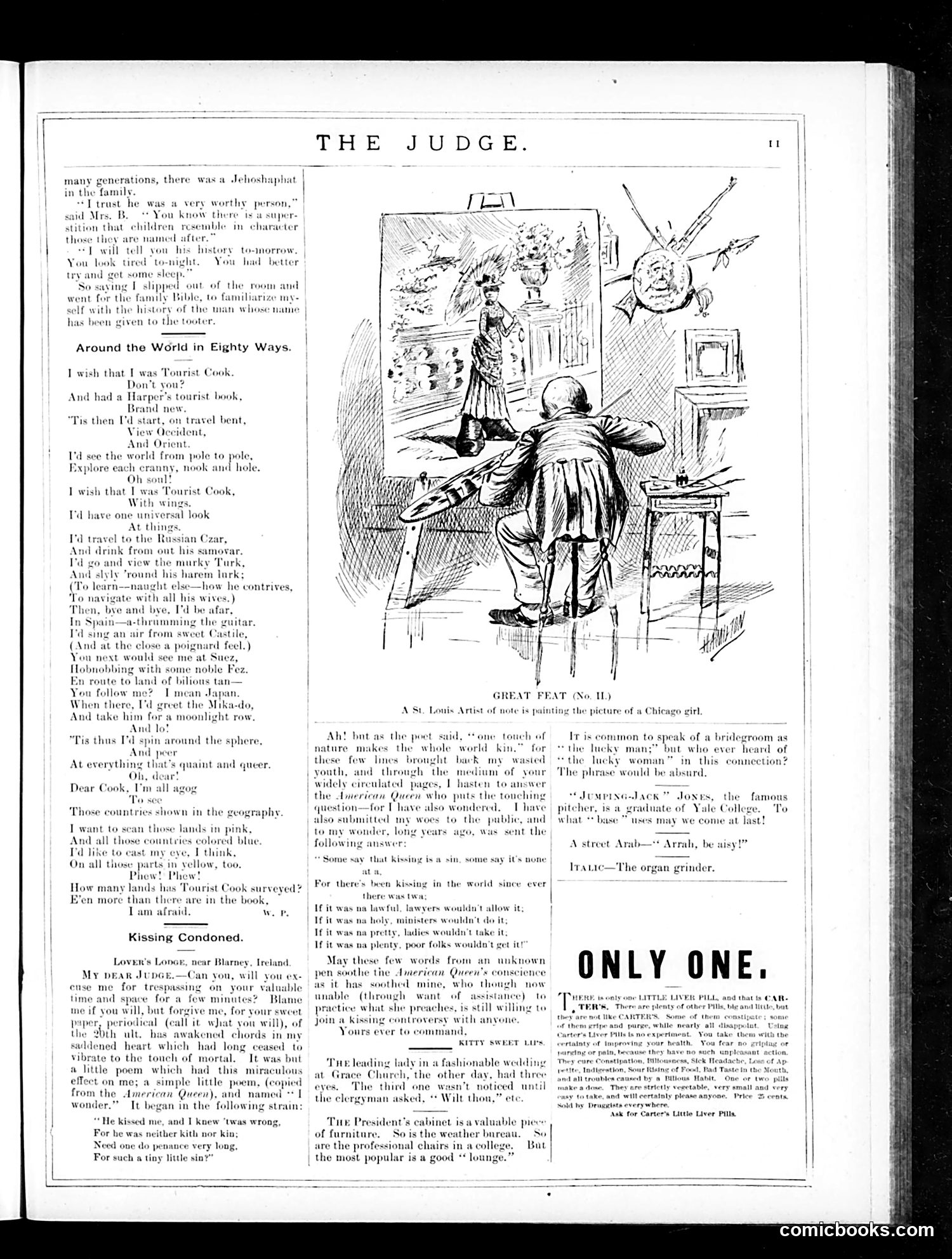
This page from Judge magazine combines poetry, social commentary, and illustrated humor typical of late 19th-century American satire. The main illustrated cartoon shows a St. Louis artist painting a portrait of a Chicago girl—likely a jab at regional artistic pretensions or the commodification of women's images. The bulk of the page features reader submissions and satirical notes: - "Around the World in Eighty Ways" parodies Thomas Cook's tourist guidebooks, mocking aspirational travel culture - "Kissing Condoned" humorously addresses Victorian anxieties about propriety, debating whether kissing outside marriage is acceptable - Brief quips mock contemporary figures: a bride with three eyes at Grace Church, Cabinet furniture, and the asymmetry of calling someone "the lucky woman" in marriage The overall tone reflects Judge's satirical approach to American society—gently mocking tourist culture, Victorian morality debates, and social pretension while maintaining light humor suitable for middle-class readers.
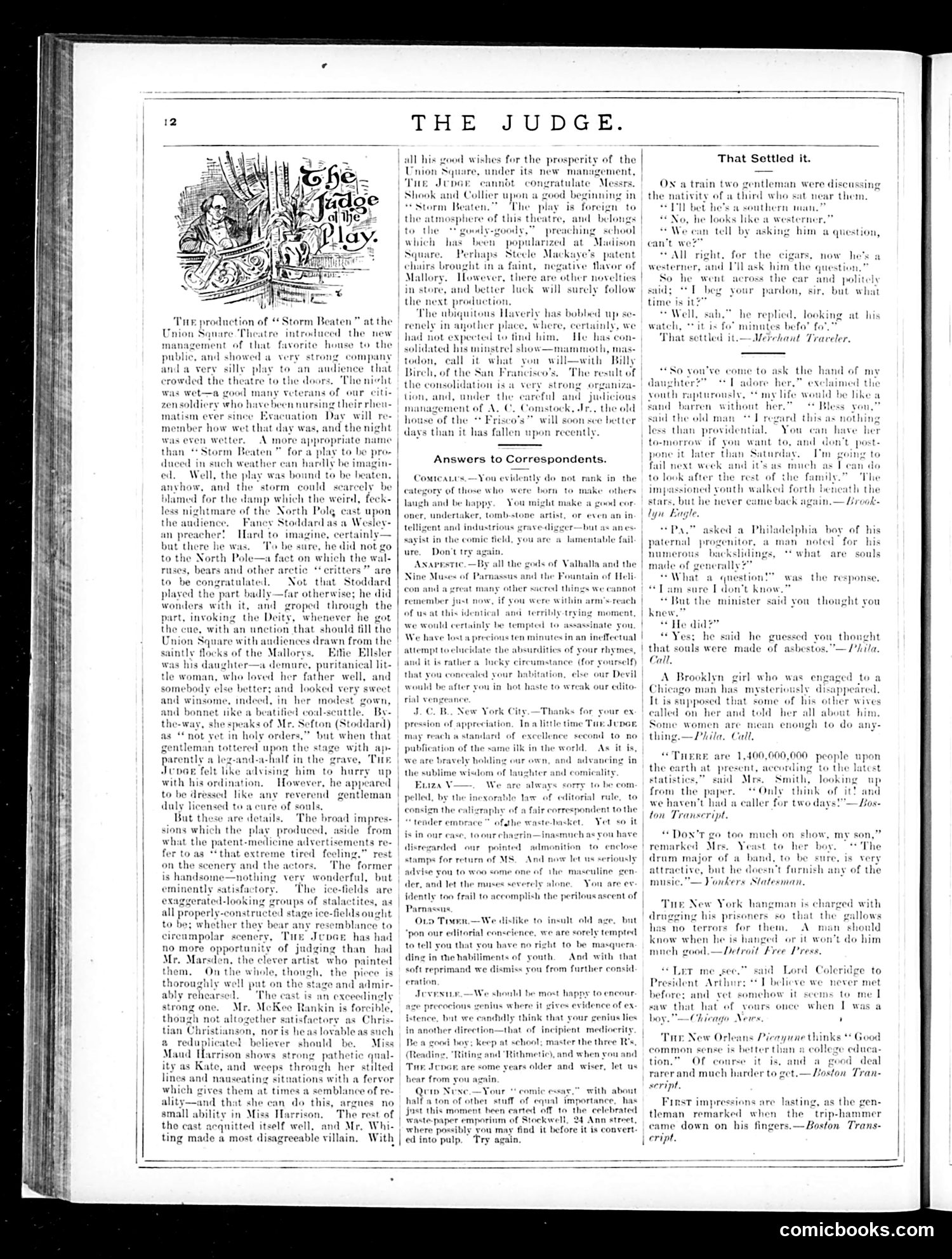
This page from **Judge** magazine contains theater criticism and a humor advice column ("Answers to Correspondents"). ## Main Content: **"The Judge on the Play"** reviews *Storm Beaten* at Union Square Theatre. The critic mocks both the play and the weather—noting the irony that a play titled *Storm Beaten* opened on a rainy night. The review is largely dismissive, criticizing the plot as "very silly" while grudgingly praising the production values and cast performances (particularly actors Rankin, Stoddard, and others). **Secondary references** include mention of Haverly's minstrel show and theater impresario Steele Mackaye. ## "Answers to Correspondents": This satirical advice column contains mock responses to fictional readers, using crude stereotypes. One response dismisses would-be comedians as lacking talent. Another mocks women's education. The tone is typical of 1880s-90s magazine humor—sarcastic, dismissive, and relying on period prejudices. The page reflects Judge's blend of theatrical criticism and broad satirical commentary on contemporary life, with humor that relies heavily on the cultural attitudes of its era.
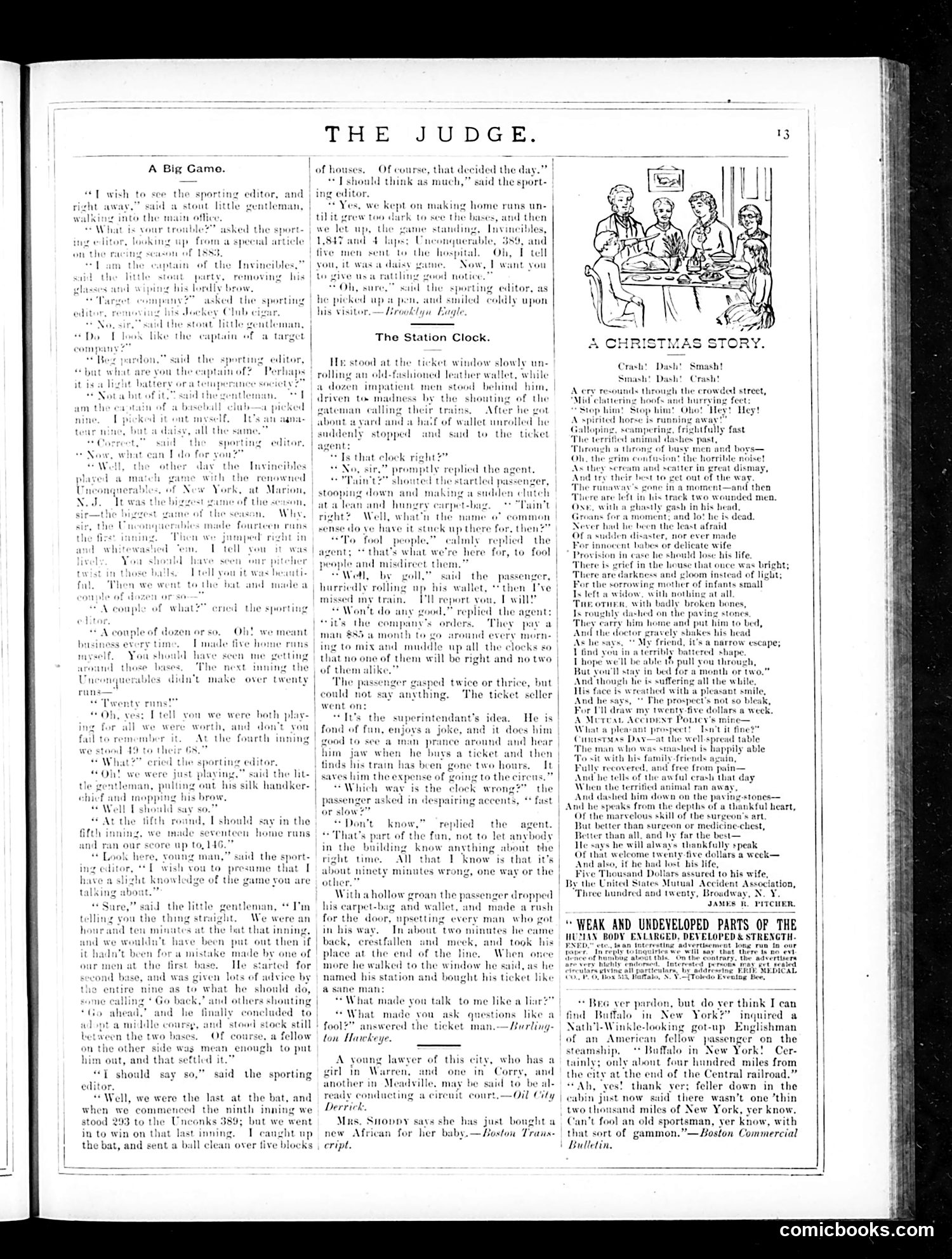
This page from *Judge* contains two main satirical pieces: **"A Big Game"** is a humorous dialogue between a sporting editor and a small gentleman claiming to be captain of a baseball team called the "Invincibles." The joke rests on the gentleman's increasingly implausible account of a game where his team scored enormous runs (the editor mentions "twenty runs"). The satire mocks both boastful sports talk and credulous journalists who uncritically report exaggerated athletic claims—a timeless target of sports humor. **"The Station Clock"** ridicules railroad inefficiency. A passenger complains about an obviously wrong clock at the ticket office. The ticket agent defends keeping it deliberately inaccurate because it amuses the superintendent and confuses impatient travelers into thinking they've missed their trains. The satire critiques bureaucratic absurdity and corporate indifference to customer inconvenience. Both pieces exemplify *Judge*'s typical late-19th-century approach: satirizing American social institutions (sports, railroads) through exaggerated dialogue that exposes human folly.
This page is primarily **advertising** interspersed with a satirical story/dialogue. The main comic content is "Shake Shtays In," which appears to be ethnic humor—likely targeting German or Eastern European immigrants through heavy dialect spelling ("vhas," "pelief," "Shiminy"). The story concerns a lazy boy named Shake whom his father considers sending to the circus for fifty cents rather than supporting him at home. The joke hinges on the father's reasoning: keeping Shake costs money for food, but sending him away means losing those wages he might earn—a crude economic logic played for laughs. The humor relies on the familiar Judge formula of caricaturing immigrant speech patterns and depicting foreigners as comically ignorant or miserly. Without clearer historical context, the specific social commentary remains unclear, though it likely mocked contemporary attitudes toward poor immigrant families and child labor.
This is primarily an **advertising page** with one central cartoon feature. The main content is "Helen's Other Baby," a joke dialogue about a mother and child observing a railroad train. **The Cartoon:** A child asks repetitive questions about a moving train ("What makes that noise?" "What are those moving for?" etc.). The humor relies on the child's literal-minded, increasingly annoying questions and the mother's patient but ultimately exasperated responses. When a conductor appears, the mother "jerked the youngster off the platform"—a darkly comic punchline suggesting she's had enough of the questioning. **The Satire:** The joke mocks both child-like persistence and adult impatience, but primarily satirizes how modern technology (the railroad) bewilders ordinary people unfamiliar with machinery. It's gentle social humor typical of the era. **Surrounding Content:** The page is dominated by period advertisements for pianos, black goods retailers, lightning sewers, fire extinguishers, and various patent medicines—typical of 1880s magazine advertising. These ads reveal contemporary consumer concerns and commercial practices rather than satirical content.
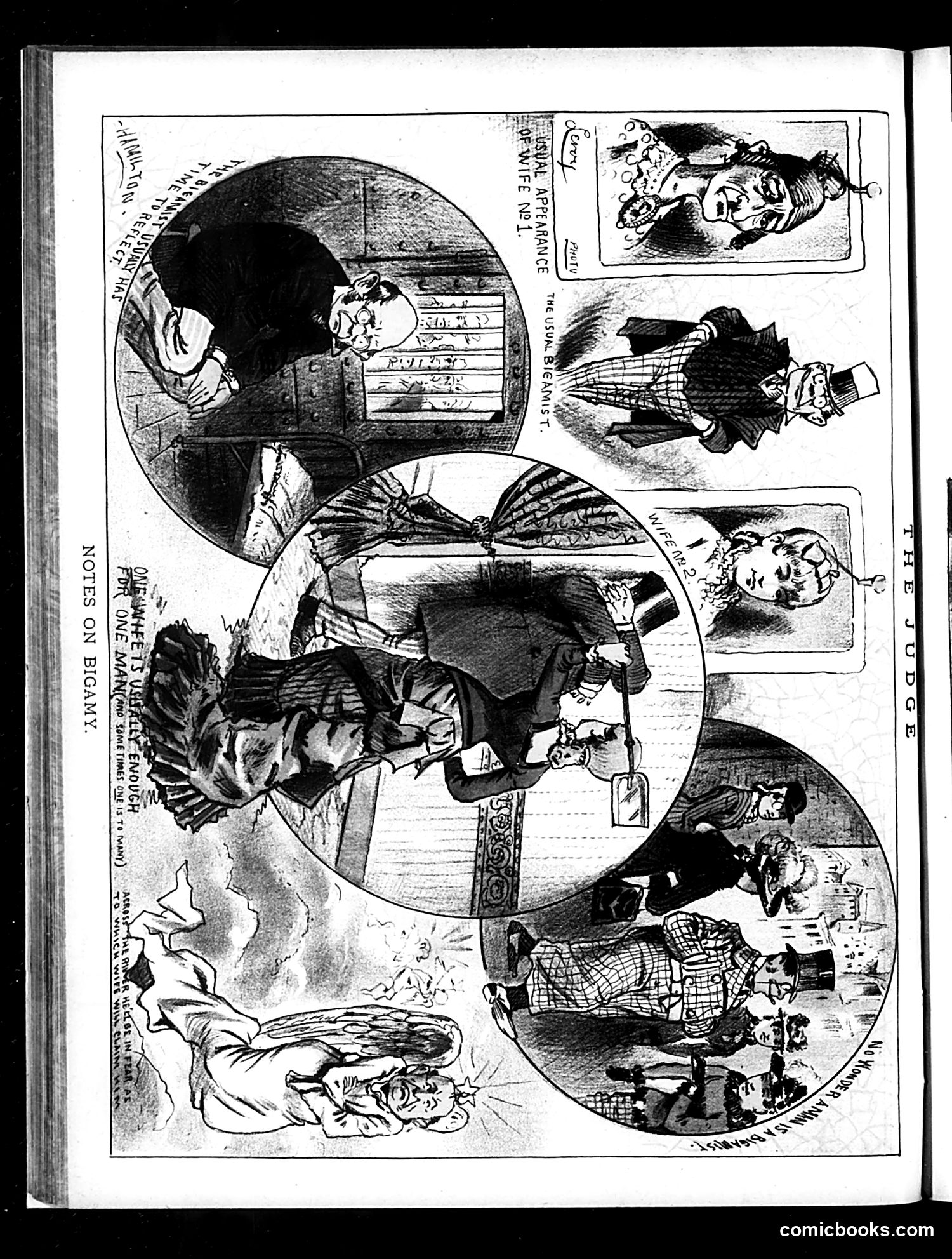
This page from *Judge* magazine satirizes bigamy through illustrated vignettes showing a man's "unusual appearance" with two wives. The central circular image depicts a man looking disheveled and exhausted, apparently juggling two relationships simultaneously. The surrounding smaller panels illustrate the complications: scenes showing the man with each wife in different contexts, suggesting the stress and logistical chaos of maintaining a secret double life. The cartoon's humor derives from physical comedy—the man's harried expression and the absurdity of his predicament. The satire targets both the man's moral transgression and the social scandal bigamy represented in the era. The "notes" format presents this as pseudo-documentary commentary on the social problem, using exaggeration for comedic effect while critiquing infidelity and deception within marriage.