
Judge, 1883-12-15 · page 2 of 16
Judge — December 15, 1883 — page 2: what you’re looking at
What you’re looking at
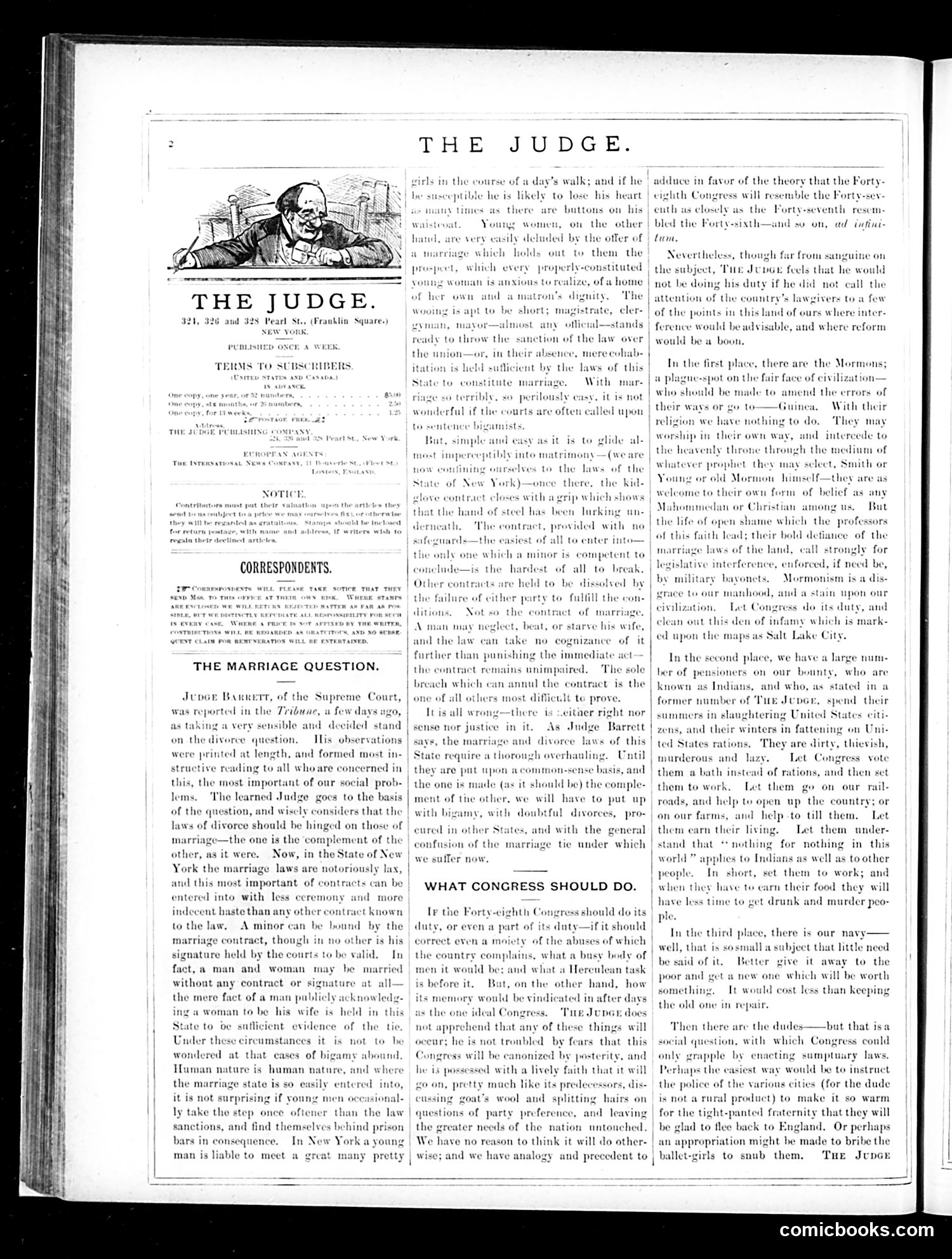
This page from *Judge* satirizes the laxity of American marriage and divorce laws, particularly in New York. The main cartoon (upper left) appears to show a judge or legal figure, accompanying an editorial titled "The Marriage Question." The author critiques how easily marriage contracts can be entered into—minors can marry with less oversight than adults face in other legal matters. Young men and women are easily manipulated into marriage, yet the laws make divorce equally frivolous. The piece mocks New York's particularly loose regulations, where cohabitation alone can constitute marriage. The satire's target is Congress's inability to reform these problems. "The Judge" sarcastically suggests that even if Congress *should* address marriage law, it won't—comparing it cynically to its predecessors, predicting it will merely engage in partisan squabbling while actual reform remains undone. The underlying point: American legal chaos regarding marriage reflects broader governmental dysfunction and indifference to meaningful social reform.
📄 Transcribed text from this page (OCR, searchable)
Machine-transcribed from the original scan — historical spelling and the odd misread are preserved.
THE JUDGE. $21, 326 and 328 Pearl St., (Franklin Square.) NEW YORK. PUBLISHED OS MS TO SUBSCRIBERS. Isreasartosat News Comes! THE MARRIAGE QUESTION. Jeper Barner, was reported int f the Supreme Court vibune, a few days nsible and as taking a very on the divorce questi observations were printed th, and formed most in- adit t important of our s he learned Judge of the question, und wisely co! hould be hinged on th »—the one is the ‘complement of the Now, in the State of New pes to the basis iders that the laws of divorce marriag r, as it we York the marriage laws are notoriously lax, | and this most important of « entered into with | = can be ss corer und more indecent haste than any other contri to the law, tknown A minor can be bound by the marriage contract, though in no other is his signature held by the courts tot In fact, a man and woman ed without any contract or all the mere fact of a man pu wledg- valid. be nature licly ack ing a woman to be his wife is Ss Un wondered at that cases of | may held in this of the ent evidence tie. er these circumstances it not Human nature is human natu the marriage state is so easily entered in men oceasional- than the law it is not surprising if youn ly take the step once oftener sanctions, and find themselves behind pris In Ne o meet a bars in consequence. man is liable York a you grea cided stand | THE JUDGE. girls in the course of a day’s walk; a he is likely to lose his heart buttons on his the ed by the offer of wome on other re very casily delu he which every hich out to them the rly-constituted 2 Woman is anxiou fa home own an Lito dt ny oflictal ready to tl ction of the law over the union . in their absence, mere col itation is nt by the laws of t With it is State eo marriag mare so perilously easy. not wonderful if t courts are often called upon But, simp mipere s been lurkir The contract 1 with no the easiest » wh the cts ar of cith Not may a of held to be hardest all di y to fulfill the con- to break. failure ditions Aa | and the law can take rve his w of it no x the immediate The sole annul the contract is the | further than punishi | the contract remains unimpaired, | breach which ex It is all wro t dificult to prove. there is .eitaer am and divorce t nor > nor justice in it. the marriag equire a thorough overh they are put upon ae the one is made (as it should be) the comple- | ment of the other, we will have to put up with bigamy, w doubtful divorces, pro- cured in other Stat nd with the general confusion of the marti tic under which we suffer now, WHAT CONGRESS SHOULD DO. Ir the Forty-cighth Congress should do its < duty—if it should teven a moiety of the ven a part of buses of which sins, wh busy body of and what a Herculean task vthe other hand, how ry would be vindicated in after days Tue Jupce does hend that any of these things will as the one ideal Congress, hot appr he is not troubled. by fears that this ess will be canonized by posterity. and cod with a lively faith that it will pretty much like its predecessors, dis- oat’s wool and. spli tions of party preference, and leaving of the nation untonched son to think it will do othe ing hairs on | wise; and we have analogy and precedent to | the life of open shan Ived by | , | clean ¢ at th, Barrett | laws of this | world i | attention Lif he | adduce in favor of the theory that the Forty- eighth Congre euth as closely as the bled the Fort xth ss will resemble the Fo tyeseventh resem. and so on, ad dufini- tum, Nevertheless, guine on the subject, Tie JtpGe feels that he would not be doing his duty if he did not call 1 though far from san f the country’s lawgivers to a few of the points in this land of ours wh ference would be ter. Avisuble, and where reform would be a boon, In the first place, there are the Mormons; who spot on the fair face of civilization— hot their way amend the errors of With their The: own way, and intercede to h the medium of whatever prophet they may select, Smith or ld Mormon himself. irown form of belief as any nor Chr But the ongly for interference, enforced, if need be, ry bayonets, Moi and a stain upon our ld be made relig we have worship in the th ly throne throu they are welcome t Mahot stan umong us, p which the of this faith lead; their bold detia mar laws of the land, call s by mili sm is a dis- grace to our manhoc civiliz ss do its duty, and den of infamy which is mark- ed upon the maps as Salt Lake City. In the second place, we have ali her of pensioners on ge num ur t pd wh who are known as Indians, s stated in a former number of Tue Jeper, spend their United States ei in fattening on Uni- hey are dirty, thievish, Let ( summers in slaughte zens, and their wint ted States rations, murderous and lazy. them a bath inst ss vot id then set them go on our rail- ad of ra them to work. L roads, and help to open up the country; or Let Let them under- “nothing for nothin applies to Ind well as toother people. In. short, set them to work; and when they have to carn their food they will have less ti on our farms, and help-to till them. them earn their living. stand that in this e to get drunk and murder peo- In the third place, there is our navy— pject that little need it away s sosmall a su of i 1 and get a new on aid iter give to the which will be worth It would cost less than keeping the old one in repair. Then there are the dudes—but that isa with which Cor pple by enacting sumptuary laws. th social quest ress could only asiest way would be to instruct of the various cities (for the dude is not a rural product) to make it so warm for the tight-panted fraternity that they will ad to flee back to England, Or per an appropriation might be made to bribe the ballet-girls to snub them. Tue JupcE comicbooks.com