
A complete issue · 16 pages · 1883
Judge — November 10, 1883
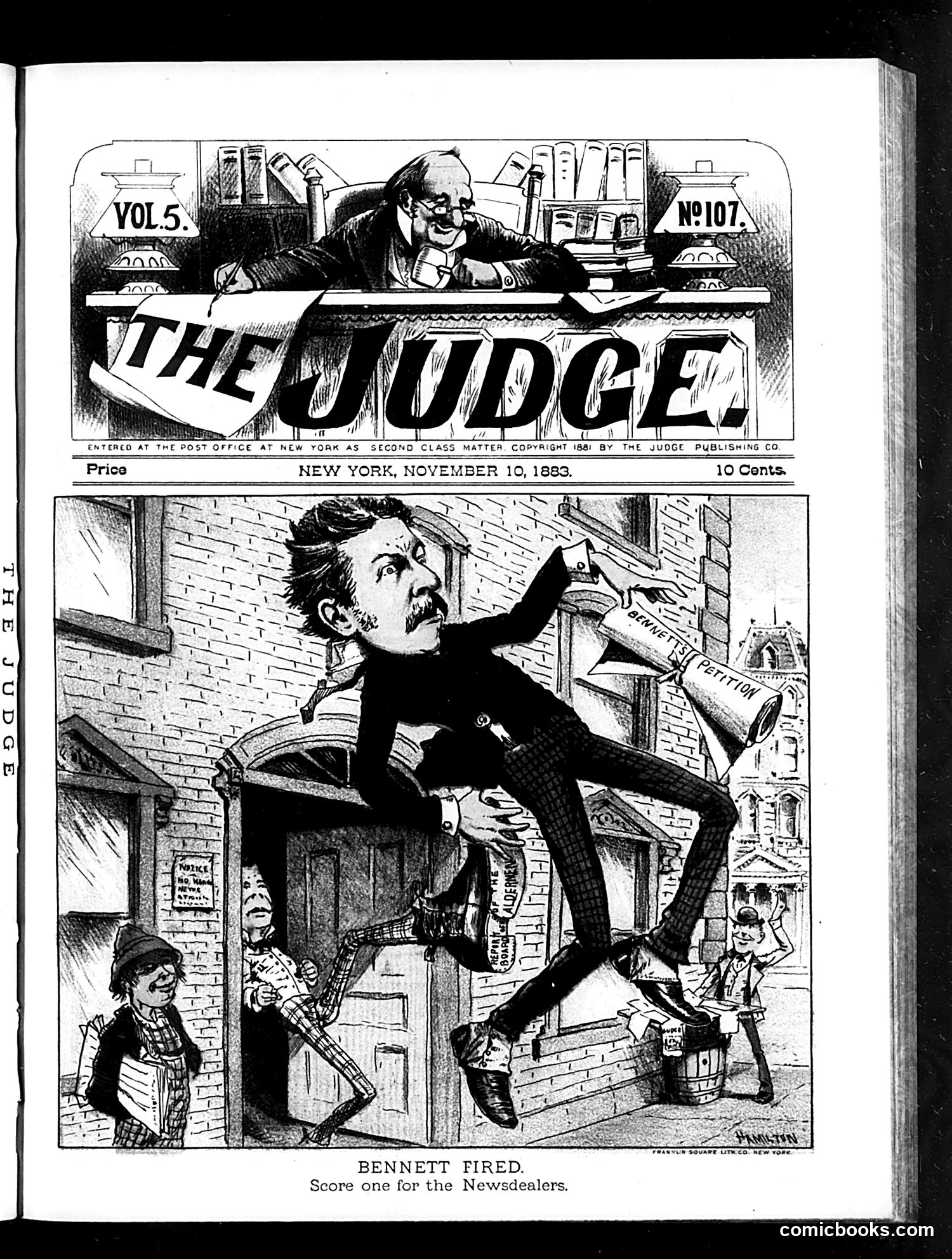
This cartoon satirizes **Bennett Fired** — likely referring to James Gordon Bennett Jr., publisher of the *New York Herald*. The caption "Score one for the Newsdealer" suggests Bennett's dismissal benefited newspaper vendors or competitors. The main illustration shows a caricatured man in exaggerated contortions being literally kicked out of a building by newsboys or street vendors. The figure's wild posture and the violent action parody Bennett's apparent fall from power or influence. The satire appears to celebrate Bennett's downfall among the working-class newspaper distribution community, suggesting he was unpopular with or had mistreated newsboys and dealers. The graphic exaggeration was typical of *Judge's* aggressive political cartooning style.
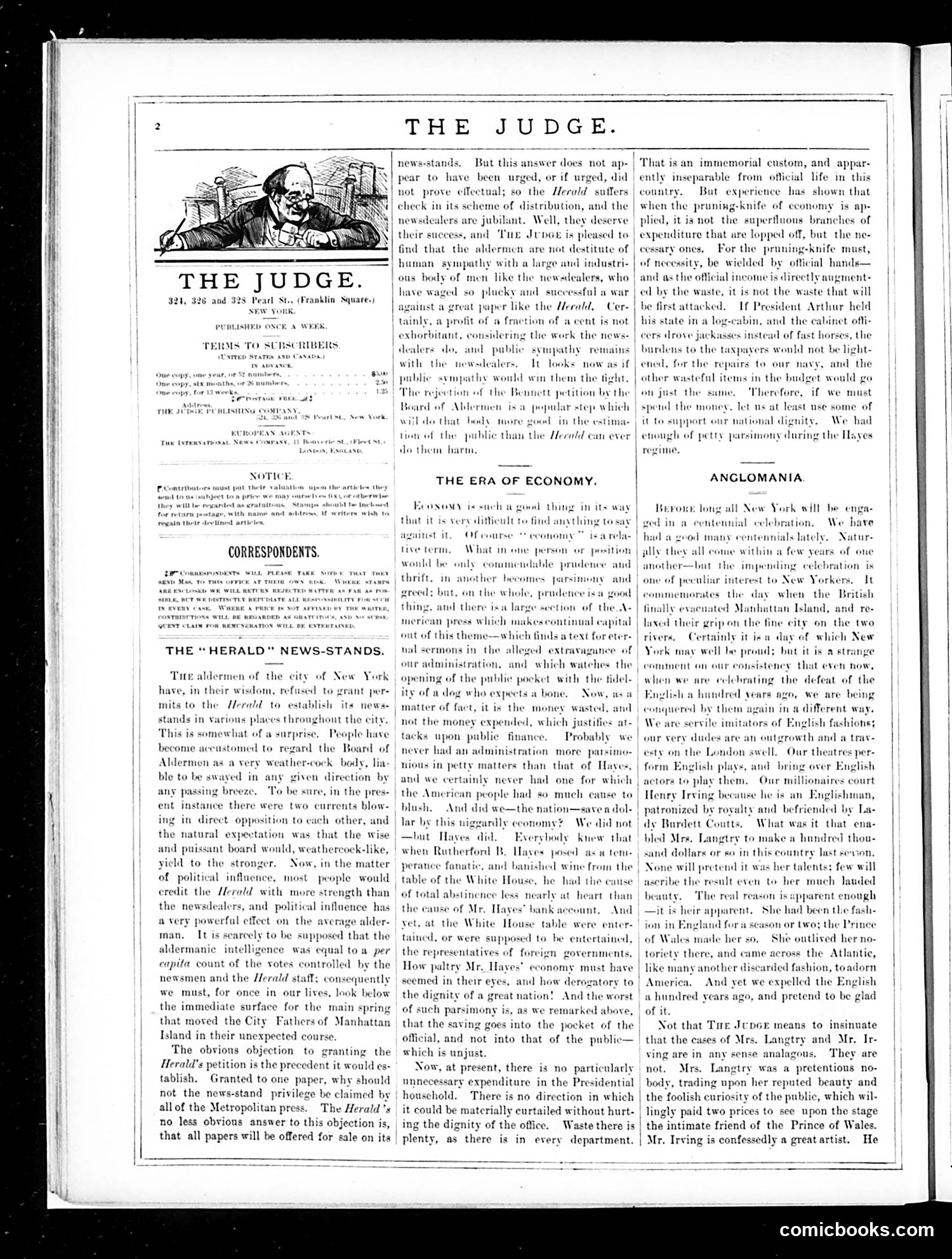
The cartoon depicts a dispute between New York's Board of Aldermen and the *Herald* newspaper over establishing news-stands throughout the city. The Aldermen refused permits, which *Judge* satirizes as hypocritical—they claim to oppose precedent-setting, yet the real reason appears to be political pressure from news-dealers threatened by competition. *Judge* mocks the Aldermen as weathervanes, easily swayed by influence. The magazine defends the *Herald's* petition while grudgingly acknowledging public sympathy favors the news-dealers. The underlying criticism targets corrupt municipal government: aldermen prioritize political pressure over logical governance, claiming principle while serving special interests. This reflects broader Progressive-era concerns about urban political machines. The second article satirizes government "economy" measures, contrasting President Hayes's publicized temperance with his actual financial dealings—another jab at hypocrisy masquerading as virtue.
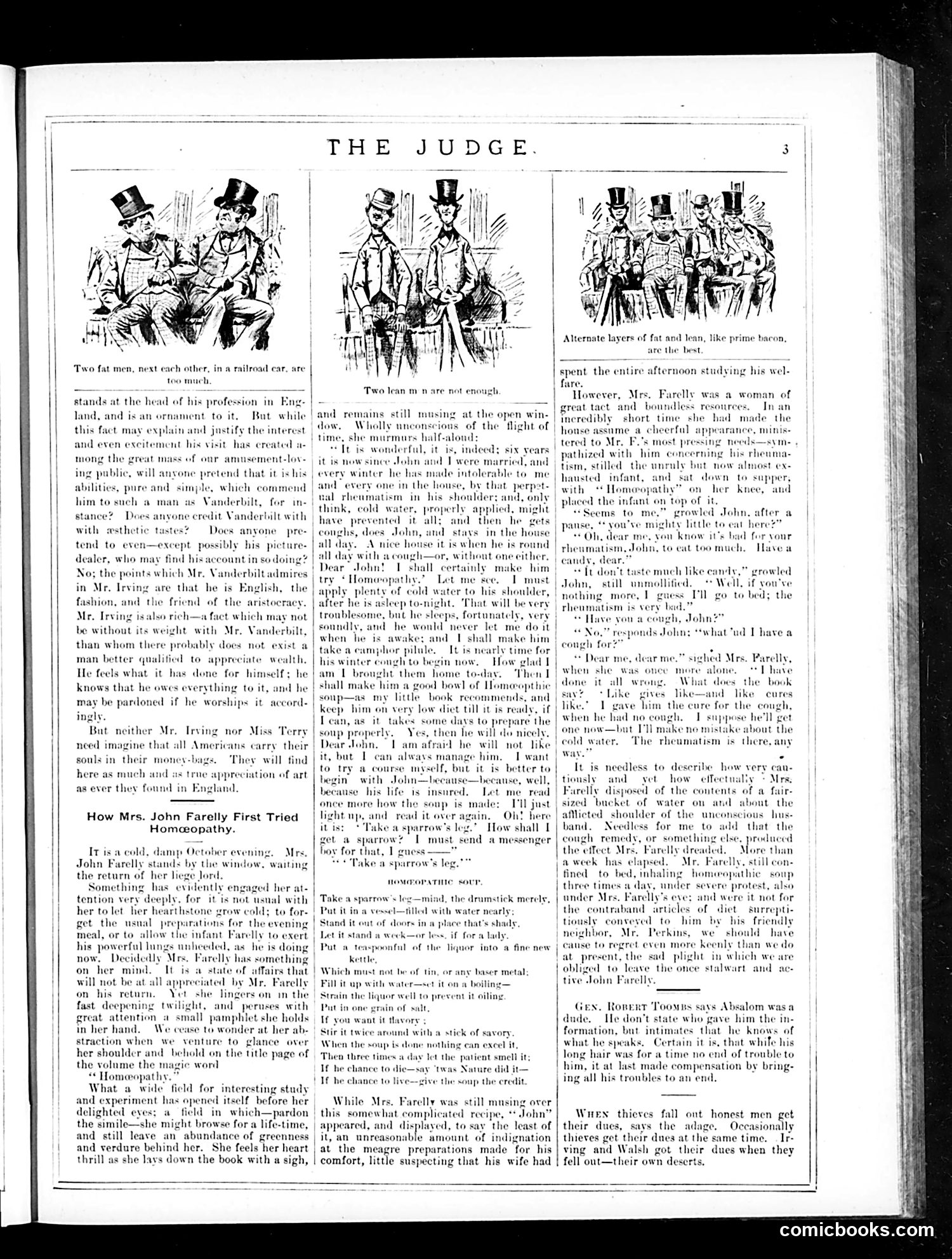
This page contains two satirical pieces mocking contemporary American trends: **"Two Fat Men" cartoon (top left):** Depicts wealthy American businessmen traveling by rail. The text suggests this mocks the ostentatious leisure habits of the wealthy class, likely referencing a specific notable figure's travels—possibly related to Mr. Irving or Vanderbilt mentioned in the adjacent text. **"How Mrs. John Farelly First Tried Homeopathy":** The primary piece satirizes the homeopathy craze sweeping America in the late 19th century. Mrs. Farelly, inspired by a homeopathy pamphlet, attempts to "cure" her husband's chronic rheumatism using absurd homeopathic remedies, including a comically complex "sparrow soup" recipe. The satire mocks both homeopathy's pseudoscientific claims and women's gullibility toward medical fads. The joke hinges on the ridiculousness of the treatment—boiling a sparrow's drumstick outdoors for a week—while expecting actual results. This reflects contemporary skepticism toward alternative medicine practices gaining popularity among the middle class.
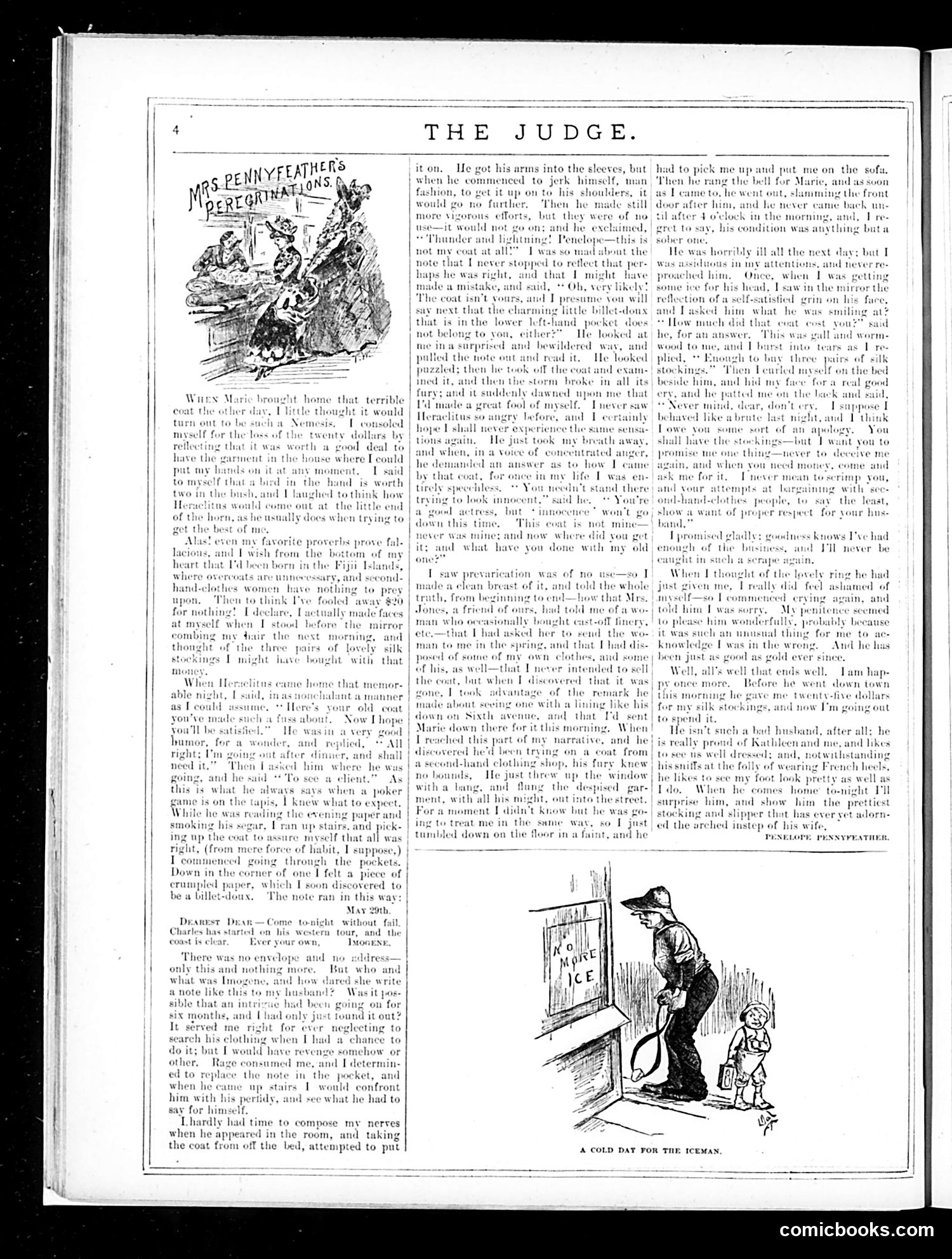
This page contains a domestic humor story by "Penelope Pennyfeather" (a pseudonymous female writer) alongside a cartoon titled "A Cold Day for the Iceman." **The Cartoon:** A man (the iceman, identifiable by his profession delivering ice blocks) stands at a doorway in winter, holding a small child's hand. The joke appears to play on the double meaning of "cold day"—both the literal winter weather and the social awkwardness or rejection he's experiencing. The iceman was a common working-class figure in early 20th-century urban America, making this a relatable subject for satirical humor about class and social encounters. **The Story:** A lengthy confessional narrative about marital conflict, where the narrator initially discovers her husband's mysterious coat, suspects infidelity, confronts him emotionally, then reconciles. It's domestic satire targeting middle-class married life anxieties. Both pieces reflect Judge's focus on American domestic comedy and class observation humor typical of the era.
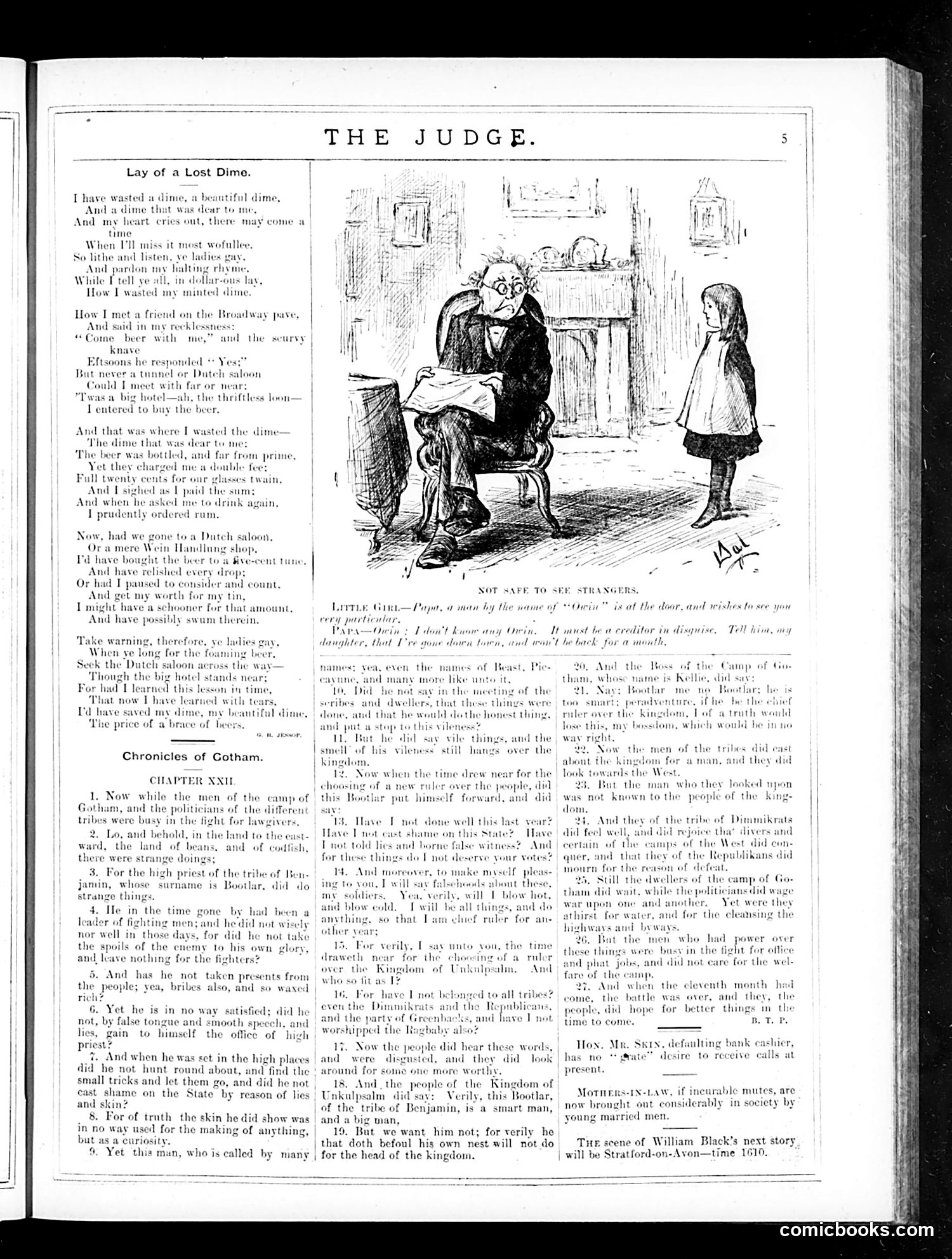
This page contains two distinct pieces of political satire: ## "Lay of a Lost Dime" A humorous poem mocking wasteful spending, particularly on alcohol. The narrator laments squandering a dime on beer at a tavern instead of saving it. The satirical point criticizes poor financial judgment and indulgence—a common morality-tale theme in 19th-century American humor. ## "Chronicles of Gotham" The main satire uses biblical language ("And lo," "verily") to describe corrupt political leadership in what appears to be New York City ("Gotham"). The unnamed leader figure (appearing corrupt and scheming in the accompanying sketch) is criticized for: - Taking bribes and presents - Covering up wrongdoing - Embezzling ("skin" likely refers to graft) - Creating disorder among the people The satire demands his removal despite his self-promotion, suggesting he's an actual political figure readers would recognize. The specific identity remains unclear without additional historical context, but the piece targets urban machine politics and official corruption—Judge's recurring themes.
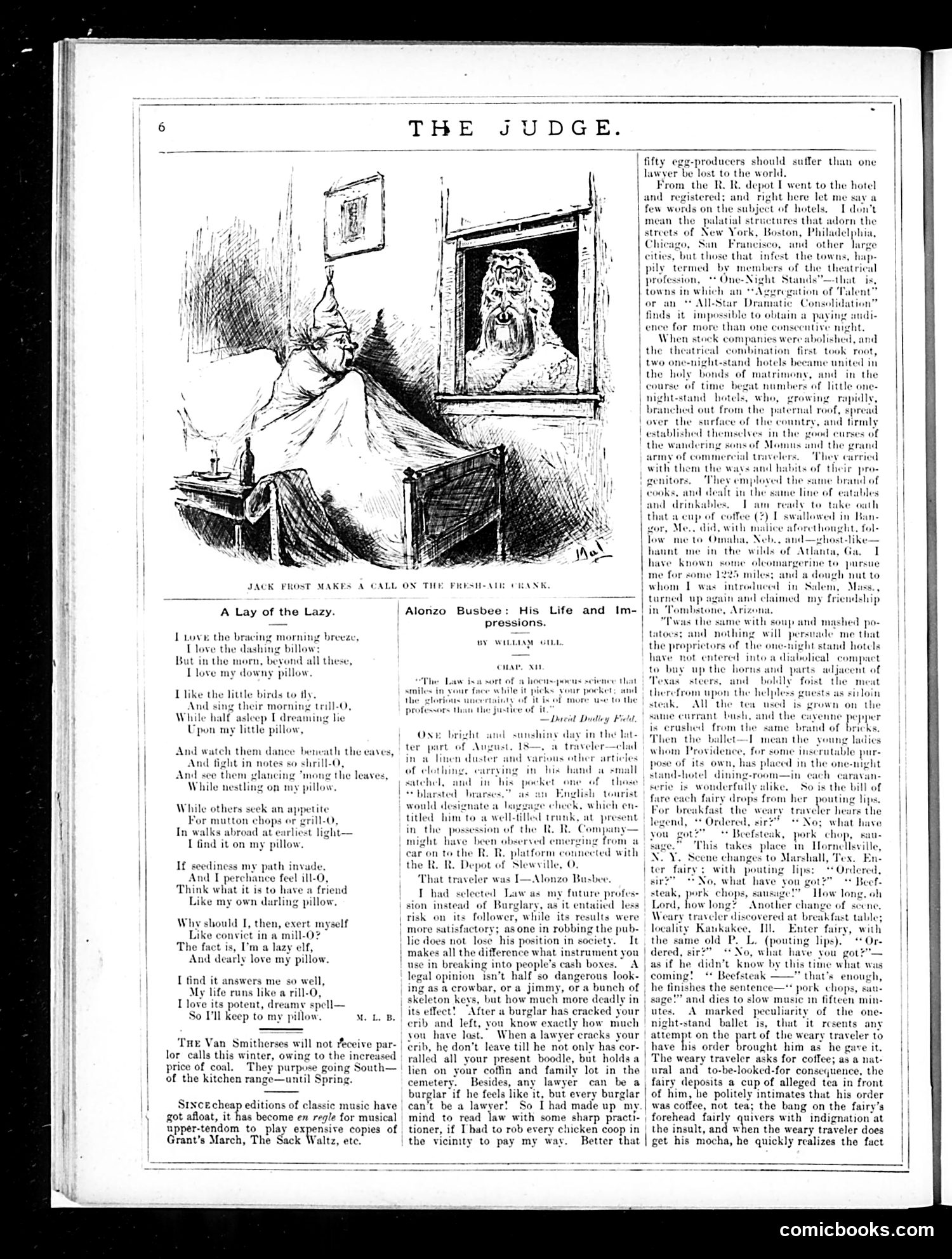
This page contains **two distinct pieces of satire** from what appears to be a late 19th-century issue: **"Jack Frost Makes a Call on the Fresh-Air Crank"** (cartoon): The illustration depicts a lazy person in bed while Jack Frost (personified winter) visits through the window. It satirizes those who romanticize "fresh air" while refusing to leave their comfortable pillows—mocking the contemporary health fad of fresh-air advocacy among the wealthy. **"Alonzo Busbee: His Life and Impressions"** (article): This piece uses dark humor to compare a lawyer to a burglar, arguing that lawyers are simply legal burglars who steal more effectively and with greater social acceptance. The satire attacks lawyers' predatory practices—their ability to seize not just current wealth but future assets ("holds a lien on your coffin"). The page also includes satirical social notices mocking upper-class affectations, like the Van Smitherses' southern flight to avoid heating costs. **Overall theme**: Judge targets both health-fad hypocrites and corrupt legal professionals—common targets of Gilded Age satire.
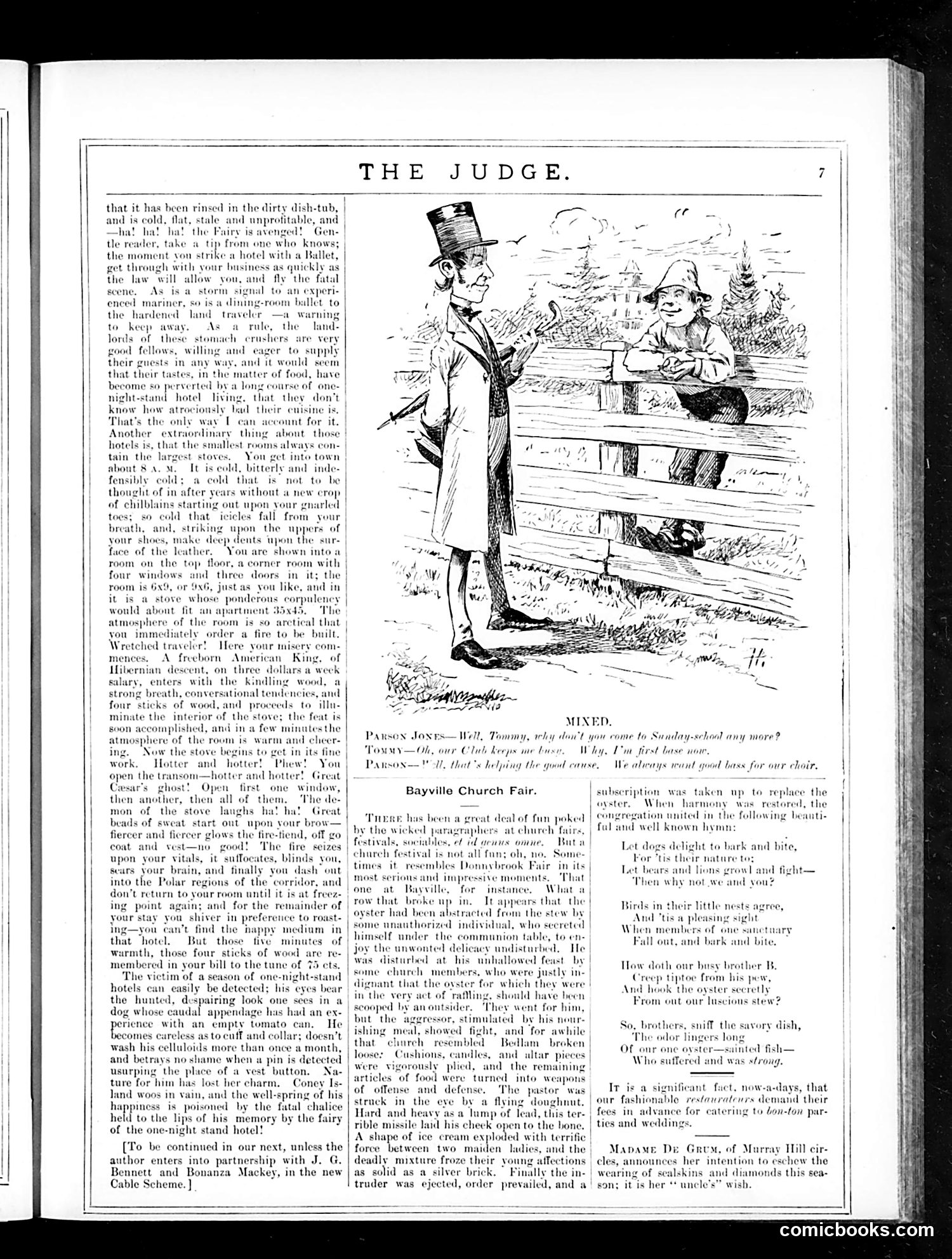
## Main Cartoon: "Mixed" The illustrated scene shows a well-dressed gentleman (identified as Parson Jones in the dialogue) encountering a boy (Tommy). The brief exchange mocks Tommy's excuse for not attending Sunday school—claiming "our Clift keeps me busy"—a transparent fabrication likely referencing some local character or obligation. The satire targets children's transparent lies and parental negligence. ## Secondary Article: "Bayville Church Fair" This piece humorously describes chaos at a church fundraising festival. The centerpiece joke involves an oyster disappearing from a communal stew, sparking a physical altercation among church members supposedly dedicated to charity and propriety. The satire ridicules the hypocrisy of supposedly pious people abandoning Christian charity over a missing oyster—turning a church fair into a Donnybrook (a reference to rowdy brawling). The humor lies in exposing how easily respectable institutions and their members abandon their stated values when self-interest is threatened. It's gentle social satire typical of Judge's approach to American institutions.
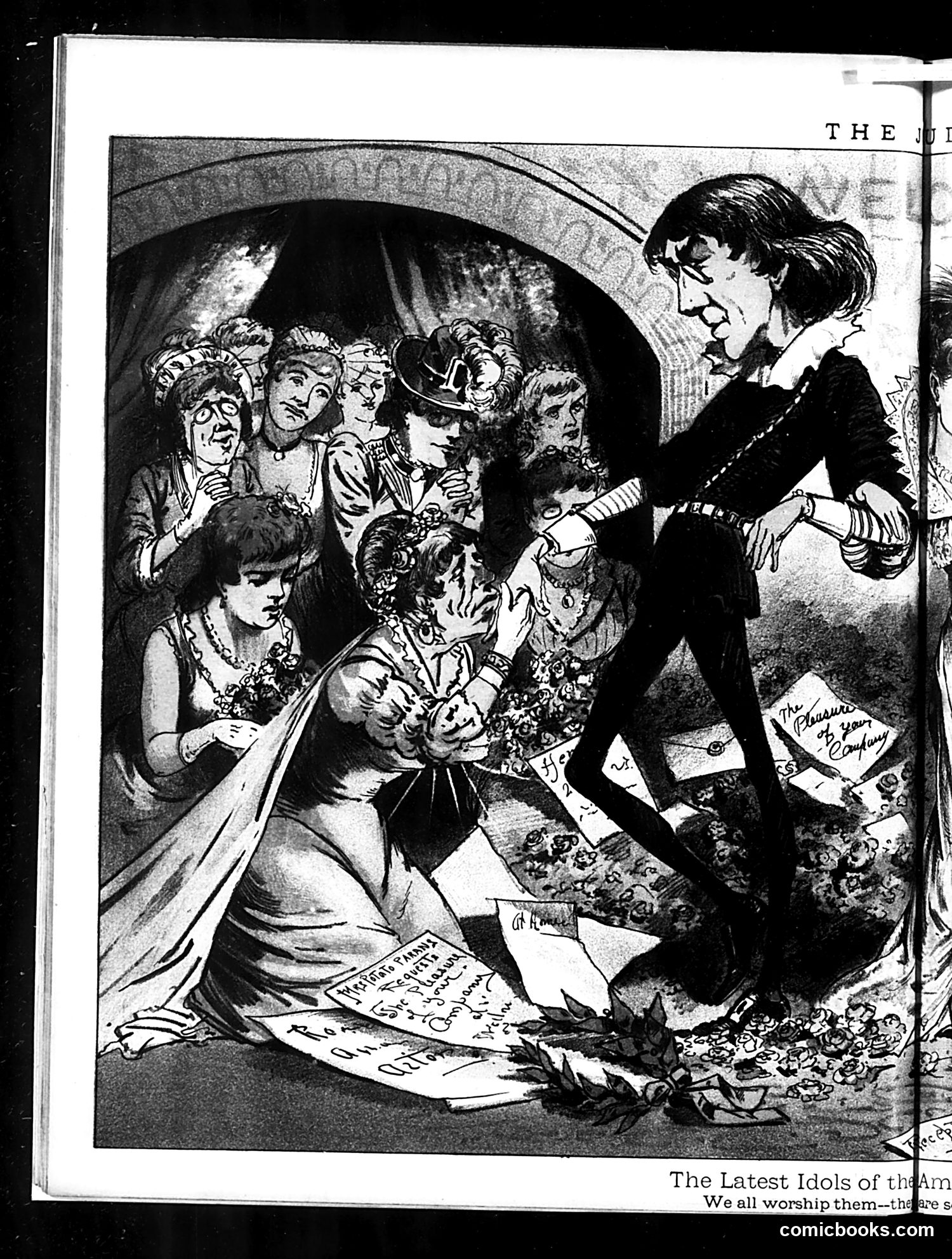
This appears to be a satirical cartoon from *Judge* magazine critiquing celebrity worship and popular culture idolatry. The illustration shows a group of women gathered around what appears to be a shrine or altar, worshipping figures on display. A well-dressed woman on the right gestures toward them, seemingly endorsing or commenting on this behavior. The caption "The Latest Idols of the Am[erica]" with "We all worship them" suggests the cartoon mocks Americans' obsessive devotion to entertainment celebrities—treating them like religious idols. The gathered women likely represent different social classes or demographics, implying this celebrity worship was widespread across society. The exact identities of the displayed figures are unclear from the image, but the satire critiques the superficiality of American celebrity culture and the quasi-religious fervor with which the public pursued entertainment personalities. This reflects early 20th-century anxieties about modern mass culture's influence on society.
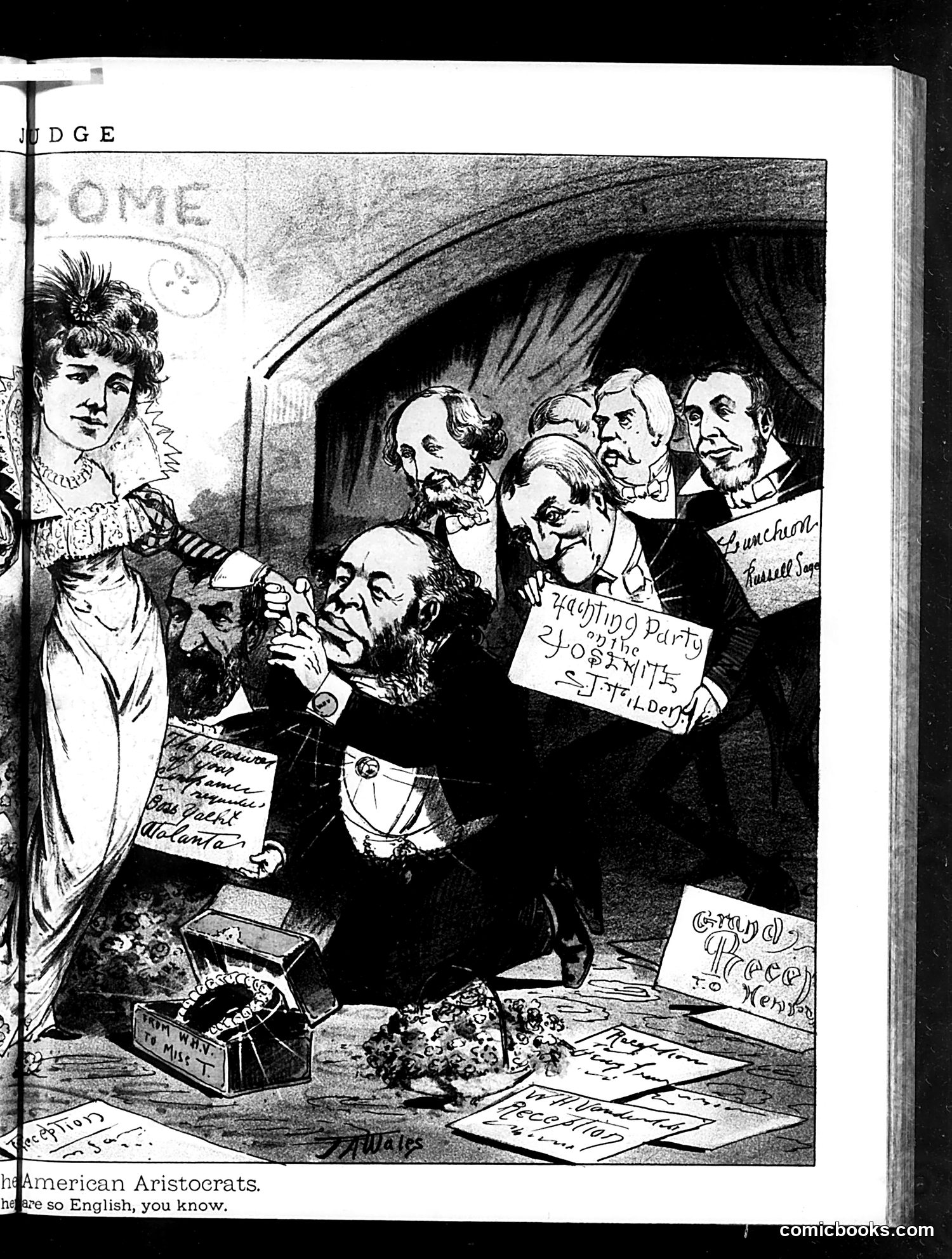
This political cartoon satirizes wealthy American aristocrats, as indicated by the caption "American Aristocrats. They are so English, you know." The image depicts a group of caricatured men gathered around what appears to be a social gathering or party. Several hold papers with labels visible in the scene, including references to "Luncheon," "Russell Sage," and "Grinding Party at the Knickerbocker." The figures display exaggerated facial features typical of period satirical art. The satire targets American elites who affect European (specifically English) mannerisms and culture while engaged in social schemes. The scattered papers and gathering suggest commentary on the dealings, business practices, or social maneuvering of wealthy American families during the Gilded Age. The cartoon criticizes these figures for their pretentiousness and their distance from ordinary American life.
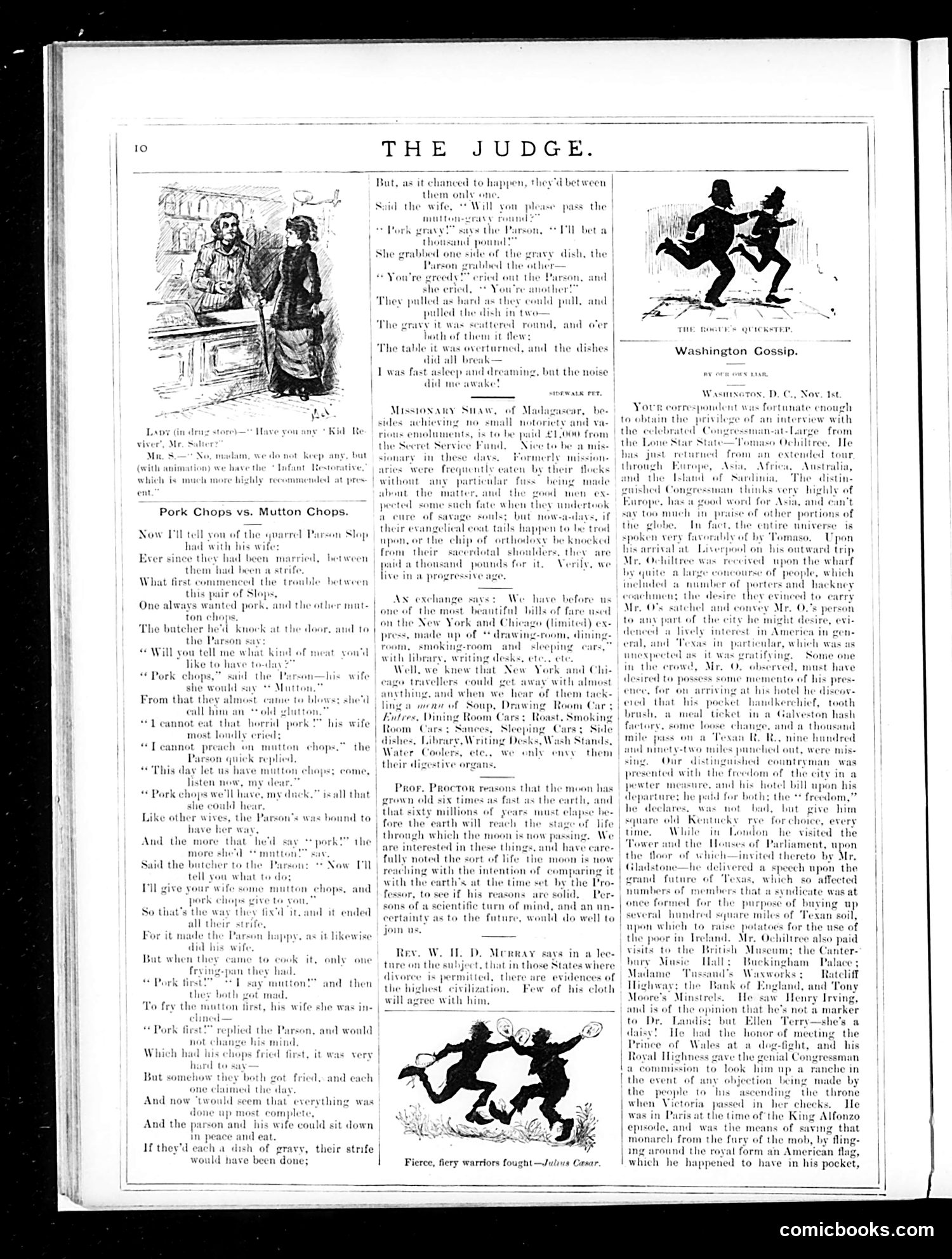
This page contains satirical commentary on American political and social life. The central cartoon, "The Rogers Quickstep," depicts two figures in a comedic chase, likely referencing a popular scandal or public figure named Rogers. The main text features "Pork Chops vs. Mutton Chops," a humorous domestic dispute between a parson and his wife that escalates into physical comedy—a common satirical device of the era. The story ridicules marital discord through exaggerated slapstick. The "Washington Gossip" column reports on Congressman O'Shiltrée's European tour, sarcastically noting his acquisition of trivial souvenirs and his reception of honors abroad. The satire mocks what appears to be a minor politician's self-importance during international travel. The final item references "Prof. Proctor" discussing lunar science—likely satirizing pseudo-scientific speculation popular in the period. Overall, the page combines domestic humor with political mockery, targeting both private human folly and public figures' pretensions. The specific identities of some individuals remain unclear without additional historical context.
This page contains multiple pieces satirizing American social life and manners. The main feature "Woman's Weapon" depicts an encounter between a woman and a police officer. The joke hinges on a woman arrested for drunk driving claiming she's actually "Mrs. A. M. Farley"—suggesting her real offense was talking excessively. The officer remarks that talking is the only offense women seem to have committed, delivering the satirical punchline that women's tongues are a "weapon" more dangerous than any man's strength. The "Masked" poem above describes a romantic dance-floor encounter where a man cannot identify his masked partner—revealed to be his sister, a common Victorian literary trope playing on themes of hidden identity and surprise. The scattered anecdotes reference "Tom Ochiltree," an apparent contemporary figure of ridicule known for linguistic incompetence and awkward diplomatic encounters abroad, used here as a vehicle for mocking American pretension and cultural ignorance internationally. The satire targets gender relations, social pretension, and American behavior abroad.
This page from *Judge* contains theater news and a satirical advice column rather than political cartoons. The main content includes: **Theater Coverage**: Gossip about popular performers like Fanny Davenport, Kate Claxton, and Annie Pixley, discussing their current productions at New York theaters (Metropolitan Opera House, Casino, Grand Opera House, etc.). The tone is lighthearted and somewhat mocking of theatrical pretension. **Central Joke/Anecdote**: A humorous story about Mr. Lardkine, a wealthy pork merchant, attempting to buy his wife a decorative order/medal as a birthday gift. When told the Garter (Order of the Garter) would suit her, his wife demands it because Queen Victoria wears one—the joke being her materially-driven vanity and one-upmanship. **Advice Column**: "Answers to Correspondents" mocks various reader questions with sardonic responses about romantic matters and social climbing. **Social Satire**: The piece satirizes American materialism, particularly wealthy nouveau-riche merchants and women's social ambitions, a common *Judge* theme of the era.
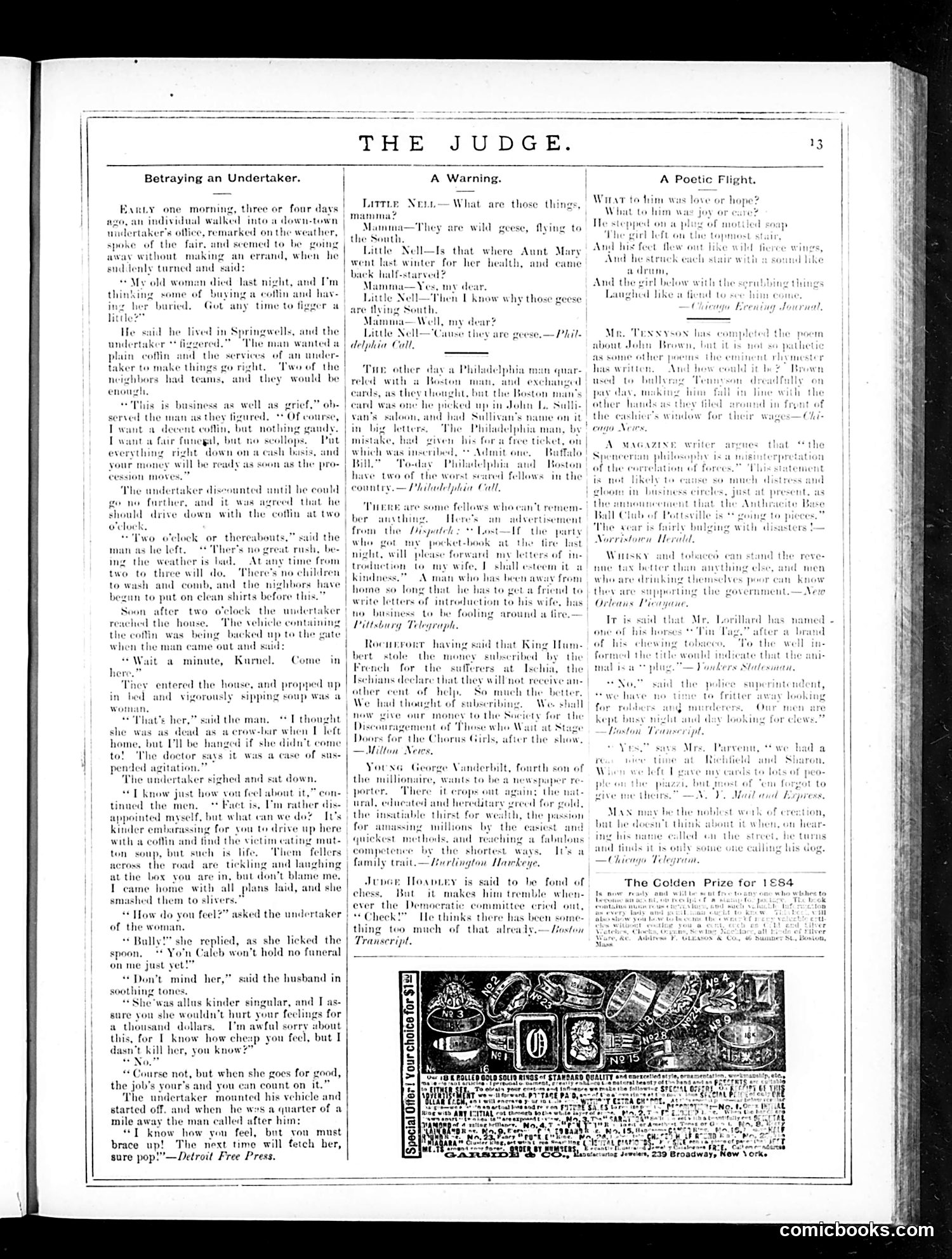
This page from *Judge* contains three humorous anecdotal pieces rather than political cartoons. **"Betraying an Undertaker"** (main story): A widow dies and her husband arranges a funeral with an undertaker. When the undertaker arrives with the coffin, he discovers the woman alive and eating mutton soup—a case of premature reports of her death. The satire mocks both the embarrassed undertaker and the husband's casual attitude toward the near-funeral, treating death preparations as comedy. **"A Warning"** (brief dialogue): A child asks why geese fly south; the mother explains they seek warmth. The child concludes Aunt Mary did likewise for health reasons—suggesting people who travel south for health are like migrating birds, satirizing fashionable health tourism. **"A Poetic Flight"** (brief poem): Simple romantic verse about a girl on a train. The bottom features an advertisement for "The Golden Prize for 1884." These pieces represent *Judge*'s typical humor: domestic situations, social observation, and gentle mockery of contemporary life rather than hard-hitting political satire.
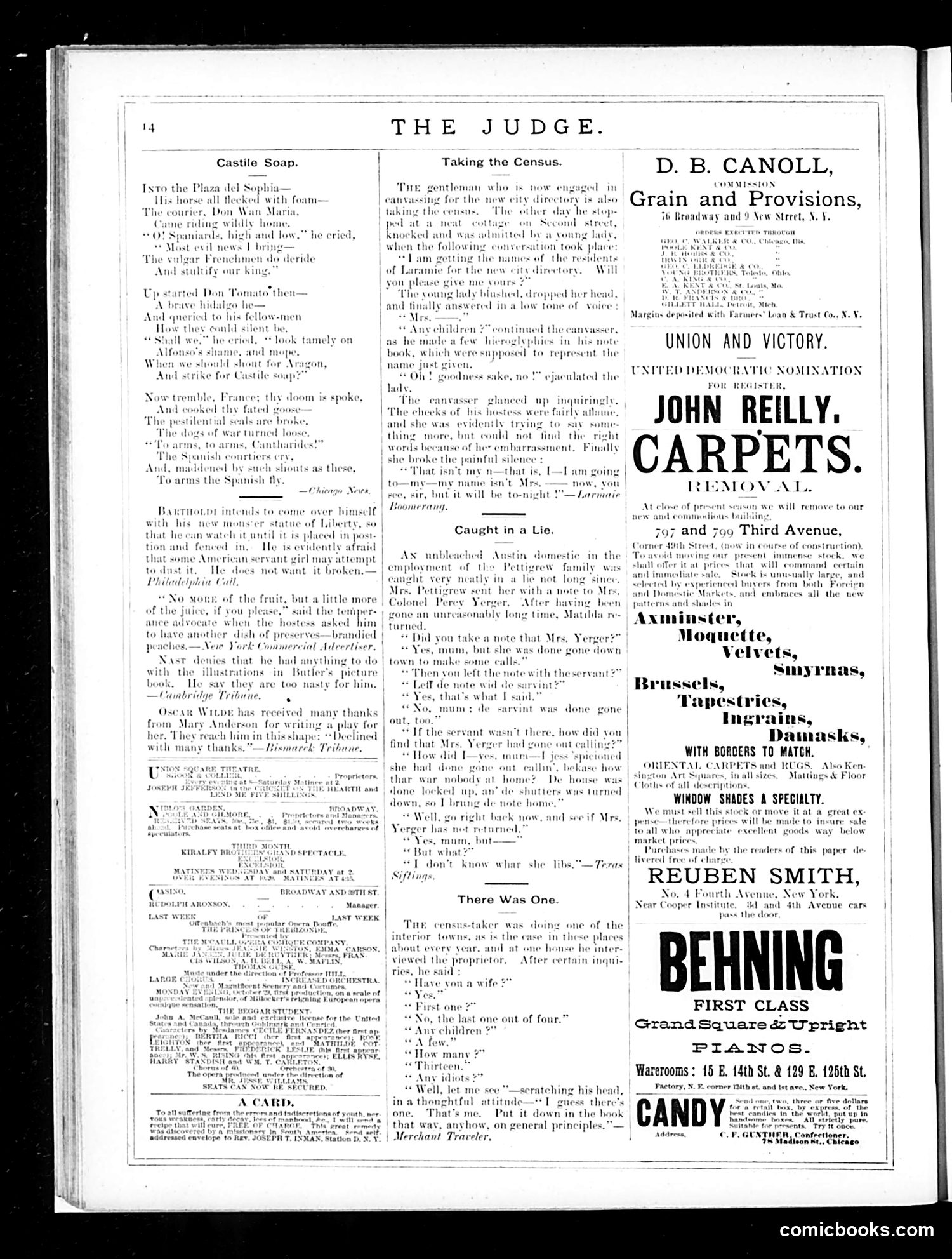
This page from *Judge* (a satirical weekly) combines three humorous short stories with period advertisements. The cartoons illustrate common social embarrassments: **"Castile Soap"** and related pieces satirize pretension—a vain Spanish gentleman on a foaming horse, French affectations, and social climbers. **"Taking the Census"** mocks the awkwardness of census-takers intruding into private lives, particularly depicting a young woman caught in a lie about her marital status to a census enumerator—she nervously corrects herself mid-answer, implying she's about to be married. **"Caught in a Lie"** shows a servant caught in contradictions about delivering a note, exposing domestic dishonesty. **"There Was One"** depicts a census-taker interviewing a man about children—the punchline involves the man's sarcastic response about "general principles," mocking census questions as intrusive. The satire reflects 1880s anxieties about government census authority, domestic privacy, and social pretense. The advertisements for carpets, pianos, and provisions occupy the right column.
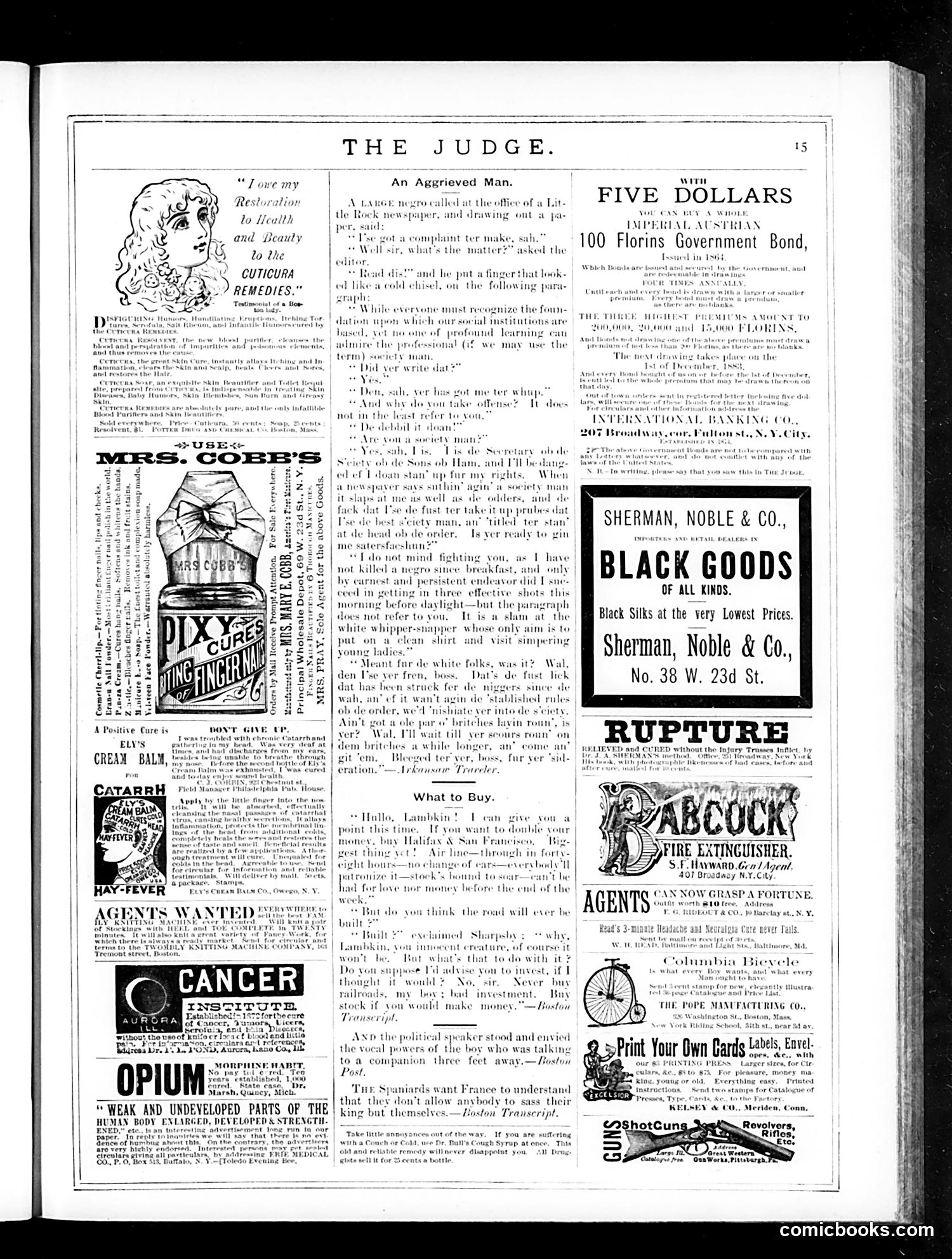
This page from the satirical magazine *Judge* is primarily **advertising with one short satirical piece**. The main cartoon/text, "An Aggrieved Man," depicts a Black man complaining to a newspaper editor about a negative article written about him. The man claims he "didn't kill a negro since breakfast" and shot only in self-defense, sarcastically insisting he's a "society man" deserving respect. The satire mocks both the man's absurd self-justification and the editor's indifference to violence against Black people. The piece reflects late 19th-century racial attitudes in *Judge*—the dialect and characterization are deeply stereotypical by modern standards. The satire appears to target either the absurdity of the man's claims or editorial negligence, but the heavy reliance on racist caricature makes the actual satirical target unclear to modern readers. The remainder of the page consists of period advertisements for various products (patent medicines, fabric, fire extinguishers, bicycles), typical of magazine revenue in that era.
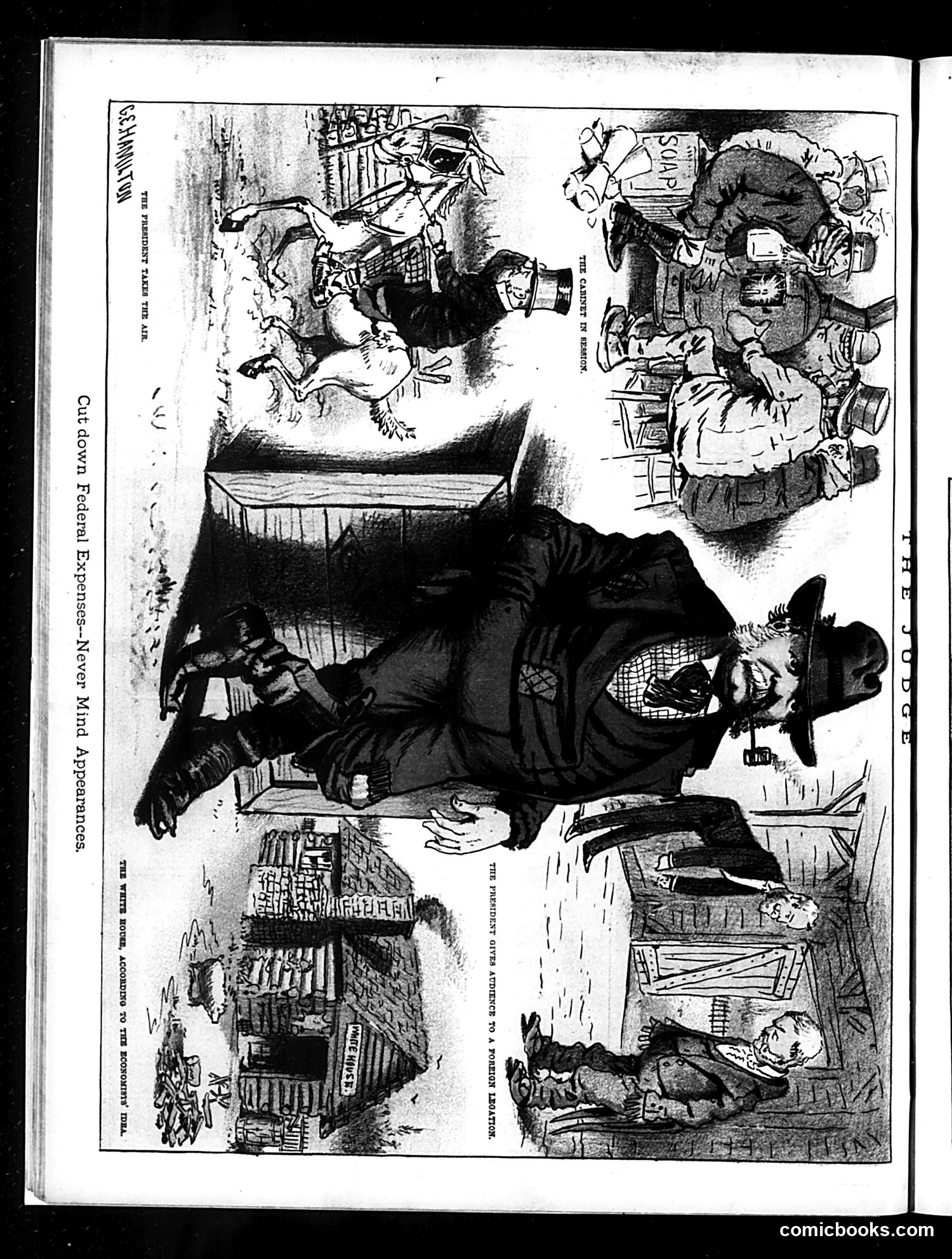
This political cartoon satirizes pressure on the President to reduce federal spending while maintaining the dignity of his office. The top panel shows "The President Takes the Air"—depicting him in an undignified position. The bottom panel contrasts this with "The White House, According to the Economists' Idea," showing a shabby, dilapidated building. The satire's point: budget-cutting advocates want the President to economize so drastically that he'd lose all presidential prestige and the office itself would become a disgrace. The cartoon mocks the impracticality of severe federal cost-cutting, suggesting that cutting "never mind appearances" would actually damage the institution beyond repair. This likely responds to specific 1920s-1930s fiscal debates about government spending during economic crisis.